
Marfa Lights
Since a cowhand named Robert Reed Ellison first recorded seeing a "flickering light" while driving cattle through Paisano Pass in 1883 — decades before automobiles existed in the region — observers near Marfa, Texas have reported unexplained lights over the Chihuahuan Desert floor. Two 21st-century instrumented field studies, by the University of Texas at Dallas (2004) and Texas State University (2008), concluded that most lights visible today from the official viewing platform correlate with distant vehicle headlights on U.S. Highway 67. But career Marfa-native investigator James Bunnell, whose eight-year (2001–2009) instrumented study is the only long-term scientific project focused specifically on the phenomenon, maintains that roughly 3% of the light events his cameras captured remain genuinely unaccounted for — and neither study explains what Ellison and his 19th-century neighbors saw before the highway, or the automobile, existed.
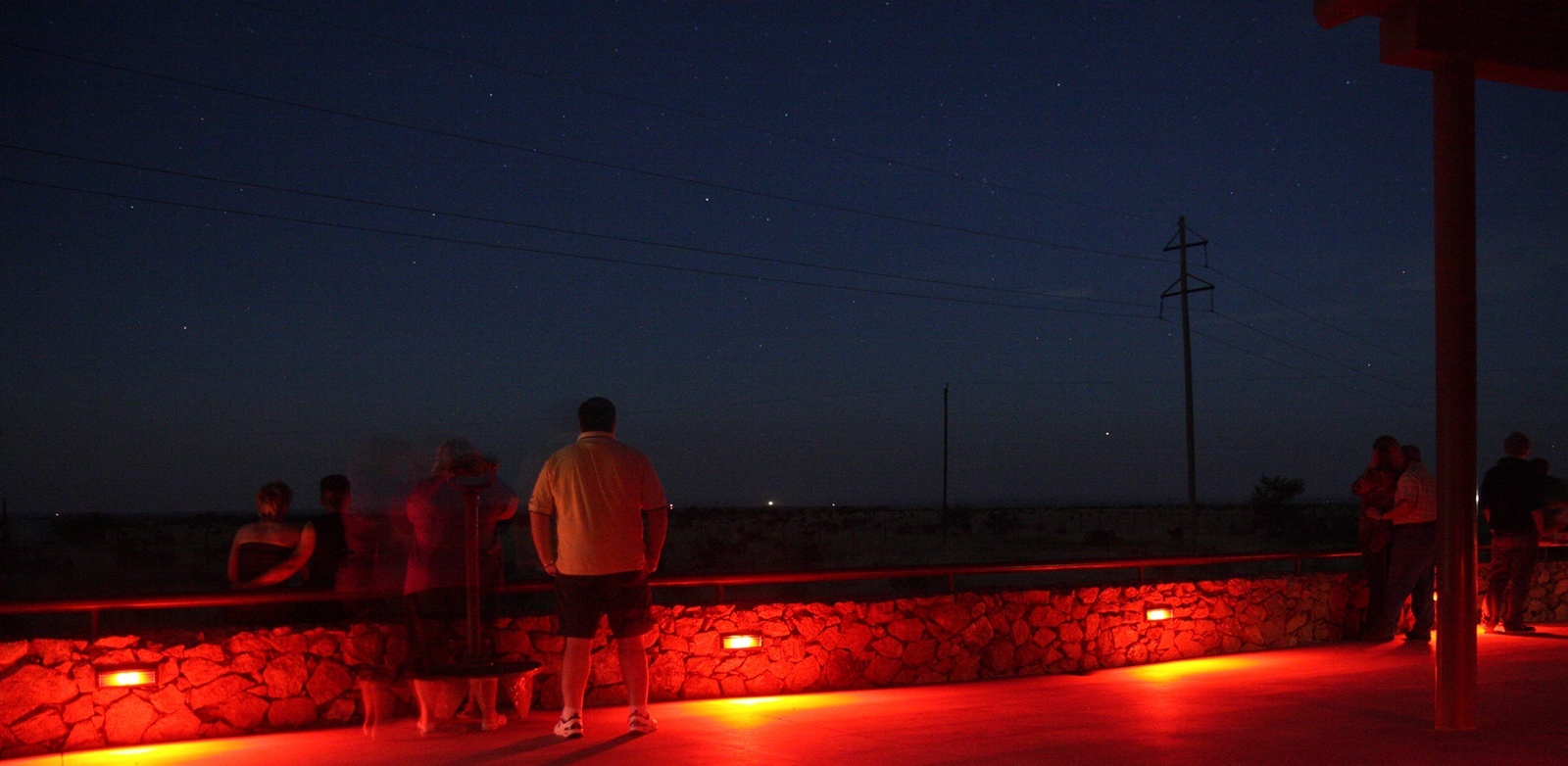
Pictured: The Marfa Mystery Lights, taken from the official viewing platform east of Marfa, Texas, May 9, 2009. Photo by Jon Hanson, Wikimedia Commons (CC BY 2.0).
Theoretical Alignment
No instrumented study of the Marfa Lights — UT Dallas (2004), Texas State University (2008), or Bunnell's own long-running investigation (2001–2009) — has proposed an extraterrestrial or interdimensional mechanism. This file weights Psycho-Social/Mundane highest because the two university studies both link the great majority of modern sightings to a specific, identifiable conventional source (distant vehicle headlights on US 67), while assigning meaningful residual weight to genuine dispute because the case's most dedicated individual investigator, working from the largest instrumented dataset ever assembled for this phenomenon, argues a small but real percentage of events resist that explanation, and because the phenomenon's own origin story predates the automobile. It is worth noting explicitly that even Bunnell's own residual-anomaly cases are described in terms of a stationary or slow-moving point of light behaving in a way that resists a specific conventional explanation, not in terms of any of the high-performance kinematic behaviors that define genuinely high-strangeness cases elsewhere in this archive — a distinction that matters for calibrating how extraordinary the case's residual mystery actually is.
Background
Marfa is a small city in Presidio County in the Big Bend region of far West Texas. The lights associated with the town are most often reported over the Chihuahuan Desert floor southeast of Paisano Pass, viewed from what is now an official Texas Department of Transportation rest area and viewing platform on U.S. Highway 90, roughly nine miles east of town, looking toward the Chinati Mountains. Regional Apache oral tradition reportedly described unexplained lights in the area before any written record exists, though this file, consistent with this archive's sourcing standard, treats undated oral accounts as important cultural context rather than independently verifiable historical fact.
The desert flat most closely associated with the phenomenon, often referred to by researchers as Mitchell Flat, sits beneath the Chinati Mountains, the eroded remnant of a large volcanic caldera complex whose rock is unusually rich in quartz-bearing igneous formations. The wider Big Bend region is also cut by numerous faults associated with the Basin and Range geologic province. On its own, this establishes only that the region's underlying geology is unusual, not that it explains any specific sighting, but the detail later became relevant to one of the case's more speculative scientific hypotheses, discussed further below. The Chihuahuan Desert itself is the largest desert in North America by area, and the stretch of it surrounding Marfa is sparsely populated and largely free of artificial light sources beyond the highway itself — a combination of darkness and flat, open sightlines that several investigators have cited as a significant contributing factor in why ordinary distant lights are so conspicuous and easy to fixate on in the first place, independent of whatever ultimately causes any individual light.
The earliest solid written record is the 1883 account of Robert Reed Ellison, a young cowhand who saw a flickering light while driving cattle through Paisano Pass and initially suspected an Apache campfire; when he and others investigated, they found no fire, no ashes, and no evidence anyone had camped there. Ellison later learned from local settlers that the lights were already a known, unexplained fixture of the area. Joe and Sally Humphreys, early settlers in the region, reported their own sighting in 1885. What makes this origin point significant to the case's evidentiary assessment is timing: 1883 predates the widespread arrival of the automobile in the United States by roughly two decades, and predates the construction of U.S. Highway 67 — the road whose traffic 21st-century studies link to most modern sightings — by more than 40 years. Some historians have noted, with mild caution, that Ellison's account, like much of the case's earliest history, entered the written record through later recollection and local tradition rather than a contemporary 1883 newspaper report, and the precise date has occasionally been treated as approximate for that reason. Even allowing for that caveat, no serious investigation of the case disputes that reports of the lights were already circulating among Presidio County ranching families in the final two decades of the nineteenth century, well before either the automobile or U.S. Highway 67 existed in the region.
One of the more evocative accounts collected from that early period comes from Mrs. W. T. Giddings, who grew up in the area watching the lights and whose father, according to the Texas State Historical Association's Handbook of Texas entry on the case, credited the lights with saving him during a blizzard by leading him to the shelter of a cave. Giddings and other long-time local observers who lived with the phenomenon for decades were, by multiple accounts, inclined to personify the lights rather than fear them; Giddings herself reportedly described them as curious observers, investigating the people and things around them — a folk framing that persists in how some Marfa residents talk about the lights today, even as the scientific literature has moved toward conventional physical explanations for most of what is seen. This account, like much of the case's pre-1950s record, is preserved mainly through the Handbook of Texas entry compiled by historian Julia Cauble Smith, first published in 1995 and updated in 2017, which remains one of the more careful efforts to separate documented local testimony from later embellishment.
By the mid-twentieth century, decades before either university study or the modern viewing platform existed, the lights had already become enough of a regional curiosity that visitors from outside Presidio County were making informal trips to the Paisano Pass area specifically hoping to see them, guided mostly by word of mouth and the kind of local folklore later recorded by Miles. That informal, self-organized tourism — well before any institution built a dedicated place to accommodate it — is part of why the Chamber of Commerce ultimately moved to formalize a roadside viewing area in the 1980s: the demand from outside visitors already existed, and the town responded to it rather than manufacturing it from nothing.
The 1919 search remains one of the case's more concrete early data points precisely because it was a deliberate, physical investigation rather than a passive sighting: cowboys already working cattle on the prairies rode over the mountains that summer specifically to locate the source of lights they had been noticing for years, and came back empty-handed, finding no fire, no structure, and no one camped in the area. The two world wars added a recurring undercurrent of official concern rather than casual curiosity. During World War I, some border-area observers worried the lights might be used to signal an infiltration or invasion from across the nearby U.S.-Mexico border; during World War II, pilots training at the nearby Midland Army Air Field are reported to have taken to the air specifically to try to spot the source of the lights from altitude, again without success. Neither military-adjacent effort produced a named source or a surviving technical report, and both are documented today mainly through the same regional folklore and local-history compilations that preserve the rest of the case's pre-1957 record — but the fact that trained observers on the ground and in the air twice found the phenomenon worth investigating during two different wars is itself a data point about how persistently strange the lights appeared at the time.
The case broke out of purely regional awareness in July 1957, when Coronet magazine, then a widely circulated general-interest monthly, published "The Mystery of the Texas Ghost Light," introducing the phenomenon to a national audience for the first time. The timing overlapped with a separate but related boost to Marfa's visibility: in the summer of 1955, production of the George Stevens film Giant, starring Elizabeth Taylor, Rock Hudson, and James Dean, relocated to a working ranch outside Marfa for extended location filming, drawing national press attention to the town itself even though the film had nothing to do with the lights. Two decades later, in 1976, Sul Ross State University folklorist Elton Miles gave the case its first serious academic-adjacent treatment, compiling nineteenth-century Big Bend accounts — including a rancher's photograph of the lights — into his book Tales of the Big Bend, published by Texas A&M University Press. Miles's work remains one of the only attempts to systematically collect and date the region's earliest oral and photographic record before living memory of it faded further.
Complete Timeline
| Date | Event |
|---|---|
| 1883 | Cowhand Robert Reed Ellison records the earliest solid written sighting while driving cattle through Paisano Pass, decades before automobiles or US 67 existed in the region. |
| 1885 | Settlers Joe and Sally Humphreys report their own sighting, corroborating that the lights were already a known local phenomenon. |
| Summer 1919 | Local cowboys herd cattle across the mountains specifically searching for the source of the lights; they find nothing. |
| World War I era | Some area residents reportedly worry the lights could be signals related to wartime activity near the U.S.-Mexico border. |
| World War II era | Pilots training at nearby Midland Army Air Field reportedly attempt aerial reconnaissance to locate the source; the effort is unsuccessful. |
| Summer 1955 | Production of the George Stevens film Giant relocates to a ranch outside Marfa for extended location filming, drawing national press attention to the town. |
| July 1957 | Coronet magazine publishes "The Mystery of the Texas Ghost Light," the phenomenon's first national print coverage. |
| 1976 | Sul Ross State University folklorist Elton Miles compiles 19th-century accounts and a rancher's photograph of the lights in his book Tales of the Big Bend. |
| 1986 | An early roadside viewing pull-off exists on US 90, and the Marfa Chamber of Commerce begins holding the annual Marfa Lights Festival on Labor Day weekend. |
| 2001–2009 | Marfa native and retired aerospace engineer James Bunnell conducts the only long-term instrumented study of the phenomenon, operating three automated monitoring stations with nine cameras. |
| 2003 | The Texas Department of Transportation uses roughly $720,000 in federal and state funds to expand the roadside pull-off into the official Marfa Lights Viewing Center on US 90, roughly nine miles east of Marfa. |
| June 3, 2005 | Two of Bunnell's monitoring stations record an extremely bright luminous object (EBLO) visible for over three hours during intense thunderstorms; the event is later analyzed and published jointly with the Texas State University team in 2011. |
| May 2004 | The University of Texas at Dallas Society of Physics Students conducts a four-day field study using traffic-monitoring equipment, video cameras, and chase cars, concluding most observed lights correlate with headlight traffic on US 67. |
| 2009 | Bunnell publishes Hunting Marfa Lights, documenting his eight-year study and 34 firsthand witness accounts; he concludes roughly 3% of captured light events remain unexplained by conventional sources. |
| May 2008; published 2009 | A Texas State University team of Karl D. Stephan, Sagar Ghimire, William A. Stapleton, and James Bunnell conducts a 20-night spectroscopic field study, published in the American Journal of Physics, concluding most observed lights were most likely distant automobile headlights. |
| 2011 | Stephan, Bunnell, and Texas State colleagues John Klier and Laurence Komala-Noor publish a quantitative radiometric and triangulation analysis of the June 2005 event in the Journal of Atmospheric and Solar-Terrestrial Physics. |
| 2015–2021 | Bunnell publishes two further books, Strange Lights in West Texas and In Defense of the Marfa Lights, continuing to argue against a fully conventional explanation. |
| Present | The Marfa Lights Viewing Center remains a popular public attraction and the annual Festival continues on Labor Day weekend; the case remains actively disputed between the "solved by headlights" position of the university studies and Bunnell's residual-anomaly position. |
Public Recognition: The Viewing Center and the Marfa Lights Festival
Long before either university study set foot in the desert, Marfa's own community had already institutionalized the lights as a civic attraction. A roadside pull-off allowing motorists to stop and look toward the Chinati Mountains existed in some form by 1986, around the time the Marfa Chamber of Commerce began holding the annual Marfa Lights Festival, which continues to run every Labor Day weekend, drawing former residents home and visitors from well beyond Presidio County for live music, art, food, and a parade through town. The festival is not a scientific event and makes no claim to investigate the phenomenon; it is, and has always been, a community celebration built around the area's best-known mystery.
The modern viewing facility dates to 2003, when the Texas Department of Transportation used a combination of federal and state funds, reported at roughly $720,000, to expand the original roadside area into the Marfa Mystery Lights Viewing Center nine miles east of town on U.S. Highway 90 — a distinctive circular adobe-style structure with a restroom, mounted binoculars, and bronze plaques describing the case's history, built specifically to accommodate the thousands of visitors who stop there each year. Both the UT Dallas (2004) and Texas State University (2008) research teams conducted their fieldwork from and near this same public platform, meaning the two most rigorous scientific studies of the case were both, in a real sense, tests of what the official viewing area actually shows the public, rather than an attempt to survey the full historical range of reported sightings.
The festival itself has grown considerably from its original scale as a small local gathering. Contemporary coverage in Marfa's own Big Bend Sentinel newspaper describes it today as a homecoming event for former residents as much as a tourist draw, featuring live music, art exhibitions, food vendors, craft stalls, and a parade through downtown, run entirely by Chamber of Commerce volunteers rather than any paid festival staff. Unlike the scientific studies covered elsewhere in this file, the festival makes no evidentiary claims about the phenomenon at all; its continued popularity is better read as evidence of the case's enduring cultural significance to the town than as evidence about the lights themselves.
The University of Texas at Dallas Study (2004)
In May 2004, the Society of Physics Students at the University of Texas at Dallas spent four days in the field southwest of the viewing platform, using traffic volume-monitoring equipment, video cameras, binoculars, and chase cars positioned along US 67. Their investigation found that the frequency of lights observed correlated directly with vehicle traffic volume on the highway, that the motion of the observed lights traced a straight line matching the road's path, and that when researchers deliberately flashed headlights from cars on US 67, other team members at the viewing platform reported seeing what looked exactly like a "Marfa light." The study did not claim to account for lights reported from other vantage points or in earlier decades, but it directly demonstrated a plausible mechanism for many modern sightings made from the official viewing area.
The team's approach was deliberately low-tech and reproducible rather than exotic: instead of relying on witness impression alone, the students paired direct visual observation from the platform with radio communication to spotters stationed along US 67 itself, allowing them to correlate, in close to real time, specific vehicles passing specific points on the highway with specific lights reported by observers at the viewing area. When spotters confirmed no vehicle was on the relevant stretch of road at a given moment, few or no lights were reported from the platform; when traffic was present, lights were reported reliably. The team also noted that the illusion depends heavily on distance and atmospheric conditions: a normal pair of headlights, seen from roughly nine to eleven miles away across open desert air with no other reference points against which to judge scale or distance, does not read to the naked eye as "a car," but as an isolated, slowly moving, sourceless point of light — which is precisely the description used in most modern eyewitness reports.
The Texas State University Spectroscopy Study (2008–2009)
In May 2008, a team from Texas State University led by physicist Karl D. Stephan spent 20 nights in the field with a more technically sophisticated setup: a Schmidt-Cassegrain telescope coupled to a CCD-array spectrometer, alongside computer-logged azimuth and altitude tracking and continuous video recording. Their key methodological innovation was using the atmospheric oxygen absorption band near 760 nanometers to calculate the distance to any observed light source with the spectrometer, reasoning that a genuinely close, unexplained light would show a measurably different absorption signature than a light originating many kilometers away. Published in the American Journal of Physics in 2009 as "Spectroscopy Applied to Observations of Terrestrial Light Sources of Uncertain Origin," the study concluded the observed lights were most likely distant automobile headlights, with small desert fires as a secondary possible source for some events — while noting that further research would be needed to fully characterize the "genuine" reports.
The paper's four listed authors were Karl D. Stephan, Sagar Ghimire, William A. Stapleton, and James Bunnell — meaning the Marfa native long treated as the university studies' chief skeptical counterpart was, on this particular paper, a named co-author rather than an outside critic. The distance-measurement technique built around the roughly 760-nanometer atmospheric oxygen absorption band proved accurate to within about six percent for light sources more than four kilometers away, giving the team, for the first time in the case's history, an instrumented way to say with confidence whether a given observed light was a few miles away on the desert floor or many miles away on the highway, rather than relying on the human eye's notoriously poor distance judgment in a featureless desert setting at night.
An earlier conference presentation by the same research group, titled "What Marfa Lights Probably Aren't" and presented to the Texas Section of the American Physical Society, worked through a longer list of candidate explanations before the team settled on its published conclusions. Auto headlights and mirages, the team found, were both physically present at the site but generally distinguishable from the reported anomalous events once instrumented; small natural-gas or methane combustion, they calculated, could plausibly account for the light output of many, though not all, of the stranger reported events, since a single cubic meter of methane at atmospheric pressure carries enough chemical energy of combustion to produce a burst of light broadly consistent with some accounts. The same presentation also weighed and dismissed a handful of more exotic mechanisms circulating in fringe UFO literature, including antimatter and evaporating micro black holes, as having no support in the observed evidence — a useful reminder that the team treated the case as a genuine open scientific question worth systematically ruling explanations in and out, rather than as a target for either credulous or dismissive shortcuts.
The 2011 Luminous Object Study: A Point of Convergence
The clearest evidence that the case's university-affiliated and independent-investigator tracks were not, in practice, fully separate came in 2011, when Karl D. Stephan, James Bunnell, and Texas State University colleagues John Klier and Laurence Komala-Noor jointly published "Quantitative Intensity and Location Measurements of an Intense Long-Duration Luminous Object near Marfa, Texas" in the peer-reviewed Journal of Atmospheric and Solar-Terrestrial Physics. The paper analyzed a specific, well-documented event from Bunnell's monitoring archive: on June 3, 2005, during a series of intense thunderstorms over western Texas, two of Bunnell's automated monitoring stations photographed an unusually bright, long-duration light source — described in the paper as an extremely bright luminous object, or EBLO — that remained visible for more than three hours.
Using optical triangulation between the two camera stations, the team placed the object's location on the ground at a distance of roughly 28 kilometers from the more distant station, and absolute radiometric analysis of the recorded imagery indicated the object's peak emitted visible-wavelength power was on the order of 10 kilowatts — far brighter and far longer-lasting than a typical car headlight glimpsed at a distance. Critically, the team cross-referenced the timing and rough location of the event against strikes recorded by the National Lightning Detection Network for the same storm system, and found that specific lightning strokes correlated closely, in both time and space, with the origin of the brightest phase of the object. The paper situated its findings within the broader scientific literature on ball lightning and related short-lived luminous atmospheric phenomena associated with intense electrical storms, rather than proposing anything exotic: the working hypothesis was that the June 2005 event represented a genuine, if unusual and still incompletely understood, electrical-atmospheric phenomenon tied to the thunderstorm activity already present that night, not a light of unknown origin in the sense implied by "UFO."
This file treats the 2011 study as significant less for its ultimate physical conclusion, which remains provisional and specific to one storm-associated event, than for what it demonstrates structurally about the case: by 2011, the case's leading independent investigator and its leading university researcher were co-authoring peer-reviewed instrumented analysis together, using Bunnell's own long-term monitoring archive as the data source. That is a meaningfully different picture than a simple "university skeptics versus lone believer" framing would suggest, and it is one reason this file treats Bunnell's continued residual-anomaly position as a genuinely considered scientific minority view within an active, collaborative research effort, rather than as an outside objection to it.
The 2011 paper's own reference list situates the June 2005 event within a substantial existing physics literature on anomalous luminous atmospheric phenomena rather than treating it as a case without scientific precedent. It cites peer-reviewed work including a 2002 Philosophical Transactions of the Royal Society paper on the energy characteristics of ball lightning, a 2006 Journal of Scientific Exploration paper proposing a unified theoretical framework for ball lightning and other unexplained atmospheric lights, and physics literature on Rydberg matter, a theoretically proposed condensed state of highly excited atoms sometimes invoked as a possible energy-storage mechanism for long-lived luminous plasmas. Whatever one concludes about the June 2005 event specifically, the paper's engagement with this literature underscores that the scientific community treats ball lightning and related electrical-discharge phenomena as real, if still incompletely understood, physics worth serious theoretical modeling — not as a polite synonym for "unexplained" in the ufological sense.
The Bunnell Investigation (2001–2009)
James Bunnell, a Marfa native who spent 37 years in the aerospace industry and worked as a member of the launch team for every crewed Apollo mission from 1968 to 1973, conducted the only long-term, extensive instrumented study of the phenomenon, running from 2001 to 2009. Bunnell installed three automated monitoring stations equipped with a combined nine cameras to collect a continuous nightly video record over multiple years, a far larger and longer-running dataset than either university study. His 2009 book Hunting Marfa Lights documents 34 firsthand witness accounts alongside more than 120 photographs and illustrations from the project. Bunnell's own analysis concludes that the substantial majority of captured light events are explainable by vehicle traffic and other conventional sources — consistent with the university studies — but that approximately 3% of the events his cameras recorded do not fit any conventional explanation he was able to test, a position he has continued to defend in two subsequent books, Strange Lights in West Texas (2015) and In Defense of the Marfa Lights (2021).
Bunnell's aerospace career gives useful context for how he approached the investigation. After 37 years in the industry, including his work supporting every crewed Apollo mission from 1968 to 1973, for which he received an Apollo Achievement Award recognizing his support of Apollo 11, he went on to serve as Director of Mission Planning Systems for BAE Systems before retiring to pursue the Marfa research full-time. That background shaped his method: rather than relying on witness recollection or occasional personal observation, he built and operated an automated, unmanned instrumentation network, deploying his monitoring stations across sites in Mitchell Flat and leaving them to record continuously, night after night, for years at a stretch — an approach closer to a long-duration remote-sensing survey than to typical eyewitness-driven field investigation.
The resulting archive is, by any measure, sparse relative to its multi-year duration, which Bunnell has repeatedly identified as the central methodological challenge of the case. Figures drawn from his research indicate his monitoring stations, operating from 2003 onward, identified an average of only about 9.5 light events across roughly 5.25 nights in a typical year, and he has stated his belief that the fixed stations likely capture only a fraction, perhaps as little as half, of the actual events occurring in the area outside camera range. Across his full catalogue spanning 1945 through 2008, Bunnell documented 34 sightings in total. As he put it in an interview describing the project, quoted in Nautilus magazine: "The biggest obstacle to gaining understanding of the Marfa lights is their rarity of occurrence." That is a genuine sample-size problem affecting every investigator who has worked the case, university-affiliated or independent, and it helps explain why, more than 140 years after Ellison's account, no single study has yet closed the case to universal satisfaction.
Where Bunnell most clearly departs from the university teams is not in his acceptance that headlights and other conventional light sources explain the majority of what people see today — he agrees with that finding — but in the physical mechanism he proposes for the residual events his cameras have captured that do not correlate with any known vehicle, aircraft, or fire. In more recent public statements and in his later books, Bunnell has pointed to the igneous, quartz-bearing rock underlying Mitchell Flat and floated a piezoelectric mechanism, in which tectonic strain on that rock generates an electrical charge capable of discharging into the atmosphere as a luminous plasma effect, a hypothesis conceptually related to the broader scientific literature on so-called earthquake lights that Karl Stephan has also pointed to as a promising avenue for the case's genuinely unresolved residue. Bunnell has also reported that his residual, unexplained events show behavior — including movement against the prevailing wind and rapid, sharp directional changes — that he considers difficult to reconcile with distant vehicle headlights, gas flares, or other conventional sources he has otherwise been able to rule in for the bulk of his dataset. He has also reported checking his residual events against ordinary natural variables that might otherwise explain them away, including humidity, barometric pressure, wind speed, ambient temperature, and solar activity, finding no consistent correlation with any of them, and noting only a loose association with lunar cycles that he has not treated as conclusive. Beyond the three books already covered in this file's Further Reading list, Bunnell also authored two earlier titles, Seeing Marfa Lights and Night Orbs, the latter extending his comparative research to two other well-known recurring-light cases: the Min Min light of the Australian outback and North Carolina's own Brown Mountain Lights, the same case cross-referenced elsewhere in this file.
The precise statistics Bunnell has reported for his own dataset have varied somewhat across his publications and interviews over the years. A 2009 tally counted 34 sightings across the period from 1945 to 2008, while later summaries of his ongoing monitoring have cited different totals for narrower slices of the archive — figures on the order of roughly 40 events across more than 750 monitored nights, or as few as 60 events his team classified as genuinely unexplained across 31 nights of activity between 2000 and 2009, depending on which subset of the dataset and which classification criteria are being described. This file treats that variability not as inconsistency undermining Bunnell's credibility, but as an honest reflection of a long-running, largely self-funded project whose classification criteria for what counts as a genuinely unexplained event were refined and tightened over nearly a decade of continuous operation, and whose reported totals depend heavily on whether a given summary is describing a single year, a specific monitoring configuration, or the full multi-year run.
Key Figures
James Bunnell
Marfa native and former Apollo-launch-team engineer who conducted the only long-term, extensive instrumented study of the phenomenon (2001–2009), documenting his findings across five books and arguing a small residual percentage of observed lights remain unexplained by conventional sources. Co-authored peer-reviewed instrumented studies with the Texas State University team in 2009 and 2011.
Karl D. Stephan
Led a 20-night spectroscopic field investigation in 2008, published in the American Journal of Physics, using an oxygen-absorption distance-measurement technique to help identify the origin of observed lights. Later co-authored a 2011 instrumented study of a specific storm-associated luminous event with Bunnell, and has publicly floated a piezoelectric, earthquake-lights-adjacent mechanism as a candidate explanation for the case's residual events.
The Five Observables Assessment
The Five Observables framework applies awkwardly to Marfa, since the case describes recurring, distant point-source lights rather than a structured craft:
Assessment: No investigation of the Marfa Lights, university-led or independent, has documented any of the Five Observables. The case's evidentiary interest lies in the genuine, sustained scientific disagreement over its residual unexplained percentage, not in any claim of anomalous performance. Even the June 2005 event examined in the 2011 Stephan-Bunnell luminous-object study, among the most rigorously measured single events in the case's history, was described in terms of brightness, duration, and location rather than any structured shape, flight maneuver, or trans-medium transition.
Evidence Assessment
Supporting Genuine Dispute
- The phenomenon's earliest solid historical record (1883) predates both the automobile and US 67 by decades, meaning the "headlights" explanation cannot account for the case's own documented origin.
- James Bunnell's eight-year instrumented study — the largest and longest-running dataset ever assembled for this specific case — independently arrives at a residual ~3% unexplained rate even while agreeing the majority of events are conventional.
- The two university studies examined different (though overlapping) viewing locations and time windows and did not claim to retroactively explain historical reports predating their fieldwork.
- The 2011 Stephan-Bunnell-Klier-Komala-Noor study of the June 3, 2005 event demonstrates that at least some recorded light phenomena in the area are tied to genuine, complex atmospheric-electrical activity during severe thunderstorms rather than to routine highway traffic, broadening what "unexplained" can mean in this case beyond a simple binary of headlights versus true anomaly.
Supporting a Largely Conventional Explanation
- The UT Dallas 2004 study directly demonstrated that deliberately flashed headlights on US 67 were mistaken for "Marfa lights" by observers at the official viewing platform, showing that misidentification of vehicle traffic is not merely plausible but experimentally confirmed for modern sightings from that vantage point.
- The Texas State University 2009 spectroscopic study, using a genuinely rigorous distance-measurement technique, independently concluded the majority of observed lights were consistent with distant vehicle headlights or fires.
- Bunnell's own analysis agrees the substantial majority (roughly 97%) of the events his cameras captured are explainable by conventional sources.
- The team's earlier conference-stage work, "What Marfa Lights Probably Aren't," systematically tested and could not support a range of proposed non-conventional mechanisms, including several drawn from popular UFO literature, strengthening confidence that the team's eventual published conclusion reflected a genuinely exhaustive process rather than a foregone one.
Why "Disputed"
Marfa earns a Disputed rating because the case presents a genuine, unresolved disagreement between credentialed, methodologically serious investigators rather than a settled conventional explanation. Two university-affiliated studies (UT Dallas 2004, Texas State 2008) independently link the great majority of modern sightings from the official viewing platform to vehicle headlight traffic on US 67, and one of them experimentally reproduced the misidentification in the field. But the case's single most extensive investigation — Bunnell's eight-year, multi-camera, continuously recorded study — agrees with that majority finding while still concluding a small, non-zero percentage of events resist it, a position he has continued to argue across three books rather than abandoning under scrutiny.
Just as importantly, this file finds it directly relevant that the phenomenon's own historical origin — Ellison's 1883 sighting and the corroborating 1885 Humphreys account — predates the existence of both automobiles and US 67 in the region by a wide margin. Whatever the correct explanation for those specific 19th-century reports is, it cannot be "headlights on a highway that did not yet exist," which means the modern studies, however rigorous, answer a narrower question (what explains sightings from the current viewing platform today) than the one the case's own history poses (what explained the lights before cars existed at all). That gap between a well-supported modern explanation and an unresolved historical origin is the specific reason this file does not rate Marfa as fully Debunked.
The case is also unusual among recurring-light phenomena in this archive for how directly its investigators have engaged with each other's evidence rather than working in isolation. Bunnell co-authored peer-reviewed papers with the Texas State University team in both 2009 and 2011, using his own instrumentation archive as the underlying dataset for the latter, and Karl Stephan has publicly floated a piezoelectric, earthquake-lights-adjacent mechanism broadly compatible with Bunnell's own hypothesis for the residual cases neither of them can otherwise explain. That degree of cross-pollination between the case's most rigorous conventional-explanation advocates and its most persistent residual-anomaly advocate is itself evidence against dismissing either side as uninformed about the other's findings. It also means the disagreement that keeps this file at Disputed rather than Debunked is a narrower, more technical one than it might first appear — not a dispute over whether headlights explain most sightings, since all parties agree they do, but over how to interpret a small, hard-to-sample residue of recorded events that has resisted explanation even to investigators actively looking for a conventional cause.
Observer Credibility & Occupational Profile
Marfa's evidentiary record rests on a genuine range of independent, credentialed investigators reaching different conclusions. The UT Dallas team was a university physics organization using purpose-built traffic-correlation methodology; the Texas State team was led by a tenured engineering professor using peer-reviewed spectroscopic distance measurement, with results published in a respected physics journal; and James Bunnell brought 37 years of aerospace engineering experience, including work on NASA's crewed Apollo launches and later service as Director of Mission Planning Systems for BAE Systems, to bear on the longest-running instrumented dataset the case has ever had. This file finds it notable that Bunnell — whose professional background gives him no obvious motive to manufacture anomalies, and whose own analysis agrees with the majority conventional finding — is also the strongest ongoing voice for a residual unexplained percentage.
The 2011 collaborative study also broadened the case's disciplinary range beyond physics and aerospace engineering: co-author John Klier's academic home was Texas State University's Department of Geography, bringing a spatial-analysis and terrain perspective to the triangulation work, while Laurence Komala-Noor, like Stephan, worked from the university's School of Engineering. A four-person team spanning aerospace mission planning, physics and engineering instruction, and academic geography, cross-referencing its findings against a third-party federal lightning-detection dataset (the National Lightning Detection Network) it did not itself operate, represents a meaningfully more rigorous evidentiary base than the single-witness or small-group sighting reports that make up the bulk of many cases in this archive.
Historical Precedents & Archive Matches
Marfa connects most directly to this catalogue's own Brown Mountain Lights entry, another long-running American recurring-light case subjected to repeated field investigation and a broadly convergent (though not unanimous) conventional explanation centered on distant vehicle lights and atmospheric effects; Bunnell's own book Night Orbs treats the two cases together as comparable phenomena. It also connects to the Hessdalen Lights entry, where sustained instrumented monitoring has likewise failed to fully resolve every recorded event despite identifying likely explanations for most.
The case's own scientific literature situates it within a broader global category of recurring, unexplained nocturnal light phenomena studied by comparably rigorous methods. The 2011 Stephan-Bunnell-Klier-Komala-Noor paper's own bibliography cites prior research on Australia's Min Min light, another long-documented recurring ghost-light phenomenon associated with open, flat outback terrain, alongside published physics literature on the energy characteristics of ball lightning. That a peer-reviewed paper about Marfa found it useful to draw on ball-lightning physics and a comparable Australian case suggests the scientific community treats recurring-light phenomena like Marfa as a distinct, cross-culturally documented category of atmospheric-optical puzzle worth its own literature, rather than as a single isolated American oddity.
Material Analysis
No physical trace, fragment, or recovered sample has ever been associated with the Marfa Lights across any investigation, including the 1919 cowboy search of the mountains and both 21st-century instrumented studies. The closest analogue to physical evidence is the spectroscopic data set from the 2008 Texas State University study, which directly measured continuum-spectrum characteristics and estimated distances for observed light sources rather than relying on visual estimation alone, and Bunnell's multi-year video archive, which remains the largest continuous observational record of the phenomenon.
The 2011 radiometric analysis of the June 2005 event is arguably the closest thing to genuine physical measurement the case has produced, because it went beyond visual description or even distance triangulation to estimate an actual absolute power output — on the order of 10 kilowatts of visible-wavelength emission at peak — for a documented event, expressed in physical units that can be compared against other known light sources and phenomena rather than described only in relative, subjective terms like "bright" or "unusually bright." That kind of quantification remains rare in ufology generally and is one of the more genuinely scientific contributions this case has produced, whatever the June 2005 event ultimately turns out to have been.
Supporting Continued Legitimate Study
- Stephan's oxygen-absorption spectroscopic distance-measurement technique remains a genuine, peer-reviewed methodological contribution, directly applicable to other recurring-light cases in this archive.
- The 2011 radiometric power estimate for the June 2005 event is among the few instances in this archive's nocturnal-light case files of an absolute physical measurement, rather than a purely descriptive account, being obtained for a recurring event.
Supporting a Largely Conventional Explanation
- No investigation has recovered any physical evidence inconsistent with the majority conventional finding shared by all three major studies.
The Conventional Explanation Candidate: Vehicle Headlight Misidentification, With an Unresolved Historical Remainder
The leading, and this file's assessed, explanation for the majority of modern sightings is vehicle headlight misidentification on US 67, independently supported by the UT Dallas (2004) and Texas State University (2008–2009) studies and even substantially accepted by the case's most dedicated independent investigator, James Bunnell. This file rates the explanation Highly Plausible for sightings made from the modern viewing platform, specifically because the UT Dallas team experimentally reproduced the misidentification by flashing headlights on the highway. It withholds a rating of "fully solved" for the case as a whole because that mechanism cannot explain the 1883 Ellison sighting or the 1885 Humphreys account, both of which predate the highway and the automobile in the region by decades, and because Bunnell's own multi-year instrumented dataset reports a small residual percentage his analysis could not attribute to any conventional source he tested; it also does not extend to the small subset of Bunnell's recorded events, including the June 2005 luminous object examined in the 2011 Stephan-Bunnell study, that the case's own most engaged investigators have been unable to attribute to a specific conventional source even after direct, collaborative, instrumented analysis.
Vehicle Headlight Misidentification on US 67
The UT Dallas 2004 study directly correlated observed light frequency and motion with US 67 traffic volume and reproduced the effect experimentally, the strongest single piece of evidence in the case's conventional-explanation column. Independent of the two university teams, astronomer Sten Odenwald — a Harvard-trained astrophysicist and longtime NASA Goddard Space Flight Center scientist-educator who has run the "Astronomy Cafe" public-outreach website since 1995 — has offered one of the more thorough public skeptical treatments of the case, walking through decades of eyewitness claims alongside the physical evidence and concluding that headlights combined with mirage effects are sufficient to account for the great majority of reports. A separate independent skeptical analysis hosted at welweb.org estimates that more than 90 percent of modern sightings are attributable to vehicle traffic once observers are shown the lights through a telescope or spotting scope, at which point most quickly recognize ordinary car headlights rather than anything unexplained.
Atmospheric Refraction Over the Desert Floor
Multiple investigators, echoing findings from comparable cases such as Brown Mountain, cite temperature-inversion and mirage effects over the arid Marfa basin as a plausible amplifier that can make a distant, ordinary light source appear to hover, bob, or change color. Marfa's roughly 4,700-foot elevation and desert climate produce large daily temperature swings, often 40 to 50 degrees Fahrenheit between the day's high and the night's low, which is precisely the kind of sharp near-surface temperature gradient that produces mirage-like optical bending.
Piezoelectric / Earthquake-Lights Hypothesis
Both Bunnell and Stephan have, independently and in public statements, pointed to a piezoelectric mechanism as a promising candidate explanation for the case's genuine residual events: tectonic strain acting on the quartz-bearing igneous rock underlying Mitchell Flat and the surrounding Chinati Mountains caldera complex could, in principle, generate an electrical charge capable of discharging into the atmosphere and ionizing air into a visible plasma, a mechanism conceptually related to the broader scientific literature on so-called earthquake lights — luminous phenomena reported in the vicinity of some earthquakes and linked in peer-reviewed research to high-intensity electric fields generated when certain rock types fracture under stress. This file rates the hypothesis Speculative But Not Frivolous: it draws on real, peer-reviewed physics rather than folklore, and the region's geology is a documented fit for the mechanism, but no study of the Marfa case has yet directly measured an electrical or seismic signature correlated with a specific observed light event, meaning the hypothesis remains a plausible research direction rather than a demonstrated explanation. Earthquake lights themselves are not a fringe concept; the best-documented case is Japan's 1965–1967 Matsushiro earthquake swarm, during which luminous phenomena were photographed in the seismic zone by amateur photographer T. Kuribayashi and later analyzed in peer-reviewed literature, including a 2017 study in Scientific Reports examining the underlying electromagnetic mechanisms. That a comparable phenomenon has been photographically documented and studied elsewhere lends the Marfa piezoelectric hypothesis a real scientific reference point, even though Presidio County has no comparable record of measured seismic activity accompanying specific light events.
Electrical-Discharge / Ball-Lightning Hypothesis
The 2011 study of the June 3, 2005 event points toward a second, related but distinct mechanism: a genuine electrical-atmospheric discharge phenomenon, in the broad scientific family that includes ball lightning, triggered by or associated with the intense thunderstorm activity documented over the area that night by the National Lightning Detection Network. This file rates this hypothesis Plausible for that specific, well-instrumented event, both because it is directly supported by correlated third-party lightning data and because ball lightning and related short-lived luminous discharge phenomena, while still not fully understood at a fundamental physics level, are broadly accepted as real by the scientific community in a way that distinguishes them sharply from any extraterrestrial or interdimensional hypothesis. It does not extend to the broader case, since most reported Marfa sightings occur on clear nights with no storm activity present.
Vehicle Headlight Misidentification, With an Unresolved Historical Remainder — Plausibility Rating: PLAUSIBLE FOR MODERN SIGHTINGS; UNRESOLVED FOR HISTORICAL ORIGIN
Related Cases
Record Status
No federal agency has ever conducted a formal investigation of the Marfa Lights specifically, and no FOIA-releasable government record addressing the case by name has been located. The Texas Department of Transportation, a state (not federal) agency, constructed and maintains the public viewing platform on US 90.
Search Government Archives Directly
Further Reading — Recommended Literature
Hunting Marfa Lights
Bunnell's account of his eight-year (2001–2009) instrumented study, including 34 firsthand witness accounts and over 120 photographs.
In Defense of the Marfa Lights
Not a response to the Stephan/Texas State University studies but to a separate 2020 photographic re-analysis by independent researchers Manuel Borraz and Vicente-Juan Ballester Olmos, who used Bunnell's own supplied photographs to argue his light tracks matched local roads; the exchange became personally acrimonious on both sides.
Strange Lights in West Texas
Not a broader multi-site survey but a Marfa-specific field manual, per Kirkus Reviews: maps, viewing tips, and Bunnell's own electric-plasma/heated-chemical hypothesis, aimed at readers wanting to investigate Mitchell Flat themselves.
Tales of the Big Bend
A Sul Ross State University folklorist's 1976 compilation of 19th-century Big Bend accounts, including the earliest print sources for the Marfa Lights.
Light and Color in the Outdoors
The standard reference on atmospheric optics, including refraction and mirage effects relevant to the desert-floor amplification theory.
DISCLOSURE: Some links above are affiliate links. If you purchase through them, OverClassified receives a small commission at no additional cost to you. This helps support independent research.
Essential Viewing
Texas Town's Unsolved Phenomenon
HISTORY, "The UnXplained" — a segment covering the case's history and ongoing investigation.
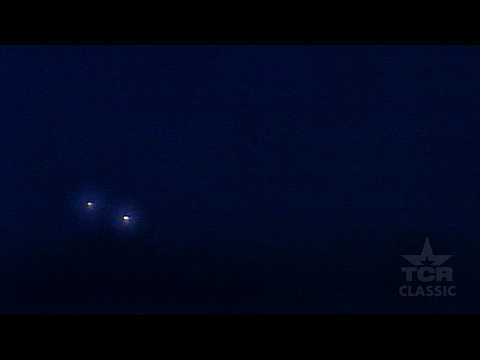
Texas' Greatest Unsolved Mystery
Texas Country Reporter — a regional feature on the lights and the local community around them.
Sources
- "Marfa Lights," Texas State Historical Association Handbook of Texas, by Julia Cauble Smith. Read online →
- "Marfa lights," Wikipedia. Read online →
- "What Are the Marfa Lights?" Live Science. Read online →
- Stephan, K.D., Ghimire, S., Stapleton, W.A., and Bunnell, J. "Spectroscopy Applied to Observations of Terrestrial Light Sources of Uncertain Origin," American Journal of Physics 77, no. 8 (2009): 697. Read abstract →
- Stephan, K.D., Bunnell, J., Klier, J., and Komala-Noor, L. "Quantitative Intensity and Location Measurements of an Intense Long-Duration Luminous Object near Marfa, Texas," Journal of Atmospheric and Solar-Terrestrial Physics 73, no. 13 (2011): 1953–1958. Read abstract →
- "What Makes Mysterious Orbs Shine Over a West Texan Desert?" Nautilus. Read online →
- "The Truth Is Out There," Texas Monthly. Read online →
- "The Marfa Lights Festival: A Celebration of Our Community," Big Bend Sentinel. Read online →
- "What Marfa Lights Probably Aren't," ResearchGate. Read online →
- "De-Mystifying the Marfa Lights," welweb.org. Read online →
- Odenwald, Sten. "The Marfa Lights," Astronomy Cafe. Read online →
- "Review of Hunting Marfa Lights," Foreword Reviews. Read online →
- "Strange Lights in West Texas," Kirkus Reviews. Read online →
- "Marfa Lights: What 140 Years of Data Reveals About Texas's Greatest Mystery," Hangar1publishing. Read online →
- Bunnell, James. Hunting Marfa Lights. Lacey Publishing Company, 2009.
- Bunnell, James. Strange Lights in West Texas. Lacey Publishing Company, 2015.
- Bunnell, James. In Defense of the Marfa Lights. 2021.
- Miles, Elton. Tales of the Big Bend. Texas A&M University Press, 1976.
- Minnaert, Marcel. Light and Color in the Outdoors. Springer, 1993.
- "The Mystery of the Texas Ghost Light," Coronet magazine, July 1957.
- "File: The Marfa Mystery Lights (3525821502) (cropped).jpg," Wikimedia Commons, photo by Jon Hanson (CC BY 2.0). View file →
See something inaccurate? Have additional information or sources?
Suggest an Edit →Last Updated: August 2026