
Real-Life X-Files
Investigating the Paranormal
Core Thesis
Real-Life X-Files: Investigating the Paranormal is Joe Nickell's 2001 hands-on examination of more than forty paranormal mysteries, ranging from stigmata and spontaneous human combustion to UFO visitations and the Roswell crash claim, unified by Nickell's signature method: visiting the scene whenever possible and physically attempting to duplicate the supposedly miraculous before considering any supernatural explanation. On this site, it supplies the essential Nickell field methodology behind this site's own Brown Mountain Lights case file, whose Further Reading section credits the book with Nickell's own firsthand field investigation and historical review of the mystery.
About the Author
Joe Herman Nickell (1944–2025) was born in Lexington, Kentucky, and earned a B.A. from the University of Kentucky in 1967 before returning years later to complete an M.A. in 1982 and a Ph.D. in 1987, both in English with a focus on literary investigation and folklore. Between his undergraduate and graduate studies, Nickell lived an unusually varied working life: stage magician, carnival pitchman, private detective, blackjack dealer, and riverboat manager, having moved to Canada in 1968 and working in these capacities until President Carter's 1977 Vietnam-era amnesty allowed his return to the United States.
That practical, hands-on background directly shaped his later investigative signature. Nickell joined the Committee for Skeptical Inquiry's staff in 1995, hand-selected by Barry Karr and CSICOP co-founder Paul Kurtz to serve as an on-staff field investigator, and wrote the "Investigative Files" column for Skeptical Inquirer continuously from 1995 until his death in 2025 — a thirty-year run of published, firsthand investigative reporting spanning hundreds of individual paranormal claims.
Beyond paranormal investigation specifically, Nickell built a parallel, well-regarded career in forensic document analysis and paleography, authoring books including Pen, Ink, and Evidence and Detecting Forgery: Forensic Investigation of Documents. His document work included exposing the James Maybrick "Jack the Ripper Diary" as a forgery and helping authenticate Hannah Crafts's The Bondwoman's Narrative — a dual expertise in physical-scene investigation and documentary analysis that runs directly through this book's own combination of on-site fieldwork and archival research.
This combination of skills was not accidental but cumulative: each strand of Nickell's unusually varied working life — magician, private investigator, riverboat manager, forensic document examiner, folklore scholar — contributed a distinct analytical tool he brought to bear on paranormal claims. A stage magician's understanding of misdirection and staged illusion, a private detective's habit of physical scene examination, and a folklorist's trained sensitivity to how stories change in oral and written transmission together produced an investigative approach few other paranormal researchers, skeptical or credulous, could genuinely replicate.
Nickell's decades of work earned him CSI's Distinguished Skeptic Award in 2000 and the Robert P. Balles Prize in Critical Thinking in 2012, and in 2011 an asteroid, 31451 Joe Nickell, was named in his honor — a rare and fitting tribute for a career built on rigorously testing extraordinary claims against physical evidence.
Nickell's investigative range extended well beyond paranormal claims specifically: he also conducted extensive research into the Shroud of Turin, concluding based on radiocarbon dating and artistic proportions inconsistent with actual human anatomy that it was a 14th-century painting on linen rather than a burial cloth of ancient origin — a case study in the same evidentiary rigor, applied to a religious rather than paranormal claim, that runs throughout this book's forty-plus paranormal investigations.
Historical Context & Origins
The book was published in 2001 by the University Press of Kentucky, a university press rather than a trade publisher — a choice reflecting Nickell's own academic credentials and the book's status as serious, if accessibly written, investigative nonfiction rather than sensationalized paranormal entertainment.
By 2001, Nickell had already spent six years as a full-time CSI field investigator, giving this book the benefit of a large, already-tested body of individual case investigations to draw its more than forty featured mysteries from — including cases as varied as a supposedly petrified girl buried in eastern Kentucky, communicating with the dead, police psychics, and the supernatural legends surrounding Abraham Lincoln's death.
The book's Kentucky-published origin is itself worth noting: Nickell's own home state's university press taking on a book this broad in scope, rather than a larger national trade publisher, reflects both his personal ties to Kentucky (born in Lexington, undergraduate degree from the University of Kentucky) and the University Press of Kentucky's own established, if less commercially prominent, tradition of publishing serious regional and folklore-adjacent nonfiction.
The book's publication predates Nickell's own later, most-cited Brown Mountain Lights fieldwork by more than a decade: his direct on-site investigation of that specific North Carolina mystery, conducted with his wife Diana across two visits in 2014 and published in Skeptical Inquirer in 2016, extended this book's established methodology to a case this site's own case file covers directly, applying the same visit-the-scene, test-the-mundane-explanations-first approach this book codifies across its dozens of earlier cases.
The book's 2001 publication also sits at a specific moment in the broader paranormal-media landscape: The X-Files television series, whose title this book's own title directly plays against, had aired its final season the previous year, ending a nine-year run that had done more than any other single piece of American popular culture to popularize the aesthetic and vocabulary of government-conspiracy-flavored paranormal investigation. Nickell's book, appearing just as that cultural moment closed, offered readers an explicit alternative: real investigative rigor applied to the same broad category of claims the television series had fictionalized.
Core Arguments & Key Concepts
The book's organizing method, consistent across all forty-plus cases it covers, is to eliminate the probable before ever seriously entertaining the supernatural: Nickell visits the scene of the reported activity whenever practically possible and attempts to physically duplicate the claimed phenomenon himself, whether that means inflicting stigmata-like marks on his own skin or recreating the liquefaction of Saint Januarius's supposed blood relic using known chemistry.
Booklist praised this exact combination, noting that "Nickell does excellent background research, which he follows up in many cases with on-site investigations of mysteries ranging from crop circles and lake monsters to spiritualist mediums and stigmata" — a review that captures the book's core structural pattern: archival groundwork first, direct physical testing second.
Skeptical Inquirer's own review offered a characteristically concise summary of the book's overall thesis: that "the truth is both stranger and more entertaining than fiction" once a case receives genuine investigative attention, rather than being left to accumulate embellishment through repeated secondhand retelling.
The book's scope deliberately spans genuinely disparate phenomena — UFO visitation claims, religious miracles, ghost photography, and folk legend alike — under a single consistent investigative standard, demonstrating that Nickell's method was never specific to any one category of paranormal claim but represented a general evidentiary discipline he considered applicable across the entire field.
Nickell's willingness to physically test claims on his own body — deliberately attempting to produce stigmata-like wounds, for instance — distinguishes his investigative approach from purely documentary or statistical skepticism. Where many skeptical investigators work primarily from records, testimony, and probability analysis, Nickell's background as a former stage magician gave him a practitioner's understanding of how physical effects producing an appearance of the miraculous or paranormal are actually achieved, a specific technical fluency this book applies case after case.
Key Cases & Evidence Discussed
This site's own Brown Mountain Lights (Case File #297, credible status, with recorded reports dating to at least September 13, 1913) is the case this site cites this book for directly: Nickell's own firsthand field investigation and historical review of Brown Mountain, North Carolina, building on the U.S. Geological Survey's original 1922 investigation, concluded the reports stem from multiple distinct mundane causes — including distant man-made lights and vehicle headlights refracted and distorted by local topography and atmospheric conditions — rather than any single unified explanation, let alone a paranormal one.
The book's treatment of the 1947 Roswell Incident situates one of American ufology's most famous cases within Nickell's broader investigative framework, applying the same scene-visit-and-test methodology he brought to cases ranging from spontaneous human combustion to religious stigmata — useful comparative context for readers of this site's own case files covering other well-known American UFO claims, since it demonstrates how a single consistent investigative standard handles cases of vastly different apparent credibility and evidentiary weight.
Critical Reception & Controversies
Booklist's review specifically credited the book's combination of thorough background research and follow-up on-site investigation as its defining strength, a judgment consistent with the broader critical reputation Nickell built across his thirty-year CSI career.
Skeptical Inquirer's own assessment — that the book demonstrates truth being "both stranger and more entertaining than fiction" — reflects a magazine with an obvious institutional stake in Nickell's work, given his parallel decades-long column there, though the review's substance is corroborated by the book's wider, more independent critical reception.
A review from WTBF described it as "refreshing to see an experienced professional who has investigated hundreds of alleged paranormal occurrences," calling the book "fascinating" — a reception pattern across multiple independent outlets that consistently emphasizes Nickell's hands-on investigative credibility as the book's central selling point, more than any single sensational finding within it.
No source located during this article's research disputes the book's core investigative findings or Nickell's underlying methodology; such criticism of Nickell's broader body of work as exists in wider skeptical and paranormal-research circles concerns specific interpretive disputes on individual cases rather than a challenge to his general evidentiary standards.
The book's continued print and ebook availability across multiple formats more than two decades after its original 2001 publication — including newer VitalSource and Storytel digital editions — reflects a sustained readership for Nickell's specific brand of methodical, first-person paranormal investigation, distinct from both credulous paranormal literature and more purely theoretical or statistical skeptical writing.
Influence & Legacy
This exact title is cited in this site's own Brown Mountain Lights case file's Further Reading section, credited there with Nickell's "own field investigation and historical review of Brown Mountain, alongside dozens of other paranormal cases he examined firsthand."
The book represents an early, comprehensive statement of the same investigative method Nickell would continue applying for another twenty-four years after its publication, including his later, more specifically cited 2014–2016 Brown Mountain Lights fieldwork — making this book less a standalone artifact than the codification point for a method Nickell kept actively practicing for the rest of his career.
Nickell's parallel legacy in forensic document analysis, and his broader thirty-book bibliography spanning both paranormal investigation and documentary forensics, situates this specific title within a career whose consistent throughline — testing extraordinary claims against direct physical and documentary evidence — this site's own case-file methodology, including its treatment of the Brown Mountain Lights, directly draws on and credits.
Following his death in March 2025, tributes from the Center for Inquiry, Skeptical Inquirer, and the broader organized skeptic community consistently emphasized the same quality: not merely that Nickell reached skeptical conclusions, but that he reached them by doing the actual physical and archival work most commentators on paranormal claims, on either side of the debate, rarely bother to do themselves. This book, written near the midpoint of his three-decade CSI career, remains one of the clearest single demonstrations of exactly what that work looked like in practice.
The Book
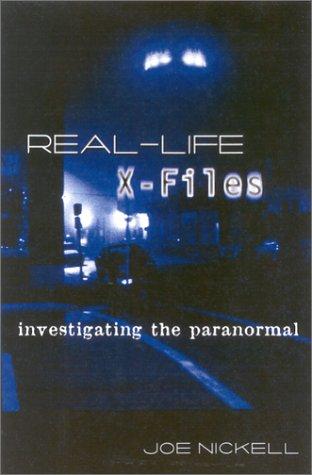
As an Amazon Associate, OverClassified may earn from qualifying purchases made through this link, at no extra cost to you.
Why This Is Essential Reading
Real-Life X-Files earns its place on this list as the clearest single-volume statement of Joe Nickell's defining investigative method — visit the scene, try to physically reproduce the phenomenon, and eliminate the mundane before ever considering the extraordinary — the same method behind the firsthand fieldwork this site's own Brown Mountain Lights case file relies on directly.
Related Cases & Theories
Sources Cited
- Nickell, Joe. Real-Life X-Files: Investigating the Paranormal. University Press of Kentucky, 2001 (ISBN-13 9780813122106). amazon.com
- "Real-Life X-Files." The University Press of Kentucky (official publisher page, description, reviews). kentuckypress.com
- "Joe Nickell." Wikipedia (full biography: education, career, investigations, death). en.wikipedia.org
- "Joe Nickell, legendary skeptical investigator, dies at the age of 80." The Skeptic, 2025 (obituary). skeptic.org.uk
- "Remembering Joe Nickell (1944–2025)." Skeptical Inquirer (obituary, career retrospective). skepticalinquirer.org
- Nickell, Joe. "The Brown Mountain Lights: Solved! (Again!)" Skeptical Inquirer, January/February 2016 (2014 firsthand field investigation this article's Key Cases section references). skepticalinquirer.org
- "Real-Life X-Files." Open Library (bibliographic record, cover art source). openlibrary.org
- "Real-life X-files: investigating the paranormal." Penn State University Libraries Catalog (bibliographic record). catalog.libraries.psu.edu
- This site's own case file: Brown Mountain Lights, for the full mystery and Nickell's own firsthand field investigation.
- This site's own case file: The Roswell Incident, for the 1947 case this book discusses within Nickell's broader investigative framework.
- This site's own key-figures entry: Joe Nickell, for his full biography and further case connections.
- "Joe Nickell Facts for Kids." Kiddle (biographical summary, career overview). kids.kiddle.co
Have corrections, additional research, or peer-reviewed sources? Help improve this entry.
Suggest an Edit