
Vieques
Caribbean UFO Cover-Up of the Third Kind
Core Thesis
Vieques: Caribbean UFO Cover-Up of the Third Kind is Puerto Rican investigative journalist Jorge Martín's 2001 book alleging that the U.S. Navy's real, historically documented bombing and training range on the island-municipality of Vieques concealed a secret joint contact program involving non-human craft and personnel, including a claimed December 1988 encounter in which two Navy F-14 Tomcats pursuing a mile-wide triangular object reportedly vanished. This site's own research draws on Martín's broader body of work, of which this book is the fullest single expression, through two separate case files: the Amaury Rivera Abduction, which Martín personally investigated and documented in the same May 1988 wave the book covers, and the Aguadilla CBP FLIR Encounter, whose footage Martín personally leaked and first published through his own ENIGMAS del Milenio magazine.
About the Author
Jorge Martín (b. 1952) is a Puerto Rican investigative journalist and the editor of Evidencia OVNI and ENIGMAS del Milenio, publications through which he has reported on UFO phenomena, alleged extraterrestrial activity, and the chupacabra mutilation wave in Puerto Rico and the wider Caribbean for over three decades. This site's own research documents his direct, personal involvement in two separate cases beyond this book: he thoroughly investigated and publicized the Amaury Rivera abduction and jet-pursuit photographs from May 1988, and he was the first to publish the leaked 2013 Aguadilla CBP infrared video, having received it from a source inside Rafael Hernández Airport security.
That direct, hands-on investigative record -- rather than secondhand compilation or armchair theorizing -- is what distinguishes Martín's body of work within this site's own research, and this book represents his fullest single statement of the broader claim his decades of Puerto Rico reporting builds toward: that the island's unusually dense cluster of UFO reports, including the F-14 incident this book centers on, reflects a genuine, ongoing, covert military-extraterrestrial relationship rather than a series of unconnected, individually explicable sightings.
This site's own research located no independent biographical profile of Martín beyond his own publishing record and his recurring media appearances -- consistent with his status as a working, still-active journalist and researcher within Puerto Rico's own UFO research community rather than a figure with a broader English-language media presence. His continued production of new material well into the 2020s, including recent interview and podcast appearances discussing Puerto Rico's UFO history, indicates an active, ongoing research career rather than a single, isolated publication.
This site's own research also notes a structural feature of Martín's career worth stating plainly: as both the primary investigator and the primary publisher of much of the material his own reporting relies on, running his findings through his own Evidencia OVNI and ENIGMAS del Milenio outlets, his work generally lacks the kind of independent editorial or peer review a conventional newsroom or academic press would apply. That structural feature does not, on its own, invalidate any specific claim, but this site's own research treats it as directly relevant context for evaluating the evidentiary weight of any single Martín-sourced account, including the ones this book compiles.
Historical Context & Origins
The book's central claim is inseparable from a real, independently and extensively documented historical fact this site's own research treats as necessary background: the U.S. Navy did operate a live-fire bombing and training range on Vieques for roughly sixty years, from the early 1940s until the range's closure in May 2003 following a sustained, internationally covered campaign of civil disobedience sparked by the 1999 death of civilian security guard David Sánchez in a stray bombing accident. That closure campaign, its associated environmental contamination legacy, and the Navy's decades-long presence on the island are matters of extensive public record entirely independent of any UFO-related claim -- this site's own research is careful to keep that well-documented military history distinct from Martín's separate, considerably less independently verifiable allegation of covert contact activity layered on top of it.
The book's 2001 publication also falls within a specific, well-documented wave of Puerto Rico UFO reports spanning the late 1980s, of which the book's central December 1988 F-14 incident and this site's own Amaury Rivera Abduction case (May 1988) are both part. This site's own research treats that clustering as itself worth noting analytically, independent of any conclusion about individual case validity: whatever their ultimate explanation, a genuinely elevated rate of reported anomalous sightings across Puerto Rico during this specific multi-year window is a real pattern in the record Martín's own decades of local reporting first systematically documented.
Martín's book arrived roughly two years into the Vieques protest movement that would ultimately force the range's 2003 closure, situating its publication within a period of intense, genuine public and media attention on the island's military presence -- a real contemporary context this site's own research treats as relevant to understanding the book's reception and framing, independent of assessing its central UFO claim.
This site's own research also situates the book within Puerto Rico's specific, decades-long relationship to U.S. military infrastructure more broadly: beyond Vieques, the island hosted Ramey Air Force Base, the Roosevelt Roads Naval Station, and a dense concentration of Cold War-era radar, communications, and anti-submarine warfare installations, including the same broader Caribbean ASW exercise apparatus this site's own Puerto Rico ASW Range Sonar Contact case file separately documents from 1963. That dense regional military footprint, independent of any UFO-specific claim, provides real, verifiable context for why a Puerto Rico-based researcher's decades of reporting would repeatedly intersect with U.S. military activity as a recurring backdrop.
Core Arguments & Key Concepts
The book's central argument holds that the U.S. Navy's documented, decades-long military presence on Vieques provided both the physical infrastructure and the operational secrecy necessary for a covert, ongoing extraterrestrial contact program, with the island's real bombing-range activity functioning as cover for classified operations unrelated to conventional military training.
A second, more specific argument centers on the December 28, 1988 incident the book treats as its central piece of evidence: an account, drawn from anonymous military-adjacent sources per Martín's own reporting, describing two Navy F-14 Tomcats scrambled to intercept a reportedly mile-wide triangular object near Vieques, which then vanished from radar along with the pursuing aircraft -- a claim this site's own research notes lacks the kind of independently verifiable official documentation (a surfaced incident report, confirmed aircraft loss record, or corroborating radar log) that would move it from an anonymously sourced allegation to an established fact.
A third argument, developed across Martín's broader body of reporting and represented in this book, treats the density and consistency of Puerto Rico UFO reports across multiple decades as itself evidence of a genuine, sustained phenomenon specifically connected to the island's military installations, rather than a product of ordinary reporting-bias effects (a small, geographically concentrated population with an unusually UFO-attentive local press, sustained substantially by Martín's own decades of coverage).
A fourth argument links the book's UFO claims to the broader chupacabra mutilation wave Martín has separately documented in Puerto Rico since the early 1990s, treating both phenomena as connected symptoms of the same underlying covert activity -- an argument this site's own research treats as considerably more speculative than the book's core Navy-cover-up claim, given the chupacabra phenomenon's own well-documented history of feral-animal-disease and cryptid-folklore explanations independent of any UFO connection.
This site's own research treats the book's overall evidentiary structure as consistent with a broader pattern seen across its own coverage of government-cover-up UFO literature: real, independently verifiable institutional secrecy (a live-fire military range, genuine Cold War and post-Cold War operational security) providing a plausible-sounding backdrop onto which considerably less verifiable specific claims are then layered, making the book's central argument neither trivially dismissible nor independently confirmed.
A sixth, more procedural point this site's own research raises concerns sourcing transparency specifically: the book's central F-14 incident rests on anonymous military-adjacent informants rather than named, on-the-record witnesses of the kind this site's own Amaury Rivera case file was able to interview directly. That distinction does not by itself disprove the incident, since anonymous sourcing is a routine and often necessary practice in investigative journalism covering sensitive military subjects, but it does place the claim on a meaningfully different evidentiary footing than a case built on named, cross-examinable testimony -- a distinction this site's own research applies consistently across its coverage regardless of how compelling any individual anonymously sourced account may otherwise read.
Key Cases & Evidence Discussed
The Amaury Rivera Abduction (May 14, 1988) sits within the same broader Puerto Rico UFO wave this book documents, and was directly investigated by Martín himself. Rivera reported his vehicle enveloped by sudden fog near Hormigueros, followed by an encounter he connected to a disc-shaped object reportedly pursued by a Navy F-14 -- the same aircraft type central to this book's own December 1988 incident. This site's own case-file research documents that later investigation concluded Rivera's photographs likely depicted scale models, a conclusion this site's research treats as the case's most probable explanation while still noting Martín's own extensive contemporary documentation of witness testimony and the broader 1988 reporting wave it belongs to.
The Aguadilla CBP FLIR Encounter (2013) represents Martín's most direct, personal connection to a case this site covers: a source inside Rafael Hernández Airport security leaked infrared video of an unidentified object to Martín specifically, who published it through his own ENIGMAS del Milenio magazine and social media channels, giving him a direct role in that case's own evidentiary provenance chain independent of any interpretation of the footage itself. This site's own research notes that AARO's later historical report ultimately favored a mundane sky-lantern explanation for the footage, a conclusion reached independently of, and after, Martín's own original 2013 publication of the material.
Critical Reception & Controversies
This site's research attempted to verify a Goodreads rating for this specific title, but repeated fetch attempts returned blank or incomplete page content during this session; per this site's own established practice, this gap is disclosed honestly here rather than a rating being fabricated or silently omitted.
This site's research also attempted to verify an Amazon rating for this title, but Amazon's bot-detection system blocked automated requests to the listing during this session, the same persistent pattern encountered across every title checked this session; per this site's own Amazon Rating Display Protocol, this gap is disclosed honestly here rather than fabricated or silently omitted.
This site's research located no mainstream English-language book-review coverage of this specific title, consistent with its origin as a Spanish-language-market-adjacent, small-press release from a Puerto Rico-based publisher (CEDICOP) aimed primarily at a regional UFO-research readership rather than a broader English-language trade audience. This mirrors a pattern this site's own research has noted across several other regionally focused UFO titles from small, non-U.S.-mainland presses: real, sustained local reporting operations that nonetheless leave little trace in the English-language review ecosystems most retail and cataloging platforms are built around.
This site's own research treats the book's critical standing as best assessed through the independently verifiable portions of Martín's own broader investigative record rather than through conventional book reviews: his direct, personal, and independently confirmable role in both the Amaury Rivera and Aguadilla cases demonstrates real, sustained investigative activity, even where this site's own research reaches different final conclusions than Martín does about what that activity ultimately proves.
Influence & Legacy
This book's clearest legacy on this site specifically runs through Martín's own direct, personal involvement in two separate, independently documented cases: the Amaury Rivera Abduction, which he investigated as part of the same broader 1988 wave this book covers, and the Aguadilla CBP FLIR Encounter, whose footage reached the public specifically because a source chose to give it to him.
Within the broader tradition of Puerto Rico and Caribbean UFO reporting this site's own research has surveyed, Martín's decades-long, geographically focused body of work -- of which this book is the fullest single statement -- represents a genuinely distinct category from the more general, multi-country surveys this site has covered elsewhere: a single dedicated regional researcher's sustained, place-specific documentation project rather than a broad international compilation.
The book's central claim about covert military-extraterrestrial contact at Vieques has not received independent verification from any source outside Martín's own reporting network in the more than two decades since publication, even as the real, entirely separate historical fact of the Navy's Vieques bombing range and its 2003 closure has been extensively documented by mainstream journalism, academic researchers, and government sources -- a genuinely useful test case, per this site's own research, for how a real, independently verifiable institutional fact and a considerably less verifiable UFO claim can become closely intertwined in a single popular account without the former lending genuine evidentiary support to the latter.
This site's own research also notes the book's continued relevance to Martín's own ongoing media presence: his repeated return to Puerto Rico UFO material in interviews and appearances well into the 2020s indicates the claims this book first compiled in 2001 remain an active, still-developing thread in his broader research rather than a closed, one-time publication.
Finally, this site's own research treats the book's full title itself -- explicitly invoking Steven Spielberg's famous 1977 film Close Encounters of the Third Kind and its own well-known, widely recognized three-tier classification framing of "third kind" contact -- as a useful marker of how deliberately the book positions itself within popular UFO culture's own established vocabulary, aiming for a readership already familiar with that classification system rather than attempting to introduce an entirely new evidentiary framework of its own from scratch.
The Book
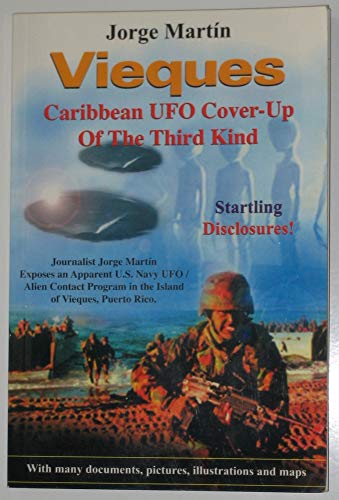
As an Amazon Associate, OverClassified may earn from qualifying purchases made through this link, at no extra cost to you.
Why This Is Essential Reading
Vieques: Caribbean UFO Cover-Up of the Third Kind earns its place on this list less for its central, largely unverified covert-contact claim than for what it represents within this site's own research: the fullest single expression of Jorge Martín's decades-long, hands-on investigative record in Puerto Rico, a record this site has already drawn on directly for two separate, independently documented case files. Its central December 1988 F-14 incident remains, per this site's own methodology, an anonymously sourced allegation rather than an independently confirmed event, layered onto the real, extensively documented history of the U.S. Navy's Vieques bombing range and its 2003 closure. Read with that distinction firmly in mind -- real military history on one side, a considerably less verifiable UFO claim layered on top of it on the other -- the book offers a useful, if not independently confirmed, window into one of Puerto Rico's most consequential and best-documented UFO researchers.
Related Cases & Theories
Essential Viewing

Sources Cited
- Martín, Jorge. Vieques: Caribbean UFO Cover-Up of the Third Kind. CEDICOP, 2001 (ISBN 978-0-9709242-3-0, cited here).
- "The US Navy's Toxic Playground: Vieques, Puerto Rico." AJ+, YouTube (mainstream documentary short on the real, independently documented history of the Navy's Vieques bombing range and its environmental legacy; video verified via oEmbed). youtube.com
- This site's own resources library: Full Reading List, where this book is cited on this site's own Amaury Rivera and Aguadilla case files.
- This site's own key-figures entry: Jorge Martín, for his full biography and site-wide connections.
- This site's own case file: The Amaury Rivera Abduction, part of the same 1988 Puerto Rico wave this book documents, directly investigated by Martín.
- This site's own case file: Aguadilla CBP FLIR Encounter, whose footage Martín personally leaked and first published.
- This site's own key-figures entry: Amaury Rivera, the case's central witness.
- This site's own locations entry: Vieques, Puerto Rico, the real, historically documented U.S. Navy bombing range central to this book's claims.
- This site's own locations entry: Puerto Rico, for the broader regional context of Martín's decades of reporting.
- United States Navy in Vieques, Puerto Rico. Wikipedia (consulted for uncontested chronological facts regarding the range's operational history and 2003 closure, cross-checked against mainstream press coverage). en.wikipedia.org
- This site's own case file: Flatwoods Monster, for a comparable example of this site's methodology separating a well-documented historical backdrop from a considerably less verifiable anomalous claim layered onto it.
- This site's own essential-reading entry: They Knew Too Much About Flying Saucers, for a comparable case study in weighing a UFO researcher's documented track record against the specific claims of a single book.
Have corrections, additional research, or peer-reviewed sources? Help improve this entry.
Suggest an Edit