
Puerto Rico ASW Range Sonar Contact
Sometime in 1963, according to published accounts gathered by the naturalist Ivan T. Sanderson, U.S. Navy sonar operators on anti-submarine warfare exercises off Puerto Rico tracked an unidentified underwater object moving at "over 150 knots" — roughly four times the fastest submarine speeds of the era — for four days, as it maneuvered down to depths of 27,000 feet, with "no less than thirteen craft" logging the contact. The story is best known from Sanderson's 1970 book Invisible Residents, which says the carrier Wasp was named "in more than one account" as the command ship but names no other ship, no sonar operator and no officer. Sanderson cites two earlier published sources, Martin Caidin's book Hydrospace (1964) and an article by Ed Hyde in Man's Illustrated (March 1966), and admits that he "was unable to obtain any confirmation" of the reports. The Navy's official history of USS Wasp records that the carrier took part in fleet exercises off Puerto Rico in late March 1963, one possible match for the setting; it mentions no unusual contact, and no Navy record of the chase itself has ever surfaced.
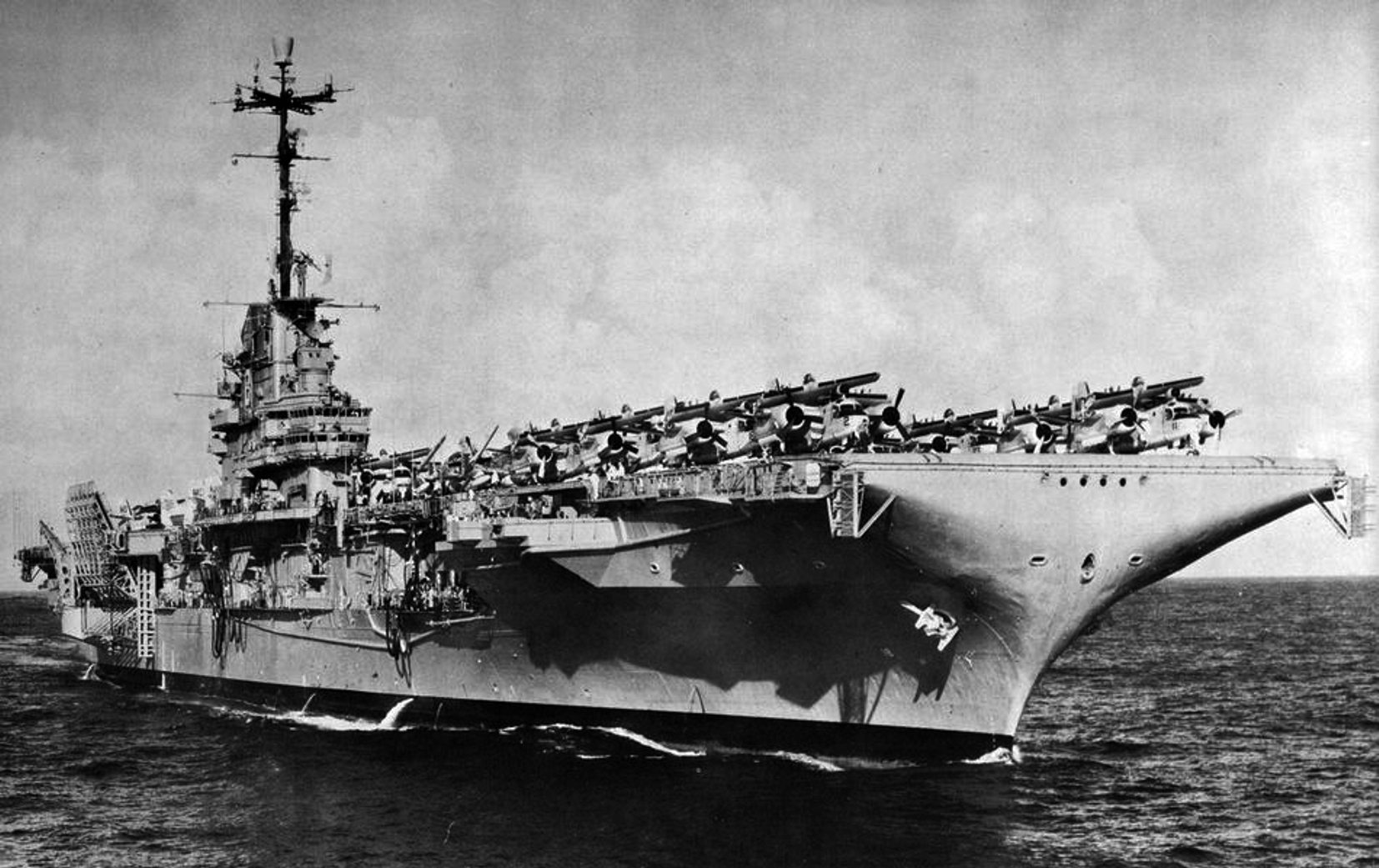
Pictured: USS Wasp (CVS-18), the Essex-class anti-submarine warfare support carrier, underway at sea in 1960 (U.S. Navy photograph, public domain, via Wikimedia Commons). Sanderson says that "more than one account" named Wasp as the exercise's command ship, and the Navy's official history records the carrier at fleet exercises off Puerto Rico in late March 1963. No photograph, sonar trace or other record of the alleged high-speed contact is known to exist; the story comes from published secondhand accounts, not from any surviving Navy document.
Theoretical Alignment
None of the three classic interpretive frameworks fit this case especially well, and that mismatch is itself informative. The Extraterrestrial Hypothesis draws only weak alignment from the raw magnitude of the claimed speed — a genuinely extraordinary figure if true — but with zero photographic, physical, or even a single named witness behind it, there is nothing here to actually evaluate against an ETH framework beyond the number itself. The Interdimensional Hypothesis finds almost no purchase at all; nothing in Sanderson's account describes a portal, a dimensional transition, or any of the phenomenology that hypothesis typically explains. The Psycho-Social Hypothesis scores modestly higher, but even that is an imperfect fit: PSH ordinarily explains how a real first-hand percept gets shaped by a witness's expectations and cultural context, and this case has no described witness psychology to examine at all — no one who saw or heard the contact left behind any personal account of what it felt like to experience it. What this case actually presents is a documentary and sourcing problem rather than an experiential one: a claim known from a few popular publications of the 1960s, best preserved in Sanderson's 1970 retelling, and disconnected from any traceable original observer. That is a different kind of anomaly than any of the three frameworks was built to assess, and this file treats it accordingly throughout.
Background
The term "USO" — Unidentified Submerged Object — entered popular use as a deliberate parallel to "UFO," describing reports of anomalous objects, lights, or sonar contacts encountered in or emerging from oceans, lakes, and rivers rather than the sky. The term has also been turned back on itself: a 2022 Naval History magazine article by Scot Christenson used "USOs" for whales, sharks and other sea creatures that interfere with ship handling, sonar and oceanographic work — a routine operational hazard, not an unexplained phenomenon. Ufological usage of the same acronym is a later and much broader borrowing, encompassing everything from glowing underwater lights reported by mariners for centuries to claimed high-speed sonar contacts like the one this file examines.
The person most responsible for popularizing USOs as a distinct category within American ufology was Ivan T. Sanderson (1911–1973), an Edinburgh-born naturalist and prolific popular-science author. Sanderson took a master's degree with honours in zoology, botany and ethnology at Cambridge by 1932, collected animals in West Africa, the Caribbean and Central America, and during the Second World War worked for British Naval Intelligence on counter-espionage in the Caribbean before settling in the United States. His scientific background lent his later writing on cryptozoology and Fortean phenomena more standing than many flying-saucer writers had, though critics have called him credulous. He set up a foundation on his New Jersey property in 1965 that became the Society for the Investigation of the Unexplained (SITU) in 1967, introduced the idea of "vile vortices" — anomaly zones such as the Bermuda Triangle and the Devil's Sea — in 1968, and in 1970 published Invisible Residents: A Disquisition upon Certain Matters Maritime, and the Possibility of Intelligent Life under the Waters of This Earth. The book gathered scattered maritime reports into a sustained argument that an unknown intelligence might inhabit the oceans. It is the best-known source for the Puerto Rico story, but not the first: Sanderson describes the story as "a compendium of statements published on the matter by quite a number of people," and his footnote cites Martin Caidin's Hydrospace (E. P. Dutton, 1964) and Ed Hyde's "U.F.O.'s — At 450 Fathoms!" in Man's Illustrated (March 1966), "and others."
If the event took place in early 1963, it sits in a tense Cold War moment. The Cuban Missile Crisis had ended in October 1962, and Soviet submarine activity in the Caribbean and western Atlantic remained a major U.S. Navy concern. Puerto Rico was central to the Navy's Atlantic anti-submarine work. Naval Station Roosevelt Roads, on the island's eastern coast, was the Atlantic Fleet's main Caribbean base, and the fleet held large exercises in the surrounding waters; the Navy's history of Wasp, for example, describes the carrier's "Springboard" operations off Puerto Rico in 1966. Separately, Naval Facility (NAVFAC) Ramey, on Puerto Rico's western coast, was commissioned in September 1954 as one of the first shore stations of the Sound Surveillance System (SOSUS), the Navy's classified network of seafloor hydrophone arrays built to detect Soviet submarines across the Atlantic. By 1963 the waters around Puerto Rico were therefore busy with anti-submarine exercises and closely monitored by fixed listening arrays.
The depth in the story is a real extreme. The Puerto Rico Trench runs about 810 kilometres along a transform boundary where the Caribbean plate slides past the North American plate, with only a small component of subduction, and it holds the deepest point in the Atlantic. The Milwaukee Deep was named for the cruiser USS Milwaukee, which sounded it on February 14, 1939, at 28,680 feet; in December 2018 Victor Vescovo's crewed descent measured the deepest point at 8,376 metres (27,480 feet). Because the trench's depth was well known from 1939 onward, the "27,000 feet" in the story could have come from any writer who knew the region, and it is discussed further in the Conventional Explanation Candidate section below.
The carrier named in the published accounts, USS Wasp (CVS-18), fits the setting. An Essex-class carrier commissioned in 1943 and redesignated an antisubmarine warfare support carrier (CVS) in 1956, Wasp operated S-2 Tracker aircraft and helicopters with a screen of destroyers. According to the Navy's Dictionary of American Naval Fighting Ships (DANFS), the early part of 1963 had Wasp "conducting antisubmarine warfare exercises off the Virginia Capes and steaming along the Caribbean coast of Costa Rica in support of the presidential visit" — President Kennedy's conference with Central American presidents in San José, held March 18–20, 1963 (DANFS dates his arrival to March 21; the State Department's historical record gives March 18–20). "After taking part in fleet exercises off Puerto Rico, the carrier returned to Boston on 4 April." That places Wasp in Puerto Rican waters in late March 1963. Sanderson, however, gives only the year, so this is a possible match rather than a confirmed one, and DANFS mentions no unusual sonar contact or incident during the deployment.
March is not the only possibility, either. The same DANFS entry says that after serving as a backup recovery ship off Bermuda for Gordon Cooper's Mercury flight from May 11 to 18, 1963, Wasp "resumed antisubmarine warfare exercises along the Atlantic Seaboard and in the Caribbean" until her next overhaul, so the carrier was in Caribbean exercise areas more than once that year. She also returned to Puerto Rico for fleet exercises in other years, including the "Springboard" operations of early 1966 that ended when heavy seas damaged the ship. Because Sanderson's account gives only the year, none of these deployments can be singled out, and the frequent presence of Wasp and other anti-submarine ships off Puerto Rico in the 1960s is one reason the setting of the story is plausible without being specific enough to check.
Complete Timeline
| Date | Event |
|---|---|
| October 1962 | The Cuban Missile Crisis brings the Cold War to its tensest point and keeps U.S. anti-submarine attention on the Caribbean. |
| Early 1963 | USS Wasp (CVS-18) conducts antisubmarine warfare exercises off the Virginia Capes, per the carrier's own official Navy service history. |
| March 18–20, 1963 | President Kennedy confers with Central American presidents in San José, Costa Rica; Wasp steams off the Caribbean coast of Costa Rica in support of the visit (DANFS dates his arrival to March 21). |
| "Sometime in 1963" (Sanderson's wording; no month or day given) | Per the published accounts, U.S. Navy ships, submarines and aircraft hold detection-and-tracking exercises off Puerto Rico ("some five hundred miles southeast of the continental United States," as Sanderson puts it). A sonar operator on a destroyer reports that one of the submarines has broken formation in apparent pursuit of an unknown object. |
| (Same undated episode) | The object is tracked at "over 150 knots." The operator does not know whether it is a planted decoy, but the speed is "not at all within the limits of any such simulation"; the command ship Wasp's radio is said to be jammed with similar reports from other ships and aircraft. |
| (Same undated episode) | "No less than thirteen craft" are said to have logged the contact, which is reported to COMLANT in Norfolk; technicians track it for four days as it maneuvers down to 27,000 feet. |
| Late March–April 4, 1963 | Wasp takes part in fleet exercises off Puerto Rico and returns to Boston on April 4 (DANFS) — a possible, unconfirmed match for the setting. The record mentions no unusual sonar contact. |
| 1964 | Martin Caidin's Hydrospace (E. P. Dutton) is published; Sanderson later cites it as one of the published sources for the story. |
| March 1966 | Ed Hyde's "U.F.O.'s — At 450 Fathoms!" appears in Man's Illustrated, the other source Sanderson cites. |
| 1970 | Ivan T. Sanderson publishes Invisible Residents (World Publishing), retelling the story in Chapter 2 and stating that he was "unable to obtain any confirmation" of it. |
| 1970s–2000s | The story is repeated in USO-themed books and articles, generally citing Sanderson, without any new document or named witness surfacing. |
| October 9, 2019 | Kyle Mizokami's Popular Mechanics article "The Weird History of Unidentified Submerged Objects" repeats the account, citing Sanderson's book (mirrored on ExoNews). |
| December 2018 | Victor Vescovo's crewed descent measures the deepest point of the Puerto Rico Trench at 8,376 m (27,480 ft). USS Milwaukee had sounded 28,680 ft there in 1939. |
| 2020s | Blogs, video channels and podcasts continue to repeat the story; some web versions are reported to add details, such as a named submarine or exercise, that are not in Sanderson's text. |
The Account As Sanderson Told It
Sanderson's version, in Chapter 2 of Invisible Residents ("A Second Mystery — Oceanic UAOs," pp. 27–29 of the edition consulted), opens by calling it "a compendium of statements published on the matter by quite a number of people," reports that had proved "least susceptible of confirmation" and were "classics of obfuscation." As he tells it: sometime in 1963 the U.S. Navy held exercises off Puerto Rico, "some five hundred miles southeast of the continental United States," to train personnel in detecting and tracking underwater craft. "All reports seem to agree" that five "small" naval vessels took part, and "in more than one account" the carrier Wasp is named as command ship. There were submarines running silent, and aircraft, one of them trailing a detection device on a line just below the surface. A sonar operator on one of the small vessels, "otherwise listed as a destroyer," reported that one of the submarines had broken formation and gone off in apparent pursuit of an unknown object. He could not tell whether it was a "plant," since decoys are always used in such exercises, but the report "was not at all within the limits of any such simulation": the object was traveling at "over 150 knots." The deck officer told the skipper, "said to have been a lieutenant commander," who found Wasp's radio "virtually jammed with similar reports" from the other ships and from the aircraft. According to "more than one of the reports," no fewer than thirteen craft — "including submersibles and aircraft, one must suppose" — noted in their logs that their tracking devices had latched on to the object, and the matter was reported to COMLANT in Norfolk. Observers agreed, he writes, that it was driven "by a single propeller at more than 150 knots"; the technicians "kept track of this thing for four days," and it maneuvered "down to depths of 27,000 feet." Sanderson compares the speed with a "semiofficial" 45-knot record for the Skipjack-class submarines and calls it "nearly four times" faster.
What Sanderson leaves out is just as notable. No ship is named except Wasp, and that only as reported in "more than one account." No submarine, destroyer or aircraft squadron is identified, no officer or sonar technician is named or quoted, and no date within 1963 is given. No deck log, after-action report or sonar tape is cited. Sanderson does not claim to have interviewed anyone involved. His sources are published writers: the "authors who originally wrote of them," he says, "are known and are respectable writers of factual matters," who specialized in underwater subjects "apparently with much help and advice from naval authorities," and his footnote names Martin Caidin's Hydrospace (1964) and Ed Hyde's 1966 Man's Illustrated article, "and others." Then comes his admission: "As I have said, I have been unable to obtain any confirmation of them," and the trail is, "at least as far as I am able to state as of the time of writing, a dead end." Neither earlier source could be examined for this review, so how much of the detail goes back to them, and where they got it, is not known.
That admission matters to how the case is rated. Sanderson did not claim firsthand knowledge or vouch for a source he had personally checked, and he said plainly that his attempts to confirm the story had failed. He nonetheless printed it with the specific figures — 150 knots, thirteen craft, four days, 27,000 feet — that have kept it in circulation for more than five decades. The claim is real in the sense that it exists in the published record and can be traced to identifiable 1960s publications; it remains, on the evidence available, unconfirmed and very possibly unconfirmable.
How the Story Has Drifted in Later Retellings
A useful test for a thinly sourced claim is whether its details stay stable as it is retold. On the core figures, this one has: the 2019 Popular Mechanics version repeats the 150 knots, the thirteen craft, the four days and the 27,000 feet, and adds only a modern comparison with submarine speeds. Some web retellings are reported to add more, naming the nuclear submarine USS Skipjack (SSN-585) or tying the exercise to the Navy's "Springboard" exercise series; those versions could not be re-located for this review, and neither detail is in Sanderson's text. Both are plausible-sounding fill-ins. Skipjack was a fast Atlantic Fleet attack submarine in 1963, and Sanderson himself mentions the Skipjack class — but only in his speed comparison, which may be where the name crept into the story. "Springboard" was a real name for the Navy's winter-spring Caribbean exercises, but nothing ties it to this particular episode. Neither detail is used elsewhere on this page.
The Earlier Published Accounts
Sanderson's footnote moves the story's known origin back at least six years before Invisible Residents. The first source he names, Hydrospace (E. P. Dutton, 1964), was by Martin Caidin (1927–1997), a prolific American writer on aviation and space who published more than fifty fiction and nonfiction books, among them the 1964 novel Marooned, later filmed, and Cyborg, the basis of television's The Six Million Dollar Man. The second, Ed Hyde's "U.F.O.'s — At 450 Fathoms!" in the March 1966 issue of Man's Illustrated, appeared in a men's adventure magazine, a genre not known for checking its stories. Sanderson adds "and others," without naming them. Neither text could be obtained for this review, so it is not known which of the details — the five small vessels, Wasp as command ship, the thirteen logs, COMLANT, the four days, the 27,000 feet — come from Caidin, which from Hyde, and which from the unnamed "others," or what either writer said about his own sources. Sanderson's remark that both writers had "much help and advice from naval authorities" is his characterization, not something the accounts are shown to document. Finding and reading those two publications is the most obvious next step for anyone trying to trace the story further, and the most likely place to learn whether it began with a named naval informant or with an earlier rumour.
The Story Elsewhere in Sanderson's Book
The figures are not entirely stable even within Invisible Residents. In Chapter 1 (p. 22 of the edition consulted), before he tells the story in full, Sanderson asks how the commander of a ship on anti-submarine exercises could accept the statements of "even all his radar operators in his fleet" that they had "tracked, and are locked on to a submarine 'construction' traveling at 150 knots at a depth of 20,000 feet." Later, in Chapter 4 (p. 67), he returns to the idea with relish, writing that "these underwater chaps can bat it out at 200 mph at 20,000 feet down." In Chapter 2 the contact is a sonar contact, the depth is 27,000 feet, and the speed is "over 150 knots." Radar cannot track a submerged object, so the Chapter 1 wording is at best loose, and the shift between 20,000 and 27,000 feet within one book is a reminder that the numbers in the story were being handled informally even by the writer who preserved it. Sanderson also sets the story inside a wider argument. He writes that the original authors "constantly state that there have been numerous other reports of a similar nature by and to our Navy since that date," and that he had taken his material to officials in "various other security agencies," asking whether he could publish it; their answer, he says, was "I don't know." None of those officials is named either.
Key Witnesses
Ivan T. Sanderson
Sanderson is the case's sole named figure, and it is important to state plainly what role he actually occupies: he was not present for, and does not claim to have witnessed, any part of the alleged sonar contact. He is the compiler whose book made the story widely known, drawing it, by his own account, from earlier published writers (Caidin, 1964; Hyde, 1966) who were said to have had naval help that he could not verify. His Cambridge training in zoology, his wartime naval-intelligence work in the Caribbean, and his standing as the founder of the Society for the Investigation of the Unexplained, lend the story a more credentialed presentation than it would carry from an anonymous tip, but they do not substitute for a named witness, an official document, or any form of independent corroboration — none of which Sanderson himself claimed to possess.
No sonar operator, ship's officer, pilot, or any other Navy or civilian individual has ever been named in connection with this case, in Sanderson's text or in any of the literature that has repeated it since. This absence of even a single identified witness, more than five decades after the claimed event and well after most other 1963-era Navy participants would have been reachable for interview during the peak decades of ufological research into Cold War military cases, is one of the case's most significant evidentiary weaknesses, and this file treats it as such throughout.
The Five Observables Assessment
The Five Observables framework, drawn from the Pentagon's own Advanced Aerospace Threat Identification Program criteria for anomalous flight characteristics, is applied here to the performance characteristics described in Sanderson's account — with the important caveat that every rating below evaluates a claim with no instrument data, no visual observation, and no named observer behind it.
Assessment: The case is a near-total outlier on this framework in that only one of the five observables is even claimed, and that single claim (the 150-knot speed) is the entire substance of the account — there is no described anti-gravity lift, no low-observability/stealth characteristic (the object was, by the account's own logic, continuously and successfully tracked, the opposite of low observability), and no trans-medium transition of any kind, since the object is described as remaining fully submerged throughout. A case this narrow in its claimed anomalous characteristics, resting entirely on one secondhand numeric figure with no supporting sensor data, sits at the extreme thin end of what this framework is designed to evaluate.
Evidence Assessment
Supporting Anomalous Origin
- The story appeared in more than one publication in the 1960s (Caidin's Hydrospace, 1964; Man's Illustrated, 1966, as cited by Sanderson) and has been repeated consistently since, without any published retraction.
- The claimed depth, 27,000 feet, is physically possible in the Puerto Rico Trench, whose deepest point is about 27,480 feet, so the story's geography is at least consistent.
- The setting is real: Wasp, the carrier named in the accounts, took part in fleet exercises off Puerto Rico in late March 1963, according to the Navy's own ship history.
- Cold War anti-submarine crews did encounter transient, hard-to-classify sonar returns, and the account's own detail — an operator unsure whether the contact was an exercise decoy — reflects that real uncertainty.
- No Navy source has ever specifically denied that an unusual contact occurred, though this is weak, since no participant has ever been identified to ask.
Supporting Conventional Explanation
- No named witness of any kind — no sonar operator, officer, pilot, or crew member — has ever been identified in over fifty years, despite the story's wide circulation within a research community that has successfully tracked down and interviewed named participants in far more sensitive Cold War-era incidents.
- Sanderson, the story's best-known source, states in his own text that he could not confirm the account and calls his search "a dead end."
- No deck log, after-action report, sonar recording, incident report, or any other primary Navy document referencing an unidentified high-speed contact during this exercise has ever surfaced, despite decades of FOIA-driven UFO research specifically targeting Cold War-era military archives.
- A sustained 150-knot submerged speed is several times faster than any submarine before or since: the Skipjack class was rated at 33 knots submerged, and the highest claimed figure, the Soviet K-222's 44.7 knots on 1969 trials, is less than a third of it.
- No month is given, the location is described only as "off Puerto Rico" at a stated distance (about 500 miles from the mainland) that is roughly half the real figure, and the chain of transmission from the participants to the 1960s writers is unknown.
Why "Disputed"
The Puerto Rico ASW Range Sonar Contact is rated Disputed at 22/100, near the low end of the site's range. The rating does not say that nothing unusual happened during a 1963 Navy exercise off Puerto Rico; a sonar contact that puzzled crews in the moment is entirely plausible. It reflects how little stands between "something happened" and the specific, dramatic claim — 150 knots, thirteen craft, four days, 27,000 feet. Every one of those figures reaches us through popular publications of 1964–1970, best preserved in a book whose author was not present, names no participant, cites no document, and says he could not confirm the story. In more than fifty years no named participant, released document or other corroboration has appeared. On the other side, the setting is real (Wasp was at fleet exercises off Puerto Rico in late March 1963), the depth is physically possible in the Puerto Rico Trench, and the core figures have stayed stable since the 1960s. That keeps the case in Disputed rather than Debunked — there is no positive proof the story is false — but far short of the documented standard needed for anything higher.
Sensor & Instrumentation Detection Profile
No sonar recording, sonar tape transcript, radar log, or any other instrument record specific to this alleged contact has ever been published, cited, or made available for independent review. What can be established is the class of instrumentation genuinely in use in this specific ocean region at this specific time. By 1963, U.S. Navy anti-submarine forces in the Puerto Rico operating area had access to two broad categories of detection technology: shipborne and airborne active sonar, and fixed passive hydrophone surveillance. Active sonar aboard 1960s-era destroyers and destroyer escorts (variants in the AN/SQS series) worked by transmitting a directional acoustic "ping" and timing the echo, a method vulnerable to a range of known false-contact sources including thermal-layer refraction, biological targets, and multipath echoes off the seafloor or subsurface density layers. Airborne ASW assets — the S-2 Tracker patrol aircraft Wasp embarked, and Navy patrol squadrons operating from Roosevelt Roads — deployed sonobuoys, expendable passive listening devices dropped into the water and radio-linked back to the aircraft, to extend detection range beyond a single ship's own sonar. Separately, Naval Facility Ramey on Puerto Rico's western coast had operated as one of the first shore stations of the classified SOSUS seafloor hydrophone network since September 1954. Any SOSUS contact logs for 1963 remain unreleased and were never cited by Sanderson or any later researcher. In short: the technology existed, in this exact place and era, to generate a genuine transient high-speed sonar contact, whether from a real target, a decoy, or a sensor artifact — but no specific instrument record tying any of that real 1963 technology to this specific claimed event has ever been produced. How well 1960s sonar could have measured a 150-knot target, and how operators would have derived the speed and the 27,000-foot depth, is not explained in any of the accounts; the figures are reported, not shown.
Environmental & Geospatial Context
The Puerto Rico Trench lies along the boundary where the Caribbean tectonic plate slides obliquely eastward past the North American plate — a transform boundary with only a minor subduction component, distinct from the more dramatic subduction-driven trenches found elsewhere in the Caribbean arc. It runs about 810 kilometres parallel to and north of Puerto Rico and contains the deepest point in the Atlantic, measured at 8,376 metres (27,480 feet) by Victor Vescovo's December 2018 crewed descent; USS Milwaukee's 1939 sounding, which gave the Milwaukee Deep its name, reported 28,680 feet. That extreme depth and the trench's generally steep, complex bathymetry make the surrounding water column oceanographically unusual in ways directly relevant to sonar performance: strong thermoclines, salinity gradients, and the ubiquitous deep scattering layer — a globally-present band of small mesopelagic fish and other organisms, concentrated at roughly 300–500 meters depth during daylight and migrating toward the surface at night, whose swim bladders reflect sonar pulses strongly enough that WWII-era sonar operators initially mistook the layer for a false seafloor, sometimes called the "phantom bottom." Any of these layers can refract, duct, or create multipath echoes of active sonar pulses in ways that produce apparent depth, range, or velocity readings that do not correspond to a genuine solid target's actual motion — a real, well-documented class of oceanographic sonar artifact directly relevant to evaluating a claimed 150-knot, multi-thousand-foot-deep contact. No meteorological, lunar-phase, or precise-date reconstruction is possible for this case, because the account gives no month, day or time of day, leaving any attempt at environmental reconstruction beyond the trench's own general, well-documented, and genuinely extreme oceanography necessarily speculative.
Observer Credibility & Occupational Profile
This case presents an unusual credibility problem: there is no primary observer to evaluate at all. The best-known figure in the chain, Ivan T. Sanderson, was not present for and does not claim direct knowledge of the alleged event; his own occupational credibility — a Cambridge degree in zoology, botany and ethnology, a career as a naturalist and museum field collector, wartime naval-intelligence service in the Caribbean, and founding leadership of the Society for the Investigation of the Unexplained — is real and relevant to how seriously his broader body of work should be taken, but it is credibility as a compiler and interpreter of secondhand reports, not as a witness to this specific event. Sanderson's own scientific training arguably cuts in both directions here: it explains why he was inclined to treat the story as worth including (he had a genuine intellectual framework, the "anomaly zones"/oceanic-intelligence thesis of Invisible Residents itself, into which a dramatic high-speed USO story fit neatly), while his explicit admission that he could not confirm it shows he was not willing to simply invent false certainty to strengthen his own book's argument — a point that, on balance, this file weighs as modestly in his favor as an honest, if credulous, compiler rather than a fabricator. Beyond Sanderson, the case has no occupational profile to assess at all: no sonar technician's rating or years of service, no officer's rank or specialty, no pilot's flight hours, because none of these people have ever been named. This total absence of any identifiable, credentialed primary witness is one of the single largest evidentiary gaps separating this case from the site's higher-rated Credible and Verified files, which typically rest on named, interviewable, and cross-checkable individuals.
Physical & Material Assays
No physical evidence of any kind is claimed to exist for this case, and none has ever been produced. There is no recovered fragment, no photograph, no sonar tape or its transcript, no deck log excerpt, and no laboratory test of any material — because the claimed event, as described, left behind nothing physical to test in the first place; it is, by its own nature, a purely acoustic/testimonial claim about a submerged object never seen, filmed, or touched by anyone. This file states that absence plainly, in keeping with the site's standing practice of treating a documented lack of physical evidence as itself an informative data point rather than an awkward gap to gloss over.
Historical Precedents & Archive Matches
The Puerto Rico region carries an unusually dense concentration of USO-adjacent reports independent of this specific 1963 claim. Journalist Kyle Mizokami's 2019 Popular Mechanics piece on the history of USOs — the same article that repeats Sanderson's 1963 account — separately relays a story told on the Joe Rogan Experience podcast by retired Navy Commander David Fravor (the pilot at the center of the famous 2004 "Tic Tac" encounter off San Diego) about a fellow retired Navy helicopter pilot based at Naval Station Roosevelt Roads, Puerto Rico, who reported twice encountering unexplained underwater masses while recovering spent practice torpedoes from the water, including one incident in which a practice torpedo was allegedly pulled under and never recovered. That account, like Sanderson's 1963 story, rests on secondhand retelling (Fravor relaying another pilot's account on a podcast, rather than a primary source under his own name) and is not independently verified here, but it does establish that Puerto Rico's status as a recurring site of Navy-adjacent USO folklore did not begin or end with the 1963 claim. Within the broader catalogue of this site's own cases, this file's closest analogues are other Navy-instrumented, secondhand, or thinly-corroborated USO/UAP reports: the USS Omaha Underwater Object case (2019) similarly involves real Navy sensor data and a genuinely unresolved rival explanation; the Shag Harbour Incident (1967) shows what a well-corroborated USO case looks like by contrast, with dozens of named civilian and Coast Guard witnesses and an official search-and-rescue response, a evidentiary standard this Puerto Rico case falls far short of; and the Iarga Encounter (1967) represents the opposite extreme of a single, richly detailed, but entirely uncorroborated personal USO account. The Naval History magazine's 2022 use of "USOs" for whales, sharks and other sea creatures, discussed in Background above, makes a related point: ambiguous, ultimately mundane underwater contacts are an everyday part of naval operations, independent of any ufological interpretation.
A better-documented near-contemporary parallel comes from Argentina. TIME, in "Argentina: The Ping in Golfo Nuevo" (February 22, 1960), reported that a sonar operator on a training patrol of three destroyers had detected an intruder in Golfo Nuevo, a Patagonian gulf, about three weeks earlier: a solid object "moving slowly 90 ft. below the surface." The navy declared the gulf a war area, and "more than 30 planes and a dozen warships" depth-charged it without result. The magazine noted that the navy had made brief contact with a submarine in the same gulf two years before, and it was openly skeptical at the time, observing that unidentified submarines "tend to show up in Argentine waters about the same time as naval appropriations bills show up in Congress" and that "sonar can confuse submarines with whales, old wrecks, even underseas prominences." That kind of contemporaneous, independently skeptical press coverage is exactly what the Puerto Rico story lacks. No 1963 press account, Navy statement or public acknowledgment of it is known; it entered print only in the mid-1960s, in a popular book and a men's magazine, and is known today mainly through Sanderson's 1970 retelling. The comparison shows what separates a real-time, press-covered naval sonar mystery from a story that surfaces later, already second- or third-hand.
Material Analysis
No physical or material trace evidence survives from, or was ever claimed to exist for, this case — a fact worth stating directly because it is itself analytically informative rather than a simple absence to note in passing. Every other physical-trace case in this catalogue, from soil samples to metal fragments to biological specimens, offers at least some object that has been described, tested, or preserved (even if imperfectly) for independent examination. This case offers none: not a recovered instrument tape, not a written contemporaneous log excerpt, not so much as a hand-drawn sonar-scope sketch. The entire evidentiary record consists of prose description in popular publications of 1964–1970, never supported by a document anyone else has been able to examine.
Supporting Non-Terrestrial Origin
- The claimed depth (27,000 feet) is consistent with the real depth of the Puerto Rico Trench, so the story's geography is at least possible.
- The account carries specific operational detail — a destroyer's sonar operator, a submarine breaking formation, an aircraft trailing a detection device, reports to COMLANT — of the kind that could in principle be checked against Navy records if they were released.
Supporting Terrestrial Origin
- No original document, recording or physical trace has ever been produced; the record is popular prose from 1964–1970, best known through one author who could not confirm it.
- The trench's depth had been public knowledge since USS Milwaukee's 1939 sounding, so a 27,000-foot figure is just what a writer anchoring the story to the region's best-known superlative might use; it is not evidence of an instrumented reading.
- The claimed speed (over 150 knots, sustained, submerged) exceeds the real, publicly documented submerged speed record of any submarine before or after 1963 by a factor of roughly three to four, a gap that basic fluid-drag and cavitation physics make extraordinarily difficult to explain for any solid object obeying ordinary hydrodynamics in seawater.
The Conventional Explanation Candidate: An Unverifiable Secondhand Claim
Because this case rests on published secondhand accounts, best known through a compilation its own author admitted he could not confirm, rather than on any primary testimony or instrument record, "conventional explanation" here means something slightly different than it does for a directly-witnessed sighting: the question is not only what mundane phenomenon might have generated a real sonar contact, but whether a real contact of any kind needs to be assumed to exist at all. This file evaluates four distinct candidates below, each addressing a different layer of that question.
Unverifiable Secondhand Compilation (No Confirmable Underlying Event)
PlausibleThe simplest explanation consistent with all available evidence is that Sanderson relayed a story from earlier popular writers, themselves relying on unnamed naval informants, that cannot now, and very possibly never could, be checked against any primary source — regardless of whether some real, more mundane sonar event originally inspired it. Sanderson's own admission that he could not confirm the account, the absence of any named participant after more than fifty years, and the absence of any released Navy document together make this the best-supported single description of the case's actual evidentiary status: not proven false, but never rising above the level of an unconfirmable claim. This candidate does not require deciding whether anything unusual really happened during a 1963 exercise; it simply states, accurately, that the published record cannot resolve that question either way.
Sonar Misidentification (Deep Scattering Layer / Thermocline Artifact)
InconclusiveIf a real, anomalous-seeming sonar return did occur during the exercise, the Puerto Rico Trench's genuinely unusual oceanography offers several well-documented, non-exotic mechanisms that could produce one: the globally-present deep scattering layer (a dense band of sonar-reflective marine life that WWII-era operators mistook for a false seafloor), thermocline-driven acoustic ducting, or multipath echoes off the trench's own complex, steeply-sloped bathymetry can all generate transient contacts that appear, briefly, to move at speed or depth values inconsistent with a genuine solid target. This candidate is rated Inconclusive rather than Plausible only because no original sonar recording survives to actually test it against — the mechanism is real and well-established in general, but nothing in the specific case record confirms or rules it out here.
Genuine But Exaggerated Submarine or Decoy Contact
InconclusiveSanderson's own account notes that Navy personnel in the moment debated whether the contact was a planted decoy target inserted into the exercise to test detection equipment — a mundane, entirely plausible possibility given that ASW exercises of this kind routinely used towed or self-propelled target decoys precisely to simulate hostile submarines. A real, unclassified friendly decoy, or even a genuine but ordinary submarine contact whose speed was misjudged, misreported, or exaggerated in the retelling chain between the exercise and the 1960s writers Sanderson drew on, would fully account for a real underlying event without requiring any genuinely anomalous vehicle. This candidate cannot be confirmed without an original record identifying what, if anything, was intentionally placed in the water as an exercise target that week, but it aligns with the one piece of real-time human reasoning the account itself preserves.
Deliberate Fabrication by Sanderson
ImplausibleWhile Sanderson's overall thesis in Invisible Residents benefited from including a dramatic story like this one, nothing in his text suggests outright invention: he explicitly flags his own inability to confirm the account rather than asserting false certainty, a choice a deliberate fabricator manufacturing a more compelling book would have had every incentive not to make. Sanderson's broader career shows a pattern of credulously repeating claims from others rather than inventing them outright, which is a real and serious methodological weakness in his work but a different failure mode than fabrication. Invention by Sanderson himself is rated Implausible, not least because he cites earlier publications; the open question is what those writers' own unnamed naval sources actually knew, and how accurately they represented it to him, as the case's genuinely open and probably permanently unanswerable core problem.
Leading Candidate: Unverifiable Secondhand Compilation remains the most accurate overall description of this case's evidentiary status, though this file stops short of asserting that no real event whatsoever underlies the story; a real 1963 Navy exercise off Puerto Rico and the ordinary uncertainty over decoy contacts described in the account are exactly the kind of true, mundane kernel that a later, more dramatic retelling can plausibly grow from.
Related Cases
Confirmed Documents & Official Records
No U.S. Navy deck log, after-action report, sonar recording or other document referencing an unidentified high-speed underwater contact during a 1963 Puerto Rico exercise has ever surfaced or been cited by any researcher. The only official record connected to the story is USS Wasp's routine 1963 deployment history (DANFS), which places the carrier at fleet exercises off Puerto Rico in late March 1963 but mentions no unusual incident. The links below search the relevant U.S. archives directly.
Search Government Archives Directly
Further Reading — Recommended Literature
Invisible Residents: The Reality of Underwater UFOs
The best-known source for this case. Sanderson's foundational USO text retells the Puerto Rico story from earlier published accounts and admits he could never confirm it.
A History of USOs: Unidentified Submerged Objects, Vol. 1: From the Beginning to 1969
A more recent, wide-ranging catalogue of USO reports through 1969, situating this case within the broader documented history of the genre Sanderson founded.
Blind Man's Bluff: The Untold Story of American Submarine Espionage
The definitive popular history of Cold War U.S. submarine operations, useful for understanding the real operational world — and real culture of classification — this claim is set against.
The Silent War: The Cold War Battle Beneath the Sea
A memoir by John Craven, chief scientist of the Navy's Special Projects Office in this era, on Cold War undersea programs; useful background on the secrecy that surrounded U.S. undersea work.
The UFO Encyclopedia (3rd Edition)
A comprehensive reference work for cross-checking claims like this one against the wider, better-documented history of the UFO field.
DISCLOSURE: Some links above are affiliate links. If you purchase through them, OverClassified receives a small commission at no additional cost to you. This helps support independent research.
Essential Viewing
No Videos Available
Sources
- Ivan T. Sanderson, Invisible Residents: A Disquisition upon Certain Matters Maritime, and the Possibility of Intelligent Life under the Waters of This Earth, World Publishing Co., 1970 — Chapter 2, pp. 27–29, with the source note (n. 12) citing Caidin and Hyde. Full text via Internet Archive
- Ivan T. Sanderson, Invisible Residents (Google Books preview/overview). Google Books
- Caidin, Martin. Hydrospace. New York: E. P. Dutton, 1964; and Hyde, Ed. "U.F.O.'s — At 450 Fathoms!" Man's Illustrated, March 1966 — cited by Sanderson as published sources for the story (not examined for this review).
- Kyle Mizokami, "The Weird History of Unidentified Submerged Objects," Popular Mechanics, October 9, 2019 (mirrored on ExoNews) — repeats Sanderson's 1963 account, and separately relays Cdr. David Fravor's Joe Rogan Experience account of Roosevelt Roads, Puerto Rico USO reports. ExoNews mirror
- Naval History and Heritage Command, Dictionary of American Naval Fighting Ships (DANFS), "Wasp IX (CV-18)" entry — official U.S. Navy service history recording USS Wasp's fleet exercises off Puerto Rico after the March 1963 Costa Rica deployment, her April 4, 1963 return to Boston, and her 1966 "Springboard" operations. Cited via its own Wikipedia mirror below; the primary NHHC domain was unreachable at time of research.
- "USS Wasp (CV-18)," Wikipedia, citing the official DANFS entry for the ship's 1963 deployment history. Wikipedia
- "Puerto Rico Trench," Wikipedia — depth, tectonic origin, and location data. Wikipedia
- "Milwaukee Deep," Wikipedia — precise 2018 depth measurement (8,376 m / 27,480 ft) by Victor Vescovo. Wikipedia
- "Deep Scattering Layer," Wikipedia — the WWII-discovered sonar phenomenon relevant to the sonar-misidentification CEC candidate. Wikipedia
- "Unidentified submerged object," Wikipedia — general USO definition, citing Scot Christenson, "USOs Not UFOs Have Been the Greatest Threat to the Navy," Naval History, August 2022. Wikipedia
- "Skipjack-class submarine," Wikipedia — the class's rated 33-knot submerged speed (actual trial speed classified). Wikipedia
- "Underwater speed records," Wikipedia — the claimed 44.7-knot submerged speed of the Soviet K-222 on 1969 trials, and the Alfa class's reported speeds. Wikipedia
- "Sound Surveillance System," Wikipedia — NAVFAC Ramey, Puerto Rico, commissioned September 1954 among the first Atlantic SOSUS stations. Wikipedia
- Naval Submarine League, "Remembering: The Sound Surveillance System (SOSUS)," parts I–II, The Submarine Review, 2007 — SOSUS origins, including the 1952 Eleuthera test array (Part I, by John Merrill). Naval Submarine League Archive
- "Roosevelt Roads Naval Station," Wikipedia — background on the Atlantic Fleet's Caribbean base. Wikipedia
- USNI News/U.S. Naval Institute, "Roosevelt Roads (Pictorial)," Proceedings, May 1964, Vol. 90/5/735 — period pictorial feature on the base (not consulted in full for this review). USNI
- "USS Skipjack (SSN-585)," Wikipedia — the submarine's 1963 Atlantic Fleet service, cited only to evaluate a later retelling detail. Wikipedia
- "Cuban Missile Crisis," Wikipedia — background context for the heightened 1962–63 Caribbean anti-submarine posture. Wikipedia
- Office of the Historian, U.S. Department of State, Foreign Relations of the United States, 1961–1963, vol. XII, editorial note on the San José meeting of March 18–20, 1963. history.state.gov
- "Argentina: The Ping in Golfo Nuevo," TIME, February 22, 1960. time.com
- Wikimedia Commons, "File:USS Wasp (CVS-18) underway at sea, in 1960.jpg" (U.S. Navy photograph, public domain), source of this case file's hero image. commons.wikimedia.org
- David Hatcher Childress, foreword to Ivan T. Sanderson's Invisible Residents (Adventures Unlimited Press reprint edition) — publication history of the book's most widely available modern edition.
- Amazon.com listing, Invisible Residents: The Reality of Underwater UFOs — verified current edition/ASIN. Amazon
- Amazon.com listing, A History of USOs: Unidentified Submerged Objects, Vol. 1, Richard M. Dolan (illustrations by Allan Lavigne — verified current edition/ASIN. Amazon
- Amazon.com listing, Blind Man's Bluff: The Untold Story of American Submarine Espionage, Sherry Sontag & Christopher Drew — verified current edition/ASIN. Amazon
- Amazon.com listing, The Silent War: The Cold War Battle Beneath the Sea, John Pina Craven — verified current edition/ASIN. Amazon
- Amazon.com listing, The UFO Encyclopedia (3rd ed.), Jerome Clark — verified current edition/ASIN. Amazon
- National Archives and Records Administration, online catalog — general search resource for any tangential U.S. government holdings. NARA Catalog
- Naval History and Heritage Command — official U.S. Navy historical office responsible for the DANFS ship-history series cited above (institutional reference; primary domain unreachable at time of research).
Corrections (October 2026)
A fact-check against the full text of Invisible Residents (Internet Archive), the DANFS entry for USS Wasp, the State Department's Foreign Relations series, TIME's 1960 Golfo Nuevo report and the ExoNews mirror of the 2019 Popular Mechanics article found that the earlier version of this page misdated the story and misstated its sourcing. It said the event happened "sometime in March 1963"; Sanderson says only "sometime in 1963," and the March date was an inference from Wasp's service record. It called Sanderson's 1970 book the claim's "earliest and only substantive source" and said he drew on "unnamed intermediaries"; in fact his footnote cites two earlier publications, Martin Caidin's Hydrospace (1964) and Ed Hyde's article in Man's Illustrated (March 1966). It treated the closeness of "27,000 feet" to the 2018 depth measurement as significant; the trench's depth had been public since USS Milwaukee's 1939 sounding.
Other corrections: DANFS describes Wasp's Puerto Rico exercises in late March 1963 as "fleet exercises," not ASW exercises specifically, and Wasp was in Caribbean exercise areas again later in 1963; the Kennedy conference in San José was held on March 18–20, 1963, not March 21; Sanderson's account names Wasp, describes the sonar operator, deck officer and skipper, the aircraft trailing a detection device and the report to COMLANT, and calls the thirteen "craft," not "ships and aircraft"; Sanderson's Cambridge degree was in zoology, botany and ethnology, not "marine biology and geology"; the Navy "classification" of USOs as marine life comes from a 2022 Naval History magazine article; NAVFAC Ramey was one of the first SOSUS stations commissioned in 1954 rather than a uniquely "first operational" one; the Golfo Nuevo paragraph has been limited to what TIME reported (unsupported ship names, dates and the "torpedo boat Cervantes" were removed); the claim that no 1960s sonar could have tracked a 150-knot target was unsourced and was removed; and the Dolan book is a 2025 publication with illustrations by Allan Lavigne. The reported Skipjack/"Springboard" embellishments could not be re-located and are now described as reported. A reference to the site's internal queue rules has been removed.
See something inaccurate? Have additional information or sources?
Suggest an Edit →Last Updated: August 2026