
Invisible Residents
The Reality of Underwater UFOs
Core Thesis
Invisible Residents: A Disquisition Upon Certain Matters Maritime, and the Possibility of Intelligent Life under the Waters of This Earth argues that a substantial share of what gets reported as a UFO — Sanderson's own preferred term was UAO, "unidentified aerial object" — is better explained as a submarine phenomenon: an intelligent, technologically advanced presence he called, half-facetiously, the OINTs ("Other Intelligencies," a term he borrowed from a Nikola Tesla quotation), inhabiting Earth's oceans rather than arriving from another planet. Working from ships' logs, naval sonar reports, and newspaper accounts spanning decades, Sanderson catalogs objects diving into and out of the sea, submarine "lightwheels," and disappearances clustered inside the Bermuda Triangle and eleven other worldwide zones he termed "vile vortices," and proposes that an oceanic civilization — conceivably twice as old as humanity's own, on his reasoning about the timeline of terrestrial evolution — may have achieved the physical medium of the sea long before humans achieved the air.
About the Author
Ivan Terence Sanderson was born January 30, 1911, in Edinburgh, Scotland, into a family with a genuinely unusual origin story for a future naturalist: his father, Arthur Buchanan Sanderson, a Cambridge-educated former army officer and whisky distiller who had converted a British-government land grant in Kenya into a game preserve, died in 1925 from injuries sustained in a rhinoceros attack while assisting a documentary film crew — an incident young Ivan, then fourteen, is reported to have witnessed. Educated at Eton and then Cambridge University, where he earned an honors master's degree in zoology, botany, and geology by 1932, Sanderson spent the 1930s on a series of tropical collecting expeditions — British Cameroons, West Africa, the Caribbean, Central America — that produced his first popular books, Animal Treasure (1937) and Caribbean Treasure (1939), and established him as a credentialed field zoologist rather than an armchair theorist. During the Second World War he served in British Naval Intelligence on counter-espionage work in the Caribbean, then relocated permanently to the United States, where by the late 1940s he had reinvented himself as a media naturalist: a fixture of early television, most durably as a recurring guest bringing live animals onto The Garry Moore Show, and host of Ivan Sanderson's Jungle Zoo from a New Jersey property he established in 1954.
It was that same institutional credibility — real zoological training, real fieldwork, a recognizable television presence — that Sanderson carried into a second career investigating phenomena mainstream science ignored. He is widely credited, alongside the Belgian-French zoologist Bernard Heuvelmans, as a founding figure of cryptozoology, the study of animals whose existence is disputed or unconfirmed, and in August 1965 he formalized his private research operation as the Ivan T. Sanderson Foundation on his Columbia, New Jersey property, renaming it the Society for the Investigation of the Unexplained (SITU) in 1967 to collect and archive witness reports of anomalous phenomena of every kind — UFOs, lake monsters, poltergeists, unexplained disappearances — under something resembling scientific method. Invisible Residents, published in 1970, applied that same collect-and-catalog approach specifically to reports involving water, three years after SITU's founding and two years before Sanderson's best-known single article, "The Twelve Devil's Graveyards Around the World" (Saga, 1972), extended the same anomaly-clustering logic to dry land and coined the phrase "vile vortices." Sanderson died of brain cancer at his New Jersey home on February 19, 1973, at sixty-two; SITU continued operating and publishing its journal, Pursuit, for several years afterward under his wife Marion's direction, though the loss of its founder marked the effective end of Sanderson's own active research career at its peak output.
Historical Context & Origins
Invisible Residents arrived in 1970 into a UFO culture still overwhelmingly organized around aerial sightings and, where cases involved retrieval at all, land-based crash claims; the idea that the ocean itself might be a primary habitat for whatever produced UFO reports was, at the time, a genuinely marginal position within ufology rather than an established subcategory. Sanderson's route into that argument ran through his own institutional platform: SITU, founded in 1967, had spent three years accumulating precisely the kind of secondhand maritime report — ships' logs, newspaper clippings, naval anecdotes passed along by correspondents — that a formal UFO organization of the period rarely bothered to collect, since land sightings with visible witnesses were both more common and easier to investigate. The book is, in that sense, less a single argument built from scratch than the first attempt to treat SITU's accumulating water-related case file as a coherent thesis in its own right.
The book's timing also sits just ahead of the decade's defining commercial UFO wave rather than inside it: Erich von Däniken's Chariots of the Gods? had reached English-language readers the year before, in 1969, priming a mass audience for speculative, myth-adjacent nonfiction about ancient or hidden intelligences, and Charles Berlitz's bestselling The Bermuda Triangle was still four years away, in 1974. Invisible Residents occupies the narrow historical space between those two publishing phenomena — too early to simply ride the Bermuda Triangle craze Berlitz's book would soon create, but positioned, by its own subject matter and its author's public profile, to directly supply that craze with its core theoretical framework once it arrived.
Sanderson wrote the book, by his own account in its opening pages, partly in frustration at what he regarded as the U.S. Navy's institutional refusal to take its own personnel's sonar and radar reports seriously — a theme that runs through the book's repeated insistence that trained naval officers, not unreliable civilian eyewitnesses, were the source of its most extraordinary claims. That framing put Invisible Residents in a similar rhetorical position to J. Allen Hynek's roughly contemporaneous argument, two years later in The UFO Experience (1972), that credentialed observers' reports deserved better treatment from official channels than they were getting — though Sanderson's own sourcing standard, discussed below, did not consistently live up to the rigor that framing implied.
Core Arguments & Key Concepts
The book's evidentiary spine is a nine-chapter survey Sanderson organizes as a sequence of numbered "mysteries": UAOs sighted over open ocean, objects diving into and emerging from the sea, sightings close to shore, unidentified objects in freshwater lakes and rivers, proposed "subaquaplanes" capable of both submarine and aerial flight, glowing submarine "lightwheels" reported by ships' crews, the Bermuda Triangle specifically, and a closing chapter on reported time anomalies experienced by vessels and aircraft passing through anomalous ocean regions. Each chapter functions as a themed case catalog rather than a single sustained narrative, a structure closer to Charles Fort's excluded-data cataloging than to a conventional linear argument.
Sanderson's central interpretive move, laid out in the book's final two chapters ("A Suggestion — Underwater Civilizations" and "A Concept — Who and Where Are the OINTs?"), is to propose that Earth's oceans could plausibly host an intelligent, technologically capable civilization that evolved independently of, and prior to, humanity's own. His reasoning leans on the ocean's sheer scale relative to explored territory and on a comparative-evolution argument: if life had a substantially longer runway to develop intelligence in the sea than on land, an oceanic civilization could in principle be considerably older, and further along, than humanity's brief history of aviation and spaceflight. He terms this hypothetical presence the OINTs, quoting Nikola Tesla's speculation about non-human intelligence adapted to environments humans cannot perceive as a partial precedent for the idea.
A second, related concept — "vile vortices," though Sanderson does not use that exact phrase until his 1972 Saga article two years later — is present in embryonic form in the book's eighth chapter on the Bermuda Triangle: the proposal that a small number of specific ocean regions worldwide show statistically elevated concentrations of unexplained ship and aircraft losses, and that these regions, rather than being randomly distributed, cluster suggestively along particular latitudes. Sanderson treats the Bermuda Triangle not as a unique anomaly but as the best-documented instance of this larger, worldwide pattern, a framing this site's own USO Hypothesis theory file traces directly from this book to Sanderson's fuller 1972 vortex map.
Throughout, Sanderson repeatedly draws a distinction between what he calls oceanic phenomena, occurring in deep water far from land, and freshwater or inshore phenomena closer to human observation — arguing that the former category, precisely because it is harder to observe and even harder to hoax convincingly, deserves more evidentiary weight than the land-based sightings that dominated contemporary ufology. That deep-ocean emphasis is also where the book's most extraordinary single claim sits: a secondhand account of a four-day U.S. Navy sonar pursuit off Puerto Rico in March 1963, in which an object is said to have been tracked at speeds "over 150 knots" to a depth of 27,000 feet, a claim discussed in detail below.
Key Cases & Evidence Discussed
The book's single most consequential case, in terms of this site's own coverage, is a March 1963 Puerto Rico incident that Sanderson himself introduces as secondhand and unconfirmed: U.S. Navy sonar operators participating in antisubmarine exercises off Puerto Rico, he writes, tracked an underwater object moving at "over 150 knots" — roughly four times the fastest submerged speed any submarine of the era could achieve — to a depth of 27,000 feet over four days, with thirteen ships and aircraft involved and reports funneled up to Atlantic Fleet command in Norfolk. Sanderson names no ship, no sonar operator, and no officer, and states plainly in his own text that he was never able to independently confirm the story from a primary source. This site's own Puerto Rico ASW Range Sonar Contact (Case File #218) traces the claim to this exact 1970 account and finds that, while a real Navy antisubmarine exercise involving the carrier USS Wasp did take place in Puerto Rico's waters that same month, no surviving Navy record corroborates the sonar chase itself — making this book the claim's only known source, seven years removed from the alleged event.
A second oceanic case Sanderson documents at length, though it currently has no dedicated case file on this site, is the July 20, 1967 sighting logged by the Argentine cargo ship Naviero roughly 120 miles off Brazil's coast: Captain Julian Lucas Ardanza and his crew reported a glowing, cigar-shaped object, silent and wakeless, that paced the ship for fifteen minutes before diving directly beneath the hull and vanishing into the depths at speed — a report Sanderson treats as a rare case with a named, credentialed witness and a contemporaneous ship's-log record rather than a secondhand retelling.
The book's third notable case is one this site has independently and much more thoroughly investigated: the Shag Harbour UFO Incident (Case File #032), which occurred October 4, 1967, off Nova Scotia and which Sanderson — writing barely three years after the event, while it was still recent news — calls "perhaps the best-documented and most-publicized case of all" of an object diving into the sea, quoting directly from contemporary Yarmouth, Nova Scotia newspaper coverage of multiple witnesses, including responding R.C.M.P. officers, who watched lights descend into the water near Shag Harbour.
Critical Reception & Controversies
Invisible Residents was not widely reviewed by mainstream outlets on release, a fate common to specialty paranormal nonfiction of its era; most of its documented reception has come later, filtered through the Bermuda Triangle publishing boom the book helped set up. A representative later assessment, a 2008 review on the blog ill-advised, praises Sanderson's writing itself as "quite pleasant and charming" and his irritable, opinionated authorial voice as a refreshing change from the flatter prose of other paranormal writers of the period, while judging the underlying argument unpersuasive: the same review faults Sanderson for leaning on UFO-magazine and newspaper sourcing rather than rigorous primary documentation, for an inconsistent narrative voice that shifts between personal "I" and a more pompous editorial "we," and for a tendency toward invented, faux-scientific terminology — coining words ending in "-ic," such as "gravitic," in place of established terms like "gravitational."
The book's own evidentiary weakest point is also its most dramatic claim, and this site's independent investigation makes the case directly: the Puerto Rico sonar-pursuit story that supplies the book's most extraordinary single data point — the 27,000-foot dive, the 150-knot speed — rests entirely on Sanderson's own unnamed, unconfirmed secondhand sources, a limitation Sanderson himself acknowledges in the original text rather than one imposed by later critics. This site's own Puerto Rico ASW Range Sonar Contact file treats the claim's total dependence on this one 1970 popular-press account, absent any surviving Navy record, as a textbook illustration of how a single uncorroborated retelling can enter the ufological record as though it were established fact.
More broadly, skeptical treatments of Sanderson's later career — particularly researcher Daniel Loxton's documented finding that Sanderson had private contact with the hoaxer behind the 1948 Clearwater Beach giant-footprint case and revised his own published account to remove material that would have exposed the hoax — have complicated his reputation as a purely disinterested investigator, a pattern of favoring a striking anomaly over a mundane resolution that critics of Invisible Residents specifically have identified in the book's treatment of its own most sensational cases as well.
Influence & Legacy
The book's most measurable single piece of influence is direct and well-documented: Charles Berlitz's The Bermuda Triangle (1974), which went on to sell roughly five million copies worldwide and remains the single most commercially successful book in the region's popular mythology, explicitly built on Sanderson's argument that the Triangle was only one of twelve worldwide "vile vortices" of unexplained disappearance — the concept Sanderson had introduced in embryonic form in this book's eighth chapter and then named outright in his 1972 Saga article. Berlitz's bestseller, in effect, took Sanderson's more modestly circulated 1970 and 1972 arguments and delivered them to a mass audience Sanderson's own SITU-adjacent publishing never reached on its own.
Within ufology specifically, this book is the text this site's own USO Hypothesis theory file identifies as the framework's founding document, crediting Sanderson's 1970 "OINTs" concept as the direct ancestor of every subsequent attempt to treat underwater UFO reports as a coherent research category rather than a subset of ordinary sightings that merely happened to occur near water. That same theory file traces the tradition forward through independent researcher Carl W. Feindt's 2010 book UFOs and Water, which substantially expanded Sanderson's original catalog using several hundred additional cases and preferred the term "Water UFOs" to USO, and forward again into a modern instrumented case with no direct lineage to Sanderson's own sourcing problems: the USS Omaha Underwater Object (Case File #159, 2019), a Navy-confirmed sensor recording of an object appearing to descend into the Pacific, which sits at the center of an unresolved dispute over exactly the kind of trans-medium phenomenon Sanderson's book first argued deserved sustained investigation.
Sanderson's parallel legacy in cryptozoology, the field he co-founded with Bernard Heuvelmans, runs on an entirely separate track from this book's specific USO argument, but the same collect-first, categorize-later methodology underlies both: SITU's journal Pursuit continued cataloging anomalous reports of every kind for years after Sanderson's 1973 death, and the broader tradition of treating dismissed or unclassifiable witness reports as a legitimate archive worth preserving — rather than noise to be forgotten — links this book, methodologically, to the earlier Fortean tradition it draws on without ever using the word "Fortean" itself.
The Book
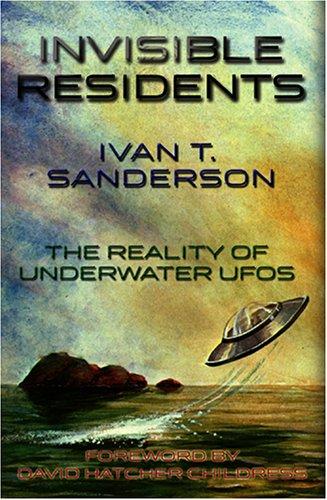
As an Amazon Associate, OverClassified may earn from qualifying purchases made through this link, at no extra cost to you.
Why This Is Essential Reading
Invisible Residents earns its place on this list as the founding document of an entire branch of ufological theory this site maintains its own dedicated file for: without this 1970 book, there is no USO Hypothesis theory page, no "vile vortices" concept for Charles Berlitz to popularize into a five-million-copy bestseller four years later, and no interpretive lens through which to read a Navy-confirmed 2019 sensor recording like the USS Omaha Underwater Object case as part of a decades-long pattern rather than an isolated incident. Ivan T. Sanderson brought genuine Cambridge-trained zoological credibility to a subject most of his contemporaries approached without any comparable scientific background, and that credibility is real — but so is the book's central weakness, laid bare by this site's own independent investigation into its most dramatic single claim: the Puerto Rico sonar case that gives Invisible Residents its most sensational evidence rests entirely on one uncorroborated secondhand account that not even its own author could confirm. Reading the book against this site's own Puerto Rico, Shag Harbour, and USS Omaha case files together is the clearest way to see both halves of Sanderson's legacy at once: a genuinely original, field-shaping idea, and a cautionary example of how thinly that idea's founding evidence could be sourced.
Related Cases & Theories
Essential Viewing
Underwater UFO's & USO's - Ivan Sanderson
fatherluvsus — Archival documentary footage discussing Ivan Sanderson's underwater UFO research and the OINTs framework this book introduced, verified via YouTube oEmbed before inclusion.
USOs - Creepiest "Unidentified Submerged Objects" You've Never Heard Of
The Last Bacon — A modern survey of USO cases that traces the category this book founded through decades of subsequent water-related UFO reports, verified via YouTube oEmbed before inclusion.
Sources Cited
- Sanderson, Ivan T. Invisible Residents: A Disquisition Upon Certain Matters Maritime, and the Possibility of Intelligent Life under the Waters of This Earth. World Publishing Company, 1970; this edition Adventures Unlimited Press, 2005, with foreword by David Hatcher Childress (ISBN-13 9781931882200, matching this site's own USO Hypothesis theory-file citation). amazon.com
- "Ivan T. Sanderson." Wikipedia (biography: birth, education, WWII service, cryptozoology, SITU founding, death). en.wikipedia.org
- "Ivan Terence Sanderson papers, ca. 1920-1973." American Philosophical Society Manuscript Collections (archival biography and career summary). search.amphilsoc.org
- Grigonis, Richard. "A Tribute to Ivan T. Sanderson" and "Chapter 2: Birth, Parents and Education." richardgrigonis.com (detailed biography, including his father Arthur Buchanan Sanderson's 1925 death). richardgrigonis.com
- Sanderson, Ivan T. Invisible Residents, full text. Internet Archive (verification of chapter structure, the "OINTs"/"Other Intelligencies" passage, and the Puerto Rico, Naviero, and Shag Harbour case text). archive.org
- "12 Vile Vortices: The Geometric Anomalies of Ivan Sanderson." Stranger Dimensions (1972 Saga magazine article history and the vortex concept's origin). strangerdimensions.com
- "BOOK: Ivan Sanderson, 'Invisible Residents.'" ill-advised (2008 critical review of the book's writing style, sourcing, and argument). illadvised.blogspot.com
- "Invisible Residents." Open Library edition record (ISBN 1931882207 / 9781931882200, Adventures Unlimited Press, 2005; original 1970 World Publishing Co. edition data). openlibrary.org
- "The Bermuda Triangle (book)." Wikipedia (Charles Berlitz's 1974 bestseller, its sales figures, and its direct debt to Sanderson's "vile vortices" concept). en.wikipedia.org
- This site's own case file: Puerto Rico ASW Range Sonar Contact (Case File #218), which traces its central claim to this exact 1970 account and finds it uncorroborated by any surviving Navy record.
- This site's own case file: The Shag Harbour UFO Incident (Case File #032), which this book discusses directly, three years after the event, as its best-documented case.
- This site's own case file: USS Omaha Underwater Object (Case File #159), a 2019 instrumented case this site's USO Hypothesis file treats as continuing the tradition this book began.
- This site's own theory file: The USO Hypothesis, which credits this book as the framework's founding text and cites this exact edition.
- This site's own theory file: Water Proximity Analysis, for the broader statistical water-clustering research this book's anomaly-zone argument anticipated.
- This site's own key-figures entry: Ivan T. Sanderson, for his full biography and further site-wide case connections.
- This site's own key-figures entry: Carl W. Feindt, for the researcher who substantially expanded this book's original OINTs/USO catalog in 2010.
- This site's own resources library: Full Reading List, where this book is cited across this site's USO Hypothesis and Puerto Rico case-file pages.
Have corrections, additional research, or peer-reviewed sources? Help improve this entry.
Suggest an Edit