
The Naviero Ship Sighting
On the evening of July 30, 1967, Captain Julián Lucas Ardanza and the crew of the Argentine cargo steamer Naviero, roughly 120 nautical miles off Cabo de Santa Marta Grande on the Brazilian coast, reported a glowing, cigar-shaped object some 30–35 meters long pacing their vessel at close range for about fifteen minutes before diving beneath the hull and vanishing into the depths. One of the most frequently cited Argentine maritime UFO reports of the 1960s, the case survives today almost entirely through a single period newspaper account and its subsequent decades of secondary retelling — a citation trail this file traces in detail, including a documented instance of the case's own descriptive paragraph being mistakenly attached to an unrelated Norwegian ship in at least one later catalog.
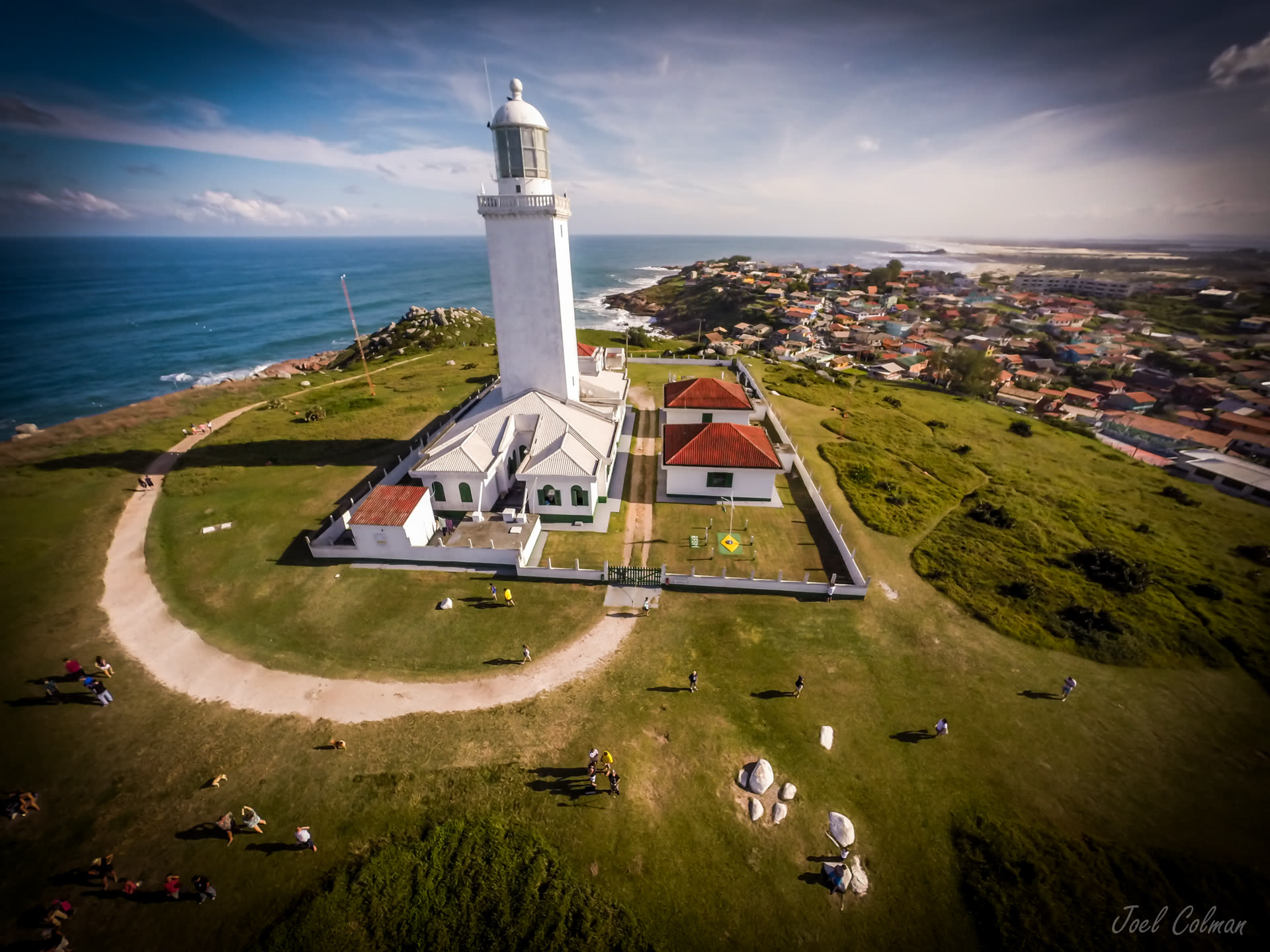
Pictured: the Santa Marta Lighthouse at Cabo de Santa Marta Grande, Laguna, Santa Catarina, Brazil — the coastal landmark nearest the Naviero's reported position, roughly 120 nautical miles further out to sea. Not a photograph of the ship, its crew, or the object itself. No photograph of any kind associated with this case is known to exist.
Theoretical Alignment
This case's evidentiary profile is dominated less by any single competing hypothesis about the object's nature than by a structural problem common to many mid-century international UFO reports: an event that was genuinely witnessed by multiple people and genuinely reported to a period newspaper, but that has never since been subjected to any dedicated investigation, technical analysis, or skeptical case study of its own. The Extraterrestrial Hypothesis receives moderate alignment on the strength of the crew's collective, explicit rejection of a submarine or marine-animal explanation at the time. The Psycho-Social Hypothesis receives comparable weight not because of any documented psychological factor specific to this crew, but because the case's entire modern reputation rests on more than half a century of uncritical retelling across secondary UFO literature, a process this file's own Material Analysis section documents as having introduced at least one demonstrable factual contamination into the wider USO record.
Background
The 1960s were an active period for maritime and submarine-adjacent UFO reports in Argentine waters, part of a broader pattern of "USO" (Unidentified Submerged Object) sightings reported by Argentine naval and merchant vessels through the decade. Earlier incidents in this same national pattern include a 1958 Argentine Navy destroyer's encounter in the Golfo Nuevo, reportedly escalated to President Arturo Frondizi; a 1959 sighting from the frigate Herpina in the Golfo San Jorge; and a 1960 pursuit by the destroyer Cervantes and patrol boats King and Murature in the same gulf, during which depth charges were reportedly used in an attempt to force the object to the surface. A 1963 sighting from the transport ship Punta Medanos reportedly disrupted the vessel's compasses for fifty-five minutes. The Naviero case, four years later, sits within this same established national pattern of open-ocean USO reports rather than representing an isolated or unprecedented event.
The Naviero itself was a cargo steamer operated by Empresa Líneas Marítimas Argentinas (ELMA), Argentina's state shipping line, formed in 1960 from the merger of two earlier state carriers and operating cargo and passenger routes across the Americas, Europe, the Mediterranean, and the Far East until its eventual dissolution decades later. At least one source describes the ship as an older, World-War-II-era vessel specifically built to evade submarine attack during wartime convoy service, later repurposed for civilian cargo work — a detail this file was unable to independently verify against a ship registry or build record, and presents here as a widely repeated claim rather than a confirmed fact.
Argentina's official institutional apparatus for evaluating UFO reports was, by 1967, reasonably well established on both the military and civilian sides. The Argentine Navy's Comisión Permanente para el Estudio de Fenómenos OVNI (COPEFO), founded in 1962 and presided over by Captain Omar Roque Pagani, alongside Frigate Captain Constantino Núñez and, in later years, researcher Daniel Perissé, was the most directly relevant official body for a maritime case of this kind, given the Navy's standing interest in incidents affecting vessels at sea. The Argentine Air Force established its own UFO Division within its Intelligence Service that same year, 1967, later formalized into a dedicated Investigation Commission (1968–69) under Commodore Eduardo J. Palma and Commander Dante Ferrero, with consultant Nicolás Ojeda. On the civilian side, CODOVNI (Comisión de Estudio de los Objetos Voladores No Identificados), founded around 1959 by Ariel Ciro Rietti with Ruth Gerstel, was Argentina's principal independent research organization of the period. This file was unable to locate any document from any of these three bodies specifically naming the Naviero case, meaning its investigation, to whatever extent one occurred, appears to have remained entirely within civilian press and informal ufological channels rather than reaching any official institutional file.
A remark attributed to Italian researcher Renato Vesco, published in a 1954 aviation-industry periodical and later requoted in Argentine ufological retrospectives, captures how Argentina's international reputation on this subject had already solidified more than a decade before the Naviero case: Vesco described the country as enjoying "the striking privilege of constituting a permanent target for the sustained espionage of flying saucers on our planet," while separately noting that formal investigative commissions already existed within all three branches of the Argentine armed forces, with their conclusions kept classified. Whatever the accuracy of Vesco's specific framing, the observation that Argentina had a distinctive, internationally noted concentration of UFO reporting by the mid-1950s is a genuinely relevant piece of context for evaluating any individual Argentine case from the following decade, including this one: the Naviero sighting did not occur in a reporting vacuum, but within a national culture already primed, at both the institutional and popular level, to notice, discuss, and publicize exactly this kind of report.
Complete Timeline
Exact dates for this case carry more uncertainty than most files on this site: at least two secondary sources give different dates (July 20 and June 30) for what is, on close comparison of every other descriptive detail, almost certainly the same event described in the primary press citation as July 30, 1967. This file treats July 30 as the best-supported date, both because it is the date given in the earliest identified citation chain and because it is internally consistent with the ship's reported August 2 arrival in port.
| Date | Event |
|---|---|
| Jul 30, 1967, ~18:15 local | Officer Jorge Montoya first spots an unusual glowing object from the SS Naviero, roughly 120 nautical miles off the Brazilian coast, and alerts Captain Julián Lucas Ardanza |
| Jul 30, 1967 | Ardanza, Chief Officer Carlos Lasca, and other crew observe a cigar-shaped, glowing object pace the ship at close range for approximately fifteen minutes |
| Jul 30, 1967 | The object accelerates, passes beneath the ship's hull, and disappears into the ocean depths; radio operator Elías Rabinovich reportedly relays a report to Argentine and Brazilian maritime authorities |
| Aug 2, 1967 | The Naviero docks at Puerto Nuevo, Buenos Aires; the crew reportedly finds photographers and television camera crews waiting alongside family members |
| Aug 2, 1967 | The Buenos Aires daily La Razón publishes the earliest identified press account of the sighting |
| 1967 | Jesuit priest and amateur astronomer Father Segundo Reyna recounts the case in a public lecture in La Plata, adding secondhand detail attributed to conversations with the crew |
| 1967 | The case is reported in the APRO Bulletin (July/August issue), the first known English-language pickup |
| 1968 | Researcher Oscar Gallíndez covers the case in Flying Saucer Review, Vol. 14, No. 2, further embedding it in the international UFO literature |
| 1970 | Ivan T. Sanderson includes the case in Invisible Residents, his foundational English-language USO compilation, listing the date as "July 20" — likely a transcription error that subsequently propagated into some later sources |
The July 30, 1967 Sighting
By the most consistent published account, the Naviero was proceeding at 17 knots through open Atlantic waters roughly 120 nautical miles off Cabo de Santa Marta Grande, on the Santa Catarina coast of Brazil, when Officer Jorge Montoya first noticed an unusual light in the water and alerted Captain Julián Lucas Ardanza by intercom. Ardanza came on deck and, together with Chief Officer Carlos Lasca and other crew members, observed a cigar-shaped object, variously estimated at thirty to thirty-five meters (roughly 105 to 110 feet) in length, positioned an estimated fifteen to fifty feet off the ship's starboard side.
The object was described as emitting a powerful blue-and-white glow, moving silently and without producing any wake, and lacking any visible periscope, conning tower, railing, or other superstructure that might have identified it as a conventional submarine. The crew's collective and explicit assessment, according to every version of the account this file was able to locate, was that the object was neither a submarine nor any marine animal they could identify — a judgment presumably informed by the practical, everyday familiarity working merchant mariners would have with both categories of object, though no formal statement documenting the specific reasoning behind this conclusion has survived in the published record.
The object paced the ship for approximately fifteen minutes, at points appearing to move slightly faster than the Naviero's own 17-knot speed, with witnesses later estimating its velocity at around 25 knots. It then accelerated, passed beneath the ship's hull at an estimated depth of roughly fifteen meters, and descended rapidly out of sight, reportedly leaving a colored phosphorescence on the water's surface as it departed. Ardanza is quoted, in later secondary accounts, as saying that in twenty years at sea he had never witnessed anything comparable.
The Radio Report and Return to Port
Radio operator Elías Rabinovich reportedly relayed a report of the sighting to both Argentine and Brazilian maritime authorities, given that the event had occurred within Brazilian territorial or near-territorial waters. This file was unable to locate any surviving copy of that radio report, any Brazilian governmental acknowledgment of having received it, or any record of what, if any, action either country's maritime authorities took in response.
When the Naviero reached Puerto Nuevo in Buenos Aires on August 2, the crew reportedly found an unexpectedly large reception waiting for them: alongside family members, press photographers and television camera crews had gathered, apparently having learned of the sighting in advance of the ship's arrival, presumably through the same radio report or through informal word reaching the press via the shipping company or port authorities. No photograph or film from this reception, or of the crew members specifically discussing the sighting, appears to have survived in any publicly accessible archive that this file's research was able to identify.
Key Witnesses
Captain Julián Lucas Ardanza
Commanding officer of the Naviero at the time of the sighting, and the source of most published detail about the object's appearance and behavior. Reportedly stated the sighting was unlike anything he had witnessed in twenty years at sea. No further biographical detail about his subsequent career or any later statements about the case has been located in available published sources.
Officer Jorge Montoya
Reportedly the first crew member to notice the object and alert Captain Ardanza. No further biographical detail or independent statement from Montoya has been located; his role in the case is known entirely through secondary summaries of the ship's collective account.
Chief Officer Carlos Lasca
Named alongside Captain Ardanza as having observed the object from the ship's deck. As with Montoya, no independent, separately documented statement from Lasca exists in available sources; his corroboration is known only through the ship's collective, secondhand-summarized account.
Radio Operator Elías Rabinovich
Credited with relaying the sighting report to Argentine and Brazilian authorities while the ship was still at sea. This detail derives from a single 2025 Argentine tabloid retrospective rather than from the earlier 1967–70 press and ufological citation chain, and this file treats it as plausible but less firmly corroborated than the core sighting account itself.
The Five Observables Assessment
As with most single-encounter cases resting entirely on witness testimony, the assessment below describes what the Naviero's crew reported rather than any independently confirmed technical data.
The Five Observables framework is applied to the performance characteristics reported in this case:
Assessment: The object's reported ability to match and slightly exceed the ship's speed while producing no wake, combined with its final descent beneath the hull into the ocean depths, together constitute this case's strongest claimed performance characteristics — a genuine air-to-water (or, in this case, water-to-deeper-water) transition consistent with the broader USO category. No sudden acceleration in the sense of an instantaneous velocity change was reported, and the described 25-knot pursuit speed, while notable for an unidentified marine object, is well within the range of conventional fast marine craft and does not itself constitute a hypersonic or otherwise physics-defying performance claim. Low Observability is marked absent since the object was, by every account, brightly glowing and clearly visible at close range throughout the encounter.
Evidence Assessment
This case's evidentiary record is unusual among files on this site less for what it contains than for what happened to it afterward: a real, contemporaneously reported multi-witness sighting that appears to have received essentially no dedicated follow-up investigation of any kind in the nearly six decades since.
Supporting Anomalous Origin
- Multiple named crew members, not a single witness, are consistently credited across sources with observing the object
- A contemporary press report (La Razón, August 2, 1967) exists, published within days of the event rather than being reconstructed years later
- The crew's collective, explicit rejection of both a submarine and a marine-animal explanation reflects the practical judgment of professional mariners in a position to make that comparison
- The object's reported behavior — pacing the ship, then diving beneath the hull at high speed — is a specific, consistent performance profile rather than a vague light-in-the-sky report
Supporting Conventional Explanation or Unresolved Uncertainty
- No photograph, film, radar contact, or any other instrumented data exists for any part of this case
- No dedicated investigation by any Argentine or Brazilian official body, or by any named civilian researcher conducting original interviews, has ever been documented
- The case's basic date is inconsistently reported across secondary sources (July 20, June 30, and July 30 all appear), indicating the underlying citation chain has not been carefully maintained
- At least one secondary USO catalog has been shown to attach this case's exact descriptive language to an entirely different, unrelated 1965 Norwegian ship sighting — direct evidence that the case's language has been mishandled in transmission at least once, which necessarily raises the question of what else may have drifted uncorrected
- No named witness beyond Captain Ardanza has ever given an individually documented, separately recorded account in their own words
Why "Disputed"
This case receives a DISPUTED classification because it presents a genuine tension between two facts that pull in opposite directions: a real, multi-witness, contemporaneously reported sighting on one hand, and an almost total absence of any subsequent independent scrutiny on the other. Both facts are unusual in combination. Most thinly-investigated cases on this site are thinly investigated because they were thinly witnessed or thinly reported in the first place; this one was witnessed by multiple named crew members and reported by a real newspaper within days of the event, yet somehow attracted essentially no dedicated follow-up in the fifty-plus years since — not from Argentina's own Navy or Air Force UFO commissions, not from any named investigator conducting original interviews with the surviving crew, and not from any skeptic proposing and testing a specific conventional explanation.
The practical consequence of that absence is that this file's own Historical Precedents and Material Analysis sections had to do analytical work — identifying the case's place within Argentina's broader USO pattern, tracing its citation chain, and flagging the demonstrated cross-contamination with the unrelated 1965 Norwegian ship case — that would, in a more thoroughly investigated case, already exist in the published record for this file to simply cite. That gap is itself informative: a sighting this specific and this multiply-witnessed, left uninvestigated for decades, is neither confirmed nor debunked by that neglect, but the neglect itself is a meaningful data point about how much confidence a reader should place in any secondary-source description of the case's details, including some of the specific figures (object length, pursuit speed, submersion depth) that appear precise but trace back to a single, unverified original report.
This rating sits appropriately below cases with genuine independent multi-source corroboration or instrumented data, and above cases with specific, demonstrated evidence of fabrication. A real event was almost certainly witnessed by the Naviero's crew that evening; what that event actually was remains genuinely and honestly unresolved. The specific numeric score reflects a case that offers real, dateable, named-witness testimony and a contemporary press citation — genuine strengths this file does not discount — set against a citation chain with a documented contamination, an inconsistently reported date, and total reliance on essentially one directly-quoted voice for every specific detail beyond the bare fact that something unusual occurred.
Sensor & Instrumentation Detection Profile
No radar, sonar, or any other instrumented detection is documented anywhere in the available record for this case. Every account, from the earliest 1967 press report through the most recent 2025 retrospective, describes a purely visual, unaided-eye sighting. This is not, on its own, unusual for a 1967 merchant vessel — commercial cargo ships of this era were not typically equipped with sonar, and even where surface-search radar was present, an object this close to the ship (fifteen to fifty feet) would likely have fallen within radar's minimum effective detection range in any case. A civilian cargo steamer of this era and class would also not typically have carried the kind of dedicated underwater-detection equipment a naval vessel like the destroyer Cervantes, discussed in Historical Precedents below, used four years earlier during its own USO pursuit.
No Brazilian or Argentine naval vessel is documented as having been in the area at the time, and no request for any nearby military radar or sonar log covering this position and date appears to have ever been made by any investigator.
Environmental & Geospatial Context
The reported position, roughly 120 nautical miles off Cabo de Santa Marta Grande in the South Atlantic, places the sighting in open ocean well beyond sight of land, along a shipping route connecting Argentine Atlantic ports with destinations further north along the Brazilian coast and beyond. This stretch of the South Atlantic sees substantial commercial shipping traffic and has a documented history, discussed in Historical Precedents below, of comparable reported USO and UFO encounters from other vessels across the same general period and region.
Bioluminescent marine phenomena are a genuinely relevant environmental consideration for evaluating this case: certain marine organisms and algal blooms can produce large-scale, moving patches of blue-white luminescence in open ocean water, and the reported "colored phosphorescence" left on the water as the object departed is, on its face, consistent with a bioluminescent event as either a full explanation or a secondary visual effect layered atop a separate primary phenomenon. This file was unable to locate any specific historical or oceanographic record confirming bioluminescent bloom activity in this exact location on this exact date, and does not present this as a confirmed explanation, only as a genuinely available regional phenomenon this case's own descriptive details make specifically relevant.
The South Atlantic waters off Santa Catarina sit within the path of the Brazil Current, a warm, southward-flowing western boundary current whose interaction with cooler subantarctic waters further south creates a genuinely dynamic thermal and biological frontal zone in this general region — conditions that, in principle, can support the kind of large, patchy planktonic and dinoflagellate concentrations responsible for visible marine bioluminescence. This file notes this regional oceanographic context as circumstantially relevant background rather than as site-specific confirmation, since establishing whether such a bloom was actually present at the precise reported position on the night of July 30, 1967 would require historical oceanographic or fisheries records this file's research was not able to access.
A second, distinct environmental consideration is the shipping route itself. The stretch of Atlantic coastline between the Río de la Plata and southern Brazil was, by 1967, among the more heavily trafficked commercial sea lanes in the South Atlantic, connecting Argentina's major export ports with destinations along the Brazilian coast and, further north, the broader transatlantic trade routes to Europe and North America. A route this heavily used naturally generates opportunities for genuine multi-vessel sightings of the kind reported in the 1964 tanker-and-Sumber case discussed in Historical Precedents above, but it does not, on its own, supply any specific evidence bearing on what the Naviero's crew actually observed on this particular night.
Observer Credibility & Occupational Profile
No corroborating employment records, prior-service history, or independent character references for Captain Ardanza or any other named crew member have been published in connection with this case. What is known is limited to their shipboard roles at the time of the sighting.
A career merchant marine captain's professional standing carries some of the same general credibility weight this site applies to other credentialed professional witnesses elsewhere: a working ship's captain has an ordinary professional interest in his vessel's and crew's reputation for sober, reliable reporting, and no obvious motive to fabricate an elaborate account that could equally invite ridicule as credibility. This consideration applies with real but limited force here, however, since it is weighed against the case's near-total absence of any independent follow-up that might have tested it — unlike cases where a credentialed witness's account has been specifically cross-examined by a skeptical investigator and found to hold up (or not), Ardanza's account has essentially never been tested at all.
The multi-witness structure of this case deserves separate consideration from the single-witness cases more common on this site. A merchant ship's bridge crew, standing watch together during the evening meal hour, represents a genuinely different evidentiary structure than a lone driver on an empty highway: several professional colleagues, each with their own independent reputational stake in the account, would need to either independently misperceive the same phenomenon in a closely matching way or actively coordinate a fabrication sustained across decades without any documented recantation. Neither possibility can be excluded, but the second is meaningfully harder to sustain informally among working colleagues than a single individual's private account, which is itself a modest point in the case's favor distinct from anything specific to Ardanza's own personal credibility.
At the same time, this file is careful not to overstate what "multi-witness" actually means in this specific case. Of the crew members named across the available sources — Ardanza, Montoya, Lasca, and Rabinovich — only Ardanza has ever been directly quoted, and even his quotations arrive secondhand, filtered through decades of press paraphrase rather than a directly recorded, verbatim statement. Montoya's and Lasca's roles in the account are described entirely in the passive voice of later summaries ("was observed by," "was also present"), never through any independently sourced statement in either man's own words. This distinction, between a case that is genuinely multiply corroborated by several separately interviewed witnesses and a case that is merely multiply mentioned within a single collective account, is one this file's own Evidence Assessment above treats as a real and specific limitation on how much evidentiary weight the case's "multi-witness" framing should actually carry.
Physical & Material Assays
No physical object, debris, sample, or trace of any kind was ever recovered or documented in connection with this case. The reported "colored phosphorescence" left on the water's surface as the object departed is a described visual observation, not a collected or physically examined sample, and no water sample, photograph of the phosphorescent patch, or any other physical documentation of it survives. Given that the reported phosphorescence was observed from a moving cargo ship continuing on its regularly scheduled commercial course rather than a vessel positioned or equipped to stop and investigate, this absence reflects the practical constraints of the situation as much as any lack of diligence on the crew's part; a merchant cargo ship mid-voyage is simply not instrumented or resourced to conduct field sampling of an ocean phenomenon it happens to observe in passing.
This absence of any physical trace evidence, while consistent with the great majority of open-ocean UFO and USO reports generally (a moving vessel is rarely positioned to collect physical evidence from a departing aerial or submerged object even when the will to do so exists), leaves this case entirely dependent on witness testimony for every specific claim it makes.
Historical Precedents & Archive Matches
These comparisons situate the case within its broader historical genre; none imply that this file's conclusions about any comparison case automatically transfer to the Naviero's own account, which this site evaluates independently on its own specific evidence.
The case sits within a well-documented Argentine national pattern of open-ocean USO reports spanning the late 1950s through the 1960s, one substantial enough that this file treats it as a distinct sub-tradition within Argentine ufology rather than a loose collection of coincidentally similar reports. The earliest of these precedents dates to May 21, 1958, in the Golfo Nuevo off Chubut province, where an Argentine Navy destroyer reportedly detected a USO closely enough that the incident escalated to the attention of then-President Arturo Frondizi — a level of political visibility no subsequent case in the pattern, including the Naviero sighting, would again reach. On October 19, 1959, the frigate Herpina reported a comparable encounter in the Golfo San Jorge. The most operationally dramatic precedent came on February 10, 1960, also in the Golfo San Jorge, when the destroyer Cervantes, accompanied by patrol boats King and Murature, actively pursued a reported USO and, according to multiple secondary accounts, deployed depth charges in an attempt to force the object to the surface — a far more aggressive institutional response than anything documented in connection with the Naviero case seven years later, and a useful benchmark for how seriously the Argentine Navy was, at least on that occasion, willing to treat a USO report operationally rather than merely administratively.
On November 12, 1963, the transport ship Punta Medanos reported a large UFO that reportedly disrupted the vessel's compasses for fifty-five minutes — a case notable for including a specific, physically measurable claimed effect (compass disruption) that the Naviero case's own account conspicuously lacks, despite the two cases sharing the same basic profile of an Argentine merchant vessel encountering an unidentified object at sea. The following year, on July 28, 1964, two Argentine oil tankers together with the Norwegian vessel Sumber reportedly observed a falling luminous object, a multi-vessel, multi-national sighting that, had it been as thoroughly documented as the Naviero case's own press citation, would represent an unusually strong corroborated USO report; unfortunately, like the Naviero case, it appears to survive today mainly through brief secondary summaries rather than any dedicated investigation. Closer to land, farmer Carlos Corosan reported a cigar-shaped object crashing into the ocean near Puerto Deseado on March 18, 1966, roughly a year before the Naviero sighting, extending the same basic craft morphology (cigar-shaped, associated with the ocean) from open-water naval and merchant encounters to a coastal civilian witness.
Later cases extend this Argentine pattern well beyond the Naviero sighting's own period: Air Force pilot Francisco Sartorio reportedly filmed an object near Mar del Plata in 1971; a metallic debris recovery was reported near Trelew in the 1978–79 period following a separate UFO sighting; and, most recently within this file's research window, airline pilot Jorge Polanco reported a close encounter near Bariloche on July 31, 1995. Internationally, U.S. Navy sonar off Puerto Rico is separately reported to have tracked a large object submerged at roughly 8,200 meters for three days in 1963 (see this site's own Puerto Rico ASW Range Sonar Contact case file) — frequently cited in USO literature as one of the "capstone" cases in the broader genre, and useful here specifically as an illustration of what a USO case with sustained instrumented naval tracking looks like, in contrast to the Naviero case's single unaided-eye observation.
Taken together, this pattern establishes that Argentine naval and merchant vessels were reporting comparable phenomena as a recognized, recurring national pattern for nearly a decade before the Naviero sighting, rather than the case representing an isolated first occurrence, and that at least some of these precedent cases (the Cervantes pursuit, the Punta Medanos compass disruption) involved either a more aggressive institutional response or a more specific, physically measurable claimed effect than anything documented in the Naviero case itself.
Internationally, the case is most directly comparable to the USS Omaha Underwater Object and the Puerto Rico ASW Range Sonar Contact, both American military USO encounters that, unlike the Naviero case, benefited from instrumented naval sensor data rather than resting on visual testimony alone — a useful contrast for illustrating what a more thoroughly documented USO case looks like relative to this one. The Aerolíneas Argentinas Flight AR674 / Bariloche Incident offers a comparison from within the same national UFO-reporting tradition, though in Argentine airspace rather than at sea.
Material Analysis
There is no physical material evidence associated with this case. What this section instead documents is the case's citation chain itself — an unusually important analytical task here, since tracing exactly how this case's descriptive details have moved through more than fifty years of secondary literature turns out to be directly relevant to assessing how much confidence any of those details deserve.
The Citation Chain
The earliest identified source is the Buenos Aires daily La Razón, August 2, 1967, timed to the ship's arrival in port. This was picked up internationally within the same year by the American APRO Bulletin (July/August 1967 issue), and more substantively the following year by Argentine researcher Oscar Gallíndez, writing in the British journal Flying Saucer Review, Vol. 14, No. 2 (1968), a citation later reprinted in the Australian UFO Review. Naturalist and cryptozoologist Ivan T. Sanderson included the case in his 1970 book Invisible Residents, the work most responsible for introducing the case to a broad English-language readership and for embedding it within his broader "OINTS" (Other Intelligences) thesis of ocean-dwelling non-human intelligence — though Sanderson's own version of the case gives the date as "July 20," an apparent transcription error from the more specific and better-supported July 30 date.
Every subsequent secondary source this file's research was able to locate — specialist USO cataloging sites, UFO-history blogs, and aggregator listicles in both English and Portuguese — ultimately traces back to this same short original chain, typically reproducing a version of the same core descriptive paragraph (object length, pursuit speed, the fifteen-minute duration, the dive beneath the hull) with only minor wording variations. This is not, on its own, evidence of fabrication; it is the completely ordinary way a single well-documented historical event propagates through secondary literature. It does mean, however, that the case's apparent multi-source corroboration is substantially illusory: dozens of websites repeating the same paragraph is not the same evidentiary weight as dozens of independent witnesses or investigators each separately confirming the account.
A Documented Contamination: The T.T. Jawesta Case
This file's research identified a specific, concrete illustration of how thin this citation chain has become in practice. At least one widely syndicated USO catalog entry describes a July 6, 1965 sighting by the Norwegian vessel T.T. Jawesta, in the Atlantic between Venezuela and the Canary Islands, using language nearly identical, word for word, to the standard Naviero description — "fifty feet away," "cigar-shaped and about 110 feet," "a powerful blue and white glow," "no periscope or conning tower." Given that the Naviero citation chain traces to a specific, dated, named-crew Argentine press report and the Jawesta entry does not appear to have any comparably specific independent origin of its own, the far more likely explanation is that a secondary compiler at some point copied the Naviero case's descriptive paragraph and mistakenly reattached it to a different ship's name, date, and location — a contamination that has since propagated into at least one further generation of USO literature as if it were an entirely separate, independently corroborating case.
This file treats this finding as directly relevant to how readers should weigh this case's own sourcing, not as a reason to doubt the underlying 1967 event occurred. It demonstrates, concretely rather than speculatively, that the secondary USO literature this case's modern reputation depends on has a documented, non-hypothetical error-propagation problem, and that any given specific figure in a modern retelling — whether from the Naviero case or any comparable case relying on the same thin secondary-literature ecosystem — should be treated as tracing back to a single original report rather than as independently reconfirmed each time it is repeated.
The broader lesson generalizes beyond this specific case: secondary and tertiary UFO-catalog websites, blogs, and listicle aggregators overwhelmingly operate by summarizing and re-summarizing earlier sources rather than by returning to primary documents, a workflow with no inherent error-correction mechanism built into it. A single transcription slip, factual misattribution, or subtle paraphrase drift introduced at any point along that chain has no natural or automatic way to be caught unless someone specifically returns to the earliest identifiable source and checks the current version against it — the exact exercise this file's own Material Analysis section has attempted here. Readers encountering the Naviero case, or any comparably thin USO report, in a source that does not itself cite an original period document should treat that source as, at very best, a faithful copy of an earlier faithful copy, and should weight its specific numerical claims accordingly rather than as independently reconfirmed.
Father Reyna's Secondhand Account
A further complication in this case's sourcing concerns the specific role of Jesuit priest and amateur astronomer Father Segundo Reyna, director of the Adhara Observatory in San Miguel, Buenos Aires. Reyna was already a publicly active figure in Argentine ufological circles by the mid-1960s, having corresponded with American researchers and reported his own observations of unusual aerial activity. His 1967 lecture in La Plata recounting the Naviero case is cited in at least one modern retrospective as a named, dateable public presentation of the story, and is credited with adding the specific detail of the object's estimated 25-knot pursuit speed. Reyna's own account, however, was itself explicitly secondhand: he was recounting what the ship's captain had told him, not describing anything he had personally witnessed or independently verified. His involvement adds a real, dateable data point to this case's citation chain, but does not constitute independent corroboration of the underlying sighting in the way a second, separately positioned eyewitness would.
Sourcing Reliability Concerns
- The case's basic date varies across sources (July 20, June 30, July 30), indicating imprecise handling somewhere in the transmission chain
- The case's core descriptive paragraph has been demonstrably misattributed to an unrelated 1965 Norwegian ship sighting in at least one syndicated catalog
- No named crew member besides Captain Ardanza has an independently documented, separately recorded statement in their own words
- The most detailed modern account (a 2025 Argentine tabloid retrospective) adds specific new details — the radio operator's name, the press reception at Puerto Nuevo — not present in the earlier 1967–70 sourcing, which this file cannot independently verify against any earlier document
The Conventional Explanation Candidate: Bioluminescent Marine Phenomenon Atop a Genuine, Uninvestigated Sighting
Because no dedicated skeptical treatment of this specific case exists in the published literature this file was able to locate, the candidates below represent this file's own original analysis, applying general categories of USO misidentification to this case's specific reported details rather than citing an existing case-specific rebuttal.
The most parsimonious conventional explanation holds that the Naviero's crew genuinely observed a large-scale bioluminescent marine phenomenon — a bloom of luminous marine organisms, moving with current or wind-driven surface water in a way that could plausibly be perceived, at night and at speed, as a discrete object pacing the ship — and that the object's final "dive beneath the hull" represents either the bloom passing naturally out of the ship's path or the visual effect of the water's own luminescence appearing to move beneath the vessel as the ship itself continued forward. This candidate directly accounts for the specific detail of "colored phosphorescence" left on the water, a detail with no obvious place in a purely technological/craft-based reading of the case but a very natural place in a bioluminescence-based one, and it requires no assumption of unusual technology, deliberate deception, or any factor beyond an ordinary, if visually striking, marine phenomenon encountered under nighttime conditions that made its true scale and nature genuinely difficult to judge accurately from the deck of a moving ship.
Submarine Misidentification
A conventional submarine, whether Argentine, Brazilian, or a third nation's vessel operating covertly in international or near-territorial waters, is the most commonly proposed generic explanation for USO reports of this type generally. This file finds it a weaker fit for this specific case than for many other USO reports, given the crew's specific, explicit observation that the object showed no periscope, conning tower, or other identifying submarine features — a detail a crew of professional mariners, likely at least passingly familiar with submarine silhouettes given Argentina's own naval submarine service, would plausibly have been positioned to notice had a real periscope or tower been present, even at night under the described lighting conditions.
Deliberate Fabrication
No specific evidence of deliberate fabrication has surfaced in any source this file was able to locate: no financial motive, no prior history of similar claims from Ardanza or any other named crew member, and a multi-witness structure that would have required active, sustained coordination among several professional colleagues to maintain consistently over decades without any later recantation of the kind documented in some other case files on this site. This file finds no specific basis to treat fabrication as the best-supported explanation, while noting it as a candidate a thorough accounting must formally acknowledge, consistent with how this site treats the same candidate in every other case file regardless of how unlikely it appears on the specific available evidence.
What Would Resolve This Case Further
Moving this case's rating beyond Disputed in either direction would most plausibly require locating and digitizing the original August 2, 1967 La Razón article itself, rather than relying on secondary summaries of it; identifying and interviewing any surviving crew member or their direct descendants; or locating any Argentine Navy (COPEFO) or Brazilian maritime authority file that may exist but has never been published. None of this material is known to have surfaced in the nearly six decades since the event, and given the case's low public profile relative to more famous international UFO cases from the same year, further primary material seems unlikely to emerge without a dedicated archival research effort specifically targeting Argentine 1967 newspaper archives.
A Genuinely Anomalous Encounter
The candidate this file's own rating treats as a live possibility, though not the best-supported single explanation, holds the crew's account largely at face value: that a genuinely unidentified, technologically capable object paced the ship and demonstrated a real air-to-water or surface-to-depth transition beyond any conventional marine craft or natural phenomenon's capability. Proponents of this reading, including Sanderson's original "OINTS" framing, point to the specificity of the crew's description (dimensions, no visible superstructure, the controlled pacing behavior) as exceeding what a purely natural bioluminescent phenomenon would typically produce. This file's own assessment gives this candidate real but limited weight, constrained less by any specific counter-evidence (none exists) than by the case's complete absence of any independent corroboration or technical follow-up capable of distinguishing it from the natural-phenomenon alternative.
Bioluminescent Marine Phenomenon
PlausiblePLAUSIBLE. Directly accounts for the reported "colored phosphorescence" and the object's silent, wake-free movement, though it cannot be confirmed or ruled out without oceanographic records this file could not locate.
Submarine Misidentification
InconclusiveINCONCLUSIVE. The generic default explanation for USO reports, but weakened here by the crew's specific observation of no periscope, conning tower, or superstructure.
Deliberate Fabrication
ImplausibleIMPLAUSIBLE as the primary explanation. No financial motive, prior comparable claims, or documented inconsistency among the crew's own account has ever surfaced.
Genuinely Anomalous Encounter (At Face Value)
InconclusiveINCONCLUSIVE. Supported by the account's specificity and multi-witness structure, but untested by any independent investigation capable of distinguishing it from a natural-phenomenon explanation.
Related Cases
The three cases below each share this case's core USO (Unidentified Submerged Object) classification or its Argentine national context, while differing in their evidentiary depth in ways that usefully illustrate the range within this case category.
Confirmed Documents & Official Records
No published Argentine Navy (COPEFO), Argentine Air Force, Brazilian naval, or U.S. Project Blue Book record specifically naming the Naviero case is known to exist. A radio report was reportedly relayed to both Argentine and Brazilian maritime authorities at the time, but no surviving copy of that report or any official response to it has been located.
Search Government & Military Archives Directly
Further Reading — Recommended Literature
This site's own Essential Reading feature on Invisible Residents and its dedicated USO Hypothesis theory page cover the broader underwater-intelligence framework this case is most often cited within; the five titles below broaden that coverage to the wider maritime UFO literature and general skeptical methodology.
Invisible Residents
The foundational English-language USO compilation that first introduced the Naviero case to a broad international readership, framed within Sanderson's broader theory of ocean-dwelling non-human intelligence.
Above Top Secret
A comprehensive catalog of government-adjacent UFO cases including numerous USO and maritime encounters, useful for situating this case within the broader genre of underwater unidentified phenomena.
Anatomy of a Phenomenon
An early, methodologically careful survey of the UFO phenomenon by a researcher who later specifically addressed the evidentiary challenges of thinly-sourced, secondary-literature-dependent cases like this one.
UFOs Explained
A foundational skeptical treatment of UFO testimony broadly, useful for the general misidentification-category framework this file applies in the absence of any case-specific skeptical analysis.
The UFO Book: Encyclopedia of the Extraterrestrial
A comprehensive general reference covering USO cases and the international UFO literature of the 1960s and 1970s that first carried the Naviero case to a wide readership.
DISCLOSURE: Some links above are affiliate links. If you purchase through them, OverClassified receives a small commission at no additional cost to you. This helps support independent research.
Essential Viewing
No Videos Available
Sources
- Parodi, Carlos. "Impactante: los testigos de 'OSNIS'." Crónica, March 23, 2025. cronica.com.ar
- Gallíndez, Oscar. "Case report: the Naviero." Flying Saucer Review, Vol. 14, No. 2 (March/April 1968), p. 22.
- Sanderson, Ivan T. Invisible Residents: The Reality of Underwater UFOs. World Publishing, 1970. Full text at archive.org
- "Underwater UFO's." UFO Evidence. ufoevidence.org
- Feindt, Carl. "USO Case Files." WaterUFO.net. waterufo.net
- "Filer's Files #42 – 2016 Underwater USOs." National UFO Center. nationalufocenter.com
- "Unidentified submerged object." Wikipedia. en.wikipedia.org
- "UFO sightings in Argentina." Wikipedia. en.wikipedia.org
- "Ché OVNI." Wikipedia (Argentine ufological culture, contextual background). en.wikipedia.org
- "Empresa Líneas Marítimas Argentinas (ELMA)." Wikipedia. es.wikipedia.org
- Vesco, Renato. Cited in Fuerza Aérea publication, 1954, on Argentine UFO commissions.
- "Santa Marta Lighthouse." Wikipedia. en.wikipedia.org
- "File: Santa Marta Lighthouse in Laguna - SanTa Catarina - Brazil.jpg." Wikimedia Commons. commons.wikimedia.org
- Vallée, Jacques. Anatomy of a Phenomenon. Henry Regnery, 1965.
- Good, Timothy. Above Top Secret: The Worldwide UFO Cover-Up. William Morrow, 1988.
- Klass, Philip J. UFOs Explained. Random House, 1974.
- Clark, Jerome. The UFO Book: Encyclopedia of the Extraterrestrial. Visible Ink Press, 1998.
See something inaccurate? Have additional information or sources?
Suggest an Edit →Last Updated: August 2026