
The Iarga Encounter
The Iarga story exists in one source: Buitenaardse beschaving (1969), a first-person book by "Stefan Denaerde," the pen name of Dutch businessman Adriaan Beers (1924–1998). Its narrator, "Stef," says his flat-bottomed sailing boat ran onto a disc-shaped craft lying awash in the Oosterschelde one summer evening, that he rescued one of its crew from the water, and that over about two days the crew, from a planet called Iarga about ten light-years away, showed him their world on a screen and lectured him on the laws a civilization must obey to survive. Beers never confirmed publicly that it really happened. No other witness, record or physical trace exists.
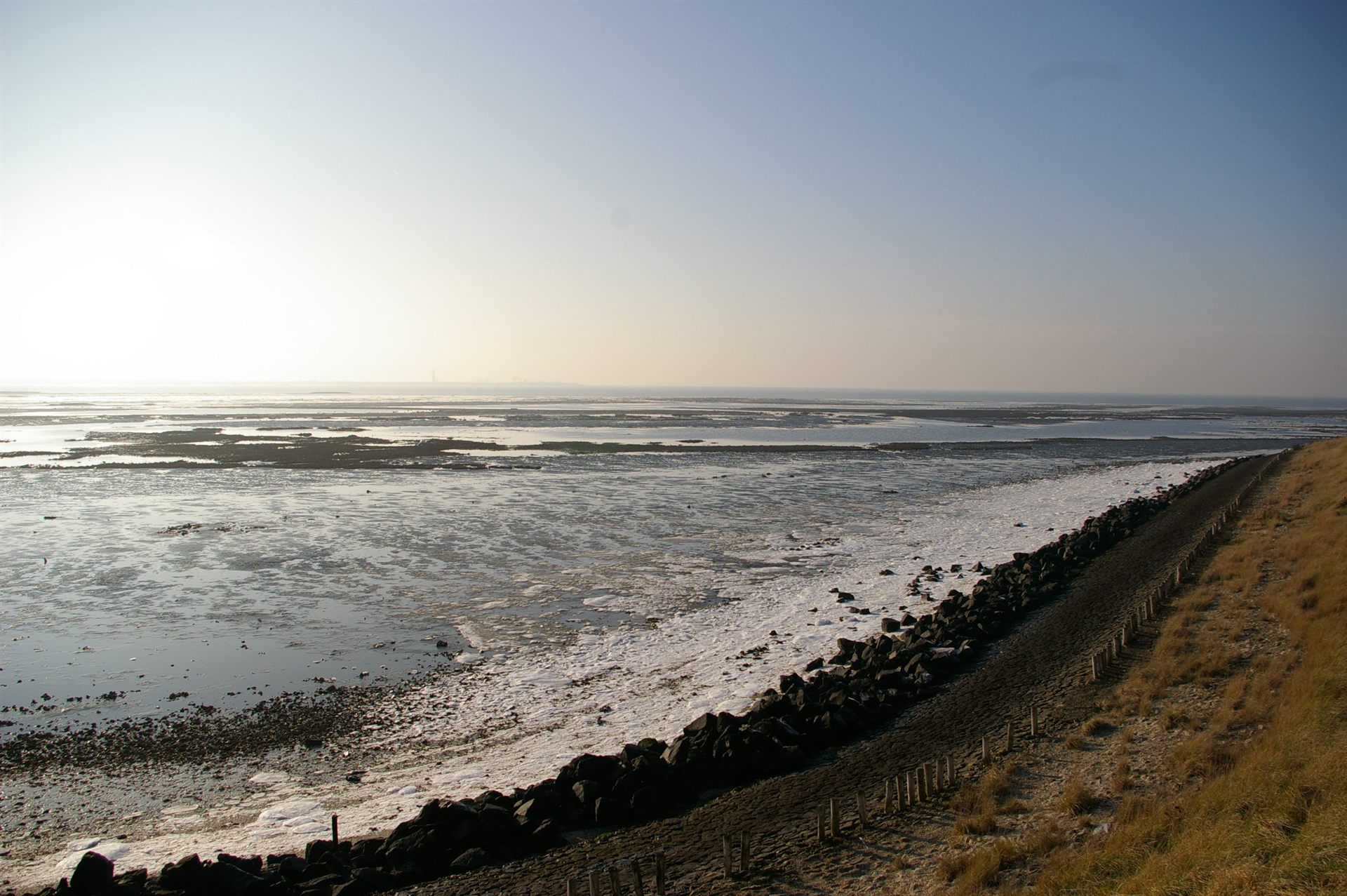
Pictured: the Oosterschelde estuary in Zeeland, the Netherlands, near where Adriaan Beers (writing under the pseudonym Stefan Denaerde) wrote that his boat ran onto a half-submerged disc, in a summer usually given as 1967 — a general view of the estuary's tidal flats and sea defenses, not the specific stretch of water where the collision reportedly occurred. No photograph of the object exists; Beers's account was never independently photographed or filmed.
Theoretical Alignment
The Iarga story fits the categories of UFO research awkwardly, because it is known only from a book whose author never said in public that it was true. Read literally, it is an Extraterrestrial Hypothesis (ETH) case: a physical craft, a physical crew, a named home planet and a described propulsion system. Its content, though, is mostly moral and economic teaching, and the visitors explicitly refuse to give technical help. That emphasis on instruction links it to the contactee tradition and to the Interdimensional Hypothesis (IDH), in which contact serves to educate. The Psycho-Social Hypothesis (PSH) reading is the most economical: a successful businessman wrote a utopian argument about efficiency, justice and the dangers of technology, and framed it as a contact story. The book's own illustrator called it "a utopian book." The percentages below are editorial judgments, not measurements.
Background
The story is set in the Netherlands of the late 1960s, a prosperous country in the middle of the Delta Works, the program of dams and barriers begun after the 1953 North Sea flood. The Oosterschelde, the tidal arm of the sea between the islands of Schouwen-Duiveland and Noord-Beveland, was still open water; its storm-surge barrier was not completed until 1986. The book's narrator, "Stef," was sailing home toward the small harbor of Burgsluis on Schouwen-Duiveland when the encounter began.
The author was Adriaan Beers (born 27 June 1924, died 5 February 1998, according to The Encyclopedia of Science Fiction), a Dutch businessman who wrote as "Stefan Denaerde." In the book the narrator says he is 43, a Catholic, and director of a business with a few hundred employees; if the narrator is Beers, his age points to 1967. The illustrator Rudolf Das, who drew the book's pictures, later described the author as the director of a large company. Wendelle Stevens, who published an English edition in 1982, called him "a master mechanical engineer" and the owner of several international companies. The earlier version of this page described him as an importer of heavy vehicles and Hino trucks; no source for that was found. In the book the boat is a tjalk, a traditional flat-bottomed sailing barge; Das recalled it as a Lemsteraak, another traditional Dutch type.
The book was written in the shadow of the Cold War and the space race, and its message speaks to both. The visitors tell Stef that the most dangerous law governing an intelligent people is that a highly technological society must eliminate all discrimination or destroy itself. They warn that nuclear weapons will spread from the great powers to smaller nationalist groups, and that technical knowledge given to a socially immature people only increases the danger. Bert Bakker, reviewing the book for the Dutch accountancy magazine Accountant in 2019, read it as a critique of capitalism written, unusually, by a successful entrepreneur.
Complete Timeline
| Date | Event |
|---|---|
| Summer evening (year not stated) | The Broken Compass. Stef's son reports that the compass is broken; the card is tilted and the north mark points east, toward the Zeeland Bridge. Stef suspects a joke, then gives up and motors in the dark toward Burgsluis. |
| Same evening | The Collision. A blue-white searchlight shines from directly ahead, a high whine sounds, and the boat runs onto something solid. A flat, dark object lies in the water. |
| Same evening | The Rescue. Stef sees a body in a metallic suit floating face down, jumps into waist-deep water over the hard platform and drags the figure to his dinghy. A second suited figure approaches; seeing its non-human face, Stef panics and flees back aboard. The boat is held fast. |
| Same evening | The Offer. Two figures bow in greeting. A mechanical voice speaking broken English thanks Stef and offers a choice: a block of an unknown metal as proof, or information about their civilization. He chooses information and promises secrecy. |
| Next morning | Into the Craft. The platform resurfaces. Despite his wife's objections, Stef climbs down into a small decompression chamber, where he sees eight beings through a window and is shown Iarga on a panoramic screen. |
| About two days | The Briefing. Stef returns to his boat to eat and sleep between sessions. The lessons cover efficiency, the moneyless "universal economy," freedom, "omni-creativity" and cosmic integration. |
| Final evening | Departure. Stef destroys his roll of film in view of the craft, as promised. The craft releases the boat, moves seaward at six or seven knots, and later rises from the sea; a second disc follows. |
| Following months and years | Continuing "Contacts." According to Wendelle Stevens's 1982 edition, the author later received further information by a kind of mental transmission, which became the material for a second book. |
| 1968–1969 | Manuscript and Illustrations. The author asks the illustrator Rudolf Das to illustrate his manuscript; Das and his wife Maja help edit it. |
| 1969 | Dutch Publication. Buitenaardse beschaving is published by Kluwer/Ankh-Hermes in Deventer. Das's foreword calls it "a utopian book," not science fiction. Das later counted fourteen printings. |
| 1977 | English Translation. Operation Survival Earth, translated by Ed Soyka, is published as a paperback by Pocket Books in New York. |
| 1982 | Stevens Edition. Wendelle Stevens publishes UFO…Contact from Planet Iarga through his UFO Photo Archives in Tucson, presenting the story as fact and adding material from the later "contacts." |
| 5 February 1998 | Death of Adriaan Beers. According to Das, he never officially confirmed in any interview that the story was true. |
How the Book Was Made and Published
The fullest account of the book's origins comes from its illustrator, Rudolf Das, who with his twin brother Robbert had made a name in the 1950s with cutaway drawings of aircraft. In a foreword to a later reissue, Das recalled that a rather nervous man telephoned him asking for an urgent appointment and, two weeks later, sat across the table from him: "Stefan," the director of a large company, who wanted illustrations for a manuscript that had to appear as quickly as possible. The story of being drawn into contact with visitors while sailing on the Oosterschelde at first sounded absurd to Das, but the man supplied so many technical details that seemed to check out that Das began to doubt his first impression.
The manuscript was long and, Das wrote, stylistically rough. Das put it aside, and it was his wife at the time, Maja, who read it first and urged him to take it seriously. She then helped edit it. The book appeared in 1969 from Kluwer in Deventer (later issued under the Ankh-Hermes imprint), and Das counted fourteen printings and translations into German and English. The author's meetings with the couple at their home in Aerdenhout became, Das recalled, conversations between friends, always accompanied by rough sketches, and the author frequently corrected the drawings. A second book by the same author, De universele schepping, followed, and a radio interview he gave to the Dutch broadcaster KRO survives. In English, the story was published first by Pocket Books in 1977 and then, with additional material, by Wendelle Stevens in 1982.
The Encounter on the Oosterschelde, as the Book Tells It
Everything known about the encounter comes from the book, so this section summarizes the book's account rather than an investigation. It opens on a windless summer evening on the Oosterschelde. Stef is in a deck chair with his coffee when his son tells him the compass is broken. The compass card is tilted against the glass and its north mark points east. Stef suspects a magnet trick, cannot find the fault, and after his wife Miriam has put the children to bed, motors in the dark toward the harbor at Burgsluis, steering by the buoys. The earlier version of this page said the compass "spun" and then "locked"; the book describes a tilted card pointing the wrong way.
About six miles from home, a blue-white searchlight shines into his eyes from directly ahead, and he hears a high-pitched whine over his engine. He throws the engine into reverse too late, and with a frightening noise the boat comes to a standstill against something solid. In the searchlight's sweep he sees a body in a metallic suit floating face down on the incoming tide. Following the drill he has rehearsed for a child overboard, he jumps in with the dinghy line and lands in less than three feet of water on something "as hard as steel." He reaches the body, which is too heavy to lift, ties it alongside the dinghy and tows it back.
Then a great diffused light comes on beneath the water, and a second suited figure runs out across the platform and wades toward him. When it turns its face to him, Stef sees that it is not human: an animal-like face with large square pupils and an air of complete superiority. He panics, flees back through the water to his boat and tries to reverse away, but the boat will not move. The being lifts the rescued crewman from the dinghy and carries him off, and the lights go out. His eldest daughter decides they have rammed a submarine, which is not unlikely, the narrator notes, because they are near a naval training area. Miriam does not believe his story and pours him a whisky.
With a flashlight Stef examines the object. It lies just above the water, round and dark gray, about as wide as his boat is long ("certainly sixteen meter"), with a twisted metal pillar about 1.5 meters wide and 2 meters high in the middle. Probing with a boat hook, he finds it under the bow and stern, and each time the hook seems to stick to it. He concludes the compass trouble was magnetism: the boat is stuck to a huge magnet. He recovers his dinghy as a possible escape route, and then two figures climb out of a hatch carrying equipment, bow to him, and stand at the edge of the platform.
A loud, mechanical, staccato voice asks, in broken English, whether he understands them. The visitors thank him for saving their crewman, explain that they have studied Earth and learned English from its broadcasts, and offer a gift: a block of a superconducting metal used for their hulls, which would prove their existence. Stef asks instead how their craft is powered, and is rebuked. Technical information, they say, would be a crime against cosmic law for a people whose social development lags so far behind its technology. They offer a choice between the metal and an explanation of what a socially stable culture is, which will take at least two days. He chooses the explanation and, with his wife, promises not to contact anyone while they are there. The earlier version of this page described a calming blue light that gave the family "a deep sense of peace"; in the book Miriam is frightened and opposed throughout.
That night the platform sinks with a loud droning noise, and the boat, anchored to it by a chain, is towed forward over a foaming wake lit from below by a dull yellow-green light. In the morning, in answer to his knocking signals, the platform rises again. In daylight its surface is mostly smooth, dark gray stone-like material scattered with white patches and scored with ragged, charred grooves, as if it had been grazed by fire. Miriam begs him not to go. He wades over with sandwiches, a thermos and notepaper, and climbs down a pole with staggered footholds into a cube-shaped chamber about 2.5 meters across.
The chamber is a small decompression room lined with equipment, with a desk, a leather-upholstered chair and a curved panoramic screen about 1.5 meters wide. Through a window beside it Stef looks into a round navigation room about 15 meters across, where eight beings sit in a half-circle. He never shares a room with them; the explanation given is that the two atmospheres are too different. The earlier version of this page described an airlock where the crew removed their suits in front of him, a "high-pressure" cabin and a "nictitating membrane"; none of this is in the book.
The visit ends on the evening of the second day. Stef has promised to destroy the film in his camera, and he does so standing in the water in front of the craft. The craft releases his boat and moves seaward at only six or seven knots, which he puts down to the shallows and sandbanks. He follows it out past Walcheren and Schouwen to the open sea, where, at dusk, a disc rises from the water in a glowing halo, spirals up around his boat and dwindles to a point of light. A second disc follows straight up. The earlier version of this page gave clock times for each stage (16:00 departure, 20:00 collision, 04:45 return). None of them appear in the book, and they have been removed.
The Iargans as the Book Describes Them
The Iargans as the book describes them are humanoid but strikingly different. The two crewmen on the platform are about 1.40 meters tall, with short, heavy legs, arms reaching to their knees, broad shoulders and heavy, claw-like hands; their gloves enclose the thumb and second finger together. The narrator stresses their evident strength: he thought they would not step aside for a gorilla. The illustrator Rudolf Das drew them from the author's descriptions, and the author notes that Das was "driven nearly to distraction" by his attempts to describe their faces.
Seen through the window, their heads are about human size but deeper toward the back, with a bony ridge along the middle of the skull that becomes a deep groove in the forehead, so that the skull seems divided into two compartments. The ridge ends in a semicircular muscle that runs down the neck into the shoulders. Their eyes are deep-set, with large rectangular pupils, which the narrator found hypnotic. The top and back of the head are covered with short, smooth hair like an animal's coat, rust-brown, gold or silver-gray, and the hairless skin has a pale, glassy sheen, darker gray-brown at the edges of the face, which seems to change tone as they turn their heads.
Their teeth are two seamless white strips that close like scissors. Their muscle seems harder than ours, "more like solid rubber," and the thin skin follows its contours closely. They can sit perfectly still for long periods and then move with lightning speed. They wear dark-blue silky overalls with three-quarter sleeves and a deep V neck over a white high-collared shirt, with a broad gold-colored belt decorated with motifs like atomic diagrams. A caption in the book explains their build as an adaptation to Iarga's conditions: a higher gravity and faster falling speeds require heavier bones and muscles, an armored skull and better-protected eyes.
The fullest physical description appears in a caption to one of the drawings, as reproduced in the 1982 English edition. It says the Iargans were originally amphibians that "really belong in the water," with streamlined bodies like a seal's, short smooth hair like an otter's, and large, broad hands and feet with webs between the fingers and toes, so that they can outswim any human. The same caption says their sexual characteristics are less pronounced than ours and that their population grows slowly. A Dutch reader who first read the book as a boy in 1969 recalled the Iargans' appearance as something like a cross between an ape and a horse.
Communication in the book is by machine, not telepathy. The visitors speak through a translating device that builds English sentences from fragments of human broadcasts, which gives the voice its staccato rhythm and mixed male and female tones. Inside the craft, a "radiation reflector" fitted above Stef's head supplements the pictures on the screen and, the visitors say, plants information directly in his memory. The narrator describes feeling cold and slightly light-headed, "like having had a little too much wine."
The earlier version of this page added a long anatomical profile that has no basis in the book: copper-based blue-green blood, a nictitating membrane, grinding plates instead of teeth, ear openings behind the eyes, a herbivorous diet, fused vertebrae and a collective "low-level mental field." None of these details was found in the 1982 English edition or in the corrected translation of the Dutch text, and they have been removed.
Planet Iarga as the Book Describes It
On the panoramic screen, the visitors first show Iarga from space: a "gigantic pink-white globe" with an unbroken, swirling cloud cover, two flat concentric rings like Saturn's, and a large, cratered moon. It lies in another solar system "not much more than ten light years" from Earth; they decline to say exactly where. Its diameter and mass are much greater than Earth's, its gravity stronger, its atmosphere much thicker, and it rotates more slowly. Because the rings reflect sunlight, some days on Iarga become nights and some nights days.
A permanent layer of mist in the upper atmosphere filters the sunlight, so Iarga never sees bright sun, moon or stars; green predominates, and the Iargans call Earth "the blue planet with the blinding light." A caption in the book gives the gravity as nearly 3g and the atmospheric pressure as more than 7 bar, with more nitrogen and ammonia than our air. Temperature extremes are milder than Earth's, but winds can reach three times our maximum and rainfall ten times ours, and a fall from two meters is fatal. The earlier version of this page described a water world with "double suns," an atmosphere "forty times thicker" than Earth's and violet light; the book says none of this.
The screen then takes Stef down through three cloud layers to a bright-green ocean crossed by a railway bridge on tall, slender towers. Streamlined "torpedoes" run along it in both directions on an eight-track system in two layers, each spaced about ten times its own length from the next. Inland, the orange railway divides the land into regular rectangles, with huge glass buildings like oil tanks with domed roofs strung along it, farmland between them, and occasional industrial complexes. The narrator calls it ribbon development in its most extreme form.
The buildings are the Iargans' "house cylinders," each a complete city. In the book they are built by robots on a saucer-shaped foundation, with a steel frame meant to last for thousands of years, and each contains a computer center and a shopping center; a caption in the English edition describes them as "floating and rotating." Inside one, Stef is shown a hollow central garden at least three hundred yards across, with a quarter of the wall made of glass. Schools and hospitals are also in the cylinders.
The earlier version of this page added details not found in the book: ocean-thermal and tidal power, superconducting batteries, maglev trains in undersea vacuum tunnels, aeroponic food towers, molecular-level recycling and ocean sensor networks. These have been removed. What the book does stress is that every product is built for the longest possible life, because repairs are inefficient, and that the planet's natural resources are treated as finite.
Inside the Craft, the Screen and the “Sun Wheel”
What Stef sees of the craft itself is limited. From the outside, it is a round, slightly domed platform about 16 meters across, lying with its edge level with the water. It rests on a ledge that reflects light like glass, and a twisted black pillar stands at its center. Inside, he sees only the small decompression chamber and, through a window, the navigation room: instruments and control panels mounted on the floor between walkways and vertical metal grilles, everything dark blue to black so that the white and polished controls seem to glow, and a highly polished wall that reflects like glass.
The screen is the center of the experience. Stef describes it as a curved, three-dimensional color panorama so convincing that he looked behind it to be sure nothing was there. The visitors adjust it from the desk, and the "radiation reflector" lets him know at once which knobs to use. The pictures are accompanied by a stream of simple words, "a somewhat childish endearing description," while the real information arrives, he says, unnoticed. He compares his role to that of a tape recorder and explains that he has written the experience up as a two-sided conversation only for the sake of readability.
Late in the visit the Iargans show him a film about their spacecraft. The disc, they say, is the universal final form of starships because the propulsion unit, the "sun wheel," is round. In a factory hall at least twelve hundred feet across he sees a disc under construction, with a complicated star-patterned rib structure, and near its rim two tubes about 6 meters in diameter, one above the other, surrounded by a larger tube of triangular section. In the two inner tubes, they explain, matter is spun in opposite directions in a magnetic field, "a sort of synchrotron."
The explanation that follows is the book's most technical passage. Fast particles are released at two opposite points of the ring into an "antimass field," where they vanish as immaterial energy, giving the effect of a rocket firing at the speed of light; the lost matter is recreated from that energy, so nothing is consumed. A caption describes a mother ship about 250 meters across, with smaller discs as landing units, and says that electromagnetic fields, high temperatures and ionized air make such craft impossible to see clearly. Stef asks whether this information could let humans build a sun wheel, and is told that it could not.
The earlier version of this page described neural headbands, an artificial-intelligence navigation system, a "boundary layer" that vaporized water, a hull of titanium, carbon fiber and ceramic, molecular sieves and twelve radial ribs. None of this is in the book, and it has been removed. The book says only that the hull metal is superconducting, stronger than steel and half its weight, with a very high melting point. The visitors offered him a block of it and he declined.
The Iargan Economy
Most of the book is not about the craft at all but about how Iargan society is organized, presented as lessons in "efficiency" and "justice." The visitors argue that justice requires that either everyone owns the same or no one owns anything, and that the second is the more efficient. Money, being a form of property, does not exist on Iarga. Stef, a supporter of the free economy, protests that abolishing personal possessions would never work, and that communism's ideals were lost in inefficiency. The Iargans reply that communism failed because of a false view of the state, not because the ideal was wrong.
Production on Iarga is organized in "trusts": primary trusts that supply consumers directly and secondary trusts that supply the primary ones. They work at cost price, calculated in a standard unit of work time the book calls the "ura," instead of for profit. Natural resources are in principle free, and the book discusses how something like gold is priced without supply and demand.
"Nothing is paid for on Iarga, only registered." Each house cylinder has a computer center linked to its shopping center, and what each consumer takes is recorded against an allowance, which the book calls the "right of acquisition." Expensive things such as houses and cars are not bought. Consumer goods are built to very high quality, because repair is inefficient, and the narrator jokes that insurers, retailers and repair firms would make a poor living there.
Advertising and public relations are close to indecent on Iarga, because propaganda damages freedom of thought. Instead, two worldwide consumer organizations carry out all market research and judge the usefulness of products, so that competition rests on consumers' free choice rather than on efforts to influence it. The book also discusses limits on the ratio between the highest and lowest incomes and how leaders can be motivated without wealth.
The earlier version of this page described a free healthcare system with gene therapy and cellular regeneration, compulsory public service in youth followed by retirement, and goods delivered by pneumatic tube or drone. These details were not found in the book and have been removed. Bert Bakker's 2019 review in Accountant read the economic chapters as an anti-capitalist utopia, notable mainly because it was written by a successful entrepreneur.
The Laws of Cosmic Selection
The book's philosophical core is a pair of "cosmic selection laws." The first is given on the platform on the first evening: a highly technological society must eliminate all discrimination, or it destroys itself. Later the visitors restate it as a confirmation of Christ's condemnation of social discrimination, with "chaos and eventual self-destruction" as the penalty. The second law, they say, "poses 'Christian love' as a condition for cosmic integration": only unselfish behavior can give an intelligent race the certainty of survival.
The religious framing is explicit. When Stef says he is a Catholic, the visitors express interest in how someone with so much property can seriously call himself a Christian. The book also describes a "reincarnation selection" which, it says, still operates on Iarga and roots out the selfish, but which "lost its validity on Earth long ago." The earlier version of this page said the Iarga case was distinguished by its "complete lack of spiritualist or mystical themes"; that is not true of the book.
The warnings are concrete. The visitors say that only the great powers have nuclear weapons now, but that smaller nationalist groups soon will, and that a still more dangerous weapon based on "immaterial radiation" will one day let a handful of people destroy mankind. They also blame Earth for poverty: half the world's population lives in poverty and hunger while it plays with Mars probes. They single out the white race for its treatment of others.
Non-intervention runs through the whole book. The visitors say that contact with an intelligent race is possible only once it reaches "social stability," and that giving technology to a socially immature people would be a crime against cosmic law. They justify talking to Stef as a reward for his unselfish rescue. In the closing scene they call the encounter "Operation Cosmic Integration Earth" and tell him he will be remembered as "Stef of the Earth." Stevens later said the pen name Stefan Denaerde was derived from that phrase.
Whether this is revelation or argument is the central question of the case. Rudolf Das's original foreword, reprinted in a later reissue, called the book "not science fiction" but "a utopian book," dangerous for conservative people who thought they were doing well. In a foreword to a later reissue, Das wrote that Beers had never officially confirmed the story in any interview, and that for the reader it did not much matter whether it had really happened.
Government Records Section
Key Witnesses
Adriaan C.M. Beers
Adriaan Beers (1924–1998) wrote the book under the pseudonym Stefan Denaerde, and its narrator is the only witness to the encounter. Beyond his dates and his career as a businessman, little about him is documented: the narrator says he directs a firm of a few hundred people, the illustrator Rudolf Das called him director of a large company, and Wendelle Stevens called him an engineer and multinational industrialist. According to Das, he never officially confirmed in an interview that the story was true. No independent investigation of his account is known.
“Miriam” (in the book)
In the book, the narrator's wife Miriam is on board with their children. She does not believe him on the first night ("There are no men from Mars in the Oosterschelde"), opposes his visits to the craft, and watches the departure. Whether Beers's real wife was named Miriam, and whether she ever said anything about the story, is not documented. The earlier version of this page described her as a corroborating witness who confirmed the object "during private investigations"; no such statement or investigation was found.
Lt. Col. Wendelle C. Stevens
Wendelle Stevens (1923–2010), a retired U.S. Air Force lieutenant colonel, published the 1982 edition through his UFO Photo Archives. His introduction presents the book as "a true story," says he investigated the case for four years, and adds a claim that NATO communications specialists detected an unexplained radio signal near the author's home in The Hague at the times he received his later "contacts"; no source is given for that claim. Stevens was arrested in 1982 on child-molestation charges, pleaded guilty and was sentenced to seven years in prison, and he was the leading American promoter of the Billy Meier photographs, widely regarded as a hoax. Neither fact settles the Iarga question, but his endorsement adds little independent weight.
The Five Observables Assessment
The performance characteristics of the USO reported during the 1967 Oosterschelde encounter are analyzed using the Five Observables framework:
In the book the platform rose and sank in the water and later lifted from the sea; this rests entirely on the author's narrative.
The book has the craft leave the estuary slowly, at six or seven knots, then rise in a glowing spiral and dwindle quickly to a point of light.
Not described in the estuary; the book's claims about interstellar propulsion are part of the visitors' lecture.
In the book the craft lay awash and unlit in a channel at night; no observation by anyone else exists either way.
The book describes the craft submerging, towing the boat underwater-fashion, and later rising out of the sea; no independent observation exists.
Assessment: Every observable in this case comes from a single book, written by an author who never publicly confirmed that it was a factual account. The craft's reported behavior (lying in shallow water, submerging, rising from the sea) would count as trans-medium travel and lift without visible means if the story were true, but there is no observation outside the narrative, so all are marked Speculative. The earlier version of this page marked four observables "Present" and described a compass that "spun" because of a field-propulsion system; the book describes a compass card tilted and pointing east, which the narrator attributes to magnetism.
Evidence Assessment
Supporting Anomalous Origin
- The book is detailed, internally consistent and written in a sober first-person style, and its author was a successful businessman with no obvious motive to invent a contact claim.
- The illustrator Rudolf Das, who worked closely with the author, recalled that the author repeatedly corrected his drawings ("No, that is not how I saw it").
- The author used a pseudonym and did not exploit the story publicly; Das says he never sought confirmation of it in interviews.
- The book's picture of a three-dimensional panoramic screen and computerized registration of consumption anticipated later technology, though such ideas were already current in 1960s futurism.
- Wendelle Stevens said he investigated the case for four years and concluded it was genuine (his evidence is not published).
Supporting Conventional Explanation
- The entire account rests on one book; no named witness, record, photograph or physical trace exists, and the narrator says he destroyed his only film.
- The author never confirmed publicly that it happened, and his illustrator presented the book from the start as "a utopian book."
- The book's content is an argument about efficiency, justice and Christian ethics that mirrors 20th-century political and religious debates, suggesting a human origin.
Why "DISPUTED"
The Iarga Encounter is rated DISPUTED because, beyond the existence of the book, there is nothing to evaluate. The narrative is detailed and its author was a respectable businessman, but he published it under a pseudonym and, according to his illustrator, never confirmed in any interview that it was literally true. The family members in the story have never been identified or quoted, no date is given, and no Dutch record mentions a vessel striking anything in the Oosterschelde. The case's reputation as a "contact" case rests largely on Wendelle Stevens's 1982 edition, which presented it as fact. Read on its own terms, the book is a utopian moral argument in the form of a contact story, and the question of whether anything happened on the water cannot be answered from the record.
Sensor & Instrumentation Detection Profile
There is no instrumental data of any kind. The only "instrument" in the story is the boat's compass, and the book describes its card as tilted against the glass with the north mark pointing east, which the narrator later attributes to the craft's magnetism. No radar, sonar, naval or coastguard record of an object in the Oosterschelde has been found, and none has been looked for by any named investigator. The earlier version of this page said that "subsequent investigators" had found the estuary's geography made sonar detection difficult; no such investigators or findings were identified.
Environmental & Geospatial Context
The Oosterschelde (Eastern Scheldt) is a broad tidal inlet in Zeeland, with deep channels between shallows and sandbanks and strong tidal currents. In the late 1960s it was still open to the sea; the Delta Works closed other inlets first, and the Oosterscheldekering, a storm-surge barrier that normally stays open, was finished only in 1986. Burgsluis, the harbor the narrator was making for, lies on the south coast of Schouwen-Duiveland, west of the long Zeeland Bridge, which opened in 1965 and toward which the faulty compass pointed in the story. The book also mentions a nearby naval training area. The earlier version of this page described overcast skies, a light breeze, a "faint hum" and a "stable resting ledge" in marine clay; the book describes a windless evening and says nothing about clay or a hum.
Observer Credibility & Occupational Profile
The author, Adriaan Beers, is the only source, and very little about him is documented independently. The Encyclopedia of Science Fiction gives his dates (27 June 1924 – 5 February 1998) and calls him an entrepreneur. Bert Bakker, writing in Accountant in 2019, described him as a level-headed, successful entrepreneur who was in his mid-forties when he went public. Rudolf Das remembered a nervous man who insisted the manuscript "MUST" appear as soon as possible and who had a growing number of technical details that seemed to check out. Wendelle Stevens's description of a 6-foot-4 master mechanical engineer living in an expensive house near The Hague comes from a promoter of the case. The earlier version of this page said "investigators, including retired military intelligence officers," had interviewed Beers and found him rational; the only such person documented is Stevens himself.
Physical & Material Assays
There is no physical evidence. In the story the narrator declines the one physical proof he is offered, a block of the visitors' hull metal, and later destroys his roll of film at their request, so the book itself explains why no evidence exists. The boat is not reported damaged: asked whether it is damaged, Stef answers "No, I don't think so." The earlier version of this page added a seamless, weld-free hull free of barnacles, an "active force-field barrier" and a cushioned impact; the book describes a "frightening noise," a surface scored with charred grooves and white patches, and nothing about fouling or force fields.
Historical Precedents & Archive Matches
The Iarga story belongs to the contactee tradition that began in the 1950s, in which a single witness meets benevolent visitors who deliver a moral and social message: humanity must abandon war and selfishness before it destroys itself. It differs from the American contactee books of George Adamski and others mainly in its sober tone, its economic detail and its explicitly Christian ethics. It is sometimes grouped with reports of unidentified submerged objects (USOs) in European waters, but no documented sonar contact or naval report from the Netherlands supports such a link. Its themes of an educational encounter and a strict rule against interference are also found in later abduction-era cases such as that of Herbert Schirmer.
Material Analysis
There is no material to analyze; this section describes only what the book says. The platform is round, slightly domed, about 16 meters across and dark gray, with a surface "as smooth as polished stone" marked by white patches and charred grooves. It rests on a glassy ledge and carries a twisted black pillar at its center, and it holds a boat hook as if magnetized. The visitors describe their hull metal as superconducting, many times stronger than steel and half as heavy, with a very high melting point.
The "star-patterned rib construction" comes from the film of a starship under construction, not from the craft in the estuary. The earlier version of this page said the hull "felt slightly warm" and vibrated, that the boat's keel was locked to the deck by a magnetic field, and that the craft was built by "molecular bonding" or 3D printing. The book says none of this.
Supporting Non-Terrestrial Material Design
- In the book, the visitors describe a superconducting hull metal stronger than steel and half as heavy.
- The book's propulsion concept (counter-rotating particle rings feeding an "antimass field") is internally worked out, which the author offered as evidence that it was not invented.
- The narrator attributes the compass error and the boat hook's sticking to the craft's magnetism.
Supporting Terrestrial Material Design
- No physical sample, photograph or record exists; in the story the metal block is declined and the film destroyed.
- A compass error on a steel boat has ordinary causes, and in the story it begins before the encounter.
- Rib-and-ring structures and particle accelerators were familiar engineering concepts in the 1960s, available to a technically minded author.
Conventional Explanation Candidates (CEC)
To conduct a rigorous investigation, we must evaluate the primary conventional explanations that have been proposed to account for the Iarga encounter. These candidates evaluate the possibility of a terrestrial origin for the event and the subsequent documentation.
Terrestrial Explanation 1: A Socio-Economic Hoax / Allegorical Novel
HighThe most economical explanation is that the book is what its illustrator called it, "a utopian book": a businessman's argument for a moneyless, efficient, Christian-ethical society, framed as a contact story. On this reading the engineering detail and the drawings are world-building by a technically minded author, and the pseudonym protected his business reputation. The framing is old. Utopian writers since Thomas More have used a traveler's report from a distant land to criticize their own society. Against this, Das recalled the author's urgency and his insistence on details he said he had "seen," and Stevens claimed the author told him it was true. Stevens also wrote that the Dutch publisher had issued it as science fiction because it would not sell as fact. That claim is unsourced, and it does not fit Das's original foreword, which insisted the book was not science fiction.
Terrestrial Explanation 2: A Secret Military Delta Test / Submarine Prototype
LowA second candidate is that a real incident, such as running onto an unlit obstruction or a military object in a channel near a naval training area, was later elaborated into the story. The book itself has the narrator's daughter suggest a submarine. Nothing supports this either: there is no record of any incident, and the story's content (two days of lectures on screen) cannot come from a collision. It would explain at most the opening scene.
Terrestrial Explanation 3: Estuary Bioluminescence & Thermal Inversion Mirage
Very LowA third candidate attributes the opening scene to natural causes: bioluminescence, a mirage, or a grounding on a sandbank, followed by a fatigue-driven narrative. This has no specific support. The book places the boat in a buoyed channel and describes an object standing above the water, and the story that follows is too long and structured to arise from a misperception. It is listed for completeness.
Related Cases
No government records are known for Case #022 (The Iarga Encounter). The book gives no date, so there is nothing specific to search for in Dutch naval, coastguard or Rijkswaterstaat files, and no researcher has reported finding a record of any incident in the Oosterschelde that matches it. The earlier version of this page said that "proponents suggest" records were classified to prevent panic; no proponent making that claim was identified.
Further Reading — Recommended Literature
UFO Contact from Planet Iarga
Wendelle Stevens's 1982 English edition, which presents the story as fact and adds material from the author's later "contacts." Note the publisher's separately documented credibility problems.
Buitenaardse beschaving: de planeet Iarga
The original Dutch book (Kluwer/Ankh-Hermes, Deventer, 1969), illustrated by Rudolf Das, whose foreword presents it as "a utopian book."
Dimensions: A Casebook of Alien Contact
Not about Iarga specifically -- Vallee's own argument that the UFO/contact phenomenon behaves more like a persistent, cross-cultural "control system," reading modern contact claims alongside historical folklore about fairies, angels, and religious apparitions.
Operation Survival Earth
The first English translation (Pocket Books, New York, 1977; translated by Ed Soyka).
Extraterrestrial Visitations: True Accounts of Contact
Ten firsthand witness accounts collected by MUFON field investigator Preston Dennett, independent of Wendelle Stevens, offering a broader comparison point for how other alleged contact cases are documented and told in witnesses' own words.
DISCLOSURE: Some links above are affiliate links. If you purchase through them, OverClassified receives a small commission at no additional cost to you. This helps support independent research.
Essential Viewing
No Videos Available
Sources
- Stevens, Wendelle C. & Denaerde, Stefan. UFO...Contact from Planet Iarga: A Report of the Investigation, UFO Photo Archives, 1982 (First Edition, Hardcover). books.google.com
- AbeBooks. Bookseller listing confirming publisher (UFO Photo Archives, Tucson, AZ), 1982 first edition, ISBN 0960855815. abebooks.com
- Goodreads. "UFO...Contact from Planet Iarga" book record, first published 1969, 365 pages. goodreads.com
- Goodreads. Stefan Denaerde author profile, listing the Dutch original alongside Italian and French translations. goodreads.com
- ThriftBooks. "Operation Survival Earth" listing, Pocket Books, English paperback translation. thriftbooks.com
- Bureau ISBN (Dutch national ISBN registry). Official metadata record for Buitenaardse beschaving, publisher VBK Media / Ankh-Hermes, illustrator Rudolf Das. metadata.isbn.nl
- Open Library. Buitenaardse beschaving catalog record, N. Kluwer, Deventer, 1969, 215 pp. openlibrary.org
- Internet Archive. "Contact From Iarga" — an English translation corrected by a reader against the 1969 Dutch text (unofficial; used here for the narrative of chapters 1, 2 and 7). archive.org
- Avalon Library. Full scanned copy of the 1982 English edition, "UFO-Contact from Planet Iarga," including original illustrations. avalonlibrary.net
- SFE: The Encyclopedia of Science Fiction. "Denaerde, Stefan" entry identifying the pseudonym and both English translations of the work. sf-encyclopedia.com
- Exopaedia. "Iarga" entry summarizing the planet description, Iargan physiology, and a proponent's description of the author (summary drawn from the 1982 Stevens edition). exopaedia.org
- Exopolitics Ohio. "Stefan Denaerde" case summary detailing the Oosterschelde collision, the magnetic lock, and the information-vs-technology choice offered to the witness. exopoliticsohio.us
- Wakkere Mensen (Dutch UFO phenomenon archive). "Buitenaardse beschaving: de planeet Iarga" summary of the encounter and the book's account of Iargan society. ufo.wakkeremensen.org
- StefanDenaerde.nl. Tribute "About" page for Ad Beers (Stefan Denaerde), referencing his two books and a surviving KRO radio interview. stefandenaerde.nl
- Accountant (Royal Netherlands Institute of Chartered Accountants members' magazine). "Out of print: Buitenaardse beschaving," retrospective on the book's 1969 publication, its anti-capitalist themes, and Ad Beers' identity as its author. accountant.nl
- Rice University, Woodson Research Center. Finding aid for the Wendelle Stevens Ufology Collection (1970–1999), documenting the investigator/publisher's case files and correspondence. archives.library.rice.edu
- Open Minds. "Wendelle Stevens Passes," obituary detailing Stevens' career as APRO Director of Investigations and publisher of the Iarga case report. openminds.tv
- Das, Rudolf. "Woord vooraf" (foreword, including his original 1969 foreword) and Hiddinga, Jaap. "Voorwoord," in the Ankh-Hermes reissue of Buitenaardse beschaving (ISBN 978-90-202-9884-0); publisher's sample. boekhuis.nl
- Stevens, Wendelle C. Introduction to UFO…Contact from Planet Iarga (1982), scanned text. archive.org
Corrections (October 2026)
This page was checked in October 2026 against the book itself (the 1982 English edition and a reader’s corrected translation of the 1969 Dutch text), Rudolf Das’s forewords, Bert Bakker’s 2019 article in Accountant, and The Encyclopedia of Science Fiction. Much of the earlier page described details that are not in the book. Removed or corrected: the date and clock times (“August 3, 1967,” 16:00 to 04:45), since the book gives no date; an “eight-hour” telepathic briefing (the book describes about two days of screen presentations through a translating machine, with the narrator in a separate chamber); a compass that “spun” and “locked”; a calming blue light that gave the family “a deep sense of peace”; an airlock where the crew undressed before him; an invented anatomy (nictitating membranes, copper-based blood, grinding plates, green skin); an invented planet (water world, double suns, an atmosphere “forty times” Earth’s) and economy (pneumatic tubes, drones, gene therapy, compulsory youth service); and claims that the book lacks spiritual themes (it is explicitly Christian and describes “reincarnation selection”).
Following this review, the rating was changed from Disputed 45 to Disputed 22 (October 26, 2026), because the higher rating had rested partly on claims corrected or removed above.
Also corrected: “Miriam Beers” is the narrator’s wife in the book, not a documented witness, and no statement or “private investigation” involving her was found; Beers’s description as a Hino truck and heavy-machinery importer was unsourced; Operation Survival Earth (1977) was a Pocket Books paperback published in New York, not a UK edition; the claim that the Dutch publisher marketed the book as science fiction comes from Wendelle Stevens’s 1982 introduction and conflicts with Das’s 1969 foreword (“not science fiction”); the Internet Archive item cited as a scan of the Dutch edition is an English translation; and Stevens, described as the case’s “lead investigator,” was its publisher and promoter, with a separately documented criminal conviction. Five Observables changed from Present to Speculative, since no observation exists outside the book.
See something inaccurate? Have additional information or sources?
Suggest an Edit →Last Updated: June 2026