
UFO Contact from Planet Iarga
A Report of the Investigation
Core Thesis
UFO Contact from Planet Iarga is the 1982 revised English edition of a claimed 1967 contact narrative this site's own Iarga Encounter case file documents in full, and rates DISPUTED. "Stefan Denaerde" is a pen name for Adriaan C.M. Beers, a Dutch businessman whose first-person narrator says his flat-bottomed sailing boat ran onto a disc-shaped craft lying awash in the Oosterschelde one summer evening (the book gives no date; 1967 is the usual year), and that over about two days the crew, from a planet called Iarga about ten light-years away, showed him their world on a screen through a translating machine. This article states upfront the two things most relevant to weighing the book honestly: its author never publicly confirmed it as fact, and its 1982 English co-editor, Wendelle Stevens, carries his own separately documented, serious credibility problems unrelated to Iarga itself.
About the Author
Adriaan Beers (1924–1998), writing as Stefan Denaerde, never personally, publicly confirmed that his account was literally true. According to Rudolf Das, the book's illustrator, Beers left the question of factual versus allegorical intent deliberately ambiguous throughout his life, framing that ambiguity as part of a personal "mission" rather than resolving it. Stevens's 1982 introduction claims that the Dutch publisher issued the book as science fiction because it would not sell as fact. That claim is unsourced, and it conflicts with Das's own 1969 foreword, which called the book “not science fiction” but “a utopian book.”
Wendelle C. Stevens (1923–2010), a retired U.S. Air Force lieutenant colonel, was not the book's original translator; he edited, revised, and expanded the existing 1977 English translation and published this 1982 edition through his own small press, UFO Photo Archives, after what he described as four years investigating the case. Stevens's own credibility is a matter of separate public record this site documents on his key-figures page: he was arrested in 1982 on child-molestation charges, pleaded guilty and was sentenced to seven years in prison (paroled in 1988), and he is, by a wide margin, best known in ufology as the American promoter of Swiss contactee Billy Meier's "Pleiadian" photographs — a case widely regarded within the field as one of its most notorious photographic hoaxes. Neither fact determines whether Beers's own account is true or false, but both are directly relevant to how much independent weight Stevens's editorial involvement and endorsement should carry.
Historical Context & Origins
The book has a genuinely tangled three-stage publication history worth stating precisely, since the site's own "coming soon" queue had listed what looked like three separate titles: the 1969 Dutch original, Buitenaardse beschaving: de planeet Iarga (N. Kluwer, Deventer, 215 pp., no ISBN in the pre-standardization era); the first English translation, Operation Survival Earth (Pocket Books, 1977); and this 1982 revised, illustrated, Stevens-edited English edition. These are one publication lineage, not three unrelated books — Operation Survival Earth is not a separate work, and this 1982 edition is a revision of the 1977 translation rather than an independent new translation of the 1969 original.
The description of the author as "a model of truthfulness and integrity" appears in the introduction to the 1982 Stevens edition (online summaries sometimes attribute it to the Norwegian researcher Rune Øverby). It comes from the case's promoters, not from an independent investigation.
Core Arguments & Key Concepts
The book's content, per its own framing and the case file's independent summary, presents Iarga as a higher-gravity, thicker-atmosphere world with a "hyperorganized," moneyless, zero-poverty government built on stated principles of freedom, justice, and efficiency — alongside detailed technical description of the craft's propulsion and construction. This article does not treat these details as verified technical disclosure; it presents them as the book's own claimed content, consistent with how this site's case file frames the broader case as unresolved.
Notably, this case has not attracted commentary from the major named skeptical UFO investigators (Philip J. Klass, Robert Sheaffer, Jerome Clark) that this article could find by name — a genuine gap in the record rather than evidence the claims survived scrutiny. This site's own case file's DISPUTED rating rests less on a specific skeptical rebuttal and more on the author's refusal to confirm it publicly and the absence of any independent evidence or witness; the narrator's family appear only as characters in the book.
Key Cases & Evidence Discussed
This site's own Iarga Encounter case file documents the full record in far greater depth than this book review needs to repeat: what the book actually says, how it was published, the lack of any Dutch government or naval record, and the case's DISPUTED classification. Readers wanting the complete, evenly weighted record should consult that case file directly.
What is specific to this book is that it is the case's only substantial published source — there is no independent investigative literature on Iarga outside Beers's and Stevens's own published accounts, unlike many other contactee cases this site covers that have generated independent skeptical or journalistic treatment. That absence of outside scrutiny is itself worth knowing before treating any of the book's specific claims as established.
Critical Reception & Controversies
As of this article's research (August 2026), no mainstream skeptical UFO researcher appears to have addressed this case by name in published work, and this article found no dedicated trade or journalistic review of either English edition. The case circulates primarily within ufology and paranormal-adjacent communities; one online forum discussion this article found treated the material with skepticism from an unusual angle — questioning whether it represents deliberate high-strangeness disinformation rather than debating simple hoax-versus-genuine terms — illustrating how thinly this case has actually been examined compared to its detailed content.
The most substantive documented critical fact remains the one already discussed above: Beers himself, per his own illustrator's account, never officially confirmed the story in any interview before his death in 1998. This article treats that as the single most important piece of critical context available, more significant than any specific rebuttal, since it comes from people closest to the book's own creation rather than an outside critic.
Influence & Legacy
The book's legacy within ufology is as a detailed, technically elaborate contactee narrative frequently cited by researchers interested in alleged extraterrestrial social and technological systems, and as one of Wendelle Stevens's signature publishing projects through UFO Photo Archives — a body of work that also includes his far more famous and far more thoroughly debunked promotion of the Billy Meier case.
Set alongside this site's own case file, which documents the case's DISPUTED status plainly and without resolving the underlying question either way, this book is best read with its full, tangled origin story in view: a story its illustrator called "a utopian book," told by a man who never publicly settled the question of its truth, and brought to English readers by an editor whose broader judgment on contact claims has been separately and seriously called into question.
The Book
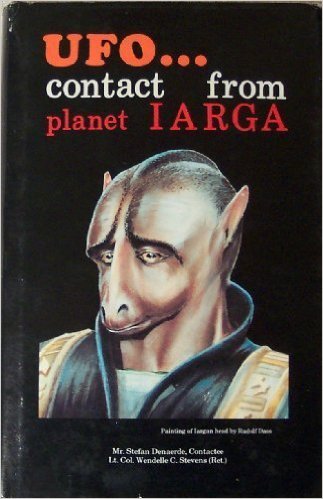
As an Amazon Associate, OverClassified may earn from qualifying purchases made through this link, at no extra cost to you.
Why This Is Essential Reading
UFO Contact from Planet Iarga earns a place on this reading list not because this article can vouch for its truth, but because it is a genuinely unusual case study in how a contact narrative's own documented origin — presented by its illustrator as a utopian book, never publicly confirmed by its author, edited into English by a figure with serious unrelated credibility problems — shapes how it should be read. This site's own Iarga Encounter case file rates the underlying case DISPUTED, and this article agrees that is the honest, evidence-consistent classification. Read as a detailed artifact of contactee literature whose own creators left its factual status deliberately unresolved, rather than as a verified account, it remains a genuinely distinctive entry in the field's history.
Related Cases & Theories
Sources Cited
- Denaerde, Stefan & Stevens, Wendelle C. UFO Contact from Planet Iarga: A Report of the Investigation. UFO Photo Archives, 1982 (ISBN-13 9780960855810). amazon.com
- Denaerde, Stefan. Buitenaardse beschaving: de planeet Iarga. N. Kluwer, Deventer, 1969 (the original Dutch edition, illustrated by Rudolf Das).
- Denaerde, Stefan. Operation Survival Earth. Pocket Books, 1977 (ISBN-10 0671808400; the first English translation, later revised into this 1982 edition).
- "Stefan Denaerde." The Encyclopedia of Science Fiction (sf-encyclopedia.com) (independent bibliographic reference confirming the pseudonym, Beers's dates and the publication lineage). sf-encyclopedia.com
- "Wendelle Stevens." UFO Watchdog (profile documenting his criminal conviction and his role promoting the Billy Meier case). ufowatchdog.com
- This site's own Wendelle Stevens key-figures entry (his editorial role and separately documented credibility history).
- This site's own Stefan Denaerde key-figures entry.
- This site's own Adriaan Beers key-figures entry (the primary witness's real identity).
- This site's own Iarga Encounter case file (full sourcing and the DISPUTED classification).
- Das, Rudolf. Foreword to the Ankh-Hermes reissue of Buitenaardse beschaving (ISBN 978-90-202-9884-0), including his account of Beers never officially confirming the story in interviews. boekhuis.nl
- Clark, Jerome. The UFO Encyclopedia, 4th Edition. Relevant Information LLC (reference-work context on contactee-era UFO literature).
- This site's own Antônio Vilas-Boas Abduction case file (a comparison point for how this site treats another contested 1950s–60s contact claim).
Have corrections, additional research, or peer-reviewed sources? Help improve this entry.
Suggest an Edit