
A History of USOs
Unidentified Submerged Objects, Volume 1: From the Beginning to 1969 — 178 Catalogued Cases With a Standardised Rating Scheme
Core Thesis
A History of USOs is the first volume of a projected three-part catalogue and it does something the underwater-object literature has never had done to it: it counts. Richard M. Dolan documents 178 cases of objects reported in oceans, lakes and rivers between 1717 and 1969, drawing on military reports, eyewitness accounts and historical records, and gives every case a standardised attribute chart — time, colour, shape, body of water, size, sound — alongside a world map marking its location. Volume 2 will cover the 1970s and 1980s, volume 3 from 1990 to 2024, and the series total exceeds six hundred cases. Whatever one concludes about what is being reported, the method is what this subject has been missing since Ivan Sanderson raised the question in 1970 and nobody systematically followed it up.
About the Author
Richard M. Dolan is a historian by training and the author of the two-volume UFOs and the National Security State, which is the most substantial documentary history of the American government's handling of the subject that exists. His method there was archival: released files, contemporaneous press, official correspondence, assembled chronologically with sources attached.
That method is what he brings to the USO material, and it is the reason this volume is worth attention. Dolan is not a field investigator and does not interview witnesses; he is a compiler and a chronologist, and the underwater corpus is precisely the kind of scattered, uncollected, multi-century body of reports that a chronologist can improve dramatically just by putting it in order.
He publishes through his own imprint, Richard Dolan Press, which means there is no external editorial or fact-checking layer. That is a real limitation and it applies to all his recent work; readers should weigh it against the fact that his sourcing practice in the National Security State volumes was unusually careful for the field and has largely stood up.
Allan Lavigne is credited as illustrator, and the illustrations are not decoration. Reviewers have noted that visual reconstruction of reported objects gives grounding to a subject whose descriptions are otherwise purely verbal, and the hardcover edition carries them in colour.
Dolan's own position on the phenomenon is not neutral — he has argued for decades that the American government has concealed knowledge of non-human technology — and a reader should hold that in view. What the catalogue format does, usefully, is separate his interpretation from his data: the case entries and attribute charts can be used by someone who rejects his conclusions entirely.
Historical Context & Origins
The underwater-object question was raised properly once and then abandoned. Ivan T. Sanderson's Invisible Residents (1970) argued that a substantial share of what was reported as aerial phenomena was better understood as a submarine presence, and it remains the field's founding text on the subject. Almost nobody followed it up, and for fifty years the USO literature consisted of scattered chapters in books about something else.
The reason for that neglect is structural rather than evidential. Aerial reports have air traffic control, radar networks, military air defence and a large civilian observer population; the ocean has almost none of that. Objects reported entering or leaving water are seen by ships' crews, coastal residents and naval sonar operators, and none of those channels feeds into a common record.
Naval sonar is the one exception and it is under-exploited. Anti-submarine warfare produced sixty years of acoustic contact data across every ocean, most of it classified at the time and much of it since released in some form, and it is the only large-scale instrumented dataset relevant to the question. This site's Puerto Rico ASW range case file covers an instance of exactly that kind.
The chronological span Dolan chose is the volume's most interesting editorial decision. Beginning at 1717 places the record well before powered aviation, before submarines, and before any technology that could plausibly account for a fast underwater object, and it means the earliest entries are drawn from ships' logs, port records and maritime press rather than from anything resembling modern UFO reporting.
The cut-off at 1969 is equally deliberate. It ends the volume with the closure of Project Blue Book and before the modern era of ocean instrumentation, satellite observation and the naval sensor programmes that have generated the current wave of interest.
The best-known case in the period is Canadian. On October 4, 1967 an object was reported to enter the water at Shag Harbour, Nova Scotia, prompting a Royal Canadian Mounted Police response, a naval search and a documented government file — the only USO case in the period with an official investigation of record. This site covers it in its own file.
The book also arrives into a specific moment. The post-2017 disclosures have been substantially naval — carrier group encounters, ship-based sensor data, and the trans-medium claim that objects have been observed moving between air and water without deceleration. That claim is the single most consequential assertion in the current official discussion, and a catalogue of two and a half centuries of underwater reports is a direct response to it.
Core Arguments & Key Concepts
The underwater corpus exists, is large, and has never been assembled. The book's foundational claim and the one that does not depend on any interpretation. One hundred and seventy-eight cases to 1969, over six hundred across the projected series, drawn from military reports, eyewitness accounts and historical records. If the number is anywhere near right, the field's neglect of this material is a serious omission.
Standardised attributes make a corpus analysable; narrative does not. The volume's most important methodological contribution. Recording time, colour, shape, body of water, size and sound in the same fields for every case allows a reader to look for patterns across cases rather than being led by whichever ones are best told. Almost no UFO casebook in any category does this, and it is the difference between a collection and a dataset.
Geographic mapping reveals distribution that prose conceals. Marking each case on a world map is a simple device with real analytical value: it makes visible whether reports cluster near naval installations, shipping lanes, populated coasts or particular bodies of water, and any of those findings would be informative about the phenomenon or about the reporting.
Reports predating relevant technology are the most interesting subset. The chronology's implicit argument. An account of a fast submerged object from 1717 cannot be a misidentified submarine, torpedo, autonomous vehicle or aircraft, because none existed. Either those accounts are describing something else conventional — marine life, weather, celestial reflection, error — or the corpus has a genuinely long tail.
The trans-medium claim is old, not new. The most directly relevant point to the current official discussion. Objects reported moving between air and water are not a product of the last decade's naval sensor programmes; they are present throughout the historical record, which means the modern claim is either continuous with a long reporting tradition or replicating an old error.
The most serious limitation is that a catalogue cannot assess its own entries. Attribute charts standardise description; they do not evaluate reliability. A ship's log entry from 1830, a 1950s newspaper account and a naval sonar report are recorded in the same fields, and the format gives no way to distinguish them. The volume needs a reliability rating alongside its attribute rating and does not have one.
Self-publication removes the check that a project of this kind most needs. A catalogue's entire value is the accuracy of its entries, and 178 historical cases across two and a half centuries in multiple languages is exactly the material where an external editorial and verification layer earns its keep. Dolan's own sourcing record is good; the absence of anyone checking it is still a structural weakness.
Key Cases & Evidence Discussed
The pre-industrial reports, from 1717. The earliest entries in the catalogue, drawn from maritime records predating powered aviation and the submarine — the subset for which the conventional technological explanations are unavailable by definition.
Nineteenth-century ships' log accounts. Reports of luminous or fast-moving submerged objects recorded by merchant and naval crews, the period's only systematic observation network and the source of the volume's early material.
Shag Harbour, October 4, 1967. The Nova Scotia case in which an object was reported entering the water at Shag Harbour, prompting RCMP attendance, a naval search and a surviving Canadian government file — the best-documented USO case of the period and the subject of this site's case file.
Naval sonar contacts. Anti-submarine warfare acoustic material, the only large instrumented dataset bearing on the question. This site's Puerto Rico ASW range file covers a case of this type in the Puerto Rico Trench area.
Trans-medium reports. Cases in which objects were reported crossing between air and water — the category most directly relevant to the current official discussion and, on Dolan's chronology, present throughout the historical record rather than novel to it.
Lake and river cases. The freshwater subset, which is geographically distinct from the maritime material and reported by different populations, and which the catalogue's body-of-water field makes separable for the first time.
Wartime and Cold War naval reports. Twentieth-century military accounts from periods of intensive naval activity, where the reporting infrastructure was densest and the conventional explanations — submarines, torpedoes, ordnance, other navies' hardware — are strongest.
The attribute and mapping apparatus itself. Not a case but the book's real subject: the standardised chart accompanying each entry and the world map locating it, which together constitute the first attempt to make this corpus something other than a collection of stories.
Critical Reception & Controversies
The book is recent, self-published through the author's own imprint, and has no reviews in the mainstream or academic press. Its reception has been within the field, where Dolan has a substantial existing readership from the National Security State volumes, and on the podcast and independent-review circuit.
The most detailed published assessment is Ray Foy's, which rates the sample volume at five stars and identifies its strengths precisely: readable case prose accessible to newcomers while still functioning as a research tool, the categorisation chart on every case, the world map locating each one, and Lavigne's illustrations giving visual grounding to a subject that is otherwise entirely verbal. Foy calls it a significant contribution to the literature.
That assessment is favourable and it comes from a reviewer inside the field, which is the standard qualification. But the specific things it praises are the correct things to praise: the apparatus rather than the conclusions, and the fact that the format serves a researcher who wants to use the data rather than a reader who wants to be persuaded.
The substantive criticism is the absence of reliability grading. Standardising the attributes of a case says nothing about whether the case is well attested, and a catalogue that records a 1717 maritime anecdote and a 1967 government-investigated incident in identical fields flattens the most important distinction in the corpus. Dolan's National Security State volumes handled provenance carefully; this format does not carry the same information.
The second criticism is about publication. Self-publishing a reference work removes exactly the layer that reference works most need, and the risk is not that Dolan is careless — his record suggests otherwise — but that 178 historical cases across two and a half centuries and multiple national records is more than any one person can verify unaided.
There is also a fair question about the corpus's boundaries. What counts as a USO case is not obvious: an aerial object seen over water, an object seen entering water, a sonar contact with no visual, and a light seen beneath the surface are four different claims, and a catalogue that includes all four needs to say so. Whether the volume handles this consistently is the thing a serious user should check first.
Against all of that, the position is straightforward: this is the only systematic treatment the subject has, the apparatus is a genuine methodological advance, and the alternative is the scattered, uncounted, unmapped state of the literature for the fifty-five years since Sanderson.
Influence & Legacy
It is too early to assess a book published in 2025, and this article will be revised as the remaining volumes appear and the reception settles. What can be said is that the underwater question has gone from having one serious book to having a catalogue, and that the change of state matters more than any individual case in it.
The apparatus is the part most likely to outlast the argument. Standardised attribute recording plus geographic mapping is straightforwardly good practice, it is rare anywhere in this field's case literature, and if it is adopted more widely this book will have improved a great deal more than USO research.
For the current official discussion, the volume's chronological depth is its most useful contribution. The trans-medium claim — objects moving between air and water — is the most consequential assertion in the post-2017 material, and establishing whether it has a two-century reporting history or is an artefact of new sensors is a question a catalogue can help answer and nothing else can.
The cautionary legacy is about what standardisation does and does not achieve. Putting 178 heterogeneous accounts into identical fields makes them comparable and also makes them look equivalent, and a reader working through the charts will find it very easy to forget that one row is a government file and the next is a two-line entry in a ship's log. The format's greatest strength is also the thing most likely to mislead.
The Book
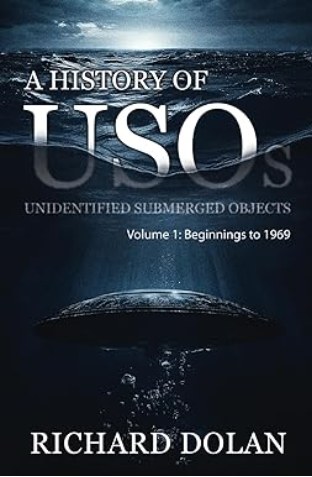
A History of USOs
Unidentified Submerged Objects, Volume 1: From the Beginning to 1969 — 178 Catalogued Cases With a Standardised Rating Scheme
Find on Amazon →As an Amazon Associate, OverClassified may earn from qualifying purchases made through this link, at no extra cost to you.
Why This Is Essential Reading
Use it as a dataset, not as an argument, and expect to supply the reliability grading yourself. A History of USOs is the first systematic catalogue the underwater-object literature has had in the fifty-five years since Sanderson raised the question — 178 cases from 1717 to 1969, each with a standardised chart of time, colour, shape, body of water, size and sound, and each mapped. That apparatus is a real methodological advance and it is rarer in this field than it should be. Its two weaknesses are structural: no reliability rating, so a 1717 maritime anecdote and the government-investigated Shag Harbour incident occupy identical rows; and no external editorial layer, on a reference work spanning two and a half centuries and several national records. Read it for the corpus, read Dolan's UFOs and the National Security State for what his sourcing looks like when he has room to show it, and check the trans-medium entries against the current naval material, because that comparison is the most useful thing this book makes possible.
Related Cases & Theories
Sources Cited
- Dolan, Richard M., with illustrations by Allan Lavigne. A History of USOs: Unidentified Submerged Objects, Volume 1: From the Beginning to 1969. Richard Dolan Press, February 13, 2025. 412 pp. amazon.com
- Google Books record, A History of USOs: Unidentified Submerged Objects — bibliographic data for the volume. books.google.com
- Ray Foy, "Book Sample Review: A History of USOs" — the most detailed published assessment: the three-volume structure covering over 600 cases, Volume 1's span from 1717 to 1969 across nine chronological chapters, the categorisation chart recording time, colour, shape, body of water, size and sound for every case, the world map marking each case's location, Allan Lavigne's illustrations and the deluxe hardcover's colour plates, and the reviewer's five-star assessment. Also the source of this article's cover image. rayfoy.substack.com
- Richard Dolan Press — the author's own imprint, through which this volume and the projected volumes 2 and 3 are published. richarddolanpress.com
- Amazon series listing for A History of USOs: Unidentified Submerged Objects — the multi-volume structure and the available formats. amazon.com
- Amazon author page for Richard M. Dolan — his complete bibliography, including the UFOs and the National Security State volumes. amazon.com
- Wikipedia, "Unidentified submerged object" — the phenomenon's definition, its reporting history and the standard conventional explanations. en.wikipedia.org
- Wikipedia, "Shag Harbour UFO incident" — the October 4, 1967 Nova Scotia case, the RCMP response, the naval search and the surviving Canadian government file. en.wikipedia.org
- Wikipedia, "Ivan T. Sanderson" — the naturalist whose Invisible Residents (1970) raised the underwater question and whose work went substantially unfollowed for half a century. en.wikipedia.org
- Wikipedia, "Anti-submarine warfare" — the naval acoustic-detection infrastructure that constitutes the only large instrumented dataset relevant to underwater-object reports. en.wikipedia.org
- Wikipedia, "Sonar" — the detection technology behind the twentieth-century military reports in the catalogue. en.wikipedia.org
- Wikipedia, "Project Blue Book" — the Air Force programme whose December 1969 closure marks this volume's chronological cut-off. en.wikipedia.org
- Wikipedia, "Submarine" — the technology whose absence before the modern era is what makes the catalogue's earliest entries analytically interesting. en.wikipedia.org
Have corrections, additional research, or peer-reviewed sources? Help improve this entry.
Suggest an Edit