
They Knew Too Much About Flying Saucers
The Book That Invented the Men in Black
Core Thesis
They Knew Too Much About Flying Saucers is Gray Barker's dramatized 1956 account of two cases he had personally reported on as a young civilian investigator -- the September 1952 Flatwoods Monster encounter he investigated within 24 hours of the event, and Albert K. Bender's claim that three men in dark suits visited him in 1953 and warned him to abandon his UFO research. Published by University Books in April 1956 and briefly reaching bestseller lists, the book's telling of the Bender episode became, in this site's own research, "the single most consequential document in this case's entire history" -- the account that created the "Men in Black" concept for a mass audience, despite Barker's own extensively documented, career-long reputation for embellishing and outright fabricating UFO stories for commercial gain. This site's own research draws on it for two case files: Albert Bender & the Three Men in Black and the Flatwoods Monster Incident.
About the Author
Gray Barker (1925-1984) was a Braxton County, West Virginia native and 1947 graduate of Glenville State College who was already an active civilian UFO investigator by the time this book's two central cases occurred. He arrived in Flatwoods within 24 hours of the September 1952 monster encounter, interviewed all seven primary witnesses separately, collected soil and vegetation samples from the site, and published his initial findings in Fate magazine in January 1953 before folding a fuller account into this book's own opening chapters.
Barker was a contributor to Albert Bender's International Flying Saucer Bureau newsletter Space Review before its October 1953 shutdown, after which he founded his own competing publication, The Saucerian, and his own imprint, Saucerian Press -- the same press that would later publish Bender's own 1962 account of the case, Flying Saucers and the Three Men, with an introduction and epilogue written by Barker himself. Barker went on to write two further books extending the Bender story, Bender Mystery Confirmed (1962) and Men in Black: The Secret Terror Among Us (1983), the year before his own death in Clarksburg, West Virginia.
This site's own research treats Barker's reputation as a documented professional embellisher as essential context rather than a side note, since it directly informs how much of this specific book's most vivid, quotable detail should be trusted. His own sister said he "wrote the books for the money"; his longtime friend and rival James W. Moseley said Barker "pretty much took all of ufology as a joke," and the two men later admitted their own public feud, staged to help sell both men's competing publications, had itself been a hoax. In 1957, Barker and Moseley fabricated a fake U.S. State Department letter and sent it to contactee George Adamski, an episode Barker later described, apparently without irony, as "one of the great unsolved mysteries of the UFO field" while knowing full well he had created it himself.
Writer John C. Sherwood, who collaborated with Barker on UFO publications as a young man, recounted in Skeptical Inquirer that Barker had encouraged him to strip an explicit fiction disclaimer from a story and add fabricated supporting documents so readers would accept it as real reporting; Barker later wrote to Sherwood, "Evidently the fans swallowed this one with a gulp." In a 1980 letter to skeptic Robert Sheaffer, Barker wrote plainly, "I AM thoroughly dedicated to promoting UFO crackpottery." He later acknowledged that at least one chapter of his own 1970 Mothman book, The Silver Bridge, was "constructed out of whole cloth."
Historical Context & Origins
The book's own two founding cases occurred within roughly a year of each other, in the same small corner of West Virginia: the Flatwoods Monster encounter on September 12, 1952, and Bender's claimed visit from the three men roughly a year later, in the summer or early autumn of 1953. Barker's own direct, hands-on involvement in the first case -- as a field investigator who personally interviewed witnesses and collected physical samples -- gave him genuine investigative credentials before he ever became entangled in the considerably more dramatized second case that would define his career.
The only contemporary press coverage of any part of the Bender story appeared in the November 29, 1953 Bridgeport Herald, in an article by reporter Lem M'Collum headlined "Mystery Visitors Halt Research." This site's own research treats that article as establishing that Bender was making his specific claim publicly within weeks of the IFSB's shutdown, ruling out the possibility that the "men in black" framing was invented years later purely for Barker's 1956 book -- while noting that the article is not itself independent corroboration of the visit occurring as described, since it is a contemporary record of Bender's own claim, sourced entirely to Bender.
Modern historians of the genre, including a 2026 Skeptical Inquirer retrospective on Barker's career this site's own research cites, generally credit the Men in Black concept with containing at least a small kernel of genuine period fact beneath Barker's dramatization: government agencies, including the Air Force, are independently documented as having discouraged and occasionally pressured civilian UFO researchers and contactees during the early 1950s, a real Cold War-era institutional posture Barker then inflated into an elaborate, cinematic conspiracy narrative involving sinister, all-knowing agents with supernatural-seeming powers of surveillance.
The book's own 1956 publication also fell squarely within the broader post-Roswell, post-Project Blue Book American UFO publishing boom of the mid-1950s, a period in which a genuinely large civilian readership had already developed a real appetite for exactly this kind of dramatic, first-person investigative narrative, a market condition this site's own research treats as directly relevant to understanding why Barker's own considerable narrative talents found such a receptive commercial audience so quickly.
Core Arguments & Key Concepts
The book's central narrative claim, drawn from Bender's own account as Barker chose to tell it, is that three men dressed entirely in black -- resembling clergymen, wearing Homburg-style hats -- appeared at Bender's home, flashed credentials identifying themselves as representatives of an unnamed "higher authority," and delivered a stark verbal warning to cease his UFO research immediately, reportedly telling him: "I suppose you know you are on your honor as an American. If I hear another word out of your office you're in trouble." The men reportedly confiscated copies of Space Review before leaving.
A second, load-bearing argument frames the visitors as almost certainly government agents -- FBI, Air Force, or some unnamed intelligence body -- using deliberate intimidation to suppress a civilian UFO researcher who had gotten too close to genuine, classified information, a framing this site's own research treats as Barker's own specific narrative choice rather than a neutral description of Bender's original, considerably less detailed claim.
A third argument, developed through the book's own separate Flatwoods chapter, presents Barker's direct field investigation as methodologically serious: interviewing all seven primary witnesses separately, collecting soil and vegetation samples, and documenting the entity's description and the witnesses' physical symptoms alongside naturalist Ivan T. Sanderson's own concurrent, more scientifically rigorous investigation -- evidence, per this site's own research, that Barker "was capable of methodical, interview-based fieldwork when he chose to practice it," even though the credibility problem this site's research identifies elsewhere is specific to his later commercial publishing career.
A fourth argument, threaded through the book's own account of the Flatwoods case specifically, documents visits by "mysterious men in dark suits" to Flatwoods witnesses as well -- a detail this site's own research flags honestly: Barker's 1956 book bundles together material from multiple cases he had separately investigated, and this site's own research treats the Bridgeport/Bender account specifically, not the Flatwoods material, as the version standard UFO histories credit with actually establishing the "Men in Black" concept for a mass audience, since it is Bender's own case that supplies the book's title and its central, most widely retold narrative.
A fifth, more implicit argument runs through the book's own narrative construction itself: this site's own research treats Barker's involvement as a serious, specific reason to discount the most vivid, quotable details of the 1956 version -- the exact dialogue, the "on your honor as an American" line, the confiscation of newsletters -- as more likely to reflect Barker's own literary embellishment than a verbatim transcript of anything Bender himself originally reported.
A sixth argument, drawn from the book's own broader structural choice to fold two separately investigated cases into a single volume, implicitly treats the two stories as belonging to one continuous regional pattern of anomalous activity in and around West Virginia, a narrative framing this site's own research treats as commercially useful for Barker specifically -- linking a case he had genuinely investigated firsthand to a considerably more sensational secondhand story lent the newer material an air of the same investigative credibility the Flatwoods chapter had actually earned.
Key Cases & Evidence Discussed
Albert Bender & the Three Men in Black is the case that gives this book its lasting fame and its title. Bender's own much later account, the 1962 book Flying Saucers and the Three Men, offered a substantially different story involving exotic, non-governmental visitors -- described in some retellings as taking Bender via astral projection to a base on a planet called "Kazik" or a hidden Antarctic installation -- and made no mention of the menacing government-agent framing Barker's 1956 book had already made famous, a discrepancy this site's own research treats as directly relevant to weighing how much of the story's most dramatic detail originated with Bender versus with Barker.
The Flatwoods Monster Incident (September 12, 1952) is the case that first brought Barker into UFO research, predating his involvement with Bender's IFSB by roughly a year. Witnesses Kathleen May, her sons, and their friends described a ten-foot-tall entity with a dark body, a spade-shaped head, and glowing eyes, associated with a luminous object on the hillside; all reported nausea, eye irritation, and throat irritation afterward, symptoms this site's own separate case file documents as objectively noted by local medical personnel. Barker's chapter on the case, drawn from his own January 1953 Fate magazine article, remains one of the earliest detailed published accounts of the encounter.
Critical Reception & Controversies
This book carries a genuinely solid Goodreads record: 3.59 out of 5 stars averaged across 142 ratings and 20 written reviews, checked August 2026 -- a substantially larger review base than most niche UFO titles this site's research has checked this session, consistent with the book's own status as one of the most historically significant single titles in the entire genre.
This site's research also attempted to verify an Amazon rating for this title, but Amazon's bot-detection system blocked automated requests to the listing during this session, the same persistent pattern encountered across every title checked this session; per this site's own Amazon Rating Display Protocol, this gap is disclosed honestly here rather than fabricated or silently omitted.
The book's own critical reputation is inseparable from Barker's own documented unreliability as a narrator: this site's own research treats the book's continued reference status as reflecting its historical and cultural significance as the originating document of a durable folklore archetype, rather than as an endorsement of its own factual accuracy, a distinction this site's own case-file research draws explicitly rather than leaving implicit.
A 2026 Skeptical Inquirer retrospective on Barker's career, cited directly in this site's own Albert Bender case file, represents the most recent serious critical engagement with the book and its author, situating Barker's own documented pattern of embellishment within the broader context of how a genuine, if modest, kernel of Cold War-era institutional fact became inflated into one of American folklore's most durable conspiracy archetypes.
Influence & Legacy
This book's cultural afterlife has been extraordinary and well-documented independent of any question about its underlying truth. It directly inspired writer Lowell Cunningham's 1990 comic book series The Men in Black, illustrated by Sandy Carruthers and originally published by Aircel Comics, which was in turn adapted into the 1997 Men in Black film starring Will Smith and Tommy Lee Jones, its sequels, and an animated television spin-off -- taking a single Connecticut hobbyist's personal, uncorroborated claim through a fully documented chain of adaptation into a global entertainment franchise worth hundreds of millions of dollars.
Scholars of American UFO culture have also traced this book's influence on The X-Files, whose central "government agents suppressing the truth about extraterrestrial contact" premise closely mirrors the template Barker's book first popularized, with one media historian describing the later series as effectively "a spinoff of the gospel according to Barker." Self-reported "Men in Black" encounters, inspired directly or indirectly by Barker's own template, continued to be reported by other UFO witnesses for decades after Bender's original claim, entirely independent of whatever actually happened to Bender himself in 1953.
Within this site's own case-file research, this book gives both the Albert Bender and Flatwoods Monster case files their earliest published treatment, letting readers trace the specific moment two of American ufology's most enduring narrative templates -- the sinister government visitor and the towering hillside entity -- first entered wide public circulation through a single author's own dramatized retelling.
This site's own research also treats the book's legacy as a genuinely useful case study in how folklore forms: a real underlying social dynamic of official discouragement of civilian UFO researchers almost certainly existed in the early 1950s, while the specific, dramatic form Barker gave it in this book -- and the further, still more exotic form Bender's own 1962 book gave it in turn -- both rest on evidence this site's own methodology cannot verify independently of the two men's own, mutually inconsistent testimony.
The Book
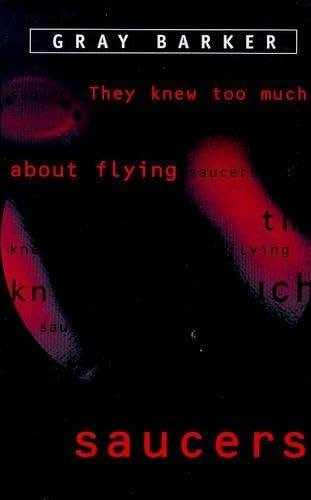
As an Amazon Associate, OverClassified may earn from qualifying purchases made through this link, at no extra cost to you.
Why This Is Essential Reading
They Knew Too Much About Flying Saucers earns its place on this list not because its central claims hold up under scrutiny -- this site's own research, consistent with Barker's own extensively documented reputation for fabrication, concludes much of its most vivid detail should be treated with real skepticism -- but because it remains, by a wide margin, the single most culturally consequential book in this site's own essential-reading library. Its direct role in creating the "Men in Black" archetype for a mass audience, later inherited by a comic book series, a Hollywood film franchise, and The X-Files itself, gives this site's own Albert Bender and Flatwoods Monster case files a documented cultural lineage few other titles in this site's library can match. Its author's own well-documented unreliability is not a reason to dismiss the book but the essential lens through which any serious reader must approach it -- the origin point of one of American folklore's most durable modern myths, told by a man who later admitted, in his own words, to being "thoroughly dedicated to promoting UFO crackpottery."
Related Cases & Theories
Essential Viewing
Sources Cited
- Barker, Gray. They Knew Too Much About Flying Saucers. University Books, 1956; Illuminet Press, 1997 (ISBN 978-1-881532-10-1, cited here).
- "They Knew Too Much About Flying Saucers." Goodreads (3.59 average rating, 142 ratings, 20 reviews, checked August 2026). goodreads.com
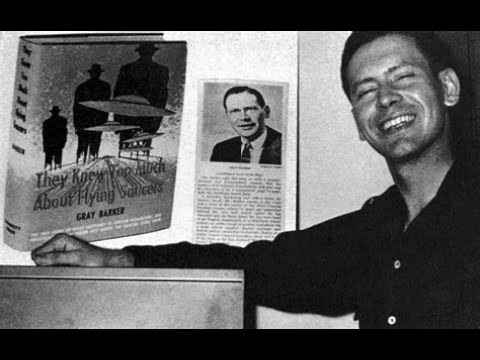
- "Men in Black | Gray Barker Lecture (1976)." The Unknown Archive, YouTube (archival audio/video of Barker himself discussing the case; video verified via oEmbed). youtube.com
- Barker, Gray. "The Monster and the Saucer." Fate magazine, Vol. 6, No. 1, January 1953 (Barker's own earlier field-investigation article on Flatwoods, later folded into this book).
- Sherwood, John C. Account of collaborating with Gray Barker on fabricated UFO material, Skeptical Inquirer (cited in this site's own Albert Bender case file).
- This site's own resources library: Full Reading List, where this exact edition is cited across 2 separate case-file pages.
- This site's own key-figures entry: Gray Barker, for his full biography and site-wide connections.
- This site's own key-figures entry: Albert Bender, the case's sole primary witness.
- This site's own case file: Albert Bender & the Three Men in Black, this book's title case.
- This site's own case file: Flatwoods Monster Incident, the earlier case Barker directly field-investigated.
- This site's own essential-reading entry: High Strangeness, Jerome Clark's own broader survey of the UFO subculture Barker helped shape.
- This site's own essential-reading entry: Why People Believe Weird Things, for a skeptical framework directly applicable to evaluating Barker's own documented embellishment.
Have corrections, additional research, or peer-reviewed sources? Help improve this entry.
Suggest an Edit