
The Flatwoods Monster Incident
On the evening of September 12, 1952, a group of local schoolboys and a mother in Flatwoods, West Virginia, climbed a hillside to look for a fireball that seemed to have landed there. For a second or two, by flashlight, they saw a tall figure with a red face, a pointed hood-like shape and shining eyes, which hissed and moved towards them; they fled. Some were later nauseated. The fireball was a meteor seen in three states that evening, and Air Force investigators and later skeptic Joe Nickell concluded the figure was most likely a startled owl, the red light an aircraft beacon and the “landing traces” a local man's pickup truck. The witnesses' fright was real; what they saw is still argued over.
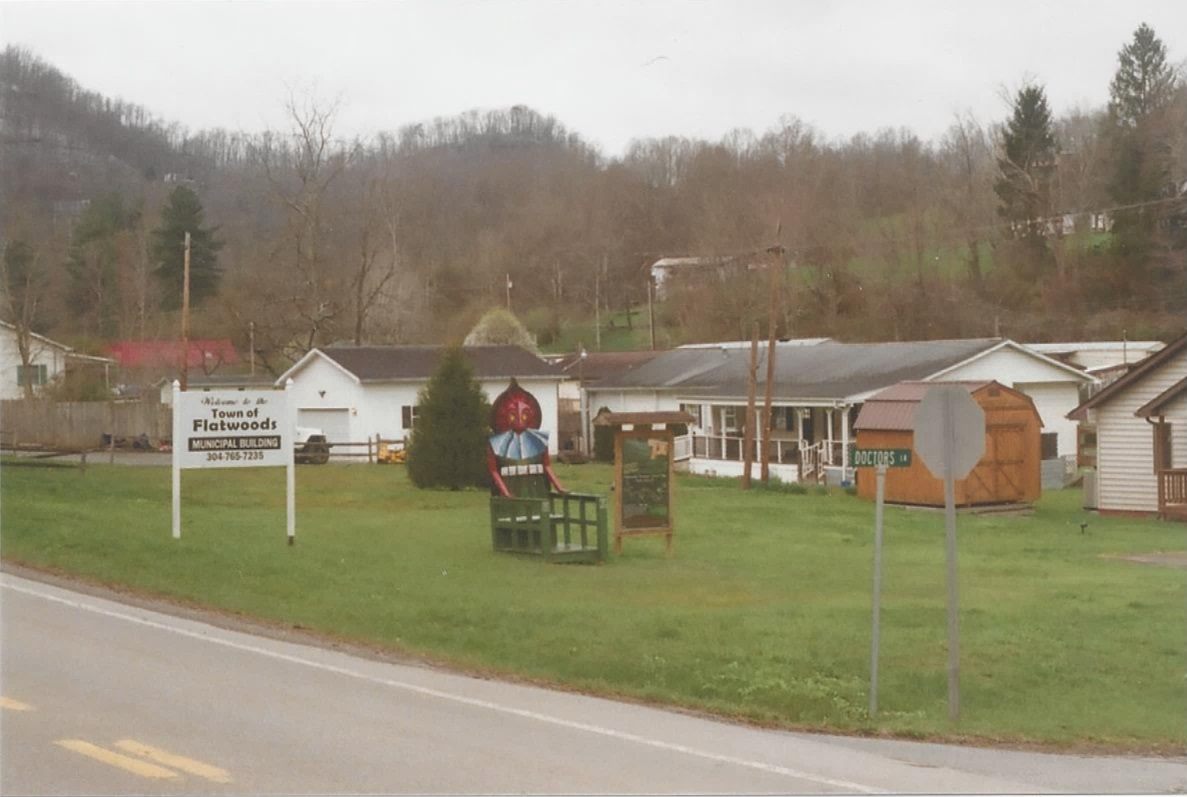
Pictured: the "Welcome to the Town of Flatwoods" sign and monster-chair sculpture installed beside the municipal building in Flatwoods, Braxton County, West Virginia — a modern memorial to the case, not the wooded hillside where the September 12, 1952 encounter actually occurred. No photograph of the entity or the original site exists; the sighting was reported only by the witnesses themselves, decades before the memorial was built.
Theoretical Alignment
To analyze the Flatwoods Monster Incident, we must evaluate how the case aligns with major hypotheses regarding the origin and nature of UAP phenomena. Below is the theoretical alignment assessment:
Alignment Analysis: These percentages are this archive's interpretive weights, not measurements, and the record gives them little support. The “fireball” that started the evening was seen across Maryland, Pennsylvania and West Virginia at about the same time and was identified at the time as a meteor. The only evidence for an entity is a few seconds' sighting, at night, by frightened witnesses, whose descriptions differed. The traces later found on the hill were attributed by a local man to his own pickup truck, and the odour by Ivan Sanderson, a believer, to a local grass. The Extraterrestrial and Interdimensional weightings reflect how the case has been told in UFO literature; the evidence itself fits a misperception under stress (a psycho-social reading) at least as well. Readers should treat the grid as a summary of competing readings, not a finding.
Background
The encounter took place in the middle of the largest wave of UFO reports of the early 1950s. In July 1952 radar and visual reports over Washington, D.C. had led to a Pentagon press conference by Maj. Gen. John A. Samford, and newspapers were full of “flying saucer” stories. Flatwoods was, and is, a small village in Braxton County in central West Virginia, a few miles from the county seat at Sutton.
At about 7:15 pm on Friday, September 12, 1952, several boys playing on the school playground saw a bright object streak across the sky and appear to land on a hilltop on the farm of G. Bailey Fisher. The boys named in the main accounts are the brothers Eddie and Freddie May and Tommy Hyer. They ran to the May home, and a group set out up the hill: Kathleen May, a local beautician; her sons; Neil Nunley, 14; Eugene “Gene” Lemon, 17, a member of the West Virginia National Guard; Tommy Hyer and Ronnie Shaver, both 10; and Lemon's dog. Joe Nickell gives the May boys' ages as 13 (Eddie) and 14 (Freddie); some later accounts make Freddie 12.
The fireball itself was widely reported. A former local news editor later wrote that a meteor “of considerable proportion” was visible that night in at least three states, and a staff member of the Maryland Academy of Sciences reported a meteor over Baltimore at about 7 pm, 60 to 70 miles up, heading towards West Virginia. Another observer about ten miles south-west of Flatwoods reported an aircraft going down in flames on a wooded hillside; the sheriff searched for that crash without result before going on to Flatwoods.
The most important early source is Gray Barker, a Braxton County writer who went to Flatwoods about a week later, tape-recorded interviews and published “The Monster and the Saucer” in Fate in January 1953. Ivan T. Sanderson also visited and wrote about the case in 1952 and in his 1967 book Uninvited Visitors. Major Donald Keyhoe gave an account in Flying Saucers from Outer Space (1953) that includes what Air Force investigators concluded. Later accounts, including Frank Feschino's The Braxton County Monster (2004) and Joe Nickell's 2000 investigation for Skeptical Inquirer, build on these. Nickell notes that there are “myriad, often contradictory versions” of what happened on the hill.
Complete Timeline
The sequence below follows Barker (1953), Keyhoe (1953), Sanderson (1967) and Nickell (2000). Times after 7:15 pm are approximate and not given precisely in any primary account.
| Date | Event |
|---|---|
| September 12, 1952, c. 7:00–7:15 PM | Fireball. A bright meteor is seen across Maryland, Pennsylvania and West Virginia. At Flatwoods, boys on the school playground see it appear to land on a hilltop on the Bailey Fisher farm. |
| September 12, 1952, shortly after | The climb. Kathleen May, her two sons, Neil Nunley, Gene Lemon, Tommy Hyer, Ronnie Shaver and Lemon's dog go up the hill. Near the top they see a pulsing red light some distance ahead and notice a pungent mist. |
| September 12, 1952 | The encounter. Lemon sees shining, animal-like eyes and turns his flashlight on them. The light shows a tall “man-like” figure with a round red “face” inside a pointed, hood-like shape. It hisses and glides towards them; Lemon screams and drops the flashlight, and the group runs. The sighting lasts a few seconds. |
| September 12, 1952, evening | Search. A. Lee Stewart Jr. of the Braxton Democrat talks to the witnesses and visits the hill. Some local men search; later Sheriff Robert Carr and a deputy, arriving from a fruitless search for a reported plane crash, find nothing. Some of the group, Lemon especially, are later nauseated and complain of irritated throats. Max Lockard drives his 1942 Chevrolet pickup up the hill and around the field looking for the object. |
| September 13, 1952, 7:00 AM | “Skid marks.” Stewart returns and finds two parallel “skid marks” in the tall grass and traces of “oil” or “an odd, gummy deposit.” |
| Mid-September 1952 | National coverage. The story runs on the wire services and radio. Kathleen May and Gene Lemon appear on the network television programme We the People in New York with an artist's rendering of the figure. |
| c. September 19, 1952 | Barker arrives. Gray Barker visits about a week after the event, by which time rain has fallen; he finds no oil and only trampled grass, which he concedes may be due to the many visitors. |
| September 1952 | Air Force inquiry. According to Keyhoe (1953), Air Force Intelligence sends two men in civilian clothes, posing as magazine writers. They conclude the object was a meteor that only appeared to land, that the “monster” was probably a large owl on a limb with underbrush beneath it, and that the illness was brought on by fright. |
| September 23, 1952 | Local theory. The Charleston Gazette reports a suggestion that the “monster” was an illusion created by vapour from the falling meteor. |
| January 1953 | Barker's article. “The Monster and the Saucer” appears in Fate, based on tape-recorded interviews. |
| 1956 | Barker's book. They Knew Too Much About Flying Saucers retells the case. The book's “Men in Black” story concerns Albert Bender in Connecticut, not the Flatwoods witnesses. |
| March 6, 1966 | Anniversary articles. The Sunday Gazette-Mail (Charleston) runs Holt Byrne's “The phantom of Flatwoods” and Terry Marchal's “Flatwoods revisited,” in which Kathleen May says what she saw “wasn't a monster” but a secret government plane. |
| 1967 | Sanderson's book. Uninvited Visitors argues for “a flight of aerial machines” and a pilot in a space suit, while attributing the smell to a local grass. |
| June 1, 2000 | Nickell's site visit. Joe Nickell interviews local residents, including Max Lockard, who says his truck made the “skid marks.” Nickell's article, published in Skeptical Inquirer (November/December 2000), proposes a meteor, an aircraft beacon and a barn owl. |
| 2004 | Feschino's book. Frank Feschino's The Braxton County Monster, with a foreword by Stanton Friedman, argues for a crashed craft and a military recovery, relying on later interviews. |
| 2019 | Heritage. Flatwoods begins hosting an annual Flatwoods Monster convention; the Flatwoods Monster Museum in Sutton, which doubles as the county visitor centre, keeps a large collection of clippings. |
The Encounter on the Hill
The most cited description comes from Barker's tape-recorded interviews. He found that the least emotional account came from Neil Nunley, one of the two youths in the lead. As the group neared the crest they saw, some distance ahead, a reddish light “pulsating from dim to bright,” described as a “globe” or “a big ball of fire.” Gene Lemon then saw a pair of shining, animal-like eyes and aimed the flashlight at them. Kathleen May at first thought the eyes belonged to an opossum or raccoon in a tree.
The light showed a towering “man-like” figure with a round, red “face” surrounded by a “pointed, hood-like shape.” Its eyes seemed to give off a greenish-orange light. The body was dark; some later said it was green, and Mrs. May described drape-like folds. Barker noted that “descriptions from the waist down are vague; most of the seven said this part of the figure was not under view.” Not all agreed it had arms, though Mrs. May described “terrible claws.” Its height was put at about ten feet. It made “something between a hiss and a high-pitched squeal” and moved towards them; witnesses described it variously as gliding “as if afloat in midair,” as “bobbing up and down,” and as “describing an arc.”
The figure was seen only for “one or a few more seconds.” Lemon screamed, fell backward and dropped the flashlight, and everyone fled down the hill. Barker himself later asked how, if Lemon dropped the light as he said, the group had an apparently longer look at the figure. Some said it was lit from within; Nunley said it was lit by the pulsing red light. The witnesses also disagreed “violently,” in Sanderson's word, about what the red light was; Sanderson was told it was over twenty feet across, though there was nothing nearby to judge its size by.
Details often added in later retellings (the figure hovering a foot above the grass, firing a beam of light, “mechanical” arms on its chest, a ten-foot entity standing in a clearing at fifty feet, children falling and being injured on the way down) do not appear in the early accounts cited here, and several of them conflict with Barker's note that most witnesses could not see the lower part of the figure.
The Physical & Physiological Impact
The group noticed a pungent mist on the hill, and afterwards some of them were nauseated. Nickell, summarising Barker, Sanderson and Keyhoe, says three of the youths, particularly Lemon, later had nausea and complained of irritated throats. Mrs. May later noticed an oily film on the boys' faces, their throats swelled, and a doctor was called, who found no apparent cause. The name of the doctor is not given in the early sources. Later retellings, summarised by Skeptoid in 2014, add weeks of vomiting and convulsions and compare the symptoms to mustard-gas exposure; those details are not in Barker, Keyhoe or Sanderson. Earlier versions of this page named a “Dr. Raymond Hunter” and described lung congestion; neither could be traced to any source.
The smell has been described as sulphurous, a “metallic stench,” a gas-like mist, or simply “sickening, irritating.” According to Nickell, the first investigators on the scene noticed no such smell, except Lee Stewart, who detected it when he bent close to the ground. Sanderson also noticed a “strange smell in the grass” but said it was “almost surely derived from a kind of grass that abounds in the area,” adding that he found it growing all over the county and it always smelled the same. The Air Force investigators described by Keyhoe concluded that the boys' illness was a physical effect of fright, and noted that Lemon, the worst affected, had seemed the most frightened. The sheriff later reported a fog “settling over the hillside,” which may account for the “mist.”
Claims that Lemon's dog became ill and died of poisoning weeks later could not be traced to any early source. A reader review of one later book reports that surviving witnesses Eddie and Freddie May disputed several stock details, including the dog's death, the oily substance, the vomiting and the floating; that is a single reviewer's account and cannot be checked here, but it is a reason for caution.
The Flatwoods Monster and the 1952 Wave
Flatwoods came at the end of a summer in which the U.S. Air Force received more UFO reports than in any other year of its programme. The case drew national coverage: a former news editor recalled that the press services rated it the eleventh biggest story of the year and that a Pittsburgh paper sent a special reporter. Barker linked it to other lights reported within a twenty-mile radius that night, which he thought were one object “making a circuit of the area” or several. Nickell's reading is simpler: they were one meteor, seen from many places.
Frank Feschino has since argued that the meteor was in fact one of several craft in a nationwide wave that night and that the Air Force was trying to intercept them. He also describes a second local encounter, the “Frametown Monster,” and an account attributed to Col. Dale Leavitt of a National Guard detachment sent to the site. These claims rest on Feschino's own interviews and have not been confirmed by any primary military record.
The Chemical Irritation and Physical Evidence
The physical evidence consists of three things: the “skid marks,” the “oil,” and the smell. A. Lee Stewart Jr., editor of the Braxton Democrat, found two parallel “skid marks” in the tall meadow grass at 7 o'clock the morning after, between where the figure was seen and where the red light had been, with traces of “oil” or “an odd, gummy deposit.” No measurements, photographs or samples of these traces are known to survive. Nothing in the early sources supports the statements that the marks were eight feet apart and fifteen feet long, that the oak was scorched, that branches were broken eight to ten feet up, or that grass was flattened in a circle.
The traces have an obvious explanation in the record. Max Lockard told Nickell in 2000 that soon after news of the incident spread that evening he drove his black 1942 Chevrolet pickup up the hillside, left the dirt road and circled through the field looking for the object. At the time, some locals attributed the marks and oil to a farm tractor. Several people told Barker that Lockard's truck had made them; Barker telephoned Lockard and concluded it had not been at the exact spot, but Barker arrived a week later, after rain, and found no oil himself. Nickell, who was taken to the site by Lockard, was convinced the truck made the traces.
The symptoms are real in the sense that people reported them, but they were not “clinically verified” in any record that survives, and their cause is unknown. Nausea and throat irritation after a panicked run up and down a hill at night, with a strong-smelling plant in the grass, need no exotic explanation, though they do not prove the ordinary one either.
Gray Barker, Ivan Sanderson, and the Investigation
Gray Barker (1925–1984) was from Braxton County. He reached Flatwoods about a week after the sighting, not within twenty-four hours, recorded interviews and wrote the first detailed account in Fate. He admitted seeing in the affair “an opportunity to get my name in print again,” and his later career is known for embellished and fabricated UFO stories. His Flatwoods article is still the main source for the witnesses' words, but it should be read with that in mind. Barker believed a craft had landed “either from necessity or to make observations.”
Ivan T. Sanderson, a naturalist and writer, also visited Flatwoods in 1952. He was not a sceptic: in Uninvited Visitors (1967) he proposed that several aerial machines were flying in formation, that one landed rather than crashed at Flatwoods, and that its pilot emerged “in a space suit.” He nevertheless conceded that three aircraft beacons were “in sight all the time on the hilltop” and that the smell probably came from a local grass. No soil analysis, chemical consultation or “electrostatic charge” measurement by Sanderson is documented.
The Air Force side of the investigation is documented only second-hand, through Keyhoe's account of two Air Force Intelligence men in civilian clothes who concluded meteor, owl and fright. This revision could not find a Flatwoods file among the September 1952 Project Blue Book files digitised on the Internet Archive, which are not complete. Statements elsewhere that the Blue Book file consists of a project card and one-page synopsis, or carries the note “Monster was walking, let the Army have it,” could not be verified and are not relied on here. The owl explanation was not first proposed by Nickell in 2000; according to Keyhoe it was the Air Force investigators' conclusion in 1952.
Historical Contextualization
The case belongs to a period when ordinary people were primed to watch the sky. The 1952 wave and its press coverage made “saucer” the first thought for anything bright moving across it, and the Ground Observer Corps was recruiting civilian volunteers to watch for Soviet aircraft. Nickell's central point is about expectation: the witnesses saw what looked like a landing, then a pulsing red light and a strange smell that seemed to confirm it, and so were ready to see an alien in whatever confronted them next.
Earlier versions of this page suggested that Kanawha Valley chemical plants or classified military re-entry test vehicles might explain the case. No source links either to Flatwoods, and those suggestions have been removed. Kathleen May's own later view, reported in 1966, was that she had seen a secret government aircraft; Nickell thought that unlikely.
Detailed Aftermath and Investigation
The story spread quickly. Wire services and radio networks carried it, hundreds of calls came in, and Kathleen May and Gene Lemon were flown to New York for the We the People television programme, with a drawing of the figure. The nicknames that stuck include the Braxton County Monster, the Phantom of Flatwoods, the Green Monster and, more recently, “Braxie.”
Nickell, who visited in 2000, found that people who had talked to the witnesses agreed they were genuinely frightened, and he did not think the case was a hoax. Johnny Lockard, then 95, told him that virtually everyone who saw the fireball took it to be a meteor. Kathleen May and her son Fred declined to be interviewed for Nickell's investigation. Fred May later worked with Frank Feschino on composite sketches in which the figure appears as a mechanical device about twelve feet tall; that reconstruction rests on recollections given decades later.
The case is now part of West Virginia's heritage. Flatwoods' welcome sign calls the village “Home of the Green Monster,” the Flatwoods Monster Museum in Sutton holds a large collection of clippings, the county has placed monster-shaped chairs around the area, and a 2019 episode of History's dramatised series Project Blue Book was based on the case. Earlier versions of this page said that Barker documented “men in black” visiting the Flatwoods witnesses and that Gene Lemon fainted and suffered career damage; no source for either was found.
How the Witness Descriptions Differ
Because the figure was seen so briefly, the accounts disagree on almost every particular, and the disagreements have themselves been preserved in the literature. Barker's 1953 summary describes a round red face, a pointed hood-like shape, shining eyes and a dark, colourless body, with most witnesses unable to see below the waist. Sanderson's account has small claw-like hands extended in front of it and a “fiery orange” head. The 2014 Skeptoid summary of the composite story gives a height anywhere from seven to twelve feet, green “armor,” a black spade-shaped cowl, glowing red eyes, and claw-like hands near the head, one possibly holding a device, and notes that reports differ on who was holding the flashlight and on whether the dog first growled at something to the group's left.
The pulsing red light is equally unsettled. It was a “globe,” “a big ball of fire,” and, to Sanderson, something over twenty feet across, while the witnesses “disagreed violently” about what it was. Its distance was never established. Even the make-up of the group varies: most accounts give seven people, but Skeptoid lists a possible eighth boy, Teddie Neal, 13, and is unsure whether Tommy Hyer went up the hill or only saw the fireball from the playground.
None of this means the witnesses were careless or dishonest. Short, frightening events seen at night by several people commonly produce exactly this pattern: agreement on the gist (eyes, a face, a hiss, a rush towards them, panic) and disagreement on everything that would allow an identification. It does mean that drawings of the “Flatwoods Monster,” including the artist's rendering shown on We the People and the now-familiar spade-headed figure on local signs, are composites rather than records of what any one person saw.
The Sheriff, the Plane Crash Report and the Same-Night Sightings
The fireball was reported well beyond Flatwoods. When the group came down the hill, Braxton County Sheriff Robert Carr was not at his office in Sutton: he had gone to investigate a plane crash reported by Woodrow Eagle, who had seen a light in the sky disappear into the hills along the Elk River south of Gassaway, roughly ten miles south-west of Flatwoods. No wreck was found. Brian Dunning and Ryan Haupt of Skeptoid (2014) note that the “downed airplane” and the Flatwoods “landing” were probably the same object: a meteor seen from different places, each observer judging it to have come down just over the nearest ridge.
By the time the sheriff and a deputy reached Flatwoods, the newspaperman A. Lee Stewart Jr. was already there, and Gene Lemon had gone back up the hill with a group of armed local men. They found nothing but, by some accounts, a faint smell. The sheriff's party later “saw, heard and smelled nothing” and noted fog settling on the hillside. The “skid marks” and deposit were reported only the next morning, after Max Lockard had driven his pickup through the field.
Ivan Sanderson, who arrived as early as September 18 according to Skeptoid, collected reports of lights from around the region and wrote a long report concluding that “at least five objects came over traveling in a straight line from Northwest to Southeast.” In his reading, several crashed and were never recovered, and one landed at Flatwoods, where its occupant emerged in a protective suit before the craft disintegrated. Nickell's criticism is that Sanderson himself noted that “all of the objects were traveling in the same direction and apparently at the same speed and at exactly the same time,” which is what one meteor seen from many places would look like.
Contemporary explanations were not all sober. A local school teacher suggested that the beacon light and the meteor's trail had somehow combined into the shape of a monster; an unnamed scientist quoted in the press proposed that a fragment of meteor had vaporised into a man-shaped cloud; others saw a religious sign; and a Wisconsin cheese company wondered whether its inflated rubber cow, launched as a publicity stunt about ten days earlier, might be responsible. Sanderson rejected all of these.
Skeptical Reassessments
Two modern skeptical treatments cover the case. Joe Nickell's “The Flatwoods UFO Monster” (Skeptical Inquirer, November/December 2000) is the more detailed, based on a site visit, interviews with local residents and a close reading of Barker, Sanderson and Keyhoe. He did not think the witnesses were lying: “Clearly, something they saw frightened them.” His conclusion was that a meteor, an aircraft beacon, a pickup truck and a startled barn owl, seen by a group already expecting an alien, together produced the story. He also recorded that Kathleen May and her son Fred declined to be interviewed, and that Johnny Lockard, then 95, said nearly everyone who saw the fireball took it for a meteor.
Ryan Haupt's 2014 Skeptoid episode, written by someone who grew up nearby in Kanawha County, reaches the same view by a slightly different route. He suggests fog for the mist and a natural sulphur source (West Virginia has several sulphur springs) for the smell; he accepts the beacon for the red light and the owl for the figure; and he attributes the witnesses' later symptoms to “hysteria and over-exertion.” Like Nickell, he stresses that the group's sincerity is not in doubt, only its interpretation.
The believing case is made most fully by Frank Feschino, whose book argues that the object was a damaged craft, that the figure was a mechanical device, and that the military quietly recovered material from the site. Its distinctive claims rest on interviews conducted decades later and have not been confirmed by any document. The record supports a narrower conclusion than either side sometimes draws: seven people had a real, frightening experience, and the details that would make it extraordinary are the ones least well attested.
Key Witnesses
Seven people went up the hill. Accounts differ on ages and on who saw what; the details below follow Barker as summarised by Nickell, except where stated.
Kathleen May
The only adult in the group, and mother of Eddie and Freddie May. She described drape-like folds on the figure's body and “terrible claws,” and at first took the eyes for an opossum or raccoon. She appeared on We the People with Gene Lemon later in September 1952. In 1966 she told the Sunday Gazette-Mail that what she had seen “wasn't a monster” but a secret government plane. She declined to be interviewed by Nickell in 2000.
Eugene "Gene" Lemon
Carried the flashlight, saw the shining eyes and turned the light on the figure. He screamed, fell backward and dropped the flashlight, and afterwards “appeared too greatly terrified to talk coherently” (Barker). He was the worst affected by nausea and throat irritation. He went with Mrs. May to New York for We the People.
Neil Nunley
One of the two youths in the lead. Barker found his account the least emotional. He said the figure was lit by the pulsing red light ahead of them.
Edward May
Kathleen May's son, one of the boys on the playground who saw the fireball. Little of his individual testimony is recorded in the early sources.
Fred May
Kathleen May's other son, also on the playground. Decades later he worked with Frank Feschino on composite sketches showing the figure as a mechanical device about twelve feet tall. He declined to be interviewed by Nickell in 2000.
A. Lee Stewart Jr.
Not a witness to the figure. He talked to the group that evening, visited the hill, detected the smell when he bent close to the ground, and the next morning reported two parallel “skid marks” and an “odd, gummy deposit.” Max Lockard, who said his truck made the marks, described Stewart to Nickell in one word: “windy.”
The Five Observables Assessment
The performance characteristics reported during the Flatwoods incident can be evaluated using the Five Observables framework developed by AATIP:
Assessment: The fireball's speed is that of a meteor, which is what it was identified as at the time, so it is not counted as an anomalous hypersonic observation. The figure was described as gliding “as if afloat in midair,” but also as “bobbing up and down” and moving in an arc, during a glimpse of a second or so; that is marked Speculative. No sudden acceleration, low observability or trans-medium movement was reported.
Evidence Assessment
Supporting Anomalous Origin
- Seven people reported a frightening figure, and those who spoke to them afterwards agreed they were genuinely scared; most investigators, including Nickell, do not think it was a hoax.
- Several witnesses reported a pungent mist and later nausea and throat irritation.
- A. Lee Stewart Jr. reported two parallel marks and a gummy deposit in the field the next morning.
- The witnesses saw a pulsing red light on or near the hilltop before the figure appeared.
Supporting Conventional Explanation
- A bright meteor was seen across Maryland, Pennsylvania and West Virginia that evening, and local people at the time recognised it as one.
- Three flashing aircraft beacons were visible from the hilltop, as Sanderson conceded and a local teacher pointed out at the time.
- The eyes, round face, hood-like outline, claws, hissing scream and swooping movement match a barn owl disturbed on a branch; Air Force investigators reportedly concluded it was an owl in 1952.
- Max Lockard said his pickup truck made the marks while he was looking for the object that evening.
- Sanderson attributed the smell to a common local grass; the sheriff noted fog settling on the hill.
Why "Disputed"
The Flatwoods case carries a DISPUTED stamp. What is credible is that a group of people, most of them children, had a genuinely frightening experience on the Fisher farm on September 12, 1952. Earlier versions of this page supported the stamp with claims that do not stand up: clinically verified injuries (no medical record is known), a dog that died of poisoning (untraced), independent trace evidence (the marks were plausibly made by a pickup truck), radar tracks and magnetic anomalies (no source), and consistent descriptions (the early accounts differ). With those removed, the case rests on a few seconds' sighting at night, by frightened witnesses expecting to find a landed craft, of something that most closely resembles a barn owl. That is why it is rated Disputed.
Sensor & Instrumentation Detection Profile
No instrument recorded anything relevant to the encounter. The only “sensor” data are the many visual reports of the meteor across three states and the Maryland Academy of Sciences estimate of its height (60 to 70 miles over Baltimore). Earlier versions of this page said that radar at Pittsburgh and Washington tracked an object performing non-ballistic manoeuvres and that magnetic stations logged an anomaly in Braxton County; no source for either claim was found, and both have been removed. Gene Lemon's flashlight was dropped, not a sign of electromagnetic interference.
Environmental & Geospatial Context
Flatwoods lies in the hills of Braxton County, near the geographic centre of West Virginia, at about 38.72° N, 80.65° W, a few miles from Sutton. The encounter took place on a partly wooded hilltop on the Fisher farm, near a large oak, overlooking the village. Three aircraft beacons were visible from the hilltop. The sheriff reported fog settling over the hillside later that night. The reanalysis weather computed below for the mapped point shows a clear, warm day; no contemporary weather record is quoted in the early sources.
That setting matters to the owl explanation: a hilltop with a large oak on the edge of farmland is typical barn-owl habitat, and the species roosts in hollow trees near people and farms.
Observer Credibility & Occupational Profile
The group was one adult, a beautician, and six young people aged about 10 to 17, one of them a National Guardsman. There is no sign that any of them invented the story, and they gained nothing from it beyond brief fame. But sincerity is not accuracy. They saw the figure for a second or two, at night, by flashlight, after running up a hill in the belief that a craft had landed, and they gave differing descriptions. Lemon's National Guard membership does not make him a trained observer. The adult witness later reinterpreted what she saw as a secret aircraft.
Physical & Material Assays
No assay of any material from the site is known. Earlier versions of this page described analyses of the residue by coal companies and private laboratories, “anomalous trace elements,” and soil tests by Sanderson showing nutrient depletion and electrostatic charge; no source for any of these was found, and they have been removed. Barker, who arrived a week later after rain, found no oil. Feschino reports a later claim that National Guard troops collected debris and oil samples and sent them to Washington, but no record of such samples or their analysis has surfaced.
Historical Precedents & Archive Matches
Flatwoods is often grouped with entity reports such as Kelly–Hopkinsville (1955), where frightened witnesses also described glowing-eyed figures at night after a reported landing. Within Braxton County, Feschino describes a “Frametown Monster” report and other local sightings in the same week, known mainly through his book. Earlier versions of this page described a separate encounter by a lone woman near Sutton; no dated, sourced account of it was found.
Material Analysis
There is no material evidence to analyse. The reported “skid marks” and “gummy deposit” were described by A. Lee Stewart Jr. but not measured, photographed or sampled in any surviving record, and a local man said his truck made them. The odour was attributed by Sanderson to a local grass. A fragment of the oak near which the figure was reportedly seen is displayed at the Flatwoods Monster Museum in Sutton; it is a memento, not evidence.
Conventional Explanation Candidates: Analysis
The conventional explanation for Flatwoods is not one idea but four, each covering a different part of the story: a meteor for the fireball, an aircraft beacon for the pulsing red light, a pickup truck for the “landing traces,” and a barn owl for the “monster.” The meteor and owl readings go back to the Air Force investigators described by Keyhoe in 1953; Joe Nickell assembled all four after his June 2000 visit, which included interviews with local residents and a trip to the site with Max Lockard.
Candidate 1: The Barn Owl (Air Force, 1952; Nickell, 2000)
According to Keyhoe, the Air Force investigators concluded that the “monster” was probably “a large owl perched on a limb,” with underbrush beneath it giving “the impression of a giant figure,” and that the excited witnesses “imagined the rest.” Nickell agreed and narrowed it to the barn owl, Tyto alba. His argument runs feature by feature. The round “face” with two eye-like openings inside a dark “hood” matches the barn owl's heart-shaped facial disc. The “hiss and high-pitched squeal” matches its shrill, rasping scream and hissing calls. The reported movement (bobbing, gliding, swinging in an arc towards the witnesses) matches a startled owl's flight. Mrs. May's “terrible claws” match its long legs and sharp talons. The vague lower body matches foliage beneath a perched bird, which Nickell suggests produced the “pleated skirt.” He also points out that the witnesses saw shining “animal eyes” first, and that Mrs. May's first thought was an opossum or raccoon.
The obvious objection is size: a barn owl is 14 to 20 inches long, and the witnesses described something ten feet tall. Nickell's answer is that the bird was seen on a branch above the observers, for a second or so, at night, by flashlight, with nothing to judge scale by, and that the witnesses were expecting an alien pilot. He also suggests the owl may have been a female, whose facial disc can be tawny rather than white, and which might have held its ground near a nest until the flashlight provoked a hissing swoop. That detail is speculation. The owl explanation also does not by itself explain the smell or the illness, which Nickell attributes to other causes.
The Barn Owl
PlausibleMatches the eyes, face, hood-like outline, claws, hissing scream and swooping movement, and the habitat (a large oak on a farm hilltop). Proposed by Air Force investigators in 1952 and argued in detail by Nickell in 2000. Its weakness is the reported ten-foot height, which depends on a glimpse of a second or two with no scale reference, and the fact that no owl was seen or caught. Earlier versions of this page rated it Implausible on the basis of injuries, a dead dog and measured tracks that are not in the record.
The Meteor and the Aircraft Beacon
PlausibleA bright meteor was seen that evening in Maryland, Pennsylvania and West Virginia, estimated over Baltimore at 60 to 70 miles up and heading towards West Virginia. It seemed to land at Flatwoods for the same reason it seemed to crash ten miles to the south-west: meteors appear to come down just beyond the nearest hill. For the pulsing red light, a local teacher pointed at the time to a nearby plane beacon, and Sanderson conceded that three beacons were “in sight all the time on the hilltop.” Earlier versions of this page said “astronomical logs” showed the meteor burning up miles away and rated this Implausible; no such logs are cited anywhere.
The Pickup Truck, the Grass and Fright
InconclusiveMax Lockard told Nickell he drove his 1942 Chevrolet pickup up the hill and around the field that evening, which would account for parallel marks and an oily deposit; some locals blamed a tractor at the time. Sanderson attributed the smell to a local grass, the sheriff noted fog, and the Air Force investigators put the illness down to fright. Each part is reasonable, but none can be confirmed now: Stewart's marks were never measured or photographed, no plant was identified by name, and no medical record survives. Earlier versions of this page argued against a coal-gas explanation that no investigator has actually proposed.
How the Story Grew
Flatwoods is a useful example of how a case accumulates detail. The early sources (Barker's 1953 article, Keyhoe's 1953 book and Sanderson's accounts) describe a pulsing red light, a figure seen for a moment with a red face, a hood and shining eyes, a hiss, a pungent mist, later nausea, and marks found the next day. Over the following decades, retellings added a great deal. Nickell noted in 2000 that one book wrongly made five of the children Mrs. May's, and another described the hood as a “halo” comparable to Japanese Buddhist art; he praised Jerome Clark's UFO Encyclopedia for a “generally factual, sensible account.”
The version on this page before October 2026 is a further example. It gave exact times to the minute, named a doctor, repeated later claims of convulsions and mustard-gas-like injuries as clinical findings, had Lemon's dog vomit, sicken and die of poisoning, measured the skid marks at eight feet apart and fifteen feet long, scorched the oak, broke its branches ten feet up, had soil assays and electrostatic readings, cited radar tracks at Pittsburgh and Washington and a magnetic anomaly, gave the creature a beam of light and a one-foot hover, sent Barker to Flatwoods within twenty-four hours, and had him report Men in Black visiting the witnesses. Apart from the convulsions and mustard-gas comparison, which appear in later retellings, none of these could be traced to any source. The original story is strange enough without them.
The same process works in both directions. History's 2019 dramatised series Project Blue Book built an episode around the case, with the freedom drama allows. Frank Feschino's later reconstruction of the figure as a twelve-foot mechanical device rests on composite sketches made with Fred May decades after the event. Later testimony can add information, but it is not the same kind of evidence as what the witnesses said in September 1952.
Related Cases
The Flatwoods Monster Incident shares significant characteristics with other famous UAP crash-retrieval and entity encounters in the research database. Below are the primary related cases for cross-referencing:
Confirmed Documents & Official Records
The Air Force’s UFO records are held by the National Archives. This revision could not find a Flatwoods file among the September 1952 Blue Book files digitised on the Internet Archive, and could not verify descriptions of one. The Air Force’s 1952 findings on Flatwoods (meteor, probable owl, illness from fright) are known from Donald Keyhoe’s 1953 account of two Air Force Intelligence investigators. (“#034” is this archive’s own case number, not a Blue Book reference.)
PUBLIC (collection)Further Reading — Recommended Literature
The Braxton County Monster: The Cover-Up of the Flatwoods Monster Revealed
The longest book on the case and the fullest statement of the believing view, based on decades of the author’s interviews; its distinctive claims (a military recovery, a mechanical figure) are not independently confirmed.
The Flatwoods Monster
A short, accessible local retelling of the Flatwoods sighting rather than an in-depth investigation; a useful quick summary alongside Feschino's far more comprehensive account above.
The Mothman Prophecies
Keel’s account of the 1966–67 Point Pleasant events elsewhere in West Virginia; useful regional context rather than a source on Flatwoods.
DISCLOSURE: Some links above are affiliate links. If you purchase through them, OverClassified receives a small commission at no additional cost to you. This helps support independent research.
Essential Viewing
The Flatwoods Monster: A Legacy of Fear (Full Movie)
A feature-length documentary from the Small Town Monsters series detailing the historical events, local interviews, and cultural impact of the 1952 sighting.
Alien or Legend: The Flatwoods Monster (BuzzFeed Unsolved Network)
An investigative episode examining the encounter on Bailey Fisher's hill, covering the eyewitness testimonies and conventional explanations.

Did the Flatwoods Monster Exist? (TREY the Explainer)
An analytical video investigating the physical trace evidence, astronomical data, and the barn owl explanation proposed by skeptics.
Sources
- Barker, Gray. “The Monster and the Saucer.” Fate, January 1953 (based on tape-recorded witness interviews; quoted via Nickell 2000).
- Barker, Gray. They Knew Too Much About Flying Saucers. University Books, 1956.
- Keyhoe, Donald E. Flying Saucers from Outer Space. Henry Holt, 1953 (the Air Force investigators’ meteor, owl and fright conclusions; quoted via Nickell 2000).
- Sanderson, Ivan T. Uninvited Visitors. Cowles, 1967; and his 1952 report on the case (both quoted via Nickell 2000 and Skeptoid 2014; not seen).
- Nickell, Joe. “The Flatwoods UFO Monster.” Skeptical Inquirer 24, no. 6 (November/December 2000), including his June 1, 2000 site investigation and interviews with Max and Johnny Lockard. csicop.org (archived); skepticalinquirer.org
- Dunning, Brian, and Ryan Haupt. “The Braxton County Monster.” Skeptoid #434, September 30, 2014 (the Woodrow Eagle crash report, Sanderson’s five-object report, contemporary explanations). skeptoid.com
- Byrne, Holt. “The phantom of Flatwoods.” Sunday Gazette-Mail State Magazine (Charleston, W. Va.), March 6, 1966 (as cited by Nickell).
- Marchal, Terry. “Flatwoods revisited.” Sunday Gazette-Mail State Magazine (Charleston, W. Va.), March 6, 1966 (Kathleen May’s “secret plane” remark; as cited by Nickell).
- “‘Monster’ held illusion created by meteor’s gas.” The Charleston Gazette, September 23, 1952 (as cited by Nickell).
- Haught, James. Article on the Flatwoods case, The Charleston Gazette, October 31, 1954 (cited via Wikipedia; not seen).
- Reese, 1952: Maryland Academy of Sciences statement on the September 12, 1952 meteor over Baltimore (as cited by Nickell; original not seen).
- Feschino, Frank C. Jr. The Braxton County Monster: The Cover-Up of the Flatwoods Monster Revealed. Quarrier Press, 2004 (later expanded self-published editions 2012 and 2013).
- Clark, Jerome. The UFO Encyclopedia, 2nd ed. Omnigraphics, 1998 (recommended by Nickell as a sensible account; not seen).
- Griffin, Buddy. “The Legend of the Flatwoods Monster.” Goldenseal, Fall 2002 (cited via Wikipedia; not seen).
- “Flatwoods monster,” Wikipedia (used as a pointer to the 1952–1966 press coverage and later heritage events). en.wikipedia.org
- Dudding, George. The Flatwoods Monster. CreateSpace, 2013.
- Keel, John A. The Mothman Prophecies. Saturday Review Press, 1975 (regional context).
- Hynek, J. Allen. The UFO Experience: A Scientific Inquiry. Henry Regnery, 1972 (the close-encounter classification).
Corrections (October 2026)
This page was rewritten in October 2026 after checking it against Joe Nickell’s 2000 Skeptical Inquirer investigation (which quotes Barker’s 1953 Fate article, Keyhoe’s 1953 book and Sanderson’s writings at length), the 2014 Skeptoid episode, and the press history summarised by Wikipedia. Most of the specific detail on the previous page could not be found in any source. The most important corrections: the “barn owl” explanation was not first proposed by Nickell in 2000; according to Keyhoe, Air Force investigators concluded in 1952 that the figure was probably a large owl, the object a meteor and the illness a product of fright. Gray Barker arrived about a week after the event, not within 24 hours, after rain had fallen, and found no oil. A local man, Max Lockard, told Nickell that his pickup truck made the “skid marks.” Sanderson attributed the smell to a local grass and conceded three aircraft beacons were visible from the hill. The figure was seen for a second or two, and most witnesses could not see its lower half. Kathleen May said in 1966 that she had seen a secret government plane, so she did not keep to one account for life. Barker’s “Men in Black” story concerns Albert Bender, not the Flatwoods witnesses.
Following this review, the rating was changed from Credible 85 to Disputed 30 (October 26, 2026), because the higher rating had rested partly on claims corrected or removed above.
Removed as unsourced: “Dr. Raymond Hunter” and his medical examination logs; mild convulsions, lung congestion and mustard-gas findings presented as clinical facts; the death of Lemon’s dog from poisoning and a veterinarian’s report; Lemon fainting and suffering career damage; skid marks eight feet apart and fifteen feet long, a scorched oak and branches broken at eight to ten feet; laboratory and coal-company assays, “anomalous trace elements” and Sanderson’s soil and electrostatic tests; radar tracks at Pittsburgh and Washington and a magnetic anomaly; compass deviations; a beam of light and a one-foot hover; minute-by-minute times; Teddy Glenn’s WHAW radio interviews; Anthony Bragalia’s 2002 investigation and UFO Magazine article; a festival from 2002; Kanawha Valley chemical plants and classified re-entry vehicles as explanations; a lone woman’s sighting near Sutton; NICAP “Unknown” status; and the source entries for eyewitness statements, a National Guard incident report, a Braxton Democrat article of September 18, 1952 and a SITU report of October 1952, none of which could be found. Statements about a Project Blue Book file (a project card and one-page synopsis, and the note “Monster was walking, let the Army have it”) could not be verified and are no longer relied on. The Five Observables tiles for lift and speed were changed (Present to Speculative; Present to Not documented), and the plausibility ratings for the owl and meteor/beacon explanations were changed from Implausible to Plausible, because their stated bases were false. The stamp and score have not been changed and are under review.
See something inaccurate? Have additional information or sources?
Suggest an Edit →Last Updated: October 2026