
The Braxton County Monster
The Cover-Up of the Flatwoods Monster Revealed
Core Thesis
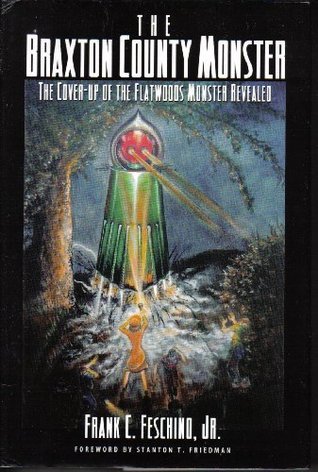
The Braxton County Monster: The Cover-Up of the Flatwoods Monster Revealed is Frank C. Feschino Jr.'s book-length argument that the September 12, 1952 encounter near Flatwoods, West Virginia — already documented in full by this site's own Flatwoods Monster Incident case file — was not an isolated local sighting but a single node in a much larger, same-night wave of UFO activity and an alleged U.S. Air Force interception effort spanning multiple states. Published in 2004 by the traditional West Virginia press Quarrier Press, with a foreword and epilogue by nuclear physicist and UFO researcher Stanton T. Friedman, the book is the product of roughly two decades of Feschino's own witness interviews and archival research, later re-issued in expanded self-published editions in 2012 and 2013 with hundreds of additional photographs and documents. It is the companion volume to Feschino's earlier book, Shoot Them Down! The Flying Saucer Air Wars of 1952 (2007), which develops the military-interception side of the same argument in more detail.
About the Author
Frank C. Feschino Jr.'s background is in the arts rather than history, journalism, or military research: he holds a Fine Arts diploma from 1981 and an Associate's degree in film and video production from 1994, earned at Phillips Junior College in Daytona Beach. His connection to the case began in the early 1990s, after visiting a relative's farm in Braxton County, West Virginia, and he went on to spend close to two decades interviewing surviving witnesses and researching archival material, including what he describes as extensive use of declassified Project Blue Book case files. That level of sustained, self-directed field research is genuine and well-documented; what it is not, and what the book does not claim it to be, is an academic historian's or trained investigator's institutional credential.
Feschino's closest public collaborator on this project is Stanton T. Friedman, who wrote both the foreword and epilogue to the book — a significant endorsement from one of ufology's most prominent researchers, though this article could not verify the specific content of Friedman's contribution beyond confirming that he wrote it. Feschino has since become a frequent guest on UFO-focused podcasts and radio programs, including Coast to Coast AM, discussing both this book and its 2007 companion volume, and has been publicly critical of History Channel's dramatized 2019 Project Blue Book television treatment of the same case for taking what he and fellow researcher Kevin Randle both describe as significant dramatic license with the historical record.
Historical Context & Origins
The case's first chronicler predates Feschino by more than four decades: Gray Barker, a Braxton County-based writer, drove to the site himself in 1952, interviewed witnesses directly, and published the first detailed account as "The Monster and the Saucer" in Fate magazine in January 1953. Barker's own later career carries a separately, extensively documented reputation for fabricating and embellishing UFO stories for commercial gain — a reputation this site's own case file and key-figures entry on him address directly — which makes his role as the case's original chronicler a genuinely double-edged piece of the case's historiography rather than a straightforwardly reliable foundation.
Feschino's book sits at the far believing end of a long shelf of Flatwoods literature that runs from Barker's original 1953 journalism through decades of subsequent treatment, most notably including the leading skeptical counterpoint: Joe Nickell's investigation for the Committee for Skeptical Inquiry, published in Skeptical Inquirer in November/December 2000, four years before this book's first edition. Nickell's piece — based on his own site visit, witness interviews, and Blue Book file review — concluded the initial light was very likely a meteor also reported that night across Maryland, Pennsylvania, and West Virginia, that the pulsating red glow matched a known aircraft hazard beacon, and that the "monster" itself was consistent with a startled barn owl perched on a branch, its features distorted by frightened witnesses in the dark. Feschino's book does not so much rebut Nickell's specific analysis point-by-point as build an entirely separate evidentiary case around new witness interviews and a broader nationwide-wave framing Nickell's more narrowly local investigation does not address.
The case remains a genuine piece of West Virginia local heritage independent of either researcher's conclusions: the Flatwoods Monster Museum in nearby Sutton, West Virginia offers free admission, holds what it describes as the most comprehensive library of Flatwoods-related newspaper and journal clippings anywhere, displays a fragment of the tree near which the creature was reportedly seen, and doubles as the Braxton County Visitors Center. History Channel's 2019 dramatized series Project Blue Book devoted an early episode to the case, a mainstream pop-culture treatment that both Feschino and Kevin Randle have separately criticized for inventing dramatic content, including a fictional hospital-death scene, well beyond anything in the actual historical record.
Core Arguments & Key Concepts
The book's most specific reinterpretation concerns what the witnesses actually saw: rather than treating the entity as a biological creature, Feschino argues — based on new composite-sketch sessions he says he conducted decades later with adult eyewitness Fred ("Freddie") May, one of the original 1952 boys — that the "monster" was in fact a large mechanical device, roughly twelve feet tall and hovering rather than standing. That reinterpretation is presented as new evidentiary work rather than a mere restating of the original 1952 testimony, and readers should weigh it accordingly: it rests on a single adult witness's decades-later recollection, elicited through a process (composite-sketch sessions conducted by the book's own author) that this article cannot independently evaluate for methodological rigor.
The book's most striking single claim is an account, attributed to retired officer Col. Dale Leavitt, of leading a National Guard detachment of fifty to sixty men to the site within hours of the sighting on Air Force orders, collecting debris, oil samples, and burned vegetation, and shipping the material to Washington without ever receiving follow-up feedback. This article could not independently verify Leavitt's account against any primary military record; it is sourced, as far as this research could trace, entirely to Feschino's own interview material, and this article presents it as a claim under that specific sourcing rather than as independently corroborated fact — notably, fellow UFO researcher Kevin Randle, no debunker himself, has separately said he finds this particular detail hard to dismiss outright even while remaining skeptical of Feschino's broader thesis.
Feschino also incorporates the case's standard physical evidence — reported skid marks roughly ten feet apart down the hillside, an oily residue on the grass, and a foul, nauseating odor that produced lasting physiological effects in several witnesses — and argues these are consistent with a large landed craft rather than an owl or meteor. His stated research method draws heavily on Project Blue Book's own "Unknown" case files; one secondary source claims as much as seventy percent of his findings trace to that archive specifically, a figure this article could not verify beyond that single mention and presents with that explicit caveat.
Key Cases & Evidence Discussed
This site's own Flatwoods Monster Incident case file documents the core event in full — Kathleen May and the group of local boys climbing the hill after the fireball, National Guardsman Eugene Lemon's flashlight encounter with the entity, and A. Lee Stewart Jr.'s same-night, on-the-ground newspaper investigation documenting the physical traces — in far greater depth than a book review needs to repeat, and readers wanting the complete, evenly weighted account should read that case file directly.
What is specific to this book is its claimed connection to a second, same-night incident Feschino calls the "Frametown Monster," a nearby West Virginia sighting this site has no independent case file for and which this article could not verify beyond Feschino's own account of it, and its broader argument that the Flatwoods sighting connects to a nationwide wave of reports and an alleged vanished USAF jet fighter that same night — a considerably larger claim than the Flatwoods case file itself makes about the September 12, 1952 encounter in isolation.
Critical Reception & Controversies
As of this article's research (August 2026), the original 2004 edition carries a 4.06-out-of-5 rating on Goodreads across 17 ratings and 2 written reviews, a reasonably healthy sample for a regionally published UFO title. The later, expanded self-published editions show far thinner engagement — the 2012 "Revised Edition" listing shows only a single rating — a gap worth noting honestly rather than citing only the more favorable original-edition figures as representative of the book's overall reception.
Reader reviews surfaced through search summaries (this article could not directly fetch Amazon's review pages due to repeated server errors) describe a genuinely split reception: several reviewers praised the research underlying the original Flatwoods incident itself as "superb" and "thorough and untainted," while at least one reviewer specifically distinguished between the book's solid initial-incident reporting and what they described as declining credibility once Feschino extends into the broader nationwide-wave and interception claims — a distinction this article's own review of the book's sourcing tends to support.
Skepticism toward the underlying case predates this book by four years and comes from two different directions worth distinguishing carefully: Joe Nickell's 2000 Skeptical Inquirer piece argues against the base Flatwoods sighting itself (meteor, hazard beacon, startled owl), while fellow UFO researcher Kevin Randle's more recent blog commentary is skeptical specifically of Feschino's broader nationwide-wave and interception extrapolations rather than of the original 1952 testimony, while separately finding the Col. Leavitt account difficult to dismiss outright. That two independent critics, one a mainstream skeptic and one a working UFO researcher, converge on doubting different parts of Feschino's larger argument while for different reasons taking the base case somewhat seriously is worth presenting as the genuinely mixed picture it is, rather than flattening it into either simple validation or simple debunking. This article found no MUFON Journal review of the book despite a direct search.
Influence & Legacy
The book's most visible mainstream legacy came via History Channel's 2019 Project Blue Book series, which dramatized the Flatwoods case in an early episode; both Feschino and Kevin Randle have separately and publicly criticized that dramatization for inventing content, including a fictional in-hospital death, that appears nowhere in either the historical record or in Feschino's own more research-grounded account.
Within West Virginia specifically, the case Feschino's book investigates continues to be commemorated at the Flatwoods Monster Museum in Sutton, which functions simultaneously as the county's visitor center and as a repository of contemporary press coverage — a piece of enduring local heritage that exists somewhat independently of whichever explanation, Feschino's expanded cover-up thesis or Nickell's owl-and-meteor account, a given reader finds more persuasive.
The Book
As an Amazon Associate, OverClassified may earn from qualifying purchases made through this link, at no extra cost to you.
Why This Is Essential Reading
The Braxton County Monster earns its place on this reading list not because its broadest claims are independently corroborated — the Col. Dale Leavitt military-deployment account rests on Feschino's own interview material alone, and this site's own case file rates the underlying encounter CREDIBLE rather than confirmed, with Joe Nickell's owl-and-meteor explanation standing as a serious, independently published rival account Feschino's book does not directly refute — but because it represents the single most sustained, decades-long research effort any investigator has brought to this specific case, conducted by someone with a genuine, if institutionally uncredentialed, personal commitment to getting the surviving witnesses' testimony on the record before it was lost. Read alongside this site's own far more evenly weighted Flatwoods Monster Incident case file and Nickell's independently published skeptical account, it is best approached as the most complete statement of the case's believing position, not as its final word.
Related Cases & Theories
Sources Cited
- Feschino, Frank C. Jr. The Braxton County Monster: The Cover-Up of the Flatwoods Monster Revealed. Foreword and epilogue by Stanton T. Friedman. Quarrier Press, 2004 (ISBN 189185237X / 9781891852374). amazon.com
- "The Braxton County Monster." Goodreads (reader rating 4.06/5, 17 ratings, 2 reviews, 2004 edition, as fetched Aug 2026). goodreads.com
- "The Braxton County Monster: The Cover-Up of the Flatwoods Monster Revealed." AbeBooks (2004 Quarrier Press first-edition bibliographic record). abebooks.com
- "The Braxton County Monster Updated & Revised Edition... Expanded." Lulu (publisher's own product page for the 2013 self-published expanded edition). lulu.com
- Feschino, Frank C. Jr. Shoot Them Down! The Flying Saucer Air Wars of 1952. Self-published, 2007 (companion volume on the military-interception side of the same thesis). amazon.com
- Nickell, Joe. "The Flatwoods UFO Monster." Skeptical Inquirer, Nov/Dec 2000 (the case's leading skeptical investigation, predating this book). skepticalinquirer.org
- Randle, Kevin. "Frank Feschino and the Flatwoods Monster." Kevin Randle's blog (fellow UFO researcher's critical assessment of Feschino's broader claims). kevinrandle.blogspot.com
- Randle, Kevin. "History's Project Blue Book: The Flatwoods Monster." Kevin Randle's blog (critique of the 2019 History Channel dramatization). kevinrandle.blogspot.com
- "Flatwoods monster." Wikipedia (general case overview, Nickell's findings, museum reference). en.wikipedia.org
- Howe, Linda Moulton. "September 12, 1952 - America's Secret War, Part 1: UFO Retrieval in Flatwoods, West Virginia." Earthfiles, 2004 (detailed summary of Feschino's investigation, including the Col. Dale Leavitt account). earthfiles.com
- "The Flatwoods Monster." Braxton County, WV official tourism site (local folklore and history). braxtonwv.org
- "Flatwoods Monster Museum." Roadside America (museum in Sutton, WV). roadsideamerica.com
- This site's own Flatwoods Monster Incident case file, drawing on contemporary press accounts and the full witness record (full sourcing documented there).
Have corrections, additional research, or peer-reviewed sources? Help improve this entry.
Suggest an Edit