
The Government UFO Files
The Conspiracy of Cover-Up — A Retired Army Intelligence Officer Works Through the Official Record
Core Thesis
The Government UFO Files: The Conspiracy of Cover-Up works through what the American government has recorded, classified, withheld and eventually released about unidentified aerial phenomena, and it is written by someone unusually qualified to do it. Kevin D. Randle is a retired US Army lieutenant colonel who served in military intelligence before spending several decades investigating UFO claims, and the combination gives him something almost nobody else in this field has: a professional reader's instinct for what a military document is, what it is for, and what it does and does not establish. Published by Visible Ink Press in May 2014, the book covers the FBI, CIA, NASA, FAA and military record. Its title promises a conspiracy; its contents deliver something better and more useful.
About the Author
Kevin D. Randle is a retired United States Army lieutenant colonel who served in military intelligence, and he is one of the most prolific and most contested figures in American UFO research. He has published extensively on Roswell, on abduction claims, on Project Blue Book and on the official record generally, across four decades.
The military background is not decoration and it is the reason this book is worth reading. Randle has spent a career handling the kind of paperwork the book examines — intelligence summaries, message traffic, unit reports, classification markings — and he brings to it a set of professional judgements about routine, format and purpose that a civilian researcher has to guess at.
His research record is genuinely double-edged and this library has documented both sides. He co-authored the influential 1990s Roswell investigations that made the crash claim mainstream; he also co-wrote The Abduction Enigma, which methodically dismantles the abduction literature, and he has spent years checking the service records of military UFO claimants and publishing the discrepancies he finds.
That last activity is the most valuable thing he does and it appears elsewhere in this library. His examination of Clifford Stone's service record, discussed in the article on UFOs Are Real, is a model of what a researcher with the right background can establish about a claimant that nobody else can.
He has also changed his mind publicly and substantially, most notably on the Roswell testimony he once helped establish, and he maintains a long-running blog on which he argues with his own earlier positions. A researcher who revises in public is rarer in this subject than one who does not.
The honest qualification concerns output. Randle has published a great many books at a steady commercial rate, and readers have consistently criticised the editing rather than the research — a Goodreads assessment of this volume calls it poorly written and edited while still finding it valuable as documentation, which is a fair summary of the trade-off across his catalogue.
Historical Context & Origins
The official American UFO record runs from 1947 and is more extensive than most readers assume. Project Sign, Project Grudge and Project Blue Book constitute the visible Air Force line, but the FBI, the CIA, the State Department, the FAA, NASA and the individual service intelligence branches all generated their own material, and it was never gathered in one place.
The classification structure is the reason the record looks like a cover-up. Air-defence reporting is classified as a matter of routine; intelligence assessments of foreign aerospace capability are classified; and the mere fact that a UFO report passed through such a channel meant it acquired markings that had nothing to do with its contents. Randle is professionally equipped to explain that distinction and does.
The Robertson Panel of January 1953 is the document that most nearly supports the book's title. Convened by the CIA, it recommended that the subject be stripped of special status and that public interest be actively reduced — an explicit official recommendation to manage perception rather than to investigate, and the strongest single item in any cover-up argument.
Blue Book's closure in December 1969 on the Condon Report's recommendation ended the visible programme without ending the reporting. Air-defence systems continued to generate unidentified tracks, aircrew continued to file reports, and the material continued to be classified — just without a public office to route it to.
The Freedom of Information Act is what made a book like this possible. Successive releases from the 1970s onward — FBI files, CIA material, State Department cable traffic, NSA documents — established that agencies which had denied interest had in fact held files, and that pattern of denial followed by disclosure is the recurring structure of the American record.
By 2014 the subject was at a low ebb publicly and the book appeared into a quiet market. The post-2017 disclosures — the AATIP reporting, the Navy sensor video, the intelligence community's UAP assessment, the congressional hearings — were three years away, and a documentary survey published just before them now reads as a snapshot of what was establishable from the record before any of that.
The case material Randle draws on runs through this site's own files. Socorro, Levelland, Cash-Landrum, the Vandenberg missile incident and the Calvine photograph all feature in the official record and are cited on this site to this book.
Core Arguments & Key Concepts
The official record is large, real, and mostly not what the cover-up literature says it is. The book's foundational and best-supported position. American agencies generated a great deal of UFO material, denied doing so, and were then shown to have done so by FOIA release — a documented pattern that requires explanation and that does not, by itself, imply concealment of anything extraordinary.
Classification markings are about channels, not contents. Randle's most valuable professional contribution and the point most often missed by civilian researchers. A report classified because it moved through an air-defence intelligence channel tells you about the channel; inferring that its subject matter was the reason for the classification is an error, and it is the error on which most of the cover-up literature rests.
The Robertson Panel is the real documented instance of official perception management. Where a cover-up argument has actual support, this is it: an explicit recommendation to reduce public interest, made by a CIA-convened panel, implemented in Air Force communications policy for the rest of Blue Book's life. Randle treats it as the load-bearing document and he is right to.
A military reader can distinguish routine documents from significant ones. The book's implicit methodological claim, and it is a real advantage. Knowing what a standard unit report looks like, what its distribution list means, and which absences are meaningful is knowledge that comes from having produced such documents, and Randle applies it throughout.
Individual cases in the official record are stronger than the documentary argument built on them. An observation the book supports without quite making. The Socorro landing, the Levelland electromagnetic-effect reports and the Cash-Landrum injury case are all in the official file and all remain unresolved on their merits — which is a more interesting fact than any inference about what agencies were hiding.
The book's title oversells its contents and the contents are better. The most useful thing to say to a prospective reader. The Conspiracy of Cover-Up promises a thesis the documentary material does not support; what the book actually delivers is a competent survey of what the record contains, with an experienced reader's judgement about what each item is worth.
Its production is the standing complaint and it is justified. Readers have criticised the writing and editing rather than the research, and that is accurate. This is a book to consult rather than to read through, and its value is in the documentary detail rather than in the prose or the structure.
Key Cases & Evidence Discussed
The FBI file. The Bureau's UFO material, its early involvement, its correspondence with the Air Force and the documented gap between its public position and its holdings — the clearest instance of the deny-then-release pattern.
The CIA material and the Robertson Panel. The Agency's involvement from the early 1950s, the January 1953 panel and its recommendation to reduce public interest, and the long consequences for Air Force communications policy.
Project Sign, Grudge and Blue Book. The visible Air Force programmes, their successive changes of posture, their case totals and the roughly 700 files left unidentified — treated in this library through Steiger's 1976 compilation as well.
The Socorro landing, April 24, 1964. Officer Lonnie Zamora's report of an egg-shaped craft on landing legs near Socorro, New Mexico, its ground traces and Blue Book's classification of it as Unknown — examined in this site's case file and one of the strongest items in the entire official record.
Levelland, November 1957. The Levelland, Texas sequence of vehicle-stalling reports investigated by Blue Book, covered in this site's case file — multiple independent witnesses reporting a consistent electromagnetic effect.
Cash–Landrum, December 1980. The Texas injury case and the litigation that followed, in this site's case file — the strongest American physical-effects claim of its decade and one where the official record is conspicuously thin.
The Vandenberg missile incident. The claimed interference with a missile test, examined in this site's case file, which cites this book.
The Calvine photograph. The 1990 Scottish image and its handling by the British Ministry of Defence, covered in this site's case file — a non-American instance of the same documentary dynamics.
The FAA and NASA material. The civil-aviation reporting channels and the space agency's involvement, both of which generated records and both of which have been the subject of persistent and largely unsupported claims about withheld imagery.
Critical Reception & Controversies
The book received the reception a Visible Ink Press reference title gets: no mainstream reviews, coverage in genre venues, and a solid reader rating across a modest number of ratings on the main platforms.
The genre reviews were favourable and unspecific. HorrorNews.net praised it for delivering content that might otherwise have stayed classified and for documenting what the FBI, CIA, NASA, FAA and military had been doing; other genre coverage was similar in register. None of it engages the documentary argument at any depth.
The most useful assessment came from a reader rather than a reviewer, and it is the fairest summary available: poorly written and edited, but nonetheless serving the function of documenting at least an outline of the US government's ongoing concern with UFO reports since the Second World War. That is exactly right on both halves.
The substantive criticism concerns the gap between title and contents. The Conspiracy of Cover-Up announces a thesis the book does not establish, and a reader who takes the title as the argument will find the documentary material disappointing while a reader who ignores it will find the material useful.
The professional-reading advantage deserves to be weighed properly, because it is genuine and rare. Most civilian UFO researchers encounter military documents as exotic objects; Randle encounters them as familiar ones, and his judgements about what a given report's routing, format and distribution imply are worth more than a non-specialist's.
The counterweight is Randle's own record on Roswell, which readers should know about. He was central to the 1990s investigations that made the crash claim mainstream, several of the witnesses he relied on were subsequently discredited, and he has revised his position substantially and publicly since. That history is a reason to read him carefully and also a reason to trust him more than most: he has demonstrated that he will abandon a position.
The fair placement is as a reference survey rather than an argument. Consult it for what the American record contains and for a professional reader's assessment of individual documents; look elsewhere for a case about what any of it means.
Influence & Legacy
The book's practical function on this site is as a citation for the official record, and that is how it is used here: this site's case files on Calvine, Cash-Landrum, Travis Walton and the Vandenberg incident all draw on it.
Its more general contribution is the classification argument, which deserves wider circulation than it has had. The insight that documents are classified because of the channel they travel through rather than because of what they say removes a great deal of the apparent mystery from the official record, and it is the kind of correction only someone with the relevant career can make credibly.
It also stands as a snapshot of what was establishable from the American record immediately before the post-2017 disclosures. Reading a 2014 documentary survey against what has emerged since is a useful exercise, and the general shape of the record turns out to have been correctly described.
The cautionary legacy is about titles and theses. Publishers sell cover-up books; researchers write documentary surveys; and the two are frequently bound together, with the title doing work the contents do not support. A reader who learns to check whether a book's argument matches its cover will have learned something applicable to most of the shelf this one sits on.
The Book
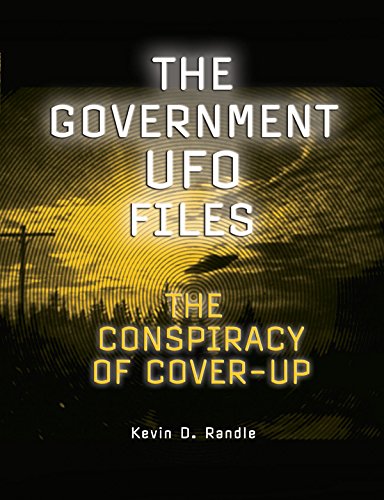
The Government UFO Files
The Conspiracy of Cover-Up — A Retired Army Intelligence Officer Works Through the Official Record
Find on Amazon →As an Amazon Associate, OverClassified may earn from qualifying purchases made through this link, at no extra cost to you.
Why This Is Essential Reading
Consult it, and ignore the subtitle. The Government UFO Files is a competent, badly edited, genuinely useful survey of what the American government recorded about unidentified aerial phenomena and what it did with the records — written by a retired Army intelligence lieutenant colonel who reads military paperwork professionally, which is an advantage almost nobody else in this literature has. His most valuable point is the one that undoes most of the cover-up literature: documents are classified because of the channel they move through, not because of what they contain, and inferring the second from the first is the standard error. The one place a cover-up argument has real documentary support is the CIA-convened Robertson Panel's January 1953 recommendation to reduce public interest, and Randle treats it correctly as the load-bearing item. Read it as a reference alongside this site's case files on Socorro, Levelland and Cash-Landrum, and note that its author is one of the few people in this field who has publicly abandoned a position he helped establish.
Related Cases & Theories
Sources Cited
- Randle, Kevin D. The Government UFO Files: The Conspiracy of Cover-Up. Visible Ink Press, May 13, 2014, in The Real Unexplained Collection. ISBN-10 1578594774 / ISBN-13 9781578594771. amazon.com
- Open Library edition record, ISBN 1578594774 — bibliographic verification. openlibrary.org
- Goodreads edition record, The Government UFO Files — edition data, reader rating, and the reader assessment that the book is poorly written and edited but nonetheless documents an outline of the US government's ongoing concern with UFO reports since the Second World War, and that Randle's background as a retired Army lieutenant colonel gives him a distinctive take on the documents, operations and intelligence involved. goodreads.com
- HorrorNews.net, review of The Government UFO Files: The Conspiracy of Cover-Up — the genre-press assessment, praising the book for documenting what the FBI, CIA, NASA, FAA and military had been doing. horrornews.net
- Everand edition record — the current ebook edition and publisher description. everand.com
- Kevin Randle, A Different Perspective — the author's long-running blog, where he argues with his own earlier positions and publishes his service-record checks on military UFO claimants. kevinrandle.blogspot.com
- Wikipedia, "Kevin D. Randle" — his US Army service, his rank, his research record on Roswell and abduction claims, and his public revisions. en.wikipedia.org
- Wikipedia, "Robertson Panel" — the January 1953 CIA-convened panel and its recommendation that the subject be stripped of special status and public interest reduced — the strongest documented item in any cover-up argument. en.wikipedia.org
- Wikipedia, "Project Blue Book" — the visible Air Force programme, its case totals, the unidentified residue and its December 1969 closure. en.wikipedia.org
- Wikipedia, "Freedom of Information Act (United States)" — the statute through which the agency files the book examines were released. en.wikipedia.org
- Wikipedia, "Classified information in the United States" — the classification system whose channel-based logic is the book's most valuable analytical contribution. en.wikipedia.org
- US National Archives, "Air Force UFO records (Project Blue Book)" — the official holding of the American UFO record the book surveys. archives.gov
- Wikipedia, "Lonnie Zamora incident" — the April 1964 Socorro landing that Blue Book classified as Unknown and that remains among the strongest items in the official record. en.wikipedia.org
Have corrections, additional research, or peer-reviewed sources? Help improve this entry.
Suggest an Edit