
The Calvine UFO Incident
On August 4, 1990, near Calvine, Scotland, two unidentified men said they watched a large diamond-shaped object hover for about ten minutes while a jet made passes, and took six photographs. The Ministry of Defence could not identify the object and returned the negatives to the newspaper that had sent them; they have since been lost. The only surviving print, kept by a retired RAF press officer, was published in 2022. Analysis shows it is the image the MoD examined and was not altered after it was taken, but the photographer, the exact location and the object itself remain unidentified.
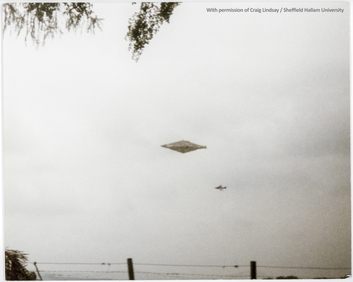
Pictured: the Calvine photograph, said to have been taken on August 4, 1990, showing the diamond-shaped object and a jet identified by MoD analysts as a Harrier. This is the only surviving print: a black-and-white copy the Daily Record sent to RAF press officer Craig Lindsay in August 1990, which he kept. Dr. David Clarke saw it in May 2022; Lindsay donated it to Sheffield Hallam University in June 2022, and it was published in August 2022, which is why it can be reproduced here with permission rather than as a placeholder.
Theoretical Alignment
These three percentages are this archive's own interpretive weights, not measurements, and on the record as it now stands they rest on very little. The case consists of one surviving photograph, a short second-hand account relayed by an RAF press officer who spoke once by telephone with one of two unnamed men, and a few pages of Ministry of Defence paperwork. The Black Project weighting reflects the explanation that the people closest to the case have favoured: Dr David Clarke wrote in 2022 that he had become convinced the image shows a classified U.S. “black project” aircraft, and an MoD officer told him that people at the ministry believed the object was an experimental American craft. No document has been released that confirms this. The Extraterrestrial weighting rests on the reported hover and vertical departure, which come from the anonymous witness statement alone and cannot be checked. The Psycho-Social weighting is low because the photograph shows something physical in front of the camera; but a hoax staged in front of the camera, which the photographic analyst says he cannot rule out, would fall outside all three headings. Readers should treat the grid as a summary of competing readings, not as a finding.
Background
Calvine is a hamlet on the A9 in Highland Perthshire, a few miles west of Blair Atholl and about ten miles north-west of Pitlochry. The surrounding hills and glens lie under the RAF's low-flying training areas, and fast jets were a familiar sight there in 1990. The case is often placed against the background of the Gulf crisis (Iraq invaded Kuwait on 2 August 1990, two days before the reported sighting), but nothing in the released record connects the two.
What is known about the sighting itself comes from three places. The first is a handwritten summary made by the MoD's UFO desk, Secretariat (Air Staff) 2a, in September 1990 and released in redacted form at The National Archives (DEFE 24/1940/1). It describes a “large diamond shaped UFO hovering for about 10 minutes before ascending vertically upwards at high speed,” and says that during the sighting an RAF aircraft “believed to be a Harrier” made a number of passes for five to six minutes. The second is the memory of Craig Lindsay, then the RAF press officer for Scotland at RAF Pitreavie Castle near Dunfermline, who received a print from the Daily Record and spoke by telephone with one of the men. The third is Nick Pope's 1996 book Open Skies, Closed Minds, which says that one of the men took six photographs over about ten minutes. Pope joined the MoD desk in 1991, after the case was closed, so his account is of the file and the photographs, not of an investigation he ran.
According to that account, two men were walking on the moors above Calvine on the evening of Saturday 4 August 1990, at about 9 pm, when they saw a large diamond-shaped object hanging silently in the sky. They sheltered under trees, a jet made several passes, and the object then rose vertically at high speed and disappeared. The men were later said to have been working in a hotel kitchen in Pitlochry. Their names are written in the MoD file but redacted, and they have never come forward. Who they were, which hotel employed them, and even which of them held the camera are all still open questions, discussed below.
The case stayed almost unknown for two decades. Pope's book mentioned it, and in 2009 David Clarke, then working with The National Archives on the release of the MoD's UFO files, found two poor photocopies of one of the images (from “Vu-Foil” transparencies made for the analysts) in DEFE 31/180/1. Interest grew after a 2015 Channel 5 documentary for which Pope had an artist recreate the image from memory; that recreation was later widely mistaken for the real photograph. The only surviving print of an original image did not reach the public until August 2022.
Complete Timeline
| Date | Event |
|---|---|
| 4 August 1990, c. 9:00 pm | The reported sighting. Two men on the moors above Calvine see a large diamond-shaped object hover for about ten minutes, with a jet believed to be a Harrier making passes, before it rises vertically and vanishes. Six photographs are said to have been taken. (Witness account as relayed to the Daily Record and to Craig Lindsay.) |
| c. 23 August 1990 | The photographs reach the Daily Record. Andrew Robinson's reconstruction, based on former editor Malcolm Speed's recollection that they arrived just before his August bank-holiday leave, puts their arrival at the Glasgow paper at about this date. The paper never publishes them. |
| Late August 1990 | RAF Pitreavie consulted. The paper's picture desk asks RAF press officer Craig Lindsay for comment and sends him a 10×8-inch print, probably around 30 August. Lindsay faxes photocopies to Sec(AS) in London, which asks for the negatives. He telephones a number supplied by the paper, reaches a Pitlochry hotel, and speaks for up to half an hour with a man working in the kitchens, then faxes a typed summary. |
| 10–14 September 1990 | MoD analysis. The negatives, forwarded by the Daily Record, arrive at the MoD on 10 September. Specialists identify the jet as a Harrier and a second, barely visible aircraft as probably another Harrier; the MoD finds no record of Harriers operating in the area at the time and no other reports of unusual air activity. A draft answer for possible parliamentary questions is prepared and the negatives are returned to the Daily Record by 14 September (DEFE 31/179). What became of them afterwards is unknown. |
| 1991–1994 | The poster. Nick Pope joins the MoD UFO desk in 1991 and finds a poster-sized enlargement of one image on the office wall. It stays there until his head of division takes it down; the date is not recorded. |
| 1996 | First public account. Pope's Open Skies, Closed Minds describes the case and the six photographs. |
| March 2009 | Photocopies released. The National Archives releases MoD UFO files including two poor photocopies of one Calvine image (DEFE 31/180/1); David Clarke publicises them on his blog on 21 March 2009. |
| 2015 | The artist's recreation. A Channel 5 Conspiracy episode features a drawing made from Pope's memory, later widely mistaken for the real photograph. |
| October 2020 | Closure reported. Press reports say the MoD file, due for release in January 2021, will stay closed to 2072 to protect the witnesses' identities. The file was later released with the witnesses' names redacted; Robinson's 2024 report gives 1 January 2076 as the date the unredacted report opens. |
| August–October 2021 | Lindsay found. Clarke contacts Craig Lindsay, whose name appears in the redacted 1990 summary. Lindsay says he has been waiting more than thirty years for someone to call; in October he emails Clarke a photocopy of the print. |
| May–June 2022 | The print. Clarke visits Lindsay in Scotland in May and photographs him holding the print he had kept since 1990. On 27 June Lindsay donates the print, his 1990 photocopies and the original Daily Record envelope to Sheffield Hallam University's Special Collections. |
| 12–13 August 2022 | Publication. Clarke publishes the image on his blog and in the Daily Mail. Andrew Robinson's first analysis follows the same month. |
| March 2023 | “Kevin Russell” traced. The name written on the back of the print is matched to a kitchen porter living at Pitlochry's Hydro Hotel on the 1990 electoral register (Daily Record, 6 March 2023). When found, he denies any knowledge of the photograph. |
| June 2024 | Updated analysis. Robinson's 34-page revised report concludes the print is “without doubt” a copy of the photograph the MoD analysed in 1990, but that there is insufficient data to say what the object is. Clarke publishes a new claim from former chef Richard Grieve. |
The Sighting: Ten Minutes over Calvine
Almost everything said about what the men saw traces back to one short description. In its released form, the MoD's handwritten summary reads like a log entry: a large diamond-shaped object hovering for about ten minutes, then ascending vertically at high speed, with an aircraft believed to be a Harrier making passes for five or six minutes before leaving. Craig Lindsay's recollection, given to Clarke three decades later, adds that the man he spoke with described himself and a friend sheltering under trees, and that the object was circled by military jets. Pope's book says one man took six photographs.
Many details repeated in popular retellings are not in any of these sources. There is no published witness estimate of the object's height above the ground, no account of the men “stepping out of the bushes,” and no description of seams, surfaces or colour beyond what the one photograph shows. Size estimates of about 30 metres come from later analysis of the photograph, using the Harrier for scale, not from the witnesses. Descriptions of a “field-effect” or “electromagnetic” propulsion system are speculation layered on a second-hand account and have no basis in the record.
The photograph itself shows less than the legend. It is taken from behind a wire fence, framed by out-of-focus branches, and shows a dark, roughly diamond-shaped object against a featureless overcast sky, with a small jet-shaped silhouette to its left and a line of low hills along the bottom of the frame. Robinson found that the sky is lit by diffused light from cloud cover, with no direct sunlight or blue sky, and that the object is not symmetrical in either dimension, although blur and the poor resolution of the copy prevent any surface features being made out. The Met Office record for 4 August 1990 describes a rather cloudy day across most of Scotland. The often-repeated “clear skies” and “setting sun” do not match the picture.
Two further points matter. First, the date, place and time rest entirely on what the witnesses told the Daily Record and Lindsay; Robinson stresses that nothing in the print confirms them, and that the photograph could have been taken somewhere other than Calvine. Second, only one of the six images survives. Lindsay and others say they saw the other five, but no negatives or other prints are known, so nothing can be learned from the sequence.
The Ministry of Defence Investigation
The released papers show a short, routine inquiry rather than the “highly classified and rigorous internal investigation” sometimes described. Lindsay faxed photocopies to Sec(AS) in late August. Sec(AS) asked for the negatives, which the Daily Record forwarded; they arrived on 10 September 1990. The photographs were examined by defence intelligence specialists (the Vu-Foil copies in DEFE 31/180/1 come from the defence intelligence branch DI55, and Robinson's report says the images were studied by the Joint Air Reconnaissance Intelligence Centre). According to the MoD's own briefing, the analysis “established that the jet aircraft is a Harrier” and found a barely visible second aircraft, again probably a Harrier.
The same briefing records that there was no record of Harriers operating in the area at the time the photographs were said to have been taken, and that no other reports of unusual air activity had been received for that place, date and time. A line was drafted in case of questions in the House of Commons, and the negatives were returned to the Daily Record by 14 September. The file entry that Pope later quoted reads “object unexplained, case closed, no further action.”
Several claims made about this stage are not supported. No released document shows that the MoD “confiscated” the negatives, that officials travelled to Scotland to collect them, that the newspaper was told not to publish, or that the RAF and the U.S. Air Force were each asked about experimental aircraft and denied involvement. The record says the opposite on the first point: the negatives went back to the newspaper. Why the Daily Record never used the story is unexplained; staff Clarke traced did not remember it clearly, and the negatives' later fate is unknown.
The later handling of the file has drawn more attention than the inquiry. In October 2020 the press reported that the MoD would keep the file closed until 2072 rather than release it after the normal thirty years. The stated reason was protecting the identities of the witnesses. Clarke has criticised the redactions, noting that the photographer had himself sent his negatives and details to Scotland's best-selling tabloid in 1990. The documents now open at The National Archives carry the names blacked out; Robinson gives 1 January 2076 as the date the unredacted version is due to open. There is no evidence that the closure protects anything other than personal details, and none that it does.
The Aurora Project and Secret Black Projects
The explanation most often offered by people with MoD connections is that the photograph shows a secret aircraft. Pope told Clarke in 2001 that MoD analysts judged the object a solid craft at least as large as a Harrier or Hawk, and that the images were not a hoax. Clarke reports that a former defence intelligence official told him further inquiries showed the two jets were U.S. and UK aircraft “escorting the object,” and that several former RAF and MoD staff who saw the images in the 1990s believed they showed either the F-117A stealth fighter or a secret U.S. or UK prototype. None of these accounts is supported by a released document.
Clarke has also pointed out a visual resemblance between the Calvine silhouette and Lockheed's “Hopeless Diamond” (a 1975–76 wooden test model) and its successor demonstrator Have Blue, both early stealth designs, while stressing that the comparison is not to scale. He notes that rumours of secret U.S. aircraft flying from RAF Machrihanish on the Kintyre peninsula circulated in aviation magazines around 1990–92, and that the UK government publicly denied in 1991 and 1992 that any U.S. black-project aircraft was based in or flying over the UK, while ministers were privately briefed that desk officers “would not be surprised” if one existed.
The name “Aurora” belongs to the rumoured hypersonic successor to the SR-71, whose existence has never been confirmed. A high-speed, high-altitude reconnaissance aircraft is a poor fit for an object reported hovering at low level for ten minutes. If the photograph shows a classified aircraft, it is more likely to have been a slow or hovering platform, such as an airship, an aerostat or a lifting-body demonstrator, than Aurora. AARO's 2024 historical report on U.S. government UAP investigations says that some classified U.S. platforms were saucer- or triangle-shaped and could hover, but it does not mention Calvine.
Craig Lindsay: The Gatekeeper of the Print
Craig Lindsay was the RAF's press officer for Scotland at Pitreavie Castle in 1990. The Daily Record's picture desk, probably picture editor Andy Allen, asked him for comment and sent him a single 10×8-inch print in a card envelope addressed via a colleague in the paper's Edinburgh office. Lindsay made photocopies to fax to London, phoned the witness number the paper gave him, and typed up what he was told. He did not examine the negatives, travel to the newspaper or collect anything for the MoD; London told him to leave the matter to them.
He kept the print. He was never asked to return it and, by his account, nobody asked him about it for more than thirty years. When Clarke phoned him in August 2021, Lindsay said, “I have been waiting more than 30 years for someone to call me about this story … and you are the first person to do so.” He disposed of his notebooks about a decade before Clarke found him and cannot remember the name of the man he spoke to, though he believed the hotel was the Atholl Palace on the edge of Pitlochry.
Lindsay's print is not a direct enlargement from the original colour negative, as is often said. Robinson's analysis shows it is a black-and-white image printed on Kodak Ektacolor colour paper from a copy negative, most likely made by the Daily Record on Ilford XP-1 film from a colour print supplied by the witnesses, before the paper had the original negatives. It is therefore at least one generation removed from the camera original. Its value is that it is the only surviving photographic print of any of the six images, and that it matches both the photocopies Lindsay faxed in 1990 and the photocopies released in 2009.
Nick Pope's Findings and the Hangar Poster Incident
Nick Pope worked on the MoD's UFO desk from 1991 to 1994, starting the year after the sighting. He has described the Calvine images as “the most spectacular UFO photo ever sent to the Ministry of Defence” and, in his 1996 book, as one of the most intriguing cases in the ministry's files. When he joined the desk, a poster-sized enlargement of one image hung on the office wall. It stayed there until his head of division took it down. Pope has not said exactly when, and no record says what became of it.
Because Pope arrived after the case was closed, he did not investigate it. His knowledge comes from the file, the poster and conversations with colleagues. His 2001 statement to Clarke that MoD analysts judged the object a solid craft and not a hoax is a second-hand report of the 1990 analysis, not a document. In 2015 he had an artist draw the image from memory for a Channel 5 documentary; that drawing circulated for years as if it were the photograph, which shows how weak the public record was before 2022.
David Clarke and the 2022 Discovery
David Clarke, a journalist and associate professor at Sheffield Hallam University, came across the case in 2009 while curating the release of the MoD's UFO files at The National Archives. In 2018 he reopened the inquiry after a former defence intelligence officer told him the photograph showed a classified U.S. platform. In 2020 the Scottish ufologist Straiph Wilson placed newspaper appeals for the witnesses, without result. In the summer of 2021 Clarke published an update in which he leaned towards a hoax.
The breakthrough came from the redacted 1990 summary, which still showed Lindsay's name. Clarke contacted him in August 2021. In October Lindsay emailed a photocopy; in May 2022 Clarke visited him and photographed him holding the print; on 27 June 2022 Clarke and Vinnie Adams interviewed Lindsay at Pitreavie Castle and Lindsay donated the print, his 1990 photocopies and the envelope to Sheffield Hallam University's Special Collections. Clarke released the image on 12–13 August 2022 on his blog and in the Daily Mail. He then wrote that he was now convinced the photograph shows a U.S. classified “black project.”
The release did not end the mystery. It made it possible, for the first time, to test the image, and it started a long search for the photographer that is still unresolved.
Photographic Analysis and Forensics
The only detailed analysis of the print is by Andrew Robinson, a photography lecturer at Sheffield Hallam University, first in August 2022 and in a revised 34-page report in June 2024. His main findings are these. The print is “without doubt” a copy of the photograph the MoD analysed in 1990. It is a black-and-white print on Kodak Ektacolor 78 resin-coated colour paper, made on a mini-lab machine of the kind used by newspapers. The film grain gives no sign of negative or print manipulation, so the image is “a genuine photograph of a scene before the camera.” If any construction or manipulation took place, it happened in front of the camera, but there are no visible signs of it.
Robinson also estimates the geometry, assuming a standard 50 mm lens. The fence is about 10.6 metres from the camera. The aircraft is about 755 metres away and roughly 117 metres above the ground. The object is between 30 and 40 metres long and 8 to 12 metres high (±10 per cent). These figures depend on the jet really being a full-size Harrier; if it were not, the scale would change completely. He considers the theory that the picture is an inverted reflection in a loch unlikely, though he cannot categorically rule it out. He identifies An Teampan, the summit of Struan Point south of Calvine, as a possible but unconfirmed location. His overall conclusion is that there is insufficient data to say what the object is.
Several claims made in earlier versions of this page do not appear in Robinson's work. He did not find that the lighting on the object and the jet matched a setting sun (the scene is overcast). He did not test the paper's chemistry, establish that the object is symmetrical (he says it is not), or perform shadow or densitometry analysis showing a “central bulge.” He did not “rule out” a hoax. What he showed is narrower: the print is authentic, unmanipulated after the shutter fired, and consistent with the story told about it.
The Investigation and Cover-Up
The idea that Calvine was “suppressed for 32 years” needs care. The MoD did not keep the negatives; it returned them to the newspaper within a week. It did not stop the Daily Record publishing; no document says so, and the paper's own staff could not explain why it did not. What the MoD did keep closed was its file, and the reason given was the witnesses' privacy. The “missing” photographs are missing because the newspaper's negatives cannot be found, not because they are known to be in a government vault.
There is still a real gap. The released papers say no Harriers were known to be operating in the area; if the jet in the photograph is a Harrier, either the record is incomplete or the picture was not taken where and when the witnesses said. Clarke's sources say the jets were escorting the object. No flight log, radar record or pilot report has been released or described by anyone who has seen one. Claims that the Harrier came from RAF Lossiemouth are wrong on their face: Lossiemouth did not operate Harriers in 1990.
The 2022 Photograph Release and Its Impact
The image went around the world within days of its release in August 2022 and was soon labelled the best UFO photograph ever taken. It also produced a wave of explanations, most of them suggesting a hoax: a mountain top seen through mist, an inverted reflection of a rock in a loch, a small object such as a Christmas ornament hanging on a thread from the branches (an idea developed by the Belgian sceptic Wim van Utrecht), or a kite, balloon or airship (suggested by Mick West). Clarke has noted that these theories cannot all be right, since they contradict one another, and that none explains the jet. The former AARO director Sean Kirkpatrick was reported as saying the image looked like a lake reflection that had been doctored.
The photograph was also included in James Fox's 2024 documentary The Program. In 2023 Clarke and colleagues tried to reproduce the hanging-ornament theory in front of a live studio audience; even a convincing reproduction would show only that such a picture can be made, not how this one was.
The Military Harrier Connection
The jet is the most important detail in the photograph, because it is the only thing that gives the object a scale. MoD specialists in 1990 identified it as a Harrier and found a second, fainter aircraft. Robinson agrees the silhouette is consistent with a Harrier but says blur and resolution prevent a conclusive identification. If it is a full-size Harrier about three-quarters of a kilometre away, the object is tens of metres across. If it is a model, the object could be very small.
The MoD's 1990 conclusion that no Harriers were operating in the area at the time adds to the puzzle rather than settling it. The witness account says the jet made passes for several minutes. A real low-flying Harrier over Highland Perthshire would normally have left records, and none has been produced. Whether that means the record was incomplete, that the flight was not one the RAF would log in the usual way, or that the photograph was staged, cannot be decided from the released papers.
The Scottish Context and Regional UAP Activity
Calvine is often grouped with other Scottish cases, such as the Bonnybridge reports of the 1990s, but there is no documented cluster of sightings around Calvine itself. The MoD found no other reports for the place, date and time. Earlier versions of this page said that civil air traffic controllers and coastal stations logged diamond-shaped and triangular craft over Scotland in summer 1990; no source for that claim could be found, and it has been removed.
The region's real military context is the RAF low-flying system. Highland Perthshire lies in an area used for low-level training by RAF and allied aircraft, so jets over the glens were common. That makes the presence of a jet in a photograph unremarkable in itself, and makes the absence of any recorded Harrier flight that evening more notable.
The MoD’s Photographic Archive
The MoD's UFO files at The National Archives contain many photographs, most of them of lights, aircraft or camera artefacts. Calvine stands out because the image is clear and because the MoD took it seriously enough to analyse it and to brief for possible parliamentary questions. But the MoD did not hold the original negatives for thirty years. What survived in the official record were Vu-Foil transparencies and their photocopies; the only photographic print that survived did so because an RAF press officer kept the copy a newspaper had sent him.
Robinson matched three generations of copy (the print, Lindsay's 1990 photocopies, and the 2009 archive photocopies) by overlaying them: the object and the jet line up exactly on all three. This is the strongest evidence that the image now in Sheffield is the one the MoD examined in 1990.
The Photograph’s Morphological Analysis
The object is dark, roughly diamond-shaped when seen side-on, with a longer upper outline and a shorter lower one. Robinson's analysis finds that it is not symmetrical in either direction. Blur and the generation loss of the copy mean that no surface detail, markings or structure can be seen, so statements that it has no seams, windows or control surfaces say more about the image quality than about the object. Clarke has compared the outline with the faceted shapes of early stealth designs, and sceptics have compared it with folded paper or a dangling ornament. The image alone cannot decide between them.
What the Evidence Proves
The evidence supports four things. A photograph exists showing a dark, diamond-shaped object and a jet-shaped silhouette above a fence and low hills. It is the image the MoD examined in September 1990. The print shows no manipulation after the photograph was taken. And the MoD could not identify the object, found no record of Harriers flying in the area, and closed the case as unexplained. It does not establish the date or place of the photograph, who took it, what the object was, how large it was, or whether the scene was staged. The witness account of a ten-minute hover and a vertical departure is second-hand, anonymous and uncorroborated. Calvine remains an unexplained photograph with a weak supporting account and a real unanswered question about the jet.
Key Witnesses
Kevin Russell
The back of Lindsay's print carries the words “Copyright Kevin Russell c/o the Daily Record, Glasgow” in red chinagraph pencil, probably written at the newspaper. The Daily Record said nobody of that name worked for it. Researchers working with Clarke traced many people of the name; in March 2023 a man listed on the 1990 Pitlochry electoral register as a kitchen porter living at the Hydro Hotel was identified, and when found he denied any knowledge of the photograph. Former chef Richard Grieve has said the two men who took the photographs were chefs at Fishers Hotel in Pitlochry, that neither was called Kevin, and that soon after the sighting the pair were questioned by men who said they were from the Royal Navy, after which both left their jobs. That account is uncorroborated. The photographer has never been identified.
Craig Lindsay
Received a 10×8-inch print from the Daily Record in late August 1990, faxed photocopies to the MoD's UFO desk, and spoke by telephone with one of the men at a Pitlochry hotel. He kept the print and, in 2022, donated it with his photocopies and the newspaper's envelope to Sheffield Hallam University. He is the only named person who spoke with a witness, and his account was given from memory thirty years later.
Nick Pope
Joined the desk the year after the sighting, so he did not investigate it. He saw a poster-sized enlargement on the office wall until his head of division removed it, described the case in Open Skies, Closed Minds (1996), and in 2001 told Clarke that MoD analysts had judged the object a solid craft and not a hoax. In 2015 he had an artist recreate the image from memory for television.
David Clarke
Found the 2009 photocopies while curating the MoD file release, traced Craig Lindsay in August 2021, and published the print in August 2022. He has since led the search for the photographer. His own view moved from hoax (2021) to a U.S. classified aircraft (2022).
Andrew Robinson
Wrote the only detailed analysis of the print (August 2022; revised June 2024). He concluded that it is a genuine copy of the image the MoD analysed, that the image was not manipulated after it was taken, that the object is about 30–40 m long if the jet is a full-size Harrier, and that there is insufficient data to say what the object is. He did not rule out a scene staged in front of the camera.
The Five Observables Assessment
The Five Observables framework is applied to the performance characteristics reported in this case:
Assessment: The reported ten-minute hover and the high-speed vertical departure come only from the anonymous witness account as relayed to the MoD and to Craig Lindsay. The single surviving photograph shows the object at one instant and cannot show either hovering or acceleration, so both are marked Speculative rather than Present. No radar data has been released, so low observability is not documented; nothing was recorded about speed, and there is no water in the scene.
If the account is accurate, a large object hanging still and silent for ten minutes and then climbing away fast would be unusual for any 1990 aircraft. But a lighter-than-air craft can hover silently, and a small object close to the camera can look large and motionless. The observables cannot be assessed further without the other five photographs or a first-hand witness.
Evidence Assessment
Supporting Anomalous Origin
- The surviving print is a genuine copy of the image the MoD analysed in 1990 and shows no post-exposure manipulation (Robinson, 2022 and 2024).
- MoD specialists could not identify the object, and the case was closed as “object unexplained.”
- The MoD found no record of Harriers operating in the area at the time, leaving the jet in the photograph unaccounted for.
- Former MoD and RAF staff who saw the images in the 1990s say they took them to be genuine (reported by Clarke).
Supporting Conventional Explanation
- The witnesses have never been identified, and the only account of the sighting is second-hand.
- Date and location rest wholly on the witness statement; the photograph itself cannot confirm either.
- Robinson could not rule out a scene staged in front of the camera; the scale depends on the jet being a full-size Harrier.
- No other reports were received for that place, date and time.
- Several people with MoD connections believe the object was a classified aircraft, which would be a terrestrial explanation.
Why "Disputed"
The Calvine case carries a DISPUTED stamp. The strongest part of the case is the photograph's chain of custody: the print in Sheffield has been shown to be the image the MoD examined, and it has not been altered after it was taken. The MoD's own analysts could not identify the object, and the presence of an unlogged jet is a genuine puzzle.
The weakest part is everything else. Earlier versions of this page supported the stamp with claims that turned out to be untrue: sworn testimony from Lindsay (there is none), a forensic finding that ruled out hoaxes (there is not), independent corroborating witnesses (there are none), and a 32-year confiscation of the negatives (they were returned within a week). With those removed, the case rests on one anonymous, second-hand account and one photograph whose date, place and author are unknown. That is why it is rated Disputed.
Sensor & Instrumentation Detection Profile
The only instrument in this case is the witness's camera, probably a 35 mm SLR or compact with a standard 50 mm or 35–70 mm zoom lens, judging from the field of view and the shallow depth of field (Robinson). Six exposures are said to have been made; one survives, as a copy. The camera, film and exposure settings are unknown, and the MoD's handwritten summary notes that camera details were wanted but there is no sign they were ever obtained.
No radar data has been released or described. The MoD's 1990 briefing does not mention radar at all; it says only that there was no record of Harriers operating in the area and no other reports. Statements that the object was tracked by air-defence radar, or that it evaded radar because it was stealthy, are speculation. The claim that the witnesses reported “absolute silence” within 2,000 feet of the ground is not in any source; the MoD summary says the object hovered, and Lindsay's account does not mention sound.
Environmental & Geospatial Context
Calvine lies on the A9 in the Garry valley of Highland Perthshire, at about 56.76° N, 3.98° W. The surrounding moorland rises to hills such as Struan Point, whose summit An Teampan Robinson identifies as one possible camera position, though not a confirmed one. The area lies within RAF low-flying training airspace.
On 4 August 1990 sunset in the area was at about 9.20 pm, so a photograph at about 9 pm would have been taken some twenty minutes before sunset. The Met Office summary describes a rather cloudy day in Scotland, with some rain in the north and west, and the photograph shows an overcast sky with diffuse light. The reanalysis weather computed below for the mapped point (light drizzle, heavy cloud) is consistent with that, and not with the “clear skies” often reported.
Observer Credibility & Occupational Profile
The two men who reportedly saw the object have never been identified, interviewed by researchers, or quoted directly. What is known is that one of them answered a call at a Pitlochry hotel kitchen in late August 1990 and described the sighting to Craig Lindsay, and that they had sent the photographs to a tabloid newspaper. They did not seek payment or publicity that anyone knows of. Richard Grieve's later account that they were chefs at Fishers Hotel and were questioned by men claiming to be from the Royal Navy is uncorroborated.
The named figures are not observers of the event. Lindsay handled the print and spoke to a witness; Pope saw the poster and the file; Clarke and Robinson studied the print decades later. None of them can add first-hand detail to the sighting. The MoD's analysts were professionals, but their work survives only as brief summaries.
Physical & Material Assays
No physical traces were reported, and no site investigation was made. The only physical object to examine is the print. Robinson identified the paper from its backprint as Kodak Ektacolor 78 resin-coated colour paper (made between 1972 and the early 1990s), measured the print at 7.9 × 9.9 inches, and found that it is a black-and-white image from a copy negative, most likely Ilford XP-1, with about 17 per cent of the original frame's width cropped to fit the 10×8 format. A small abrasion in the emulsion shows the orange-red layer typical of colour paper. These findings date and source the print. They say nothing about the object.
Historical Precedents & Archive Matches
Calvine is often compared with the Rendlesham Forest case of 1980 and the Belgian wave of 1989–90, but the only real link is the period and the interest of the same MoD desk. Its closer parallels are other cases where a single striking photograph, with an anonymous or vanished photographer, outlived the account behind it. The comparison Clarke has drawn with early Lockheed stealth shapes, and AARO's 2024 statement that some classified U.S. platforms were saucer- or triangle-shaped and could hover, place it among cases that may yet turn out to be secret aircraft. No archive match with any other recorded sighting has been found.
Material Analysis
The material record is the print, its envelope and Lindsay's photocopies, all held in Sheffield Hallam University's Special Collections, plus the photocopies and handwritten summaries in the MoD files at The National Archives.
Photographic Print and Chemistry
Robinson's examination of the print found:
- Paper: Kodak Ektacolor 78 resin-coated colour paper, identified from its backprint; printed borderless on a mini-lab machine.
- Image: A black-and-white image made from a copy negative of an original colour print, most likely on Ilford XP-1 film, so the print is at least one generation removed from the camera negative.
- Grain: Grain is consistent across the frame, with no sign of negative or print manipulation.
- Lighting: Diffuse light from an overcast sky, with no direct sunlight.
- Provenance: The image matches the 1990 fax photocopies and the 2009 archive photocopies when overlaid.
Stealth Technology and Materials
Nothing is known about what the object was made of. Earlier versions of this page described radar-absorbing composites and active acoustic suppression; those were speculation about a hypothetical aircraft, not findings, and have been removed. If the object was a classified aircraft, its materials would be in records that have not been released; if it was a model or a hoax, the question does not arise.
Supporting Anomalous Origin
- The print is a genuine copy of the MoD's image and shows no manipulation after exposure.
- The MoD's specialists could not identify the object in 1990.
Supporting Terrestrial Origin
- A staged scene in front of the camera cannot be ruled out from the print.
- The outline resembles early faceted stealth designs, and people with MoD connections believe it was a classified aircraft.
The Conventional Explanation Candidates
Three kinds of conventional explanation have been put forward for the Calvine photograph: a classified aircraft, a staged scene in front of the camera, and a misread natural scene such as a reflection. None can be confirmed or excluded on the released record.
1. A Classified U.S. or UK Aircraft
PlausibleThis is the view of David Clarke since 2022 and of several former MoD and RAF staff he has quoted, one of whom said further inquiries showed the jets were U.S. and UK aircraft “escorting the object.” Pope reported in 2001 that MoD analysts judged the object a solid craft. The outline resembles early faceted stealth designs such as Lockheed's “Hopeless Diamond,” and in 1990–92 rumours of secret U.S. aircraft at RAF Machrihanish were current in the aviation press. A hypersonic “Aurora” aircraft fits the reported hover badly; a slow, hovering or lighter-than-air platform would fit better. Against this: no document, flight record or programme has been identified, the MoD's own 1990 briefing found no record of Harriers in the area, and the UK government publicly denied any U.S. black-project flights in UK airspace.
2. A Scene Staged in Front of the Camera
InconclusiveSceptics have suggested a small object hung on a thread from the overhanging branches (Wim van Utrecht proposed a five-pointed Christmas ornament), with the “Harrier” a model or a real aircraft caught by chance. Robinson's analysis cannot exclude this: he found no manipulation after exposure, but says any construction would have happened in front of the camera, while also finding no visible sign of one. A staged scene would explain why the photographer never came forward and why no Harrier flight was logged. Against this: no supporting line or model detail is visible, the MoD's analysts in 1990 did not report a hoax, and no one has shown how the reported sequence of six images was produced.
3. A Reflection or Misread Natural Scene
UnlikelyOther suggestions are that the picture is upside down and shows a rock or island reflected in still water, or a mountain top seen through mist from Struan Point. Sean Kirkpatrick was reported as calling it a doctored lake reflection. Robinson considers the reflection theory unlikely and unproven, because the “reflection” is lighter than it should be, the camera position required is awkward, and there is no sign of a water surface or disturbance; a 3D reconstruction by an independent analyst reached a similar view. The mountain-top theory depends on a camera position that has not been confirmed. Neither explains the aircraft.
Related Cases
Confirmed Documents & Official Records
The MoD UFO desk's September 1990 handwritten summary of the Calvine report: a large diamond-shaped object hovering about ten minutes before ascending vertically at high speed, with an aircraft believed to be a Harrier making passes for five to six minutes. Released at The National Archives with the witnesses' and photographer's names redacted; the unredacted version is reported to be closed until 2072 (press reports, October 2020) or 1 January 2076 (Robinson, 2024).
Open with redactionsDEFE 31/180/1 holds the two poor photocopies of one Calvine image made from Vu-Foil transparencies for the defence intelligence analysts, released in March 2009. DEFE 31/179 (pp. 156–157) holds the briefing recording the negatives' arrival on 10 September 1990 and their return to the Daily Record by 14 September, and the finding that there was no record of Harriers operating in the area.
Open (released 2009)Search Government Archives Directly
Further Reading — Recommended Literature
Open Skies, Closed Minds
Pope's account of his years on the MoD UFO desk (1991–94), including the first published description of the Calvine case and the six photographs.
The UFO Files: The Inside Story
A comprehensive history of the British government's official UFO investigations, utilizing declassified files from The National Archives.
How UFOs Conquered the World
Clarke's history of the UFO phenomenon as modern folklore, written before he found the Calvine print; useful for the method he later applied to the case.
DISCLOSURE: Some links above are affiliate links. If you purchase through them, OverClassified receives a small commission at no additional cost to you. This helps support independent research.
Essential Viewing
The Calvine UFO: The World's Best Photograph Found
Detailed BBC News documentary covering Dr. David Clarke's search for the lost photograph, featuring interviews with Craig Lindsay and the photographic analysis by Sheffield Hallam University.
The Calvine UFO Incident | Nick Pope
UFO Hub's dedicated interview segment with Nick Pope, the former MoD UFO desk officer, discussing the Calvine case, the lost negatives, and why he regards the photograph as the most compelling evidence he encountered during his tenure.
The Calvine UFO Sighting — Jimmy Akin's Mysterious World
A long-form, evidence-focused investigation from Jimmy Akin and Dom Bettinelli examining what actually happened at Calvine, what became of the two witnesses, and the competing explanations for the object they photographed.
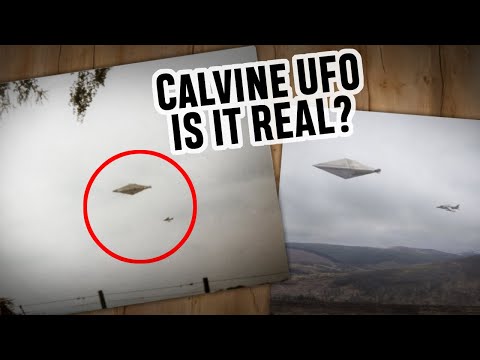
The Calvine UFO! Debunking Scotland's Most Credible UFO Case
A skeptically-minded analysis and breakdown of the case, weighing the photographic forensics and the Aurora/black-project theory against the possibility of a conventional or hoax explanation.
Thoughty2 — The Most Credible UFO Photo (2022)
Detailed breakdown of the 1990 Calvine incident, the Ministry of Defence's classification efforts, and the investigation leading to the photo's release.
Sources
- Clarke, David. “The Calvine UFO photograph – revealed.” Dr David Clarke: Folklore and Journalism (blog), 12 August 2022. Lindsay’s “waiting more than 30 years” remark, Pope’s “most spectacular” quote, Clarke’s black-project conclusion. drdavidclarke.co.uk
- Clarke, David. “Calvine UFO Revisited.” David’s Substack, 7 June 2024. The Kevin Russell search, Richard Grieve’s account, the MoD’s Harrier identification and “no Harriers” finding, the “escorting” claim, sceptical theories, Hopeless Diamond comparison, Machrihanish rumours. drclarke.substack.com
- Robinson, Andrew. Photographic analysis of the 10x8" print of Calvine UFO photograph donated by Craig Lindsey … [Version 5 – 2024]. Sheffield Hallam University, June 2024. Print and image analysis, size and distance estimates, timeline of the negatives, weather and sunset data. shura.shu.ac.uk
- Robinson, Andrew. Photographic analysis of the 10x8" print of Calvine UFO photograph … [Version 4 – 2022]. Sheffield Hallam University, August 2022 (superseded by Version 5). shura.shu.ac.uk
- Pope, Nick. Open Skies, Closed Minds. Simon & Schuster, 1996. (Cited via secondary accounts; not seen for this revision.)
- The National Archives, Kew. DEFE 24/1940/1, UFO reports (with redactions), pp. 113–116: Sec(AS)2a handwritten summary of the Calvine report, September 1990. nationalarchives.gov.uk
- The National Archives, Kew. DEFE 31/180/1, UFO incidents (with redactions), pp. 36–37: DI55 Vu-Foil photocopies of one image, released March 2009.
- The National Archives, Kew. DEFE 31/179, pp. 156–157: Sec(AF)2a briefing recording receipt of the negatives (10 September 1990) and their return to the Daily Record (by 14 September 1990), as reproduced in Robinson (2024).
- Clarke, David. The UFO Files: The Inside Story of Real-Life Sightings. The National Archives, 2009.
- Kean, Leslie. UFOs: Generals, Pilots, and Government Officials Go on the Record. Harmony Books, 2010. (Background only.)
- Aitkenhead, Kate. “The truth is out there: FOIA and the Calvine UFO sighting.” Simply Archivists, 18 October 2020. Reports the closure of the file to 2072, citing The Sun. simplyarchivists.wordpress.com
- McGivern, Mark. “Investigators believe Scot could hold important clue to one of world’s biggest UFO mysteries.” Daily Record, 6 March 2023 (the Hydro Hotel kitchen porter). dailyrecord.co.uk
- Madeley, “Revealed: Hotel porter who took this extraordinary photo of a UFO above the hills of Perthshire.” Daily Mail Scotland, 25 March 2023, p. 26 (as cited by Robinson; not seen).
- Lavelle, D. “What really happened in Calvine?” The Guardian, 11 February 2025 (cited via Wikipedia; not seen).
- “Calvine UFO photograph,” Wikipedia (used as a pointer to the dated sequence of Clarke’s investigation). en.wikipedia.org
- Randle, Kevin D. The Government UFO Files: The Conspiracy of Cover-Up. Visible Ink Press, 2014. (Further reading; not a source on Calvine.)
- “The story of the Calvine UFO photograph.” In Case You Missed It, BBC News (video). youtube.com
Corrections (October 2026)
This page was rewritten in October 2026 after checking it against Andrew Robinson’s 2022 and 2024 analyses of the print, David Clarke’s 2022 and 2024 accounts of his investigation, the MoD documents they quote (DEFE 24/1940/1, DEFE 31/179 and DEFE 31/180/1), and press reports of the file’s closure. Much of the earlier text was unsupported or wrong. The most important corrections: the MoD did not confiscate or keep the negatives; it received them on 10 September 1990 and returned them to the Daily Record by 14 September, and they were later lost. Craig Lindsay did not examine the negatives, collect them, or make a copy from them; he was sent a black-and-white copy print by the newspaper and kept it. The photograph shows an overcast sky, not clear skies or a setting sun. Robinson’s analysis did not “rule out” a hoax, test the paper chemistry, or find the object symmetrical; it found the print genuine and unmanipulated after exposure, did not exclude staging in front of the camera, and concluded there is insufficient data to identify the object. The MoD’s 1990 briefing found no record of Harriers operating in the area. Nick Pope joined the UFO desk in 1991 and did not investigate the case. “Kevin Russell” is the name written on the back of the print; the man of that name traced in 2023 denies involvement, and the photographer is unknown.
Following this review, the rating was changed from Credible 85 to Disputed 42 (October 26, 2026), because the higher rating had rested partly on claims corrected or removed above.
Removed as unsourced or false: the MoD file reference “DEFE 24/2072/1” (that file concerns 2006 FOI requests) and a “Sec(AS)/12/90” index entry; officials travelling to Scotland and telling the paper not to publish; RAF and USAF denials of experimental aircraft; JARIC “density mapping” and grain findings attributed to 1990; Kodak watermark and densitometer tests; “sworn testimony” from Lindsay; “independent witnesses” from other hotels; Harriers based at RAF Lossiemouth; an altitude of 1,500–2,000 feet and “absolute silence” attributed to the witnesses; civil and coastal reports of diamond-shaped craft over Scotland in summer 1990; a cluster of reports along the A9 documented by Scottish groups; EHD and “field-effect” propulsion; the poster being removed in 1994; and the source entries for JARIC logs, Daily Record editorial files and an unrelated Hansard sitting. The Five Observables tiles for lift and acceleration were changed from Present to Speculative, and Low Observability to Not documented, because they rested on the second-hand account alone. The stamp and score have not been changed and are under review.
See something inaccurate? Have additional information or sources?
Suggest an Edit →Last Updated: October 2026