
Secrets of Antigravity Propulsion
Tesla, UFOs, and Classified Aerospace Technology — A Self-Taught Systems Scientist's Case That the U.S. Military Quietly Solved Gravity Control Decades Ago
Core Thesis
Secrets of Antigravity Propulsion: Tesla, UFOs, and Classified Aerospace Technology is Paul A. LaViolette's 512-page case that gravity-control propulsion was never the physical impossibility mainstream physics treats it as, but a real technology quietly cracked by U.S. military and aerospace contractors beginning in the years after Nikola Tesla's death and T. Townsend Brown's Cold War-era electrogravitics experiments, then buried inside compartmentalized black programs ever since — surfacing, LaViolette argues, in the otherwise-unexplained flight characteristics of aircraft like the B-2 Spirit stealth bomber. Published in 2008 by Bear & Company, an Inner Traditions imprint specializing in esoteric and alternative-science titles rather than a peer-reviewed or academic press, the book leans on LaViolette's own decades-old, non-mainstream theoretical framework called subquantum kinetics to explain how such propulsion could work, and on a single anonymous former Rocketdyne informant's secondhand account to establish that it already has been built, under a program LaViolette calls "Project Skyvault." LaViolette holds a genuine 1983 Ph.D. in systems science from Portland State University, a legitimate, regionally accredited public research university — a credential this entry takes seriously and represents accurately, while also representing accurately that neither subquantum kinetics nor this book's central classified-program claim has gained acceptance, or even substantial engagement, from mainstream physicists, aerospace historians, or the peer-reviewed literature in the seventeen years since publication.
About the Author
Paul Alex LaViolette (November 8, 1947 – December 19, 2022) held real, verifiable academic credentials: a B.A. in physics from Johns Hopkins University, an M.B.A. in organizational administration from the University of Chicago, and a Ph.D. in systems science from Portland State University, awarded in 1983 for a dissertation titled "Galactic Explosions, Cosmic Dust Invasions, and Climatic Change." That dissertation topic — the claim that periodic bursts of cosmic-ray activity from the galactic center have driven abrupt climate shifts on Earth — became the seed of what LaViolette spent the following four decades developing as the "galactic superwave" hypothesis, pursued through the Starburst Foundation, the interdisciplinary research institute he led as president and director from 1984 onward. Unlike this site's Farrell entry, whose doctorate (Patristics, Oxford) sits in a field with no substantive connection to his later Nazi-technology claims, LaViolette's doctorate is at least topically adjacent to his later work — systems science bridging physics, astronomy, and thermodynamics — which makes it more directly relevant to, but no more validating of, the specific claims in this particular book.
LaViolette's best-known independent contribution is subquantum kinetics, a self-originated "unified field" framework he first published in 1985 that models subatomic particles as self-organizing wave patterns in an underlying reaction-diffusion medium, and which he uses throughout Secrets of Antigravity Propulsion as the theoretical mechanism supposedly permitting the electrogravitic and "gravity beam" propulsion effects the book describes. Subquantum kinetics has not been adopted, tested, or engaged with by any mainstream theoretical-physics research program; a representative 2020s Physics Forums discussion thread asking plainly whether "there's anything to it" was closed by a moderator after posters noted that essentially every published discussion of the theory traces back to LaViolette's own writing rather than independent replication, and characterized the framework as sitting well outside anything the Standard Model or general relativity could accommodate. LaViolette was also a longtime, vocal critic of Big Bang cosmology, promoting a "tired light" static-universe alternative to cosmic expansion — a position with real historical antecedents in 20th-century physics but one that has been a decisively minority, largely rejected view within professional cosmology since the 1960s discovery of the cosmic microwave background, the strongest single piece of evidence for the expanding-universe model LaViolette spent his career arguing against.
None of this makes LaViolette a fraud or his doctorate illegitimate — Portland State University is a real, regionally accredited public research institution, and his systems-science training genuinely equipped him to engage with thermodynamics, signal processing, and astrophysical data in ways an untrained popular author could not. What it does establish, and what this entry represents honestly rather than either inflating or dismissing, is a specific credibility profile: a real scientist working almost entirely outside the peer-review and replication process that normally validates physics claims, publishing his most consequential theoretical and historical work through his own foundation and a small alternative-press imprint rather than through refereed journals or an academic publisher, over a research career the mainstream physics and astronomy communities have, with rare exception, simply not engaged.
Historical Context & Origins
Secrets of Antigravity Propulsion arrived in 2008 as the fullest expression of research threads LaViolette had been developing since the 1980s and 1990s, when he began arguing that Cold War-era "electrogravitics" research — the antigravity-adjacent capacitor-thrust experiments T. Townsend Brown conducted for the U.S. Navy under Project Winterhaven in the early 1950s, documented on this site's own T. Townsend Brown & Electrogravitics case file (Case File #192) — had not ended in the null result the Navy's own 1952 evaluation reported, but had instead gone underground into classified follow-on programs. The book followed by seven years Nick Cook's The Hunt for Zero Point (2001), which had already carried a closely related Nazi-antigravity-into-Cold-War-secrecy narrative to a much wider mainstream readership through a credentialed aerospace journalist rather than an independent physicist; LaViolette's book pushes the same broad suspicion — that documented, real electrogravitics research never actually stopped — considerably further, past historical inference and into a specific claimed program name, chapter structure, and mechanism.
The book's evidentiary core is a single claimed source: LaViolette reports that an anonymous former engineer at North American Aviation's Rocketdyne division described to him, secondhand, a classified early-1950s effort to develop a microwave-beam-powered antigravity aircraft that the engineer's colleagues informally called "Project Skyvault." No declassified Department of Defense document, congressional record, or independent aerospace-history source uses this name or otherwise corroborates the program LaViolette describes; the entire claim rests on the credibility of one unnamed informant's decades-later recollection, relayed through LaViolette's own reporting rather than through any documentary record this book or any subsequent researcher has produced. That evidentiary structure — a specific, named-but-unconfirmable black program, sourced to a single anonymous informant, presented as history rather than as an unverified claim — is the exact pattern this site's catalogue elsewhere flags as the central weakness of the "secret space program" literature broadly.
The book's publication also sat, almost entirely by coincidence of timing rather than by any actual overlap in institutional pedigree, alongside a genuinely different model for how this same general subject — whether exotic propulsion physics deserves serious study — can be pursued. NASA's Breakthrough Propulsion Physics Project ran from 1996 to 2002, and its formal, peer-reviewed findings were published the following year as Frontiers of Propulsion Science (AIAA, 2009), co-edited by Marc G. Millis and Eric W. Davis. That volume devotes entire chapters — "Nonviable Mechanical 'Antigravity' Devices" and "Null Findings of Yamashita Electrogravitational Patent" among them — to formally testing and ruling out specific claimed antigravity effects circulating in exactly the literature LaViolette's book belongs to. LaViolette's book and NASA's AIAA anthology were therefore published within a year of each other, covering overlapping physics territory (electrogravitics, gravity-control propulsion, the Podkletnov-style claims both books discuss), through diametrically opposed methods: one a formally funded, refereed, null-results-inclusive government research program, the other an independent researcher's self-published theoretical framework applied to a single unnamed source's testimony.
Core Arguments & Key Concepts
The book's opening chapters, titled (per the Library of Congress's own cataloged table of contents) "Antigravity," "Beyond Rocket Propulsion," and "An Etheric Explanation," lay out LaViolette's central mechanism: that subquantum kinetics permits localized manipulation of the gravitational potential field through high-voltage, asymmetric-capacitor and pulsed-microwave configurations, building directly on Nikola Tesla's turn-of-the-century high-voltage experiments and T. Townsend Brown's later capacitor-thrust work. This is the book's most direct point of conflict with settled physics: the U.S. Office of Naval Research's own September 15, 1952 evaluation of Brown's Project Winterhaven concluded the thrust his devices produced was ordinary "electric wind" — ionized air pushed by corona discharge — not gravitational effect, a finding decades of subsequent vacuum-chamber testing (which eliminates the air a corona-wind explanation requires) has independently reinforced. LaViolette's book treats that 1952 finding as an intentional cover story rather than as a genuine experimental result.
A chapter titled "The U.S. Antigravity Squadron" extends the argument from individual devices to institutional secrecy, arguing that development continued inside classified Air Force and contractor programs through the Cold War and into the stealth-aircraft era. The book's most specific and most checkable claim follows in its "Project Skyvault" chapter: LaViolette's anonymous Rocketdyne source's account of a 1952–1957 North American Aviation effort to build a microwave-beam-propelled antigravity vehicle — a claim, as this entry's Historical Context section notes, with no corroboration outside LaViolette's own reporting of that single interview.
The chapters "Gravity Beam Propulsion" and "Microwave Phase Conjugation" (again, per the Library of Congress's cataloged contents) generalize the claimed mechanism into a broader classified-technology framework, and the book's most publicly visible single claim — frequently repeated in LaViolette's subsequent interviews — is that the Northrop B-2 Spirit stealth bomber's documented high-altitude performance and unusual radar signature reflect electrogravitic drive elements layered onto its airframe rather than purely conventional aerodynamics and propulsion. This claim runs directly against extensively public, independently documented engineering fact: the B-2 is powered by four non-afterburning General Electric F118-GE-100 turbofan engines, each producing roughly 17,300 pounds of thrust, buried in the wing root specifically for radar-cross-section reduction rather than for any exotic propulsion purpose — a configuration documented in Air Force and manufacturer specifications with no ambiguity or gap requiring an unconventional explanation. The B-2's real flight-test program was conducted openly by the Air Force Flight Test Center at Edwards Air Force Base in California beginning with its first flight in July 1989, a documented, non-classified testing history that leaves no gap in the aircraft's known development timeline for an undisclosed antigravity element to have been secretly incorporated.
Running underneath all of these specific claims is LaViolette's consistent methodological move: presenting subquantum kinetics not as one contested framework among several competing speculative physics proposals, but as the settled theoretical foundation that makes each subsequent claimed historical episode plausible. Readers are asked to accept the underlying physics as given in order to find the anonymous Rocketdyne testimony, the B-2 inference, and the broader classified-antigravity-squadron narrative credible — the same claims-compounding-on-unproven-claims structure this site's own Farrell entry documents as a defining weakness of the wider secret-space-program literature.
Key Cases & Evidence Discussed
This site's own T. Townsend Brown & Electrogravitics case file (Case File #192) is the book's single most load-bearing real-world case: LaViolette treats Brown's genuine, documented 1952 Project Winterhaven proposal and the Navy's ONR evaluation of it (led by physicist Willoughby M. Cady, whose findings are also profiled on this site's key-figures page) as the true starting point of a program that never actually stopped, rather than as the null result the declassified record shows it to be.
Nikola Tesla's genuine, well-documented high-voltage and wireless-power experiments — profiled on this site's own key-figures entry for Nikola Tesla — form the book's historical starting point, though LaViolette's specific claim that Tesla's seized papers fed directly into a postwar antigravity program goes well beyond anything Tesla's own surviving correspondence or the FBI's released file on him documents.
The B-2 Spirit program, developed by Northrop (later Northrop Grumman) and first flown in 1989, is the book's most contemporary and most publicly checkable case; unlike the anonymous-source-dependent Project Skyvault claim, the B-2's actual propulsion system is a matter of extensive public record, making it the clearest single point in the book where LaViolette's classified-antigravity reading can be directly compared against non-classified, independently documented engineering fact.
For a direct evidentiary-standard comparison within this site's own catalogue, Frontiers of Propulsion Science (AIAA, 2009) covers substantially the same electrogravitics and antigravity-device territory — including a formal chapter on the Yamashita electrogravitational patent and null tests of comparable claimed effects — through NASA's peer-reviewed Breakthrough Propulsion Physics Project rather than through an independent researcher's own theoretical framework and a single anonymous informant, making it the single most useful comparison title for readers evaluating this book's claims. This site's own Covert Wars and Breakaway Civilizations entry, by Joseph P. Farrell, documents the closest comparable case in this catalogue of a real, credentialed doctorate applied to a totalizing classified-technology-secrecy narrative built largely on secondary and single-source testimony rather than primary documentation.
Critical Reception & Controversies
Secrets of Antigravity Propulsion received no reviews from mainstream trade outlets such as Kirkus, Publishers Weekly, or major newspapers, consistent with its publication through Bear & Company, an Inner Traditions imprint focused on esoteric, alternative-health, and visionary-fiction titles rather than science publishing subject to independent editorial vetting. Its reception has instead played out almost entirely among readers already inclined toward its subject matter: it holds a 3.93-out-of-5 average across 145 Goodreads ratings, with jacket endorsements from systems philosopher Ervin Laszlo, who called LaViolette "one of the most interesting and innovative thinkers" of his generation, and from Steven M. Greer, whose own disclosure-advocacy work this site profiles elsewhere.
Even within that sympathetic readership, real reservations surface. One reviewer, while engaged by the book's detail, observed that the underlying classified research it describes "will stay away from the public's eye forever" — an acknowledgment, whether intended as one or not, that the book's central claims are effectively unfalsifiable by design. A more pointed reader objection cuts directly at the book's physics: one commenter noted flatly that explaining the claimed thrust effects requires no new physics at all, since "the Maxwellian framework and Newton's third law are sufficient" — a direct challenge to subquantum kinetics' claimed necessity as an explanatory mechanism, made not by a professional physicist in a journal but by an ordinary reader in an online review, itself a small illustration of how little formal scientific engagement this book's central theoretical apparatus has drawn in either direction.
The book's most specific claim to independent scientific vindication — that the Pioneer anomaly (the slight, unexplained sunward acceleration detected in the Pioneer 10 and 11 spacecraft) confirmed a photon-blueshift effect LaViolette says he predicted from subquantum kinetics as early as 1980 — did not hold up. In 2012, a team led by Slava Turyshev published "Support for the Thermal Origin of the Pioneer Anomaly" in Physical Review Letters, building a detailed finite-element thermal model of both spacecraft and showing that ordinary recoil force from anisotropic heat radiation off the vehicles' own instruments and radioisotope power supplies fully accounts for the anomaly's magnitude, direction, and behavior over time — leaving, in the study's own finding, no anomalous acceleration requiring new physics at all. LaViolette has continued to dispute the interpretation, but the mainstream physics literature's settled explanation directly undercuts the specific vindication claim this book and LaViolette's other writing repeatedly invokes.
The sharpest available contrast for evaluating this book, and the one this entry weighs most heavily, is against this site's own Frontiers of Propulsion Science breakdown. Both books cover the same underlying physics territory — whether gravity-control propulsion is achievable, and whether historical electrogravitics claims deserve to be taken seriously — but through opposite methods and opposite institutional postures. Millis and Davis's 737-page AIAA anthology subjects specific claimed antigravity devices and patents to formal, published null testing inside a professionally refereed volume produced under an actual NASA research program; LaViolette's 512-page book applies his own self-originated, professionally unengaged theoretical framework to a single anonymous informant's secondhand account, published through a small alternative-science press with no peer review at all. Where Frontiers of Propulsion Science treats the antigravity-device literature as a set of testable hypotheses, most of which it formally rules out, Secrets of Antigravity Propulsion treats the same broad claim as already-settled history, requiring only the right insider's testimony to document further. Readers who take one seriously without reading the other are missing exactly the comparison this site's catalogue exists to make available.
Beyond this specific book, LaViolette's wider scientific output has drawn what little formal engagement exists in similarly skeptical terms: his subquantum kinetics framework has never been adopted or tested by an independent physics research group, with online physicist discussion (a representative Physics Forums thread explicitly asking whether "there's anything to it") concluding that virtually all published discussion of the theory traces back to LaViolette's own writing, and his broader anti-Big-Bang "tired light" cosmology remains, as it has since the 1960s discovery of the cosmic microwave background, a decisively minority position rejected by the professional cosmological consensus.
Influence & Legacy
Within the alternative-propulsion and "secret space program" research and conference circuit, Secrets of Antigravity Propulsion became, and has remained, one of the most frequently cited single titles connecting Tesla and T. Townsend Brown-era electrogravitics history to later black-program secrecy claims; LaViolette discussed the book directly at venues including the Laughlin UFO Mega Conference and the Alt Propulsion Conference (later folded into the broader exotic-propulsion research circuit), and on programs such as American Antigravity and The Higherside Chats through the years following its publication.
LaViolette continued developing and promoting the book's core claims, alongside his subquantum kinetics and galactic superwave research, through the Starburst Foundation until his death in December 2022; the foundation has continued to make his published predictions, dissertation excerpts, and electrogravitics research available through its own website since.
The book's influence on mainstream aerospace engineering and physics has been effectively nonexistent — a direct contrast with Frontiers of Propulsion Science, whose contributors and findings continue to be cited within the Tau Zero Foundation's interstellar-flight research community and, through Eric Davis specifically, within the Pentagon's own later AAWSAP and AATIP UAP programs. LaViolette's book, by comparison, circulates almost entirely within the alternative-research and secret-space-program audience it was written for, its "Project Skyvault" claim repeated across UFO-propulsion blogs and forums in the years since without ever gaining independent documentary corroboration.
Within this site's own catalogue, the book connects most directly to the T. Townsend Brown & Electrogravitics case file whose real history it reinterprets, to the Secret Space Program Hypothesis and Zero-Point Energy Extraction Hypothesis theory pages whose speculative-propulsion territory it shares, and to this site's own Frontiers of Propulsion Science and Covert Wars and Breakaway Civilizations entries, its closest available points of contrast in evidentiary standard and genre, respectively.
The Book
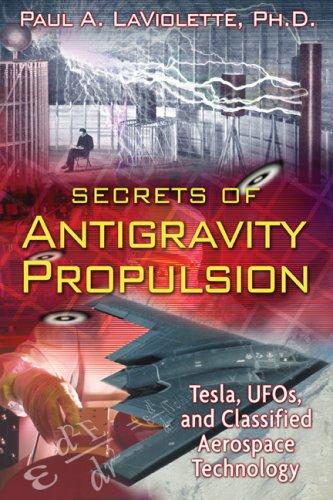
Secrets of Antigravity Propulsion
Tesla, UFOs, and Classified Aerospace Technology — A Self-Taught Systems Scientist's Case That the U.S. Military Quietly Solved Gravity Control Decades Ago
Find on Amazon →As an Amazon Associate, OverClassified may earn from qualifying purchases made through this link, at no extra cost to you.
Why This Is Essential Reading
Secrets of Antigravity Propulsion earns its place on this list as the catalogue's clearest single-author test case for what happens when a legitimate doctorate, applied through a self-originated theoretical framework the physics community has never engaged with, meets a classified-program claim resting on one anonymous informant's secondhand testimony. Paul A. LaViolette's 1983 Portland State University Ph.D. in systems science is real, and his systems-science training is genuinely visible in how the book handles thermodynamics and signal data — but neither that credential nor his subquantum kinetics framework has translated into acceptance from mainstream physics, and this book's central "Project Skyvault" claim remains, seventeen years after publication, undocumented outside LaViolette's own reporting of a single interview. Read it specifically alongside this site's own Frontiers of Propulsion Science entry, which covers nearly identical electrogravitics and antigravity-device territory through NASA's own formally refereed research program and arrives at the opposite conclusion about most of the same specific claims — the clearest available demonstration, in this catalogue, of how far apart "independent researcher's self-published theory" and "peer-reviewed institutional anthology" can land on the same underlying physics question.
Related Cases & Theories
Essential Viewing
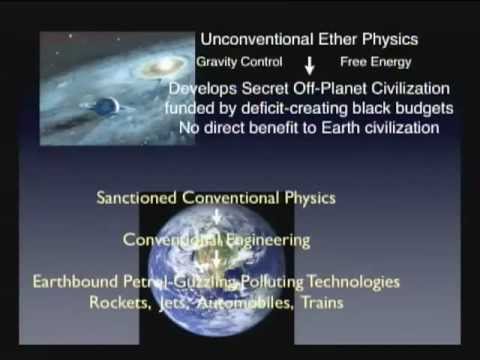
Dr. Paul LaViolette Presents Secrets of Antigravity Propulsion
Laughlin UFO MEGA CONFERENCE — LaViolette presenting this exact book's claims directly at the Laughlin UFO Mega Conference. Verified via YouTube oEmbed before inclusion.
Paul Laviolette on Electrogravitic Propulsion
Alt Propulsion Conference — LaViolette discussing the electrogravitics and Biefeld-Brown-effect research territory this book builds its historical narrative on, at the Alternative Propulsion Engineering Conference. Verified via YouTube oEmbed before inclusion.
Sources Cited
- LaViolette, Paul A. Secrets of Antigravity Propulsion: Tesla, UFOs, and Classified Aerospace Technology. Bear & Company, Rochester, VT, 2008 (ISBN 978-1-59143-078-0 / 159143078X, 512 pp.).
- "Secrets of antigravity propulsion: Tesla, UFOs, and classified aerospace technology." Library of Congress catdir publisher description and cataloged table of contents (LCCN 2008004466; Bear & Co., Rochester, VT, 2008, vii + 503 pp.). catdir.loc.gov
- "Secrets of Antigravity Propulsion." Open Library (Bear & Company, 2008 edition record, ISBN 159143078X / 9781591430780, 512 pp., publication date May 26, 2008). openlibrary.org
- "Secrets of Antigravity Propulsion: Tesla, UFOs, and Classified Aerospace Technology." Amazon.com (LaViolette Ph.D., Paul A., paperback listing, ISBN 9781591430780). amazon.com
- "Secrets of Antigravity Propulsion." Goodreads (reader ratings: 3.93/5 average across 145 ratings; reviewer comments on falsifiability and on Maxwellian/Newtonian sufficiency cited in this entry's Critical Reception section). goodreads.com
- "Director's Bio." The Starburst Foundation (LaViolette's education: BA physics Johns Hopkins, MBA University of Chicago, PhD Portland State University; career as Starburst Foundation president). starburstfound.org
- "Paul LaViolette's 1983 Ph.D. dissertation." The Starburst Foundation (dissertation title "Galactic Explosions, Cosmic Dust Invasions, and Climatic Change," Portland State University, 1983). starburstfound.org
- "Astrophysicist Paul Alex LaViolette, PhD has passed away." ProtoThema English, December 20, 2022 (death date December 19, 2022, Athens, Greece; birth date November 8, 1947, Niskayuna, NY). en.protothema.gr
- "Subquantum kinetics- anything to it?" Physics Forums (physicist/enthusiast discussion thread assessing subquantum kinetics; moderator-closed after noting the theory's near-total lack of independent corroboration beyond LaViolette's own publications). physicsforums.com
- Turyshev, Slava G., et al. "Support for the Thermal Origin of the Pioneer Anomaly." Physical Review Letters 108, 241101, June 12, 2012 (finding that anisotropic thermal recoil force fully accounts for the Pioneer anomaly, leaving no anomalous acceleration). link.aps.org
- "Early prediction of Pioneer anomaly challenges energy conservation law." The Starburst Foundation (LaViolette's own account of his 1980 blueshift prediction and its claimed relevance to the Pioneer anomaly, presented here alongside the Turyshev et al. 2012 thermal-origin finding that undercuts the vindication claim). starburstfound.org
- "Confirmation Of Project Skyvault?" The Alchemical Beacon (Substack discussion documenting that the Project Skyvault claim traces to LaViolette's own reporting of an anonymous former Rocketdyne source and remains uncorroborated by any declassified government or independent aerospace-history record). thealchemicalbeacon.substack.com
- "General Electric F118." Wikipedia (B-2 Spirit's four non-afterburning F118-GE-100 turbofan engines, thrust rating, and wing-root placement for radar-cross-section reduction). en.wikipedia.org
- This site's own case file: T. Townsend Brown & Electrogravitics (Case File #192), documenting the real 1952 Project Winterhaven proposal and ONR evaluation this book reinterprets as ongoing secret research.
- This site's own essential-reading entry: Frontiers of Propulsion Science, covering the same electrogravitics and antigravity-device territory through NASA's formally refereed Breakthrough Propulsion Physics Project.
- This site's own essential-reading entry: Covert Wars and Breakaway Civilizations, the closest comparable case of a real doctorate applied to a classified-technology-secrecy narrative built on secondary and single-source testimony.
- This site's own theory page: Secret Space Program Hypothesis (Theory File SSP-001), for the broader classified-technology-secrecy framework this book's claims feed into.
- This site's own theory page: Zero-Point Energy Extraction Hypothesis (Theory File ZPE-001), for the related speculative-energy territory LaViolette's subquantum kinetics framework also addresses.
Have corrections, additional research, or peer-reviewed sources? Help improve this entry.
Suggest an Edit