
The Hunt for Zero Point
Nick Cook's Jane's Defence Weekly Credentials Meet the Contested Nazi Bell: Inside the Classified World of Antigravity Technology
Core Thesis
The Hunt for Zero Point is Nick Cook's account of a decade spent, on and off his day job as Jane's Defence Weekly's aviation and defence editor, chasing rumors that Cold War-era classified programs had gotten further with antigravity propulsion than the public aerospace world let on. The book runs two investigations side by side: a genuinely reported one, built on Cook's own defense-industry sourcing, into fringe electrogravitics research and the postwar absorption of German scientists into American and Soviet weapons programs; and a far more speculative one, built almost entirely on Polish researcher Igor Witkowski's uncorroborated account, into an alleged Nazi device called "Die Glocke" (the Bell). Cook's own journalism credentials gave the book mainstream shelf space few antigravity titles ever get — and made its most extraordinary claim, the Bell, land with a credibility its actual sourcing has never independently supported.
About the Author
Nick Cook earned a BA (Hons) in Arabic and Islamic Studies from the University of Exeter in 1982, then began reporting on aerospace and defense in the mid-1980s for Interavia and International Defense Review. From 1987 to 2005 he served as a senior editor at Jane's Defence Weekly — the defense industry's most institutionally respected trade publication — where he wrote and commissioned award-winning features and received four Journalism Awards from the Royal Aeronautical Society across the Defence, Business, Technology, and Propulsion categories. That is a genuinely mainstream aerospace-journalism credential, not a fringe byline, and it is the credential this book's reception has turned on ever since: reviewers who would never have opened a self-published antigravity title took Cook's claims seriously specifically because of who he was when he wrote them.
Cook has said the investigation began when an anonymous reader mailed him a 1950s magazine clipping describing defense contractors' claims of proximity to antigravity research, a decade-old rumor his day-job sourcing let him actually chase into classified-program territory most outsiders couldn't reach. The Hunt for Zero Point, published by Century (Random House UK) in 2001 and by Broadway Books in the US the following year, was the result — a bestseller that reached number three in Amazon's nonfiction rankings and has never gone out of print. Cook went on to write or ghostwrite more than fifteen books, several reaching the Sunday Times Top Ten, including six ghostwritten titles (two of them number-one bestsellers), and produced antigravity- and UFO-themed documentaries for Discovery, Channel 5, and the History Channel, including 1999's Billion Dollar Secret and 2005's UFO's: The Secret Evidence.
Cook's later career moved further from mainstream defense journalism than this book's original readers might have expected. He served as CEO of the defense consultancy Dynamixx from roughly 2008 to 2015, then, after his wife described a "shared-death experience," turned to consciousness research: in 2020 he won a $20,000 prize in a Robert Bigelow-funded essay competition on survival of consciousness after death, and Bigelow subsequently made him a director at the Bigelow Institute for Consciousness Studies. That trajectory — from Jane's Defence Weekly's newsroom to a Bigelow-funded consciousness institute — is itself part of how this book's critics and defenders alike have come to read Cook: a credentialed journalist whose two-decade-plus career has run steadily toward, not away from, the field's most speculative edges.
Historical Context & Origins
When Cook began his research in the early 1990s, the antigravity-conspiracy literature he was wading into was thin and largely unfootnoted, built around a handful of 1950s-era magazine claims and the real, well-documented career of T. Townsend Brown, whose electrogravitics experiments and Cold War-era defense-contractor pitches had already produced decades of speculation about suppressed propulsion breakthroughs by the time Cook started asking his own defense-industry contacts whether any of it was real. What Cook brought that earlier antigravity writers hadn't was access: two decades of Jane's Defence Weekly sourcing gave him working phone numbers inside the same classified-program world the earlier literature could only speculate about from outside.
The book's most consequential historical import came from outside Cook's own reporting entirely. In 2000, Polish journalist Igor Witkowski published Prawda o Wunderwaffe ("The Truth About the Wonder Weapon"), claiming that declassified Polish government documents — including an affidavit from SS general Jakob Sporrenberg's postwar war-crimes trial — described a secret Nazi device, code-named Die Glocke (the Bell), tested at a mine near Wenceslas in Lower Silesia and allegedly responsible for the deaths of roughly sixty people with knowledge of the project. Witkowski's book would not appear in English translation until 2003; Cook, who met Witkowski during his research and found him credible on personal impression rather than independent verification, became the device's primary English-language conduit two years before Witkowski's own book was even translated — meaning most English readers encountered the Bell claim through Cook's retelling of an unpublished, unverified source rather than through any independently checkable original document.
The book also arrived at a moment when the antigravity and "black budget" black-projects genre was gaining a more mainstream audience than it had had in decades, helped along by renewed public interest in Area 51 and reverse-engineering claims through the 1990s. Cook's Kirkus reviewer explicitly placed the book in "the territory of what scientists call 'The Legend'" — the recurring rumor, discussed but never confirmed within aerospace engineering circles, that someone, somewhere, had quietly cracked antigravity propulsion decades ago. The Hunt for Zero Point became the genre's most mainstream-credentialed entry into that territory, and remains, more than two decades later, the book most frequently cited by later "secret space program" and breakaway-civilization theorists as their starting citation.
Core Arguments & Key Concepts
Cook structures the book as a personal investigative chronology rather than a settled thesis: chapter by chapter he follows leads from defense-industry contacts, retired engineers, and archival fragments toward the vacuum-energy physics concept of "zero point energy" — the theoretical residual energy present in a vacuum even at absolute zero — as a hypothetical physical basis for the antigravity effects he was chasing rumors of. Cook is explicit throughout that this connection is speculative rather than demonstrated; his own Kirkus reviewer flagged that his argument rests on "questionable evidence and a cool-to-cold trail," a description Cook's own narrative voice, hedging and second-guessing itself at multiple points, does little to contradict.
The book's most widely cited chapters trace what Cook frames as a continuous postwar thread: German antigravity research allegedly underway before 1945, the American and Soviet postwar programs (paralleling the real, well-documented Operation Paperclip recruitment of German rocket scientists) that absorbed surviving German aerospace expertise, and a chain of Cold War-era "black budget" U.S. programs Cook argues may have continued that research in secret. This is the part of the book closest to Cook's actual professional expertise, and where his defense-journalism sourcing is doing real reporting rather than repeating secondhand claims.
The book's single most contested chapters concern Witkowski's Die Glocke account specifically: a glowing, rotating device Cook describes as filled with a mercury-like substance code-named "Xerum 525," tested underground near Wenceslas under SS general Hans Kammler's direct authority, with Cook further speculating that Kammler may have traded the technology to American intelligence after the war in exchange for personal immunity. Cook presents this material with real narrative caution — he repeatedly flags Witkowski's sourcing as unverifiable and explicitly frames the Bell as a mystery rather than a proven device — but the chapters' overall effect, several critics have argued, still blurs the line between "an unconfirmed claim I cannot verify" and "documented history," introducing the Bell to English-language readers with far more narrative weight than its single, unverified source could support.
A final, more diffuse argument runs through the book's closing chapters: that the pattern of official secrecy, contractor non-denial, and program compartmentalization Cook documented firsthand in his own defense-journalism career is itself indirect evidence that something genuinely classified sits behind the antigravity rumors he spent a decade chasing — an inference from the sociology of secrecy to the existence of a specific suppressed technology that this site's own Secret Space Program Hypothesis and Breakaway Civilization theory pages both treat as a recurring, methodologically shaky move across the wider black-projects literature this book helped popularize.
Key Cases & Evidence Discussed
T. Townsend Brown & Electrogravitics (Case File #192) supplies the book's deepest historical grounding: Brown's decades of genuine, documented electrogravitics experimentation and his Cold War-era defense-contractor pitches are the real, checkable precedent Cook builds his more speculative later chapters on top of, and this site's own case file on Brown already carries a direct citation back to this exact edition of Cook's book.
This site's Secret Space Program Hypothesis (Theory File SSP-001) draws directly on the black-budget, compartmentalized-classification framework Cook's book popularized: later secret-space-program claimants have repeatedly cited The Hunt for Zero Point as an early, mainstream-credentialed precedent for the idea that classified aerospace programs could run decades ahead of publicly acknowledged technology without leaking.
This site's Breakaway Civilization theory (Theory File BCV-001) is even more directly downstream of this book: this exact title is already cited in this site's own library under that theory page's citation record, reflecting how closely Cook's black-budget antigravity narrative maps onto Richard Dolan's later, more explicitly named formulation of the same idea.
Cook's chapters on postwar German scientist recruitment situate their claims against the real, well-documented history of American reverse-engineering and black-project aerospace testing centered on facilities including Wright-Patterson Air Force Base, the wartime and postwar foreign-technology evaluation hub Cook's own defense-journalism sourcing repeatedly returns to, and later, more speculative black-project claims centered on Area 51 — both recurring loci in the broader classified-aerospace literature this book helped bring into the UFO-research mainstream.
Critical Reception & Controversies
Trade reviews at publication were genuinely mixed rather than dismissive. Kirkus Reviews called it "an intriguing work of scientific speculation" that "technology enthusiasts, aviation buffs, and UFO watchers should find fascinating," while cautioning that Cook's case relies on "questionable evidence and a cool-to-cold trail" and that "hardheaded rationalists will likely take this with a shakerful of salt." Publishers Weekly similarly credited Cook's reporting while warning readers they would have to "wade through some opaque thumbnail descriptions of the science and arcane WWII history" to get through it, concluding it was nonetheless "well worth it."
The most substantive skeptical takedown came from science writer Kurt Kleiner in Salon (August 5, 2002), who argued Cook "isn't that author" capable of building "a careful, reasonable and convincing case." Kleiner's review is specific rather than dismissive: he documents Cook justifying his trust in Witkowski with nothing more than "When I saw him, I knew he was OK," shows Cook inflating the actual content of a 1947 Gen. Nathan Twining memo well beyond what the document states, and identifies a recurring circular-reasoning pattern in which missing evidence, official denials, and ambiguous details are each treated by Cook as further confirmation of the underlying conspiracy rather than as gaps in the case. Kleiner's review closes on a proverb rather than a verdict: "Sometimes, someone's just blowing smoke."
Named critics of the Die Glocke claims specifically — the chapters this book is now most remembered for — have been pointed and largely unanimous. Skeptical author Robert Sheaffer, writing for the Skeptical Inquirer, called the material "a classic example of how to spin an exciting yarn based on almost nothing," arguing Cook's actual discovery amounted to unsubstantiated rumor rather than evidence. Writer Jason Colavito has described Die Glocke as "a device few outside of fringe culture think actually existed... it looks to be a hoax, or at least a wild exaggeration," characterizing the underlying claims as recycled 1960s-era rumors of Nazi occult science rather than a new discovery. Skeptoid host Brian Dunning concluded that "all we have in the way of evidence is a third-hand anecdotal account of something that's desperately implausible, backed up by neither evidence nor even a corroborating account," and military aviation historian and author Robert F. Dorr characterized Die Glocke among "the most imaginative of the conspiracy theories" typical of postwar "fantasies of magical German weapons." No professional historian specializing in the actual, documented German V-weapons and Wunderwaffe programs has endorsed Witkowski's account, and Witkowski's core sourcing — an unnamed Polish intelligence contact and documents he says he was permitted to view but never copy — has never been independently produced or verified by anyone outside his own account.
Cook's own position on the Bell has visibly softened since 2001. In retrospective interviews marking the book's twenty-fifth anniversary, Cook has stated plainly that "there is no smoking gun to any kind of German anti-gravity development effort," reframing the Bell from a live propulsion mystery toward a more prosaic, if still unresolved, artifact of wartime SS secrecy and nuclear-research compartmentalization — a considerably more cautious position than the book's own narrative momentum encouraged many readers to take away from it in 2001.
Influence & Legacy
The Hunt for Zero Point became, and remains, the single most frequently cited mainstream-journalism entry point into antigravity and black-budget conspiracy discourse. Its influence runs directly into this site's own Breakaway Civilization and Secret Space Program Hypothesis theory pages, both of which cite this book's black-budget antigravity framework as an early, credentialed precedent for their own later, more elaborate claims.
The book's Die Glocke chapters specifically launched Igor Witkowski's Nazi Bell claim into the English-language UFO and conspiracy mainstream, generating a still-growing library of Nazi-UFO documentaries, cable specials, and video-essay treatments — almost none of which trace the claim back past Cook's own retelling to check Witkowski's original, still-unverified sourcing.
On the more institutional side, Cook has continued to appear at events including the Alternative Propulsion Engineering Conference's twenty-fifth-anniversary retrospective on the book, framing its lasting value less as a validated technological claim and more as a case study in how classified-program secrecy generates exactly the kind of unverifiable rumor his own book both documented and, in the Bell's case, arguably amplified.
Within this site's own catalogue, this exact edition (ISBN 0767906284 / 9780767906289) is already cited across resources.html in connection with the T. Townsend Brown case file and this site's Inertial Mass Reduction (Pais Effect) and Plasma Sheath/MHD Propulsion theory pages, reflecting its role as this site's most load-bearing single citation for antigravity-adjacent propulsion speculation generally.
The Book
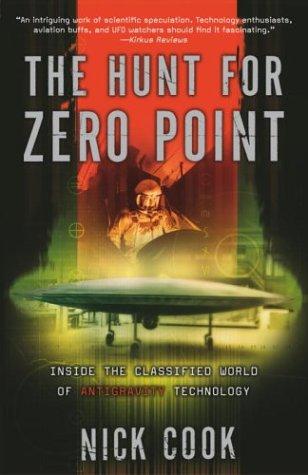
The Hunt for Zero Point
Nick Cook's Jane's Defence Weekly Credentials Meet the Contested Nazi Bell: Inside the Classified World of Antigravity Technology
Find on Amazon →As an Amazon Associate, OverClassified may earn from qualifying purchases made through this link, at no extra cost to you.
Why This Is Essential Reading
The Hunt for Zero Point earns its place on this list not because its central mystery holds up, but because of exactly how it doesn't: a genuinely credentialed defense journalist, writing from two decades of real Jane's Defence Weekly sourcing, produced a book whose most famous chapters rest on a single uncorroborated source — Igor Witkowski's account of the Nazi Bell — that no independent historian of the actual German wartime weapons programs has ever verified, and that Cook himself has since walked back to "no smoking gun." Read the book's early chapters on electrogravitics and postwar German-scientist recruitment for what they are: solid, source-backed defense journalism tracing a real historical thread from T. Townsend Brown forward. Read the Die Glocke chapters specifically alongside the named, documented pushback from Kurt Kleiner, Robert Sheaffer, Jason Colavito, and Brian Dunning collected in this entry's Critical Reception section — and treat the book's enormous downstream influence on this site's own Breakaway Civilization and Secret Space Program theory pages as a case study in how a legitimate journalism byline can carry an unverified claim much further than its actual sourcing ever earned.
Related Cases & Theories
Essential Viewing

The Origins of The Hunt for Zero Point | Nick Cook
Nick Cook — Cook's own account, on his own channel, of how the decade-long investigation behind this book began. Verified via YouTube oEmbed before inclusion.

The Story behind Die Glocke | And Why I Hate This Conspiracy Theory
Zwalada — A critical breakdown of the Die Glocke/Nazi Bell claim this book popularized, examining Igor Witkowski's uncorroborated sourcing directly. Verified via YouTube oEmbed before inclusion.
Sources Cited
- Cook, Nick. The Hunt for Zero Point: Inside the Classified World of Antigravity Technology. Broadway Books, New York, 2003 paperback ed. (ISBN 9780767906289 / 0767906284, cited here, matching this exact edition already cited across this site's own resources library).
- "Nick Cook (writer)." Wikipedia (biography; documents his Jane's Defence Weekly tenure 1987-2005, education, Dynamixx, and Bigelow Institute for Consciousness Studies role). en.wikipedia.org
- "Die Glocke (conspiracy theory)." Wikipedia (documents Igor Witkowski's original sourcing, Cook's role popularizing the claim in English, and named critics including Sheaffer, Colavito, Dunning, and Dorr). en.wikipedia.org
- "THE HUNT FOR ZERO POINT: Inside the Classified World of Anti-Gravity Technology." Kirkus Reviews (trade review). kirkusreviews.com
- "THE HUNT FOR ZERO POINT: Inside the Classified World of Anti-Gravity Technology." Publishers Weekly, review dated June 10, 2002. publishersweekly.com
- Kleiner, Kurt. "'The Hunt for Zero Point' by Nick Cook." Salon, August 5, 2002 (documents the Witkowski sourcing critique, the Twining memo misreading, and the closing "blowing smoke" verdict). salon.com
- "The Hunt for Zero Point." Open Library (Broadway, 2003 paperback edition record, ISBN 0767906284 / 9780767906289). openlibrary.org
- "The Hunt for Zero Point." Open Library (Broadway, 2002 hardcover edition record, ISBN 0767906276 / 9780767906272 — a bibliographically distinct printing from the paperback cited here). openlibrary.org
- "The Hunt for Zero Point: Inside the Classified World of Antigravity Technology." Amazon.com (Broadway Books paperback listing, ISBN 9780767906289). amazon.com
- "The Hunt for Zero Point: 25 Years Later." Alternative Propulsion Engineering Conference (retrospective; documents Cook's own revised position that there is "no smoking gun to any kind of German anti-gravity development effort"). altpropulsion.com
- "Nick Cook." Alternative Propulsion Engineering Conference (biographical page). altpropulsion.com
- This site's own case file: T. Townsend Brown & Electrogravitics, which cites this exact book directly and documents the electrogravitics research this book's early chapters build on.
- This site's own theory page: Secret Space Program Hypothesis, for the later black-budget claims this book's framework helped popularize.
- This site's own theory page: Breakaway Civilization, which cites this exact book directly in its own sourcing.
- This site's own resources library: Full Reading List, where this exact 2003 paperback edition (ISBN 0767906284) is cited across multiple case-file and theory pages.
Have corrections, additional research, or peer-reviewed sources? Help improve this entry.
Suggest an Edit