
Covert Wars and Breakaway Civilizations
The Secret Space Program, Celestial Psyops and Hidden Conflicts
Core Thesis
Covert Wars and Breakaway Civilizations: The Secret Space Program, Celestial Psyops and Hidden Conflicts is Joseph P. Farrell's 2012 sequel to Saucers, Swastikas and Psyops (2011), the second book in a rough trilogy an Oxford-trained patristics scholar turned prolific alternative-history author built around a single, ever-expanding claim: that surviving elements of the Third Reich, having exfiltrated advanced weapons research and reconstituted themselves primarily through South America, quietly grew into a self-financing "breakaway civilization" that infiltrated NATO's real, documented Cold War stay-behind networks, ran a hidden international financial system tied to the Vatican Bank, developed a covert human spaceflight capability parallel to and beyond NASA's, and has waged a decades-long, still-ongoing "psyops" campaign against the publics and governments of the nations it operates within. It is one of the single most direct citations behind this site's own Secret Space Program Hypothesis and Breakaway Civilization theory pages, both of which already list Farrell among their key proponents — and it belongs on this list as a case study in how a real academic credential, applied to almost entirely secondary and frequently already-contested sourcing, produced one of the field's most totalizing and least falsifiable unified conspiracy frameworks.
About the Author
Joseph P. Farrell's academic credentials are genuine and, within their own field, serious: a B.A. from John Brown University, an M.A. from Oral Roberts University, and a D.Phil. in Patristics from Pembroke College, Oxford, awarded in 1987 under the supervision of the eminent Orthodox theologian Metropolitan Kallistos (Timothy) Ware. His early scholarly output matched that pedigree — a translation of Patriarch Photios I of Constantinople's Mystagogy of the Holy Spirit, the monographs Free Will in St. Maximus the Confessor (1989) and The Disputation with Pyrrhus (1990), and the four-volume God, History, and Dialectic, a study of the Great Schism between Eastern and Western Christianity — and he went on to teach Patristics at Saint Tikhon's Orthodox Theological Seminary, an institution accredited by the Association of Theological Schools.
Beginning in 2001, Farrell's published output shifted almost entirely toward alternative history, physics speculation, and Nazi-technology conspiracy writing, starting with The Giza Death Star (2002) and its two sequels, then accelerating through Reich of the Black Sun (2004), The SS Brotherhood of the Bell (2006), The Nazi International and its own sequels, Cosmic War (2007), Grid of the Gods (2011, with Scott D. de Hart), Genes, Giants, Monsters, and Men (2011), and this book's direct predecessor, Saucers, Swastikas and Psyops (2011). Covert Wars and Breakaway Civilizations, published by Adventures Unlimited Press in November 2012, was followed a year later by Covert Wars and the Clash of Civilizations (2013), rounding the three books into a loose trilogy. Across roughly two decades since, Farrell has maintained a prolific presence on the alternative-research interview and conference circuit — Red Ice Radio, Dark Journalist, The Byte Show, and multiple Secret Space Program Conferences — and runs his own long-running Giza Death Star website and members' forum.
It is worth stating plainly what this site's own Jason Colavito has documented directly: Farrell's current academic post is Adjunct Professor of Patristic Theology and Apologetics at the California Graduate School of Theology, an unaccredited institution in La Habra, California — a considerable step down in institutional standing from his earlier, accredited Saint Tikhon's post. Colavito, reviewing a related Farrell title, has characterized this trajectory pointedly: that after Farrell's serious theological scholarship failed to gain wider recognition, he turned toward alternative history and conspiracy writing instead. Whatever one makes of that framing, the underlying facts — a real Oxford doctorate, a real early academic career, and a subsequent multi-decade pivot to a publishing genre with no peer-review requirement at all — are the specific credibility profile every claim in this book has to be read against.
Historical Context & Origins
Covert Wars and Breakaway Civilizations arrived in November 2012 as the middle volume of a loose trilogy: a direct sequel to Saucers, Swastikas and Psyops (2011), which had already laid out Farrell's claims about SS commando Otto Skorzeny, UFO contactee George Adamski, and alleged wartime Nazi "Haunebu" and "Vril" craft, and itself followed a year later by Covert Wars and the Clash of Civilizations (2013). It was published roughly a decade after Nick Cook's far more mainstream-credentialed The Hunt for Zero Point (2001) had already carried the contested Nazi "Die Glocke" (Bell) claim, sourced to Polish researcher Igor Witkowski, into wide English-language circulation — a claim Farrell's own earlier books, including Reich of the Black Sun and The SS Brotherhood of the Bell, had independently elaborated on well before this volume folded the same thread into its larger breakaway-civilization synthesis.
The book's own foundational sourcing sits on genuinely mixed historical ground. A contemporary review of Saucers, Swastikas and Psyops at Covert Book Report noted that Farrell "borrows heavily" from two sources he treats as equally reliable: Charles Higham's Trading with the Enemy (1983), a well-documented, FOIA-sourced account of American corporations that continued doing business with Nazi Germany, and John Loftus's The Belarus Secret (1982), an account of Nazi collaborators recruited into postwar American intelligence. Loftus's own scholarship, however, has drawn sustained criticism from professional historians independent of anything Farrell later built on it: Office of Special Investigations historian David Marwell called it "the worst kind of amateur history," and both Israeli historian Efraim Zuroff and researcher Vital Zayka have separately challenged its accuracy. That Farrell's own "reliable" source base already includes material contested by mainstream historians, well before his own further extrapolations begin, is a foundational problem this book shares with the rest of his Nazi-technology output.
The book's more speculative claims are nonetheless built on top of real, independently documented history. Operation Paperclip — the U.S. government's genuine, if long-secret, program recruiting German scientists including Wernher von Braun into postwar American rocketry and weapons research, much of it processed through Wright-Patterson Air Force Base — is real and well documented, as is Operation Gladio, the network of anti-communist paramilitary "stay-behind" units NATO member states organized across Western Europe during the Cold War, whose existence was confirmed by Italian Prime Minister Giulio Andreotti in 1990 and subsequently investigated by multiple European parliamentary inquiries. Farrell's book uses both as launching points rather than as its actual evidentiary core: the claim that a coordinated, Nazi-descended "breakaway" leadership secretly directed either program, rather than each having its own separately documented Cold War institutional history, is Farrell's own addition, not a finding either program's real declassified record supports.
Core Arguments & Key Concepts
Farrell's central claim is that surviving Third Reich elements, having exfiltrated advanced wartime research programs and reconstituted much of their leadership and financing primarily through South America, grew over subsequent decades into a self-sustaining "breakaway civilization" — a globally networked, technologically advanced group operating with effective independence from the nominal governments of the countries it is embedded within, financed through a hidden international banking apparatus Farrell ties to the Vatican Bank and sustained in part, he argues, through large-scale financial fraud and precious-metals manipulation.
The book's specific contribution to that larger framework, reflected in its subtitle, is the claim that this breakaway group infiltrated and ultimately redirected NATO's real Operation Gladio stay-behind networks into a self-funding covert-warfare and psychological-operations apparatus — the "celestial psyops" of the title — that Farrell argues has included staged or manipulated UFO-related incidents among its tools, waged against Western publics and governments alike across the second half of the twentieth century and into the twenty-first.
From that base, Farrell extends the argument into a fully realized secret space program: a covert, crewed spacefaring capability he argues this breakaway group developed in parallel with, and considerably beyond, NASA's public space effort, financed off the books and hidden behind the same compartmentalized secrecy apparatus. As with the book's NATO and financial claims, this argument rests almost entirely on secondary conspiracy literature, Farrell's own prior books in the same series, and inference from the pattern of documented Cold War secrecy rather than on any new primary document, defector account, or physical evidence introduced in this volume specifically.
Methodologically, the book follows a pattern a reviewer identified directly in a companion Farrell title, Reich of the Black Sun: unproven claims established in one chapter, or in an earlier book in the series, are treated as settled fact in the next, each layer of speculation becoming the load-bearing foundation for the layer built on top of it. Even readers sympathetic to Farrell's overall project have noted this pattern in Covert Wars and Breakaway Civilizations specifically; a Goodreads reviewer who called Farrell "brilliant" nonetheless cautioned that the book remains "speculative to a very high degree," comparing it more to "entertaining fiction and conspiracy theory writing" than to verified historical argument.
Key Cases & Evidence Discussed
The contested Nazi "Die Glocke" (Bell) device, which Farrell had already elaborated across Reich of the Black Sun and The SS Brotherhood of the Bell before folding the same claim into this book's larger synthesis, traces back to the same single, uncorroborated Igor Witkowski account this site's own essential-reading breakdown of Nick Cook's The Hunt for Zero Point covers in detail — including named critics' assessments, such as Jason Colavito's description of the Bell as "a device few outside of fringe culture think actually existed... a hoax, or at least a wild exaggeration."
This site's own T. Townsend Brown & Electrogravitics case file (Case File #192) documents the genuine, independently verifiable Cold War-era antigravity research Farrell's broader "suppressed technology" claims are frequently read alongside, even though this specific book focuses more on financial and paramilitary infrastructure than on propulsion physics itself.
Operation Paperclip's real, declassified history — the postwar recruitment of German scientists into American rocketry and weapons programs, much of it processed through Wright-Patterson Air Force Base — is the book's most solidly documented historical anchor, and the point from which Farrell's own claims of a coordinated, still-active "breakaway" leadership diverge furthest from the independently verifiable record.
This site's own Secret Space Program Hypothesis (Theory File SSP-001) and Breakaway Civilization (Theory File BCV-001) theory pages both already treat this exact book as a key primary source: the Breakaway Civilization page lists Farrell among its Key Proponents and cites this title directly in its own Sources Cited and Further Reading sections, reflecting how directly this book's synthesis feeds those two theories' own claims.
Critical Reception & Controversies
Covert Wars and Breakaway Civilizations was published by Adventures Unlimited Press, a small niche publisher specializing in fringe and alternative-history titles, and received no mainstream trade reviews from outlets like Kirkus, Publishers Weekly, or major newspapers — itself a useful data point about how far outside conventional publishing and editorial vetting this book, and Farrell's broader output, sit. Its reception has instead played out almost entirely among the alternative-research audience it was written for, on Goodreads and Amazon, where it holds a 4.38-out-of-5 average across 119 Goodreads ratings, with 56% five-star and only a handful of one- or two-star reviews.
Even that largely sympathetic readership has registered real reservations about the book's reliability. One 2016 Goodreads reviewer, while praising Farrell's research, counted what he estimated at roughly one typo or grammatical error per page, more than 350 across the text — a basic editorial-quality problem consistent with a small press publishing a prolific author's output on a rapid schedule. A second 2016 reviewer, Pat Rolston, called Farrell "brilliant" while cautioning that the material is "speculative to a very high degree" and reads more like "entertaining fiction and conspiracy theory writing" than established fact — a strikingly candid admission from within the book's own admiring readership. A 2024 reviewer who otherwise found the book "fascinating" specifically flagged Farrell's insistence that all UFO phenomena are exclusively human-operated devices as "cartoonish," a claim that undercuts rather than supports the book's own broader synthesis.
This site's own Jason Colavito, reviewing Farrell's closely related title Genes, Giants, Monsters, and Men, characterized that book's argumentation as containing "outdated information, debunked theories, and slipshod reasoning," and described Farrell more broadly as citing Colavito's own published research to support conclusions Colavito explicitly rejects. A separate reviewer assessing Reich of the Black Sun — the earlier Farrell title most directly upstream of this book's Nazi-technology claims — went further, arguing the book's central premise, that Nazi scientists achieved breakthroughs specifically by rejecting "Jewish science" (relativity), carries "unintentionally pro-Nazi" implications even without deliberate anti-Semitic intent, and identified the same chapter-to-chapter pattern of unproven claims hardening into "certain facts" that critics have flagged across Farrell's wider body of work, this book included.
No professional historian of the actual, documented postwar Nazi-scientist recruitment programs, NATO's Gladio networks, or Vatican financial history has endorsed Farrell's synthesis connecting the three into a single coordinated "breakaway civilization." The most that can be said in the book's favor is that each of its component historical threads — Operation Paperclip, Operation Gladio, and postwar Nazi-network scholarship generally — has some genuine documented basis; what the professional historical record does not support is Farrell's specific claim that a single, continuously operating group has directed all three toward a shared, still-active agenda for eight decades.
Influence & Legacy
This book's most concrete, checkable influence runs directly into this site's own catalogue: the Breakaway Civilization Hypothesis theory page already lists Farrell among its Key Proponents and cites this exact title, by ISBN, in its own Sources Cited section and Further Reading book list, while the Secret Space Program Hypothesis page draws on the same broader framework this book helped popularize. Few single titles on this site's reading list have a more directly documented downstream footprint in this site's own theory pages than this one.
Within the wider alternative-research and "secret space program" conference and podcast circuit, this book (along with its companion volumes) became a standard reference point through the 2010s, discussed alongside Richard Dolan's own, independently developed "breakaway civilization" framework at events including the Secret Space Program Conference and on interview programs such as Dark Journalist, which hosted Farrell alongside Dolan, Catherine Austin Fitts, and Linda Moulton Howe in a 2015 roundtable explicitly built around this book's themes.
Farrell's own interview appearances promoting this book and its companion volumes show the framework's characteristic elasticity: a 2014 Byte Show interview folded the still-unexplained disappearance of Malaysia Airlines Flight 370 into the same breakaway-civilization narrative, illustrating a recurring pattern — also visible in how readily the framework absorbed later claims like David Grusch's 2023 congressional testimony, discussed on this site's Secret Space Program theory page — in which the theory expands to incorporate whatever new event or disclosure arrives next, a flexibility supporters read as accumulating corroboration and critics read as a lack of genuine falsifiability.
Farrell has remained continuously productive since this book's publication, releasing further titles across his Nazi International, Cosmic War, and financial-conspiracy series through the 2010s and 2020s, and his Giza Death Star website and member forum have functioned as an ongoing hub sustaining this book's readership and framework well over a decade after its original 2012 publication.
The Book
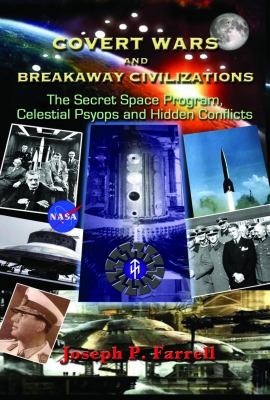
Covert Wars and Breakaway Civilizations
The Secret Space Program, Celestial Psyops and Hidden Conflicts
Find on Amazon →As an Amazon Associate, OverClassified may earn from qualifying purchases made through this link, at no extra cost to you.
Why This Is Essential Reading
Covert Wars and Breakaway Civilizations earns its place on this list not because its central synthesis holds up under scrutiny, but because of how directly and how far a genuine academic credential can travel once it moves from peer-reviewed patristics scholarship into a publishing genre with no equivalent editorial check. Joseph P. Farrell's real Oxford doctorate, earned under a genuinely eminent scholar, lends this book's Vatican Bank financing claims, its NATO-Gladio infiltration argument, and its covert secret-space-program synthesis a surface credibility that its actual sourcing — secondary conspiracy literature, Farrell's own earlier books in the same series, and at least one source, John Loftus, that professional historians have separately called "the worst kind of amateur history" — does not independently support. Read this book specifically for what it demonstrably is: the single most direct primary source behind this site's own Breakaway Civilization and Secret Space Program Hypothesis theory pages, and a case study in how even a book's own sympathetic readers — Goodreads reviewers who call Farrell "brilliant" in the same sentence they call his material "speculative to a very high degree" — have learned to hold its claims at arm's length from its considerable narrative appeal.
Related Cases & Theories
Essential Viewing
Joseph P. Farrell : Covert Wars and Breakaway Civilizations
The Byte Show — Farrell discussing this exact book directly on The Byte Show. Verified via YouTube oEmbed before inclusion.
Analysis of the Breakaway Civilization
Secret Space Program — A Secret Space Program Conference talk by Farrell on the breakaway civilization framework this book helped popularize. Verified via YouTube oEmbed before inclusion.
Sources Cited
- Farrell, Joseph P. Covert Wars and Breakaway Civilizations: The Secret Space Program, Celestial Psyops and Hidden Conflicts. Adventures Unlimited Press, 2012 pbk., 1st ed. (ISBN 9781935487838 / 1935487833, matching the citation already on this site's own Breakaway Civilization theory page).
- "Covert Wars and Breakaway Civilizations." Open Library (Adventures Unlimited Press, 2012 edition record, ISBN 1935487833 / 9781935487838, 292 pp.). openlibrary.org
- "Covert Wars and Breakaway Civilizations: The Secret Space Program, Celestial Psyops and Hidden Conflicts." Biblio (Adventures Unlimited Press, 2012, listing publication details). biblio.com
- "Covert Wars and Breakaway Civilizations: The Secret Space Program, Celestial Psyops and Hidden Conflicts." Amazon.com (Adventures Unlimited Press paperback listing, ISBN 9781935487838). amazon.com
- "Covert Wars and Breakaway Civilizations." Goodreads (reader ratings and reviews, including reviews from users Eric, Pat Rolston, and Dan Zarfati cited in this entry's Critical Reception section). goodreads.com
- "Joseph P. Farrell." EverybodyWiki (biographical summary: education, academic career, and bibliography). en.everybodywiki.com
- Colavito, Jason. "Me in the Media: Alternative Historian Disses Me." JasonColavito.com (documents Farrell's citation of Colavito's own research, Farrell's academic trajectory, and Colavito's assessment of Farrell's methodology). jasoncolavito.com
- Colavito, Jason. "Die Glocke (conspiracy theory)." Cited via Wikipedia (Colavito's assessment of the Nazi Bell claim Farrell elaborated across multiple earlier books). en.wikipedia.org
- Bradley, Kit. "Reich of the Black Sun by Joseph P. Farrell (Review)." KitBradley.net (detailed critical review of Farrell's methodology, sourcing, and the book's ideological implications, in the companion volume most directly upstream of this book's Nazi-technology claims). kitbradley.net
- "Review: 'Saucers, Swastikas And Psyops' — Joseph P. Farrell." Covert Book Report (review of this book's direct predecessor, documenting Farrell's reliance on Charles Higham's and John Loftus's earlier historical research). covertbookreport.com
- "John Loftus (military author)." Wikipedia (documents historian David Marwell's, Efraim Zuroff's, and Vital Zayka's criticism of Loftus's The Belarus Secret, a primary source this book's predecessor volume draws on). en.wikipedia.org
- "Operation Gladio." Wikipedia (documents the real NATO stay-behind paramilitary networks this book's "celestial psyops" claims are built on top of, including Giulio Andreotti's 1990 confirmation). en.wikipedia.org
- "Operation Paperclip." Wikipedia (documents the real, declassified postwar German-scientist recruitment program this book's speculative claims extend well beyond). en.wikipedia.org
- This site's own theory page: Breakaway Civilization Hypothesis, which already cites this exact book directly in its own Sources Cited and Further Reading sections and lists Farrell among its Key Proponents.
- This site's own theory page: Secret Space Program Hypothesis, for the closely related framework this book's synthesis feeds into.
- This site's own essential-reading entry: The Hunt for Zero Point, for the Die Glocke/Nazi Bell claim this book elaborates on from Farrell's own earlier titles.
- This site's own case file: T. Townsend Brown & Electrogravitics, for the genuinely documented antigravity research this book's broader suppressed-technology claims are frequently read alongside.
Have corrections, additional research, or peer-reviewed sources? Help improve this entry.
Suggest an Edit