
Encounter in Rendlesham Forest
The Inside Story of the World's Best-Documented UFO Incident
Core Thesis
Encounter in Rendlesham Forest: The Inside Story of the World's Best-Documented UFO Incident is built around a three-way author structure with no close parallel elsewhere on this site's Essential Reading shelf: Nick Pope, who ran the UK Ministry of Defence's UFO investigation desk from 1991 to 1994 and reviewed the Rendlesham file from the government side more than a decade after the fact, writing alongside John Burroughs and Jim Penniston, the two retired USAF security policemen who were among the first Americans to reach the object in Rendlesham Forest on the night of December 26, 1980. Rather than a single narrative voice, the book alternates an official investigator's after-the-fact analysis with two participants' first-person memory of the event itself, reproducing the Halt Memo, Penniston's notebook pages, and Ministry of Defence radiation and CINCUSAFE-visit assessments as numbered appendices — documents obtained under Freedom of Information requests on both sides of the Atlantic. The book does not resolve the case; it lays out the believers' strongest evidence and the skeptics' strongest counter-explanations, including the disputed Orford Ness lighthouse theory and Penniston's own thirty-years-delayed binary-code claim, side by side.
About the Author
This book's authorship is its most structurally unusual feature among this site's Essential Reading titles: it pairs a former government investigator who came to the case from outside, years after it happened, with two of the enlisted men who lived through it. The three did not divide the manuscript into separate solo chapters so much as interleave Pope's framing, archival, and investigative material with Burroughs's and Penniston's own recollections and a closing "Final thoughts from John Burroughs and Jim Penniston" section, credited on the cover in that order — Pope first, then Burroughs and Penniston identified by their USAF (Ret.) service.
Nick Pope was born September 19, 1965, in London and joined the Ministry of Defence as a civil servant in 1985, working across a 21-year career that ran until 2006. From 1991 to 1994 he staffed Secretariat (Air Staff) 2a — the department's UFO desk — an executive-officer post whose job description called for roughly a day a week spent assessing civilian and military UFO reports for defence significance and, in most cases, sending back standard replies stating that the reports posed no threat. Pope's own account, both in this book and in his earlier Open Skies, Closed Minds (1996, cited elsewhere in this site's own resources library), is that the Rendlesham file was the single most significant case he encountered during that tenure, and that when he reviewed it he found no evidence any systematic scientific investigation had ever been conducted. After leaving the MoD in 2006, Pope became a full-time UFO researcher, media commentator, and author of further nonfiction and two science-fiction novels, building a substantial American media profile as a frequent contributor on UFO and UAP subjects and a recurring presence on History Channel's Ancient Aliens — a public career often summarized with the tabloid shorthand "Britain's real-life Fox Mulder." Pope died on April 6, 2026, in Tucson, Arizona, at age 60, following a diagnosed case of stage 4 esophageal cancer announced that February; this book remains among the most substantial products of the four-decade public career that followed his departure from the UFO desk.
John Burroughs entered the U.S. Air Force in 1979 and was assigned to RAF Bentwaters as a security policeman that June, going on to serve more than twenty-six years in uniform. As an Airman First Class on the night of December 26, 1980, he accompanied Staff Sergeant Penniston and Airman Edward Cabansag into the forest after the East Gate patrol reported unusual lights, and remained with Penniston during the close-range encounter with the object this site's own Rendlesham Forest Incident case file documents in detail. Decades later, Burroughs's Rendlesham-linked medical records were classified at a level his own VA-accredited attorneys initially could not access; the 2015 disability settlement he ultimately won, with the direct intervention of Senator John McCain, is covered at length in this book's closing chapters and remains one of the case's most concrete downstream consequences.
Jim Penniston served over twenty years of active duty in the U.S. Air Force and, as the Staff Sergeant leading the security patrol on Night One, is the witness most associated with direct physical contact: he has described approaching the landed object, touching its warm, glasslike surface, and sketching the raised, hieroglyph-like markings he saw on its hull in his police notebook at the scene. This book gives him and Burroughs the space to walk through that account, and through Night One's aftermath, in their own words rather than filtered entirely through Pope's analysis — including Penniston's most contested claim, that touching the object transferred a sixteen-page sequence of binary code into his mind, which he says he transcribed into the same notebook and did not publicly disclose for nearly thirty years.
The book's collaborative structure reflects each author's distinct standing in the case rather than a simple division of labor: Pope supplies the institutional and documentary framing — internal MoD correspondence, the Defence Intelligence Staff's own radiation assessment, and comparative analysis of British and American official responses — while Burroughs and Penniston supply the testimony no outside investigator could provide firsthand. All three had already spoken and appeared publicly together for years before the book's 2014 publication, including at the joint National Press Club briefings where Penniston discussed the case on the record.
Historical Context & Origins
By 2014, the Rendlesham Forest Incident had already been public for three decades, ever since the Halt Memo was released under the U.S. Freedom of Information Act in 1983 and published in the British tabloid News of the World that October. In the years between, the case had accumulated a substantial independent literature — Brenda Butler, Dot Street and Jenny Randles's early Sky Crash (1984), Georgina Bruni's You Can't Tell the People (2000), and Larry Warren and Peter Robbins's contested Left at East Gate (2003) among them, all separately cited on this site's own resources library — but none of it had been written jointly by a former government investigator and two of the case's own primary military witnesses working from the same set of declassified documents.
The book also arrived after two developments specific to its three authors: the UK's Ministry of Defence had, between 2008 and 2013, released roughly 60,000 pages of its own UFO files through The National Archives, giving Pope fresh primary-source material to cite alongside what he had already reviewed while running the UFO desk in the early 1990s; and Penniston had, in 2010, publicly revealed for the first time the existence of the binary-code sequence he said he had recorded in his notebook on the night of the encounter but had kept largely private for three decades. Both developments meant that by the time Pope, Burroughs and Penniston sat down to write together, there was substantially more official documentation, and one significant new and immediately controversial witness claim, than had existed when the earlier Rendlesham books were written.
The book was published in April 2014 by Thomas Dunne Books, an imprint of St. Martin's Press, and its own publisher's description frames it explicitly against the American case it is most often compared to, presenting Rendlesham as a story "set to become better-known than Roswell" — a framing that leans directly into the "Britain's Roswell" label this site's own Rendlesham Forest Incident case file also uses, while noting the comparison somewhat overstates the parallel: Roswell is fundamentally a crash-retrieval mythology, while Rendlesham is a multi-night, military-witness light-and-forest case with disputed physical traces.
Core Arguments & Key Concepts
The book's table of contents itself signals its dual structure: early chapters — "Ground Zero," "The Morning After," "Into the Darkness," "It's Coming This Way" — stay close to the ground-level chronology of the three nights, walking through Burroughs's and Penniston's Night One encounter and Lieutenant Colonel Charles Halt's Night Two investigation this site's own Rendlesham Forest Incident case file also documents in full, including the three ground depressions, the elevated radiation readings, and Halt's contemporaneous eighteen-minute audio recording.
A middle section shifts registers entirely into institutional analysis: chapters titled "The Most Important Bases in NATO," "Debriefing the Witnesses," "The Brits Are Coming," and "No Defense Significance?" carry Pope's own MoD-insider perspective, tracing how the case moved from a Deputy Base Commander's memo to a filed, unactioned document at the Ministry of Defence, and drawing directly on internal correspondence the National Archives releases had newly made available. A dedicated chapter on Project Condign, the MoD's own 2000 internal UAP study, situates Rendlesham within the wider, decades-long pattern of British official non-investigation this site's own Project Condign Summary case file covers independently.
The book then turns explicitly adversarial toward its own subject matter, in a structural choice reviewers have specifically noted: a chapter titled "Skeptical Theories" is followed directly by one titled "Exotic Theories," placing the Orford Ness lighthouse explanation, misidentified stars, and mundane military-hardware hypotheses in direct sequence with time-travel and interdimensional readings of Penniston's binary code — giving both sides real estate rather than resolving the tension between them.
The book's most extended and most disputed material is reserved for its final third: "The Rendlesham Code" walks through Penniston's account of the binary sequence and its 2010 decoding, while "Final Thoughts from John Burroughs and Jim Penniston" gives the two witnesses the book's closing word in their own voice rather than Pope's. The book closes with six lettered appendices reproducing primary documents directly — Halt's official report, Penniston's binary-code notebook pages, a Defence Intelligence Staff assessment of the radiation readings, a Defence Intelligence document confirming a CINCUSAFE visit to the bases immediately after the encounter, a full transcript of the Halt tape, and a letter from six former U.S. Congressional representatives requesting release of Burroughs's and Penniston's classified VA medical records — giving readers primary-source material to weigh independently rather than only the authors' own summaries of it.
Key Cases & Evidence Discussed
The book's entire subject is this site's own Rendlesham Forest Incident (Case File #004, December 1980), and the case file cites this exact edition directly; nearly every witness, document, and disputed claim in that case file — Penniston's notebook, the Halt Memo, the radiation readings, the binary code, and the Orford Ness lighthouse counter-theory — receives its fullest first-person and government-side treatment in this book specifically.
This site's own Project Condign Summary (Case File #125, 2000) is the subject of one of the book's own named chapters, and Pope's insider account of how that MoD study fit into the broader pattern of official non-investigation directly parallels his own characterization of the department's handling of Rendlesham a decade earlier.
Capel Green, the clearing near the landing site where Larry Warren has separately claimed a disputed third-night encounter occurred, and the Orford Ness lighthouse, the mundane explanation astronomer Ian Ridpath has championed for at least part of what witnesses saw, are both discussed directly in the book's "Skeptical Theories" chapter and both have their own entries in this site's own Locations database.
This site's own UFOs & Nuclear Weapons theory file connects to the book's own repeated emphasis, across its "Most Important Bases in NATO" chapter, on the fact that RAF Bentwaters and RAF Woodbridge sat among the most strategically sensitive nuclear-capable installations NATO operated in Europe during the Cold War — a proximity the book's authors treat as central to why the case escalated to the Deputy Base Commander level in the first place.
Critical Reception & Controversies
Publishers Weekly, reviewing the book on its March 2014 release, judged it a genuinely mixed effort: the review credited Pope with starting "strong," citing his use of internal memos and interview transcripts, but found the book eventually lost its narrative thread as Pope worked through a wide range of explanatory theories "ranging from the plausible to the far-fetched." The review's overall verdict was that the book gives "readers on both sides of the UFO debate plenty to chew on" — praise for its evidentiary range more than for any single argued conclusion.
The Washington Post's June 2014 review pushed back directly on the book's central claim, noting that Pope treats the case as effectively settled while the reviewer did not find it so; the review nonetheless allowed that the book is "not without its charms," while noting that the whole project is "full of paranoia about the government — not all of it, or even most of it, unwarranted," a backhanded acknowledgment that the book's suspicion of official secrecy is, on the available documentary record, frequently justified even where its UFO conclusions remain unproven.
Ufologist and author Kevin Randle's own May 2014 review welcomed the book's firsthand testimony specifically — "new information found through the detailed memories of Burroughs and Penniston" — and credited Pope's insider account of how both governments handled the case with adding real credibility, while criticizing chapters he felt wandered into tangential UFO history that "did nothing to advance the case" (he singled out the book's single-paragraph treatment of the 1948 Thomas Mantell case as an example) and flagging that the book's account of radar tracking of the object is presented as settled fact when it rests on a single secondhand report.
The book's own "Skeptical Theories" chapter gives real space to the case's most durable mundane counter-explanation, championed outside the book by astronomer Ian Ridpath: that the initial lights witnesses saw through the trees on Night One were the rotating beam of the Orford Ness lighthouse, roughly five miles distant, its five-second flash interval and compass bearing both consistent with elements of the patrol's own account. Halt has stated on record that his own team, familiar with the lighthouse, observed it and the anomalous Night Two lights simultaneously and in different directions — a rebuttal the book presents but does not treat as fully dispositive, since the lighthouse alone does not explain the ground depressions, radiation readings, or Penniston's close-range physical description.
Penniston's binary-code claim receives the book's most extended and most genuinely contested treatment. The sequence went unmentioned for nearly thirty years after the 1980 encounter; the notebook pages themselves show ink and handwriting inconsistencies researchers have flagged as evidence of later addition rather than a contemporaneous record; the ASCII encoding scheme used to "decode" the sequence into the message "Exploration of Humanity 666 8100" and a set of geographic coordinates was already a public standard in 1980, available to any technically literate person of the era; and the decoded output itself has been shown to shift depending on which ASCII table version is applied. The book does not resolve these problems — it presents Penniston's account, the decoding process, and its skeptics' objections largely side by side, leaving the binary code the single most disputed element in a case its own authors otherwise present as unusually well documented.
Influence & Legacy
The book's most concrete, verifiable influence is its direct citation on this site's own Rendlesham Forest Incident case file and its listing in this site's resources library under this exact edition's ISBN, reflecting its continued use here as a primary secondary-source reference for the case's witness testimony and its government-side handling.
Because Burroughs and Penniston are named co-authors rather than simply interviewed subjects, the book functioned as a platform the two witnesses used directly: both continued appearing at public events and press briefings discussing the case in the years following publication, including National Press Club appearances, extending testimony that had already begun with Penniston's 2010 binary-code disclosure and Burroughs's ongoing VA case.
The book's central claim that Rendlesham would eventually become "better-known than Roswell" has not been borne out in American popular culture specifically, but the case's British profile as "Britain's Roswell" has only grown since 2014: Rendlesham Forest itself now carries an official Forestry Commission "UFO Trail" with marked sites, and the incident continues to generate new documentary treatments, including a 2025 feature-length documentary revisiting the case under that same "Britain's Roswell" framing.
For Nick Pope specifically, this book sits roughly at the midpoint of the public career he built after leaving the Ministry of Defence in 2006, sandwiched between his earlier MoD-insider books and his later run as a fixture of American UFO media and History Channel's Ancient Aliens — a career that ended with his death in April 2026, making this collaboration one of the more substantial published records of his own government-side account of the case he called the most significant he reviewed during his time on the UFO desk.
The Book
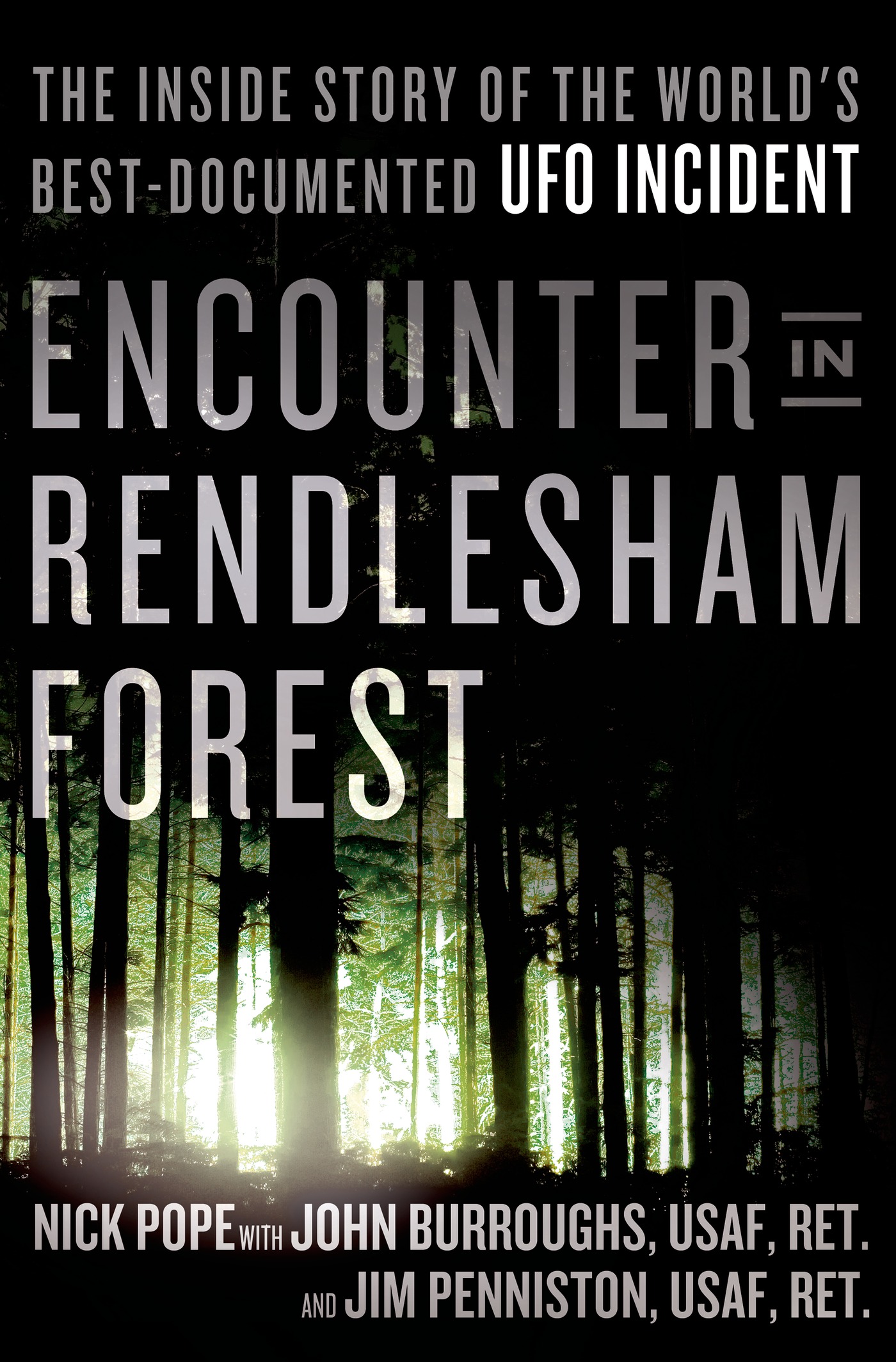
Encounter in Rendlesham Forest
The Inside Story of the World's Best-Documented UFO Incident
Find on Amazon →As an Amazon Associate, OverClassified may earn from qualifying purchases made through this link, at no extra cost to you.
Why This Is Essential Reading
Encounter in Rendlesham Forest earns its place on this list for a structural reason as much as an evidentiary one: it is the only book covered here written jointly by a government UFO investigator and the military witnesses whose case he was investigating, and that three-way authorship — Nick Pope's institutional access paired with John Burroughs's and Jim Penniston's firsthand testimony — produces a document this site's own Rendlesham Forest Incident case file draws on directly. Its limits are real: reviewers on both the skeptical and sympathetic sides of the field have flagged the same core problem, that the book presents the Orford Ness lighthouse rebuttal and the thirty-years-delayed binary code claim without fully resolving either, leaving readers to weigh primary documents — the Halt Memo, the notebook pages, the Defence Intelligence radiation assessment — that the book's own appendices reproduce directly rather than only summarize. That refusal to force a tidy conclusion, more than any specific argument it makes, is what makes the book worth reading alongside this site's own case file rather than as a substitute for it.
Related Cases & Theories
Essential Viewing
Nick Pope - Rendlesham Forest and more
IvolveTV — An interview with co-author Nick Pope discussing the Rendlesham Forest case and his book directly, verified via YouTube oEmbed before inclusion.
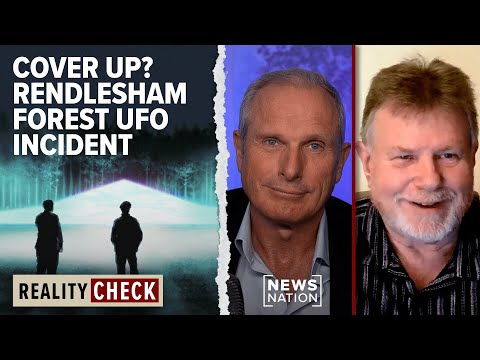
UFOs, interrogations, cover-ups: The Rendlesham Forest incident | Reality Check
NewsNation — A news-documentary segment covering the December 1980 encounter, the Halt Memo, and the case's disputed evidence, verified via YouTube oEmbed before inclusion.
Sources Cited
- Pope, Nick, Burroughs, John & Penniston, Jim. Encounter in Rendlesham Forest: The Inside Story of the World's Best-Documented UFO Incident. Thomas Dunne Books / St. Martin's Press, 2014 (ISBN 9781250038104 / 1250038103, cited here, matching this site's own resources library and Rendlesham Forest case-file citation). amazon.com
- "Encounter in Rendlesham Forest: The Inside Story of the World's Best Documented UFO Incident." Publishers Weekly, March 3, 2014 (original trade review: praise for early documentary evidence, criticism of unfocused later theorizing). publishersweekly.com
- "Book review: 'Encounter in Rendlesham Forest,' a look at a UFO, by Nick Pope." The Washington Post, June 13, 2014 (reviewer pushback on the book's certainty, "not without its charms" assessment). washingtonpost.com
- Randle, Kevin. "Encounter in Rendlesham Forest – A Review." A Different Perspective, May 2014 (independent ufologist's review: praise for witness testimony, criticism of tangential chapters and unverified radar-tracking claim). kevinrandle.blogspot.com
- "Encounter in Rendlesham Forest." Open Library edition record (ISBN 1250038103 / 9781250038104, Thomas Dunne Books, 2014; full table of contents including appendices A–F). openlibrary.org
- "Nick Pope (journalist)." Wikipedia (biography: birth date, MoD career 1985–2006, UFO desk 1991–1994, bibliography, death April 6, 2026). en.wikipedia.org
- "Nick Pope, UFO sleuth who chased the truth, dies at 60." The Spokesman-Review, April 29, 2026 (obituary: career summary, esophageal cancer diagnosis, death in Tucson, Arizona; page no longer live as of Aug 2026, no archived mirror found).
- "Rendlesham Forest incident." Wikipedia (case background, witness accounts, Halt Memo, binary code controversy, Orford Ness lighthouse theory). en.wikipedia.org
- Ridpath, Ian. "Rendlesham Forest UFO explained – the original article." ianridpath.com (the Orford Ness lighthouse and meteor explanation, bearing and flash-interval analysis). ianridpath.com
- Ridpath, Ian. "Rendlesham Forest UFO – Jim Penniston's notebook." ianridpath.com (analysis of the binary-code notebook pages, ink and dating inconsistencies). ianridpath.com
- "Encounter in Rendlesham Forest." Macmillan Publishers, official book page (publisher's synopsis, 2015 paperback edition ISBN 9781250063311). us.macmillan.com
- This site's own resources library: Full Reading List, where this exact edition (ISBN 1250038103) is cited on the Rendlesham Forest Incident case file.
- This site's own case file: The Rendlesham Forest Incident, the case this book's entire narrative and documentary appendices are built around.
- This site's own case file: Project Condign Summary, the 2000 MoD study this book covers directly in its own dedicated chapter.
- This site's own key-figures entry: Nick Pope, for his full biography and case connections beyond this book.
- This site's own key-figures entry: John Burroughs, for his full Rendlesham role and VA settlement history.
- This site's own key-figures entry: Jim Penniston, for his full Rendlesham role and binary-code claim history.
Have corrections, additional research, or peer-reviewed sources? Help improve this entry.
Suggest an Edit