
The Roswell Incident
The Book That Turned a 33-Year-Old Silence Into the Modern Roswell Phenomenon
Core Thesis
The Roswell Incident is the book that made Roswell, New Mexico synonymous with the modern crashed-saucer legend. Written by bestselling paranormal author Charles Berlitz and UFO researcher William L. Moore, and published by Grosset & Dunlap in October 1980, it was the first book-length treatment of the July 1947 Roswell Incident, arguing that an extraterrestrial craft had crashed on the Foster Ranch outside Roswell, New Mexico after a lightning strike killed its crew, and that the U.S. military had spent more than three decades suppressing the truth. The book exists at all because of a single 1978 phone call: ufologist Stanton Friedman's chance interview with retired intelligence officer Jesse Marcel broke 31 years of public silence and handed Berlitz and Moore the raw material for a case the country had almost entirely forgotten. Its historical importance is not in dispute — every major Roswell book that followed, on both the believer and skeptical sides, exists in direct or reactive relationship to it — but neither is the extensive, decades-long documented criticism of its methods: reliance on secondhand and thirdhand hearsay, an inflated witness count, a badly conflated second "crash site" that would go on to distort Roswell research for a generation, and, most seriously, co-author William Moore's own later admitted role in a genuine U.S. Air Force disinformation operation that has permanently complicated how his half of this book should be read.
About the Author
Charles Berlitz was born Charles Frambach Berlitz on November 22, 1914, in New York City, the grandson of Maximilian Berlitz, the linguist who founded the Berlitz Language Schools. Raised deliberately multilingual — his father, grandfather, and household staff each addressed him in a different language — Berlitz grew up fluent in several languages and graduated magna cum laude from Yale University. He served roughly thirteen years on active duty in U.S. Army intelligence, including wartime service as a Counterintelligence Corps agent, before working as a vice president of the family's Berlitz publishing house, where he authored tourist phrasebooks and pocket dictionaries and helped develop its record- and tape-based language courses. He left the company in the late 1960s, not long after it was sold to Crowell, Collier & Macmillan, and turned to writing paranormal nonfiction full-time. His breakout book, The Bermuda Triangle (1974), sold an estimated 20 million copies in 30 languages and made Berlitz, by a wide margin, the best-known popular paranormal author in America by the time he turned to Roswell — a level of commercial credibility no other writer touching the case in 1980 could match, and the main reason this book found a mainstream publisher and national distribution that no purely regional UFO title of the era could have secured.
That commercial credibility came with a well-documented cost to Berlitz's credibility as a researcher. Larry Kusche, the reference librarian and author of The Bermuda Triangle Mystery — Solved (1975), directly accused Berlitz of fabricating evidence and inventing mysteries with no basis in fact in his Bermuda Triangle writing, a pattern of uncritical, sensationalized nonfiction that runs through Berlitz's subsequent bibliography — The Philadelphia Experiment: Project Invisibility (1979, with Moore), The Roswell Incident (1980, with Moore), and several books asserting the historical reality of Atlantis. Berlitz's own role in this book was primarily that of the established, saleable byline and general paranormal-history framing rather than the case's actual field investigator; the interviewing, document-hunting, and witness-tracking that produced the book's Roswell-specific content was overwhelmingly Moore's work, built directly on research Stanton Friedman had already begun. Berlitz married Valerie Seary in 1950, with whom he had a daughter, Lynn, and died December 18, 2003, in Tamarac, Florida, at age 89.
William Leonard Moore was born October 31, 1943, and graduated from Thiel College in Greenville, Pennsylvania, in 1965, after which he taught language and humanities at various high schools. He entered organized ufology as Arizona state section director for the Mutual UFO Network before leaving teaching to become a full-time freelance writer, first pairing with Berlitz on The Philadelphia Experiment: Project Invisibility (1979) — a book this site's own key-figures entry on Moore identifies as the original, unsourced source of the false claim linking physicist T. Townsend Brown to the fabricated USS Eldridge invisibility legend, and a book later scholarship has largely dismissed as perpetuating an unsubstantiated urban myth. The Roswell Incident, published the following year, was Moore's more consequential project: years of his own interviewing and archival digging, building directly on Stanton Friedman's initial 1978 breakthrough with Jesse Marcel, went into assembling the book's witness base and documentary framing.
Moore's subsequent career is the reason this book cannot be read today without a significant caveat, and this site addresses it directly rather than passing over it. In May 1987, Moore, together with Jaime Shandera and Stanton Friedman, circulated the purported "Majestic-12" briefing documents that this site's own Top Secret/Majic entry examines in depth; Moore himself separately received the same MJ-12 material years before its public surfacing. Then, on July 1, 1989, at a MUFON symposium in Las Vegas, Moore delivered an on-the-record confession that stunned the field: he admitted to having been recruited by U.S. Air Force Office of Special Investigations (AFOSI) counterintelligence and to knowingly feeding fabricated material to Albuquerque researcher Paul Bennewitz as part of a real government disinformation campaign — the exact operation this site's own Project Beta entry documents in full, drawing on Greg Bishop's direct interviews with both Moore and AFOSI agent Richard Doty. That confession effectively ended Moore's standing in ufology. It does not retroactively invent the Roswell debris Jesse Marcel described, and it does not appear to implicate this book's specific research directly — but it means every claim in The Roswell Incident that traces back to Moore's own uncorroborated interviewing, rather than to Marcel's own words or independently verifiable documents, should be weighed with the knowledge that its co-author later admitted to knowingly fabricating UFO material for an intelligence agency, a caveat this site's own Roswell: Inconvenient Facts entry asks readers to apply to Doty's testimony in exactly the same way.
Historical Context & Origins
The case this book revived had lain almost entirely dormant for three decades. In July 1947, rancher Mac Brazel found debris on the Foster Ranch northwest of Roswell; the Roswell Army Air Field issued a same-day "flying disc" press release on July 8 and reversed it within hours at a Fort Worth press conference identifying the material as a weather balloon. For the next 31 years, as this site's own Roswell Incident case file documents, the story received only passing mention in wider UFO literature and no dedicated investigation.
That changed in February 1978. Stanton Friedman, a nuclear physicist turned full-time UFO lecturer, was in Baton Rouge, Louisiana promoting his "Flying Saucers ARE Real" speaking tour and waiting at a local television station for a scheduled interview when the station manager, who happened to know retired Air Force intelligence officer Jesse Marcel through amateur radio, told Friedman that Marcel had an extraordinary story to tell. Friedman called Marcel at his home in Houma, Louisiana, and Marcel — speaking publicly about the case for the first time in three decades — described recovering debris in 1947 that he had come to believe was not of this world. Friedman's resulting research, and Marcel's own appearance in the November 1979 documentary UFOs Are Real (which Friedman co-wrote) and the 1980 television series In Search Of..., supplied the public reintroduction of the case that made a full book-length treatment commercially viable for the first time since 1947.
William Moore built directly on that opening. Working from Friedman's initial contact with Marcel and conducting years of his own subsequent interviewing, Moore assembled the witness base and documentary framing that became The Roswell Incident, with Berlitz's established paranormal-bestseller name attached to secure a major trade publisher. The book arrived into a UFO-literature landscape still dominated by the 1950s contactee era and Cold War sighting waves — there was no existing shelf of rival Roswell books to compete with, no Air Force counter-report to answer, and no organized skeptical rebuttal specifically aimed at the case, because until this book appeared in October 1980, there had been essentially nothing published about Roswell substantial enough to rebut.
Core Arguments & Key Concepts
The book's central claim, stated plainly across its opening chapters, is that a genuine extraterrestrial craft crashed on the Foster Ranch after apparently being struck by lightning during a New Mexico storm, killing its crew, and that the Army Air Forces recovered wreckage and, according to secondhand testimony introduced in this book for the first time, bodies — before mounting a deliberate, decades-long cover-up built on the weather-balloon explanation issued at the July 1947 Fort Worth press conference. The authors present Jesse Marcel's own account, obtained through Friedman's 1978 interview and Moore's subsequent follow-up conversations, as the book's evidentiary anchor: a career military intelligence officer describing debris he said was unlike anything produced on Earth.
Beyond Marcel, the book's most consequential and most heavily criticized contribution is its introduction of secondhand testimony attributed to civil engineer Grady "Barney" Barnett and an unnamed group of university archaeology students, who the authors say encountered a separate wrecked craft and small humanoid bodies on the Plains of San Agustin — a location roughly 150 miles west of the Foster Ranch debris field. This site's own research, consistent with the book's own text and later independent analysis, finds the authors treat this dramatically distant secondhand account as compatible with a single Roswell event rather than flagging the geographic contradiction it poses; the "multiple crash site" framing this book pioneered would go on to multiply across decades of subsequent Roswell literature, culminating in books like Witness to Roswell's own proposed additional "Site No. 7."
The book also advances a debris-substitution claim — that the material photographed with Marcel at the Fort Worth press conference had been swapped for genuine weather-balloon wreckage as part of the cover-up — and documents what it presents as two instances of government intimidation of witnesses, including an account of Mac Brazel being held in military custody until he agreed to publicly describe the debris as a weather balloon. Berlitz and Moore claimed to have conducted more than 90 witness interviews over the course of their research, though the book itself presents testimony from only 25 named individuals, of whom seven describe having personally seen debris and five describe having handled it — a gap between the claimed research base and the material actually presented that later researchers, discussed below, treated as one of the book's clearest structural weaknesses.
Structurally, the book moves from Marcel's own account through the wider debris-field investigation, into the Barnett/Plains of San Agustin material, and finally into a broader case for a sustained cover-up extending through the following three decades, closing with an argument that official secrecy itself — rather than any single piece of physical evidence — was the strongest indicator that something extraordinary had genuinely happened outside Roswell in July 1947.
Key Cases & Evidence Discussed
This book's entire subject is this site's own Roswell Incident (Case File #001, July 1947), and its account of Mac Brazel's discovery, Jesse Marcel's involvement, and the Fort Worth press conference reversal tracks the same documentary spine that case file lays out in far greater and more source-disciplined detail than this 1980 book itself attempts.
This site's own Roswell: Inconvenient Facts and the Will to Believe entry (ER-033), Karl Pflock's 2001 skeptical rebuttal, exists specifically to re-examine the witness claims and physical-evidence interpretations this book first popularized, ultimately concluding the Foster Ranch debris was Project Mogul balloon-train wreckage rather than an alien craft — the direct critical descendant of the narrative this book established.
This site's own Witness to Roswell entry (ER-065), Thomas Carey and Donald Schmitt's 2007/2009 bestseller, is this book's direct believer-side continuation: it extends the crash-retrieval narrative Berlitz and Moore began into a far larger witness base, deathbed testimony from senior officers, and additional proposed crash sites, carrying the multi-site framing this 1980 book pioneered even further from the original Foster Ranch debris field.
This site's own Project Beta entry (ER-064) intersects this book through its co-author directly: Greg Bishop's account of the AFOSI disinformation operation run against Paul Bennewitz features William Moore as one of its two central figures, and Moore's July 1989 public confession there is the same episode this entry's About the Author section addresses as the central credibility caveat readers should apply to his half of this book.
Critical Reception & Controversies
Media scholar Barna William Donovan, assessing the book in Conspiracy Films: A Tour of Dark Places in the American Conscious (2011), characterized it as "a collection of wild hearsay" built on "second- and third-hand accounts" that Berlitz and Moore "then use for fantastic speculation and to jump to a lot of unwarranted conclusions" — a summary judgment that has become the most frequently cited single characterization of the book's methodology in later academic and popular treatments of Roswell literature.
Skeptical investigator Kal K. Korff's The Roswell UFO Crash: What They Don't Want You to Know (Prometheus Books, 1997) directly tested the book's evidentiary claims against its own numbers: Korff found that of the more than 90 witnesses Berlitz and Moore claimed to have interviewed, only 25 appear in the finished book, just seven describe having personally seen debris, and only five describe having handled it — a gap between claimed research volume and presented evidence that Korff treated as symptomatic of the wider Roswell literature's tendency to substitute quantity of claimed sourcing for verifiable, individually scrutinized testimony.
Anthropologist Charles A. Ziegler, co-author with Benson Saler and Project Mogul engineer Charles B. Moore (no relation to William Moore) of UFO Crash at Roswell: The Genesis of a Modern Myth (Smithsonian Institution Press, 1997), analyzed this book as an early, formative version of what Ziegler treats as a folk narrative that evolved across successive retellings rather than a stable historical account — noting that the authors and publishers of later Roswell books had a considerably stronger commercial incentive to embellish the story than the original 1947 witnesses ever did, a dynamic Ziegler's analysis traces back directly to this book's own commercial success.
Subsequent Roswell researchers on both sides of the case's central argument have identified this book's Barney Barnett/Plains of San Agustin material as its most consequential single error: the roughly 150-mile distance between that account and the actual Foster Ranch debris field became, over the following decades, the seed of an ever-multiplying set of proposed "additional crash sites" that Karl Pflock's Roswell: Inconvenient Facts and later critics of Witness to Roswell alike have treated as evidence of advocacy overtaking evidentiary discipline rather than a genuinely expanding factual record. Commercially, the book itself, despite Berlitz's established bestseller name, "did not make the commercial impact its authors hoped" on initial release — its lasting influence came less from its own sales than from the far larger shelf of Roswell literature it made possible.
Influence & Legacy
The Roswell Incident's most fundamental legacy is definitional: before this book, "Roswell" was an obscure, largely forgotten 1947 news item; after it, the name became permanently attached to the crashed-saucer narrative that now dominates popular UFO culture. This site's own Roswell Incident case file timeline marks its October 1980 publication as the moment the modern investigation of the case began in earnest, following directly from Marcel's 1978 and 1979 public reemergence.
Every major subsequent Roswell book exists in direct lineage from this one. Kevin Randle and Donald Schmitt's UFO Crash at Roswell (1991) and The Truth About the UFO Crash at Roswell (1994) expanded this book's crash-retrieval framework into the multiple-site, recovered-bodies narrative that dominates popular treatments of the case today; Philip J. Corso's The Day After Roswell (1997, ER-087) and Carey and Schmitt's Witness to Roswell (2007/2009, ER-065) carried the believer-side narrative this book started even further. On the opposite side, Karl Pflock's Roswell: Inconvenient Facts and the Will to Believe (2001, ER-033) and the U.S. Air Force's own two official reports (1994 and 1997) exist specifically to re-examine and rebut the case this book first assembled into a single narrative.
This book's influence is documented directly within this site's own case-file research: the Roswell Incident case file's account of former Base Adjutant Lewis Rickett Saunders records that, after his 1995 death, his family discovered his personal copy of The Roswell Incident annotated in his own handwriting confirming the cover-up account, with the note "We found them, and the book is mostly true" — a genuinely rare instance of a book like this one receiving what its own subject's inner circle treated as direct corroboration, independent of the book's broader methodological problems.
The book's second, more troubling legacy runs through William Moore's own subsequent career rather than through its text. His 1987 role circulating the MJ-12 documents and his 1989 public confession to knowingly participating in an AFOSI disinformation campaign against Paul Bennewitz — the subject of this site's own Project Beta entry — mean this foundational Roswell text was co-authored by a man who later admitted, in his own words, to fabricating UFO material on behalf of U.S. intelligence, a fact every subsequent reader and researcher engaging with this book's specific claims has had to reckon with.
The Book
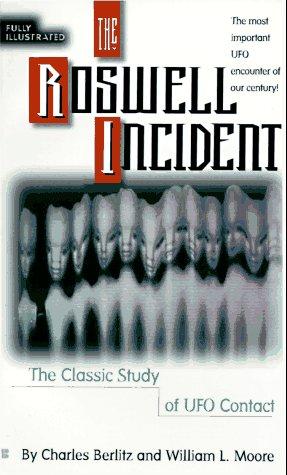
The Roswell Incident
The Book That Turned a 33-Year-Old Silence Into the Modern Roswell Phenomenon
Find on Amazon →As an Amazon Associate, OverClassified may earn from qualifying purchases made through this link, at no extra cost to you.
Why This Is Essential Reading
The Roswell Incident belongs on this list for a reason that has nothing to do with whether its central claim is true: it is the book that took a 31-year-old silence and turned it into the most consequential UFO case of the modern era, and every subsequent Roswell book on this site's own shelf — from Witness to Roswell's believer-side expansion to Roswell: Inconvenient Facts's skeptical rebuttal — exists because Charles Berlitz and William Moore got there first. That priority does not excuse the book's genuine and extensively documented flaws: an inflated witness count Kal Korff's own research exposed, a hearsay-heavy structure Barna Donovan and other critics have rightly called out, and a distant, badly conflated second "crash site" whose consequences distorted Roswell research for a generation afterward. Nor does it excuse the deeper problem this entry addresses directly — that co-author William Moore later stood up at a 1989 MUFON symposium and admitted, on the record, to fabricating UFO material as part of a real Air Force disinformation campaign, a confession that permanently complicates how his half of this book's uncorroborated claims should be read. Read this book not as a reliable account of what happened at Roswell in July 1947, but as the primary artifact of how the entire modern Roswell phenomenon began: a genuinely important historical document precisely because of, not despite, how thoroughly its own methods have since been taken apart.
Related Cases & Theories
Essential Viewing
Full, infamous 1989 disinformation confession speech by Bill Moore on ufology, Paul Bennewitz & more
Eyes On Cinema — The complete recording of William Moore's July 1, 1989 MUFON symposium address, in which this book's co-author publicly admitted to knowingly participating in an Air Force disinformation operation. Verified via YouTube oEmbed before inclusion.
Stanton Friedman - Roswell Lecture at the Citizen Hearing
Exopolitical Archive — Stanton Friedman discussing his own investigation of the Roswell case, rooted in the 1978 interview with Jesse Marcel that supplied this book's foundational research. Verified via YouTube oEmbed before inclusion.
Sources Cited
- Berlitz, Charles, and William L. Moore. The Roswell Incident. Grosset & Dunlap, 1980 (hardcover first edition, ISBN 9780448211992). Berkley Books paperback reprint, "The Classic Study of UFO Contact" (ISBN 9780425126028 / 0425126021, cited here, matching this site's own resources library citation under this exact edition). amazon.com
- "The Roswell Incident (1980 book)." Wikipedia (publication details, contents, witness numbers, reception, and legacy). en.wikipedia.org
- "Bill Moore (ufologist)." Wikipedia (biography: birth date, education, MUFON role, Philadelphia Experiment, Roswell Incident, MJ-12 documents, 1989 MUFON confession). en.wikipedia.org
- "Charles Berlitz." Wikipedia (biography: birth/death, Berlitz family background, education, military intelligence service, Bermuda Triangle, Larry Kusche's fabrication accusation, later life). en.wikipedia.org
- "Jesse Marcel." Wikipedia (biography and the 1978 Stanton Friedman interview that revived the Roswell case). en.wikipedia.org
- "Stanton T. Friedman." Wikipedia (biography, the February 1978 Baton Rouge/Marcel interview, and Friedman's role reviving the Roswell case). en.wikipedia.org
- Donovan, Barna William. Conspiracy Films: A Tour of Dark Places in the American Conscious. McFarland, 2011 (critical characterization of this book's hearsay-based methodology).
- Korff, Kal K. The Roswell UFO Crash: What They Don't Want You to Know. Prometheus Books, 1997 (skeptical analysis documenting the gap between the book's claimed 90-plus witnesses and the 25 actually presented). simonandschuster.com
- Saler, Benson, Charles A. Ziegler, and Charles B. Moore. UFO Crash at Roswell: The Genesis of a Modern Myth. Smithsonian Institution Press, 1997 (anthropological analysis of this book's role as an early version of the Roswell narrative). smithsonianbooks.com
- "Full, infamous 1989 disinformation confession speech by Bill Moore on ufology, Paul Bennewitz & more." Internet Archive (William Moore's July 1, 1989 MUFON symposium confession, recorded in full). archive.org
- "The Roswell Incident." AbeBooks bibliographic listings (first-edition and Berkley paperback-reprint collation details, ISBN 9780425126028 / 0425126021). abebooks.com
- This site's own case file: The Roswell Incident (Case File #001), which documents the full 1947 debris-field discovery and government response this book was the first to investigate at book length, and records the Lewis Rickett Saunders family's own annotated copy of this exact book.
- This site's own essential-reading entry: Roswell: Inconvenient Facts and the Will to Believe (ER-033), Karl Pflock's skeptical rebuttal to the narrative this book established.
- This site's own essential-reading entry: Witness to Roswell (ER-065), Thomas Carey and Donald Schmitt's direct believer-side continuation of this book's crash-retrieval narrative.
- This site's own essential-reading entry: Project Beta (ER-064), Greg Bishop's account of the AFOSI disinformation operation co-author William Moore later admitted participating in.
- This site's own key-figures entries: Charles Berlitz and William Moore, for full biographical detail and further case connections beyond this book.
- This site's own resources library: Full Reading List, where this exact edition (ISBN 0425126021) is cited in connection with the Roswell Incident case file.
Have corrections, additional research, or peer-reviewed sources? Help improve this entry.
Suggest an Edit