
Project Beta
The Story of Paul Bennewitz, National Security, and the Creation of a Modern UFO Myth
Core Thesis
Project Beta: The Story of Paul Bennewitz, National Security, and the Creation of a Modern UFO Myth is Greg Bishop's FOIA-document-and-interview-based reconstruction of how a real U.S. Air Force Office of Special Investigations (AFOSI) counterintelligence operation, run out of Kirtland Air Force Base beginning in 1980, deliberately fed Albuquerque physicist and businessman Paul Bennewitz an escalating stream of fabricated documents, staged confirmations, and invented mythology about underground alien bases and secret alien treaties — not to debunk his mistaken belief that he had detected extraterrestrial signals near the Manzano Weapons Storage Area, but to exploit, redirect, and ultimately weaponize it, both to protect genuinely classified programs and to identify and manipulate the wider civilian UFO research community. Drawing on declassified Air Force Intelligence Service records, Bennewitz's own family and colleagues, and firsthand interviews with the two men most directly responsible — AFOSI Special Agent Richard Doty and UFO researcher William Moore, who publicly admitted his own role in 1989 — Bishop's book is not a case for or against the extraterrestrial hypothesis at all. It belongs on this list as this site's own Kirtland AFB Sighting case file already treats it: as the single fullest documented account of a government disinformation operation manufacturing a piece of UFO mythology from the ground up, and of the severe, well-documented human cost to the one man it was built around.
About the Author
Greg Bishop is a Los Angeles-based writer, researcher, and radio host whose career in UFO and fringe-topics journalism runs back to 1991, when he co-founded The Excluded Middle, a small-press magazine covering UFOs, conspiracy research, psychedelia, and "new science," with fellow researchers Robert Larson and Peter Stenshoel. The magazine published through 1999, and Bishop later anthologized its interviews and features in Wake Up Down There! The Excluded Middle Anthology (2000). He moved the same interview-driven approach into radio in October 1997 with The Hungry Ghost on the Los Angeles pirate station KBLT, and, after KBLT's 1998 FCC shutdown, founded Radio Misterioso in September 2000 — a long-running interview program on paranormal and fringe-science topics that has continued, with occasional format changes, for more than two decades. Bishop has been recognized with a Project Censored award and has served as a regional representative for the Centre for Fortean Zoology; outside his research work, he has also worked as a digital audio engineer, film production supervisor, and paraglider pilot, and consulted for the television series Conspiracy Zone.
Project Beta, published by Paraview Pocket Books in 2005, is Bishop's second book and by far his most consequential: a years-long reconstruction of the Bennewitz affair built on declassified Air Force Intelligence Service documents obtained through FOIA requests, Bennewitz's own surviving family members and Thunder Scientific colleagues, and direct, on-the-record interviews with Doty and Moore, the two men most responsible for the disinformation campaign the book documents. Bishop went on to write Weird California (2006), a guide to the state's strange history and places, and It Defies Language! (2016), a collection of essays on UFOs, government secrecy, and fringe topics drawn substantially from his UFOMystic blog writing with fellow researcher Nick Redfern. Bishop also appears extensively, as Project Beta's author, in the 2013 documentary Mirage Men, which dramatizes much of the same material for a wider audience.
Bishop holds no institutional credential in intelligence studies, journalism, or investigative reporting — his authority on this specific subject rests instead on roughly fifteen years of interview-based fringe-topics journalism through The Excluded Middle and Radio Misterioso, and, more directly, on the years he spent securing FOIA releases and building working relationships with sources, including Doty and Moore, who had every institutional incentive not to cooperate. That access is also this book's central methodological tension, one Bishop does not fully resolve: large parts of the reconstruction depend on the retrospective testimony of men — Doty above all — whose entire documented role in this story is fabricating convincing falsehoods, a problem this entry's Critical Reception section addresses directly.
Historical Context & Origins
Paul Bennewitz, born September 29, 1927, held a graduate degree in physics from the University of Denver by most published accounts and served as a radio electronics engineer for the U.S. Coast Guard during World War II before working as a broadcast engineer for CBS television affiliates. In 1966 he founded Thunder Scientific Corporation, an Albuquerque instrumentation manufacturer specializing in precision temperature and humidity calibration equipment, with NASA and U.S. Air Force contracts among its client base. Thunder Scientific's location, and Bennewitz's own home in the Four Hills neighborhood, gave him a direct line of sight to the Manzano Weapons Storage Area, a hardened nuclear-weapons storage site adjoining Kirtland AFB. Beginning in 1979, as this site's own Kirtland AFB Sighting case file documents in detail, Bennewitz began independently filming what he believed were unidentified aerial objects from his rooftop and recording radio signals he associated with the activity — an investigation that ran parallel to, and initially separate from, a genuine cluster of security-police sightings reported at the same weapons-storage site in August 1980.
Bennewitz's approach to Air Force officials on October 24, 1980 drew AFOSI Special Agent Richard Doty, who had separately compiled the August 1980 security-police reports into a declassified complaint form, into direct contact with his civilian investigation for the first time. What followed, rather than a conventional debunking or dismissal, was the beginning of a documented multi-year disinformation operation: on November 17, 1980, a purported SECRET Air Force document known as the "Project Aquarius" memo began circulating, describing a 37-foot disc-shaped craft with a "trilateral insignia" and referencing a body called "MJ Twelve" — the same Majestic-12 mythology this site's own Top Secret/Majic entry covers from the opposite side of the authenticity dispute. An internal Air Force Intelligence Service memo from January 1983 concluded the document was "a fake for several reasons," but by then it, and a stream of similarly fabricated material, had already become central to Bennewitz's deepening conviction that he had uncovered evidence of an underground alien base near Dulce, New Mexico — a belief compounded by a separate 1980 hypnotic-regression case involving a woman identified as "Myrna Hansen," whose account of an alleged abduction and underground facility fed directly into the same emerging mythology.
By the time Bishop began his own research, the case's basic outline had already surfaced piecemeal: researchers Bruce Maccabee and William Moore had published a 1985 Fund for UFO Research paper arguing a withheld Air Force follow-up investigation existed, and Moore himself, in a widely discussed July 1, 1989 address to a MUFON symposium in Las Vegas, publicly admitted to having knowingly participated in AFOSI's disinformation campaign against Bennewitz. That confession effectively ended Moore's career in ufology and left the field with a partial, scattered record of what had actually happened. Bennewitz, meanwhile, suffered a severe psychological breakdown as the fabricated material about alien invasion and secret treaties escalated; he was hospitalized at a psychiatric facility in August 1988 and died in Albuquerque in 2003, two years before Project Beta was published. Bishop's book, built on FOIA-released documents and direct interviews with Doty and Moore that neither man had previously given at this length, was the first attempt to assemble the full, chronological record of the operation from its origins through Bennewitz's death.
The book also arrived amid a broader turn in UFO literature toward taking government disinformation seriously as its own subject of study, rather than treating official denials simply as cover for a hidden truth. Mark Pilkington's later book Mirage Men: A Journey into Disinformation, Paranoia and UFOs (2010) and its 2013 documentary adaptation, in which Bishop appears extensively as Project Beta's author, extended the same Bennewitz-centered material to a much wider audience and situated it within a larger argument about Doty's continuing influence on UFO folklore, including his identification by multiple researchers as "Falcon," one of the alleged sources behind the MJ-12 documents this site's Top Secret/Majic entry examines in full.
Core Arguments & Key Concepts
Bishop's central argument is that the operation against Bennewitz was not designed to convince him he was wrong, but to validate and amplify his existing beliefs in an ever more elaborate, ultimately unfalsifiable direction — a strategy the book argues was chosen specifically because ridicule and flat denial had already failed to make Bennewitz drop his investigation. Rather than correcting his mistaken interpretation of conventional radar, radio, and aircraft activity near a sensitive nuclear-weapons site, Doty and Moore instead fed him fabricated confirmation: forged documents, staged briefings, and invented technical detail about alien communications and underground bases, all calibrated to keep Bennewitz occupied, discredit him if he went public, and divert his considerable technical skill away from any classified programs, including reported stealth-aircraft testing, actually underway at Kirtland.
The book gives particular weight to Moore's dual and genuinely compromised role: recruited by Air Force counterintelligence with the promise of access to classified UFO material in exchange for reporting on Bennewitz and the wider civilian UFO research community, Moore was simultaneously one of the case's investigators and one of its documented sources of fabricated material — a conflict he did not publicly disclose until his own 1989 MUFON confession, six years after his and Bruce Maccabee's 1985 published research had already treated the case as a legitimate, withheld-investigation mystery. Bishop treats this dual role as the book's clearest illustration of how disinformation operations can co-opt a field's own investigators rather than simply deceiving them from outside.
A second major argument concerns Richard Doty specifically: the book traces his path from the AFOSI agent who compiled the original, comparatively modest August 1980 Kirtland/Manzano security-police sightings into a declassified complaint form, to the central operative who spent years supplying Bennewitz with escalating fabrications. Bishop connects Doty's role in the Bennewitz operation to his separate, disputed identification by multiple researchers as "Falcon," one of the alleged sources behind the Majestic-12 documents — without asserting that identification as proven fact, since Doty himself has given inconsistent public accounts of his own involvement in different UFO-mythology episodes over multiple decades.
Bishop is explicit that the book's ultimate subject is not whether Bennewitz's original 1979 observations had any genuine anomalous component, but what happened to a real, technically credentialed person once a government counterintelligence apparatus decided his sincere, mistaken belief was more useful to exploit than to correct. The book's closing chapters treat Bennewitz's 1988 hospitalization and eventual 2003 death as the operation's actual outcome and moral center — explicitly framing what could otherwise read as an entertaining spy story about forged documents as, first and foremost, the account of one man's documented psychological destruction.
Key Cases & Evidence Discussed
This site's own Kirtland AFB Sighting (Case File #116, August 1980) supplies this book's entire factual foundation: the genuine, multiply-corroborated security-police sightings that first drew AFOSI's Richard Doty into contact with Bennewitz's separate civilian investigation, and the same case file this site maintains independently documents in detail how the original testimonial record was subsequently overtaken by the fabricated "Project Aquarius" document and the disinformation operation this book reconstructs.
The disputed MJ-12 documents, examined at length in this site's own Top Secret/Majic entry from the perspective of their most prominent defender, intersect this book directly: the November 1980 "Project Aquarius" memo fed to Bennewitz referenced a body called "MJ Twelve" years before the 1984 MJ-12 film roll surfaced publicly, and Doty's own disputed identification as an MJ-12-adjacent source ("Falcon") makes this book's account of his operational methods directly relevant to evaluating the MJ-12 controversy's likely origins.
The "Dulce Base" mythology — an alleged underground joint human-alien facility beneath Archuleta Mesa near Dulce, New Mexico — receives extended treatment as one of the disinformation campaign's most durable products, traced by Bishop through Bennewitz's own escalating claims and the 1980 hypnotic-regression case of "Myrna Hansen," whose account of an alleged abduction and underground facility fed directly into material later circulated as confirmed intelligence.
This site's own Government Deception Hypothesis theory page (GDH-001) treats the Bennewitz case as one of its most thoroughly documented supporting examples, and this book is the fullest single account of exactly how that kind of operation is run in practice, from initial contact through years of escalating fabrication to the target's eventual breakdown.
Critical Reception & Controversies
Publishers Weekly's review, published January 31, 2005, offered a genuinely mixed assessment focused on the book's narrative execution rather than its factual reporting. The reviewer noted the story "reads like the entire story arc of the X-Files" in its raw material — alien contact claims, government cover-up, betrayal by a trusted colleague — but concluded "the narrative never gels into such a tale," faulting Bishop specifically for thin characterization: "Bishop never conveys a real sense of Bennewitz's personality and motivations," the review states, adding pointedly that "Mulder and Scully seem more three dimensional than the players in this narrative." The same review allowed that hardcore UFO enthusiasts would likely find the technical detail and documentary allegations compelling despite that limitation.
A more structural methodological problem, raised by multiple readers in the book's aggregate reception (3.94 out of 5 across roughly 150 Goodreads ratings) rather than by any single named critic, concerns Bishop's own sourcing: substantial parts of the reconstruction rely on the retrospective, on-the-record testimony of Richard Doty and William Moore, the two men whose entire documented role in this story is producing convincing fabrications. As more than one reader review has put the objection: if a source's own established record is deliberate deception in this exact case, on what basis should his later, self-reported account of his own motives and actions be taken as reliable? Bishop does not fully resolve this tension in the text, and it is worth stating plainly for readers of this entry: the book's driest, most verifiable spine — the declassified AFOSI and Air Force Intelligence Service documents, the January 1983 internal "fake" finding, and Moore's own independently corroborated 1989 public confession — stands on much firmer ground than the passages built primarily on Doty's own later, first-person account of his motives.
Unlike this site's Top Secret/Majic entry, where the underlying dispute concerns whether contested documents are genuine, no serious researcher across the range of positions on UFOs generally disputes this book's central factual claim: that AFOSI ran a real, sustained disinformation operation against Bennewitz, that Moore knowingly participated and later admitted it under oath-adjacent circumstances at a public symposium, and that the operation contributed to Bennewitz's documented psychological decline. The genuine critical debate concerns scope and interpretation — how much of the wider Dulce/MJ-12/alien-treaty mythology traces specifically to this operation versus independently circulating rumor, and how far Doty's own shifting, decades-long public statements about his own role can be trusted on any specific detail — not whether the core disinformation campaign happened at all.
It bears stating with the same care this site applies elsewhere on this subject: this book documents the deliberate psychological destruction of a real person, and its value rests on treating that outcome as the story's actual center of gravity rather than as a colorful footnote to a spy-versus-saucer narrative. Readers approaching this book expecting confirmation of an alien cover-up will instead find a documented account of a man being systematically deceived, by name, by agents of his own government, until his mental health collapsed.
Influence & Legacy
Project Beta remains the standard published reference for the Bennewitz case specifically, and this site's own Kirtland AFB Sighting case file cites it directly alongside the 2013 documentary Mirage Men as the two works that "cemented its place in popular ufology." Bishop's extensive on-camera participation in that documentary, released eight years after the book, extended the same research to a far wider audience and folded the Bennewitz story into a broader argument about Richard Doty's continuing influence on UFO folklore generally.
The book's reconstruction of Doty's operational methods — validating rather than debunking a target's beliefs, then escalating them toward a discrediting or diversionary end — has become a recurring reference point for later discussion of UFO disinformation as its own distinct phenomenon, separate from the question of whether any individual sighting has a genuine anomalous cause. Doty himself continued to make public statements about his own role for years afterward, including a widely covered July 2014 interview in which he again described hoaxing material for UFO researchers under Air Force direction, a continuity of public attention this book's original 2005 research helped establish.
Because the fabricated "Project Aquarius" document fed to Bennewitz referenced "MJ Twelve" in November 1980, four years before the anonymously mailed Majestic-12 film roll surfaced in December 1984, this book is frequently read alongside this site's own Top Secret/Majic entry as evidence that at least some MJ-12-adjacent material circulated, and was taken seriously by AFOSI's own targets, well before the documents that became the center of Stanton Friedman's later authenticity defense. Neither this book nor the Kirtland case file it draws on definitively resolves how much continuity exists between the two episodes, but the chronological overlap is itself part of why researchers on both sides of the MJ-12 dispute have found this book relevant to that separate controversy.
Within this site's own catalogue, this exact edition (ISBN 0743470923 / 9780743470926) is already cited in resources.html in direct connection with the Kirtland AFB case file, and this book's account of AFOSI's methods is one of the most heavily drawn-upon sources for this site's own Government Deception Hypothesis theory page, reflecting its role as this site's most load-bearing single source for how a real, documented UFO disinformation operation actually functioned in practice.
The Book
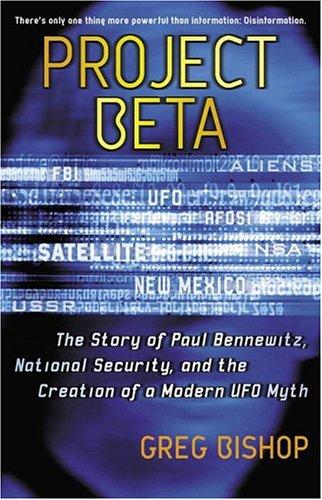
Project Beta
The Story of Paul Bennewitz, National Security, and the Creation of a Modern UFO Myth
Find on Amazon →As an Amazon Associate, OverClassified may earn from qualifying purchases made through this link, at no extra cost to you.
Why This Is Essential Reading
Project Beta earns its place on this list not as a book about whether UFOs are real, but as the fullest documented account of what happens when a government counterintelligence apparatus decides a civilian's sincere, mistaken belief is more useful to exploit than to correct. Every load-bearing element of Bishop's reconstruction — the declassified AFOSI and Air Force Intelligence Service records, the January 1983 internal finding that the "Project Aquarius" document was fabricated, and William Moore's own independently corroborated 1989 public confession — is corroborated well beyond Richard Doty's own later, self-interested testimony, even where the book leans on that testimony for texture and detail it cannot otherwise verify. Read alongside this site's own Kirtland AFB Sighting case file and its Top Secret/Majic entry, it completes a genuinely rare thing in ufology: a case where the disinformation campaign itself, rather than the disputed lights that started it, is the best-documented and most consequential part of the whole story — and where the human cost of that campaign, a real man's hospitalization and early death, is never allowed to disappear behind the more entertaining mystery of the documents themselves.
Related Cases & Theories
Essential Viewing
Project Beta - The Paul Bennewitz Story - by Greg Bishop
International UFO Congress (2006) — Greg Bishop's own lecture on the Bennewitz case and this book, delivered at the International UFO Congress on February 28, 2006. Verified via YouTube oEmbed before inclusion.

"Aliens" Drove This Man Insane! (Ft. Greg Bishop)
Jesse Michels — A more recent long-form interview with Greg Bishop revisiting the Bennewitz disinformation case and this book's research. Verified via YouTube oEmbed before inclusion.
Sources Cited
- Bishop, Greg. Project Beta: The Story of Paul Bennewitz, National Security, and the Creation of a Modern UFO Myth. Paraview Pocket Books, 2005 pbk. (ISBN 9780743470926 / 0743470923, matching this site's own resources library citation under this exact edition). amazon.com
- "Project Beta: The Story of Paul Bennewitz, National Security, and the Creation of a Modern UFO Myth." Open Library edition record (Paraview Pocket Books, 2005, 288 pp., ISBN 0743470923 / 9780743470926). openlibrary.org
- "Project Beta: The Story of Paul Bennewitz, National Security, and the Creation of a Modern UFO Myth." Publishers Weekly, review dated January 31, 2005 ("reads like the entire story arc of the X-Files," characterization criticism, "Mulder and Scully seem more three dimensional"). publishersweekly.com
- "Project Beta." Official Publisher Page, Simon & Schuster (publisher description and edition details). simonandschuster.com
- "About." Radio Misterioso (Greg Bishop's own biographical account: Excluded Middle co-founding 1991, The Hungry Ghost on KBLT from 1997, Radio Misterioso founded September 2000). radiomisterioso.com
- "Bishop, Greg." Anomaly Archives (biography: Project Censored award, Centre for Fortean Zoology regional representative, career background, bibliography). anomalyarchives.org
- "Paul Bennewitz." Wikipedia (biography: birth/death dates, education, Thunder Scientific, the 1979–1980 investigation, the disinformation campaign, 1988 hospitalization, and 2003 death). en.wikipedia.org
- "Ex-Air Force Law Enforcement Agent Says He Hoaxed Major UFO Mythologies." HuffPost, July 13, 2014 (Richard Doty's own public admission of hoaxing documents and disinformation under Air Force direction). huffpost.com
- "Mirage Men." IMDb (2013 documentary directed by John Lundberg, written by Mark Pilkington, featuring Greg Bishop as Project Beta's author and Richard Doty directly). imdb.com
- "Project Beta: The Story of Paul Bennewitz, National Security, and the Creation of a Modern UFO Myth." Goodreads (aggregate reader rating and reader-review commentary on sourcing reliability). goodreads.com
- This site's own case file: Kirtland AFB Sighting (Case File #116), the August 1980 security-police sightings and the subsequent AFOSI disinformation campaign this book reconstructs in full.
- This site's own essential-reading entry: Top Secret/Majic, for the disputed MJ-12 documents this book's fabricated "Project Aquarius" memo references years before their public 1984 surfacing.
- This site's own theory page: Government Deception Hypothesis (GDH-001), which draws directly on this book's documentation of the Bennewitz operation's methods.
- This site's own key-figures entries: Paul Bennewitz and Richard Doty, for full biographical detail and further case connections beyond this book.
- This site's own resources library: Full Reading List, where this exact 2005 edition (ISBN 0743470923) is cited in connection with the Kirtland AFB case file.
Have corrections, additional research, or peer-reviewed sources? Help improve this entry.
Suggest an Edit