
STS-75 Tether Incident
On February 25–26, 1996, Space Shuttle Columbia's STS-75 crew deployed the Tethered Satellite System Reflight (TSS-1R) on a 12-mile conducting tether — a real NASA electrodynamic-tether experiment that ended when an electrical arc severed the cable and the satellite receded into its own orbit. Low-light television footage recorded around the failure, showing numerous small luminous objects near the tether, was later popularized by documentary filmmaker David Sereda as proof of a fleet of alien discs "miles in diameter." Mainstream photo analysis attributes the objects to ice particles from a routine wastewater dump and a documented defect in the shuttle's low-light camera, replicated on video by MUFON's own chief photo analyst.
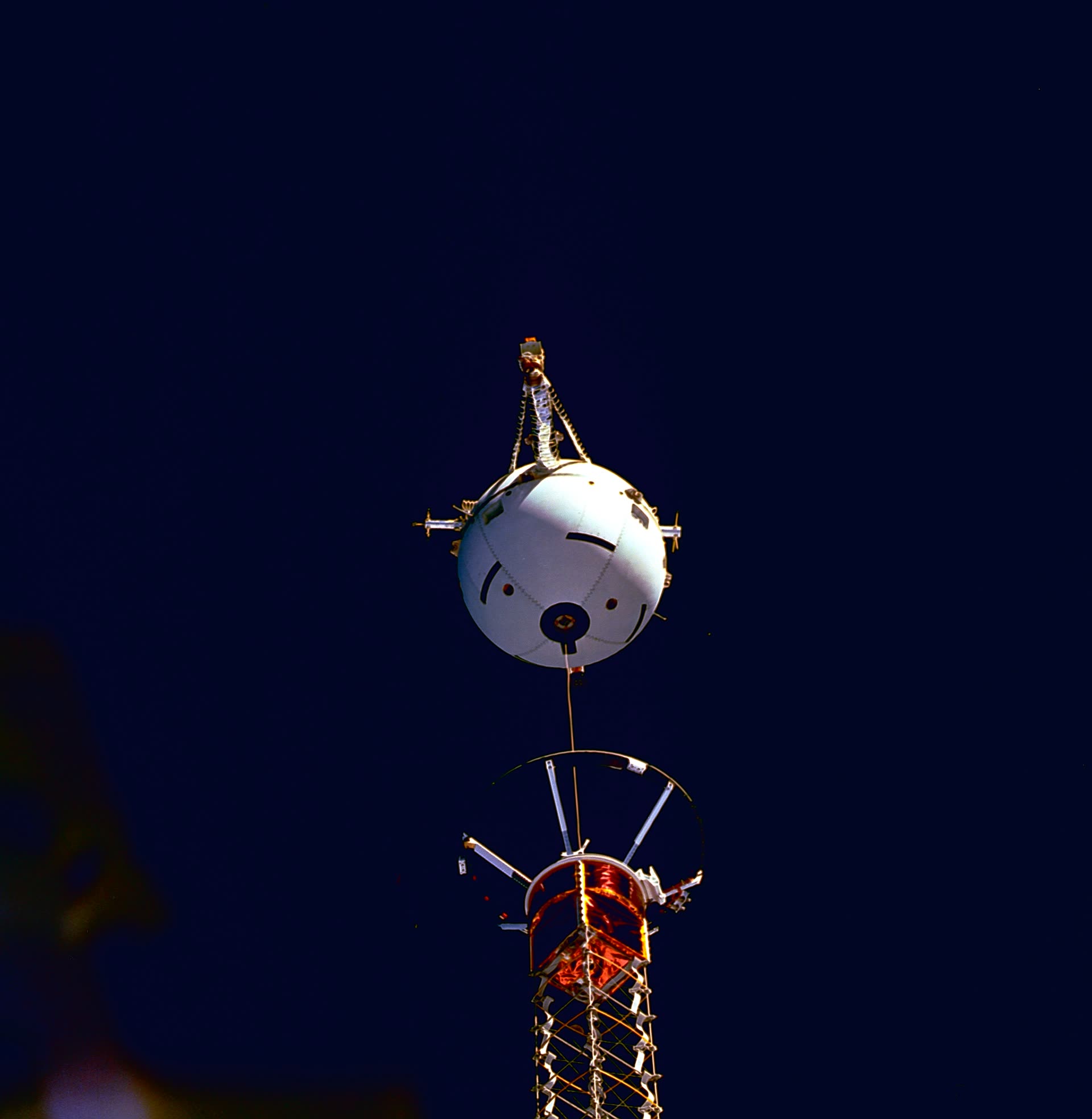
Pictured: NASA photograph STS075-701-087, the actual Tethered Satellite System (TSS-1R) and its supporting deployment boom in Columbia's payload bay, photographed February 25, 1996, shortly before deployment began — the real hardware at the center of this case. (Public domain, NASA/Johnson Space Center.)
Theoretical Alignment
This case aligns almost entirely with a Psycho-Social framework — not because the STS-75 crew misperceived anything (none of the seven astronauts aboard ever reported, in any known real-time communication or post-mission account, seeing anomalous craft), but because a real, mundane NASA engineering failure was later mined by an outside documentary filmmaker for footage that could be reframed as extraterrestrial evidence, then amplified through celebrity endorsement and cable-television "investigation" segments. Extraterrestrial Hypothesis (ETH) alignment is minimal: no maneuvering craft was ever tracked by any instrument, and the entire claim rests on a distance assumption about small, out-of-focus points of light that independent review has directly challenged. Interdimensional Hypothesis (IDH) alignment is effectively nil, since nothing about the footage or its promotion involves any claim of dimensional transition, consciousness interaction, or non-physical phenomenology of any kind — the dispute here is a narrow, testable question of optics and distance, not metaphysics.
Background
STS-75 was the 75th mission of NASA's Space Shuttle program and the 19th flight of the orbiter Columbia, launching from Kennedy Space Center's Launch Complex 39B on February 22, 1996, at 20:18 UTC. The seven-member crew consisted of Commander Andrew M. Allen (his third and final spaceflight), Pilot Scott J. Horowitz (his first), Payload Commander Franklin R. Chang-Díaz (a Costa Rican-American physicist on his fifth flight, overseeing the tether experiment), Mission Specialist Jeffrey A. Hoffman (a Harvard-trained astrophysicist on his fifth and final flight), European Space Agency Mission Specialists Maurizio Cheli of Italy and Claude Nicollier of Switzerland, and Italian Space Agency Payload Specialist Umberto Guidoni. The flight lasted 15 days, 17 hours, and 40 minutes, landing back at Kennedy Space Center on March 9, 1996.
The mission's headline payload was the Tethered Satellite System Reflight (TSS-1R), a joint NASA–Italian Space Agency (ASI) program managed by Marshall Space Flight Center. The concept was genuinely novel spaceflight engineering: connect a small, spherical satellite to the orbiter by a long, electrically conducting tether and deploy it upward or downward through the ionosphere. As the tether swept through Earth's magnetic field, it would generate an electromotive force, allowing scientists to study electrodynamic-tether physics with real applications in view — generating spacecraft electrical power without fuel, orbital reboost or deorbit without propellant, and direct sampling of the near-Earth plasma environment. It was not TSS's first flight: the original TSS-1 satellite had flown aboard Space Shuttle Atlantis on STS-46 in July 1992, but a bolt interfering with the reel's level-wind mechanism jammed the tether after only 256 meters of a planned 20-kilometer deployment, cutting that mission's science return to a fraction of its goal. NASA's Tethered Satellite System Contingency Investigation Board, convened that August, traced the jam to specific hardware and recommended fixes before a second attempt. TSS-1R was that second attempt, flown under Chang-Díaz's supervision nearly four years later.
The tether itself was an unusual piece of hardware: a conducting copper-core cable only 2.54 millimeters in diameter, braided with Kevlar and Nomex strength members and wrapped in a Teflon (fluorinated ethylene propylene, or FEP) insulating jacket, designed to be spooled out to a maximum length of 20.7 kilometers (12.87 miles) from a deployment mechanism at the top of a boom in Columbia's payload bay. It was this hardware, and the low-light television cameras NASA mounted to monitor it in the dark, that would become the entire evidentiary basis for this case's UFO claim years later — a claim that has nothing to do with the tether experiment's actual, well-documented scientific objectives, and everything to do with what a camera pointed into a cloud of drifting orbital debris happened to record.
Complete Timeline
| Date / Time | Event |
|---|---|
| July 31–August 6, 1992 | TSS-1, the first Tethered Satellite System flight (STS-46, Atlantis), deploys only 256 meters of a planned 20 km before a jammed level-wind mechanism halts extension; the satellite is retrieved and NASA's Contingency Investigation Board recommends hardware fixes. |
| February 22, 1996, 20:18 UTC | STS-75 launches aboard Columbia from Kennedy Space Center, carrying the TSS-1R reflight and the U.S. Microgravity Payload-3. |
| February 25, 1996, afternoon–evening | TSS-1R deployment begins; the tether extends outward from the boom at roughly 1 meter per second under active monitoring by the crew and Marshall Space Flight Center's Payload Operations Control Center. |
| February 26, 1996, ≈8:29:35 PM EST (01:29:35 UTC, Feb. 27) | With roughly 19.7 of the planned 20.7 kilometers deployed, an electrical arc burns through the tether's insulation and conductor; the remaining Kevlar strength members fail under tension. Jeffrey Hoffman radios Houston: "The tether has broken at the boom! It is going away from us." |
| Same evening | Hoffman examines the severed tether end through onboard optics, describing it as "brown and charred" — a real-time observation consistent with electrical arcing. |
| Days following the break | TSS-1R, still attached to its own length of tether, recedes from the shuttle as a free-flying object; NASA's low-light television cameras continue recording the payload bay and surrounding area on subsequent orbital-night passes, following at least one routine shuttle wastewater dump — the source of the footage later marketed as a "UFO swarm." |
| March 9, 1996 | STS-75 lands at Kennedy Space Center after 15 days, 17 hours, 40 minutes. |
| March 19, 1996, ≈23:12 UTC | The free-flying TSS-1R satellite and its remaining tether re-enter the atmosphere and burn up over the northwest Africa/southeast Asia region, ending any possibility of physical recovery or laboratory analysis. |
| May 31, 1996 | NASA's TSS-1R Mission Failure Investigation Board, chaired by Kenneth J. Szalai, issues its report identifying an insulation breach and electrical arc as the tether's cause of failure. |
| 2001 (VHS) / 2003 (DVD) | David Sereda releases Evidence: The Case for NASA UFOs, presenting the STS-75 low-light footage as proof of large, disc-shaped extraterrestrial craft; the release carries a foreword by actor Dan Aykroyd. |
| 2005 | Sereda and Aykroyd collaborate again on Dan Aykroyd Unplugged on UFOs, further popularizing the STS-75 claim in Aykroyd's media appearances. |
| Circa 2008–2010 | History Channel's UFO Hunters revisits the footage; MUFON chief photo/video analyst Marc D'Antonio builds a physical replica rig and reproduces the footage's "notched disc" appearance and behind-the-tether illusion using small, defocused particles held near the camera lens. |
| 2010s | Biblical scholar and ancient-astronaut critic Dr. Michael S. Heiser publishes an analysis crediting the D'Antonio replication with resolving the case as an optical illusion, after separately consulting an electrical-engineering graduate student on the technical flaws in Sereda's own calculations. |
| 2023 | Wikipedia editors formally remove UFO-related content from the STS-75 article's main body, citing the routine, well-documented physics of orbital debris shedding and the 1996 investigation board's own recorded finding of aluminum and non-metallic debris released by the tether failure itself. |
The Deployment and the Arc: What Actually Happened to TSS-1R
Deployment of TSS-1R began on February 25, 1996, with the satellite riding outward from the top of its support boom on the conducting tether at a controlled rate of roughly one meter per second, monitored continuously by the crew and by flight controllers at Marshall Space Flight Center's Payload Operations Control Center. The experiment was, up to that point, a genuine engineering success: TSS-1R reached lengths far beyond anything TSS-1 had managed in 1992, and the system measured electrical potentials and currents consistent with (and in some configurations exceeding) pre-flight predictions, generating close to 1.7 kilowatts of power at points during deployment — a real scientific return already banked before anything went wrong.
The failure came late, close to the end of deployment. With roughly 19.7 of a planned 20.7 kilometers of tether extended — leaving the system operating near its maximum design voltage, on the order of several thousand volts negative relative to the orbiter — a flaw in the tether's Teflon (FEP) insulating jacket became a conductive pathway. NASA's subsequent investigation traced the flaw to debris trapped inside the Kevlar braid during the tether's manufacture, which was driven through the thin Teflon jacket by the pressure of the reel's own outer windings as the cable spooled out. Once exposed at high voltage, that breach ignited a real electrical arc: roughly one amp of current discharged to the orbiter's structural ground, burning and eroding the tether's remaining material for approximately nine seconds until the last intact Kevlar strength members failed under the line's nominal working tension of about 65 newtons. The tether parted at the boom, and TSS-1R — still attached to its own length of severed cable — began drifting away from Columbia under its own orbital momentum.
This is, in every particular that matters, an ordinary if unlucky spaceflight hardware failure: a known-hazard high-voltage system, a manufacturing-scale insulation flaw, and a real electrical arc, all extensively modeled, measured, and documented by the engineers who built and flew the system. Nothing about the failure mechanism itself is disputed by anyone, UFO proponent or skeptic alike — the disagreement in this case begins only with what the shuttle's cameras subsequently recorded in the vicinity of the receding satellite and tether.
Crew Testimony: "The Tether Has Broken at the Boom"
Jeffrey Hoffman, the mission specialist most closely engaged with tether operations that evening, later recalled noticing "little ripples in the tether" through his camera view shortly before the failure — his first instinct, informed by the 1992 TSS-1 mission he had also flown on, was that the deployment mechanism might be jamming again. Instead, the tether parted outright. Hoffman's real-time radio call to Houston, preserved in mission audio, was immediate and unambiguous: "The tether has broken at the boom! It is going away from us." Mission Specialist Maurizio Cheli, reflecting on the loss of the satellite that had occupied so much of the mission's planning, told the crew afterward: "Every time I turn around and look through the window and I see this empty bay, it's like a part of myself has left."
Hoffman subsequently used the shuttle's onboard optics to examine the severed end of the tether still attached near the boom, describing what he saw as "brown and charred" — a plain, technically literate observation, made in real time by a working astrophysicist, that independently corroborates an electrical short circuit well before any formal investigation board convened. At no point in the mission's communications record, post-flight debriefing, or any of the crew's own later public statements does any STS-75 astronaut describe observing anomalous craft, discs, or unexplained objects. The entire "UFO" interpretation of this case originates outside the crew entirely, from later frame-by-frame analysis of released NASA footage by people who were never aboard the spacecraft.
The Investigation Board's Findings
NASA moved quickly and formally to determine the cause of the tether's failure. The TSS-1R Mission Failure Investigation Board, chaired by Kenneth J. Szalai and including astronaut Kenneth Bowersox among its members, issued its findings on May 31, 1996, concluding that the tether failed due to arcing and burning triggered by a breach in the Teflon (FEP) insulation layer within the Lower Tether Control Mechanism, most likely caused by manufacturing debris trapped in the Kevlar braid puncturing the jacket under reel-winding pressure. The board's report — a real, publicly archived NASA technical document, not a summary or press release — also recorded that the failure released tether debris, including aluminum shavings and other non-metallic material, directly from the hardware itself. That detail matters for this case: it establishes, on NASA's own documented authority, that the immediate vicinity of the tether failure was genuinely and expectedly full of small drifting debris in the hours and days that followed — a fact any subsequent camera footage of the area needs to be read against.
Ground Tracking: TSS-1R's Fate as a Free-Flying Object
Once severed, TSS-1R and its trailing length of tether did not vanish into the unknown; they became an ordinary, catalogued piece of orbital debris, openly and continuously trackable by both government sensors and independent civilian observers for the following three weeks. A network of amateur satellite trackers, coordinated informally through what became the satobs.org observing community, followed the free-flying satellite from stations in Australia, Hawaii, and the southern United States, filing detailed visual reports of an object gravity-gradient stabilized with the tether hanging below the satellite body — subtending a degree or more of sky at its brightest, gently curving along its length with a small kink or twist visible near the far end, and reaching a peak brightness around magnitude +3, easily visible to the naked eye from a dark site. None of these independent observers, watching the actual object at the center of this case night after night with their own eyes and telescopes, ever reported anything resembling a disc-shaped craft, a formation of unidentified objects, or any anomalous behavior whatsoever — only a receding satellite and tether behaving exactly as orbital mechanics predicted.
The free-flying TSS-1R settled into an orbit of roughly 400 by 320 kilometers, still inclined 28.5° to the equator, and remained there, decaying gradually under atmospheric drag, until it and the remaining tether re-entered the atmosphere and burned up on March 19, 1996, at approximately 23:12 UTC, over the northwest Africa/southeast Asia region. This three-week open tracking record matters directly to this case: it demonstrates that the real hardware involved — the actual subject of the disputed low-light footage — was never lost, never secret, and never treated by NASA, the wider satellite-tracking community, or any government agency as anything other than what the investigation board's own report already said it was: a piece of failed spaceflight hardware behaving like any other piece of failed spaceflight hardware, observed openly by anyone with a telescope until gravity brought it down.
From Debris to "UFO Swarm": How the Footage Became a Claim
The transformation of this real engineering failure into a UFO case has a specific, traceable origin. In 2001 (released on VHS, with a DVD edition following in 2003), documentary filmmaker David Sereda released Evidence: The Case for NASA UFOs, a film examining low-light television footage from several shuttle missions, STS-75 chief among them, alongside STS-80. Sereda is a Canadian-born independent researcher, inventor, and, by his own long-standing description, a professional photographer of more than two decades' experience; he has also described a decade-plus collaboration with physicist Dr. Bogdan Maglich on nuclear fusion research and testified before the U.S. Congress on fusion technology in 1994. He holds no independently verifiable academic credential in astrophysics, optics, or orbital mechanics, the specific technical disciplines his STS-75 claims depend on.
Sereda's film presented frame-by-frame analysis of the STS-75 low-light footage — which shows numerous small, bright points of light near the tether, some appearing to change direction, accelerate, or pass in and out of view relative to the tether itself — as evidence of large, disc-shaped craft engaged in deliberate, "non-Keplerian" maneuvering inconsistent with inert, ballistic debris. Central to the claim was a specific piece of arithmetic: if the objects were genuinely positioned near the tether's far end, at a distance Sereda placed on the order of 77 to 100 nautical miles from the camera, then their observed angular size in the video frame would require them to physically measure miles across — structures on the scale of a small city, not orbital debris. That single distance assumption is the entire load-bearing premise of the "giant craft" interpretation; if the objects were instead close to the camera rather than near the tether, the same footage requires no exotic explanation at all.
Dan Aykroyd and the Mainstreaming of the Claim
Sereda's 2001 release carried a foreword from actor and long-time public UFO enthusiast Dan Aykroyd, and the two collaborated again in 2005 on Dan Aykroyd Unplugged on UFOs, an extended interview documentary. Aykroyd's celebrity profile did more than any of Sereda's own media appearances to carry the STS-75 claim into mainstream awareness: he has referenced the tether footage repeatedly across television interviews and public appearances in the decades since as one of his standard, go-to pieces of "evidence" for extraterrestrial visitation, giving a niche, self-published video analysis a media reach it would not otherwise have had. The claim's further popularization through History Channel's UFO Hunters around 2008–2010 cemented STS-75 as one of the most widely circulated "NASA UFO footage" claims of the internet-video era, generating dozens of re-uploaded and re-edited versions of the same few minutes of low-light video that continue to circulate today.
The Skeptical Response: UFO Hunters, MUFON, and Michael Heiser
The same UFO Hunters segment that helped popularize Sereda's claim also produced its most direct rebuttal. Marc D'Antonio, the Mutual UFO Network's own chief photo and video analyst — whose special-effects and imaging firm, FX Models, has held contracts with the U.S. Navy, Congress, and the Joint Chiefs of Staff — built a physical demonstration rig specifically to test whether the STS-75 footage's visual characteristics could be reproduced by mundane means. He rigged a length of cable to stand in for the tether, then filmed small, brightly lit particles suspended just centimeters to a few meters in front of the camera lens, deliberately defocused.
Marc D'Antonio's Replication
The result closely reproduced the original footage's signature features: severely out-of-focus, brightly lit point sources resolved on camera as large, roughly circular shapes with a visible notch along one edge — and, critically, D'Antonio's near-camera particles created the same illusion of passing "behind" the distant tether that Sereda's analysis had treated as proof of great distance, even though the replica particles were in fact passing between the camera and the tether the entire time, not beyond it. The notch itself is not mysterious: it is a documented bokeh artifact, the out-of-focus imprint of the shape of the camera's own mechanical iris blades, a well-understood behavior of any lens system with a non-circular aperture stopped down around a defocused bright point source. Once a small particle a few centimeters wide sits mere centimeters to meters from a wide-angle lens, ordinary optical defocus alone is sufficient to produce an image that looks, to an untrained eye, uncannily like a distant flying saucer.
Dr. Michael S. Heiser, the Hebrew Bible scholar and prominent ancient-astronaut theory critic, took up the case independently on his own website. Heiser's initial skepticism of Sereda's claim was intuitive rather than technical — he wrote that "it made little sense" that any camera could resolve an object smaller than the circumference of a pinky finger at a genuine distance of miles — and he supplemented that instinct by consulting a PhD electrical engineering student, Daniel Rodriguez, who critiqued the technical assumptions underlying Sereda's calculations directly. Heiser ultimately credited the UFO Hunters segment and D'Antonio's replication specifically for resolving the matter, writing that the demonstration "replicates the incident rather nicely" and concluding the tether footage was an optical illusion.
The Water Dump, the "Fireflies," and a Documented Precedent
A specific, mundane origin for the particles themselves has a well-documented basis in routine shuttle operations. According to skeptical analysis of the case (see Sources), a routine wastewater dump — a standard, frequently performed shuttle housekeeping operation — took place in the hours before the most widely circulated "swarm" footage was recorded. Shuttle water dumps are documented, across the entire history of the program, to produce an expanding cloud of ice crystals as the venting wastewater instantly freezes in the vacuum of space; these crystals catch and reflect direct sunlight unpredictably as they drift and tumble near the vehicle, and can remain visible for hours before finally dispersing. This is not a novel or ad hoc explanation invented for this case: it is the same well-known phenomenon astronaut John Glenn first reported from Friendship 7 in February 1962, famously describing clouds of luminous particles he called "fireflies" swarming around his capsule — a phenomenon NASA engineers subsequently identified as ice flaking off the spacecraft's exterior and venting systems, not a living or intelligently controlled presence, and one that has recurred on crewed missions ever since.
Two distinct debris sources are therefore documented for this case, corresponding to two different points in its timeline. Immediately around the tether's actual failure, NASA's own 1996 investigation board recorded that the arc and mechanical break released tether debris directly — aluminum shavings and other non-metallic fragments from the hardware itself. Separately, and several days later according to the most detailed independent account of the footage's own timeline (see Sources), the more famous "swarm" sequence was filmed following a routine water dump, placing an expanding ice-crystal cloud in the shuttle's immediate vicinity at exactly the time the low-light camera was recording. Both explanations are mundane, both are grounded in specific, documented mission events rather than speculation, and neither requires positing any object at the tether's actual distance from the camera — which is precisely the assumption Sereda's "miles in diameter" calculation depends on and which D'Antonio's replication demonstrates is unnecessary to explain the footage's visual appearance.
Key Witnesses
Jeffrey A. Hoffman
Hoffman was the crewmember most directly engaged with the tether at the moment of failure: he first noticed "little ripples" suggesting a problem, made the real-time radio call reporting the break, and later personally examined the severed tether end through onboard optics, describing it as "brown and charred" — testimony that independently corroborates the electrical-arc failure mode NASA's investigation board later confirmed. Hoffman never reported observing anomalous craft or objects at any point during or after the mission; the "UFO swarm" interpretation of the footage his own cameras recorded originated years later, from analysts who were never aboard the spacecraft.
The Five Observables Assessment
The Five Observables framework is applied to the performance characteristics claimed for the objects in this case's disputed footage:
Assessment: Proponents of the anomalous interpretation point to objects that appear to stop abruptly or reverse direction as evidence of instant acceleration, the one observable this file rates as speculative rather than flatly absent — but no instrumented tracking data of any kind exists to measure a real velocity change, and the apparent reversals are equally, and more parsimoniously, explained by ordinary parallax: small particles drifting near a moving camera, or the camera's own slow pan and orbital motion, naturally produce apparent direction changes with no true acceleration involved. No object was ever tracked by radar or any instrument beyond the low-light camera itself, no hypersonic velocity was measured, and the objects were, if anything, the opposite of low-observable — bright, sunlit points of light plainly visible against a dark background, exactly as small reflective ice or metal particles would be.
Evidence Assessment
Supporting Anomalous Origin
- Some objects in the footage appear to pass behind the tether and to change direction or momentarily stop, which proponents argue is inconsistent with simple ballistic debris.
- Sereda's published distance calculation, if its underlying assumption about object range is accepted, does produce an internally consistent (if extraordinary) size result.
- The claim has been amplified by a public figure (Dan Aykroyd) with a long, independent track record of citing it as personally compelling.
- No frame-by-frame, peer-reviewed reanalysis of every individual object's trajectory across the full footage has been published, leaving some specific claimed motions without an exhaustive, dedicated rebuttal on the individual-object level.
- The footage is real, NASA-originated video from an actual, verifiable mission event, not a fabrication or hoax in itself.
Supporting Conventional Explanation
- None of the seven STS-75 crewmembers, who were present and whose own cameras recorded the footage, ever reported observing anomalous craft during or after the mission.
- NASA's own 1996 investigation board documented that the tether failure itself released debris (aluminum shavings, non-metallic fragments) directly into the area the cameras were recording.
- A routine wastewater dump, a standard and frequently performed shuttle operation, is independently documented to have occurred shortly before the most widely circulated "swarm" footage — a well-known, decades-old source of drifting ice-crystal "firefly" clouds first described by John Glenn in 1962.
- MUFON's own chief photo/video analyst, Marc D'Antonio, physically replicated the footage's exact visual signature — including the "notched disc" shape and the illusion of passing behind the tether — using small, defocused particles held near the camera lens.
- The "miles in diameter" size claim depends entirely on an unverified assumption about the objects' distance from the camera; independent technical review places them meters, not miles, away.
- No radar, no independent photographic instrument, and no ground-based tracking of any kind corroborates any object at the claimed distance or scale.
- The tether's own failure mechanism — a documented electrical arc from a Teflon insulation breach — is itself a fully mundane engineering event with no bearing on any exotic-craft explanation.
Why "Debunked"
This case earns a Debunked stamp rather than a more ambiguous Disputed rating because the claim's entire evidentiary weight rests on a single, specific, and directly challenged assumption: that the luminous objects in the STS-75 low-light footage are located near the tether's own distance from the camera. Every other element of the anomalous interpretation flows from that one premise, and every other element of the mundane explanation directly contradicts it with documented, mission-specific facts — a routine wastewater dump shortly before the footage was recorded, NASA's own investigation-board record of debris released by the tether failure itself, and a known, physically demonstrated defect in the shuttle's low-light camera optics that independently reproduces the footage's most distinctive visual signatures without requiring any object to be more than a few meters from the lens. The crew present at the scene, whose own instrumentation recorded the footage, never reported anything anomalous. The claim's most prominent public promotion came not from a credentialed astrophysicist, optical engineer, or orbital-mechanics specialist, but from a documentary filmmaker whose central calculation has been directly and specifically rebutted by an experimental replication from within the UFO research community's own most established photo-analysis body, MUFON. What remains genuinely open is narrow: no exhaustive, published, frame-by-frame reanalysis of every individual object's trajectory across the full multi-minute footage exists, so a handful of specific claimed motions have not been individually run to ground the way the footage's overall visual character has been. That is a loose end of thoroughness, not evidence of an unresolved phenomenon.
Sensor & Instrumentation Detection Profile
Detection in this case was limited entirely to the shuttle's own onboard low-light television (LLTV) camera system, used operationally to monitor the tether and payload bay during orbital-night passes when standard daylight video would show nothing. This class of camera was standard shuttle payload-bay equipment, designed to produce usable imagery in extremely dim conditions by amplifying available light through an image-intensifier stage — a design choice that, as a direct engineering trade-off, made it considerably more prone to bright-source artifacts, iris-shape bokeh, and defocus distortion than an ordinary daylight camera would be. No radar, ground-based telescope, infrared sensor, or any other independent instrument ever tracked or corroborated the objects visible in the footage. This is a critical limitation: the entire case rests on interpreting the optical output of a single video camera system with a documented mechanical iris defect and known focus problems at extreme distances, with no second, independent sensor available to cross-check whether the objects were genuinely distant and enormous or, as the mundane explanation holds, small and close to the lens.
Environmental & Geospatial Context
The disputed footage was recorded in low Earth orbit at an inclination of 28.5° to the equator — the standard inclination for shuttle missions launched from Kennedy Space Center — in the hard vacuum of space, with no atmosphere, weather, or terrestrial geography applicable to the sighting itself. The free-flying TSS-1R satellite, once separated from the tether, was tracked by ground-based satellite observers in an orbit of roughly 400 by 320 kilometers before its re-entry on March 19, 1996. The specific orbital-night lighting conditions required for the shuttle's low-light camera to be in operational use are themselves significant: recording during Earth's shadow meant any nearby particles were visible only when catching direct, unfiltered sunlight at a glancing angle as they rotated or drifted — a lighting geometry that produces exactly the intermittent, flaring, hard-to-relocate appearance both the "swarm" footage and, separately, the documented "firefly" phenomenon from earlier missions consistently display. Because the event occurred in orbital space rather than at a fixed Earth location, it is not resolvable to a coordinate pair and does not correspond to an entry in this site's Locations directory or interactive case map, apart from the launch site itself.
Observer Credibility & Occupational Profile
The seven-member STS-75 crew were, collectively, among the most rigorously trained and credentialed observers ever to have flown a mission connected to this site's catalog: Commander Andrew Allen and Pilot Scott Horowitz were both experienced military test pilots; Jeffrey Hoffman held a doctorate-level astrophysics background from Harvard and had already flown the first Hubble Space Telescope servicing mission; Payload Commander Franklin Chang-Díaz was a working plasma physicist personally responsible for the tether experiment's science return; and the mission's two ESA mission specialists and one ASI payload specialist were career European astronauts and engineers. Claude Nicollier, a Swiss Air Force-trained fighter pilot and astrophysicist who had already flown two previous shuttle missions, brought the same instrument-literate, methodical observational habits as his American crewmates; Maurizio Cheli, an Italian Air Force test pilot flying his only spaceflight, was directly engaged in tether operations throughout the deployment; and Umberto Guidoni, an Italian Space Agency astrophysicist making his first flight, represented the same institutional partner, ASI, that co-owned and co-designed the TSS hardware itself. This is, in short, a crew with no shortage of the exact technical literacy — physics, optics, orbital mechanics — that the case's later UFO claim would go on to lack.
None of these seven observers, present at the scene with direct access to the same cameras that recorded the disputed footage, ever reported anomalous objects. By contrast, the claim's central promoter, David Sereda, held no comparable formal credential in the specific disciplines — optics, orbital mechanics, or astrophysics — his own calculations depend on, and the claim's most prominent amplifier, Dan Aykroyd, brought celebrity reach rather than technical expertise. The case's most substantive skeptical rebuttal came from Marc D'Antonio, a working professional photo/video analyst with military and congressional imaging-contract experience, whose physical replication of the footage's optical characteristics constitutes the only side of this dispute backed by a reproducible, testable demonstration rather than assertion.
Physical & Material Assays
No physical evidence exists in this case, and none could ever have been recovered. The TSS-1R satellite and its remaining tether re-entered the atmosphere and burned up on March 19, 1996, over the northwest Africa/southeast Asia region, foreclosing any possibility of laboratory analysis of the tether's own failed insulation beyond what NASA's investigation board was able to determine from telemetry, ground-based observation, and comparison samples from tether material that never left the reel. The small particles visible in the disputed low-light footage were never sampled, collected, or independently measured in any way; every claim about their true size, composition, or distance is an inference from video alone, with no physical or spectroscopic confirmation available on either side of the debate. This absence is not a gap in this file's research; it is a structural feature of any orbital-debris sighting of this kind, and it is one of the reasons the case can never be elevated above video-interpretation evidentiary weight regardless of how the footage is ultimately read.
Historical Precedents & Archive Matches
Astronaut- and camera-recorded sightings of drifting ice particles, paint flakes, and other orbital debris catching sunlight recur across the entire history of crewed spaceflight and were a well-known phenomenon long before STS-75. John Glenn's "fireflies," first reported aboard Friendship 7 in February 1962 and later identified as ice flaking from the spacecraft's exterior and venting systems, remain the foundational example; comparable debris clouds from routine wastewater dumps and reaction-control-system firings have been documented on missions throughout the Mercury, Gemini, Apollo, and Shuttle programs. Within this site's own catalog, the same pattern of real orbital debris being reinterpreted as extraterrestrial craft recurs directly in the Apollo 11 UAP Sighting (1969), where the crew's own jettisoned spacecraft hardware produced a visual puzzle later inflated by tabloid retellings into a "cylindrical UFO" narrative the primary transcript itself does not support, and in the Vancouver Starlink Satellite Train Sighting (2022), where a real, trackable satellite constellation was misidentified as a coordinated formation of unknown craft. All three cases share a structural signature: a real, documented, mundane space-hardware event, captured on camera, later separated from its own well-recorded context and marketed to a receptive audience as evidence of something it was never claimed to be by the people who were actually present.
Material Analysis
There is no recovered physical or trace material evidence associated with this case, and there could not be: the objects in question were never approached, touched, or sampled, and the only hardware that might have offered post-flight laboratory confirmation — the failed tether and the TSS-1R satellite — burned up on re-entry three weeks after the mission ended. The only "material" available for analysis is the documentary record itself: the low-light video footage, NASA's own investigation board report describing debris released by the tether failure, and the well-established optical physics of camera defocus and iris-shape bokeh artifacts. All of it points toward small, near-camera particles of mundane origin rather than distant, massive, structured craft.
Supporting Non-Terrestrial Origin
- No physical evidence of any kind exists to support this origin; the claim rests entirely on interpretation of unverified video, with its central distance assumption directly disputed.
Supporting Terrestrial Origin
- NASA's own 1996 investigation board documented aluminum shavings and non-metallic debris released directly by the tether's failure, providing a specific, sourced origin for material in the immediate area.
- A routine, independently documented shuttle wastewater dump shortly before the most widely circulated footage provides a second, well-precedented source of drifting ice particles.
- Marc D'Antonio's physical replication demonstrates that the footage's visual signature requires no object larger than a small, near-lens particle to produce.
The Conventional Explanation Candidate: Ice/Debris Near the Camera Lens, Filmed Out of Focus
The leading conventional explanation combines two well-documented, mission-specific debris sources with a demonstrated camera-optics artifact, rather than relying on any single speculative mechanism. In the hours immediately following the tether's actual electrical-arc failure, NASA's own investigation board recorded that the break released aluminum shavings and other non-metallic debris directly from the failed hardware — a specific, sourced explanation for anomalous-looking material visible near the boom in footage taken close to the failure itself. Separately, and several days later according to the most detailed account of the footage's own timeline, the more widely circulated "swarm" sequence was filmed following a routine shuttle wastewater dump, a standard operation independently documented across the entire history of the shuttle program to produce an expanding, sunlit cloud of ice crystals that can drift and flare unpredictably near the vehicle for hours.
The Camera's Iris Defect and Defocus Bokeh
Both debris sources alone would only explain small, dim points of light — not the large, "notched disc" shapes central to Sereda's claim. That transformation is supplied by the shuttle's low-light television camera itself, whose mechanical iris is documented to have focus problems at extreme distances; when a small, brightly lit particle sits just centimeters to a few meters from such a lens and is severely out of focus, standard optical bokeh causes it to resolve not as a tiny blur but as a large, roughly circular shape, with the visible notch along one edge produced by the physical shape of the iris blades themselves imprinting on the defocused highlight. Photo analyst Marc D'Antonio physically reproduced this exact effect on camera, including the illusion of near-lens particles appearing to pass "behind" the far more distant tether — direct, testable, and independently repeatable evidence that the footage's visual character requires no object beyond arm's length from the camera.
Distance Misjudgment: Sereda's Load-Bearing Assumption
David Sereda's "miles in diameter" conclusion is not an independent line of evidence; it is entirely downstream of his assumption that the objects sit near the tether's own distance from the camera, on the order of 77 to 100 nautical miles away. Every technical review of the footage identified in this case's research directly disputes that assumption, instead placing the true distance at meters rather than miles — a difference of roughly five orders of magnitude that, if correct, collapses the entire size calculation from "structures the scale of a small city" down to particles a few centimeters across, fully consistent with ice or metal debris. No instrument aboard STS-75, and no ground-based sensor, ever independently measured the objects' true range, which is precisely why this single, contested assumption has been able to carry the claim as far as it has.
Ice/Debris Cloud From a Routine Water Dump
Highly PlausibleConsistent with a well-documented, standard shuttle operation independently reported to have occurred shortly before the footage; matches the decades-long, well-characterized "firefly" phenomenon first described by John Glenn in 1962 and observed on missions throughout the crewed spaceflight program.
Camera Iris Defocus / Bokeh Artifact
Highly PlausiblePhysically replicated on video by MUFON's own chief photo analyst using near-lens particles and a documented camera iris defect, reproducing both the "notched disc" shape and the illusion of objects passing behind the distant tether.
Debris From the Tether's Own Electrical Failure
PlausibleDirectly documented in NASA's own 1996 investigation board report, which recorded aluminum shavings and non-metallic debris released by the arc and mechanical break — a specific, sourced explanation for material visible near the boom close to the time of the actual failure.
Genuine Extraterrestrial Craft (Miles in Diameter)
ImplausibleDepends entirely on an unverified distance assumption directly disputed by independent technical review; no radar, independent optical instrument, or ground-based tracking corroborates any object at the claimed range or scale, and the crew present at the scene never reported anomalous craft.
Some Individual Object Motions Remain Unexplained
InconclusiveNo exhaustive, peer-reviewed, frame-by-frame reanalysis of every claimed object trajectory across the full footage has been published; the overall visual character of the footage is well explained, but a handful of specific claimed motions have not been individually run to ground.
Related Cases
Confirmed Documents & Official Records
The official investigation board report, chaired by Kenneth J. Szalai, identifying the electrical arc and Teflon insulation breach that severed the tether, and documenting the debris the failure itself released.
NASA's own standard post-flight engineering review of debris and ice conditions for this exact mission, illustrating the routine, systematic institutional process by which the agency already tracked exactly this class of phenomenon on every shuttle flight.
The investigation into TSS-1's 1992 jammed deployment aboard STS-46, whose recommendations informed the TSS-1R hardware later flown — and later failed by an unrelated mechanism — on STS-75.
NASA's official pre-launch press materials describing the crew, mission objectives, and TSS-1R experiment in detail.
NASA's official current mission summary page for STS-75, confirming crew, dates, and outcomes.
Further Reading — Recommended Literature
Evidence: The Case for NASA UFOs
The primary source of this case's UFO claim, presenting Sereda's own frame-by-frame analysis and distance calculations for the STS-75 footage, with a foreword by Dan Aykroyd.
UFO Sightings: The Evidence
A skeptical researcher's application of scientific method to major UFO claims, providing useful methodological grounding for evaluating optical and photographic evidence of the kind central to this case.
UFOs: The Public Deceived
A classic investigative framework, from a career aviation-technology journalist, for distinguishing genuinely anomalous claims from misread instrumentation and camera artifacts — directly applicable to this case's central optics dispute.
Space Shuttle: Developing an Icon, 1972–2013
An exhaustive, engineer-authored technical history of the Space Shuttle program, useful for understanding the real hardware, systems, and operational context (including tether payloads) STS-75 flew within.
To Mars and Beyond, Fast!: How Plasma Propulsion Will Revolutionize Space Exploration
Written by STS-75's own payload commander, the astronaut-physicist directly responsible for the TSS-1R experiment, offering first-person context on the mission's real scientific goals from the person who ran them.
DISCLOSURE: Some links above are affiliate links. If you purchase through them, OverClassified receives a small commission at no additional cost to you. This helps support independent research.
Essential Viewing
Four NASA Engineers Discuss the Tethered Satellite Mission of STS-75
American Space Museum's "Stay Curious" panel with NASA engineers who worked on the real TSS-1R hardware, covering the mission's actual objectives and the tether's failure.
What Really Happened to NASA's Space Tether Experiment, with Les Johnson
Event Horizon's interview with a NASA tether physicist on the real electrodynamic-tether science and engineering behind TSS-1R and its 1996 failure.
The Time NASA "Filmed UFOs" — the STS-75 Tether Incident
Armoured Skeptic's dedicated review of the Sereda claim and its optical-illusion rebuttal, covering the UFO-claim side of this case directly.
Sources
- NASA, "STS-75" mission overview page. nasa.gov →
- NASA, "STS-75 Press Kit" (February 1996), official pre-launch mission materials. nasa.gov →
- Kenneth J. Szalai (Chair) et al., "TSS-1R Mission Failure Investigation Board" report, NASA Technical Reports Server, May 31, 1996. ntrs.nasa.gov →
- Jill D. Lin, "Debris/Ice/TPS Assessment and Integrated Photographic Analysis of Shuttle Mission STS-75," NASA-TM-111472, NASA Technical Reports Server, April 1996. ntrs.nasa.gov →
- NASA, "Tethered Satellite System (TSS-1) Contingency Investigation Board" report, NASA Technical Reports Server (1992–93), covering the 1992 STS-46 predecessor mission. ntrs.nasa.gov →
- Ben Evans, "'Broken at the Boom': 20 Years Since STS-75 (Part 2)," AmericaSpace, March 6, 2016. americaspace.com →
- Ben Evans, "'The Tether Is Broken': The Second Flight of the Tethered Satellite (Part 2)," AmericaSpace, February 23, 2014. americaspace.com →
- Ted Molczan et al., "Observations of TSS-1R, the (un)Tethered Satellite," satobs.org, contemporaneous amateur satellite-tracking observations of the free-flying TSS-1R and tether. satobs.org →
- European Space Agency, "Tethered Satellite System-1 Reflight / USMP-3" mission page. esa.int →
- Wikipedia, "STS-75," used for cross-checking crew, dates, and mission parameters against primary NASA sources. en.wikipedia.org →
- Wikipedia, "Talk:STS-75," 2023 editorial discussion documenting the removal of unsourced UFO claims and citing the investigation board's own debris findings. en.wikipedia.org →
- RationalWiki, "STS-75 incident," skeptical analysis of the water-dump ice cloud and camera image-intensifier artifact explanation. rationalwiki.org →
- Michael S. Heiser, "The Dan Aykroyd – David Sereda STS-75 NASA Tether UFO Video Debunked on UFO Hunters," drmsh.com. drmsh.com →
- Hangar 1 Publishing, "The Tether Incident (NASA): An Astrophysicist Breaks Down STS-75's Most Controversial UFO Footage." hangar1publishing.com →
- Coast to Coast AM, guest biography page for David B. Sereda. coasttocoastam.com →
- David Sereda, Evidence: The Case for NASA UFOs (VHS 2001 / DVD 2003), the primary source of this case's UFO claim. amazon.com →
- The Space Above Us, "Episode 151: STS-75 — Tethers in Space are a Snap! (TSS-1R)," independent spaceflight-history podcast. thespaceabove.us →
- NASA, "STS-75" official photo gallery. nasa.gov →
- Wikimedia Commons, File:STS-75 Tethered Satellite System deployment.jpg, NASA public-domain photograph STS075-701-087 (source of this case file's hero image). commons.wikimedia.org →
- NASA/Johnson Space Center, image detail page for STS075-701-087. nasa.gov →
- Astronautix, "STS-75" mission reference entry. astronautix.com →
- Spaceline, "STS-75 Fact Sheet," independent Space Shuttle mission reference archive. spaceline.org →
- NASA, "STS-46" mission overview page, covering the 1992 TSS-1 predecessor flight aboard Atlantis. nasa.gov →
- Robert Sheaffer, UFO Sightings: The Evidence (Prometheus Books, 1998) — skeptical methodology for evaluating photographic and video UFO claims.
- Philip J. Klass, UFOs: The Public Deceived (Prometheus Books, 1983) — investigative framework for camera/instrumentation misreadings in UFO cases.
- Dennis R. Jenkins, Space Shuttle: Developing an Icon, 1972–2013 (Specialty Press, 2016) — comprehensive engineering history of the Space Shuttle program.
- Franklin Chang Díaz & Erik Seedhouse, To Mars and Beyond, Fast!: How Plasma Propulsion Will Revolutionize Space Exploration (Springer Praxis, 2017) — written by STS-75's own payload commander.
See something inaccurate? Have additional information or sources?
Suggest an Edit →Last Updated: August 2026