
The Ellsworth AFB Sighting
Shortly after 8:00 PM on August 5, 1953, Ground Observer Corps volunteer Phyllis Killian at Black Hawk, South Dakota, reported a bright red light that moved, hovered and returned. Over the next four hours the radar station at Ellsworth Air Force Base reported targets, airmen and several Black Hawk residents saw lights, and two F-84 pilots chased what they took to be the object; one, 1st Lt. David K. Needham, got a gunsight radar “lock-on” light. The squadron's operations officer called it “an excellent case for the actual existence of a flying object.” Edward J. Ruppelt later called it “the best UFO report in the Air Force files.” The Blue Book investigator carried it as “Unsolved,” but Blue Book's August 1953 log lists the visual sightings as stars or planets and the radar as anomalous propagation, and the 1969 Condon Report reached a similar conclusion. Needham himself wrote that the first object “could have been a planet or star.”
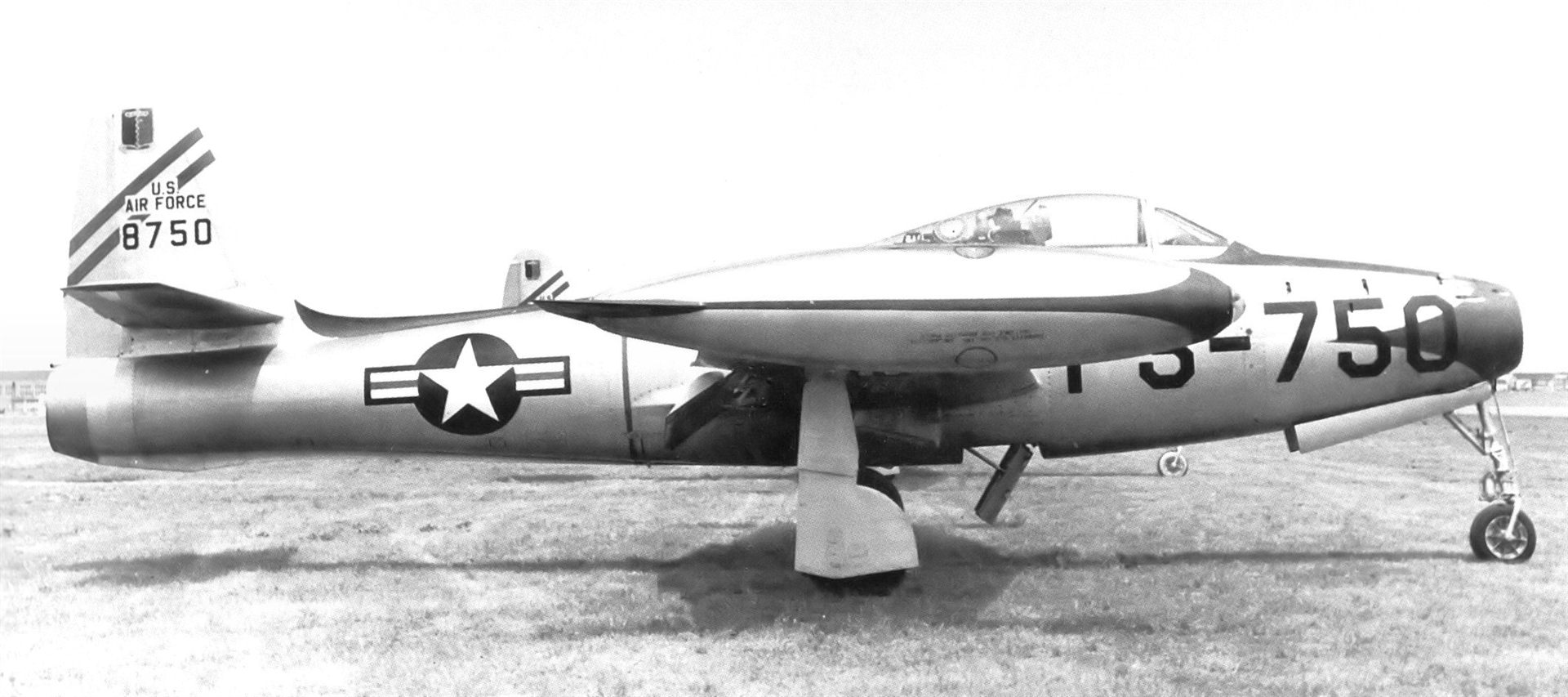
Pictured: a Republic F-84D Thunderjet, serial 48-750 of the 78th Fighter Group, photographed on the ground circa 1950 — the same type of aircraft (the F-84D) that the 740th AC&W Squadron's report says the 54th Fighter-Interceptor Squadron flew on the night of August 5–6, 1953. This is not either of the two actual aircraft flown that night, nor the object they pursued; no photograph of the specific interceptors or the object itself is known to exist.
Theoretical Alignment
The ETH figure reflects the case's reputation more than its record. Ellsworth became famous because Edward J. Ruppelt called it “the best UFO report in the Air Force files” and because his account described a light that held a constant three-mile lead on a jet for 120 miles, then outclimbed a second jet while showing up on the pilot's gunsight radar. The declassified 1953 documents are less dramatic. The first pilot saw a bright light for 20 to 30 seconds and lost it. The second pilot first took it for a star or planet and later wrote that it “could have been a planet or star”, though he could not explain a second light he saw on the way home. The radar returns were in ground clutter and were not photographed. Blue Book's August 1953 log classifies the visual sightings as stars or planets and the radar as anomalous propagation. The Psycho-Social figure reflects how the alert itself shaped what people saw. The ground observers, the airmen sent outside, the pilots and the Bismarck filter center were all told to look for a moving light, and the Blue Book investigator wrote that the Bismarck post had been told to “look for flying saucers,” “a perfect set up to see every star move around.” Nothing in any account suggests an interdimensional explanation.
Background
Ellsworth Air Force Base had existed under that name for less than two months by the time of the August 1953 sighting. Originally established during the Second World War as Rapid City Army Air Base and later Weaver Air Force Base, the installation was officially redesignated Rapid City Air Force Base, and on February 16, 1953 the 740th Aircraft Control and Warning Squadron transferred to the 29th Air Division; the base itself was renamed Ellsworth Air Force Base only in June 1953, in honor of Brigadier General Richard E. Ellsworth, commander of the 28th Strategic Reconnaissance Wing, who had been killed on March 18, 1953, when his RB-36 reconnaissance bomber crashed near Burgoyne's Cove, Newfoundland. President Dwight D. Eisenhower personally traveled to the base on June 13, 1953 — not quite two months before the UFO sighting — to dedicate it in Ellsworth's memory, underscoring how prominent and freshly staffed a facility it was at the moment the case unfolded. The base's air-defense apparatus was equally new: the 54th Fighter-Interceptor Squadron had been reactivated there on December 1, 1952, absorbing personnel and aircraft from a North Dakota Air National Guard unit called to Korean War service, and initially flew propeller-driven F-51D Mustangs before converting to Republic F-84D Thunderjets returning from Korean combat duty in July 1953 — meaning the squadron had been operating its jet-age interceptor for barely a month when it was scrambled against the August 5 target. The 740th Aircraft Control and Warning Squadron, the ground radar unit almost certainly responsible for the case's radar detection, had itself only activated at the base on February 1, 1953, under the 31st Air Division of Air Defense Command, before transferring to the 29th Air Division on February 16, 1953.
The Ground Observer Corps, the civil-defense network that put Phyllis Killian at her post that evening, had been re-established in 1950 to fill gaps in the Air Force's radar coverage against a possible Soviet bomber attack. From July 1952, under Operation Skywatch, many posts were manned around the clock. Volunteers were taught aircraft recognition and phoned reports to a regional filter center, which passed them to Air Defense Command radar stations. Killian was manning a post of the Rapid City Filter Center, and her report reached the radar station at Ellsworth through that channel. The GOC was disbanded in January 1959, as radar coverage improved.
Complete Timeline
| Date | Event |
|---|---|
| 1942–1947 | The installation later known as Ellsworth Air Force Base is built as Rapid City Army Air Base and later renamed Weaver Air Force Base, then Rapid City Air Force Base. |
| December 1, 1952 | The 54th Fighter-Interceptor Squadron is reactivated at Rapid City AFB, flying propeller-driven F-51D Mustangs, assigned to the 31st Air Division. |
| February 1, 1953 | The 740th Aircraft Control and Warning Squadron activates at the base, providing the ground radar coverage later used to detect the August 5 target. |
| February 16, 1953 | The 740th Aircraft Control and Warning Squadron transfers to the 29th Air Division. |
| March 18, 1953 | Brig. Gen. Richard E. Ellsworth is killed when his RB-36 crashes near Burgoyne's Cove, Newfoundland. |
| June 1953 | Rapid City Air Force Base is officially redesignated Ellsworth Air Force Base in his honor, dedicated by President Eisenhower on June 13. |
| June 13, 1953 | President Dwight D. Eisenhower personally dedicates the base in Ellsworth's honor. |
| July 1953 | The 54th Fighter-Interceptor Squadron re-equips with Republic F-84D Thunderjets returning from Korean War combat duty. |
| August 5, 1953, ~8:05 PM MST | Phyllis Killian, manning a post of the Rapid City Filter Center at Black Hawk, reports a bright red light. In her signed statement she says it was southeast of Black Hawk, turned green as it moved west, stopped south of the town and returned; the squadron report says it was low, about four miles northeast, and made a pass over Rapid City before returning to hover. |
| Shortly after 8:05 PM | The radar station's controller searches for targets. Two airmen sent outside report seeing the object (squadron report; Ruppelt also says two, the Condon Report says three). S/Sgt. Ernest S. McDonald describes a round, blue-green object 20–30 feet across moving northeast to southwest, by his estimate near the speed of sound. |
| ~8:05–9:00 PM | 2nd Lt. James W. Stockham, on combat air patrol after practice intercepts on an RB-36, searches west of Rapid City and finds nothing. Preparing to land, he sees a bright white light over Piedmont, apparently about 15,000 feet above him, moving northwest at what he judged to be at least 800 mph. He keeps it in sight for 20–30 seconds before it disappears, and returns low on fuel. |
| ~8:30–11:00 PM | Black Hawk residents Martha Daughenbaugh and Jim, Mrs. Jim, Richard and Olaf Aldren watch a light that changes color, moves up and down and seems to vanish when jets approach and reappear when they leave. |
| ~9:15–9:24 PM | 1st Lt. David K. Needham takes off on combat air patrol. At 15,000 feet he sees a light changing from white to green, which he first takes for “an especially brilliant star or planet” until it seems to move “spasmodically up and down.” |
| Later that evening | Needham climbs to 26,000 feet heading north. His A-4 gunsight's radar “lock-on” light comes on and stays on. The light climbs away and fades, and he breaks off. The squadron report says the radar showed about fifteen blips on a heading of 360°, which he pursued out to 85 miles. On the way back the lock-on light blinks on and off, giving him “the impression of a radar malfunction.” |
| Return flight | Near the base Needham sees an alternating red and white light. He exposes about 40 feet of gun-camera film on what seems to be the original object; the film is blank. Thirteen radarscope photographs fail because of a camera breakdown. |
| ~12:23–1:01 AM MST, Aug. 6 | The Bismarck, North Dakota filter center, alerted by Rapid City, reports several lights, including sightings by Mrs. Gertrude Dahl and the Bismarck controller, Lt. Koontz. |
| August 8, 1953 | Capt. John W. Bristol, operations officer of the 740th Aircraft Control and Warning Squadron, files an Air Intelligence Information Report. He judges that the statements “present an excellent case for the actual existence of a flying object.” |
| August 1953 | Project Blue Book sends an investigator. The report in file T53-11156 doubts the controller, finds that the airmen's description fits a meteor, says the Bismarck sightings were doubtful, suggests the star Capella for the pilot's light, and carries the case as “Unsolved” pending further study. Blue Book's August 1953 log later lists Rapid City, 5–6 August, as “Astro (Stars/Planets)” (visual) and “Anomalous Propagation” (radar). |
| 1956 | Edward J. Ruppelt publishes The Report on Unidentified Flying Objects. His chapter 17 tells the story as he says he heard it on site, dates it to August 12 rather than August 5, and calls it “the best UFO report in the Air Force files.” |
| July 29, 1968 | James E. McDonald tells the House Committee on Science and Astronautics that the case, which J. Allen Hynek “has termed ‘one of the most puzzling cases I have studied’,” is “far too long and complex to recapitulate here.” |
| 1969 | The Condon Report lists the case as 15-B in Gordon D. Thayer's radar chapter. It attributes the sightings to a radio-tower light, a meteor, the stars Pollux and Mirfak, stars seen through an inversion at Bismarck, and anomalous or “ghost” radar echoes, with a malfunctioning gunsight. It reports that Needham told Hynek he felt he had been chasing a star. |
| 2000s–2020s | NICAP's Francis Ridge and Brad Sparks republish the Blue Book material and argue that the Condon treatment left out the pilots' observations. The full squadron report and witness statements are posted by the Air Force's “Secrets Declassified” site. |
A Red Light Over Black Hawk
The case began with a Ground Observer Corps post. At 8:05 PM Mountain Standard Time on August 5, 1953, about 45 minutes after sunset, Phyllis Killian was manning a post of the Rapid City Filter Center at Black Hawk, a small community in the Black Hills foothills northwest of Rapid City. The 740th Aircraft Control and Warning Squadron's report, written three days later, says she saw an object that was “bright red and very low” about four miles northeast of Black Hawk, which made a pass over Rapid City “at a very high rate of speed,” came back and hovered. Her own signed statement puts it southeast of Black Hawk at first, glowing red, turning green as it sped west, stopping abruptly south of the town and returning to where it started before disappearing behind the hills. Twenty or thirty minutes later she saw “perhaps the same object” overhead, and some 45 minutes after that saw it hovering northeast of Black Hawk. She wrote that it would disappear to the north each time a jet came near and reappear when the jets left, and judged its speed at “three or four times as fast as the jet interceptor.”
She was not alone. Statements from neighbors Martha Daughenbaugh and the Aldren family (Jim, his wife, Richard and Olaf) describe a light that “looked like a star except that it glowed red and green and moved,” moving “up and down, back and forth in no apparent pattern,” out of sight when a jet chased it and back when the jet left. Jim Aldren added that its disappearance when the jet was heard “could have just been coincidental.” Olaf Aldren, watching from about 11:15 PM, said that through binoculars it looked like a basketball. The Condon Report later quoted a companion of the GOC observer as thinking the first light was “just the red tower light” on a nearby FM transmitter tower. That remark is not in the squadron report or Ruppelt's account, and its source is not given.
Confirmation on the Scope
The radar evidence is weaker than the case's reputation suggests. In Ruppelt's 1956 account, the duty controller, a warrant officer, told him that he had studied the target for several minutes and that, although he knew how weather could affect radar, it was “well defined, solid, and bright,” and that the height-finder put it at 16,000 feet. The Blue Book investigator's report is more cautious. It says the controller saw “2 blips going south” but “could not get a distinct track because of ground clutter.” It also says the controller “left the impression that he was trying to prove the existence of an unidentified flying object” and that “it is very unfortunate that no scope photos were available.” The squadron report says thirteen photographs were taken of the scope, but none came out because the camera mechanism broke down.
The airmen sent outside are also less independent than later retellings make them. The squadron report says two men from the control room were told to look outside and “gave the same reply of seeing the object.” Ruppelt also says two; the Condon Report says three. The Blue Book investigator wrote that “they were told to go out and look for a light so they saw one,” and that their description of a “streak” that went south and did not return fits a meteor. One airman's statement is more vivid: S/Sgt. Ernest S. McDonald described a “perfectly round” object “like a mammoth discus,” light blue-green, 20 to 30 feet across, flying northeast to southwest at close to the speed of sound, which went out “as if a light had been clicked off.” That description is consistent with a bright meteor.
The First Intercept
The pilot of the first F-84 was 2nd Lt. James W. Stockham of the 54th Fighter-Interceptor Squadron. (The squadron report's summary calls him “John W.”; his statement is signed James W. Stockham.) His statement says he had spent about 15 minutes on practice intercepts against an RB-36 when the controller, at 8:05 PM, asked him to look for an object reported hovering west of Rapid City. He searched until 8:20 and found nothing, then checked a radar target 46 miles south and again saw nothing. Preparing to land, he was told of an object over Black Hawk and saw “a bright light” high at 11 o'clock, apparently over Piedmont. He went to full power, but the light was moving northwest at “at least twice as fast as I was flying” and, he judged, about 15,000 feet above him. He had it in sight for “about 20 or 30 seconds,” and then “the light just disappeared.” Low on fuel, he asked to break off and land. He estimated its speed at “at least 800 MPH.”
The Blue Book investigator's summary of the same interview agrees: the pilot saw a silver light, “brighter than the brightest star I've ever seen,” for two 30-second periods before it faded, and “only got a glimpse of a light.” The same report says that the ground radar obtained four blips moving on a heading of about 320° after the pilot's sighting, the last at 70 miles.
Ruppelt's 1956 version is very different. In it, the controller vectored the patrolling F-84 straight to the light at 16,000 feet. Controller, spotter and pilot all saw it begin to move “at the same time,” and the jet chased it north for about 120 miles, the light staying about three miles ahead “as if the UFO had some kind of an automatic warning radar linked to its power supply,” until the pilot had to turn back for fuel. The light then followed him home 10 or 15 miles behind. Ruppelt attributes the three-mile description to the controller. None of these details appears in the pilot's signed statement or in the Blue Book investigator's report. They are the main source of the case's later fame.
Lieutenant Needham's Pursuit
The second pilot was 1st Lt. David K. Needham. His statement says he took off at 9:15 PM on combat air patrol and was told by “Grady Control” that the GOC had spotted a light northeast of Black Hawk, though the controller could give no speed, heading or altitude. After three requests for a vector, he saw what was “apparently the object” about 30° to his right, at a lower altitude and apparently paralleling his course, a light of varying intensity that alternated from white to green. “From previous experiences with hallucinations during night flying,” he wrote, “my first impression was that the object was an especially brilliant star or planet.” After several seconds, though, it “moved spasmodically up and down” and then went on as before.
He climbed from 15,000 to 26,000 feet and turned north. While turning he switched on his A-4 gunsight. After he had held a heading of 360° for a short time, its radar “lock-on” light came on and stayed on, with the object straight ahead and slightly above him. Then, he wrote, it “appeared to move rapidly to a much greater altitude and the light decreased rapidly in intensity.” Feeling he was losing ground, he broke off. As he turned away, the lock-on light “began to blink off and on which gave me the impression of a radar malfunction,” and he removed the bulb so it would not blind him. The squadron report says the radar showed about fifteen blips on his heading, which he pursued out to 85 miles. The Blue Book investigator notes that the A-4 sight starts ranging at about 4,000 yards, so the light showed at most that something was beyond that distance, and that the sight was never checked by maintenance.
On the way back Needham saw an alternating white and red light a few miles west of the base, which disappeared, reappeared and disappeared. Asked by the controller to photograph the original object, he found what appeared to be it and exposed about 40 feet of gun-camera film; the film was blank. His statement ends: “In the opinion of this pilot, the original object could have been a planet or star. The changes in intensity and color and the apparent movements could possibly be explained by refraction and spherical aberration caused by varying air densities and various cloud layers. This pilot can think of no plausible explanation for the second object sighted.”
Later versions add a good deal. Ruppelt, who does not name him, describes the second pilot as a skeptical World War II and Korea veteran who had met “ME 262's over Germany” and “MIG-15's over Korea.” In this version the pilot turned off his lights, rolled the aircraft, watched the light move against three bright stars, switched on his gunsight “to confirm” something solid was there, was frightened, and asked to break off, after which the light headed toward Fargo. The Blue Book investigator also wrote that the second pilot “was worried about the fact that the light moved relative to the stars,” and that he “obviously was trying to convince himself the light was a star, but was having difficulty.” According to the Condon Report, Needham told J. Allen Hynek that he felt he had been chasing a star, although some aspects of the object disturbed him, and that the gunlock was due to equipment malfunction. An earlier version of this page described the gunsight lock as independent radar proof. On the record, the pilot himself attributed it to a probable malfunction.
The Missing Film
Two attempts to photograph the evidence failed. The squadron report says thirteen pictures were taken of the radarscope but “none came out due to a breakdown in the camera mechanism,” and that Needham's 40 feet of gun-camera film “turned out blank.” The gun-camera film was exposed on the return leg, against what Needham took to be the original object, not during the lock-on. Equipment failures of this kind were common, and the documents give no reason to suspect anything else. The result, though, is that no instrument record survives. In 1960 Donald Keyhoe reported that an Air Force public-information officer, Maj. Lawrence Tacker, had told a NICAP member that the Air Force held gun-camera and radarscope photographs of the object. That claim is contradicted by the squadron and Blue Book reports, and no such photographs have been released.
Ruppelt's Account
Edward J. Ruppelt's chapter in The Report on Unidentified Flying Objects (1956, chapter 17) is the version most people know. He writes that Max Futch of ATIC phoned him at about two in the morning, saying, “you know that for a year I've read every flying saucer report that's come in and that I never really believed in the things,” then, quickly, “But you should read this wire.” Ruppelt says he took the first airliner from Dayton to Rapid City on his emergency orders and “talked to everyone involved.” His dates do not match the record, however. He puts the sighting on “the night of the twelfth” and Futch's call at 2 AM on August 13, but every contemporary document gives August 5–6. An earlier version of this page dated the call to August 11.
His account also differs from the documents in substance: a single light at 16,000 feet seen simultaneously by spotter, controller and pilot; a 120-mile chase at a fixed three-mile separation; a light that followed the first jet home; and a second pilot who confirmed the light's motion against three stars before his gunsight locked on. The Blue Book investigator's report says it was decided that “Project Blue Book would send an investigator to the scene,” and that “no attempt was made to contact the GOC observers,” who had already been questioned by base personnel and were “all excited.” NICAP's document index credits the investigation to Capt. Charles Hardin and J. Allen Hynek, and the Condon Report says Hynek interviewed the second pilot. Ruppelt may have gone as he says, but the surviving file does not name him, and his narrative cannot be checked against it on several points. Ruppelt also told a version of the story in True magazine, in which the second pilot climbed to 20,000 feet.
"The Best UFO Report in the Air Force Files"
Ruppelt's verdict is clear: “The show they put on is still the best UFO report in the Air Force files,” and, after the story, “This was an unknown—the best.” He adds that the case was “thoroughly investigated” and that “in every facet we looked into we saw nothing. Nothing but a big question mark.” At the time, the squadron's own operations officer, Capt. John W. Bristol, went further, writing that the statements “coincide to such an extent so as to present an excellent case for the actual existence of a flying object,” and that the radar pickups by the F-84D and the ground station “confirm the existence of something solid.”
Later endorsements are thinner than they are often presented. James E. McDonald, in his July 29, 1968 statement to the House Committee on Science and Astronautics, mentioned the case in a single paragraph as “still another famous combined radar-visual case, which Hynek has termed ‘one of the most puzzling cases I have studied,’” and said it was “far too long and complex to recapitulate here.” The Hynek phrase therefore predates 1968; an earlier version of this page attributed it to his 1977 book The Hynek UFO Report. Hynek also remarked that the GOC witnesses were “trained observers.” At the same time, by the Condon Report's account, he recorded the second pilot's view that he had chased a star, and attributed the Bismarck lights to stars seen through an inversion.
The Case in Blue Book's Own Records
The Blue Book investigator's report, file T53-11156, reprinted in Project Blue Book Status Report No. 12 (pages 20–23 of that report; NICAP's scan numbers them 226–229), concludes that “by eliminating doubtful sightings, the only thing that can be reasonably assured is that a GOC post observed a light. This could be a balloon or star.” It suggests that “the star Capella is possibly visible low on the horizon to the north and the pilot could have seen this,” and ends: “Pending further study, this incident is carried as Unsolved.” Status Report No. 12 was the last of a series issued from 1951 to 1953 or early 1954, not a 1956 report as an earlier version of this page said.
The further study evidently happened. Blue Book's typed list of August 1953 sightings (NARA microfilm, as posted by NICAP) gives two lines for “Rapid City, South Dakota, 5–6” August: “Visual — Astro (Stars/Planets)” and “Radar — Anomalous Propagation.” NICAP's Francis Ridge notes that Blue Book never listed the case as an Unknown. Ruppelt's “unknown—the best” was his personal judgment, not Blue Book's final evaluation.
The Condon Report's Explanations
The University of Colorado study, published in 1969 as Scientific Study of Unidentified Flying Objects under Gordon D. Thayer's radar analysis, lists the case as 15-B, “Blackhawk and Rapid City, S. Dak., and Bismarck, N. Dak., 5-6 August 1953,” under “Class I-C: Primarily visual, blurry light or glow.” It records the weather as “clear, excellent visibility, stable conditions, temperature inversions and radio surface ducts prevalent,” with refractivity profiles for Rapid City and Bismarck showing low-level inversions. Its reconstruction is as follows. The first light was perhaps the red warning light of an FM transmitter tower, as the observer's companion is said to have suggested. The airmen saw “what was undoubtedly a meteor.” The first F-84 chased the star Pollux, then low in the northwest. The second chased a star, “may well have been Mirfak,” while the ground radar showed a “ghost” echo pacing the aircraft. The Bismarck objects were, in Hynek's analysis, Arcturus, Capella, Jupiter and Betelgeuse seen through a surface inversion. The gunsight lock was a malfunction. The report also notes that the commanding officer of the Rapid City radar detachment later doubted there had been even a ghost echo.
The Condon Report's critics, notably Francis Ridge of NICAP and the French researcher Patrick Gross, object that it omits the second pilot's report that the light moved relative to the stars, the controller's account of a height-finder return, and Ruppelt's 120-mile chase. They also argue that a GOC observer would hardly report a fixed tower light as a fast-moving object. These points have weight, but they cut both ways. The 120-mile chase is not in the pilots' statements, and the pilot whose motion-against-the-stars observation is cited wrote himself that the light “could have been a planet or star.” An earlier version of this page assigned Mirfak or Capella to the first pilot, called Condon's account a bundle of “four separate, simultaneous misidentifications,” and said no inversion was documented. The Condon Report assigns Pollux to the first chase and Mirfak to the second, and it does document inversions.
Circumstantial Evidence
- Several groups reported lights the same evening: the GOC observer and five Black Hawk neighbors in signed statements, airmen at the radar site, and both F-84 pilots. All of them, however, were alerted to look for a light, and the Blue Book investigator considered this a key weakness.
- The ground radar reported targets, but the Blue Book report says they were in ground clutter, the controller could not get a distinct track, and the thirteen scope photographs failed. The Condon Report records inversions and radio ducts that night.
- Needham's A-4 gunsight showed a lock-on, but he himself took its later blinking as a sign of malfunction, and the sight was never checked.
- Needham saw the light move “spasmodically up and down” and, per the Blue Book report, relative to the stars. He also wrote that it could have been a star or planet distorted by refraction and cloud layers. He could not explain the second light he saw near the base.
- The investigator carried the case as “Unsolved,” but Blue Book's August 1953 log lists the visual sightings as stars or planets and the radar as anomalous propagation.
- Ruppelt's famous details (the 120-mile chase at a constant three miles, the light following the jet home, the frightened veteran) come from his 1956 book, which misdates the event by a week and does not match the signed statements.
Key Researchers
- Edward J. Ruppelt (1923–1960) — Head of Project Blue Book until 1953. His 1956 book, chapter 17, is the source of the case's reputation as “the best UFO report in the Air Force files.” He says he investigated in person, but he misdates the event to August 12, and his account differs substantially from the 1953 documents.
- J. Allen Hynek (1910–1986) — Blue Book's scientific consultant. According to the Condon Report and NICAP, he took part in the 1953 investigation, interviewed the second pilot, and attributed the Bismarck lights to stars seen through an inversion. McDonald quoted him in 1968 as calling the case “one of the most puzzling cases I have studied.”
- James E. McDonald (1920–1971) — Atmospheric physicist at the University of Arizona. He cited the case briefly as a “famous combined radar-visual case” in his July 29, 1968 statement to the House Committee on Science and Astronautics.
- Gordon D. Thayer — Radar and optics specialist for the 1969 Condon Report. His radar chapter lists the case as 15-B and attributes it to stars, a meteor and anomalous radar propagation.
- Brad Sparks — UFO researcher whose detailed case summary for NICAP draws on the Blue Book file, Ruppelt and the Condon Report.
- Francis Ridge — NICAP web archivist who republished the Blue Book documents, noted that Blue Book never listed the case as an Unknown, and criticized the Condon Report for omitting the second pilot's motion-against-the-stars observation.
Cultural Impact
Ellsworth is little known outside the UFO literature, partly because no photograph or physical evidence survives. Within that literature it is widely cited, almost always in Ruppelt's form: a constant three-mile buffer, a 120-mile chase, and a combat veteran frightened by a light he locked onto with radar. NICAP's case pages and James E. McDonald's 1968 statement made it a standard example of a radar-visual case. The release of the 740th AC&W squadron's report and the pilots' statements on the Air Force's “Secrets Declassified” site allows the story to be checked against the original record. The documents confirm a real and widely witnessed alert on the night of August 5, 1953, but not most of the details that made the case famous.
Key Witnesses
Mrs. Phyllis Killian
Phyllis Killian was manning a post of the Rapid City Filter Center at about 8:05 PM on August 5, 1953, when she reported a bright red light. Her signed statement describes it turning green as it moved west, stopping abruptly, returning, and later hovering northeast of Black Hawk, disappearing when jets came near and reappearing when they left, until about 11 PM. She estimated its speed at three or four times that of the jet. Blue Book's investigator did not interview her, and the Condon Report quotes an unnamed companion who thought the first light was a radio-tower warning light. (Patrick Gross spells her name “Kellian”; the squadron report and her signature read Killian.)
Lieutenant Needham
1st Lt. David K. Needham took off on combat air patrol at 9:15 PM and saw a white-to-green light he first took for “an especially brilliant star or planet.” He climbed to 26,000 feet in pursuit, and his A-4 gunsight's lock-on light came on until the light climbed away and faded. When the lock-on light later blinked, he took it as a radar malfunction. He exposed 40 feet of gun-camera film on the return leg, which came out blank. He concluded in writing that the first object “could have been a planet or star” but that he had “no plausible explanation” for a second red-and-white light he saw near the base. Ruppelt describes the second pilot (unnamed) as a frightened World War II and Korea veteran; Needham's statement says nothing about fear or his combat record.
The Radar Duty Controller (unnamed)
The controller directed both intercepts. In Ruppelt's account he described a target that was “well defined, solid, and bright” at 16,000 feet, and the light's three-mile lead on the first jet. The Blue Book investigator's report says he saw two blips going south but could not get a distinct track in ground clutter, that he “left the impression that he was trying to prove the existence of an unidentified flying object,” and that no scope photographs supported his story.
Capt. Edward J. Ruppelt
Ruppelt writes that Max Futch woke him with the case at 2 AM, that he flew to Rapid City on emergency orders, and that he “talked to everyone involved.” His 1956 account, which dates the events to August 12–13, is the origin of the case's reputation as “the best UFO report in the Air Force files.” The surviving Blue Book report does not name its investigator. NICAP credits Capt. Charles Hardin and J. Allen Hynek, and that report says the GOC observers were not contacted.
The Five Observables Assessment
The Five Observables framework, developed by former AATIP director Luis Elizondo, is used to classify UAP encounters by performance characteristics exceeding known technology of their era. Ellsworth offers an unusually rich behavioral record for a 1953 case, combining sustained ground and airborne visual observation with two independent forms of radar data.
Assessment: All three performance observables are rated speculative. The ground witnesses describe a light that hovered, darted up and down and moved quickly, and Needham saw it move “spasmodically up and down” and then climb away. But these are naked-eye impressions of a point of light at unknown distance, the kind of apparent motion a bright star near the horizon can produce through an inversion layer. Needham himself suggested refraction and cloud layers. Stockham's “at least 800 MPH” and Killian's “three or four times as fast as the jet interceptor” are estimates without a known range. The ~960 mph radar figure in Brad Sparks's NICAP summary is marked as uncertain there and rests on returns in ground clutter. The “constant three-mile buffer” comes from Ruppelt's later account, not from the pilots' statements. Low Observability is absent: the light was conspicuous. Trans-Medium is absent.
Evidence Assessment
Supporting Anomalous Origin
- Signed 1953 statements from a GOC observer, five neighbors, airmen and two pilots describe lights behaving unlike aircraft: hovering, darting, color changes.
- The squadron's operations officer judged the evidence “an excellent case for the actual existence of a flying object,” citing radar pickups by both the ground station and an F-84D.
- Needham's gunsight showed a lock-on while he was pointed at the light, and the Blue Book report says he was “worried about the fact that the light moved relative to the stars.”
- Needham could find “no plausible explanation” for the second, red-and-white light he saw near the base.
- Blue Book's own investigator carried the case as “Unsolved” pending further study.
Supporting Conventional Explanation
- Needham wrote that the original object “could have been a planet or star,” and told Hynek he felt he had chased a star. He attributed the gunsight lock-on to malfunction, and the sight starts ranging only at about 4,000 yards.
- The first pilot saw the light for only 20–30 seconds. The airmen's “streak” fits a meteor, and the controller's targets were in ground clutter. No scope photographs or gun-camera film survive.
- The Condon Report documents temperature inversions and radio ducts that night, and finds bright stars (Pollux, Mirfak; Arcturus, Capella, Jupiter, Betelgeuse at Bismarck) in the directions reported.
- Blue Book's August 1953 log lists the case as stars/planets (visual) and anomalous propagation (radar).
- Every observer had been alerted to look for a moving light. The Blue Book investigator called the Bismarck alert “a perfect set up to see every star move around.”
- The most striking details (the 120-mile chase at a constant three miles, the light following the jet home) come from Ruppelt's 1956 retelling, which misdates the event and is not supported by the signed statements.
Why "Disputed"
Ellsworth is rated DISPUTED because the record supports two incompatible readings, and neither has been settled. What is documented: on August 5, 1953, a GOC observer and her neighbors reported a moving, color-changing light for about three hours; a radar station reported targets; two jets were sent up and both pilots saw a bright light; one pilot's gunsight showed a lock-on; and the squadron's operations officer thought the evidence “excellent.” Against that, the radar returns were in clutter and unphotographed, the airmen probably saw a meteor, the first pilot had only a brief glimpse, and the second pilot himself thought the light could have been a star and the lock-on a malfunction. The Condon Report found bright stars where the lights were reported and inversions that night, and Blue Book's August 1953 log explains the case as stars and anomalous propagation. The case's high standing in the literature rests mainly on Ruppelt's 1956 account, which misdates the event and adds details not found in the 1953 statements. What remains unexplained is modest but real: the GOC observers' descriptions of a light that moved quickly and returned to the same place, and the red-and-white light near the base that Needham could not explain.
Sensor & Instrumentation Detection Profile
Three kinds of instrument were involved, and none left a usable record. The 740th Aircraft Control and Warning Squadron's ground radar, which the squadron's report says belonged to the station at Ellsworth AFB, picked up targets in the area. In Ruppelt's account the controller described a “well defined, solid, and bright” return with a height-finder reading of 16,000 feet. The Blue Book investigator's report says instead that he saw “2 blips going south” but “could not get a distinct track because of ground clutter”; that four blips were later obtained on a heading of about 320° out to 70 miles; that a target 5–10 miles ahead of the second F-84 was carried on a heading of 360°; and that the height-finder showed something at 8,000 feet near a later light. The squadron report counts about fifteen blips on the second chase. The thirteen scope photographs failed. The second instrument was the F-84D's A-4 gunsight, whose radar ranging “lock-on” light came on during Needham's pursuit. The Blue Book report notes that the sight begins ranging at about 4,000 yards, so the light showed at most that something reflective was beyond that range. It later blinked on and off, and Needham removed the bulb, taking it as a malfunction. The sight was never checked. The third was the gun camera, whose 40 feet of film, exposed on the return leg, was blank. The Condon Report attributes the ground radar's pacing target to a “ghost” echo and anomalous propagation under the inversions present that night. The ~960 mph speed in Brad Sparks's summary is marked as uncertain there.
Environmental & Geospatial Context
Black Hawk, South Dakota, lies in the eastern foothills of the Black Hills northwest of Rapid City; Ruppelt put it about 10 miles west of Ellsworth Air Force Base, which lies east of the city. Sunset was at 7:20 PM MST, with 33 minutes of twilight, and the night was dark and moonless. The Condon Report describes the weather as clear, with excellent visibility, stable conditions, and “temperature inversions and radio surface ducts prevalent.” Its refractivity profiles show a 0.5°C inversion over a 109 m layer at Rapid City at 8 PM, a stronger elevated duct by the next morning, and a 1.2°C surface inversion at Bismarck at 9 PM. These conditions favor both twinkling, color-changing stars low on the horizon and false radar returns. Needham also mentions passing “several cloud layers.” An earlier version of this page said no inversion was recorded; the Blue Book investigator could not get the inversion data at the time because it had been forwarded to Asheville, but the Condon study later obtained it. The airspace was busy that evening, with F-84 combat air patrols and an RB-36 on practice intercepts, and the base itself had only recently been renamed (June 13, 1953) and re-equipped with F-84Ds (July 1953). The reports later extended to Bismarck, North Dakota, roughly 270 miles to the northeast, where the filter center had been told to look for the objects.
Observer Credibility & Occupational Profile
The witnesses had a range of relevant training. Phyllis Killian was a Ground Observer Corps volunteer doing exactly what the GOC asked: report anything unidentified to the filter center. Her neighbors, the Aldrens and Martha Daughenbaugh, were civilians watching at the same time. The radar controller was a warrant officer, and the airmen were radar-site personnel. Stockham was a second lieutenant and Needham a first lieutenant in the 54th Fighter-Interceptor Squadron. Ruppelt describes the second pilot as a World War II and Korea veteran, but Needham's statement does not mention his service history. Training cuts both ways in this case. Needham's own statement shows a careful observer: he thought first of a star or planet, checked for reflections, and in the end offered refraction as a possible explanation. The Blue Book investigator rated him “on the ball.” The same investigator was critical of the controller and the airmen, and noted that every group had been told what to look for. Blue Book did not interview the GOC observers. The squadron's evaluation grades (A-1 for the pilots, B-1 for the GOC) reflect source reliability, not whether the object was anomalous.
Physical & Material Assays
No physical debris, trace or artifact is associated with the case, and none has been claimed. The only physical evidence anyone tried to collect was photographic, and it failed: thirteen radarscope photographs did not come out because of a breakdown in the camera mechanism, and Needham's 40 feet of gun-camera film, exposed against a light on his return leg, was blank. The A-4 gunsight that gave the lock-on indication was never checked by maintenance, so whether it malfunctioned, as Needham suspected, is unknown. Keyhoe's 1960 report that the Air Force held gun-camera and radarscope photographs conflicts with these documents.
Historical Precedents & Archive Matches
Ellsworth belongs to the same dense wave of early Cold War Air Defense Command radar-visual intercept cases that also produced the Kinross Incident, barely three months later and involving the same F-89/F-84-era generation of interceptor aircraft, and it shares its combined ground-radar/airborne-radar/multi-witness-visual profile with the later Redmond, Oregon sighting of 1959 and the still-earlier White Sands radar-visual-photographic case of 1951. Within Project Blue Book's own institutional history, the case occupies an unusually well-documented position: unlike Kinross, whose Air Technical Intelligence Center file later could not even be located, Ellsworth was formally logged, investigated by Blue Book, carried as “Unsolved” in Project Blue Book Status Report No. 12, and then logged as stars/planets and anomalous propagation — much the same conclusion the 1969 Condon Report later reached. Researcher Brad Sparks has catalogued the case within his long-running radar-UFO case compilation alongside other 1950s multi-sensor military intercepts, and physicist James E. McDonald cited it in 1968 testimony before Congress as one of the discipline's "famous combined radar-visual" cases — though, as with Kinross, the instrument record that would decide the case does not survive.
Material Analysis
No physical debris, trace residue or recovered artifact of any kind is connected to the Ellsworth sighting, and none has ever been claimed. The light never approached the ground. Its closest documented approach was Needham's pursuit, when the gunsight indicated something beyond about 4,000 yards. The most important material absence is photographic. Two cameras could have recorded the decisive evidence, and both produced nothing: the radarscope camera, which broke down during the thirteen exposures, and Needham's gun camera, whose film was blank. Equipment failures like these were common at 1950s Air Defense Command units and are not in themselves evidence of anything. The effect is that the radar part of the case rests on the controller's account, which Blue Book's investigator doubted, and the visual part on naked-eye observations of a light that both the Blue Book log and the Condon Report attribute to stars.
Supporting a Genuine, Undocumented Anomaly
- The photographic record failed for documented mechanical reasons, so the absence of images does not by itself count against the witnesses.
- Needham's gunsight was never checked, so a malfunction was suspected but never confirmed.
Supporting Caution / Non-Verification
- With no photograph, radarscope image or physical trace, the case rests on testimony, and the most dramatic version of that testimony (Ruppelt's) is the least well documented.
- The pilot whose gunsight locked on thought it was malfunctioning, and inversions favoring false radar returns were present that night.
The Conventional Explanation Candidate: Stars, a Meteor and Anomalous Propagation
Bright Stars Seen Through an Inversion Layer (Blue Book and Condon Report)
PlausibleBlue Book's August 1953 log lists the visual sightings as “Astro (Stars/Planets).” The Condon Report proposes Pollux for the first chase (low in the northwest, where Stockham headed) and Mirfak for the second (about 15° azimuth and 5–7° elevation at 8:40 PM, in the north where Needham turned). At Bismarck, Hynek identified the lights as Arcturus, Capella, Jupiter and Betelgeuse. The night had documented low-level inversions, which make stars near the horizon twinkle, change color and appear to jump, and the Condon Report notes that diffraction along an inversion can make them look brighter. The strongest support comes from the second pilot: Needham's own first impression was “an especially brilliant star or planet,” and he concluded the original object “could have been a planet or star,” distorted by refraction and cloud layers.
The weaknesses are real. The GOC observer and her neighbors describe a light that sped west, stopped and returned to its starting point, which is hard to reconcile with a fixed star even allowing for autokinetic illusion. The Blue Book report says Needham was “worried” that the light moved relative to the stars. Needham could not explain the second red-and-white light near the base. Ruppelt's 120-mile chase and three-mile buffer would be difficult to explain as a star, but those details are not in the pilots' statements.
Anomalous Radar Propagation and Ghost Echoes
PlausibleBlue Book's log lists the radar portion as “Anomalous Propagation.” The Condon Report documents surface ducts at Rapid City and Bismarck that night, and suggests the target pacing the second jet was a “ghost” echo, which appears on the far side of an aircraft from the radar and moves with it. The Blue Book report's description of returns lost in ground clutter, and the absence of any usable scope photographs, fit this explanation. Against it, Ruppelt quotes the controller describing a solid, well-defined target with a height-finder reading of 16,000 feet. The Condon Report itself notes that the radar detachment's commanding officer later doubted there had even been a ghost echo.
Meteor (Airmen's Sighting) and Gunsight Malfunction
PlausibleThe Blue Book investigator and the Condon Report both judged that the airmen sent outside saw a meteor: a fast “streak” going one way that did not return. McDonald's statement, a blue-green object that went out “as if a light had been clicked off,” fits a bright fireball. For the gunsight, the Blue Book report notes that the A-4's lock-on light means only that something was beyond about 4,000 yards; Needham saw it blink afterwards and took it as a malfunction; and the sight was never checked.
Radio-Tower Warning Light or Balloon
InconclusiveThe Condon Report cites a companion of the GOC observer who thought the first light was “just the red tower light” of an FM transmitter tower, but gives no source, and a fixed light does not match the movement Killian and her neighbors described. The Blue Book investigator also mentioned a balloon. The Rapid City Weather Bureau's 8 PM balloon tracked south, out of the area, but two research balloons launched from Lowry AFB in Denver had been lost and “could have been in the area.” Neither candidate explains the reports well on its own.
Taken together, stars seen through an inversion, a meteor, anomalous propagation and a suspect gunsight account for most of what the 1953 documents describe, and they match the Air Force's own final classification. They do not obviously account for the GOC observers' description of a light that moved and returned, or for the red-and-white light near the base that Needham could not explain. This is why the case remains rated Disputed rather than Explained.
Related Cases
Confirmed Documents & Official Records
The squadron's report by Capt. John W. Bristol, with signed statements from 2nd Lt. James W. Stockham, 1st Lt. David K. Needham, S/Sgt. Ernest S. McDonald, S/Sgt. Bobby J. Burgess, Phyllis Killian, Martha Daughenbaugh and the Aldren family. Released on the Air Force's “Secrets Declassified” site (archived copy).
UNCLASSIFIED (declassified)National Archives finding aid for the Project Sign, Project Grudge, and Project Blue Book records transferred from Wright-Patterson AFB (Record Group 341), the broader collection holding the Ellsworth case's original Blue Book file.
UNCLASSIFIED (declassified)Official National Archives history of Project Blue Book's origins, staffing, and recordkeeping practices during the exact 1951–1953 period Ruppelt directed the investigation of the Ellsworth case.
UNCLASSIFIEDSearch Government Archives Directly
Further Reading — Recommended Literature
The Report on Unidentified Flying Objects
Ruppelt's 1956 memoir, whose chapter 17 tells the story in the form that made the case famous, including the verdict “This was an unknown—the best.” Compare it with the 1953 documents: it misdates the event and adds details not found in the pilots' statements.
UFOs and Government: A Historical Inquiry
A scholarly, four-year research effort by a team of veteran UFO historians documenting the U.S. government's handling of UFO reports from World War II onward, including the Air Defense Command intercept culture that produced cases like Ellsworth.
Project Blue Book Exposed
A detailed case-by-case review of Blue Book's most significant files by a veteran Air Force intelligence officer, useful for situating Ellsworth's "Unsolved" classification within the wider pattern of Blue Book's own institutional record-keeping.
Watch the Skies!: A Chronicle of the Flying Saucer Myth
A rigorously documented, skeptically minded history of American UFO cases that situates Ellsworth within the broader early-1950s wave of radar-intercept "unknowns" generated by Air Defense Command's rapidly expanding Cold War radar network.
DISCLOSURE: Some links above are affiliate links. If you purchase through them, OverClassified receives a small commission at no additional cost to you. This helps support independent research.
Essential Viewing
No Videos Available
A genuine search turned up no video content specifically and primarily about this case. Several general documentaries and local news retrospectives touch on Ellsworth Air Force Base's broader Cold War history, and at least one podcast episode covers the sighting in audio form, but none of the video content located is centrally and primarily focused on the August 5–6, 1953 radar-visual case itself, so none are included here per this site's standard against padding with mismatched content.
Sources
- 740th Aircraft Control and Warning Squadron. Air Intelligence Information Report, “Unidentified Flying Objects, Rapid City, So. Dakota, Bismark, No. Dak.,” Capt. John W. Bristol, 8 August 1953, with statements by 2nd Lt. James W. Stockham, 1st Lt. David K. Needham, S/Sgt. Ernest S. McDonald, S/Sgt. Bobby J. Burgess, Phyllis Killian, Martha Daughenbaugh, Jim, Mrs. Jim, Richard O. and Olaf Aldren (AFD-100617-042). secretsdeclassified.af.mil (archived)
- Project Blue Book. Investigation report, file T53-11156, 5 August 1953, Rapid City, South Dakota (“Unsolved”), in Status Report No. 12, pp. 20–23; transcribed by Patrick Gross. ufologie.patrickgross.org
- NICAP. “Unsolved” — Project Blue Book Status Report 12 (scan pages 226–229) & transcripts. nicap.org
- Project Blue Book. “August 1953 Sightings” evaluation list (Rapid City, S.D., 5–6 Aug: Visual — Astro (Stars/Planets); Radar — Anomalous Propagation), NARA microfilm, as posted by NICAP (NARA-PBB1-102). nicap.org (PDF)
- Ruppelt, Edward J. The Report on Unidentified Flying Objects. Doubleday, 1956, chapter 17. gutenberg.org
- NICAP. “The Ellsworth Case,” excerpted from Capt. Edward J. Ruppelt's account. nicap.org
- Condon, Edward U. (dir.). Scientific Study of Unidentified Flying Objects. 1969. Case 15-B, “Blackhawk and Rapid City, S. Dak., and Bismarck, N. Dak., 5-6 August 1953,” in G. D. Thayer's radar chapter; text reproduced by Patrick Gross. ufologie.patrickgross.org
- McDonald, James E. Statement to the House Committee on Science and Astronautics, Symposium on Unidentified Flying Objects, 29 July 1968. project1947.com
- NICAP. “UFO Report: Ellsworth AFB / Rapid City, South Dakota, August 5, 1953” (case directory and document index, Francis Ridge). nicap.org
- NICAP. “Detailed Case Summary,” by Brad Sparks. nicap.org
- NICAP. Blue Book Documentation Group 1 (Francis Ridge). nicap.org
- NICAP. Blue Book Documentation Group 2 (Francis Ridge). nicap.org
- NICAP. “Comments/Rapid City AFB,” Joel Carpenter. nicap.org
- Gross, Patrick. “UFOs at Close Sight: Ellsworth AFB 1953, a Radar Multiple Visual Case” (discussion, with Hynek, Tacker and Ridge excerpts). ufologie.patrickgross.org
- Keyhoe, Donald E. Flying Saucers: Top Secret. Putnam, 1960, p. 243 (Maj. Lawrence Tacker on photographs), as cited by Gross.
- Gross, Loren E. UFOs: A History, 1953: August–December. Sign Oral History Project. sohp.us
- South Dakota Historical Society Foundation. “Is It an Airplane, Star, or Flying Saucer?” (August 2021). sdhsf.org
- Wikipedia. “Ellsworth Air Force Base” (pointer). en.wikipedia.org
- Wikipedia. “Richard E. Ellsworth” (pointer). en.wikipedia.org
- Wikipedia. “54th Fighter Squadron” (pointer: 1952 reactivation at Rapid City AFB; F-84D from July 1953). en.wikipedia.org
- Wikipedia. “740th Aircraft Control and Warning Squadron” (pointer). en.wikipedia.org
- Wikipedia. “Ground Observer Corps” (pointer). en.wikipedia.org
- Wikipedia. “Blackhawk, South Dakota” (pointer). en.wikipedia.org
- Wikimedia Commons. “78th-fighter-group-F-84D-48-750.jpg” (U.S. Air Force photograph, public domain). commons.wikimedia.org
- Peebles, Curtis. Watch the Skies!: A Chronicle of the Flying Saucer Myth. Smithsonian Institution Press, 1994 (context).
Corrections (October 2026)
This page was rewritten in October 2026 after checking it against the declassified 740th AC&W Squadron report and signed witness statements (8 August 1953), the Blue Book investigation report (file T53-11156), Blue Book's August 1953 evaluation list, Ruppelt's 1956 book, the Condon Report's case 15-B and McDonald's 1968 statement. The earlier text followed Ruppelt's retelling as if it were the record. It has been corrected on several points. The first pilot, 2nd Lt. James W. Stockham, saw the light for 20–30 seconds and did not fly a 120-mile chase at a fixed three-mile separation; those details are Ruppelt's. The second pilot, 1st Lt. David K. Needham, took the light at first for a star or planet, attributed his gunsight lock-on to a probable malfunction, and wrote that the object “could have been a planet or star.” Blue Book's “Unsolved” was an interim finding in Status Report No. 12, not a 1956 report, and the August 1953 log lists the case as stars/planets and anomalous propagation. The Condon Report assigns Pollux to the first chase and Mirfak to the second, and documents temperature inversions; the earlier text said Mirfak or Capella for the first chase and that no inversion was recorded. Two airmen, not three, went outside, according to the squadron report and Ruppelt. Ruppelt dates Futch's call to August 13 (with the sighting on the 12th), not August 11. Hynek's “one of the most puzzling cases” predates 1968 and is not from his 1977 book.
Following this review, the rating was changed from Disputed 74 to Disputed 50 (October 27, 2026), because the higher rating had rested partly on claims corrected or removed above.
Removed or corrected as unsupported: Ruppelt “personally interviewed” Killian (the Blue Book report says the GOC observers were not contacted); Needham's fear and his World War II and Korean combat record (these are Ruppelt's description of an unnamed pilot); the gun camera failing during the lock-on (it was exposed on the return leg); a 30° shift, vertical climb and return in Killian's first report presented as her own account (this is the Condon Report's summary; her statement differs); “brighter than the brightest star” attributed to the second chase (it was the first pilot's remark); the light holding a 5–10-mile lead “beyond his aircraft's performance envelope”; Brig. Gen. Ellsworth's crash “near Nut Cove” (Burgoyne's Cove); GOC membership figures; the “1978” Hynek book citation; and a “Clark 4th edition” entry described as separating the record from retelling, which was not checked.
See something inaccurate? Have additional information or sources?
Suggest an Edit →Last Updated: October 27, 2026