
The Redmond UFO Sighting
Shortly before dawn on September 24, 1959, Redmond, Oregon police officer Robert Dickerson watched a bright light descend "rapidly" north of the airport and stop, hovering at "several hundred feet" by the FAA log (about 200 feet in NICAP's later account, which adds that its glow lit up juniper trees). Dickerson drove to the Federal Aviation Agency station at Redmond Airport, where Flight Service Specialist Laverne Wertz and others watched the light through binoculars as it hung to the east, throwing out "long tongues of red, yellow and green light." At 1310Z (5:10 a.m. PST) the station reported it to Seattle Air Route Traffic Control Center, which relayed it to Hamilton Air Force Base in California; F-102 Delta Dagger interceptors were scrambled from Portland. According to the FAA log, as a high-speed aircraft approached, the light "took shape of mushroom" and rose into a scattered cloud layer. Air Force radar held a target some 25–40 miles south of Redmond for hours, at altitudes logged between 6,000 and 52,000 (or 54,000) feet; F-102s, a helicopter and a propeller aircraft searched it without seeing anything, and the Air Force later attributed it to a stationary echo from a gap-filler radar antenna on a mountain. The story that pilots diving on the object were nearly thrown out of control by its wake comes from later popular accounts, not the logs. The Air Force first carried the case as "insufficient information" and suggested a balloon (January 1960), then blamed the radar on the gap-filler echo (April 1960), and in 1963 attributed the visual sighting to "the refraction of light from the planet Venus," which the FAA had already suggested in October 1959. NICAP disputed the balloon and Venus explanations; skeptics regard Venus, low in the east before dawn, as the likely answer.
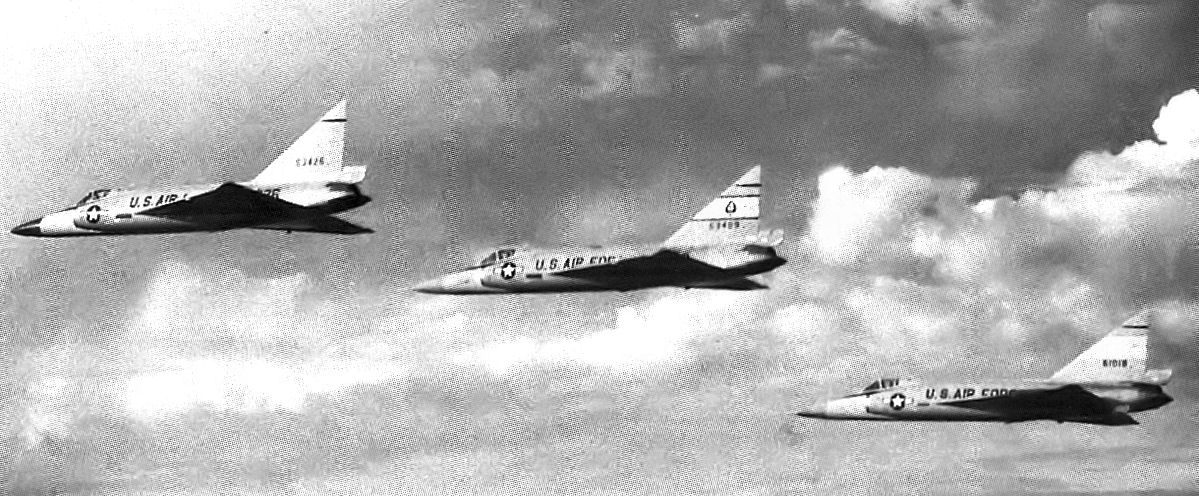
Pictured: a three-ship formation of Convair F-102A Delta Dagger interceptors, the type scrambled from Portland in this case — not the actual interceptors involved in 1959. No photograph of that specific intercept, the pursuing F-102s, or the object itself is known to exist; the case rests on ground-witness testimony and radar logs rather than imagery.
Theoretical Alignment
Redmond earns a moderate ETH alignment not from any structured-craft description — no witness ever described windows, an interior, or occupants — but from the reported stop-and-hover of what had looked like a falling light, the "mushroom" ascent logged by the FAA, and a government paper trail that never offered a single consistent story. The claimed radar-visual correlation is weak: the radar target lay 25–40 miles south and did not move, and the Air Force attributed it to a false echo. The Psycho-Social component is elevated above a token score because a bright planet seen low in a twilight sky through broken cloud is a classic source of such reports, and because the Air Force's own shifting account — "insufficient information," a balloon, a stationary antenna echo, then Venus — is itself a well-documented case study in how an investigating agency's public messaging can generate as much confusion and suspicion as the original sighting, independent of what the object actually was. The Interdimensional Hypothesis finds essentially no support: nothing in any contemporaneous account describes materialization, dematerialization, or portal-like behavior. What ultimately keeps this file in "Disputed" territory rather than pushing it toward either extreme is the same tension found in this catalogue's other strong Cold War intercept cases: credentialed, on-duty ground witnesses on one side, and on the other a strong astronomical candidate, a radar target that was probably spurious, and no photograph or film frame of the object (an IGY all-sky camera's film showed only Venus and the Moon).
Background
Redmond, Oregon was incorporated in 1910, named for early settler Frank T. Redmond, and by 1959 was a small Central Oregon farming and ranching community of a few thousand residents whose most significant piece of infrastructure was its airport. Built in the 1920s as a grass airstrip and expanded during World War II into a U.S. Army Air Forces training field for B-17 and P-38 crews, the airport — known historically as Roberts Field and today as Redmond Municipal Airport — had returned to civil use after the war and by 1959 hosted a Federal Aviation Agency communications station (its log was signed by L. E. Davis, Chief, Air Traffic, "Redmond Communication Station") providing weather observations and flight services for pilots across Central Oregon. That FAA station, staffed that pre-dawn morning by Flight Service Specialist Laverne Wertz, is the fixed point around which the entire case pivots: it was the destination Officer Robert Dickerson chose to drive to rather than simply continuing his patrol, and it was the facility with the direct line to Seattle Air Route Traffic Control Center that turned a police officer's sighting into a report to the air defense system.
The case unfolded a little less than two years after the Soviet Union's October 1957 launch of Sputnik, at a moment of genuine and widely shared American anxiety about what might be moving through domestic airspace undetected. Air Defense Command's radar and interceptor network, of which both the radar station at Keno near Klamath Falls and Portland's F-102 squadron were a part, had been substantially built out over the preceding decade specifically to close exactly this kind of detection gap in the Pacific Northwest, a region considered a plausible polar approach corridor for Soviet bombers. Hamilton Air Force Base, the installation Seattle's air traffic controllers turned to once Redmond's report reached them, was an Air Defense Command base squarely inside the Cold War interceptor infrastructure the Redmond report reached within minutes of being logged.
Complete Timeline
| Date | Event |
|---|---|
| 1910 | Redmond, Oregon is incorporated in Deschutes County, Central Oregon. |
| 1920s–1940s | Redmond's airfield is built, then expanded during World War II as an Army Air Forces training base; it is sold back to the city after the war and becomes Roberts Field, later Redmond Municipal Airport. |
| October 4, 1957 | The Soviet Union launches Sputnik, sharply intensifying American public and military anxiety about undetected activity in domestic airspace. |
| September 24, 1959, ~1200–1259Z (4:00–4:59 AM PST) | Redmond police officer Robert Dickerson, on patrol, sees a "strange bright light descending rapidly north of the station" which, at several hundred feet, "stopped and hovered for several minutes" (FAA log). Blue Book gives the first sighting as 1200Z; the FAA log entry is timed 1259Z. |
| Before 5:10 AM | Dickerson drives toward the light and turns in at the airport; the light turns orange and appears to move "very rapidly" to a position about 10 miles northeast, estimated at 3,000 feet. At the FAA station, Flight Service Specialist Laverne Wertz, who had just finished a weather observation, watches it with Dickerson through binoculars; it stays "very steady" and projects "long tongues of red, yellow and green light." |
| 5:10 AM PST (1310Z) | The FAA station reports the object to Seattle Air Route Traffic Control Center, which relays the report to Hamilton Air Force Base. The Seattle log adds: "UFO also seen on the radar at Klamath Falls GCI site. F-102's scrambled from Portland." Per the Blue Book file the F-102s are airborne at 1301Z and are directed to a radar contact well south of Redmond. |
| About 1310Z | The FAA observers see a "high speed aircraft approaching from southeast"; the light "took shape of mushroom," showed "long yellow and red flame from lower side," and "rose rapidly and disappeared above clouds estimated 14,000 feet, scattered layer." Dickerson, who had driven east toward Powell Butte, later told James McDonald that he saw it shoot straight up, lighting the cloud deck, but never saw any jets. |
| 1325Z–1511Z | Wertz reports a light about 20 miles south of Redmond, estimated at 35,000 feet. Seattle advises a radar contact at 1420Z, 25 miles south of Redmond at 52,000 feet, and at 1511Z reports it still there "at various altitudes from 6,000 to 52,000 feet." The Air Force radar target ("JB 129") lies over a gap-filler radar site near La Pine, about 40 miles south. |
| Rest of the day | Between 1300Z and 2230Z, F-102s make repeated passes over the radar target at various altitudes, and a helicopter and a propeller aircraft carrying a Geiger counter are sent to it; nothing is seen and no radiation is detected (Blue Book file). The station's IGY all-sky auroral camera film, later inspected, shows "nothing unusual"; only "Venus and the moon show just before sunrise." |
| October 1, 1959 | The FAA publicly downplays the incident, saying observers probably saw Venus (as reported by Bend's Source Weekly). |
| January 15–19, 1960 | The Redmond FAA station sends NICAP its log entries. On January 19, Maj. Lawrence J. Tacker of the Air Force tells NICAP the case is carried by ATIC as "insufficient information," that the ATIC account "fails to reveal any evidence of radar tracking," and that the object "was probably a balloon." NICAP obtains Weather Bureau winds from the southeast at 3–7 knots, against the Air Force's "south at 15 knots." |
| March–April 1960 | After the logs are forwarded to ATIC, the Air Force tells NICAP that "insufficient data" is "definitely valid." On April 27, Col. Gordon B. Knight writes to Senator Warren Magnuson that six interceptors were scrambled, but that "the four senior controllers on duty" had determined the radar return was "a radar echo from a gap filler antenna located on a mountain at the 8010-foot level," which "did not move during the entire period of the search," in "complete disagreement" with the ground observers' account of a maneuvering object. |
| 1963 | An Air Force information sheet attributes the UFO to "the refraction of light from the planet Venus." NICAP replies that the witnesses saw and identified Venus only afterwards. |
| 1964 | Richard Hall's NICAP report The UFO Evidence publishes the case as a radar-visual sighting. |
| 1966 | Physicist James E. McDonald interviews Dickerson and reports to Hall that the next morning he and Wertz saw Venus to the left (north) of Highway 126, whereas the object had been to the right (south) of it, and that the object was oblong, not round. |
| 1973 | Donald Keyhoe gives the case, including an interceptor encounter, in his book Aliens From Space. |
| 1989 | MUFON UFO Journal #257 summarizes the case, including the story that a pilot banked to avoid a collision and another was nearly thrown out of control. |
| 2008 | Central Oregon hosts the first "Project Blue Book Festival," created in part to commemorate Redmond's own documented 1959 encounter. |
| 2020s | The case remains a recurring subject of Central Oregon regional journalism. In 2025, Tim Printy's SUNlite argues that the visual sighting was Venus (with Sirius possibly explaining the later light to the south) and that the radar target was a false echo. |
A Falling Light Over the Juniper
By every surviving account, the sighting began as something that looked, for a moment, entirely ordinary. Robert Dickerson, a Redmond police officer on overnight patrol, watched what he first took to be a bright meteor descending. The FAA log, written that morning, says only that he "reported strange bright light descending rapidly north of the station, at several hundred feet it stopped and hovered for several minutes." NICAP's 1964 account puts the hover at about 200 feet and adds that its glow lit up juniper trees below it. Blue Book's file records that the light showed four protruding lights of green, yellow, white and red that went out and came back on. In his 1966 interview with James McDonald, Dickerson said that the light then went out and he saw it climb off eastward at an angle "looking more like a red streak," and that he drove out to the airport to find someone who had seen it. Dickerson's own later account, preserved in regional retrospective reporting, is spare and unembellished: "It came close to the ground and it stopped. And at that time, I pulled over the side of the road and stopped the car and watched it." That instinct — to stop, watch, and then seek a second trained observer rather than simply filing a routine report — is what turned a solitary roadside sighting into a multiply corroborated case with an institutional paper trail.
Corroboration at the FAA Office
Dickerson drove directly to the Federal Aviation Administration's field office at Redmond Airport, arriving to find Flight Service Specialist Laverne Wertz, who had just completed a routine weather observation and had noticed nothing unusual moments before. Alerted by Dickerson, Wertz and other FAA personnel stepped outside and located the object, examining it through binoculars for what several accounts describe as close to an hour. The FAA log records that the light, after turning orange, "moved to the northeast of the station very rapidly, relocated approximately 10 miles northeast of the station estimated 3000 feet," and that it then "stayed very steady and projected long tongues of red, yellow and green light," which "varied in length and extended and retracted at irregular times." NICAP described it as "round and flat," with tongues of "flame" from the rim; Dickerson told McDonald it was "a glowing white light, oval, with longer axis horizontal," lying to their east, making small oscillations without changing its general location, perhaps seven or eight miles away by his guess. They watched for about half an hour by his recollection; NICAP notes that the FAA log implies a visual sighting of about ten minutes after the report. Distances and the "relocation" are estimates of a light's position, not measurements: skeptic Tim Printy points out that Highway 126 bends to the south-east as it approaches the airport, so a stationary light could appear to shift to the north-east for a driver who assumed he was still heading east. The later light "20 miles south" was seen by Wertz alone, after the first had disappeared into cloud.
The Chain of Command: Redmond to Seattle to Hamilton
At 5:10 a.m. PST — logged in official records as 1310 Zulu time — the FAA formally reported the sighting to Seattle Air Route Traffic Control Center, the regional facility responsible for coordinating high-altitude air traffic across the Pacific Northwest. The Seattle center's log shows that the report was relayed to Hamilton Air Force Base in Marin County, California, an Air Defense Command installation, and continues: "UFO also seen on the radar at Klamath Falls GCI site. F-102's scrambled from Portland." Which command actually ordered the scramble, and whether it was prompted by the visual report or by the radar contact to the south, the released records do not make clear; the Blue Book file says the radar site directed the interceptors, and NICAP wrote that the jets were scrambled "because, according to FAA logs, an Air Force radar station was also tracking a UFO."
Six Delta Daggers Scrambled
Convair F-102A Delta Dagger interceptors were scrambled from Portland, Oregon; Colonel Knight's 1960 letter to Senator Magnuson says six. According to the Blue Book file they were airborne at 1301Z and were directed by the radar site to its contact over the La Pine area, about 40 miles south of Redmond, not to the light the Redmond observers were watching; F-102s made repeated passes over that position at various altitudes until 2230Z, and a helicopter and a propeller aircraft carrying a Geiger counter were also sent, without seeing anything or detecting radiation. The 1989 MUFON summary adds that a B-47 bomber and an F-89 fighter already airborne were ordered to join the chase; that detail does not appear in the logs quoted by NICAP or in the Blue Book summary. Printy notes that Portland is about 100 nautical miles from Redmond, so jets airborne at 1301Z could hardly have reached the Redmond light by 1310Z without a sonic boom that no witness mentioned.
The Intercept
The case's most dramatic and most frequently retold sequence is an intercept over Redmond itself. In the version summarized in the 1989 MUFON UFO Journal, when the fighters dived toward the object it "accelerated at terrific speed and shot straight up in the jets' path"; one pilot banked to avoid a collision, another "caught in the churning air caused by the UFO, almost went out of control," and the rest climbed after it but were "quickly left behind." Keyhoe's 1973 Aliens From Space gives a similar account. The contemporaneous records do not support it. The FAA log says only that a "high speed aircraft" was seen approaching from the southeast as the light rose into the clouds; Dickerson never saw jets and heard about them from Wertz, who was monitoring radio traffic; the Blue Book file places the interceptors over the radar target 40 miles south; and the Air Force's letters say the intercept had no success. No pilot has ever been named or quoted. This file therefore treats the near-collision and wake-turbulence story as an unverified later embellishment.
"Perhaps the Best Pilot Eyewitness Testimony Ever"
Several later secondary sources, including a widely circulated UFO Digest article and an independent blog post by researcher "Docvega," have characterized the Redmond intercept as offering "perhaps the best pilot eyewitness testimony ever" produced by a UFO case. It is worth being precise about what that claim actually rests on, since the framing can be read as overstating what survives in the documentary record. It does not rest on named, individually interviewed, on-the-record pilot testimony of the kind that makes cases like the 1948 Gorman Dogfight or the 2004 "Tic Tac" encounter analytically strong; no crew member's name has surfaced in any source this file could verify. Nor does it rest on official reports: the wake-turbulence story appears in Keyhoe's and MUFON's popular accounts, not in the FAA log, the Seattle log, the Air Force letters or the Blue Book file, which records the interceptors searching a radar position 40 miles away and seeing nothing. This file therefore does not accept the "best pilot testimony" framing: there is no documented pilot testimony about the Redmond light at all.
Two Hours on the Scope: Klamath Falls and Redmond Radar
The radar target was not over Redmond. The Ground Control Intercept radar covering the region was the Air Force station at Keno, near Klamath Falls (an FPS-20 search radar and FPS-6 height-finder, per Printy), and its target, logged as track "JB 129," lay south of Redmond: 25 miles south at 52,000 feet according to the Seattle center's advice to the FAA station at 1420Z, and over a gap-filler radar site near La Pine, about 40 miles south, according to the Blue Book file. The FAA log quoted by NICAP says "Altitude has been measured on height finder at altitudes that vary from 6000 to 54,000 feet"; the FAA's letter to NICAP gives 6,000 to 52,000. There was no radar at Redmond tracking the light the witnesses saw. The Air Force concluded, from "the four senior controllers on duty," that the return was a stationary echo from the gap-filler antenna on a mountain at the 8,010-foot level, and the Blue Book file adds that "since 24 September 1959 several instances have been observed by these directors wherein non-moving radar returns appear in the same location as JB 129." Another document attributes the return to a normally out-of-range mountain peak. Printy notes a temperature inversion at about 1,500–3,150 m in the Medford radiosonde that morning, which could have bent the radar beam. NICAP itself conceded that "if the radar target was perfectly stationary throughout, it was not the UFO observed visually." An earlier version of this page described the return as "300 to 400 feet across"; no source for that figure was found.
The Air Force's Shifting Story
What makes Redmond a useful case study in institutional messaging, independent of what the object itself actually was, is how many official positions it passed through over four years. In October 1959 the FAA suggested Venus. On January 19, 1960, Maj. Lawrence J. Tacker wrote to NICAP that ATIC carried the case as "insufficient information," that its account "fails to reveal any evidence of radar tracking or any success of the attempted intercept," and that the object "was probably a balloon," citing winds "south at 15 knots"; NICAP's Weather Bureau data showed winds from the southeast at 3–7 knots, and no balloon had been launched locally. In March 1960 the Air Force said "insufficient data" was "definitely valid." On April 27, 1960, Col. Gordon B. Knight told Senator Magnuson that the radar return was a stationary echo from a gap-filler antenna — which, he added, did not match the ground observers' account of a maneuvering object, meaning the radar and the visual sighting were separate matters. In 1963 an Air Force information sheet attributed the visual sighting to "the refraction of light from the planet Venus." The radar explanation and the Venus explanation are not, as earlier versions of this page suggested, rival accounts of one object: the first concerns the target 25–40 miles south, the second the light seen from Redmond.
Venus, Announced
On October 1, 1959, the FAA publicly downplayed the incident, saying people had probably seen Venus (an earlier version of this page named the official as Boyd Wolfe; that attribution could not be verified). Venus was then near greatest brilliancy, at about magnitude −4.7; it rose at an azimuth of about 81° at 1128Z and by 1200Z stood about 5° high at azimuth 87°, roughly due east, which is where Dickerson told McDonald the light lay, according to Printy. A brilliant planet low in a twilight sky, seen through "high, thin, broken clouds," can appear to hover, oscillate (the autokinetic effect) and throw off colored flashes (scintillation), and it would fade as the sky brightened before the 1354Z sunrise. Against this, the witnesses described the light as descending and stopping, and NICAP reported that they "did not see Venus during the UFO sighting, but did see it and identify it afterwards" — per McDonald's 1966 interview, the next morning, when Venus lay to the left (north) of Highway 126 while the object had been to the right (south), and was round where the object had been oblong. Printy replies that a change of a few hundred feet in the observers' position would move Venus from one side of the road to the other. Former Redmond Spokesman writer Trish Pinkerton put the proponents' view: "Venus would have behaved very strangely if the people who saw it were reporting accurately." One piece of instrumental evidence bears on the question: the International Geophysical Year all-sky auroral camera operating at Redmond that night. Earlier versions of this page said it had stopped filming an hour before the sighting; in fact, according to G. Sprague of the IGY data center (quoted by Loren Gross), the film was inspected and "we found nothing unusual on this film," though "the camera gives a very small image of the sky and it is seldom possible to see star sized objects unless they are very bright"; "Venus and the moon show just before sunrise, but no other stars are visible."
NICAP's Rebuttal and the 1963 Reversal
The National Investigations Committee on Aerial Phenomena investigated after the press reports, obtaining information from the FAA, the Weather Bureau and the IGY World Data Center at Cornell University and a taped interview of the witnesses made by members in the area. The Redmond FAA station's January 15, 1960 letter, signed by L. E. Davis, reproduced its log entries. NICAP rebutted the balloon explanation with the wind data, published the FAA's height-finder figures against the Air Force's stationary-echo explanation, and, when the Air Force turned to Venus in 1963, answered that its own astronomy advisers had already considered Venus and that the witnesses had identified it only afterwards. The Air Force sheet, for its part, accused NICAP of "exploitation" of the FAA logs. NICAP did concede that a perfectly stationary radar target could not have been the object seen visually. Donald Keyhoe, NICAP's founder, gave the case its fullest early published account in his 1973 book Aliens From Space, framing the Air Force's shifting explanations and its reluctance to publicly engage with the radar data as part of the broader pattern of institutional evasiveness that had animated his UFO research and advocacy since the early 1950s.
Circumstantial Evidence
- Two on-duty government witnesses — a police officer and an FAA Flight Service Specialist — watched the same light together through binoculars, and the FAA logged it in real time.
- The report went through official channels within minutes and coincided with an Air Force radar contact south of Redmond, which led to a scramble of F-102s and a day-long search; the radar target, however, was 25–40 miles away, stationary, and attributed by the Air Force's own controllers to a false echo.
- The Air Force's position moved from "insufficient information" and a balloon (1960) to a gap-filler echo for the radar (1960) and Venus for the visual sighting (1963); the balloon explanation rested on wind data that NICAP showed to be wrong.
- The witnesses said that when they looked again the next morning, Venus was on the other side of Highway 126 from where the object had been.
- Against all this: Venus was the brightest object in the eastern sky at the time, an IGY all-sky camera film showed Venus and the Moon and "nothing unusual," and no pilot reported seeing the Redmond light.
Key Researchers
- Donald Keyhoe (1897–1988) — Retired Marine Corps major and NICAP founder whose 1973 book Aliens From Space gave the case its fullest early published account, including the interceptor pilots' reported encounter.
- Richard H. Hall — NICAP's assistant director, whose 1964 The UFO Evidence published NICAP's investigation, including the Air Force letters and the FAA log.
- James E. McDonald — University of Arizona atmospheric physicist who interviewed Dickerson in 1966 and reported the details to Hall, including the Venus comparison along Highway 126.
- Loren Gross — Independent UFO historian whose privately published UFOs: A History (1959 volume, pp. 81–86) covers the case, including the "JB 129" track and the IGY camera correspondence.
- Tim Printy — Skeptical writer whose SUNlite (2/2025) analysis argues for Venus and a false radar echo, drawing on the Blue Book file.
Cultural Impact
Redmond has never achieved the broad name recognition of Roswell or the McMinnville photographs, but within Central Oregon it has become a genuine piece of local historical identity rather than a forgotten footnote. Regional retrospective journalism, including a dedicated "Little Did I Know" feature by Central Oregon Daily and a Source Weekly cover story titled "UFOregon," has revisited the case repeatedly for new generations of readers, and Central Oregon began hosting an annual "Project Blue Book Festival" beginning in 2008, created in part specifically to commemorate Redmond's own documented 1959 encounter. The case has also become something of a touchstone in later UFO-research writing for its pilot-encounter story, cited by UFO Digest and the "Docvega" blog as "perhaps the best pilot eyewitness testimony ever," a story this file finds unsupported by the contemporaneous records.
Key Witnesses
Robert Dickerson
On patrol before dawn on September 24, 1959, Dickerson watched a bright light descend and stop, hovering at "several hundred feet" by the FAA log (about 200 feet in NICAP's account). He drove to the FAA station at Redmond Airport and watched it with Laverne Wertz, then drove east toward Powell Butte and saw it shoot up into the clouds; he told McDonald in 1966 that he never saw the jets. He was filmed describing the sighting for KGW-TV.
Laverne Wertz
On duty at the Redmond FAA station, Wertz had just completed a routine weather observation, noticing nothing unusual, when Officer Dickerson arrived. He and others watched the light through binoculars as it threw out tongues of colored light, and the station reported it to Seattle Air Route Traffic Control Center at 1310Z (5:10 a.m.). After it disappeared into cloud, Wertz reported a light about 20 miles south of Redmond; he also told Dickerson that he had heard on the radio that jets were approaching as the object rose.
The F-102 Aircrews (unnamed)
F-102 Delta Dagger crews from Portland were directed to the radar target south of Redmond and made repeated passes over it during the day without seeing anything, according to the Blue Book file. Popular accounts (Keyhoe, 1973; MUFON, 1989) describe pilots diving on the object over Redmond and nearly losing control in its wake, and add a B-47 and an F-89; no crew member has been named, and the contemporaneous records do not support that story.
Boyd Wolfe
Not a witness. Earlier versions of this page named him as the FAA official behind the October 1, 1959 Venus statement and said an IGY all-sky camera under his oversight had stopped filming before the sighting. Neither claim could be verified: the FAA's Venus statement is reported without a name, and the IGY data center said the camera's film, inspected by a "Wolf" among others, showed "nothing unusual," with Venus and the Moon visible before sunrise.
Donald Keyhoe
The retired Marine Corps major and NICAP's former director gave the Redmond case a dramatic account in his 1973 book Aliens From Space, including an interceptor encounter that the contemporaneous logs do not support, and used it as an example of the Air Force's shifting public explanations.
The Five Observables Assessment
The Five Observables framework, developed by former AATIP director Luis Elizondo, is used to classify UAP encounters by performance characteristics exceeding known technology of their era. Redmond offers an unusually rich behavioral record for this framework relative to most 1950s cases, because the object was both visually observed at length and independently radar-tracked, rather than relying on one form of evidence alone.
Assessment: Anti-Gravity Lift is rated speculative: the stop-and-hover was seen only by Dickerson, as a light at an estimated "several hundred feet," and a stationary light low in the twilight sky is also what a bright planet looks like. Instant Acceleration is rated speculative: the FAA log records the light rising "rapidly" into cloud as an aircraft approached, but the wake-turbulence story that once supported a "present" rating is not in the contemporaneous records. Hypersonic Velocity is rated absent; no speed was measured. Low Observability is rated absent: the light was conspicuous to the naked eye. Trans-Medium travel is rated absent; no transition between air, water, or space was ever reported.
Evidence Assessment
Supporting Anomalous Origin
- A police officer and an FAA flight service specialist watched the light together through binoculars, and the FAA logged it as it happened, including a reported descent and stop, a move to the north-east, colored "tongues" of light and a "mushroom" shape as it rose.
- The witnesses said that the next morning Venus lay on the opposite side of Highway 126 from where the object had been, and that the object was oblong rather than round.
- The Air Force's balloon explanation rested on wrong wind data, and its positions changed several times.
Supporting Conventional Explanation / Non-Corroboration
- Venus, near greatest brilliancy, stood about 5° high almost due east at 1200Z, roughly where Dickerson placed the light; it would have faded in the brightening sky before sunrise, as the light did, and the IGY all-sky film showed Venus and the Moon and "nothing unusual."
- The radar target was 25–40 miles south of Redmond, did not move, and was attributed by the Air Force's own controllers to a gap-filler echo in a place where similar non-moving returns recurred; NICAP conceded a stationary target could not be the visual object.
- Interceptors searched the radar position for hours and saw nothing; no pilot is recorded as seeing the Redmond light, and the wake-turbulence story appears only in later popular accounts.
- Neither Blue Book nor NICAP obtained a formal written statement from Dickerson or Wertz; the witnesses' accounts survive in a log, NICAP summaries and McDonald's 1966 interview, which differ on duration and direction.
Why "Disputed"
This case earns a DISPUTED classification because two on-duty officials watched and logged a light whose behavior, as they described it, does not match a planet, while the strongest conventional explanation, Venus, fits its position, timing and fading, and the rest of the case's reputation rests on material that does not hold up. What is not seriously in dispute: Robert Dickerson and Laverne Wertz watched a bright light before dawn and the FAA reported it to Seattle at 1310Z; an Air Force radar station had a target south of Redmond and F-102s were scrambled to it; and the Air Force's explanations shifted. What has fallen away on examination is the radar-visual link (the target was 25–40 miles away, stationary, and judged a false echo by the controllers), the pilots' near-collision story (not in any contemporaneous record), the "300–400 foot" radar return (no source), and the camera that supposedly stopped filming (its film showed Venus and the Moon). What remains open is whether the witnesses' descent-and-stop and their next-morning comparison with Venus outweigh the astronomical fit. That is the profile of a disputed case: a real, well-logged sighting by credible people, with a plausible mundane explanation that was never conclusively demonstrated.
Sensor & Instrumentation Detection Profile
This is usually described as a radar-visual case, but the two kinds of evidence point to different places. The only radar involved was the Air Force Ground Control Intercept station at Keno, near Klamath Falls, whose target, logged as track "JB 129," lay 25–40 miles south of Redmond; the FAA station at Redmond relayed what Seattle told it, and had no radar of its own on the light. The height-finder readings were logged as varying from 6,000 to 52,000 or 54,000 feet, while the Air Force's controllers judged the target a stationary echo from a gap-filler antenna on a mountain near La Pine, a spot where similar non-moving returns recurred. Visual detection was by Dickerson, Wertz and other FAA personnel at Redmond, using binoculars; no aircrew is recorded as seeing the Redmond light. An International Geophysical Year all-sky auroral camera was operating at Redmond; its film showed "nothing unusual," with Venus and the Moon visible before sunrise. No photograph was taken by any observer.
Environmental & Geospatial Context
Redmond, Oregon sits in the high desert of Central Oregon, roughly 13 miles north of Bend, a landscape of juniper and sagebrush flats at about 3,000 feet elevation. The city's airport, historically known as Roberts Field and now Redmond Municipal Airport, had served as a regional hub since the 1920s and hosted an FAA Flight Service Station whose personnel provided weather observation and flight-following services for the two commercial carriers then flying into Redmond, West Coast Airlines and United Air Lines. That morning the FAA log records a scattered cloud layer estimated at 14,000 feet, and the Blue Book file "high, thin, broken clouds"; the Weather Bureau recorded surface winds from the southeast at 3–7 knots, and the Medford radiosonde showed a temperature inversion that could have affected radar propagation. Sunrise was at 1354Z (5:54 a.m. PST), so the sighting took place in deepening twilight. Geospatially, the case sits inside a dense slice of Cold War air-defense infrastructure: the Keno radar station near Klamath Falls roughly 130 miles to the south, Hamilton Air Force Base in California, and Portland's fighter-interceptor squadron about 100 nautical miles to the north-west.
Observer Credibility & Occupational Profile
The case's witness roster is built almost entirely from on-duty government personnel performing their ordinary professional functions, not incidental civilian bystanders. Robert Dickerson was a sworn municipal police officer on routine overnight patrol, trained to observe and accurately report unusual activity as a basic function of the job; his decision to drive directly to the FAA office rather than simply filing a report afterward reflects a level of engagement consistent with someone who judged the sighting significant enough to seek independent, technically equipped corroboration in real time. Laverne Wertz, as an FAA Flight Service Specialist, held a professional aviation-weather and flight-following role that required the ability to distinguish celestial objects, aircraft, weather phenomena, and genuine unknowns as a matter of daily practice — precisely the kind of trained-observer profile this site's credibility framework weighs most heavily, comparable to the air traffic controllers at the center of the Washington, D.C. flap seven years earlier. No aircrew testimony about the Redmond light exists in the records; the interceptors searched the radar position to the south and saw nothing, and the popular story of a near-collision has no documented source. The case's principal credibility weakness is that neither Blue Book nor NICAP took a formal written statement from Dickerson or Wertz, and that, by NICAP's own account, they had not noticed Venus that morning although it was the brightest object in the eastern sky.
Physical & Material Assays
No physical debris, trace residue, or recovered artifact of any kind is associated with this case, and none has ever been claimed by any source. Unlike ground-trace cases such as Delphos or Trans-en-Provence, the Redmond object never landed or touched anything; its closest approach to the ground was the reported 200-foot hover, close enough to illuminate treetops but not close enough to leave any tested trace. The closest thing to instrumental documentation is the International Geophysical Year all-sky auroral camera operating at Redmond. Its film was inspected after the sighting and, according to the IGY data center, showed "nothing unusual," with Venus and the Moon visible just before sunrise; the data center cautioned that the camera's small image of the sky seldom shows star-sized objects unless they are very bright.
Historical Precedents & Archive Matches
Redmond sits within the same late-1950s wave of Air Defense Command interceptor scrambles against unidentified radar targets that also produced the Kinross Incident (1953) and echoes the earlier Gorman Dogfight (1948), sharing with both the basic structural pattern of a ground-radar detection triggering a fighter-interceptor response against a target that outperformed or outmaneuvered the intercepting aircraft. It differs from Kinross in that the Redmond light was watched by name-identified ground witnesses, though at Redmond the radar target and the visual object were miles apart. NICAP's own period case-indexing work classified Redmond under the same "Aircraft/UFO Radar-Visual" category used for the small number of 1959-era cases judged to combine credible radar data with credible independent visual corroboration, placing it in a comparatively small, higher-confidence tier within that year's reporting. The case's evolving official explanation — "insufficient information," a balloon, a radar echo, then Venus — fits a familiar Blue Book pattern of initial explanations that a closer records check later contradicted.
Material Analysis
No physical debris, trace residue, or recovered artifact of any kind is associated with the Redmond sighting, and none has ever been claimed by any source consulted for this file. The object's closest reported approach to the ground was its roughly 200-foot hover over the city, close enough to illuminate treetops but never close enough to leave a tested physical trace of the kind documented in cases like Delphos or Trans-en-Provence. The case's single most consequential absence in this domain is photographic: despite nine military aircraft, a police officer, and multiple FAA personnel all reportedly viewing the object at various points, no photograph or film frame of it has ever surfaced in any source this file could verify, and the one automated instrument nearby, the International Geophysical Year all-sky auroral camera at Redmond, recorded Venus and the Moon before sunrise and "nothing unusual." Earlier versions of this page said the camera had stopped filming an hour before the sighting; the IGY data center's correspondence shows that its film was inspected and that it was running.
Supporting a Genuine, Undocumented Anomaly
- The all-sky camera's small image of the sky could miss a star-sized object, so its film does not rule out a light that was not very bright.
Supporting Caution / Non-Verification
- With no physical evidence and no photograph of any kind, the case's most dramatic details ultimately depend on witness memory and secondary published accounts rather than independently testable material.
- The radar target was miles from the visual object and judged a false echo; the all-sky camera recorded Venus and the Moon and nothing unusual.
The Conventional Explanation Candidate: The Planet Venus
The Planet Venus
InconclusiveThe Air Force and FAA's final, lasting explanation holds that Robert Dickerson, Laverne Wertz, and other observers mistook the planet Venus, genuinely bright and low on the pre-dawn eastern horizon that morning, for an unidentified object. This deserves serious consideration on its own astronomical merits: Venus was real, was visible, and bright-planet misidentification is one of the single most common, well-documented sources of UFO reports throughout this catalogue and the wider literature, particularly in the disorienting minutes just before dawn when a stationary light low on the horizon can appear to move relative to foreground terrain or clouds as an observer's own position or attention shifts.
Its strengths are specific: Venus was near greatest brilliancy, about 5° high almost due east at 1200Z, roughly where Dickerson placed the light; it would twinkle in color and seem to oscillate low in the sky; it would fade into the brightening twilight and broken cloud before the 1354Z sunrise, as the light did; the witnesses had not noticed Venus that morning; and the IGY all-sky film shows Venus and the Moon and nothing else. Its weaknesses are the witnesses' description of a descent and stop, the apparent move to the north-east, the "mushroom" shape and flame, and their statement that Venus the next morning lay north of Highway 126 while the object had been south of it. The radar target is a separate matter, explained by the Air Force as a false echo, so Venus does not need to account for it.
The Gap-Filler Antenna Radar Reflection
InconclusiveA second, more technically specific candidate, floated by the Air Force before it settled on Venus, held that the ground radar return was a stationary echo bouncing off a "gap filler" antenna reportedly mounted on a mountainside at roughly the 8,010-foot level, part of the era's effort to plug low-altitude radar coverage gaps between primary search stations. This candidate is attractive because such reflection artifacts were a real, documented limitation of 1950s ground radar systems, and the Blue Book file records that similar non-moving returns kept appearing at the same spot afterwards. It was offered for the radar target only: the Air Force itself pointed out that a stationary return could not be the maneuvering object the ground observers described, and NICAP agreed. It is better read as removing the radar from the visual case than as a failed explanation of the visual sighting.
Weather or Research Balloon
InconclusiveA third candidate, offered by the Air Force in January 1960 and later dropped, holds that the witnesses saw a balloon. It rested on a wind of "south at 15 knots"; NICAP's Weather Bureau data showed light south-easterly winds of 3–7 knots, and no balloon had been launched locally. It does not explain the reported descent and stop or the rapid rise into cloud.
Taken together, the two surviving official explanations divide the case cleanly: a false radar echo for the target 25–40 miles south, and Venus for the light seen from Redmond. The radar explanation is well supported. The Venus explanation fits the light's position, timing and fading, but not every detail the witnesses reported, and was never tested by a formal interview — which is why this case stays "Disputed" rather than "Explained."
Related Cases
Confirmed Documents & Official Records
National Archives finding aid for the Project Blue Book records transferred from Wright-Patterson AFB (Record Group 341), the broader collection within which Redmond's more-than-fifty-document case file falls.
UNCLASSIFIED (declassified)Official National Archives history of Project Blue Book's origins, staffing, and recordkeeping practices during the 1958–1963 period when Maj. Robert Friend directed the program and the Redmond file was compiled.
UNCLASSIFIEDSearch Government Archives Directly
Further Reading — Recommended Literature
Aliens From Space: The Real Story of Unidentified Flying Objects
The book that gave the Redmond intercept its fullest early published account, including the F-102 pilots' reported near-loss-of-control encounter and the Air Force's shifting public explanations.
The Report on Unidentified Flying Objects
Written by Project Blue Book's first chief, essential background on how the Air Force's investigative apparatus and Ground Control Intercept liaison procedures — the same institutional machinery Seattle ARTCC and Hamilton AFB relied on in 1959 — actually functioned during this era.
Project Blue Book Exposed
A case-by-case audit of Blue Book's investigative record by a veteran military intelligence officer, useful for placing Redmond's own sequence of shifting official explanations within the wider, documented pattern of Blue Book inconsistency.
DISCLOSURE: Some links above are affiliate links. If you purchase through them, OverClassified receives a small commission at no additional cost to you. This helps support independent research.
Essential Viewing
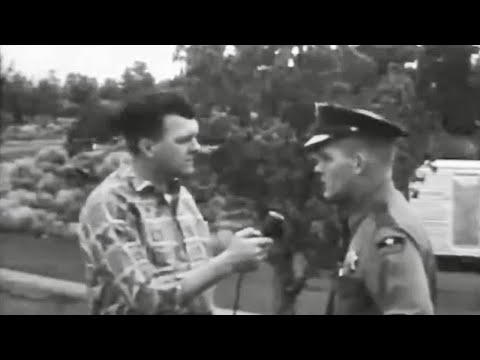
Police Officer Robert Dickerson on Witnessing a UFO in Redmond, Oregon, September 24, 1959
Archival KGW-TV footage of Robert Dickerson describing his own encounter, republished by the archival-television channel Eyes On Cinema.
The Central Oregon UFO Sighting of 1959 | KGW Vault
Portland station KGW's own news archive retrospective on the Redmond case, drawing on the station's original 1959 coverage and later reporting.
Sources
- ufologie.patrickgross.org. "UFOs at Close Sight: The Redmond UFO Incident, September 24, 1959, USA." ufologie.patrickgross.org
- ufologie.patrickgross.org. "The Redmond UFO Incident, September 24, 1959, USA — NICAP Summary." ufologie.patrickgross.org
- ufologie.patrickgross.org. "The Redmond UFO Incident, September 24, 1959, USA — MUFON Summary." ufologie.patrickgross.org
- NICAP. "Aircraft/UFO Radar-Visual Cases, 1959" (Redmond, Oregon case entry). nicap.org
- NICAP. "UFO Report: Redmond, Oregon, September 24, 1959" (case directory, document index). nicap.org
- UFO Digest. "The 1959 Delta Daggers vs. UFO Sighting: Perhaps Best Pilot Eye Witness Testimony Ever." ufodigest.com
- Docvega's Blog. "1959 UFO Sighting Perhaps Best Evidence of Eye Witness Testimony Ever." docvega.wordpress.com
- Central Oregon Daily. "The Day UFOs Hovered Over Redmond — and the Air Force Scrambled Jets" (Little Did I Know series). centraloregondaily.com
- The Source Weekly (Bend, Oregon). "UFOregon." bendsource.com
- Sign Oral History Project. "UFOs: A History / The Fifth Horseman of the Apocalypse," by Loren E. Gross — 1959 July–September index (Redmond, OR; Robert Dickerson; Laverne Wertz; Track "JB 129"). sohp.us
- Eyes On Cinema (YouTube). "Police Officer Robert Dickerson on Witnessing a UFO in Redmond, Oregon, September 24, 1959" (archival KGW-TV footage). youtube.com
- KGW News (YouTube). "The Central Oregon UFO Sighting of 1959 | KGW Vault." youtube.com
- Wikipedia. "Roberts Field" (Redmond Municipal Airport history). en.wikipedia.org
- Wikipedia. "Redmond, Oregon." en.wikipedia.org
- Wikipedia. "Hamilton Field (Hamilton AFB)." en.wikipedia.org
- Wikipedia. "San Francisco Air Defense Sector" (Hamilton AFB's Cold War command structure). en.wikipedia.org
- Wikipedia. "Convair F-102 Delta Dagger." en.wikipedia.org
- Cave Tigrim! The 460th FIS in the Cold War. "The Deuce Years" (460th Fighter-Interceptor Squadron, Portland AFB, F-102 service history). 460fis.wordpress.com
- Wikipedia. "Kingsley Field Air National Guard Base" (Klamath Falls-area Ground Control Intercept radar history, 827th Radar Squadron/Keno AFS). en.wikipedia.org
- Wikipedia. "Mount Hebo Air Force Station" (regional Oregon Air Defense Command radar network context). en.wikipedia.org
- Wikimedia Commons. "47th Fighter-Interceptor Squadron three-ship F-102 formation 1959.jpg" (U.S. Air Force photograph, public domain). commons.wikimedia.org
- Keyhoe, Donald E. Aliens From Space: The Real Story of Unidentified Flying Objects, Doubleday, 1973.
- Clark, Jerome. The UFO Encyclopedia, 4th Edition, Relevant Information (Redmond, Oregon case entry; not checked for this revision).
- Randle, Kevin D. Project Blue Book Exposed, Da Capo Press, 1997 (general Blue Book context).
- Peebles, Curtis. Watch the Skies!: A Chronicle of the Flying Saucer Myth, Smithsonian Institution Press, 1994 (general context).
- Hall, Richard H., ed. The UFO Evidence. NICAP, 1964, p. 113 ("Radar-Visual at Redmond"), quoting Maj. L. J. Tacker (19 Jan 1960) and Col. G. B. Knight to Sen. W. G. Magnuson (27 Apr 1960).
- Davis, L. E., Chief, Air Traffic, FAA Redmond Communication Station. Letter "To Whom It May Concern," 15 Jan 1960, transcribing the station log (via Patrick Gross). ufology.patrickgross.org
- Printy, Tim. "Weeding out the Weinstein catalog: September 24, 1959 – Redmond, Oregon." SUNlite 2/2025 (reposted by CENAP, 13 Jul 2025; quotes the Blue Book file, McDonald's 1966 interview and the IGY camera correspondence via Loren Gross). hjkc.de
- Harvel, Jack. "UFOregon." The Source Weekly (Bend), 28 Apr 2022 (FAA's Oct. 1, 1959 Venus statement; Trish Pinkerton quote; Project Blue Book Festival).
Corrections (October 2026)
A fact-check against the FAA station's own log (as transcribed in its January 1960 letter to NICAP), NICAP's 1964 account and the Air Force letters it quotes, the Blue Book file as summarized by Tim Printy, and McDonald's 1966 interview of Officer Dickerson found that the earlier version of this page presented the case as a radar-visual intercept that the records do not support. The radar target was 25–40 miles south of Redmond, stationary, and attributed by the Air Force's controllers to a gap-filler echo; there was no FAA radar track of the light seen at Redmond. The story of pilots diving on the object and nearly losing control in its wake appears only in later popular accounts (Keyhoe, 1973; MUFON, 1989); the Blue Book file has the interceptors searching the radar position and seeing nothing, and Dickerson never saw any jets. The IGY all-sky camera did not stop filming an hour before the sighting: its film was inspected and showed Venus and the Moon and "nothing unusual." The "300–400 foot" radar return, the Hal Starr quotation, the attribution of the October 1959 Venus statement to Boyd Wolfe, and the "more than fifty documents" catalogued by Wilson and Ballester Olmos could not be verified and were removed.
Following this review, the rating was changed from Disputed 64 to Disputed 45 (October 27, 2026), because the higher rating had rested partly on claims corrected or removed above.
Other corrections: the Air Force's explanations came over four years (balloon and "insufficient information," January 1960; gap-filler echo, April 1960; Venus, 1963), not "in quick succession" in late September 1959, and the radar and Venus explanations concern different things; the hover was "several hundred feet" in the FAA log (about 200 feet in NICAP's account); the sky had a scattered cloud layer, not clear conditions; the jets approached from the south-east; the B-47 and F-89 are now attributed to the 1989 MUFON summary, and the "William Tell" and "337th Fighter Group" details were removed as unsupported; Venus's position and the skeptical analysis were added.
See something inaccurate? Have additional information or sources?
Suggest an Edit →Last Updated: October 2026