
Aliens From Space
The Real Story of Unidentified Flying Objects
Core Thesis
Aliens From Space: The Real Story of Unidentified Flying Objects is retired Marine Corps Major Donald E. Keyhoe's final major book, published in 1973 four years after his 1969 ouster as NICAP's director. Where his earlier books had focused their cover-up argument primarily on the Air Force, this one explicitly widens the target: its own cover copy states it "was written in defiance of both the U.S. Air Force and the C.I.A.," with an entire chapter, "The CIA Takes Over," naming CIA officials directly in connection with the 1953 Robertson Panel that Keyhoe argues set the government's debunking policy. This site cites the book for two cases it gave their fullest early published treatment: the 1953 Kinross Incident and the 1959 Redmond, Oregon UFO Sighting.
About the Author
This site's own Donald Keyhoe key-figures entry documents his career in full: a retired Marine Corps major whose January 1950 True magazine article expanded into the bestselling book The Flying Saucers Are Real, already covered on this site, and who went on to direct NICAP (the National Investigations Committee on Aerial Phenomena) for twelve years beginning in 1957, building it into the era's leading civilian UFO research organization. This site separately covers his 1955 book The Flying Saucer Conspiracy -- a distinct, earlier title from this one, written while Keyhoe was still two years from taking NICAP's helm.
This book arrived under very different circumstances: Keyhoe was forced out as NICAP's director in 1969 by the organization's board, headed by Col. Joseph Bryan III, a former CIA officer, with John "Jack" Acuff taking over as director while Keyhoe was moved to the board of governors. In the book's own foreword, Keyhoe states he served "thirteen years as director of NICAP" and explains he wrote the book because sightings since mid-1972 had put the Air Force "in a serious predicament," aiming to prepare the public before an anticipated government admission. The book's confrontational tone -- explicitly naming the CIA alongside the Air Force as an adversary -- is consistent with a valedictory, embittered posture following his departure from the organization he had led for over a decade.
Historical Context & Origins
Direct examination of the book's table of contents and text shows it functions as a culmination of Keyhoe's NICAP-era casework: chapters draw on "certified copies of the FAA logs... obtained by NICAP" and correspondence and Freedom-of-Information-obtained Air Force documents accumulated across his 1957-1969 tenure. Chapter 5, "The CIA Takes Over," covers the January 1953 Robertson Panel -- a CIA-convened scientific review Keyhoe identifies as run by agents Philip G. Strong and Ralph L. Clark alongside scientist Marshall Chadwell -- which he argues established the government's debunking policy. Chapter 8, "Battle at Boulder," covers the Condon Committee at the University of Colorado in detail, including Keyhoe's own direct dealings with Edward Condon and Robert Low.
The book's Chapter 3, "The Hidden Gamble" (pages 33-37 in the Signet paperback), gives the fullest early published account of the September 24, 1959 Redmond, Oregon case: police officer Robert Dickerson's sighting, FAA tracking by staff including Laverne Wertz, and a six-F-102 interception attempt from Portland that Keyhoe frames as a deliberate high-level "capture" attempt rather than a routine intercept, with one pilot's near-loss-of-control encounter matching this site's own case file description. Chapter 11, "The Crucial Question" (pages 165-167), gives the book's account of the November 23, 1953 Kinross Incident, quoting the Chicago Tribune's "JET, TWO ABOARD, VANISHES OVER LAKE SUPERIOR" headline and detailing the Air Force's disputed Royal Canadian Air Force explanation, which the RCAF itself denied.
Core Arguments & Key Concepts
The book's central argument extends Keyhoe's long-running government-cover-up thesis by explicitly incorporating the CIA as a co-architect of official secrecy, not merely a passive Air Force partner -- a significant escalation from his earlier books, reflecting both new evidence he says accumulated during his NICAP tenure and, plausibly, his own more adversarial relationship with the intelligence establishment following his 1969 ouster.
Applied to this site's own cases, that argument treats both Kinross and Redmond as textbook examples of the Air Force's "pattern of shifting, evasive public explanations" -- Kinross's disputed RCAF-aircraft claim and Redmond's sequence of a nuclear-powered-craft rumor followed by a publicly retracted weather-balloon explanation -- presented as evidence of a deliberate policy rather than isolated investigative errors.
Key Cases & Evidence Discussed
This site's own Kinross Incident case file documents the full record of Lt. Felix Moncla and Lt. R.R. Wilson's disappearance in far greater depth than this book's own chapter, including the complete radar timeline and the case's continued unresolved status. Readers wanting that complete record should consult that case file directly.
This site's own Redmond, Oregon UFO Sighting case file similarly documents the September 1959 interception attempt in full, including the FAA's "JB 129" radar track designator and the case's later FOIA-driven document history through Ground Saucer Watch and MUFON. This book's own account, drawn directly from Keyhoe's NICAP files, remains the earliest detailed published treatment of both cases.
Critical Reception & Controversies
As of this article's research (August 2026), the book holds a modest 3.09/5 aggregate rating on Goodreads from 32 ratings, a small sample. This article was not able to locate a contemporary 1973 trade review (Kirkus, Publishers Weekly, or a major newspaper), which may reflect the limits of what is indexed online for a decades-old title rather than a genuine absence of period coverage.
This article found no dedicated ufology-community retrospective assessment comparing this book's reception to Keyhoe's earlier, more famous titles, and does not assert one exists. What can be said with confidence, from direct examination of the book's own text, is that it marks a documented tonal shift toward more adversarial, CIA-focused argument relative to his earlier NICAP-era writing.
Influence & Legacy
The book's legacy is bound up with its status as Keyhoe's last major work: he continued writing occasionally afterward but produced no further book-length statement before his death in 1988, making this the final full articulation of the cover-up framework he had spent over two decades developing and popularizing.
Set alongside this site's own Kinross Incident and Redmond, Oregon UFO Sighting case files, which draw on far more extensive documentary sourcing developed in the decades since, this book remains valuable as the direct, primary published record of how NICAP's own files characterized both cases at the height of Keyhoe's access to that material -- and as a documented artifact of how his cover-up argument evolved after leaving the organization he built.
The Book
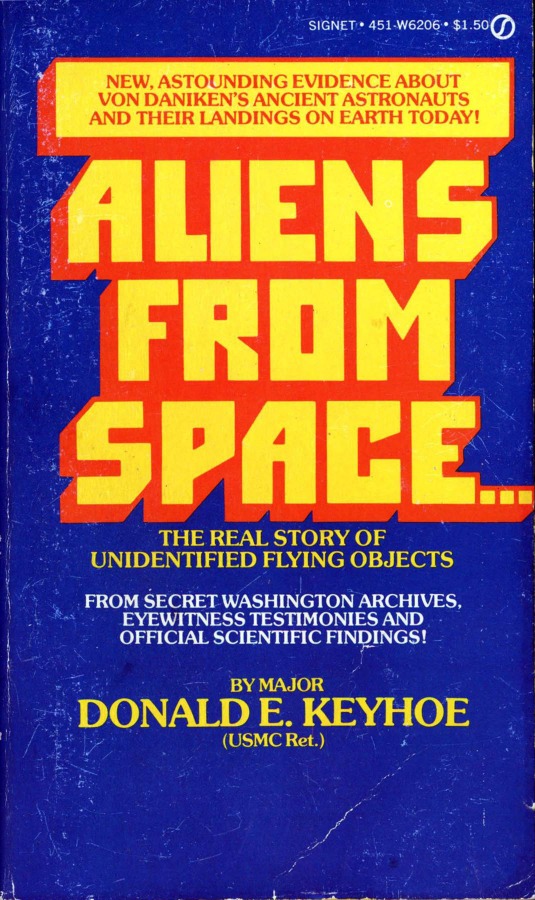
As an Amazon Associate, OverClassified may earn from qualifying purchases made through this link, at no extra cost to you.
Why This Is Essential Reading
Aliens From Space earns its place on this reading list as Donald Keyhoe's final and most confrontational statement of the government-cover-up argument he originated, escalating from an Air Force-focused critique to a direct accusation against the CIA, and giving both the Kinross Incident and the Redmond, Oregon sighting their fullest early published accounts drawn from his own NICAP investigative files. Read alongside this site's own Kinross Incident and Redmond, Oregon UFO Sighting case files, which supply the fuller modern documentary record for both cases, it remains essential as the primary source closest to Keyhoe's own NICAP-era files and to the man who did more than anyone to popularize the cover-up framework itself.
Related Cases & Theories
Sources Cited
- Keyhoe, Donald E. Aliens From Space: The Real Story of Unidentified Flying Objects. Doubleday & Company, 1973. amazon.com
- Open Library, edition record for the 1973 Doubleday hardcover (OL5435482M) and later Signet paperback printings. openlibrary.org
- Goodreads listing for Aliens From Space (aggregate reader rating). goodreads.com
- This site's own Donald Keyhoe key-figures entry (his full NICAP career and other Essential Reading titles).
- This site's own The Flying Saucer Conspiracy Essential Reading entry (Keyhoe's earlier, separately covered 1955 book).
- This site's own The Flying Saucers Are Real Essential Reading entry (Keyhoe's original 1950 bestseller).
- This site's own Kinross Incident case file (full sourcing and this book's role in the case's early documentation).
- This site's own Redmond, Oregon UFO Sighting case file (full sourcing and this book's role in the case's early documentation).
- This site's own Richard H. Hall key-figures entry (Keyhoe's NICAP assistant director).
- "Donald Keyhoe." Wikipedia (biographical detail, NICAP career, and 1969 board dispute). en.wikipedia.org
- Clark, Jerome. The UFO Encyclopedia, 4th Edition. Visible Ink Press, 2023 (reference-work entries on Kinross and Redmond).
- Internet Archive, digitized copy of a Signet paperback reprint used for direct chapter-level verification of the book's Redmond and Kinross content.
Have corrections, additional research, or peer-reviewed sources? Help improve this entry.
Suggest an Edit