
The Flying Saucer Conspiracy
Donald Keyhoe's Case for a Government Silence Group
Core Thesis
The Flying Saucer Conspiracy is retired Marine Corps Major Donald E. Keyhoe's 1955 case for a coordinated government "silence group" suppressing UFO evidence, discussing dozens of cases including the one this site's own Kinross Incident file documents in full: the November 23, 1953 disappearance of an F-89C Scorpion jet, piloted by Lt. Felix Moncla with radar operator Lt. Robert Wilson, after ground radar tracked it merging with an unidentified target over Lake Superior. This is a broad conspiracy-argument survey rather than a Kinross-specific study; Kinross is one of many cases Keyhoe cites in building his larger argument about official secrecy.
About the Author
Donald E. Keyhoe (1897–1988) was a U.S. Naval Academy graduate and retired Marine Corps major who worked as a professional writer, including managing promotional tours for Charles Lindbergh, before turning his attention to UFO reporting. His first book, The Flying Saucers Are Real (1950), expanded from a True magazine article, became a half-million-copy bestseller and established him as the era's most influential UFO writer. He went on to become Director of NICAP (the National Investigations Committee on Aerial Phenomena) from 1957 to 1969, building a board that included former CIA Director Admiral Roscoe Hillenkoetter, and is widely credited as the originator of the "government cover-up" framing that has shaped popular UFO discourse ever since.
This particular book arrived between his first bestseller and his NICAP directorship, at a moment when his reputation for careful, if strongly argued, use of official material was already well established: philosopher and psychiatrist Carl Jung, in his own 1958 book on UFOs, specifically praised Keyhoe's early books as "based on official material" that avoided "wild speculations" — a notable contemporary endorsement of Keyhoe's documentary approach, though Jung himself remained skeptical of the extraterrestrial explanation Keyhoe favored.
Historical Context & Origins
This site's own case file already treats Keyhoe as a source requiring care rather than uncritical acceptance, citing his report of a private Air Force acknowledgment that "the unknown in that case was a Canadian DC-3" alongside a secondhand "hit by a flying saucer" phone tip he explicitly did not verify himself. This article follows the same standard, treating Keyhoe's own claims in this book as his reporting rather than as independently established fact.
One specific, striking claim from the book is worth flagging precisely because it illustrates both Keyhoe's approach and the limits of what this article could independently verify: Keyhoe wrote that a Chicago Tribune headline, "Jet, Two Aboard, Vanishes Over Lake Superior," was reportedly pulled from later editions of the newspaper after its initial run — a detail this site's own case file does not currently include and that this article could not independently confirm against a primary newspaper archive, but which is worth noting as exactly the kind of documentary claim that gives the book its persuasive force.
Core Arguments & Key Concepts
The book's central argument is structural rather than case-specific: Keyhoe contends that a coordinated intelligence and public-relations effort, which he calls a "silence group," has systematically minimized, explained away, or suppressed evidence of extraterrestrial visitation across dozens of individual incidents, of which Kinross is one prominent example given the case's dramatic loss of an aircraft and crew.
Applied to Kinross specifically, Keyhoe's argument rests on the gap between the Air Force's official Canadian-aircraft explanation and what he presents as inconsistencies in the public record, including the reported headline suppression discussed above. This site's own case file treats the RCAF C-47 explanation (tail VC-912, en route Winnipeg to Sudbury) as the documented official account while separately noting the case remains formally listed among genuinely unresolved incidents given the aircraft and crew were never recovered.
Key Cases & Evidence Discussed
This site's own Kinross Incident case file documents the full record in far greater depth than this book review needs to repeat: the complete radar timeline, the F-89C's disappearance, the RCAF C-47 explanation and pilot Gerald Fosberg's reported denial of being off course, and the aircraft's status as never recovered. Ground radar at Calumet Air Force Station tracked the F-89 closing on the unidentified target until the two blips converged into a single return, at which point contact with Moncla and Wilson was lost permanently — a specific, documented radar signature that gives the case its enduring evidentiary weight regardless of which explanation for the merged track one ultimately accepts. Readers wanting the complete, independently sourced record should consult that case file directly.
What is specific to this book is Kinross's place within Keyhoe's much broader argument about official secrecy, discussed alongside dozens of other cases from the early 1950s rather than as a dedicated standalone study — useful for understanding how contemporaries situated the case within the period's wider UFO discourse, rather than as a source of additional case-specific evidence.
Critical Reception & Controversies
As of this article's research (August 2026), contemporary reception was mixed: The New York Times reportedly called the book "repetitious and unconvincing," while Library Journal found it "less fantastic than others" in the genre and engaging on its own terms. This split reception is consistent with Keyhoe's broader reputation as a persuasive advocate whose specific claims individual reviewers weighed differently depending on their own priors about the subject.
Independent of this specific book, Keyhoe's overall approach earned a notable endorsement from Carl Jung, discussed above, for relying on official material rather than pure speculation — context this article treats as relevant to how seriously to take the book's documentary claims, without treating it as proof that any single claim within it is correct.
Influence & Legacy
The book's legacy is bound up with Keyhoe's broader historical role: it appeared two years before he took the helm of NICAP, the organization that would become the era's most prominent civilian UFO research body, and it helped cement the "government cover-up" framing that has remained a durable feature of popular UFO discourse for seven decades since.
Set alongside this site's own case file, which draws on independently verifiable radar records, the RCAF's own aircraft identification, and later investigative work, this book is best read as a snapshot of how one of ufology's most influential early figures framed Kinross within his larger case for official secrecy, rather than as the case's primary evidentiary source.
The Book
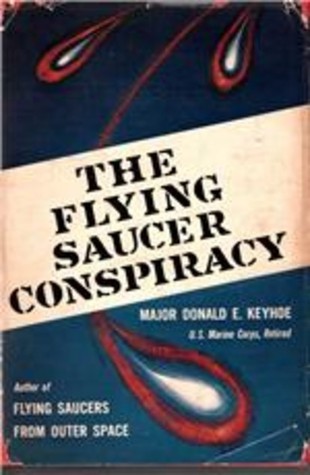
As an Amazon Associate, OverClassified may earn from qualifying purchases made through this link, at no extra cost to you.
Why This Is Essential Reading
The Flying Saucer Conspiracy earns its place on this reading list as a document of how the era's most influential ufologist, two years before taking over NICAP, built his broader case for government secrecy using cases like Kinross as supporting evidence. Read alongside this site's own Kinross Incident case file, which supplies the fuller, independently sourced record of the F-89's disappearance and the RCAF's own explanation, it remains valuable as a primary artifact of 1950s UFO conspiracy argument from the figure most responsible for popularizing that framework.
Related Cases & Theories
Sources Cited
- Keyhoe, Donald E. The Flying Saucer Conspiracy. Henry Holt and Company, 1955. amazon.com
- National Investigations Committee on Aerial Phenomena (NICAP), full scanned copy of the original 1955 edition. nicap.org
- "Felix Moncla." Wikipedia (independent case overview, consistent with this site's own case file). en.wikipedia.org
- "Donald Keyhoe." Wikipedia (biographical detail, NICAP directorship, and career). en.wikipedia.org
- This site's own Donald Keyhoe key-figures entry (his career and NICAP role).
- This site's own Felix Moncla key-figures entry (the F-89's pilot).
- This site's own Robert Wilson Jr. key-figures entry (the F-89's radar operator).
- ufobc.ca, detailed investigation page on the Kinross Incident (independent corroboration of the RCAF C-47 tail number VC-912). ufobc.ca
- Clark, Jerome. The UFO Encyclopedia, 4th Edition. Visible Ink Press, 2023 (reference-work entry on the case and on Keyhoe's broader career).
- Jung, Carl G. Flying Saucers: A Modern Myth of Things Seen in the Sky, 1958 (contemporary assessment of Keyhoe's documentary approach).
- Goodreads listing for The Flying Saucer Conspiracy (edition record and cover art). goodreads.com
- This site's own Kinross Incident case file (full sourcing, the radar timeline, and the RCAF explanation documented there).
Have corrections, additional research, or peer-reviewed sources? Help improve this entry.
Suggest an Edit