
The UFO Enigma
A New Review of the Physical Evidence
Core Thesis
The UFO Enigma is Peter A. Sturrock's own general-audience account of the workshop he personally organized and directed: this site's own Case File #292, the Sturrock Panel, a four-day, Laurance Rockefeller-funded scientific review of UFO physical evidence held at the Pocantico Conference Center in September–October 1997. Rather than arguing a single thesis about what UFOs are, the book distills roughly 120 pages of Sturrock's own synthesis around the panel's nine physical scientists and the technical case material presented to them by eight established UFO investigators, category by category — photographic evidence, radar returns, automobile and aircraft electrical interference, ground traces and vegetation injury, and physiological effects on witnesses. Its central, carefully calibrated argument is that this physical evidence, examined with the same instrumental rigor a working physicist would apply to any other unexplained phenomenon — microdensitometry scans of photographic film grain, spark mass spectrometry on recovered material, cross-correlation of radar returns against visual reports — produces no convincing proof of extraterrestrial intelligence or any violation of known physical law, but does produce a specific, bounded residue of well-documented cases that remains genuinely unexplained and therefore scientifically worth further, properly funded study, rather than either credulous belief or reflexive dismissal.
About the Author
Peter Andrew Sturrock was born on March 20, 1924, in South Stifford, Essex, England, and died on August 12, 2024, in Palo Alto, California, at age 100. He studied mathematics at St John's College, Cambridge, beginning in 1942, pausing his studies from 1943 to 1946 to work on radar systems at the wartime Telecommunications Research Establishment, then returned to Cambridge to win the University's Rayleigh Prize in mathematics in 1949 and complete a Ph.D. in astrophysics in 1951 at the Cavendish Laboratory under Vernon Ellis Cosslett. That combination — theoretical training interrupted by hands-on wartime instrumentation work — runs through his entire subsequent career, which spanned electron optics, particle accelerators, plasma physics, solar physics, and astrophysics rather than staying inside any single specialty.
Sturrock joined Stanford University in 1955 as a research associate in the Microwave Laboratory, spent time researching at CERN, and returned to Stanford as a professor of applied physics in 1961, a position he held until 1998 before becoming emeritus. He was an internationally recognized leader in solar physics for more than half a century, invented the "fast-wave microwave tube" that helped open the door to free-electron laser development, established Stanford's Institute for Plasma Research in 1964 (directing it on two separate occasions), and founded the university's Center for Space Science and Astrophysics in 1985, directing it from 1992 to 1998. He chaired the American Astronomical Society's Solar Physics Division, received the Society's Hale Prize in 1986, was awarded the National Academy of Sciences' Arctowski Medal in 1990, and was named an American Astronomical Society Legacy Fellow in 2020 — a mainstream scientific record, built across more than 300 published papers and five monographs, that gives his interest in UFO physical evidence a credibility few other authors on this site's own reading list can claim.
That interest traces to the early 1970s, when Sturrock hired researcher Jacques Vallée for an unrelated project and, on learning Vallée had written several books on UFOs, felt a professional obligation to read them. Rather than taking the subject on faith, Sturrock did what a working physicist does: he measured it. He conducted a 1973 survey of members of the American Institute of Aeronautics and Astronautics and a 1975 survey of American Astronomical Society members, finding in both professional populations that roughly five percent of respondents reported having personally observed some aerial phenomenon they could not explain — a modest but, to Sturrock, methodologically significant result suggesting the subject was not confined to unreliable or untrained observers. In 1981–1982 he founded the Society for Scientific Exploration (SSE) to give this kind of unconventional but genuinely testable subject matter a forum with real scientific standards, served as its president for two decades, and became the founding editor of its Journal of Scientific Exploration.
In 1987 Sturrock personally took custody of the remaining Ubatuba magnesium fragments from Coral Lorenzen, arranged new isotope testing, and in 2001 published the definitive synthesis of that case's first four decades of laboratory analysis in the Journal of Scientific Exploration — hands-on physical-evidence work that directly continued the research agenda this book and the 1997 panel it describes had formally established. Later in life he turned the same evidence-first method on an entirely different question in AKA Shakespeare: A Scientific Approach to the Authorship Question (2013), and reflected on his own unconventional career, including its UFO chapter, in the 2009 memoir A Tale of Two Sciences: Memoirs of a Dissident Scientist. Colleagues remembered him, on his death in 2024, less for any single finding than for what Stanford solar physicist Roger Blandford called his "strikingly original contributions" and "lively and inquiring mind" across nearly eight decades of active research.
Historical Context & Origins
By the mid-1990s, official American scientific engagement with UFO reports had been effectively dormant for a generation. The 1969 Condon Report's dismissive conclusions had given the U.S. Air Force its rationale for closing Project Blue Book that same year, and no comparably resourced, credentialed scientific body had conducted a fresh review of the subject's physical evidence in the nearly three decades since — the same institutional silence this site's own James E. McDonald Congressional UFO Testimony case file (#285) documents from the losing side of that earlier fight.
The impetus for a fresh review came from Laurance S. Rockefeller (1910–2004), an heir to the Rockefeller family fortune and a longtime, low-profile patron of UFO research through his LSR Fund, who approached the Society for Scientific Exploration — the organization Sturrock had founded roughly fifteen years earlier specifically to provide a credible forum for exactly this kind of unconventional subject — about whether a genuinely rigorous scientific review of UFO physical evidence might be possible. Sturrock agreed to direct the resulting workshop, and Rockefeller's funding made possible the four-day gathering at the Pocantico Conference Center in Tarrytown, New York, from September 29 through October 4, 1997, followed by a second three-day writing meeting in San Francisco. This site's own Sturrock Panel case file (#292) covers the workshop's full roster, structure, and findings in detail; this article treats the book as Sturrock's own, separately published distillation of that same underlying record for a general readership rather than a second, independent account of the same events.
The panel's findings reached national television and print audiences on June 29, 1998, in a wave of coverage including a Washington Post report and an NPR segment, roughly a year and a half before this book itself reached shelves in November 1999. That gap gave Sturrock time to expand the 1998 Journal of Scientific Exploration proceedings — a technical publication aimed at other researchers — into a considerably longer, more narratively accessible 416-page book aimed at general readers, incorporating individually authored chapters from several of the workshop's own investigators, including Richard Haines on photographic evidence and Jennie Zeidman on a widely reported 1973 helicopter-UFO encounter over Ohio, alongside Sturrock's own connective synthesis of the panel's core findings.
Core Arguments & Key Concepts
The book's organizing method, carried over directly from the 1997 workshop's own design, is categorical rather than case-by-case: rather than surveying the full mass of UFO reports, it works systematically through specific evidentiary types — photographic evidence, radar returns, automobile and aircraft electrical interference, ground traces and vegetation damage, and physiological effects on witnesses — asking in each category which known technology, natural phenomenon, or sensor artifact could plausibly account for the strongest examples on record, and which cannot be so explained.
A recurring thread is the book's insistence on instrumental, checkable technique over impressionistic judgment. Kirkus Reviews specifically highlighted its use of "micro-densitometry scans of photographic film crystals, and the probings of spark mass spectrometry" — laboratory methods drawn directly from Sturrock's own physics background and applied to UFO photographs and recovered material, sections the same review found "tough going for the lay reader" even as it praised the book's narrative case studies and interviews as "captivating."
The book sorts the cases it examines into two broad outcomes rather than presenting them as uniformly mysterious: roughly seventy percent, in its own accounting, resolve to conventional explanations — satellites, marsh gas, radar mirages, and other identifiable stimuli — while a residual roughly thirty percent, featuring multiple witnesses, photographic evidence, material remains, or radar corroboration, resist that kind of resolution even after sustained technical scrutiny. Sturrock treats that residue, not the full case volume, as the book's actual evidentiary subject.
Individual chapters extend the panel's category-based approach into specific technical territory: Richard Haines's photographic-evidence analysis of a disc-shaped object, Jennie Zeidman's detailed account of a 1973 helicopter-UFO encounter over Ohio, and a discussion of France's SEPRA program — the government UFO-investigation office within the French space agency CNES — as the closest international counterpart to the kind of institutional review the panel itself represented. Publishers Weekly's contemporary review specifically noted the book's argument that physical scientists can meaningfully analyze material evidence even without specialized training in evaluating eyewitness testimony, a methodological division of labor that runs throughout the book's structure.
The book's closing argument is institutional rather than case-specific, echoing the panel's own formal recommendation: having built its case category by category, it argues the residue of unresolved reports is large and consistent enough to warrant a dedicated, properly funded scientific research project, and that the principal obstacle to that project is not a shortage of evidence but the professional stigma — the "giggle factor" the panel itself explicitly named — that has discouraged credentialed scientists from engaging with the subject openly since the Condon Report.
Key Cases & Evidence Discussed
The book's central case is, in effect, the 1997 workshop itself: this site's own Sturrock Panel (Case File #292) documents the same nine-scientist review panel, the same eight invited investigators, and the same category-based evidentiary structure this book distills for general readers — making the two the closest possible companion pieces in this site's own library, one a third-person case-file account, the other the workshop director's own first-person synthesis.
The Trans-en-Provence Case (Case File #099, 1981) appears as presented to the panel by Jean-Jacques Velasco, then head of France's official GEPAN/SEPRA UFO-investigation office, whose documented soil and vegetation analysis this site's own case file treats as one of the strongest ground-trace cases in its entire catalogue — exactly the kind of measurable physical evidence the book's ground-trace chapter builds its argument around.
The Cash-Landrum Incident (Case File #011, 1980) appears through John F. Schuessler's presentation of its physiological evidence, in which he told the assembled panel of physical scientists that extensive medical testing left "no doubt" the two witnesses had been exposed to some form of intense radiation — the book's principal illustration of physiological injury as a distinct, medically documentable evidentiary category separate from sighting testimony.
The Ubatuba Magnesium Fragments (Case File #157, 1957) connect to this book through Sturrock's own biography rather than the 1997 workshop's presentations: he had personally held custody of the remaining fragments since 1987 and would go on to publish the definitive synthesis of their isotope analysis in the Journal of Scientific Exploration in 2001, two years after this book's publication — a direct, independently verifiable continuation of the same material-evidence research agenda the book and panel describe.
A 1973 helicopter-UFO encounter over Mansfield, Ohio — documented for the book by investigator Jennie Zeidman and involving an Army Reserve helicopter crew's reported near-collision with an unidentified object — receives one of the book's fullest individual case treatments outside the panel's own presentations, illustrating how the book supplements the 1997 workshop's formal record with additional investigator-authored case studies not otherwise covered in this site's own holdings.
Critical Reception & Controversies
Kirkus Reviews called the book "a comprehensive investigation of encounters with unidentified flying objects, all the more riveting because it is both skeptical and scrupulously objective," praising its "exquisite debunkings of the bureaucratic obfuscation" surrounding official dismissals while cautioning that its more technical sections — the microdensitometry and spark mass spectrometry chapters in particular — are "tough going for the lay reader." Its verdict was that the book reaches a deliberately inconclusive position: something in the residual cases warrants investigation, yet remains scientifically unexplained, which the review characterized as appropriate intellectual honesty rather than a weakness.
Publishers Weekly's contemporary review found the book "informative reading" offering "a hoard of raw information, and some admirably cautious reasoning, from which any reader who already cares about UFOs might be glad to learn," while noting its scientific, sometimes dry register was better suited to an already-interested audience than to a general reader encountering the subject for the first time.
Skeptical engagement came from within organized skepticism's own long-running UFO-watch tradition. Philip J. Klass, in his self-published Skeptics UFO Newsletter, focused specifically on the panel's own carefully hedged bottom line — that it was "not convinced that any of the evidence involved currently unknown physical processes or pointed to the involvement of an extraterrestrial intelligence" — and pointed out that some UFO researchers publicizing the panel's findings had downplayed or omitted that qualifying conclusion in their own summaries, a critique aimed less at Sturrock's own careful language than at how selectively the panel's results were being repeated within the wider UFO research community.
This site's own Sturrock Panel case file independently documents the same limitations a more skeptical reading of this book would raise: private, single-donor funding from a longtime UFO-research patron rather than a peer-reviewed government or university grant process; investigators pre-selected as established UFO researchers rather than randomly sampled, and explicitly instructed to present their own strongest cases; and a recommendation for further study that did not translate into any comparably funded follow-up research program in the years immediately following publication.
Because the book functions largely as Sturrock's own account of a workshop he personally organized and directed, it has drawn comparatively little independent academic review outside the skeptical press and library-trade outlets like Kirkus and Publishers Weekly; its reception is best understood as running along the same divide this site's own Sturrock Panel case file documents for the underlying 1997 workshop — credentialed, disciplined, and carefully non-definitive to its supporters, privately funded and pre-selected in its evidence base to its critics — rather than as a separate controversy in its own right.
Influence & Legacy
The book's most concrete, independently verifiable influence is documented on this very site: this exact 1999 edition, cited under ISBN 9780446525657, appears twice in resources.html in connection with two separate case-file pages — The Belgian UFO Wave and The Ubatuba Magnesium Fragments — and a companion paperback printing of the same title and author is separately cited in connection with the Tully Saucer Nests Sighting, reflecting its standing here as a working secondary reference on UFO physical evidence rather than a novelty citation.
Within the Society for Scientific Exploration Sturrock founded, the book and the 1997 panel it describes established a physical-evidence research agenda the organization and its Journal of Scientific Exploration continued for decades afterward, most directly in Sturrock's own 2001 Ubatuba isotope synthesis and, much later, in the SCU-led forensic re-analyses this site's own UFOs: A Scientist Explains What We Know essential-reading entry documents in detail — a continuous, traceable line of credentialed physical-evidence research running from Sturrock's 1997 workshop through Robert Powell's 2024 book.
More broadly, Sturrock's own mainstream scientific standing — a Stanford applied-physics professor with a National Academy of Sciences medal and no prior public reputation as a UFO advocate — did for the physical-evidence question what few other UFO-adjacent books on this site's reading list can claim: it made taking the subject seriously professionally survivable for other credentialed scientists. That same pattern, a genuinely eminent mainstream physicist lending unusual legitimacy to calls for rigorous UAP study, recurs directly in this site's own Extraterrestrial essential-reading entry on Harvard astrophysicist Avi Loeb, whose 2021 book and subsequent Galileo Project echo Sturrock's own earlier insistence that the taboo against studying anomalous aerial phenomena is a problem of institutional culture, not of the evidence itself.
Sturrock did not live to see the most recent chapter of that throughline: he died on August 12, 2024, three years into the U.S. government's own post-2021 UAP disclosure push and the stand-up of the Pentagon's All-domain Anomaly Resolution Office, developments this site's own case files document as having validated, at an institutional scale Sturrock's privately funded 1997 workshop never achieved, the same basic argument — that some UAP reports merit serious, funded scientific study — this book made a quarter-century earlier.
The Book
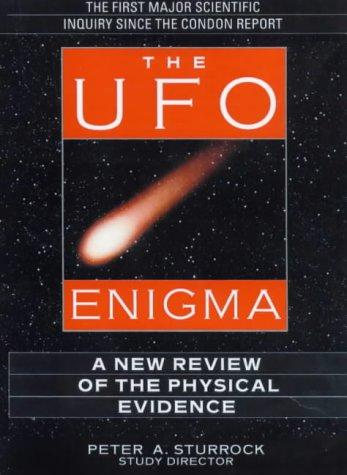
As an Amazon Associate, OverClassified may earn from qualifying purchases made through this link, at no extra cost to you.
Why This Is Essential Reading
The UFO Enigma earns its place on this list less as an argument in its own right than as the fullest public record, in Peter Sturrock's own words, of directing this site's own Case File #292 — the most credentialed scientific review of UFO physical evidence conducted in the three decades since the Condon Report closed the question for official American science. Kirkus's "skeptical and scrupulously objective" and Publishers Weekly's "admirably cautious reasoning" both land on the same real quality: a working physicist's insistence on instrumental method over impression, applied evenhandedly enough that Philip Klass's own skeptical newsletter found more to criticize in how other researchers repeated the panel's findings than in the panel's own carefully hedged conclusions. Its limits, documented candidly in this site's own Sturrock Panel case file, are equally real — private single-donor funding, pre-selected investigator testimony, no comparably resourced follow-up program. Read as a companion to that case file rather than a stand-alone verdict, and alongside this site's own Extraterrestrial for the same pattern recurring a generation later in Avi Loeb's Galileo Project, this book remains essential as a credentialed scientist's own account of what rigorous engagement with the strongest UFO physical evidence actually looked like, once someone with the standing to be taken seriously finally attempted it.
Related Cases & Theories
Essential Viewing
Peter Sturrock on Plasma UFO's
ballyhooray — Archival footage of Peter Sturrock discussing plasma-physics explanations considered for some UFO reports, drawing on the same physical-evidence background underlying this book. Verified via YouTube oEmbed before inclusion.
The Rockefeller UFO Initiative
Pot Boys — A documentary segment on Laurance Rockefeller's 1990s funding of UFO-research projects, the broader context this book's own 1997 Pocantico workshop grew out of. Verified via YouTube oEmbed before inclusion.
Sources Cited
- Sturrock, Peter A. The UFO Enigma: A New Review of the Physical Evidence. Warner Books/Aspect, 1999 (ISBN-13 9780446525657, hardcover, cited here matching this site's own resources library citations). amazon.com
- "The UFO Enigma: A New Review of the Physical Evidence." Kirkus Reviews (contemporary review: "skeptical and scrupulously objective," publication details, page count, ISBN). kirkusreviews.com
- "The UFO Enigma: A New Review of the Physical Evidence by Peter A. Sturrock." Publishers Weekly (contemporary review, November 1, 1999: "a hoard of raw information, and some admirably cautious reasoning"). publishersweekly.com
- "Peter A. Sturrock." Wikipedia (biography: birth/death, Cambridge education, Stanford career, Society for Scientific Exploration founding, UFO research, bibliography). en.wikipedia.org
- "Peter Sturrock, influential applied physics professor, has died." Stanford School of Humanities and Sciences, 2025 (obituary: career achievements, colleague quotes from Roger Romani and Roger Blandford). humsci.stanford.edu
- "Obituary: Peter Sturrock (1924-2024)." SolarNews / American Astronomical Society Solar Physics Division (career retrospective: solar physics leadership, monographs, honors). solarnews.aas.org
- "Society for Scientific Exploration - Peter Andrew Sturrock 1924-2024." Society for Scientific Exploration (memorial notice, founding role, JSE editorship). scientificexploration.org
- Sturrock, P. A., Eshleman, V. R., Holzer, T. E., et al. "Physical Evidence Related to UFO Reports: The Proceedings of a Workshop Held at the Pocantico Conference Center, Tarrytown, New York, September 29 - October 4, 1997." Journal of Scientific Exploration, 1998 (the panel's own peer-review-adjacent published proceedings this book distills for general readers). researchgate.net
- "Panel Urges Study of UFO Reports." The Washington Post, June 29, 1998 (national press coverage of the panel's findings). washingtonpost.com
- "Scientific Panel Concludes Some UFO Evidence Worthy Of Study." ScienceDaily, July 1, 1998 (panel findings, evidence categories examined, panel composition). sciencedaily.com
- Klass, Philip J. Skeptics UFO Newsletter, No. 54 (1998) (skeptical commentary on the panel's own conclusions and their subsequent public characterization). centerforinquiry.org
- "The UFO Enigma." Open Library (bibliographic record: publisher, publish date, cover art). openlibrary.org
- This site's own resources library: Full Reading List, where this edition is cited across two case-file pages and a companion paperback printing across a third.
- This site's own case file: The Sturrock Panel (Case File #292), for the full workshop this book distills, its panel roster, and its documented institutional limitations.
- This site's own case file: The Ubatuba Magnesium Fragments, for Sturrock's own 1987-2001 physical-evidence custody and analysis.
- This site's own case file: Trans-en-Provence Case, for the ground-trace evidence presented to the panel.
- This site's own case file: Cash-Landrum Incident, for the physiological-injury evidence presented to the panel.
- This site's own key-figures entry: Peter A. Sturrock, for his full biography and further case connections.
- This site's own essential reading entry: Extraterrestrial by Avi Loeb, for the later recurrence of a credentialed mainstream physicist's UAP-legitimacy argument.
Have corrections, additional research, or peer-reviewed sources? Help improve this entry.
Suggest an Edit