
UFOs: A Scientist Explains What We Know (And Don't Know)
Robert Powell's Solo Case for a Scientific UAP Research Discipline
Core Thesis
Writing alone for the first time after more than a decade and a half of collaborative casework, Robert Powell argues that the UAP subject's central problem has never been a shortage of interesting reports but a shortage of disciplined analysis applied to the small subset of reports that actually merit it. UFOs: A Scientist Explains What We Know (And Don't Know) works case by case — radar returns, FLIR video, cockpit instrumentation, laboratory-tested physical material — to separate sightings that dissolve under scrutiny from a much smaller residue that, in Powell's assessment, resists conventional explanation even after that scrutiny is applied. The book's governing method, carried over directly from his MUFON and Scientific Coalition for UAP Studies (SCU) fieldwork, is to name specific physical characteristics — extreme acceleration without apparent propulsion, no sonic boom, no thermal signature consistent with the reported speed, radar-and-visual correlation across independent sensors — and ask which known technology, natural phenomenon, or sensor artifact could plausibly produce each one. Where a case fails that test cleanly, Powell says so and moves on; where it does not, he argues the honest scientific conclusion is not extraterrestrial confirmation but a narrower, harder claim: that something not yet explained by conventional means was reliably detected, and that this residue of unexplained cases is large enough, and consistent enough across independent investigations, to justify sustained institutional science rather than either ridicule or premature belief.
About the Author
Robert Powell's own account of how he arrived at this book runs through engineering, not journalism or paranormal advocacy. He holds a B.S. in chemistry and spent 28 years in engineering management in the semiconductor industry at Advanced Micro Devices, where he helped develop the company's first flash-memory technology, managed chemistry laboratories, led nanotechnology research using atomic force and near-field optical microscopy, and holds four patents in the field. That specific background — someone trained to distrust a result until an instrument and a control group both confirm it — is the lens the book is built around, and it shows most clearly in the chapters working through radar cross-sections, infrared signature analysis, and the isotope chemistry of physical samples rather than in narrative reconstruction of what a witness says they saw.
By 2024, Powell's institutional footprint inside UAP research had grown considerably beyond the MUFON research-director role and the 2012 co-authored history this site's own UFOs and Government article covers in full. He is a co-founder and current Executive Board Member of the Scientific Coalition for UAP Studies (SCU), the organization he helped launch in 2014 specifically to bring formal technical analysis — the kind government agencies and academic institutions had largely declined to fund — to bear on a defined set of high-quality UAP cases. Under that banner he has led or co-authored SCU's forensic re-analysis of the 2004 Nimitz encounter, its 2015 report on the "Gimbal" and "GoFast" Navy videos, its multi-year technical investigation of the Aguadilla CBP FLIR footage, and its 2022 peer-reviewed isotope re-analysis of the Ubatuba magnesium fragments — the specific body of hands-on technical casework this 2024 book distills into a single argument aimed at a general audience rather than a specialist journal readership.
That distinction matters for how this article treats the book differently from this site's earlier UFOs and Government entry, which covers Powell's 2012 role as Michael Swords's documentary-history co-author and editor. This is Powell's solo book, written twelve years and one SCU co-founding later, and it reads less like an archival historian's synthesis of declassified records and more like a working analyst's field report on the cases his own organization spent the intervening decade investigating directly.
Historical Context & Origins
Powell wrote and published this book in the specific window opened by the U.S. government's own 2021 and 2022 acknowledgments that UAP were a legitimate subject of military and intelligence concern — the Office of the Director of National Intelligence's June 2021 preliminary assessment and the Pentagon's subsequent stand-up of the All-domain Anomaly Resolution Office (AARO). Where earlier UAP books, including his own 2012 UFOs and Government, had to argue for the subject's basic legitimacy against decades of Robertson Panel-era stigma, Powell's 2024 book could instead build directly on official validation already on the public record and focus its argument on evidentiary method rather than institutional credibility.
The book also arrived roughly a year after David Grusch's July 2023 congressional testimony pushed crash-retrieval and reverse-engineering claims into the mainstream news cycle, and Powell's approach is a deliberate contrast to that moment: rather than engage whistleblower testimony about alleged retrieved craft, the book stays close to sensor data and physical evidence Powell and SCU had personally examined, implicitly arguing that the field's credibility is better served by a small number of rigorously worked cases than by amplifying claims that cannot yet be independently verified.
Structurally, the book also represents Powell completing a personal transition that began with his 2007-2017 tenure as MUFON's director of research: from coordinating a large volunteer field-investigation organization toward SCU's smaller, credential-focused technical model founded in 2014, and finally, in 2024, to distilling that decade of SCU casework into a single-author synthesis aimed at general readers rather than a specialist report aimed at other researchers or government offices.
Core Arguments & Key Concepts
The book's organizing argument is that most reported UFO sightings are not mysterious once ordinary explanations — aircraft, balloons, astronomical objects, drones, camera artifacts — are systematically checked against the available evidence, and that treating the entire UAP topic as either all-hoax or all-extraterrestrial obscures the much smaller number of cases where that checking process genuinely fails to produce a conventional answer.
A recurring analytical thread running through the book's strongest chapters is kinematics: Powell repeatedly returns to reported flight characteristics — instantaneous acceleration to speeds that would be lethal to a human pilot, right-angle turns with no visible control surfaces, sustained hover with no downwash or exhaust plume — and argues that these specific, measurable characteristics, not vague visual impressions, are what separate his book's short list of genuinely unresolved cases from the much larger pool of misidentifications.
The book gives sustained attention to sensor corroboration as its evidentiary gold standard: cases where two or more independent detection systems — radar and a human witness, infrared video and a separate visual sighting, cockpit instrumentation and a chase aircraft's own sensor pod — register the same anomalous object at the same time are treated as categorically stronger than any single-witness account, mirroring the standard Powell and Glen Schulze applied years earlier to the Stephenville radar-and-witness correlation.
Powell also devotes real space to physical material evidence rather than treating video and radar as the whole of the available evidence base, walking readers through the modern instrumental methods — isotope ratio analysis via HR-ICPMS chief among them — that his own SCU-led re-analysis of the Ubatuba magnesium fragments applied, and using that case as a worked example of how physical samples can be tested against known terrestrial baselines rather than simply asserted to be anomalous.
The book's closing argument is institutional rather than case-specific: having built its evidentiary case chapter by chapter, it argues that the residue of unresolved encounters is large and consistent enough to warrant dedicated, funded, peer-reviewed scientific study — comparable to how any other poorly understood physical phenomenon would be treated — rather than the ad hoc mix of volunteer investigation, classified compartmentalization, and media sensationalism that has characterized most of the subject's history to date.
Key Cases & Evidence Discussed
The 2008 Stephenville Lights Sighting (Case File #051) is Powell's own foundational case, and the book draws directly on the roughly 2.8 million FOIA-obtained radar returns he and Glen Schulze analyzed as MUFON investigators in 2008, using it as the book's worked example of how radar-witness correlation can be built and stress-tested.
The 2004 USS Nimitz / Tic Tac Encounter (Case #003) receives extended treatment drawing on Powell's own lead-authored SCU report, "A Forensic Analysis of Navy Carrier Strike Group Eleven's Encounter with an Anomalous Aerial Vehicle," which estimated accelerations in the range of hundreds of g's with no observed air disturbance, sonic boom, or heat signature — the book's central illustration of its kinematic-anomaly argument.
The 2015 USS Theodore Roosevelt "Gimbal" and "GoFast" Encounters (Case File #059) appear as companion cases to Nimitz, examined through the same SCU forensic methodology Powell applied to the earlier 2004 incident, reflecting his direct authorship of the underlying technical analysis for both encounters.
The 2013 Aguadilla CBP FLIR Encounter (Case File #221), recorded over the airspace near Aguadilla, Puerto Rico, is discussed as the book's example of a roughly two-year, 1,000-plus-hour SCU investigation Powell personally led, cross-referencing infrared sensor data against a Customs and Border Protection aircraft's own flight track — the same case this site's own case file credits Powell's team with driving the public technical record on, opposite AARO's later 2025 sky-lantern resolution.
The Ubatuba Magnesium Fragments (Case File #157) appear as the book's principal physical-evidence case study, built on the 2017–2018 HR-ICPMS isotope testing Powell commissioned with Michael Swords, Mark Rodeghier, and Phyllis Budinger and published in the Journal of Scientific Exploration in 2022 — a study whose carefully hedged, largely null result (terrestrial-consistent magnesium at one lab, probable measurement error at the other) the book uses to model how physical-evidence claims should be reported even when they do not confirm anything exotic.
Critical Reception & Controversies
The book's most substantive scholarly notice came from folklorist and longtime UFO researcher Dr. Thomas E. Bullard — author of The Myth and Mystery of UFOs — writing in Limina: The Journal of UAP Studies (Vol. 2, No. 1, Spring 2025). Bullard's review credited Powell with filling several basic needs of the field at once: a methodical, evidence-first survey stripped of speculation, organized around high-veracity cases rather than the full undifferentiated mass of UFO reports, and current enough to place recent developments like AARO's stand-up into the book's own analytical framework rather than treating them as an afterthought.
Reader response on Goodreads, where the book holds a 3.83-average rating from reader reviews, has been positive but candid about its density. Five-star reviewer Lamont S. called it "required reading" for scientifically minded UFO study and singled out its treatment of Project Blue Book-era radar cases as particularly interesting, while four-star reviewer William Williford praised its "logical, grounded examination" of the topic but questioned one of the book's own institutional arguments — why a government convinced a phenomenon was worth investigating would nonetheless outsource so much of that investigation to private researchers like Powell rather than fund it directly.
Other reader reviews flagged the same tradeoff this site's own UFOs and Government article notes about Powell's earlier collaborative book: four-star reviewer Ron Baumer found parts of the case-by-case survey slow going despite an interesting overall investigation, and Sharon Zink's review singled out the book's final chapter on recommended actions by scientists and government — rather than the sighting narratives themselves — as her favorite section, a preference that underscores how much of the book's real argument is institutional and methodological rather than narrative.
As a 2024 book with a comparatively small, specialist-adjacent readership, UFOs: A Scientist Explains What We Know (And Don't Know) has not yet drawn the sustained, named skeptical rebuttals that older books on this site's list — Robert Sheaffer's or Brian Dunning's critiques of Skinwalkers at the Pentagon, for instance — have accumulated over years. This article treats that absence honestly as a function of the book's youth rather than as evidence its claims have gone unchallenged; the specific cases it leans on hardest, particularly Nimitz and Aguadilla, remain independently contested by AARO's own more recent, and in Aguadilla's case directly opposing, technical conclusions, which this site's own case files document without resolving in either direction.
No reviewer located in researching this article, favorable or otherwise, disputes that Powell's engineering background and SCU casework give the book a genuinely different evidentiary texture than most UFO-shelf books; the live disagreement, consistent with Bullard's review and the more measured reader reviews alike, is whether the specific residue of unexplained cases Powell identifies is as clean of alternative explanation as the book concludes, or whether it simply reflects the limits of what SCU's own volunteer technical teams were able to rule out with the data available to them.
Influence & Legacy
The book's most concrete, independently verifiable influence is documented on this very site: this exact 2024 edition, under ISBN 9781538173589, is already cited across resources.html in connection with three separate case-file pages — the AARO Reaper Drone Metallic Sphere Video, the Aguadilla CBP FLIR Encounter, and the Stephenville Lights Sighting — reflecting its standing here as a current secondary reference for Powell's own case-analysis framework rather than a novelty citation.
Because the book is barely two years old at the time of this article, its longer-term legacy within UAP research cannot honestly be assessed the way this site's older Essential Reading titles can; it has not yet had the decade-plus most influence claims on this list rest on. What can be said with confidence is narrower: the book functions as the first single-author public synthesis of SCU's decade of technical case reports (Nimitz, Gimbal/GoFast, Aguadilla, Ubatuba), making that body of work accessible to general readers who would otherwise have to locate and read SCU's separate, more technical published reports individually.
Within SCU itself, the book has coincided with, rather than caused, the organization's continued institutional growth — SCU has kept publishing peer-reviewed technical analyses after 2024, and Powell has continued appearing as the organization's primary public spokesperson across independent podcasts and interviews, suggesting the book has functioned more as a consolidation and public-outreach tool for existing SCU work than as the launch point for new research directions.
Read alongside Powell's own 2012 UFOs and Government, this book also documents a genuine arc in his own career: from historian of other people's government-era case files to, by 2024, the lead author of the specific technical reports on Nimitz, Gimbal/GoFast, Aguadilla, and Ubatuba that this later book distills — a transition from documentary synthesis to primary investigation that few other figures on this site's key-figures roster can claim across a comparable span of years.
The Book
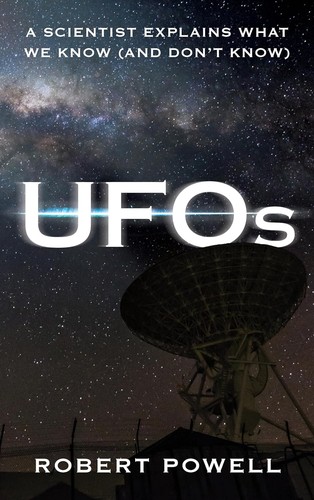
UFOs: A Scientist Explains What We Know (And Don't Know)
Robert Powell's Solo Case for a Scientific UAP Research Discipline
Find on Amazon →As an Amazon Associate, OverClassified may earn from qualifying purchases made through this link, at no extra cost to you.
Why This Is Essential Reading
UFOs: A Scientist Explains What We Know (And Don't Know) earns its place on this list not for breaking new evidentiary ground — nearly every case it leans on hardest (Stephenville, Nimitz, Gimbal/GoFast, Aguadilla, Ubatuba) is a case Powell or his SCU colleagues had already investigated and published on well before this book collected them into one argument — but because it is the clearest single public statement of the analytical standard a working engineer, rather than a journalist or a believer, applies to that evidence. Thomas Bullard's Limina review and the more measured reader reviews alike converge on the same point: this is a methodical, case-by-case book that says plainly when a sighting fails to hold up and argues, with comparable directness, for the specific residue of cases that in Powell's professional judgment do not. Read alongside this site's own UFOs and Government for Powell's earlier, more purely historical collaboration with Michael Swords, and against this site's own case files on Nimitz, Aguadilla, and Ubatuba — several of which document AARO reaching different conclusions than Powell's own SCU teams did — this book is essential as a transparent record of one credentialed researcher's evidentiary standard, not as a final word on any single case it discusses.
Related Cases & Theories
Essential Viewing
04-09-24 Robert Powell, UFOs: A Scientist Explains What We Know (And Don't Know)
Podcast UFO Live Shows — A long-form live interview with Robert Powell discussing the newly published book on the Podcast UFO live show, days after its April 2024 release. Verified via YouTube oEmbed before inclusion.
UFOs: A Scientist Explains The Phenomenon | Robert Powell
Tim Ventura — Tim Ventura interviews Robert Powell about the book's central arguments and the SCU casework, including the Gimbal and GoFast encounters, underlying it. Verified via YouTube oEmbed before inclusion.
Sources Cited
- Powell, Robert. UFOs: A Scientist Explains What We Know (And Don't Know). Rowman & Littlefield, 2024 (ISBN-13 9781538173589, cited here matching this site's own resources library citations). amazon.com
- "UFOs: A Scientist Explains What We Know (And Don't Know)." AbeBooks (Rowman & Littlefield, 2024, ISBN 9781538173589, bibliographic record). abebooks.com
- "UFOs: A Scientist Explains What We Know (And Don't Know)." Harvard Book Store (publisher, format, and hardcover bibliographic listing). harvard.com
- "UFOs: A Scientist Explains What We Know by Robert Powell." Goodreads (reader ratings and reviews, including Lamont S., William Williford, Ron Baumer, and Sharon Zink reviews quoted in this article). goodreads.com
- Bullard, Thomas E. "Review of Robert Powell's UFOs: A Scientist Explains What We Know (And Don't Know)." Limina: The Journal of UAP Studies, Vol. 2, No. 1 (Spring 2025). researchgate.net
- "Limina — The Journal of UAP Studies, Volume 2 Number 1." Society for UAP Studies (table of contents confirming the Bullard review's placement and issue date). societyforuapstudies.org
- "Robert Powell." The Scientific Coalition for UAP Studies (official biography: engineering career, SCU co-founding, current Executive Board Member role). explorescu.org
- "Robert Powell." Center for UFO Studies (official biography: MUFON research directorship, SCU co-founding). cufos.org
- Powell, Robert; Reali, Peter; Thompson, Tim; Beall, Morgan; Kimzey, Doug; Cates, Larry; & Hoffman, Richard. "A Forensic Analysis of Navy Carrier Strike Group Eleven's Encounter with an Anomalous Aerial Vehicle." Scientific Coalition for UAP Studies, March 2019 (Nimitz/Gimbal/GoFast technical report underlying the book's kinematic-anomaly chapters). academia.edu
- Powell, Robert M.; Swords, Michael D.; Rodeghier, Mark; & Budinger, Phyllis. "Isotope Ratios and Chemical Analysis of the 1957 Brazilian Ubatuba Fragment." Journal of Scientific Exploration, Vol. 36, No. 1, Spring 2022, pp. 39–48 (the 2017–2018 HR-ICPMS re-analysis the book uses as its physical-evidence case study). journalofscientificexploration.org
- "Renowned UFO Researcher Robert Powell Unveils Innovative Book: UFOs: A Scientist Explains What We Know (And Don't Know)." EIN Presswire, 2024 (publication announcement). web.archive.org
- "UFOs." Open Library (bibliographic record: publisher, publish date, cover art). openlibrary.org
- This site's own resources library: Full Reading List, where this exact edition (ISBN 9781538173589) is cited across three separate case-file pages.
- This site's own case file: The Stephenville Lights Sighting, for Powell's own foundational 2008 MUFON radar investigation.
- This site's own case file: USS Nimitz / Tic Tac Encounter, for the SCU forensic analysis Powell led and the book draws on directly.
- This site's own case file: Aguadilla CBP FLIR Encounter, for SCU's 2015 technical report and its disputed status against AARO's 2025 resolution.
- This site's own case file: The Ubatuba Magnesium Fragments, for the 2022 isotope re-analysis the book treats as its physical-evidence model case.
- This site's own key-figures entry: Robert Powell, for his full biography and further case connections.
- This site's own essential reading entry: UFOs and Government, for Powell's earlier 2012 collaborative history with Michael Swords.
Have corrections, additional research, or peer-reviewed sources? Help improve this entry.
Suggest an Edit