
The Keesler AFB Weather Tower Sighting
At about 4:05 in the morning on Sunday, April 4, 1965, an Air Force weather observer on duty in the observation tower at Keesler Air Force Base, Biloxi, Mississippi, saw four white lights come in from the southwest under a 1,200-foot cloud deck. As they came closer, Airman Second Class Corum made out a dark oval behind them, "darker than the cloud background," about 40 feet long by his estimate. It crossed just north of the zenith in level flight, with no sound, trail or exhaust, and faded into the clouds to the northeast fifteen to twenty seconds later. The FAA had no aircraft in the area. The Foreign Technology Division's first reply was that the objects "resemble possible A/C observations"; then J. Allen Hynek interviewed Corum, and Project Blue Book closed the case as UNIDENTIFIED. In 2019 the skeptical researcher Tim Printy argued that it was probably a bright fireball. This file reads the surviving documents directly and sets out what fits that explanation and what does not.
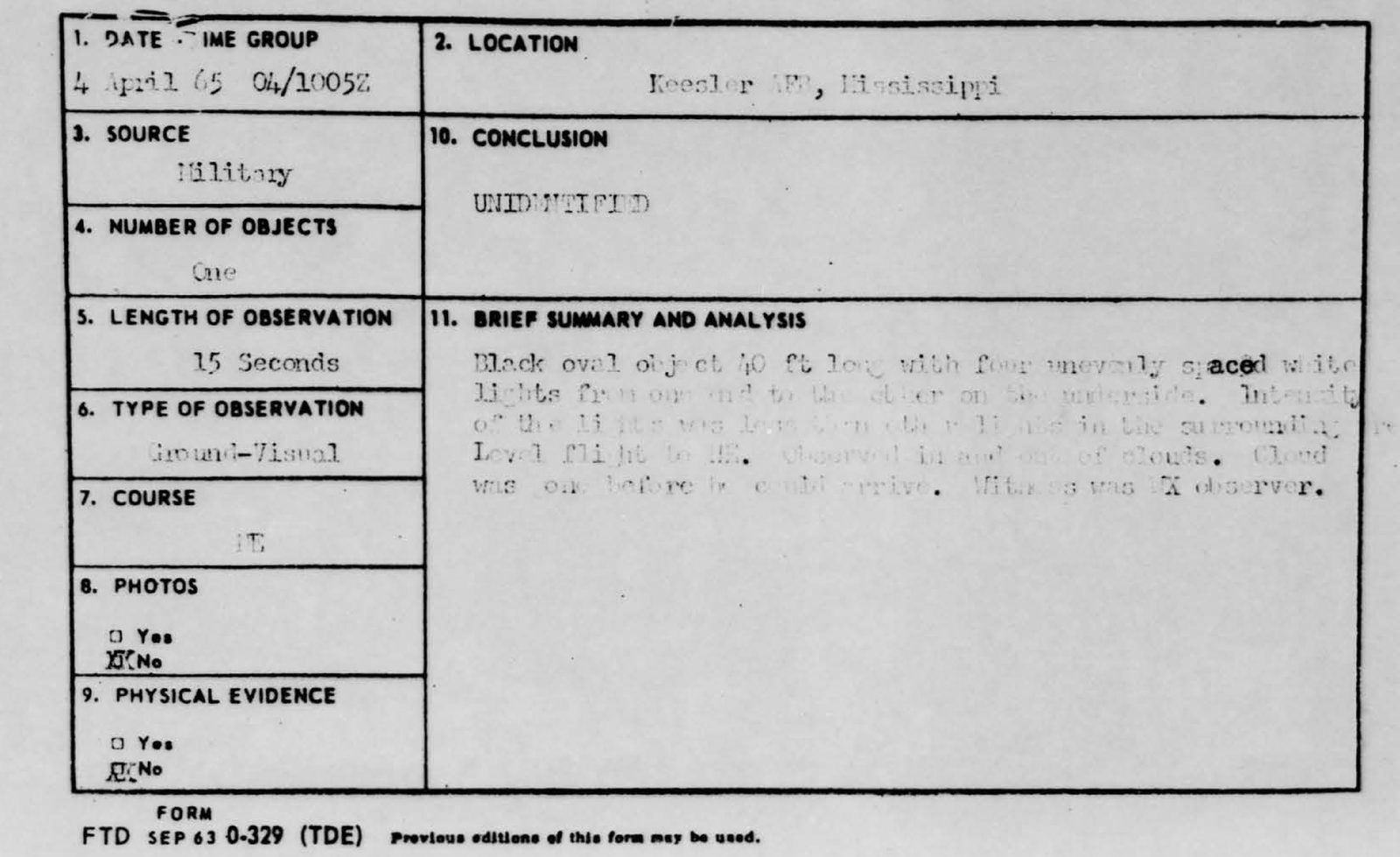
Pictured: the Project Blue Book record card for this case (FTD Form 0-329, Sep 63) — “4 April 65 04/1005Z,” Keesler AFB, Mississippi, source “Military,” one object, 15 seconds, ground-visual, course northeast, conclusion “UNIDENTIFIED,” and a faint summary ending “Witness was WX observer.” It is the Air Force’s own index card, not a photograph; no photograph of the object exists. U.S. government record, public domain.
Theoretical Alignment
The Extraterrestrial Hypothesis gets a low score. Taken at face value, the report describes a silent, wingless, 40-foot body flying level below a 1,200-foot cloud base, which is not any aircraft. But nearly everything that makes it look like a craft depends on one judgment: that the lights and the dark shape were below the clouds and therefore close. The witness first saw only four lights; the dark outline appeared "when the object got closer." Remove the assumption of low altitude, and the same observation reads very differently.
The Interdimensional Hypothesis has nothing to hold: the object came into view, crossed the sky and faded into cloud. The Psycho-Social score is low but not zero. One observer, at four in the morning, for fifteen to twenty seconds, is the situation in which separate lights are most easily joined into one object, a tendency the Air Force-funded Condon study documented in 1968. Nothing suggests fantasy; Corum was a trained observer who reported honestly that he could not identify what he saw.
Background
By 1965 Keesler had been the Air Force's main electronics school for more than fifteen years. According to the base's history, Air Training Command made it its center for radar, radio and electronics training in 1949 and on January 1, 1959 redesignated the wing that ran it as Headquarters, Keesler Technical Training Center: the "TECHTNGCEN" and "HQ KTTC" of this file's teletype. It was also a basic training center from 1950 to 1966. It was not a busy flying base: Corum told Hynek that Keesler "has no flying at night, unless it would be Coast Guard a/c."
The base weather station was run by Detachment 22 of the 24th Weather Squadron, part of the Air Weather Service, which had been assigned to the Military Air Transport Service since June 1948; hence "(MATS)" after the unit name. The teletype calls Corum a "TWR WX observer." His duty was observing and recording the sky over the base, including cloud heights and visibility, and he was doing it when he saw the object.
Project Blue Book was then a small office in the Foreign Technology Division (FTD) at Wright-Patterson AFB, Ohio. Hector Quintanilla was involved with it from July 1963 until it closed in December 1969, according to the preface to his unpublished memoir; here he signs as "Major, USAF, Chief, Aerial Phenomena Branch." Hynek, whom the Air Force had first engaged in the late 1940s to screen reports for astronomical causes (as Blue Book's first chief, Edward J. Ruppelt, recorded), was still its scientific consultant. Reporting was governed by AFR 200-2 of July 20, 1962, replaced by AFR 80-17 in September 1966. When Blue Book closed, the National Archives records, 12,618 sightings had been reported to it and 701 remained unidentified. This is one of the 701. It came a year before the Michigan "swamp gas" episode made Hynek's and Quintanilla's methods a national controversy.
Complete Timeline
| Date / Time | Event |
|---|---|
| April 3–4, 1965, about 9:05 PM or 2:05 AM CST | A student at Perkinston Junior College, five miles south of Wiggins, Mississippi, sees a light-red oval with a darker red trailing light heading south-southeast for about five minutes. The faint teletype time reads 0305Z or 0805Z; Printy reads 0805Z. |
| About 2:00 AM CST (0800Z) | Brookley AFB, Mobile, Alabama, receives a UFO report, "classified" according to the Keesler teletype. A Blue Book case at St. Petersburg, Florida, at the same hour is later listed as a rocket-body decay (per Printy). |
| About 3:30 AM CST (0930Z) | Two naval air cadets from Ellyson Field, Pensacola, see "a ball of flame about 15 feet long from which two objects appeared to emerge." |
| About 4:05 AM CST (1005Z) | A2C Corum, in the Keesler weather tower, sees four white lights and a dark oval cross from southwest to northeast below the clouds in 15–20 seconds. He calls another observer, too late, and the FAA, which has no aircraft in the area. |
| About 4:20 AM CST | Astronomical twilight begins at Biloxi. The Moon, a thin crescent, is about 38° below the horizon throughout (computed). |
| 3:45 PM CST (042145Z) | Keesler sends teletype UNCLAS CAS 00166 to Air Defense Command, the 73rd Air Division at Tyndall AFB, FTD and the Secretary of the Air Force's information office, carrying "UFO Report Nr 1" (Wiggins) and "UFO Nr 2" (Corum). Reporting officer: Capt. Samuel P. Wheate. |
| April 4, 23:24 UTC | The Corona J-19 satellite re-enters, seen over Austria and Germany (Molczan's catalog), about 13 hours after the Keesler sighting. |
| April 1965 | FTD replies (UNCLAS/TDEW(UFO) 13569): "Objects resemble possible A/C observations." Drafted by Maj. Hector Quintanilla, Jr. |
| 1965 (dates not recorded) | Hynek interviews Corum and re-times the sighting at 17 seconds. Blue Book's summary concludes that "the case is carried as unidentified." |
| December 17, 1969 | The end of Project Blue Book is announced. The case remains one of its 701 unidentified. |
| January 1974 | Don Berliner's "The Blue Book Unknowns" lists the case, with the student's report as a "confirmation" that is "not clear from available data." |
| March–April 2019 | Printy, SUNlite 11-2, argues for reclassification as "possible meteor." |
| February 3, 2026 | Version 1.35 of Brad Sparks's catalog lists the case as entry 1606, with "[radar?]" in its evidence column. |
What Corum Saw
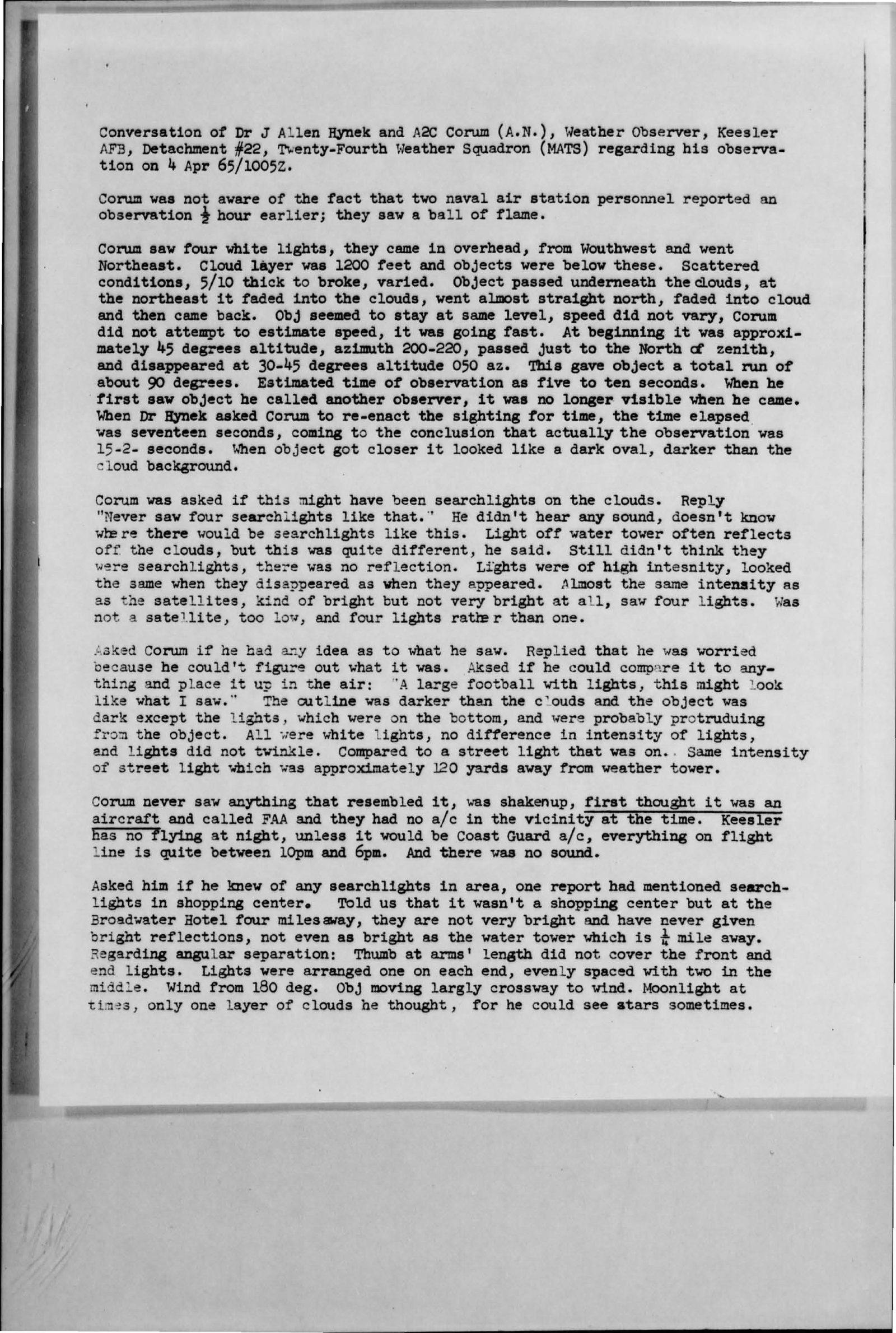
The file holds four accounts: the teletype of April 4, the record card, a typed Blue Book case summary, and a typed page headed "Conversation of Dr J Allen Hynek and A2C Corum (A.N.), Weather Observer, Keesler AFB, Detachment #22, Twenty-Fourth Weather Squadron (MATS)." They agree on the essentials.
The teletype gives an "oval," "40 feet long," "black," with "four white evenly spaced lights from one end to the other on the underside" and "intensity of lights less than those in local area," in "level flight moving NE," "in & out of bases of clouds at 1200 ft," for "15 seconds — called for his buddy to see but object was gone before his friend could verify." Blue Book's summary adds the sequence: "At first the witness only noticed four lights, but when the object got closer it looked like a dark oval, darker than the cloud background." The lights were first seen at about 45° elevation and 200–230° azimuth; the object "passed overhead and headed northeast" and "faded into the clouds 15–20 seconds later at approximately 30°–45° elevation and 050° azimuth." Corum "stated that it was fast," and there was no "sound, trail or exhaust."
The Hynek interview
The interview record is the most revealing document in the file, because it shows the account being tested. It notes that Corum "was not aware of the fact that two naval air station personnel reported an observation ½ hour earlier; they saw a ball of flame." The object "seemed to stay at same level, speed did not vary," passed "just to the North of zenith," and at the northeast "faded into the clouds, went almost straight north, faded into cloud and then came back." Corum's own estimate of the duration was "five to ten seconds"; when Hynek had him re-enact it, "the time elapsed was seventeen seconds."
Hynek then went through the alternatives. Searchlights? "Never saw four searchlights like that." The water tower's light "often reflects off the clouds, but this was quite different." The lights were "almost the same intensity as the satellites, kind of bright but not very bright at all," but it "was not a satellite, too low, and four lights rather than one." Asked what he had seen, Corum said he "was worried because he couldn't figure out what it was," and offered: "A large football with lights, this might look like what I saw." "The outline was darker than the clouds and the object was dark except the lights... All were white lights, no difference in intensity of lights, and lights did not twinkle."
He "first thought it was an aircraft and called FAA and they had no a/c in the vicinity at the time"; someone has underlined that sentence. The local searchlight was "at the Broadwater Hotel four miles away" and had "never given bright reflections, not even as bright as the water tower which is ¼ mile away." On size: "Thumb at arms' length did not cover the front and end lights." The page ends: "Moonlight at times, only one layer of clouds he thought, for he could see stars sometimes."
The accounts differ in small ways. The lights were less bright than local lights (teletype), "of high intensity" (summary), and "not very bright at all" (interview). The duration is 15 seconds (teletype, card), 5–10 (Corum's first estimate), 17 (re-enactment) or 15–20 (summary). The typed accounts all say "evenly spaced"; the faint card may read "unevenly." And only the interview has the object "come back," without saying where.
The "Confirmation" from Wiggins
The teletype carried two reports, and the first was not Corum's. "UFO Report Nr 1" describes a "light red" oval that "had darker red trailing light or light effect approximately 10 feet behind," at "300 feet altitude, 500 feet ground distance away," in "level flight, heading SSE," at "500 mph approx (estimate)," for "5 minutes, approx." The observer was a student at Perkinston Junior College, "5 mi S of Wiggins, Miss."; his name is redacted in the released file and is not given here. (The college took the name Perkinston Junior College in 1942 and is now part of Mississippi Gulf Coast Community College.)
Berliner's 1974 list called the student's report a "confirmation" that was "not clear from available data," and Sparks repeats it. The documents show why. Perkinston is about 29 miles north-northwest of Keesler (computed). The object was red with a trail, not black with four white lights; it went south-southeast, not northeast; it lasted five minutes, not fifteen seconds. Its time is printed "0403057" or "0408057." Printy reads 0805Z, about 2:05 AM CST, two hours before Corum's sighting; on this teletype the 8 often prints like a 3 (the student's longitude is printed "39-09W," which must be 89-09W). If the digit is a 3, the time is 9:05 PM the evening before. Either way it was not the same moment. Its own figures do not fit together either: at 500 mph an object would travel about 40 miles in five minutes (computed), so it could not have stayed 500 feet away.
One coincidence is worth recording. If the time was 0805Z, it falls in the same hour as the classified report received by Brookley AFB at 0800Z and the St. Petersburg case at 0800Z, which Printy took together as "nothing more than a fragmenting meteor." None of this links the Wiggins report to Corum's. FTD's reply nonetheless has "4 Apr. Wiggins, Miss." written at the top.
The Investigation
Corum's own checks came first: a colleague, too late, and the FAA, which "reported no aircraft in the area at the time of the sighting." The base added two more, recorded at the end of the teletype. "A check with NAS Pensacola base ops revealed that two naval air cadets from Ellyson NAS, at about 0930Z sight a ball of flame about 15 feet long from which two objects appeared to emerge. The O.D. at Ellyson had no info." And "a Brookley AFB CP revealed a UFO report had been received by them at 0800Z but the report was classified." Ellyson Field, the Navy's helicopter training field north of Pensacola, is about 103 miles east of Keesler; Brookley AFB, at Mobile, about 53 miles east-northeast (computed). Neither report is in the file. The teletype was sent at 042145Z by Capt. Samuel P. Wheate ("Samiel" on the faint copy) of the operations staff at Keesler's headquarters, and the copy in the file is stamped "Corrected copy of message previously released."
FTD's answer, drafted by Quintanilla, is one paragraph: "Reference your message, cite CAS 00166, 5 Apr 65. Objects resemble possible A/C observations. Request compliance with para 14K and para 16 of AFR 200-2." "Objects" suggests one verdict on both reports. This file has not seen the 1962 text of AFR 200-2. Paragraph 14 was the reporting paragraph (Keesler's own 1963 report on another sighting is submitted under "paragraph 14, AFR 200-2, 20 July 1962"), and in the teletype's numbered format, item K is simply the reporting officer's name. In the 1966 regulation that replaced AFR 200-2, the corresponding item k asks for the preparing officer's details and "comments ... including his preliminary analysis of the possible cause of the sighting." If the 1962 item was similar, FTD was asking Keesler for its own analysis, which the teletype had not given; the file does not show a reply. "Possible aircraft" was a natural first guess from a teletype about lights in level flight, but the report itself said the FAA had none.
Hynek's interview, whose date the file does not give, tested exactly the explanations a skeptic would raise: aircraft, searchlights, reflections, satellites and the duration. Blue Book's summary rejects each in turn. The FAA had no aircraft. "A balloon has to be discarded as a possible explanation since the wind was from 180° and the object was mainly moving cross-wise to the wind." A cloud reflection was possible, "but the observer stated that the object was quite different." The satellite was rejected because the object "was too low, and had four lights rather than one." The summary does not mention a meteor. It ends: "With such available information the case is carried as unidentified. All alternatives are not substaniated [sic] with conclusive data to warrant a definite explanation."
That verdict is narrower than it sounds: it says only that no explanation Blue Book considered could be confirmed. It should be weighed like any official finding. Blue Book under Quintanilla was criticized for forcing conventional labels onto reports, so an UNIDENTIFIED from that office means even a project disposed to explain cases did not explain this one. But the office was small, often worked from what bases sent it, did not on these pages consider a meteor, and cannot be audited beyond the pages in the file. The label is one input, not a verdict, in either direction.
Later retellings add nothing. Berliner's one-line entry ("One 40' black, oval object with four lights along the bottom, flew in and out of the clouds for 15 seconds") is repeated in Patrick Gross's transcription and in Sparks's catalog, which adds "[radar?]." Printy "could not find any mention of radar" in the file, and neither has this file. No press coverage, later witness statement or video has been found.
Keesler in the Blue Book Files
Corum's was not the first report from Keesler. A search of the Internet Archive's Project Blue Book collection for files whose identifiers name the base returns twelve case files from 1952 to 1967, this one included, plus a separate folder of photographs for one of them. The conclusion on each record card below was read from the card image itself, not from the archive's OCR text, which prints every checkbox option and cannot show which was marked. Read together, they show how the office handled reports from this base, and where the 1965 case stands among them.
- May 7, 1952. Four Air Force men at a navigation site near the base watched about ten small, bright "aluminum or silver" objects dart in and out of the clouds for five to ten minutes. Card: Unknown. This is the case in this site's Keesler AFB Sighting file.
- August 10, 1952, about 2:10 AM CST. Two civilians, one of them a radar instructor at Keesler, saw two orange, oval objects the size of a penny at arm's length perform "erratic maneuvers" at about 200 mph for five to ten seconds. Card: Possibly Balloon.
- February 26, 1954, at night (0120Z on the 27th). Three servicemen saw a "round, bright, incandescent" object the size of a volleyball travel straight from south to north for five seconds, then split and disappear. Card: Probably Astronomical, with "Meteor" typed beside it and the comment "Description indicates meteor."
- March 7, 1954, late morning. A crew sent up from Keesler in a C-45 to look for an object reported over Wiggins was redirected by the Brookley tower to one over Mobile, circled beneath it for two hours, and photographed it with a stereoscopic camera; a T-33 pilot put it at about 47,000 feet. It was white and translucent, with a streamer hanging below, drifting east at about 20 mph. Card: Was Balloon, with the comment that the photographs show an "apparent brilliant blob of light" and that "all sources believe obj to have been a balloon reflecting sun light." A separate file, 2928, holds two of the prints.
- March 11, 1954, at dusk. A staff sergeant, a weather analyst, at an open-air movie near the base saw seven to nine round, pale orange objects in a V formation, with "a low pitched flutter," cross in two or three seconds from 45° elevation at an azimuth of about 200° to a point overhead. Keesler reported that analysis and questioning of the observer "did not result in explanation of sighting." Card: Was Astronomical, "Meteors," with the comment "Bolide observation."
- February 7, 1956, morning. Three objects in a cluster were seen from the ground and from aircraft, including an F-86 whose pilot put it at about 40,000 feet over Dauphin Island, and picked up by a local radar unit; through a theodolite the base identified them as large plastic balloons tied together, drifting east at about 60 knots. Card: Was Balloon, "Definitely identified as balloon cluster."
- October 1, 1959, about 4:52 AM. An airman walking to breakfast with two others saw a round object the size of the full Moon, about 5° to the right of Venus, change from white to orange and appear to explode, over about three minutes; he first wrote to the Atomic Energy Commission. Card: Insufficient Data for Evaluation, "Data incomplete for analysis."
- December 3, 1960, at dusk. An airman third class on duty as a weather observer, in the weather observation tower 70 feet above the ground, followed a steady white light the size of an average star with a clinometer for five minutes as it crossed from west to east. FTD sent back a list of questions. Card: Other: "Poss satellite," with the comment that a "request for satellite information [was] not answered, however since this sighting has all the characteristics of a satellite in orbit, case will be carried as a possible satellite."
- April 7, 1962. Not a sighting but a find: the remnants of a large polyethylene balloon, 1,000 to 1,500 pounds, with no markings or payload, recovered near the base. FTD's memo for the record: "Called Capt Joe Kittinger. Balloon belongs to him. He wants it and will make necessary arrangements. Also notified Dr Hynek of situation." Card: Was Balloon.
- September 23, 1963, about 10:20 PM. Two airmen on the base and a staff sergeant five and a half miles west saw a glowing contrail with no visible aircraft, which seemed to "explode" and left a lingering cloud. Keesler's covering letter, citing "paragraph 14, AFR 200-2, 20 July 1962," judged it most likely a jet. Card: Other: "Contrails," with "also possible meteor contrails" written in by hand.
- April 4, 1965. Corum's sighting. Card: UNIDENTIFIED.
- March 28, 1967, about 10:10 PM. A serviceman standing in a neighbor's yard in base housing saw an elongated fireball "the size of a 4 engine airliner" with an orange-yellow flame and falling pieces cross overhead, straight and level, westward, for one and a half to two minutes. Keesler's reporting officer suggested "a re-entry burn out of some space trash"; a memo of April 3 records that the space-tracking system (SPADATS) found no decay or re-entering debris at that time. Card: Astro (Meteor) (Fireball), with "Prob." added by hand and "? Trail?" written beside the duration.
The pattern is plain. Of the twelve files, four ended as balloons (one only "possibly"), three as meteors, one as a possible satellite and one as contrails. One was closed for insufficient data. Two were left unexplained: the 1952 daylight objects and Corum's. The explained cases are not obviously weaker reports. The 1956 cluster was seen from the ground and the air and on radar before a theodolite settled it; the 1954 balloon was watched for two hours from a circling aircraft. Where a cause was available, Blue Book used it.
Three of these files bear directly on Printy's argument. In 1954 and again in 1967, observers at Keesler reported objects that split, flamed or shed pieces, and Blue Book called them meteors. In March 1954 it did so for a formation of orange lights crossing from about 45° at an azimuth of about 200° to overhead, almost the same path as Corum's object, even though the base itself had not been able to explain it. And in 1967 it accepted a fireball seen for one and a half to two minutes, with only a handwritten question mark beside the duration. The office was willing, in other words, to apply the meteor label to Keesler reports with long durations and odd details. It did not do so in 1965. The surviving pages do not say why: the summary simply never mentions a meteor. One reading is that Hynek, an astronomer, heard Corum's description of steady, unchanging lights on a dark body below the cloud and did not think it sounded like one. Another is that the meteor explanation was never seriously considered. The file supports neither over the other.
The 1960 file is a closer parallel in another way. It, too, came from an airman on watch in the base weather observation tower, using his instruments to fix angles, and FTD's response was to ask for more data and then settle on the most likely conventional cause. In 1965 FTD's first reply was much the same, but after Hynek's interview the case went the other way. Of the two reports from the base weather tower in these files, the 1960 light became a possible satellite; Corum's remained unidentified, one of only two Keesler files across fifteen years that Blue Book did not explain.
Printy's Fireball Argument
The only detailed analysis is Tim Printy's two-page review, "The 701 Club: Case 9345 April 4, 1965 Keesler AFB Mississippi," in SUNlite 11-2 (March–April 2019), part of a series on the cases Blue Book left unidentified. Its points, in order:
- The "confirmation" is not one: two hours earlier, about 30 miles away, five minutes long, heading south-southeast.
- A fragmenting meteor at 0800Z. The Wiggins and St. Petersburg sightings, at about the same time and in the same direction, "were probably related." Blue Book called the St. Petersburg case a rocket-body decay, but Ted Molczan's catalog of observed re-entries shows the only re-entry that date at 2324Z, so "it seems this was nothing more than a fragmenting meteor." Printy judged a link to Keesler "unlikely": wrong direction, two hours apart.
- Pensacola may be the Keesler event. The cadets' "ball of flame" came 35 minutes earlier on the record, and fireball report times in the American Meteor Society's database "can be as much as an hour or more" off. If one object was seen from both places, "then it was much higher than 1200 feet."
- The sky was not overcast. Weather Underground's history gives Biloxi as partly cloudy at 4 AM, which "tends to confirm" that some stars were visible.
- Separate lights become one object. "The Zond IV event, as well as others, demonstrate that witnesses can, and do, perceive a group of individual lights as being connected to a larger object."
- Conclusion: "it is plausible that this was an observation of a bright fireball visible passing between and visible through thin clouds," citing NASA's report of a 2018 Michigan fireball "so bright that it was seen through clouds." He recommends reclassification as "possible meteor."
Several points check out independently. Molczan's current catalog still lists the April 4, 1965 re-entry at 23:24 UTC: the Corona J-19 satellite, seen over Austria and Germany. The Condon Report's study of the March 3, 1968 Zond IV re-entry, by William K. Hartmann, found that "the two most lengthy unsolicited reports described the apparition as a cigar-shaped craft with a row of lighted windows." And the geometry supports Printy in a way he did not mention. Corum's object crossed about 90–105° of sky in 15–20 seconds. At the 80–100 km where meteors glow, that is a path of roughly 160–270 km, or about 8–18 km/s (computed for this file); meteoroids enter the atmosphere at about 11 to 72 km/s. The crossing fits a slow meteor on a shallow path, and four lights more than a thumb-width apart would be fragments a few kilometers apart.
What in the file sits poorly with a fireball
The file also records things a fireball would not usually do, or that Corum specifically said did not happen. They are facts from the documents, not a rebuttal.
- Duration. "A fireball usually lasts only a few seconds" (American Meteor Society). This one lasted 15–20 seconds by re-enactment: possible on a shallow path, but long.
- Steady lights. They "looked the same when they disappeared as when they appeared," were equal in brightness and "did not twinkle," with no trail. Fireballs often fragment visibly and leave trains, though most trains last only seconds.
- Constant motion. "Speed did not vary."
- Below the clouds. Every account puts the object below the 1,200-foot cloud base, judged by a man whose job was judging that cloud base. A meteor seen through gaps could look as if it went "in and out" of the cloud, but it would be seen through the cloud, not under it.
- A dark body, "darker than the clouds." Zond IV shows observers can supply such a body, but Corum said he saw one.
- "And then came back," if it means what it seems to, is something a meteor cannot do. It is an unclear paraphrase.
- Pensacola. "A ball of flame... from which two objects appeared to emerge" sounds like a fragmenting fireball, and not much like four steady white lights on a dark body.
The geometry cuts both ways. If the object really was just under a 1,200-foot cloud base, the same crossing implies only about 70–150 mph (computed), and a 40-foot object would span about 2°, just more than a thumb's width, consistent with Corum's own estimate. Those numbers describe a slow, low, silent object; "fast" was an angular impression. Low and silent is hard to square with an aircraft, and the FAA had none. High and fast is easy to square with a meteor, but harder to square with what Corum said about the clouds, the dark body and the steady lights. The record does not decide between them.
Key Witnesses
A2C Corum
Named in the teletype, the case summary and the Hynek interview, which gives his initials as "A.N." On duty in the base weather tower at about 4:05 AM on April 4, 1965, he took the lights first for an aircraft, called the FAA and a fellow observer, and later described the sighting to Hynek in detail, including a re-enactment and a thumb-width size estimate. No later statement by him, and nothing else about him, has been found.
Samuel P. Wheate
Not a witness. Reporting officer for both reports in teletype CAS 00166 (printed "Samiel P. Wheate"), which records the base's checks with NAS Pensacola and Brookley AFB.
J. Allen Hynek
Not a witness. Interviewed Corum, re-timed the sighting at seventeen seconds, and questioned him on searchlights, reflections, satellites, aircraft and angular size before the case was closed as unidentified.
Hector Quintanilla
Not a witness. Drafted FTD's first reply: "Objects resemble possible A/C observations."
The student at Perkinston Junior College, whose separate report is discussed above, is not named here; his name is redacted in the released file.
The Five Observables Assessment
The Five Observables framework, associated with former AATIP director Luis Elizondo, classifies UAP reports by performance characteristics beyond known technology. Applied to this report, it finds one observable that is arguably present in a weak form and four that are not.
Assessment:
- Anti-gravity lift (speculative). A silent, wingless 40-foot body in level flight below 1,200 feet would need unexplained support, but only if it was as low and as solid as Corum judged.
- Instant acceleration (absent). "Speed did not vary."
- Hypersonic speed (absent as an anomaly). About 70–150 mph at cloud-base height; natural meteor speeds at meteor height.
- Low observability (absent). The lights were plainly visible.
- Trans-medium travel (not applicable).
On this framework the case is weak. Its interest lies in the witness and the dark body against the cloud deck, not in performance.
Evidence Assessment
Supporting Anomalous Origin
- An on-duty Air Force weather observer, in a weather tower, whose job was judging cloud heights.
- He placed the object below a 1,200-foot cloud base and saw a dark body "darker than the cloud background."
- No sound, trail or exhaust; level flight at constant speed; steady, non-twinkling lights.
- No aircraft in the area (FAA); no night flying at Keesler.
- Hynek interviewed him, tested the obvious explanations and re-timed the sighting; Blue Book, whose first read was "possible aircraft," closed it as UNIDENTIFIED.
Supporting Conventional Explanation
- One witness, 15–20 seconds, at night; the object was first seen as lights only.
- A "ball of flame" was reported near Pensacola 35 minutes earlier on the record; fireball report times are often off by that much.
- A probable fragmenting meteor was reported across the region at about 0800Z the same night.
- The crossing fits real meteor speeds at meteor height, and bright fireballs can be seen through thin cloud.
- Observers of the Zond IV re-entry turned separate fragments into a single "craft."
- The "confirmation" is a different report; there was no radar or photograph.
Why "Disputed"
The Keesler AFB Weather Tower Sighting is stamped DISPUTED with a score of 38/100. Its strengths are a better-than-average witness and investigation for a 1965 night sighting: a working weather observer who checked with the FAA and gave positions, angles and cloud heights, then a Hynek interview that tested the obvious explanations, and an Air Force that moved from "possible aircraft" to unidentified. Its weaknesses are just as plain: one witness and nothing else, fifteen to twenty seconds at night, lights first, a "confirmation" that is a different report, and a specific, credible conventional candidate with support from another report the same night. That candidate has real problems with the file's details, which is why the score is not lower; but it has never been ruled out.
Among this site's Mississippi Blue Book cases, it sits just above the earlier Keesler AFB Sighting (Disputed, 36), which had four witnesses but small objects at unknown range and no traffic check, because this case has a traffic check, a Hynek interview and a closer, more detailed description; its single witness and stronger skeptical candidate keep it close. It sits below the Meridian "Flying Cymbal" (Disputed, 44), a single witness in daylight at close range, and the Jackson Airborne Sighting (Disputed, 46), with three witnesses in daylight, and between the Natchez Trace Ranger Sighting (35) and the Flora, Mississippi Police Encounter (42). The UNIDENTIFIED label is weighed as one input: it neither shows that the object was anomalous nor rules out the explanation Blue Book never examined.
Sensor & Instrumentation Detection Profile
No instrument recorded the object.
- Radar. None mentioned in the file. Sparks's "[radar?]" is a query, not a finding.
- Air traffic control. The FAA had no aircraft in the vicinity. The file does not say which facility was called or whether its answer rested on radar or flight plans.
- Weather observations. The tower's observations are the source of the cloud base and wind; the observation sheets are not in the file.
- Other reports. NAS Pensacola and Brookley AFB were contacted; Brookley's report was classified and is not in the file.
- Cameras. None; the card marks "Photos: No."
Environmental & Geospatial Context
Keesler lies on the east side of Biloxi, between the Mississippi Sound and the Back Bay. The object came in from the southwest, over the Sound, and left toward the northeast, over the Back Bay. Gulfport is about 10 miles west-southwest, Perkinston about 29 miles north-northwest, Brookley AFB about 53 miles east-northeast, and Ellyson Field about 103 miles east (computed).
Weather
The teletype gives "scattered to clear conditions, vis good (5 miles)," with "1500 broken, variable scattered" at BIX, Keesler's station identifier; surface wind southwest at 10 knots, winds aloft backing to west and northwest with height. Corum told Hynek the cloud was at 1,200 feet, "5/10 thick to broke," with stars visible "sometimes." Printy's check gives Biloxi as partly cloudy at 4 AM. A low, broken deck with gaps matters to both explanations: it is the cloud the object went "in and out of," and the cloud through which a high fireball might have been glimpsed. The automatically computed weather field in the Forensic Data Profile below is a modern daily reanalysis, not an observation; the file's own figures are the better source.
The sky
Computed with NASA JPL's Horizons system for Keesler's position: at 4:05 AM CST the Sun was about 21° below the horizon, and astronomical twilight began at about 4:20. The Moon, a crescent about 7 percent lit, was about 38° below the horizon and did not rise until after dawn. The interview's note "Moonlight at times" therefore cannot describe the sky at the time of the sighting; it may refer to earlier in the night or be a misrecording. The dark outline was not a silhouette against moonlit cloud; the cloud base, if lit at all, would have been lit from below, by the base and the town. The file names three such lights: a water tower whose light "often reflects off the clouds," a street light 120 yards away, and the searchlight at the Broadwater Hotel, a Biloxi resort, four miles away. Corum knew all three and said this was "quite different."
Observer Credibility & Occupational Profile
Corum's occupation is the strongest thing in the case. A tower weather observer's estimate of a 1,200-foot cloud base, and his judgment that the object was below it, are not a casual observer's guesses, and he knew the local lights and their reflections. He behaved as a careful witness: he tried the ordinary explanation first by calling the FAA, called a colleague, accepted Hynek's re-timing of his own estimate, and claimed no knowledge of what it was. Nothing suggests embellishment. The limits are those of any single observer. He was alone when it mattered. The dark body, the key element, was by his own description a later impression, formed as the object "got closer" against a dark, broken cloud deck, and a weather observer's training is in judging clouds, not the distance of a light of unknown size. Whether a light is just under a cloud or far above a gap in it can be hard to tell at night.
Physical & Material Assays
No physical evidence exists. The record card marks "Physical Evidence: No." The object never came near the ground, and nothing was searched for or recovered.
Historical Precedents & Archive Matches
- May 7, 1952, the Keesler AFB Sighting. Four Air Force men near Keesler reported small, bright objects darting in and out of the clouds; Blue Book carried it as Unknown. The two cases share a base and little else.
- July 17, 1957, the RB-47 Bomber Chase, whose first electronic contact, near Gulfport, has been attributed by skeptics to Keesler's radar classes.
- March 3, 1968, the Zond IV re-entry (no case file on this site): the Condon Report's demonstration that witnesses can see a structured craft in a line of burning fragments.
- The night of April 3–4, 1965: the Wiggins report, Brookley at 0800Z, St. Petersburg at 0800Z and the Pensacola ball of flame at 0930Z. Only Keesler and Wiggins are in this file.
Material Analysis
There is no material to analyze. This section looks instead at the physical description and what each explanation predicts.
The lights
Four white lights in a line, one at each end and two evenly spaced between, equal in brightness, steady, not twinkling, unchanged from first sight to last. A breaking fireball gives a line of lights, and the American Meteor Society describes bolides as often showing visible fragmentation, but a burning fireball is an evolving event, and Corum described nothing changing. An aircraft at 1,200 feet would have been heard, and Corum, who first took it for one, ruled that out himself after calling the FAA.
The body and the silence
"Darker than the cloud background": if the cloud base was faintly lit from the ground, a solid object beneath it would show as a dark shape, which is what Corum described. It is also what the mind can build from a regular row of lights against a patchy, dark sky. The silence cuts the same way. From an object within about 1,200 feet it rules out most aircraft; from a meteor at 80 km it is expected, since any sonic boom from a large fireball arrives minutes later.
Supporting Non-Terrestrial or Anomalous Origin
- A dark, solid-looking body with four identical steady white lights, below a 1,200-foot cloud base, seen by a weather observer.
- No sound, wings, trail or exhaust from an object apparently within a quarter mile.
- No aircraft, no balloon, and no searchlight or reflection in the observer's experienced judgment.
Supporting Terrestrial Origin
- No physical, photographic or instrumental evidence exists.
- The object was first seen as lights only, at night, against a broken cloud deck.
- A fireball seen through or between clouds would also be silent and would cross that much sky in that time at meteor height.
The Conventional Explanation Candidate
No explanation was established at the time, and none can be proved now. As with every official finding on this site, Blue Book's two verdicts, "possible A/C" and then UNIDENTIFIED, are treated as inputs rather than conclusions.
A bright fireball seen through broken cloud
Printy's explanation, set out above, is the strongest conventional candidate. It accounts for the silence, the absence of aircraft, a line of lights, the angular rate and the "in and out of the clouds" appearance, and it has support in the Pensacola "ball of flame" the same night and in the documented tendency of observers to join separate lights into one craft. Against it are the duration, the steady, unchanging lights, the lack of a train, the constant speed, the observer's firm placement of the object below the cloud base, the dark body and the unclear "came back." It is plausible, not established.
An aircraft
FTD's first suggestion. A slow aircraft at about 1,000 feet would fit the computed angular speed and the level flight. But the FAA had none in the area, Keesler had no night flying, an aircraft that low would have been heard, and Corum, who first took it for one, did not think it was one after watching it. A Coast Guard aircraft was the only local exception he named, and nothing in the file shows it was checked.
A balloon
Rejected by Blue Book on the wind. More decisively, a balloon would not cross 90° of sky in 20 seconds at any height consistent with Corum's account, and would not carry four white lights.
Searchlight or reflection
The Broadwater Hotel searchlight and the water tower's reflections were familiar to Corum, who said this was "quite different." Four separate lights moving steadily together do not match a beam on cloud.
A satellite or re-entry
Four lights rather than one, and no re-entry until 2324Z (Molczan). With the Sun 21° below the horizon, only high satellites would have been sunlit.
A genuine unidentified object
On this reading, a weather observer saw a dark, silent, 40-foot craft with four lights on its belly cross his base below the cloud deck at a little over 100 mph. It rests on his training, his position, his care and his firmness about the cloud height and the dark body, and on Blue Book's final verdict. It is weakened by everything that makes a single, brief night sighting of lights hard to interpret, and by a natural explanation that fits most of the evidence. The record cannot separate the two.
Bright Fireball (Printy)
PlausibleSilent; fits the angular rate at meteor height; four lights as fragments; a Pensacola "ball of flame" the same night. But 15–20 seconds, steady non-twinkling lights, no train, and an object placed below the cloud base with a dark body.
Aircraft
Unlikely but UnexcludedFTD's first read. Fits the level flight; but the FAA had no traffic, there was no sound, and Keesler had no night flying.
Balloon
ImplausibleToo fast across the sky, and carried no such lights; Blue Book rejected it on the wind.
Searchlight / Reflection
ImplausibleThe witness knew the local searchlight and water-tower reflections and said this was "quite different."
Satellite / Re-entry
ImplausibleFour lights, not one; no re-entry until 2324Z.
Genuine Unidentified Object
InconclusiveRests on one trained observer's judgment that a dark body was below the clouds. Not ruled out; not supported by anything else.
Related Cases
Confirmed Documents & Official Records
From the Project Blue Book File
Eight pages of the ten-page Project Blue Book file for case 9345, as read for this case file: the record card, the case summary, the four pages of Keesler's teletype, FTD's reply and the typed record of Hynek's conversation with the witness. U.S. Air Force records, public domain (Project Blue Book, Internet Archive item 1965-04-9071466-KeeslerAFB-Mississippi); the student's name was redacted before release. Click any page to open it full size.
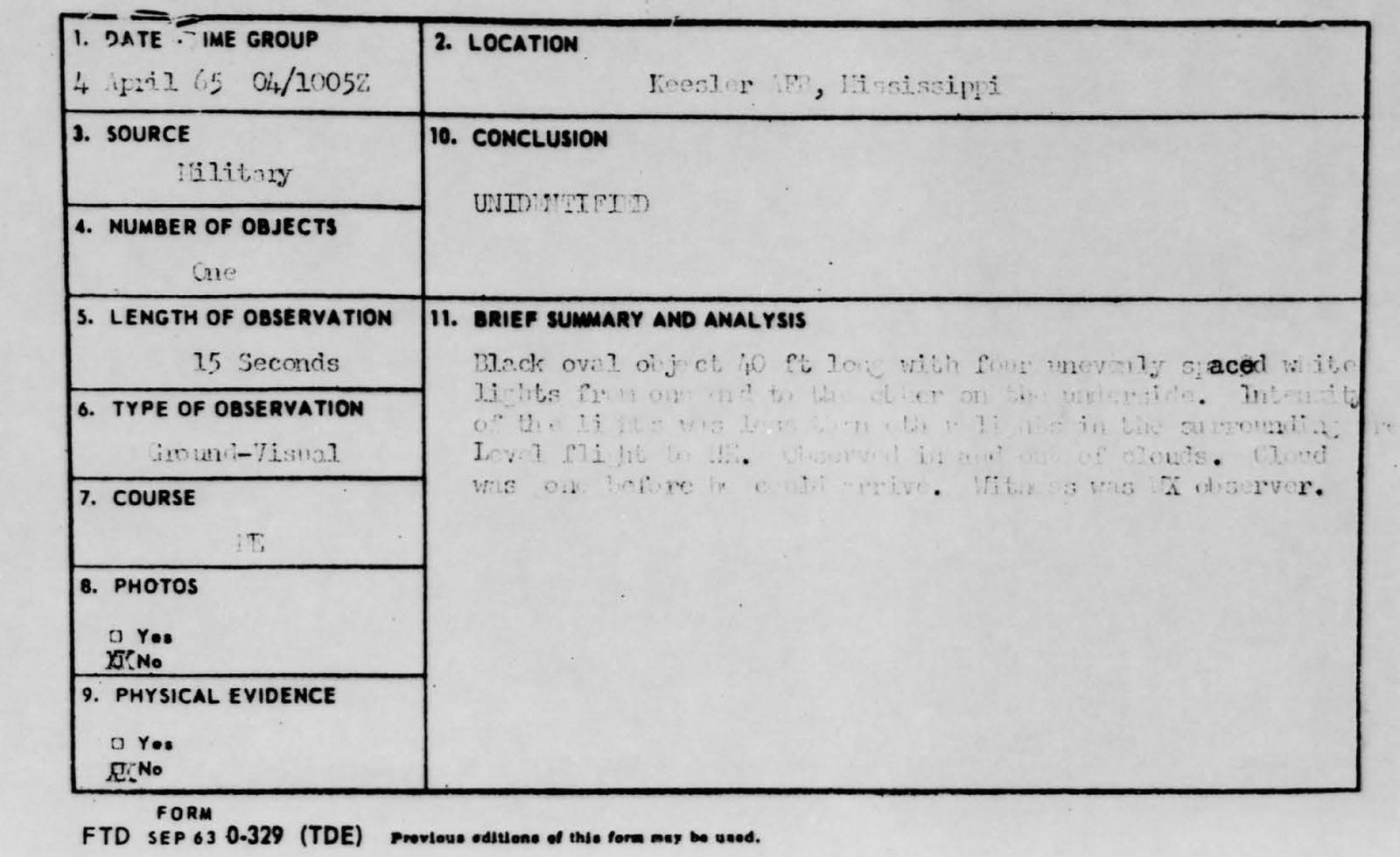
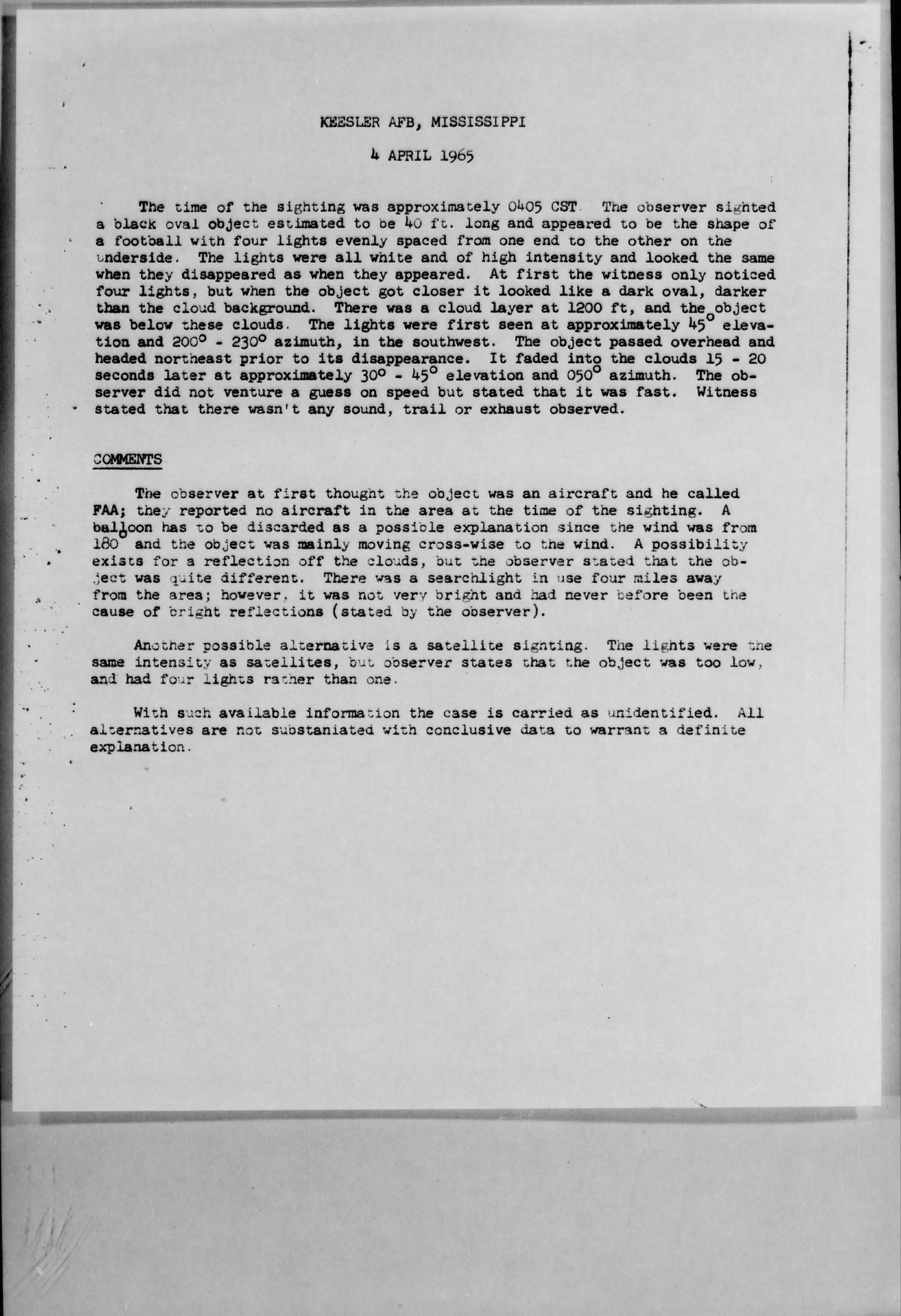
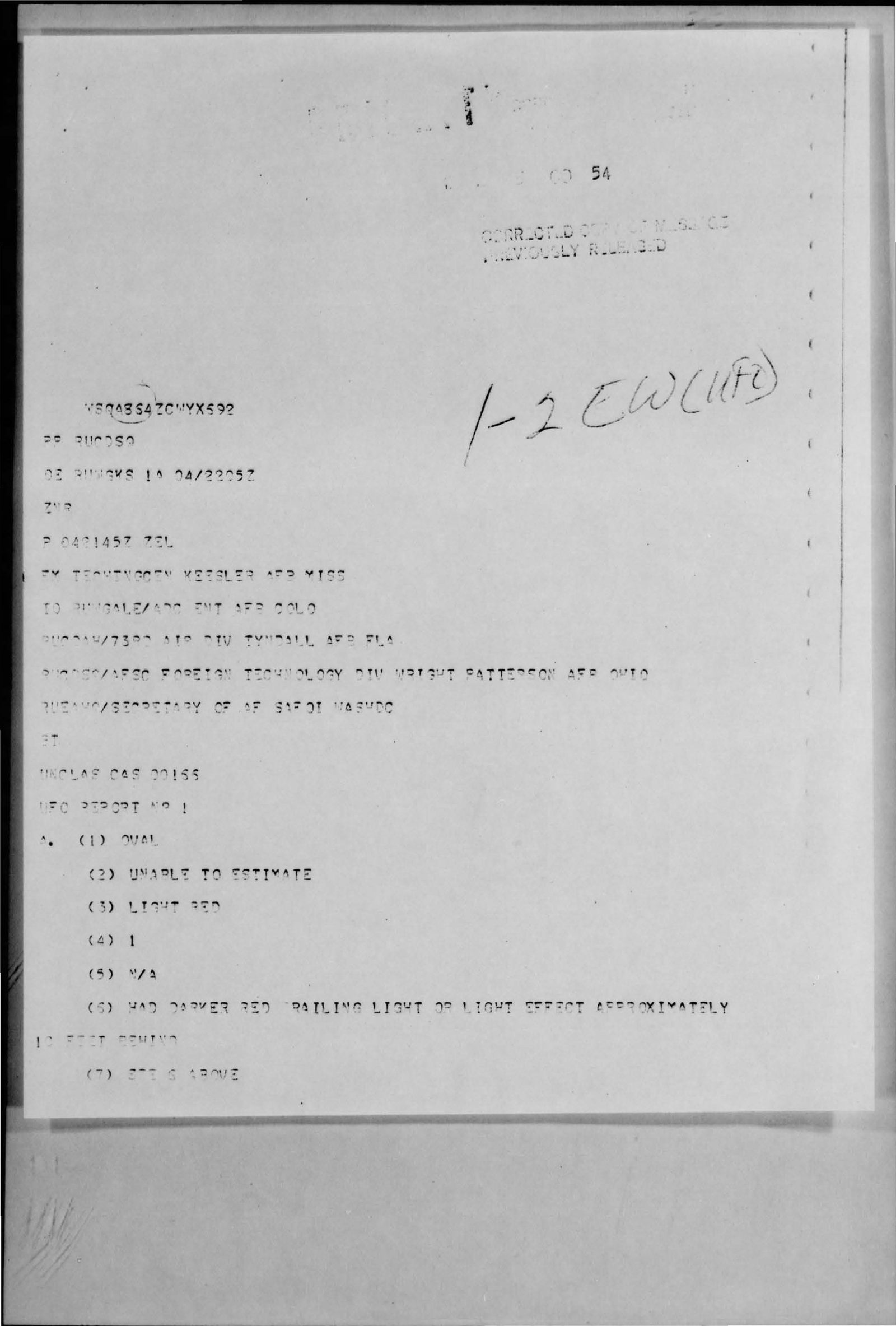
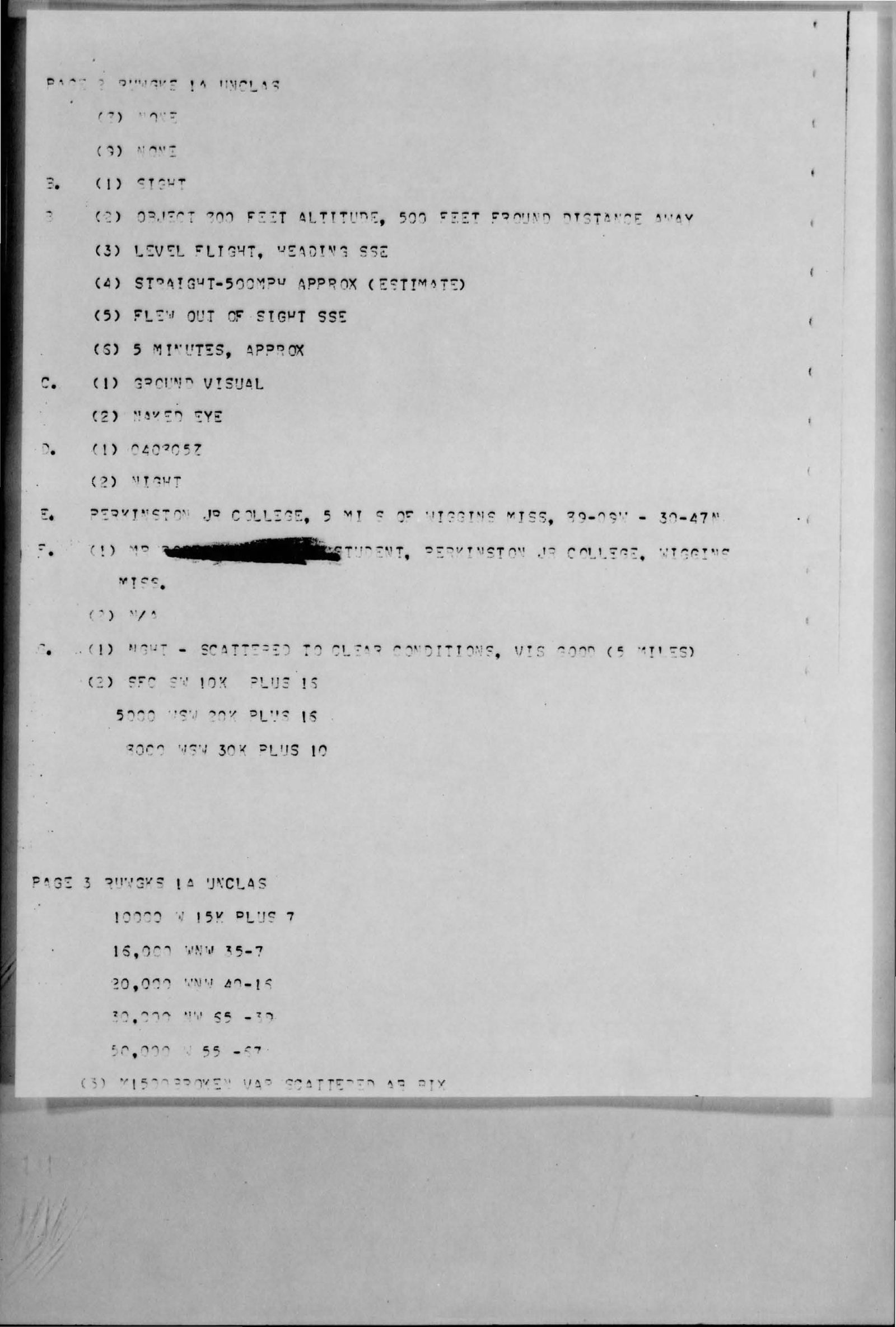
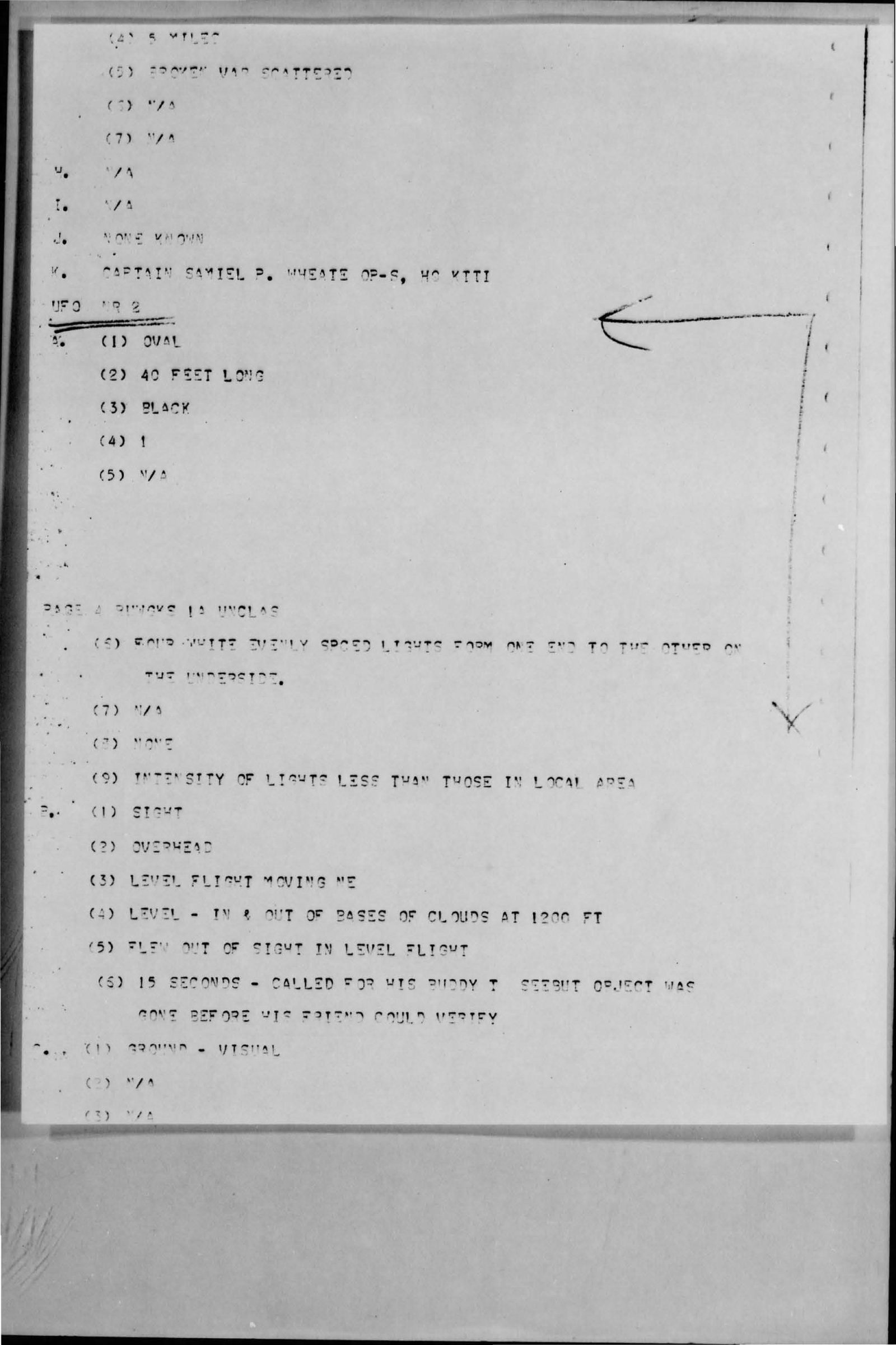
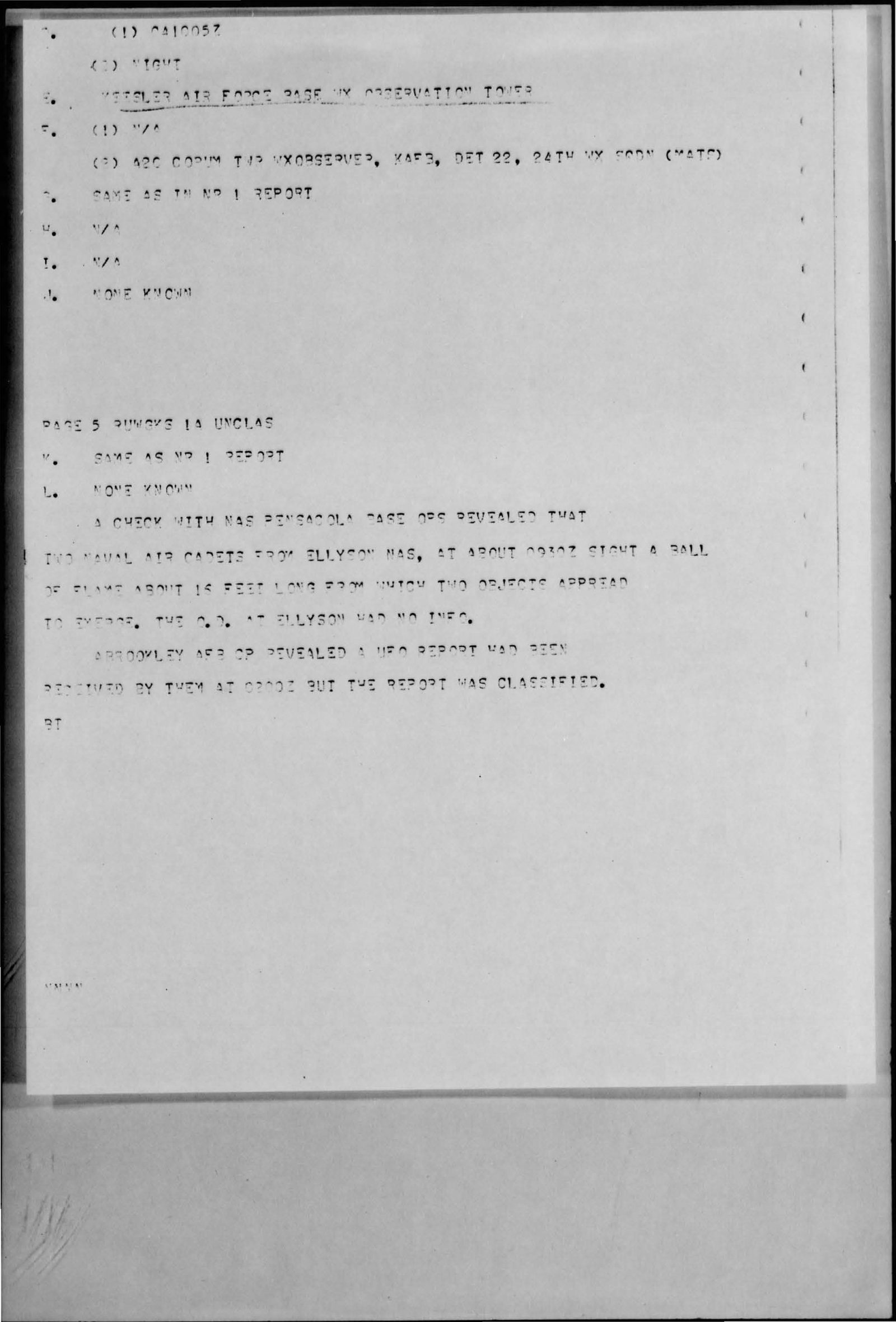
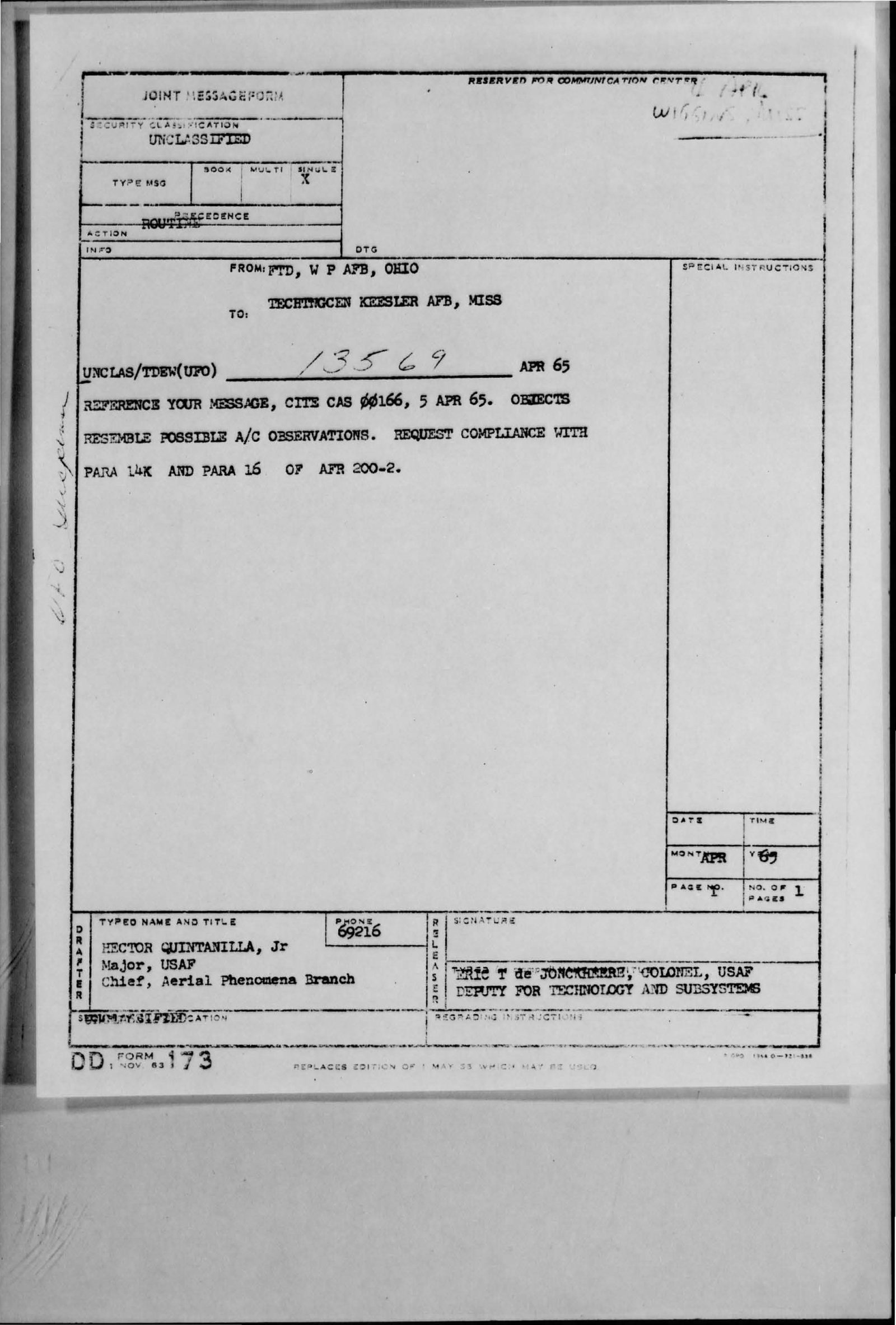
The ten-page released Project Blue Book file for this case (Fold3 file 9071466), part of the Internet Archive's Project Blue Book collection. The primary source for this case file; the page images were read directly.
UNCLASSIFIEDThe same file in Fold3's “Project Blue Book – UFO Investigations, 1947–1969” collection, scanned from the National Archives microfilm (page 3 shown; Fold3 is a commercial site and full viewing may require an account).
UNCLASSIFIEDThe catalog series for the released, name-redacted Blue Book case files (Record Group 341), filmed as microfilm publication T1206.
UNCLASSIFIEDNARA's fact sheet on Project Blue Book: 12,618 sightings reported from 1947 to 1969, 701 unidentified; termination announced December 17, 1969.
UNCLASSIFIEDSearch Government Archives Directly
Further Reading — Recommended Literature
The UFO Experience: A Scientific Inquiry
The interviewer in this file on his two decades as the Air Force's consultant, and on how Blue Book handled reports like this one.
The Hynek UFO Report
Hynek's account of the Blue Book files and the cases the Air Force left unexplained.
UFOs and Government: A Historical Inquiry
A documented history of official UFO investigation, including Blue Book under Quintanilla in the 1960s.
DISCLOSURE: Some links above are affiliate links. If you purchase through them, OverClassified receives a small commission at no additional cost to you. This helps support independent research.
Essential Viewing
No Videos Available
Sources
- U.S. Air Force, Foreign Technology Division, Project Blue Book. Record card, “4 April 65 04/1005Z — Keesler AFB, Mississippi” (FTD Form 0-329, Sep 63; conclusion “UNIDENTIFIED”). In Blue Book file “1965 04 9071466 KeeslerAFB Mississippi”: archive.org
- Project Blue Book. Case summary and comments, “Keesler AFB, Mississippi, 4 April 1965” (“With such available information the case is carried as unidentified”). Same file: archive.org
- Headquarters, Keesler Technical Training Center. Teletype UNCLAS CAS 00166, DTG 042145Z [April 1965], to ADC Ent AFB, 73rd Air Division Tyndall AFB, AFSC Foreign Technology Division Wright-Patterson AFB and SAF-OI; UFO Report Nr 1 (Perkinston Jr College) and UFO Nr 2 (Keesler weather tower); reporting officer Capt. Samuel P. Wheate; “Corrected copy of message previously released.” Same file: archive.org; Fold3 pages 3 and 5: fold3.com (p. 3); fold3.com (p. 5)
- Foreign Technology Division, Wright-Patterson AFB. Joint Messageform (DD Form 173), UNCLAS/TDEW(UFO) 13569, April 1965, to TECHTNGCEN Keesler AFB: “Objects resemble possible A/C observations,” drafted by Hector Quintanilla, Jr., Major, USAF, Chief, Aerial Phenomena Branch; released by Eric T. de Jonckheere, Colonel, USAF. Same file: archive.org
- “Conversation of Dr J Allen Hynek and A2C Corum (A.N.), Weather Observer, Keesler AFB, Detachment #22, Twenty-Fourth Weather Squadron (MATS) regarding his observation on 4 Apr 65/1005Z” (typed record, one page). Same file: archive.org; Fold3 page 7: fold3.com
- U.S. Air Force, Project Blue Book. Case file “Keesler AFB, Mississippi,” 7 May 1952 (record card: Unknown); conclusion read from the record card image. Internet Archive item 1952-05-6316037-KeeslerAFB-Mississippi: archive.org
- U.S. Air Force, Project Blue Book. Case file “Keesler AFB, Mississippi,” 10 August 1952 (record card: Possibly Balloon; Air Intelligence Information Report IR-4-52); conclusion read from the record card image. Internet Archive item 1952-08-8759886-KeeslerAFB-Miss: archive.org
- U.S. Air Force, Project Blue Book. Case file “Keesler AFB, Mississippi,” 26 February 1954 (record card: Probably Astronomical, meteor); conclusion read from the record card image. Internet Archive item 1954-02-6780232-KeeslerAFB-Mississippi: archive.org
- U.S. Air Force, Project Blue Book. Case file “Keesler AFB, Mississippi,” 7 March 1954 (record card: Was Balloon; C-45 crew statement); conclusion read from the record card image. Internet Archive item 1954-03-6780676-KEESLERAFB: archive.org
- U.S. Air Force, Project Blue Book. Case file “Keesler AFB, Mississippi,” File 2928, March 7, 1954 (two photographs); conclusion read from the record card image. Internet Archive item 1954-03-7276085-KeeslerAFB-Mississippi-2928-: archive.org
- U.S. Air Force, Project Blue Book. Case file “Keesler AFB, Mississippi,” 11 March 1954 (record card: Was Astronomical, meteors, “Bolide observation”); conclusion read from the record card image. Internet Archive item 1954-03-6780796-KeeslerAFB-Mississippi: archive.org
- U.S. Air Force, Project Blue Book. Case file “Keesler AFB, Mississippi,” 7 February 1956 (record card: Was Balloon, balloon cluster); conclusion read from the record card image. Internet Archive item 1956-02-7340476-KeeslerAFB-Mississippi: archive.org
- U.S. Air Force, Project Blue Book. Case file “Keesler AFB, Mississippi,” 1 October 1959 (record card: Insufficient Data for Evaluation); conclusion read from the record card image. Internet Archive item 1959-10-6958991-KeeslerAFB-Miss: archive.org
- U.S. Air Force, Project Blue Book. Case file “Keesler AFB, Mississippi,” 3 December 1960 (record card: Other, possible satellite; weather tower observer); conclusion read from the record card image. Internet Archive item 1960-12-8601908-KeeslerAFB-Mississippi: archive.org
- U.S. Air Force, Project Blue Book. Case file “Keesler AFB, Mississippi,” 7 April 1962 (record card: Was Balloon; recovered balloon, memo naming Capt. Joe Kittinger); conclusion read from the record card image. Internet Archive item 1962-04-8649917-KeeslerAFB-Mississippi: archive.org
- U.S. Air Force, Project Blue Book. Case file “Keesler AFB, Mississippi,” 23 September 1963 (record card: Other, contrails; Keesler letter citing paragraph 14, AFR 200-2); conclusion read from the record card image. Internet Archive item 1963-09-9734461-KeeslerAFB-Miss: archive.org
- U.S. Air Force, Project Blue Book. Case file “Keesler AFB, Mississippi,” 28 March 1967 (record card: Astro (Meteor) (Fireball), probable; SPADATS memo); conclusion read from the record card image. Internet Archive item 1967-03-7468186-KeeslerAFB-Miss: archive.org
- Internet Archive. “1965 04 9071466 KeeslerAFB Mississippi” (U.S. Air Force, ten pages; Project Blue Book collection, contributed by Michael Best). archive.org
- Printy, Tim. “The 701 Club: Case 9345 April 4, 1965 Keesler AFB Mississippi,” SUNlite 11, no. 2 (March–April 2019): 6–7. (Download PDF): astronomyufo.com
- Berliner, Don. “The Project Bluebook ‘Unknowns’,” compiled for the Fund for UFO Research (entry for April 4, 1965, Keesler AFB). NICAP: nicap.org
- Berliner, Don. Blue Book “unknowns,” 1965 entries (April 4, 1965, Keesler AFB, A/2c Corum), transcribed by Patrick Gross, UFOs at Close Sight: ufology.patrickgross.org
- Sparks, Brad. “Comprehensive Catalog of 2,200 Project Blue Book UFO Unknowns,” version 1.35, February 3, 2026, entry 1606 (BB case 9345, April 4, 1965, Keesler AFB; “[radar?]”), p. 314. NICAP (Download PDF): nicap.org
- Molczan, Ted. “Visually Observed Natural Re-entries of Earth Satellites” (version of September 7, 2025): 1965 Apr 04, 23:24 UTC, 1965-026A, Corona J-19, seen from Austria and Germany. (Download PDF): satobs.org
- Hartmann, William K. “Processes of Perception, Conception, and Reporting,” Section VI, Chapter 2, in Scientific Study of Unidentified Flying Objects (Condon Report, 1968/1969): the Zond IV re-entry of March 3, 1968. NCAS online edition: files.ncas.org
- U.S. Air Force. AFR 80-17, “Unidentified Flying Objects (UFO),” 19 September 1966 (“supersedes AFR 200-2, 20 July 1962”; FTD's role), Appendix B of the Condon Report. Project 1947: project1947.com
- National Archives. “Project BLUE BOOK — Unidentified Flying Objects” (12,618 sightings, 701 unidentified; termination announced December 17, 1969; microfilm T1206). archives.gov
- National Archives Catalog. Series 597821, “Sanitized Version of Project Blue Book Case Files on Sightings of Unidentified Flying Objects.” catalog.archives.gov
- Quintanilla, Hector. “UFOs, An Air Force Dilemma” (unpublished manuscript; NIDS preface: Quintanilla's involvement with Blue Book July 1963 to December 1969). The Black Vault: theblackvault.com
- Ruppelt, Edward J. The Report on Unidentified Flying Objects. Garden City, NY: Doubleday, 1956 (Project Gutenberg e-text: Hynek's contract to screen reports for astronomical causes). gutenberg.org
- Keesler Air Force Base. “History of Keesler Air Force Base” (fact sheet: electronics training from 1949; Headquarters, Keesler Technical Training Center from January 1, 1959; basic training 1950–1966). keesler.af.mil
- Department of the Air Force Historical Support Division. “Air Force Weather Agency (USAF)” (lineage fact sheet: Air Weather Service assigned to the Military Air Transport Service from June 1, 1948). dafhistory.af.mil
- Mississippi Gulf Coast Community College. “MGCCC History” (Perkinston Junior College named in 1942; Mississippi Gulf Coast Community College from October 1, 1987). mgccc.edu
- Freeman, Paul. “Abandoned & Little-Known Airfields: Florida, Pensacola area” (NAS Ellyson Field: helicopter training from 1950, north of Pensacola airport, flight operations ended December 28, 1973). airfields-freeman.com
- Wikipedia. “Brookley Air Force Base” (Mobile, Alabama; Air Force Logistics Command; closure announced November 19, 1964, closed June 1969; used for orientation only). en.wikipedia.org
- Mississippi Public Broadcasting. “Biloxi Memories: The Broadwater Beach Hotel.” mpbonline.org
- American Meteor Society. “Fireball FAQ” (“a fireball usually lasts only a few seconds”; visible fragmentation; trains; sonic booms 1.5 to 4 minutes after; several thousand fireball-class meteors a day). amsmeteors.org
- American Meteor Society. “Meteor FAQ” (entry speeds about 11–72 km/s; visible at roughly 80–120 km). amsmeteors.org
- NASA, Watch the Skies. “Bright Fireball Spotted Over Michigan,” January 18, 2018 (“so bright that it was seen through clouds”; cited by Printy). nasa.gov
- NASA Jet Propulsion Laboratory. Horizons System ephemerides for the Sun and Moon as seen from 30.41° N, 88.92° W, April 4, 1965, 08:00–12:00 UT (computed for this file). ssd.jpl.nasa.gov
- OverClassified. Keesler AFB Sighting case file, Jackson Airborne Sighting case file, Meridian “Flying Cymbal” case file, Flora, Mississippi Police Encounter case file and Natchez Trace Ranger Sighting case file (score calibration).
See something inaccurate? Have additional information or sources?
Suggest an Edit →Last Updated: October 2026