
The Meridian "Flying Cymbal"
At about 5:50 PM on Monday, July 10, 1967, Harold Washington, a 44-year-old retired Marine Corps captain who worked as the golf professional at Naval Auxiliary Air Station Meridian, was driving home in light rain when his white 1965 Corvair lost power and coasted to a stop, and its radio went silent. He got out to look at the engine. Seconds later, by his account, an object "of excessive size" shaped like the cymbal on a drum set swept over the road 200 to 300 feet above him with a rushing, swishing sound, tilted up just short of a line of pines, darted to the right and climbed almost straight up into the low clouds. A herd of black Angus cattle in the next pasture bolted. When the object was gone, his radio started playing again and the car started normally. A Naval Investigative Service agent took his report that evening, checked the station's radar and control tower, walked the site before dark and interviewed the neighbors. Project Blue Book carried the case, number 11869, as Unidentified, and its scientific consultant, J. Allen Hynek, wrote that it should stay that way, "since we have no evidence that this person was mentally unbalanced." This file sets out what the surviving government documents say, where they disagree with each other and with later retellings, and what can and cannot be said about it now.
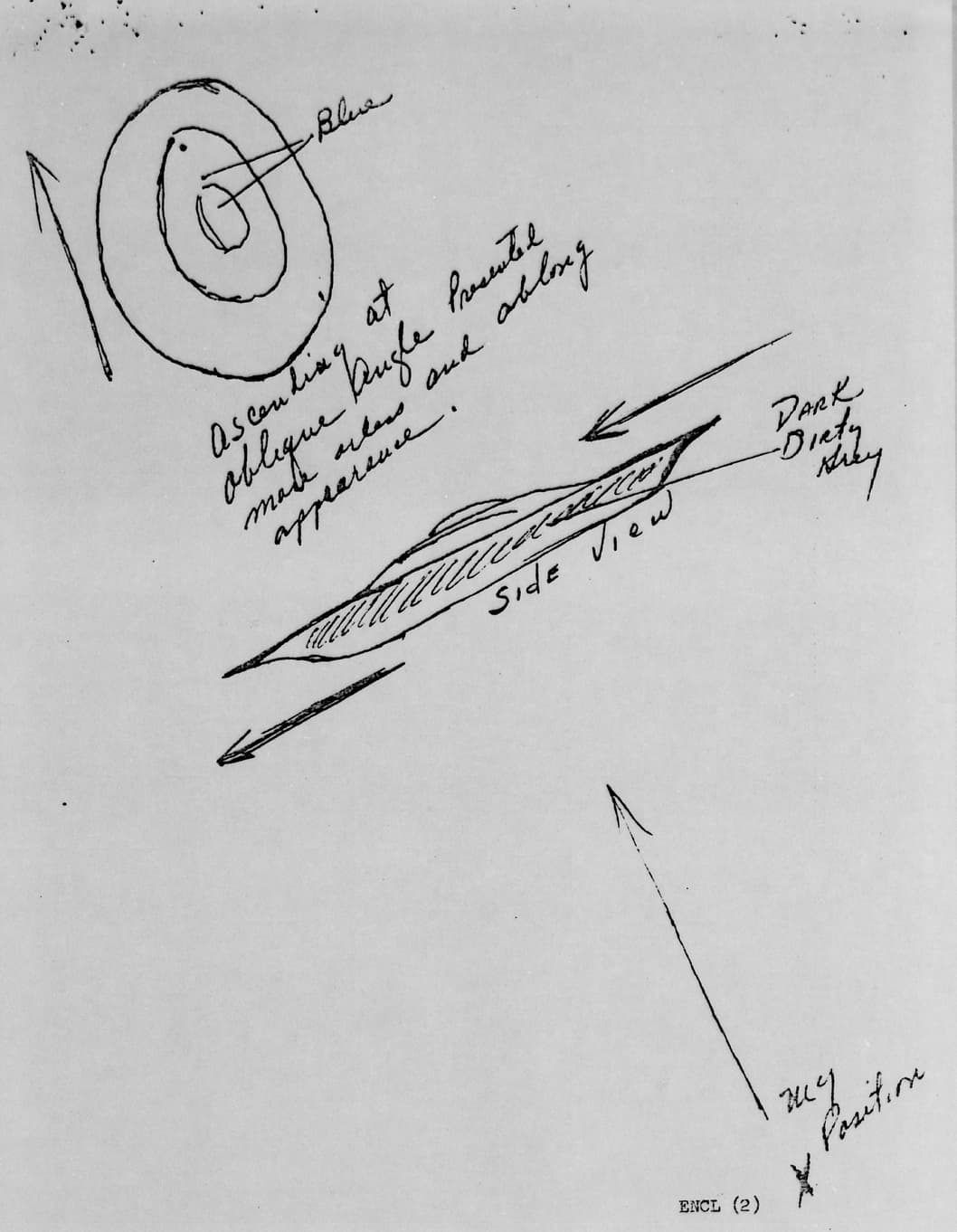
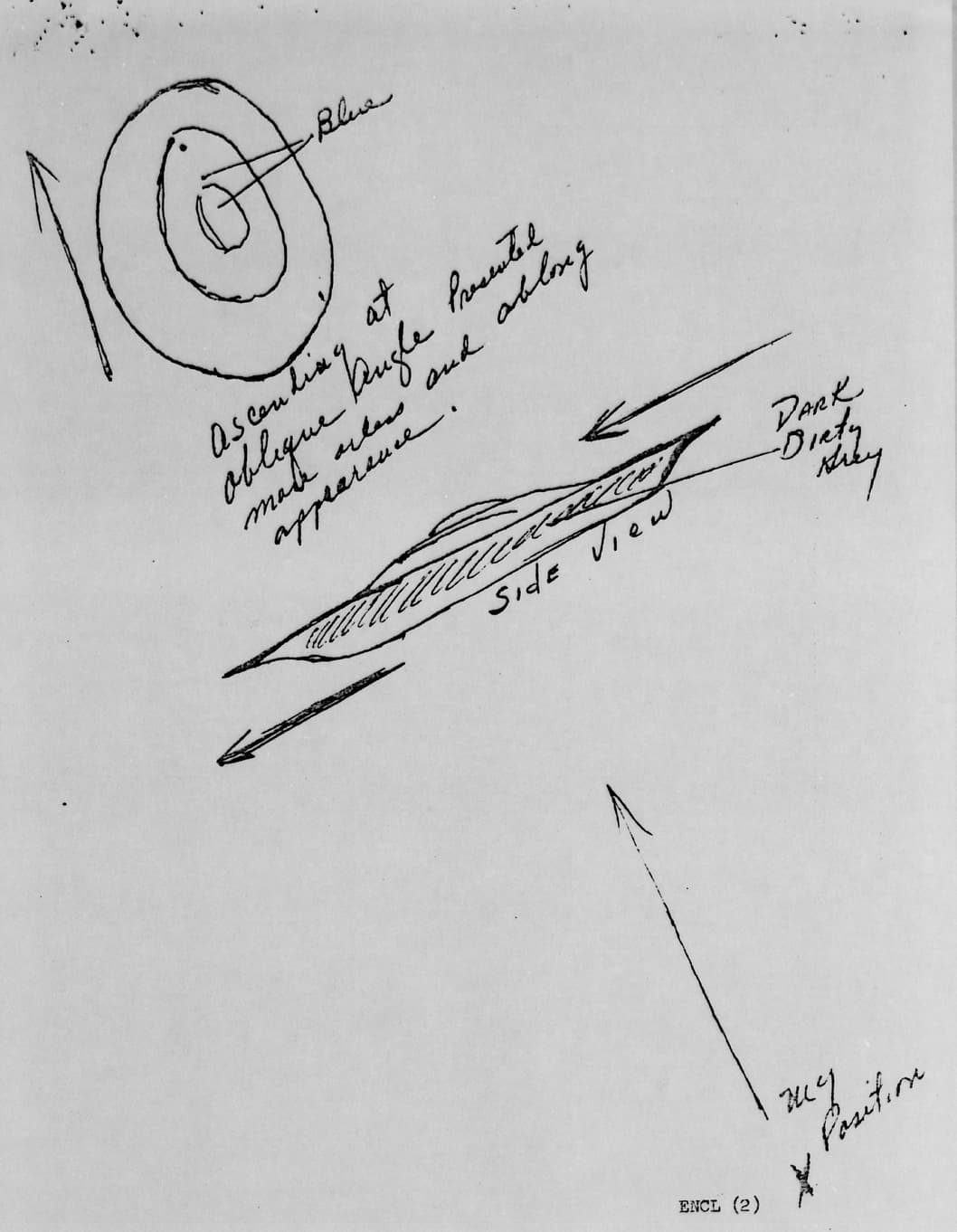
Pictured: the witness’s own pencil sketch, filed with his signed statement of July 11, 1967 in Project Blue Book case 11869 — a top view of the dish (center labeled “Blue”) and a side view of the thin disc labeled “Dark Dirty Grey.” It is a drawing made from memory the day after, not a photograph; no photograph of the object was taken. U.S. government record, public domain.
Theoretical Alignment
The Extraterrestrial Hypothesis gets its score from the content of the report itself. The witness described a large, structured, silent object passing a few hundred feet overhead in daylight, an apparent effect on his car's electrical system, a reaction from animals, and a departure that he compared to "the sharp darting movement of a hummingbird." Those are the features that, taken at face value, separate a report like this from a distant light. Hynek, reviewing the case for the Air Force, said that in "our present scientific framework" a soundless tilt, acceleration and climb into the clouds within a few seconds was "utterly impossible." Nothing in the file, however, points to an origin of any kind. The witness did not say what he thought it was, and he saw no openings, markings or occupants. The score stays well short of half.
The Interdimensional Hypothesis has little to work with. The object appeared and left in a physical way: it came from one direction, crossed a road, tilted and climbed into cloud. There is no appearance or disappearance in place, no missing time, and no perceptual oddity beyond the event itself.
The Psycho-Social alignment reflects the fact that this is a single-witness report lasting, by the witness's own estimate, three to five seconds. Hynek himself wrote that without the car stoppage and the animal effect "it would seem logical to ascribe this to a hallucination on the part of the single witness," and that "we have only the witness's word" for both. He then declined to do so, because there was no evidence the witness was unbalanced. The score here is not a finding that anyone imagined anything. It records that a very short, unexpected, single-observer event is the kind of experience in which perception and memory are most easily shaped by surprise and fear.
Background
Lizelia is an unincorporated community on Mississippi Highway 39 in Lauderdale County, about 12 miles north of Meridian. It had a post office under that name from 1886 to 1911. In 1967 the most important thing nearby was the Navy. Naval Auxiliary Air Station Meridian, about 4½ miles east-northeast of Lizelia (computed), had been commissioned in July 1961 on land straddling Lauderdale and Kemper counties, 11 miles northeast of the city. Its operations area was named McCain Field. Training Squadron Seven (VT-7) arrived in July 1961, and on December 15, 1961 it split to form Training Squadron Nine (VT-9). Both flew the North American T-2 Buckeye jet trainer, designated T-2A from 1962. The station became a full Naval Air Station by July 1968, a year after this sighting, which is why the 1967 documents use both "NAAS" and "NAS."
The T-2A was a single-engine, two-seat jet, about 38 feet 8 inches long with a 36-foot wingspan, powered by a Westinghouse J34 turbojet. Its appearance in this case is not incidental. The witness himself used it as a yardstick: according to the Navy agent, he said the object was large enough to make a T-2A "by comparison, appear as being the size of a child's toy." Living and working beside a busy jet training base, he saw T-2As every day.
The witness was the station's golf professional. The Naval Investigative Service report and the Air Force's teletype both identify him as a civil service employee and a retired Marine Corps captain. He was 44, lived in Meridian, and drove a 1965 white Corvair. The Corvair was Chevrolet's compact car of the 1960 to 1969 model years, and its engine was air-cooled and mounted at the rear. That explains a small detail in his statement: when the car died, he "had taken several steps to the rear in preparation of exploring the trouble."
The investigation fell to the Navy rather than the Air Force for practical reasons. The witness worked on a naval station and knew a Naval Intelligence man. The Navy had its own standing order, OPNAV Instruction 3820.9 of November 10, 1955, titled "Unidentified flying objects; reporting of," and the agent's report cites it as his authority. The Air Force's Project Blue Book, then headed by Lt. Col. Hector Quintanilla at Wright-Patterson Air Force Base, was the federal collection point for such reports, and the case reached it by teletype from Columbus Air Force Base, Mississippi, three days later.
Mid-1967 was a busy and uncomfortable time for Blue Book. Under heavy criticism after the 1966 Michigan sightings and the "swamp gas" episode, the Air Force had contracted with the University of Colorado in October 1966 for an outside scientific study under the physicist Edward U. Condon. The Colorado project was in the middle of its fieldwork in July 1967. Blue Book was still receiving and classifying reports. By the National Archives' count, of the 12,618 sightings reported to it between 1947 and 1969, 701 remain "Unidentified." This is one of them.
Complete Timeline
| Date / Time | Event |
|---|---|
| July 1961 | Naval Auxiliary Air Station Meridian is commissioned; VT-7 arrives. VT-9 is formed there on December 15, 1961. Both fly the Buckeye jet trainer (T-2A from 1962). |
| October 1966 | The Air Force signs its contract with the University of Colorado for the study later known as the Condon Report. |
| July 10, 1967, about 5:00–5:30 PM | A doctor's wife who lives beside a cattle pasture on the road takes her maid home at 5:00 PM and returns at about 5:30. |
| About 5:30–5:35 PM | The witness's car goes through "a heavy rain" 15 or 20 minutes before the sighting, by his own account. |
| About 5:35–6:00 PM | The doctor's wife is in her yard. At some point she sees a small white car stopped on the road near her property line for two or three minutes, and thinks she sees a man moving near it. |
| About 5:50 PM CDT | On his way home from the air station, the witness's Corvair loses power at normal highway speed and the radio stops. He steers onto the right shoulder, gets out, and takes two or three steps. A swishing noise approaches from the right front (west). A large cymbal-shaped object passes over the road 200–300 feet up, heading east, seems about to crash into pines on the left, tilts up, moves sharply right, and climbs almost vertically into the clouds. He estimates 3 to 5 seconds. Black Angus cattle in the pasture to his right run toward the middle of the field. Afterward the radio plays again and the car starts. |
| About 6:00 PM or a little before | At the air station, radar and other equipment are running on emergency generators because of thunderstorms. A variation in the generators' frequency is noted "at approximately 1800 or a little before," considered normal. |
| About 6:00 PM | A young man sitting on his porch about a quarter mile north of a house on the road sees three jets from the naval base fly over "at an extremely low altitude." He sees and hears nothing else. |
| 6:00 PM CDT (2300Z) | Weather observation at NAS Meridian: drizzle, low clouds, ceiling estimated 3,500 feet broken, visibility 7 miles in very light rain showers, 5 to 9 tenths cloud cover, thunderstorms west of the station. |
| About 6:00 PM or a few minutes after | The doctor arrives home from the hospital and sees no car stopped near his pasture. |
| About 6:25 PM | After talking it over with his family at home, the witness telephones the Naval Investigative Service agent at Meridian, asking that the news media not be told. Minutes later the agent calls back; the witness's wife says he is sober and badly frightened. |
| About 7:00 PM | The agent reaches Lt. Charles T. Sanders, the station's radar air traffic control watch officer: about 30 aircraft were up, including T-2As; weather blanked about a fifth of the search scope; radar saw nothing unusual. The tower reports no pilot saw anything unusual. |
| About 7:15 PM | The agent visits the site, confirms the pasture and cattle, and interviews the doctor and his wife. |
| July 11, 1967 | The witness signs a typed statement and draws a sketch. A woman living across the road is reached by phone and saw nothing; her yard worker gives his account of the three low jets. The witness adds that a cataract has left him with under 10% vision in his right eye, 20/20 in the left, and that his hearing is normal. |
| Mid-July 1967 | The Naval Investigative Service Resident Agency at Meridian reports to its Charleston office, with a copy to Base Operations, Columbus AFB. (The day of the month on the available copy is hard to read.) |
| July 13, 1967 (1430Z) | A teletype from the 454th Bomb Wing at Columbus AFB, logged at Air Force headquarters as AF IN 39189, reports the sighting to the Foreign Technology Division (Blue Book's parent), Air Force headquarters and others in the standard UFO report format. |
| 1967–1968 | Blue Book opens case 11869 and records its conclusion as "Unidentified." A copy of the record card is marked "Copy for Hynek." |
| June 4, 1968 | J. Allen Hynek sends Quintanilla a two-page evaluation ("Supplemental Sheet B") recommending the case be carried as "unidentified (single witness)." |
| November 1968 – January 8, 1969 | The Condon Report is delivered to the Air Force and then released to the public. |
| December 17, 1969 | The Air Force announces the end of Project Blue Book. |
| January 1974 | Don Berliner reviews the Blue Book files at Maxwell AFB, Alabama, and compiles a list of "unknowns" that includes this case under the witness's name. |
| 1989 | Kevin D. Randle's The UFO Casebook tells the story under the name "Philip Lanning." |
| July 10, 2025 | Images of the Blue Book file are posted on the UAP Discovery forum's Blue Book Unknowns section, making the documents widely readable. |
| February 3, 2026 | Version 1.35 of Brad Sparks's Blue Book unknowns catalog lists the case as entry 1751, flagged "EM." |
The Witness's Statement
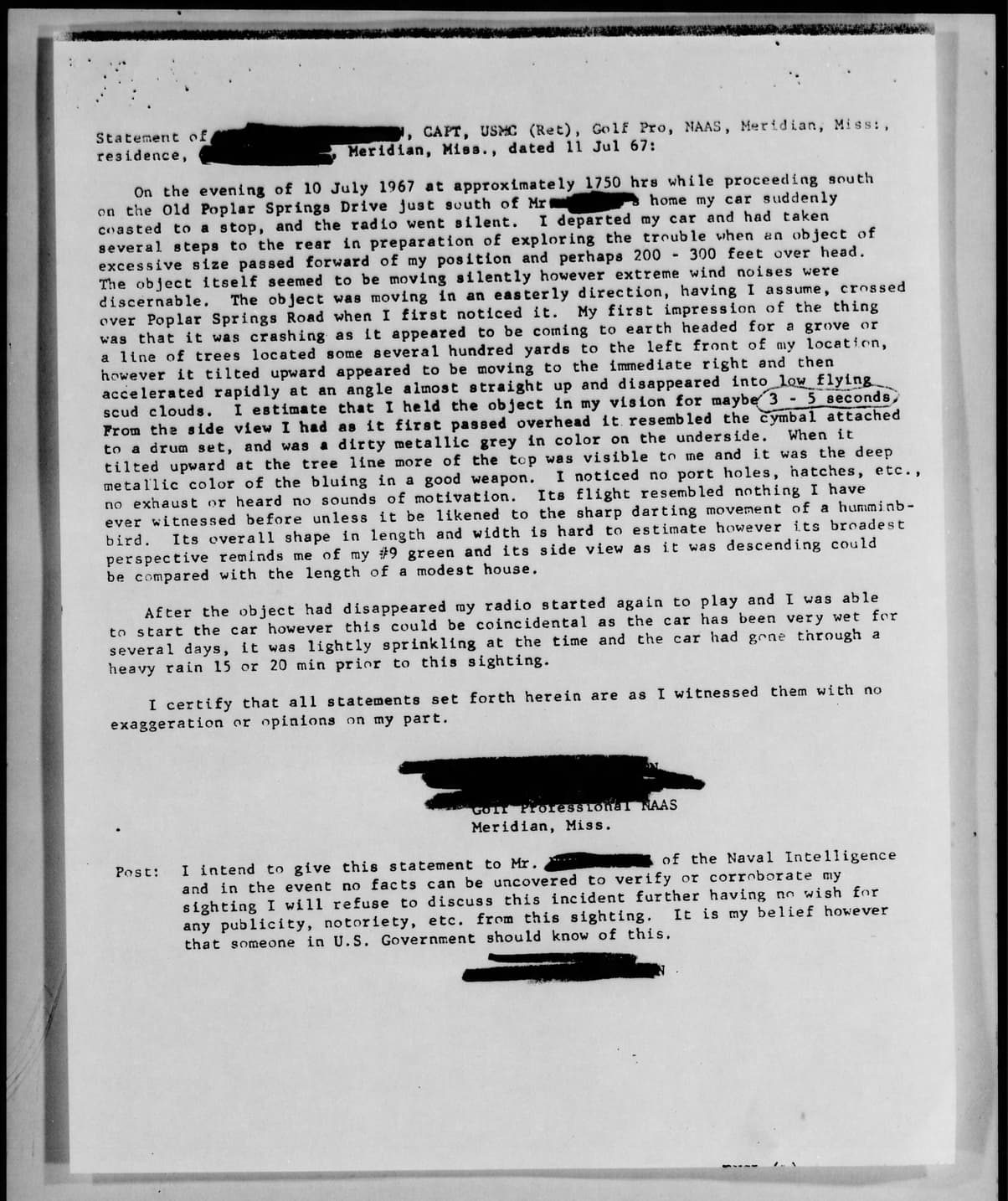
The core of the case is a one-page typed statement dated July 11, 1967, the day after the sighting. The copy in the released file has the name blacked out. It is headed as the statement of a "CAPT, USMC (Ret), Golf Pro, NAAS, Meridian, Miss." and signed over the title "Golf Professional NAAS Meridian, Miss." It is written in the first person, in plain and slightly formal language, and it is short enough to follow closely.
It begins: "On the evening of 10 July 1967 at approximately 1750 hrs while proceeding south on the Old Poplar Springs Drive" just south of a neighbor's home, "my car suddenly coasted to a stop, and the radio went silent." He "departed my car and had taken several steps to the rear in preparation of exploring the trouble when an object of excessive size passed forward of my position and perhaps 200 - 300 feet over head."
He was careful about sound: "The object itself seemed to be moving silently however extreme wind noises were discernable." It was moving east, "having I assume, crossed over Poplar Springs Road when I first noticed it." His first impression was that it was crashing, "headed for a grove or a line of trees located some several hundred yards to the left front of my location, however it tilted upward appeared to be moving to the immediate right and then accelerated rapidly at an angle almost straight up and disappeared into low flying scud clouds."
Then comes the line every later account repeats: "I estimate that I held the object in my vision for maybe 3 - 5 seconds." On the released copy, "3 - 5 seconds" has been circled by hand. Whoever circled it is not identified.
He described the object's appearance in two stages. "From the side view I had as it first passed overhead it resembled the cymbal attached to a drum set, and was a dirty metallic grey in color on the underside. When it tilted upward at the tree line more of the top was visible to me and it was the deep metallic color of the bluing in a good weapon." Then the negatives: "I noticed no port holes, hatches, etc., no exhaust or heard no sounds of motivation." His one comparison for its motion was a bird's: "Its flight resembled nothing I have ever witnessed before unless it be likened to the sharp darting movement of a hummingbird."
On size, he admitted the difficulty: its "overall shape in length and width is hard to estimate however its broadest perspective reminds me of my #9 green and its side view as it was descending could be compared with the length of a modest house." A golf professional comparing an object to one of his own greens is using the most familiar large surface he knew.
The second paragraph deals with the car, and it is the most important passage for weighing the case: "After the object had disappeared my radio started again to play and I was able to start the car however this could be coincidental as the car has been very wet for several days, it was lightly sprinkling at the time and the car had gone through a heavy rain 15 or 20 min prior to this sighting." The witness himself offered the most obvious ordinary explanation for the car's failure.
He closed with a certification, "I certify that all statements set forth herein are as I witnessed them with no exaggeration or opinions on my part," and a postscript. He intended to give the statement to a man "of the Naval Intelligence," and "in the event no facts can be uncovered to verify or corroborate my sighting I will refuse to discuss this incident further having no wish for any publicity, notoriety, etc. from this sighting. It is my belief however that someone in U.S. Government should know of this."
The sketch
The statement was filed with a sketch, listed in the Navy report as enclosure 2. It shows two views. At the upper left is a top view: concentric rings, like a shallow dish, with "Blue" written beside the center and an arrow pointing up the page. Below it is a side view of a thin, lens-shaped disc with a small dome on top, shaded underneath and labeled "Dark Dirty Grey" and "Side View," drawn at a slant between two arrows. A handwritten note reads "Ascending at oblique angle presented more circular and oblong appearance." A long arrow at the bottom points up the page from an "X" labeled "My Position." The drawing is consistent with the statement: a flat disc seen edge-on as it passed, then seen more nearly face-on as it tilted and climbed away.
The Navy Investigation
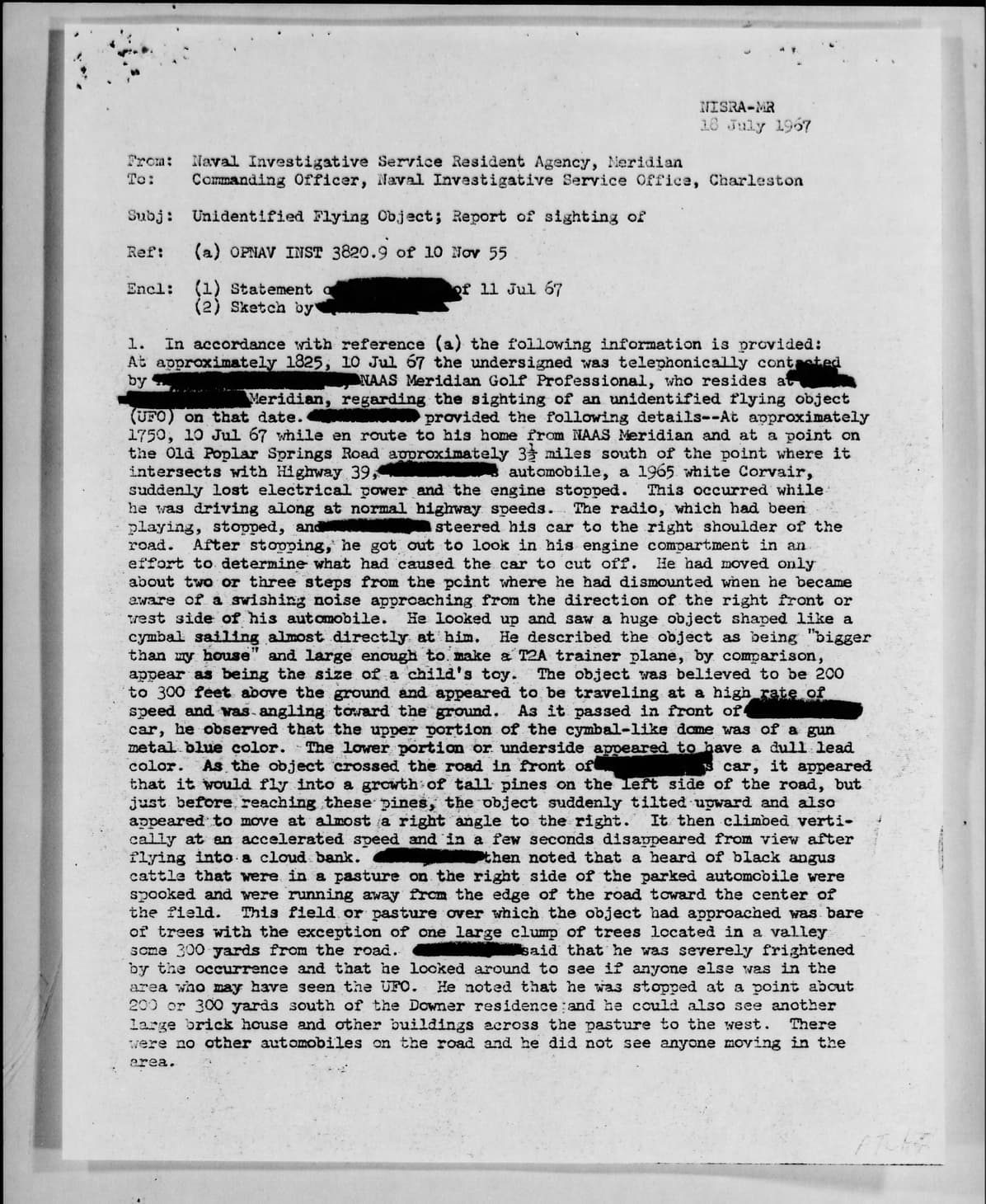
The longest document in the file is a three-page report from the Naval Investigative Service Resident Agency, Meridian (NISRA Meridian), to the Commanding Officer of the Naval Investigative Service Office at Charleston, South Carolina. Its subject line is "Unidentified Flying Object; Report of sighting of," and it cites OPNAV Instruction 3820.9. The agent's name and signature are blacked out, as are most mentions of the witness. A copy went to "USAF, Base Operations, Columbus AFB, Miss." The date at the top is typed as July 1967, but the day is hard to read on the available copy; it appears to be the 13th or the 18th.
The report reads as the work of a careful investigator. It records not only what the witness said, but what the agent checked, when, and with whom, and it reports negative results as plainly as positive ones.
The first telephone call
At about 6:25 PM the agent "was telephonically contacted" by the station's golf professional. According to the report, at about 5:50 PM, on his way home from the air station "and at a point on the Old Poplar Springs Road approximately 3½ miles south of the point where it intersects with Highway 39," his 1965 white Corvair "suddenly lost electrical power and the engine stopped." This happened "while he was driving along at normal highway speeds." The radio, which had been playing, stopped, and he steered to the right shoulder.
He had moved "only about two or three steps" when he became aware of "a swishing noise approaching from the direction of the right front or west side of his automobile." He looked up and saw "a huge object shaped like a cymbal sailing almost directly at him." He called it "bigger than my house," large enough to make a T-2A trainer look like a child's toy. It was believed to be 200 to 300 feet up, "traveling at a high rate of speed and was angling toward the ground." As it passed in front of the car, the upper part of the "cymbal-like dome was of a gun metal blue color" and the underside "appeared to have a dull lead color."
As it crossed the road, "it appeared that it would fly into a growth of tall pines on the left side of the road, but just before reaching these pines, the object suddenly tilted upward and also appeared to move at almost a right angle to the right. It then climbed vertically at an accelerated speed and in a few seconds disappeared from view after flying into a cloud bank."
He then noticed that a herd of black Angus cattle in a pasture on the right side of the parked car "were spooked and were running away from the edge of the road toward the center of the field." The pasture, over which the object had approached, was bare of trees except for one large clump in a valley about 300 yards from the road. He was "severely frightened." He looked around for anyone else who might have seen it. He was stopped about 200 or 300 yards south of a neighbor's house, and could see another large brick house and other buildings across the pasture to the west. There were no other cars on the road, and he saw no one moving.
Afterward
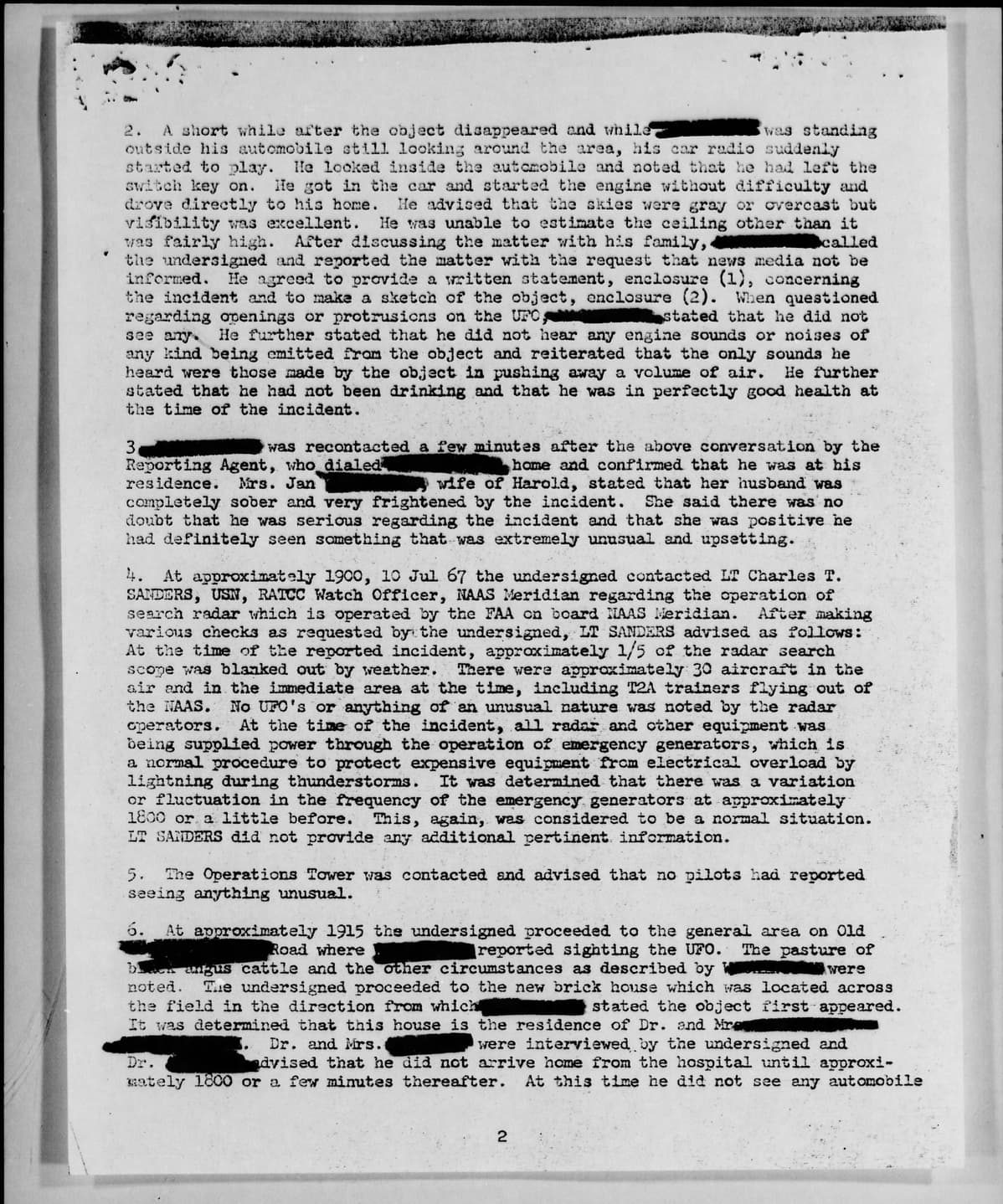
A short while later, while he was still standing outside looking around, his car radio "suddenly started to play." He looked in the car and saw that he had left the ignition key on. He got in, started the engine "without difficulty," and drove straight home. He told the agent that the skies were gray or overcast but visibility was excellent; he could not estimate the ceiling except that it was fairly high.
After talking with his family, he called the agent and reported the matter "with the request that news media not be informed." He agreed to provide the written statement and the sketch. Asked about openings or protrusions, he said he saw none. He heard no engine sounds "or noises of any kind being emitted from the object" and repeated that "the only sounds he heard were those made by the object in pushing away a volume of air." He said he had not been drinking and was in perfectly good health.
A few minutes later the agent called his home to confirm he was there. His wife, identified only as "Mrs. Jan" with the surname blacked out, the "wife of Harold," said her husband "was completely sober and very frightened by the incident," that there was no doubt he was serious, and that she was positive "he had definitely seen something that was extremely unusual and upsetting."
The radar and the tower
At about 7:00 PM the agent contacted Lt. Charles T. Sanders, USN, the RATCC (radar air traffic control center) watch officer at NAAS Meridian, about the search radar "which is operated by the FAA on board NAAS Meridian." After checks the agent requested, Sanders reported:
- At the time, "approximately 1/5 of the radar search scope was blanked out by weather."
- "There were approximately 30 aircraft in the air and in the immediate area at the time, including T2A trainers flying out of the NAAS."
- "No UFO's or anything of an unusual nature was noted by the radar operators."
- All radar and other equipment was being run on emergency generators, "a normal procedure to protect expensive equipment from electrical overload by lightning during thunderstorms."
- There was "a variation or fluctuation in the frequency of the emergency generators at approximately 1800 or a little before," which was "considered to be a normal situation."
The Operations Tower "advised that no pilots had reported seeing anything unusual."
These checks cut both ways. Radar saw nothing, but a fifth of the scope was blanked by weather, and a target 200 to 300 feet above the ground some ten miles from the station may well have been below the radar's coverage; the report does not say. Thirty aircraft were airborne, which makes a misidentified aircraft possible, but none of their pilots reported anything unusual. And the generator fluctuation "at approximately 1800 or a little before" is the sort of coincidence that an enthusiast would make much of and a skeptic would dismiss. The Navy, sensibly, recorded it and moved on.
The site visit and the neighbors
At about 7:15 PM, less than an hour and a half after the sighting, the agent drove to Old Poplar Springs Road. "The pasture of black angus cattle and the other circumstances were as described." He went to the new brick house across the field "in the direction from which" the witness said the object first appeared, the home of a doctor and his wife, and interviewed both.
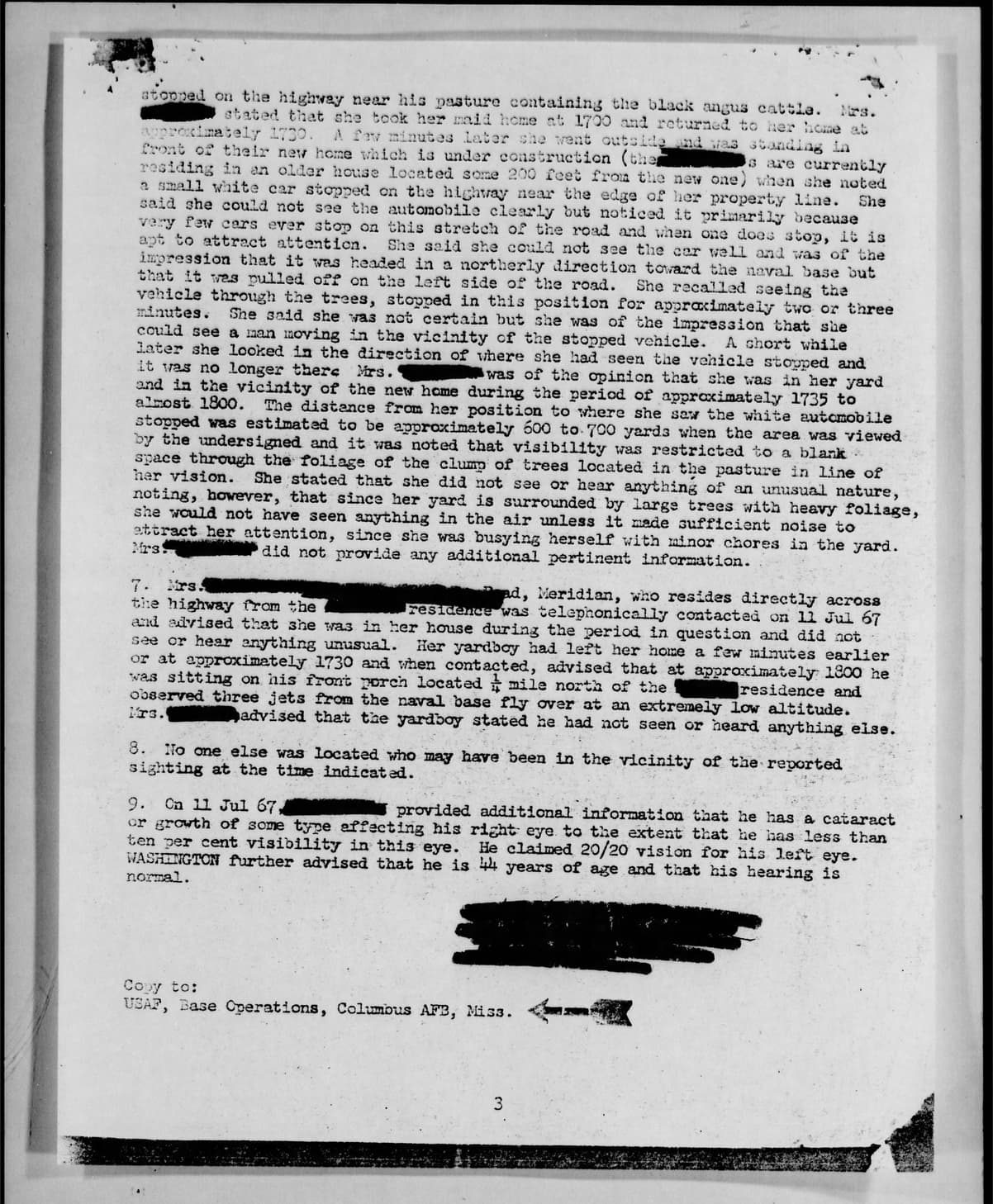
The doctor said he had not got home from the hospital until about 6:00 PM or a few minutes after, and "at this time he did not see any automobile stopped on the highway near his pasture." His wife's account is the closest thing in the file to corroboration. She had taken her maid home at 5:00 PM and returned at about 5:30. A few minutes later, standing in front of the new house the couple was building (they were living in an older house about 200 feet away), she noticed "a small white car stopped on the highway near the edge of her property line." She could not see it clearly but noticed it because "very few cars ever stop on this stretch of the road." She "was of the impression that it was headed in a northerly direction toward the naval base but that it was pulled off on the left side of the road." She remembered seeing the car through the trees, stopped for two or three minutes, and was "of the impression" that she could see a man moving near it. A short while later she looked again and it was gone.
She thought she was in her yard from about 5:35 PM until almost 6:00. The agent estimated the distance from where she stood to where the car had stopped at 600 to 700 yards, and noted that the view was partly blocked by the clump of trees in the pasture. She "did not see or hear anything of an unusual nature," but she pointed out that her yard was surrounded by large trees with heavy foliage, so she would not have seen anything in the air unless it made enough noise to draw her attention.
The next day the agent telephoned a woman who lived directly across the highway. She had been indoors and had seen or heard nothing. Her yard worker, who had left her home at about 5:30 PM, said that at about 6:00 PM, sitting on his front porch about a quarter mile north of her house, he "observed three jets from the naval base fly over at an extremely low altitude." He had seen or heard nothing else. "No one else was located who may have been in the vicinity of the reported sighting at the time indicated."
The final paragraph
On July 11 the witness added two facts that any investigator would want, and that a witness keen to be believed might have kept to himself. He had "a cataract or growth of some type affecting his right eye to the extent that he has less than ten per cent visibility in this eye," and he claimed 20/20 vision in his left eye. The report continues: "WASHINGTON further advised that he is 44 years of age and that his hearing is normal." The surname was left unredacted in this one line.
Which Way Was the Car Facing?
The documents disagree on one point that a reader should know about. The witness's own statement says he was "proceeding south." The Navy report says he was on his way home from the air station, which lies to the north, so south is the direction the rest of the file implies. The doctor's wife, however, had the impression that the small white car was headed north, toward the naval base, and was pulled off on the left side of the road.
This file does not resolve the difference, and the documents do not either. Two points are worth noting. First, she said plainly that she "could not see the car well," at 600 to 700 yards through trees. Second, the two accounts put the car on the same side of the road. A car heading south that pulls onto its right shoulder and a car heading north that pulls onto its left shoulder are both on the west side, the side of the pasture, the doctor's house and her property line. What the two accounts disagree about is only which way the car was pointing. Her account supports the claim that a small white car was stopped there for a few minutes during her time in the yard. It does not confirm which way it faced, why it stopped, or anything about the sky.
The Air Force Report
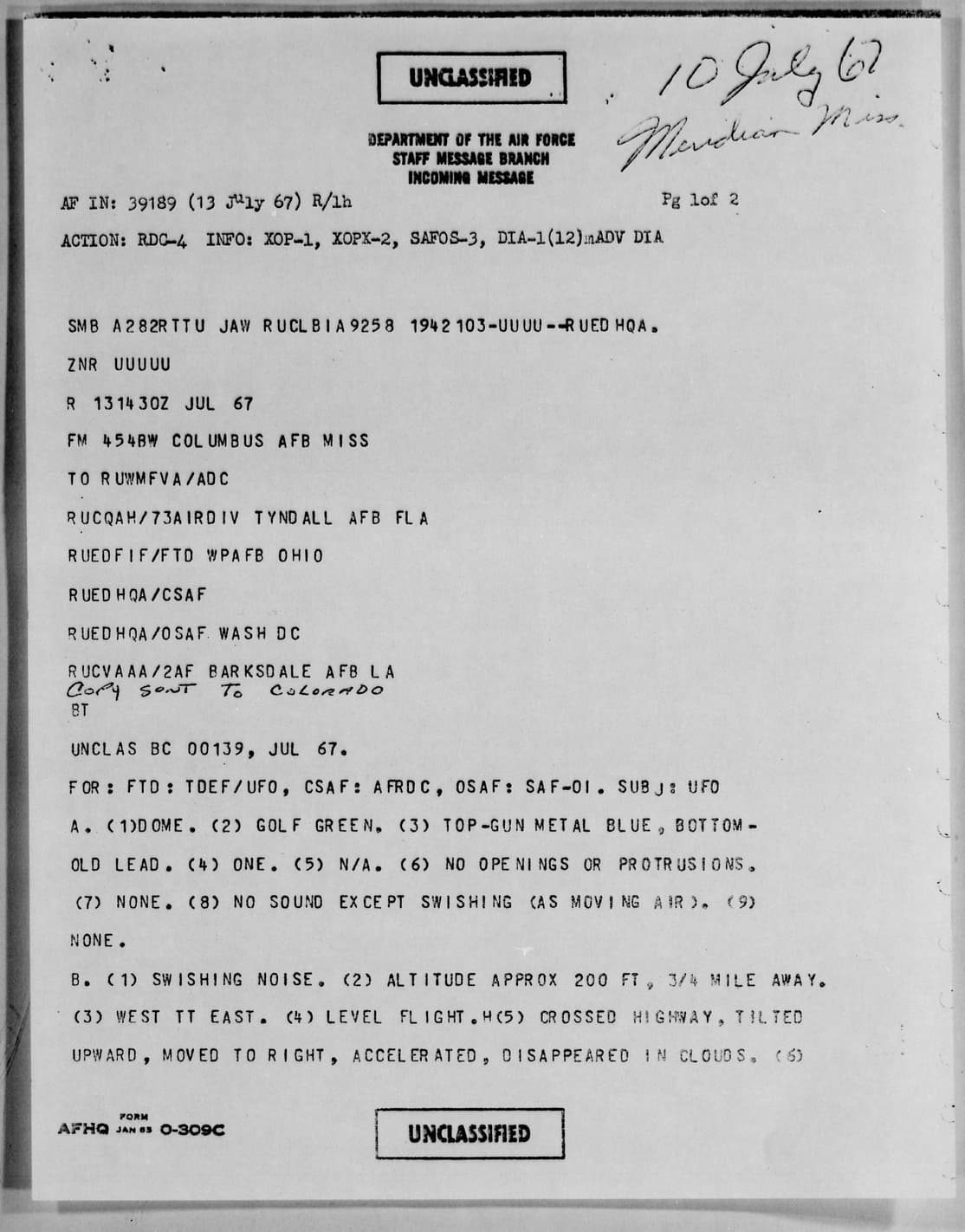
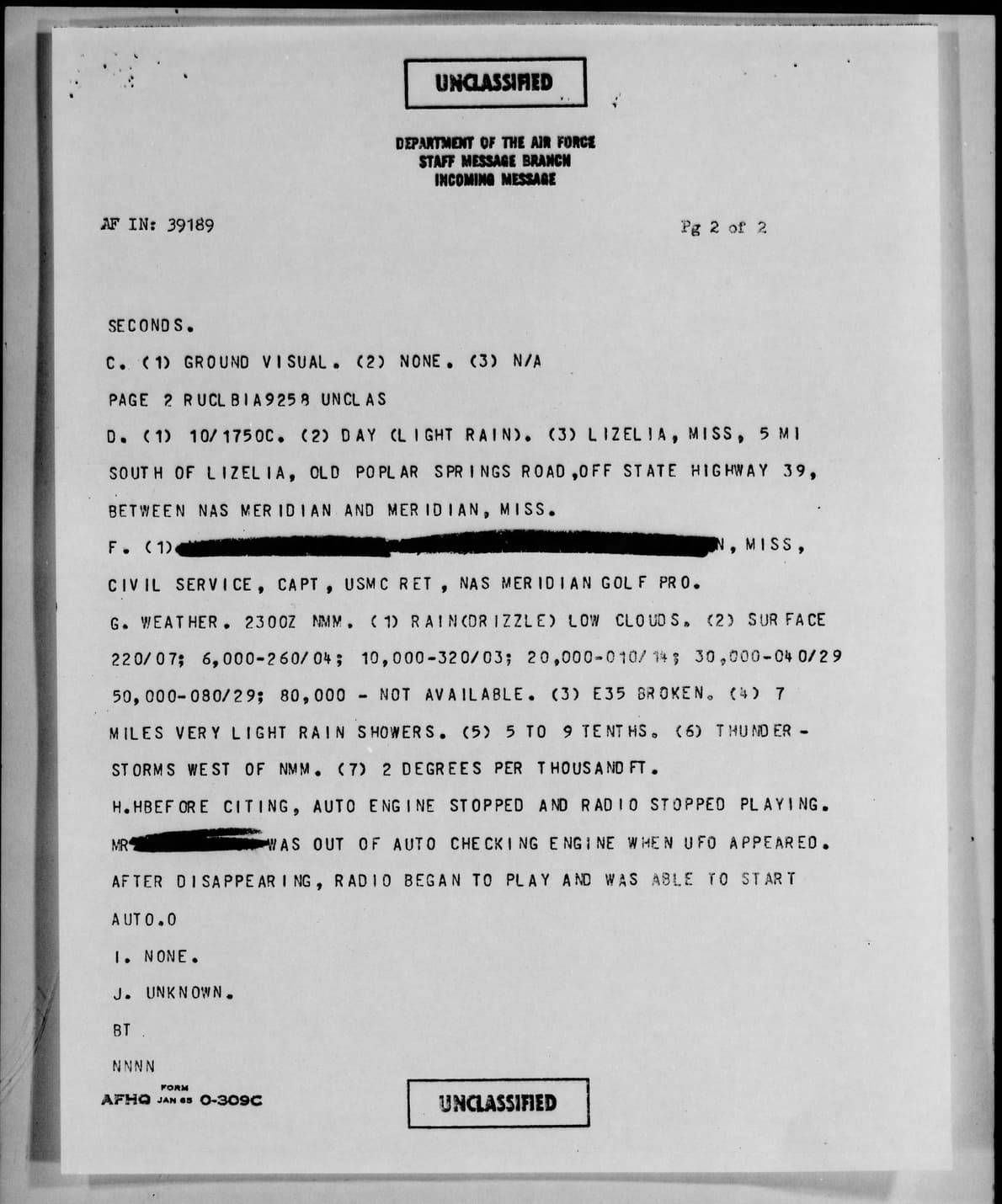
The case reached Air Force channels as a teletype sent at 1430Z on July 13, 1967 "FM 454BW COLUMBUS AFB MISS," logged at Air Force headquarters' Staff Message Branch as incoming message AF IN 39189. The 454th Bomb Wing was the Strategic Air Command B-52 and KC-135 wing then stationed at Columbus. The message went to the Air Defense Command, the 73rd Air Division at Tyndall AFB, the Foreign Technology Division at Wright-Patterson ("FTD: TDEF/UFO," Blue Book's address), the Chief of Staff and Secretary of the Air Force, and the Second Air Force at Barksdale AFB. Someone later wrote "Copy sent to Colorado" by hand on the first page, and "10 July 67, Meridian Miss." across the top. The note does not say who in Colorado received it.
The message follows the format laid down in Air Force Regulation 80-17 of September 19, 1966, which required UFO reports to give, in a fixed order, a description of the object, its course, the manner of observation, the time and date, the observer's location and identity, the weather and winds aloft, any other unusual activity, any interception action, and any nearby air traffic. Read against that format, the message's terse entries make sense:
- A. Description: (1) shape, "DOME"; (2) size compared to a known object, "GOLF GREEN"; (3) color, "TOP-GUN METAL BLUE, BOTTOM-OLD LEAD"; (4) number, "ONE"; (5) formation, "N/A"; (6) features, "NO OPENINGS OR PROTRUSIONS"; (7) tail or exhaust, "NONE"; (8) sound, "NO SOUND EXCEPT SWISHING (AS MOVING AIR)"; (9) other, "NONE."
- B. Course: (1) what first drew attention, "SWISHING NOISE"; (2) position when first seen, "ALTITUDE APPROX 200 FT, 3/4 MILE AWAY"; (3) "WEST TO EAST"; (4) "LEVEL FLIGHT"; (5) how it disappeared, "CROSSED HIGHWAY, TILTED UPWARD, MOVED TO RIGHT, ACCELERATED, DISAPPEARED IN CLOUDS"; (6) duration, "SECONDS."
- C. Manner of observation: "GROUND VISUAL," no optical aids.
- D. Time and place: "10/1750C," "DAY (LIGHT RAIN)," "LIZELIA, MISS, 5 MI SOUTH OF LIZELIA, OLD POPLAR SPRINGS ROAD, OFF STATE HIGHWAY 39, BETWEEN NAS MERIDIAN AND MERIDIAN, MISS."
- F. Observer: name and town blacked out; "CIVIL SERVICE, CAPT, USMC RET, NAS MERIDIAN GOLF PRO."
- G. Weather at 2300Z at NMM (NAS Meridian): rain (drizzle) and low clouds; surface wind 220° at 7 knots and winds aloft from 6,000 to 50,000 feet; ceiling "E35 BROKEN"; visibility "7 MILES VERY LIGHT RAIN SHOWERS"; cloud cover "5 TO 9 TENTHS"; "THUNDERSTORMS WEST OF NMM"; temperature gradient "2 DEGREES PER THOUSAND FT."
- H. Other unusual activity: "BEFORE SIGHTING, AUTO ENGINE STOPPED AND RADIO STOPPED PLAYING. MR [name blacked out] WAS OUT OF AUTO CHECKING ENGINE WHEN UFO APPEARED. AFTER DISAPPEARING, RADIO BEGAN TO PLAY AND WAS ABLE TO START AUTO."
- I. Interception: "NONE." J. Air traffic: "UNKNOWN."
Three things about the message deserve comment. The first is the distance. Every other document has the object passing 200 to 300 feet overhead, almost on top of the witness. The message, in the field for the object's position when first seen, says "ALTITUDE APPROX 200 FT, 3/4 MILE AWAY." The two are not strictly contradictory, because the regulation's item concerns where the object was first seen, and an object flying at 200 feet could have been three quarters of a mile away at the moment the swishing noise first drew his attention. But nothing in the witness's statement or the Navy report mentions such a distance, and the message does not say where the figure came from. If the object was never closer than three quarters of a mile, its size, the detail of its coloring and the witness's sense of it passing overhead would all have to be reassessed. This file reports the discrepancy and does not try to reconcile it.
The second is item J. The Navy agent had learned that about 30 aircraft were in the air near the station, including T-2As. The Air Force message, sent days later, gives air traffic as "UNKNOWN." Whether the Columbus officer who drafted it had the Navy's findings is not clear.
The third is item A(2). Under the regulation, A(2) is the object's size compared to a known object. "GOLF GREEN" is the witness's own comparison, his #9 green. That matters for the next document.
The Blue Book Record Card
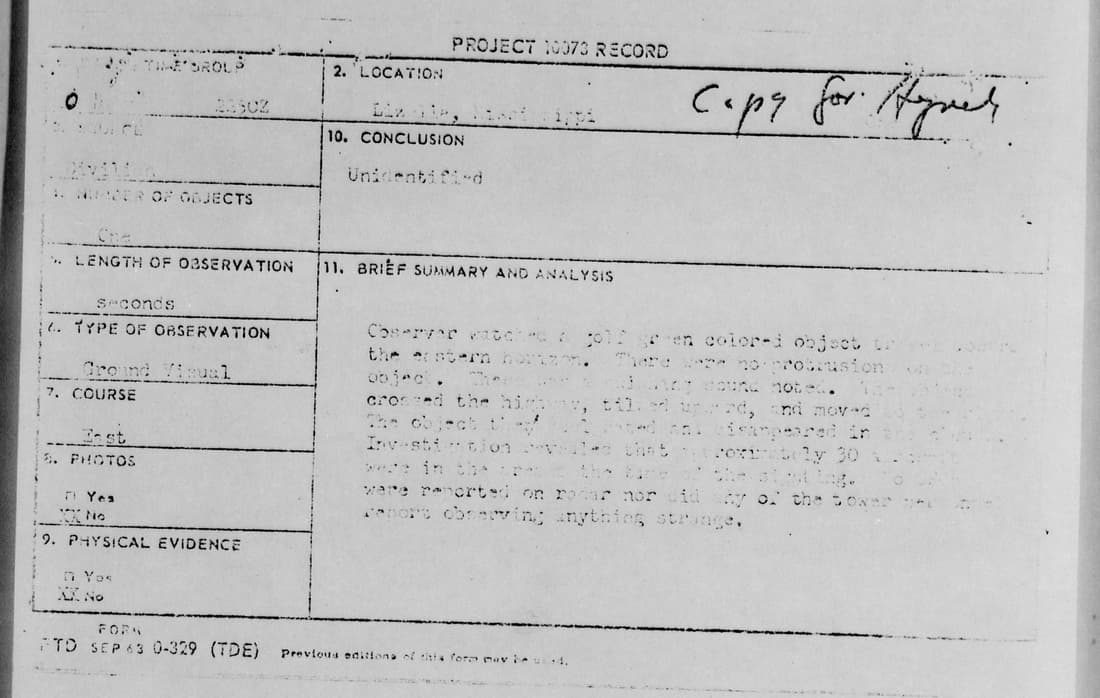
Blue Book summarized each case on a "Project 10073 Record" card. The copy of this one in the released file is marked by hand "Copy for Hynek." It gives the location as Lizelia, Mississippi; the number of objects as one; the length of observation as "seconds"; the type of observation as "Ground Visual"; the course as "East"; and "No" for both photographs and physical evidence. Under "Conclusion" it says "Unidentified."
The typed summary is badly faded. The parts that can be read clearly say that the observer watched a "golf green color" object; that there was "no protrusion" on the object and a swishing sound was noted; that it "crossed the highway, tilted upward, and moved"; and that "Investigation revealed" that approximately 30 aircraft were in the area at the time of the sighting, but nothing was reported on radar, nor did any of the tower personnel report "observing anything strange."
The phrase "golf green color" appears to be a transcription slip. In the teletype, "GOLF GREEN" stands in the size field, not the color field, and the color was given separately as gun-metal blue and old lead. Whoever typed the card seems to have read the size comparison as a color. It is a small error, but it is in the official summary of the case, and it is the kind of detail that gets repeated.
Hynek's Evaluation
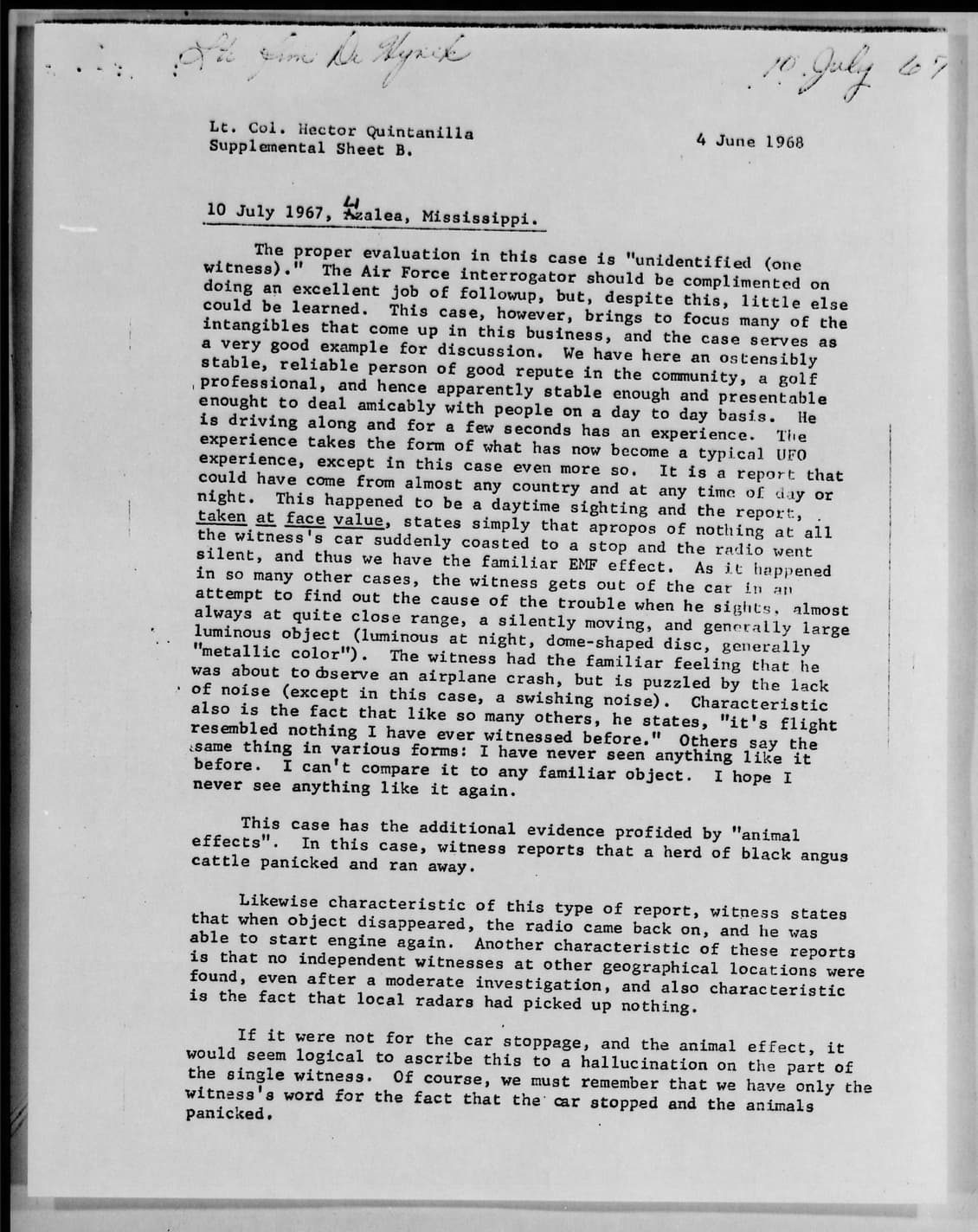
The most interesting document in the file is the last. On June 4, 1968, nearly eleven months after the sighting, J. Allen Hynek, the Northwestern University astronomer who had been Blue Book's scientific consultant since 1952, sent Lt. Col. Hector Quintanilla a two-page evaluation headed "Supplemental Sheet B." The case heading is typed as "Azalea, Mississippi," with a handwritten correction over the first letter, evidently a mishearing of Lizelia. The memo is signed "J. Allen Hynek."
It begins with a verdict: "The proper evaluation in this case is 'unidentified (one witness).'" Then a compliment: "The Air Force interrogator should be complimented on doing an excellent job of followup, but, despite this, little else could be learned." (The interrogator was in fact a Navy agent.) Hynek wrote that the case "brings to focus many of the intangibles that come up in this business, and the case serves as a very good example for discussion."
He described the witness as "an ostensibly stable, reliable person of good repute in the community, a golf professional, and hence apparently stable enough and presentable enough to deal amicably with people on a day to day basis." The experience, he said, "takes the form of what has now become a typical UFO experience, except in this case even more so. It is a report that could have come from almost any country and at any time of day or night."
Hynek then listed the features that made the report typical. The car "suddenly coasted to a stop and the radio went silent, and thus we have the familiar EMF effect." The witness got out to find the trouble and saw, as in so many other cases, "almost always at quite close range, a silently moving, and generally large luminous object." He "had the familiar feeling that he was about to observe an airplane crash, but is puzzled by the lack of noise (except in this case, a swishing noise)." And, "like so many others," he says its flight resembled nothing he had ever witnessed before.
"This case has the additional evidence profided by 'animal effects,'" Hynek went on (the misspelling is in the original). Other characteristic features followed: the radio came back on and the engine restarted when the object left; no independent witnesses were found elsewhere "even after a moderate investigation"; and "local radars had picked up nothing."
Then the key passage: "If it were not for the car stoppage, and the animal effect, it would seem logical to ascribe this to a hallucination on the part of the single witness. Of course, we must remember that we have only the witness's word for the fact that the car stopped and the animals panicked."
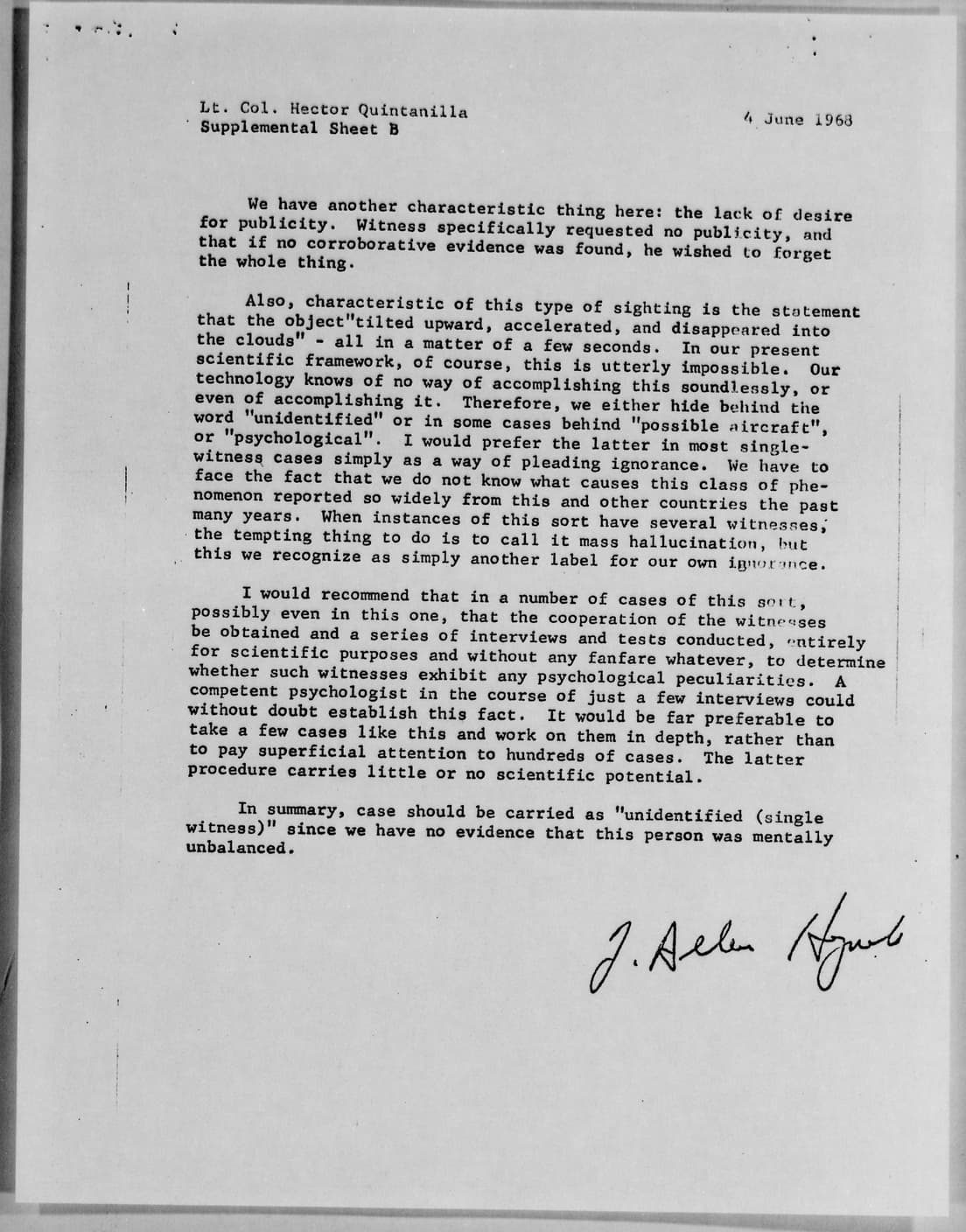
The second page continues the list. The witness's "lack of desire for publicity" was another characteristic: he "specifically requested no publicity, and that if no corroborative evidence was found, he wished to forget the whole thing." So was the statement that the object "tilted upward, accelerated, and disappeared into the clouds" in a few seconds. "In our present scientific framework, of course, this is utterly impossible. Our technology knows of no way of accomplishing this soundlessly, or even of accomplishing it. Therefore, we either hide behind the word 'unidentified' or in some cases behind 'possible aircraft', or 'psychological'. I would prefer the latter in most single-witness cases simply as a way of pleading ignorance. We have to face the fact that we do not know what causes this class of phenomenon reported so widely from this and other countries the past many years." When such cases have several witnesses, he added, "the tempting thing to do is to call it mass hallucination, but this we recognize as simply another label for our own ignorance."
He made a recommendation. "In a number of cases of this sort, possibly even in this one," the witnesses' cooperation should be obtained and "a series of interviews and tests conducted, entirely for scientific purposes and without any fanfare whatever, to determine whether such witnesses exhibit any psychological peculiarities." A competent psychologist, he thought, could establish this in a few interviews. "It would be far preferable to take a few cases like this and work on them in depth, rather than to pay superficial attention to hundreds of cases. The latter procedure carries little or no scientific potential."
He ended: "In summary, case should be carried as 'unidentified (single witness)' since we have no evidence that this person was mentally unbalanced."
Reading Hynek fairly
Hynek's memo is sometimes quoted as an endorsement of the case. It is something more careful than that. He did not say the witness saw a craft, and he did not say the car was stopped by the object. He said that the case fitted a pattern he had seen many times, that the Air Force's usual labels ("possible aircraft," "psychological") were ways of "pleading ignorance," that he would rather admit ignorance honestly, and that the right scientific response was to study witnesses like this one in depth. He also made the skeptic's central point himself, in so many words: the two features that lift the case above a possible hallucination rest entirely on the witness's own report.
The memo is also a document of its moment. In mid-1968 the Colorado study was finishing its work, and Hynek was openly frustrated with how Blue Book handled reports. In April 1969, three months after the Condon Report was released, he reviewed it critically in the Bulletin of the Atomic Scientists. His remark that the shallow treatment of hundreds of cases "carries little or no scientific potential" reads, in hindsight, as a criticism of the whole system he was advising. There is no record in the file that his recommendation of psychological interviews was ever acted on in this case. Blue Book closed eighteen months later.
How the Case Was Retold
The case was never in the newspapers. No 1967 coverage in the Meridian Star or any other paper has been found for this file, which is what one would expect: the witness asked the Navy not to tell the press, and the Navy and Air Force documents give no sign that anyone did. The case entered the UFO literature through the Blue Book files, and each retelling has changed it a little.
Don Berliner's list (1974)
In January 1974 the aviation writer Don Berliner visited the U.S. Air Force archives at Maxwell AFB, Alabama, and compiled a list of the Blue Book cases still carried as unknowns. The French researcher Patrick Gross has transcribed it online. Its entry for July 10, 1967, headed "Lizelia, Mississippi. 5:50 p.m.," names the witness as "golf pro Harold Washington (Capt, USMC, ret.)." It describes one object with a dome, "the top colored gunmetal blue, the bottom the color of old lead," which moved east, crossed the highway, tilted upward, moved to the right, accelerated and disappeared into the clouds after 3 to 5 seconds, making a swishing sound. Berliner evidently worked from the unredacted file. His details match the teletype closely. Gross's separate page for case 11869 gives a short narrative account.
Kevin Randle's "Philip Lanning" (1989)
Kevin D. Randle's The UFO Casebook (1989) tells the story on pages 134 and 135 under the heading "July 10, 1967: Meridian, Mississippi." Randle calls the witness "Philip Lanning" and gives no source for the name. His account follows the witness's statement closely and quotes it ("excessive size," "like the bluing of a good weapon," "could be compared with the length of a house"), with some differences in wording. He has the witness driving "south of town" and looking "under the hood," although a Corvair's engine was at the back. He says the witness "forwarded it to a friend in Naval Intelligence" and that "The Air Force received it and began an investigation," which compresses what the documents show was a Navy investigation passed on to the Air Force.
Randle adds one detail not found in the released pages: that "one Air Force officer" thought the three-to-five-second estimate was important and was of the opinion that "no one could have observed all that Lanning claimed he had seen in only five seconds." Randle disagreed, noting that people are poor at estimating time when excited. The circled "3 - 5 seconds" on the statement is consistent with someone having fixed on that point, but the released file does not name the officer or record the opinion. Randle also describes, without naming him, a reviewer "nearly a year later" who called the statements "characteristic of this type of sighting." That is Hynek's memo of June 1968. Randle calls the case "one of the very last cases in the files to receive the unidentified tag." On Berliner's list, only three Blue Book unknowns are dated 1968, so that description is broadly fair.
Brad Sparks's catalog
Brad Sparks's continuing "Comprehensive Catalog" of Blue Book unknowns, hosted by NICAP, lists the case in version 1.35 (February 3, 2026) as entry 1751, Blue Book number 11869: "5 mi S of Lizelia (near Meridian), Mississippi. 5:50 p.m." It names "golf pro Harold Washington (Capt., USMC Ret.)," gives the duration as 3 to 5 seconds, one witness, and flags the case "EM." An earlier version of the same entry, reproduced on the UAP Discovery forum, carries the number 1745. Sparks cites himself, Berliner, and Randle, though his Randle page reference (p. 264) does not match the pages of The UFO Casebook reproduced on the forum (pp. 134–135).
"Philip Lansing" and other variants
The UAP Discovery forum's Blue Book Unknowns section, which posted images of the file in July 2025, introduces the case with a summary tagged to the researcher George Eberhart, in which the witness is "Philip Lansing," driving "south of Meridian." It is a short step from Randle's "Lanning."
The primary file supports neither name. The Navy agent's report quotes the witness's wife as the "wife of Harold," and its last paragraph, in the one place the censor missed, reads "WASHINGTON further advised that he is 44 years of age." Berliner, who saw the file before redaction mattered, gives "Harold Washington." On the witness's signed statement, a final letter "N" is visible at the end of the blacked-out name, both in the heading and under the signature, consistent with Washington. This file therefore names the witness as Harold Washington. "Philip Lanning" and "Philip Lansing" appear to be either an error or a deliberate pseudonym introduced in Randle's 1989 book, and they are attributed here to the sources that use them.
"South of Meridian": a location error
Several online summaries place the sighting "south of Meridian." That is wrong, and the mistake probably grew out of Randle's "driving south of town." The Air Force message puts it "5 mi south of Lizelia ... between NAS Meridian and Meridian," and Lizelia is about 12 miles north of Meridian. The sighting therefore took place north of the city, on the stretch of country between the town and the air station.
Where It Happened
No road named "Old Poplar Springs Road" appears on modern maps of Lauderdale County. The obvious candidate is today's Poplar Springs Drive, which runs north out of Meridian. In OpenStreetMap data, its northern end meets Mississippi Highway 39 at about 32.476° N, 88.677° W, roughly 4.2 miles south of Lizelia. Measured 3½ miles south along the road from that junction, as the Navy report describes, the site would fall at about 32.43° N, 88.70° W, on what is now the northern edge of Meridian. That point is about 7.7 miles south-southwest of Lizelia, about 11 miles southwest of the air station, and about 4.7 miles north of downtown Meridian (all computed).
This identification is this file's inference, not a fact from the documents, and it does not quite agree with the Air Force's "5 mi south of Lizelia." The road may have been realigned or renamed since 1967, and the Air Force figure may itself be approximate. What the documents agree on is the setting: a two-lane country road with a cattle pasture on its west side, a stand of tall pines on its east side, a new brick house and other buildings across the pasture to the west, and almost no traffic. In 1967 that was farmland. Much of it has since been built over.
The documents also fix the geometry of the sighting. The car stopped on the west shoulder. The object came from the west, over the pasture, "from the direction of the right front." It crossed the road ahead of the car, heading east toward the pines on the left, then tilted, swung right, and climbed. If the car faced south, as the witness said, the object's swing "to the right" would have taken it toward the south and southwest as it climbed.
Key Witnesses
Harold Washington
The only witness to the object. A civil service employee and retired Marine captain, aged 44 in July 1967, he ran the golf course at Naval Auxiliary Air Station Meridian and lived in Meridian. His name is blacked out in most of the released file but survives in one unredacted line of the Navy report ("WASHINGTON further advised that he is 44 years of age"), in his wife's reference to "Harold," and in Don Berliner's 1974 list. Kevin Randle's 1989 book calls him "Philip Lanning," and later summaries "Philip Lansing." He reported the sighting to a Naval Intelligence contact within about 35 minutes, asked that the press not be told, signed a statement certifying "no exaggeration or opinions on my part," and volunteered that he had a cataract in his right eye and that his car had been very wet. His wife told the Navy he was "completely sober and very frightened." No later statement by him has been found.
Charles T. Sanders
Not a witness to the object. The radar air traffic control watch officer whom the Navy agent called at about 7:00 PM. He reported that about 30 aircraft, including T-2A trainers, were in the air near the station; that weather blanked about a fifth of the search radar's scope; that the operators saw nothing unusual; and that the equipment was on emergency generators because of thunderstorms, with a normal frequency fluctuation at about 6:00 PM or a little before.
J. Allen Hynek
Not a witness. The astronomer who reviewed the file for Blue Book and, on June 4, 1968, recommended that it be carried as "unidentified (single witness)," praising the follow-up investigation, calling the car stoppage "the familiar EMF effect," and noting that "we have only the witness's word" for the car and the cattle.
The other people in the record are not named in the released file and are not named here: the Navy agent, the witness's wife, the doctor and his wife whose pasture adjoined the road, the woman across the highway, and her yard worker who saw three low jets at about 6:00 PM. The doctor's wife is the only person besides the witness who saw anything relevant, and what she saw was a small white car stopped on the road, not an object in the sky.
The Five Observables Assessment
The Five Observables framework, associated with former AATIP director Luis Elizondo, classifies UAP reports by performance characteristics beyond known technology. Here it can only be applied to one person's three-to-five-second visual impression.
Assessment:
- Anti-gravity lift (speculative). The witness heard no engine, saw no exhaust, and described only the sound of displaced air while a large object flew low, turned and climbed. A large object flying without visible means of lift or propulsion is the essence of this observable. It cannot be scored higher because the observation lasted seconds, the distance is uncertain (200 to 300 feet in two documents, "3/4 mile" in one), and a jet heard against the wind and rain, or a quieter source than he expected, cannot be excluded on one person's hearing.
- Instant acceleration (speculative). The departure, a sudden tilt, a "right angle" turn and a climb "almost straight up" that he compared to a hummingbird's darting, is the most anomalous part of the report and the part Hynek called "utterly impossible" for known technology to do soundlessly. But "accelerated rapidly" over a few seconds into low cloud is an impression, not a measurement, and an object that is climbing away into cloud while also receding can appear to accelerate.
- Hypersonic speed (absent). The Navy report says it appeared to be "traveling at a high rate of speed," but nothing suggests speeds beyond those of aircraft.
- Low observability (absent). Nothing was seen on radar, but about a fifth of the scope was blanked by weather and an object at a few hundred feet ten or so miles from the station may have been below coverage. That is not evidence of low observability. Visually the object was conspicuous.
- Trans-medium travel (not applicable). Entering cloud is not a change of medium in this sense.
On this framework the case is moderate: two observables described but neither measured, both resting on one witness's impressions of a few seconds.
Evidence Assessment
Supporting Anomalous Origin
- The witness was a mature, employed, retired Marine officer who reported within about 35 minutes, signed a statement, drew a sketch, asked for no publicity, and said he would drop the matter if it could not be corroborated.
- He volunteered information that weakened his own case: the wet car, the cataract in his right eye, and that the stall "could be coincidental."
- His wife, contacted minutes after his call, said he was sober, very frightened and entirely serious.
- A Navy agent visited the site the same evening and found "the pasture of black angus cattle and the other circumstances" as described.
- A neighbor independently saw a small white car stopped on that quiet stretch of road for two or three minutes within her 5:35 to 6:00 PM window, consistent with the witness's account of stopping.
- He knew jet aircraft well, worked beside a jet training base, and explicitly compared the object to the T-2A trainer, saying it dwarfed one.
- The engine stopping and radio failing together, then both recovering after the object left, is the pattern reported in other vehicle-interference cases.
- Project Blue Book's conclusion was "Unidentified," and its scientific consultant wrote that it should remain so.
Supporting Conventional Explanation
- There was one witness, and the sighting lasted, by his own estimate, three to five seconds.
- He had less than 10% vision in his right eye, which would have affected his depth perception and his judgment of distance and size.
- The car had been "very wet for several days" and had just driven through heavy rain; light rain was falling. He himself suggested the stall might be coincidental.
- About 30 aircraft, including T-2A jet trainers, were airborne near the station, and three base jets were seen flying "at an extremely low altitude" nearby at about 6:00 PM.
- Visibility was reduced by drizzle and low, ragged cloud, conditions that make the size, distance and shape of a briefly seen object hard to judge.
- The documents disagree on distance (200–300 feet overhead against "3/4 mile away") and, between the witness and the neighbor, on which way the car was facing.
- The neighbor saw no object and heard nothing, and the doctor, home at about 6:00 PM, saw no car. Radar saw nothing, and no pilot reported anything.
- As Hynek noted, the car stoppage and the cattle stampede, the two features that make the case unusual, rest only on the witness's word.
Why "Disputed"
The Meridian "flying cymbal" is stamped DISPUTED with a score of 44/100. It is a better-documented case than most single-witness reports from the 1960s. A Navy investigator took the report within about 35 minutes of the event, checked radar and the tower within about 70 minutes, and walked the site and interviewed neighbors before dark. The file contains the witness's own signed statement and sketch, a contemporaneous character reference from his wife, a neighbor's partial corroboration of the stopped car, an Air Force report in the regulation format, and an explicit written judgment from Blue Book's own scientist. The witness behaved throughout like someone trying to be accurate rather than noticed. Those strengths put the case above the Natchez Trace Ranger Sighting (Disputed, 35), which rests on one wire story and was never investigated, and slightly above the Flora, Mississippi Police Encounter (Disputed, 42), whose documentation is good but whose main witness later disowned his account.
The reasons it goes no higher are just as specific. Everything anomalous depends on one person's impressions over three to five seconds, through drizzle and low cloud, by a man with poor vision in one eye. Nothing was photographed, measured or found on the ground. The car had an obvious ordinary reason to stall, and the witness said so himself. Jet trainers were flying in numbers nearby, and three were seen low within minutes. The one document that gives a distance other than "overhead" says three quarters of a mile.
Among this site's vehicle-interference cases, it sits close to the Loch Raven Dam incident (Disputed, 34) and the Long Prairie incident (Disputed, 33) in kind. It scores above them because its investigation was prompt, official and documented in detail, and because the witness's own caution is on the record. It sits far below Levelland (Disputed, 74), where many independent motorists reported the same engine-stopping effect on the same night. The stamp is Disputed rather than Credible because no second person saw the object, and rather than Debunked because no conventional explanation fits all of what the witness described.
Sensor & Instrumentation Detection Profile
Three kinds of instrument were, or could have been, in a position to record something. None did.
- Radar. The FAA-operated search radar at NAAS Meridian was running, on emergency generator power because of thunderstorms. About one fifth of its scope was blanked by weather. Its operators noted nothing unusual among the roughly 30 aircraft in the area. The Navy report does not say whether the radar could see a target 200 to 300 feet above the ground at the sighting site, which this file estimates was about 11 miles southwest of the station; a target that low at that range may well have been below its coverage, so the negative result is weaker than it looks.
- The car. The witness's Corvair is the only "instrument" said to have responded. Its engine stopped, its radio went silent, and both recovered after the object left. No one examined the car. The Condon Report's chapter on indirect physical evidence, by Roy Craig, describes how a car body's steel retains a magnetic pattern that a strong external field could alter, and reports a test showing that a field of about 1 kilogauss altered the pattern on the deck of a 1962 Corvair. Magnetic mapping of this car might have shown whether it had been exposed to a strong field. It was never done.
- The generators. The station's emergency generators showed "a variation or fluctuation in the frequency" at about 6:00 PM "or a little before." Lt. Sanders considered it normal. It is recorded here because it was recorded at the time, not because it shows anything. The generators were miles from the site, and fluctuations under thunderstorm conditions were evidently routine.
- Witnesses as sensors. No pilot reported anything, the tower saw nothing, and no other person on the ground saw the object. The doctor's wife pointed out that her trees would have hidden anything in the air that did not make enough noise to draw her attention.
The investigation's checks of the radar and the tower are the only places where an institution's statement bears on the case, and they need the caveat this site applies to every official finding. Government and military bodies that handled UFO reports have a documented record of incomplete answers and later-revised explanations, from Blue Book-era identifications criticized by the Air Force's own consultants to the CIA's 1997 acknowledgment that it had let many Cold War reports caused by its reconnaissance flights go unexplained. An institution checking on its own aircraft also has an incentive toward the least alarming answer. Here, the official statements are modest and specific: radar saw nothing, pilots reported nothing. They are useful negatives, but they are statements about what a partly blanked radar and thirty busy student pilots happened to notice, not proof that nothing was there. The Blue Book conclusion itself, "Unidentified," is unusual in that it is the institution declining to explain the case, which makes the usual concern about convenient explanations less pressing here.
Environmental & Geospatial Context
The sighting took place in rolling farmland in Lauderdale County, east Mississippi, north of Meridian, at about 32.43° N, 88.70° W by this file's estimate (see "Where It Happened" above). NAAS Meridian, whose coordinates are about 32.55° N, 88.56° W, lay roughly 11 miles to the northeast, and Lizelia about 8 miles to the north-northeast (computed).
Weather
Every source describes wet, gray conditions. The witness said it was "lightly sprinkling" and that his car had gone through "a heavy rain 15 or 20 min prior." He told the Navy agent the skies were gray or overcast but visibility was excellent, and that the ceiling was fairly high. He also said the object "disappeared into low flying scud clouds." The National Weather Service defines scud as small, ragged, low cloud fragments unattached to a larger cloud base, often seen behind cold fronts and thunderstorm gust fronts and associated with cool moist air such as thunderstorm outflow.
The Air Force message gives the 6:00 PM CDT (2300Z) observation at NAS Meridian: drizzle and low clouds; a ceiling estimated at 3,500 feet, broken; visibility 7 miles in very light rain showers; 5 to 9 tenths cloud cover; thunderstorms west of the station; surface wind from 220° at 7 knots, and light winds aloft up to 10,000 feet. The station's radar was on generator power "to protect expensive equipment from electrical overload by lightning during thunderstorms," and a fifth of the scope was blanked by weather. So a band of thunderstorms lay to the west, and the sighting took place under a broken deck with ragged cloud fragments below it. Those are exactly the conditions under which a briefly seen object's distance and size are hardest to judge, and under which an object, or an aircraft, could vanish into cloud within seconds of climbing.
The automatically computed weather field in the Forensic Data Profile below, drawn from modern ERA5 reanalysis, is a whole-day average for one grid square and is not an observation of the evening. The 1967 observation quoted in the Air Force message is the better source. All three computed fields are calculated for this file's mapped point, the coordinates of Lizelia itself, several miles north of the estimated sighting site; the lunar figure is irrelevant to a daylight sighting.
Light
The sighting was in daylight. Mississippi was on Central Daylight Time in July 1967 under the Uniform Time Act of 1966, so 5:50 PM local time was 2250Z, ten minutes before the 2300Z weather observation. Computed with NASA JPL's Horizons system for the estimated site, the Sun at 5:50 PM CDT stood about 26° above the horizon at an azimuth of about 281°, a little north of due west, and set at about 8:08 PM. The object came from the west, over the pasture, so under a clear sky it would have come out of the general direction of the Sun. Under the overcast reported that day, the Sun's direction would have meant a brighter patch of cloud rather than glare, but it is one more reason a quick look westward would not have been a good view.
Aviation
The single most important feature of the environment is the air station. In July 1967 NAAS Meridian was home to two jet training squadrons, VT-7 and VT-9, flying the T-2A Buckeye. At the time of the sighting about 30 aircraft were in the air in the immediate area, according to the radar watch officer. About ten minutes later, a man sitting on his porch about a quarter mile north of a house on the same road saw three jets from the naval base fly over "at an extremely low altitude." The sighting took place in airspace full of small jets, under a low ceiling, during thunderstorm weather that may have been affecting flight paths and approaches.
Observer Credibility & Occupational Profile
Harold Washington was a retired Marine Corps captain and a golf professional employed on a naval air station. Neither occupation trained him to observe aircraft or the sky, but both gave him relevant experience. A Marine officer would have seen a great deal of military aviation, and a golf professional at a jet training base spent his working days outdoors under the flight paths of T-2As. He used that experience directly, comparing the object to a T-2A and to one of his own greens.
His behavior is the strongest thing in his favor. He reported within about 35 minutes, to an investigator, not a newspaper. He asked for no publicity. He signed a statement that certified "no exaggeration or opinions on my part" and that, unusually, included his own reason to doubt the car's failure. He volunteered his cataract. He said he would refuse to discuss the matter again if nothing could be found to back it up. His wife, called without warning minutes after his report, described him as sober, frightened and serious. Hynek, reading the file a year later, saw "an ostensibly stable, reliable person of good repute."
Against this, he was a single observer with a seriously impaired right eye. With less than 10% vision in one eye, a person's binocular depth perception is much reduced, which bears directly on judging the distance, and therefore the size, of an unfamiliar object seen for seconds against a gray sky. His estimates of 200 to 300 feet and "bigger than my house" are linked: if the distance was wrong, so was the size. He was also, by his own account and his wife's, badly frightened, and fear is not a good condition for estimating time or distance. None of this suggests dishonesty. It means his account should be treated as an honest report of what he perceived, which is the only way any single-witness report can be treated.
The Navy agent comes out of the file well. He worked fast, checked the obvious alternatives (radar, tower, the neighbors), visited the site before dark, wrote down negative results, and recorded the witness's medical disclosure. Hynek's compliment was deserved.
Physical & Material Assays
No physical evidence was collected, and no analysis was done. The Blue Book record card answers "No" to physical evidence. Nothing in the file suggests the object touched the ground. The agent noted the pasture and the cattle but recorded no marks, burns or residue, and the object was never reported to have come lower than the pines it seemed about to hit.
The one physical system that may have been affected, the car, was not examined. No one tested the ignition, the battery connections or the wiring, and no one mapped the car body's magnetism, the test the Condon Report's investigators later suggested for such cases "if used with proper reservation." The witness restarted the car "without difficulty" and drove it home, and that was the end of its role as evidence.
Historical Precedents & Archive Matches
Hynek's main point about this case was that it was typical. The pattern he described, a car's engine and electrics failing as a large silent object appears nearby and recovering when it leaves, was well established in the UFO literature by 1967. The Condon Report's chapter on indirect physical evidence cites a 1964 compilation by NICAP's Richard Hall listing 106 UFO cases with significant electromagnetic effects, 45 of them involving stalled car engines. In 1981 Mark Rodeghier of the Center for UFO Studies published a dedicated catalog and analysis, UFO Reports Involving Vehicle Interference. This site covers several of the best-known examples:
- Levelland, Texas (November 2–3, 1957): The archetype. Some fifteen calls to the police in a few hours described a glowing object near roads around Levelland and cars whose engines and lights failed and recovered. Hynek later admitted in print that the weather rationale behind the Air Force's "ball lightning" finding was wrong. Its strength, many independent drivers on one night, is exactly what Meridian lacks.
- Loch Raven Dam, Maryland (October 26, 1958): Two young men whose car died completely, headlights and ignition, as they crept toward a large glowing object hovering over a bridge. Blue Book closed it as unidentified. Two witnesses rather than one, but a similarly thin physical record.
- Long Prairie, Minnesota (October 23, 1965): A 19-year-old radio announcer whose engine, headlights and radio died together on a rural highway before a rocket-shaped object and small figures. Blue Book called it "psychological." A single witness of good character whose car radio also failed, like Meridian, but with far stranger content.
- Herbert Schirmer, Ashland, Nebraska (December 3, 1967): A police officer's encounter five months after Meridian, which led to a hypnotic regression session conducted for the Colorado project.
- Flora, Mississippi (1977) and the Natchez Trace ranger sighting (1973): The other two Mississippi case files on this site from the decade after Meridian. Both involve officers; neither involves vehicle effects; neither had an investigation as thorough as this one.
- The Condon Report: The University of Colorado study that was in progress when this sighting happened and that received at least a copy of this case's teletype, according to a handwritten note on it.
The animal reaction also has precedents. Hynek wrote of "animal effects" as a recognized feature of such reports. Here, though, the cattle may have been reacting to the same thing the witness heard, a sudden rushing noise, whatever its source. A herd running from the road toward the middle of a field is what cattle would do at any sudden loud noise from the direction of the road.
In the archives searched for this file, the case appears in the Project Blue Book file itself; in Berliner's 1974 list as transcribed by Patrick Gross; in Randle's UFO Casebook; in Sparks's catalog; in the Hatch UFO*DB, which cites Randle and summarizes the case as an EM sighting at Lizelia; and on the UAP Discovery forum. No contemporary newspaper story has been found.
Material Analysis
There is no material evidence to analyze. This section looks instead at the one physical claim in the case, that the car's electrical system failed and then recovered, and at what each explanation predicts about it.
What actually failed
The documents describe the failure in two slightly different ways. The witness's statement says the car "suddenly coasted to a stop, and the radio went silent." The Navy report says the car "suddenly lost electrical power and the engine stopped," and that the radio, which had been playing, stopped. Afterward the radio "suddenly started to play" while he was standing outside, and when he looked into the car he found "he had left the switch key on." He then started the engine "without difficulty."
That sequence is informative. The ignition switch was on the whole time. The radio went off without anyone touching it and came back on without anyone touching it. And the engine restarted normally once he turned the key. Whatever happened, it interrupted the car's electrical supply to both the engine's ignition and the radio, and then restored it on its own.
Water
The witness's own explanation was water: the car "has been very wet for several days," it was raining, and it had just gone through heavy rain. Moisture in an ignition system is a familiar cause of stalling. But a wet ignition would stop the engine without, by itself, silencing a radio that was running from the battery with the key on. A failure of both together, and a spontaneous recovery of the radio, fits better with an interruption in the main electrical supply, for example an intermittent connection at the battery or ignition switch, which wet weather could aggravate. That is this file's reasoning, not a finding by anyone who examined the car, and no one did.
An external field
The alternative, that something external interfered with the car, is the explanation the UFO literature has usually favored for such cases. The Condon Report's investigators tested ignition components in strong magnetic fields and found that a coil in a steel case kept working in fields up to about 20 kilogauss, and concluded that "No satisfactory explanation for such effects, if indeed they occurred, is apparent." They suggested magnetic mapping of the car body as a way of detecting exposure to a strong field. That test could, in principle, have distinguished the two explanations here. It was never applied.
On the record as it stands, the car's failure is real only in the sense that the witness reported it and a neighbor saw a small white car stopped on the road for a few minutes. Its cause cannot be determined.
Supporting Non-Terrestrial or Anomalous Origin
- The engine and radio failed together, while the car was moving, and both recovered after the object had gone, the sequence reported in other vehicle-interference cases.
- The witness heard no engine and saw no exhaust from a large object flying a few hundred feet up, though he knew jet aircraft well.
- No aircraft, balloon or natural phenomenon has ever been tied to the sighting.
- Blue Book's consultant judged that the reported departure was beyond any known technology.
Supporting Terrestrial Origin
- No physical, photographic or instrumental evidence exists, so nothing in the record requires a non-terrestrial origin.
- The car had a plain reason to fail, which the witness himself identified, and was never examined.
- Dozens of jet trainers were airborne nearby, three were seen very low minutes later, and drizzle and low cloud made the object's size and distance hard to judge.
- The witness had very poor vision in one eye and saw the object for a few seconds.
The Conventional Explanation Candidate
No single conventional explanation accounts for everything the witness described, and the file contains no evidence that settles the question. Each candidate is taken in turn below, with what favors it and what does not.
A low-flying jet trainer seen in poor conditions
This is the strongest conventional candidate. About 30 aircraft were in the air near the station, including T-2As. Three jets from the base were seen flying "at an extremely low altitude" about ten minutes later, over a porch about a quarter mile north of a house on the same road. The weather was poor, with drizzle, ragged low cloud and thunderstorms to the west, the conditions in which an aircraft might fly lower than usual and appear and vanish quickly in cloud. A jet seen briefly, banking steeply and then climbing into cloud, could produce the impression of a dark disc that "tilted upward," swung to one side and "accelerated rapidly at an angle almost straight up." Seen through rain by a man with one weak eye, a plan-form glimpsed during a steep bank could look like a disc.
The objections are substantial. The witness worked beside the T-2A every day and specifically said the object made a T-2A look like a child's toy. He heard no engine, only a rushing of air; a jet engine a few hundred feet away is very loud. The radar operators saw nothing unusual among the 30 aircraft, and no pilot reported an unusual maneuver near the road. To make the jet explanation work, one has to assume the witness misjudged distance badly, perhaps by a factor of several, and failed to hear an engine. The first assumption is possible: the Air Force message itself says "3/4 mile away," and at that distance a 39-foot T-2A would span about half a degree, the size of the full Moon, compared with about nine degrees at 250 feet (both computed). The second is harder, though wind, rain, a car's interior and the shock of the moment all affect what a person notices hearing.
Wet ignition or an electrical fault
This explains the car, not the object, and the witness proposed it himself. The car had been wet for days and had just been through heavy rain. If the stall and the sighting were unrelated, the stall would explain why he was standing outside looking around at the moment something flew over. As discussed under Material Analysis, a fault in the main electrical supply fits the simultaneous loss of engine and radio, and their spontaneous recovery, better than a wet ignition alone. The objection is the timing. A coincidence of a few seconds between an unrelated stall and an extraordinary sighting is possible but unlikely, and the stall came first, before he knew anything was there. That ordering cuts against the idea that fear of the object made him imagine the car's failure, but it does not make the car's failure anomalous.
The cataract
The witness had less than 10% vision in his right eye. That alone does not create an object, but it seriously affects depth perception and therefore estimates of distance and size, the very things on which the case's strangeness depends. It also helps explain how a smaller, more distant object could have been perceived as huge and close. The objection is that he described specific details: two distinct colors, a dome, the absence of ports and hatches, and a change of outline as it tilted. Those details are consistent with what the sketch shows, and suggest he saw something with a definite form rather than a blur.
A single-witness misperception under stress
This is the general form of the explanation Hynek considered and declined. A man whose car has just died on a wet road, who is surprised by a loud rushing sound and sees something large and dark pass over him for three to five seconds, may reconstruct the event as more coherent and more extraordinary than it was. Hynek's own point applies: the two features that resist this explanation, the stall and the stampede, depend on the witness's word. Against it are the witness's evident caution, his immediate report, the neighbor's sighting of the stopped car, and his wife's description of his state of mind.
A natural phenomenon
Thunderstorms were active to the west, and lightning-related phenomena are sometimes proposed for vehicle-interference cases. Nothing in the record supports it here. The object was described as dark and metallic, not luminous, and no source mentions lightning at the site. This candidate is listed only because the weather invites it.
A genuine unidentified object
On this reading, the witness saw, at close range, a large structured object of unknown origin whose passage affected his car and frightened the cattle. It is supported by his credibility and caution, the coherence of his account and sketch, the stall and recovery, the stampede, the stopped car seen by the neighbor, and the conclusion of Blue Book and its scientific consultant. It is weakened by everything that makes this a single-witness, few-second sighting in bad weather beside a busy jet base, and by the fact that every unusual feature beyond the stopped car rests on one person's perception.
Low-Flying Jet Trainer
InconclusiveDozens of T-2As were airborne and three base jets were seen very low minutes later, in drizzle and low cloud. But the witness knew T-2As, said the object dwarfed one, and heard no engine; radar and pilots reported nothing unusual.
Wet Ignition / Electrical Fault
Plausible (the car) Does not explain the objectThe witness's own explanation for the stall. An intermittent supply fault fits the engine and radio failing and recovering together. The car was never examined.
Right-Eye Cataract
Contributing FactorLess than 10% vision in one eye undermines depth perception and so the size and distance estimates, but does not account for the specific shape and colors described.
Single-Witness Misperception
UnresolvedThree to five seconds, one observer, a frightening moment. Hynek considered it and declined it for lack of any evidence of instability.
Natural Electrical Phenomenon
UnsupportedStorms were nearby, but the object was dark and metallic, not luminous, and no lightning at the site is recorded.
Genuine Unidentified Object
InconclusiveBlue Book's own conclusion, endorsed by Hynek. Supported by a careful witness and a prompt investigation, but resting on one person's few-second observation.
Related Cases
Confirmed Documents & Official Records
From the Project Blue Book File (Case 11869)
The pages of the original file discussed on this page, as reproduced from Project Blue Book file 11869 (U.S. Air Force / Naval Investigative Service records, public domain), via the UAP Discovery forum’s scans. Names were redacted on these copies before release, except where noted in the text. Click any page to open it full size.
The National Archives' catalog series for the released, name-redacted Blue Book case files (Record Group 341, microfilm publication T1206), in which the file for case 11869 belongs. This file's searches of the catalog did not find a file unit titled with Lizelia or Meridian for July 1967; its title may have been indexed differently.
UNCLASSIFIEDNARA's fact sheet on Project Blue Book: headquartered at Wright-Patterson AFB, 12,618 sightings reported from 1947 to 1969, 701 still "Unidentified," terminated December 17, 1969. This case is one of the 701.
UNCLASSIFIEDThe Navy reporting order cited by the Naval Investigative Service agent at Meridian as his authority for investigating this sighting. The four-page instruction is held in the USNS General John Pope Collection at Texas Tech University's Vietnam Center and Sam Johnson Vietnam Archive.
UNCLASSIFIEDSearch Government Archives Directly
Further Reading — Recommended Literature
The UFO Casebook
Retells this case on pages 134–135 from the Blue Book file, under the name "Philip Lanning."
The UFO Experience: A Scientific Inquiry
Hynek's own account of close encounters and the patterns, vehicle effects among them, that he saw recur in reports like this one.
The Hynek UFO Report
Hynek on the Blue Book years and how the Air Force handled cases, written by the consultant who reviewed this one.
DISCLOSURE: Some links above are affiliate links. If you purchase through them, OverClassified receives a small commission at no additional cost to you. This helps support independent research.
Essential Viewing
No Videos Available
Sources
- U.S. Air Force, Project Blue Book case 11869 (Lizelia/Meridian, Mississippi, July 10, 1967): witness statement dated 11 Jul 67 and sketch (enclosures 1 and 2); Naval Investigative Service Resident Agency, Meridian, report to NIS Office Charleston, "Unidentified Flying Object; Report of sighting of," July 1967 (3 pp.); Project 10073 Record card ("Copy for Hynek"). Document images posted by the UAP Discovery forum, "July 10, 1967 — Meridian, MS — Flying Cymbal," July 10, 2025: uapdiscovery.discourse.group
- Department of the Air Force, Staff Message Branch. Incoming message AF IN 39189, 13 July 1967, from the 454th Bomb Wing, Columbus AFB, Miss., "Subj: UFO" (2 pp.), in Blue Book case 11869. Images on the UAP Discovery forum: uapdiscovery.discourse.group
- Hynek, J. Allen. Memorandum to Lt. Col. Hector Quintanilla, "Supplemental Sheet B," 10 July 1967 [Lizelia], Mississippi, dated 4 June 1968 (2 pp.), in Blue Book case 11869. Images on the UAP Discovery forum: uapdiscovery.discourse.group
- Berliner, Don. List of Project Blue Book "unknowns" (compiled January 1974 at Maxwell AFB), 1967 entries, transcribed by Patrick Gross, UFOs at Close Sight: ufology.patrickgross.org
- Berliner, Don. Blue Book "unknowns," 1968 entries, transcribed by Patrick Gross: ufology.patrickgross.org
- Gross, Patrick. "Blue Book unexplained case 11869" (Meridian, Mississippi, July 10, 1967), UFOs at Close Sight: ufologie.patrickgross.org
- Randle, Kevin D. The UFO Casebook. New York: Warner Books, 1989, pp. 134–135, "July 10, 1967: Meridian, Mississippi" (page images reproduced on the UAP Discovery forum page cited above).
- Sparks, Brad. "Comprehensive Catalog of 2,200 Project Blue Book UFO Unknowns," version 1.35, February 3, 2026, entry 1751 (Blue Book 11869); entry 1745 in an earlier version reproduced on the UAP Discovery forum. NICAP (Download PDF): nicap.org
- Hatch, Larry. UFO*DB record 8305, "Lizelia, MS," July 10, 1967 (citing Randle), as held in this site's Sightings database.
- National Archives. "Project BLUE BOOK — Unidentified Flying Objects" (12,618 sightings; 701 "Unidentified"; terminated December 17, 1969). archives.gov
- National Archives Catalog. Series 597821, "Sanitized Version of Project Blue Book Case Files on Sightings of Unidentified Flying Objects." catalog.archives.gov
- Department of the Navy, Office of the Chief of Naval Operations. OPNAV Instruction 3820.9, "Unidentified flying objects; reporting of," 10 November 1955 (catalog record, USNS General John Pope Collection, Vietnam Center and Sam Johnson Vietnam Archive, Texas Tech University). vva.vietnam.ttu.edu
- Department of the Air Force. Air Force Regulation 80-17, "Unidentified Flying Objects (UFO)," 19 September 1966, paragraph 11, "Basic Reporting Data and Format," as reproduced in Appendix B of the Condon Report. project1947.com
- Craig, Roy. "Indirect Physical Evidence," Section III, Chapter 4 of Scientific Study of Unidentified Flying Objects (University of Colorado, 1968/1969): automobile engine malfunction, ignition-coil field tests, car-body magnetic mapping (1962 Corvair test). files.ncas.org
- Hynek, J. Allen. Review of the Condon Report, Bulletin of the Atomic Scientists, April 1969, pp. 39–42 (with editor's note on his 1952–1969 Blue Book consultancy), transcribed by Patrick Gross. ufology.patrickgross.org
- Quintanilla, Hector. "UFOs, An Air Force Dilemma" (unpublished manuscript covering his Blue Book service, July 1963 to December 1969), The Black Vault. theblackvault.com
- Commander, Naval Air Training Command. "VT-7 Eagles: History" (moved to Meridian 1961; T-2 Buckeye 1962–1971). cnatra.navy.mil
- Skyhawk Association. "VT-9" squadron history (established at NAAS Meridian December 15, 1961; T-2A; T-2B from December 31, 1968). skyhawk.org
- Planes of Fame Air Museum. "North American T-2A 'Buckeye'" (36 ft span; 38 ft 8 in length; one Westinghouse J34). planesoffame.org
- Wikipedia. "Naval Air Station Meridian" (commissioned as NAAS 1961; full NAS by July 1968; 11 miles northeast of Meridian; used for orientation only). en.wikipedia.org
- Wikipedia. "Lizelia, Mississippi" (on Highway 39, 12 miles north of Meridian; post office 1886–1911). en.wikipedia.org
- Wikipedia. "Chevrolet Corvair" (rear-mounted air-cooled engine; second generation from the 1965 model year). en.wikipedia.org
- Wikipedia. "454th Bombardment Wing" (at Columbus AFB, B-52 and KC-135, 1963–1969). en.wikipedia.org
- National Weather Service. Glossary: "Scud." weather.gov
- Gurevitz, Mark. "Daylight Saving Time." Congressional Research Service report RS22284 (Uniform Time Act of 1966). everycrsreport.com
- NASA Jet Propulsion Laboratory. Horizons System ephemeris for the Sun as seen from 32.43° N, 88.70° W, July 10, 1967, 5:30–8:30 PM CDT (computed for this file). ssd.jpl.nasa.gov
- OpenStreetMap contributors. Road geometry for Poplar Springs Drive and Mississippi Highway 39, Lauderdale County, and place data for Lizelia and NAS Meridian (queried via Overpass and Nominatim; distances computed for this file). openstreetmap.org
- Rodeghier, Mark. UFO Reports Involving Vehicle Interference: A Catalog and Data Analysis. Center for UFO Studies, 1981 (copy in the Joachim P. Kuettner Papers, NCAR Archives). aspace.archives.ucar.edu
- OverClassified. The Condon Report case file (contract October 1966; report released January 8, 1969).
- OverClassified. Levelland case file, Loch Raven Dam case file and Long Prairie case file (vehicle-interference comparisons).
See something inaccurate? Have additional information or sources?
Suggest an Edit →Last Updated: October 2026