
The Natchez Trace Ranger Sighting
On the night of Wednesday, October 3, 1973, Thomas E. Westmoreland, a National Park Service ranger for the Tupelo subdistrict of the Natchez Trace Parkway, told United Press International that he, three other rangers and a deputy sheriff had watched an object "the size of a two-bedroom house" hover over the Tupelo, Mississippi area for about 15 minutes, flashing rotating red, green and yellow lights. He was not alone. Highway patrolmen, policemen and a sheriff reported strange objects across northeastern Mississippi that night, radio stations from Corinth to Kosciusko were swamped with calls, and a Corinth radio sales manager, Arlin Mohundro, described an oval object hovering about 100 feet behind his station. The Tupelo Daily Journal ran the story on its front page the next day, and according to its reporter Phyllis Harper, the reports went on for a week or more. Eight days later came the Pascagoula abduction. This file sets out what the surviving record actually contains, what was in the sky over Tupelo that night, and why the ranger's own best guess was a secret Air Force aircraft.
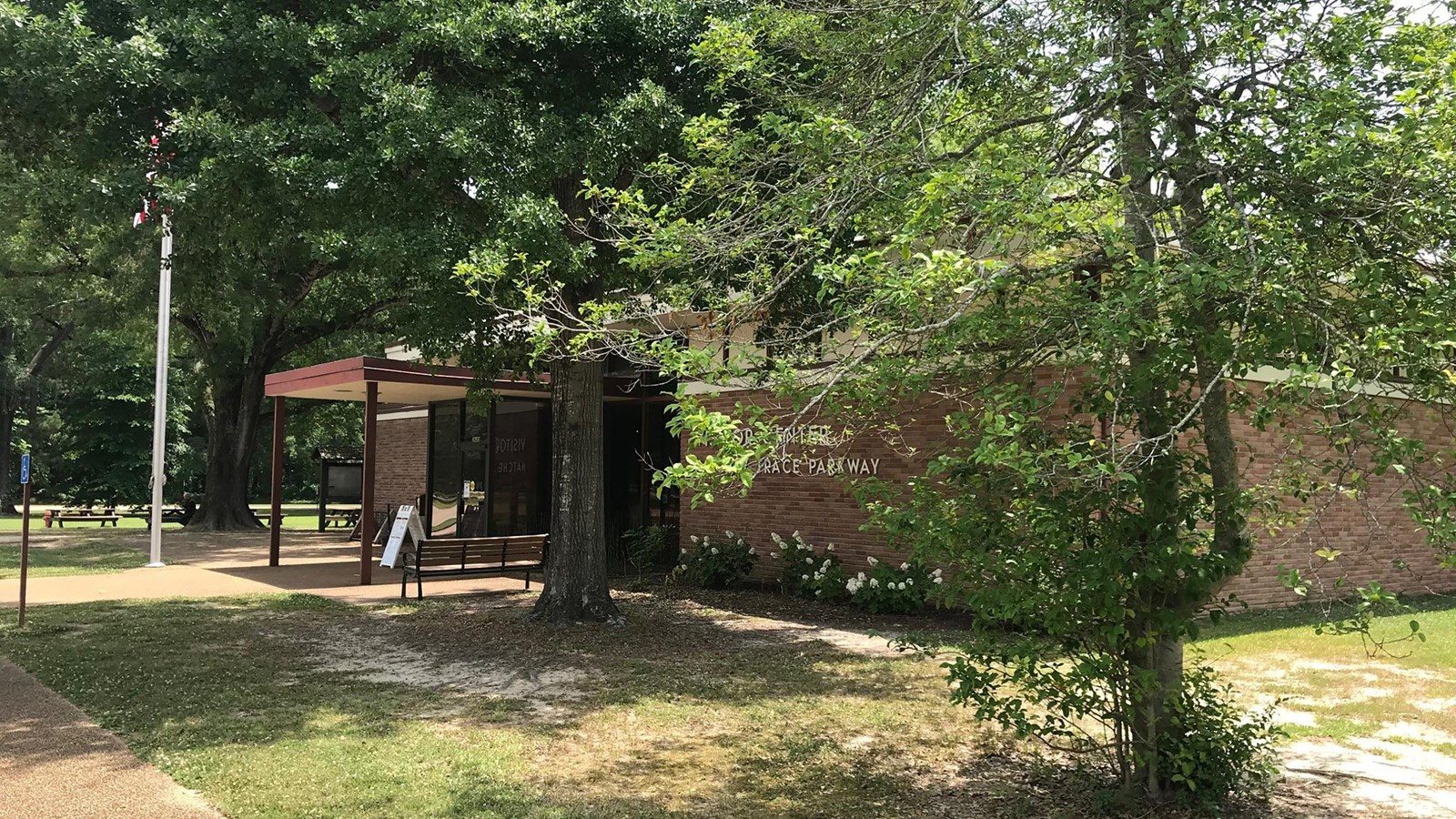
Pictured: the Natchez Trace Parkway Visitor Center at milepost 266 near Tupelo, headquarters area of the parkway in Lee County (National Park Service photo by Jane Farmer, public domain). It shows the parkway itself in the present day, not the 1973 sighting, the object, or the rangers involved; no photograph of anything seen over northeast Mississippi on October 3, 1973 is known to exist.
Theoretical Alignment
The case scores for the Extraterrestrial Hypothesis only because of the ranger's description: a large object hovering for a quarter of an hour at about 1,000 feet, carrying circular lights that "were rotating continuously" and were, in his words, "not the standard beacon type you have on aircraft." Westmoreland did not himself think it was extraterrestrial. His stated theory was a "highly secret experimental aircraft the Air Force is trying out." Nothing in the record describes occupants, a landing with traces, effects on people or machines, or any behavior beyond hovering and moving away, so the score stays low. The Interdimensional Hypothesis has essentially nothing to work with.
The Psycho-Social alignment is the highest of the three, and that judgment does not require anyone to have been dishonest. Four features of the record fit it:
- The reports came in the middle of a well-documented regional flap. UPI's own story noted that "Similar sightings have been reported in southern Georgia and parts of Tennessee in recent weeks."
- Radio stations in Corinth and Kosciusko said they were "swamped with calls." Call-in waves of this kind generate reports from people who would not otherwise have looked up.
- At least one cluster of reports, at Okolona, was later attributed by the Mississippi National Guard to one of its own helicopters testing lights, according to the Daily Journal's reporter.
- A Lee County officer who had himself seen an object told the same paper that many sightings were probably exaggerated by imagination and that some were probably hoaxes.
Each of these is the kind of social or perceptual process the Psycho-Social Hypothesis describes. None of them, on its own, explains what a named federal ranger and four other officers said they watched for 15 minutes.
Background
Tupelo is the seat of Lee County in northeast Mississippi. The 1970 census counted 20,471 people there. It is also the headquarters of the Natchez Trace Parkway, the National Park Service road that follows the old Natchez Trace for 444 miles from Natchez, Mississippi, into Tennessee. Congress made the parkway a unit of the National Park System in 1938, and it was not finished until 2005, so in 1973 it was still an unfinished road. Today the park's main visitor center stands at milepost 266, near Tupelo, and the parkway's mailing address is 2680 Natchez Trace Parkway, Tupelo.
UPI described Thomas E. Westmoreland as "a ranger for the Tupelo subdistrict of the Natchez Trace Parkway." The story does not say what his duties were, how long he had served, or where he and the other rangers were standing. The parkway today lists its own law enforcement office among its staff contacts. That is the background to Westmoreland's own remark that he had "been dealing with the public for years." No other public record of his career has been found for this file.
The wider region in October 1973 had several features that bear on the case:
- Military aviation. About 45 miles south-southeast of Tupelo (computed) lies Columbus Air Force Base. After 14 years under Strategic Air Command, the base returned to Air Training Command on July 1, 1969. Its first undergraduate pilot training class began that month, flying the T-37 and T-38 trainers. On June 1, 1972, the 14th Flying Training Wing was activated there. In other words, a jet pilot-training base was operating about 45 miles from Tupelo in 1973.
- National Guard helicopters. According to Wikipedia's history of the Mississippi Army National Guard's aviation units (unsourced on that point), full-time maintenance support facilities for Guard aviation were opened in Tupelo and Meridian between 1959 and 1968. An Associated Press report in 2014 placed the state's Apache helicopters at the Army Aviation Support Facility in Tupelo. Guard helicopters based at or flying near Tupelo in 1973 are therefore not a speculation invented to explain the case. As shown below, the Guard itself said one of its helicopters was flying near Okolona that week.
- The 1973 flap. The autumn of 1973 brought a heavy concentration of UFO reports to the Deep South. The National Investigations Committee on Aerial Phenomena (NICAP) chronology for 1973 carries a summary entry headed "August 31-October 19, 1973: Flurry of Sightings" covering Alabama, Georgia, Louisiana and Mississippi, describing "Fast-moving oblong objects with bright flashing or revolving lights" seen by "local and state police and many others."
There was no longer any official federal program to receive such reports. The Secretary of the Air Force announced the end of Project Blue Book on December 17, 1969, nearly four years earlier. By NARA's count, Blue Book had received 12,618 sightings between 1947 and 1969. In 1973, a citizen or officer who saw something strange could call the police, a newspaper, a radio station, or a civilian research group. NICAP's own Georgia entry for August 30, 1973 shows what happened when such reports reached the military that year. A duty officer at Robins Air Force Base in Macon said they would be handled by the base's air police, "who make all investigations of UFO reports."
Complete Timeline
| Date | Event |
|---|---|
| August 30–31, 1973 | Reports of flashing lights from a wide area of south Georgia go out over the state police communications network shortly after midnight. NICAP records the lights as "flashing blue, yellow, and green," citing a UPI story from Albany, Georgia. A Robins AFB duty officer says air police will handle the reports. |
| August 31–October 19, 1973 | NICAP's "Flurry of Sightings" period across Alabama, Georgia, Louisiana and Mississippi. |
| Sunday, date not given | According to Phyllis Harper's 2003 recollection, the parents of a friend of her children, in Lee Acres, watch an object through a telescope for more than half an hour, shortly before dark. They said it "looked nothing like a jet or other plane or helicopter." |
| Tuesday, October 2, 1973 (night) | According to Harper, three Mississippi Highway Patrolmen report flying objects in the Ashland–Holly Springs area, about 48–55 miles northwest of Tupelo (computed). UPI later counts this as the first of three consecutive nights of police reports around Tupelo. |
| Wednesday, October 3, ~6:35 PM CDT | Sunset at Tupelo. Venus, at magnitude −4.1, stands about 20° up in the southwest. The Moon, 46% illuminated, is in the south. (Computed with JPL Horizons.) |
| October 3, "about dark" | According to the Daily Journal's front-page story, "A rash of UFO sightings" begins in northeast Mississippi and continues until press time. Officers and many residents report objects. Harper later recalled that most reports were in Northeast Mississippi. |
| October 3, ~7:55 PM CDT | Mars, three weeks from opposition and at magnitude −2.1, rises in the east-northeast. Astronomical twilight ends about 8:03 PM. (Computed.) |
| October 3, ~8:32 PM CDT | Venus sets in the west-southwest. (Computed.) |
| October 3, night (time not given) | Ranger Thomas E. Westmoreland, three other rangers and a deputy sheriff watch an object hover over the Tupelo area for about 15 minutes, at about 1,000 feet, with rotating red, green and yellow lights. Behind WKCU in Corinth, sales manager Arlin Mohundro watches an oval object with red, green and white lights hover about 100 feet off the ground. Radio stations in Corinth and Kosciusko are flooded with calls. Several Lee County residents report an object that "went down to the ground" and flew back up north of Tupelo. Numerous people and officers see an object at Okolona. |
| Thursday, October 4, 1973 | The Daily Journal runs "UFOs Sighted in Tupelo Area" on page 1. UPI's story "Ranger 'Sure' of UFO," datelined Tupelo, is printed that day in The Crescent-News of Defiance, Ohio. Harper says she gets calls from all over the country, including one from Paul Harvey. |
| October 4, night | According to UPI, Tupelo police report multicolored UFOs "for the third consecutive night." The Lee County sheriff's office says two deputies saw brightly lighted objects, and similar reports come from the sheriff's departments of Pontotoc and Itawamba counties. |
| Friday, October 5, 1973 | UPI's follow-up appears in The Columbus Dispatch (Ohio) and, under the headline "The South's Saucer Siege," in the San Francisco Examiner. The Zanesville, Ohio, Times Recorder prints the Westmoreland story. |
| Following days (date not given) | According to Harper, National Guard authorities say they had a helicopter flying in the Okolona area testing lights. |
| About October 6–8, 1973 | An AP story datelined Petal, Mississippi, printed in the Mobile Register on October 9, reports that Forrest County Constable Charlie Delk chased a lighted object for more than 30 miles, and that his car and radio briefly went dead. |
| October 10, 1973 | NICAP lists a report of a round, shiny object on or near the ground at Magnolia, Mississippi. |
| October 11, 1973 | Charles Hickson and Calvin Parker report being taken aboard a craft beside the Pascagoula River. See this site's Pascagoula Abduction file. |
| The following week | According to Harper, reports in the Tupelo area "continued for a week or more after the Wednesday activity." She never saw an object herself. |
| October 15–17, 1973 | NICAP lists further Mississippi reports at Lambert and Marks, Henryville, Hattiesburg (October 16) and Eupora (October 17). |
| October 18, 1973 | An Army Reserve helicopter crew reports a close encounter near Mansfield, Ohio. See this site's Coyne Helicopter Incident file. |
| May 4, 2003 | Harper's column "UFO sightings elude camera-toting Journal reporter" in the Daily Journal looks back on her week as the paper's "UFO writer." |
| May 2024 | Columnist Lewis LeMaster, writing in the Zanesville Times Recorder, recalls that paper's October 1973 UFO coverage, including the October 5 Westmoreland story. |
The Ranger's Account
Almost everything known about Westmoreland's sighting comes from a single UPI wire story of about 400 words. It ran under the headline "Ranger 'Sure' of UFO" on Thursday, October 4, 1973, in The Crescent-News of Defiance, Ohio. The French researcher Patrick Gross's online press archive transcribes it in full, and that transcription is the version used here. The dateline is "TUPELO, Miss. (UPI)."
The story opens with Westmoreland's claim: "A National Park Service ranger said Wednesday night he saw a flying saucer the size of a two-bedroom house hover over this area for about 15 minutes flashing 'red, green and yellow lights.'" The phrase "said Wednesday night" matters. It means he gave the interview the same night as the sighting, not after days of retelling. It also fixes the date: Wednesday, October 3, 1973.
His first recorded words are about his own reliability: "I've been dealing with the public for years and I know people exaggerate and see what they want to see, but I know I saw this." Later in the story he added, "I know this sounds strange, and I can assure you I'm sober."
He described the object in three short passages:
- Altitude and size. "It was approximately 1,000 feet in altitude and roughly the size of a two-bedroom house or a little smaller."
- Lights. "It had red, green and yellow flashing lights — not the standard beacon type you have on aircraft. They were circular and they were rotating continuously." The UPI reporter paraphrased this as lights, "but not the same kind of lights that are on airplanes."
- Duration. It hovered "over this area for about 15 minutes."
The story does not give a time of night, a direction, a bearing, or a description of how the object left. It does not say whether the object made any sound. It does not say where the rangers were standing, whether on the parkway, at its headquarters, or elsewhere in the Tupelo area. It does not describe the object's shape beyond its size, and it never actually uses the word "disc." "Flying saucer" is the reporter's term in the opening sentence, not a quotation.
The corroboration the story claims is significant: "Westmoreland... said three other rangers and a deputy sheriff were with him when he saw the strange craft." That would make five law officers in all, four of them federal, watching the same object together. But none of the four is named, and none is quoted. No other source found for this file names them or records anything any of them said. The number of witnesses therefore rests on Westmoreland's own word, as relayed by UPI.
Then comes the explanation Westmoreland and his colleagues had settled on: "Our theory is that it's some highly secret experimental aircraft the Air Force is trying out and doesn't want the public to know about." The word "our" suggests that the group had talked it over. This is the single most important interpretive statement in the record. The principal witness, a federal law officer, did not claim to have seen a spacecraft. He claimed to have seen something he could not identify, which he assumed was a classified American aircraft. That is the same guess Deputy Kenneth Creel reached three and a half years later in the Flora, Mississippi police encounter, and it is a common one among officers who report UFOs.
How the wire story framed the night
The remainder of the UPI story widened the frame in three steps. First: "Highway patrolmen, policemen and a sheriff all reported seeing strange flying objects over northeastern Mississippi Wednesday night." Second, a regional context: "Similar sightings have been reported in southern Georgia and parts of Tennessee in recent weeks." Third, a measure of the public response: "Most of the latest reports were around the Tupelo area, although radio stations from Corinth, 50 miles to the north, and Kosciusko, 100 miles to the south, said they were swamped with calls from persons who said they had sighted unidentified flying objects."
The distances check out. Corinth is about 48 miles north of Tupelo and Kosciusko about 97 miles south-southwest (both computed between town centers). The officers in the story's first step are not named. The story does not say which sheriff, which highway patrolmen, or which police department, or whether any of them was the deputy who was with Westmoreland.
The Corinth Report: Arlin Mohundro and WKCU
The UPI story names only one other witness. Arlin Mohundro was the sales manager of radio station WKCU in Corinth, the Alcorn County seat about 48 miles north of Tupelo. WKCU had been on the air at 1350 kHz AM since October 24, 1965. Mohundro told UPI that "the object he saw hovered about 100 feet off the ground behind the station."
His description in the wire story is present tense, which suggests he was speaking while still watching it or immediately afterward: "It's lights are red and green and white. When it gets close it has kind of a black color. The lights are flashing and it looks like it might be the size of an automobile, but it's in an oval shape." ("It's" is the wire story's spelling.)
Mohundro's object differs from Westmoreland's in almost every measurable respect:
- Size: "the size of an automobile," against "the size of a two-bedroom house."
- Height: about 100 feet, against about 1,000 feet.
- Colors: red, green and white, against red, green and yellow.
- Shape: "oval," with "kind of a black color" when close. Westmoreland's quoted words give no shape at all.
The two men were about 48 miles apart. There is no reason to think they saw the same object, and the wire story does not say they did. What they share is a hovering source of multicolored flashing lights on the same night, in the same corner of the state.
One detail of Mohundro's description deserves a plain statement. Red, green and white are exactly the colors of standard aircraft position lights. Under U.S. airworthiness rules for rotorcraft, the forward position lights must be "a red and a green light," with "the red light... on the left side and the green light... on the right side," and the rear position light "must be a white light." The rules for fixed-wing aircraft use the same scheme. A helicopter hovering at about 100 feet behind a building at night would show red, green and white lights, look dark when close, and appear roughly oval from some angles. That does not prove Mohundro saw a helicopter. He gave no information about sound, and a helicopter at 100 feet is loud. But his description is fully consistent with one, and in a week when the National Guard acknowledged flying a helicopter testing lights in the region, it is the first explanation that has to be ruled out.
No further statement by Mohundro has been found, and no other public record of him has been located for this file.
The Daily Journal's Front Page
The most detailed local record of the night is the Tupelo Daily Journal's front-page story of Thursday, October 4, 1973, headlined "UFOs Sighted in Tupelo Area." The original page has not been located online for this file. What is known of it comes from a column published thirty years later by the reporter who covered the sightings.
Phyllis Harper was a Daily Journal columnist and feature writer who retired from the paper in 1997. (A 2009 obituary in the Jackson Free Press spells her first name "Phillis"; this file uses the spelling in her own paper's headline.) In 1973 she was, in her words, "A reporter covering the crime, crud and corruption beat." Her column of May 4, 2003, "UFO sightings elude camera-toting Journal reporter," opens: "For a week or so, I was the Daily Journal UFO writer." She had recently come across the October 4, 1973 front page and quoted from it. The later passages of her column are available online only to Daily Journal subscribers. For this file, those passages are drawn from notes made when the full column was read, and they are attributed to her throughout.
According to Harper, the 1973 story began by reporting that "A rash of UFO sightings reported in the Northeast Mississippi area Wednesday night began about dark" and lasted until press time. "A few sightings were in other places," she wrote, "but most were in Northeast Mississippi." She recalled the reaction: "I got calls from all over the country. Tupelo UFOs were news. Paul Harvey called." One caller from Zanesville, Ohio, assured her that the lights were the spirits of Civil War soldiers, "because they were all being seen near Civil War battlefields." The caller's theory is recorded here only as part of the reaction the story drew.
The excerpts Harper quoted add several details that the wire story does not have:
- Okolona. Numerous people and officers saw an object at Okolona, about 18 miles south of Tupelo (computed). National Guard authorities later said they had had a helicopter aloft in the area testing lights.
- A descent north of Tupelo. Several Lee County citizens said that "one UFO went down to the ground," then "flew back up again north of Tupelo."
- The night before. On Tuesday night, October 2, three Mississippi Highway Patrolmen had reported flying objects in the Ashland–Holly Springs area, roughly 50 miles northwest of Tupelo.
- An officer's own caution. A Lee County law officer who had himself seen an object near the Lee–Pontotoc county line said "many sightings probably were exaggerated by the imagination" and "some were probably hoaxes."
- An earlier sighting. The 1973 story also carried an account from the parents of Kim, a friend of Harper's children, in Lee Acres. They had watched an object through a telescope for more than half an hour on a Sunday evening, shortly before dark, and said it "looked nothing like a jet or other plane or helicopter."
- Duration of the wave. Reports "continued for a week or more after the Wednesday activity."
Her column's headline describes her as a "camera-toting" reporter, but in her week of covering the sightings she "never saw one." This file does not have the 1973 story's full text and does not know whether it named Westmoreland. Harper's surviving excerpts do not mention him or the parkway.
The Follow-Up Reports: A Third Night
UPI returned to Tupelo the next day. Its story about a truck driver injured near Greenville, Missouri, by what he described as a "large ball of fire," was printed on Friday, October 5, 1973, in The Columbus Dispatch of Ohio and in the San Francisco Examiner, where it ran under the headline "The South's Saucer Siege." Both printings, transcribed in Patrick Gross's archive, end with the same two paragraphs about Mississippi:
"In Tupelo, Miss., police reported for the third consecutive night the sighting of multicolored UFOs Thursday. The Lee County sheriff's office said two deputies told of seeing brightly lighted objects in the Tupelo area and that similar reports had come from sheriff's departments in neighboring Pontotoc and Itawamba counties."
(The Examiner version reads "what they called multicolored UFOs yesterday" and omits "in the Tupelo area.")
This short report does three things. First, it confirms that police reports in the Tupelo area continued on Thursday, October 4. Second, "third consecutive night" counts back to Tuesday, October 2, which agrees with Harper's account of three Highway Patrolmen reporting objects that night. Third, it spreads the reports across three counties: Lee, Pontotoc to the west, and Itawamba to the east. Neither UPI story names the two Lee County deputies or says whether either was the deputy who was with Westmoreland on Wednesday.
The Missouri case that led the same story is Eddie Webb's, discussed in this site's Piedmont Missouri Wave file. Webb said a bright light came up behind his truck "about dawn Wednesday," October 3, some 13 hours before the Tupelo sightings began. The physicist Harley Rutledge examined his damaged glasses. The pairing is a reminder of how editors of the time handled UFO stories: as a running national feature, with sightings from several states stitched into one report.
No Associated Press version of the Westmoreland story has been found for this file. The ranger's account also reached Zanesville, Ohio. In a 2024 column, Lewis LeMaster, a retired Zanesville-area schoolteacher, recalled that the Times Recorder ran at least 13 UFO articles in October 1973, and that its October 5 edition carried Westmoreland's description of an object "approximately 1,000 feet in altitude." Harper's Zanesville caller was apparently reading the same coverage.
Was Anyone Investigating?
No investigation of the Tupelo reports by any official body or civilian research organization has been found.
- The Air Force. The Air Force had closed Project Blue Book in December 1969 and no longer collected civilian UFO reports. Westmoreland's own theory, an Air Force test aircraft, was never put to the Air Force, so far as the record shows. No document links Columbus AFB, or any other installation, to the night of October 3.
- The National Park Service. No NPS report, memorandum or statement about the sighting has been located. If Westmoreland or his colleagues filed an incident report, it has not surfaced online.
- The National Guard. The Guard's statement about a helicopter testing lights near Okolona is the only official explanation offered for any part of the wave. Its exact wording, its date and its source survive only in Harper's account, quoted from the 1973 Daily Journal.
- NICAP. NICAP's 1973 chronology, the most detailed public listing of that year's reports, has no entry for Tupelo, Corinth, Okolona or the Natchez Trace. Its Mississippi entries for October 1973 are Magnolia (October 10), Pascagoula (October 11), Lambert and Marks and Henryville (October 15), Hattiesburg (October 16) and Eupora (October 17). The Tupelo reports would fall under its general "Flurry of Sightings" entry.
- APRO, MUFON and CUFOS. No record of the Tupelo reports in the files of the Aerial Phenomena Research Organization, the Mutual UFO Network or the Center for UFO Studies (founded in 1973) has been found online. The leading civilian investigators of the time were in Mississippi a week later, but they went to Pascagoula. According to this site's Pascagoula file, J. Allen Hynek and APRO's James Harder arrived there within days of October 11.
The absence of an investigation is the case's largest weakness. A case with a named federal witness, four corroborating officers, and the wire services' attention would normally have drawn at least a telephone call from a civilian investigator. If one was made, its result was not published, or has not survived in any place searched for this file. With Pascagoula eight days later and the national flap at its peak, the northeast Mississippi reports were simply overtaken.
The Regional Pattern, August–October 1973
The Tupelo reports cannot be read in isolation, because the people making them did not see them in isolation. The UPI reporter himself put them in the context of "southern Georgia and parts of Tennessee." What follows is limited to reports with a documented source.
South Georgia (August 30–31). NICAP, citing a UPI story from Albany, Georgia, records reports of flashing lights "from a wide area of south Georgia" relayed over the state police network after midnight. The objects, it says, "changed colors as they moved through the night, flashing blue, yellow, and green." These are among the reports UPI's Tupelo story was referring to.
Tennessee (late September–early October). NICAP lists two reports from Tennessee on October 1, at Giles and at Anthony Hill, both involving an egg-shaped object, with reported imprints. Together with the Georgia reports, they show the "recent weeks" the UPI reporter mentioned.
Missouri (October 3). The Eddie Webb incident near Greenville, Missouri, that morning, discussed above.
Forrest and Jones counties, Mississippi (about October 6–8). An AP story datelined Petal, Mississippi, and printed in the Mobile Register on October 9 reported that Forrest County Constable Charlie Delk chased an object "for over 30 miles, 'hoping it would land so I could see if anybody got out.'" He described it as looking "like an old-timey wind-up top with yellow lights all the way around it," said "some lights came out the side" that "looked sort of like blow torches," and reported that his car died for about 15 minutes and his police radio went dead. The story does not give the date of the chase.
Elsewhere in Mississippi (October 10–17). NICAP's entries, most of them citing "UFOE II" (The UFO Evidence, Volume II), list a landed object at Magnolia (October 10), the Pascagoula abduction (October 11), an orange oval at Lambert and Marks and an object with "legs" standing on the road at Henryville (October 15), an object that landed on a motorist's car at Hattiesburg (October 16), and a 50-foot domed object over Highway 82 at Eupora (October 17).
Two things stand out in this list. First, Tupelo was early. Its wave began on October 2–3, more than a week before Pascagoula drew national attention to Mississippi. It cannot be explained as a reaction to Pascagoula, although it may have been a reaction to the Georgia and Tennessee coverage. Second, the Tupelo reports are of a different kind from most of the later Mississippi entries. They describe lights at a distance, not landings, entities or effects on cars. On the night of October 3, the most dramatic claim was the Lee County report of an object that went to the ground and rose again.
What the Witnesses Agreed On, and What They Did Not
With so little primary testimony, the comparison has to be made from four sources: the UPI story of October 4, the UPI follow-up of October 5, and the two layers of Harper's account (her 2003 recollection and the 1973 front-page excerpts she quoted).
- Date. All sources agree on Wednesday night, October 3, 1973, as the peak. UPI's follow-up and Harper agree that police reports began on Tuesday, October 2, and continued through at least Thursday, October 4.
- Start time. The Daily Journal: "about dark." No time is recorded for Westmoreland's or Mohundro's sighting.
- Colors. Westmoreland: red, green and yellow. Mohundro: red, green and white. UPI's follow-up: "multicolored" and "brightly lighted." All describe colored, flashing or rotating lights.
- Size. Westmoreland: "the size of a two-bedroom house or a little smaller." Mohundro: "the size of an automobile." No other size estimates survive.
- Height. Westmoreland: "approximately 1,000 feet." Mohundro: about 100 feet. The Lee County citizens: down to the ground and back up.
- Behavior. Westmoreland: hovering for about 15 minutes. Mohundro: hovering, and apparently moving closer ("When it gets close"). Lee County citizens: a descent and climb. No source describes high speed or abrupt maneuvers.
- Interpretation. Westmoreland: a secret Air Force aircraft. The Guard: its own helicopter, for Okolona. The Lee County officer who saw an object near the Pontotoc line: many reports exaggerated, some hoaxes. Kim's parents: not a jet, plane or helicopter.
The common ground is narrow but real. On three consecutive nights, officers from at least four agencies (the National Park Service, the Highway Patrol, the Lee County sheriff's office and the Tupelo police) and many civilians, from Corinth and Ashland in the north to Okolona in the south and into Pontotoc and Itawamba counties, reported colored, flashing lights in the night sky, some apparently hovering. Beyond that, the descriptions diverge widely, which is what one would expect if several different things were being seen.
Key Witnesses
Thomas E. Westmoreland
The National Park Service ranger whose account led UPI's October 4, 1973 story. He said that he, three other rangers and a deputy sheriff watched an object about "the size of a two-bedroom house" hover at roughly 1,000 feet over the Tupelo area for about 15 minutes, with circular red, green and yellow lights that "were rotating continuously" and were "not the standard beacon type you have on aircraft." He stressed his experience with the public ("I know people exaggerate and see what they want to see, but I know I saw this") and his sobriety. He did not claim the object was extraterrestrial. His group's "theory" was that it was "some highly secret experimental aircraft the Air Force is trying out." No later statement by him, and no other public record of his career, has been found.
Arlin Mohundro
The only other witness named in the UPI story. He said an object hovered about 100 feet off the ground behind WKCU, showing flashing red, green and white lights. It looked "kind of a black color" when it came close and was about "the size of an automobile, but... in an oval shape." His station was one of the Corinth radio stations that UPI said were "swamped with calls" that night. No further account from him has been found.
Phyllis Harper
Not a witness to any object. She "never saw one." She was the Daily Journal reporter assigned to the sightings for about a week in October 1973, and the only surviving source for the paper's October 4 front-page story, the National Guard's helicopter statement, the Ashland–Holly Springs patrolmen and the Lee Acres telescope sighting. Her 2003 column is skeptical in a careful way: she would not dismiss the word of so many reliable people, but she thought reason pointed to an explanation. She retired from the paper in 1997 and died in February 2009.
The other witnesses are known only collectively: three other Natchez Trace Parkway rangers and a deputy sheriff (with Westmoreland), "Highway patrolmen, policemen and a sheriff" (UPI, October 3), three Highway Patrolmen near Ashland and Holly Springs (Harper, October 2), two Lee County deputies and officers in Pontotoc and Itawamba counties (UPI, October 4), "numerous persons and officers" at Okolona, a Lee County officer near the Pontotoc line, Lee County citizens north of Tupelo, and Kim's parents in Lee Acres. None of them is named in any source found for this file.
The Five Observables Assessment
The Five Observables framework, developed by former AATIP director Luis Elizondo, classifies UAP encounters by performance characteristics that exceed known technology. The Tupelo reports are visual only, with no instrument data, so the assessment can only be made from testimony.
Assessment:
- Anti-gravity lift (speculative). Westmoreland's object hovered for about 15 minutes at an estimated 1,000 feet, and Mohundro's hovered at about 100 feet. Neither man is quoted on sound. A hover is not in itself anomalous: helicopters hover, and a distant light that is not moving relative to the observer looks the same as a hovering one. Without any sound report or reliable distance, the observable cannot be scored above speculative.
- Instant acceleration (absent). No source describes sudden acceleration or abrupt maneuvers. The Lee County report of an object descending to the ground and climbing again describes vertical movement, not acceleration beyond known aircraft.
- Hypersonic speed (absent). Not described.
- Low observability (absent). Every object reported was conspicuously lit and seen by many people.
- Trans-medium travel (not applicable). No water was involved.
On this framework the case is weak. Its interest lies in the number and standing of the people who reported lights, not in any described flight performance.
Evidence Assessment
Supporting Anomalous Origin
- The principal witness was a named federal law officer, a National Park Service ranger, who said four other officers (three rangers and a deputy sheriff) watched with him.
- He gave his account to a wire service the same night, before it could be shaped by days of retelling.
- He described himself as experienced with members of the public who "exaggerate and see what they want to see," explicitly denied drinking, and offered a conventional interpretation rather than an extraterrestrial one. None of this suggests a witness eager for attention.
- He specifically said the lights were "not the standard beacon type you have on aircraft" and were "rotating continuously," which, if accurate, argues against an ordinary aircraft.
- Officers from several agencies, in Lee, Pontotoc and Itawamba counties and beyond, reported lights over three consecutive nights, and civilians reported them across a region extending from Corinth to Kosciusko.
- Kim's parents in Lee Acres watched an object through a telescope for more than half an hour and said it looked nothing like a jet, plane or helicopter.
- The Tupelo reports began more than a week before Pascagoula, so they cannot be explained as copycat reports prompted by that case.
Supporting Conventional Explanation
- The only detailed account is one wire story. The three other rangers and the deputy are not named or quoted anywhere, so the corroboration rests on Westmoreland's word.
- No investigation by any official or civilian body has been found, and no report, photograph, radar record or physical trace exists.
- The National Guard said one of its helicopters was flying near Okolona that week, testing lights, which accounts for at least one cluster of reports.
- Mohundro's red, green and white lights are the colors of standard aircraft position lights, and his object's height and size fit a helicopter.
- Venus, the brightest object in the night sky at magnitude −4.1, stood low in the southwest and west-southwest from sunset until it set at about 8:32 PM, at the start of the wave "about dark." Mars, near its brightest, rose in the east-northeast at about 7:55 PM. Planets low on the horizon often appear to flash colors and to hover.
- Columbus AFB, an active jet pilot-training base, was about 45 miles away.
- The descriptions vary widely: a house-sized object at 1,000 feet against a car-sized oval at 100 feet, yellow lights against white.
- The reports came in a recognized flap, with radio stations "swamped with calls" and a local officer warning that many sightings were exaggerated and some were probably hoaxes.
- The principal witness himself thought it was a man-made aircraft.
Why "Disputed"
The Natchez Trace ranger sighting is stamped DISPUTED with a score of 35/100. Its strengths are real. A named federal officer gave a same-night account to a wire service, claimed four corroborating officers, and was careful to present himself as a skeptic of other people's sightings. Officers from at least four agencies reported lights across several counties over three nights. Those strengths are why the case is not rated lower.
Four things hold it down. First, the record is extremely thin. One wire story carries the ranger's account, and none of the other four officers ever speaks. Second, nobody investigated, and nothing was measured, photographed or logged. Third, conventional sources are known to have been present: a National Guard helicopter testing lights in the area, a jet training base 45 miles away, and two of the brightest planets low on opposite horizons during the evening. Fourth, the descriptions of the objects disagree so widely that they are better explained as several different things than as one.
The case scores below the Flora, Mississippi police encounter (Disputed, 42), which has a far better paper trail: an AP story, a detailed local interview, a filmed second witness and a published CUFOS investigation with aviation checks. Flora's close-encounter testimony was later disowned by its main witness, but its documentation is much stronger. This case also scores well below the Pascagoula Abduction eight days later, which drew immediate investigation by sheriffs, Air Force personnel and civilian scientists. It sits near the Kirtland AFB sighting (Disputed, 43) in kind, a light seen by witnesses from several agencies, but has less documentation. The score reflects a real night of widespread reports by credible people, with no investigation behind them and several likely conventional sources in play.
Sensor & Instrumentation Detection Profile
No instrument recorded anything. In detail:
- Visual: All reports were naked-eye observations except one. Kim's parents in Lee Acres used a telescope, the only optical aid mentioned in any source. The telescope observation is the most instrument-like record in the case, but no notes, sketches or magnifications survive, and its date is not known.
- Acoustic: No source found for this file records any sound, or the absence of sound, from any object. That is a serious gap, because sound is the simplest way to separate a helicopter from a silent light.
- Radio: Police, sheriffs' offices and the Highway Patrol were all reporting objects, and radio stations in Corinth and Kosciusko said they were "swamped with calls." No dispatch log or call record has surfaced.
- Radar: No radar check is recorded, and no one is known to have asked any military or civilian radar facility for its records.
- Photographs and film: None are known. Harper, the "camera-toting" reporter of her column's headline, never saw an object to photograph.
The one official statement in the case, the National Guard's helicopter explanation for Okolona, needs the caveat this site applies to every institutional explanation. Military and government bodies dealing with UFO reports have a documented history of incomplete or later-revised answers. In the Blue Book era, the Air Force issued identifications that some of its own scientific consultants later criticized, and in 1997 the CIA acknowledged that many Cold War-era UFO reports had been caused by reconnaissance flights it chose not to explain. A unit asked about its own aircraft also has an incentive to give the least alarming answer. None of this means the Guard's statement was wrong. A helicopter testing lights over Okolona is an entirely plausible and ordinary explanation, and nothing contradicts it. But it covers one town, it was relayed secondhand through a newspaper, and there is no way now to check which reports it was meant to cover or whether the helicopter's route and times actually matched them.
Environmental & Geospatial Context
Tupelo lies at about 34.26° N, 88.70° W, in the rolling country of northeast Mississippi. The places named in the reports surround it: Corinth about 48 miles north, Ashland and Holly Springs 48 to 55 miles to the north-northwest and northwest, Pontotoc about 17 miles west, Okolona about 18 miles south, and Kosciusko about 97 miles south-southwest. Columbus Air Force Base is about 45 miles south-southeast (all computed between town centers). The Natchez Trace Parkway runs past Tupelo on its way from Natchez to Tennessee, and its main visitor center is at milepost 266, near Tupelo.
No weather observation for the night has been found. The reports themselves suggest a sky clear enough for lights to be seen widely, but that is an inference, not a record.
The sky over Tupelo on October 3, 1973
Because no source records the weather, the positions of the bright planets and the Moon are the most useful environmental facts available. They were computed for this file with NASA JPL's Horizons ephemeris system for an observer at Tupelo (34.258° N, 88.703° W) on the evening of October 3, 1973. Mississippi was then on Central Daylight Time (UTC−5), because the Uniform Time Act of 1966 kept daylight saving time in force until the last Sunday in October, which in 1973 was October 28. The results:
- The Sun set at about 6:35 PM CDT. Civil twilight ended at about 7:04 PM, and astronomical twilight at about 8:03 PM. The Daily Journal's "about dark" therefore means roughly 7:00 to 7:30 PM.
- Venus, at magnitude −4.1, was by far the brightest object in the sky after the Moon. It stood about 20° up in the southwest at sunset, about 16° up at 7:00 PM (azimuth 231°), about 11° at 7:30 PM, and about 6° at 8:00 PM, and it set at about 8:32 PM in the west-southwest (azimuth 245°).
- Jupiter, at magnitude −2.5, was in the south-southeast at dusk, about 32° up at 7:00 PM. It crossed the meridian about 35° up at around 8:30 PM and was still about 31° up in the south-southwest at 10:00 PM.
- Mars, at magnitude −2.1 and three weeks from its October 25, 1973 opposition, rose in the east-northeast (azimuth about 76°) at about 7:55 PM. It was about 13° up at 9:00 PM and about 25° at 10:00 PM. At opposition it reached magnitude −2.6, about as bright as Jupiter.
- The Moon was 46% illuminated, a little short of first quarter. It stood about 32° up in the south at dusk and set at about 11:33 PM in the west-southwest.
- Saturn, much fainter at magnitude 0.0, did not rise until about 11:30 PM.
These positions matter for two reasons. First, the evening sky that night held three very bright points of light besides the Moon: Venus low in the southwest and west, Jupiter high in the south, and red Mars climbing in the east. Second, two of them spent part of the evening close to the horizon. Venus was below 10° from about 7:35 PM until it set, and Mars was below 10° from its rising until about 8:45 PM. Seen through the thick, turbulent air near the horizon, a bright planet often twinkles strongly and appears to flash red, green and other colors. Because a planet appears to stand still for many minutes, it can easily look as though it is hovering.
This does not show that Westmoreland saw Venus or Mars. His sighting lasted about 15 minutes, which is consistent with a low planet, but its time and direction were not reported, and he described the lights as "circular" and "rotating," which is not how planets are usually described. What the ephemeris does show is that, at the start of the wave "about dark," the single brightest object in the sky stood low in the southwest and was moving toward the horizon, and that a second, reddish planet was rising in the opposite direction as the evening went on. Any investigator in 1973 would have asked the witnesses which way they were looking. Nobody did, or if anyone did, the answer has not survived.
The Lee Acres telescope sighting is harder to place, because its date is not known. Venus was a brilliant evening object in the southwestern sky throughout early October 1973, and a bright planet seen "shortly before dark" and watched until it set is a classic source of long-duration reports. But Kim's parents were looking through a telescope, which would normally show Venus as a small, bright, phased disc rather than an unidentifiable object, and they were confident it was not an aircraft. Without the date, the direction or the 1973 description itself, this file cannot test it.
Two of the computed fields appended automatically to the Forensic Data Profile below need a note. The lunar figure there (37%) comes from a simple phase calculation for the date; the JPL Horizons computation used in this file gives the Moon as about 46% illuminated at dusk. The weather field, drawn from ERA5 reanalysis, gives light drizzle and 57% average cloud cover, but those are whole-day averages for one grid square, not observations of the evening. No 1973 source found mentions rain or cloud.
Observer Credibility & Occupational Profile
The witnesses' occupations are the main reason the case drew attention, and they deserve a fair assessment. Most were law officers or responsible professionals. None is known to have been a trained observer of the sky.
Thomas E. Westmoreland was a federal law enforcement and visitor-services officer. His comment that he had dealt with the public for years and knew that "people exaggerate and see what they want to see" shows an awareness of how misperception works, and his offer of a conventional explanation is the behavior of a cautious witness. But a ranger's training is in people, roads and parkland, not in estimating the altitude and size of an unfamiliar light at night. The figures he gave, "approximately 1,000 feet" and "the size of a two-bedroom house," are linked: without knowing the distance, the size cannot be known, and vice versa. They should be read as impressions, not measurements.
The four officers said to have been with him would, if they could be named and their accounts found, be the most valuable addition to the record. As it stands, their corroboration is reported, not documented.
Arlin Mohundro was a radio station sales manager, a member of the public with no relevant training. His account is the most specific in the record about colors and shape, and those details fit a lighted aircraft.
The unnamed Highway Patrolmen, deputies and police officers are, as a group, credible people with a professional interest in accurate reporting. The Lee County officer quoted by the Daily Journal is a good example. He had seen an object himself, yet he said on the record that many sightings were probably exaggerated and some probably hoaxed.
Phyllis Harper was a crime reporter, used to weighing what people told her. She saw nothing herself, and her 2003 account is balanced. Her column was written 30 years after the event, but its key details come from the 1973 front page she quoted, not from memory.
Physical & Material Assays
No physical or material evidence of any kind is associated with the case. No source reports ground marks, burned or flattened vegetation, residue, radiation, electromagnetic effects on vehicles or radios, or physical effects on any witness. The only report of an object reaching the ground, by Lee County citizens north of Tupelo, does not name a place, and no one is recorded as having gone to look. No samples were taken and no analysis was done or requested. There is nothing to assay.
That absence stands out against the Mississippi reports later the same month. Constable Delk's car and radio reportedly died near Petal. NICAP's Eupora entry for October 17 describes a car's lights and engine failing. The Pascagoula witnesses described being physically handled. None of the Tupelo reports describes any physical effect at all.
Historical Precedents & Archive Matches
The Tupelo reports belong to a familiar pattern: a regional wave of nocturnal lights, reported by police and the public, amplified by radio call-ins and wire coverage, and never investigated case by case. This site documents several comparable cases.
- Piedmont, Missouri (1973): A wave of light sightings in the Missouri Ozarks from early 1973, which led physicist Harley Rutledge to set up the instrumented field study he called Project Identification. It is the clearest contemporary example of what an investigation of a wave like Tupelo's could have looked like. It was also the source of the Eddie Webb report that shared a UPI story with Tupelo on October 5.
- Pascagoula, Mississippi (October 11, 1973): The state's most famous case, eight days after Tupelo. It drew the investigators Tupelo never did.
- The Coyne Helicopter Incident, Ohio (October 18, 1973): An Army Reserve helicopter crew's encounter at the height of the same flap, and a reminder that military helicopters were both sources of reports and observers that autumn.
- The 1973–74 Pennsylvania UFO-Bigfoot Wave: Another regional wave of the same season, logged by a local investigator.
- Flora, Mississippi (February 9, 1977): A later Mississippi police case in which the principal officer also guessed "some secret Air Force test," and in which planets low in the evening sky were later shown to match much of what was seen.
- Exeter, New Hampshire (September 3, 1965): A case in which officers independently corroborated a civilian's report of red flashing lights over a field. Its strength, named and quoted officer witnesses, is exactly what Tupelo lacks.
In the archives searched for this file, the case appears only in the press: the UPI stories transcribed in Patrick Gross's archive, the Zanesville Times Recorder, and the Daily Journal as recalled by Harper. It does not appear in NICAP's 1973 chronology. A 2023 Clarion-Ledger retrospective of Mississippi UFO encounters covered Pascagoula and several later Mississippi cases but did not mention Tupelo.
Material Analysis
There is no material evidence to analyze. This section therefore looks at what the absence of physical evidence means for the question of terrestrial versus non-terrestrial origin, and at what documentary evidence could, in principle, still be found.
What a physical record would have looked like
Each candidate explanation predicts a different physical record:
- A helicopter would leave no ground trace unless it landed, but it would leave paperwork: a flight log, a crew, a unit. For Okolona, the Guard said exactly that.
- A jet trainer from Columbus AFB would leave flight records at the base.
- A planet leaves no record at all, which is what exists.
- An unknown craft that descended to the ground north of Tupelo might have left marks, but no one is recorded as having looked.
Documentary evidence that may still exist
The most promising untapped records are documents:
- the full Daily Journal front page of October 4, 1973, and its follow-up stories that week, which may name Westmoreland's companions, give times and directions, and quote the Guard statement exactly;
- National Park Service incident or daily reports from the Tupelo subdistrict of the Natchez Trace Parkway for October 3, 1973;
- Mississippi Army National Guard aviation flight records for the Tupelo facility for October 1–10, 1973;
- Columbus AFB flying records for the evening of October 3, 1973;
- Mississippi Highway Patrol and Lee, Pontotoc and Itawamba county dispatch logs for October 2–4, 1973;
- the Corinth Daily Corinthian's coverage of the Mohundro report, and the Kosciusko Star-Herald's coverage of its local call-ins;
- any APRO or NICAP correspondence about the Tupelo reports.
None of these has been located online for this file. Several could settle the case's main questions, especially what time Westmoreland's sighting happened, which way he was looking, and whether a Guard or Air Force aircraft was flying near Tupelo at that hour.
Supporting Non-Terrestrial or Anomalous Origin
- The ranger specifically distinguished the lights from aircraft beacons and described them as circular and continuously rotating.
- A telescope observation by two residents produced the judgment that the object looked nothing like a jet, plane or helicopter.
- No aircraft, military or civilian, has ever been tied to Westmoreland's sighting.
Supporting Terrestrial Origin
- No physical, photographic or instrumental evidence exists, so nothing in the record requires a non-terrestrial origin.
- A known terrestrial source, a National Guard helicopter testing lights, was acknowledged to have been flying in the area that week.
- The red, green and white lights at Corinth match standard aircraft position lights.
- Venus and Mars were both low on the horizon during parts of the evening, where bright planets are most often reported as flashing, hovering lights.
- The principal witness's own explanation was a terrestrial aircraft.
The Conventional Explanation Candidate
No single conventional explanation covers every report from northeast Mississippi that week, and the record is too thin to test any of them properly. The candidates are best taken one at a time.
A National Guard helicopter
This is the only explanation with an official statement behind it. According to Harper, Mississippi National Guard authorities said they had a helicopter aloft in the Okolona area testing lights. Guard aviation had a full-time facility in Tupelo by then, according to the unit history summarized on Wikipedia. A helicopter can hover, carries red, green and white position lights, and can descend to the ground and climb again, which would also account for the Lee County report of an object that "went down to the ground" and "flew back up again." Mohundro's description in Corinth fits a helicopter closely.
It fits Westmoreland's account less well. He said the lights were "not the standard beacon type you have on aircraft" and were "rotating continuously," and he gave the object's size as a house. A helicopter testing unusual lights could plausibly show lights that looked unlike ordinary beacons, but that is speculation. The Guard's statement, as quoted, concerned Okolona, 18 miles south of Tupelo, not the parkway. A ranger might also be expected to recognize a helicopter's sound at 1,000 feet, unless it was farther away than he thought; but no source says whether the object made any sound. As an explanation for Okolona, it is strong. As an explanation for the whole wave, and for Westmoreland's sighting in particular, it is possible but unproven.
Venus, Mars and Jupiter
At the start of the wave "about dark," Venus was the brightest object in the sky, low in the southwest and sinking. Later in the evening Mars, near its brightest, rose low in the east-northeast. A bright planet near the horizon commonly twinkles in color and seems to hover, and it is one of the most frequently misreported sources of UFO sightings. Venus or Mars could account for a stationary multicolored light watched for 15 minutes, and Venus for the Lee Acres telescope sighting if it took place at dusk when Venus was setting. Against this: no report says which direction anyone was looking; Westmoreland described "circular" lights "rotating continuously" at an estimated 1,000 feet, which is not a typical description of a planet; and a park ranger might be expected to recognize Venus. The planetary explanation is plausible for part of the wave but cannot be tested against any specific report.
Jet trainers or other conventional aircraft
Columbus AFB's T-37 and T-38 training aircraft flew about 45 miles away, and ordinary civilian traffic crossed the region. A distant aircraft approaching head-on can appear to hover for minutes, with its lights flashing. But neither UPI story reports a sound, a track or a departure, and a 15-minute apparent hover is long for an approaching aircraft. No flight records were ever checked. This candidate can be neither confirmed nor excluded.
A secret military aircraft
This was Westmoreland's own theory: "some highly secret experimental aircraft the Air Force is trying out and doesn't want the public to know about." It is the most interesting statement in the record, because it comes from the principal witness. But no program, aircraft type, unit or document has ever been linked to northeast Mississippi in October 1973. The theory amounts to the conclusion that the object was not a recognizable aircraft, which the witness then explained by the most familiar mystery available to him.
Hoaxes and exaggeration in a flap
A Lee County officer who had himself seen an object told the Daily Journal that "many sightings probably were exaggerated by the imagination" and "some were probably hoaxes." Radio stations in Corinth and Kosciusko were "swamped with calls." In a wave of this kind, publicity itself produces reports. This explanation probably covers some share of the civilian call-ins, but it cannot explain away a group of five officers who said they watched something together for 15 minutes, and there is no suggestion that Westmoreland was joking.
A genuine unidentified object
On this reading, Westmoreland and his companions saw something not attributable to any known aircraft or natural source, and the conventional explanations account only for other reports around it. It is supported by the ranger's standing and caution, his explicit distinction between these lights and aircraft beacons, the four other officers he said were present, and the Lee Acres telescope observation. It is weakened by the absence of any investigation, the anonymity of every corroborating witness, the confirmed presence of a Guard helicopter testing lights nearby, the planets low in the sky, and the principal witness's own conclusion that he had seen a man-made aircraft.
National Guard Helicopter
Plausible (Okolona, Corinth) Unproven (ranger's sighting)The Guard said a helicopter was testing lights near Okolona that week, and Mohundro's red, green and white lights match aircraft position lights. Whether any helicopter was over Tupelo during Westmoreland's 15 minutes is unknown.
Venus, Mars & Jupiter
InconclusiveVenus was low in the southwest at dusk and Mars rose low in the east-northeast near 8 PM, both prime sources of "hovering," color-flashing lights. No report records a direction or time precise enough to test.
Jet Trainers or Other Aircraft
InconclusiveColumbus AFB's pilot training base was about 45 miles away. No flight records were checked, and a 15-minute apparent hover is long for an approaching aircraft.
Secret Military Aircraft
SpeculativeThe ranger's own theory, but no program, unit or document has ever been linked to the night.
Hoaxes & Flap Exaggeration
Plausible (some call-ins)A local officer said so at the time, and radio stations were swamped with calls. It does not account for five officers watching together.
Genuine Unidentified Object
InconclusiveSupported by a careful federal witness and four reported companions, but no one investigated, no corroborating officer is named, and the witness himself thought it was an aircraft.
Related Cases
Confirmed Documents & Official Records
NARA's guide to the Air Force's Project Blue Book records, which record the program's termination on December 17, 1969. It is background only: Blue Book had closed nearly four years before the Tupelo reports, and no federal agency is known to have investigated them.
UNCLASSIFIEDThe National Archives' finding aid for UFO and UAP textual records across record groups. Any surviving National Park Service or Air Force paperwork about October 1973 would be found through finding aids like this one; none specific to the Tupelo reports has been identified.
UNCLASSIFIEDSearch Government Archives Directly
Further Reading — Recommended Literature
Project Identification: The First Scientific Field Study of UFO Phenomena
The physicist's account of his instrumented study of the 1973 Missouri light wave, the kind of investigation the Tupelo reports never received.
The UFO Handbook: A Guide to Investigating, Evaluating, and Reporting UFO Sightings
CUFOS's chief investigator of the 1970s on how planets, aircraft and advertising lights were mistaken for UFOs in the reports of that decade.
The Hynek UFO Report
Hynek's account of the Project Blue Book years, written a few years after the Air Force stopped collecting reports like these.
DISCLOSURE: Some links above are affiliate links. If you purchase through them, OverClassified receives a small commission at no additional cost to you. This helps support independent research.
Essential Viewing
No Videos Available
Sources
- United Press International. "Ranger 'Sure' of UFO." Dateline Tupelo, Miss. The Crescent-News (Defiance, Ohio), Thursday, October 4, 1973. Transcribed in Patrick Gross, UFOs at Close Sight, press archive: ufologie.patrickgross.org
- United Press International. "Truck Driver Blinded: Scientist Investigates Reported UFO Attack" (Cape Girardeau, Mo., with Tupelo paragraphs). The Columbus Dispatch (Columbus, Ohio), Friday, October 5, 1973. Transcribed in Patrick Gross's press archive: ufologie.patrickgross.org
- United Press International. "The South's Saucer Siege." San Francisco Examiner, October 5, 1973. Transcribed in Patrick Gross's press archive: ufologie.patrickgross.org
- Associated Press. "Forest Constable Chases UFO Through Two Counties." Dateline Petal, Miss. Mobile Register, October 9, 1973. Transcribed in Patrick Gross's press archive: ufologie.patrickgross.org
- Harper, Phyllis. "UFO sightings elude camera-toting Journal reporter." Northeast Mississippi Daily Journal (Tupelo), May 4, 2003; quotes the paper's Page 1 story "UFOs Sighted in Tupelo Area," October 4, 1973 (later passages subscriber-only). djournal.com
- LeMaster, Lewis. "Was Zanesville visited by space aliens in 1973?" Zanesville Times Recorder, republished May 26, 2024 (recalls the paper's October 5, 1973 Westmoreland story). aol.com
- Mott, Ronni. "Mississippi Mourns Two Journalists." Jackson Free Press, February 16, 2009 (obituary of Phillis Harper). jacksonfreepress.com
- National Investigations Committee on Aerial Phenomena. "1973 Chronology": entries for South Georgia (August 30, 1973), "August 31-October 19, 1973: Flurry of Sightings," Giles and Anthony Hill, TN (October 1), Jackson, MO (October 3), and Mississippi (Magnolia, Pascagoula, Lambert and Marks, Henryville, Hattiesburg, Eupora). nicap.org
- Broom, Brian. "Congressional UFO hearings: A look back at Mississippi UFO encounters." Clarion-Ledger, August 1, 2023 (republished by Yahoo News). yahoo.com
- National Archives. "Project Blue Book — Unidentified Flying Objects" (termination December 17, 1969; 12,618 sightings 1947–1969). archives.gov
- National Archives. "UAP Textual and Microfilm Records Research Guide." archives.gov
- National Park Service, Natchez Trace Parkway. "History & Culture" (444 miles; designated 1938; completed 2005). nps.gov
- National Park Service, Natchez Trace Parkway. "Our Staff & Offices" (parkway headquarters in Tupelo). nps.gov
- National Park Service. "Parkway Visitor Center, Milepost 266." nps.gov
- U.S. Air Force. "Columbus Air Force Base" fact sheet (return to Air Training Command July 1, 1969; first T-37/T-38 class July 1969; 14th Flying Training Wing activated June 1, 1972). columbus.af.mil
- Associated Press. "Tupelo Guard unit could be stripped of Apaches." The Dispatch (Columbus, Miss.), April 21, 2014 (Army Aviation Support Facility in Tupelo). cdispatch.com
- Wikipedia. "185th Aviation Brigade (United States)" (Mississippi Army National Guard aviation history; Tupelo and Meridian maintenance facilities, 1959–1968; used only with this limitation noted). en.wikipedia.org
- Electronic Code of Federal Regulations. 14 CFR § 27.1385, "Position light system installation" (red left, green right, white rear). law.cornell.edu
- Gurevitz, Mark. "Daylight Saving Time." Congressional Research Service report RS22284, updated March 7, 2007 (Uniform Time Act of 1966). everycrsreport.com
- NASA Jet Propulsion Laboratory. Horizons System ephemerides for the Sun, Moon, Venus, Mars, Jupiter and Saturn as seen from 34.258° N, 88.703° W, October 3–4, 1973, and Mars elongation October 20–30, 1973 (computed for this file). ssd.jpl.nasa.gov
- Wikipedia. "Tupelo, Mississippi" (Lee County seat; 1970 census; Natchez Trace Parkway headquarters). en.wikipedia.org
- Wikipedia. "WKCU" (Corinth, Mississippi; 1350 kHz; first air date October 24, 1965). en.wikipedia.org
- OverClassified. Pascagoula Abduction case file (October 11, 1973; Hynek and Harder's investigation).
- OverClassified. Piedmont Missouri Wave case file (Eddie Webb, October 3, 1973; Harley Rutledge).
- OverClassified. Flora, Mississippi Police Encounter case file (1977 comparison).
See something inaccurate? Have additional information or sources?
Suggest an Edit →Last Updated: October 2026