
The 1973–74 Pennsylvania UFO-Bigfoot Wave
Beginning in the summer of 1973 and continuing through 1974, southwestern Pennsylvania — principally Westmoreland and Fayette Counties, along the Chestnut Ridge corridor of the Allegheny Mountains — experienced a sustained cluster of hundreds of UFO reports overlapping with dozens of Bigfoot-type creature encounters, some occurring at the same locations within hours of one another. Civilian investigator Stan Gordon personally logged the wave in real time, producing what remains the most extensively documented "high strangeness" UFO-cryptid overlap case in American ufological literature, including two separate incidents in which an armed witness fired on a creature at close range.
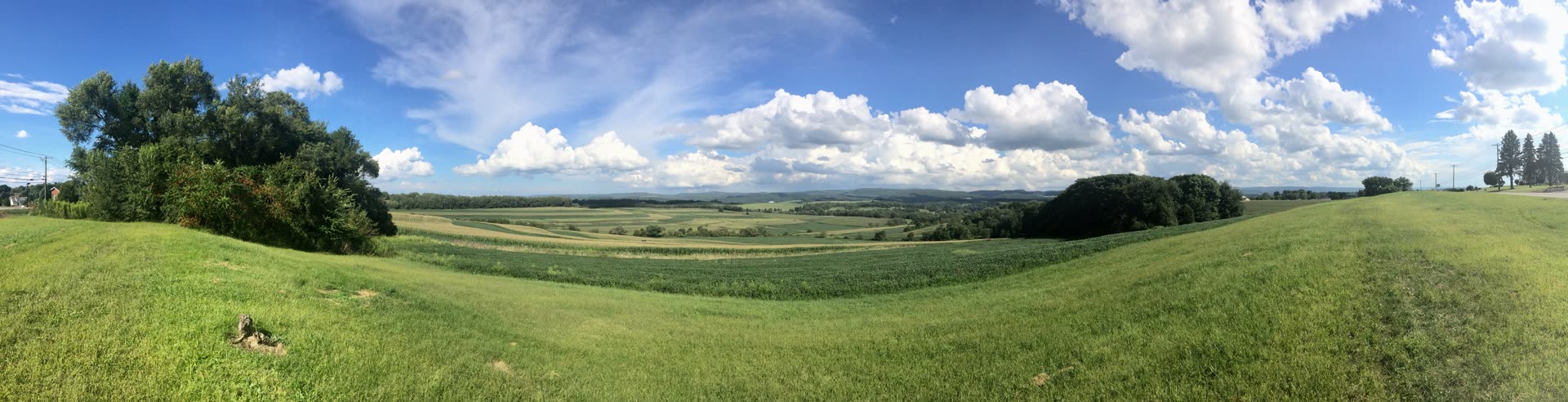
Pictured: the Laurel Highlands countryside of Mount Pleasant Township, Westmoreland County, Pennsylvania — the rural, forested terrain characteristic of the wave's reporting area. Photographed in 2018 by Wikimedia contributor Andre Carrotflower; not a photograph of any specific incident location or witness. Licensed CC BY-SA 4.0 via Wikimedia Commons.
Theoretical Alignment
This case sits at an unusual intersection within this site's broader catalog: it is simultaneously a UFO wave and a cryptid wave, and its central interpretive question is not merely whether any individual sighting was genuine, but whether the documented overlap between the two categories of report is itself meaningful. Stan Gordon's own "correlation of strangeness" framing — his observation that UFO and Bigfoot-type reports repeatedly clustered at the same places within hours or days of each other — sits closest to the kind of "window area" or "high strangeness" thinking associated with researcher John Keel, who proposed that certain geographic zones experience recurring anomalous activity spanning multiple, superficially unrelated phenomenon categories rather than a single consistent "type" of visitor. This file finds no evidence Keel personally commented on this specific Pennsylvania wave, and treats the interdimensional/high-strangeness framing here as a retrospective theoretical lens later writers have applied to Gordon's data, not a contemporary interpretation Gordon himself insisted upon. The substantial residual Psycho-Social alignment reflects this file's own assessment, detailed under Material Analysis below, that the wave's rapid escalation, media coverage, and citizen-patrol dynamics are at least as consistent with a socially amplified reporting cascade as with any single underlying physical phenomenon.
Background
Southwestern Pennsylvania in the early 1970s was rural, forested, and traversed by the Chestnut Ridge, the westernmost ridge of the Allegheny Mountains, running roughly 75 miles southwest from southern Indiana County through Westmoreland and Fayette Counties toward the West Virginia border. The region's mixed farmland-and-woodland terrain, low population density outside a handful of small boroughs, and long-standing rural folklore about strange lights and unexplained animal encounters supplied the physical and cultural backdrop against which this wave unfolded.
The wave's investigator, Stan Gordon, was already a fixture of Pennsylvania ufology by 1973. Born in 1949 and raised in Greensburg, Westmoreland County, Gordon traced his interest in unexplained phenomena to a childhood radio program heard around age ten, began field investigations in 1965, and had already built a regional reputation through his work on the December 9, 1965 Kecksburg UFO crash-retrieval case, documented in detail on this site's own Kecksburg file. By 1973 he had served as a telephone sighting-report coordinator for the UFO Research Institute of Pittsburgh, founded the Westmoreland County UFO Study Group in 1970, and was serving as Pennsylvania State Director for the Mutual UFO Network (MUFON). This file notes as relevant background that Gordon has consistently stated, across decades of interviews, that he has never personally witnessed a UFO himself — a professed non-witness stance this file weighs as a modest point in favor of his general investigative posture, though it does not by itself resolve the evidentiary weaknesses inherent to a wave documented almost entirely through one civilian archive, discussed at length below.
The specific national context of 1973 also deserves note: the United States experienced a substantial nationwide UFO reporting wave that year, one of the larger post-1952 flaps in American ufological history, driven by extensive press coverage of sightings across multiple states. This file treats the national 1973 wave as directly relevant background for understanding southwestern Pennsylvania's own local escalation: a population already primed by national UFO news coverage was, in this file's own reading, considerably more likely to interpret ambiguous nocturnal stimuli through a UFO or cryptid lens, and considerably more likely to report such interpretations to Gordon's well-publicized hotline, than would otherwise have been the case in a year without comparable national media saturation.
This case is unusual within this site's broader catalog for the sheer combined volume of its underlying reports — Gordon's own archive describes several hundred separate contact points across a documented nine-county, roughly 80-mile-wide reporting area within a two-year span — set against comparatively thin corroborating physical evidence for any single incident. It is further unusual for combining two categories of anomalous report, UFOs and cryptid creatures, that this site's own catalog most often treats as entirely separate phenomena classes; this file's own Material Analysis section addresses directly whether that combination reflects a genuine underlying connection or a shared, mundane social and psychological reporting dynamic.
Complete Timeline
| Date | Event |
|---|---|
| July 1973 | A group of witnesses reportedly sees a large-shouldered, ape-like creature at Jumonville Summit, Fayette County; sighting ends when fog rolls in |
| August 7, 1973 | Near Greensburg, a creature with glowing red eyes reportedly peers into a window roughly 8 feet off the ground; Gordon personally casts a three-toed footprint found on the hillside behind the house |
| September 1, 1973 | Whitney, near St. James Cemetery: a mother with an infant encounters a large hairy figure emerging from woods at dawn and flees by car; neighbors later report the creature watching the home |
| September 3, 1973 | Whitney: a man at home sees an approximately 8-foot hairy creature staring at his house after hearing a banging noise |
| September 21, 1973 | Near a Pennsylvania State Police barracks in Greensburg, two boys report seeing the upper torso of an ape-like creature at roughly 2:00 p.m.; State Police reportedly find footprints at the scene |
| September 24, 1973 | Same Greensburg area: boys report a "tall, tan-colored creature" around 5:00 p.m. |
| October 4, 1973 | The Latrobe Bulletin publishes a Bigfoot-related article, the one dated, indexed contemporary newspaper reference located for this wave |
| October 25, 1973 | The wave's flagship incident: near North Union Township, Fayette County, roughly fifteen people see a hovering red sphere become a domed white object; a pseudonymous adult witness ("Stephen Pulaski") fires three rifle shots at one of two creatures seen along a fence line; the UFO's glow and sound vanish at that moment, and the creatures walk calmly back into the woods; a state trooper and Gordon's Westmoreland County UFO Study Group both respond that night |
| November 24, 1973 | Latrobe: four boys riding dirt bikes see a tall creature with reddish-pink eyes and unusually long arms standing between two telephone poles; it flees into the woods, then briefly re-emerges before the boys leave |
| February 6, 1974 | Near Dunbar, Fayette County: an unnamed woman fires a shotgun at point-blank range at a roughly 7-foot creature standing in her trailer doorway; the creature reportedly vanishes instantly in a flash of light; her son, investigating separately nearby, encounters several more creatures and also fires a weapon; a large red light is reported hovering over nearby woods during the incident |
| 1974 (exact date uncertain) | Near West Newton, Westmoreland County: a man fires a .22-caliber handgun through a screen door at a creature looking in; the creature reportedly flees, screaming, clearing a barbed-wire fence built to contain 1,500-pound cattle |
| August 1974 | Dawson, Fayette County: two boys come face-to-face with an approximately 8-foot hairy being in brambles; it stares briefly, then vanishes into the forest |
| 1974 (undated) | An unnamed man on a Fayette County road reports a hairy creature crossing directly in front of his vehicle |
| 1974 (Vol. 20, Flying Saucer Review) | Psychiatrist Dr. Berthold Eric Schwarz publishes "Berserk: A UFO Creature Encounter," his own independent field investigation of the October 25, 1973 incident, after being alerted by Gordon and by Allan Noe of the Society for the Investigation of the Unexplained |
| 2010 | Gordon publishes Silent Invasion: The Pennsylvania UFO-Bigfoot Casebook, consolidating his full wave archive into a single volume |
The Investigator and the "Correlation of Strangeness"
Gordon's central and most-cited analytical contribution to this case is methodological rather than evidentiary: rather than logging UFO reports and cryptid reports in separate files, as most contemporaneous American ufology and cryptozoology organizations did, he maintained a single, unified case log for both categories and observed a pattern he later termed the "correlation of strangeness" — a statistically and geographically notable tendency for UFO and Bigfoot-type reports to cluster at the same locations within hours, days, or occasionally minutes of one another across the two-year wave. This file treats that specific methodological choice as this case's most genuinely distinctive feature within its broader catalog: most cryptid-flap case files this site documents involve no UFO overlap at all, and most UFO-wave case files involve no cryptid overlap, making Gordon's own unified logging practice the primary reason this specific correlation was ever documented and preserved as a single body of evidence rather than being split across two entirely separate, unconnected local folklore traditions.
This file also notes a significant limitation inherent to that same methodological choice: because Gordon was simultaneously the primary collector, cataloguer, and public-facing investigator for both categories of report, the "correlation" he identified cannot be independently disentangled from his own reporting and collection practices. A UFO witness calling Gordon's well-publicized hotline in 1973 would, by virtue of reaching an investigator known for cataloguing both categories, have been more likely to hear about, and potentially report, an unrelated cryptid sighting nearby than would a witness reporting to an organization that only tracked one phenomenon type. This file treats this as a structural, not a personal, limitation — it does not suggest any deliberate fabrication or bias on Gordon's part, whose own reputation among sympathetic and skeptical commentators alike is for methodical, patient documentation — but does weigh it as a meaningful reason to treat the raw quantity of correlated reports with some caution before accepting it as independent statistical evidence of a genuine underlying connection between the two phenomena.
Gordon's organizational footprint expanded considerably in the years following this wave. He founded the Pennsylvania Center for UFO Research in 1975 and, in 1981, the Pennsylvania Association for the Study of the Unexplained (PASU), which operated until ceasing activities in November 1993 and published the PASU Data Exchange newsletter under his editorship. He later received MUFON's Meritorious Achievement in UFO Investigation award (secondary sources place the exact year inconsistently, in either 1978 or 1987; this file was unable to resolve the discrepancy against a single authoritative source and flags it explicitly rather than asserting either date as confirmed). Today Gordon operates "Stan Gordon's UFO Anomalies Zone," maintaining a 24-hour sightings hotline and reporting an archive exceeding 3,000 documented Pennsylvania cases across his full career.
The October 25, 1973 Incident: "Pulaski" at North Union Township
The wave's best-documented single incident occurred the evening of October 25, 1973, near North Union Township, Fayette County, close to Uniontown along the Chestnut Ridge. Around 9:00 p.m., roughly fifteen people in the area reportedly saw a hovering red sphere descend into a pasture and transform into a dome-shaped white object approximately 100 feet across, emitting a whining, mechanical sound one witness compared to "a baby crying" mixed with a lawnmower engine.
An adult witness, identified in the case's only independent published write-up under the pseudonym "Stephen Pulaski," approached the scene on foot with two neighbor boys after the initial sighting. Along a fence line, the group reported seeing two bipedal creatures — one approximately 7 feet tall, the other 8 feet or more — covered in matted, dark brownish-gray hair, with glowing green-yellow eyes, arms hanging low, no visible neck, and a strong odor described as resembling burning rubber. Pulaski fired a rifle, first as warning shots above the creatures' heads, then, in the fuller account, three shots directly at one creature from a range of roughly 75 feet. The creature reportedly made a whining sound and raised its arms; at that same moment, witnesses reported the hovering object's glow and sound abruptly ceased and it disappeared, after which the creatures calmly turned and walked back into the woods rather than fleeing or vanishing themselves.
A Pennsylvania State Trooper arrived at the scene around 9:45 p.m., and members of Gordon's Westmoreland County UFO Study Group reached the location between roughly 1:00 and 1:30 a.m. A luminescent ring or glowing patch reportedly remained visible at the object's apparent landing site for several hours afterward, described by one account as bright enough to read a newspaper by in the dark.
This file treats the case's chain of independent, contemporaneous documentation as its single strongest evidentiary feature within the entire wave: a state trooper's on-scene presence the same night, Gordon's own team's arrival within hours, and, most significantly, a subsequent independent field investigation by a credentialed outside professional, psychiatrist Dr. Berthold Eric Schwarz, published under the title "Berserk: A UFO Creature Encounter" in Flying Saucer Review, Volume 20, 1974, after Schwarz was alerted to the case by both Gordon and by Allan Noe of the Society for the Investigation of the Unexplained. This file was able to confirm the existence and general publication details of this specific Flying Saucer Review issue independently, though it was not able to obtain and directly review the article's full original text, and accordingly treats the incident's finer testimonial details as sourced through Gordon's and secondary accounts of Schwarz's investigation rather than through this file's own direct reading of the primary journal article.
This file also flags two specific, unresolved discrepancies in the available secondary sourcing for this incident, in keeping with this site's general practice of surfacing rather than silently resolving unverifiable conflicts. First, at least one secondary source names the witness "Steve Palmer" and places the incident on his father's farm, directly conflicting with the "Stephen Pulaski" pseudonym used in the Schwarz/Flying Saucer Review write-up; because "Pulaski" is explicitly identified as a pseudonym in the more credentialed source, this file treats "Palmer" as an unverified and likely incorrect alternative rather than a second confirmed identity, but notes the conflict rather than silently picking one name as settled fact. Second, some secondary paraphrases place this incident "near Greensburg," Gordon's own home base in Westmoreland County, while the more specific sourcing located by this file's research (a regional Fayette County newspaper and a dedicated Fayette County cryptid-sighting archive) places it in North Union Township, Fayette County; this file adopts the more specific Fayette County placement as the more likely accurate location, given that a general reference to "near Greensburg" is more plausibly a loose shorthand for "in Stan Gordon's home region" than a precise place-name conflicting with two independently sourced, more specific citations.
The February 6, 1974 Incident: The Vanishing Creature at Dunbar
The wave's second flagship incident, and the one most directly matching a creature vanishing outright rather than retreating on foot, occurred the evening of February 6, 1974, near Dunbar, Fayette County. An unnamed woman living in a trailer heard a noise outside, retrieved a 16-gauge shotgun, and opened her door to find an approximately 7-foot ape-like creature standing directly in the doorway. She fired at point-blank range; the creature reportedly vanished instantly in a flash of light rather than falling, fleeing on foot, or otherwise behaving as a physically struck animal normally would.
Her adult son, living nearby, heard the shots and went to investigate independently. He reported encountering several additional hairy creatures himself and also fired a weapon, by one account a pistol. A large red light was reported hovering over woods roughly 500 yards from the trailer during the incident, echoing the UFO-creature co-occurrence pattern documented at North Union Township four months earlier. This incident is the specific case Gordon's own book titles "The Case of the Vanishing Bigfoot."
This file must be considerably more cautious in its evidentiary weighting of this second incident than the first: unlike the October 1973 case, this file's research located no independent investigation, no named witness, no contemporaneous newspaper reference, and no source describing this incident that does not trace directly back to Gordon's own reporting and book. This file treats the Dunbar incident as Gordon-primary-sourced in the fullest sense — a genuine entry in his documented case archive, but one this file cannot independently corroborate through any source outside that single archive, and one whose most striking specific detail, the instantaneous vanishing in a flash of light, is precisely the kind of claim this file's general methodology treats as requiring the strongest available corroboration before being weighted heavily, corroboration this specific incident does not have.
The Wider Wave: Dozens of Overlapping Reports
Beyond its two flagship incidents, Gordon's archive documents dozens of additional reports across Westmoreland and Fayette Counties through 1973 and 1974, several of which are listed in the Complete Timeline above. Recurring features across these reports include: creatures described as roughly 7 to 8 feet tall, covered in dark hair, frequently with glowing or reflective eyes reported in shades of red, pink, or yellow-green; encounters clustered around dusk or after dark; a consistent pattern of the creature retreating into forest cover rather than approaching witnesses directly, with the North Union Township case's close-range approach standing as a notable exception; and, in a minority of reports, an accompanying unexplained light or hovering object reported at or near the same time and location.
One piece of physical evidence beyond witness testimony was located for this wave: on August 7, 1973, following a report of a creature with glowing red eyes peering into a second-story window near Greensburg, Gordon personally cast a three-toed footprint found on the hillside behind the property. This file treats a personally cast footprint, made by the investigator himself close in time to the reported sighting, as more evidentially useful than an undocumented verbal claim, while also noting that a plaster cast alone cannot establish an animal's identity, authenticity of origin, or freedom from deliberate or accidental fabrication, and that this file was unable to locate any independent forensic or zoological analysis of this specific cast.
A confirmed contemporary press reference exists for this wave: the Latrobe Bulletin published a Bigfoot-related article on October 4, 1973, indexed in newspaper archive databases, though this file was unable to access the article's full text directly due to a subscription paywall. This file's own research also identified several additional Westmoreland and Fayette County newspapers active during this period — including predecessor titles to today's Pittsburgh Post-Gazette, Greensburg Tribune-Review, Indiana Gazette, and Uniontown Herald-Standard — as plausible candidates for further contemporary coverage that a dedicated newspaper-archive search beyond this file's own access could likely surface, and flags this as a specific, identifiable gap in the available public documentation for this wave rather than asserting no further contemporary coverage exists.
Key Witnesses
"Stephen Pulaski" (Unregistered — Documented Pseudonym)
An adult witness whose real identity was deliberately withheld and replaced with the pseudonym "Stephen Pulaski" in psychiatrist Dr. Berthold Eric Schwarz's published field investigation. Reported firing three rifle shots at close range at one of two creatures seen along a fence line; the UFO present at the scene vanished at the moment of firing, and the creatures walked calmly into the woods. This file treats "Pulaski" as a protected identity comparable to this site's treatment of other deliberately anonymized primary witnesses, and explicitly does not treat a separate, less-sourced "Steve Palmer" identification found elsewhere as confirmed.
Unnamed Woman, Dunbar (Unregistered)
An unnamed resident of a trailer near Dunbar who reportedly fired a 16-gauge shotgun at point-blank range at a creature standing in her doorway, after which it reportedly vanished in a flash of light. No independent source beyond Gordon's own reporting was located for this witness or incident.
Unnamed Son, Dunbar (Unregistered)
The adult son of the primary Dunbar witness, who investigated independently after hearing gunshots, reported encountering several additional creatures, and also fired a weapon.
Dr. Berthold Eric Schwarz
A credentialed outside professional who personally investigated the October 25, 1973 North Union Township incident after being alerted by Stan Gordon and Allan Noe, publishing his findings in Flying Saucer Review, Volume 20, 1974. His involvement is this wave's single strongest instance of documentation independent of Gordon's own personal archive.
Stan Gordon
Pennsylvania-based civilian UFO and cryptid researcher who personally collected, catalogued, and responded to the great majority of this wave's reports in real time, later consolidating his archive into the 2010 book Silent Invasion: The Pennsylvania UFO-Bigfoot Casebook. Has stated he has never personally witnessed a UFO.
Sharon A. Hill
A researcher who has written on the cultural and psychological dimensions of Bigfoot belief broadly, including commentary relevant to waves of this kind. This file discusses her skeptical framework in detail under Historical Precedents and Material Analysis below.
The Five Observables Assessment
The standard Five Observables framework, drawn from AATIP's own criteria for evaluating anomalous aerospace performance, applies only loosely to this case, since the great majority of its documented reports concern static or slow-moving lights and hovering objects rather than any high-performance flight characteristics, and a substantial share of the wave's total reports concern ground-based creatures rather than aerial objects at all.
Assessment: The October 1973 object's reported behavior — a stationary hover followed by an abrupt disappearance of light and sound coincident with the shooting incident — is the wave's single most performance-suggestive report, but this file finds it insufficiently documented by independent instrumentation of any kind to support a confident performance-based assessment beyond simple witness testimony.
Evidence Assessment
This wave's evidentiary profile is dominated by testimony: a very large number of independently reported, broadly consistent creature descriptions, set against almost no corroborating physical, photographic, or instrumented evidence for any single incident.
Supporting a Genuine Underlying Phenomenon (of Some Kind)
- A large volume of independently reported creature descriptions sharing consistent core physical details (height, coloration, eye-shine, retreat-into-forest behavior) across dozens of separate witnesses over two years
- Independent, credentialed field investigation of the wave's flagship October 1973 incident by psychiatrist Dr. Berthold Eric Schwarz, published in Flying Saucer Review
- A same-night Pennsylvania State Trooper response to the October 1973 incident
- A footprint cast made by the investigator himself in close temporal proximity to a reported sighting
- A confirmed, dated contemporary newspaper reference (Latrobe Bulletin, October 4, 1973)
Complicating a Genuine Underlying Phenomenon
- No photograph, film, video, or physical creature remains exist for any incident in this wave
- The great majority of individual reports, including the entire February 1974 Dunbar incident, trace to Gordon's own archive with no independent corroborating source located
- Unresolved witness-naming and location conflicts in the available secondary sourcing for the October 1973 incident
- No government agency, university, or wildlife-management body appears to have formally investigated any incident in this wave
- The wave's rapid escalation and eventual media coverage are consistent with a socially amplified reporting cascade as well as with a genuine underlying phenomenon
Why "Disputed"
This file assigns the 1973–74 Pennsylvania UFO-Bigfoot Wave a DISPUTED classification with a low Data Integrity Score, reflecting a case with genuine documentary substance — a large, methodically collected, internally consistent witness archive, one incident independently investigated by a credentialed outside professional, and a modest amount of physical and press corroboration — set against evidentiary weaknesses this file finds serious enough to prevent any stronger classification. Those weaknesses include this wave's near-total dependence on a single investigator's own archive for the great majority of its individual reports, the complete absence of photographic, filmed, or preserved physical creature evidence across two full years of documented activity, at least one significant pseudonymous-witness naming conflict this file was unable to resolve, and the complete absence of any government, academic, or wildlife-agency investigation of any incident in the wave.
This file weighs the October 25, 1973 North Union Township incident considerably more favorably than the wave's other individual reports, given its same-night state trooper response and its independent investigation and publication by Dr. Berthold Eric Schwarz, a credentialed psychiatrist with no evident institutional stake in Gordon's own ufological archive. This file weighs the February 6, 1974 Dunbar incident considerably less favorably, given its complete dependence on Gordon's own reporting with no located independent corroboration of any kind for its central, highly specific claim of a creature vanishing instantly in a flash of light. This file's overall score reflects a weighted assessment across the wave as a whole, rather than treating either flagship incident in isolation as representative of the entire case's evidentiary quality.
Sensor & Instrumentation Detection Profile
No instrumented detection of any kind — radar, photographic, audio recording, or otherwise — was located for any incident in this wave. The October 1973 incident's reported "lawnmower/baby-crying" sound and the residual glowing ground patch reported at its landing site were both described entirely through witness testimony, with no audio recording, photograph, or subsequent soil or vegetation analysis located by this file's research. The August 1973 footprint cast represents this wave's only physical-evidence-collection activity beyond witness statements, and this file was unable to locate any subsequent forensic, zoological, or comparative analysis of that specific cast beyond its creation.
This file weighs the complete absence of any instrumented detection across a two-year, multi-county wave as a significant evidentiary limitation in its own right, particularly given that the same general period saw active radar-and-visual UFO cases documented elsewhere in this site's catalog with genuine instrumented corroboration. A wave of this reported scale and duration, had it involved a genuine and consistently physical phenomenon, would in this file's own assessment have presented meaningful opportunities for photographic or other instrumented capture across dozens of separate incidents and witnesses; that no such capture exists for any single incident in this specific wave is a relevant, if not by itself conclusive, data point this file weighs in its overall evidentiary assessment.
Environmental & Geospatial Context
The wave's reporting area centers on the Chestnut Ridge, a heavily forested ridge of the Allegheny Mountains running through Westmoreland and Fayette Counties, an area of low population density, extensive tree cover, and a documented population of black bears and other large wildlife. This file notes bear misidentification as a standard, though not the only, mundane explanation raised generally in Bigfoot-report skepticism, and finds it a plausible contributing factor for at least some of this wave's individual reports, particularly nighttime sightings of an indistinct dark shape at a distance, without asserting it as a comprehensive explanation for the wave's more detailed, close-range encounters such as the October 1973 North Union Township incident. The specific geographic overlap between this wave's reporting area and Gordon's own earlier Kecksburg investigation, roughly 15 miles to the north, has led some commentators, including Gordon himself in later interviews, to describe the Chestnut Ridge corridor as an especially anomaly-dense region within Pennsylvania, a characterization this file treats as a retrospective pattern-observation by an investigator with an evident personal and professional interest in the region's continued anomalous reputation, rather than as independently established by any outside body.
Observer Credibility & Occupational Profile
This wave's witness population spans a wide range of ages and circumstances: adult residents, teenage and pre-teen boys, a Pennsylvania State Trooper's on-scene response, and, in the wave's single strongest corroborating professional presence, an outside credentialed psychiatrist. This file finds this occupational range itself only modestly informative: it demonstrates that reports came from ordinary community members rather than a narrow, self-selected subculture of committed believers, but does not by itself establish the accuracy of any individual account, since ordinary honest witnesses remain fully capable of misperceiving ambiguous nighttime stimuli, particularly animals, shadows, and unfamiliar shapes in low light.
Dr. Berthold Eric Schwarz's involvement deserves particular attention as this wave's strongest single credibility asset. As a practicing psychiatrist choosing to personally investigate and publish on a UFO-creature case, entirely outside his own primary medical specialty, Schwarz's participation carries a form of professional risk and reputational exposure a purely ufological writer would not face, a dynamic this file generally treats as a modest positive credibility signal when such investigators do choose to engage. This file was nonetheless unable to independently review Schwarz's full original article, and accordingly cannot verify his specific methodology, the exact wording of his conclusions, or whether he expressed any of his own reservations about the case within the piece itself; this file's assessment of his involvement is limited to the fact and general topic of his publication, not an endorsement of any specific finding within it.
The wave's most severe credibility limitation is structural rather than individual: because Stan Gordon personally collected, interviewed, and archived the overwhelming majority of this wave's reports, with almost no reports reaching this file's research through any channel independent of his own organization, this file cannot meaningfully assess witness credibility on a report-by-report basis for the great majority of the wave's total volume. This is a materially different evidentiary situation from a case in which multiple independent investigating bodies each separately interviewed and documented the same witnesses, and this file weighs it accordingly: Gordon's own reputation for methodical, non-sensationalized documentation is a genuine and relevant factor, but it cannot substitute for independent corroboration the great majority of this wave's individual reports simply do not have.
The pseudonymous "Stephen Pulaski" identity presents its own distinct credibility question. This file treats the use of a deliberate pseudonym, applied by a credentialed outside investigator (Schwarz) rather than chosen unilaterally by the witness or by Gordon, as a normal and defensible practice for protecting a private individual's identity in a published case involving a firearm discharge, and does not treat pseudonymity itself as evidence of fabrication. The unresolved "Steve Palmer" naming conflict discussed above, however, does meaningfully complicate this file's ability to independently trace or verify the witness's account through any channel beyond the Schwarz/Gordon record itself.
Physical & Material Assays
This wave's only collected physical evidence is the plaster footprint cast made by Stan Gordon himself on August 7, 1973, following a reported window-peering creature sighting near Greensburg. This file treats a footprint cast, made by the investigator in close temporal proximity to a witness report, as a genuine and worthwhile piece of field documentation, while noting the significant limitations inherent to any single footprint cast as evidence: it cannot by itself establish the track-maker's species, cannot rule out deliberate or accidental human fabrication, and this file was unable to locate any subsequent independent forensic, zoological, or comparative morphological analysis of this specific cast against known animal tracks or documented hoax techniques. No other physical trace evidence — hair samples, scat, bedding sites, or similar — was located for any incident in this wave, a notable absence given the reported frequency and physical scale of the described creatures across a two-year period.
Historical Precedents & Archive Matches
This wave sits within a broader American tradition of localized UFO-and-cryptid "flap" periods, in which a specific region experiences a concentrated cluster of anomalous reports over a limited window before subsiding.
The Keel "Window Area" Framework
Researcher John Keel, writing primarily about the 1966–67 Point Pleasant, West Virginia "Mothman" wave, proposed the concept of geographic "window areas" or "zones of fear" in which UFOs, cryptid creatures, and other anomalous phenomena cluster together, and coined the term "ultraterrestrials" for non-human, non-extraterrestrial entities he argued might underlie such waves. This file's own research located no direct, contemporary statement from Keel specifically addressing the Pennsylvania wave documented in this file; the theoretical connection drawn between Keel's framework and Gordon's own "correlation of strangeness" appears in current secondary ufological writing as a retrospective application of Keel's general theory to Gordon's specific data, not as a link either researcher personally drew at the time. This file presents the comparison for its genuine conceptual relevance while explicitly flagging that it should not be read as evidence the two researchers collaborated or that Keel personally endorsed Gordon's specific wave as an example of his own theory.
Skeptical Treatment
The most substantive skeptical commentary this file's research identified relevant to waves of this general type comes from folklorist and researcher Sharon A. Hill, who has written extensively on the cultural and psychological dimensions of Bigfoot belief. Her relevant analytical points include: ordinary psychological misperception of mundane stimuli (animals, shadows, unfamiliar shapes) reinterpreted through pre-existing fear or belief; cultural contagion, in which regional media coverage of a wave measurably increases the volume of subsequent local reports independent of any change in the underlying physical environment; and what she terms "supernatural creep," a pattern in which witnesses and communities reach for a paranormal explanation for an ambiguous experience rather than accepting a more mundane, if less dramatic, alternative. This file's own research located no evidence that any major institutional skeptical body, such as CSICOP or a university zoology department, formally investigated this specific wave at the time or has done so since, a gap this file notes explicitly rather than implying either an endorsement or a debunking that never actually occurred.
Comparable Cases in This Archive
This site's own Flatwoods Monster file documents a structurally similar single-incident case combining a reported aerial object with a described humanoid creature encounter, offering a useful point of comparison for how a single UFO-creature overlap incident, rather than a sustained two-year wave, has been evaluated elsewhere in this archive. Gordon's own earlier Kecksburg case, documented separately on this site, demonstrates his investigative methodology applied to a single, geographically proximate UFO incident roughly eight years before this wave began. This site's Skinwalker Ranch file documents a different, more contemporary American case built around a broadly comparable "window area" framing, in which a single location is reported to generate a recurring, mixed-category pattern of anomalous phenomena over an extended period.
Material Analysis
This case's central analytical question is not whether Gordon's witnesses were lying, but how much evidentiary weight a large volume of internally consistent, but almost entirely single-source, testimony genuinely deserves, and whether the wave's documented UFO-cryptid correlation reflects a genuine underlying connection or a shared reporting and social dynamic.
The Case for a Genuine Underlying Phenomenon
The strongest argument in favor of treating this wave as reflecting some form of genuine underlying phenomenon rests on the consistency of core creature descriptions across dozens of independent witnesses who, in most cases, had no documented prior contact with each other: a hair-covered, bipedal creature roughly 7 to 8 feet tall, with eye-shine variously described in shades of red, pink, or yellow-green, consistently retreating into forest cover rather than approaching, reported across a genuinely wide geographic area and a genuinely extended two-year period rather than a single night's mass hysteria. The October 1973 incident's same-night state trooper response and its subsequent independent investigation by a credentialed outside psychiatrist further distinguish it, in this file's own assessment, from a purely uncorroborated folklore tradition.
The Case for a Socially Amplified Reporting Cascade
The strongest argument against treating this wave's sheer volume as independent evidence of a genuine phenomenon rests on the specific, well-documented mechanics of reporting cascades in wave-type cases generally: once local and then regional press coverage of a "monster" or "UFO" story begins, subsequent ambiguous nighttime experiences in the same region become measurably more likely to be interpreted and reported through that same specific framework, a dynamic Sharon Hill and other Bigfoot-belief researchers have documented in other regional flaps. Secondary accounts of this wave explicitly describe residents "keeping shotguns close" and organizing informal armed patrols as the flap progressed — behavior this file reads as itself evidence of a socially amplified fear response building on its own momentum, a dynamic capable of generating both a rising volume of reports and, in at least two documented instances, an armed civilian actually discharging a firearm at a perceived creature, independent of whether any of the underlying stimuli were genuinely anomalous.
Why the Two Explanations Are Not Fully Separable
This file's own position is that these two explanations are not mutually exclusive and likely operated together across the wave's two-year span: a small number of genuinely anomalous or difficult-to-explain individual encounters, most plausibly the October 1973 North Union Township incident given its comparatively stronger documentation, may have occurred within a broader social environment already primed by national 1973 UFO coverage and increasingly saturated by its own local press attention, generating a much larger secondary volume of reports describing genuine but mundane stimuli (wildlife, unfamiliar shapes, imagination-filled ambiguous nighttime perception) reinterpreted through an already-established local "UFO-Bigfoot" framework. This file finds this blended reading more consistent with the available evidence than either a pure genuine-phenomenon reading, which struggles to explain the near-total absence of physical or instrumented evidence across such a large reported volume, or a pure social-contagion reading, which struggles to fully account for the specific, independently investigated detail of the October 1973 incident's coincident UFO disappearance at the exact moment of the shooting.
The Question of the "Correlation of Strangeness" Itself
Gordon's own signature analytical claim — that UFO and creature reports correlated geographically and temporally more often than chance would predict — is, in this file's own assessment, genuinely difficult to evaluate rigorously using only the information available in secondary sources, since it would require a formal statistical comparison against a defined baseline rate of both UFO and cryptid reports across the same region and period, a comparison this file's own research did not locate as having been performed by Gordon, by any outside researcher, or by any skeptical reviewer. This file treats the "correlation of strangeness" as a genuine, honestly reported pattern within Gordon's own data, worth documenting and preserving as this case's central organizing observation, while explicitly declining to treat it as independently statistically validated in the absence of that comparison.
This file also weighs a further, more mundane possible contributor to the observed correlation, distinct from both a genuine underlying connection and simple reporting bias: once local press coverage established the wave as a joint "UFO-Bigfoot" story rather than two separate phenomena, witnesses experiencing an ambiguous nighttime event of either general type would have had every reason to interpret and describe that event using the same locally familiar, dual-category framework, independent of whether the specific stimulus they encountered was actually aerial, terrestrial, or entirely mundane in origin. A witness half-glimpsing an indistinct shape at the treeline after dark, in a community already primed by weeks of combined UFO-and-creature news coverage, might reasonably describe glowing eyes, a hovering light, or both, not because both were genuinely present, but because the locally dominant explanatory vocabulary for any unexplained nighttime experience had, by that point in the wave, already merged the two categories into a single shared narrative frame. This file finds this dynamic difficult to distinguish empirically from Gordon's own preferred reading using only the testimonial evidence available, and treats it as a further, independent reason for caution before accepting the correlation itself as strong evidence of any single underlying physical cause.
The Conventional Explanation Candidate: Bear Misidentification, Social Contagion, and Genuine Residual Uncertainty
As with other multi-incident wave case files on this site, the analysis below weighs several broad candidate explanations against each other rather than treating this wave as reducible to a single verdict applicable to every incident within it.
Wildlife Misidentification and Social Contagion
This candidate holds that the wave's large total volume of reports is best explained by a combination of black bear misidentification in low-light rural conditions, ordinary ambiguous-stimulus misperception, and a self-reinforcing social contagion effect once local and regional press coverage began, with armed citizen patrols and heightened local anxiety both amplifying report volume and increasing the likelihood of a frightened witness discharging a firearm at a misperceived animal or shadow. This file finds this candidate well-supported for explaining the wave's overall volume and its rapid geographic spread, and particularly well-suited to explaining reports lacking close-range detail, but finds it less fully satisfying as a complete explanation for the October 1973 incident's specific, independently investigated detail of a coincident UFO disappearance at the precise moment of the shooting.
A Genuine, Unidentified Underlying Phenomenon
This candidate holds that at least some portion of this wave, most plausibly its more thoroughly documented flagship incidents, reflects a genuine encounter with an unidentified biological or anomalous phenomenon not adequately explained by known wildlife or ordinary misperception. This file finds this candidate impossible to rule out given the consistency of independent witness description and the October 1973 incident's stronger documentation, but finds it correspondingly difficult to affirmatively support given the complete absence of physical, photographic, or instrumented evidence across the wave's full two-year span.
A Mixed Explanation
This file's own preferred reading, consistent with the Material Analysis above, treats this wave as most likely a genuine blend of a small number of harder-to-explain core incidents occurring within, and substantially amplified by, a broader social and media environment that generated a much larger secondary volume of misidentified or reinterpreted mundane encounters.
Wildlife Misidentification / Social Contagion
PlausiblePLAUSIBLE. Well-supported for the wave's overall volume and rapid spread; less complete for the flagship October 1973 incident's specific details.
Genuine Unidentified Phenomenon
InconclusiveINCONCLUSIVE. Cannot be ruled out given consistent independent testimony, but lacks any physical, photographic, or instrumented support.
Mixed: Core Incidents Amplified by Social Contagion
PlausiblePLAUSIBLE. This file's preferred reading, best reconciling the wave's total volume with its strongest individual incident's documentation.
Related Cases
No Government Investigation Located
This file's own research located no evidence that any federal, state, or local government agency, wildlife-management body, or academic institution formally investigated any incident within this wave. Beyond the single Pennsylvania State Trooper who responded to the scene of the October 25, 1973 incident the same night, no law-enforcement report, agency memo, or official record was located or is known to survive; this is a genuine, notable evidentiary gap for this case rather than an oversight in this file's own research, and distinguishes this wave from many other cases in this archive that were examined, however skeptically, by a formal government or military body.
Search Government & Official Archives Directly
Further Reading — Recommended Literature
Stan Gordon's own book remains the primary, and in most cases the only, documentary source for this wave's individual incidents; the four titles below provide the broader theoretical and skeptical framework this file draws on for evaluating the wave's UFO-cryptid overlap and its overall evidentiary weight.
Silent Invasion
The investigator's own consolidated casebook, and this wave's primary documentary source.
The Mothman Prophecies
The foundational account of a comparable UFO-cryptid "window area" wave, useful for direct comparison with Gordon's own correlation framework.
Operation Trojan Horse
Keel's foundational statement of the "ultraterrestrial" and window-area theoretical framework this file discusses under Historical Precedents.
The Cryptoterrestrials
A direct theoretical treatment of cryptid-UFO overlap hypotheses, relevant to this case's central interpretive question.
Why People Believe Weird Things
A general skeptical framework for evaluating socially amplified belief waves, directly applicable to this case's reporting-cascade dynamics.
DISCLOSURE: Some links above are affiliate links. If you purchase through them, OverClassified receives a small commission at no additional cost to you. This helps support this site's continued independent research work.
Essential Viewing
Sources
- Gordon, Stan. "Bigfoot" category archive. Stan Gordon's UFO Anomalies Zone. stangordon.info
- Gordon, Stan. Biography page. stangordon.info
- "Silent Invasion" book page. Stan Gordon's UFO Anomalies Zone. stangordon.info
- "Fayette County's 1973 Encounter." Herald-Standard, October 7, 2014. heraldstandard.com
- "Studying the Unexplained at Fayette County's First UFO-Bigfoot Paranormal Expo." Herald-Standard, October 18, 2015. heraldstandard.com
- "Fayette County." KeystoneBigfoot.com (crediting Dr. Paul Johnson and Stan Gordon). keystonebigfoot.wixsite.com
- "Westmoreland County Bigfoot Reports, 1973 to 2003." PA Research Org. paresearchers.com
- "Bigfoot in Fayette County." Benner's Meadow Run. bennersmeadowrun.com
- "Silent Invasion: The Pennsylvania UFO-Bigfoot Casebook." Bigfoot Times. bigfoottimes.net
- "Silent Invasion by Stan Gordon." Book review. Sasquatchploitation. sasquatchploitation.com
- "Ep. 185: Correlation of Strangeness, with Stan Gordon." Astonishing Legends. astonishinglegends.com
- Stan Gordon guest page. Coast to Coast AM. coasttocoastam.com
- Hill, Sharon A. "Bigfoot" topic archive. sharonahill.com
- "UFOs, Bigfoot, and the Interdimensional Connection." Gaia.com. gaia.com
- "Silent Invasion: The Pennsylvania UFO-Bigfoot Casebook." Amazon listing (publisher description, ISBN 0966610830). amazon.com
- Flying Saucer Review, Vol. 20, No. 1 (1974), containing Dr. Berthold Eric Schwarz's "Berserk: A UFO Creature Encounter." amazon.com
- Berthold Eric Schwarz, biographical entry. Kook Science. hatch.kookscience.com
- Berthold Eric Schwarz, obituary. Cryptomundo. cryptomundo.com
- Latrobe Bulletin, October 4, 1973, Bigfoot article (index listing). Newspapers.com. newspapers.com
- "File: Laurel Highlands Pano - Sept 2018.jpg." Wikimedia Commons (photograph by Andre Carrotflower, 2018, CC BY-SA 4.0). commons.wikimedia.org
- This site's own Kecksburg file, documenting Stan Gordon's earlier signature Pennsylvania case.
- This site's own Flatwoods Monster file, a comparable single-incident UFO-creature overlap case.
See something inaccurate? Have additional information or sources?
Suggest an Edit →Last Updated: August 2026