
The Jackson Airborne Sighting
At about 5:00 PM Central Standard Time on New Year's Day, 1949, a light plane carrying two couples was descending toward a small airpark on the edge of Jackson, Mississippi, at the end of a flight from Gulfport, when something crossed in front of it about 500 feet away. One of the passengers, Thomas A. Rush, a former military pilot with about 1,800 hours, took it for another airplane and tried to work out the type. Then it turned about 50 degrees toward the southwest, and he saw that it had no wings. It looked, he wrote, like "a large tow target about 60 feet long," dark blue or black, its tail fluttering "like a target," but "there was nothing towing it," and it left with "a sudden burst of speed." His wife, a private pilot, and the pilot's wife saw it too; the pilot did not. The Air Force's Office of Special Investigations interviewed Rush five days later, a weather detachment filed its own report, and the case became Incident 233 in Project Grudge. J. Allen Hynek listed it among the reports for which "lack of evidence precludes explanation"; Project Blue Book's record card says "Insufficient Data." This file reads all of the surviving documents directly, and it looks at something no published account of the case appears to mention: the investigation's own list of aircraft in the area includes an Air National Guard F-47 fighter flying into Jackson from the east at about the same time.
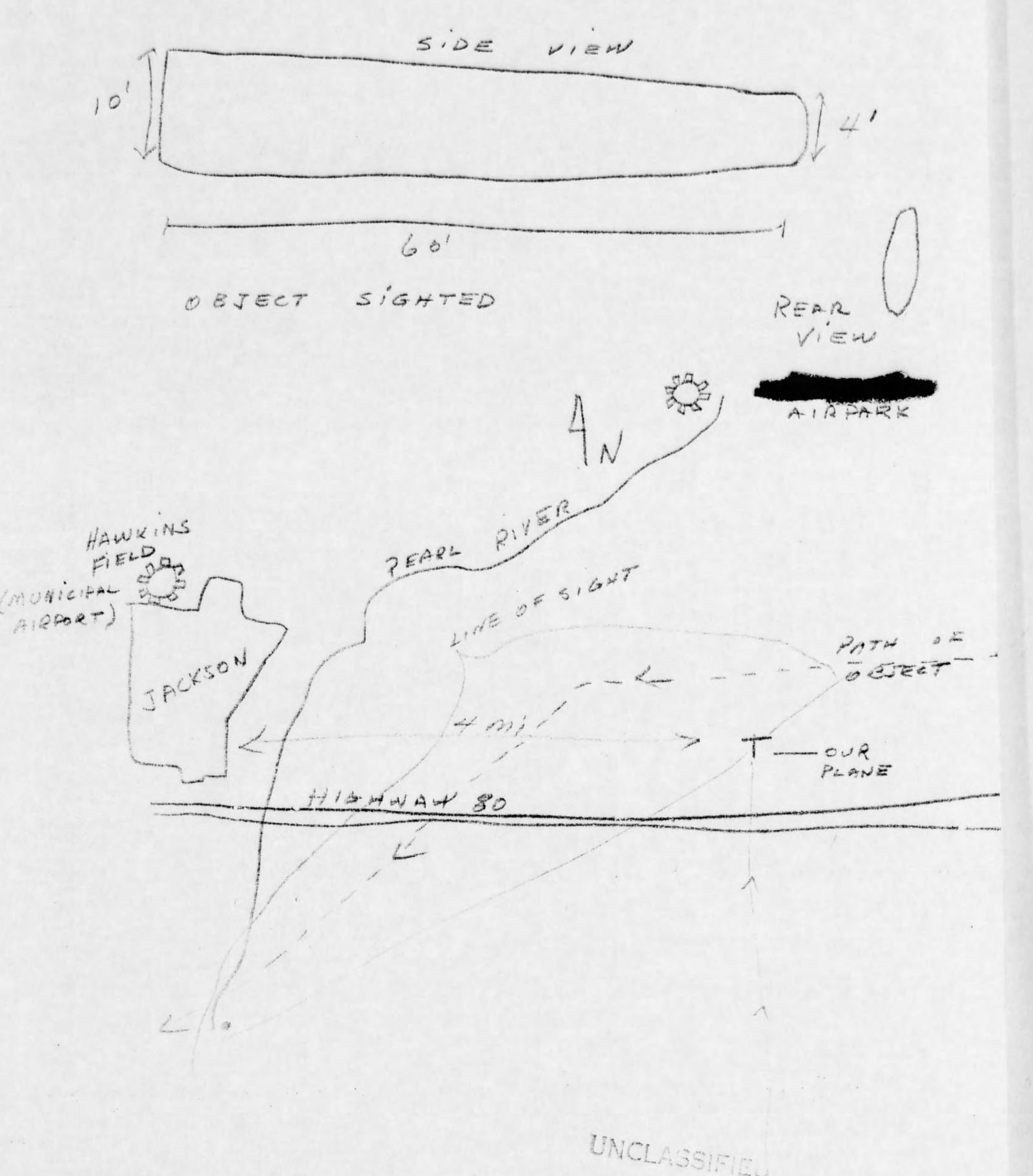
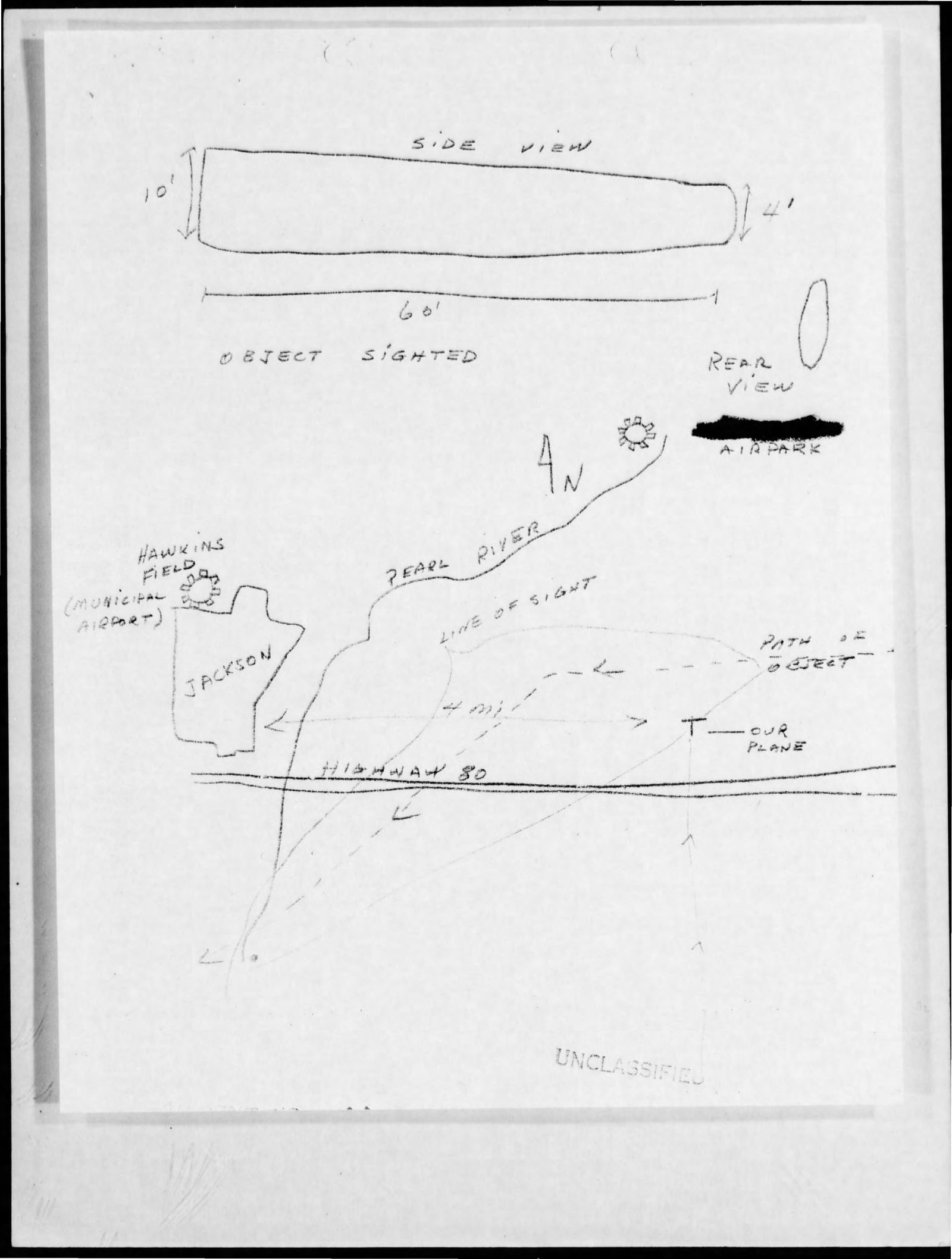
Pictured: the witness's own drawing from the Blue Book file — a side view of the "object sighted" marked 60 feet long, 10 feet at the front and 4 feet at the rear, a rear view, and a rough map showing Hawkins Field (municipal airport), Jackson, the Pearl River, Highway 80, "our plane" and the "path of object," with the airpark's name blacked out. It is a hand sketch attached to Rush's letter of January 6, 1949 (cropped from the full page), not a photograph; no photograph was taken because no camera was available. U.S. government record, public domain.
Theoretical Alignment
The Extraterrestrial Hypothesis gets a modest score. What makes this sighting stand out is the range: the object passed about 500 feet in front of an aircraft carrying experienced aviators, it was described in some detail, and it was said to have no wings, no visible propulsion, no exhaust and no tow plane. A wingless, solid-looking body that turns and accelerates to several hundred miles an hour is not something any aircraft of 1949 could do. But nothing in the account requires an exotic origin either. The object stayed in level or gently climbing flight, turned through about 50 degrees, sped up and flew away. Its size was estimated by eye in ten or twelve seconds, at dusk, against the western sky. The one observer who changed his description, from "short stubby wings" to none, did so on the basis of a single moment in the turn.
The Interdimensional Hypothesis has almost nothing to hold. The object did not appear or vanish abruptly; it crossed, turned, accelerated and "just faded from view" as it flew into the dusk toward the setting Sun, which is what any receding object does at that hour.
The Psycho-Social score is low but not zero. The sighting was brief and unexpected, and the main witness's own account shows how his perception changed as it went on: first another plane, then a tow target, then something with no wings. That is a normal process of interpretation, not a sign of fantasy, and three people saw the object at once. But it is a reminder that the case's most striking detail, the missing wings, rests on a judgment made during a few seconds of a turn.
Background
By New Year's Day 1949 the Air Force had been formally collecting reports of "flying discs" for about a year. According to Edward J. Ruppelt, later head of Project Blue Book, a letter of September 23, 1947 from the Air Force's technical intelligence center at what is now Wright-Patterson AFB concluded that "the reported phenomena were real," and the project that resulted, code-named Sign, was given a 2A priority. In 1948 it dealt with three of the period's best-known cases: the death of Capt. Thomas Mantell in January, the Chiles-Whitted sighting of a cigar-shaped object by two Eastern Air Lines pilots in July, and the Gorman "dogfight" over Fargo in October. Ruppelt wrote that a few days after the Chiles-Whitted case, Sign's staff decided to write a Top Secret "Estimate of the Situation," whose conclusion was that UFOs were interplanetary, and that it was rejected higher up. By the start of 1949 the mood was changing.
The Jackson sighting came at the end of that period. Six weeks later, on February 11, 1949, an order changed the project's name from Sign to Grudge. Ruppelt, who joined the effort only in 1951, called what followed "The Dark Ages": "Everything was being evaluated on the premise that UFO's couldn't exist." As part of the cleanup that began under Sign, he wrote, the Air Weather Service "had been asked to screen the reports and check those that sounded like balloons against their records of balloon flights," and Dr. J. Allen Hynek, an astronomer at Ohio State University, "had been given a contract to sort out those reports that could be blamed on stars, planets, meteors, etc." Both reviews left their marks in this file. Grudge issued its final report, "Unidentified Flying Objects—Project Grudge," Technical Report No. 102-AC-49/15-100, in August 1949, and announced on December 27, 1949 that the project had been closed. According to Ruppelt, Hynek's appendix covered 237 reports and found 32 percent astronomical, the Air Weather Service and the Air Force Cambridge Research Laboratory wrote off 12 percent as balloons, and after hoaxes, vague reports and probable aircraft were removed, 23 percent were left as "unknown."
The Air Force side of this story is also tied to the place. Jackson's municipal airport, Hawkins Field, on the northwest side of the city, had been Jackson Army Air Base during the war. In early 1949 it was still in Air Force hands as a reserve training center; the flight check in this file is signed off against "Base Operations, 2588th AFRTC, Hawkins Field," and the OSI agent was accompanied by the deputy commander of the 2588th. The Air Force returned the field to civil control on March 31, 1949, according to the airport's history. Delta Air Lines and Chicago and Southern Air Lines both served it, and an Air Force weather detachment worked there. The documents call the base "Jackson Army Air Base," "Jackson Air Force Base" and "Jackson AFB" interchangeably, a reminder that the Air Force had become a separate service only fifteen months earlier.
The Office of Special Investigations, which handled the interview, was also new. It had been created under the Air Force Inspector General and is considered operational from August 1, 1948. Its report on this case is headed "Project 'Sign'," which shows that six weeks into 1949 the field still knew the project by its first name. Its "Character" line reads "Subversive Activity." Nothing in the file explains that choice, and nothing suggests that anyone suspected the witnesses of anything.
Complete Timeline
| Date / Time | Event |
|---|---|
| September 23, 1947 | A letter from the Air Force's technical intelligence center at Wright Field concludes, in Ruppelt's account, that "the reported phenomena were real" and asks for a permanent project. Project Sign follows. |
| September 22, 1948 | Date of "Group Letter 205-3," the instruction under which the Jackson weather detachment later files its report. |
| January 1, 1949, about 4:48 PM CST | An Air National Guard F-47, logged as "NG-8651-F-47-McWilliams," departs Meridian, Mississippi, for Jackson (Exhibit IV of the OSI report; the "48" is partly faint). |
| About 5:00 PM CST (2300Z) | A Stinson carrying Thomas A. Rush, his wife, and another couple, on the last leg from Gulfport, is about two miles east of Jackson at 1,700–1,800 feet, heading about 340°. An object passes about 500 feet in front of it from the right, turns about 50° toward the southwest, accelerates and fades from view. In sight 10–12 seconds. The Sun is about to set. |
| About 5:05 PM | The Stinson lands. Rush calls the CAA control tower to ask whether anything has landed at the municipal airport; nothing has. The tower notifies the Air Force. |
| About 5:07 PM CST | Sunset at Jackson at ground level (computed for this file). |
| 5:15 PM CST | The F-47 arrives at Jackson (Exhibit IV). |
| 5:18 PM CST | An Air National Guard T-6, "NG-1545-T-6-Jordan," departs Meridian for Jackson; it arrives at 5:50 PM. |
| 5:30 PM CST | Jackson weather observation: high ceiling (16,000 feet measured), visibility 15+ miles, 52°F, remark "BINOVC" (breaks in overcast). |
| 5:31 PM CST | Delta Flight 309, Atlanta to Dallas, arrives at Jackson: the only airline flight in the area between 4:30 and 5:30 PM. |
| January 2, 1949, 0230Z (8:30 PM CST, Jan. 1) | The Maxwell Flight Service Center at Montgomery, Alabama, sends a priority teletype to Air Materiel Command at Wright-Patterson: "Unidentified flying object reported 2 mi east of Jackson Miss at 1700C 1 Jan 1949." |
| January 4, 1949 | The airlines and base operations are asked about flights near Jackson between 4:30 and 5:30 PM (Exhibit IV; the day digit is faint but reads as 4). |
| January 5, 1949 | Capt. Benjamin H. Cole, commanding Weather Detachment 26-4L, 26th Weather Squadron, Hawkins Field, sends "Reporting of Information on Flying Discs" to Air Materiel Command. |
| January 6, 1949 | OSI Special Agent Bernard A. Price, with the deputy base commander, interviews Rush. Rush writes a two-page letter to the Commanding General, Air Materiel Command, with a drawing and a sketch map. |
| January 18, 1949 | Price's Report of Investigation, file 9D 32-3, is approved by Maj. Edward R. Ford, commander of the 9th OSI District at Barksdale AFB, Louisiana, and sent to the 5th District at Wright-Patterson. Status: "Closed." |
| January 24–26, 1949 | The 5th District stamps the report received on January 24 and forwards it on January 26 to Air Materiel Command, "ATTN: MCIAXO, Lt. Smith." |
| February 11, 1949 | Project Sign is renamed Project Grudge. |
| March 9 and 31, 1949 | Air Materiel Command writes to the Air Weather Service about "Unidentified Flying Objects" (March 9); the service replies with a first indorsement (March 31). |
| March 31, 1949 | The Air Force returns Hawkins Field to civil control (airport history). |
| May 11, 1949 | Headquarters, Air Weather Service, reports that incident summaries 173 through 233 have been checked against balloon ascents and recommends changes to the "Guide To Investigation Of Unidentified Aerial Objects." A one-line comment on No. 233 reads: "Definitely no balloon." |
| August 1949 | The Grudge report is completed. A later extract of "Dr Hynek's Evaluations" lists Incident 233 under "Non-astronomical, with no explanation evident: Lack of evidence precludes explanation." |
| December 27, 1949 | The Air Force announces that Project Grudge has been closed. |
| After January 2, 1952 | The case is entered on a Blue Book index card (Temporary ATIC Form 329, dated 2 Jan 52), with "Insufficient Data" handwritten beside it. |
| March 8, 2011 | Dan Wilson posts the Blue Book pages for NICAP's aircraft-sightings catalog. |
| March 7, 2023 | The Debrief summarizes the case in a feature on lesser-known Blue Book files. |
| March–April 2024 | Tim Printy's review of the 1949 Blue Book files in SUNlite argues that the case should be reclassified from "Insufficient data" to "Unidentified." |
| January 1, 2026 | The UAP Discovery forum posts the file's pages in its Blue Book Unknowns section. |
| February 3, 2026 | Version 1.35 of Brad Sparks's catalog of Blue Book unknowns lists the case as entry 158. |
The Flight
The aircraft was a Stinson, a light plane. None of the documents gives the model, but a four-seat Stinson 108 Voyager, the type Stinson was building from 1946, would fit four people and the OSI's cruising speed of about 125 miles an hour. It was owned and flown by a couple whose names are blacked out throughout the file. Thomas A. Rush and his wife were passengers. The four were flying from Gulfport, on the Gulf Coast, back to Jackson.
The documents disagree about where they were going to land. Rush's own letter and the OSI report say they were "flying from Gulfport to North Jackson Airpark" (the OSI spells it "North Jackson Air Park"), and the OSI adds that Rush "is the owner and operator of the Jackson Air Park." The weather detachment's report and the Grudge incident summary, however, say they were "making an approach for a landing at the Dixie Airport," and the Grudge summary calls Rush "a pilot with Dixie Air Service, Jackson, Mississippi." The weather detachment lists the first observer as "Airport Manager, Dixie Airport." The likeliest reading is that Dixie Airport and the North Jackson airpark were the same small field, or that Rush's business operated under both names, but this file has not been able to find any record of either name outside the Blue Book papers. The airpark's name on Rush's sketch map is blacked out, which suggests that the censor thought it would identify one of the witnesses. On his map it sits northeast of the city near the Pearl River.
The OSI's position report is unusually exact. At about 5:00 PM the Stinson was "at an altitude of seventeen hundred feet, traveling 340° or Northwest, two miles East of Jackson, Mississippi, one half mile North of Highway 80E, almost to the Pearl River Swamp and East of Knox Glass Bottling Company," at 32°20' North, 90°10' West. Rush's letter gives the altitude as "about 1,800 feet" and says they were "approaching the airport." His sketch map, drawn without a scale, puts "our plane" about four miles east of the city, a little north of Highway 80, flying north. The difference between two miles and four is probably the difference between the city limits and the center of town; it does not affect anything else in the account.
Rush also pins down the time. "The time was 17:00 as we had just made a comment on the time and I had checked our ground speed." They landed "about five minutes later." The OSI's synopsis widens this to "between the hours of 1630 and 1730," but that is the window it used for the flight check, not a different estimate.
What They Saw
There are four accounts of the object in the file, written by different people over five days: the teletype sent on the evening of the sighting, the weather detachment's report of January 5, Rush's own letter of January 6, and the OSI agent's summary of his interview with Rush the same day. They agree on the essentials and differ on several details.
Rush's letter
Rush's letter is the closest thing to a first-person statement. It begins by explaining that it is "in reply to a request from the Base Commander, Jackson Army Air Base," about "a strange object sighted by my wife on 1 January 1949." He goes on:
"Mr. and Mrs. [redacted], my wife, and I were flying from Gulfport to North Jackson Airpark and were approaching the airport and our altitude was about 1,800 feet when I saw something go in front of us. I assumed that it was another plane since it was headed toward the Municipal Airport in Jackson and was on the eastern leg of the airways."
He watched it "to try to recognize the type of plane." After it passed, it "made a turn of about 50 degrees and headed southwest." "As the object made its turn, it was then that I noticed the object didn't have wings. At that time, my wife saw the object and became excited. She is a private pilot and is familiar with plane identification from the air." The Sun "had not set and the weather was clear to the southwest as the object went away from us." He estimated its speed at "about 200 mph" when it crossed "about 500 feet in front of us," and after the turn "it was as close as 1,200 feet from us. We tried to point out the object to the pilot, but he thought we were trying to show him something else. As the object turned and went to the southwest, with a sudden burst of speed, it was out of sight. In all, I saw the object 10 or 12 seconds."
The second page contains the sentence that gives the case its character:
"At first, I thought the object was a large tow target about 60 feet long and about 10 feet in diameter at one end and about 4 feet at the trailing end. The tail even fluttered like a target but there was nothing towing it and it moved at a greater speed than tow targets I've seen before."
He adds that "although I was not flying at the time, I have approximately 1,800 hours of military and civilian pilot time and know my aircraft identification pretty good—except in this case," and that he enclosed "a drawing of this object and a rough sketch of where the object was sighted."
The OSI interview
The OSI agent's paragraph 2 is longer and adds several things the letter does not have. The object was first seen "about five hundred feet directly in front of" the plane, and when first seen it "was about 10° below the horizon and gradually climbing above the horizon as the object went around, at an altitude of approximately sixteen hundred feet to seventeen hundred feet." In clock terms it moved "from a position of 1:00 counter-clockwise to between 7:00 and 8:00," that is, from just right of the nose, across the front, to behind the left wing. Rush "further described the object as being either dark blue or black" and said it "appeared to be of solid construction." The OSI's size figures are wider than the letter's: "sixty feet to seventy feet long, eight feet to ten feet in diameter, the front end tapering to two feet to three feet at the rear." It "resembl[ed] a large sleeve target, the front opening much larger than the opening of a sixty foot sleeve target." Its direction was "west toward Jackson, Mississippi, at a 50° to 60° turn toward the Southwest," and its maneuvers "horizontal, then turned, gradual ascent, picked up a tremendous speed, seemingly a very slow fluttering as it departed." There was "no evidence of any kind" of exhaust, effect on clouds, lights, support or propulsion. Its speed was about 200 miles an hour at first, "but as it turned and departed, its speed appeared faster than Jets, making four hundred to five hundred miles per hour."
On sound, the OSI recorded something the letter does not say: Rush "did not notice any particular sound; however, [his] wife and the pilot's wife claim to have heard a seemingly roaring sound as the object left the vicinity," and Rush "further added that this object just faded from view." Paragraph 8 adds: "There were no fragments or physical evidence available, nor was there any radio antenna to be observed, nor were there any other projections or extensions that might possibly be construed as such."
The teletype and the weather detachment
The first report, the teletype relayed through the Maxwell Flight Service Center on the evening of January 1, was evidently based on a telephone account. It describes "one object seen approximately 60 ft long cigar shape short wings looked like rocket dark blue or black in color traveling at very high speed at 1500 ft altitude. Apparently very maneuverable made sound like helicopter no exhaust trail. Heading southwest last seen." The page in the released file ends partway through the next line, which appears to read "...front of reporting civilian pilot"; the rest of the message is not in the file.
The weather detachment's report of January 5, written under Group Letter 205-3 by Capt. Benjamin H. Cole, commanding Weather Detachment 26-4L of the 26th Weather Squadron at Hawkins Field, follows a numbered format: one object; "cigar like. Not unlike sleeve target"; "approximately 60 feet long and 10 feet diameter at the front tapering to the rear"; "dark blue or black"; speed about 200 mph at first, "then accelerated to approximately 400 to 500 MPH"; heading "west, turning to south to southwest"; maneuverability "not noticed"; altitude "1500 to 1600 feet, then gradual climb"; sound "roar"; exhaust trail "none." Its general remarks note that after landing the witness "called the control tower at Hawkins Field to find out if the object had landed there and if so to find out its identity. The control tower reported the incident to Base Headquarters." The report lists three observers by name, all redacted: the airport manager of Dixie Airport and two women, one described as a housewife.
Where the accounts differ
- Wings. The teletype says "short wings looked like rocket." Every later document says there were none, and the Grudge summary notes the change: "Second report states there were no wings." Rush's letter explains it: he noticed the absence of wings only when the object turned.
- Sound. The teletype says "sound like helicopter." The weather detachment says "roar." The OSI says Rush heard nothing in particular and that the two women heard "a seemingly roaring sound" as it left.
- Maneuverability. The teletype says "apparently very maneuverable." The weather detachment says "not noticed." The OSI describes one turn of 50° to 60° and a gradual climb.
- Size. About 60 feet long, tapering from 10 to 4 feet (letter, sketch, summaries), or 60 to 70 feet long, tapering from 8–10 to 2–3 feet (OSI).
- Final speed. 400 to 500 mph in most documents; "faster than Jets" in the OSI; "between 400 to 600 mph" in the Grudge narrative summary; 400 mph in the Air Weather Service comment.
- Altitude. The Stinson at 1,700 feet (OSI) or 1,800 feet (letter, Grudge summary); the object at 1,500 (teletype) or 1,500–1,700 feet.
- Who saw it. The letter says it was sighted "by my wife," then makes clear that Rush saw it first. The OSI says the other witnesses were Rush's wife and the pilot's wife. The pilot did not see it. Hynek's note speaks of "this one sighting by several persons."
None of these differences is large, and most are the kind expected when a ten-second event is retold by telephone, then to a weather officer, then in a letter, then to an investigator. The wings are the exception, because they decide what the object could have been. That question is taken up under the Conventional Explanation Candidate below.
The Investigation
For a flying-disc report in early 1949, this one was investigated well. Three separate Air Force channels produced paper within a week.
The tower, the flight service center and the weather detachment
Rush's letter says that when they landed, "we called the CAA Control Tower to see if this thing had landed at the Municipal Airport and were informed that nothing had landed there recently. The Control Tower then notified the Air Corps." The teletype, from the Maxwell Flight Service Center in Montgomery, Alabama, to "CG AMC Wright-Patterson AFB Ohio, Attn MCIAXO-3," with information to "HQ Flt Svc Wash DC, Attn A-2," carries the date-time group 020230Z, which is 8:30 PM Central time on January 1. A handwritten note at the top asks the receiving station to "give UEDC some bells and have the opr there look at this mesg so that it can be handled quickly," and a pencilled receipt note reads "Rec'd 2220, 1 Jan 49." A second pencilled note, only partly legible, appears to record that it was passed to someone in the operations section of the Technical Intelligence Division; the name is illegible.
The weather detachment at Hawkins Field filed its own report four days later, addressed to the Commanding General, Air Materiel Command, "ATTN: TSDIN" (the last letter is uncertain), with copies to the Chief of Staff's Director of Intelligence, the Military Air Transport Service at Andrews Air Force Base, the 2059th Air Weather Wing at Tinker AFB, the 2104th Air Weather Group at Robins Air Force Base, Georgia, and the 26th Weather Squadron at Brookley AFB, Mobile. Its enclosures were the Jackson weather and a sketch of the object.
The OSI Report of Investigation
Meanwhile Wright-Patterson sent a wire to the commanding officer at Jackson asking for "a detailed report," and he asked the OSI for one. Special Agent Bernard A. Price of the Jackson AFB detachment of the 9th OSI District interviewed Rush on January 6, 1949, accompanied by Lt. Col. Richard L. Bisgard (the surname is faint in the scan; this is the most likely reading), deputy base commander of the 2588th AFRTC at Hawkins Field. The report, dated January 18, covers the period January 1 to 6 and is titled "Project 'Sign' — Unidentified Phenomena Sighted at Jackson, Mississippi, by Mr. Thomas A. Rush." Price initialed the copy of Rush's drawing "(BAP)."
Price did more than take a statement. He checked Rush's background: "Informant claims eyesight as being 20-20. As to reliability of [Rush], he was given good recommendations by all who knew him. A check of law enforcement agencies was made concerning [Rush], with negative results." Rush was his own employer, "as he is the owner and operator of the Jackson Air Park," and "is not considered an amateur pilot." Rush "considers himself well qualified to determine type, size, color, and distance of most objects, and particularly aircraft." Lt. Col. Bisgard and the agent "considered [Rush] as being thoroughly reliable and of better-than-average intelligence, and seemingly of an excellent character. Mr. Rush is a former USAF Pilot." The pilot's wife was also checked: "according to informants, Mrs. [redacted]'s reliability is unquestionable." The synopsis concludes that Rush "is a reliable man and one who is not inclined to create objects of this type by his imagination."
Price then checked the sky. "There are no radar operations in this area." He enclosed the weather report as Exhibit C and the flight check as Exhibit D, and wrote: "A check with the Airport Managers of both the Delta Air Lines and the Chicago and Southern Airlines and with the Base Operations failed to reveal any flights in this vicinity at the time object was sighted, other than is shown. (See Exhibit 'D'.) It is unknown whether there were any testing devices of the United States Air Force sent aloft in this area on this date." The words "other than is shown" turn out to matter, as the next section explains. The report's other exhibits were Rush's map (A), his sketch (B) and his letter (E). Maj. Edward R. Ford, commanding the 9th OSI District at Barksdale AFB, Louisiana, approved the report and sent it to the 5th District at Wright-Patterson, which forwarded it to Air Materiel Command on January 26, attention "MCIAXO, Lt. Smith." (Ford's covering letter is typed "18 January 1948," evidently a slip for 1949.)
Exhibit IV: the flights in the area
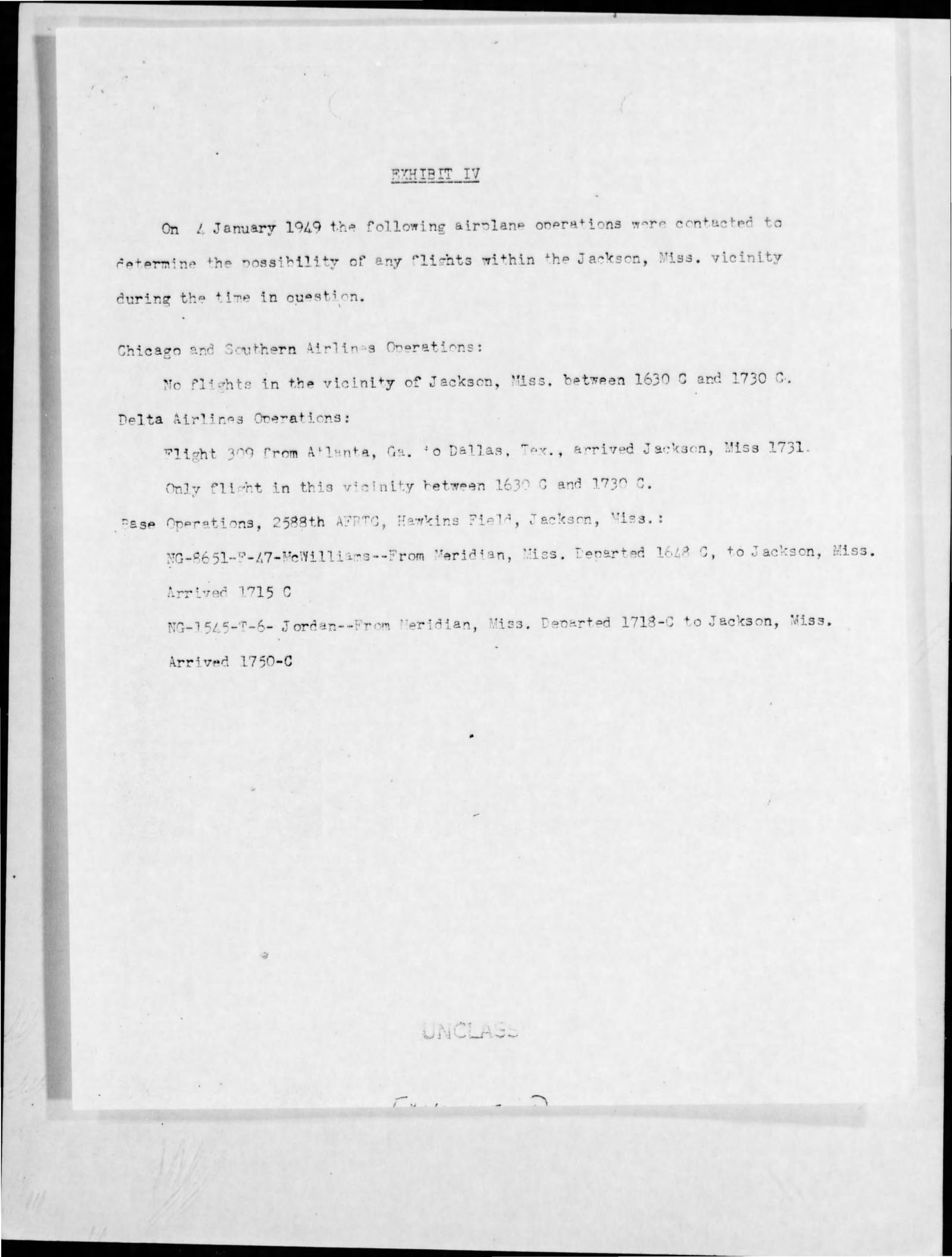
The flight check is headed "Exhibit IV" and dated (the digit is faint) 4 January 1949. It lists the replies from three operations offices about flights "within the Jackson, Miss. vicinity during the time in question":
- Chicago and Southern Air Lines: "No flights in the vicinity of Jackson, Miss. between 1630 C and 1730 C."
- Delta Air Lines: "Flight 309 from Atlanta, Ga. to Dallas, Tex., arrived Jackson, Miss 1731. Only flight in this vicinity between 1630 C and 1730 C."
- Base Operations, 2588th AFRTC, Hawkins Field: "NG-8651-F-47-McWilliams—From Meridian, Miss. Departed 1648 C, to Jackson, Miss. Arrived 1715 C" and "NG-1545-T-6-Jordan—From Meridian, Miss. Departed 1718-C to Jackson, Miss. Arrived 1750-C."
The "NG" prefix marks National Guard aircraft. The F-47 is the Republic P-47 Thunderbolt under its post-war designation, and the Mississippi Air National Guard's 153rd Fighter Squadron at Key Field, Meridian, flew F-47D Thunderbolts in this period. So the investigation's own exhibit shows a single-seat fighter flying from Meridian, east of Jackson, into Jackson's airport, landing fifteen minutes after the time Rush gave. Nothing in the file says that anyone compared this flight with the sighting, and none of the published summaries of the case this file has found mentions it. Whether it could have been the object is discussed below.
The Air Weather Service review
In March 1949 Air Materiel Command sent the incident summaries to Headquarters, Air Weather Service, at Andrews AFB, for the balloon check Ruppelt described. On May 11, 1949, the service replied over the signature of Lt. Col. W. A. West, its adjutant general, that "the incident summaries 173 through 233 have been checked against routine weather-balloon ascents made by the Air Force, Navy and Weather Bureau." It enclosed its comments and made two recommendations for the "Guide To Investigation Of Unidentified Aerial Objects": that item 13, "Direction of Flight of Object," "should be clarified so that vertical and horizontal motions are distinguished if possible, and so that motion is specified as the direction towards which the object appears to move," and that the section "Relative to Radar Settings" should include "a statement of the type of radar set used." The Jackson case was the last in the batch, but the letter does not say that it prompted either recommendation, and this file has not found evidence that it did. A separate typed slip in the file, evidently from the comments, reads: "No. 233: Definitely no balloon; made turns, definite fuselage, accelerated from 200 M.P.H. to 400 M.P.H."
Hynek's evaluation
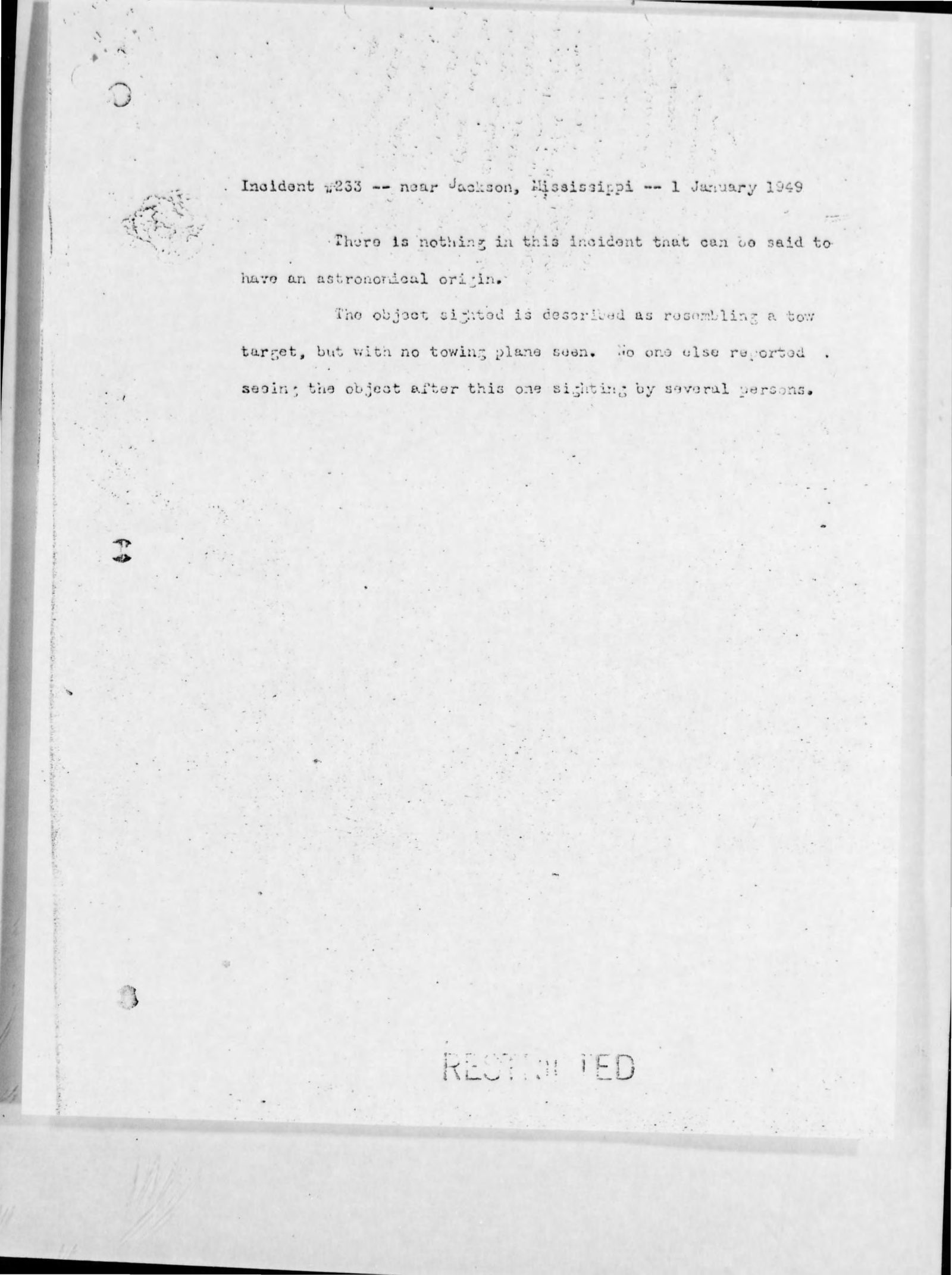
The file contains a typed extract headed "Dr Hynek's Evaluations Extracted From Project Grudge Report. Incident Index." It sorts incident numbers into three groups: astronomical (high, or fair to low, probability); non-astronomical but suggestive of other explanations (balloons or ordinary aircraft; rockets, flares or falling bodies; miscellaneous); and "Non-astronomical, with no explanation evident," split into "a. Lack of evidence precludes explanation" and "b. Evidence offered suggests no explanation." Incident 233 is the last number in group 3a, and someone has circled it. A second page, stamped RESTRICTED, gives Hynek's comment on the case in full:
"Incident #233 — near Jackson, Mississippi — 1 January 1949. There is nothing in this incident that can be said to have an astronomical origin. The object sighted is described as resembling a tow target, but with no towing plane seen. No one else reported seeing the object after this one sighting by several persons."
Hynek's job under the contract was to identify astronomical causes. He found none and said so, noted the tow-target resemblance, and placed the case in the category that meant, in effect, "not enough to go on." He did not put it in group 3b, the group for reports whose evidence positively suggested no explanation.
The record card
The Blue Book record card, Temporary ATIC Form 329 dated "2 Jan 52," must have been typed when Blue Book indexed its older files. It summarizes the case: date of information 1 Jan 49; Jackson, Miss; source "Civilian Pilot"; 1700 CST; one object, about 60 feet long and 10 feet in diameter; "similar to helicopter" sound; dark blue or black; 200 to 400–500 mph; 1,500 feet then gradual climb; 10–12 seconds; aerial observation; "made 50° turn"; sketches "yes." Some typed fields are too faint to read; the shape line appears to end in "target" and the course line in "then SW." In the margin someone has written "Insufficient Da—," running off the edge of the card. That is the case's final official evaluation.
Blue Book's later practice, as set out in its Status Report No. 8 of December 1952, was to put "all cases where there is only a single observer, unless his or her reliability is unquestionable," into "Insufficient Data." This case had three observers and an OSI finding that the main one was "thoroughly reliable." Hynek's "lack of evidence" category, rather than the number of witnesses, is the more likely reason for the label.
How the Case Was Retold
Because the released file is not easy to read, most later summaries rest on someone else's reading of it, and several have drifted.
- Brad Sparks's catalog of Blue Book unknowns (version 1.35, February 2026) lists the case as entry 158: "Pilot D. [?] Rush flying private plane saw a 60 ft cigar-shaped object cross the sky in front of the plane to the SW, nearly colliding, at 500 mph." The file shows that Rush was a passenger, not the pilot ("I was not flying at the time"), that his first initial was T., and that the closest approach was about 500 feet, not a near collision. The catalog's own sources for the entry are Project 1947, the McDonald list and the Saunders/FUFOR index, not the file.
- NICAP's aircraft-sightings directory carries the case as "Cigar-Shaped Object Encountered By Bush Pilot," with summaries attributed to Sparks and to Dan Wilson, who describes "Pilot Tom Rush and his wife." Wilson's March 2011 post links the original scans.
- The UAP Discovery forum's January 1, 2026 entry, with a summary attributed to George Eberhart, says "Pilot Thomas A. Rush and his wife are in a private plane with two passengers flying east of Jackson." In the file the Rushes were the passengers. The post reproduces the file's pages and cites the National Archives file unit, Sparks, NICAP, The Debrief, and Loren Gross's chronicle for January to June 1949, which this file has not seen.
- The Debrief (Jazz Shaw, March 7, 2023) gets the passengers right ("another couple who owned the private plane"), describes the object as "megaphone-shaped," and notes that a memo from the Air Weather Service recommended changes to the investigation guide.
- Tim Printy, a skeptical reviewer who has worked through the Blue Book files year by year in his newsletter SUNlite, reviewed all of 1949 in the March–April 2024 issue. Of 268 classified cases he considered 34 misclassified. The Jackson case was the one he moved in the less skeptical direction: "One of the cases was classified as insufficient data but should be listed as Unidentified. This was the case from Jackson, Mississippi in January 1949. There was enough data to classify the case but I could not figure out what it might have been. I suspect it could have been a balloon but the description of the flight path was against the wind."
The National Archives holds the file as "Jackson, Miss, January 1949 — Incident Number: 233," in the name-redacted Blue Book series, with images from microfilm publication T1206, roll 4. This case file was read from the 21-page copy posted on the Internet Archive, which carries the same Fold3 file number, 6792140, as the National Archives entry.
The Press in 1949
This file looked for coverage of the sighting in the Jackson papers, the Clarion-Ledger and the Jackson Daily News, and found none in the online sources it could search. The teletype and the tower's call to the Air Force show that the report reached official channels the same evening, but nothing in the file mentions the press, and none of the later summaries cites a newspaper story. This does not mean that no story ran; the Jackson papers of January 1949 are not freely searchable online. It means that no contemporary press account is known to this file. If one exists, it would be the most useful new source for the case, because it might name the pilot and give the airpark's name.
Mississippi in the 1949 Files
The Jackson case was the first of several 1949 Mississippi reports in the Blue Book files. The Internet Archive's copies of the released files include Vicksburg (incident 306, April 1949), Biloxi–Hattiesburg (August 1949), Guntown (October 1949) and Biloxi (November 1949). They are mentioned here only as context; none has been researched for this file, and each may become a case file of its own.
Key Witnesses
Thomas A. Rush
Named in the OSI report's title and text and on his own drawing ("Drawn by Rush"). A former USAF (or Army Air Forces) pilot with "approximately 1,800 hours of military and civilian pilot time," and, according to the OSI, the owner and operator of the Jackson Air Park, his own employer; the Grudge summary instead calls him a pilot with Dixie Air Service. He was a passenger on January 1, 1949, and saw the object first. He took it for an airplane, then a tow target, and then, as it turned, noticed it had no wings. He wrote a two-page letter and drew a sketch and map for Air Materiel Command. The OSI agent and the deputy base commander judged him "thoroughly reliable and of better-than-average intelligence." His eyesight was 20-20 by his own account. Nothing more about him has been found.
Mrs. Rush (name withheld)
Rush's wife, whose first name is not given. According to his letter, "my wife saw the object and became excited. She is a private pilot and is familiar with plane identification from the air." The OSI says she and the pilot's wife heard "a seemingly roaring sound" as the object left. No statement of her own survives.
The pilot and his wife (names withheld)
The couple who owned the plane. The husband was flying; Rush and his wife tried to point the object out to him, "but he thought we were trying to show him something else," and he apparently did not see it. His wife did. The OSI recorded that her "reliability is unquestionable," and the weather detachment lists her as a housewife. Her own description is not recorded separately.
Bernard A. Price
Not a witness. He interviewed Rush on January 6, 1949, checked his background and the local flights, and wrote the Report of Investigation dated January 18, 1949. His report records both the case for Rush's reliability and the F-47 flight from Meridian, without comment on the latter.
Benjamin H. Cole
Not a witness. He signed the weather detachment's "Reporting of Information on Flying Discs" on January 5, 1949, the first formal written report of the case, which records the "roar," the "sleeve target" comparison and the Jackson weather.
J. Allen Hynek
Not a witness. In his 1949 evaluation he found "nothing in this incident that can be said to have an astronomical origin," noted the tow-target resemblance "with no towing plane seen," and placed it in the group of non-astronomical reports where "lack of evidence precludes explanation."
The Five Observables Assessment
The Five Observables framework, associated with former AATIP director Luis Elizondo, classifies UAP reports by performance characteristics beyond known technology. Applied to this report, it finds one observable that is arguably present in a weak form and four that are not.
Assessment:
- Anti-gravity lift (absent as an observation, implied by inference). The object did not hover or stop. It flew level, turned and climbed gradually, as an aircraft does. The only sense in which lift is an issue is that a wingless body of this shape should not be able to fly at all, and that depends entirely on whether the witnesses were right about the wings.
- Instant acceleration (speculative). All accounts say the object sped up from about 200 mph to 400–500 mph as it turned away, "with a sudden burst of speed" in Rush's words. But the estimate of the later speed was made as the object receded into dusk, and speed estimates for receding objects at unknown range are unreliable. Nothing suggests an instantaneous change.
- Hypersonic speed (absent). Even the highest estimate, 600 mph, is subsonic. The OSI's "faster than Jets" was a comparison with jets of 1949.
- Low observability (absent). The object was plainly visible at close range in daylight. It faded from view as it flew away into the dusk, which needs no explanation.
- Trans-medium travel (not applicable).
On this framework the case is weak. Its interest lies not in performance but in the combination of close range, an apparently wingless shape and the absence of a tow plane.
Evidence Assessment
Supporting Anomalous Origin
- Three observers in the same aircraft saw the object at once, at close range: about 500 feet as it crossed, 1,200 feet after the turn.
- The main witness was a former military pilot with about 1,800 hours and an airport operator; his wife was a private pilot. Both were used to identifying aircraft from the air.
- The OSI checked Rush's background and found him "thoroughly reliable" and "not inclined to create objects of this type by his imagination."
- Rush first assumed it was an aircraft and watched it in order to identify the type, which is not the behavior of someone expecting to see a flying saucer.
- The object was described as solid, dark, 60 feet long and tapered, with no wings, no exhaust and no visible means of propulsion, and with nothing towing it.
- Nothing had landed at the municipal airport, the two airlines had no flights in the area at the time, and the Air Weather Service's comment was "definitely no balloon."
- The report went through three Air Force channels within days and was investigated by the OSI, with written exhibits.
- Hynek found no astronomical explanation. Even Tim Printy, a skeptical reviewer, concluded that the case should be listed as Unidentified.
Supporting Conventional Explanation
- The object was in sight for only 10 to 12 seconds, and the wingless shape was noticed during a turn.
- The sighting happened about seven minutes before sunset, and the object flew away toward the low Sun, where any aircraft would be a dark silhouette quickly lost in glare and dusk.
- The first report described "short wings" and said it "looked like rocket." The change to "no wings" came later.
- The pilot, the person whose attention was on the sky ahead, did not see it.
- The accounts differ on sound (helicopter-like, a roar, or nothing), on size, on maneuverability and on final speed.
- The OSI's own flight check lists an Air National Guard F-47 fighter flying from Meridian, to the east, into Jackson, arriving at 5:15 PM.
- The witnesses themselves compared the object to a tow target. Whether any target-towing flight was in the area was never checked; the OSI wrote that it was "unknown whether there were any testing devices of the United States Air Force sent aloft."
- No one else reported the object. There were no photographs, no radar and no physical evidence.
Why "Disputed"
The Jackson Airborne Sighting is stamped DISPUTED with a score of 46/100. Its strengths are unusual for 1949. Three people in the same aircraft saw the object at close range; the main witness was an experienced pilot whose first instinct was to identify it as an airplane; the Air Force investigated promptly and recorded his reliability; the obvious explanations were checked as far as they could be; and both Hynek and, seventy-five years later, a skeptical reviewer of the whole 1949 file failed to find an answer. It is not a case of lights at night or a distant glint.
Its weaknesses are just as specific. The sighting lasted ten or twelve seconds. It took place at sunset, with the object flying away into the glare. The most important detail, the absence of wings, was not in the first report and was noticed only during a turn. The pilot did not see it. The descriptions of sound and maneuverability conflict. And the investigation's own flight list shows a National Guard fighter flying into Jackson from the east at nearly the same time. As discussed under the Conventional Explanation Candidate below, the timing does not fit that fighter well, and the witnesses would have had to misjudge its wings, but no one ever tested it, and it cannot now be ruled out.
Among this site's Mississippi Blue Book cases, it sits a little above the Meridian "Flying Cymbal" (Disputed, 44), which had a single witness but a close, structured object and a same-evening Navy check, because Jackson has three witnesses, two of them pilots, and a more complete paper trail. It sits above the Flora, Mississippi Police Encounter (Disputed, 42), the Keesler AFB Sighting (Disputed, 36), where the objects were small and distant and no traffic check was made, and the Natchez Trace Ranger Sighting (Disputed, 35). It sits well below the Chiles-Whitted sighting of 1948, the classic airborne report of a wingless cigar, which involved two airline pilots and a night-time object with windows and an exhaust flame. The stamp is Disputed rather than Credible because an untested conventional candidate sits in the file itself and the sighting was so short; it is not lower because the witnesses were close, competent and checked, and because the candidate fits the timing and the description imperfectly.
The official labels should be read for what they are. "Insufficient Data" was a conclusion reached by a project that, by its own later chief's account, was then "evaluated on the premise that UFO's couldn't exist," and the case's file shows that the data were not especially thin by the standards of the time. Like any official finding, it is one input to weigh, not a final word, and the same caution applies in both directions: neither the Air Force's label nor its investigators' praise of the witness settles what was in the sky.
Sensor & Instrumentation Detection Profile
No instrument recorded the object.
- Radar. The OSI recorded simply: "There are no radar operations in this area." Hawkins Field had a CAA control tower but, on this evidence, no surveillance radar.
- Air traffic records. The flight check is the one piece of instrumental-style evidence in the file: written replies from two airlines and a base operations office about flights between 4:30 and 5:30 PM. It confirms that no airline flights were near Jackson at 5:00 PM and that two National Guard aircraft from Meridian were inbound, one of them arriving at 5:15. It is not a radar record; it shows only scheduled and logged flights. Private aircraft, Navy aircraft passing through, and any military aircraft not logged at Hawkins Field would not appear.
- Tower. The CAA tower at the municipal airport told the witnesses that "nothing had landed there recently." That excludes a landing at Hawkins in the minutes before Rush called. It does not exclude an aircraft that landed at 5:15 and was no longer remembered as recent, or one that did not land there at all.
- Weather instruments. The Jackson observations at 4:30 and 5:30 PM and the winds aloft are enclosed. They are used below.
- Cameras. "No photographs were taken since a camera was not available."
Environmental & Geospatial Context
The sighting took place over the low ground east of Jackson, near the Pearl River, a short distance north of U.S. Highway 80. The OSI's position, 32°20' N, 90°10' W, lies about three miles east of Hawkins Field and about two and a half miles northeast of downtown Jackson (computed for this file). The Stinson was heading about 340°, toward the airpark, which Rush's map places northeast of the city along the river. Meridian, where the two National Guard aircraft took off, is about 86 miles due east of Hawkins Field (computed for this file), and the direct route from Meridian to Jackson passes over this area.
Weather
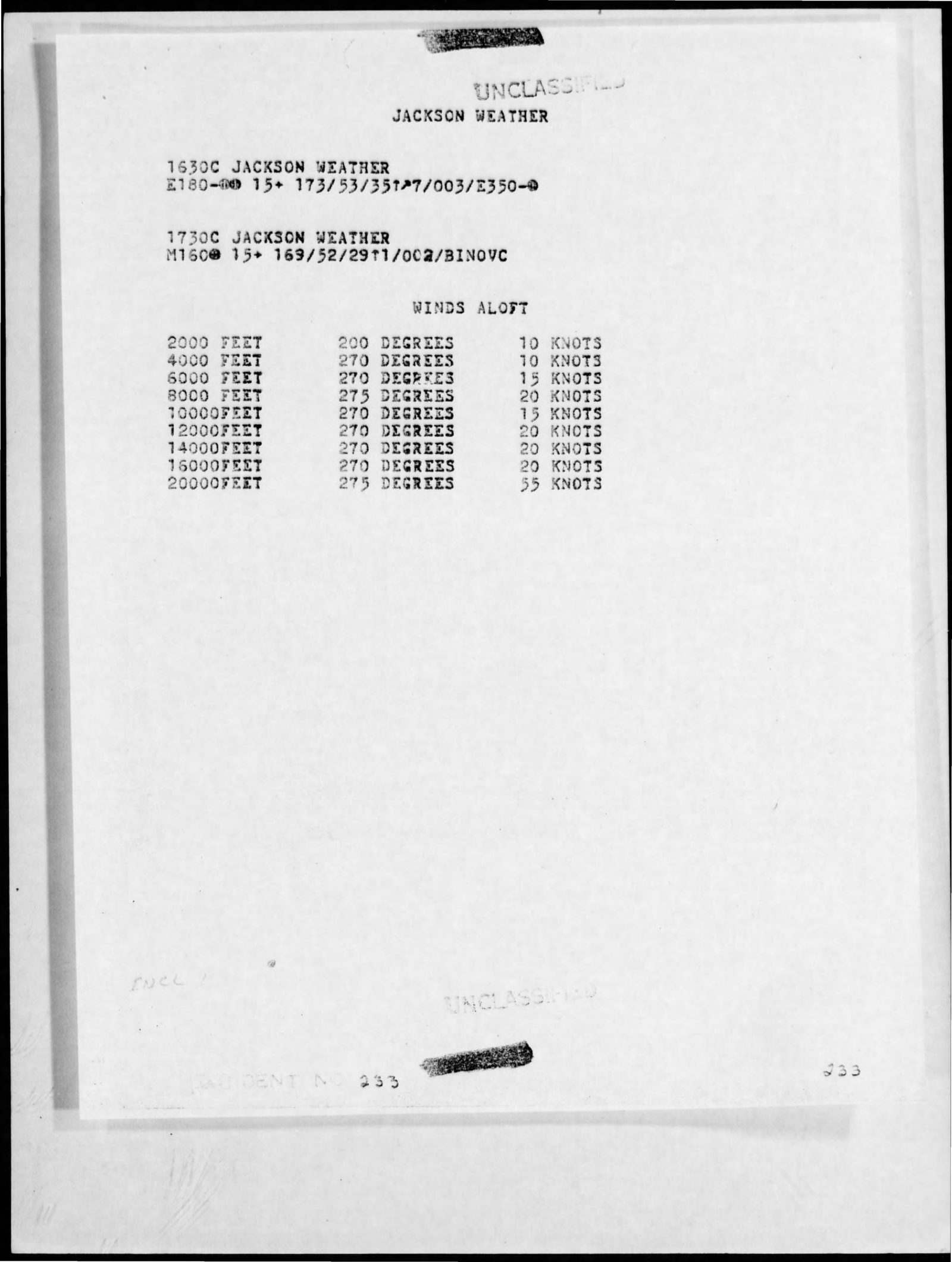
The teletype says "weather clear and visibility unrestricted," and Rush that it was "clear to the southwest." The Jackson observations enclosed in the file confirm a fine winter evening. At 4:30 PM: an estimated ceiling of 18,000 feet, visibility 15 miles or more, 53°F, dew point 35°F, altimeter 30.03. At 5:30 PM: a measured ceiling of 16,000 feet with breaks ("BINOVC"), visibility 15+, 52°F, dew point 29°F, altimeter 30.02. The sky-cover symbols after the ceiling figures and the wind groups are not clearly legible in the scan. There was, in other words, high cloud well above the aircraft and nothing at its height to obscure the view. The winds aloft at 2,000 feet were from 200° at 10 knots, and from 270° at 10 to 20 knots at every level from 4,000 to 16,000 feet. The automatically computed weather field in the Forensic Data Profile below comes from modern ERA5 reanalysis averaged over the whole day for one grid square, and is not an observation; the 1949 Jackson observations in the file are the better source. All three computed fields are calculated for the city's mapped coordinates, not for the point in the air east of it.
The light
This is the most important environmental fact in the case. Computed for this file using the NOAA solar position equations for 32.30° N, 90.18° W, the Sun at 5:00 PM CST on January 1, 1949 was less than half a degree above the true horizon, at an azimuth of about 242°, west-southwest. It set at ground level at about 5:07 PM. From 1,700 feet it would have stayed in view a few minutes longer, which agrees with Rush's statement that "the sun had not set." Civil twilight ended at about 5:34 PM.
The object was first seen just right of the Stinson's nose, crossed from right to left heading west, then turned toward the southwest, and flew away. In other words, it turned toward almost exactly the point where the Sun was setting. Any object seen in that direction at that moment would be a dark shape against the brightest part of the sky, with its colors and details lost. "Dark blue or black" is what a silhouette at sunset looks like. Thin edges, such as wings seen from almost edge-on or tail surfaces, are the first thing to disappear against glare. And a receding object flying into the glare will "fade from view" quickly, whatever it is. None of this proves what the object was. It does mean that the most important judgments, color, wings and the later speed, were made in the worst light of the day.
Geometry
The documents allow some checks, all computed for this file. The OSI says that when first seen the object was "about 10° below the horizon" and about 500 feet away. Ten degrees below the horizontal at 500 feet is about 87 feet lower than the aircraft, which would put the object at about 1,610 feet if the Stinson was at 1,700. That agrees with the object altitude given in the same report, "approximately sixteen hundred feet to seventeen hundred feet," and the account is internally consistent. A 60-foot object at 500 feet would span about 7° of sky, about fourteen times the width of the full Moon, and at 1,200 feet about 3°. An object crossing at 200 mph at 500 feet would sweep across the field of view at more than 30° a second, which explains why the first impression was little more than "something go in front of us."
These figures depend on Rush's distance estimate. An observer who misjudges an object's size will misjudge its distance by the same factor: something half as long at half the distance looks identical. A fighter about 36 feet long at about 300 feet would look the same as a 60-foot object at 500. The estimates are not unreasonable for a trained pilot, but they cannot be checked.
Observer Credibility & Occupational Profile
The file is unusually informative about the main witness. Rush had about 1,800 hours of "military and civilian pilot time," was described as a "former USAF Pilot" (OSI) and "Ex AAF pilot" (incident summary sheet), ran his own airpark, and "considers himself well qualified to determine type, size, color, and distance of most objects, and particularly aircraft." The OSI checked his reputation and police record and found nothing against him, and two officers judged him "thoroughly reliable." His wife was a private pilot. The pilot's wife's reliability was called "unquestionable." By 1949 standards, these are good witnesses.
Several features of Rush's account count in his favor. He did not claim to have recognized a flying saucer; he says he assumed it was an airplane and tried to identify it. He volunteered the tow-target comparison, which points toward an ordinary explanation. He admitted that "I was not flying at the time" and that his identification skills failed him "in this case." He called the tower within minutes to try to identify the object. And his account stayed consistent from the letter to the interview, apart from details of size.
Other features count the other way. Rush's training was in recognizing aircraft, and the absence of wings was a single impression during a turn, against the sunset. The first report, presumably passed on by telephone, said there were short wings. The person with the best view forward, the pilot, did not see it at all, which suggests that the object was not directly ahead of the aircraft for long. The witnesses saw it for at most twelve seconds. None of this impugns their honesty. It describes the limits of what three people in the cabin of a light plane could establish about a fast-moving object in a few seconds of twilight.
Physical & Material Assays
No physical evidence exists. The OSI recorded that "there were no fragments or physical evidence available." The object never came near the ground, no one looked for traces, and the record card lists none. There is nothing to analyze.
Historical Precedents & Archive Matches
The Jackson report belongs to a recognizable group of 1948–1949 cases in which pilots described dark, wingless, cigar-shaped objects at close range.
- July 24, 1948, the Chiles-Whitted sighting. Two Eastern Air Lines pilots near Montgomery, Alabama, saw a wingless, cigar-shaped object with two rows of windows and a fiery exhaust pass close to their DC-3 at night. It is the classic wingless-cigar report and the one that, according to Ruppelt, prompted the "Estimate of the Situation." Jackson is a far plainer report: no windows, no exhaust, daylight, and a shape the witnesses compared to a tow target.
- January 7, 1948, the Mantell incident, and October 1, 1948, the Gorman dogfight. Two other Sign-era cases involving military pilots and the National Guard. In the Gorman case the pilot was a North Dakota Air National Guard officer flying an F-51; in the Mantell case Kentucky Air National Guard P-51s chased what is now usually identified as a Skyhook balloon. Both show how often National Guard fighters figured in the reports of the period, as observers and, sometimes, as the thing observed.
- The 1949 Mississippi files. As noted above, the released Blue Book files include Vicksburg (April 1949), Biloxi–Hattiesburg (August 1949), Guntown (October 1949) and Biloxi (November 1949). None has been researched here.
- Hynek's group 3a. The same list places 29 other incident numbers alongside 233 under "Lack of evidence precludes explanation" (one of them, 137, appears to be struck through). This file has not examined them.
In the archives searched for this file, the case appears in the National Archives file unit and its Internet Archive copy, in Sparks's catalog, in NICAP's aircraft-sightings directory, in The Debrief's 2023 summary, in Printy's 2024 review and in the UAP Discovery forum's 2026 post. No newspaper story and no later statement by any witness has been found.
Material Analysis
There is no material to analyze. This section looks instead at the physical descriptions in the file and at what each explanation predicts about them.
The shape
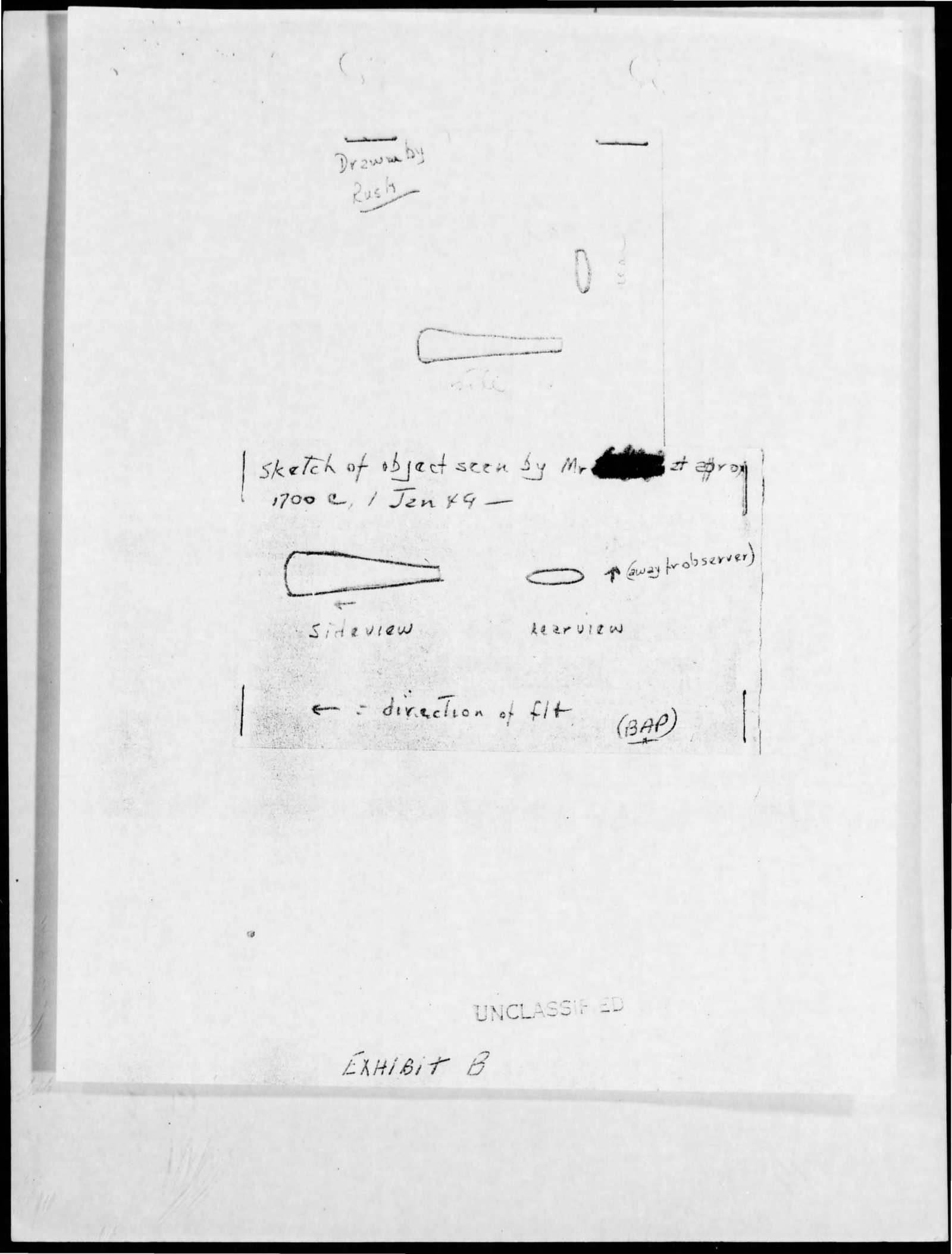
Rush's drawing is consistent across both versions in the file. The large sketch shows a long, slightly tapering body, marked 10 feet at the front, 4 feet at the rear and 60 feet long, with a rounded front end and a squared-off rear. A small "rear view" shows a tall, narrow oval. The smaller drawing, labelled "Drawn by Rush" and initialed "(BAP)" by the OSI agent, shows the same profile with an arrow indicating that the wide end led: the object flew "front first," fat end forward. Its rear view is a flat oval, with an arrow pointing away from the observer. The two rear views are drawn at different orientations, one tall and one flat, which may simply reflect the angle each was drawn from.
That profile is, as everyone noticed, the profile of a sleeve target: a fabric target towed behind another aircraft for aerial gunnery practice, a standard part of training in the 1940s. Rush's own words describe the comparison he was making. The OSI quotes him as saying the object's "front opening" was "much larger than the opening of a sixty foot sleeve target," so the targets he had in mind were open at the wide front end, which in his drawing is the end that led, and narrowed toward a fluttering tail: "the tail even fluttered like a target." He was evidently comparing it with targets of a size he knew.
The color
"Dark blue or black." The file does not say what color the targets Rush had seen were, and this case file has not found a reliable source on the colors used in 1949. The more important point is that the color may have been produced by the light. As explained under Environmental Context, an object between the observer and the setting Sun appears dark whatever its real color. Rush first saw the object crossing in front of him, when the Sun was to his left and slightly behind the line of sight, and the dark color may have been seen then; but most of the observation, and all of it after the turn, was toward the Sun.
The wings
The absence of wings is what separates this object from an airplane, and the evidence for it is a single observation: "As the object made its turn, it was then that I noticed the object didn't have wings." An aircraft banking into a turn presents its wings at a changing angle. Seen from behind and slightly below as it rolls away from the viewer, or edge-on, the wings of a fighter can nearly disappear, leaving the fuselage. The first report's "short wings" and "looked like rocket" are, if anything, a description of a stubby-winged aircraft. On the other side, Rush watched the object for several seconds before the turn specifically to identify the type of plane, and he did not report seeing a cockpit, propeller or tail surfaces. A fighter's large tail and canopy are not obviously consistent with the drawing.
The sound
Rush heard nothing in particular. The two women heard a roar as it left, and the first report said it sounded like a helicopter. In a light plane cabin in 1949, with the Stinson's own engine running, almost any external sound would be hard to hear. A roar as the object accelerated away is what a piston fighter at full throttle would produce; a "helicopter" sound is a reasonable description of a large radial engine heard from inside another aircraft. Neither proves anything, but a silent object would have been harder to explain conventionally than a roaring one.
Supporting Non-Terrestrial or Anomalous Origin
- Three witnesses describe a solid, wingless, tapering body with no exhaust, no propeller and no visible propulsion.
- A sleeve target cannot fly without a tug, and none was seen, at a range of 500 to 1,200 feet in clear air.
- A free-flying target or balloon could not have turned against the wind and accelerated.
- No one has identified the object in 77 years.
Supporting Terrestrial Origin
- No physical, photographic or instrumental evidence exists.
- The object behaved like an aircraft: level flight, a banked turn, a climb and acceleration, and a roar on departure.
- The dark color and the missing wings were seen toward the setting Sun, where any aircraft would be a dark silhouette with thin edges lost in glare.
- The first report described "short wings."
- A National Guard fighter was flying into Jackson from the east at about the same time.
The Conventional Explanation Candidate
No explanation was established at the time, and none can be proved now. The candidates are taken in turn, with what favors each and what does not. As with every official finding cited on this site, the Air Force's own labels, "Insufficient Data" on the card and "lack of evidence" in Hynek's list, are treated as one input rather than a verdict. The project that applied them was, by Ruppelt's account, working from the premise that there was nothing to find, and outside researchers cannot audit how much effort it put into this case beyond what the file shows.
An aircraft, possibly the National Guard F-47
The object behaved like an airplane. It flew level at about the height of the Stinson, crossed its path, banked into a turn of about 50°, climbed gradually, accelerated and left with a roar. Rush himself first took it for "another plane" because it was "headed toward the Municipal Airport in Jackson and was on the eastern leg of the airways." The investigation's flight list shows exactly such a plane: an Air National Guard F-47 Thunderbolt, flown by a pilot logged as McWilliams, which left Meridian at 4:48 PM and landed at Jackson at 5:15 PM. Meridian is due east of Jackson, so its route would have crossed the area where the Stinson was flying, heading west toward the city.
Several details fit. The Thunderbolt, about 36 feet long with a wingspan of about 41 feet, had a large, round-nosed fuselage, fattest at the front where its big radial engine sat and tapering toward the tail, which is broadly the shape Rush drew. Seen at a few hundred feet against the setting Sun, it would have been a dark shape. A banking fighter seen from behind can appear almost wingless for a moment, and the first report did mention "short wings." A fighter accelerating away at full power would roar, and its engine might well sound like a "helicopter" from inside another aircraft. Its normal speeds, with a cruise of about 350 mph, overlap the range the witnesses estimated.
Several things do not fit. The first is the timing. The F-47 took 27 minutes for a trip of about 86 miles, an average of about 190 mph. If both its log and Rush's clock were right, at 5:00 PM it would have been only twelve minutes out of Meridian and still about 45 miles east of Jackson, not over the Pearl River. Rush's time is unusually firm: he says they had just remarked on it and checked their ground speed. For the F-47 to be the object, either Rush's clock or the logged times must be off by about ten minutes, or the fighter must have reached the area early and spent time near the city before landing. None of this is impossible, and logged departure and arrival times in 1949 were often rounded or recorded after the fact, but the file offers no support for it. The second is the turn. The object turned southwest after crossing; Hawkins Field lies northwest of the sighting position, so a fighter heading to land there would be expected to turn the other way, unless it was maneuvering to enter the traffic pattern. The third is the witnesses. Rush watched it, specifically trying to identify the type, and two pilots aboard did not recognize a common fighter that was then flown by their own state's Air National Guard. The Thunderbolt's big tail and canopy are not in his drawing. The fourth is that the tower told Rush that nothing had landed recently, although by the time he called, about 5:05 PM on his clock, the F-47 had not yet landed, according to its log.
There is also the T-6 trainer that left Meridian at 5:18 PM, but it was not in the air at 5:00. Delta Flight 309 landed at 5:31 PM and would have been far to the east at 5:00. Private aircraft, Navy aircraft in transit, or Air Force aircraft not logged at Hawkins would not appear in the check at all.
The general aircraft explanation is therefore plausible and the F-47 is a specific, documented candidate that no one appears to have examined, but the timing and the identification problems keep it from being a solution.
A sleeve target with an unseen tug
The witnesses' own comparison. A sleeve target is shaped like the object, flies wide end forward, flutters, and would look like a solid body from some angles. A target is towed on a cable some distance behind its tug, so the tug can be well ahead of the target and easy to miss if attention is fixed on the target. The object's apparent "acceleration" could be the target swinging outward on its cable as the tug turned.
Against this: Rush, who said he had seen tow targets before, judged that "it moved at a greater speed than tow targets I've seen before" and that "there was nothing towing it." Hynek took the point directly: "described as resembling a tow target, but with no towing plane seen." Gunnery towing over the edge of a state capital, on the approach to its airport, on a holiday evening at sunset, would have been unusual. And the flight check found no towing aircraft. The candidate remains possible, because a tug could have been missed and because the OSI wrote that it was "unknown" whether any Air Force devices were aloft, but it requires the witnesses to have missed both the tug and the cable at close range in clear air.
A balloon
The Air Weather Service checked and commented "definitely no balloon." Tim Printy, who suspected a balloon, noted that "the description of the flight path was against the wind." The file's winds aloft confirm it: at 2,000 feet the wind was from 200°, so a balloon near the Stinson's height would have drifted toward the north-northeast, and above that from the west, carrying it east. The object went west and then southwest, turned and accelerated. A balloon cannot do that. This file rates it implausible.
Astronomical or meteor
Hynek found "nothing in this incident that can be said to have an astronomical origin." The object was seen below the horizon at first, at close range, for ten seconds, and turned. No astronomical or meteoric explanation fits.
A genuine unidentified object
On this reading, three people saw at close range a dark, wingless, tapering craft about 60 feet long, flying under control without visible propulsion. It is supported by the closeness of the encounter, the witnesses' aviation experience, their insistence on the absence of wings and tug, the absence of any balloon or airline explanation, and the fact that both Hynek and a skeptical modern reviewer could not explain it. It is weakened by the brevity of the sighting, the sunset light, the change in the description of the wings, the pilot's failure to see it, and a documented aircraft candidate that was never tested. The record cannot separate it from the aircraft explanation.
Aircraft (incl. the ANG F-47)
Possible but UntestedBehaved like an aircraft; the first report had "short wings"; a fighter was inbound from the east and landed at 5:15. But the logged times put it about 45 miles away at 5:00, it turned the wrong way for Hawkins, and two pilots did not recognize it.
Sleeve Target, Tug Unseen
InconclusiveThe witnesses' own comparison and a good match for the shape and flutter. But no tug or cable was seen at close range, no towing flight appears in the flight check, and the object outpaced any target Rush had seen.
Balloon
Implausible"Definitely no balloon" (Air Weather Service). The object moved west and southwest against winds from 200° and 270°, turned and accelerated.
Astronomical / Meteor
ImplausibleHynek found nothing astronomical. Close range, ten seconds and a turn exclude it.
Genuine Unidentified Object
InconclusiveSupported by three close witnesses, two of them pilots, and by Hynek's and Printy's failure to explain it. But the decisive details were seen for seconds against a setting Sun.
Related Cases
Confirmed Documents & Official Records
From the Project Blue Book File
Sixteen of the 21 pages of the National Archives file for Incident 233, as read for this case file: the record card, the first teletype, the OSI Report of Investigation, Rush's letter and drawings, the flight and weather exhibits, the weather detachment report, the Grudge summary, the Air Weather Service letter and Hynek's evaluation. U.S. Air Force records, public domain; names other than Rush's were redacted before release. Click any page to open it full size.
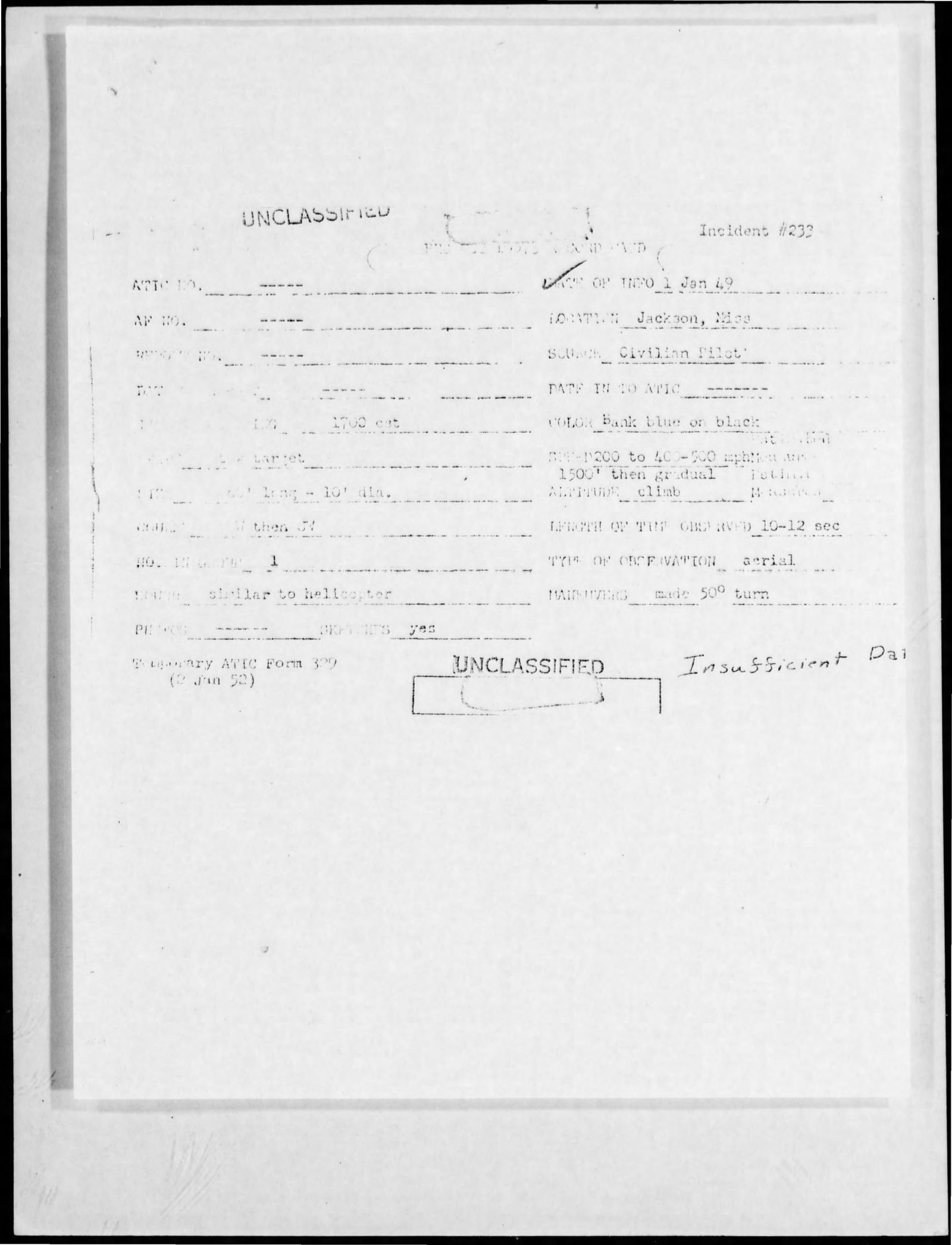
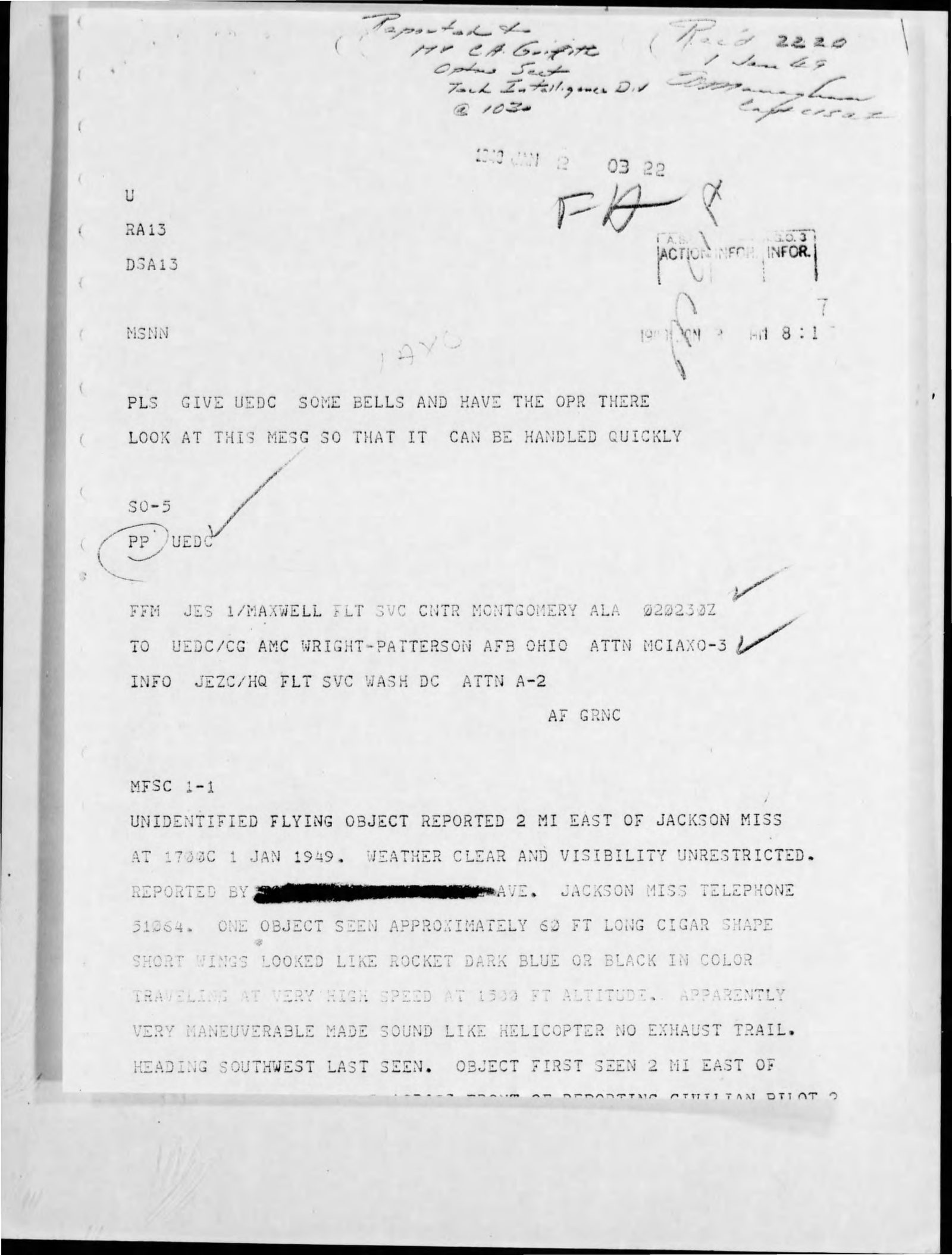
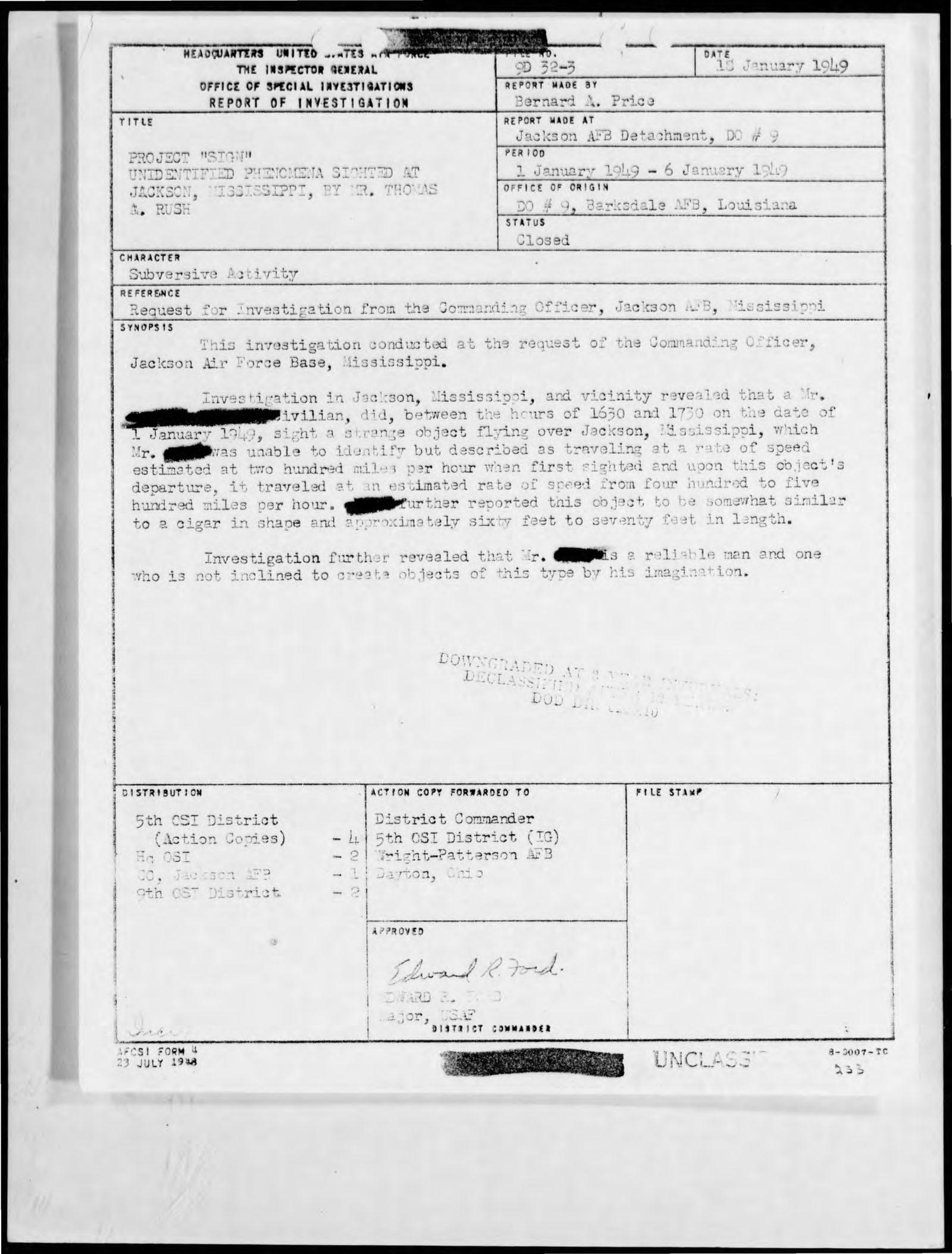
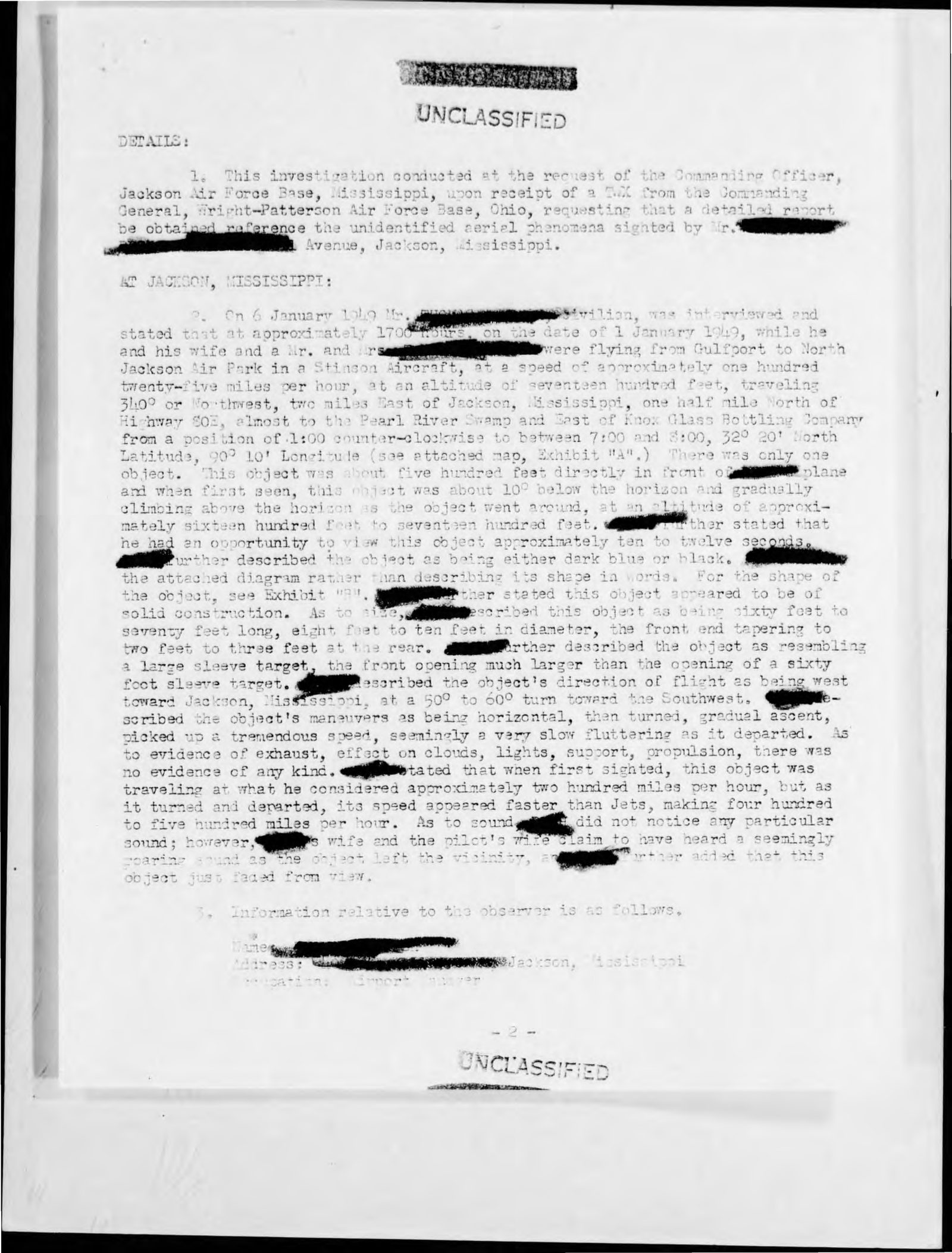
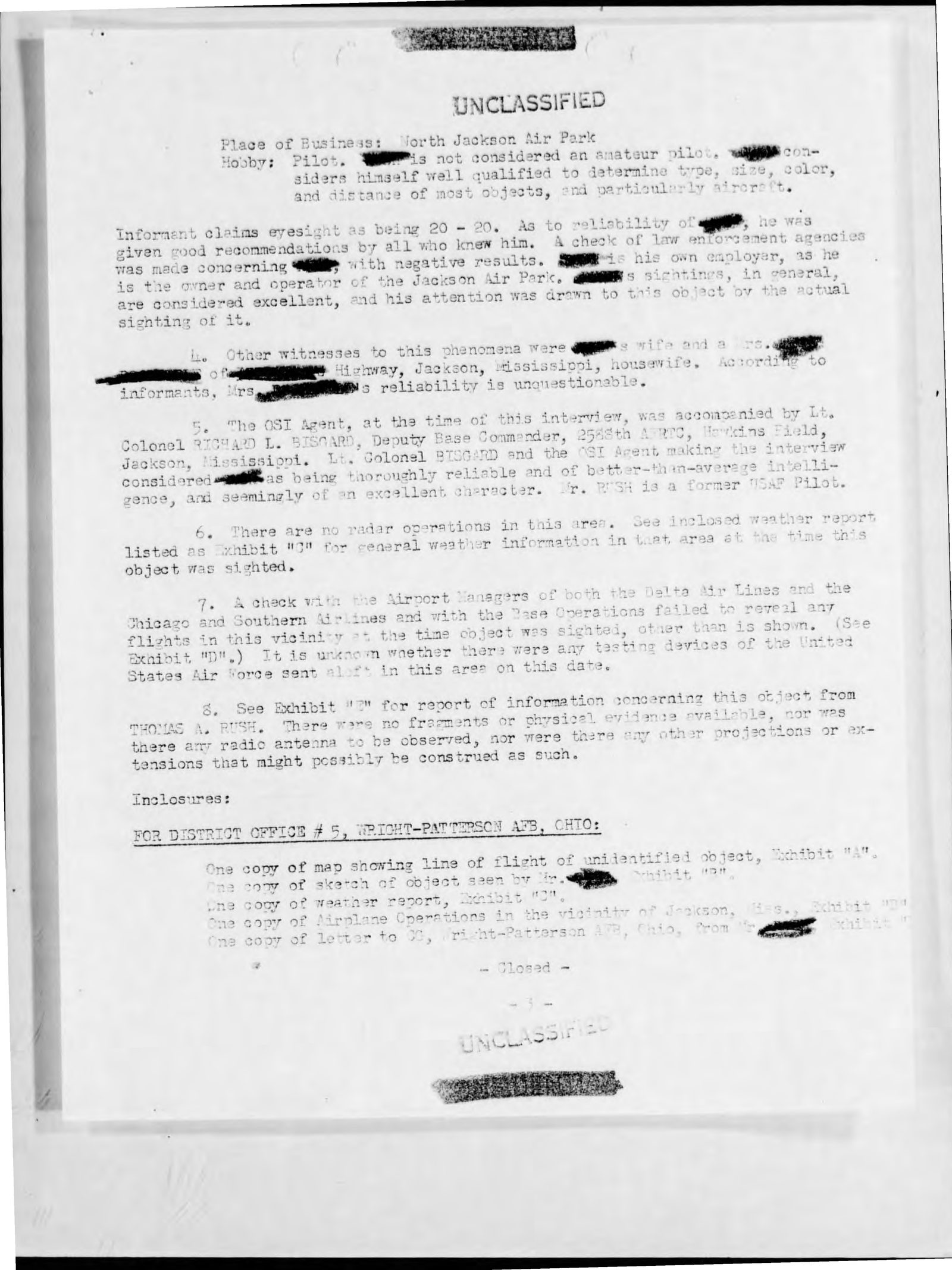
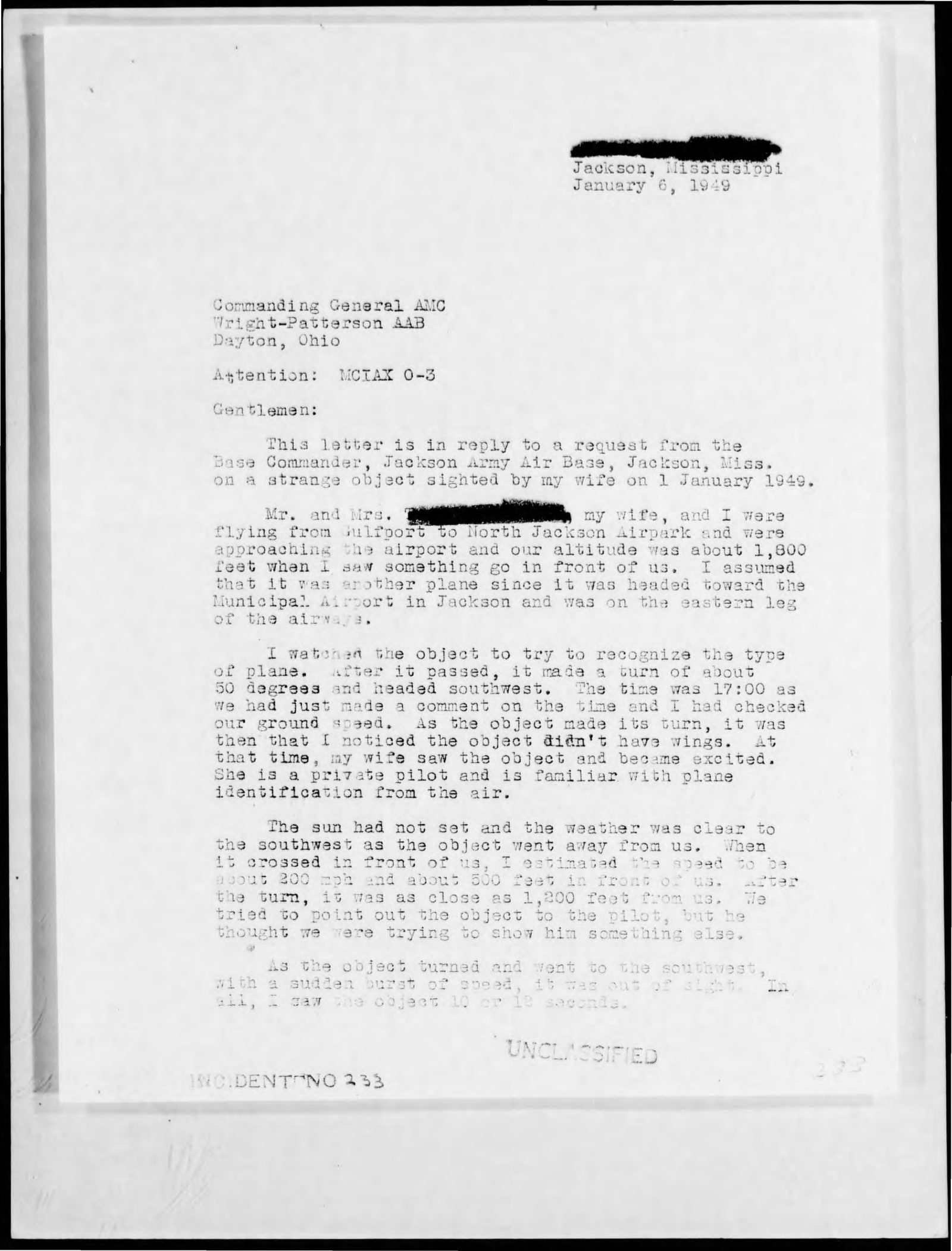
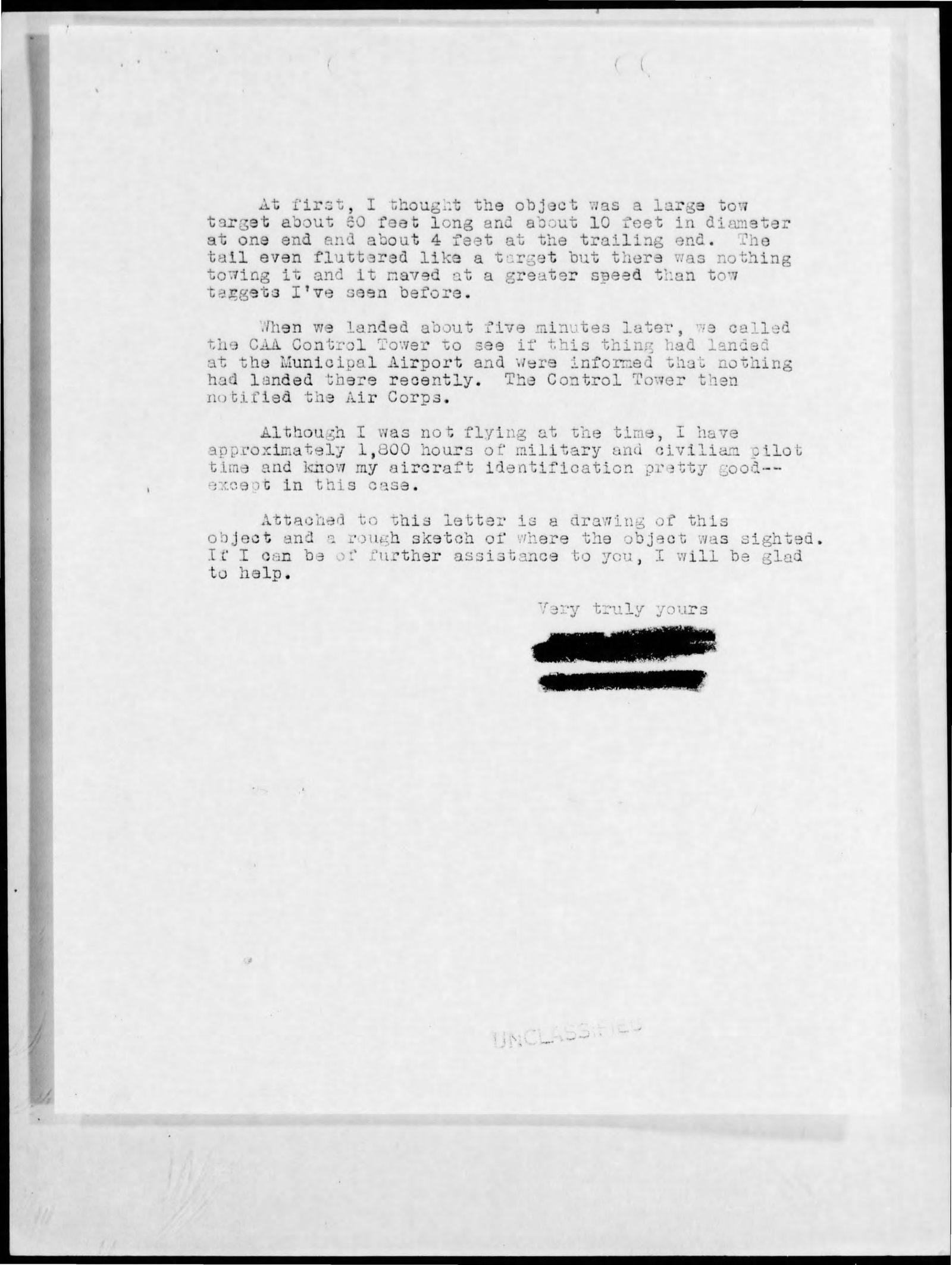
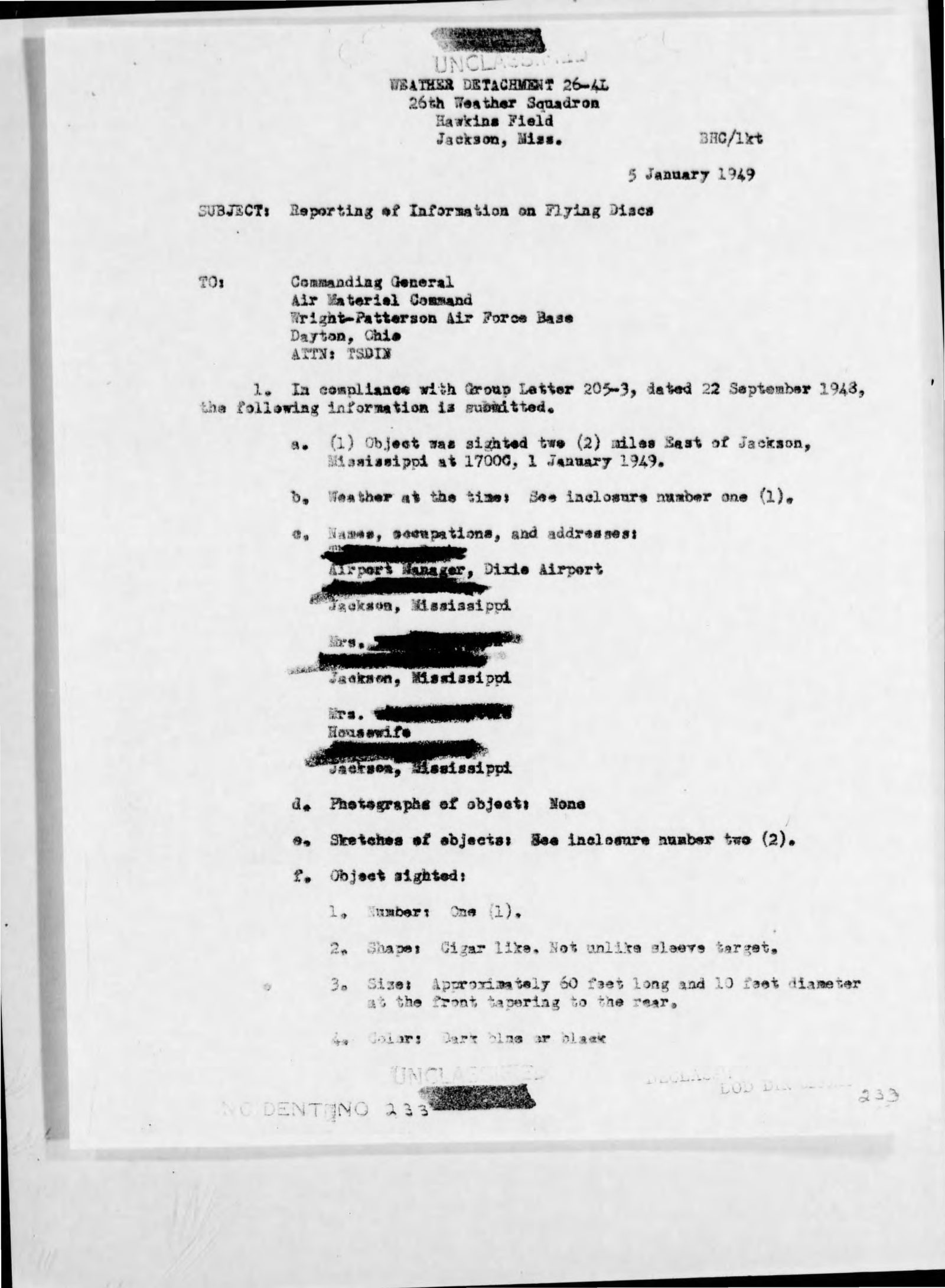
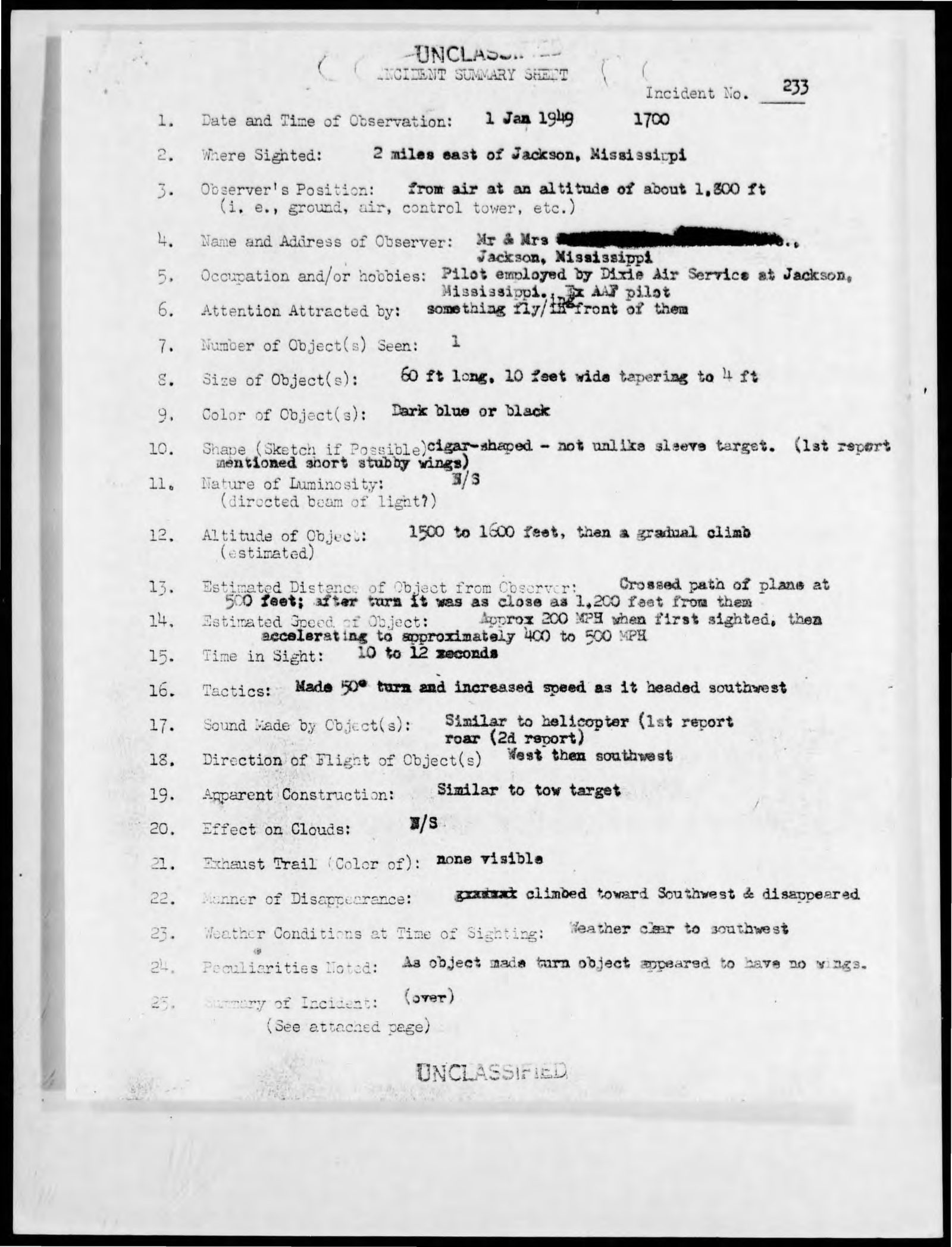
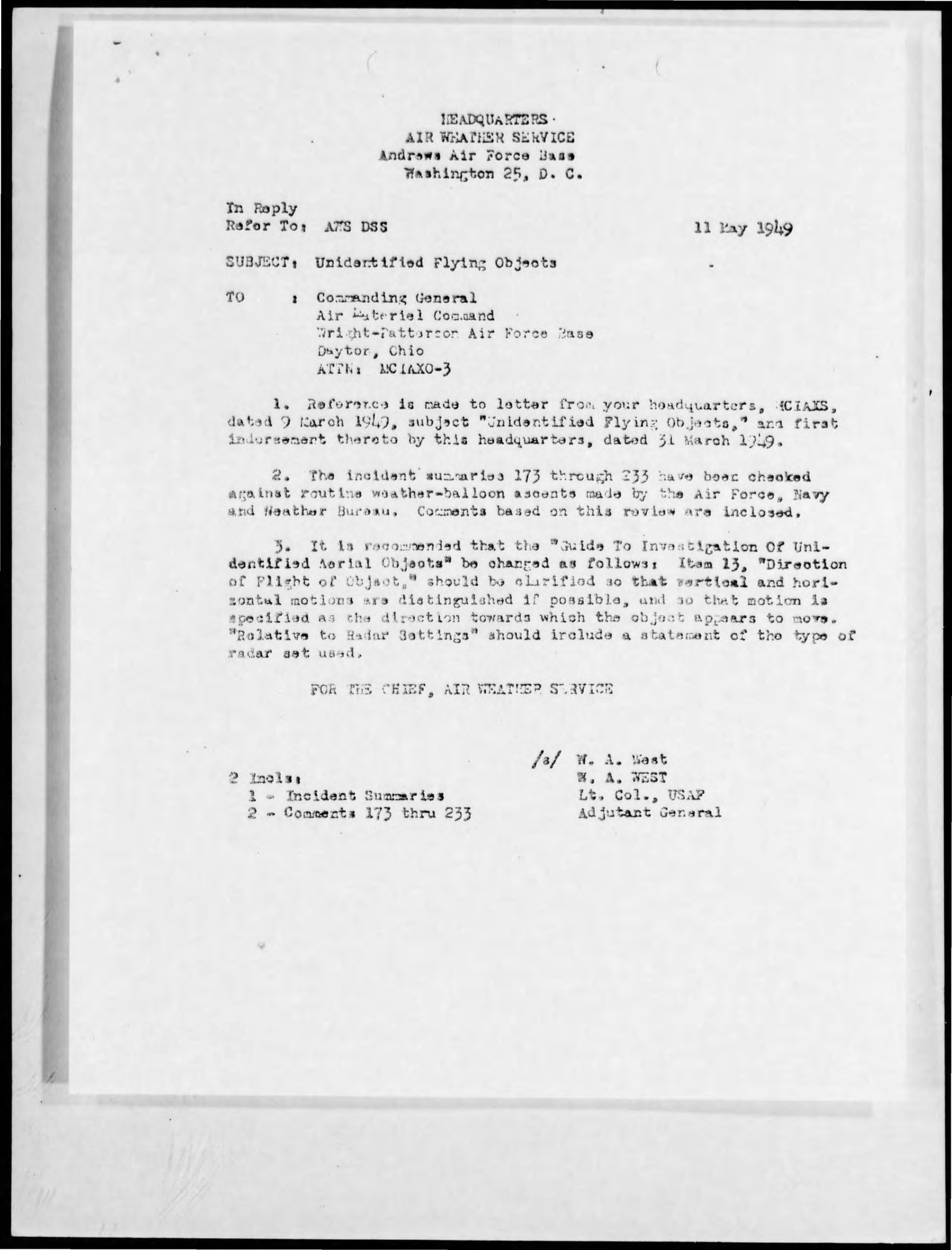
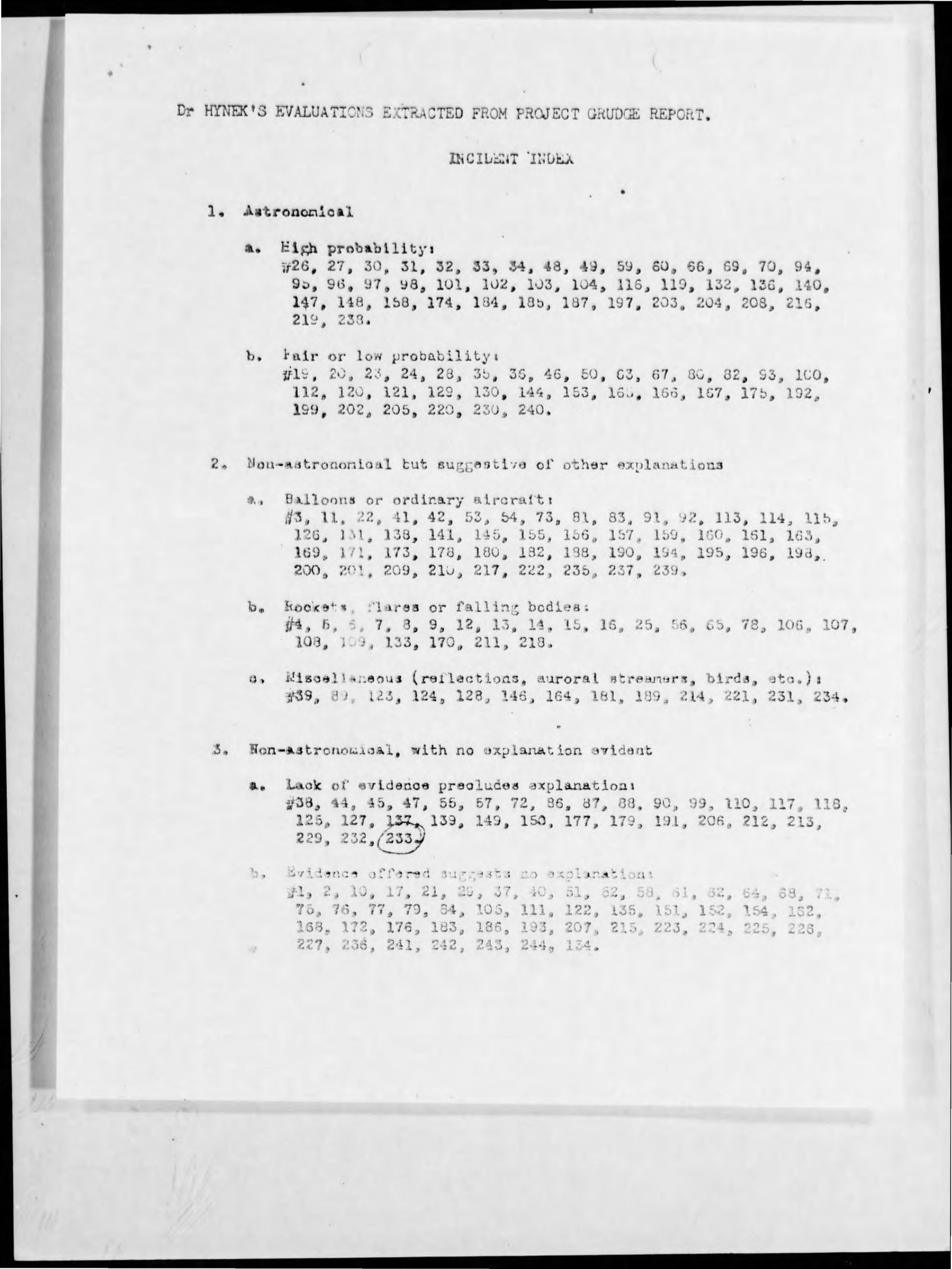
The National Archives catalog entry for this case's Project Blue Book file, with page images from microfilm publication T1206 (roll 4), scanned with Fold3. Access and use unrestricted. The primary source for this case file.
UNCLASSIFIEDA 21-page PDF copy of the same released file (Fold3 file 6792140), with an OCR text layer. The page images were read directly for this case file; the OCR text is unreliable.
UNCLASSIFIEDThe catalog series for the released, name-redacted Blue Book case files (Record Group 341), which include the Project Sign and Grudge files of 1947–1951.
UNCLASSIFIEDNARA's fact sheet on Project Blue Book and its predecessors, Projects Sign and Grudge.
UNCLASSIFIEDSearch Government Archives Directly
Further Reading — Recommended Literature
The Report on Unidentified Flying Objects
Blue Book's chief on Project Sign, the change to Grudge in February 1949, the "Dark Ages" that followed, and the Grudge report's appendixes.
UFOs and Government: A Historical Inquiry
A documented history of official UFO investigation, with detailed chapters on Sign, Grudge and the 1948–1949 shift in Air Force policy.
The UFO Controversy in America
A historian's account of the Air Force's handling of UFO reports, including the Sign and Grudge years.
The Hynek UFO Report
The astronomer whose 1949 evaluation is in this file, on his years as the Air Force's consultant and why so many reports were left unexplained.
DISCLOSURE: Some links above are affiliate links. If you purchase through them, OverClassified receives a small commission at no additional cost to you. This helps support independent research.
Essential Viewing
No Videos Available
Sources
- U.S. Air Force, Office of Special Investigations. Report of Investigation, file 9D 32-3, "Project 'Sign' — Unidentified Phenomena Sighted at Jackson, Mississippi, by Mr. Thomas A. Rush," made by Bernard A. Price at Jackson AFB Detachment, District Office No. 9, Barksdale AFB, 18 January 1949, approved by Maj. Edward R. Ford; with transmittal of 18 January and 5th District OSI indorsement of 26 January 1949, and Exhibits A–E (map, sketch, weather, "Exhibit IV" airplane operations, letter). In Project Blue Book file "Jackson, Miss, January 1949 — Incident Number: 233," National Archives: catalog.archives.gov
- Rush, Thomas A. Letter to the Commanding General, Air Materiel Command, Attention MCIAXO-3, Jackson, Mississippi, January 6, 1949 (two pages), with drawing and sketch map. Same file: catalog.archives.gov
- Cole, Benjamin H., Captain, USAF, commanding Weather Detachment 26-4L, 26th Weather Squadron, Hawkins Field, Jackson, Miss. "Reporting of Information on Flying Discs," to the Commanding General, Air Materiel Command, 5 January 1949, with Jackson weather and winds aloft. Same file: catalog.archives.gov
- Maxwell Flight Service Center, Montgomery, Alabama. Teletype to CG AMC Wright-Patterson AFB, Attn MCIAXO-3, date-time group 020230Z [January 1949], "Unidentified flying object reported 2 mi east of Jackson Miss at 1700C 1 Jan 1949." Same file: catalog.archives.gov
- Project Grudge. Incident Summary Sheet No. 233 and "Incident: 233" narrative summary; "Dr Hynek's Evaluations Extracted From Project Grudge Report, Incident Index," and Hynek's comment on "Incident #233 — near Jackson, Mississippi — 1 January 1949"; Blue Book record card (Temporary ATIC Form 329, 2 Jan 52). Same file: catalog.archives.gov
- Headquarters, Air Weather Service, Andrews Air Force Base. Letter, "Unidentified Flying Objects," to the Commanding General, Air Materiel Command, Attn MCIAXO-3, 11 May 1949, signed W. A. West, Lt. Col., USAF, Adjutant General; with comment "No. 233: Definitely no balloon." Same file: catalog.archives.gov
- Internet Archive. "1949 01 6792140 Jackson Miss 233" (PDF of the released file, 21 pages, with OCR text). archive.org
- Internet Archive. Released Blue Book files "1949 04 6309380 Vicksburg Mississippi 306," "1949 08 6311912 Biloxi Hattiesburg Mississippi," "1949 10 6314622 Guntown Miss" and "1949 11 6314750 Biloxi Miss" (titles only; not researched for this file). archive.org (Vicksburg); archive.org (Biloxi–Hattiesburg)
- Sparks, Brad. "Comprehensive Catalog of 2,200 Project Blue Book UFO Unknowns," version 1.35, February 3, 2026, entry 158 (Jan. 1, 1949, Jackson, Mississippi). NICAP (Download PDF): nicap.org
- NICAP. "Cigar-Shaped Object Encountered By Bush Pilot," Category 11 case directory, "Sightings from Aircraft" (AVCAT; summaries attributed to Brad Sparks and Dan Wilson). nicap.org
- Wilson, Daniel. "Jan. 1, 1949; Jackson, Mississippi (BBU)," post to AVCAT, March 8, 2011 (index of the Blue Book scans). NICAP: nicap.org
- UAP Discovery forum, Blue Book Unknowns. "January 1, 1949 — Jackson, MS — Cigar-Shaped Object Encountered by Bush Pilot," posted January 1, 2026 (images of the file; summary attributed to George Eberhart). uapdiscovery.discourse.group
- Shaw, Jazz. "From The Project Blue Book Archives: A Few Lesser-Known UFO Cases From Yesteryear," The Debrief, March 7, 2023. thedebrief.org
- Printy, Tim. "Project Blue Book case review: 1949," SUNlite 16, no. 2 (March–April 2024): Jackson, MS reclassified from "Insufficient data" to "UNIDENTIFIED." (Download PDF): astronomyufo.com
- Ruppelt, Edward J. The Report on Unidentified Flying Objects. Garden City, NY: Doubleday, 1956 (Project Gutenberg e-text: Project Sign, the "Estimate of the Situation," the renaming to Grudge on February 11, 1949, "The Dark Ages," Air Weather Service and Hynek screening, and the Grudge report and its appendixes). gutenberg.org
- National Archives. "Project BLUE BOOK — Unidentified Flying Objects." archives.gov
- National Archives Catalog. Series 597821, "Sanitized Version of Project Blue Book Case Files on Sightings of Unidentified Flying Objects." catalog.archives.gov
- Wikipedia. "Project Grudge" (dates of the August 1949 report; used for orientation only). en.wikipedia.org
- Wikipedia. "Hawkins Field (airport)" (Jackson Army Air Base; 2588th Air Force Reserve training unit; returned to civil control March 31, 1949; coordinates). en.wikipedia.org
- Wikipedia. "153d Air Refueling Squadron" (redesignated 153d Fighter Squadron, Mississippi Air National Guard, organized at Key Field, equipped with F-47D Thunderbolts; used for this point only). en.wikipedia.org
- Wikipedia. "Stinson 108" (four-seat light aircraft built from 1946; cruise speed about 121 mph; used for orientation only, since the file does not give the model). en.wikipedia.org
- Wikipedia. "Air Force Office of Special Investigations" (1 August 1948 operational date; under the Inspector General; district organization). en.wikipedia.org
- Wikipedia. "Republic P-47 Thunderbolt" (P-47D length about 36 ft, span about 41 ft, Pratt & Whitney R-2800 radial engine, cruise about 350 mph; later F-47 with the Air National Guard; used for orientation only). en.wikipedia.org
- The American Rifleman. "Clay Pigeons That Shoot Back: Aerial Gunnery Training & Combat In WWII," originally published July 1945, reposted July 27, 2025 (towed sleeve targets in wartime gunnery training). americanrifleman.org
- NOAA Global Monitoring Laboratory. Solar Calculator and its published solar position equations (Sun altitude and azimuth, sunset and civil twilight at 32.30° N, 90.18° W on January 1, 1949; computed for this file). gml.noaa.gov
- OverClassified. Chiles-Whitted UFO Encounter case file, Thomas Mantell Incident case file and Gorman Dogfight case file (the Project Sign period).
- OverClassified. Meridian "Flying Cymbal" case file, Keesler AFB Sighting case file, Flora, Mississippi Police Encounter case file and Natchez Trace Ranger Sighting case file (score calibration).
See something inaccurate? Have additional information or sources?
Suggest an Edit →Last Updated: October 2026