
The Keesler AFB Sighting
At about 12:15 PM Central Standard Time on Wednesday, May 7, 1952, four Air Force men working at a VHF omni-range navigation site twelve miles from the end of the main runway at Keesler Air Force Base, Biloxi, Mississippi, watched what they estimated to be ten small, bright objects "of a bright metallic color such as polished aluminum" appear one or two at a time near the base of the clouds, each "apparently followed by a trail of some type," and vanish into the clouds again. The men, an officer and three enlisted men from an Airways and Air Communications Service installation squadron based at Tinker Air Force Base, Oklahoma, said the objects moved in a straight line to the southeast "at a considerably greater speed than jet aircraft" and were "definitely not birds or airplanes." The sighting lasted five to ten minutes, stopped, and resumed for about a minute five minutes later. Thirteen days afterward, an intelligence officer at Tyndall Air Force Base, Florida, filed a two-page Air Intelligence Information Report on it. Project Blue Book carried the case as Unknown. The same report also records that "air traffic at the time of the sighting was unknown": nobody checked whether aircraft were in the sky. This file reads the surviving documents closely, sets out how later catalogs changed them, and weighs the case against the ordinary explanations that were never ruled out.
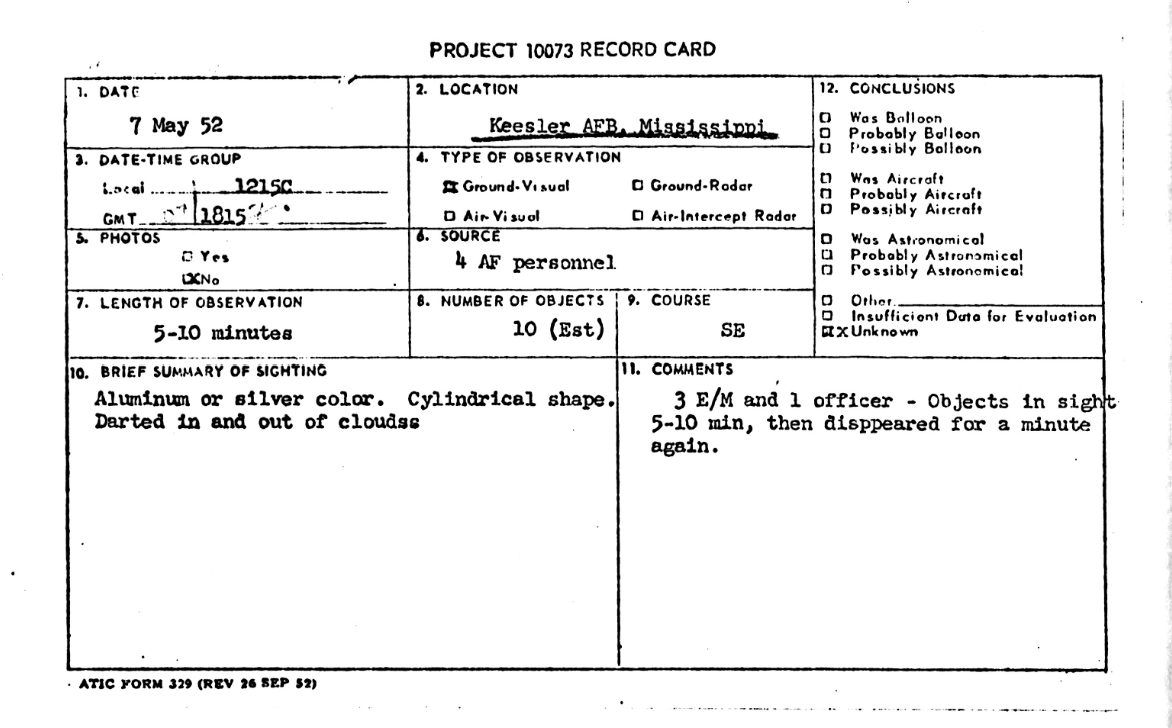
Pictured: the Project 10073 record card for this case — dated 7 May 52, Keesler AFB, Mississippi, four Air Force personnel, “Aluminum or silver color. Cylindrical shape. Darted in and out of clouds,” with the Unknown conclusion box checked. It is the Air Force’s own index card, not a photograph; no photograph of the objects was taken (“There were no fragments or photographs taken,” the report says). U.S. government record, public domain.
Theoretical Alignment
The Extraterrestrial Hypothesis gets a low score because the report itself gives it little to hold. The witnesses saw small, shiny, apparently cylindrical objects at an unknown distance, moving in a straight line and in and out of thin cloud. The two claims that could make the case anomalous, a speed "considerably greater" than jets and the confident statement that the objects were "definitely not birds or airplanes," are judgments that depend entirely on knowing how far away the objects were, and the report says that distance "was unknown." There was no hovering, no maneuvering, no close approach, no landing and no physical effect. What is left is an unidentified sighting by four servicemen, which is a real thing but not evidence of anything in particular.
The Interdimensional Hypothesis has almost nothing to work with. The objects "would suddenly become visible" and "disappear into the clouds," but in thin scattered cloud with a smoke layer at the same height, appearing and disappearing is what any object passing behind and between cloud fragments will do. Nothing in the file suggests an appearance or disappearance in clear air.
The Psycho-Social score is also low. Four men saw the same thing at the same time over several minutes, and their accounts were taken together. This is not the kind of brief, single-witness, frightening event in which perception and memory are most easily shaped. The question this case raises is not whether something was there but what it was, and that is a question of identification rather than psychology.
Background
Keesler Air Force Base sits on the narrow peninsula of east Biloxi, between the Mississippi Sound and the Back Bay of Biloxi. According to the base's own history, it opened in 1941 as Army Air Corps Station No. 8 and was named for 2nd Lt. Samuel Reeves Keesler Jr. of Greenwood, Mississippi, an aerial observer who died of wounds in France in World War I. The Air Force's radar school moved there from Boca Raton, Florida, in November 1947, and in early 1949 Air Training Command decided that Keesler should concentrate on radar, radio and electronics maintenance. By the end of that year the last aircraft-mechanic courses had left and Keesler had become known as the "Electronics Training Center of the Air Force." It also trained air traffic service technicians, aircraft approach controllers and ground radar mechanics.
In 1952 Keesler was in the middle of a Korean War expansion. A rebuilding program had begun in August 1950, and in 1951 Congress appropriated another $44 million to complete it. The base was run by the 3380th Technical Training Wing. Air Training Command had reorganized to cope with the war's training load: a Technical Training Air Force was set up at Gulfport, Mississippi, in July 1951, and a Crew Training Air Force at Randolph AFB, Texas, in March 1952. As their names suggest, the first was responsible for technical schools such as Keesler's and the second for aircrew training, which included the interceptor aircrew school at Tyndall Air Force Base, Florida, which had begun classes on January 4, 1951 to train jet fighter pilots and radar observers for all-weather interception. Both organizations matter here, because the report on this sighting was written at Tyndall and sent to "Hq CTAF," the Crew Training Air Force.
Nationally, the spring of 1952 was the beginning of the largest wave of UFO reports the Air Force had ever handled. In March 1952 Project Grudge, the Air Force's small UFO project at Wright-Patterson AFB, Ohio, was made a separate group and renamed Project Blue Book, under Capt. Edward J. Ruppelt. Ruppelt later wrote that reports had risen from about ten a month to twenty a month since December 1951, and that "April was a big month. In April we received ninety-nine reports." That month Life magazine published "Have We Visitors From Space?" by H. B. Darrach Jr. and Robert Ginna in its issue of April 7, 1952. Air Force Letter 200-5, "Reporting of Unidentified Flying Objects," dated April 5, 1952 and, in Ruppelt's words, "duly signed and sealed by the Secretary of the Air Force," in essence "stated that UFO's were not a joke," required the commander of every Air Force installation to forward UFO reports to the Air Technical Intelligence Center (ATIC) by wire, with a fuller report to follow, and let Blue Book contact any Air Force unit directly.
This sighting came about a month after that order went out, and the report on it cites the directive by name ("AF Reg 200-5"). Two months later, the wave peaked with the radar-visual sightings over Washington, D.C. on the weekends of July 19–20 and 26–27. Blue Book's own Status Report No. 8 says that from June 1 to October 31, 1952 it received more reports than in the whole period from 1947 to the end of 1951, including more than 440 in July alone. The Keesler sighting belongs to the quieter months just before that surge, when the new reporting rules were taking hold and a report like this one, from four servicemen, would be filed as a matter of routine.
Complete Timeline
| Date / Time | Event |
|---|---|
| November 14, 1947 | The Air Force's radar school officially arrives at Keesler from Boca Raton, Florida. |
| 1949 | Air Training Command makes Keesler its center for radar, radio and electronics training, the "Electronics Training Center of the Air Force." |
| January 4, 1951 | Interceptor aircrew training begins at Tyndall AFB, Florida, under Air Training Command. |
| July 1951 | Air Training Command sets up a Technical Training Air Force at Gulfport, Mississippi. |
| March 1952 | Crew Training Air Force is created at Randolph AFB, Texas. At Wright-Patterson AFB, Project Grudge becomes Project Blue Book under Capt. Edward J. Ruppelt. |
| April 5, 1952 | Air Force Letter 200-5, "Reporting of Unidentified Flying Objects," is issued. |
| April 7, 1952 | Life publishes "Have We Visitors From Space?" Blue Book receives 99 reports in April. |
| May 7, 1952, about 12:15 PM CST (1815Z) | At a VHF omni-range site 12 miles from the northeast end of Keesler's main runway, four Air Force men see small, bright, metallic-looking objects appear one or two at a time near the base of the clouds at a magnetic bearing of about 30°, each apparently followed by a trail, travelling in a straight line to the southeast. They estimate about ten in all. After five to ten minutes the objects vanish. |
| About 12:20–12:30 PM | Five minutes after the first sightings end, objects reappear in the same area for about a minute. (Exact clock times for this second phase are not recorded; this row is computed from the report's durations.) |
| 12:30 PM CST | Official weather observation: thin scattered clouds at 2,000 and 10,000 feet; smoke layer at 2,000 feet, thin scattered; visibility 10 miles; 72°F, dew point 68°F; wind southwest at 7 knots. |
| Between May 7 and May 20, 1952 | The four men are interviewed. The report does not say where, when or by whom. |
| May 20, 1952 | 2nd Lt. William J. Kormos, Assistant Wing Intelligence Officer at Tyndall AFB, signs Air Intelligence Information Report IR-10-52 (AF Form 112), evaluated B-3, distribution "Org & 4 cys, Hq CTAF." |
| About August 5, 1952 (reading uncertain) | A handwritten notation on the report's first page, partly legible, appears to include an ATIC reference and the date "5 Aug 52," possibly marking its receipt or filing in Blue Book's records. |
| July 19–20 and 26–27, 1952 | The Washington, D.C. radar-visual sightings bring the 1952 wave to its peak. |
| After September 26, 1952 | The case's Project 10073 record card is typed on ATIC Form 329, a form revised on that date, with the conclusion "Unknown" checked. |
| December 31, 1952 | Blue Book Status Report No. 8 sets out the project's evaluation categories, including its definition of "Unknown." |
| January 1974 | Don Berliner reads the unredacted Blue Book files at Maxwell AFB, Alabama, and lists the case among the unknowns, naming the officer as "Capt. Morris." |
| Mid-1970s | The Blue Book files are copied with witness names blacked out and microfilmed for the National Archives. |
| January 17, 1992 | Berliner's list, including this entry, is posted to the Usenet newsgroup alt.alien.visitors. |
| April 19, 2016 (file date) | NICAP posts a three-page PDF of the Blue Book pages for this case. |
| May 6, 2025 | The UAP Discovery forum posts images of the file in its Blue Book Unknowns section. |
| February 3, 2026 | Version 1.35 of Brad Sparks's catalog of Blue Book unknowns lists the case as entry 571. |
The Intelligence Report
Almost everything known about this sighting comes from one document: an Air Intelligence Information Report on Air Force Form 112, report number IR-10-52, headed "Unidentified Flying Object Report (FLYOBRPT)." The "area reported on" is "Mississippi." The report is "From" the "Intell. Off. Tyndall AFB, Florida." The date of the report is 20 May 1952 and the date of the information is 7 May 1952. It was prepared by "2nd Lt. William J. Kormos" and gives as its reference "AF Reg 200-5 (FLYOBRPT)." Its evaluation is "B-3." Its distribution was "Org & 4 cys, Hq CTAF": the original and four copies to Headquarters, Crew Training Air Force. It is marked UNCLASSIFIED, with a stamped downgrading notice, and the classification line at the top and bottom has been partly blacked out. Part I is signed and approved by William J. Kormos, "2nd Lt. USAF, Asst Wg Intell Off." The approving signature on Part II has been blacked out.
Part I: the summary
Part I is a single paragraph, which is quoted here in full because it is short and because later catalogs depart from it:
"On Wednesday, 7 May 1952, four Air Force personnel saw bright metallic objects near Kessler Air Force Base, Mississippi. The objects were traveling at a considerably greater speed than jet aircraft and were followed by a trail. Although no more than one object was seen at a time, a total of ten (10) were estimated to be in the sky. Due to the distance, the size and shape were not known, but to one observer they seemed to be cylindrical in appearance."
Three things in it deserve attention. First, the base's name is misspelled "Kessler" in the summary but spelled correctly in Part II. (This site's own location entry for Keesler carries the same misspelling in its internal identifier, which is why some links point to "kessler-air-force-base.") Second, the summary says that "no more than one object was seen at a time," while Part II says "only one or two were visible at any one time." That is a small inconsistency inside a single report. Third, and most important, the summary says outright that "due to the distance, the size and shape were not known," and that the cylindrical shape was the impression of only "one observer." The cylinder that later appears in every catalog entry began as one man's impression of objects too far away to measure.
Part II: the numbered paragraphs
Part II is a one-page form with ten numbered paragraphs. Paragraph 1 is the description:
"Observers estimated approximately a total of ten (10) objects were present, although only one or two were visible at any one time. They appeared to be very small cylindrical shaped objects of a bright metallic color such as polished aluminum. One object would suddenly become visible, apparently followed by a trail of some type, and then disappear into the clouds. Sources state these objects traveled at a considerably greater speed than jet aircraft and were definitely not birds or airplanes. These objects were observed for approximately five or ten minutes upon which time they vanished, re-appearing five minutes later in the same vicinity for approximately one minute."
The wording is careful in places and loose in others. "Very small" and "apparently followed by a trail of some type" are honest hedges. "Considerably greater speed than jet aircraft" and "definitely not birds or airplanes" are confident conclusions, and the report attributes them to the "sources," meaning the witnesses, rather than adopting them itself. "Ten" is an estimate built up over several minutes from objects seen one or two at a time; it is not a count of a group seen together. Nothing in the report says that the same object was not seen more than once.
Paragraphs 2 and 3 give the time, "approximately 1215 Central Standard Time 7 May 1952," and the type of sighting: "Visual ground observation was made." Paragraph 4 gives the place and direction:
"Observed from the VHF Omni Range site, located twelve (12) miles from the northeast end of the northeast-southwest runway (coordinates, 210°– 30°) at Keesler Air Force Base. The objects were at an approximate magnetic bearing of 30° from the observers. Distance of, the objects were unknown but they appeared to be approximately the same elevation as the base of the cloud layer."
The "coordinates" are runway headings, not a map position: Keesler's single runway is aligned 030°/210°, and is still designated 03/21 today. The paragraph says the site was twelve miles from the runway's northeast end but does not say in which direction. Paragraph 5, discussed below under "Who the Witnesses Were," identifies the men and their unit; most of it is blacked out. Paragraph 6 is the weather, also discussed below. Paragraph 7 reads: "Objects were traveling in a straight line heading southeast." Paragraph 8: "There were no fragments or photographs taken." Paragraph 9: "Air Force Form 112 submitted in compliance with existing regulations." And paragraph 10, the last line of the report, reads: "Air traffic at the time of the sighting was unknown."
What the report does not contain
For a report filed thirteen days after the event, IR-10-52 is thin. It gives no estimate of the objects' angular size or elevation above the horizon, only that they seemed to be at about cloud-base height. It gives no names in the surviving copy, no ranks, and no individual statements; all four men are summarized together. It does not say whether the trail was white, dark, persistent or brief. It does not say whether any sound was heard. It does not say whether the observers had binoculars, though a navigation-aid installation crew might well have had surveying or test instruments with them. It does not record any check with Keesler's control tower, with the Air Defense Command, with nearby Air Force and Navy bases, or with civil airways traffic control, and its final line confirms that none was made. It does not say why the intelligence office at Tyndall, two hundred miles away, rather than Keesler's own staff, wrote it up. None of these gaps is unusual for a 1952 report, but together they mean the case cannot be reconstructed in much more detail than the paragraph quoted above.
The Blue Book Record Card
The second document is the case's Project 10073 Record Card. "Project 10073" was the internal project number under which ATIC filed Blue Book material; Status Report No. 8 carries the same number. The card is on ATIC Form 329, marked "Rev 26 Sep 52." That revision date matters: a card printed on a form revised in late September 1952 cannot have been typed in May. The card was made up at least four and a half months after the sighting, during or after the summer wave, when Blue Book was working through hundreds of backlogged reports.
The card gives the date as "7 May 52" and the location as "Keesler AFB, Mississippi." The date-time group is "Local 1215C" and "GMT 1815Z," consistent with Central Standard Time six hours behind Greenwich. The type of observation is checked "Ground-Visual." Photos: "No." Source: "4 AF personnel." Length of observation: "5-10 minutes." Number of objects: "10 (Est)." Course: "SE." In the conclusions box, "Unknown" is checked. None of the balloon, aircraft, astronomical, "Other" or "Insufficient Data for Evaluation" boxes is marked.
The two free-text boxes are short and, in the copy available, contain typing errors. The "Brief Summary of Sighting" reads: "Aluminum or silver color. Cylindrical shape. Darted in and out of cloudss" (sic). The "Comments" box reads: "3 E/M and 1 officer - Objects in sight 5-10 min, then disppeared for a minute again" (sic). "E/M" means enlisted men. The second sentence is garbled; it appears to compress the report's statement that the objects vanished and then reappeared for about a minute five minutes later.
The card introduces two changes. It turns the report's "one observer" impression into a flat "Cylindrical shape," and it adds a verb the report never uses. The report says the objects "would suddenly become visible" and "disappear into the clouds." The card says they "Darted in and out." That word, "darted," passes into every later summary of the case.
The card is also the only place where Blue Book's conclusion is recorded, and it gives no reason for it. There is no evaluation memo in the file as published, no analyst's note, and no correspondence. Why the case was marked "Unknown" rather than "Possibly Aircraft" or "Insufficient Data" has to be inferred from Blue Book's own published criteria, which are discussed below under "Why Blue Book Called It Unknown."
This site applies a standing caveat to official conclusions, and it applies here in an unusual direction. Government bodies that investigated UFO reports have a documented history of incomplete, delayed or later-revised explanations, from Blue Book-era identifications criticized by the Air Force's own consultants to the CIA's 1997 acknowledgment that many Cold War reports caused by its reconnaissance flights were allowed to go unexplained. Institutions also have an incentive toward the least alarming available answer, and outside researchers cannot audit how a 1952 analyst reached a one-word verdict. In this case the verdict is "Unknown," the institution declining to explain the sighting. That does not make it a finding that the objects were anomalous. It is a record that, on the information Blue Book had, it could not name them, and the information it had did not include the one check most likely to settle the question.
Reading the Weather Paragraph
Paragraph 6 of Part II, marked "(OFFICIAL)," is the only instrumental data in the file. It reads, as far as it is legible: "Clouds 2000 feet, thin scattered, 10,000 feet thin scattered; visibility 10 miles, sea level pressure 159 / temperature 72°, dew point 68°; wind southwest, seven knots; altimeter setting 999, smoke layer 2000', thin scattered. Time 1230." The station is not named, but the most likely source is Keesler's own base weather station, fifteen minutes after the sighting began.
Two of the figures are in the shorthand used in surface weather observations of the period. "Sea level pressure 159" is the last three digits of the pressure in tenths of a millibar, that is, 1015.9 millibars. "Altimeter setting 999" is the last three digits of 29.99 inches of mercury. The two are consistent with each other: 1015.9 millibars is about 30.00 inches, and an altimeter setting a hundredth of an inch lower at a station near sea level is what one would expect. This file reads both figures this way; the report does not decode them.
The rest of the paragraph describes a warm, humid, late-spring noon on the Gulf Coast. A temperature of 72°F with a dew point of 68°F means relative humidity of roughly 87 percent (computed). The cloud was thin and scattered at two levels, 2,000 and 10,000 feet, so most of the sky was clear, with fragments of low cloud between the observers and the higher layer. A "smoke layer," also thin and scattered at 2,000 feet, sat at the same height as the lower cloud. Visibility was ten miles. The wind was from the southwest at seven knots.
These conditions bear directly on the sighting. Objects seen "at about the same elevation as the base of the cloud layer" were, if the lower layer is meant, about 2,000 feet up. In thin scattered cloud at that height, anything passing through or behind the cloud would seem to "suddenly become visible" and "disappear into the clouds," exactly as described. And with ten miles of visibility and most of the sky clear, a bright object could be seen at a considerable distance. The report does not say which cloud layer the witnesses meant; if they meant the upper layer at 10,000 feet, the geometry changes, as discussed below.
Where They Were Standing
The report places the observers at "the VHF Omni Range site, located twelve (12) miles from the northeast end of the northeast-southwest runway." It does not give the site's direction from the runway, its name or its coordinates, and this file has not been able to identify it. Brad Sparks's catalog gives coordinates of 30.42° N, 88.94° W, but those are the coordinates of Keesler AFB itself, not of an omni-range site twelve miles away.
The lead brief for this file suggested that "twelve miles northeast of the runway" would put the site around the Back Bay, D'Iberville or Big Lake area. That does not work. The Back Bay and D'Iberville lie only two to five miles north of the base. Twelve statute miles from the runway's northeast end, at about 30.42° N, 88.91° W, would reach roughly 30.57° N, 88.81° W if measured due northeast (computed): rural country north of the Back Bay in the Harrison-Jackson county line area. But the report does not say northeast. It says only twelve miles from the northeast end, and the site could lie in any direction from that point. The Mississippi Sound and the barrier islands to the south rule out some directions, since an installation crew working at a navigation site would be on land, but that still leaves a wide arc across Harrison and Jackson counties.
A VHF omni-range, or VOR, is a ground radio beacon from which a properly equipped aircraft can read its bearing. A February 1951 article in Radio-Electronics explained that each station "covers 360 degrees for every ground station," against the 3-degree-wide beams of the older four-course radio ranges, and that the Civil Aeronautics Administration expected its national program to take about fifteen years. Within the Air Force, communications and air traffic facilities, including navigation aids, were the business of the Airways and Air Communications Service, and the four witnesses were from an AACS installation squadron. The simplest reading is that they were installing, testing or maintaining an omni-range station for Keesler's traffic. Searches of the available online sources for this file did not find a record of a VOR station near Biloxi in 1952 or of its exact location; historical aeronautical charts of the period would be the place to look.
The report does give one useful angle. The objects were "at an approximate magnetic bearing of 30° from the observers." In May 1952 the magnetic declination on the Mississippi coast was about 5.5° east, according to the International Geomagnetic Reference Field model as calculated by the British Geological Survey's online service (computed for this file). A magnetic bearing of 30° therefore corresponds to a true bearing of about 35°, a little east of north-northeast. The witnesses were looking roughly northeast, away from the coast and toward the interior of Jackson County and, beyond it, southwest Alabama. Without the site's location that line cannot be fixed on a map, but its direction can.
Who the Witnesses Were
Paragraph 5 of Part II begins: "The information contained in this report pertains to [the next word is partly covered by the redaction, but its visible letters fit 'interrogations'] of ..." and the next two lines are blacked out. The end of the second line is visible: "... all of whom are assigned to the 1st AACS I & K Squadron, Tinker Air Force Base, Oklahoma." The record card adds that there were "3 E/M and 1 officer."
The unit designation as typed reads "I & K," not "I & M." The lead brief for this file read it as "I & M," for Installation and Maintenance, and that is almost certainly what was meant. The Airways and Air Communications Service did use the designation "AACS Installation and Maintenance Squadron": the 11th AACS Installation and Maintenance Squadron, for example, was constituted in the Air Force Reserve and activated at Tinker AFB on June 18, 1954, later becoming an engineering and installation squadron. This file has not found an independent record of the 1st AACS squadron of that type in 1952, and so it quotes the document as typed and notes the probable typing error rather than silently correcting it.
AACS itself has a well-documented history. According to the Air Force's Cyberspace Capabilities Center history office, the Army Airways Communications System was set up in November 1938 to run the Air Corps' fixed radio facilities; it became the Air Communications Service in March 1946 and, six months later, the Airways and Air Communications Service. It was assigned to the Military Air Transport Service on August 16, 1948, and in 1961 became the Air Force Communications Service. Its business was communications and air traffic control, including navigational aids such as ground-controlled approach radar. A squadron of installation specialists from Tinker AFB, a major Air Force depot in Oklahoma, working on temporary duty at a navigation site on the Mississippi coast, fits that mission exactly.
The men's names were blacked out when the Blue Book files were copied for public release. Don Berliner, who read the files at Maxwell AFB in January 1974 before the redaction, wrote that he "made extensive notes, including the names and other identifying information on all witnesses where given." His list gives the witnesses as "Capt. Morris, a Master Sergeant, a Staff Sergeant, and an Airman First Class." That fits the record card's "3 E/M and 1 officer." Berliner gives no first name for Morris and no names for the enlisted men. This file treats "Capt. Morris" as the officer's rank and surname as Berliner recorded them, with the caveat that the surviving documents do not themselves show the name.
It is worth being clear about what these men were and were not. They were Air Force technicians and an officer whose work was radio navigation equipment. They would have seen a great deal of aircraft, and an AACS crew would know what an airway was and roughly what traffic used it. But nothing in the file says that any of them was a pilot, a weather observer, a control tower operator or a trained aircraft spotter, and their statement that the objects were "definitely not birds or airplanes" carries the weight of experienced servicemen, not of a measurement.
Why Tyndall?
The report's "From" line is the intelligence office at Tyndall AFB, Florida, near Panama City, about two hundred miles east of Biloxi. Its author was an assistant wing intelligence officer there, and it went to Headquarters, Crew Training Air Force. Neither the witnesses' unit (AACS, under the Military Air Transport Service) nor the base where they were working (Keesler, a technical training base) belonged to Tyndall's chain of command.
The documents do not explain the arrangement. Possible reasons include that Keesler, a school, had no intelligence officer assigned to handle such reports and Tyndall's wing intelligence office had area responsibility; that the men had moved on to Tyndall by the time they were interviewed; or that the report was simply routed through the nearest Air Training Command intelligence office. This file cannot choose between those, and lists them only to show that the routing is a genuine open question rather than an error. One practical consequence is clear: an interviewing officer two hundred miles away, writing up the case nearly two weeks later, was poorly placed to check Keesler's local air traffic at 12:15 PM on May 7, and the report says no one did. (Three months later, though, Keesler had its own Wing Intelligence Office: Maj. Eli S. Fowler, Jr. wrote up the August 1952 Biloxi reports there; see the Biloxi Highway 90 Sighting.)
The evaluation "B-3" uses the letter-and-number rating then standard on intelligence reports, a scheme still in use and commonly called the Admiralty code. In its usual definitions, "B" rates the source as "usually reliable" and "3" rates the information as "possibly true": not confirmed, but reasonably logical and consistent with other information. The Form 112 itself does not define the terms, so this is the conventional reading rather than the Tyndall office's own explanation. It is a fair rating of four servicemen's honest account of something they could not identify.
How the Case Was Retold
No newspaper story about this sighting has been found (see "The Press in 1952" below). The case entered the UFO literature through the Blue Book files, and each step changed it a little.
Don Berliner's list (1974)
Berliner, an aviation writer, compiled his list of Blue Book unknowns for the Fund for UFO Research after a week at the Air Force archives at Maxwell AFB in January 1974. His introduction explains that soon afterward the files were withdrawn, xeroxed, censored ("blacking out the names and other identifiers of all witnesses") and microfilmed for the National Archives, where the microfilm was available from 1976. The list circulated widely; one copy was posted to the Usenet newsgroup alt.alien.visitors in January 1992, and the French researcher Patrick Gross has transcribed it on his website. The entry reads:
"May 7, 1952; Keesler AFB, Mississippi. 12:15 p.m. Witnesses: Capt. Morris, a Master Sergeant, a Staff Sergeant, and an Airman First Class. Ten times, an aluminum or silver cylindrical object was seen to dart in and out of the clouds during a 5-10 minute period."
Berliner's entry is closer to the record card than to the intelligence report. It takes "aluminum or silver," "cylindrical" and "dart in and out of the clouds" from the card, and it turns the report's estimate of ten separate objects, seen one or two at a time, into "Ten times, an ... object was seen." That is not the same claim. The report says the observers thought there were about ten objects; Berliner's wording reads as one object seen ten times. It also drops the trail, the speed, the straight-line southeast course and the second, one-minute appearance, and it places the sighting at "Keesler AFB" rather than at a site twelve miles away. Berliner was summarizing hundreds of cases in a line or two each, and none of these simplifications is unreasonable, but the entry should not be read as an independent account. Its one contribution not found in the published documents is the officer's name.
Gross's transcription of the 1952 list shows that this was one of twelve Blue Book unknowns dated May 1952 and one of two in Mississippi that year; the other was a sighting at Pascagoula on October 1, 1952.
Brad Sparks's catalog
Brad Sparks's "Comprehensive Catalog of 2,200 Project Blue Book UFO Unknowns," a work in progress hosted by NICAP, lists the case in version 1.35, dated February 3, 2026, as entry 571, with the number 1185 in the column the catalog uses for Blue Book case numbers. (This file has not independently confirmed 1185 against a Blue Book index, though it fits the sequence: this site's Carson Sink file gives that July 24, 1952 case the Blue Book number 1584.) The entry reads: "Keesler AFB, Mississippi (30.42° N, 88.94° W). 12:15 p.m. (CST). Capt. Morris, a M/Sgt., a S/Sgt., and an Airman 1/c saw an aluminum or silver cylindrical object dart in and out of the clouds 10 times," with a duration of 5–10 minutes and four witnesses, citing "Sparks; Berliner." An older version of the catalog, reproduced on the UAP Discovery forum, numbered the entry 570 on page 131. The entry follows Berliner closely, including the "ten times" reading.
Sparks is careful to say that his catalog "is not a list of official USAF designations" of unknowns, and it includes cases Blue Book did not carry as unknown. One of these is a second 1952 Keesler case, discussed below under "Historical Precedents."
The UAP Discovery summary
On May 6, 2025 the UAP Discovery forum posted images of the record card and both pages of IR-10-52, together with the older Sparks catalog page, under the heading "May 7, 1952 — Keesler AFB, Biloxi, MS — AF Personnel See 1-2 Silver Cylindrical Objects." Its summary, attributed to George Eberhart, describes Captain Morris and three enlisted men seeing one or two aluminum or silver cylindrical objects darting in and out of the clouds ten times. That combines the report's "one or two" visible at a time with Berliner's "ten times," and so it describes something the documents do not: one or two objects making ten passes. The file itself says something different, ten objects estimated in all, never more than one or two in view.
The progression is a small example of a common pattern. The intelligence report hedges ("very small," "apparently," "to one observer they seemed"). The record card condenses and adds a vivid verb. The catalog compresses further. Each step is reasonable on its own, and each loses some of the uncertainty that the person closest to the witnesses wrote down.
The Press in 1952
The Biloxi-Gulfport Daily Herald, now the Sun Herald, was the Mississippi Coast's daily newspaper, and in 1952 it carried flying saucer news like papers everywhere. A collection of 1952 press items transcribed by the website Saturday Night Uforia includes Daily Herald stories from that year, among them an August 9, 1952 report headed "Nine Persons In Louisiana Town Sight 'Saucers'," about objects seen near Farmerville, Louisiana, in which the Shreveport airport tower discounted jets and the weather bureau said it had no meteor reports. The paper was reporting the national wave, and it checked such stories against obvious explanations.
This file found no Daily Herald story, or any other newspaper story, about the Keesler sighting of May 7, 1952. Searches of the online sources available, including the transcribed 1952 press collection just mentioned, turned up nothing for early May on the Mississippi Coast. That is not surprising. The witnesses were military men on temporary duty, the report went through intelligence channels, and in May 1952 the Air Force was not publicizing individual reports. A search of the Daily Herald's May 1952 issues on microfilm, which this file could not do, would be the way to settle the question.
One national item from later that year does mention Keesler. On September 26, 1952, the syndicated Washington columnist Robert S. Allen reported on what he described as an Air Force study of "flying saucers" prepared at ATIC, and printed a list of places where, he said, the most important sightings had come from. Under Mississippi he listed "Airbases at Jackson, Keesler and Biloxi." The column, as reprinted from the Alton Evening Telegraph, does not identify any particular sighting, and Allen's account of the study's conclusions was his own. It shows only that, by the autumn of 1952, Keesler had a place in the Air Force's file of military-base reports, which this sighting would have helped to give it.
Why Blue Book Called It Unknown
Blue Book's Status Report No. 8, dated December 31, 1952, sets out the categories the project used that year. It defines "Unknown" as reports "that contain relatively enough data to evaluate, but cannot be associated with any known phenomenon or object," and adds: "There is a possibility that some of these reported objects or phenomena in this category could be identified if more background data on balloon tracks, aircraft movements, etc., were available." That sentence could have been written about this case. The one piece of background data that might have identified the objects, aircraft movements, is the one the report says was "unknown."
The same report explains how Blue Book judged aircraft. "In evaluating reports as aircraft, a great deal of importance is put on any comments by the reporting officer about local air traffic." It added that an observer in a quiet place can usually hear an aircraft above 60° of elevation, so that "all reports of moving lights at night or 'shiny' objects in the daytime, moving at moderately fast speeds (i.e., in view for 2-5 minutes), and observed below 60° could be aircraft and are evaluated as aircraft." Conversely, a silent object passing within 30° of the zenith at moderately fast speeds "is not likely to be an aircraft."
The Keesler objects fit the first description closely. They were "shiny" objects in daytime. They were near cloud-base height at an unknown distance, which almost certainly put them well below 60° of elevation (see "Environmental & Geospatial Context" below). No sound is recorded. By the project's own published rule, a report like this could have been evaluated as aircraft. That it was carried as "Unknown" instead probably reflects two things in the report: the witnesses' insistence that the objects were "definitely not birds or airplanes" and faster than jets, and the fact that the reporting officer offered no comment on local traffic for the analyst to use. In effect, the analyst had four servicemen saying it was not an airplane and nothing on the other side of the scale.
Status Report No. 8 also explains why a case like this was not put in the "Insufficient Data" file: "All cases where there is only a single observer, unless his or her reliability is unquestionable, are put in this category." Four witnesses kept the case out of that bin. And Ruppelt's own account shows how high the unknown rate ran in that period. "Unknowns were running about 40 percent," he wrote of mid-1952, and the status report's cumulative table for June through September gives 206 unknowns, about 23 percent of the reports it lists. A daylight sighting by four airmen with no identification and no traffic check would have been an ordinary member of that group.
Ruppelt also described how Blue Book handled a report that came out of its screening as "Unknown": it went to a "modus operandi" file, where it was compared with other reports. His own example was a May 25, 1952 report from Randolph AFB, Texas, that came out "Unknown" until the comparison file showed an identical report from Moorhead, Minnesota, which had turned out to be "a flock of ducks reflecting the city lights." He also wrote that "when a report came out with the final conclusion, 'Unknown,' we were sure that it was unknown." Both statements are relevant. The first shows that the project knew how easily bright moving objects could be ordinary things. The second is a claim about the project's confidence, made in a book written after he had left it, and it should be weighed with the general caveat about official conclusions given above.
Key Witnesses
Capt. Morris
The officer among the four witnesses, named only by Don Berliner, who read the unredacted file in 1974 ("Capt. Morris, a Master Sergeant, a Staff Sergeant, and an Airman First Class"). The surviving documents black out his name and give no first name, assignment or statement of his own; the record card calls him "1 officer." According to IR-10-52, all four men were assigned to the 1st AACS "I & K" (probably Installation and Maintenance) Squadron at Tinker AFB, Oklahoma, and were at a VHF omni-range site near Keesler when they saw the objects. Whether he was the "one observer" to whom the objects "seemed to be cylindrical" is not recorded. No later statement by him has been found.
Three enlisted men (names withheld)
The three enlisted witnesses, identified by rank in Don Berliner's list and as "3 E/M" on the record card. Their names are blacked out in the released report. Their account is summarized jointly in IR-10-52: about ten small, bright, metallic-looking objects seen one or two at a time near cloud-base height, each apparently trailed, moving in a straight line to the southeast faster than jets, and "definitely not birds or airplanes." No individual statement survives.
William J. Kormos
Not a witness. The intelligence officer who prepared and approved Air Intelligence Information Report IR-10-52, dated May 20, 1952, citing "AF Reg 200-5 (FLYOBRPT)," rating it B-3 and sending it to Headquarters, Crew Training Air Force. His summary is the most cautious account of the sighting: it states that "due to the distance, the size and shape were not known," and records that air traffic at the time was "unknown." Nothing further about him has been found.
Edward J. Ruppelt
Not a witness and not named in this file. Head of Project Blue Book when this report arrived, he described in The Report on Unidentified Flying Objects (1956) the spring 1952 rise in reports, the April 1952 reporting order under which this report was filed, and the screening process through which a case like this one would have been marked "Unknown."
The Five Observables Assessment
The Five Observables framework, associated with former AATIP director Luis Elizondo, classifies UAP reports by performance characteristics beyond known technology. Applied to this report, it finds very little, because none of the performance claims can be separated from the unknown distance.
Assessment:
- Anti-gravity lift (absent). The objects were never described as hovering, stopping or moving without visible means of support. They moved steadily in a straight line.
- Instant acceleration (absent). The record card says the objects "darted," but the intelligence report describes objects appearing, apparently trailed, and disappearing into cloud while moving in a straight line. That is consistent with steady motion past breaks in thin cloud, not with sudden changes of speed or direction.
- Hypersonic speed (speculative). The witnesses said the objects traveled "at a considerably greater speed than jet aircraft." Without a distance, that is a judgment of how fast the objects crossed the sky compared with how fast the witnesses expected a jet to cross it. A jet much closer than they assumed, or an object much farther away, would change the comparison entirely. The claim is recorded but cannot be scored higher.
- Low observability (absent). The objects were bright and conspicuous. Their appearing and disappearing is explained by the cloud, and no radar was involved.
- Trans-medium travel (not applicable). Passing in and out of cloud is not a change of medium in this sense.
On this framework the case is weak: one observable described in a way that cannot be measured, and four absent.
Evidence Assessment
Supporting Anomalous Origin
- Four Air Force personnel, an officer and three NCOs and airmen, saw the objects together over five to ten minutes, and again about five minutes later.
- The witnesses were men whose daily work involved aviation radio navigation and who would have seen a great deal of military aircraft.
- They stated that the objects were faster than jets and "definitely not birds or airplanes."
- The objects were reported as a bright polished-metal color, cylindrical to one observer, and each apparently trailed, a combination the witnesses evidently did not associate with anything familiar.
- The report was taken through official intelligence channels under AFL 200-5, rated B-3 ("usually reliable" source, information "possibly true"), and sent to command headquarters.
- Project Blue Book carried the case as "Unknown," and it appears in Berliner's 1974 list and in Sparks's catalog of Blue Book unknowns.
- No astronomical object could have been in the direction the witnesses were looking (see "Environmental & Geospatial Context").
Supporting Conventional Explanation
- The objects' distance was "unknown," and the report says that because of the distance "the size and shape were not known." Without distance, neither speed nor size can be judged.
- The cylindrical shape was the impression of only "one observer," of objects described as "very small."
- "Air traffic at the time of the sighting was unknown": no one checked whether aircraft were in the area.
- Bright, shiny objects moving steadily in a straight line in daylight, one or two at a time, at or near cloud-base height, with trails, are a good description of aircraft glinting in a high noon sun and passing through thin scattered cloud.
- Blue Book's own 1952 criteria said that "shiny" daytime objects at moderate speeds below 60° of elevation "could be aircraft and are evaluated as aircraft."
- The report was written up thirteen days after the event, two hundred miles away, with no individual statements, no estimate of elevation angle, and no description of the trail.
- The record card and later catalogs added details ("darted," a flat "cylindrical shape," "ten times") that are not in the intelligence report.
Why "Disputed"
The Keesler AFB sighting is stamped DISPUTED with a score of 36/100. It has real strengths. Four military witnesses saw the same thing for several minutes, the report went through formal intelligence channels within two weeks, the reporting officer wrote a careful, hedged summary, and Project Blue Book did not explain it. There is no reason to doubt that the four men saw bright, moving objects they could not identify.
Its weaknesses are more specific and, on balance, heavier. Everything that would make the objects anomalous depends on their distance, and the report says the distance was unknown. The witnesses' own description, small bright objects moving steadily in a straight line under a high sun, appearing and disappearing in thin cloud, trailing something, matches ordinary aircraft at a distance well. Blue Book's own published rule of the time would have classed such a report as aircraft. The one check that could have settled it, local air traffic, was not made. And the file is thin: no individual statements, no angles, no description of the trail, no sound.
Against this site's other Mississippi cases from the Blue Book files and the same region, it sits just above the Natchez Trace Ranger Sighting (Disputed, 35), which rests on one wire story and was never investigated, because Keesler has primary government documents and four witnesses. It sits below the Flora, Mississippi Police Encounter (Disputed, 42) and the Meridian "Flying Cymbal" (Disputed, 44). The Meridian case had only one witness, but its object was large, close, structured and described in detail, and a Navy investigator checked radar, the tower and the site the same evening. At Keesler the objects were small and distant, and no such check was made.
Among this site's 1952 Blue Book unknowns it ranks far below the Carson Sink Incident (Credible, 73), where two senior Pentagon officers saw objects close to their aircraft and personally confirmed with Air Defense Command that no aircraft were nearby, and the Nash-Fortenberry Sighting (Credible, 74). The difference is the traffic check and the distance: at Carson Sink both were known, and here neither is. The stamp is Disputed rather than Debunked because no specific aircraft, flight or other cause has ever been identified, and rather than Credible because the leading conventional explanation was never tested and fits the description well.
Sensor & Instrumentation Detection Profile
No instrument recorded the objects. The sighting was made by eye from the ground.
- Radar. Keesler was the Air Force's radar school, and a separate 1952 report (see "Historical Precedents") shows that a CPS-5 search radar was being operated there that summer. But IR-10-52 makes no mention of radar, and nothing suggests any set was asked to look. Whether any radar was watching that part of the sky at 12:15 PM, and whether anyone would have noticed or logged a few small targets, cannot now be known.
- Air traffic records. Keesler had an operating airfield, and the witnesses' own unit belonged to the service that ran Air Force air traffic and navigation facilities. A check with base flight operations or with airways traffic control on the day could have established whether aircraft were passing northeast of the omni-range site at 12:15 PM. The report records that air traffic at the time was "unknown."
- Weather instruments. The official observation at 12:30 PM is the one instrumental record in the file, and it is useful: it fixes the cloud heights, visibility and humidity at the time.
- Cameras. "There were no fragments or photographs taken."
The absence of instrumental data is not suspicious in itself. Four men at a remote navigation site in 1952 had no reason to carry a camera, and checking radar after the fact was not routine. But it does mean that the case rests entirely on visual impressions of distant objects, the category of report in which identification is hardest.
Environmental & Geospatial Context
The sighting took place on the Mississippi Gulf Coast, somewhere within about twelve miles of Keesler AFB, whose airfield lies at about 30.41° N, 88.92° W. The observers were looking toward a true bearing of about 35°, north-northeast to northeast, inland from the coast. Keesler had its own runway, and Tyndall's jet interceptor school lay about two hundred miles to the east. This file has not been able to determine whether any military or civil aircraft were in the air northeast of Biloxi at 12:15 PM, and neither did the 1952 investigation.
Weather
The 12:30 PM observation describes a warm, humid, mostly clear midday: thin scattered cloud at 2,000 and 10,000 feet, a thin scattered smoke layer at 2,000 feet, visibility ten miles, temperature 72°F, dew point 68°F, and a light southwest wind at seven knots. A thin smoke layer at the same height as the low cloud could only have added to the impression of objects fading in and out. The automatically computed weather field in the Forensic Data Profile below, drawn from modern ERA5 reanalysis, is a whole-day average for one grid square and is not an observation; the 1952 observation quoted in the report is the better source. All three computed fields are calculated for the base's own mapped coordinates, not for the unidentified omni-range site twelve miles away, and the lunar figure is irrelevant to a sighting made at noon with the Moon below the horizon.
Light
The sighting took place within half an hour of local solar noon. Computed with NASA JPL's Horizons system for Keesler's coordinates, the Sun on May 7, 1952 crossed the meridian at about 11:52 AM CST and at 12:15 PM stood about 75.6° above the horizon at an azimuth of about 202°, a little west of due south. The witnesses were looking at about 35° true, so the Sun was high and almost directly behind them. That is close to ideal lighting for seeing sunlit objects: everything in their field of view was lit from behind and above. Polished metal in that light shows as a bright, often elongated highlight, and the curved surface of an aircraft fuselage in particular returns a line of reflected sunlight toward an observer over a wide range of angles. That is one ordinary way a distant aircraft can appear as a small, bright "cylinder" of "polished aluminum."
Astronomy
The lead brief for this file asked whether Venus, which can sometimes be seen in daylight, could be involved. It could not. JPL Horizons places Venus on May 7, 1952 only about 13° from the Sun, at magnitude −3.9, at an azimuth of about 226° and an altitude of about 65° at 12:15 PM: in the southwest sky, close to the Sun's glare, and on the opposite side of the sky from where the witnesses were looking. Jupiter was about 15° from the Sun, in the same part of the sky. The Moon and Mars were below the horizon. No planet or star could have been seen in the north-northeast at noon, and in any case none would move, let alone appear ten times. No astronomical explanation fits.
Geometry of the sighting
The report's few figures allow some rough calculations, all computed for this file and all dependent on assumptions. If the objects were near the base of the 2,000-foot cloud layer, their elevation above the horizon depended on their distance. At one mile they would have been about 21° up; at three miles, about 7°; at five miles, about 4°. Unless they were within about a fifth of a mile, they were well below 60°, which is the threshold Blue Book used in deciding whether a shiny daytime object could be an aircraft. If the witnesses meant the 10,000-foot layer, the objects would have been about 62° up at one mile and about 21° up at five miles, and still under 60° at any distance beyond a little more than a mile.
Apparent size depends on distance in the same way. A fighter-sized aircraft about 40 feet long would span about 0.4° at one mile, a little less than the full Moon, and about 0.09° at five miles, a small bright speck. "Very small cylindrical shaped objects" is what such an aircraft would look like at several miles. A jet crossing the line of sight at 500 miles an hour, five miles away, would move across the sky at about 1.6° per second; the same aircraft at one mile would move about 8° per second. Without a known distance, a witness's sense that something is moving "considerably faster" than a jet is a comparison of angular speeds, and it cannot be turned into a real speed.
Observer Credibility & Occupational Profile
The four witnesses were Air Force personnel from an Airways and Air Communications Service installation squadron: an officer, a master sergeant, a staff sergeant and an airman first class. By rank, the two senior NCOs would have had substantial service. Their unit's business was installing and maintaining aviation communications and navigation equipment, and their presence at an omni-range site suggests they were doing exactly that. Men in that line of work would have spent a great deal of time around airfields and would have known the aircraft of the day by sight. That gives weight to their statement that what they saw did not look like airplanes.
It also has limits. Recognizing an aircraft at close range is a different skill from identifying a glint at an unknown distance. The report's own author recorded that "due to the distance, the size and shape were not known," and that only one of the four thought the objects cylindrical. When the witnesses said the objects were faster than jets and not airplanes, they were drawing a conclusion from an observation that, by the report's own account, did not contain the information needed to support it. That is not a criticism of their honesty or competence; it is a description of what a naked-eye sighting of distant objects can and cannot establish.
Several features of the report count in the witnesses' favor. They saw the objects together, over a long enough period to compare impressions. They made no claim of close approach, landing, occupants or physical effects. Their account, as summarized, is modest: small bright objects, a trail of "some type," a straight course. Nothing in the file suggests exaggeration, publicity-seeking or a prior interest in flying saucers. The report's author, William J. Kormos, also comes out well: his Part I summary is careful to separate what was seen from what was inferred, and his last paragraph records the investigation's main gap rather than hiding it.
Physical & Material Assays
No physical evidence exists. Paragraph 8 of the report states, "There were no fragments or photographs taken." The objects were never reported closer than cloud-base height, no trace was looked for, and the record card lists no physical evidence. There is nothing to analyze.
Historical Precedents & Archive Matches
Keesler appears in the UFO record more often than most training bases, partly because of its size and partly because its radar school put many trained operators and many radar sets in one place. The cases below are listed as context; none of them bears directly on what the four men saw on May 7, 1952.
- July 30, 1952, Keesler AFB (radar). Sparks's catalog lists, as entry 756, a night radar sighting at Keesler beginning at 11:55 PM, in which Capt. Eugene P. Daspit of the 3398th Technical Training Squadron and Tech. Sgt. James E. Hansen of the 3381st tracked a slow-moving target on a CPS-5 radar about 40 to 43 miles north of the base for about 17 minutes, citing Blue Book microfilm. It does not appear in Berliner's list of Blue Book unknowns for 1952, and Sparks notes that his catalog includes cases Blue Book did not carry as unknown. It shows that Keesler's radar school was reporting to Blue Book during the 1952 wave.
- October 1, 1952, Pascagoula, Mississippi. The other Mississippi entry on Berliner's 1952 list: an evening sighting by Mr. and Mrs. C. C. McLean and one other person of a round, milky-white object that hovered and flew away, about twenty miles east of Keesler.
- February 7, 1956, Keesler AFB. Sparks's catalog notes a morning sighting at Keesler later identified as three tethered large plastic balloons. It is a useful reminder that bright objects near a base were sometimes ordinary things, and that identification was possible when someone checked.
- July 17, 1957, the RB-47 bomber chase. The crew's first electronic intercept came over the Gulf near Gulfport. Philip J. Klass later proposed that a radar at Keesler's training school was the source of that first signal, a suggestion other researchers dispute.
- April 4, 1965, Keesler AFB. A second Keesler case on Berliner's list of Blue Book unknowns: at 4:05 AM, USAF A/2c Corum, a weather observer, saw "one 40' black, oval object with four lights along the bottom," which "flew in and out of the clouds for 15 seconds." Confirmation by a college student, Berliner noted, was "not clear from available data." This site covers it in the Keesler AFB Weather Tower Sighting file.
- October 11, 1973, the Pascagoula abduction. Charles Hickson and Calvin Parker first tried to report their experience to Keesler AFB and were told to go to the sheriff.
Two other 1952 cases offer closer comparisons in kind. On the same day, May 7, 1952, the photographer Ed Keffel and journalist João Martins produced the Barra da Tijuca photographs in Rio de Janeiro, later shown to be a staged double exposure; the coincidence of date is only that, but it shows how much the world was looking at the sky that spring. And on July 2, 1952, Navy Chief Warrant Officer Delbert C. Newhouse filmed about a dozen bright objects milling in the clear sky near Tremonton, Utah. That case, too, involved small, bright, distant objects of unknown range seen by an experienced military man. Its long analysis history, in which seabirds reflecting sunlight became the leading explanation, illustrates exactly how hard it is to identify bright specks without a distance.
In the archives searched for this file, the May 7, 1952 case appears in the Blue Book file itself (record card and IR-10-52, as reproduced by NICAP and by the UAP Discovery forum); in Berliner's 1974 list, in its 1992 Usenet posting and in Patrick Gross's transcription; in Sparks's catalog; and in the UAP Discovery forum's summary. No newspaper story and no later statement by any of the witnesses has been found.
Material Analysis
There is no material to analyze. This section looks instead at the two physical descriptions in the report, the "bright metallic color such as polished aluminum" and the "trail of some type," and at what each explanation predicts about them.
Polished aluminum
In 1952 many U.S. military jets and transports flew in natural metal finish: bare, polished or lightly lacquered aluminum. Seen in sunlight, such aircraft appear silver, and at a distance they reduce to bright highlights where the curved fuselage and canopy reflect the Sun toward the observer. With the Sun about 76° high and almost directly behind the witnesses, any aircraft in front of them would have been lit fully. "Aluminum or silver color" is exactly the color a distant natural-metal aircraft shows. It is also the color of a balloon's skin, a bird's white plumage in strong light, or any other reflective surface. The description fits an aircraft well, and does not by itself exclude the other two.
The trail
The trail is the more interesting detail, and the report says too little about it. "Apparently followed by a trail of some type" could mean a visible streak of vapor or smoke, or simply the impression of motion left by a bright point crossing the sky. If it was a real trail, three kinds are possible.
The first is a true exhaust contrail. These form when water vapor from engine exhaust freezes, and according to NASA's Patrick Minnis their formation "is generally limited to temperatures below −40°C," which in late spring on the Gulf Coast means altitudes above about 25,000 feet. At 2,000 feet and 72°F an exhaust contrail could not form. If the objects were at the height of the lower clouds, the trail was not an ordinary contrail. If they were in fact at high altitude and only seemed to be near the clouds, a contrail becomes possible.
The second is an aerodynamic trail, condensation formed briefly in the low-pressure air over wings or at wingtips. Minnis notes that such trails can form at low altitudes in air warmer than −40°C. In very humid air, as here, with the dew point within four degrees of the temperature, an aircraft maneuvering or flying fast near cloud base can produce short-lived vapor trails. This is plausible but not established by anything in the file.
The third is smoke. Some jet engines of the period, and piston engines at high power, could leave visible smoke trails, and the official observation recorded a smoke layer at exactly the height of the objects. An aircraft passing through or near that layer could also appear to drag a trail of haze. Again, plausible but unrecorded.
Each of these points the same way. A trail is something aircraft produce, and nothing balloons or birds produce. If the trail was real, it argues for aircraft. If it was only an impression of motion, it argues for nothing.
Supporting Non-Terrestrial or Anomalous Origin
- The witnesses said the objects were faster than jets and not airplanes, and they were men who knew aircraft.
- No aircraft, balloon, bird flight or other cause has ever been tied to the sighting.
- Ten objects appearing one or two at a time over several minutes, and then again after a pause, is an unusual pattern that the witnesses evidently did not recognize.
- Project Blue Book could not identify the objects.
Supporting Terrestrial Origin
- No physical, photographic or instrumental evidence exists.
- A polished-aluminum color and a trail are what natural-metal aircraft of the period showed in high sunlight.
- A straight-line course to the southeast, with objects appearing in succession, fits a stream or series of aircraft on a common heading.
- The distance, and therefore the size and speed, were unknown, and no air traffic check was made.
The Conventional Explanation Candidate
No conventional explanation was tested at the time, and none can be proved now. The candidates are taken in turn below, with what favors each and what does not.
Aircraft glinting in the noon sun
This is the strongest candidate. The witnesses described small, bright, metallic-looking objects moving in a straight line on a steady southeast heading, appearing one or two at a time, each apparently trailed, near the height of thin scattered cloud, under a Sun about 76° high and behind them. Natural-metal military aircraft of 1952, seen at a few miles' range in those conditions, would look very much like that. A series of aircraft on a common track, a formation in loose trail, or several training flights passing in succession could account for "ten" objects seen one or two at a time over five to ten minutes, and for a second group a few minutes later. Thin cloud at 2,000 feet would make each one "suddenly become visible" and "disappear into the clouds." Blue Book's own published rule at the time would have classed a report like this as aircraft, and the project itself acknowledged that some unknowns "could be identified if more background data on ... aircraft movements" were available.
The objections are the witnesses' own: the objects moved faster than jets and were "definitely not ... airplanes." These were men who worked with aviation every day, and their judgment deserves weight. But both claims rest on the objects' distance, which the report says was unknown, and on their size and shape, which it says were "not known" for the same reason. An aircraft at five miles is a bright speck with no visible wings; its apparent speed depends on its distance and track. No sound is recorded, which is what one would expect at that range. The decisive check, whether aircraft were flying northeast of the omni-range site at 12:15 PM, was not made, and the explanation cannot be confirmed or excluded.
Contrails and vapor trails
This is a variant of the aircraft explanation, focused on the trail. As set out under Material Analysis, a true exhaust contrail could not form at 2,000 feet on a 72°F day; it needs air colder than about −40°C, which means high altitude. If the objects were high-flying aircraft leaving contrails, they were much farther away than the clouds they seemed to be near, and they would have been very small indeed, consistent with "very small." If they were low, the trail was more likely smoke or a brief aerodynamic vapor trail in very humid air. Either version strengthens the aircraft explanation rather than standing alone.
Birds catching the sunlight
White or pale birds, gulls, egrets, pelicans and terns among them, are common on the Mississippi Coast and can flash brightly in strong sun, appearing and disappearing as they turn. Ruppelt's own example of a Blue Book "unknown" that turned out to be ducks shows that the project took the possibility seriously, and the Tremonton film of July 1952 is the best-known case in which seabirds became the leading explanation for small, bright, distant objects. Against birds here are three details: the "trail," which birds do not produce; the straight, steady southeast course; and the witnesses' explicit statement that the objects were "definitely not birds." Birds remain possible for some of the objects, but they fit the description less well than aircraft.
Balloons
Balloons were Blue Book's most frequent identification in 1952, and Keesler itself later produced a case identified as tethered balloons (in 1956). They fit this sighting poorly. Weather balloons were launched at fixed times, 0300Z, 0900Z, 1500Z and 2100Z, according to Status Report No. 8; the nearest launch, 1500Z, was more than three hours before the sighting. With a southwest surface wind, a free balloon would drift toward the northeast, not travel "in a straight line heading southeast" faster than a jet. And balloons do not produce trails. This file rates balloons unsupported.
Meteors or astronomical objects
No planet or star was in the direction the witnesses were looking, and Venus and Jupiter, the only bright planets above the horizon, were close to the Sun on the other side of the sky. Daylight meteors bright enough to be seen at noon are rare, last seconds, and would not appear ten times over several minutes on the same heading. This candidate is excluded.
A genuine unidentified object
On this reading, the four men saw a group of small, fast, metallic objects of unknown nature, flying in succession on a southeast heading. It is supported by their number, their experience with aviation, their insistence that the objects were neither birds nor airplanes, the trail and the speed, and by Blue Book's failure to identify them. It is weakened by the fact that every anomalous feature depends on the unknown distance, by the close fit of the description to ordinary aircraft, and by the absence of the one check that would have tested it. Of the six candidates, it is the one the record can least distinguish from the leading conventional explanation.
Aircraft Glinting in Sunlight
PlausibleBright, trailed objects on a steady straight course near thin cloud under a high sun, one or two at a time, fit distant natural-metal aircraft, and Blue Book's 1952 rule would have classed them so. No traffic check was made, and the witnesses said they were not airplanes.
Contrails / Vapor Trails
Partially PlausibleExhaust contrails were impossible at 2,000 feet on a 72°F day but possible for high-altitude aircraft; smoke or brief vapor trails in very humid air are possible at low level. A variant of the aircraft explanation, not a separate one.
Birds in Sunlight
InconclusivePale coastal birds flash in strong sun, and Blue Book knew it. But birds leave no trail, rarely hold a steady straight course, and the witnesses ruled them out.
Balloons
UnsupportedNo launch near the time, a southwest wind that would carry a balloon northeast rather than southeast, no trail, and a reported speed far beyond drifting.
Astronomical / Meteor
ImplausibleNothing astronomical lay in the north-northeast at noon; Venus and Jupiter were near the Sun in the southwest. Meteors would not repeat ten times over minutes.
Genuine Unidentified Object
InconclusiveBlue Book's own conclusion, supported by four military witnesses. But every anomalous feature depends on a distance the report says was unknown.
Related Cases
Confirmed Documents & Official Records
From the Project Blue Book File
The pages of the original file discussed on this page — the record card and both parts of Air Intelligence Information Report IR-10-52 from the Intelligence Office, Tyndall AFB — as reproduced by NICAP and the UAP Discovery forum. U.S. Air Force records, public domain; names were redacted before release. Click any page to open it full size.
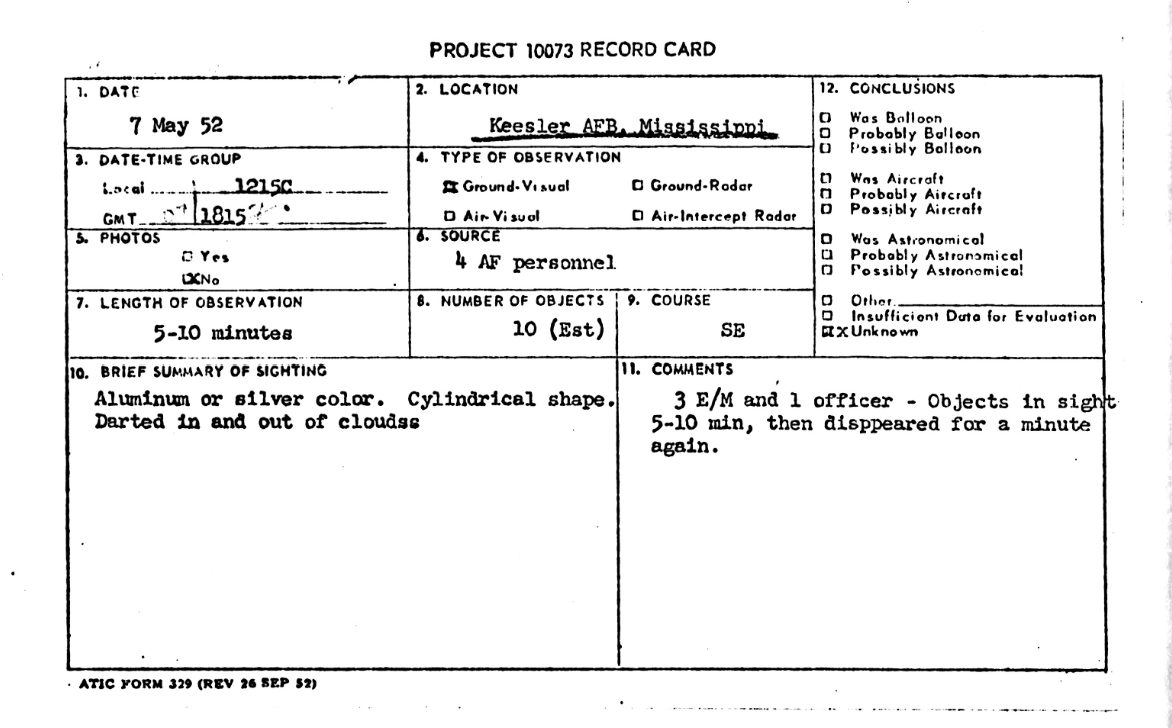
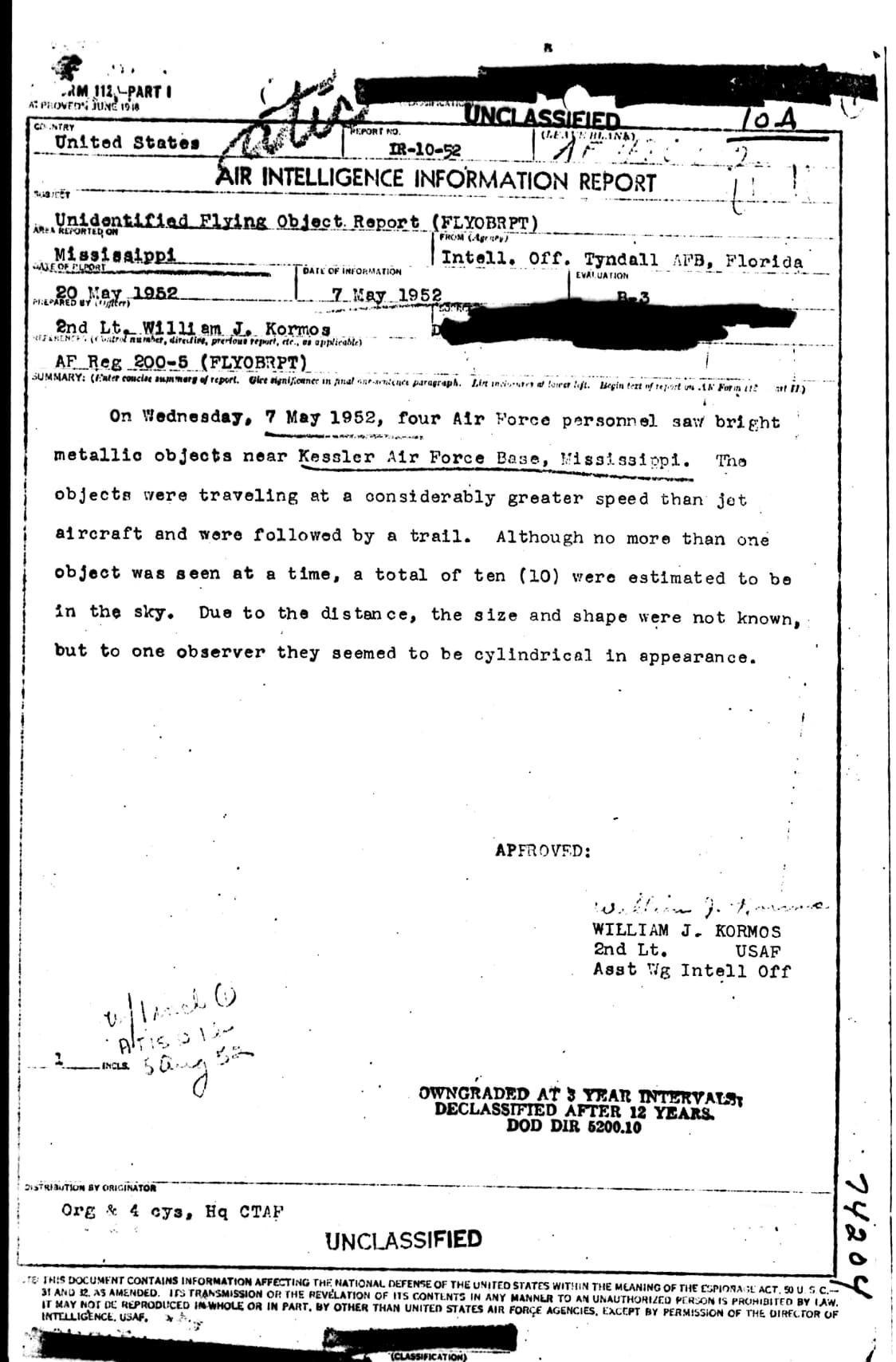
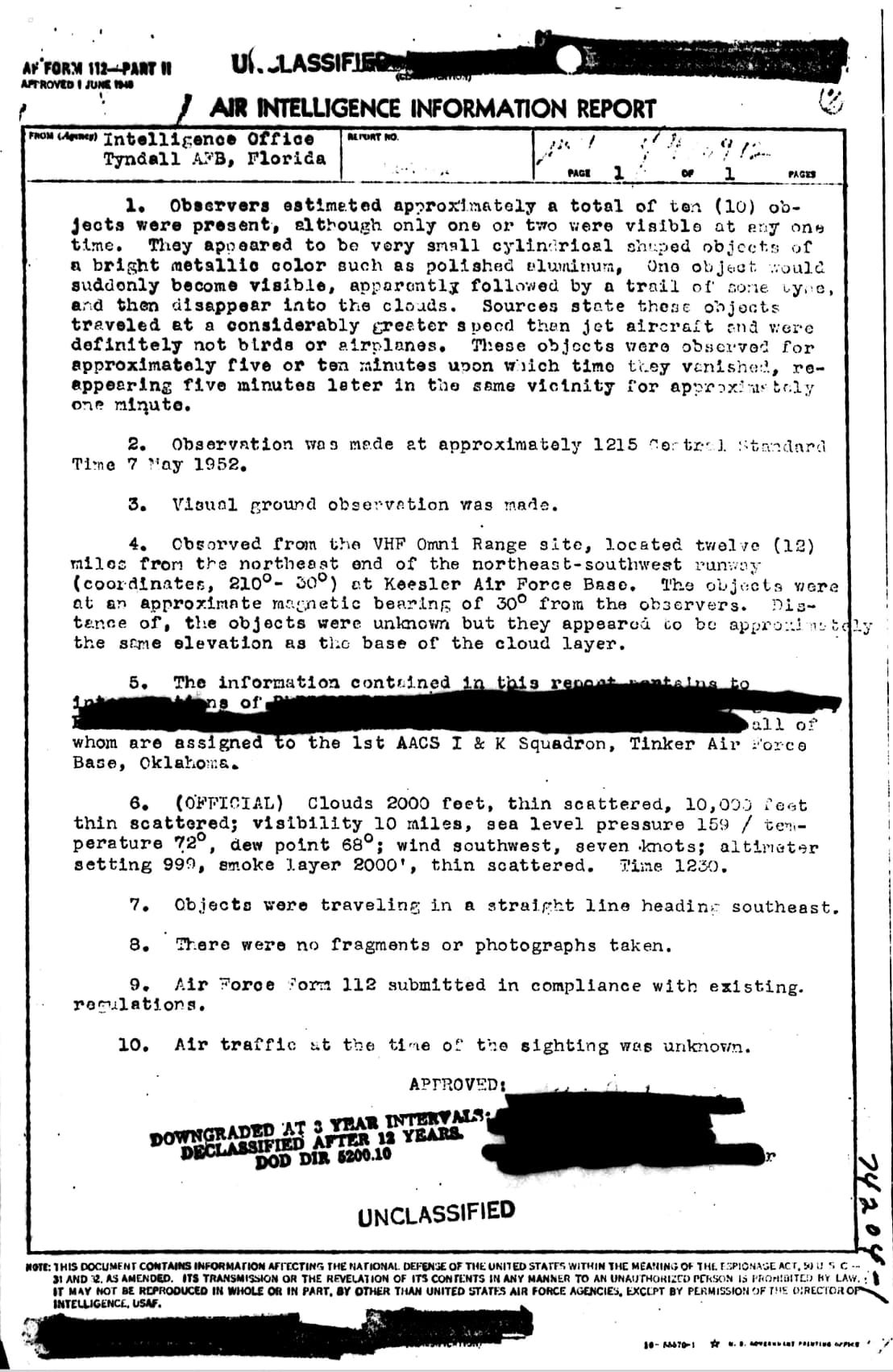
Three scanned pages hosted by NICAP: the Project 10073 record card (conclusion "Unknown") and both pages of IR-10-52 from the Intelligence Officer, Tyndall AFB, prepared by 2nd Lt. William J. Kormos. Witness names are redacted. The primary source for this case file.
UNCLASSIFIEDATIC's report on the June–October 1952 wave, including the project's definitions of "Unknown," "Insufficient Data" and "Aircraft," and its rule that shiny daytime objects below 60° elevation could be evaluated as aircraft. Hosted by The Black Vault.
UNCLASSIFIEDThe National Archives' catalog series for the released, name-redacted Blue Book case files (Record Group 341), the series to which the May 1952 Keesler file belongs.
UNCLASSIFIEDNARA's fact sheet on Project Blue Book: 12,618 sightings reported from 1947 to 1969, 701 still "Unidentified," terminated December 17, 1969.
UNCLASSIFIEDSearch Government Archives Directly
Further Reading — Recommended Literature
The Report on Unidentified Flying Objects
Blue Book's chief on the spring 1952 rise in reports, the April 1952 reporting order this case was filed under, and how a report became an "Unknown."
UFOs and Government: A Historical Inquiry
A documented history of official UFO investigation, with detailed chapters on Blue Book and the 1952 wave.
The UFO Controversy in America
A historian's account of the Air Force's handling of UFO reports, including the 1952 reporting reforms and the summer wave.
The Hynek UFO Report
Blue Book's scientific consultant from 1952 on how the project evaluated daylight sightings and why so many were left unexplained.
DISCLOSURE: Some links above are affiliate links. If you purchase through them, OverClassified receives a small commission at no additional cost to you. This helps support independent research.
Essential Viewing
No Videos Available
Sources
- U.S. Air Force, Project Blue Book. Project 10073 Record Card, "7 May 52 — Keesler AFB, Mississippi" (ATIC Form 329, Rev 26 Sep 52; conclusion "Unknown"), and Air Intelligence Information Report IR-10-52 (AF Form 112, Parts I and II), Intelligence Officer, Tyndall AFB, Florida, prepared by 2nd Lt. William J. Kormos, 20 May 1952. Scanned pages hosted by NICAP (Download PDF): nicap.org
- UAP Discovery forum, Blue Book Unknowns. "May 7, 1952 — Keesler AFB, Biloxi, MS — AF Personnel See 1-2 Silver Cylindrical Objects," posted May 6, 2025 (images of the record card, IR-10-52 and an earlier Sparks catalog page; summary attributed to George Eberhart): uapdiscovery.discourse.group
- Berliner, Don. "The Blue Book Unknowns," compiled for the Fund for UFO Research from the files at Maxwell AFB, January 1974; 1952 entries transcribed by Patrick Gross, UFOs at Close Sight: ufology.patrickgross.org
- Berliner, Don. "The Blue Book Unknowns," parts 1 and 2, as posted by Don Allen to the Usenet newsgroup alt.alien.visitors, January 17, 1992 (introduction and the May 7, 1952 entry), archived at textfiles.com: textfiles.com (part 1); textfiles.com (part 2)
- Berliner, Don. Blue Book "unknowns," 1965 entries (April 4, 1965, Keesler AFB, A/2c Corum), transcribed by Patrick Gross: ufology.patrickgross.org
- Sparks, Brad. "Comprehensive Catalog of 2,200 Project Blue Book UFO Unknowns," version 1.35, February 3, 2026, entries 571 (May 7, 1952), 756 (July 30, 1952), 1175 (February 7, 1956) and 1606 (April 4, 1965). NICAP (Download PDF): nicap.org
- Air Technical Intelligence Center. Project Blue Book Status Report No. 8 (Project No. 10073), 31 December 1952: evaluation categories, aircraft and balloon criteria, monthly evaluation tables. The Black Vault (Download PDF): theblackvault.com
- Ruppelt, Edward J. The Report on Unidentified Flying Objects. Garden City, NY: Doubleday, 1956 (Project Gutenberg e-text: spring 1952 report numbers, Air Force Letter 200-5, the "Unknown" screening and MO file, "Unknowns were running about 40 percent"): gutenberg.org
- National Archives. "Project BLUE BOOK — Unidentified Flying Objects." archives.gov
- National Archives Catalog. Series 597821, "Sanitized Version of Project Blue Book Case Files on Sightings of Unidentified Flying Objects." catalog.archives.gov
- Keesler Air Force Base. "History of Keesler Air Force Base" (fact sheet: founding 1941, radar school 1947, "Electronics Training Center of the Air Force" 1949, 1950–1951 rebuilding, 3380th Technical Training Wing). keesler.af.mil
- Air Education and Training Command History Office. "Significant Events" (interceptor crew training at Tyndall from 4 January 1951; Technical Training Air Force at Gulfport, July 1951; Crew Training Air Force at Randolph AFB, March 1952). aetc.af.mil
- Roberts, Ted. "Tyndall History Revisited," 325th Fighter Wing Public Affairs, March 8, 2010 (Interceptor Aircrew School, 3626th Training Group, first classes January 4, 1951). tyndall.af.mil
- Williams, Dan. "HQ CCC: 'Providing the Reins of Command' for 80 Years!" Cyberspace Capabilities Center History Office, March 23, 2023 (AACS history: 1938 origins, 1946 renamings, assignment to MATS August 16, 1948, AFCS 1961). scott.af.mil
- Wikipedia. "219th Electronics Engineering and Radar Installation Squadron" (lineage: constituted as the 11th AACS Installation and Maintenance Squadron; station Tinker AFB from June 18, 1954; used for the unit-type designation only). en.wikipedia.org
- Wikipedia. "Keesler Air Force Base" (runway 03/21; used for orientation only). en.wikipedia.org
- Freedman, Samuel. "Omnirange = Air-Safety," Radio-Electronics, February 1951, as reproduced by RF Cafe. rfcafe.com
- Minnis, Patrick. "Contrails," NASA Langley Research Center (encyclopedia article; exhaust contrails generally limited to temperatures below −40°C; aerodynamic contrails at warmer temperatures). NASA SatCORPS (Download PDF): satcorps.smce.nasa.gov
- NASA Jet Propulsion Laboratory. Horizons System ephemerides for the Sun, Venus, Jupiter, Mars and the Moon as seen from 30.41° N, 88.92° W, May 7, 1952, 17:45–18:45 UT (computed for this file). ssd.jpl.nasa.gov
- British Geological Survey. IGRF magnetic field calculator (declination at 30.41° N, 88.92° W on 7 May 1952: about 5.5° E; computed for this file). geomag.bgs.ac.uk
- Wikipedia. "Admiralty code" (source-reliability and information-credibility scale; "B" usually reliable, "3" possibly true; used for the conventional reading of the B-3 evaluation only). en.wikipedia.org
- Biloxi-Gulfport Daily Herald, August 9, 1952, "Nine Persons In Louisiana Town Sight 'Saucers'," as transcribed by Saturday Night Uforia, "In the News, 1952." saturdaynightuforia.com
- Allen, Robert S. "Flying Saucers Real?" syndicated column, Alton Evening Telegraph (Alton, Illinois), September 26, 1952, as transcribed by Saturday Night Uforia (list of military-base sighting locations including "Airbases at Jackson, Keesler and Biloxi"). saturdaynightuforia.com
- OverClassified. Carson Sink Incident case file (Blue Book case 1584, July 24, 1952; traffic check with Air Defense Command).
- OverClassified. Washington D.C. UFO Flap case file and Tremonton, Utah UFO Film case file (the summer 1952 wave; small bright objects of unknown range).
- OverClassified. Meridian "Flying Cymbal" case file, Flora, Mississippi Police Encounter case file and Natchez Trace Ranger Sighting case file (score calibration).
See something inaccurate? Have additional information or sources?
Suggest an Edit →Last Updated: October 2026