
The Biloxi Highway 90 Sighting
At about five minutes past three on the morning of Tuesday, August 26, 1952, a staff sergeant from Keesler Air Force Base was walking east along U.S. Highway 90, the beach road between Gulfport and Biloxi, Mississippi, about a block west of a place called the Ship and Shore Drive Inn, when "something caught the attention of my right eye." Off to his right, at an azimuth he gave as 120 degrees, a round, white light was "hanging in the sky," and it looked twice the size of a full Moon. He watched it for about forty seconds. Then, he swore later that day, "the object seemed to veer off at an angle, upwards, at a high rate of speed" and was gone in about six seconds, leaving a trail like a shooting star. He was a Loran observer with two and a half years' experience as a radar observer on weather reconnaissance aircraft. Seventy minutes later and about four miles to the east-northeast, the assistant manager of a Biloxi movie theater and his wife began watching a reddish-orange object in the east-southeast that stayed in view until sunrise; he took twenty-three photographs of it, and every frame came out underexposed. Keesler's Wing Intelligence Office investigated both and wrote two separate reports. Project Blue Book's record card for the sergeant's sighting is marked Unknown; its worksheet for the theater manager's says Possibly Balloon. This file reads all 29 pages of the released Blue Book file, separates the two sightings that it holds, and tests both against the sky, the winds and the air traffic of that morning.
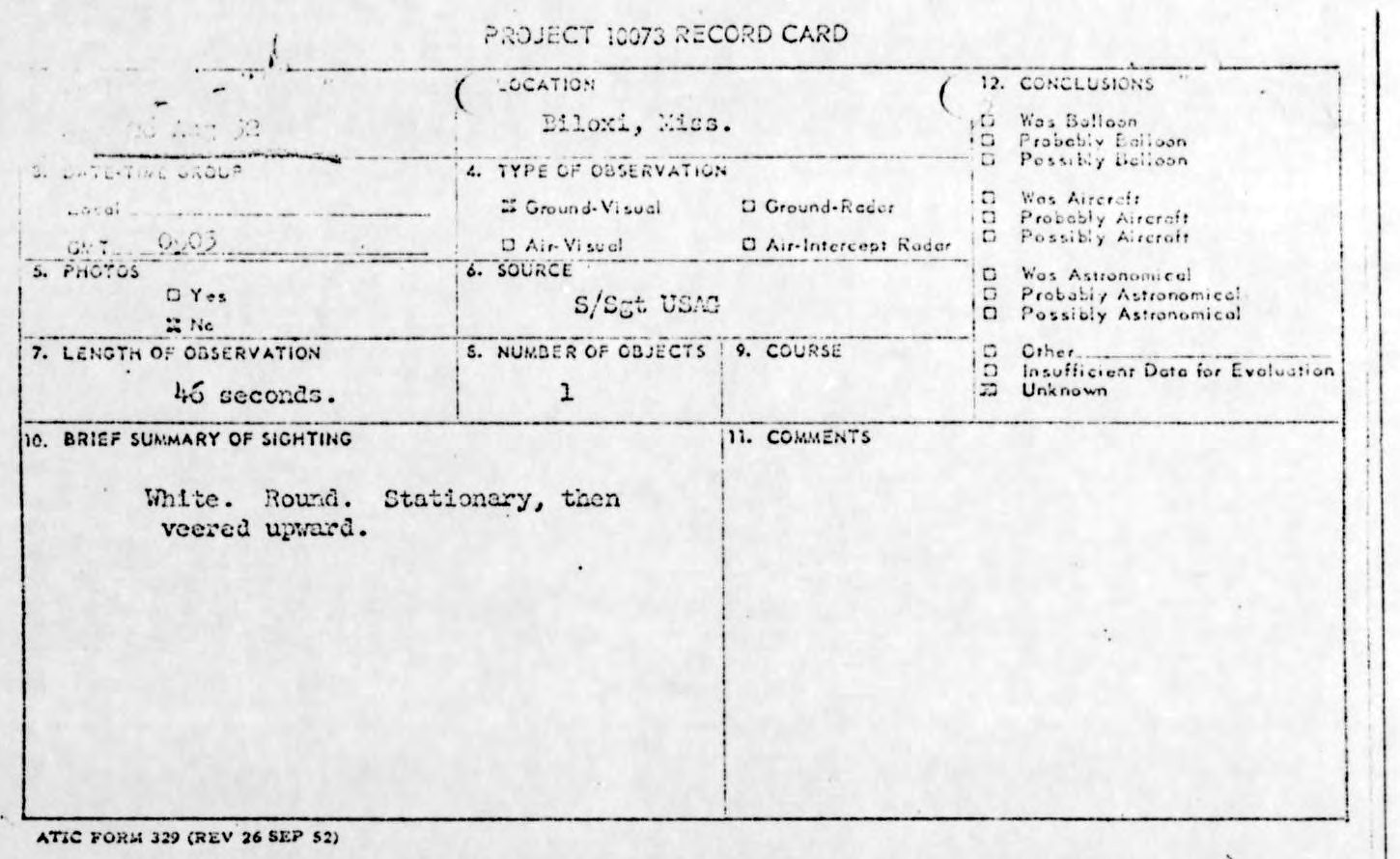
Pictured: the Project 10073 record card for this case, cropped from the first page of the Project Blue Book file and contrast-enhanced: "Biloxi, Miss.," a faded date of "26 Aug 52," source "S/Sgt USAF," length of observation "46 seconds," one object, and the summary "White. Round. Stationary, then veered upward." The "Unknown" box under Conclusions is checked. It is the Air Force's own typed index card, not a picture of the object. No photograph of either object exists: the civilian witness's 23 frames were underexposed and are not in the file, and the only drawings are the sergeant's rough position sketches on his questionnaire. U.S. government record, public domain.
Theoretical Alignment
The Extraterrestrial Hypothesis scores low. The sergeant's account has the outline of a classic "UFO" report, a bright light that hangs motionless and then shoots away upward, and the Air Force could not explain it. But it rests on one man, alone, at three in the morning, for forty-six seconds, and it describes a light, not a shape: "round in shape with no clearly definable edge." The brightest object in the night sky, the planet Jupiter, stood within about ten degrees of the direction he gave. Nothing in either report requires a technology beyond 1952, and the one maneuver that might, the sudden departure, lasted six seconds and was seen by no one else.
The Interdimensional Hypothesis has nothing to work with. The Psycho-Social score is somewhat higher than usual for a Blue Book file, for ordinary reasons the file itself records. The sergeant had spent the previous half hour "sitting in a lounge" and had had a few beers. The civilian's object, a reddish-orange light low in the east-southeast before dawn that seemed to "veer" from side to side for over an hour and faded at sunrise, has the signature of a bright star seen through the thick air near the horizon. And both reports came at the end of the largest wave of UFO reports the Air Force had yet seen, in the summer of the Washington sightings, when anyone who looked up at a bright light was primed to wonder what it was.
Background
The summer of 1952
August 1952 was the tail of the biggest UFO wave the Air Force had recorded. Project Blue Book's own Status Report No. 8, written at the end of that year, explained that it had abandoned its usual monthly listing of sightings "due to an extremely heavy workload caused by an increase in reports." Its tables count 147 reports in June, 442 in July and 218 in August. Edward J. Ruppelt, who ran the project, wrote that by mid-July "we were getting about twenty reports a day plus frantic calls from intelligence officers all over the United States," and that the volume fell "from nearly 500 in July to 175 in August, but this was still far above the normal average of twenty to thirty reports a month." The peak had come with the radar-and-visual sightings over the capital on the weekends of July 19–20 and 26–27, described in this site's Washington, D.C. UFO Flap of 1952 file. A week before the Biloxi reports, on August 19, a Florida scoutmaster had claimed to have been burned by a hovering craft, the story in this site's Sonny DesVergers Scoutmaster Case.
The historian Loren E. Gross, compiling the month's reports from the Blue Book files, noticed a geographical drift as August went on. He called it a "southern shift" of UFO activity and argued that, late in the month, the more puzzling reports tended to come from "the lower half of the U.S." and late at night. His example for August 26 was a report from Ellington AFB in Texas at 1:18 that morning; the Biloxi reports do not appear in his chronology at all. Whatever the merit of the theory, the Gulf Coast was busy. On August 28 the Air Force at Brookley AFB in Mobile took reports of red objects, about fifty-five miles to the east-northeast, that were watched for nearly an hour by civilians, an OSI agent and control-tower operators, a case Brad Sparks lists among Blue Book's unknowns.
Air Force Letter 200-5 and the reporting chain
Both Biloxi reports went to Washington because a regulation said they must. The two letters of transmittal in the file, from "Headquarters, Keesler Air Force Base and 3380th Technical Training Wing," read: "In compliance with paragraph 7 c (2), Air Force Letter 200-5, dated 29 April 1952, the attached report is hereby submitted." Ruppelt called that letter "the piece of paper that made Project Blue Book legitimate": it "stated that the commander of every Air Force installation was responsible for forwarding all UFO reports to ATIC by wire, with a copy to the Pentagon. Then a more detailed report would be sent by airmail." (Ruppelt himself dates AFL 200-5 to April 5, 1952 elsewhere in his book; the Keesler letters give April 29.) Each Biloxi letter went to the Director of Intelligence at Air Force headquarters, with information copies to the Chief of the Air Technical Intelligence Center (ATIC) at Wright-Patterson, "Attn: ATIAA-2c," and to the commanders of "TTAF" and "ATRC," the Technical Training Air Force and Air Training Command. Ruppelt added a detail that fits these two reports exactly: "for some reason, all messages reporting UFO's seemed to arrive between midnight and 4:00A.M."
Keesler's Wing Intelligence Office
Keesler in 1952 was the Air Force's main school for radar, radio and electronics, and the seat of the 3380th Technical Training Wing. Its Wing Intelligence Office handled UFO reports from the base and the town, and the officer who signed both of these reports, Major Eli S. Fowler, Jr., had done so at least once before that month. Gross's chronology for August 10, 1952 describes "a pair of grayish-orange, oval-shaped objects, with the apparent size of a penny at arm's length," seen near Keesler at 2:10 that morning, "executing impressive veering turns to the right and to the left," and cites an "Air Intelligence Information Report, by Major Eli Fowler, Wing Intelligence Office, Keesler AFB, Mississippi. 11 August 52." This site's Keesler AFB Sighting file notes that the May 7, 1952 report from near the base, whose witnesses were also AACS men, was written up by the intelligence office at Tyndall AFB in Florida, and lists among the possible reasons that Keesler may have had no intelligence officer handling such reports; by August, at least, Keesler's own Wing Intelligence Office was doing so. That August 10 report is one of the twelve Keesler files surveyed in this site's Keesler AFB Weather Tower Sighting file, where its record card reads "Possibly Balloon." The Biloxi reports are numbered IR-5-52, the sergeant's, and IR-6-52, the civilian's. The Biloxi file, though, is indexed under "Biloxi, Miss." rather than the base's name, and so it was not among the twelve files in that survey. It adds a third unexplained Keesler-area report to the two unexplained files the survey found.
New forms for a new workload
The Biloxi file also shows Blue Book's paperwork changing under the strain. Each sighting has a two-sided "Project 10073 Worksheet," printed as "ATIC Test Form 334 (13 Aug 52)," with sections for general data, astronomical data, aircraft data, balloon data and evaluation, and there are two "Project 10073 Weather Data Sheets," "ATIC Test Form 333 (13 Aug 52)." Both forms were dated thirteen days before the sighting; they were new. The worksheet's balloon section asks how long it had been since the last scheduled balloon release and which launch sites lay upwind, exactly the test that Status Report No. 8 describes: "All weather balloons in the United States are launched at 0300Z, 0900Z, 1500Z and 2100Z. If an object is reported near a balloon launch site within an hour after these scheduled launch times, it is classed as a balloon." The record card is a later form again, "ATIC Form 329 (Rev 26 Sep 52)," so it was typed at least a month after the sighting, as was the case for this site's Keesler AFB Sighting of May 7, 1952.
Complete Timeline
| Date / Time | Event |
|---|---|
| April 1952 | Air Force Letter 200-5 orders every installation to report UFO sightings to ATIC (dated April 29 in the Keesler letters; April 5 in Ruppelt's book). |
| July 19–20 and 26–27, 1952 | The Washington, D.C. radar-visual sightings; Blue Book receives 442 reports in July (Status Report No. 8). |
| August 10, 1952, 2:10 AM | Two orange, oval objects reported near Keesler AFB; reported by Maj. Eli Fowler, Wing Intelligence Office, on August 11 (Gross). Card: "Possibly Balloon." |
| August 13, 1952 | Edition date of the new ATIC Test Forms 333 (weather data sheet) and 334 (worksheet) used in this file. |
| August 26, about 2:00–3:00 AM CST | Period of the first Keesler synoptic and winds-aloft report: winds from 100° at 10–25 knots from 2,000 to 12,000 feet. |
| August 26, 0900Z (3:00 AM CST) | A civilian aircraft from Lackland AFB, Texas, "was preparing to land at Keesler AFB"; PBY aircraft 8314 departs Keesler "on a search mission over the Gulf of Mexico" (IR-5-52). Scheduled 0900Z weather-balloon releases across the region, including the rawinsonde at Eglin AFB, Florida (IGRA). |
| August 26, about 0905Z (3:05 AM CST) | A Keesler staff sergeant walking east on U.S. Highway 90 sees a round, white light at an azimuth of about 120°, "hanging in the sky." After about 40 seconds it veers off "at an angle, upwards," and disappears in about 6 seconds, leaving a trail like a shooting star. |
| August 26, about 1015Z (4:15 AM CST) | From his home in Biloxi, a theater assistant manager sees a round, flat, reddish-orange object in the east-southeast, with two trails joining behind it. He and his wife watch it; he takes 23 photographs. |
| August 26, 1130Z (5:30 AM CST) | Sunrise. "The object remained in sight until sunrise (1130Z) when the object became non-distinguishable" (IR-6-52). |
| August 26, 1952 | The sergeant makes a sworn statement at Keesler before 1st Lt. Burlingame, Assistant Wing Adjutant, and fills out an eight-page observer questionnaire. |
| August 27, 1952 | Keesler's letter of transmittal (signed for the commanding general by Maj. Jack P. Kern, Adjutant) sends IR-5-52 on the sergeant's sighting to the Director of Intelligence, USAF, with copies to ATIC. |
| August 28, 1952 | Red objects watched for nearly an hour over Chickasaw and Brookley AFB, Mobile, Alabama (Sparks entry 803). |
| August 29, 1952 | The civilian makes a sworn statement at Keesler. Maj. William D. Beasley, Station Weather Officer, signs the synoptic and winds-aloft report for 0400–0500. |
| Late August – early September 1952 | IR-6-52 on the civilian's sighting is completed and transmitted (letter stamped in September; day illegible). |
| After August 1952 | At ATIC, worksheets are filled out for both sightings: the sergeant's marked "Unknown" ("Exhaust trail is unexplainable"), the civilian's "Possibly Balloon." |
| After September 26, 1952 | A Project 10073 record card on ATIC Form 329 (Rev 26 Sep 52) is typed for the sergeant's sighting, with "Unknown" checked. |
| December 31, 1952 | Blue Book Status Report No. 8 gives August's evaluations: 34 Unknown of 218 reports. |
| December 17, 1969 | Project Blue Book's termination is announced; Biloxi, August 26, 1952 remains among its unidentified cases. |
| January–February 2025 | Tim Printy's SUNlite case review of August 1952 lists "Biloxi, MS," with the Blue Book explanation "UNIDENTIFIED" and his own evaluation "UNIDENTIFIED." |
| February 3, 2026 | Version 1.35 of Brad Sparks's catalog of Blue Book unknowns lists "Aug. 26, 1952. Biloxi, Miss." as entry 801, with no details. |
The File, Page by Page
The released file, item "1952-08-8771479-Biloxi-Miss" in the Internet Archive's Project Blue Book collection (Fold3 file 8771479), has 29 pages. Every page was read for this case file as an image at its native scan resolution, with contrast-enhanced enlargements of the faint ones; no machine transcription was relied on, and the checkboxes on the record card and worksheets were read from the images themselves. Unlike many Blue Book folders, this one contains nothing from any other place. It does contain two different sightings, which are easy to run together. In the order the pages were scanned:
- The record card, for the sergeant's sighting only (see "The Record Card" below).
- A Keesler weather memo dated August 29: "Synoptic Situation and Winds Aloft Report 0400-0500 26 Aug 52," for the civilian's sighting.
- The civilian's sworn statement, sworn August 29.
- A letter of transmittal from Headquarters, Keesler AFB, stamped August 27, sending the sergeant's report.
- IR-5-52, Part I, the summary of the sergeant's sighting (very faint).
- IR-5-52, page 2: shape, size, color, trail, speed, sound and maneuvers.
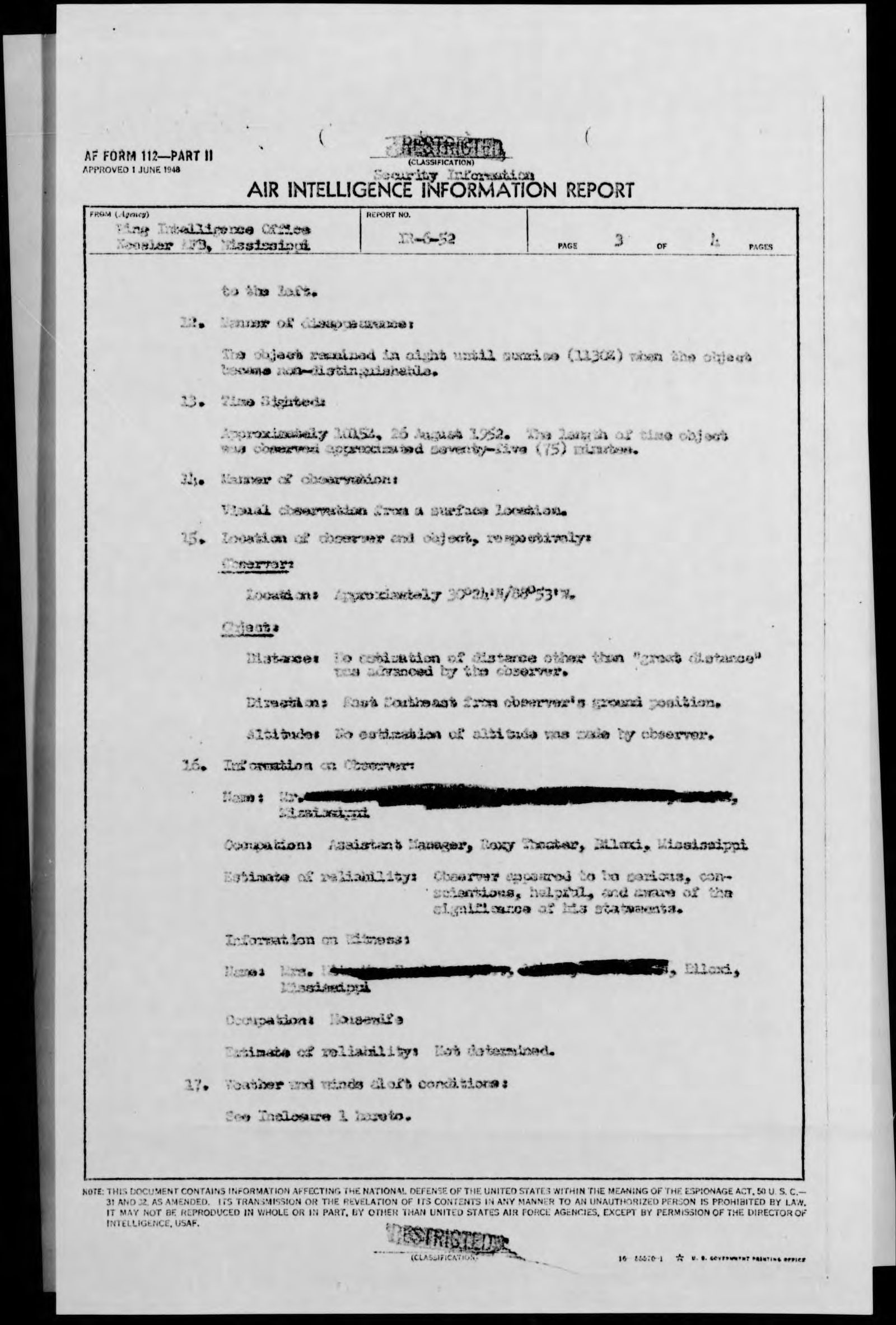
- IR-5-52, page 3: time, location, direction, and information on the observer.
- IR-5-52, page 4: physical evidence, interception, and air traffic.
- A Keesler weather memo: "Synoptic Situation and Winds Aloft Report 0200-0300 26 August 1952," for the sergeant's sighting.
- The sergeant's sworn statement, sworn August 26.
- Pages 1–8 of a "Tentative Observers Questionnaire" filled out by the sergeant (scan pages 11 and 13–19), with sketches; scan page 12, filed between its first two pages, is the front of the ATIC worksheet for the civilian's sighting.
- The ATIC worksheet for the sergeant's sighting, front and back (pages 20–21), with the evaluation "Unknown" and a handwritten comment.
- An ATIC weather data sheet with winds only (page 22).
- The back of the civilian's worksheet, with the evaluation "Possibly Balloon" (page 23).
- An ATIC weather data sheet headed "Keesler AFB" (page 24).
- A second letter of transmittal, stamped in September 1952, sending the civilian's report (page 25).
- IR-6-52, Parts I and II, four pages on the civilian's sighting (pages 26–29).
The sergeant's sighting therefore occupies pages 1, 4–11 and 13–22, and the civilian's pages 2–3, 12, 23–29; which worksheet back belongs to which front is worked out here from their contents (a balloon release "75 minutes" before fits the civilian's 1015Z, and "5 minutes" fits the sergeant's 0905Z), since the backs are unlabeled. Nothing appears to be missing except the civilian's 23 underexposed photographs, which the report says were developed but which are not in the file, and any ATIC correspondence about the cases. There is only one record card. The questionnaire is the sergeant's, not the civilian's: it gives his address as "(LORAN) KAFB Miss." and his job as "Radar Observer."
Two Sightings, Not One
The most important thing the file shows is that it holds two separate events, seventy minutes and about four miles apart, described in different words by different people, and evaluated differently by the Air Force. They have been confused before. Printy's 2025 list of the sightings remaining from Blue Book's 701 unknowns describes the Biloxi entry as "4:15 AM. Round reddish-orange object seen to the ESE. Appeared to be moving on ESE course. Object visible for 46 seconds." That takes the time, color and direction from the civilian's report and the duration from the sergeant's. The case Blue Book counted as Unknown is the sergeant's: the only record card is his, with his 46 seconds, his "White. Round. Stationary, then veered upward," and the source "S/Sgt USAF." The civilian's sighting got a worksheet that says "Possibly Balloon" and, in this file, no card.
| The sergeant (IR-5-52) | The theater manager (IR-6-52) | |
|---|---|---|
| Time | About 0905Z (3:05 AM CST) | About 1015Z (4:15 AM CST) to sunrise, 1130Z |
| Place | U.S. 90, west Biloxi, about 30°23′ N, 88°57′ W, walking east | His home in Biloxi, about 30°24′ N, 88°53′ W, about 4 miles east-northeast |
| Direction | Azimuth "120°"; "Southeast" | "East Southeast" |
| Appearance | Round, white, "no clearly definable edge," "twice that of a full moon" | "Round and flat," "reddish-orange, comparable to the color of a burning match seen from a distance," about "nine (9) feet by fifteen (15) feet" |
| Motion | Stationary about 40 s, then veered off upward and vanished in about 6 s | "Following an East Southeast course," veering right, back, then left, at "a fairly high rate of speed" |
| Trail | "A definite trail, comparable to that of a shooting star," as it disappeared | "Two (2) trails, similar to the trails of jets seen at night," joining behind |
| Duration | 46 seconds | About 75 minutes |
| Witnesses | One | Two (he and his wife) |
| Air traffic | Two aircraft near the base at 0900Z | "No air traffic in area" |
| ATIC evaluation | Unknown (worksheet and record card) | Possibly Balloon (worksheet) |
The two reports agree on almost nothing except the date, the town and a general direction, east-southeast. They should be judged separately, and they are below.
What the Sergeant Saw
The sergeant's own words survive in his sworn statement, taken at Keesler on the day of the sighting. He appeared before 1st Lt. Burlingame, the Assistant Wing Adjutant, "authorized to administer oaths in cases of this nature," and, "upon being warned of his rights under the 31st Article, Uniform Code of Military Justice, and upon being duly sworn according to law," made "the following voluntarily sworn statement":
"I, Staff Sergeant [redacted], was walking East on United States Highway 90 between Gulfport and Biloxi, Mississippi, approximately one (1) block West of the Ship and Shore Drive Inn, at approximately 0905Z, 26 August 1952, when I saw a round, white light in the sky off to my right at an approximate azimuth of 120°. The object appeared to be hanging in the sky; its size approximating that of twice the size of a full moon seen from a ground position. After approximately forty (40) seconds, the object seemed to veer off at an angle, upwards, at a high rate of speed. The object disappeared from sight in approximately six (6) seconds. I approximate the distance as being two (2) miles."
Article 31 of the Uniform Code of Military Justice is the code's protection against compelled self-incrimination: no one may be made to incriminate himself, and a suspect must be told he need not make a statement and that anything he says can be used against him. Why the warning was given here the file does not say. Its effect was that the sergeant put his account on the record formally, under oath, on the day of the sighting. Highway 90 runs along the beach between Gulfport and Biloxi, with the Mississippi Sound on its south side; walking east, the water was on his right. An azimuth of 120 degrees is east-southeast, out over the Sound toward the barrier islands and Biloxi's own waterfront.
The intelligence report
Major Fowler's report, IR-5-52, restates the account in the Air Force's standard twenty-one paragraphs. Its summary places the sergeant at "approximately 30°23′N/88°57′W," says the object was "round in shape with no clearly definable edge, and white in color," and continues: "The period of observation was estimated as being approximately forty-six (46) seconds. The object, hanging in the sky in a stationary position for approximately forty (40) seconds, veered off and disappeared from sight in an upwards movement in an approximated six (6) seconds. No definite sound was distinguished by the observer; a trail comparable to that of a shooting star was observed as the object disappeared." The detailed pages add: "No estimation of speed other than 'a high rate of speed' was given by observer"; sound, "Negative"; and, under maneuvers, "When first seen, the object was observed to be 'hanging' in a stationary position. After a period of time, the object veered off and disappeared from sight in an upwards movement." The direction is "Southeast from observer's ground position," the distance "approximately two (2) miles," and "No estimation of altitude was made by observer." Paragraph 18, "Activity or condition, meteorological or otherwise, which might account for sighting," reads "Unknown."
The evaluation code typed in Part I of the report appears to read "F-3," but the page is too faint for that reading to be relied on. The worksheet ATIC later filled out is clearer: "Evaluation of Source: Fair," "Details of Report: Good."
The questionnaire
The sergeant also completed a "Tentative Observers Questionnaire," an eight-page printed form headed "Tentative," by hand. It is the only place where his own wording goes beyond the sworn statement, and it adds several details that the intelligence report leaves out:
- Time: "Between 3 & 3:15" A.M., Central, with "Standard" written in; how certain: "Certain."
- Where: "Outdoors," "In the residential section of a city," in Biloxi.
- How he noticed it: "As I was walking along something caught the attention of my right eye."
- What he was doing: "nothing in particular." In the previous thirty minutes: "I had been sitting in a lounge and had" a handwritten number, apparently 3 or 4, "beers."
- Moving: yes, east, "walking"; he stopped while watching. He was looking southeast when he first saw the object and southeast when it disappeared, "Certain."
- Glasses: no. Seen "Through open space." Sky: "Clear sky." Wind: "Don't remember." Temperature: "Warm."
- Duration: "46 Sec," "Fairly sure."
- Appearance: "Solid"; it changed direction and changed speed; it gave off light, "bright white"; sound "none"; color "iridescent white."
- Size: of the objects listed, from a pea to a dirigible, he circled "Dirigible," "Fairly certain."
- Height and distance: "2 miles" for both; speed "don't know"; and of these answers, "Not very sure."
- Disappearance: "Suddenly."
- First time he had seen such a thing: "Yes." His opinion of what it was: "Don't have any idea."
- About himself: "Radar Observer," age 27, male; no one was with him.
The sketches are rough. On the quarter-circle diagram for elevation he put the "A," where the object was first seen, on the arc at roughly 45 degrees, and the "B," where it was last seen, higher, above the arc. On the sky-dome diagram he placed both letters high, a little to the right of overhead. The path diagram is a short, nearly vertical line from A at the bottom to B at the top, with "ME" circled below it. For the shape he drew a large, faint circle with an arrow pointing up, and wrote beside it: "When I first noticed it, it was hanging motionless, then later it took off at terrific speed." His last comment, on the final page, repeats the size: "The object was about the size of two full moons viewing them from the ground."
Two of these answers matter more than the rest. The first is the time: "Between 3 & 3:15" A.M. Central Standard, which agrees with the 0905Z in his statement and fixes the sky that has to be checked. The second is the elevation. The sketch puts the light about halfway up the sky when he first saw it, and the dome diagram puts it higher still. The worksheet's question "Was the object viewed above 45° elevation?" was left unanswered, with a pencil question mark beside it, but the sergeant's own sketches answer it: yes, or very nearly.
What the Theater Manager Saw
The second witness came to Keesler three days later. On August 29 he appeared before the same assistant adjutant and swore to the following statement. His name and street address are blacked out; this case file does not attempt to recover them.
"At approximately four-fifteen (0415), 26 August 1952, I, [redacted], sighted an unidentified flying object in the sky East Southeast of my home at [redacted], Biloxi, Mississippi. The object appeared to be round and flat in shape and reddish-orange, comparable to the color of a burning match seen from a distance, in color. I could not accurately determine the size of the object but a rough estimate would be somewhere around nine (9) feet by fifteen (15) feet.
"The object was following an East Southeast course and would veer from its course to the right, come back on course, and then veer to the left. The object appeared to be at a great distance from me and traveling at a fairly high rate of speed. I observed two (2) trails, similar to the trails of jets seen at night, coming from each end of the object, uniting toward the rear of the object. I could hear no sounds coming from the object and noticed no aerodynamic features.
"From the time I first saw the object until sunrise, I took twenty-three (23) pictures of the object. Upon development of the film, however, all frames were underexposed."
IR-6-52, the report Major Fowler approved on this sighting, follows the statement closely. It gives the time as "approximately 1015Z," his position as "30°24′N/88°53′W," and the period of observation as "seventy-five (75) minutes." It adds the one fact the statement leaves implicit: "The object remained in sight until sunrise (1130Z) when the object became non-distinguishable." Under distance it records "No estimation of distance other than 'great distance' was advanced by the observer"; under altitude, "No estimation"; under speed, only "a fairly high rate of speed." The trails were "located on opposite ends of the object on the outer perimeter" and "were seen as uniting a short distance to the rear of the object."
The report identifies the observer as "Assistant Manager, Roxy Theater, Biloxi, Mississippi," and judges that he "appeared to be serious, conscientious, helpful, and aware of the significance of his statements." It names a second witness, his wife, "Mrs. [redacted] ... Biloxi, Mississippi," occupation "Housewife," whose reliability was "Not determined." She gave no statement, and nothing in the file records what she saw or said. On air traffic it says: "Information from Base Operations this Base indicates no air traffic in area during time of sighting." On the photographs, under "Interception or identification action taken," it repeats that he "took twenty-three (23) photographs of sighted object but upon development of film, it was discovered that the all frames were underexposed."
The photographs
Twenty-three exposures over an hour and a quarter before dawn, all underexposed, is itself a small piece of evidence. An ordinary camera of 1952, loaded with the slow film of the day and set for a snapshot, could not record a single point of light against a dark sky in a fraction of a second; to show anything it would have needed a tripod and a time exposure of seconds or more. Blank or nearly blank frames are what such a camera would produce whether the object was a distant light or a star. They neither confirm nor rule out anything about what he saw, but they do say that the object did not light up the scene and was not large and bright at close range. The file does not say whether anyone at Keesler looked at the negatives.
What the Investigation Checked
For two reports handled within a few days each, the Wing Intelligence Office gathered a fair amount. It took sworn statements from both principal witnesses. It had the sergeant fill out the full questionnaire. It asked the base weather station for the synoptic situation and the winds aloft for both times. It checked base operations for air traffic. It recorded geographic coordinates for both observers. And ATIC, when the reports arrived, ran both through its new worksheet, including a check of balloon launch sites.
The weather
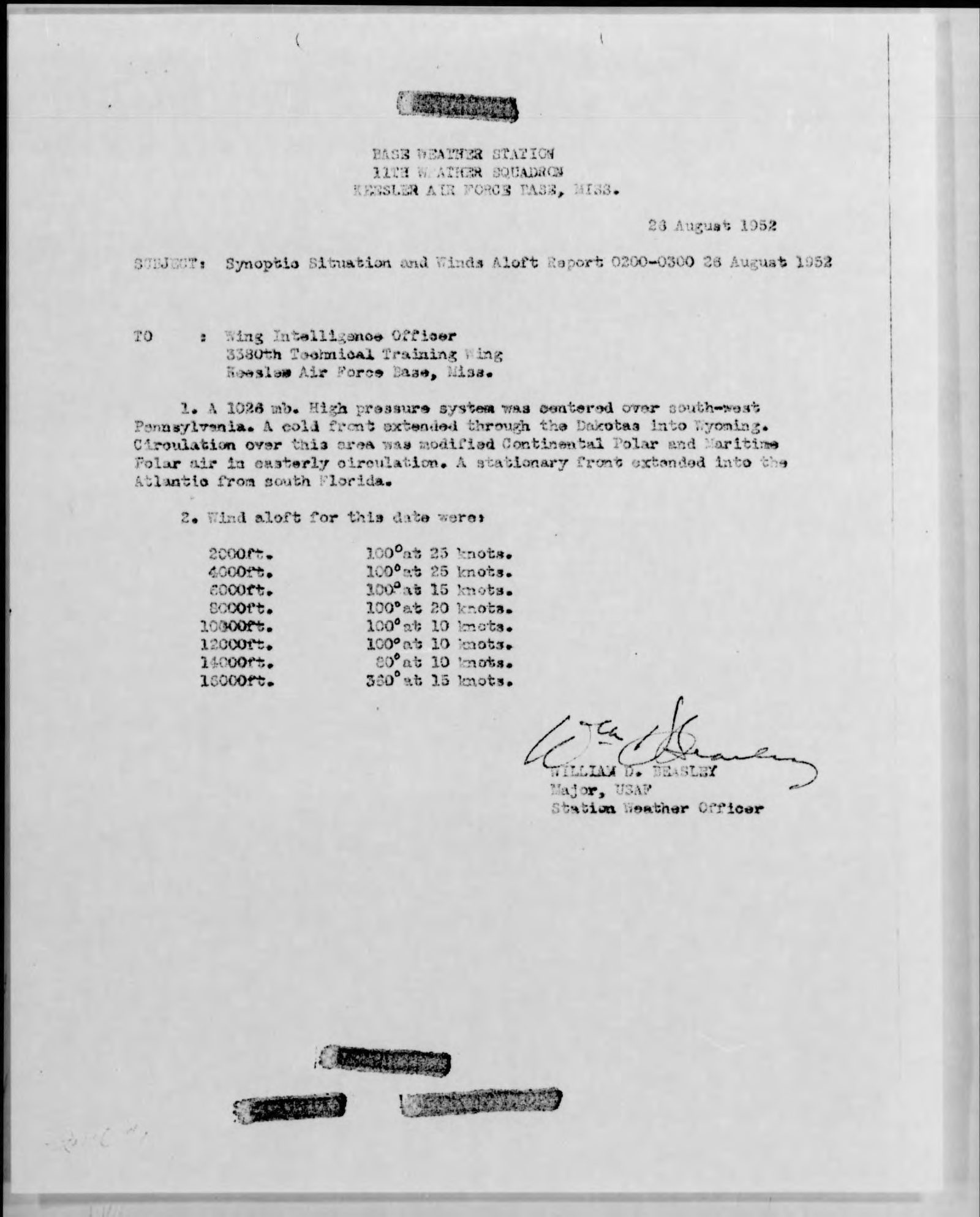
The two weather memos, from the "Base Weather Station, 11th Weather Squadron, Keesler Air Force Base, Miss.," are identical except for their subject lines: "Synoptic Situation and Winds Aloft Report 0200-0300 26 August 1952" for the sergeant and "0400-0500 26 Aug 52" for the civilian. Both are signed by Major William D. Beasley, Station Weather Officer. The synoptic paragraph reads: "A 1026 mb. High pressure system was centered over south-west Pennsylvania. A cold front extended through the Dakotas into Wyoming. Circulation over this area was modified Continental Polar and Maritime Polar air in easterly circulation. A stationary front extended into the Atlantic from south Florida." The winds aloft were:
| Altitude | Wind from | Speed |
|---|---|---|
| 2,000 ft | 100° (east by south) | 25 knots |
| 4,000 ft | 100° | 25 knots |
| 6,000 ft | 100° | 15 knots |
| 8,000 ft | 100° | 20 knots |
| 10,000 ft | 100° | 10 knots |
| 12,000 ft | 100° | 10 knots |
| 14,000 ft | 80° | 10 knots |
| 16,000 ft | 360° (north) | 15 knots |
The two ATIC weather data sheets copy the same numbers (one lists the 8,000-foot wind at 7,000 feet, and the other the 16,000-foot wind at 18,000 feet, both apparently slips) and add "No" to the question of an inversion and "Clear" for visibility. Neither memo gives surface observations, cloud or visibility at the time, so the clearest statement about the sky is the sergeant's own "Clear sky." In plain terms, a high-pressure air mass sat over the Gulf Coast with a steady breeze from a little south of east at every level up to about 12,000 feet: anything drifting in it would move from the east-southeast toward the west-northwest.
Air traffic
Paragraph 21 of IR-5-52 is the most specific air-traffic finding in either report: "At 0900Z, 26 August 1952, two (2) aircraft were in the vicinity of 30°23′N/88°57′W. A civilian aircraft from Lackland AFB, Texas, bearing identification number N-9343, was preparing to land at Keesler AFB, Mississippi; PBY Aircraft 8314 departed Keesler AFB at 0900Z, 26 August 1952, on a search mission over the Gulf of Mexico." (The last digit of the registration is faint.) That is two aircraft maneuvering near the base five minutes before the sighting, one coming in to land and one, a PBY flying boat, climbing out over the Gulf. The report records them and says nothing more. It does not say where either aircraft was at 0905Z, whether either carried landing lights or a searchlight, or whether either crew was asked about anything. The ATIC worksheet for the sergeant's sighting checks "Were aircraft noted in area? Yes, More Than One Aircraft." For the civilian's sighting seventy minutes later, base operations reported no traffic.
What was not checked
No one recorded the elevation of either object in degrees; the sergeant's sketches are the only clue. No one compared the sergeant's direction with the positions of the stars and planets: the worksheet's "What astronomical activity was noted?" is answered with a single word, "None," on both worksheets. No radar check is recorded, although Keesler was the Air Force's radar school; both worksheets answer "Was object observed by ground radar?" with "No." The civilian's wife was not interviewed in any recorded way, and the negatives were not described. Nobody asked the PBY crew what they had seen or where they had been. None of this was unusual for 1952. It means that the investigation documented the two reports well but did not try to identify either object.
The ATIC Worksheets: Two Verdicts
The new worksheets are where the Air Force actually evaluated the two reports, and they reached different conclusions.
The sergeant: "Unknown"
The front of the sergeant's worksheet gives the date as "26 Aug 52," the place as "Biloxi, Miss.," the Zebra time as "0905" (with the local time mislabeled "EST"), and the reporting agency as "Hq, Keesler AFB, Miss." It checks that the object was seen from the ground with the naked eye, not by radar and not from the air; that no aircraft were scrambled; that the object changed direction, "Normal"; that it was a "Steady" light; and that it was in sight "1-5 Minutes," the nearest box to 46 seconds. Astronomical activity: "None." Aircraft in the area: yes, more than one. Sound: no.
On the back, the balloon section gives the time since the scheduled balloon release as "5 Minutes or 185," and lists four possible launch sites "downwind of sighting," all with lighted balloons: Mobile (pilot balloon, Weather Bureau), Eglin AFB, Florida (rawinsonde, Air Weather Service), Pensacola (rawinsonde and pilot balloon, Navy) and Tallahassee (pilot balloon, Weather Bureau). The evaluation of the source is "Fair," the details of the report "Good," and the final evaluation "Unknown." The analyst's handwritten comment explains why:
"Time element rules out baloon from Mobile or Talahassee. Wind direction + velocity indicate remote possibility of balloon from Pensacola or Eglin, provided balloons for some reason remained below 8,000' for over three hours. Exhaust trail is unexplainable."
That is a short but real piece of analysis. The 0900Z release was only five minutes old, too fresh for any balloon launched then to have reached Biloxi from any of these stations. A balloon from an earlier launch could have been carried west on the easterly winds from Pensacola or Eglin, the only sites upwind, but only if it had stayed low for hours instead of rising and bursting as weather balloons do. And no balloon makes a trail. The "185" is not explained; 185 minutes before 0905Z is 0600Z, which is not one of the four standard release times in Status Report No. 8, and it may refer to a Navy pilot-balloon schedule at Pensacola. The analyst checked balloons and set them aside; the report stayed Unknown.
The theater manager: "Possibly Balloon"
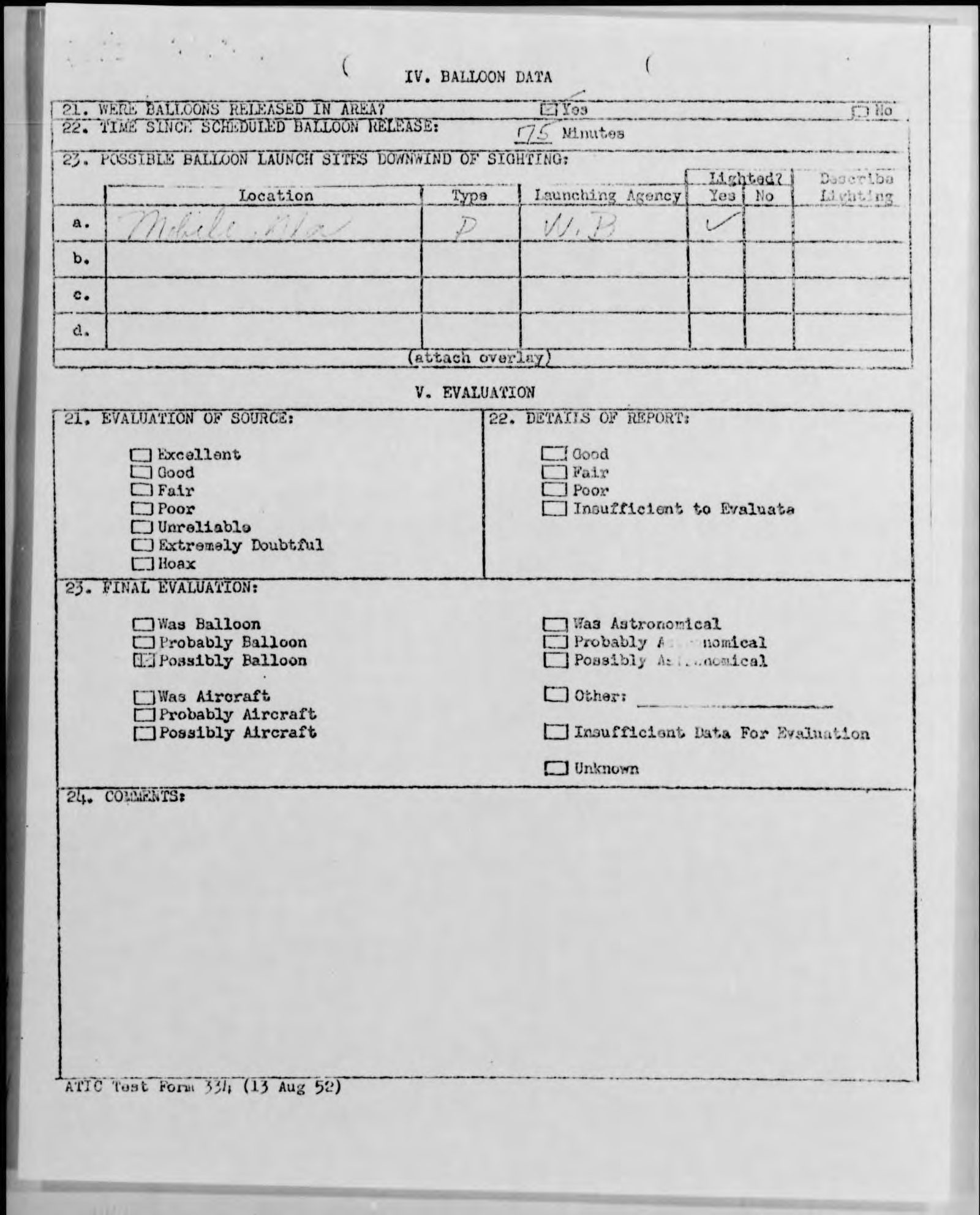
The civilian's worksheet front gives the Zebra time as "1015" (local again mislabeled "0515EST"), the reporting agency as "Wing Intelligence Office, Keesler AFB, Miss.," the object as seen from the ground with the naked eye, no radar, no aircraft, and no change of direction, which contradicts the witness's own description of veering. It checks "Over 10 Minutes" for the time in sight, "Yes" for "Did object have a tail?," "Sunrise" for the time of the sighting relative to sunrise or sunset, and "No" for aircraft in the area. Astronomical activity: "None." On the back, balloons were released in the area, the time since the scheduled release was "75 Minutes," and the one launch site listed is "Mobile, Ala," a pilot balloon launched by the Weather Bureau, lighted. The source and detail boxes are empty, there is no comment, and the final evaluation, checked with a light pencil tick, is "Possibly Balloon."
Status Report No. 8 explains how that label was used: "The possibility of observers seeing balloons that have developed slow leaks and have drifted long distances is always present. In cases where the description of the object is identical to that of a balloon and yet no balloons can be positively determined as having been in that area, the report is evaluated as possibly a balloon on the chance that a balloon has become 'lost' and has drifted into the area." It is a default for reports that look like a balloon, not an identification. Whether this one looked like a balloon is examined under the Conventional Explanation Candidate below.
The Record Card
The first page of the file is the case's "Project 10073 Record Card," "ATIC Form 329 (Rev 26 Sep 52)." "Project 10073" was the number under which ATIC filed Blue Book material. The card's entries, read from the image:
- Date: faint, but legible as "26 Aug 52."
- Location: "Biloxi, Miss."
- Date-time group: local time blank; GMT faded, apparently "0905."
- Type of observation: "Ground-Visual" checked.
- Photos: "No" checked.
- Source: "S/Sgt USAF."
- Length of observation: "46 seconds."
- Number of objects: "1." Course: blank.
- Brief summary: "White. Round. Stationary, then veered upward."
- Comments: blank.
- Conclusions: of the twelve boxes, from "Was Balloon" to "Unknown," only "Unknown" is checked.
The card is the sergeant's alone. The civilian's 75 minutes, reddish-orange color, two trails and photographs appear nowhere on it, and its "Photos: No" would be wrong if it were meant to cover both. The card form was revised on September 26, 1952, a month after the sighting, so the card was typed in the autumn at the earliest, while Blue Book, by Status Report No. 8's account, was still struggling with the summer's workload.
An official "Unknown" is not a statement that the object was extraordinary. Status Report No. 8 defines the category as reports "that contain relatively enough data to evaluate, but cannot be associated with any known phenomenon or object," and adds that "some of these reported objects or phenomena in this category could be identified if more background data on balloon tracks, aircraft movements, etc., were available." The same report also says something that makes this card a little surprising: "All cases where there is only a single observer, unless his or her reliability is unquestionable, are put in" the Insufficient Data category. The sergeant was a single observer whose source rating on the worksheet was only "Fair." That the case was carded Unknown anyway suggests that the analyst weighed the trained-observer background, the sworn statement and the "unexplainable" trail more heavily than the rule. Blue Book's August figures show how unusual that was: of 218 reports evaluated for August 1952, 34 were Unknown, 55 Insufficient Data, 70 balloons and 22 astronomical. As with any official finding, the label records what one analyst concluded from what was in front of him, with the checks he chose to make; it is one opinion to weigh, not a verdict, and the opposite label would have deserved the same caution.
Later Catalogs
The case has appeared in print only as a line in lists:
- Brad Sparks, "Comprehensive Catalog of 2,200 Project Blue Book UFO Unknowns," version 1.35 (February 3, 2026), entry 801: "Aug. 26, 1952. Biloxi, Miss. (Sparks; NARA)," with the number 1987 in the column the catalog uses for Blue Book case numbers. There is no description. The neighboring entries are the same morning's Lathrop Wells, Nevada report (entry 800) and the Veracruz, Mexico report of August 26–27 (entry 802).
- Tim Printy, "Project Blue Book case review: August-September 1952," SUNlite volume 17, number 1 (January–February 2025). In the August table the line for the 26th reads "Biloxi, MS | UNIDENTIFIED | UNIDENTIFIED": Printy, who explains a large share of the cases he reviews, left this one unexplained too. On the same night he re-evaluated an Atlanta, Georgia report that Blue Book had called a balloon as "Jupiter."
- Printy, "The remaining unknowns," SUNlite 17, no. 3 (May–June 2025), entry 196, in his list of the sightings left from Blue Book's 701 unknowns after his earlier reviews: "8/26/52 Biloxi, MS 4:15 AM. Round reddish-orange object seen to the ESE. Appeared to be moving on ESE course. Object visible for 46 seconds." As noted above, this merges the two sightings.
- Don Berliner's list of Blue Book unknowns, as reproduced by NICAP and by Patrick Gross, has entries for August 24, 25, 26 (Lathrop Wells) and 28, 1952, but none for Biloxi.
- Loren E. Gross, UFOs: A History, 1952: August, does not mention it; his "UFO activity on the 26th" covers only the Ellington AFB report. His Supplemental Notes for August 1952 were searched without result.
No newspaper coverage of either sighting was found in the searches made for this file. The Biloxi-Gulfport Daily Herald of August 1952 is not available in a searchable online archive and was not read page by page.
The Sky Over Biloxi
Both sightings happened in darkness, with the Moon long set, so the stars and planets have to be checked. The positions below were computed for this file with NASA JPL's Horizons system for an observer at 30.383° N, 88.95° W, with atmospheric refraction; the star positions were computed from their catalog coordinates, precessed to 1952, with the same code checked against Horizons' position for Jupiter to within a hundredth of a degree. Azimuth is measured clockwise from north, as the sergeant's "120°" was.
| Object | 0905Z (3:05 AM) | 1015Z (4:15 AM) | 1100Z (5:00 AM) | Notes |
|---|---|---|---|---|
| Jupiter | azimuth 113°, 62° up | 146°, 74° up | 189°, 76° up | Magnitude −2.5, the brightest object in the sky |
| Sirius | 110°, rising (1°) | 120°, 14° up | 127°, 23° up | Magnitude −1.5, the brightest star; at 1130Z 133°, 28° up |
| Betelgeuse | 96°, 24° up | 106°, 39° up | 115°, 48° up | Orange-red, magnitude about +0.5 |
| Rigel | 116°, 24° up | 130°, 36° up | 141°, 43° up | Blue-white, magnitude +0.1 |
| Aldebaran | 97°, 46° up | 111°, 60° up | 127°, 69° up | Orange, magnitude +0.9 |
| Mercury | Rises about 1012Z at azimuth 73° (east-northeast); 10° up by 1100Z | Magnitude +0.5, low in the dawn | ||
| Moon | Below the horizon throughout | A 28% crescent that had set the previous evening | ||
| Venus, Mars, Saturn | Below the horizon throughout | — | ||
| Sun | 29° below the horizon | 15° below | 6° below | Rises at 1130Z (5:30 AM CST), azimuth 78° |
Two things stand out. At the moment of the sergeant's sighting, Jupiter, by far the brightest object in the sky, stood at an azimuth of 113 degrees, seven degrees from the 120 degrees he gave and squarely "Southeast" in the report's terms, at 62 degrees elevation. His sketch put the light at about 45 degrees when he first saw it and higher when he last saw it. And at the start of the civilian's sighting, Sirius, the brightest star, was rising at an azimuth of 120 degrees, exactly east-southeast, fourteen degrees above the horizon, and it climbed slowly to the southeast until the Sun came up. The Air Force's own sunrise time, 1130Z, matches the computation exactly. Neither worksheet mentions either body; both answer the astronomical question with "None." What these coincidences mean is weighed below.
The Sun's depression angle also matters. At 0905Z the sky was fully dark. Astronomical twilight began at about 1002Z, nautical twilight at about 1032Z and civil twilight at about 1101Z, so the civilian's sighting began just as the first faint light of dawn appeared, and ran through the whole of twilight to sunrise.
The Winds and the Balloons
The nearest upper-air stations for which observations from this night survive in the National Centers for Environmental Information's Integrated Global Radiosonde Archive (IGRA) are Eglin AFB, Florida, about 145 miles to the east, and Boothville, Louisiana, near the mouth of the Mississippi. Keesler's own radiosonde record in the archive ends in 1947, and the Weather Bureau's Mobile record in 1947. Eglin's rawinsonde was released on schedule that night, with soundings dated 03Z and 09Z on August 26. Its 0900Z sounding recorded, near the surface, a light wind from the northeast (45° at 5 meters per second, about 10 knots), turning to come from 135° (southeast) at about 12 meters per second (23 knots) near 5,100 feet, and back to the north-northwest above about 19,000 feet. That broadly agrees with Keesler's memo: below about 12,000 feet the air over the coast was moving westward, toward Biloxi from the east and east-southeast.
The distances from the sergeant's position to the launch sites on ATIC's list, computed for this file, were: Mobile (the Weather Bureau station at the municipal airport) about 47 miles at a bearing of 64°; Pensacola Naval Air Station about 97 miles at 91°; Eglin AFB about 145 miles at 87°; and Tallahassee about 274 miles at 89°. With winds of 15 to 25 knots from 100°, a balloon from Pensacola would take roughly three and a half to five and a half hours to reach Biloxi, and one from Eglin five to eight hours, provided it stayed below the 12,000-foot level where those winds blew. A weather balloon does not stay low: according to the National Weather Service, a radiosonde rises "at about 300 meters/minute (about 1,000 feet/minute)" until the balloon bursts, high in the stratosphere. The ATIC analyst's "remote possibility ... provided balloons for some reason remained below 8,000' for over three hours" is therefore a fair statement. Mobile's balloon released at 0900Z, five minutes before the sighting, could not have crossed 47 miles in five minutes, and from Mobile the easterly winds would in any case have carried it west along a track north of Biloxi, not into the southeastern sky.
For the civilian's sighting at 1015Z, the same Mobile pilot balloon, released 75 minutes earlier, is the one the worksheet lists. A pilot balloon rises steadily and is tracked with a theodolite for as long as it can be seen; at night it carries a small light. Seventy-five minutes after release it would be very high, and the easterly winds below 12,000 feet would have carried it west from Mobile, toward the sky north or northeast of Biloxi, not the east-southeast, and it could not have stayed in view for another seventy-five minutes until sunrise while holding to one part of the sky. The worksheet's "Possibly Balloon" fits Status Report No. 8's "lost balloon" default better than it fits the description.
Key Witnesses
The staff sergeant (name redacted)
Age 27. Walking east on U.S. Highway 90 at about 3:05 AM after half an hour in a lounge, he saw the round white light at an azimuth of 120° and watched it for 46 seconds. His sworn statement was taken on the day of the sighting, after an Article 31 warning. The report records that he "stated that he has two and one-half (2½) years' experience as a Radar Observer with a Weather Reconnaissance Squadron in addition to one (1) years' experience as a Loran Observer," and judged that he "appeared to be serious, conscientious and aware of the significance of his statements." It was the first time he had seen such a thing, and he had no idea what it was. His name, address and telephone number are blacked out throughout the file.
The theater assistant manager (name redacted)
Watched a reddish-orange object in the east-southeast from his home from about 4:15 AM until sunrise and took 23 photographs, all underexposed. His sworn statement was taken at Keesler on August 29. The report judged that he "appeared to be serious, conscientious, helpful, and aware of the significance of his statements." His name and street address are blacked out.
His wife (name redacted)
Listed in IR-6-52 as a witness; "Estimate of reliability: Not determined." No statement from her is in the file, and the report does not say what she saw.
Eli S. Fowler, Jr.
Not a witness. Prepared and approved both Air Intelligence Information Reports, IR-5-52 on the sergeant's sighting and IR-6-52 on the civilian's. Earlier that month he had reported a pair of orange objects seen near Keesler on August 10 (Gross). His typed name is faint in this file; Gross gives it as "Major Eli Fowler, Wing Intelligence Office, Keesler AFB."
William D. Beasley
Not a witness. Signed both "Synoptic Situation and Winds Aloft" reports to the Wing Intelligence Officer, for 0200–0300 and 0400–0500 on August 26: easterly flow, with winds from 100° at 10–25 knots up to 12,000 feet.
1st Lt. Burlingame (first name partly legible)
Not a witness. Took both sworn statements, the sergeant's on August 26 and the civilian's on August 29, "at Keesler Air Force Base, Mississippi." The surname is clear in his typed signature block; his first name and middle initial are not.
Maj. Jack P. Kern
Not a witness. His stamped signature block, "for the Commanding General," appears on both letters transmitting the reports to the Director of Intelligence, USAF, under Air Force Letter 200-5.
The Five Observables Assessment
The Five Observables framework, associated with former AATIP director Luis Elizondo, classifies UAP reports by performance characteristics beyond known technology. The sergeant's report touches one of them, briefly; the civilian's touches none.
Assessment:
- Anti-gravity lift (speculative). The light "appeared to be hanging in the sky" for forty seconds without sound. That is remarkable only if it was a solid object two miles away; a distant light, a star or planet, or an aircraft flying toward the observer all appear motionless.
- Instant acceleration (speculative). The departure, "at an angle, upwards, at a high rate of speed," gone in six seconds, is the one element of the sergeant's report that suggests unusual performance. It was seen by one person, its speed was never estimated, and its distance is a guess.
- Hypersonic speed (absent). No speed was estimated; the civilian's object moved at "a fairly high rate of speed" while staying in one part of the sky for over an hour.
- Low observability (absent). Both objects were bright lights.
- Trans-medium travel (not applicable). Both were seen over the Sound, but neither touched the water.
Evidence Assessment
Supporting Anomalous Origin
- The principal witness was a serviceman with three and a half years' experience as a radar and Loran observer, who swore to his account under an Article 31 warning on the day of the sighting.
- His description is definite and consistent across the statement, the questionnaire and the report: a round white light, stationary for about forty seconds, that departed upward in about six seconds with a trail.
- ATIC checked balloons, found only a "remote possibility," and concluded "Exhaust trail is unexplainable." The case was carded Unknown even though Blue Book's own rule sent most single-observer reports to Insufficient Data.
- A second, independent report came from the same town the same morning, also in the east-southeast.
- Tim Printy, a skeptic who explains most of the cases he reviews, leaves this one "UNIDENTIFIED."
Supporting Conventional Explanation
- The sergeant was alone, at three in the morning, after "sitting in a lounge" and drinking beer, and the whole event lasted 46 seconds.
- Jupiter, the brightest object in the sky, stood at an azimuth of 113° and 62° up, about seven degrees from his stated direction and high in the southeast, as his sketches show.
- Two aircraft were moving near Keesler at 0900Z, one landing and one departing over the Gulf, and neither was traced or ruled out.
- The size, "twice that of a full moon," and the distance, "two (2) miles," are impressions, not measurements; a bright point of light is routinely overestimated in size.
- The civilian's reddish-orange light in the east-southeast, which "veered" from side to side for over an hour and faded at sunrise, matches the position and behavior of the rising star Sirius.
- No photograph, radar return, physical trace or second witness to the sergeant's light exists.
Why "Disputed"
The Biloxi Highway 90 Sighting is stamped DISPUTED with a score of 32/100. It is a real report, carefully recorded, and it has two things many Blue Book cases lack: a sworn statement taken the same day from a witness with real observing experience, and an Air Force analyst who tested the obvious balloon explanation, rejected it in writing, and left the case Unknown. Those are the reasons it is not scored lower. Its weaknesses are larger. There was one witness, he was walking home from a lounge at three in the morning, and he watched for forty-six seconds. What he described was a light, not a structured craft, and the brightest light in the night sky was within about ten degrees of where he was looking. Two aircraft were in the air near the base five minutes earlier, and no one asked where they were. The only thing that resists those explanations is the six-second departure with its trail, which no one else saw. The second Biloxi report of that morning, from the theater manager, adds less than it seems to: it describes a different object in a different way, and its position and behavior point strongly to Sirius.
Among this site's Mississippi Blue Book cases, it ranks just below the Keesler AFB Sighting and the Greenville AFB Tower Sighting (36 each). The first had four witnesses in daylight; the second had five, a tower crew with binoculars among them, though its star-like light fits Arcturus and, in part, Antares. It ranks below the Keesler AFB Weather Tower Sighting and the Biloxi VA Hospital Sighting (38 each), the Ocean Springs Family Sighting (40), the Meridian "Flying Cymbal" (44) and the Jackson Airborne Sighting (46). The official "Unknown" is weighed for what it is. It is the judgment of an analyst who checked balloons and nothing else, during the busiest autumn Blue Book had known; it is not evidence that the light was anything unusual, any more than a "Possibly Balloon" on the civilian's worksheet is evidence that it was a balloon. Official evaluations from this period were often made quickly, with a limited set of checks and an institutional preference for one answer or the other, and outside researchers cannot audit what else the analyst considered. Here the record shows plainly that he never looked at the sky.
Sensor & Instrumentation Detection Profile
No instrument recorded either object.
- Optical aids. None. Both witnesses used the naked eye; the sergeant wore no glasses.
- Cameras. The civilian exposed 23 frames over about 75 minutes; "all frames were underexposed." No print or negative is in the file. The record card for the sergeant's sighting checks "Photos: No."
- Radar. No radar check is recorded. Both worksheets answer "No" to "Was object observed by ground radar?" Keesler was the Air Force's radar school, and the principal witness belonged to a Loran squadron based there.
- Air traffic. Base operations reported a civilian aircraft landing and PBY 8314 departing at 0900Z, five minutes before the sergeant's sighting, and no traffic at the time of the civilian's.
- Weather. Winds aloft for 0200–0300 and 0400–0500 from the Keesler Base Weather Station; no surface observations in the file. Eglin AFB's 0900Z rawinsonde (IGRA) is used here as an independent check.
- Balloons. ATIC listed four possible upwind launch sites, Mobile, Eglin, Pensacola and Tallahassee, and found none a good fit for the sergeant's object.
Environmental & Geospatial Context
Biloxi occupies a narrow peninsula with Back Bay to the north and the Mississippi Sound to the south. U.S. Highway 90 runs along the beach from Biloxi west through Gulfport, with the Sound and its sea wall on one side and the town on the other. The sergeant's position, 30°23′ N, 88°57′ W, lies on that stretch in west Biloxi, about 2.4 miles southwest of the center of Keesler AFB's airfield (computed). An azimuth of 120° from there looks out over the Sound, past the eastern end of the Biloxi peninsula, toward the open water beyond it. The civilian's position, 30°24′ N, 88°53′ W, is about four miles to the east-northeast, in east Biloxi, about 2.6 miles east-southeast of the airfield; his view to the east-southeast also lay over the water.
Weather
The night was clear by the sergeant's account and "Clear" by ATIC's weather data sheet, and he remembered it as warm. The synoptic memo describes a large high-pressure system over the eastern United States and "modified Continental Polar and Maritime Polar air in easterly circulation" over the coast. Winds were from 100° at 10 to 25 knots from 2,000 to 12,000 feet, turning to the north above 14,000 feet. No inversion was noted. A clear sky over the water and a steady easterly breeze are good conditions for seeing stars and planets low in the east, and for the strong twinkling that bright stars show near the horizon.
The Moon and twilight
The Moon, a 28 percent crescent, had set the previous evening and was below the horizon throughout. The sergeant's sighting took place in full darkness, with the Sun 29 degrees below the horizon. The civilian's began at the start of astronomical twilight and ran through nautical and civil twilight to sunrise at 1130Z, 5:30 AM CST.
Observer Credibility & Occupational Profile
The sergeant was a better-qualified observer than most. He had served two and a half years as a radar observer with a weather reconnaissance squadron and one year as a Loran observer. Loran (Long Range Navigation) was a radio navigation system developed during the Second World War, in which a receiver measured the time difference between pulses from pairs of stations; operating it is a matter of reading signals, not watching the sky, but his radar background meant years of work around aircraft and weather. He swore to his account the same day, after a formal warning of his rights, which is not something people do lightly. The intelligence officer found him "serious, conscientious and aware of the significance of his statements."
Against that, the circumstances were not good. He was alone, on foot, at three in the morning, and by his own written answer he had spent the previous half hour sitting in a lounge drinking beer. Nothing suggests he was drunk, and the Air Force did not treat him as unreliable, but ATIC's worksheet rated the source only "Fair," and Blue Book's own rule held that a single observer belonged in Insufficient Data "unless his or her reliability is unquestionable." His estimates of size and distance are the kind no one can make about a light in the night sky: a light "twice the size of a full moon" at "two (2) miles" would be some two hundred feet across, but nothing in the account fixes either number, and he himself rated his height and distance answers "Not very sure."
The theater manager was described as "serious, conscientious, helpful." He watched for over an hour with his wife, took two dozen photographs, and went to the base three days later to swear to his account. Nothing in the file suggests he sought publicity. His description is in some ways more careful than the sergeant's; he said honestly that he "could not accurately determine the size of the object." But he had no observing experience recorded, and the "nine (9) feet by fifteen (15) feet" he estimated cannot be reconciled with "a great distance": a distant light has an apparent size, not a size in feet.
Physical & Material Assays
No physical evidence exists. Neither object came near the ground, nothing was searched for or recovered, and IR-5-52 and IR-6-52 both answer "Existence of physical evidence" with "Negative." The civilian's underexposed negatives were the only physical record of either sighting, and they are not in the file.
Historical Precedents & Archive Matches
- August 10, 1952, near Keesler AFB. Two orange, oval objects seen at 2:10 AM making "veering turns to the right and to the left," reported by the same Maj. Eli Fowler (Gross); record card "Possibly Balloon," as listed in this site's Keesler AFB Weather Tower Sighting file.
- August 26, 1952, Atlanta, Georgia. The same night; carried by Blue Book as a balloon, re-evaluated by Printy as Jupiter.
- August 26, 1952, Lathrop Wells, Nevada, and Ellington AFB, Texas. The other reports of that morning: a bright object with a V-shaped contrail seen by an Air Force captain (a Blue Book unknown), and a light "slightly larger than Jupiter" that zigzagged north and blinked, seen by three airmen (Gross).
- August 28, 1952, Chickasaw and Brookley AFB, Mobile, Alabama. Red objects watched for about fifty minutes by civilians, an OSI agent and tower operators, one confirmed as a stationary radar target (Sparks entry 803).
- May 7, 1952, the Keesler AFB Sighting. Small bright objects darting in and out of clouds near the base, carried as Unknown.
- July 30, 1952, Keesler AFB. A slow-moving radar target watched for seventeen minutes on a CPS-5 set by a training-squadron officer and a radar team chief (Sparks entry 756).
- November 18, 1949, the Biloxi VA Hospital Sighting. Three guards watching a white cigar over Ship Island from beside the base, in daylight; never evaluated.
- April 4, 1965, the Keesler AFB Weather Tower Sighting. A weather observer's dark oval with lights, the other Keesler-area report that Blue Book left unidentified.
Material Analysis
There is no material to analyze. This section looks instead at what each element of the two descriptions implies about the objects.
"A round, white light ... hanging in the sky"
A steady white light that does not move is the commonest description in the UFO literature, and it fits a planet, a bright star, a distant aircraft coming nearly head-on with its landing light, or a lighted balloon. The sergeant called it "round in shape with no clearly definable edge," which is how a bright point source looks to the naked eye, especially a tired one: a glow, not a disc.
"Twice the size of a full moon"
The full Moon is about half a degree across. Bright lights against a dark sky are routinely overestimated in angular size because of glare and the eye's own scattering, and a light the sergeant compared to a dirigible and placed two miles away would have been many times larger than any planet's disc, which is far too small for the naked eye to resolve. This is an impression, not a measurement, and cannot by itself distinguish a planet from a large object.
The departure and the trail
"After approximately forty (40) seconds, the object seemed to veer off at an angle, upwards, at a high rate of speed," and "a trail comparable to that of a shooting star was observed as the object disappeared." This is the heart of the case. A planet does not leave its place; a meteor does not hang for forty seconds first. An aircraft turning away can seem to "veer off" as its landing light swings away from the observer and dims, but it does not leave a meteor-like trail at night. A meteor crossing near a bright planet in the moment the observer was watching it would produce exactly this sequence, a stationary light and then a streak, but it would leave the planet behind, still shining; the sergeant says the object "disappeared from sight." ATIC's analyst, looking at the same words, wrote "Exhaust trail is unexplainable."
The civilian's "reddish-orange" object with two trails
"Comparable to the color of a burning match seen from a distance," low in the east-southeast before dawn, veering right and left while holding the same general direction for over an hour, then fading at sunrise. Bright stars near the horizon flash red, orange and blue as the turbulent air refracts their light, and a fixed point of light watched against a dark sky without reference points appears to wander, the autokinetic effect. The "two (2) trails, similar to the trails of jets seen at night," joining behind the object, are the one detail that does not obviously belong to a star; to a dark-adapted eye, flaring and twinkling around a very bright star can look like rays, but the file gives no way to test that.
Supporting Non-Terrestrial or Anomalous Origin
- A stationary light that departed upward in six seconds with a trail, as described under oath by a trained observer.
- An analyst at ATIC who examined the balloon possibility called the trail "unexplainable" and left the case Unknown.
Supporting Terrestrial Origin
- No physical, photographic, radar or instrumental evidence exists for either sighting.
- The brightest planet was within about ten degrees of the sergeant's stated direction, and the brightest star was exactly where the civilian looked, at exactly the right time.
- Aircraft were taking off and landing at the base next door minutes before the sergeant's sighting.
- Every element except the six-second departure is typical of a planet, star or distant aircraft light.
The Conventional Explanation Candidate
The two sightings need separate answers. For the sergeant's, ATIC tested only balloons and left the case Unknown; Printy agrees that it is unidentified. For the civilian's, ATIC wrote "Possibly Balloon" without comment. The candidates below are tested against what the file establishes: the times, the directions, the sergeant's sketches, the winds, and the aircraft movements the base reported.
The sergeant: Jupiter
At 0905Z Jupiter was at an azimuth of 113 degrees and 62 degrees above the horizon, shining at magnitude −2.5, brighter than anything else in the sky that night. The sergeant gave his azimuth as 120 degrees and the report says "Southeast." His sketch placed the light at roughly 45 degrees when he first saw it, and his sky-dome sketch higher still, a little to the right of overhead. Seven degrees in azimuth and fifteen or so in elevation are well within the errors of an unaided estimate by someone walking along a road at night. A bright planet seen unexpectedly is the classic "light hanging in the sky": it does not move perceptibly in forty seconds, it is steady, it looks larger than it is, and it often seems "solid." Printy, reviewing the same night's reports, re-evaluated an Atlanta sighting as Jupiter.
The difficulty is the ending. Jupiter does not "veer off at an angle, upwards," and it does not disappear; it would still have been there after the six seconds, in the same place, for the rest of the night. For Jupiter to explain the case, something else must explain the departure: a meteor crossing near it at the moment the sergeant was looking, which he took for the same object leaving, combined with his not finding Jupiter again as he walked on; or an aircraft light passing in front of it. A meteor would explain the "trail comparable to that of a shooting star" exactly, and sporadic meteors are commonest in the hours before dawn. But the coincidence is a real cost, and the sergeant, who said it disappeared "Suddenly," does not mention a light remaining. Jupiter explains the first forty seconds well and the last six not at all.
The sergeant: an aircraft
Two aircraft were moving near Keesler at 0900Z, five minutes before the sighting: a civilian aircraft from Lackland AFB "preparing to land," and PBY 8314 "departed Keesler AFB at 0900Z ... on a search mission over the Gulf of Mexico." An aircraft flying toward an observer with its landing light on appears as a single bright, steady, motionless light, often described as large; when it turns, the beam swings away, the light seems to "veer off" and dims or vanishes within seconds. A PBY climbing out from Keesler toward the Gulf could well have been somewhere over the Sound, south or southeast of the base, a few minutes after takeoff, though the report does not say which way it went, and the sergeant was looking southeast over the Sound. This fits the stationary phase and the sudden departure better than Jupiter does.
It has three problems. The trail: an aircraft at night does not leave a streak like a shooting star, though the sergeant might have seen an afterimage or the aircraft's lights smeared by motion. The elevation: an aircraft a few miles away at a few thousand feet would be low in the sky, not at 45 degrees or more, unless it was much closer than two miles. And the record: the base knew both aircraft were up and did not try to place them, so their positions at 0905Z are unknown. The candidate is plausible and untested.
The sergeant: a balloon
ATIC's own test, and it fails for the reasons the analyst wrote down. The scheduled release at 0900Z was only five minutes old. The upwind stations were 97 to 274 miles away, and a balloon from any of them would have needed to drift for hours below 8,000 feet to arrive, which a rising weather balloon does not do. A lighted balloon could hang in the sky, but it could not depart upward in six seconds, and "Exhaust trail is unexplainable." The balloon explanation is unlikely.
The sergeant: a meteor alone
A fireball traveling nearly toward the observer can appear almost stationary for a moment, then brighten and streak away. But "a moment" is a second or two, not forty seconds, and meteors do not hang. A meteor alone does not fit. A meteor together with a planet or an aircraft light is the combination considered above.
The theater manager: Sirius
At 1015Z, when the civilian says he first saw his object "in the sky East Southeast of my home," Sirius, the brightest star in the sky, was rising at an azimuth of 120 degrees, fourteen degrees above the horizon. Over the next seventy-five minutes it climbed slowly to 133 degrees and 28 degrees elevation, remaining in the east-southeast to southeast the whole time. Low in a humid sky, Sirius flashes red, orange, white and blue; "reddish-orange, comparable to the color of a burning match seen from a distance" is a fair description of its color near the horizon. A fixed bright point watched for over an hour without a reference frame appears to wander, which matches "would veer from its course to the right, come back on course, and then veer to the left," while the object never actually left that part of the sky. It "remained in sight until sunrise (1130Z) when the object became non-distinguishable," which is what a bright star does as the sky brightens. And twenty-three snapshots of a single star from a hand-held 1952 camera would all come out blank.
Betelgeuse, an orange-red star, was also in the east-southeast, higher, at 106 degrees and 39 degrees up, and Rigel at 130 degrees and 36 degrees; Sirius was the brightest and the lowest, and the one most likely to look red and to flicker. The parts of the account that do not fit are the "two (2) trails ... uniting toward the rear" and the "fairly high rate of speed." The first may be how strong scintillation and the eye's own glare looked to a tired observer; the second is the usual impression of motion that a wandering point of light gives. Neither is decisive, and Sirius is the strongest candidate for this sighting.
The theater manager: a balloon
ATIC's "Possibly Balloon" rests on the Mobile pilot balloon released 75 minutes before the sighting. Mobile lies to the northeast of Biloxi, and the easterly winds would have carried its balloon westward, toward a point to the north of Biloxi, while it rose steadily to great heights; it would not have been low in the east-southeast, and it could not have stayed in view in the same quarter of the sky for another seventy-five minutes until sunrise. The label is Status Report No. 8's default for a balloon-like report with no balloon found. It is possible in principle and a poor fit in practice.
The theater manager: Mercury or an aircraft
Mercury rose at about 1012Z, but at an azimuth of 73 degrees, east-northeast, forty degrees from the civilian's direction, and at magnitude +0.5 it would have been faint in the dawn. Base operations reported no air traffic in the area at the time. Neither fits as well as Sirius.
A genuine unidentified object
On this reading, the sergeant saw an unknown craft hover over the Mississippi Sound for forty seconds and depart at speed, and the theater manager, an hour later, saw an unknown object maneuvering in the same part of the sky. The two reports are independent, and the sergeant's was taken seriously enough by the Air Force to remain Unknown. But they describe different things, in different colors, at different times, behaving differently; they do not corroborate each other. The sergeant's light is unexplained in the sense that no one tested the planet in front of him or the aircraft around him, and the departure he describes would require a coincidence for any ordinary explanation. That is a real residue, and it is a small one.
Jupiter (Sergeant)
Plausible for the stationary phase Does not explain the departureBrightest object in the sky, 7° from his stated azimuth and high in the southeast. Explains a light "hanging" for forty seconds, but not its upward departure or disappearance, unless a meteor coincided.
Aircraft Landing Light (Sergeant)
Possible but UntestedTwo aircraft were moving near Keesler at 0900Z, one departing over the Gulf. A head-on landing light hangs, then "veers off" and vanishes. The trail and the high elevation fit poorly, and their positions were never checked.
Balloon (Sergeant)
UnlikelyATIC's own test: the 0900Z release was five minutes old, upwind sites were 97–274 miles away, and "Exhaust trail is unexplainable."
Meteor Alone (Sergeant)
ImplausibleMatches the trail and the sudden end, but no meteor hangs stationary for forty seconds.
Sirius (Theater Manager)
Highly PlausibleRising at azimuth 120°, exactly east-southeast, at 1015Z; red-orange and flickering near the horizon; seemed to wander; faded at sunrise; unrecordable by a 1952 snapshot camera. Only the "two trails" are unexplained.
Balloon (Theater Manager)
Poor FitATIC's "Possibly Balloon." The Mobile pilot balloon would have drifted west, north of Biloxi, and could not have stayed in the east-southeast for 75 minutes.
Genuine Unidentified Object
InconclusiveThe sergeant's six-second departure with a trail resists every ordinary explanation without a coincidence. One witness, 46 seconds, and untested aircraft and planet leave it a small residue, not a strong case.
Related Cases
Confirmed Documents & Official Records
From the Project Blue Book File
Ten of the 29 pages of the Project Blue Book file, as read for this case file: the record card, both sworn statements, two pages of each intelligence report, the sergeant's sketches, both ATIC worksheet evaluations and a Keesler winds-aloft memo. U.S. Air Force records, public domain (Project Blue Book, Internet Archive item 1952-08-8771479-Biloxi-Miss); the witnesses' names were redacted before release. The record card and two faint report pages are contrast-enhanced. Click any page to open it full size.
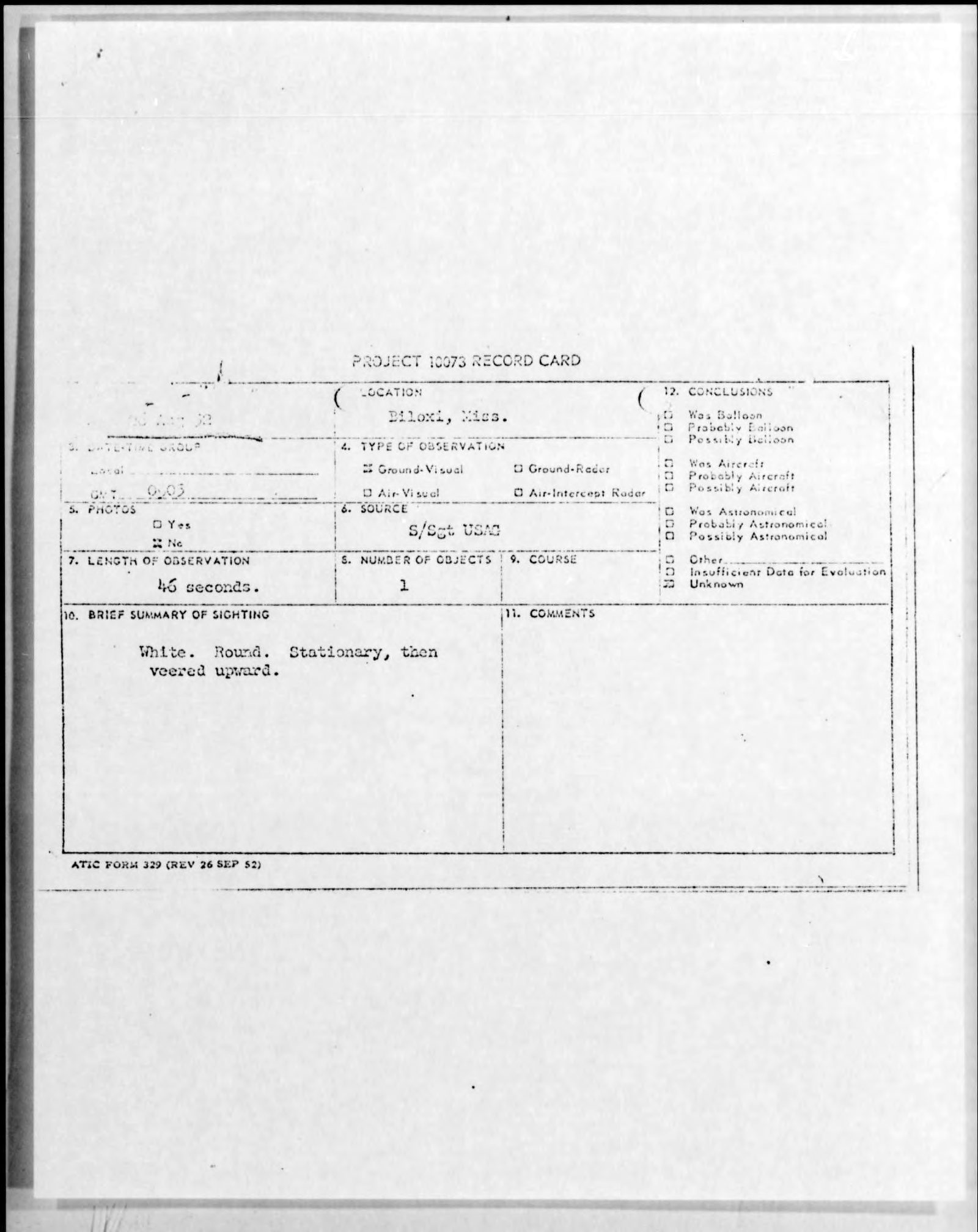
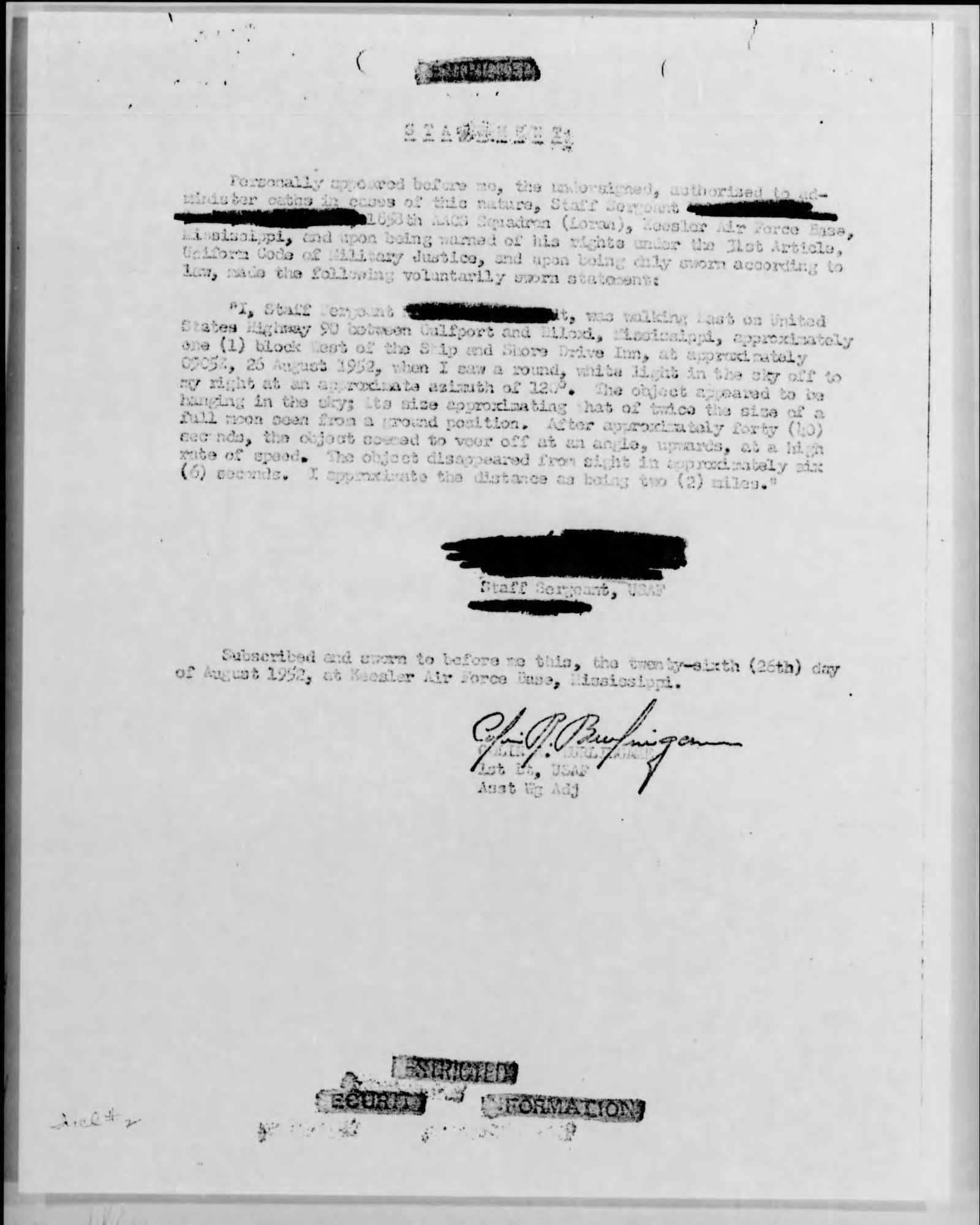
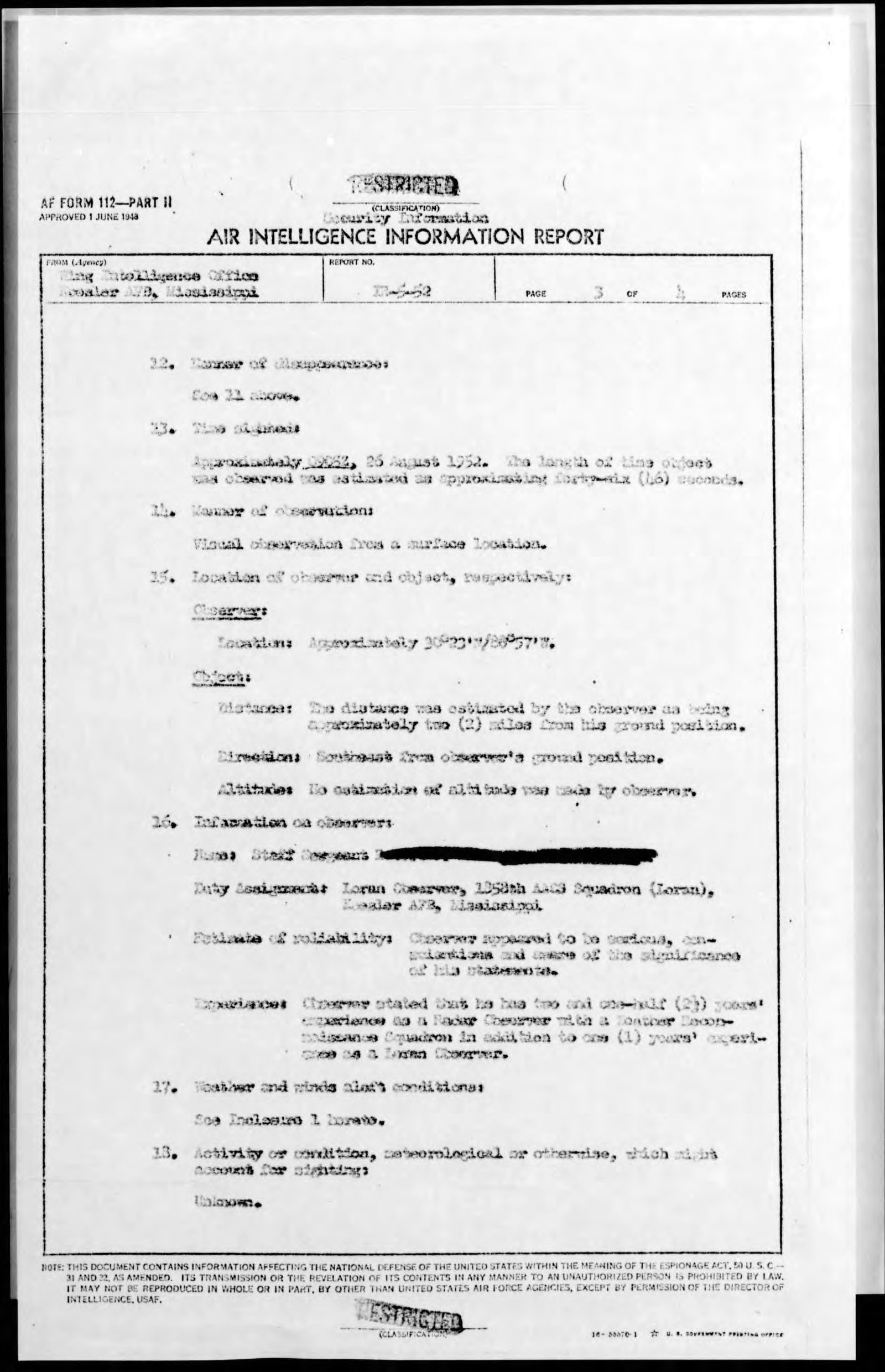
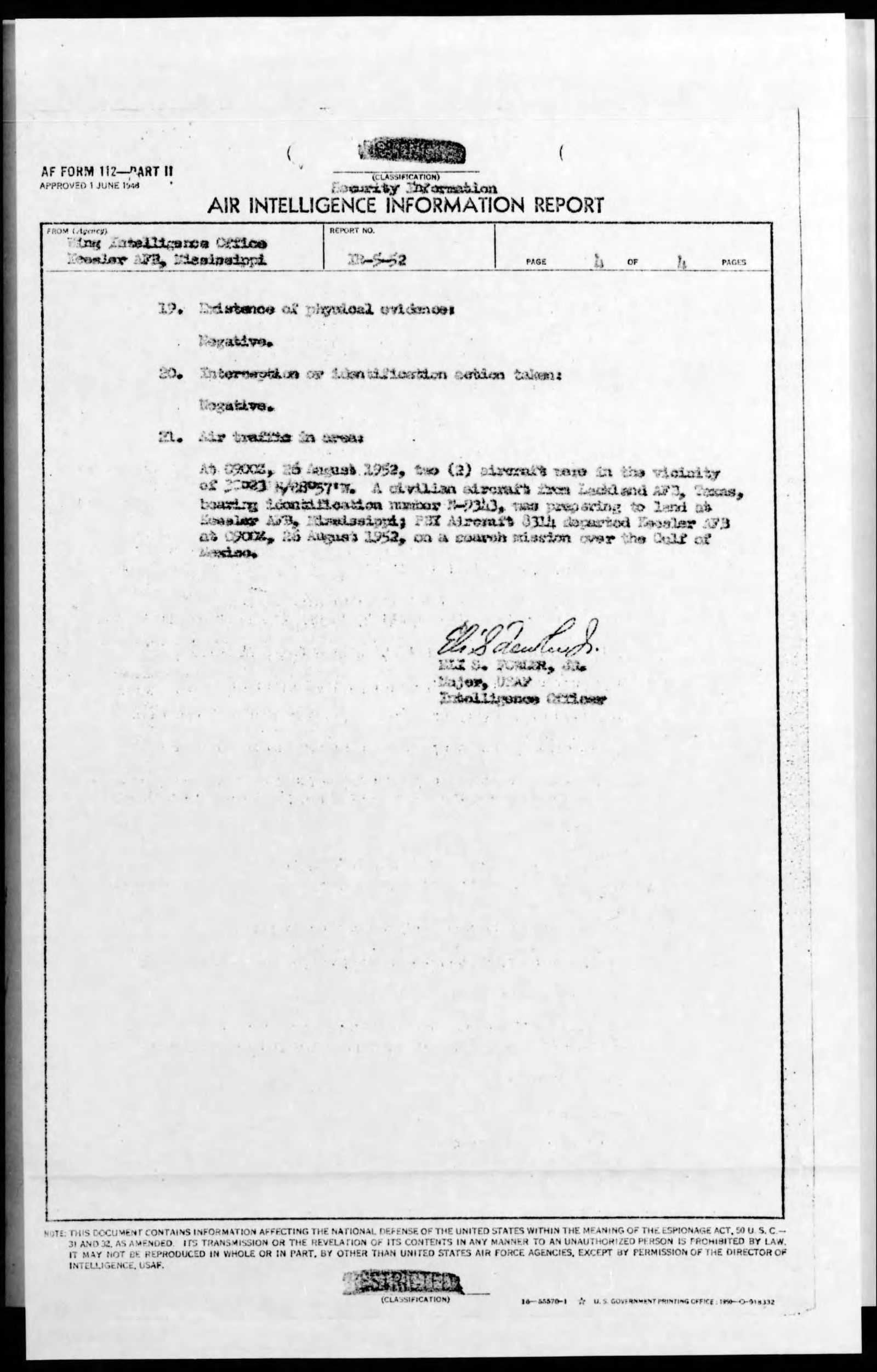
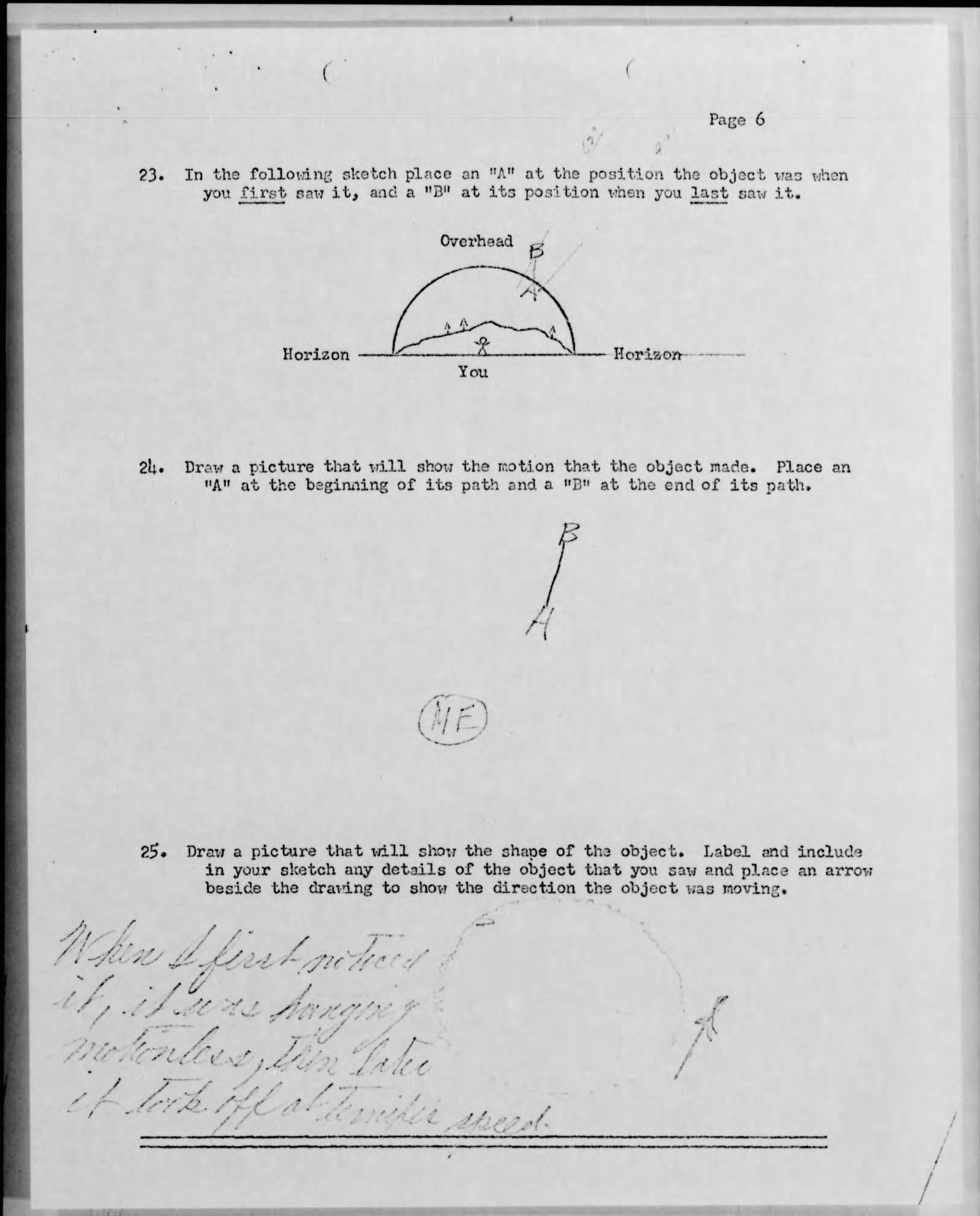
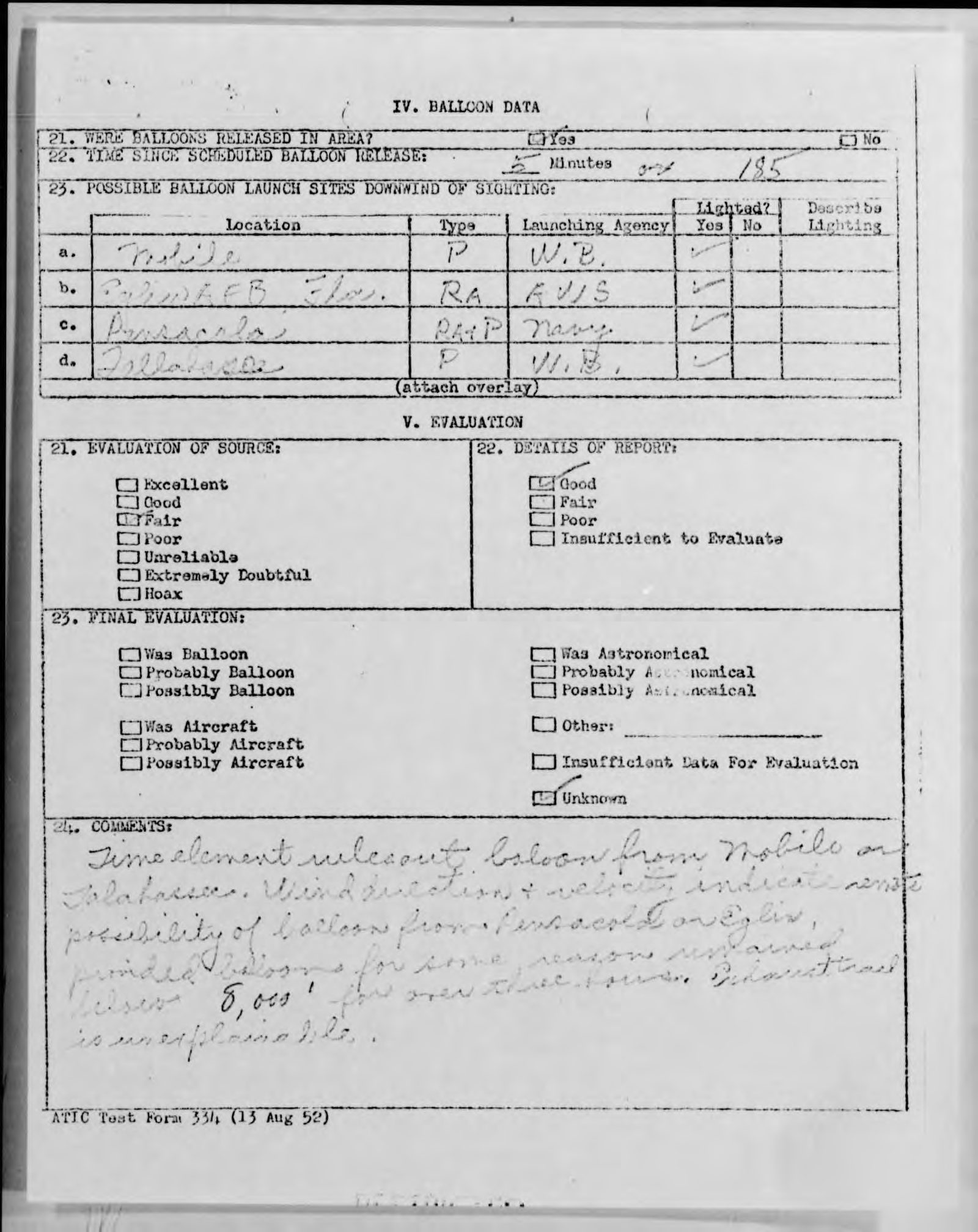
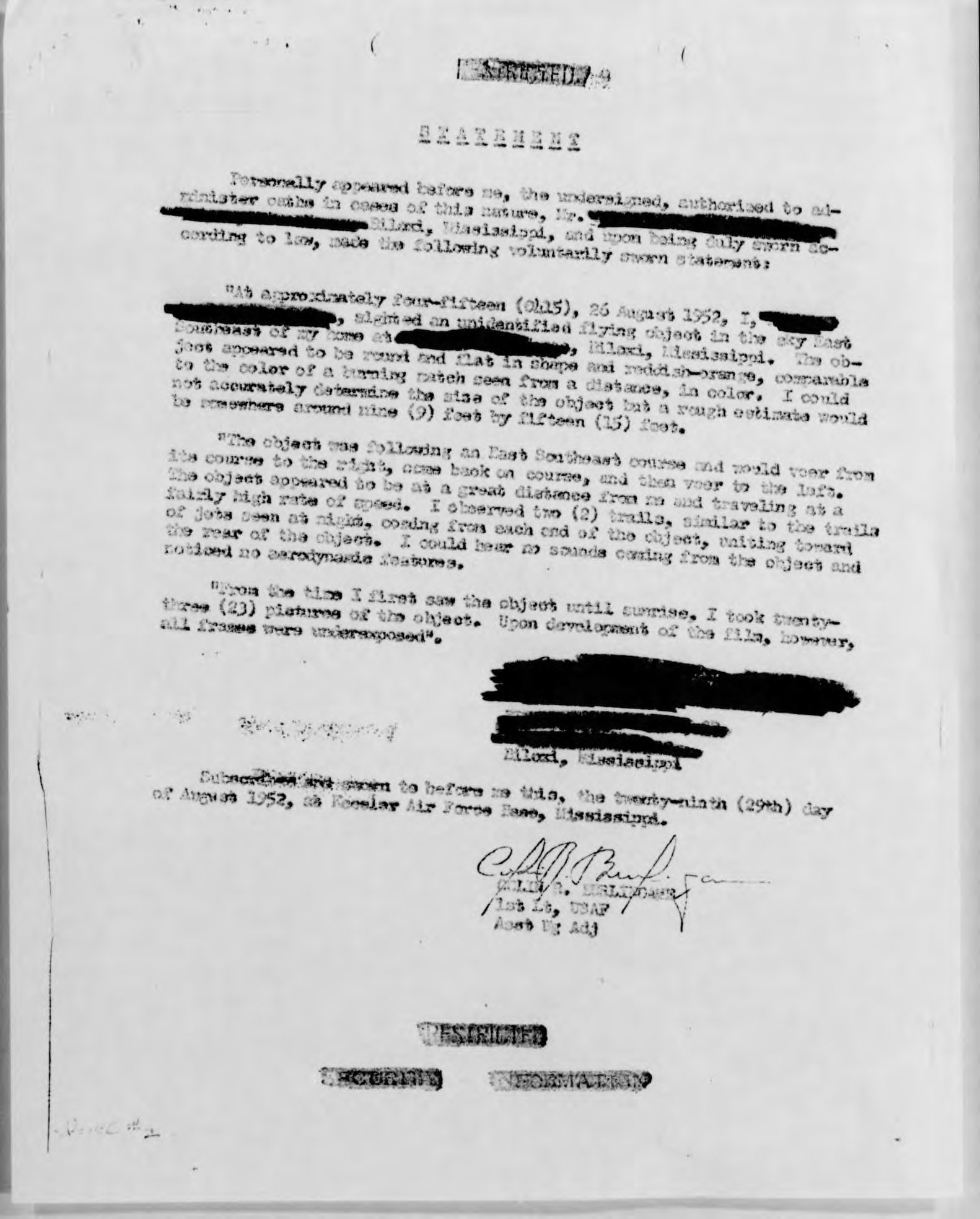
The 29-page released Project Blue Book file (Fold3 file 8771479), part of the Internet Archive's Project Blue Book collection. It holds both Keesler intelligence reports, IR-5-52 and IR-6-52, with their statements, questionnaire, worksheets and weather memos. The primary source for this case file; the page images were read directly.
UNCLASSIFIEDATIC's report on the June–October 1952 wave: the definitions of "Unknown" and "Insufficient Data," the single-observer rule, the balloon-release times and the "lost balloon" rule, and August 1952's evaluations (34 Unknown of 218). Hosted by The Black Vault.
UNCLASSIFIEDThe catalog series for the released, name-redacted Blue Book case files (Record Group 341), filmed as microfilm publication T1206.
UNCLASSIFIEDNARA's fact sheet on Project Blue Book: 12,618 sightings reported from 1947 to 1969, 701 unidentified; termination announced December 17, 1969.
UNCLASSIFIEDSearch Government Archives Directly
Further Reading — Recommended Literature
The Report on Unidentified Flying Objects
Blue Book's chief on the summer of 1952, Air Force Letter 200-5, and the flood of reports that arrived "between midnight and 4:00A.M."
Captain Edward J. Ruppelt: Summer of the Saucers — 1952
A documented account of Blue Book during the 1952 wave, when this report and hundreds like it were filed.
Invasion Washington: UFOs Over the Capitol
The July 1952 Washington sightings that drove the summer's wave of reports to its peak.
DISCLOSURE: Some links above are affiliate links. If you purchase through them, OverClassified receives a small commission at no additional cost to you. This helps support independent research.
Essential Viewing
No Videos Available
Sources
- Fowler, Eli S., Jr., Major, USAF, Intelligence Officer, Wing Intelligence Office, Keesler AFB, Mississippi. Air Intelligence Information Report IR-5-52 (AF Form 112, Parts I and II, four pages), 26 August 1952 sighting by a staff sergeant, 1958th AACS Squadron (Loran) (azimuth Southeast; 46 seconds; "a trail comparable to that of a shooting star"; air traffic at 0900Z). In Blue Book file “1952-08-8771479-Biloxi-Miss”: archive.org
- Fowler, Eli S., Jr., Major, USAF. Air Intelligence Information Report IR-6-52 (AF Form 112, Parts I and II, four pages), subject “FLYOBRPT,” area “Southeast Mississippi,” date of information 26 August 1952 (1015Z; 75 minutes; “until sunrise (1130Z)”; Assistant Manager, Roxy Theater; 23 underexposed photographs). Same file: archive.org
- Sworn statement of a Staff Sergeant [name redacted], 1958th AACS Squadron (Loran), Keesler AFB, subscribed and sworn 26 August 1952 before 1st Lt. Burlingame, Assistant Wing Adjutant (“walking East on United States Highway 90 ... approximate azimuth of 120°”). Same file: archive.org
- Sworn statement of Mr. [name redacted], Biloxi, Mississippi, subscribed and sworn 29 August 1952 at Keesler AFB (“reddish-orange, comparable to the color of a burning match”; “two (2) trails”; “twenty-three (23) pictures”). Same file: archive.org
- “Tentative Observers Questionnaire,” eight pages, completed by the staff sergeant (“Between 3 & 3:15” A.M. Central Standard; “46 Sec”; “Dirigible”; sketches; “Radar Observer,” age 27). Same file: archive.org
- Beasley, William D., Major, USAF, Station Weather Officer, Base Weather Station, 11th Weather Squadron, Keesler AFB. “Synoptic Situation and Winds Aloft Report 0200-0300 26 August 1952” and “... 0400-0500 26 Aug 52” (29 August 1952), to the Wing Intelligence Officer, 3380th Technical Training Wing. Same file: archive.org
- Headquarters, Keesler Air Force Base and 3380th Technical Training Wing. Letters of transmittal to the Director of Intelligence, Headquarters USAF (info copies Chief, ATIC, Attn ATIAA-2c; CG, TTAF; CG, ATRC), “In compliance with paragraph 7 c (2), Air Force Letter 200-5, dated 29 April 1952,” stamped 27 August 1952 and September 1952, signature block of Jack P. Kern, Major USAF, Adjutant. Same file: archive.org
- Air Technical Intelligence Center. “Project 10073 Worksheet,” ATIC Test Form 334 (13 Aug 52), two copies: Biloxi, 26 Aug 52, Zebra 0905 (balloon sites Mobile, Eglin, Pensacola, Tallahassee; source “Fair”; final evaluation “Unknown”; “Exhaust trail is unexplainable”) and Zebra 1015 (Mobile pilot balloon, 75 minutes; “Possibly Balloon”); and two “Project 10073 Weather Data Sheets,” ATIC Test Form 333 (13 Aug 52). Same file: archive.org
- U.S. Air Force, Project Blue Book. Project 10073 Record Card, ATIC Form 329 (Rev 26 Sep 52), Biloxi, Miss., 26 Aug 52 (“S/Sgt USAF”; “46 seconds”; “White. Round. Stationary, then veered upward.”; conclusion “Unknown”). Same file: archive.org
- Internet Archive. “1952 08 8771479 Biloxi Miss” (U.S. Air Force, 29 images; Project Blue Book collection, contributed by Michael Best). archive.org
- Air Technical Intelligence Center. Project Blue Book Status Report No. 8 (Project No. 10073), 31 December 1952: definitions of “Unknown” and “Insufficient Data” (“All cases where there is only a single observer, unless his or her reliability is unquestionable, are put in this category”); balloon release times and the “lost” balloon rule; June, July and August 1952 evaluation tables. The Black Vault (Download PDF): theblackvault.com
- Sparks, Brad. “Comprehensive Catalog of 2,200 Project Blue Book UFO Unknowns,” version 1.35, February 3, 2026: entry 801, “Aug. 26, 1952. Biloxi, Miss. (Sparks; NARA),” number 1987; also entries 756 (Keesler AFB, July 30, 1952), 800 (Lathrop Wells, Nev., Aug. 26, 1952) and 803 (Chickasaw and Brookley AFB, Mobile, Ala., Aug. 28, 1952). NICAP (Download PDF): nicap.org
- Printy, Tim. “Project Blue Book case review: August-September 1952,” SUNlite 17, no. 1 (January–February 2025): 8ff. (August table: “26 | Biloxi, MS | UNIDENTIFIED | UNIDENTIFIED”; “26 | Atlanta, GA | Balloon | Jupiter”). (Download PDF): astronomyufo.com
- Printy, Tim. “The remaining unknowns,” SUNlite 17, no. 3 (May–June 2025): 52ff., entry 196 (“8/26/52 | Biloxi, MS | 4:15 AM. Round reddish-orange object seen to the ESE ... Object visible for 46 seconds”). (Download PDF): astronomyufo.com
- Gross, Loren E. UFOs: A History, 1952: August (Fremont, Calif.): p. 33 (Keesler AFB, August 10, “veering turns to the right and to the left,” note 124, “Air Intelligence Information Report, by Major Eli Fowler, Wing Intelligence Office, Keesler AFB ... 11 August 52”); p. 71 (“UFO activity on the 26th,” Ellington AFB; the “north-to-south shift theory”); no Biloxi entry. Sign Historical Group, UFO History Project (Download PDF): sohp.us
- Gross, Loren E. UFOs: A History, Supplemental Notes, 1952: August (searched; no Biloxi entry). Sign Historical Group (Download PDF): sohp.us
- Berliner, Don. “The Project Bluebook ‘Unknowns’,” compiled for the Fund for UFO Research (checked: August 1952 entries for the 24th, 25th, 26th (Lathrop Wells), 28th and 29th; no Biloxi). NICAP: nicap.org
- Gross, Patrick. “Project Blue Book unexplained cases summaries with witness names: Year 1952,” UFOs at Close Sight (transcription of Berliner's list; checked, no Biloxi entry). ufology.patrickgross.org
- Ruppelt, Edward J. The Report on Unidentified Flying Objects (Doubleday, 1956) (Air Force Letter 200-5 as “the piece of paper that made Project Blue Book legitimate”; messages arriving “between midnight and 4:00A.M.”; AFL 200-5 “dated 5 April 1952”; “about twenty reports a day” by mid-July; “nearly 500 in July to 175 in August”). Project Gutenberg eBook #17346: gutenberg.org
- NASA Jet Propulsion Laboratory. Horizons System ephemerides for the Sun, Moon, Mercury, Venus, Mars, Jupiter and Saturn as seen from 30.383° N, 88.95° W, 26 August 1952, 08:30–11:45 UT, refracted (computed for this file; star positions computed from catalog coordinates precessed to 1952 and checked against Horizons). ssd.jpl.nasa.gov
- NOAA National Centers for Environmental Information. Integrated Global Radiosonde Archive (IGRA), version 2: station USM00072221 (Valparaiso/Eglin AFB, Fla.), soundings of 26 August 1952, 03Z and 09Z; USM00072222 (Pensacola NAS) and USM00072232 (Boothville, La.); station list (Biloxi/Keesler AFB, USW00013820, 1942–1947 only; Mobile, USW00013894, 1939–1947 only) (computed for this file). ncei.noaa.gov
- NOAA NCEI. “Integrated Global Radiosonde Archive Version 2 – Data Format Description” (wind speed in tenths of meters per second). ncei.noaa.gov
- National Weather Service. “Radiosonde Observation” fact sheet (ascent “at about 300 meters/minute (about 1,000 feet/minute)”; a sounding “can last in excess of two hours”). weather.gov
- Legal Information Institute, Cornell Law School. 10 U.S. Code § 831, “Art. 31. Compulsory self-incrimination prohibited” (Uniform Code of Military Justice). law.cornell.edu
- Wikipedia. “LORAN” (Long Range Navigation, a hyperbolic radio navigation system developed in the United States during World War II; used for orientation only). en.wikipedia.org
- Wikipedia. “Air Force Communications Service” (Airways and Air Communications Service from 11 September 1946; redesignated 1 July 1961; used for orientation only). en.wikipedia.org
- Keesler Air Force Base. “History of Keesler Air Force Base” (Radar School arrived 14 November 1947; electronics training focus from early 1949). keesler.af.mil
- National Archives. “Project BLUE BOOK — Unidentified Flying Objects” (12,618 sightings, 701 unidentified; termination announced December 17, 1969). archives.gov
- National Archives Catalog. Series 597821, “Sanitized Version of Project Blue Book Case Files on Sightings of Unidentified Flying Objects.” catalog.archives.gov
- OverClassified. Keesler AFB Weather Tower Sighting case file (survey of twelve Keesler Blue Book files, including August 10, 1952, “Possibly Balloon”), Keesler AFB Sighting case file (Project 10073 and ATIC Form 329), Biloxi VA Hospital Sighting case file, Washington, D.C. UFO Flap of 1952 case file, Greenville AFB Tower Sighting case file, Ocean Springs Family Sighting case file, Meridian “Flying Cymbal” case file and Jackson Airborne Sighting case file (context and score calibration).
See something inaccurate? Have additional information or sources?
Suggest an Edit →Last Updated: October 2026