
The Ocean Springs Family Sighting
At 11:20 on the night of Sunday, July 29, 1962, a nine-year-old girl lying on her bed in a house near Ocean Springs, Mississippi, saw a large red light hanging above the top of a pine tree east of the house. Within minutes her fifteen-year-old cousin, her father and her mother were all at the windows. For about ten minutes the four of them watched a "bright cherry red" object, round to one, rectangular to another, move slowly to the left, stop dead, and then rise and fall in what the Air Force officer who interviewed them called "a square wave pattern," before it went out as an airliner droned overhead. A captain from Keesler Air Force Base came to the house, paced off the trees and took their angles by compass. Project Blue Book checked the weather soundings for a mirage and filed the case as UNIDENTIFIED; six months later someone at Wright-Patterson wrote to Ocean Springs asking whether there was any point carrying it that way. This file reads the released Blue Book file page by page and computes the sky the family was looking at.
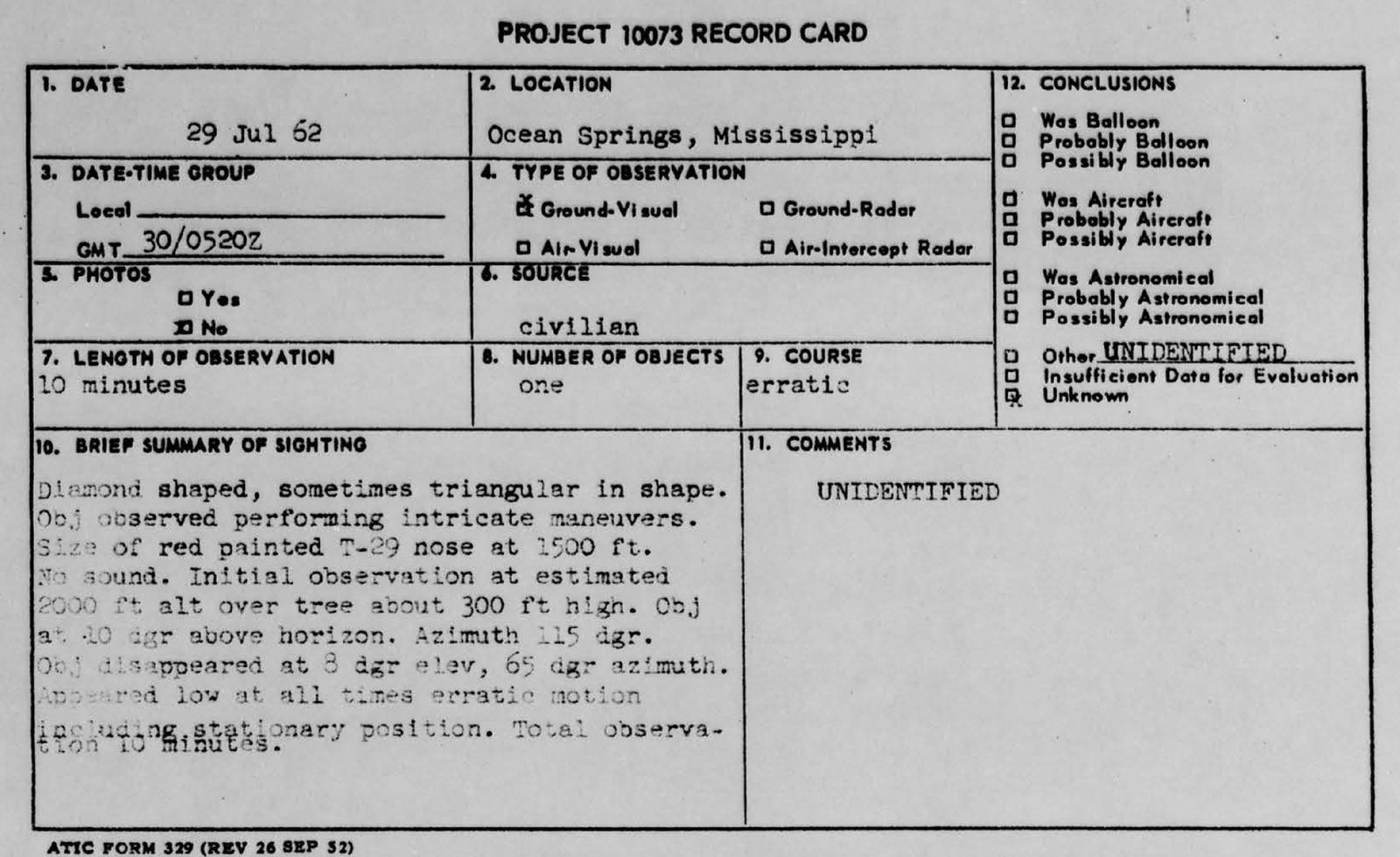
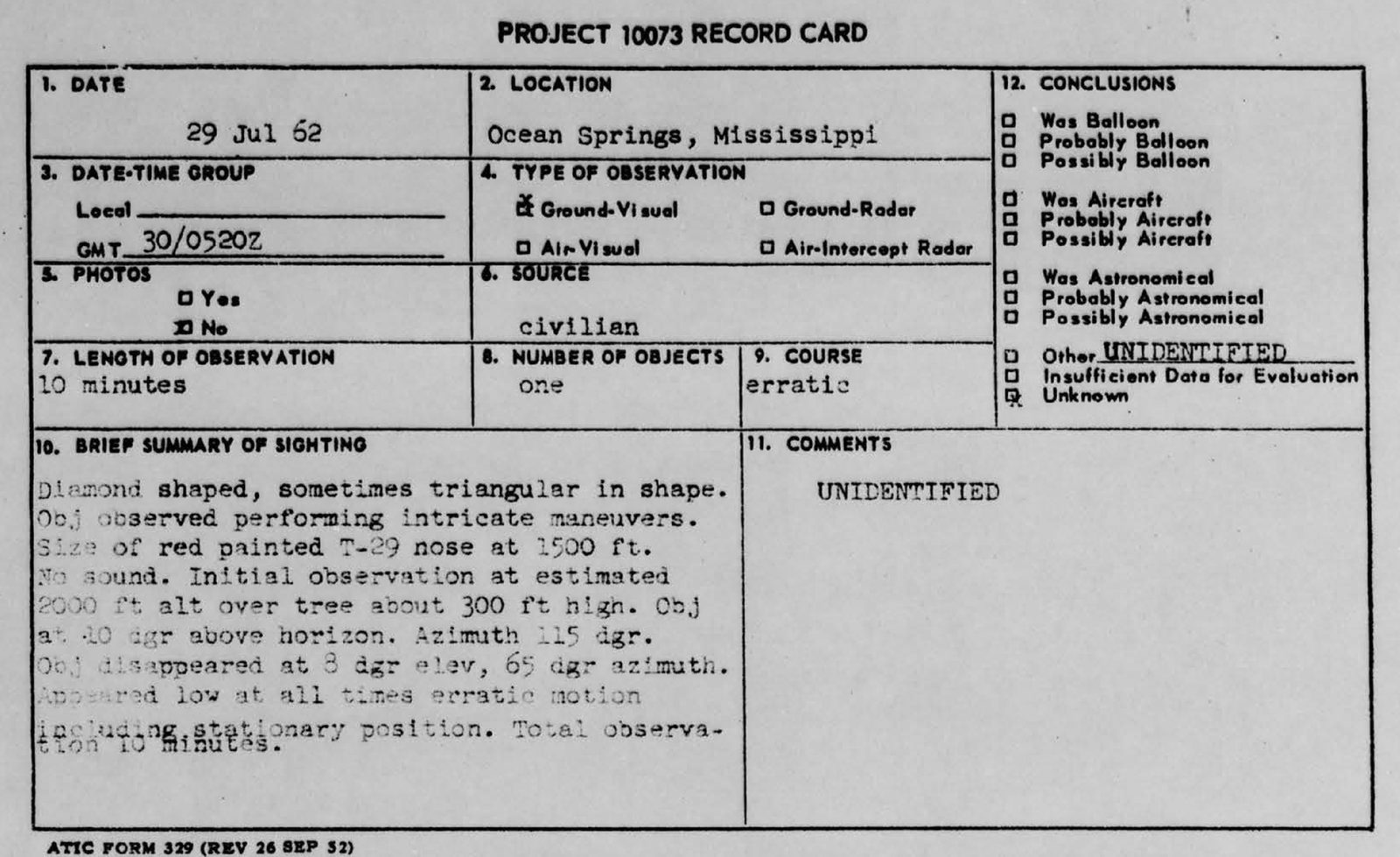
Pictured: the Project Blue Book record card for this case (Project 10073 Record Card, ATIC Form 329) — “29 Jul 62,” “GMT 30/0520Z,” Ocean Springs, Mississippi, ground-visual, source “civilian,” one object, ten minutes, course “erratic,” conclusion “Other: UNIDENTIFIED” with the Unknown box marked. It is the Air Force’s own index card, not a photograph; no photograph of the object exists. U.S. government record, public domain.
Theoretical Alignment
The Extraterrestrial Hypothesis gets a low score. Read literally, the report describes a silent red object a few hundred feet up that stopped, reversed and climbed in fractions of a second for ten minutes, which no aircraft of 1962 could do. But every part of that description is the behavior of a single point of light watched for a long time against a dark sky, and nothing in the file shows that the object had a size, a structure or a distance that anyone could check. Four people saw it, and they did not agree on its shape.
The Interdimensional Hypothesis has almost nothing to work with: a light appeared, moved and went out. The Psycho-Social score is the highest of the three, and still modest. The sighting spread through the house as an alarm, from a child to a teenager to the parents, with each new witness arriving primed by the one who called them; the Air Force-funded Condon study described exactly how a stationary light in a dark field comes to seem to move. Nothing suggests invention. The family were, in the investigating officer's words, "very sincere, anxious for an explanation."
Background
Ocean Springs in 1962
Ocean Springs sits on the east side of Biloxi Bay, across the water from Biloxi and Keesler Air Force Base. It is one of the oldest European settlements on the Gulf Coast: in April 1699 Pierre Le Moyne d'Iberville built a small wooden fort, Fort Maurepas, on "the east bank of Biloxi Bay (now Ocean Springs, Mississippi)," according to the Louisiana Historical Association's Dictionary of Louisiana Biography. The town was incorporated in 1854, and by the 1920s it was a resort community on the Louisville & Nashville railroad. It was still small in 1962: census figures compiled by the railroad historians of Mississippi Rails give 3,058 people in 1950 and 5,025 in 1960.
The family in this file lived north of the town center. The report places the house at 30°27′ N, 88°51′ W, "four NM northeast of Keesler AFB, Miss. 1,000 ft from abandoned private sod airstrip." Those coordinates, given only to the nearest minute of arc (about a mile), put the house about 5.2 miles (4.5 nautical miles) from Keesler on a bearing of 58°, which agrees with the report's own "four NM northeast," and about three miles north-northwest of the center of Ocean Springs (computed). The father's mailing address was "c/o Ocean Springs Seafood Co., Ocean Springs"; his occupation is given as "Salesman and truck driver."
Keesler in 1962
Keesler was the Air Force's main electronics school, as this site's Keesler AFB Weather Tower Sighting file sets out in more detail. Its headquarters in 1962 was Headquarters, Keesler Technical Training Center, under Air Training Command; the letterhead of this file's report reads "Keesler Technical Training Center (ATC)." A 1960 Keesler yearbook, excerpted by the Air Defense Radar Museum, lists among its courses "Officer training ... in the field of electronic warfare, air traffic control, weapons control (SAGE system)." The officer who investigated this case was an instructor in that course. The same museum's notes give 1741 as the Air Force specialty code for weapons controllers, which matches the "OBR1741B" after his name.
The report says nothing about flying at Keesler that night beyond the absence of traffic, but it does contain one small, telling detail of the base's daily routine. When the officer asked the father how big the object looked, the father compared it to "the red painted nose of a T-29," and the officer added that 1,500 feet was "my estimate of the height of a T-29 flying over as I questioned Mr. [redacted]." An Air Force T-29 flew over the house while the interview was going on.
Project Blue Book in 1962
In 1962 Project Blue Book was a small office in the Foreign Technology Division (FTD) at Wright-Patterson AFB, Ohio. FTD had existed only a year: on July 1, 1961, according to a history by the National Air Intelligence Center's historian, the Air Technical Intelligence Center (ATIC) was transferred to Air Force Systems Command and renamed the Foreign Technology Division. That is why Keesler addressed its report to "AFSC (FTD)," while the Air Weather Service, writing a week later, still addressed the same office as "Aerospace Technical Intelligence Center." The record card itself is still printed "ATIC Form 329."
The office was headed by Lt. Col. Robert Friend, a Tuskegee Airman who, as Smithsonian magazine recorded at his death in 2019, "led Project Blue Book ... between 1958 and 1963." He is named in this file's 1963 letter. Reports reached him under Air Force Regulation 200-2, and the version in force was brand new: Keesler's report cites "paragraph 14, AFR 200-2, 20 July 1962," a regulation issued nine days before the sighting. It remained in force until AFR 80-17 replaced it in September 1966. The report follows the regulation's lettered format, items a through l, with item k reserved for the preparing officer's own comments. When Blue Book closed in 1969, according to the National Archives, 12,618 sightings had been reported to it and 701 remained "Unidentified." This is one of them.
Complete Timeline
| Date / Time | Event |
|---|---|
| About 1950 ("approximately 12 years ago") | The father and his wife see "an orange object pass at a tremendous speed moving from north to south" (his account to the investigator). |
| About February 1962 | Driving his truck "about 130 miles north of Biloxi," the father stops to watch "two objects that looked like two moons side by side" for about 30 seconds until they disappear. |
| July 20, 1962 | AFR 200-2, the Air Force's UFO reporting regulation, is issued in a new edition. |
| July 29, 1962, evening | The family returns home from "local church activities." The Moon has set at about 5:36 PM CST; Jupiter rises at about 8:38 PM (computed). |
| 11:20 PM CST (0520Z, July 30) | The daughter, 9, lying on her bed, sees a large red diamond-shaped object "above the top of a tree measured 300 ft east of the house," at about 10° elevation and 115° azimuth. She calls her cousin, 15, who calls the father. |
| 11:20–11:30 PM | All four watch the object make "half loops," then "square movements," reversing over 20–25° of azimuth, staying between 8° and 15° elevation, and passing behind a pine tree 600 feet away. The father looks at it through binoculars. |
| About 11:30 PM (0530Z) | The object, now lower, "suddenly just went out" at about 8° elevation and 65° azimuth as an airliner approaches from the west and passes overhead; a jet then passes from east to west. |
| July 30–31, 1962 | The Weather Bureau station at Burrwood, Louisiana, about 107 miles south-southwest, makes its routine radiosonde ascents; the charts later go to Blue Book. |
| August 1962 (date not recorded) | Capt. Charles O. Williams interviews the family, measures distances and angles to the trees, and checks traffic and weather. |
| August 23, 1962 | Headquarters, Keesler Technical Training Center sends the four-page report to AFSC (FTD), signed for the commander by Lt. Col. Lester Bridges, Chief, Operations Services Division. |
| August 28, 1962, 9:30 AM EST | Sgt. Moody at Wright-Patterson telephones the Air Weather Service's Climatic Center in Asheville, North Carolina. |
| August 29, 1962 | The Climatic Center mails photocopies of the Burrwood adiabatic charts for July 29–31, "the closest station to Keesler AFB taking radiosonde observations." |
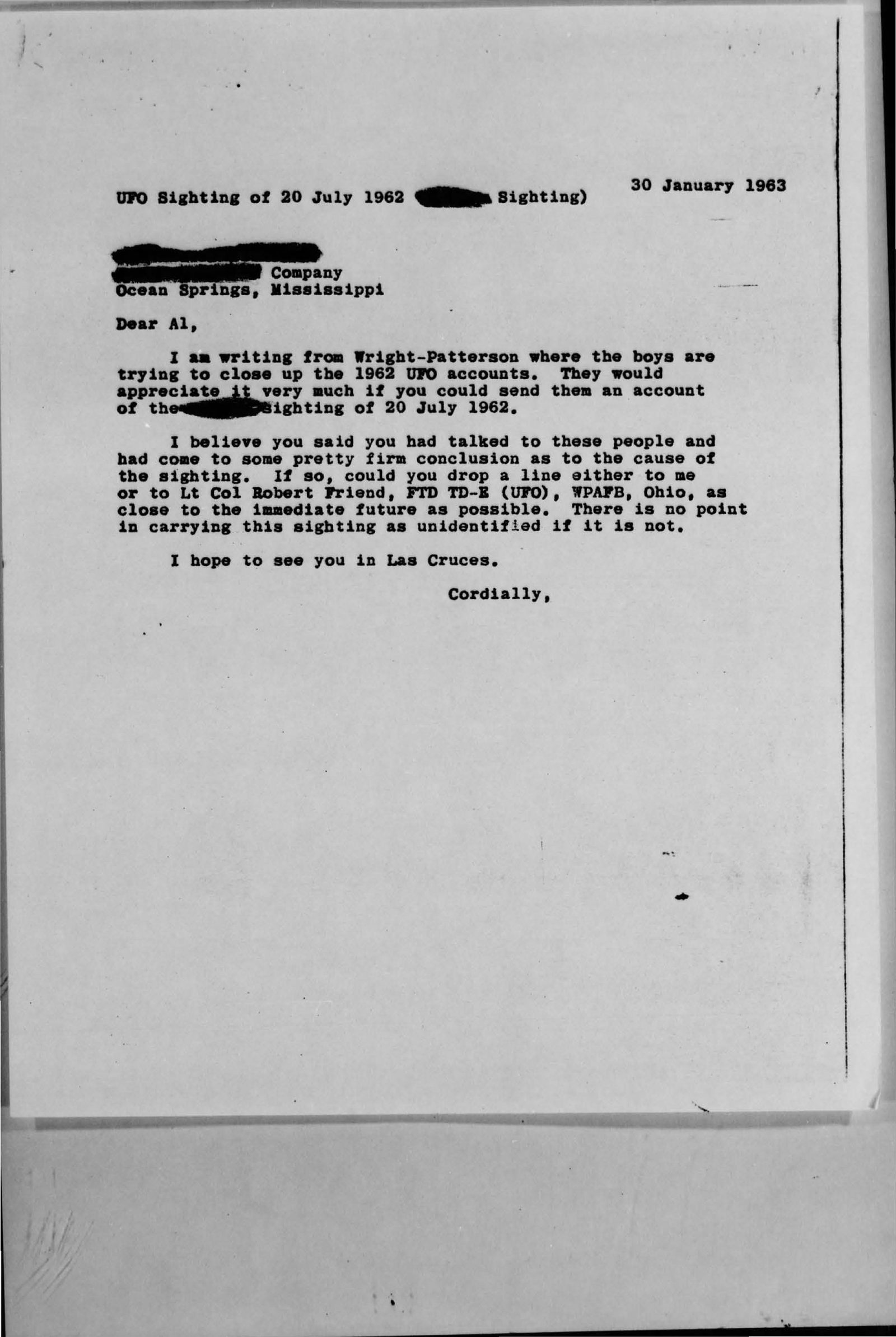
| January 30, 1963 | An unsigned letter, "Dear Al," addressed to a company in Ocean Springs, asks for an account of a sighting "of 20 July 1962" because "the boys are trying to close up the 1962 UFO accounts." No reply is in the file. |
| December 17, 1969 | The end of Project Blue Book is announced. The case remains on the record card as UNIDENTIFIED. |
| January 1974 | Don Berliner reads the unredacted file at Maxwell AFB for his list of Blue Book "unknowns." |
| May–June 2025 | Tim Printy's final SUNlite lists the case among the Blue Book unknowns he did not examine. |
What the Family Saw
The account in the file is not a witness statement. It is the investigating officer's narrative, written in the third person from interviews with all four witnesses, in paragraph b of Keesler's report. It is unusually full.
The daughter and the niece
The two girls shared a bedroom next to the parents' room. "While in bed the observer was called by his daughter [redacted] (age 9), and neice [sic], [redacted] (age 15) from their adjoining bedroom." The daughter, "while lying on her bed looking through a window observed a large red diamond-shaped object (estimated distance 2,000 ft) moving slowly above the top of a tree measured 300 ft east of the house." It was "first observed 10° above the horizon just above the top of a tree. The tree is 300 ft from the house and 115° azimuth."
The object "was moving very slowly from right to left at tree top level and sometimes appeared to be stationary. It appeared to be quite large and cast a red glow. As it continued to move from right to left, starting and stopping, increasing and decreasing in intensity, [the daughter] observed that it was now round and as there was no sound she became alarmed and called to her cousin [redacted] to look at the strange helicopter. She thought it must be a helicopter as it would stop perfectly still every little bit." The niece "saw a large round red object when she looked thru the open bedroom window. Seeing the strange object and hearing no sound she also became alarmed and called to her uncle ... in the adjoining bedroom to look at the strange object."
The maneuvers
"At this time the object began to make half loops very fast as it continued to move from right to left. It would go straight up move over a degree or so and come straight down to the same level that it had started, then repeat this many times. Then it began make square movements, moving from right to left. It would go straight up, stop for an instant, move left level, then stop for an instant, then go straight down to the same level that it began, stop just for a split second and then go left level and pause, then straight up again. It was moving in a square wave pattern."
"After moving 20° to 25° in azimuth it reversed and made the same square movement back to the starting point. It would go up, across, and down, in less than a second. As it accelerated and decelerated it would increase and decrease in brightness and change direction 90°. After returning to approximately the starting point it paused, then moved very fast level from 100° azimuth to 95° azimuth then back to 100° azimuth then back to 95° azimuth, then paused, all within one second. After this flash back and forth it continued to move to the left making square wave movements then reversing and repeating staying between 8° and 15° above the horizon."
"At this time it passed behind a pine tree, measured 600' from the house, and the red object could be seen thru the top of the tree." The parents had been watching "since beginning the fast maneuvering." The father "stated that the object looked rectangular to him but tilted away from him. His wife said it was just a big round red light to her." He tried binoculars: "Binoculars were used by [redacted] and the (rectangular almost on end) object just became more distinct and brighter."
The end
"When the object, moving to the left, came out from behind the tree it was lower on the horizon and suddenly just went out or disappeared as they became aware of the sound of engines of an airliner approaching from the west, which then passed overhead and droned on to the east. Before the sound of the engines faded a jet passed overhead from east to west. The object did not reappear." It "disappeared about 8° above the horizon at 65° azimuth very close by another tree. This tree was 600 ft from the house." It had been "visible for about ten minutes," from 0520Z to "about 0530Z," and it was watched "thru open window, window glass, and thru screen wire."
The rest of paragraph a fills in what was not seen. There was one object, no formation, no "discernible features," no "tail, trail or exhaust," and no sound. Its color was "bright cherry red varying in intensity as it maneuvered." Its shape was "Diamond, mostly round, sometimes rectangular." Its size was "half dollar at arms length."
Two Versions on Paper
The record card is Blue Book's own summary of the report, and it is not a careful one. It reads: "Diamond shaped, sometimes triangular in shape. Obj observed performing intricate maneuvers. Size of red painted T-29 nose at 1500 ft. No sound. Initial observation at estimated 2000 ft alt over tree about 300 ft high. Obj at 10 dgr above horizon. Azimuth 115 dgr. Obj disappeared at 8 dgr elev, 65 dgr azimuth. Appeared low at all times erratic motion including stationary position. Total observation 10 minutes."
Three details have changed in the copying. The report's "estimated distance 2,000 ft" has become "2000 ft alt." The tree "measured 300 ft east of the house" has become a tree "about 300 ft high." And "sometimes rectangular" has become "sometimes triangular." None of these changes alters the conclusion, but they matter to anyone who reads only the card, as most later catalogs did. The geometry shows which version is right. A tree whose top stood 10° above the horizon at 300 feet would be about 53 feet taller than the eye; the second tree, at 8° and 600 feet, about 84 feet (computed). Those are ordinary heights for Gulf Coast pines. A 300-foot tree would not be.
The size comparison also deserves a closer look. A half dollar is 1.205 inches across; at a typical arm's length of about 25 inches it covers roughly 2.8° of sky (computed), more than five times the width of the full Moon. Williams translated the father's half dollar into a more familiar military yardstick, the nose of a T-29 at 1,500 feet, and the card kept that version. Neither figure is a measurement of the object. They describe how big the light seemed, which, for a bright point of light, is a matter of glare and impression rather than of angular size.
The Investigation
Captain Williams
The report ends with item k: "Prepared by Capt Charles O. Williams 47026A, instructor in the SAGE, Weapons Controller Course, OBR1741B." The file does not say how a sighting by a civilian family reached Keesler, or why an instructor rather than an intelligence or operations officer took the report. What it does show is that he did more than write down what he was told: "I measured the distance to the trees mentioned and measured the angle of elevation to the top of the trees and the degrees in azimuth to the trees by compass." Every angle in the report, 10° and 115° at the start, 8° and 65° at the end, comes from that survey. They are the positions of tree tops that the witnesses pointed to, measured on the ground, not guesses about a point in the sky.
He also judged the witnesses. "All members of the family are very sincere, anxious for an explanation, and reliable in the eyes of neighbors as far as I can determine. They were awake at this hour because they had just returned from local church activities." And he gave his own assessment, as AFR 200-2 asked: "I have not been able to determine any possible cause for this sighting. The moon had not yet risen. There were no baloons [sic], search lights, or fireworks. There were no aircraft. There were no temperature inversions."
The checks behind those statements are partly recorded. Under item j he wrote: "No air traffic at Keesler AFB or Gulfport Municipal airport from several hours before sighting until the next morning." The weather came from the "8th Weather Detachment, Keesler AFB": surface wind calm, winds aloft "light and variable, calm," no ceiling, visibility 12 miles, "8,000 scattered, high thin overcast," no thunderstorms, and a "Temperature gradiant [sic] - 2° c per 1,000 ft, 28° c at the surface to 0° c at 14,000 ft." The family's own account of the weather was "stars shining, very light wind."
The report went out under the signature of Lt. Col. Lester Bridges, "Chief, Operations Services Div," "For the Commander," with a received stamp of August 23, 1962, more than three weeks after the sighting. Item l, "Comments," reads "None," and the report attaches nothing.
What the checks did not cover
Williams's traffic check was narrow. It covered Keesler and Gulfport Municipal, about 13 miles west-southwest of the house (computed). It did not mention Pascagoula, Mobile, Brookley AFB or the Navy fields around Pensacola, and it did not address en-route traffic overhead, of which there plainly was some: the family heard an airliner pass from west to east and a jet from east to west at the very end of the sighting. His statement that "there were no aircraft" therefore means no local departures or arrivals, not an empty sky. Nor does the file show any check of helicopters, which the daughter first thought she was seeing, beyond the general traffic statement.
The Burrwood Soundings
Blue Book did one piece of investigation of its own, and it is the bulkiest part of the file. Five days after Keesler's report was stamped, someone at Wright-Patterson telephoned the Air Weather Service. The reply, on the letterhead of the "Data Processing Division, Climatic Center, USAF, Air Weather Service (MATS), Asheville, North Carolina," dated August 29, 1962, is addressed to "Aerospace Technical Intelligence Center, Attn: Sgt. Moody, Wright-Patterson AFB, Ohio," and refers to "Your telephone call 0930 EST 28 Aug 1962." It reads, in full: "We are sending photocopies of Adiabatic Charts (WBAN 31) for soundings taken at Burrwood, Louisiana on 29 through 31 July 1962. Burrwood is the closest station to Keesler AFB taking radiosonde observations." It is signed by Pallas L. Tye, Jr., Captain, USAF, Administrative Officer. The sergeant's first name is not given, and this file does not guess it.
About 27 of the file's 36 pages are those charts: Weather Bureau Form WBAN-31A, "Adiabatic Chart," each recording one balloon ascent, with pressure, temperature, humidity and wind at successive levels plotted against height. The one shown in the gallery below is marked "Burrwood, Louisiana," 28°58′ N, 89°23′ W, July 29, 1962. Burrwood was a Weather Bureau office at the mouth of the Mississippi River; according to the National Weather Service's history of its Louisiana offices, it opened in March 1942 "to conduct upper-air observations" and was relocated to Boothville in February 1965. The station is about 107 miles south-southwest of the Ocean Springs house (computed).
What the charts were for
An adiabatic chart is the tool for finding a temperature inversion, a layer in which the air grows warmer with height instead of cooler. Inversions bend light, and a bent light can make a distant ground light, ship or star appear displaced, stretched, doubled or jumping. That was the explanation Blue Book was testing. Williams had already said there were no inversions, and the figures he quoted support him as far as they go: 28°C at the surface falling to 0°C at 14,000 feet is a fall of about 6.6°C per kilometer (computed), an ordinary steady decrease of temperature with height, with no inversion in the average. But a single average gradient from the surface to 14,000 feet can hide a thin layer near the ground, which is presumably why Blue Book wanted the soundings themselves.
The file does not record what Blue Book concluded from them. There is no memo, note or annotation analyzing the charts, and the card, which stayed UNIDENTIFIED, does not mention them. Two observations from the Condon Report bear on whether they could have settled anything. In its chapter on optical mirages, the atmospheric physicist William Viezee wrote that "principal characteristics of the optical mirage are the small elevation angles under which the phenomenon is observed (< 1°)," and that positive identification of a mirage requires "a complete set of meteorological and astronomical data," which "are practically never available for the specific place and time of observation." The family's object was never lower than about 8°, far above the band in which mirages appear. And in the chapter on radar, Roy Blackmer noted that "even if timely radiosonde data are available from a nearby location, the information they provide on the thermal and humidity gradient is often inadequate," because "shallow layers of abnormal refractivity commonly occur either close to the surface or at various levels aloft." A balloon released 107 miles away, over the river delta, could not have shown what the air was doing over a pine grove in Jackson County.
The soundings are best read as evidence of how Blue Book worked in 1962: faced with a detailed report and no obvious cause, it reached for the one conventional mechanism it could test from a desk, collected the data, and filed it. The case stayed unidentified.
That finding, like any official one, is an input rather than a verdict. Blue Book in this period is often criticized for forcing conventional labels onto reports, so an UNIDENTIFIED from it carries some weight: the office looked for a mirage and did not claim one. But the file shows no astronomical check, no interview by Blue Book's own staff, and no reasoning on the page. Its label cannot be audited beyond what the file shows, in either direction.
The Sky That Night
Williams's first check was the Moon, and he was right: "The moon had not yet risen." The obvious next question, which the file never asks, is what else was in the eastern sky. A bright planet or star low in the east, seen through a window screen and glass, flickering red through the thick air near the horizon, and drifting in the way a fixed light in a dark field seems to drift, is the first explanation any astronomer would test. The positions below were computed for this file for the report's coordinates (30.45° N, 88.85° W) at 05:20 and 05:30 UT on July 30, 1962, the start and end of the sighting. The Sun, Moon and planets come from NASA JPL's Horizons system; the stars were computed from their catalog positions, precessed to 1962, with a routine that reproduces Horizons' position for Jupiter to within 0.01°. Elevations are geometric; refraction would raise objects at 5–10° by roughly a tenth of a degree.
| Object | 11:20 PM CST (azimuth, elevation) | 11:30 PM CST | Brightness |
|---|---|---|---|
| Reported object | 115°, 10° (start) | 65°, 8° (end) | "Bright cherry red" |
| Jupiter | 124.6°, 32.0° | 126.7°, 33.7° | magnitude −2.8 |
| Saturn | 164.9°, 39.3° | 167.9°, 39.8° | magnitude +0.2 |
| Fomalhaut | 140.1°, 15.9° | 141.8°, 17.2° | magnitude 1.2 |
| Diphda (β Ceti) | 114.9°, 5.5° | 116.2°, 7.5° | magnitude 2.0 |
| Hamal (α Arietis) | 68.4°, 9.3° | 69.5°, 11.4° | magnitude 2.0 |
| Moon | below horizon (−39.8°) | below horizon | under 2% lit; rose 4:20 AM |
| Mars | below horizon (45°, −21.7°) | below horizon | rose 1:21 AM |
| Venus, Mercury | below horizon | below horizon | set in the evening |
Jupiter: bright, but in the wrong place
Jupiter was the brightest object in the night sky and was approaching opposition, which Horizons puts at about September 1, 1962 (Saturn's came on July 31–August 1). It had risen at about 8:38 PM CST, and by 11:20 it stood at an azimuth of about 125°, ten degrees to the right of where the girls first saw the object. But it was 32° up, more than three times the height of the tree top the daughter pointed to, and it climbed further while the family watched. It was not "at tree top level." Jupiter had been at 10° above the horizon at about 9:28 PM CST, at an azimuth of about 106° (computed), nearly two hours before the reported time. Nothing in the file suggests the time is wrong: it is given twice, as 0520Z and 0530Z, and the card agrees.
Diphda and Hamal: in the right places, but faint
Two ordinary stars sat close to the two measured positions. Diphda, the brightest star in Cetus, was at almost exactly the starting azimuth, 115°, but about 5.5° up, below the 10° tree top; it would have cleared that tree only after the sighting ended. Hamal, in Aries, stood at about 68° and 9° at the start and 70° and 11° at the end, close to where the object vanished. Both are second-magnitude stars, about as bright as the Pole Star. Neither is a light that "cast a red glow" or could be mistaken for a helicopter, and the object, by every account, moved continuously from one position to the other, not from one star to another.
The direction of travel
The decisive point is the motion. Every star and planet in the eastern sky that night was rising and moving to the right, toward the south: Jupiter's azimuth increased by about 2° and Diphda's by about 1.3° in the ten minutes of the sighting. The object went the other way, from 115° to 65°, fifty degrees to the left, staying between 8° and 15° up. No celestial body can do that. If the object was a star or planet, the witnesses' memory of its path, and the trees they used to mark it, would have to be wrong by a wide margin. That is possible, but it is not what the file says, and it is the sort of error Williams's survey was designed to prevent.
The "square wave" and autokinesis
The motion that made this case memorable is a different matter. In the Condon Report's chapter on perceptual problems, the psychologist Michael Wertheimer wrote: "Normally a single object in a completely unstructured field will soon appear to move, even though it is actually stationary. This phenomenon, autokinesis, is frequently studied by experimental psychologists." A bright point low in the sky also changes in brightness and color as the air between it and the eye shimmers; William Viezee's chapter notes that "atmospheric scintillation can introduce rapid variations in position, brightness, and color variations of the image." A light that seems to jump "a degree or so," stop, return and brighten "as it accelerated" fits both descriptions closely. Wertheimer also noted that a reference frame such as "the part of a window frame one concentrates on while looking through the window" changes how motion is perceived, and this family was looking through an open window, glass and screen wire at a light just above a tree line.
But autokinesis is a property of the viewer, not a source. It explains wandering around a fixed point, the "half loops" and the "flash back and forth" from 100° to 95°. It does not explain a steady fifty-degree drift from south of east to north of east over ten minutes, and it needs a light to act on. At the measured starting position, nothing brighter than a second-magnitude star was in the sky. The autokinetic reading therefore works best for the maneuvers and worst for the path, and it leaves the source unidentified.
Satellites were not checked for this file; reliable orbital elements for 1962 were not available to it. Printy notes that the Echo balloon satellite was "often reported" to Blue Book in this period, but a satellite crosses the sky steadily in one direction and cannot stop or reverse.
The 1963 Letter
The last document in the file is the strangest. It is a carbon copy of a typed letter dated January 30, 1963, with no signature, headed "UFO Sighting of 20 July 1962 ([redacted] Sighting)." The addressee's name is redacted; the second line of the address ends "Company," and the third reads "Ocean Springs, Mississippi." The letter reads:
Dear Al, I am writing from Wright-Patterson where the boys are trying to close up the 1962 UFO accounts. They would appreciate it very much if you could send them an account of the [redacted] sighting of 20 July 1962. I believe you said you had talked to these people and had come to some pretty firm conclusion as to the cause of the sighting. If so, could you drop a line either to me or to Lt Col Robert Friend, FTD TD-E (UFO), WPAFB, Ohio, as close to the immediate future as possible. There is no point in carrying this sighting as unidentified if it is not. I hope to see you in Las Cruces. Cordially,
Several things can be read from it, and several cannot.
- The date. It says July 20, not July 29. It may be a typing error, or a different sighting. A search of the Internet Archive's Project Blue Book collection finds no other file for Ocean Springs, and no other Mississippi file for July 1962; this letter was filed with this case, and its heading names a family sighting whose name is redacted, as this family's is.
- The address. The father's mailing address in the Keesler report was "c/o Ocean Springs Seafood Co." The letter went to a company in Ocean Springs. The redaction makes it impossible to say whether it was the same company.
- The writer. He was not a member of the Blue Book staff: he was "writing from Wright-Patterson," referred to "the boys," and offered Friend's office as an alternative address. He knew "Al" well enough to expect to meet him in Las Cruces, New Mexico. The file does not identify him, and this case file does not guess.
- "Al." He was not one of the witnesses. The writer says Al "had talked to these people," so he was someone in or near Ocean Springs who had interviewed the family independently, and who had, it seemed, reached "some pretty firm conclusion as to the cause." The file does not say who he was or what that conclusion was. Berliner's list, which records the names in the unredacted file, gives the witnesses' names but no "Al."
- The outcome. No reply is in the file. The record card still reads UNIDENTIFIED.
The letter matters for two reasons. It shows Blue Book, under Friend, actively trying to explain away an unidentified case six months after the fact, which fits what critics then and since have said about the office's priorities: "There is no point in carrying this sighting as unidentified if it is not." And it shows that someone outside the Air Force, who had spoken to the family, thought he knew the answer. If his conclusion was ever written down, it has not survived in this file, and nothing found for this case file records it.
The Father's Earlier Sightings
Williams asked the father whether he had seen anything like it before. His answer is quoted directly: "Approximately 12 years ago my wife, [redacted] and I saw an orange object pass at a tremendous speed moving from north to south; and about February 1962 I saw two objects that looked like two moons side by side. I stopped the truck I was driving and observed them for approximately 30 seconds until they disappeared. This happened about 130 miles north of Biloxi, Miss."
Neither earlier sighting appears to have been reported to the Air Force, and there is not enough in these two sentences to identify either. An orange object crossing fast from north to south, around 1950, describes a bright meteor as well as anything. Two "moons" side by side for 30 seconds, seen from a truck cab in February 1962, has no obvious explanation in the words given. A point about 130 miles north of Biloxi lies roughly at the latitude of Meridian, Mississippi (computed); the father's route is not recorded.
The answer cuts both ways. A witness with two previous sightings may be a more practiced watcher of the sky, or more ready to see something unusual in it. Williams recorded the answer without comment, and the family's reliability rests on his separate judgment of them and their neighbors, not on this.
1962 on the Mississippi Coast
This site's Keesler AFB Weather Tower Sighting file surveys the twelve Blue Book files whose titles name Keesler, from 1952 to 1967, and shows that where Blue Book could find a conventional cause for a Keesler report, it used one. That survey is not repeated here. The Ocean Springs file is not among them, because its title names the town, but a search of the Internet Archive's Blue Book collection for 1962 files naming places on the Mississippi coast finds four others from the same year. Their conclusions were read from the record-card images.
- April 7, 1962, Keesler AFB. The remains of a large polyethylene balloon recovered near the base, claimed by Capt. Joe Kittinger. Card: Was Balloon (see the Keesler survey).
- June 8, 1962, Biloxi (0100Z on the 9th). Military and civilian witnesses saw a very bright "oval or oblong" object with "two rows of lights at each end with one light in the middle" rise from 3° to 45° elevation in the west in five to seven seconds. Card: Was Astronomical, Meteor, with the comment that the object was visible "hardly time to notice the rptd detail given" and that the weather included "lightning, thunderstorms."
- July 29, 1962, Ocean Springs. This case. Card: Other: UNIDENTIFIED.
- September 21, 1962, west-southwest of Biloxi, in the Gulf (0134Z on the 22nd). From a fishing vessel, "pilot and deck hand" watched a dull red object "size of full moon with smaller object trailing" move slowly east for thirteen minutes. Card: Other: UNIDENTIFIED, with the comment "Venus in the initial position of sighting. No accounting for movement to the East." (Computed for this file: Venus, at magnitude −4.7, stood about 1.5° above the west-southwest horizon at that time and set a few minutes later.)
- October 14, 1962, six miles from Southwest Pass at the mouth of the Mississippi River (filed under "Mississippi"). An object "leaving contrail observed to explode after 4-5 seconds." Card: Was Astronomical, Meteor: "Although the witness indicated that the sighting was not meteor origin, the description conforms to that of a bolide."
The September case is the closest parallel. There Blue Book found a bright planet exactly where the sighting began, and still declined to call it Venus, because the object moved the wrong way: "No accounting for movement to the East." The Ocean Springs object also moved against the sky, from south toward north, and in its case Blue Book did not even record a planet at the starting point; the computation above suggests there was none bright enough to find. The pattern is consistent. In 1962, as in the Keesler files, the office applied meteor and balloon labels freely where they fit, and kept the unidentified label for reports whose motion it could not reconcile with the obvious source.
Across the twelve Keesler files, two were left unexplained. With Ocean Springs and the September Gulf case, three of the five Blue Book files from the 1962 Mississippi coast read here ended as identified and two as unidentified. Both of those two were long night sightings of red lights low in the sky, one of them reported by children first.
Later Catalogs
The case has had almost no attention since 1962. The searches made for this file found no press coverage, later interview or follow-up investigation; local newspapers of the time were not searched page by page. It survives in the catalogs of Blue Book unknowns, which all descend from one source.
- Don Berliner (1974). In January 1974 Berliner read the unexplained cases in the original files at the Air Force Archives at Maxwell AFB, before the names were blacked out for public release, and compiled "The Blue Book Unknowns" for the Fund for UFO Research. His entry reads: "July 29, 1962; Ocean Springs, Mississippi. 11:20 p.m. Witnesses: Mr. and Mrs. [names]. One bright cherry-red, diamond-shaped object flew slow, hovered, made fast 1/2 loops for 10 minutes." Berliner names the couple from the unredacted file. This case file does not repeat the names, which the National Archives' release redacts. His entry also counts two witnesses; the report shows four, and the girls saw the object first.
- Patrick Gross reproduces Berliner's entry, names included, in his year-by-year transcription of the unknowns on UFOs at Close Sight, with an explanation of how Berliner obtained the names.
- Brad Sparks, in version 1.35 (February 3, 2026) of his "Comprehensive Catalog of 2,200 Project Blue Book UFO Unknowns," dates it "July 29 [30?], 1962," reflecting the Greenwich date, and repeats Berliner's summary, crediting it to Berliner.
- Tim Printy, the skeptic whose "701 Club" series in SUNlite examined Blue Book's unknowns one by one, never gave this case an article. His last regular issue (vol. 17, no. 3, May–June 2025) lists it as number 402 among "the remaining unknowns," the sightings left after removing those he examined in his 701 Club articles, with a summary drawn from the record card: "Object observed to have been performing intricate maneuvers. Initial position 115 degree azimuth and 10 degrees elevation. Disappeared at 65 degrees azimuth and 8 degrees elevation. Motion was erratic and duration 10 minutes."
Every catalog entry takes its description from either Berliner's notes or the card, and none from the four-page report. The report's specific language, the "square wave pattern," the measured trees, the binoculars and the airliner, has not appeared in any of them.
Key Witnesses
The daughter (name redacted)
Saw the object first, from her bed, "looking through a window," as a "large red diamond-shaped object" above a tree east of the house; later saw it as round, took it for "the strange helicopter," and called her cousin. Her pointing to the first tree fixed the starting position Williams later measured.
The niece (name redacted)
Saw "a large round red object" through the open bedroom window, heard no sound, "became alarmed," and called her uncle from the adjoining bedroom.
The father (name redacted)
Watched from the start of the "fast maneuvering." The object "looked rectangular to him but tilted away from him"; through binoculars it "just became more distinct and brighter." He gave the size as a half dollar at arm's length and described two earlier sightings of his own.
The mother (name redacted)
Watched with her husband; to her it was "just a big round red light." The report records her as a witness, with her husband, to an orange object about twelve years earlier.
Charles O. Williams
Not a witness. Interviewed all four family members, measured distances, elevations and compass azimuths to the trees, checked local traffic and weather, and wrote that he could not "determine any possible cause for this sighting."
Lester Bridges
Not a witness. Signed Keesler's report to FTD "For the Commander."
Robert Friend
Not a witness. Named in the unsigned January 1963 letter as the officer to whom an explanation could be sent.
The family's names are redacted throughout the released file and are not given here.
The Five Observables Assessment
The Five Observables framework, associated with former AATIP director Luis Elizondo, classifies UAP reports by performance characteristics beyond known technology. Read at face value, this report claims one of them strongly; read against what is known about a light watched at night, it claims none securely.
Assessment:
- Anti-gravity lift (speculative). Silent hovering at an estimated 2,000 feet, "stop perfectly still every little bit," with no sound in a calm night. Only meaningful if the object was a nearby body, which nothing in the file establishes.
- Instant acceleration (speculative). "Up, across, and down, in less than a second," with 90° changes of direction. This is the report's central claim, and it is also the textbook description of autokinetic and scintillation effects on a point of light.
- Hypersonic speed (absent). Over ten minutes the object covered about 50° of azimuth; its quick moves spanned a degree or a few degrees.
- Low observability (absent). It was a bright light that "cast a red glow."
- Trans-medium travel (not applicable).
On this framework the case is weak. Its interest lies in the number of witnesses, the quality of the survey and the absence of an obvious source, not in demonstrated performance.
Evidence Assessment
Supporting Anomalous Origin
- Four witnesses in one house, two of them adults, watching for about ten minutes; the investigating officer found them "very sincere" and well regarded by neighbors.
- The start and end positions are measured, not guessed: an Air Force officer surveyed the trees by compass and angle.
- No bright star or planet was at the measured starting position; Jupiter, the obvious candidate, was 22° higher.
- The object moved about 50° against the diurnal motion of every celestial body in that part of the sky.
- No local air traffic, no balloons, searchlights or fireworks, and no inversion, according to the investigator; Blue Book checked for a mirage and kept the case UNIDENTIFIED.
- Binoculars made the object "more distinct and brighter" and showed a shape, "rectangular almost on end."
Supporting Conventional Explanation
- A single red light at night, low in the sky, seen through an open window, glass and screen wire: no structure, no sound, and four different shapes from four witnesses.
- The "square wave" jumps, stops and reversals are characteristic of autokinesis and atmospheric scintillation acting on a point of light.
- The sighting spread by alarm from a nine-year-old to the rest of the household, each new witness primed by the last.
- Aircraft were in the sky: an airliner and a jet passed overhead as the object vanished, and the traffic check covered only two local airfields.
- A private correspondent who had talked to the family reportedly reached "some pretty firm conclusion as to the cause"; it is lost.
- No photograph, radar return or physical trace exists, and the investigation took place weeks later.
Why "Disputed"
The Ocean Springs Family Sighting is stamped DISPUTED with a score of 40/100. Its strengths are real for a 1962 night sighting: four witnesses at one location for ten minutes, an investigating officer who went to the house and measured the angles instead of estimating them, an Air Force check for a mirage that came back empty, and, computed for this file, the absence of any bright planet or star at the measured starting point, together with a path that runs against the motion of the sky. Its weaknesses are just as specific. The object was only a red light, low over a tree line, watched through glass and screen; the witnesses could not agree on its shape; its most striking behavior is exactly what a fixed light seems to do when watched in the dark; the sighting spread by alarm through a household of children and adults just home from church; and the traffic check left the skies above and around the house unaccounted for, though aircraft were demonstrably passing.
Among this site's Mississippi Blue Book cases, it sits just above the Keesler AFB Weather Tower Sighting (Disputed, 38), which had a single trained observer and a strong fireball candidate, and the earlier Keesler AFB Sighting (36), because this case has more witnesses, a longer duration and no specific conventional candidate that fits. It sits below the Meridian "Flying Cymbal" (44) and the Jackson Airborne Sighting (46), both daylight sightings of structured objects, because a light at night carries much less information than a shape seen by day. The UNIDENTIFIED label is weighed as one input: Blue Book looked for one explanation and did not find it, never recorded looking for others, and was still trying to find one six months later.
Sensor & Instrumentation Detection Profile
No instrument recorded the object.
- Optical aids. Binoculars, used by the father; the object became "more distinct and brighter" and looked "rectangular almost on end." Their power is not recorded.
- Survey instruments. A compass and an elevation measurement, used weeks later by Williams to fix the positions of the trees the witnesses pointed to.
- Air traffic. Keesler and Gulfport Municipal reported no traffic for hours before and after. No radar data are mentioned.
- Weather instruments. Keesler's weather detachment supplied surface and upper-wind observations and a temperature gradient; the Climatic Center supplied the Burrwood radiosonde charts for July 29–31.
- Cameras. None; the card marks "Photos: No."
Environmental & Geospatial Context
The house stood north of Ocean Springs, about 5.2 miles east-northeast of Keesler, 13 miles from Gulfport's airport, and about 18.5 miles west-northwest of Pascagoula (all computed from the report's coordinates). The family looked east. The starting azimuth, 115°, points across the Jackson County woods toward the Pascagoula area, which lies at about 108°; the end point, 65°, points north of east, inland. Any fixed light on the ground in those directions, a tower or a ship's mast at Pascagoula, for instance, would have stood within a fraction of a degree of the horizon at that distance, not 8° to 15° above it over the trees. The report also places the house "1,000 ft from abandoned private sod airstrip." No activity there is mentioned.
Weather
It was a calm summer night. Keesler's weather detachment gave the surface wind as calm and the winds aloft as "light and variable, calm," with no ceiling, 12 miles' visibility, scattered cloud at 8,000 feet and a "high thin overcast," and no thunderstorms; the family said "stars shining, very light wind," and the report notes "some stars visible." A calm night matters in two ways. It makes a drifting balloon an unlikely source of a fifty-degree traverse, and it means that a helicopter or aircraft within a mile or so should have been heard, as the airliner was. The "high thin overcast" also matters: thin high cloud would have dimmed faint stars, leaving the brightest lights, and any aircraft lights, the most prominent things in the sky.
The Moon and twilight
Computed with JPL Horizons for the house's coordinates: the Sun set at about 6:52 PM CST and was nearly 40° below the horizon during the sighting, so the sky was fully dark. The Moon, a thin crescent less than 2% lit two days before new, had set at about 5:36 PM and did not rise until about 4:20 AM. Williams's statement that "the moon had not yet risen" is correct.
Observer Credibility & Occupational Profile
The witnesses were a family: a salesman and truck driver, his 35-year-old wife, their nine-year-old daughter and his fifteen-year-old niece. None had any training in observing the sky, and none claimed to know what the object was; the daughter's first guess was a helicopter. Williams's assessment of them is the only one on record: "very sincere, anxious for an explanation, and reliable in the eyes of neighbors as far as I can determine." There is no sign of publicity-seeking: no press account of the sighting was found, and the family's names survive outside the Air Force file only through Berliner's notes.
The account has the virtues and the limits of a group sighting in a single house. Four people agreeing that a light was there, and that it moved, makes it very unlikely that the light was imagined. It does not make their perceptions of its motion independent: they watched the same light, through the same windows, after being called to it by someone already frightened. Their disagreement on shape, diamond, round, rectangular, "just a big round red light," is itself informative; it is what one would expect if there was no shape to see. The father's two earlier sightings show a man who had looked at the sky and found things in it before. The investigating officer's work is the strongest element: he fixed the observations to physical landmarks and recorded the answers carefully, including the ones that did not help the case.
Physical & Material Assays
No physical evidence exists. The object never came near the ground, nothing was searched for or recovered, and the file contains no reference to traces of any kind.
Historical Precedents & Archive Matches
- September 21, 1962, west-southwest of Biloxi. A red light seen from a fishing boat, which Blue Book declined to call Venus because it moved east, against the planet's motion; carried as UNIDENTIFIED. The closest parallel in the Blue Book files.
- April 4, 1965, the Keesler AFB Weather Tower Sighting. The next unidentified case from the immediate area, reported by a weather observer about five miles away, and the file whose survey of Keesler's Blue Book record this case builds on.
- February 9, 1977, the Flora, Mississippi Police Encounter. Officers' reports of distant lights later attributed by the Center for UFO Studies to Venus and Jupiter; a Mississippi case where planets were in the right place.
- January 6, 1969, the Jimmy Carter Sighting. A group watching a bright light low in the sky that changed color and seemed to approach and recede, a case often discussed in terms of Venus.
- October 11, 1973, the Pascagoula Abduction. Mississippi's best-known case, on the Pascagoula River about 18 miles east of the Ocean Springs house; no connection beyond geography.
- April 18, 1961, the Eagle River Pancake Incident. Another case from Robert Friend's years in charge of Blue Book.
Material Analysis
There is no material to analyze. This section looks instead at the physical description and what each explanation predicts for it.
The color and the glow
"Bright cherry red," "varying in intensity," and enough to "cast a red glow." Stars and planets near the horizon redden and flicker because their light passes through a long column of turbulent air, and the Condon Report's optical chapter notes that scintillation varies an image's "position, brightness, and color." But a star at 10° is not normally a saturated cherry red, and no star or planet casts a visible glow. An aircraft's red light, by contrast, is red because it is meant to be, and a red light can light up haze. The "glow" may also be the daughter's impression of a bright light seen through window glass and screen, which scatter light into a halo.
The shape
Diamond, round, rectangular, triangular on the card, "rectangular almost on end" through binoculars. A point source viewed through screen wire and glass, or through slightly misfocused binoculars, can take on the shape of the optics; a bright light also produces star-shaped glare in the eye. Four different shapes from four people looking at the same light suggest that no one saw a shape that was there to be seen.
The silence and the disappearance
No sound, on a calm night, at an estimated 2,000 feet, from something the size of a T-29's nose at 1,500 feet. If the estimate of distance was right, the object made no audible sound, while an airliner passing at cruising height was clearly heard. If it was far away, the silence is expected. The object "suddenly just went out" as the airliner approached. That can be read as coincidence, or as the moment the witnesses' attention moved to the sound, or as a light switched off or turned away, and the file gives no way to choose.
Supporting Non-Terrestrial or Anomalous Origin
- A red light that stopped, reversed and moved in rapid right-angle steps for ten minutes, silent on a calm night.
- Its measured positions match no bright star or planet, and its path ran against the sky's motion.
- Binoculars showed it brighter and more distinct, with a definite outline.
Supporting Terrestrial Origin
- No physical, photographic or instrumental evidence exists.
- The object was a light only; the four witnesses saw four different shapes.
- Its jumps and pauses match well-documented perceptual effects on point lights, and aircraft were in the sky as it disappeared.
The Conventional Explanation Candidate
No explanation was established at the time, and none can be proved now. Blue Book's UNIDENTIFIED is treated here as one input, for the reasons given above: it records a failed search for a mirage, not a positive finding.
A star or planet, with autokinesis
The classic explanation for a long, low, red, jittering light at night. It fits the color, the flicker, the silence, the shapeless shape, the binocular view and, above all, the "square wave" jumps. It fails on position and path. Jupiter, the only light in the eastern sky bright enough to alarm a household, was 22° above the measured starting point; the stars at the measured positions were faint; and the object moved fifty degrees in the opposite direction to every celestial body. To make it work, the witnesses' memory of where the light was, recorded weeks later against trees they pointed out, would have to be wrong by twenty degrees or more.
A distant aircraft, with autokinesis
An aircraft's light, far enough away to be silent, moving slowly across the eastern sky from south to north, would account for the steady leftward drift that no star can, and for a light that was red. Seen through a window for ten minutes, it would be subject to the same autokinetic jumps. The numbers constrain it (computed): for an aircraft crossing the line of sight, fifty degrees in ten minutes means about 50 mph at 10 miles or about 100 mph at 20 miles, and to stay 8° to 15° up it would have to be at roughly 7,000–14,000 feet at 10 miles or 15,000–28,000 feet at 20 miles. A distant, high aircraft, or one flying partly toward the house, would fit; a nearby one would not. Against it: Williams found no traffic at the two local airfields; the light's brightness varied, but it was not described as flashing; and it seemed to hover. But the traffic check did not cover Pascagoula, Mobile or en-route flights, and aircraft were certainly in the sky. This is the candidate the file does least to exclude.
A helicopter
The daughter's first thought, because "it would stop perfectly still every little bit." A helicopter can hover and move slowly, but at an estimated 2,000 feet on a calm night it would have been heard, and the family heard nothing until the airliner. A distant helicopter would be silent and would reduce to the aircraft candidate above.
A balloon
Williams found none, and the wind was calm at the surface and "light and variable, calm" aloft. A lighted balloon drifting fifty degrees in ten minutes in still air is unlikely, and a balloon would not jump.
A mirage or refraction effect
The explanation Blue Book tested by sending for the Burrwood charts. Mirages appear within about a degree of the horizon; this object was 8° to 15° up. Williams reported no inversion, and Keesler's overall gradient was a normal lapse rate. Unlikely, though a sounding 107 miles away could never have ruled it out.
A genuine unidentified object
On this reading, a silent red object hovered a few hundred feet above the trees outside Ocean Springs for ten minutes, moving in rapid right-angle steps, and switched off as an airliner approached. It rests on four sincere witnesses, a careful survey and the absence of an astronomical source. It is weakened by everything that makes a light at night, watched through a window, so hard to interpret, and by the fact that the behavior that makes it remarkable is the behavior the eye supplies. The record cannot separate the two.
Distant Aircraft + Autokinesis
PossibleExplains the leftward drift, the red light and the silence; aircraft were overhead and the traffic check was narrow. No specific flight identified; it needs a distant, high aircraft, and the light seemed to hover and was not described as flashing.
Star or Planet + Autokinesis
UnlikelyFits the jitter and color, but no bright body was at the measured positions; Jupiter was 22° higher, and the path ran against the sky.
Helicopter
Unlikely but UnexcludedThe daughter's guess; at the estimated distance it would have been heard on a calm night.
Balloon
ImplausibleCalm air, none found, and no balloon jumps.
Mirage / Refraction
ImplausibleBlue Book's own test. Mirages appear within about 1° of the horizon; the object was 8°–15° up.
Genuine Unidentified Object
InconclusiveFour sincere witnesses and no astronomical source; but only a light, and its remarkable motion is what the eye supplies.
Related Cases
Confirmed Documents & Official Records
From the Project Blue Book File
Eight pages of the 36-page Project Blue Book file for this case, as read for this case file: the record card, the four pages of Keesler's report, the Climatic Center's letter, one of about 27 Burrwood adiabatic charts, and the unsigned letter of January 30, 1963. U.S. Air Force records, public domain (Project Blue Book, Internet Archive item 1962-07-8686654-OceanSprings-Mississippi); the family's names were redacted before release. Click any page to open it full size.
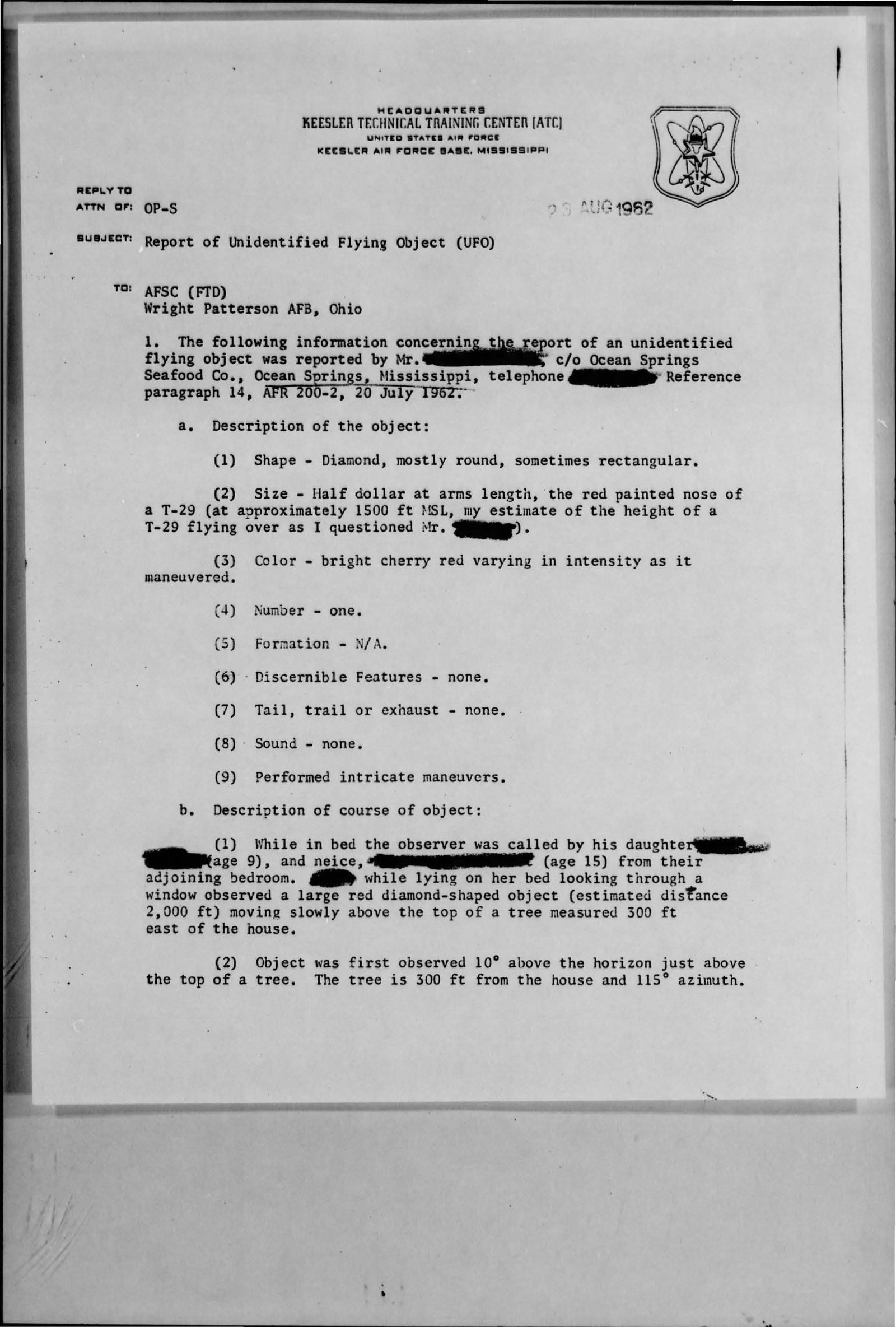
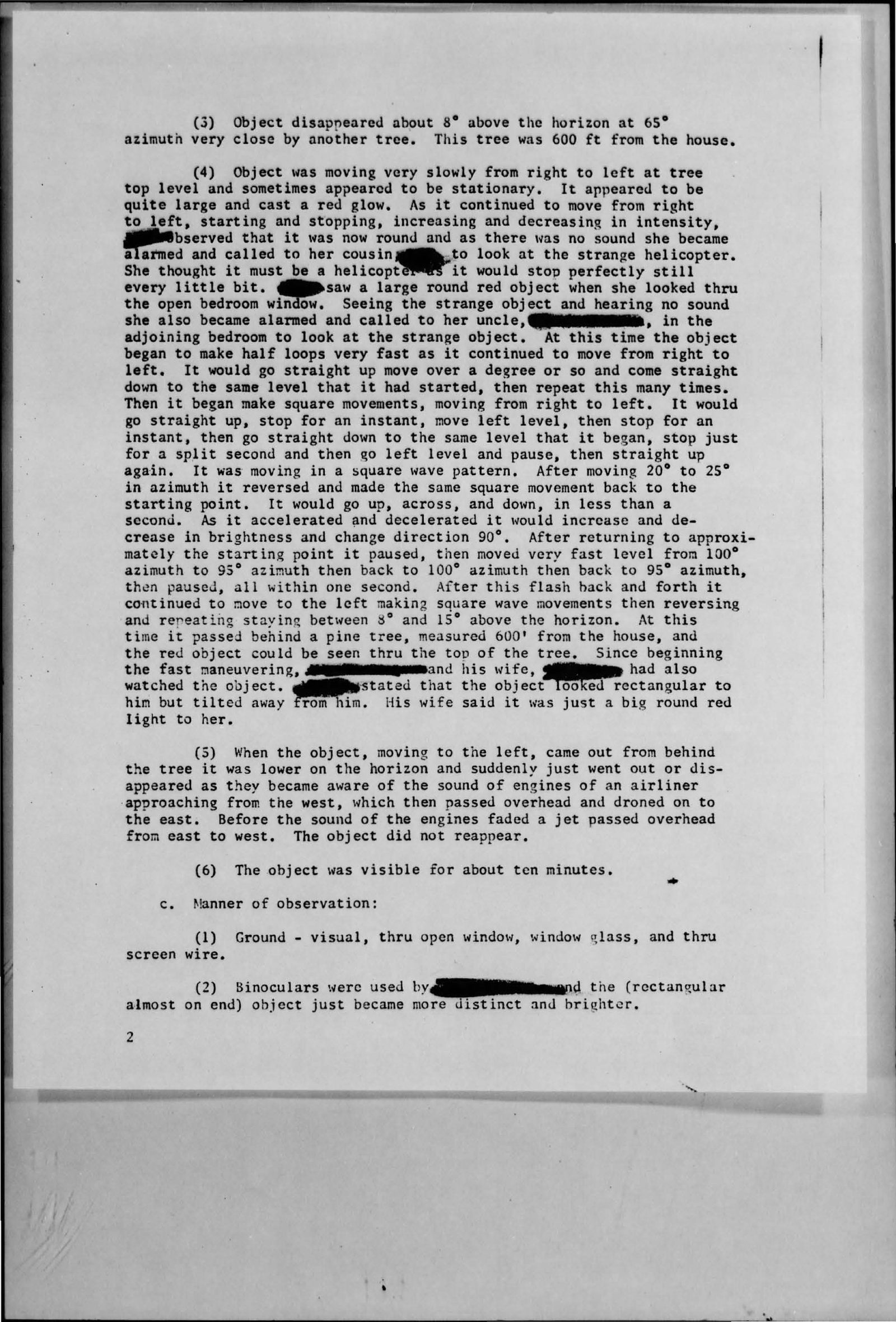
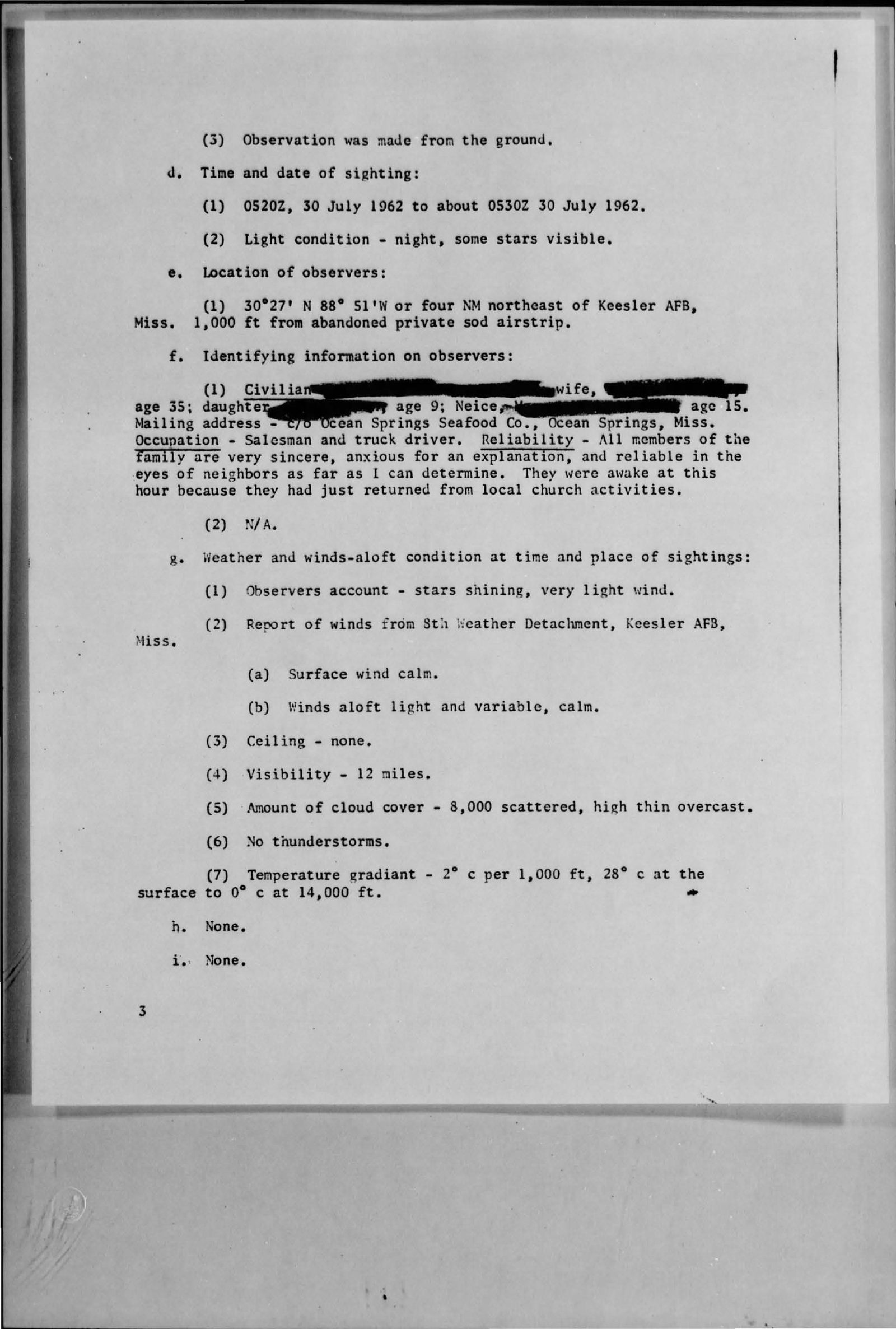
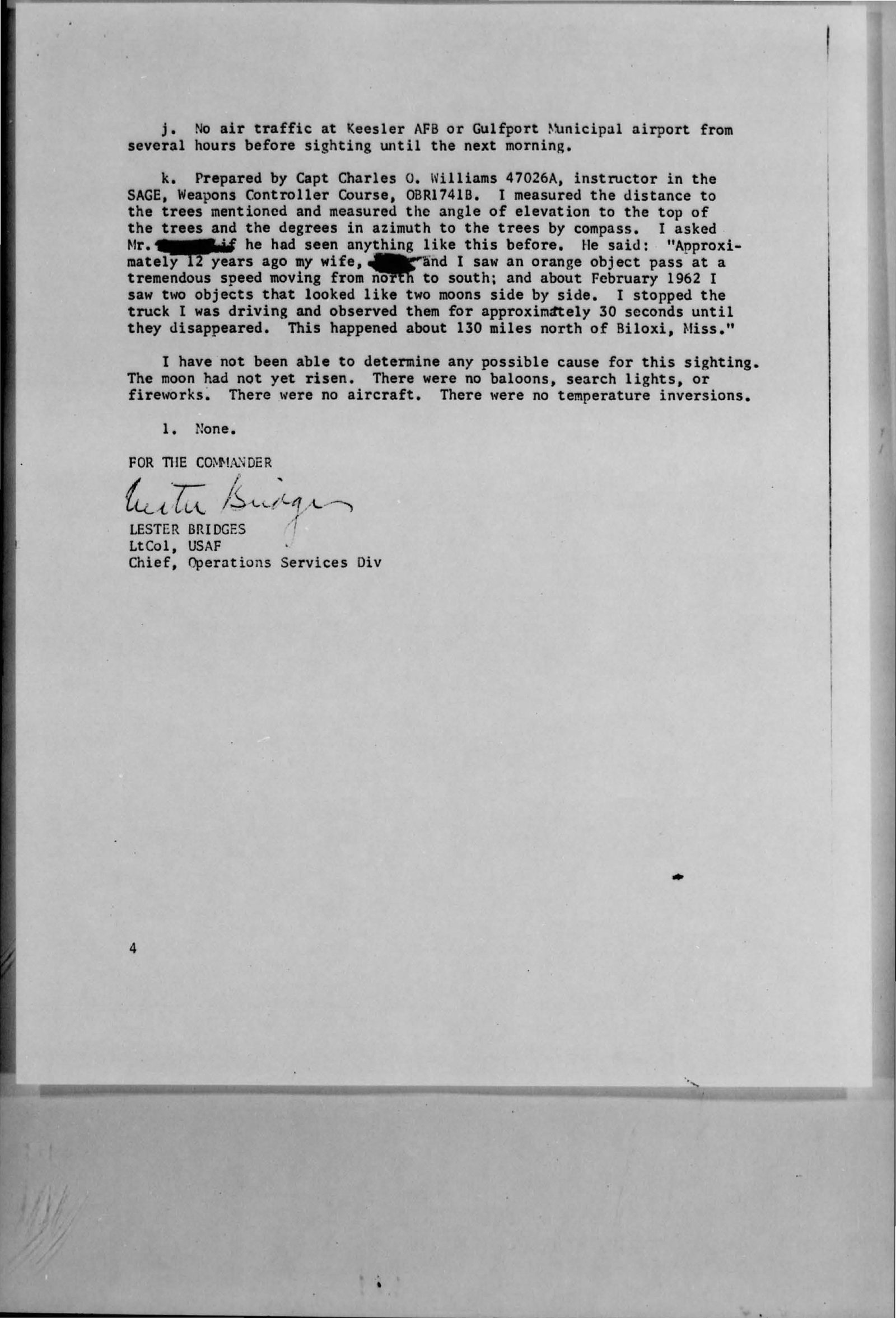
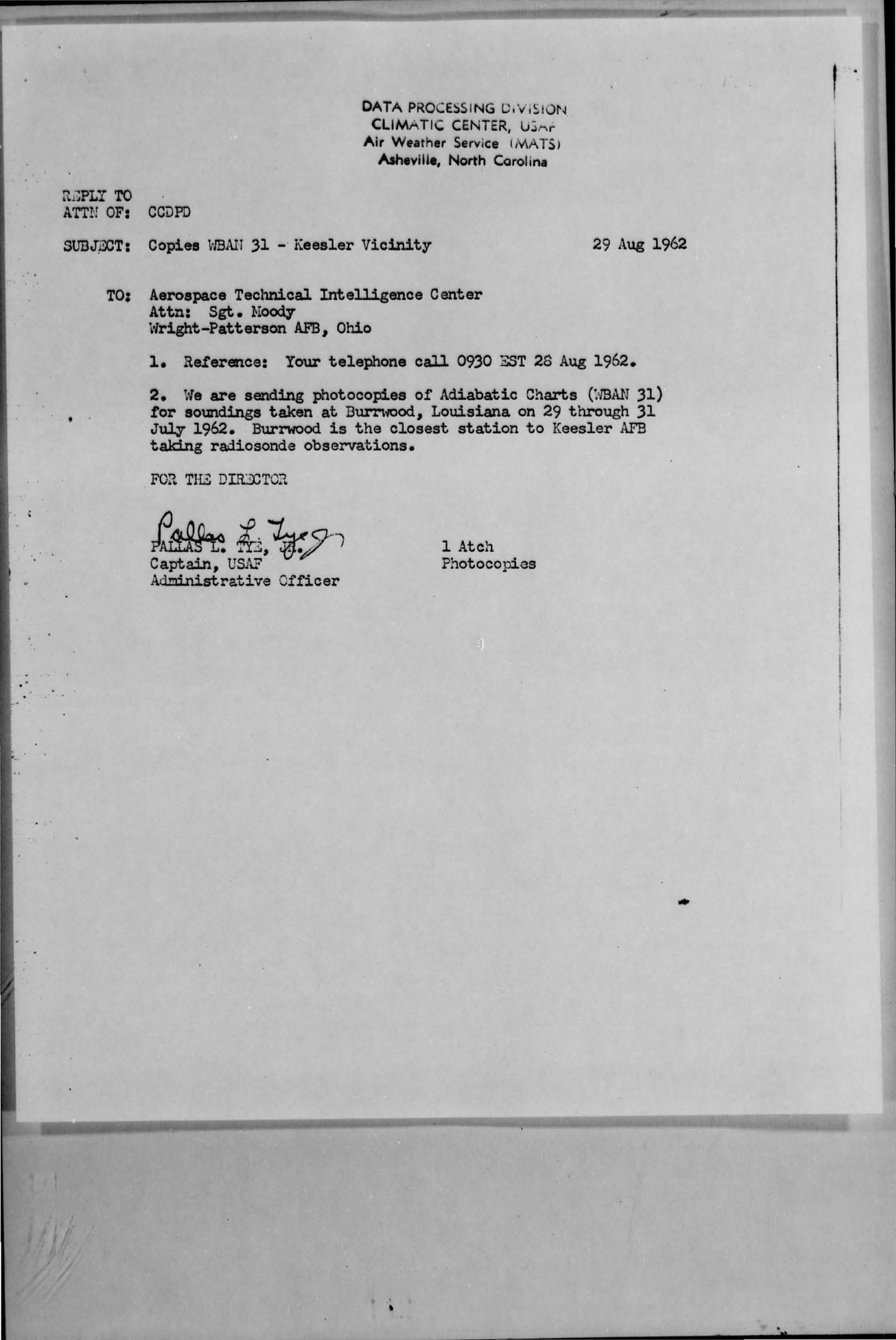
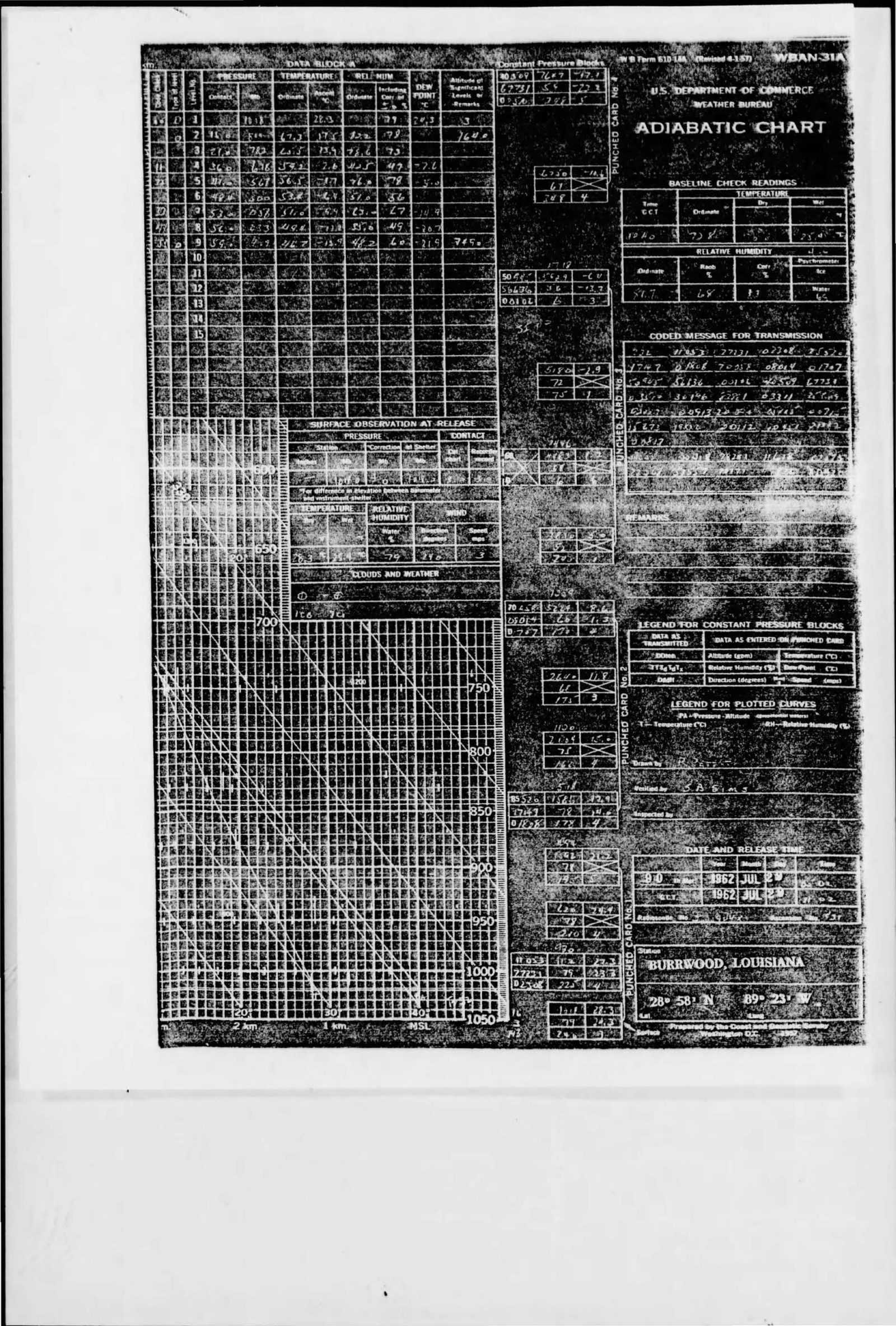
The 36-page released Project Blue Book file for this case (Fold3 file 8686654), part of the Internet Archive's Project Blue Book collection. The primary source for this case file; the page images were read directly.
UNCLASSIFIEDThe Blue Book file for the September 21, 1962 sighting from a fishing vessel in the Gulf west-southwest of Biloxi, also carried as UNIDENTIFIED: “Venus in the initial position of sighting. No accounting for movement to the East.”
UNCLASSIFIEDThe catalog series for the released, name-redacted Blue Book case files (Record Group 341), filmed as microfilm publication T1206.
UNCLASSIFIEDNARA's fact sheet on Project Blue Book: 12,618 sightings reported from 1947 to 1969, 701 unidentified; termination announced December 17, 1969.
UNCLASSIFIEDSearch Government Archives Directly
Further Reading — Recommended Literature
The UFO Experience: A Scientific Inquiry
Blue Book's astronomical consultant on how the project sorted night lights, stars and planets from the reports it could not explain.
The Hynek UFO Report
Hynek's account of the Blue Book files and of the count of unidentified cases, including the 1960s under Friend and Quintanilla.
UFOs and Government: A Historical Inquiry
A documented history of official UFO investigation, including Blue Book's quiet early-1960s years.
DISCLOSURE: Some links above are affiliate links. If you purchase through them, OverClassified receives a small commission at no additional cost to you. This helps support independent research.
Essential Viewing
No Videos Available
Sources
- U.S. Air Force, Project Blue Book. Record card, “29 Jul 62 — Ocean Springs, Mississippi,” GMT 30/0520Z (Project 10073 Record Card, ATIC Form 329; conclusion “Other: UNIDENTIFIED,” Unknown marked). In Blue Book file “1962 07 8686654 OceanSprings Mississippi”: archive.org
- Headquarters, Keesler Technical Training Center (ATC), OP-S. “Report of Unidentified Flying Object (UFO),” to AFSC (FTD), Wright-Patterson AFB, stamped 23 August 1962, four pages; prepared by Capt. Charles O. Williams; signed for the commander by Lester Bridges, Lt. Col., USAF, Chief, Operations Services Division; citing “paragraph 14, AFR 200-2, 20 July 1962.” Same file: archive.org
- Data Processing Division, Climatic Center, USAF, Air Weather Service (MATS), Asheville, N.C. Letter, “Copies WBAN 31 – Keesler Vicinity,” 29 August 1962, to Aerospace Technical Intelligence Center, Attn: Sgt. Moody; signed Pallas L. Tye, Jr., Captain, USAF. Same file: archive.org
- U.S. Department of Commerce, Weather Bureau. Adiabatic Charts (Form WBAN-31A), Burrwood, Louisiana (28°58′ N, 89°23′ W), soundings of 29–31 July 1962 (about 27 pages, photocopies). Same file: archive.org
- Unsigned letter (carbon), “UFO Sighting of 20 July 1962 ([redacted] Sighting),” 30 January 1963, to [redacted] Company, Ocean Springs, Mississippi (“Dear Al”), naming Lt. Col. Robert Friend, FTD TD-E (UFO). Same file: archive.org
- Internet Archive. “1962 07 8686654 OceanSprings Mississippi” (U.S. Air Force, 36 pages; Project Blue Book collection, contributed by Michael Best). archive.org
- U.S. Air Force, Project Blue Book. Case file “WSW Biloxi, Mississippi,” 21 September 1962, GMT 22/0134Z (record card: Other: UNIDENTIFIED; “Venus in the initial position of sighting. No accounting for movement to the East”); read from the record card image. Internet Archive item 1962-09-8724587-WSWBiloxi-Mississippi: archive.org
- U.S. Air Force, Project Blue Book. Case file “Biloxi, Mississippi,” 8 June 1962, GMT 09/0100 (record card: Was Astronomical, Meteor); read from the record card image. Internet Archive item 1962-06-8669556-Biloxi-Mississippi: archive.org
- U.S. Air Force, Project Blue Book. Case file “6 Mile, SW Pass, Mississippi,” 14 October 1962, GMT 15/0508Z (record card: Was Astronomical, Meteor; “the description conforms to that of a bolide”); read from the record card image. Internet Archive item 1962-10-8726250-6Mile-SWPass-Mississippi: archive.org
- Berliner, Don. “The Project Bluebook ‘Unknowns’,” compiled for the Fund for UFO Research (entry for July 29, 1962, Ocean Springs, Mississippi; names from the unredacted files read at Maxwell AFB, January 1974). NICAP: nicap.org
- Gross, Patrick. “Project Blue Book unexplained cases summaries with witness names: Year 1962,” UFOs at Close Sight (transcription of Berliner's list; last updated June 30, 2001). ufology.patrickgross.org
- Sparks, Brad. “Comprehensive Catalog of 2,200 Project Blue Book UFO Unknowns,” version 1.35, February 3, 2026 (entry “July 29 [30?], 1962. Ocean Springs, Mississippi,” credited to Berliner). NICAP (Download PDF): nicap.org
- Printy, Tim. “The remaining unknowns,” SUNlite 17, no. 3 (May–June 2025): 52–77 (entry 402, 7/30/62, Ocean Springs, MS, p. 72). (Download PDF): astronomyufo.com
- Printy, Tim. Editorial (“The Echo satellite is often reported”) and “Project Blue Book case review: July–December 1962,” SUNlite 13, no. 3 (May–June 2021): 1–17. (Download PDF): astronomyufo.com
- NASA Jet Propulsion Laboratory. Horizons System ephemerides for the Sun, Moon, Mercury, Venus, Mars, Jupiter and Saturn as seen from 30.45° N, 88.85° W, July 29–30, 1962 (positions at 05:20 and 05:30 UT; rise and set times; opposition dates); star positions computed from catalog coordinates precessed to date and checked against Horizons (computed for this file). ssd.jpl.nasa.gov
- Wertheimer, Michael. “Perceptual Problems,” Section VI, Chapter 1, in Scientific Study of Unidentified Flying Objects (Condon Report, 1968/1969): autokinesis; window frames as reference; elevation estimates. NCAS online edition: files.ncas.org
- Hartmann, William K. “Processes of Perception, Conception, and Reporting,” Section VI, Chapter 2, Condon Report (autokinesis among list of physiological causes; autokinesis effects among Zond IV observers). NCAS online edition: files.ncas.org
- Viezee, William. “Optical Mirage,” Section VI, Chapter 4, Condon Report (mirages observed at elevations under 1°; scintillation varies position, brightness and color; hard data “practically never available”). NCAS online edition: files.ncas.org
- Blackmer, Roy H., Jr. “Radar and the Observation of UFOs,” Section VI, Chapter 5, Condon Report (limits of radiosonde data from a nearby location). NCAS online edition: files.ncas.org
- National Weather Service. “Weather Bureau/National Weather Service History in Louisiana” (Burrwood WBO 1942–1965: opened March 1942 “to conduct upper-air observations,” relocated to Boothville February 1965). (Download PDF): weather.gov
- Solly, Meilan. “Robert Friend, Tuskegee Airman Who Flew in 142 Combat Missions, Dies at 99,” Smithsonian, June 26, 2019 (“led Project Blue Book ... between 1958 and 1963”). smithsonianmag.com
- Ashcroft, Bruce (NAIC historian). “ATIC, The 1950s, and National Security Policy” (ATIC transferred to Air Force Systems Command and renamed the Foreign Technology Division, July 1, 1961). The Black Vault: theblackvault.com
- U.S. Air Force. AFR 80-17, “Unidentified Flying Objects (UFO),” 19 September 1966 (“This regulation supersedes AFR 200-2, 20 July 1962”; item k, the preparing officer's “preliminary analysis of the possible cause”), Appendix B of the Condon Report. Project 1947: project1947.com
- National Archives. “Project BLUE BOOK — Unidentified Flying Objects” (12,618 sightings, 701 unidentified; termination announced December 17, 1969). archives.gov
- National Archives Catalog. Series 597821, “Sanitized Version of Project Blue Book Case Files on Sightings of Unidentified Flying Objects.” catalog.archives.gov
- Air Defense Radar Museum (radomes.org). “AC&W Technical Training, Keesler AFB, MS” (excerpt of the 1960 Keesler AFB yearbook: officer training in “weapons control (SAGE system)”). radomes.org
- Air Defense Radar Museum (radomes.org). “Radar Maintenance Officer Training — Mid 60s” (AFSC 1741, weapons controller; Keesler electronics fundamentals course). radomes.org
- Louisiana Historical Association. “Iberville, Pierre Le Moyne d',” Dictionary of Louisiana Biography (Fort Maurepas, April 1699, “on the east bank of Biloxi Bay (now Ocean Springs, Mississippi)”). lahistory.org
- Mississippi Rails. “Ocean Springs, Mississippi” (Jackson County; incorporated 1854; census populations 3,058 in 1950 and 5,025 in 1960). msrailroads.com
- OverClassified. Keesler AFB Weather Tower Sighting case file (survey of the twelve Keesler Blue Book files, including the April 7, 1962 balloon), Keesler AFB Sighting case file, Jackson Airborne Sighting case file and Meridian “Flying Cymbal” case file (score calibration).
See something inaccurate? Have additional information or sources?
Suggest an Edit →Last Updated: October 2026