
The Biloxi VA Hospital Sighting
At ten o'clock on the clear, cool morning of Friday, November 18, 1949, a guard on duty at the main gate of the Veterans Administration hospital on Pass Road in Biloxi, Mississippi, noticed a "glint of light" in the sky to the south. He called his superior, the hospital's chief guard, and a third guard joined them. Out over the Gulf, roughly above Ship Island, a white object "similar to a cigar" was moving slowly from west to east, from the direction of New Orleans toward Mobile. It had no wings, no visible cabin, no exhaust and made no sound. It held a level course at what the guards took to be 2,500 to 3,000 feet and about fifty miles an hour, and after some twenty-five minutes it passed behind the trees around the hospital grounds. Four weeks later an agent of the Air Force's Office of Special Investigations interviewed the three men, checked their records and their reputations, and on January 9, 1950 sent a closed "Special Inquiry" to the Air Materiel Command at Wright-Patterson AFB. No one in the Air Force ever wrote an evaluation of it. This file reads every page of the 23-page Project Blue Book file in which the report survives, separates it from the three unrelated reports filed with it, and tests the conventional explanations against the sky, the winds and the geometry of that morning.
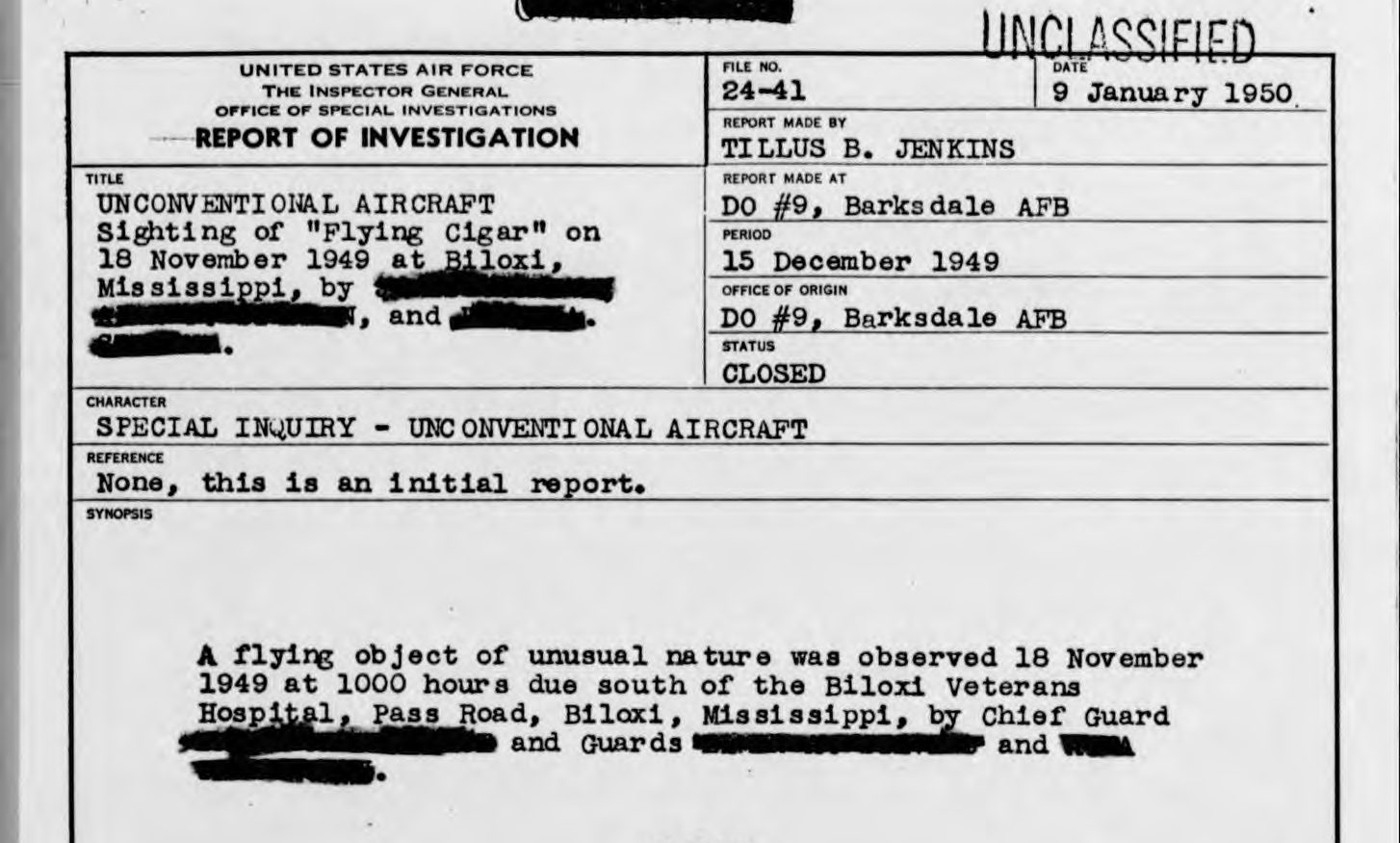
Pictured: the top half of the cover sheet of the Air Force Office of Special Investigations' Report of Investigation, file 24-41, made by Tillus B. Jenkins at District Office No. 9, Barksdale AFB, and dated January 9, 1950, cropped from the Project Blue Book file. Its title reads "Sighting of 'Flying Cigar' on 18 November 1949 at Biloxi, Mississippi"; the three guards' names were blacked out before release. It is a typed government form, not a picture of the object: no photograph or sketch of the object exists, and the file contains none. U.S. government record, public domain.
Theoretical Alignment
The Extraterrestrial Hypothesis scores low, but not for lack of a structured object. Three men saw, in daylight and for twenty-five minutes, something with a definite shape, a definite color and a steady path. What they did not see was anything that an aircraft, an airship or a balloon could not do: the object moved in a straight, level line at about the speed of a car on a highway, in silence, and went out of sight behind trees. Nothing in the report requires a technology that did not exist in 1949, and every number in it, the size, the height and the speed, rests on a single guess about its distance.
The Interdimensional Hypothesis has nothing to work with. The Psycho-Social score is low too. These were three men on duty, not a crowd, and the report reached the Air Force through no newspaper that has been found; one guard noticed a glint and the others were called to look at something already in view. The one psychological factor that matters is the ordinary one: an object of unknown size at an unknown distance will be given whatever size and distance the observer assumes, and the guards assumed it was over Ship Island.
Background
The Biloxi Veterans Hospital and Keesler Air Force Base in 1949
The hospital that the three guards protected had served veterans on the Gulf Coast since the 1930s. The Department of Veterans Affairs today describes its Biloxi medical center as standing "along the picturesque southern shore of Back Bay in the city of Biloxi," and the National Cemetery Administration records that the burial ground on its grounds was "established in March 1934 as part of the VA Medical Center," with the first burial on March 24, 1934, and that the cemetery is "adjacent to the Keesler Field Air Force Base." The hospital's main gate opened onto Pass Road, which runs east and west along the Biloxi peninsula between Back Bay to the north and the Mississippi Sound to the south. The Report of Investigation places the guards "directly south of the Biloxi Veterans Hospital, Pass Road"; the Essential Elements of Information place them more exactly, "Directly South of Main Gate." From there, looking south, the Sound and the barrier islands lay beyond the town.
Next door was Keesler Air Force Base. According to the base's own history, the War Department activated "Army Air Corps Station No. 8, Aviation Mechanics School" at Biloxi on June 12, 1941; it was named for 2nd Lt. Samuel Reeves Keesler Jr. of Greenwood, Mississippi, an aerial observer who died of wounds in France in the First World War, and designated Keesler Army Airfield on August 25, 1941. The Army Air Forces' Radar School moved there from Boca Raton, Florida, on November 14, 1947, Keesler Field was "officially redesignated as an Air Force base on 13 January 1948," and "in early 1949, Air Training Command decided that Keesler should focus its efforts on teaching radar, radio, and electronics maintenance and repair." In November 1949, then, the hospital's neighbor was the Air Force's main electronics school, with its own flight line and its own weather station. That station supplied the only measurements in this case.
Project Grudge at the end of 1949
The report went to the Air Materiel Command at Wright-Patterson AFB, Ohio, "ATTN: MCIAXO-3," the office symbol of the Air Force's UFO project. In November 1949 that project was Project Grudge, and it was winding down. Edward J. Ruppelt, who later ran its successor, Project Blue Book, wrote that the name had been changed from Project Sign to Project Grudge by an order of February 11, 1949, and he called the period that followed "the Dark Ages." Grudge's final report was ready in August 1949, according to Gross; on December 27, 1949, Ruppelt recorded, "it was announced that Project Grudge had been closed out," and "with the completion and approval of the Grudge Report, Project Grudge folded." The Biloxi sighting happened between those two events. The OSI agent interviewed the guards on December 15, twelve days before the announcement, and the closed report was signed on January 9, 1950, thirteen days after it.
The effect on the files of this period is visible. The historian Loren E. Gross, writing about this very case, observed that "not much work was being done at Project GRUDGE headquarters." The skeptical researcher Tim Printy, after reviewing every Blue Book case from 1949, wrote that he "was surprised to find that the last four months of 1949 had missing files and no classifications on most of the cases," and suspected "the reason for these lack of classifications had to do with project Grudge not dedicating much in the way of resources towards evaluating reports after releasing their report in August of 1949." The Biloxi file is a clear example: it contains a careful field inquiry and nothing at all from the project that was supposed to evaluate it.
The Office of Special Investigations
The investigator came from the Office of Special Investigations, the Air Force's own criminal and counterintelligence service, which considers August 1, 1948 its operational date. The letterhead on the transmittal letter shows where it sat: "Headquarters United States Air Force, The Inspector General, Office of Special Investigations," and below that, "9th OSI District, Barksdale AFB, La." The 9th District, at Barksdale in Louisiana, covered Mississippi too. Earlier in 1949 the same district had investigated the airborne sighting by Thomas A. Rush near Jackson, recorded in this site's Jackson Airborne Sighting file, using the same kind of questionnaire that appears here. In the Jackson case the agent interviewed the witness, checked his reputation, gathered the weather and sent the results to the Air Materiel Command without offering an explanation of his own. That is exactly what this report does.
Complete Timeline
| Date / Time | Event |
|---|---|
| February 11, 1949 | The Air Force's UFO project is renamed from Project Sign to Project Grudge (Ruppelt). |
| Early 1949 | Air Training Command makes Keesler AFB its radar, radio and electronics school (Keesler history). |
| November 16, 1949, 9:30 AM | Near Oxford, Mississippi, farmers and a storekeeper watch a "whitish-gray cloud-like cylinder shape" drift east for ten minutes (Gross, from Blue Book file #510). |
| November 18, about 9:00 AM CST (1500Z) | The New Orleans upper-air sounding measures winds from the north-northeast near the ground and from the northwest at every level above about 5,000 feet (IGRA). |
| November 18, 9:30 AM CST | Keesler AFB Weather Station: "clear ten miles visiblity," wind northeast at eleven knots. South of Raceland, Louisiana, four people begin watching a shiny, fuselage-shaped "thing" for 30 minutes (Gross). |
| November 18, 10:00 AM CST (1600Z) | A guard at the main gate of the Biloxi Veterans Hospital sees a "glint of light" to the south and calls the chief guard; with a third guard they watch a white cigar-shaped object over Ship Island moving west to east, silently, at an estimated 2,500–3,000 ft and 50 mph. |
| About 10:25 AM | After "approximately twenty-five (25) minutes" the object passes "behind the tree line surrounding the Biloxi Veterans Hospital." |
| November 18, 10:30 AM CST | Keesler AFB Weather Station: "clear twelve miles visibilty," wind northeast at eight knots. |
| November 21–22, 1949 | Three unrelated reports later filed in the same folder: Chattanooga, Tennessee (November 20–21); an F-80 pilot over Akita, Japan (November 21); Dover, New Jersey (November 22). |
| December 9, 1949 | Letter, 9th OSI District, Barksdale AFB, File 24-41, initiates the investigation. |
| December 15, 1949 | The three guards are interviewed; the Executive Officer of the hospital, Mr. Elsworth J. Sacks, vouches for them. |
| December 27, 1949 | The Air Force announces that Project Grudge has been closed out (Ruppelt). |
| January 9, 1950 | Special Agent Tillus B. Jenkins dates the Report of Investigation, status "CLOSED"; Lt. Col. John C. McLendon, District Commander, approves it and transmits it to the Air Materiel Command: "District Office No. 9 contemplates no further investigation of this case." |
| January 1952 or later | A temporary ATIC record card is typed for the case, on a form edition of January 1952; it has no conclusion. |
| December 17, 1969 | Project Blue Book ends. The Biloxi report is still unevaluated. |
| 1988–1990 | Loren E. Gross publishes the case in UFOs: A History, 1949: July–December, beside the Oxford and Raceland reports. |
| March–April 2024 | Tim Printy, in SUNlite, lists his own evaluation of the case: "Balloon." |
The File, Page by Page
The released file, item "1949-11-6314750-Biloxi-Miss" in the Internet Archive's Project Blue Book collection (Fold3 file 6314750), has 23 pages. Every page was read for this case file as an image, without relying on machine transcription; the record card and one Japanese-theater memo are too faint for it. Only ten of the 23 pages concern Biloxi. In the order the pages were scanned:
- The record card for Biloxi, a temporary ATIC card, almost illegible (see below).
- A Keesler AFB weather memo on the Biloxi area for the morning of November 18, addressed to "Special Agent Robert A. Smith."
- A Third Army letter, Fort McPherson, Georgia, November 29, 1949, "Unconventional Aircraft," forwarding information on "flying objects sighted in Chattanooga, Tennessee" (signed copy).
- The same letter, unsigned file copy.
- The Third Army's "Summary of Information": an article from the Chattanooga Times of November 21, 1949.
- A Far East Air Forces teletype, page 1: an F-80 pilot's sighting over Akita, Japan, November 21, 1949.
- The same teletype, page 2.
- A second copy of the teletype's page 2.
- A second copy of its page 1.
- A very faint typed memo about the Japanese sighting, mostly illegible, with handwritten file numbers.
- Page 2 of 5 of the Far East Air Forces' Air Intelligence Information Report on the Akita sighting.
- The OSI transmittal letter for Biloxi, January 9, 1950, signed by Lt. Col. John C. McLendon.
- Page 3 of 5 of the Akita report.
- Page 4 of 5 of the Akita report, with the pilot's "Certificate."
- Page 5 of 5 of the Akita report, the pilot's signature block.
- A First Army teletype of November 22, 1949 about white objects over Dover, New Jersey.
- The cover sheet of the OSI Report of Investigation on Biloxi (shown above).
- The report's "Details," page 2, the narrative of the sighting.
- The "Details," page 3, the witnesses' reliability.
- "Essential Elements of Information," page 1.
- Its page 2, headed "Essential Elements of Info / Project 'SIGN'."
- Its page 3, the questions about the observer.
- Its page 4, the witnesses, and the "General" questions on weather, air traffic and balloon releases.
The Biloxi pages are therefore 1, 2, 12 and 17 through 23. Three things are missing. The transmittal letter lists "Rpt of Invest (2)," two copies, and the file holds one. The questionnaire says that the winds-aloft report was in an "Extract, Keesler Weather report" attached to it, and the only Keesler page in the file gives surface weather only. And the Akita report's first page, page 1 of 5, is absent. There is also no record of how the sighting first reached the Air Force, no letter from the hospital, no teletype, no newspaper clipping, and no evaluation by anyone at Wright-Patterson.
What the Guards Saw
The heart of the case is paragraph 2 of the Report of Investigation's "Details." It is the only narrative account, and it is the agent's summary of three interviews, not any guard's own words. It is quoted here in full, with the redactions shown as they appear in the file:
An unidentified aerial object was observed 18 November 1949, at 1000 hours directly south of the Biloxi Veterans Hospital, Pass Road, Biloxi, Mississippi, by [redacted] Guard [redacted] and Guards [redacted] and [redacted], according to information received during interviews with aforementioned persons on 15 December 1949. Guard [redacted] first sighted the object while on duty at the Hospital Main Gate and notified his superior, Chief Guard [redacted]. At this first appearance, the object was approximately over Ship Island, which lies off the Biloxi coast about ten (10) miles to the south. There was only one (1) object. At the distance of ten (10) miles, the altitude of this object appeared to be between 2500 and 3000 feet. The object remained in sight for approximately twenty-five (25) minutes. It was white and reflected the sunlight. The shape was similar to a cigar. Nothing could be determined as to the type of construction.
The paragraph goes on. "[Redacted] Guard [redacted] stated that, using similar type planes and aerial objects as a guide, the size of the object appeared to be approximately two hundred feet (200') in length and a proportionate diameter to that of a cigar of that size. The line of flight was from New Orleans, La., to Mobile, Alabama. It maintained a steady flight with no change of altitude while in the view of these observers. There was apparently no exhaust or any engine sound. The day was clear and no clouds were viewed near this object. Being daylight at the time the object was sighted, no lights of any type were observed in connection with the object. No wings or normal control surfaces were observed." The method of propulsion "could not be determined as there was no sound of any power or any visible evidence of engine and exhaust. Control and stability was apparently excellent, however, the method of control could not be determined. The speed was approximately fifty (50) miles per hour and this object was completely silent in its passage through the air. It finally passed from sight behind the trees surrounding the area from which the object was observed, after having remained within view for approximately twenty-five (25) minutes."
What is observation and what is inference
Read closely, the account contains a small number of direct observations and a larger number of conclusions drawn from them. The direct observations are these: one object; white; shaped like a cigar; reflecting sunlight; seen to the south, in line with Ship Island; moving steadily from right to left, west to east; no sound; no visible exhaust, wings, control surfaces or projections; in view for about twenty-five minutes; lost behind trees. Everything else is inferred. The distance of ten miles is the distance to Ship Island, and the guards placed the object over the island because it was in line with it; nothing in the file says how they knew it was not nearer or much farther. The altitude of 2,500 to 3,000 feet is stated in the report itself as conditional: "At the distance of ten (10) miles, the altitude of this object appeared to be between 2500 and 3000 feet." The length of 200 feet was reached "using similar type planes and aerial objects as a guide," which means it was scaled from the assumed distance. The speed of fifty miles an hour must have been derived the same way. Even "control and stability was apparently excellent" is an inference from a steady path, as the questionnaire admits: the object "appeared to be under excellent control in that its flight was regular throughout the period of observation."
This is not a criticism of the guards. It is how everyone describes an object of unknown size, and the OSI agent recorded the reasoning honestly. But it means that the three most striking numbers in the case, 200 feet, 2,500 to 3,000 feet and fifty miles an hour, are not three independent facts. They are one fact, an assumed distance, expressed three ways. If the object was twice as far away, it was twice as long, twice as high and twice as fast; if it was half as far, everything halves.
"Not an aircraft of such nature"
Paragraph 3 adds the one piece of testimony that bears directly on what the object was not. "Two (2) of the observers are familiar with the derigible type aircraft, having in their lifetime observed Air Force equipment of most types. They positively state that this object was not an aircraft of such nature. There was no projection on the underside of the cigar-shaped object which would indicate a cabin or other such space. The object was even in contour throughout its length according to Mr. [redacted]." The guards had evidently been asked whether they had seen a blimp, and they said no, because they saw no gondola. That is a reasonable answer and a testable one; it is examined under the Conventional Explanation Candidate below.
The Essential Elements of Information
The second half of the report is a four-page questionnaire titled "Essential Elements of Information (Re Sighting(s) of Unidentified Aerial Object(s))." Its continuation pages are headed "Essential Elements of Info / Project 'SIGN'," although the project had been renamed Grudge nine months earlier; the form had evidently not been retyped. The agent answered its numbered questions in a few words each, and those answers are the most precise statements in the file:
- Time: "1000CST," with "CST" added by hand; a handwritten note beside it appears to read "1600Z," the correct Greenwich equivalent.
- Observer's position: "Directly South of Main Gate of the Biloxi Veterans Hospital, Pass Road, Biloxi, Mississippi." Map coordinates: "Not available."
- Where the object was: "Approximately over Ship Island which lies approximately 10 miles south of the coast line between Gulfport and Biloxi, Miss."
- Number: "One (1)." Formation type: "Cigar shaped."
- Distance: "10 miles ... Laterally, 10 miles." Angle of elevation from horizon: "Unknown." Altitude: "2500 - 3000, estimated approximately."
- Time in sight: "approximately 25 minutes."
- Appearance: color "White"; shape "Cigar shaped"; construction "undetermined"; size "approximately 200 feet in length with a diameter proportionate to that of a cigar of that size," and as it appeared from the observer's view, "Same as (1) above (Compared to known object)."
- Direction of flight: "From West to East." Maneuvers: "Horizontal flight."
- Exhaust: smoke "None," odor "none," "No trail or sound."
- Effect on clouds: "No clouds present during observation." Lights: "No lights observed."
- Support and propulsion: "undetermined. No wings or normal means of support visible"; "undetermined. No visible means." Air ducts: "None observed."
- Speed: "estimated at approximately 50 miles per hour." Sound: "None."
- Disappearance: "Disappeared behind obstacle. The object disappeared from the view of the observers behind the tree line surrounding the Biloxi Veterans Hospital."
- How attention was drawn to the object: "Glint of light."
Two of these answers matter more than the rest. The angle of elevation, the one measurement that would have fixed the object's real distance and height, was "Unknown"; nobody asked the guards to point. And the object first drew attention by a "glint of light," a flash of reflected sun, which says that it had at least one surface bright or smooth enough to reflect sunlight specularly toward the gate.
The Witnesses and Their Reliability
The three men are never named in the released file; every occurrence of their names is blacked out, and this case file does not attempt to recover them. What the report does say about them is unusually full. They "are employed by the Biloxi Veterans Hospital, Pass Road, Biloxi, Mississippi. All of these men, in connection with their assigned duties, are trained to observe and report unusual incidents." The two junior guards gave their address as "Barracks No. 1, Biloxi Veterans Hospital." The chief guard's hobbies were "Hunting and fishing"; his ability to judge color was "O.K.," his ability to judge the speed of moving objects "average ability," and size at a distance "O. K."
The agent checked them three ways. He interviewed the hospital's Executive Officer, whose name is blacked out in the narrative but printed in full twice in the questionnaire, "Mr. ELSWORTH J. SACKS," who "stated that, in his opinion, they were entirely reliable personnel, that all had been employed at the hospital for several years with no bad marks of any kind on their records." He read their personnel records: "they had all passed their physical examinations without any trouble and, while two (2) of the men ... wear reading glasses, they have no difficulty in determining true color and both drive automobiles. Their estimate of speed of moving objects and size at a distance appears reliable to the average degree." And he relied on his own acquaintance: "This Agent has known Chief Guard [redacted] for approximately two (2) years and considers him to be an entirely reliable person who has a responsible position at the local Veterans Hospital." The chief guard "is charged with the responsibility of Ground Safety and Fire Prevention and Control" in addition to his other duties, and he "has vouched for the reliability of his two (2) men." The questionnaire repeats the judgment: "Mr. [redacted] is a person of high calibre and holds a very responsible position with the Biloxi Veterans Hospital. This Agent has known Mr. [redacted] for approximately 2 years and considers him to be completely reliable."
That is a strong character reference, and nothing in the file contradicts it. It is worth noticing what it is a reference for: honesty, steadiness and normal eyesight. The agent's own phrase, "reliable to the average degree," is the right measure of their estimates of size and speed. Nobody suggested that the guards had invented the sighting. The question is what they saw.
Who wrote the report
The cover sheet says the report was "made by TILLUS B. JENKINS" at "DO #9, Barksdale AFB," for the "Period 15 December 1949," the day of the interviews. Gross gives him the title "S/A," special agent. But the weather memo in the file is addressed to a different man, "Special Agent Robert A. Smith," and the agent who wrote that he had known the chief guard "for approximately two (2) years" sounds like someone who lived and worked in Biloxi, not some 300 miles away at Barksdale, near Shreveport. Whether Smith gathered the local information and Jenkins wrote it up, or the reverse, or Jenkins himself was stationed near Biloxi, the file does not say.
What the Investigation Checked, and What It Did Not
The last page of the questionnaire is a checklist headed "General," and it shows exactly how far the inquiry went:
1. Teletype sequences of local weather conditions - Extract from the Keesler Weather Station attached to this report. 2. Winds aloft report - See Extract, Keesler Weather report. 3. Local flight schedules of commercial, private and military aircraft flying in vicinity at the time - Unknown. 4. Possible releases of testing devices in vicinity sent aloft by Ordance, Navy, Air Force, Army, Weather Units, Research Organizations or any other - No record.
Item 8, "Secure signed statement," has no answer at all, and no signed statement is in the file. The radar section reads "Not applicable."
The weather was checked. The memo from Keesler, signed by Sgt. Donald E. Heggedahl, Chief Observer, gives the conditions at the base weather station: "At 0930C the local weather condition at Keesler AFB Weather Station was clear ten miles visiblity, wind direction and speed was northeast at eleven knots. At 1030C the local weather condition was clear twelve miles visibilty wind direction and speed was northeast eight knots." Those two readings bracket the sighting.
The rest was not. The winds aloft, which would have shown which way a balloon would drift, are referred to but not in the file. The air traffic question, the most obvious one for a slow, cigar-shaped object over a coast with an Air Force flying field next door and the cities of New Orleans and Mobile at either end, was answered "Unknown": no one checked. "No record" of balloon or test releases is a statement that the agent found none, not that he searched the records of every organization on the list; the file does not say whom he asked. The elevation angle was never measured, so the object's distance was never established. And the interview took place twenty-seven days after the sighting. None of this was unusual for a 1949 field inquiry; it means that the inquiry could describe the object but could not identify it.
The Record Card
The first page of the file is a small temporary record card, so faint that most of its printed labels cannot be read even in a contrast-enhanced scan. The typed entries that survive read: a date of report, "9 Jan 1950"; a time, "1000"; a shape, "Cigar"; a size, "200' Length"; a number of objects, "1"; a date of incident beginning "1" and then "Nov," the rest illegible; a location, faintly, "Biloxi, Miss."; a source, "Civilian"; a color, "White"; a speed, "50 MPH"; an altitude, "2500'-3000' at 10 Mi. Distance."; a length of observation, "2" followed by a lost digit and "Minutes"; and a type of observation, "Ground." The other fields are filled with dashes, including one beside the printed word "SKETCHES."
The form's own footer identifies it as an "ATIC Form 329" of a January 1952 edition, the Air Technical Intelligence Center's record card. The card was therefore typed in 1952 or later, two years or more after the OSI report, when the older files were being carded; the 1949 Jackson case's card, a "Temporary ATIC Form 329" dated January 1952, is another of the kind. It does not record an evaluation. There is no conclusion field on it, and no conclusion, comment or index note is written anywhere on it. The card simply transcribes the OSI report.
So the answer to the question "What did the Air Force decide?" is that it decided nothing. Nowhere in the 23 pages is there an evaluation, a routing comment, an analyst's note or a conclusion about Biloxi. The only closing words are administrative ones. The cover sheet's status box reads "CLOSED," and the transmittal letter says: "Transmitted herewith is Closed Report of Investigation regarding the above Subject. District Office No. 9 contemplates no further investigation of this case." That sentence ended OSI's work. Nobody at Wright-Patterson began any.
The absence of an official explanation is not evidence of anything unusual, and neither would an official explanation have been proof. The project that should have evaluated this report was being dissolved when it arrived, and the case received the same treatment as most of its neighbors that autumn: none. As with any official record, the file reflects what its investigators had the time, the resources and the reason to check, and here the evaluating office checked nothing.
The Other Reports in the File
More than half the file has nothing to do with Biloxi. These pages were filed in the same folder, probably because they arrived at Wright-Patterson in the same weeks and were stored by date, and anyone who reads the file as a single case will be misled by them. Each is summarized here so that it can be set aside.
Akita, Japan, November 21, 1949
Nine pages concern a sighting by a jet fighter pilot over northern Honshu. A priority teletype "FM COMGEN FEAF TOKYO JAPAN," date-time group 220624Z, received at Wright Field on November 23, reported "ONE UNINDENTIFIED OBJECT SIGHTED 21 NOVEMBER 1949 OVER AKITA CMA JAPAN ... AT 1100 ITEM." The pilot, flying an F-80 at 30,000 feet on a heading of 220 degrees, saw an object at one o'clock, 30 degrees up, for two seconds, at 31,000 to 32,000 feet, heading 10 to 30 degrees. It "APPEARED TO BE RECTANGULAR IN SHAPE APPROXIMATELY 20 FEET WIDE AND 60 FEET LONG PD TRAILING EDGE APPEARED TO FLUTTER," and "THE TWO PILOTS IN THE FLIGHT OF THREE F-80 AIRCRAFT DID NOT OBSERVE THE OBJECT." The Far East Air Forces' follow-up Air Intelligence Information Report, of which pages 2 to 5 survive, names him as "First Lieutenant John J. Jackson, Jr.," a "Jet Fighter Pilot, 8th Fighter Squadron, 49th Fighter Group" at Misawa Air Base. It gives the object as "Grayish-white," with a drawing of a 60-by-20-foot rectangle; it "Had appearance of tow target" and "Appeared at least twice the size of normal towed target," traveling at an estimated "400 and 600 MPH." In his signed certificate the pilot wrote that "an object which appeared to be an aerial tow target was observed." A check with the local Air Weather Service detachment "revealed no clues." Brad Sparks lists the Akita report in his catalog of Blue Book unknowns (entry 307); Printy evaluates it as "Balloon. Seen for a few seconds by pilot of F-80. No other pilots saw the object." It is a separate case and is not discussed further here.
Chattanooga, Tennessee, November 20–21, 1949
Three pages are a Third Army letter of November 29, 1949, signed for Col. John Meade, Assistant Chief of Staff, G-2, at Fort McPherson, Georgia, forwarding a "Summary of Information" that consists of an article from the Chattanooga Times of November 21, "CITY FOLK LOOK UP, SEE THINGS IN THE SKY." A woman near Brainerd and Airport roads saw "a dozen round-shaped silvery things like parachutes" flying in three V's, and a man in Lupton City saw "a great ball of fire" cross the southern sky at five in the morning. Printy's evaluations: "1. Birds 2. Meteor."
Dover, New Jersey, November 22, 1949
One page is a First Army teletype from New York about a noon sighting at Dover ("CMA NAN JIG," the phonetic spelling of N.J.) of "SERVERAL HUNDRED SPHERICAL OBJECTS 5 OR 6 INCHES IN DIAMETER WHITE COLOR," drifting southeast in groups; smaller objects were "RECOVERED AND PRED TO BE THISTLE OR SEED," and an industrial plant in Dover emitted "WHITISH MATERIAL" from its stacks. Printy lists it under "Dover, DE" with the evaluation "Birds"; the teletype itself places it in New Jersey.
The Chattanooga letter and the Dover teletype both cite the Air Materiel Command's "Control No. A-1917," the reference under which Army commands forwarded reports of "unconventional aircraft" in late 1949; the handwritten file number "7-3712-26" appears on the Chattanooga letter, the faint Akita memo and the Biloxi transmittal alike. That shared filing, not any connection between the sightings, explains why they are together.
Three "Things" in Three Days
The only published account of the Biloxi sighting before this one is in Loren E. Gross's UFOs: A History, 1949: July–December, a chronology compiled from the Blue Book files and the press. Gross tells the story under the heading "Still another 'thing.'" and cites "Special Inquiry by S/A Tillus B. Jenkins D0#9, Barksdale AFB ... 9 January 50. Blue Book Files." His summary follows the report closely, except that he adds a detail not in the file, that the hospital's entrance "commanded a beautiful view of the waters of the Gulf of Mexico," and he gives the altitude as "about 2,500 to 3,000 feet altitude" without the report's condition that this was what it appeared to be at ten miles.
Gross's real contribution is the context. He places Biloxi as the third of three similar reports in the Gulf South within three days, all from files of the same period. On November 16, at 9:30 in the morning, farmers near Oxford, Mississippi, ran into a store and called out the storekeeper to see "the thing": a "whitish-gray cloud-like cylinder shape moving slowly past the store in an easterly direction only 60 feet in the air," upright, "approximately two feet in diameter and tapered at one end," drifting "at some 30 to 40 miles per hour" and out of sight in ten minutes (Gross cites "Blue Book File #510"). And on the morning of November 18 itself, "9:30 a.m. to be exact," four people south of Raceland, Louisiana, watched for thirty minutes a "thing" that was "shiny and similar in shape to a fuselage of an aircraft but without protruding appendages of any sort," first traveling southwest and then making "two 90 degree turns," investigated by another 9th District agent, Alvin E. Cambre. Gross then complains that "there is no comment in Air Force files that recognizes the very apparent similarities in the previously mentioned three cases: the geographical proximity, the similar time of day, shape, and even velocity."
The similarities are real, and they cut both ways. Raceland lies in the bayou country southwest of New Orleans, about 110 miles west-southwest of Biloxi; a shiny, wingless, fuselage-shaped object seen there half an hour before a white, wingless, cigar-shaped object was seen from Biloxi, moving on a line "from New Orleans, La., to Mobile," is a coincidence worth noticing. But the Raceland object was heading southwest and turning, and the two descriptions are not detailed enough to say they were the same thing. What the cluster does suggest is that a reasonably common kind of object, white or shiny, elongated, slow and silent, was being seen in daylight over the Gulf South that week. Printy, who reviewed all three files, evaluated the Oxford object as a "Possible contrail" and both the Raceland and the Biloxi objects as "Balloon." The reports of the same morning are also a reminder that the Biloxi guards were not the only people who could have seen this object; if anyone else on the coast reported it, that report has not been found.
The Sky at Ten in the Morning
The positions of the Sun, Moon and bright planets were computed for this file with NASA JPL's Horizons system, for an observer at 30.405° N, 88.97° W, from 9:30 to 10:40 AM CST (15:30–16:40 UT) on November 18, 1949:
| Object | 9:30 AM CST | 10:00 AM CST | 10:30 AM CST | Notes |
|---|---|---|---|---|
| Sun | azimuth 143°, 31° up | 151°, 35° up | 159°, 37° up | South-southeast, climbing |
| Moon | 168°, 44° up | 178°, 45° up | 187°, 45° up | 4% lit, a thin waning crescent a few days before new; about 25° from the Sun |
| Venus | 116°, below horizon | 119°, 1.5° below | 123°, 4° up | Rising in the east-southeast about 10:10 AM; magnitude −4.5 |
| Mars | 245°, 50° up | 251°, 44° up | 257°, 37° up | Magnitude +1.2; invisible in daylight |
| Jupiter | Below the horizon throughout | — | ||
No astronomical body was anywhere near the object. The object was due south and, if the guards' estimates are even roughly right, only two or three degrees above the horizon. The Sun was 35 degrees up in the south-southeast, some 30 degrees to the left of the object and well above it; the thin crescent Moon stood almost due south but 45 degrees up, far too high and, at four percent illumination so close to the Sun, essentially invisible in daylight. Venus, the one planet bright enough to be seen in a clear daytime sky, was just rising in the east-southeast as the sighting began, in the wrong direction and at the horizon. A planet or star cannot explain a white cigar crossing the southern sky in daylight, and none is proposed here.
The Sun's position does matter in one way. The guards were looking roughly toward the Sun's side of the sky, with the Sun high on their left. An object in that direction would be lit from above and from its eastern side, partly toward the observers; a smooth or shiny surface in that geometry can throw a specular flash toward the ground, which is consistent with the "glint of light" that first drew the guard's attention and with the report that it "was white and reflected the sunlight."
The Winds That Morning
The winds-aloft extract that the questionnaire mentions is not in the file. A substitute exists. The nearest upper-air station for which 1949 observations survive in the National Centers for Environmental Information's Integrated Global Radiosonde Archive (IGRA) is New Orleans (station 72231), about 83 miles west-southwest of the hospital. Its sounding at 1500Z on November 18, 9:00 AM Central time, an hour before the sighting, recorded:
| Level | Height | Temperature | Wind from | Wind speed |
|---|---|---|---|---|
| Surface | 3 m | 14.0°C (RH 48%) | 23° (NNE) | 7.0 m/s (16 mph) |
| 1000 hPa | 233 m (760 ft) | 11.4°C | 23° (NNE) | 7.0 m/s (16 mph) |
| 850 hPa | 1,581 m (5,190 ft) | 7.1°C (RH 37%) | 338° (NNW) | 14.0 m/s (31 mph) |
| 700 hPa | 3,159 m (10,360 ft) | 1.7°C (RH 24%) | 315° (NW) | 21.0 m/s (47 mph) |
| 500 hPa | 5,807 m (19,050 ft) | −13.5°C (RH 24%) | 315° (NW) | 18.0 m/s (40 mph) |
| 400 hPa | 7,467 m (24,500 ft) | −25.2°C (RH 19%) | 315° (NW) | 29.0 m/s (65 mph) |
| 300 hPa | 9,491 m (31,140 ft) | −40.3°C | 315° (NW) | 35.0 m/s (78 mph) |
| 250 hPa | 10,713 m (35,150 ft) | −48.7°C | — | — |
The surface wind at New Orleans, north-northeast at about 14 knots, agrees with Keesler's northeast at 8 to 11 knots: the same cool, dry air mass covered the whole coast. Above a few thousand feet the wind turned and strengthened, blowing from the northwest at every level up to at least 31,000 feet, and the air was dry, with relative humidity of 19 to 37 percent above the surface. These figures are an hour earlier and 83 miles west of the sighting, and wind directions in the archive for this period are rounded to sixteen compass points; they describe the general flow, not the air over Ship Island at 10:00 exactly. But they are the best measurement available, and they are enough to test two things: which way a balloon would have drifted, and whether an aircraft could have left a contrail.
A free balloon goes where the wind takes it. Near the ground that morning it would have moved toward the south-southwest, away from the coast; above about 5,000 feet it would have moved toward the southeast. A balloon over the Sound south of Biloxi drifting southeast would, to an observer on Pass Road looking south, move from right to left, west to east, while also moving away. The guards' "From West to East" is consistent with that. A balloon at the guards' estimated 2,500 to 3,000 feet, in the light northerly winds near the surface, would have moved mainly away from them rather than across their view, which fits the reported motion much less well. Contrails form, according to NASA's summary of the physics, at temperatures "generally limited to temperatures below –40°C"; that morning such temperatures began at about 31,000 feet. In air that dry, any contrail would most likely have been short-lived.
The Geometry
The questionnaire says the object was "approximately over Ship Island which lies approximately 10 miles south of the coast line between Gulfport and Biloxi." Measured with OpenStreetMap from the south edge of the hospital grounds, at about 30.405° N, 88.95° W (the national cemetery on the grounds is mapped at 30.411° N, 88.945° W), the island's western end lies about 13 miles away at a bearing of 189°, and its eastern end about 12.6 miles away at 159°. From the gate, then, Ship Island spanned some thirty degrees of the southern horizon, from a little east of south to a little west of it, at twelve to thirteen miles. The guards' "ten miles" is a fair approximation of a distance they could hardly have measured, and the island fixes the direction well: the object first appeared somewhere within that thirty-degree arc, low over the water.
Three numbers follow from the guards' own estimates. At ten to thirteen miles, an object 2,500 to 3,000 feet up would stand only about two to three degrees above the horizon, a finger's width over the sea, low enough to vanish behind the hospital's trees as soon as its bearing swung far enough east. A 200-foot object at ten miles would span about thirteen minutes of arc, roughly four-tenths of the Moon's diameter: a small but clearly shaped white sliver, comfortably resolvable by the naked eye. And an object moving at fifty miles an hour for twenty-five minutes covers about twenty-one miles, so that an object starting over Ship Island and flying east along the coast would end up somewhere south of Pascagoula, well to the east-southeast, where trees on the hospital grounds could easily hide it from the gate.
The internal consistency of those numbers is no proof that they are right. Because size, height and speed all scale with the assumed distance, the same angular picture, a white sliver of about thirteen arc-minutes, low in the south, moving left at a few degrees per minute, would be produced by a 100-foot object at five miles doing twenty-five miles an hour, or by a 400-foot object at twenty miles doing a hundred. Without an elevation angle or a second observer elsewhere, the geometry cannot choose among them.
Later Catalogs
The case is almost unknown. It is not in Don Berliner's list of Project Blue Book "unknowns," compiled for the Fund for UFO Research and reproduced by NICAP and by Patrick Gross, which has no entries at all for November 1949; it could not be, since Blue Book never classified it. It is not in Brad Sparks's "Comprehensive Catalog of 2,200 Project Blue Book UFO Unknowns" (version 1.35, February 3, 2026), which does include the Akita report filed beside it. Its only appearances found are:
- Loren E. Gross, UFOs: A History, 1949: July–December (1988; revised 1990), page 57, as described above. Gross's later Supplemental Notes for the same half-year (2000) add nothing on Biloxi.
- Tim Printy, "Project Blue Book case review: 1949," SUNlite volume 16, number 2 (March–April 2024). In his table for November 1949 the "BB explanation" column for "18 | Biloxi, MS" is blank and his own evaluation reads "Balloon." He gives no case-specific reasoning. All 97 issues of SUNlite available online were searched for this file; no other discussion of the 1949 Biloxi case appears in them.
No newspaper coverage of the sighting was found in the searches made for this file. The Biloxi-Gulfport Daily Herald of November 1949 is not available in a searchable online archive and was not read page by page.
Key Witnesses
The chief guard (name redacted)
Called to the main gate by the guard who first saw the object. The principal source of the description, including the estimate of 200 feet "using similar type planes and aerial objects as a guide," and the "even in contour" description. Known to the OSI agent for about two years and described as "a person of high calibre" and "completely reliable." His name is blacked out throughout the released file.
The first guard (name redacted)
"First sighted the object while on duty at the Hospital Main Gate," drawn by a "glint of light," and notified the chief guard. He lived in Barracks No. 1 at the hospital. Vouched for by the chief guard and the Executive Officer.
The second guard (name redacted)
Joined the other two and watched the object. Also lived in Barracks No. 1; vouched for by the chief guard and the Executive Officer. Two of the three men wore reading glasses; the report does not say which.
Elsworth J. Sacks
Not a witness. Interviewed by OSI about the three guards; said they "were entirely reliable personnel" with "no bad marks of any kind on their records," and "personally verified the reliability" of the chief guard. His name is redacted in the report's narrative but printed in the questionnaire.
Tillus B. Jenkins
Not a witness. Named on the cover sheet as the maker of the Report of Investigation, file 24-41, dated January 9, 1950, covering the interviews of December 15, 1949.
John C. McLendon
Not a witness. Approved the report and signed the transmittal letter: "District Office No. 9 contemplates no further investigation of this case."
Donald E. Heggedahl
Not a witness. Signed the memo giving the Keesler weather at 9:30 and 10:30 AM on November 18: clear, ten and twelve miles' visibility, wind northeast at eleven and eight knots.
Robert A. Smith
Not a witness. The Keesler weather memo is addressed "TO : Special Agent Robert A. Smith." He appears nowhere else in the file, and his part in the inquiry is not stated.
The Five Observables Assessment
The Five Observables framework, associated with former AATIP director Luis Elizondo, classifies UAP reports by performance characteristics beyond known technology. This report describes an object that showed none of them.
Assessment:
- Anti-gravity lift (speculative). The object had "No wings or normal means of support visible" and made no sound. That would matter for a heavier-than-air craft; it is exactly what is expected of a lighter-than-air one.
- Instant acceleration (absent). It "maintained a steady flight with no change of altitude."
- Hypersonic speed (absent). About fifty miles an hour, by the guards' estimate.
- Low observability (absent). It was white, reflected the sun, and was watched for twenty-five minutes.
- Trans-medium travel (not applicable). It was over water but never entered it.
Evidence Assessment
Supporting Anomalous Origin
- Three witnesses, on duty, trained by their jobs to observe and report incidents, vouched for by their employer and by an OSI agent who had known the principal witness for two years.
- Daylight, clear sky, twelve miles' visibility, and twenty-five minutes of observation: good conditions for seeing a shape.
- A definite, consistent description: white, cigar-shaped, "even in contour throughout its length," no wings, control surfaces, cabin or exhaust, and silent.
- Two of the witnesses knew what a dirigible looked like and "positively" said it was not one.
- OSI found "No record" of balloon or test releases, and no evaluation was ever made, so no conventional explanation has been established.
- Similar daylight reports of elongated, shiny, slow objects came from Oxford, Mississippi, two days earlier and from Raceland, Louisiana, half an hour earlier.
Supporting Conventional Explanation
- Nothing in the description exceeds the abilities of an airship, a balloon or an aircraft: steady, level, silent flight at about fifty miles an hour.
- The size, height and speed are not measurements; the report itself derives them from an assumed distance of ten miles, and the elevation angle was "Unknown."
- The upper winds that morning blew from the northwest; a balloon drifting with them would have moved from west to east across the southern sky, as reported.
- Air traffic was never checked ("Unknown"), and the "no record" of releases rests on an unstated search.
- The guards were interviewed four weeks after the event, and no signed statement, sketch or bearing was taken.
- No physical, photographic, radar or instrumental evidence, and no other witness on a coast with tens of thousands of people.
Why "Disputed"
The Biloxi VA Hospital Sighting is stamped DISPUTED with a score of 38/100. It is a real event, carefully recorded: three steady, vouched-for witnesses, on duty in clear daylight, watched a definite white shape for twenty-five minutes, and an OSI agent took their account seriously enough to check their records and their eyesight. Its weakness is not the witnesses but the object. What they described, a silent, featureless, white elongated form drifting level across the southern sky at about the speed of a car, is a description that fits several ordinary things, and the inquiry measured none of the quantities that would have separated them: no elevation angle, no bearings beyond "over Ship Island," no air traffic check, and no winds aloft in the surviving file. The sky contains no astronomical candidate. The winds of that morning were right for a balloon at altitude to cross the guards' view from west to east. An airship fits the shape, size and speed, though the guards rejected it. A distant aircraft cannot be excluded. Nothing points beyond those.
Among this site's Mississippi Blue Book cases, it sits with the Keesler AFB Weather Tower Sighting (38), above the Keesler AFB Sighting and the Greenville AFB Tower Sighting (36 each), which involved small or star-like lights, and below the Ocean Springs Family Sighting (40), whose light moved in ways no ordinary object easily does, the Meridian "Flying Cymbal" (44), and the Jackson Airborne Sighting (46), in which a pilot saw a cigar-shaped object at close range from the air. The absence of any Air Force conclusion is weighed as what it is: the product of a project that was closing down, not a judgment that the object was unexplainable. Had the Air Force written "balloon" on the card, as Printy now does, that too would have been one opinion to weigh rather than a settled answer; official findings of this period were often made with little investigation and an institutional preference for the least troubling answer, and this file shows that the evaluating office did not even look.
Sensor & Instrumentation Detection Profile
No instrument recorded the object.
- Optical aids. None mentioned; the guards watched with the naked eye.
- Radar. "Relative to Radar Sightings: Not applicable." Keesler was the Air Force's radar school, but no check of any radar was made or recorded.
- Air traffic. "Local flight schedules of commercial, private and military aircraft flying in vicinity at the time - Unknown." No check was made.
- Weather. Surface observations from the Keesler AFB Weather Station at 9:30 and 10:30 AM. The winds-aloft extract that the questionnaire mentions is not in the file; the New Orleans upper-air sounding of 9:00 AM (IGRA) has been used here in its place.
- Releases. "Possible releases of testing devices ... No record."
- Cameras. None; the record card's sketches field is blank, and no photograph is mentioned.
Environmental & Geospatial Context
Biloxi sits on a narrow peninsula between Back Bay and the Mississippi Sound, a shallow body of water about ten to twelve miles wide that separates the mainland from a chain of barrier islands. Ship Island, the island named in the report, lies "about 12 miles off the coast of Mississippi," in the words of the National Park Service, which now administers it as part of Gulf Islands National Seashore and whose ferry leaves from Gulfport. Its historic Fort Massachusetts is a large masonry fort. From the hospital's main gate on Pass Road, the view south crossed the town and its trees toward the Sound and the islands, a low, open horizon over water. Gulfport lies about nine miles west along the coast, and Ocean Springs and Pascagoula to the east; Mobile is some 58 miles to the east-northeast and New Orleans about 74 miles to the west-southwest (computed).
Weather
Every source agrees that the morning was clear. Keesler's weather station reported "clear" with ten miles' visibility at 9:30 and twelve at 10:30, and a northeast wind of eleven, then eight, knots. The guards said "The day was clear and no clouds were viewed near this object," and the questionnaire repeats "No clouds present during observation." The New Orleans sounding shows a dry air mass, a northerly flow at the surface and northwesterly winds above. A clear, dry morning after a cool northerly wind gives the best visibility the Gulf Coast offers, and it also means that there was no cloud to mistake and no cloud to measure an altitude against.
The Sun and Moon
The Sun was 35 degrees up in the south-southeast at 10:00, climbing toward noon. The Moon was a four-percent crescent, 45 degrees up and almost due south, invisible in practice. See "The Sky at Ten in the Morning" above.
Observer Credibility & Occupational Profile
As civilian witnesses go, these are good ones. They were security guards on duty at a federal hospital, which means sober, awake and paying attention at the time; their job, in the report's words, required them "to observe and report unusual incidents." They had all "been employed at the hospital for several years with no bad marks of any kind on their records," had passed their physical examinations, and had normal color vision; two wore reading glasses, which does not affect distance vision. The chief guard held additional responsibilities for ground safety and fire prevention. Two of the three had seen "Air Force equipment of most types" and dirigibles. Nothing suggests that they sought publicity: no newspaper account has been found, and they did not, as far as the file shows, report the sighting to anyone but their own chain of command and, eventually, the Air Force.
But none of them was a pilot, an observer or a weather man, and the qualities the report vouches for are honesty and ordinary competence, not experience with unfamiliar aerial objects at unknown distances. The OSI agent's careful phrasing, that their estimates "of speed of moving objects and size at a distance" appeared "reliable to the average degree," is accurate. The account that survives is the agent's summary, written four weeks after the event, rather than a statement in any guard's own words; there are no sketches; and the three men, who worked together and were interviewed on the same day, may have settled on a shared description before anyone asked. Their honesty is not in doubt. Their identification of what they saw is.
Physical & Material Assays
No physical evidence exists. The object never came near the ground, no trace was reported, and nothing was searched for or recovered.
Historical Precedents & Archive Matches
- November 16, 1949, Oxford, Mississippi. A whitish-gray "cloud-like cylinder," tapered at one end, drifting east at an estimated 30 to 40 miles per hour for ten minutes at 9:30 AM (Gross; Printy: "Possible contrail").
- November 18, 1949, Raceland, Louisiana. Half an hour earlier: a shiny, wingless, fuselage-shaped object watched for thirty minutes by four people (Gross; Printy: "Balloon").
- January 1, 1949, the Jackson Airborne Sighting. A cigar-shaped object seen from a light aircraft near Jackson; the same OSI district and the same questionnaire.
- January 7, 1948, the Thomas Mantell Incident. The best-known daylight sighting of a large, slow, shining object later attributed to a high-altitude research balloon, at a time when, as Ruppelt wrote, "the big skyhook balloon project was highly classified."
- May 7, 1952, the Keesler AFB Sighting. Small, bright objects seen by four airmen near the same base, carried by Blue Book as Unknown.
- Later Keesler files. Blue Book later recorded several balloon cases at Keesler, among them March 7, 1954 ("Was Balloon"), February 7, 1956 (a balloon cluster) and April 7, 1962 (a recovered balloon), as listed in this site's Keesler AFB Weather Tower Sighting file.
Material Analysis
There is no material to analyze. This section looks instead at what each element of the description predicts about the object's nature.
"Similar to a cigar"
An elongated, rounded form with no projections. Blimps, partly inflated or tilted research balloons, aircraft fuselages seen at a distance where the wings become invisible, and short contrails can all look like this. The phrase "even in contour throughout its length" argues against an aircraft seen close enough to show wings, and against an airship seen close enough to show a gondola, but how close is close enough is the whole question.
The white color and the glint
White in sunlight, with a glint that first caught the guard's eye. Polyethylene research balloons, rubberized fabric envelopes and polished aircraft skin all reflect sunlight; a flash of specular reflection is common from a curved shiny surface when the Sun is roughly on the observer's side of the sky, as it was here, high in the south-southeast.
The silence
No sound at all. At ten miles almost nothing is audible, including aircraft and airship engines; at 2,500 to 3,000 feet and ten miles, a light aircraft or a blimp would very likely be inaudible against wind and traffic. Silence fits a distant powered craft as well as an unpowered one.
The steady level flight
"Horizontal flight," "regular throughout the period of observation." A balloon at its floating altitude, an airship cruising, and an aircraft in level flight all behave this way. An object that does not change height and does not maneuver gives no clue to its nature beyond its shape.
Supporting Non-Terrestrial or Anomalous Origin
- A clearly shaped object, seen in daylight for twenty-five minutes, that three witnesses could not identify and that two experienced witnesses specifically said was not a dirigible.
- No wings, control surfaces, cabin or exhaust were seen at any time.
Supporting Terrestrial Origin
- No physical, photographic or instrumental evidence exists.
- Every feature described, shape, color, glint, silence and steady level flight, is a feature of balloons, airships and distant aircraft.
- The motion matched the direction of the upper winds that morning.
The Conventional Explanation Candidate
No explanation was ever established. OSI collected facts and offered no opinion; the Air Force wrote no evaluation; the only later evaluation is Printy's single word, "Balloon." The candidates below are tested against what the file actually establishes, which is a direction, a duration, a shape, a color, silence, and a west-to-east motion in clear daylight.
A balloon at high altitude
Printy's evaluation, and the explanation that best fits the winds. Above about 5,000 feet the air over the coast was moving from the northwest at 30 to almost 80 miles an hour; a balloon riding it south of Biloxi would have crossed the guards' view from west to east while drifting away from them, would have been silent, steady and level, and would have flashed in the sunlight. Large research balloons were often seen at great distances; Ruppelt wrote, of the Mantell case, that "it is not unusual to be able to see a large balloon for 50 to 60 miles," and a partly inflated plastic research balloon, seen from the side, is elongated rather than round.
There are two difficulties. The first is that no specific balloon has been found. The nearest regular releases were weather balloons: the New Orleans station launched its sounding about 9:00 AM, but its balloon would have been miles high within the hour and carried southeast from New Orleans, toward the open Gulf some 80 miles west-southwest of Biloxi, and an ordinary radiosonde balloon at that distance would have been far too small to see as a shape. Stratocat, a public catalog of stratospheric balloon flights, lists no launches in the United States on November 18, 1949; its only entries for that date are two "Skyhook" cosmic-ray flights launched from the aircraft carrier USS Palau under General Mills supervision, while the ship was "sailing in an area southeast of the Jamaica strait," more than a thousand miles from Biloxi. Stratocat does not claim to be complete, and Keesler's own weather station, which might have launched pilot balloons, was never asked about anything but surface weather in the surviving file. The second difficulty is that the guards placed the object at 2,500 to 3,000 feet, where the winds were light and from the north; a balloon there would have drifted away from them, not across their view. That estimate, however, depends entirely on the assumed ten-mile distance.
A balloon at low altitude
A small balloon at the height the guards estimated, released locally, would have been carried by the north-northeast surface winds out over the Sound toward the south-southwest at fifteen or twenty miles an hour, moving mostly away from the gate and somewhat to the right, not to the left. It would also have looked small and round rather than like a 200-foot cigar unless it was much closer than the guards thought. This fits the reported motion poorly.
An airship
The shape, the color, the estimated size, the height and the speed together describe a blimp almost exactly. A wartime K-class Navy airship was about 252 feet long and 58 feet in diameter, cruising at about 58 miles an hour, and blimps routinely flew at a few thousand feet over coastal water. Seen side-on, a blimp is a white or silver cigar; at a distance its engines are inaudible. The guards rejected the idea because they saw "no projection on the underside ... which would indicate a cabin." That observation is weaker than it sounds. At ten to twelve miles a gondola ten feet tall would subtend little more than half a minute of arc, at or below the limit of normal vision, while the 58-foot envelope above it would still be plainly visible; the tail fins would be similarly hard to make out against a bright sky. A distant blimp would look "even in contour throughout its length."
What is missing is a blimp. By the Naval Airship Association's account, the Navy's lighter-than-air force had shrunk from more than 125 airships in 15 squadrons to two squadrons by the end of 1946; one of them, ZP-2, kept a detachment at Naval Air Station Key West, Florida, and a third, ZP-3, was not commissioned until September 1950. Goodyear also flew advertising blimps in this period, including, in 1947 and 1948, a former Navy K-ship. Whether any airship was flying along the Mississippi coast on the morning of November 18, 1949 has not been established; no record of one has been found, and OSI did not ask. The candidate fits the description better than any other, and has no evidence behind it.
A distant aircraft or contrail
An aircraft flying along the coast toward or away from the observers, far beyond the assumed ten miles, can appear as a short, wingless, gleaming body moving slowly across the sky; its wings are thin edges at long range, and its sound does not carry. Keesler, next door to the hospital, had its own runway, and the coast lies between the airports of New Orleans and Mobile. The objection is the duration: an aircraft in view for twenty-five minutes, without either passing overhead or disappearing into the distance, would have to be very far away and moving almost directly along the line of sight, and even then the guards' "steady flight" across the southern sky is hard to sustain for so long. A short contrail behind a high aircraft would add a white, cigar-shaped appearance, but on this morning contrails were possible only above about 31,000 feet, and in air that dry they would likely have been short-lived. Air traffic was never checked, so this candidate cannot be excluded either.
An astronomical body
Excluded. The only bright bodies in the sky were the Sun, high in the south-southeast, a nearly invisible crescent Moon 45 degrees up, and Venus, rising in the east-southeast. None was low in the south, and none moves west to east.
A genuine unidentified object
On this reading, a large, featureless, silent craft flew along the Mississippi coast at low altitude for twenty-five minutes in clear daylight, possibly the same object seen half an hour earlier near Raceland. The witnesses' honesty and the quality of the viewing conditions support taking the report seriously. But nothing the object did required an unknown technology, the only measurement that could have established its size and distance was never taken, and the object's motion matched the direction of the upper winds. The case remains unexplained in the sense that no explanation was ever checked, not in the sense that explanations were checked and failed.
High-Altitude Balloon
PlausibleNorthwesterly winds aloft would carry it west to east across the southern view; silent, level, sunlit. Printy's evaluation. No specific launch identified; requires the ten-mile, 2,500–3,000 ft estimate to be wrong.
Low-Altitude Balloon
UnlikelySurface winds from the north-northeast would carry it away to the south-southwest, not across the view to the east.
Airship (Blimp)
Possible but UnverifiedFits shape, size, height and speed; a gondola would be near the limit of vision at ten miles. The guards rejected it, and no airship is known to have been there.
Distant Aircraft or Contrail
UntestedAir traffic was never checked. Twenty-five minutes of steady crossing is long for an aircraft; contrails were possible only above about 31,000 ft in dry air.
Astronomical Body
ExcludedNo planet or bright body was low in the south; the Sun and a faint crescent Moon were high, and Venus was rising in the east-southeast.
Genuine Unidentified Object
InconclusiveCredible witnesses and good conditions, but no performance beyond known craft, no measured distance, and no explanation ever tested by the Air Force.
Related Cases
Confirmed Documents & Official Records
From the Project Blue Book File
All ten Biloxi pages of the 23-page Project Blue Book file, as read for this case file: the record card, the Keesler weather memo, the OSI transmittal letter, the Report of Investigation and its four-page questionnaire. The thirteen pages about Akita, Chattanooga and Dover are not reproduced. U.S. Air Force records, public domain (Project Blue Book, Internet Archive item 1949-11-6314750-Biloxi-Miss); the witnesses' names were redacted before release. Click any page to open it full size.
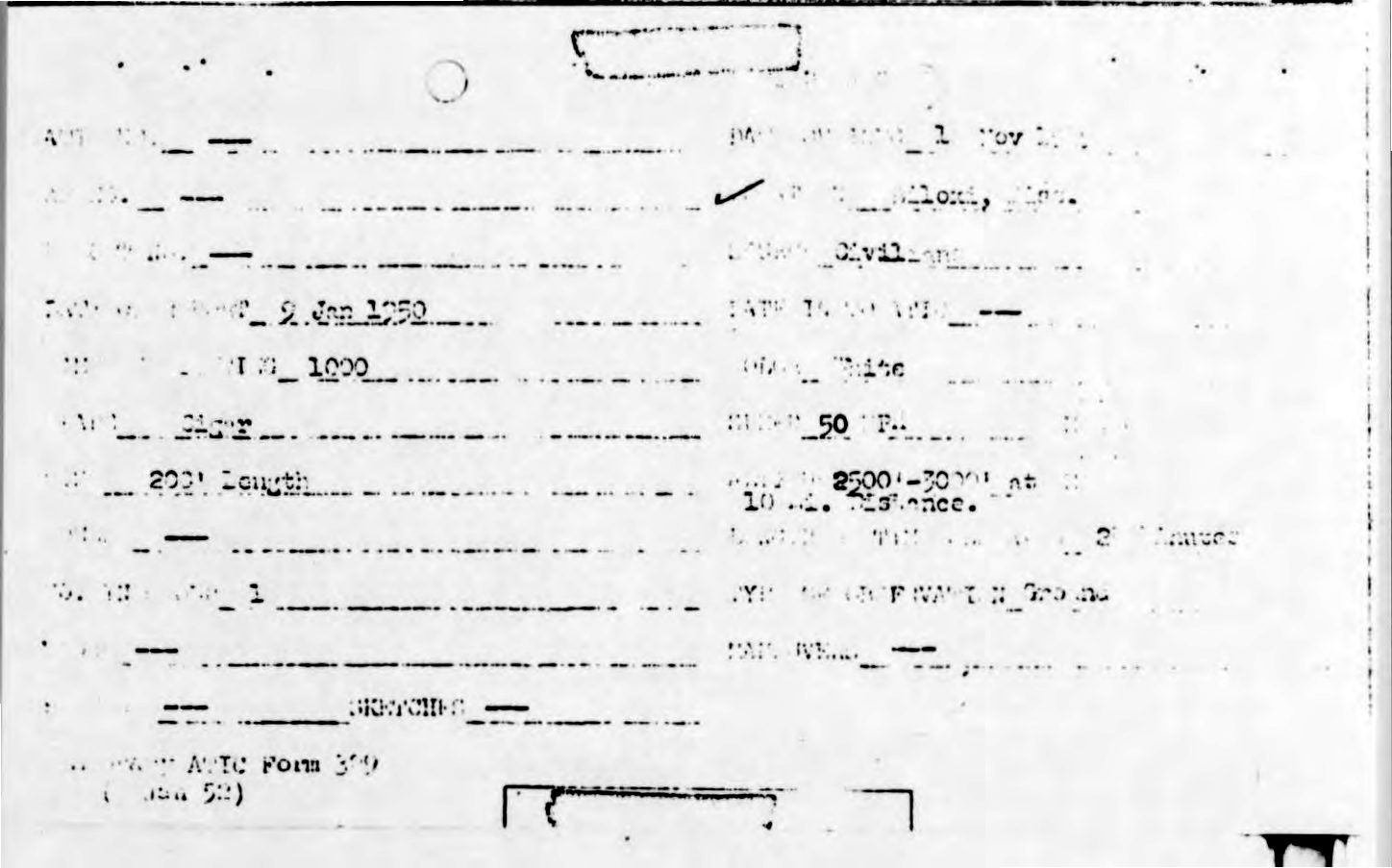
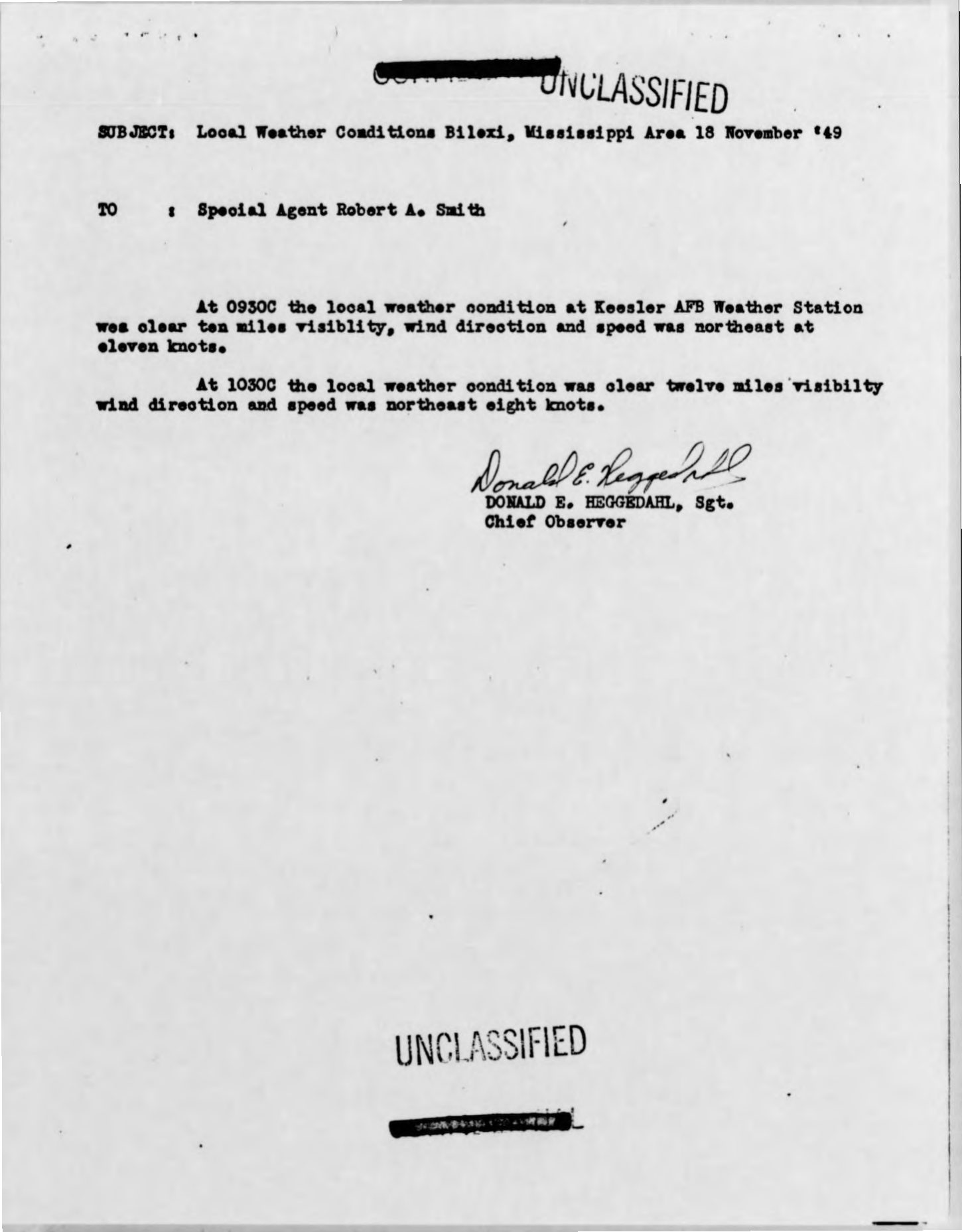
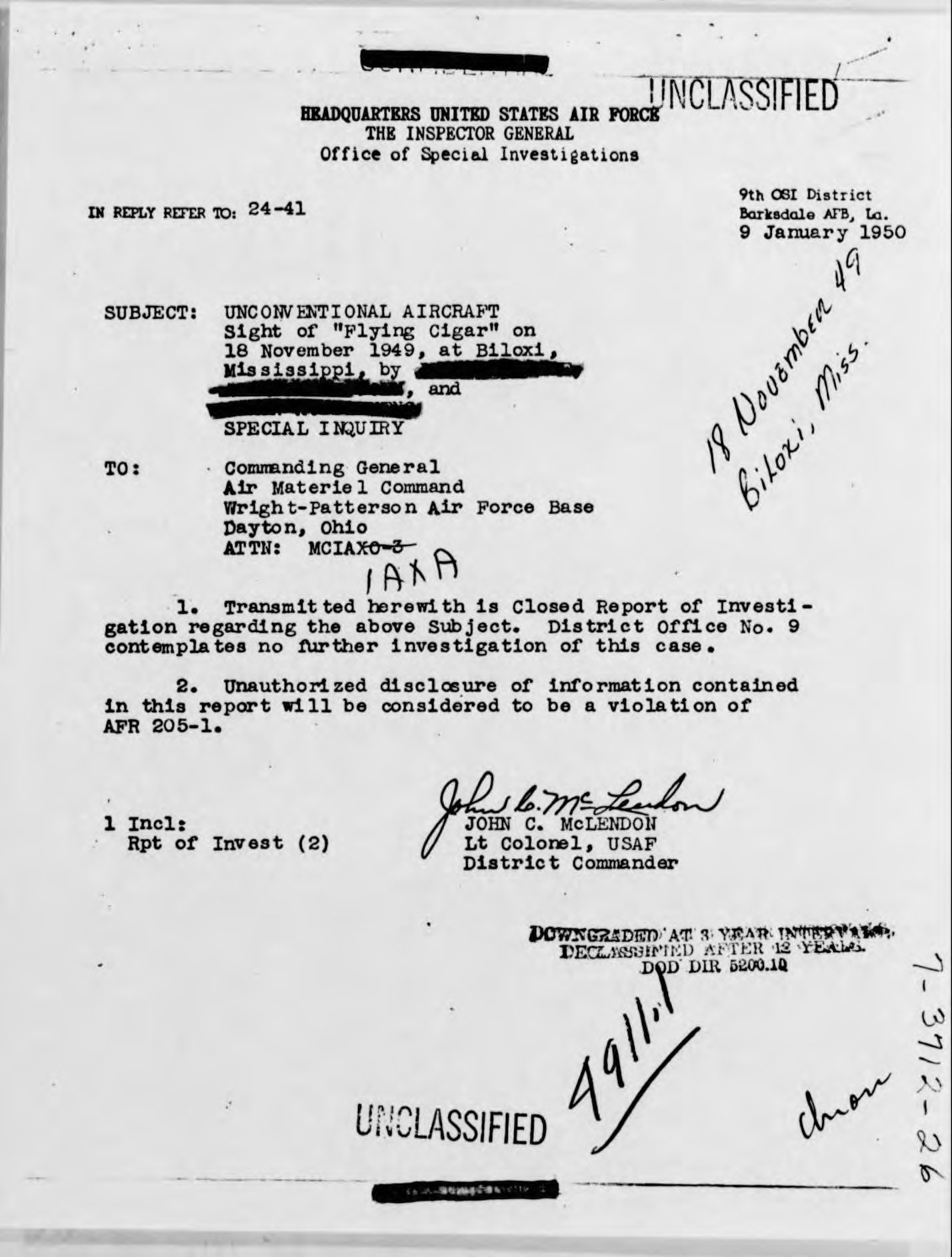
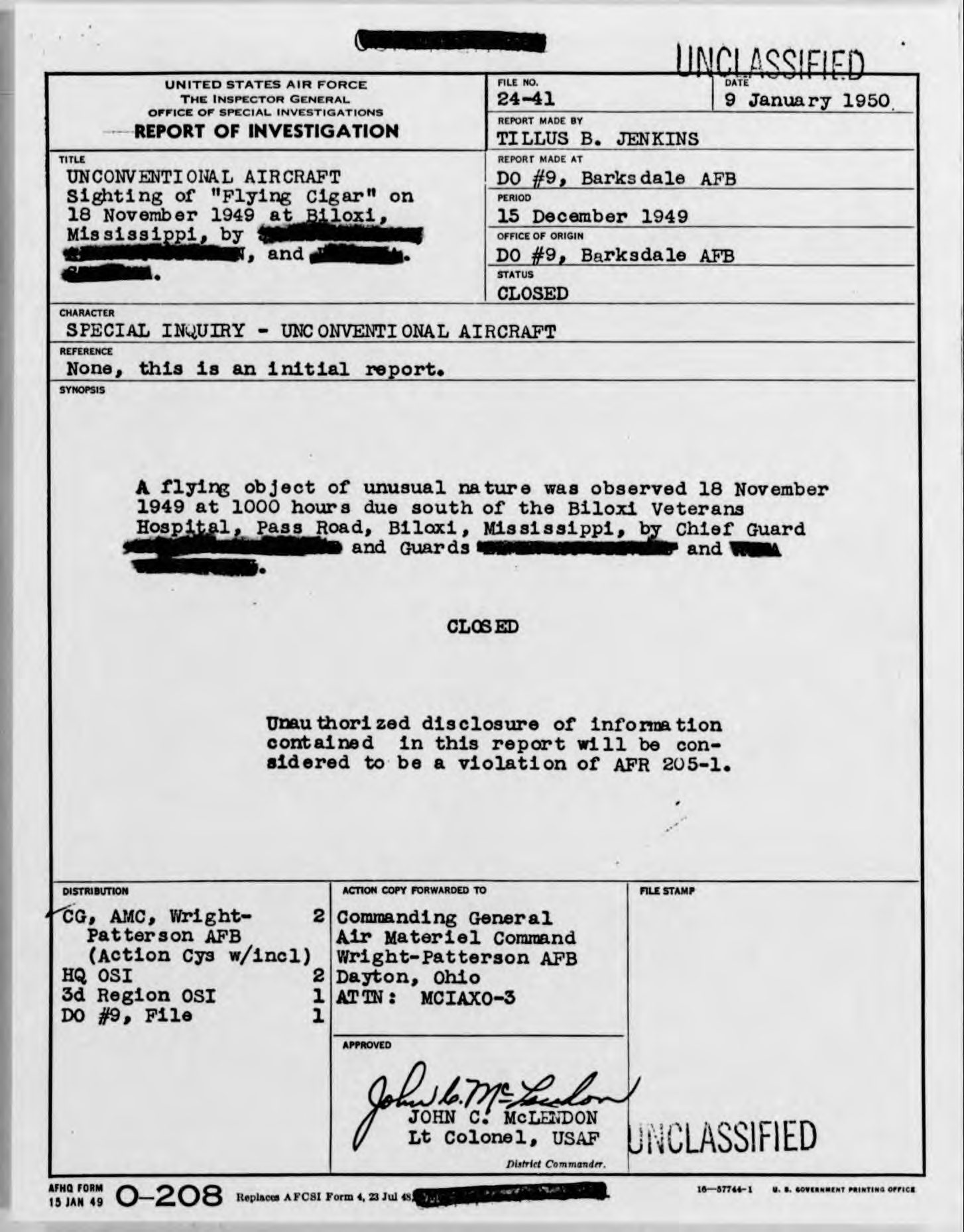
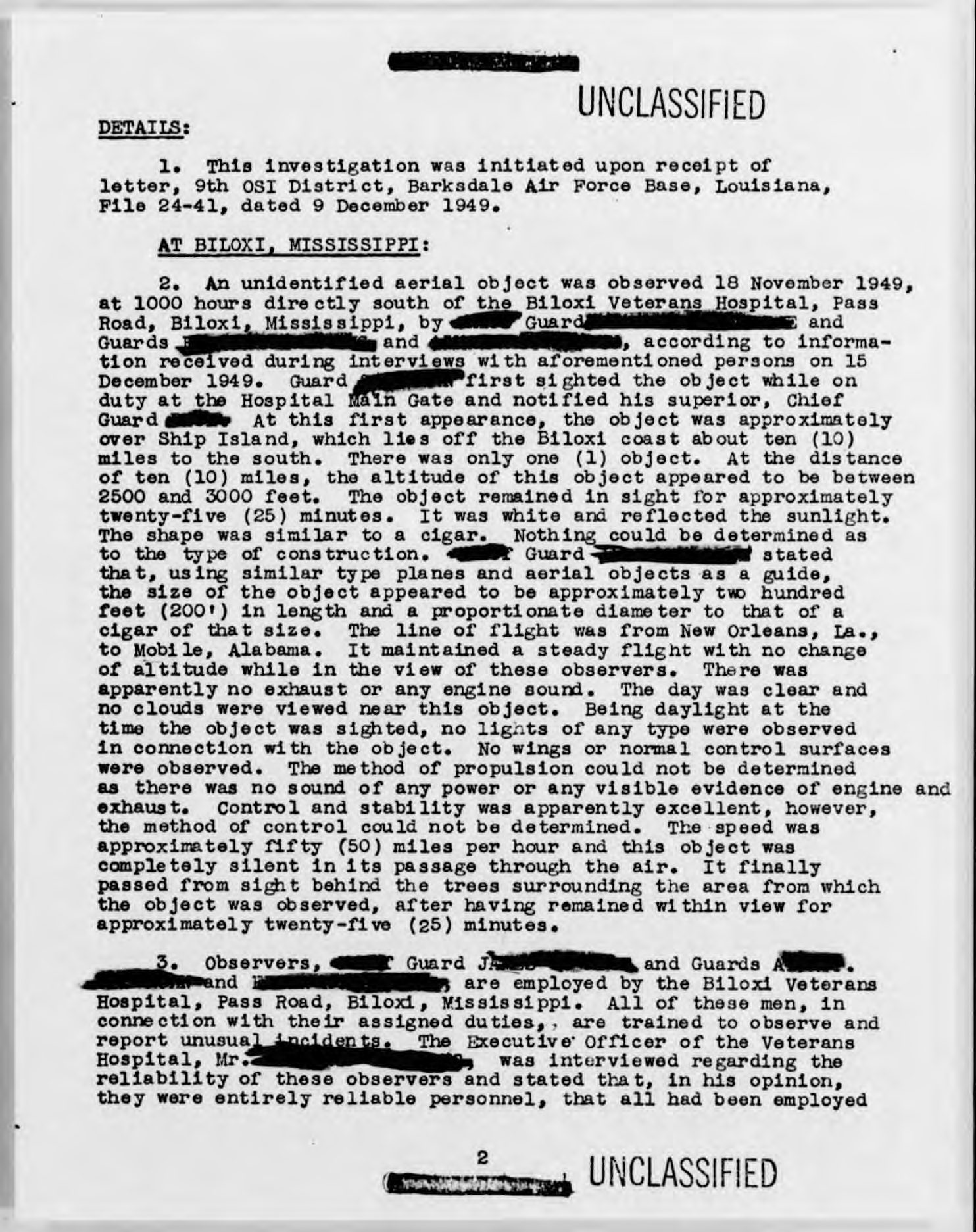
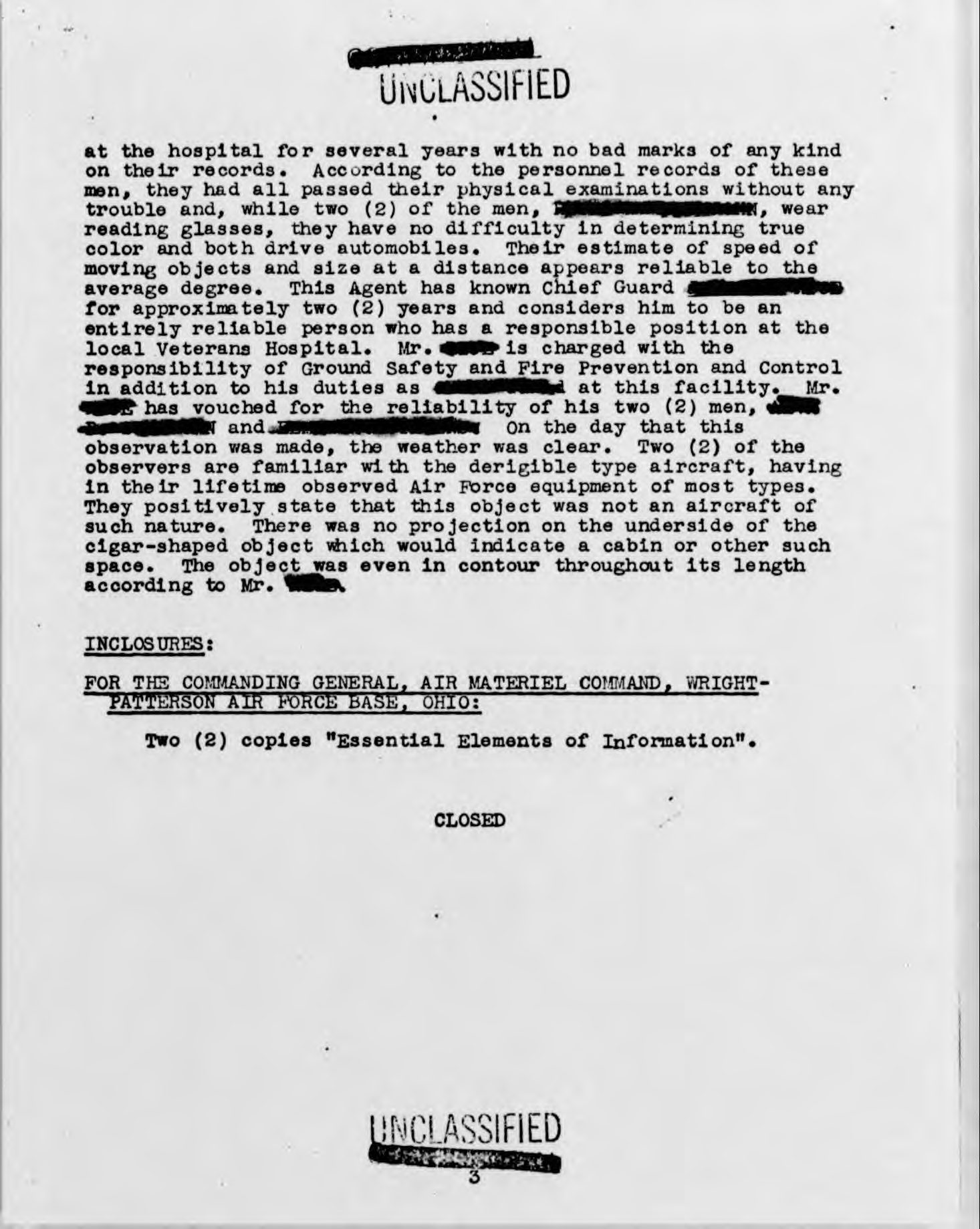
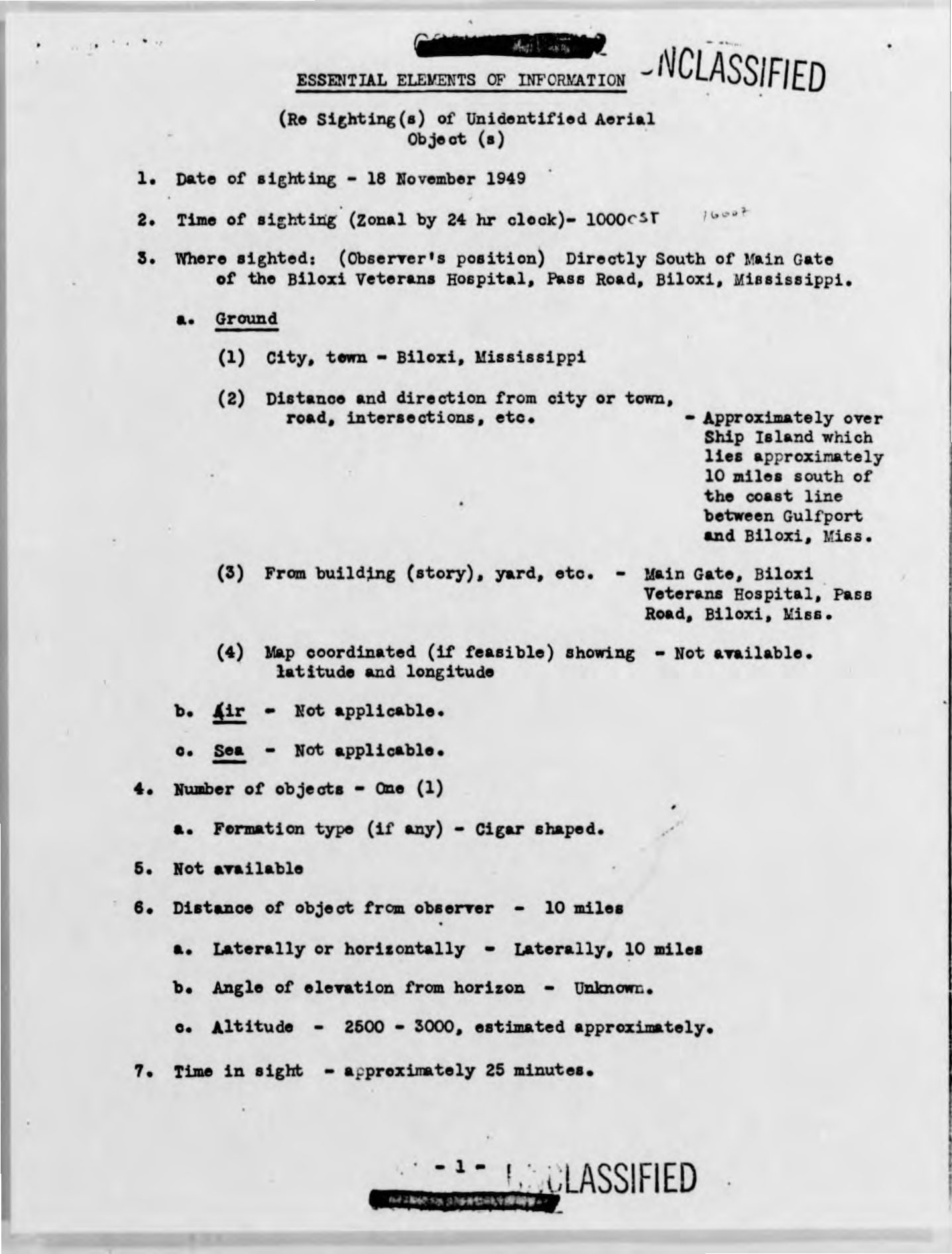
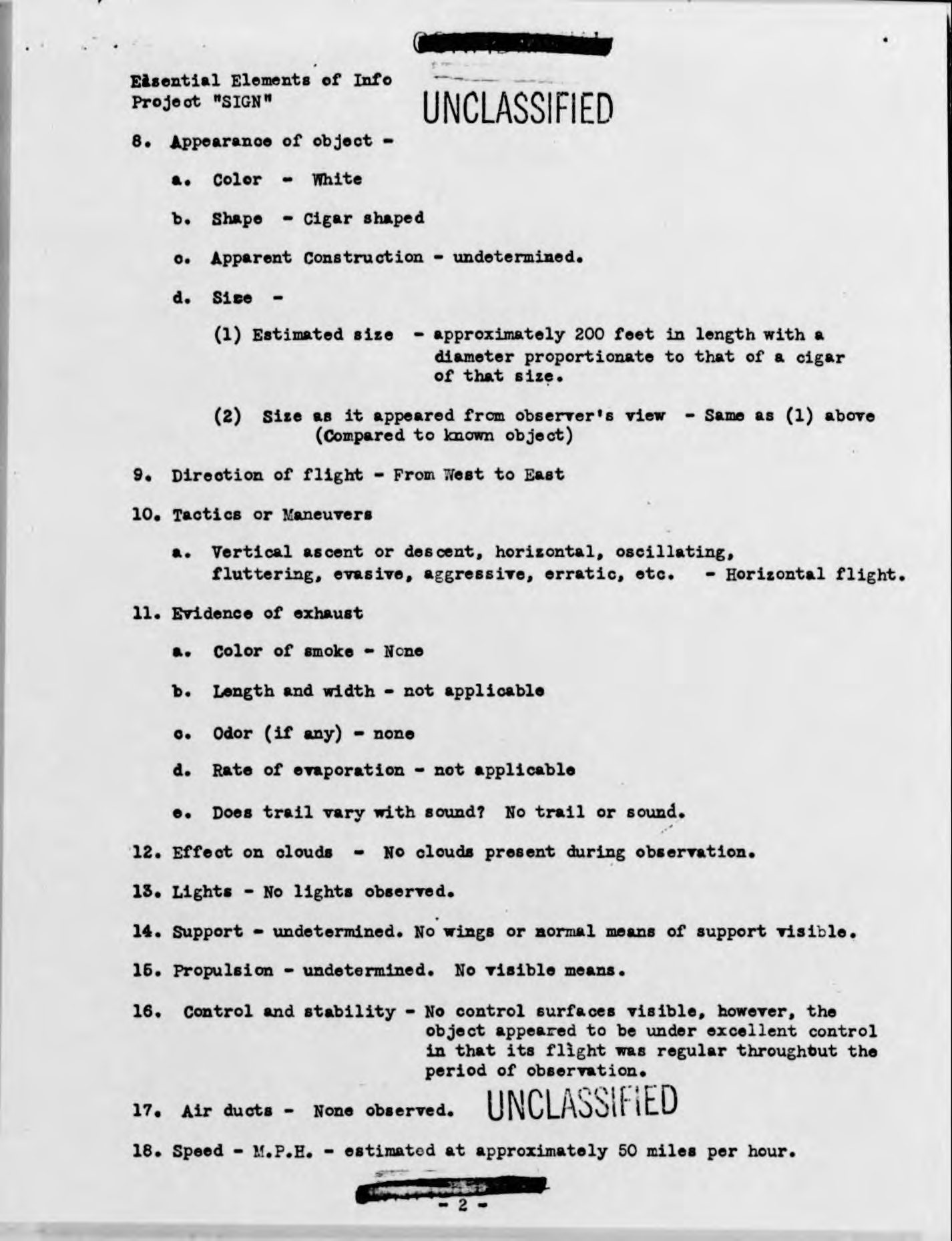
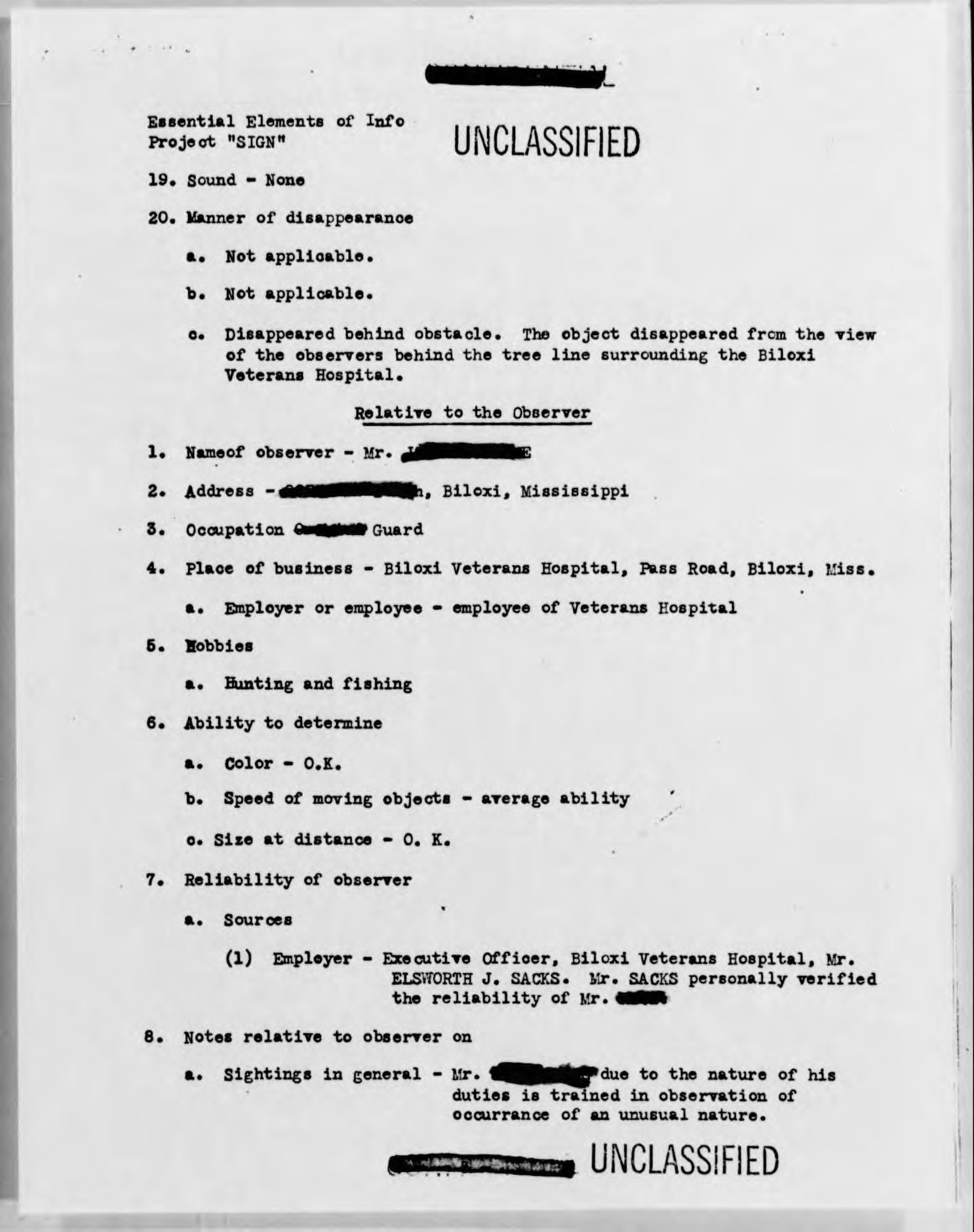
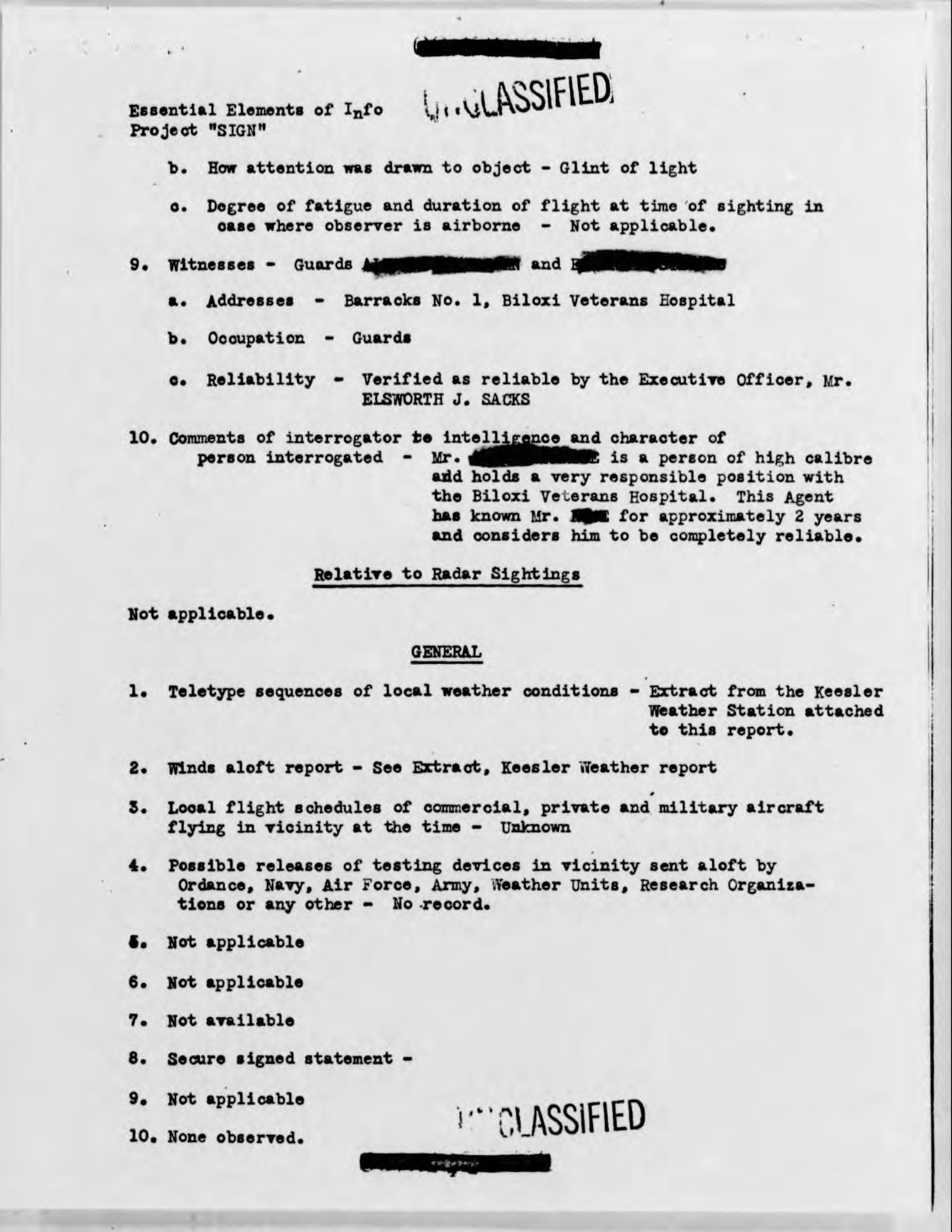
The 23-page released Project Blue Book file (Fold3 file 6314750), part of the Internet Archive's Project Blue Book collection. Pages 1, 2, 12 and 17–23 concern Biloxi; the rest are unrelated reports from Akita, Chattanooga and Dover. The primary source for this case file; the page images were read directly.
UNCLASSIFIEDThe Blue Book file for the January 1, 1949 Jackson, Mississippi sighting, investigated by the same OSI district with the same questionnaire.
UNCLASSIFIEDThe catalog series for the released, name-redacted Blue Book case files (Record Group 341), filmed as microfilm publication T1206.
UNCLASSIFIEDNARA's fact sheet on Project Blue Book: 12,618 sightings reported from 1947 to 1969, 701 unidentified; termination announced December 17, 1969.
UNCLASSIFIEDSearch Government Archives Directly
Further Reading — Recommended Literature
The Report on Unidentified Flying Objects
Blue Book's former chief on Project Grudge's "Dark Ages," the period in which this report arrived and was never evaluated, and on skyhook balloons as the answer to daylight sightings.
The UFO Experience: A Scientific Inquiry
The Air Force's astronomical consultant on daylight discs and cigars, and on why so many reports were never properly investigated.
UFOs and Government: A Historical Inquiry
A documented history of official UFO investigation, including the Grudge years and the role of OSI field inquiries.
DISCLOSURE: Some links above are affiliate links. If you purchase through them, OverClassified receives a small commission at no additional cost to you. This helps support independent research.
Essential Viewing
No Videos Available
Sources
- Air Force Office of Special Investigations, District Office No. 9, Barksdale AFB, Louisiana. Report of Investigation, file 24-41, “Unconventional Aircraft: Sighting of ‘Flying Cigar’ on 18 November 1949 at Biloxi, Mississippi,” made by Tillus B. Jenkins, 9 January 1950 (period 15 December 1949; status “CLOSED”; character “Special Inquiry – Unconventional Aircraft”; AFHQ Form 0-208), with “Details,” pages 2–3. In Blue Book file “1949-11-6314750-Biloxi-Miss”: archive.org
- “Essential Elements of Information (Re Sighting(s) of Unidentified Aerial Object(s)),” four pages, headed “Essential Elements of Info / Project ‘SIGN’,” inclosure to OSI file 24-41 (time “1000CST”; elevation “Unknown”; direction “From West to East”; flight schedules “Unknown”; releases “No record”). Same file: archive.org
- McLendon, John C., Lt. Colonel, USAF, District Commander, 9th OSI District, Barksdale AFB, La. Letter to the Commanding General, Air Materiel Command, Attn MCIAXO-3, “Unconventional Aircraft / Sight of ‘Flying Cigar’ on 18 November 1949, at Biloxi, Mississippi ... Special Inquiry,” 9 January 1950, file 24-41 (“District Office No. 9 contemplates no further investigation of this case”). Same file: archive.org
- Heggedahl, Donald E., Sgt., Chief Observer. Memo, “Local Weather Conditions Biloxi, Mississippi Area 18 November ’49,” to Special Agent Robert A. Smith (Keesler AFB Weather Station, 0930C and 1030C). Same file: archive.org
- U.S. Air Force, Air Technical Intelligence Center. Temporary record card, ATIC Form 329 (January 1952 edition), Biloxi, Miss. (date of report 9 Jan 1950; “Cigar”; “200′ Length”; “50 MPH”; “2500′-3000′ at 10 Mi. Distance”; no conclusion field). Same file: archive.org
- Commanding General, Far East Air Forces, Tokyo. Priority teletype, DTG 220624Z [November 1949], CLN AX 3852 INT-IR, sighting over Akita, Japan, 21 November 1949; and Air Intelligence Information Report (AF Form 112), Headquarters FEAF, APO 925, pages 2–5 of 5, with the certificate of 1st Lt. John J. Jackson, 8th Fighter Squadron, 49th Fighter Group (filed in the same folder; unrelated to Biloxi). Same file: archive.org
- Headquarters Third Army, Fort McPherson, Georgia. Letter AJACI-3 360.33, “Unconventional Aircraft,” 29 November 1949, signed for Col. John Meade, AC of S, G-2, with Summary of Information quoting the Chattanooga Times, 21 November 1949; and First Army teletype, DTG 221900Z [November 1949], on Dover, N.J. (filed in the same folder; unrelated to Biloxi). Same file: archive.org
- Internet Archive. “1949 11 6314750 Biloxi Miss” (U.S. Air Force, 23 images; Project Blue Book collection, contributed by Michael Best). archive.org
- Gross, Loren E. UFOs: A History, 1949: July–December (Fremont, Calif., 1988; revised 1990), pp. 57–58 and notes 181–184 (Oxford, Raceland, Biloxi and Akita; “Special Inquiry by S/A Tillus B. Jenkins”). Sign Historical Group, UFO History Project (Download PDF): sohp.us
- Gross, Loren E. UFOs: A History, Supplemental Notes, 1949: July–December (2000) (searched; no Biloxi entry). Sign Historical Group (Download PDF): sohp.us
- Printy, Tim. “Project Blue Book case review: 1949,” SUNlite 16, no. 2 (March–April 2024): 8–17 and summary (November 1949 table: “18 | Biloxi, MS | Balloon”; Raceland “Balloon”; Oxford “Possible contrail”; Akita “Balloon”). (Download PDF): astronomyufo.com
- Berliner, Don. “The Project Bluebook ‘Unknowns’,” compiled for the Fund for UFO Research (checked: no November 1949 entries). NICAP: nicap.org
- Gross, Patrick. “Project Blue Book unexplained cases summaries with witness names: Year 1949,” UFOs at Close Sight (transcription of Berliner's list; last 1949 entry July 30). ufology.patrickgross.org
- Sparks, Brad. “Comprehensive Catalog of 2,200 Project Blue Book UFO Unknowns,” version 1.35, February 3, 2026 (checked: no Biloxi 1949 entry; entry 307, “Nov. 21, 1949. Akita, Honshu, Japan”). NICAP (Download PDF): nicap.org
- Ruppelt, Edward J. The Report on Unidentified Flying Objects (Doubleday, 1956) (the order of February 11, 1949 renaming Sign to Grudge; “the Dark Ages”; Grudge “closed out” December 27, 1949; skyhook balloons “highly classified”; “not unusual to be able to see a large balloon for 50 to 60 miles”). Project Gutenberg eBook #17346: gutenberg.org
- NOAA National Centers for Environmental Information. Integrated Global Radiosonde Archive (IGRA), version 2, station USM00072231 (New Orleans), sounding of 18 November 1949, 15Z, and station list (Keesler AFB, USW00013820, 1942–1947 only) (computed for this file). ncei.noaa.gov
- NOAA NCEI. “Integrated Global Radiosonde Archive Version 2 – Data Format Description” (wind speed in tenths of meters per second; temperature in tenths of degrees). ncei.noaa.gov
- NASA Jet Propulsion Laboratory. Horizons System ephemerides for the Sun, Moon, Venus, Mars and Jupiter as seen from 30.405° N, 88.97° W, 18 November 1949, 15:30–16:40 UT (computed for this file). ssd.jpl.nasa.gov
- Minnis, Patrick. “Contrails,” NASA Langley Research Center (contrail formation “generally limited to temperatures below –40°C”; short-lived and persistent contrails). NASA SatCORPS (Download PDF): satcorps.smce.nasa.gov
- Stratocat. “Stratospheric balloons launched worldwide in 1949” (November 1949 launches from USS Palau only) and “USS Palau” (cosmic-ray expedition, “southeast of the Jamaica strait,” Skyhook balloons under General Mills supervision). stratocat.com.ar; stratocat.com.ar
- Naval Airship Association. “Post-War / Cold War” (two squadrons by the end of 1946; ZP-2 with a detachment at NAS Key West; Fleet Airship Wing 1 re-commissioned January 1949; ZP-3 commissioned September 1950). naval-airships.org
- Wikipedia. “K-class blimp” (length 251 ft 8 in, diameter 57 ft 10 in, cruise speed 58 mph; used for dimensions only). en.wikipedia.org
- Keesler Air Force Base. “History of Keesler Air Force Base” (activation 12 June 1941; named for 2nd Lt. Samuel Reeves Keesler Jr.; Radar School arrived 14 November 1947; redesignated an Air Force base 13 January 1948; electronics focus from early 1949). keesler.af.mil
- U.S. Department of Veterans Affairs. “History,” VA Gulf Coast Health Care (serving veterans since the 1930s; Biloxi medical center on the southern shore of Back Bay). va.gov
- National Cemetery Administration. “Biloxi National Cemetery” (established March 1934 as part of the VA Medical Center; adjacent to Keesler). cem.va.gov
- National Park Service, Gulf Islands National Seashore. “Ship Island” (“about 12 miles off the coast of Mississippi”; ferry from Gulfport; Fort Massachusetts). nps.gov
- OpenStreetMap. “Ship Island” (relation 9174018) and “Biloxi National Cemetery” (way 166620433), coordinates used for the bearings and distances computed in this file. openstreetmap.org
- Wikipedia. “Air Force Office of Special Investigations” (1 August 1948 as the operational date; used for orientation only). en.wikipedia.org
- National Archives. “Project BLUE BOOK — Unidentified Flying Objects” (12,618 sightings, 701 unidentified; termination announced December 17, 1969). archives.gov
- National Archives Catalog. Series 597821, “Sanitized Version of Project Blue Book Case Files on Sightings of Unidentified Flying Objects.” catalog.archives.gov
- OverClassified. Jackson Airborne Sighting case file (9th OSI District, 1949), Keesler AFB Weather Tower Sighting case file (later Keesler balloon cases), Keesler AFB Sighting case file, Ocean Springs Family Sighting case file, Greenville AFB Tower Sighting case file and Meridian “Flying Cymbal” case file (score calibration).
See something inaccurate? Have additional information or sources?
Suggest an Edit →Last Updated: October 2026