
The Greenville AFB Tower Sighting
At 9:45 on the night of Thursday, August 27, 1953, an Air Force master sergeant looking out of his bedroom window in Greenville, Mississippi, saw what he described as something "similiar to a large star" that "seemed to be rotating," flashing green and red, and sinking slowly toward the horizon past a power pole behind his house. He watched it for fifty minutes. He telephoned the base, and the officer of the day, Capt. William D. Lehman, looked from the control tower at Greenville Air Force Base, where two airmen were on duty; from 10:30 until 11:00 the three of them watched a light "hovering on the horizon" to the southwest through 7x50 binoculars. The tower checked with Memphis: no aircraft. The base checked its own flight line and its weather detachment: no aircraft and no balloons. The Air Technical Intelligence Center asked for an investigation, and Project Blue Book filed the case as UNIDENTIFIED, with a note that the star Antares had been setting in the west but was "not sufficiently bright to cause sighting." This file reads all fifteen pages of the released Blue Book file, including the two witnesses' own sketches and maps, and computes the sky they were looking at.
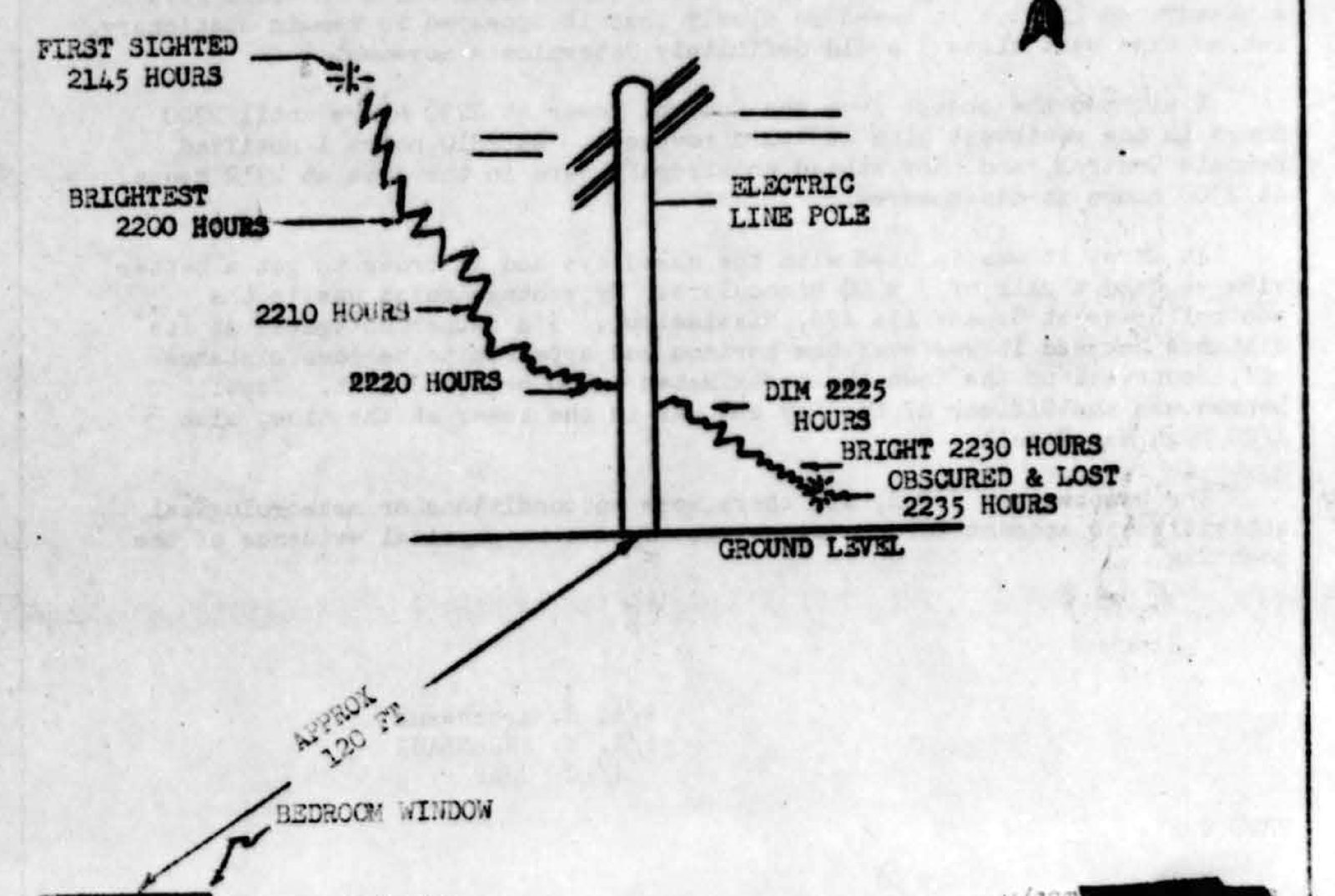
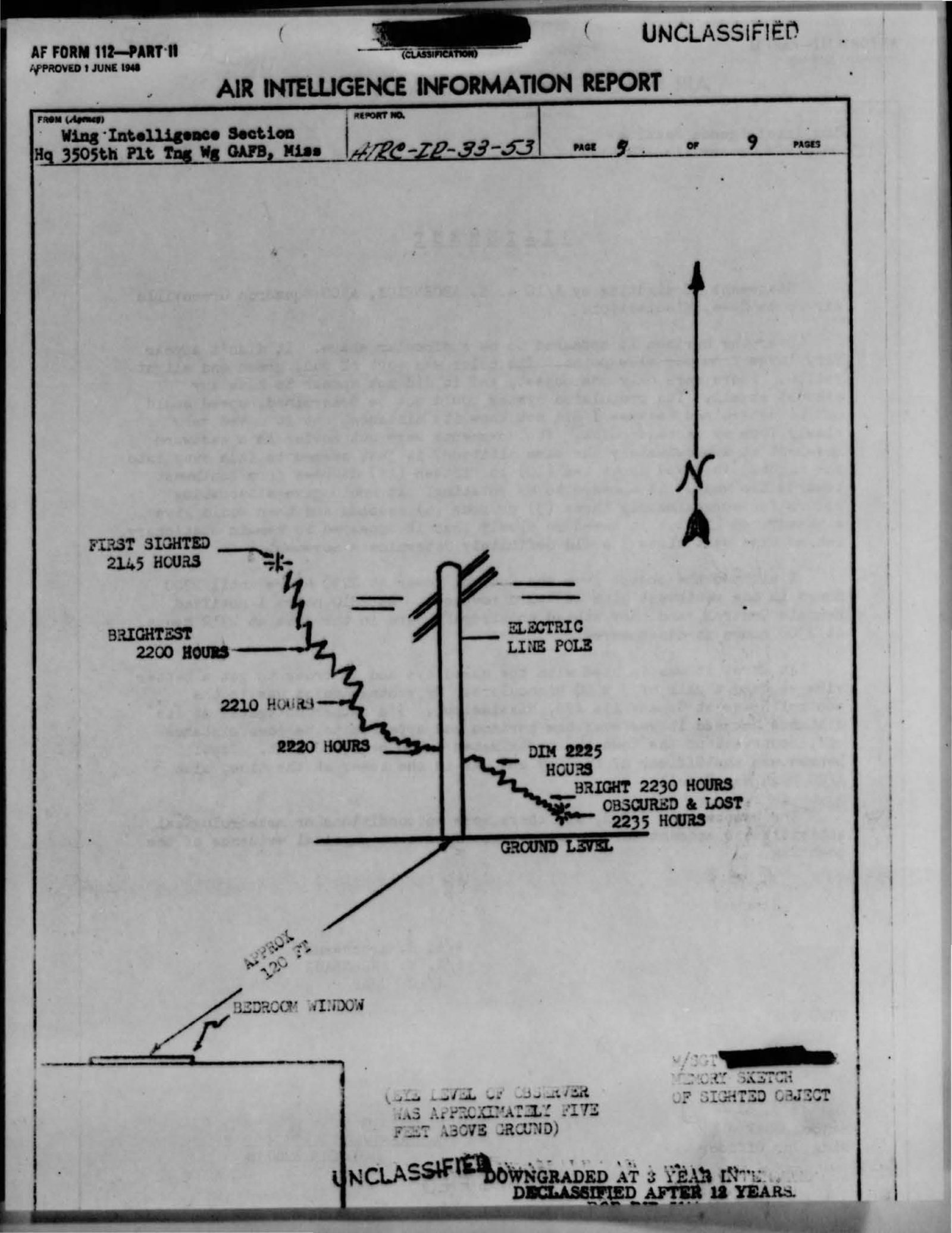
Pictured: part of the master sergeant's "Memory Sketch of Sighted Object," an inclosure to the base's report ATRC-IR-33-53, cropped from the Project Blue Book file. It is his drawing, made afterward, of the light's path as seen from his bedroom window: "First Sighted 2145 Hours," "Brightest 2200 Hours," past an "Electric Line Pole" about 120 feet away, "Dim 2225," "Bright 2230," and "Obscured & Lost 2235 Hours" just above "Ground Level." It is not a photograph and not to scale; no photograph of the object exists. U.S. government record, public domain.
Theoretical Alignment
The Extraterrestrial Hypothesis scores low. Every witness described a point of light that looked, in the base report's own words, "similiar to a large star," sat low on the horizon, flashed colors, faded slowly and moved only a few degrees in half an hour. Nothing in the file gives the light a size, a structure, a distance or a speed that anyone measured, and the two groups of witnesses were looking in directions about eighty degrees apart. The case's interest lies in the quality of the witnesses and of the checks, not in any performance that would point to an engineered craft.
The Interdimensional Hypothesis has nothing to work with. The Psycho-Social score reflects the way the sighting spread: one man watching from his bedroom for three-quarters of an hour, then a telephone call that sent three men in a control tower to look for something already described to them. That is not an accusation of invention. All three tower witnesses signed statements that are plain, cautious and unembellished, and Arceneaux wrote that he would "rather not guess at its distance." It is a reminder that the second sighting began as a search, and a search tends to find something.
Background
Greenville Air Force Base in 1953
Greenville Air Force Base lay northeast of the city of Greenville, on the Mississippi Delta in Washington County, about seven miles east of the Mississippi River. It was activated in 1940 as the United States prepared for war, and, according to a memorial profile published by Clemson University's Scroll of Honor, it conducted the basic phase of Army flight training "through early 1945" and was then used to store surplus B-17 and B-24 bombers and C-47 cargo planes. The Korean War brought it back. "In April 1953," the same profile records, "the Air Force began basic phase, single-engine flight training there." The unit was the 3505th Pilot Training Wing; its headquarters' Wing Intelligence Section wrote this report, and its letterhead reads "Hq 3505th Plt Tng Wg GAFB, Miss."
The base was flying T-28 Trojan propeller trainers that summer. The Clemson profile tells the story of one of its instructors, 1st Lt. John Bunyan Mitchell, who on July 17, 1953, six weeks before this sighting, was flying a T-28 with a student when the right wing apparently separated during a Split S; both men bailed out over the Mississippi, and Mitchell drowned. Jets came later: a historical marker erected at the field by the Greenville Rotary Club in 2005 records that "in 1954, Greenville AFB was designated a basic school for single engine jet pilots," and that more than 150 T-33s were assigned to the 3505th "from 1954 through 1960." The airfield is now Mid Delta Regional Airport.
Two of the men in this file belonged to that training world. Capt. William D. Lehman of the 3505th Pilot Training Group was "an Air Force Officer on flying status" and, on the night of August 27, the base's officer of the day. A/1C A. E. Arceneaux belonged to the base's AACS squadron, the Airways and Air Communications Service unit that ran the control tower, and the report calls him "a qualified control tower operater." The third witness lived off base, in Greenville itself: a master sergeant with twelve years' service, about 300 hours of night flying as a flight engineer on C-47s, and a private pilot's certificate.
Project Blue Book in August 1953
The report went to the Air Technical Intelligence Center (ATIC) at Wright-Patterson AFB, Ohio, home of Project Blue Book. In late August 1953 the project was at its lowest ebb. Its former chief, Capt. Edward J. Ruppelt, wrote in his 1956 memoir that while he was away on temporary duty earlier that year, Lt. Bob Olsson ran it with a staff that "consisted of Airman First Class Max Futch," and that when he came back in July, "Lieutenant Olsson was just getting out of the Air Force" and Futch "was now it." Ruppelt soon took the project back as an additional duty, arranged for the Air Defense Command's 4602nd Air Intelligence Service Squadron to do field investigations, and then left the service, writing that he "turned my command over to" Futch. The message ATIC sent to Greenville about this case on August 31, 1953 was drafted by "A/1C Max G. Futch." This was one of the reports that crossed Futch's desk in the weeks when, by Ruppelt's account, an airman first class was most of what Project Blue Book had.
The regulations were also in transition. ATIC's message asked Greenville to investigate "according to Air Force Letter 200-5," which Ruppelt describes as the April 1952 letter that made every base commander responsible for forwarding UFO reports "to ATIC by wire," followed by a fuller written report. But a new regulation had just been signed. The 1954 edition of Air Force Regulation 200-2 states that it "supersedes AFR 200-2, 26 August 1953," which means the first AFR 200-2 was dated the day before this sighting. Neither Greenville's report nor ATIC's message mentions it; both still worked under the 1952 letter. When Blue Book closed in 1969, according to the National Archives, 12,618 sightings had been reported to it and 701 remained "Unidentified." This is one of them.
Complete Timeline
| Date / Time | Event |
|---|---|
| April 5, 1952 | Air Force Letter 200-5 sets the procedure for reporting UFOs to ATIC by wire (Ruppelt). |
| April 1953 | Basic single-engine pilot training begins at Greenville AFB (Clemson Scroll of Honor). |
| July 17, 1953 | A Greenville T-28 breaks up during a training maneuver over the Mississippi; instructor 1st Lt. John B. Mitchell is killed. |
| August 26, 1953 | The first edition of AFR 200-2 is dated (per the 1954 edition's supersession note). |
| August 27, about 8:52 PM CST | Saturn sets in the west; no planet remains in the western sky (computed). |
| 9:45 PM CST (0345Z, August 28) | From his bedroom window in Greenville, M/Sgt T. O. Cooper sees a star-like light flashing green and red, "moving slowly north and downward." His wife also sees it. |
| 10:00 PM | "Brightest" on his sketch. The light passes an electric line pole about 120 feet from the window at about 10:20. |
| 10:25–10:30 PM | "Dim 2225 hours," then "bright 2230 hours" on his sketch. |
| 10:30 PM | After "a call from M/Sgt T. O. Cooper," Capt. William D. Lehman, the officer of the day, who is in the Greenville AFB control tower, sees a light with A/1C A. E. Arceneaux and A/2C H. H. MacDonell, first with the naked eye, then through 7x50 binoculars, in the southwest at 235°–245°. (The teletype says 10:15.) |
| 10:35 PM | Cooper's light is "obscured by clouds" and lost near the ground line of his sketch. |
| About 10:50–10:53 PM | Arcturus sets in the west-northwest at azimuth 294°; Antares sets in the southwest at 238° (computed). |
| 11:00 PM | The tower's light "just seemed to fade away into the night." It had moved "about ten (10) to fifteen (15) degrees from southwest towards the west," or "5° to 10°" on Arceneaux's sketch. |
| 11:10 PM | Arceneaux notifies Memphis Control. |
| 11:12 PM | Memphis calls the tower back: Memphis Flight Service reports "no transit aircraft in Greenville Area." Base Operations reports no Greenville aircraft flying; the weather detachment reports no balloons. |
| 11:30 PM | End of the sighting according to the base's summary, which disagrees with both tower statements. |
| August 28, 0604Z | The Flight Service Center at Maxwell AFB, Alabama, transmits a "FLYOBRPT" to the Director of Intelligence, ATIC, Air Defense Command, MATS and Flight Service; "message received as CIRVIS." |
| August 31, 1953 | Maj. Gerald E. Tyler of Flight Service, MATS, forwards the teletype to ATIC: "A total lack of investigative capabilities ... prohibits attainment of any valid conclusion." |
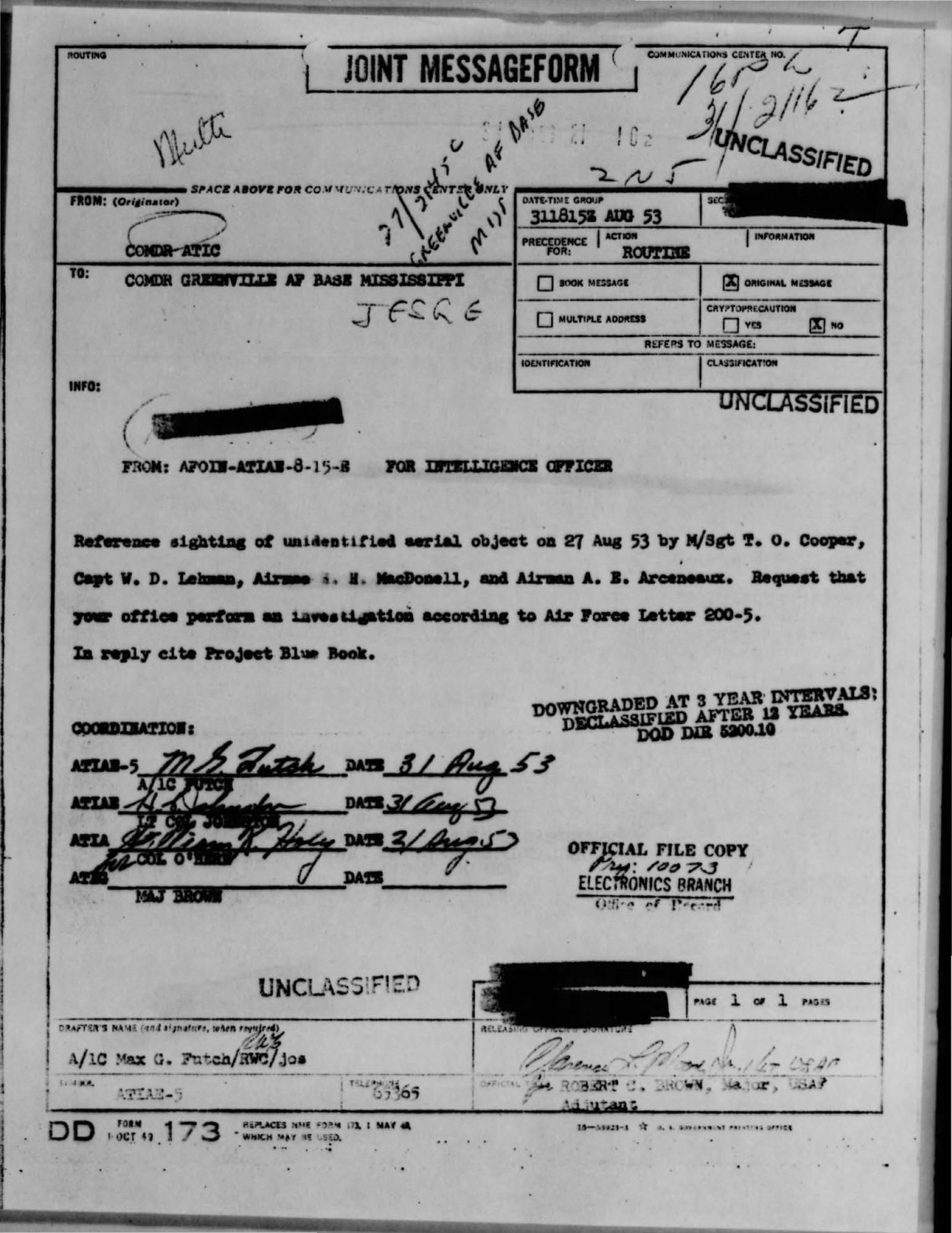
| August 31, 1953, 1815Z | ATIC asks Greenville's intelligence officer to "perform an investigation according to Air Force Letter 200-5. In reply cite Project Blue Book." Drafted by A/1C Max G. Futch. |
| September 3, 1953 | Maj. Joseph H. King, Wing Operations Officer, approves the nine-page report ATRC-IR-33-53, evaluation "B"; four copies go to the Commander, Flying Training Air Force, Texas. |
| Late 1963 or later | The surviving record card is typed on an FTD form whose edition is dated September 1963: "UNIDENTIFIED," with "Antares?" on the index strip. |
| December 17, 1969 | The end of Project Blue Book is announced. The case remains UNIDENTIFIED. |
| July–August 2014 | Tim Printy, in SUNlite, proposes that the house sighting was Arcturus and the tower sighting Antares. |
The File, Page by Page
The released file has fifteen pages. They were read for this case file as images, page by page, without relying on machine transcription; the record card in particular is too faint for it. In the order the pages were scanned:
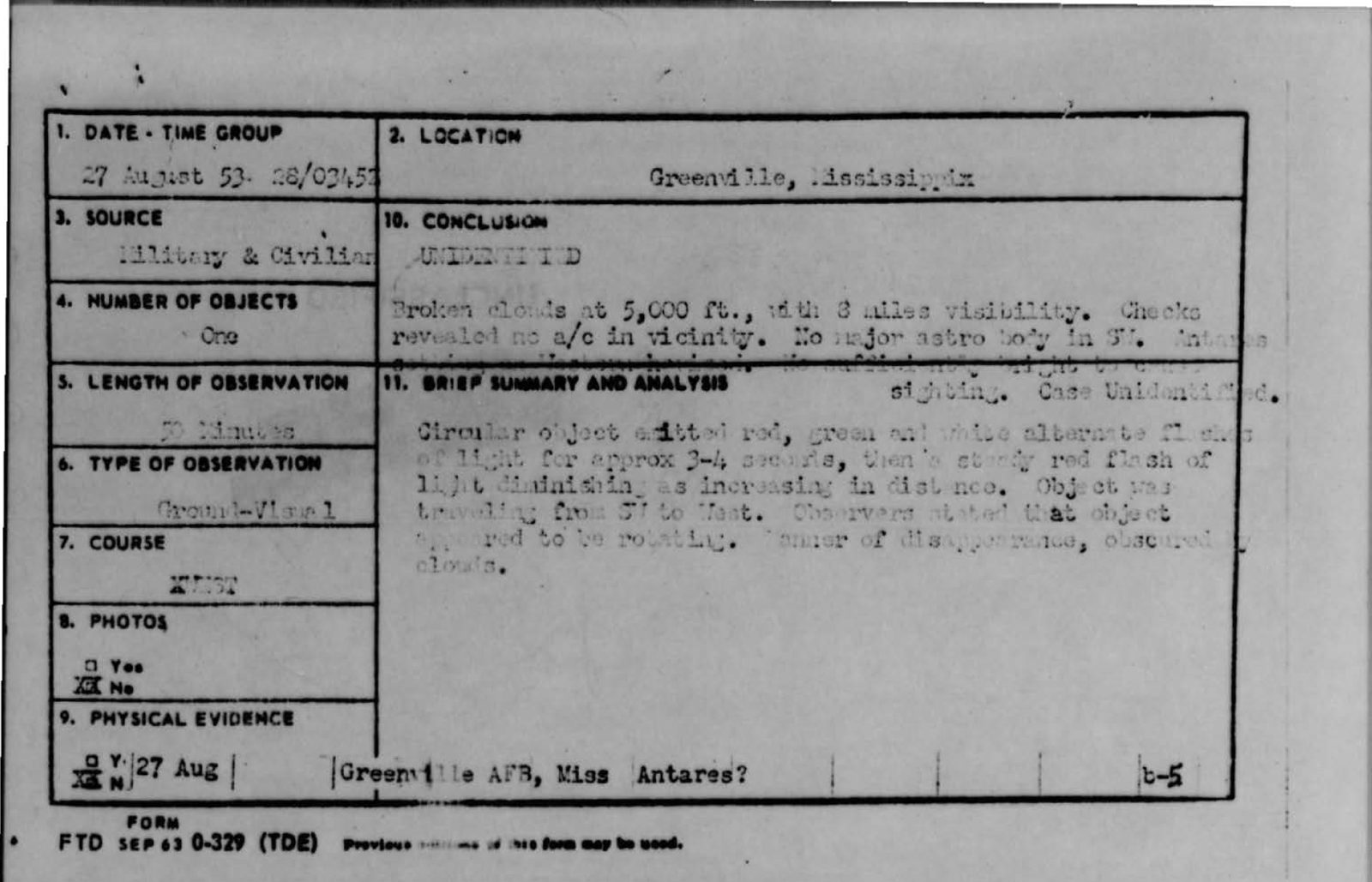
- The record card. "27 August 53 28/0345Z," "Greenville, Mississippi," source "Military & Civilian," one object, "50 Minutes," "Ground-Visual," course "WEST," no photos, no physical evidence, conclusion "UNIDENTIFIED," with a typed comment and a summary (both quoted below). It is printed on "FTD SEP 63 0-329 (TDE)."
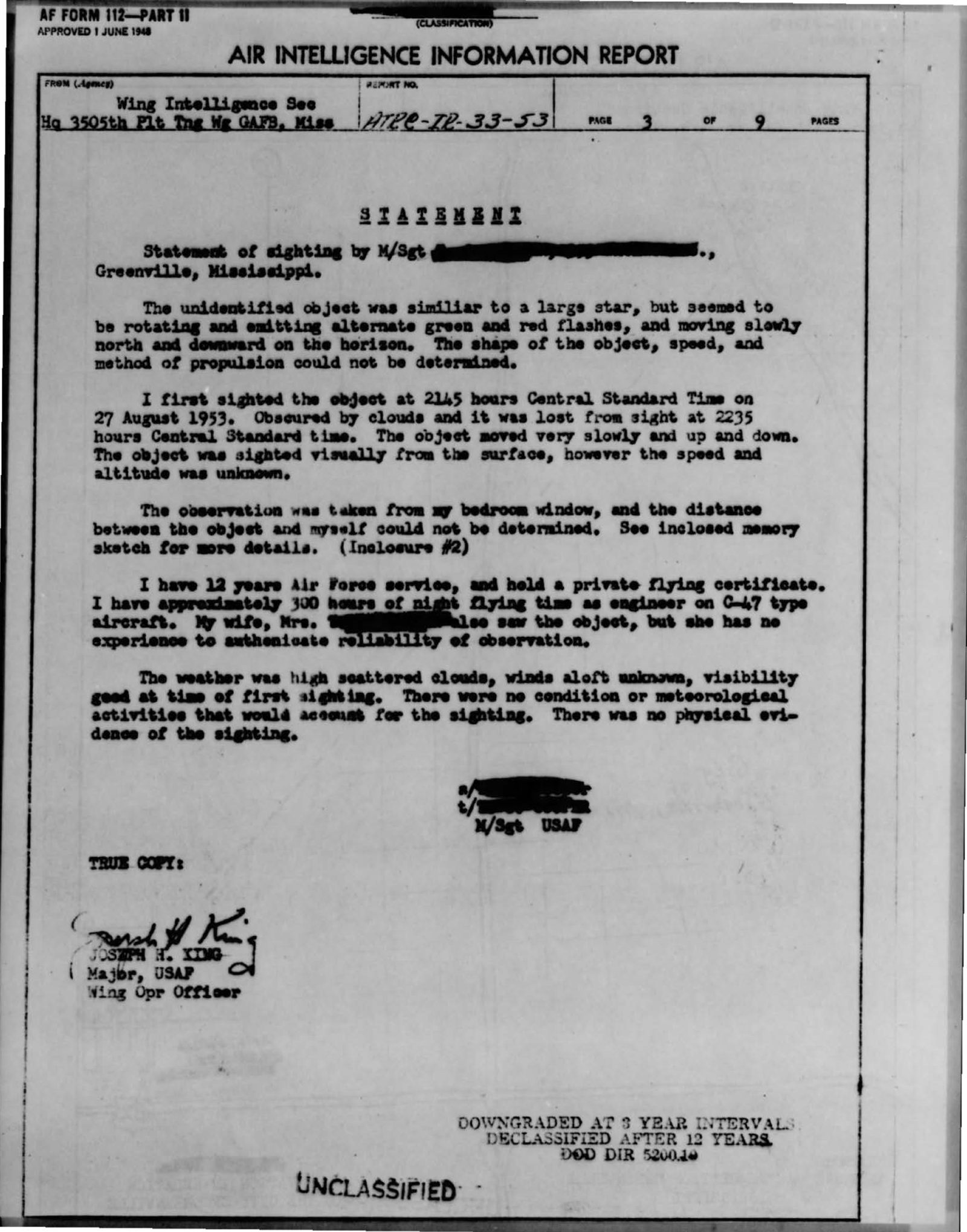
- The sergeant's statement (page 3 of the nine-page report), his name blacked out in the heading and the signature.
- His "Memory Sketch of Sighted Object" (the page number is hand-corrected and hard to read; Printy cites it as page 5), the drawing shown above.
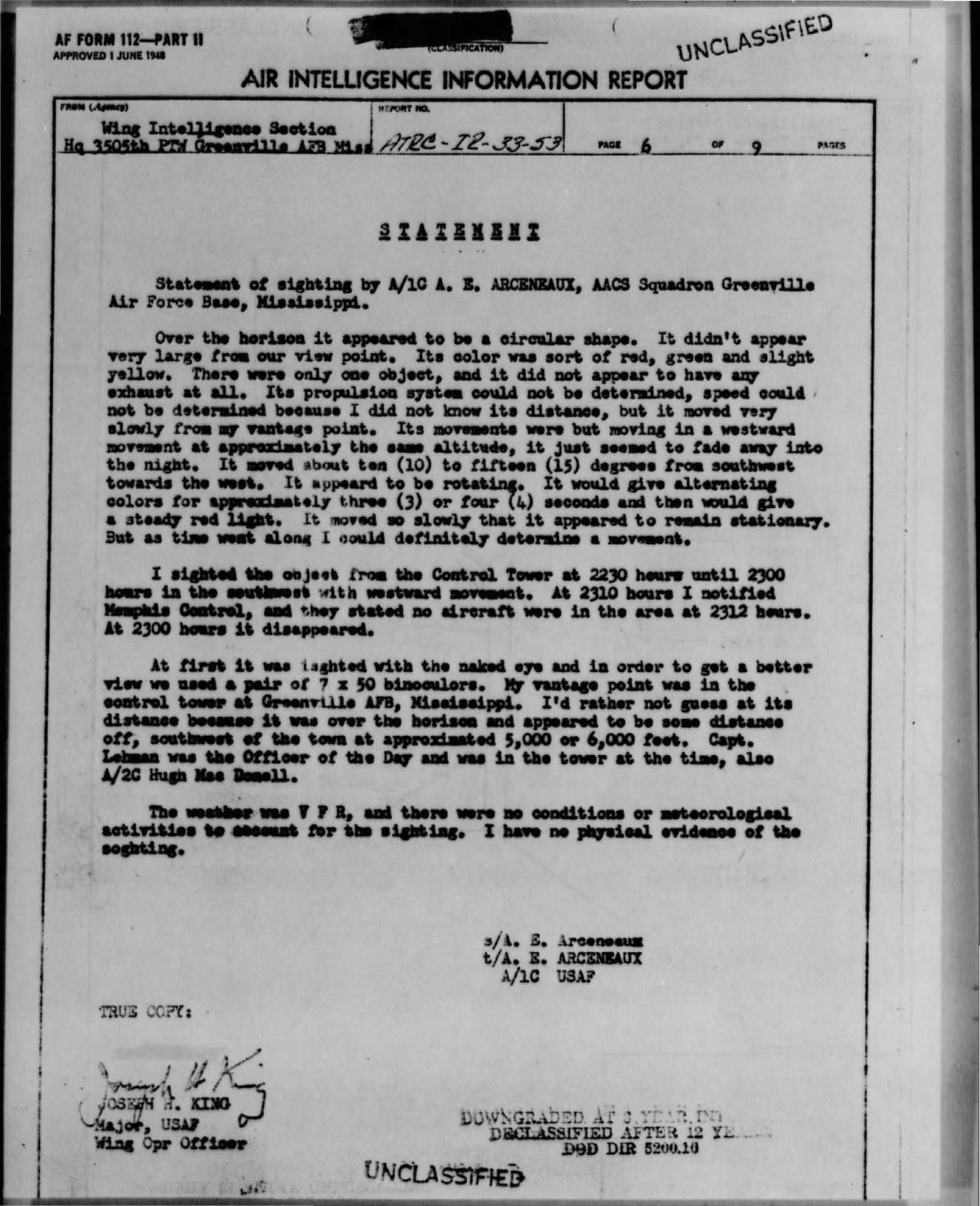
- Arceneaux's statement (page 6).
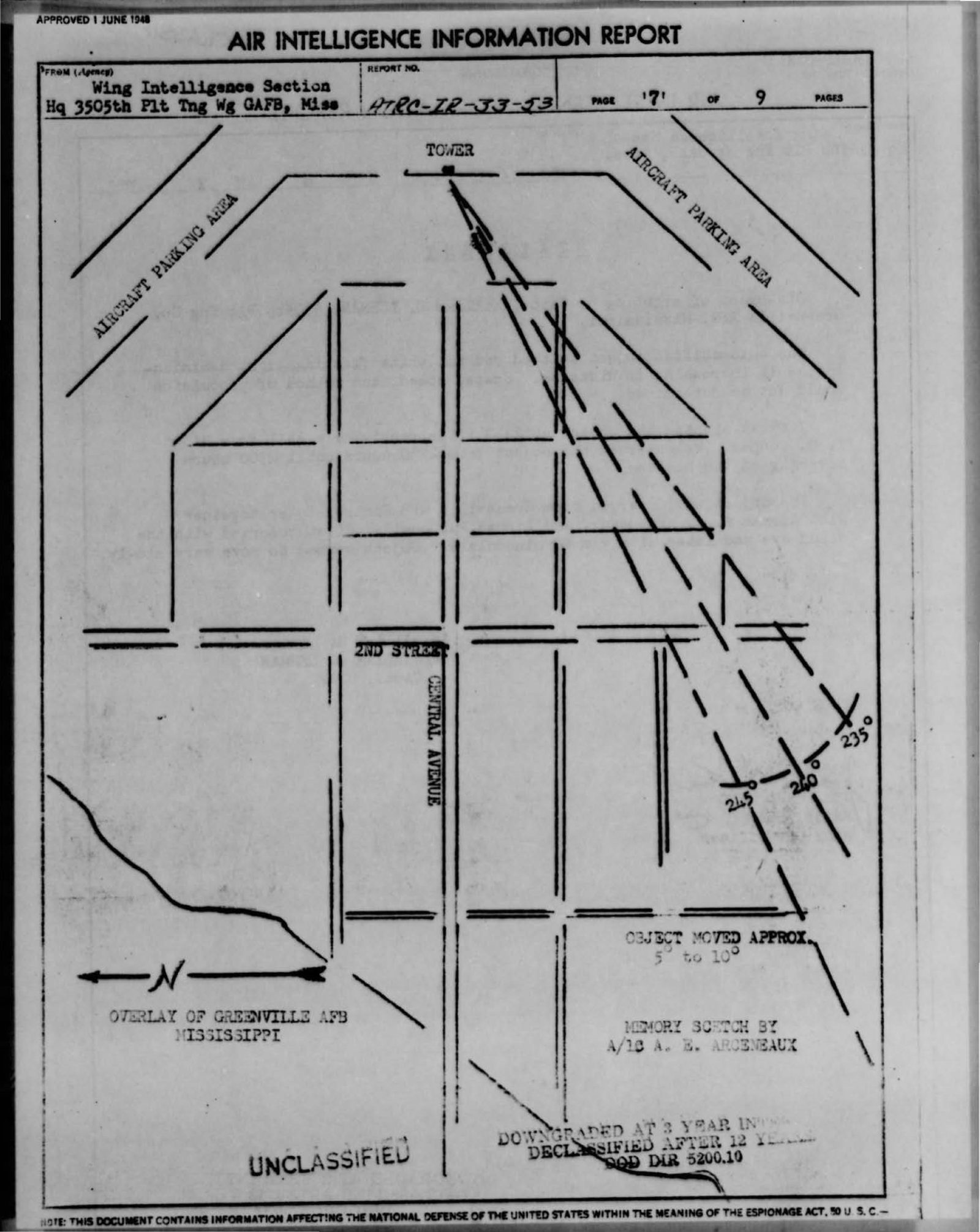
- Arceneaux's "Memory Scetch" (page 7), an overlay of the base with three bearings drawn from the tower.
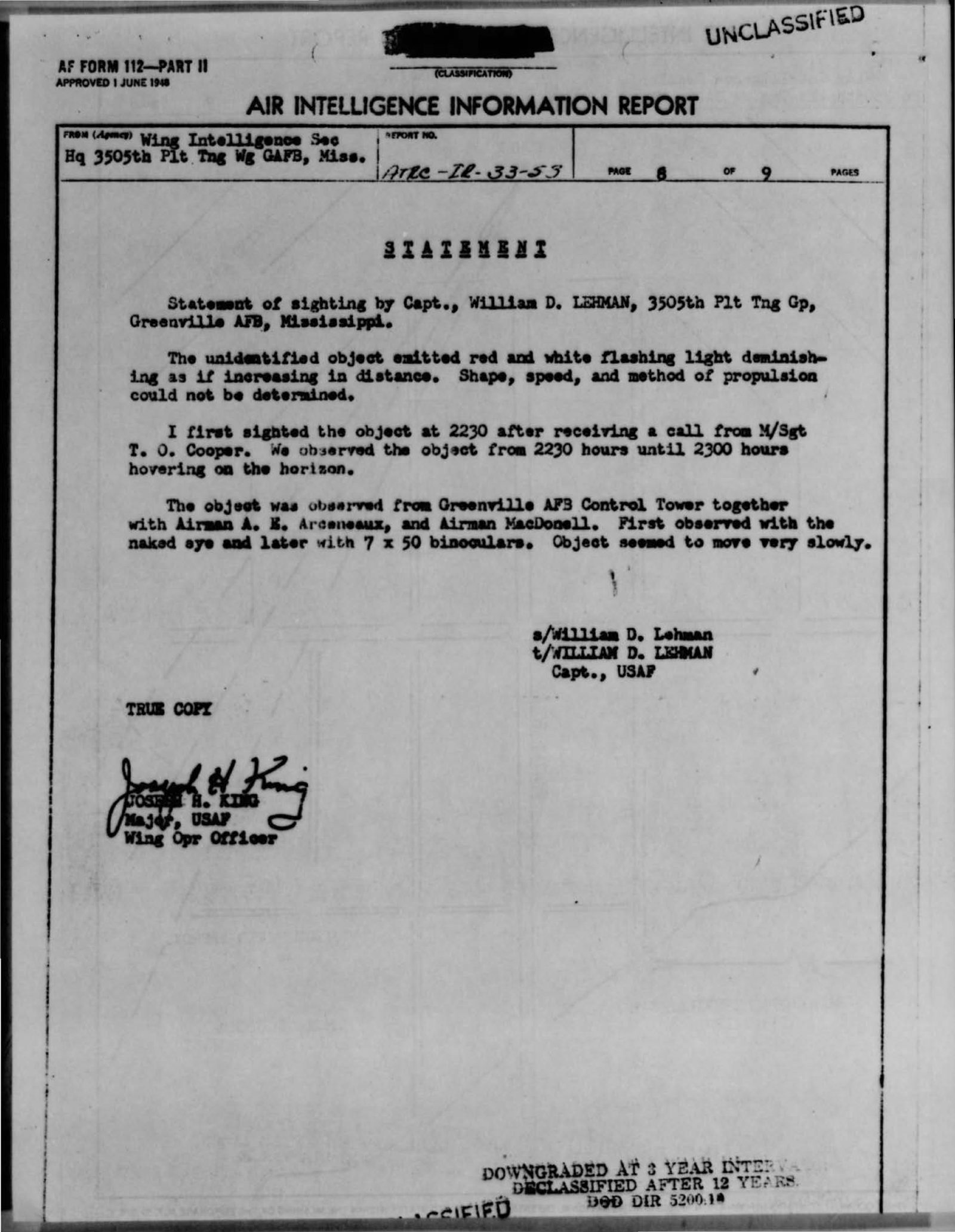
- Lehman's statement (page 8).
- "Comments of Approving Officer" (page 9), quoting ATIC's message.
- A teletype header sheet, received "1953 AUG 28," with routing indicators and handwritten action notes.
- The teletype itself, from the Flight Service Center at Maxwell AFB, Alabama.
- ATIC's outgoing message to Greenville on a Joint Messageform, with its coordination signatures.
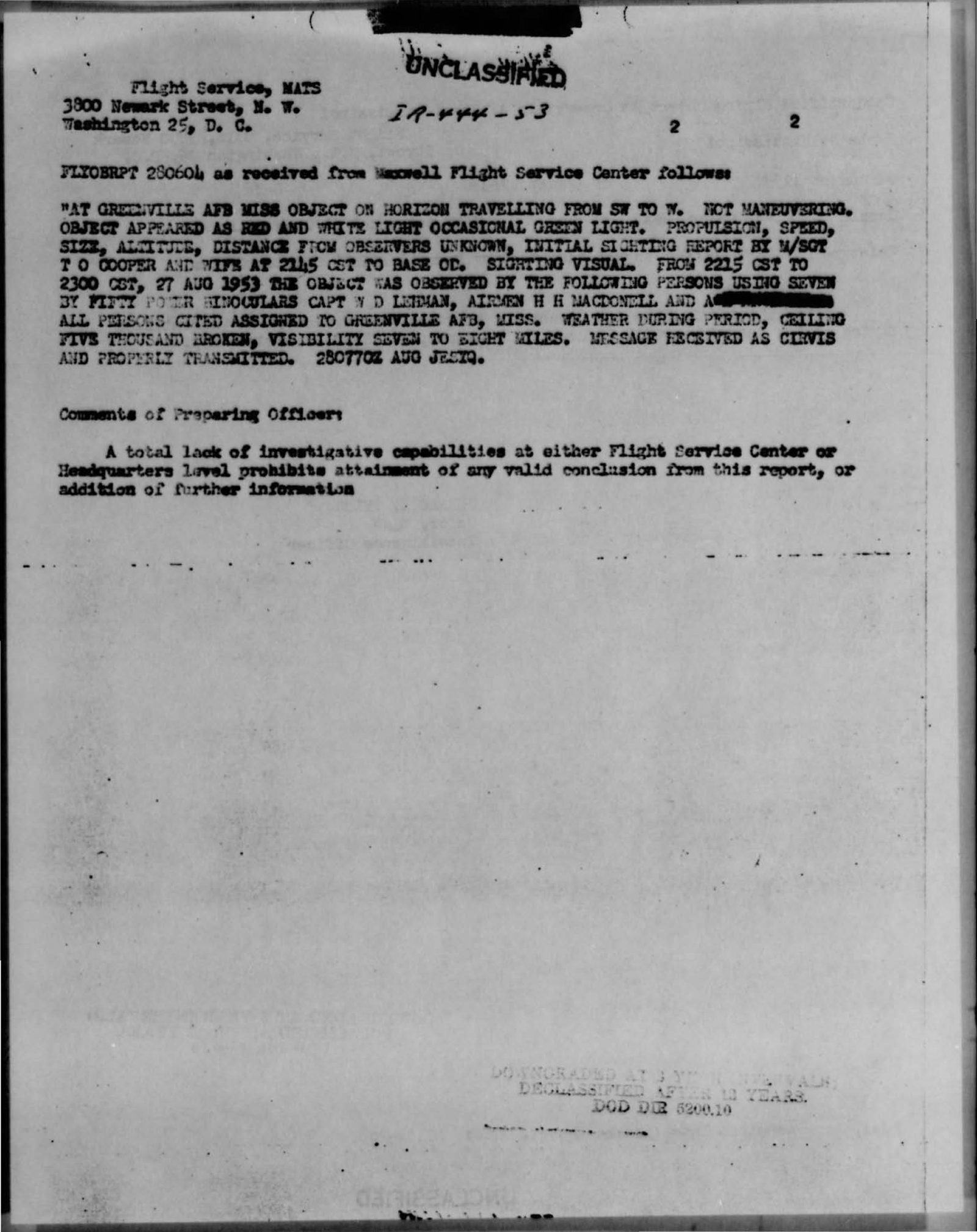
- Page 2 of a MATS Flight Service report, IR-444-53, retyping the teletype and adding a comment.
- Page 1 of the same MATS report.
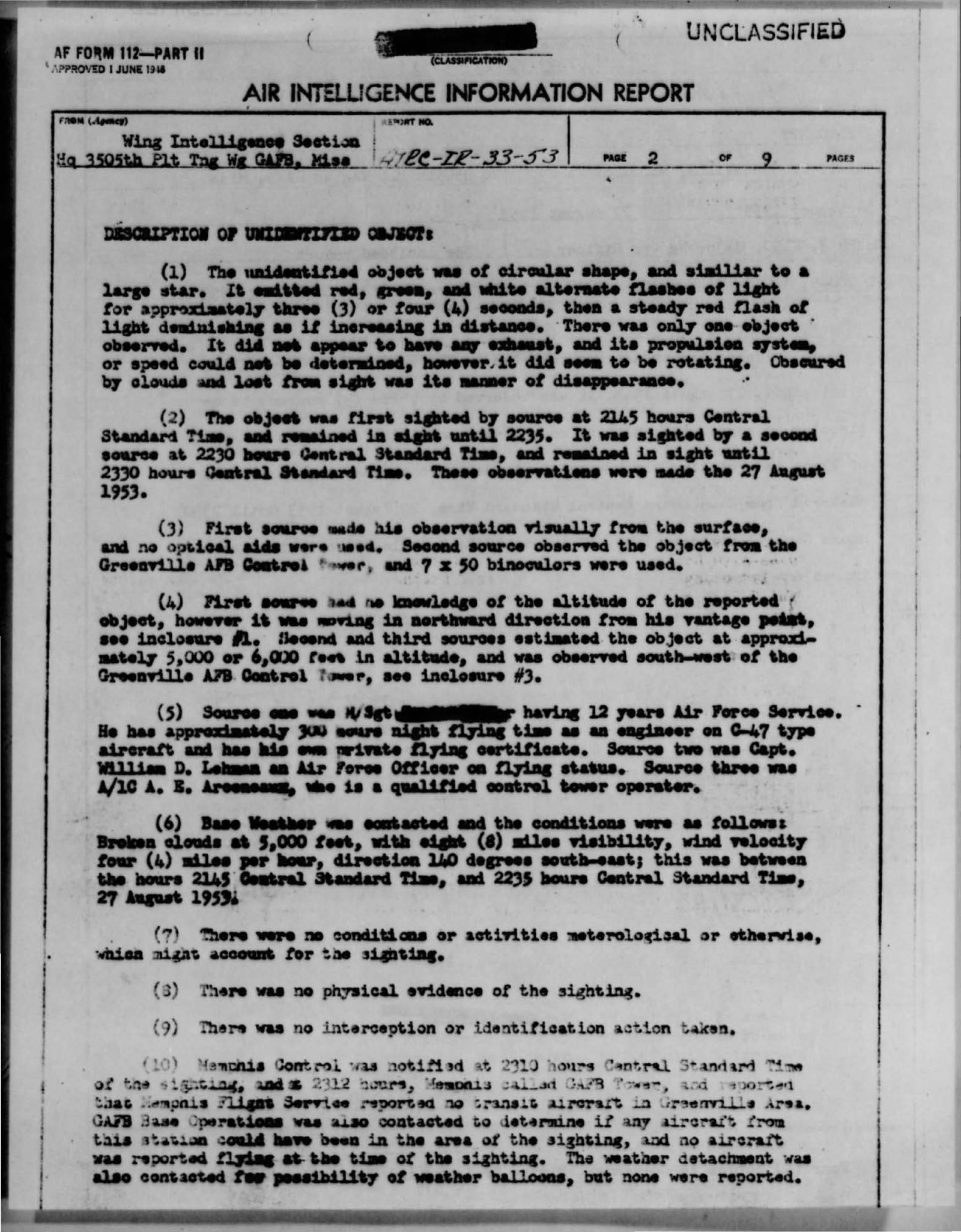
- Page 2 of the base report, "Description of Unidentified Object," the investigating officer's synthesis.
- Page 1 of the base report, the AF Form 112 cover sheet.
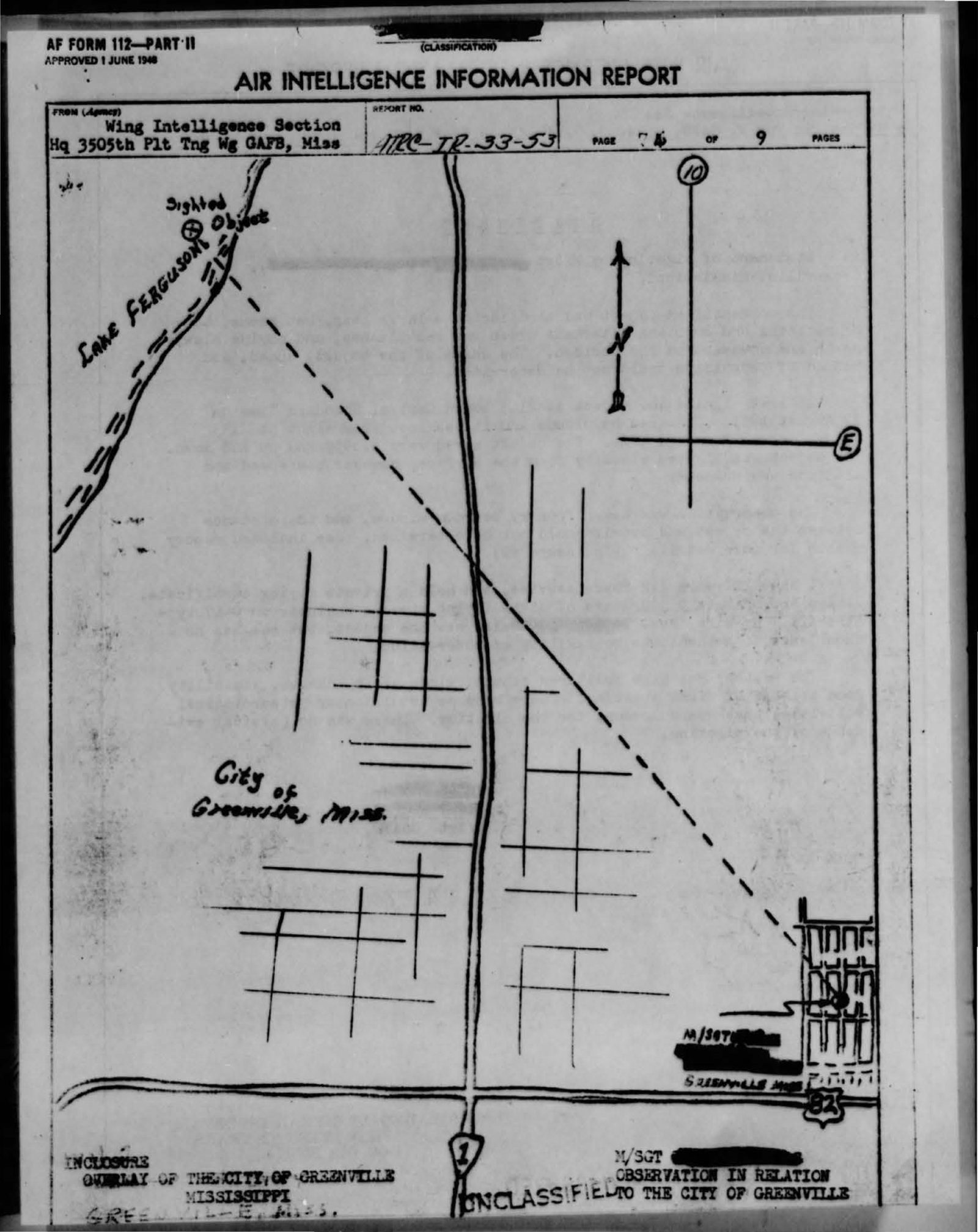
- The sergeant's map, "Observation in Relation to the City of Greenville" (page number overwritten; probably page 4).
Nothing else is in the file: no Blue Book worksheet, no astronomical computation, no correspondence after September 1953, and no interview by Blue Book's own staff.
What the Sergeant Saw
The sergeant's statement is short and, as typed, a "true copy" certified by Major King. Its key paragraph reads:
The unidentified object was similiar to a large star, but seemed to be rotating and emitting alternate green and red flashes, and moving slowly north and downward on the horizon. The shape of the object, speed, and method of propulsion could not be determined.
"I first sighted the object at 2145 hours Central Standard Time on 27 August 1953. Obscured by clouds and it was lost from sight at 2235 hours Central Standard time. The object moved very slowly and up and down. The object was sighted visually from the surface, however the speed and altitude was unknown." He watched "from my bedroom window, and the distance between the object and myself could not be determined." He gave his own credentials: "I have 12 years Air Force service, and hold a private flying certificate. I have approximately 300 hours of night flying time as engineer on C-47 type aircraft." And, scrupulously: "My wife, Mrs. [name redacted] also saw the object, but she has no experience to authenicate reliability of observation." The weather, as he saw it, "was high scattered clouds, winds aloft unknown, visibility good at time of first sighting."
His name
The sergeant's name is blacked out on his own statement, his sketch, his map, the cover sheet and the Maxwell teletype. It is not blacked out elsewhere in the same released file. Lehman's statement says he looked "after receiving a call from M/Sgt T. O. Cooper"; ATIC's message names "M/Sgt T. O. Cooper"; and the MATS report reads "INITIAL SIGHTING REPORT BY M/SGT T O COOPER AND WIFE AT 2145 CST TO BASE OD." This case file uses the name exactly as the released file gives it, M/Sgt T. O. Cooper, and nothing more. His wife's name and his address are not given here.
The memory sketch
The sketch, shown at the top of this page, is the most informative document in the file. It is drawn from the bedroom window. A line labelled "Approx 120 ft" runs from the window to the foot of an "Electric Line Pole" with cross-arms and wires, and a note in the lower margin reads: "(Eye level of observer was approximately five feet above ground)." The light's path is a zig-zag that runs diagonally down and to the right: "First Sighted 2145 Hours" at upper left; "Brightest 2200 Hours"; "2210 Hours"; "2220 Hours," where the path reaches the pole; then, to the right of the pole, "Dim 2225 Hours," "Bright 2230 Hours," and "Obscured & Lost 2235 Hours," a few millimeters above the line marked "Ground Level." A north arrow is drawn pointing up the page, which on a picture of the sky does not fix a direction.
Three things in the drawing matter for what follows. The overall path descends steadily, at roughly 40° to 45° from the horizontal as drawn. The zig-zag matches the statement's "moved very slowly and up and down." And the brightness changes, brightest at 10:00, dim at 10:25, bright again at 10:30, are irregular rather than a steady fading.
The map
The sergeant also drew a map, "Overlay of the City of Greenville, Mississippi," titled "M/Sgt [redacted] Observation in Relation to the City of Greenville." It shows a sketched street grid labelled "City of Greenville, Miss.," U.S. Highway 1 running north and south through it and Highway 82 along the bottom, a north arrow pointing up with east to the right, and, at upper left, "Lake Ferguson," the oxbow lake on the city's west side. His house is a small mark at the east edge of the drawn city, near the label "Greenville Miss" and Highway 82; the label beside it is redacted. A dashed line runs from the house to a circled cross at the edge of the lake, marked "Sighted Object." Measured on the drawing, the line bears about 320°, northwest. Printy measured it as "roughly 315 degrees." It is a map of direction, not of distance: the sergeant wrote that the distance "could not be determined," and the circled cross sits where the line meets the lake, not at a measured point.
What the Tower Saw
Arceneaux
A/1C A. E. Arceneaux, "AACS Squadron Greenville Air Force Base," gave the longest of the three statements:
Over the horison it appeared to be a circular shape. It didn't appear very large from our view point. Its color was sort of red, green and slight yellow. There were only one object, and it did not appear to have any exhaust at all. Its propulsion system could not be determined, speed could not be determined because I did not know its distance, but it moved very slowly from my vantage point. Its movements were but moving in a westward movement at approximately the same altitude, it just seemed to fade away into the night. It moved about ten (10) to fifteen (15) degrees from southwest towards the west. It appeard to be rotating. It would give alternating colors for approximately three (3) or four (4) seconds and then would give a steady red light. It moved so slowly that it appeared to remain stationary. But as time went along I could definitely determine a movement.
"I sighted the object from the Control Tower at 2230 hours until 2300 hours in the southwest with westward movement. At 2310 hours I notified Memphis Control, and they stated no aircraft were in the area at 2312 hours. At 2300 hours it disappeared." They used binoculars: "At first it was sighted with the naked eye and in order to get a better view we used a pair of 7 x 50 binoculors." On distance he was careful: "I'd rather not guess at its distance because it was over the horison and appeared to be some distance off, southwest of the town at approximated 5,000 or 6,000 feet." He named the others: "Capt. Lehman was the Officer of the Day and was in the tower at the time, also A/2C Hugh Mac Donell." And: "The weather was V F R, and there were no conditions or meteorological activities to account for the sighting."
The tower sketch
Arceneaux's "Memory Scetch," an "Overlay of Greenville AFB Mississippi," shows the base's layout: the "Tower" at the top edge, "Aircraft Parking Area" on both sides, "2nd Street" and "Central Avenue." Its north arrow points to the left of the page, so the drawing is turned: the dashed lines running down and to the right from the tower point southwest. Three are marked with bearings, "235°," "240°" and "245°," and a note reads: "Object moved approx. 5° to 10°." No elevation angle is given anywhere in the tower's account, beyond "over the horison" and "hovering on the horizon."
Lehman
Capt. William D. Lehman's statement is the briefest: "The unidentified object emitted red and white flashing light deminishing as if increasing in distance. Shape, speed, and method of propulsion could not be determined. I first sighted the object at 2230 after receiving a call from M/Sgt T. O. Cooper. We observed the object from 2230 hours until 2300 hours hovering on the horizon. The object was observed from Greenville AFB Control Tower together with Airman A. E. Arceneaux, and Airman MacDonell. First observed with the naked eye and later with 7 x 50 binoculars. Object seemed to move very slowly."
The fourth man in the tower, Airman H. H. MacDonell (spelled "Mac Donell" by Arceneaux), gave no statement that survives in the file. He appears only in the statements, the teletype and ATIC's message.
The Investigating Officer's Synthesis
Page 2 of the report, "Description of Unidentified Object," is the base's own summary, and it is the source of most later summaries, including the record card. It blends the two sightings into one:
The unidentified object was of circular shape, and similiar to a large star. It emitted red, green, and white alternate flashes of light for approximately three (3) or four (4) seconds, then a steady red flash of light deminishing as if increasing in distance. There was only one object observed. It did not appear to have any exhaust, and its propulsion system, or speed could not be determined, however it did seem to be rotating. Obscured by clouds and lost from sight was its manner of disappearance.
The rest of the page adds the facts not found elsewhere. The first source "made his observation visually from the surface, and no optical aids were used." He "had no knowledge of the altitude of the reported object, however it was moving in northward direction from his vantage point." The "second and third sources estimated the object at approximately 5,000 or 6,000 feet in altitude, and was observed south-west of the Greenville AFB Control Tower." Base Weather reported "Broken clouds at 5,000 feet, with eight (8) miles visibility, wind velocity four (4) miles per hour, direction 140 degrees south-east" between 2145 and 2235. "There were no conditions or activities meterological or otherwise, which might account for the sighting." "There was no interception or identification action taken." And paragraph 10 records the checks: Memphis Control "was notified at 2310 hours Central Standard Time of the sighting, and at 2312 hours, Memphis called GAFB Tower, and reported that Memphis Flight Service reported no transit aircraft in Greenville Area. GAFB Base Operations was also contacted to determine if any aircraft from this station could have been in the area of the sighting, and no aircraft was reported flying at the time of the sighting. The weather detachment was also contacted for possibility of weather balloons, but none were reported."
Where the synthesis departs from the statements
Read against the three signed statements, the synthesis makes four changes that later readers inherited.
- The end time. Both tower witnesses wrote that the light was gone at 2300. The synthesis, and the cover sheet's summary, say the second source watched "until 2330 hours." The Maxwell teletype, sent hours after the event, says 2300. Printy noticed the same thing: the summary "incorrectly stated it was visible until 2330 but both witness statements clearly state it was gone by 2300." Arceneaux's call to Memphis at 2310 came ten minutes after the light had gone.
- The direction. The sergeant's light moved "north and downward" on a line of sight that his map draws to the northwest; the tower's moved "from southwest towards the west." The synthesis records both directions without noticing that they describe different parts of the sky. The teletype reduced them to "travelling from SW to W," and the card to "traveling from SW to West."
- The colors. The sergeant saw green and red; Arceneaux red, green and "slight yellow"; Lehman red and white. The synthesis made it "red, green, and white."
- The start time. Both tower statements say 2230. The teletype says the tower watched "from 2215 CST."
None of these is unusual in a report of this kind, and none is concealment: the statements are attached. But the merged account, "one object" seen from 2145 to 2330 moving from southwest to west, is the version that went into the catalogs, and it describes something no single witness reported.
How the Report Traveled
The CIRVIS teletype
The base itself sent no wire. Major King's "Comments of Approving Officer" say so plainly: "No electrical report was submitted from this headquarters. However Memphis Flight Service was notified immediately of the sighting by telephon." The report reached Washington and Wright-Patterson through the Air Force's flight service network instead. The teletype in the file comes "FM CMDR FLIGHT SERVICE CENTER MAXWELL AFB ALA" and is addressed to the Director of Intelligence, Headquarters USAF; to ATIC at Wright-Patterson, "ATTN ATIAA-2C"; to the Commander, Air Defense Command, at Ent AFB, Colorado Springs; to the Commander, MATS, at Andrews AFB; and to the Commander, Flight Service, in Washington. It reads, in part:
AT GREENVILLE AFB MISS OBJECT ON HORIZION TRAVELLING FROM SW TO W. NOT MANUVERING. OBJECT APPEARED AS RED AND WHITE LIGHT OCCASIONAL GREEN LIGHT. PROPULSION, SPEED, SIZE, ALTITUDE, DISTANCE FROM OBSERVERS UNKNOWN. INITIAL SIGHTING REPORT BY M/SGT [redacted]. SIGHTING VISUAL. FROM 2215 CST TO 2300 CST, 27 AUG 1953 THE OBJECT WAS OBSERVED BY FOLLOWING PERSONS USING SEVEN BY FIFTY POWER BINOCULARS CAPT W D LEHMAN, AIRMEN H H MACDONELL AND [redacted]. ALL PERSONS CITED ASSIGNED TO GREENVILLE AFB, MISS. WEATHER DURING PERIOD, CEALING FIVE THOUSAND BROKEN, VISIBILITY SEVEN TO EIGHT MILES PD MESSAGE RECEIVED AS CIRVIS AND PROPERLY TRANSMITTED PD
It is signed with a name that reads "GOLINSKY" (the first letter could be a C) and timed "28/0710Z AUG." The end time on this copy is smudged; the MATS retyping reads 2300. "CIRVIS," Communications Instructions for Reporting Vital Intelligence Sightings, was the military procedure for urgent reports of unidentified or hostile traffic; a modern Air Force instruction still describes it as a report which, "in the opinion of the observer, requires very urgent defensive action or investigation." In other words, someone in the flight service chain treated a telephone call about a light on the horizon as a possible air-defense matter and pushed it to five headquarters overnight. The header sheet shows the message arriving on August 28 with an "Action" notation in pen.
The MATS report
Flight Service, part of the Military Air Transport Service, then wrote it up in its own intelligence format. Report IR-444-53, dated August 31, 1953 and signed by Maj. Gerald E. Tyler, Intelligence Officer, carries the title "Unidentified Flying Object At Greenville AF Base, Mississippi," the source "USAF personnel at Greenville AFB," and an evaluation "B-2." It retypes the teletype, which it numbers "FLYOBRPT 280604," with one addition: the initial report was "BY M/SGT T O COOPER AND WIFE AT 2145 CST TO BASE OD." Tyler's own comment is one sentence: "A total lack of investigative capabilities at either Flight Service Center or Headquarters level prohibits attainment of any valid conclusion from this report, or addition of further information."
The phrase "to base OD at 2145" does not quite agree with Lehman, who wrote that he looked "at 2230 after receiving a call." Either the teletype gives the sighting's start time rather than the call's, or the sergeant called twice, or the call did not reach the tower at once. The file does not say.
ATIC's request
ATIC's reply went out on August 31 at 1815Z on a Joint Messageform, "Routine," from "COMDR ATIC" to "COMDR GREENVILLE AF BASE MISSISSIPPI," from office symbol "AFOIN-ATIAE-8-15-E," "for Intelligence Officer": "Reference sighting of unidentified aerial object on 27 Aug 53 by M/Sgt T. O. Cooper, Capt W. D. Lehman, Airman H. H. MacDonell, and Airman A. E. Arceneaux. Request that your office perform an investigation according to Air Force Letter 200-5. In reply cite Project Blue Book." The drafter is "A/1C Max G. Futch," and his signature heads the coordination block, dated 31 August 1953. Below it are the initials of a lieutenant colonel and, signed "for," a colonel, both partly obscured by their signatures, and a blank line for "Maj Brown." The release signature is "for Robert C. Brown, Major, USAF, Adjutant." A stamp reads "Official File Copy, Prj: 10073, Electronics Branch, Office of Record."
Greenville's answer
Greenville answered in three days. Its nine-page Air Intelligence Information Report, ATRC-IR-33-53, from the "Wing Intelligence Section, Hq 3505th Plt Tng Wg GAFB, Miss," is dated September 3, 1953. The cover sheet gives the subject as "FLYOBRPT," the area as "Vicinity of Greenville, Mississippi," the references as "AFL 200-5, AFOIN-ATIAE-8-15-E, ATIC, Wright-Patterson AFB, dtd 31 Aug 1953," and the evaluation as "B." It was "prepared by Joseph H. King, Major Wg Opr Officer," and distributed in "Four (4) copies to Commander, Flying Training Air Force, Texas"; a copy reached Blue Book's file. Its summary repeats the merged version: "observed by three (3) sources to be circular in shape, and emitting red, green, and white alternate flashes of light and rotating and moving slowly downward on the horizon ... from 2145 hours ... until 2330 hours." Nothing in the report suggests that anyone went to the sergeant's house, compared the two sightings' directions, or looked at the sky.
The Record Card and "Antares?"
The record card is the only place in the file where anyone considered an astronomical cause. Its comment, typed under the conclusion "UNIDENTIFIED," is faint, and its third line is overprinted by the box's own ruled line, but it can be read:
Broken clouds at 5,000 ft., with 8 miles visibility. Checks revealed no a/c in vicinity. No major astro body in SW. Antares setting on Western horizon. Not sufficiently bright to cause sighting. Case Unidentified.
Its summary is a close paraphrase of the synthesis: "Circular object emitted red, green and white alternate flashes of light for approx 3-4 seconds, then a steady red flash of light diminishing as increasing in distance. Object was traveling from SW to West. Observers stated that object appeared to be rotating. Manner of disappearance, obscured by clouds." The strip along the bottom, used for indexing, reads "27 Aug | Greenville AFB, Miss | Antares? | b-5."
The card was not typed in 1953. Its form is "FTD SEP 63 0-329 (TDE)," an edition of the Foreign Technology Division's record card printed no earlier than September 1963, with the note "Previous editions of this form may be used." The two other Blue Book cards from Greenville, for 1957 and 1960, are on the original "ATIC Form 329 (Rev 26 Sep 52)." So the Antares comment was written at least ten years after the event, during one of Blue Book's later reviews of old cases, by someone who looked for a bright body in the southwest, found Antares setting, judged it too faint, and left the case unidentified with a question mark. The card does not mention the sergeant's northwest line of sight at all.
The Sky That Night
The positions below were computed for this file for the site of the old base, now Mid Delta Regional Airport (33.487° N, 90.988° W, from OpenStreetMap), on the evening of August 27, 1953 (03:45–05:30 UT on August 28). Greenville lies only a few miles away, too close for the difference to matter. The Moon and planets come from NASA JPL's Horizons system; the stars were computed from their catalog positions, precessed to 1953, with a routine that reproduces Horizons' position for Saturn to within 0.01°. Elevations include standard refraction. Azimuths are measured from north through east.
| Object | 9:45 PM CST | 10:30 PM CST | Sets (CST) | Catalog magnitude |
|---|---|---|---|---|
| Sergeant's light | Northwest on his map (about 320°); "north and downward"; lost 10:35 near the ground line | — | "a large star" | |
| Tower's light | — | 235°–245° "on the horizon," moving 5°–15° west by 11:00 | — | — |
| Arcturus | 285.3°, 12.3° | 291.2°, 3.5° | about 10:50, at 294° | −0.05 |
| Antares | 228.1°, 10.9° | 235.1°, 3.6° | about 10:53, at 238° | about +1.0 (variable) |
| Sabik (η Ophiuchi) | 228.1°, 25.2° | 236.6°, 17.7° | after midnight | +2.4 |
| Vega | 292.6°, 71.1° | 290.8°, 62.4° | — | 0.0 |
| Moon | 86.4°, 17.5° (east) | 92.2°, 26.7° | rising | 84% lit, waning gibbous |
| Saturn | below horizon | below horizon | about 8:52 PM, at 262° | +0.8 |
| Venus, Mars, Jupiter, Mercury | below horizon | below horizon | — | — |
Two facts stand out. First, there was no planet anywhere in the western half of the sky: Saturn had set almost an hour before the sergeant looked out, and the only other bright body above the horizon, the Moon, was in the east. The card's "No major astro body in SW" is correct. Second, the two brightest stars low in the west were both setting during the sighting, one on each of the two lines of sight. Arcturus, the brightest star in the northern sky, was sinking toward the west-northwest; Antares, the red star at the heart of Scorpius, toward the southwest.
The sergeant's line of sight and Arcturus
At 9:45 PM Arcturus stood about 12° above the horizon at azimuth 285°, a little north of west. Over the next fifty minutes it slid down and to the right, toward the north: at 10:00 it was at 287° and 9°; at 10:15, 289° and 6°; at 10:30, 291° and 3.5°; at 10:35, when the sergeant lost his light, about 292° and 2.6°, just above the horizon. It set at about 10:50.
The match with the sergeant's account is close on four points. The time is right: he watched from 9:45 to 10:35, the last fifty minutes in which Arcturus was a useful distance above the horizon. The motion is right: "moving slowly north and downward" is exactly the diurnal path of a star setting in the west-northwest, and his sketch shows a steady diagonal descent to the right that ends at the ground line. The sketch's path descends at roughly 40°–45° from the horizontal; Arcturus's track that night descended at about 55°, a difference well within what a memory sketch can carry. The brightness is right: Arcturus was the brightest thing in the western sky, the obvious candidate for "a large star." And the colors are right, as discussed below.
The direction is roughly right. The sergeant's map draws his line of sight at about 320°; Arcturus was at 285°–292°. A memory map whose street grid is sketched freehand can easily be thirty degrees out. Printy went further: using aerial imagery of the neighborhood, he found a power pole behind the house, at a distance close to the 120 feet on the sketch, lying "at an azimuth of 275-300 degrees" from the house, and concluded that "he was not looking towards the northwest but more towards the west or west-northwest." That analysis depends on the house's location, which Printy took from an unredacted copy of the map; this case file has not repeated it and does not publish the address.
The brightness pattern is the one part that a star does not obviously explain. A setting star fades steadily as it sinks into thicker air. The sergeant's sketch has it "brightest" at 10:00, "dim" at 10:25 and "bright" again at 10:30. Broken cloud at 5,000 feet, which the base weather station reported and which finally "obscured" the light, would produce exactly that kind of irregular dimming and brightening as gaps passed in front of a star. It is a reasonable explanation, not a demonstrated one.
The tower's line of sight and Antares
At 10:30 PM, when the tower crew began looking, Antares stood at azimuth 235°, 3.6° above the horizon. It moved down and to the right: 236° and 2° at 10:40, 237° and 1.2° at 10:45, and it set at about 10:53 at azimuth 238°. Arceneaux's sketch puts the light at 235° to 245°, moving 5° to 10° toward the west. The position at 10:30 is a direct hit, and the direction of motion is right.
Two things are wrong. The first is the time. Antares was below the horizon from about 10:53, and, as the next section shows, too faint to see well before that, while both tower witnesses watched their light until 11:00. The second is the brightness, and here the record card's anonymous reviewer was on firmer ground than he is usually given credit for.
"Not sufficiently bright"
Printy disagreed with the card: "I am not sure why the entry states this because Antares is just above magnitude +1 and is a very prominent star (17th on the list of 26 brightest stars)." That is true of Antares high in a dark sky. It is not true of Antares three degrees above a Mississippi horizon. Starlight near the horizon passes through many times more air than starlight from overhead, and loses brightness in proportion. The International Comet Quarterly's standard procedure for correcting observations for this effect, by Daniel W. E. Green, gives a formula for the "air mass" at any altitude and notes, citing the astronomer Bradley Schaefer, that "in a humid climate, values of 0.25, 0.3, and 0.4" magnitudes of dimming per air mass "correspond to good, average, and poor nights, respectively." A late-August night in the Delta, with broken cloud at 5,000 feet and eight miles' visibility, was not a dry mountain night.
Applied to Antares (computed for this file, using Green's air-mass formula and the humid-climate range):
- At 10:30 PM, at 3.6°, it looked through about 13 air masses and would have appeared at roughly magnitude 4.4 to 6.3: faint to invisible to the naked eye, though easy in 7x50 binoculars.
- At 10:40, at 2°, about 19 air masses: roughly magnitude 6 to 9, beyond the naked eye on any night.
- By 10:45 it was effectively gone.
The tower crew said they saw their light "at first ... with the naked eye," and then watched it for half an hour. Antares at 10:30 was at best a faint star, and it was fading out within ten or fifteen minutes. The card's judgment, "Not sufficiently bright to cause sighting," holds up for the naked-eye part of the tower sighting and for its duration. It does not exclude the possibility that a binocular search, once begun, settled on Antares for its last few minutes.
The same calculation for Arcturus supports the sergeant's half of the story. At 9:45, at 12°, it would have appeared at about magnitude 1.1 to 1.8, still one of the brightest stars in the sky; at 10:30, about magnitude 3.4 to 5.4; and it would have been fading into the murk near the horizon just when the sergeant lost it at 10:35.
Other stars in the tower's direction
Printy suggested that the tower crew, with binoculars, might have "picked up a nearby star" after Antares set. The computation finds one candidate that fits the tower's numbers uncomfortably well. Sabik, eta Ophiuchi, was at azimuth 236.6° at 10:30 and 241.6° at 11:00, inside the 235°–245° band of Arceneaux's sketch and moving five degrees to the west, as he drew. But it was 12° to 18° up, not "on the horizon," and at magnitude 2.4 dimmed to roughly 3.5 by the air at that height, it is an unremarkable star. Zeta Ophiuchi (2.5) was a little further west, at 246°–251°. The brighter stars of Scorpius and Sagittarius, Shaula and Kaus Australis, were well to the south, at 211°–222°. No bright star sat on the tower's bearings close to the horizon after about 10:40.
The colors and the "rotation"
Every witness described a light that flashed colors for a few seconds and then shone steady red, and seemed to rotate. That is the classic description of a bright star near the horizon. In the Condon Report's chapter on optical mirages, the atmospheric physicist William Viezee wrote that "atmospheric scintillation can introduce rapid variations in position, brightness, and color variations of the image." Near the horizon the effect is strongest, because the light passes through the most turbulent air, and the reddening of the star by the thick air explains why its steady color between flashes was red. In the Condon Report's chapter on perception, the psychologist Michael Wertheimer described a second effect that applies to a single light watched for a long time: "Normally a single object in a completely unstructured field will soon appear to move, even though it is actually stationary. This phenomenon, autokinesis, is frequently studied by experimental psychologists." The sergeant's "up and down" and the zig-zag on his sketch fit it. So does Lehman's "deminishing as if increasing in distance": a star sinking into thicker air fades exactly as a receding light would. Ruppelt himself recorded how often this happened: the reports that reached one civilian investigator, he wrote, of "green, red, blue, gold and white; discs, triangles, squares and footballs which hovered, streaked, zigzagged and jerked, turned out to be Venus, Jupiter, Arcturus and an occasional jet."
One Object or Two?
Printy's central argument, and the most important analytical point in the case, is that "there are two different sightings in this case. Blue Book felt they were of the same object but I think they actually involved two different astronomical objects." The file supports the first half of that sentence strongly. The sergeant's light lay on a line of sight that he drew toward the northwest, moved north and down, and was lost at 10:35. The tower's lay at 235°–245°, moved west, and was watched until 11:00. Only five minutes overlap. For any distant object, such as a star, the two sites are effectively the same point, and the two directions are seventy-five to eighty-five degrees apart. They cannot be the same star.
There is one way they could be the same thing, and it should be stated, because the file allows it. If the light was not distant but a few miles away, the two directions could cross. Computed from OpenStreetMap's outline of Lake Ferguson's shoreline, the lake, seen from the base, spans azimuths of about 217° to 237° at a distance of about 8.5 to 16 kilometers, with its northern end near 237°. The sergeant's map draws his line of sight ending at that lake. A single object near the north end of Lake Ferguson would therefore have appeared to the northwest of a house on the east side of Greenville and at about 237° from the tower, at the edge of Arceneaux's band. At the tower's estimated height of 5,000 to 6,000 feet, it would have been about 10° to 12° above the tower's horizon.
That reading has real difficulties. The sergeant drew his line only as a direction and wrote that he could not judge distance; the circled cross sits where his line meets the lake because that is where the map's features are, not because he saw something over the water. The tower crew began looking because the sergeant called, so their choice of direction may have been guided by his description of "over the town" or "toward the lake," whatever he actually said, rather than independent. And the tower's light lasted twenty-five minutes after the sergeant's was gone, in a direction that was, from his house, no longer where he had been looking. The geometry is compatible with one nearby object; it does not demonstrate one. It is equally compatible with two crews looking at two different stars, each in the direction they had chosen.
Greenville in the Blue Book Files
A search of the Internet Archive's Project Blue Book collection finds two other files for Greenville. Their conclusions were read from the record-card images.
- October 17, 1957, Greenville, Mississippi (18/0005Z). A civilian saw a "Triangular, reddish orange object, traveling in straight line NNE." Card: Probably Aircraft: "Probably a/c reflecting rays of setting sun."
- June 17, 1960, Greenville AFB (18/0328Z). A military witness saw a "Very large yellow ball with broken tail which had a green fringe, turning to bright yellow-white as it approached the horizon where it burned out." Card: Probably Astronomical, Meteor: "Description is typical of a meteor." The file's teletype, from the commander of the 3505th, identifies the witness as a tower operator of the 2022-1 AACS Detachment at Greenville AFB, who saw it "at 155 degrees from control tower": the same kind of witness, in the same tower, as Arceneaux seven years earlier.
Both later cases received conventional labels, as most Blue Book cases did. The 1953 case is the only Greenville file left unidentified, and it was left that way by a reviewer who had the right star in mind for half of it.
Later Catalogs
The case attracted almost no attention for sixty years. It survives in the catalogs of Blue Book unknowns:
- Don Berliner, "The Blue Book Unknowns," compiled for the Fund for UFO Research from the original files: "Aug. 27, 1953; Greenville, Mississippi. 9:45 p.m. Witnesses: USAF pilot, M/Sgt., others, all on the ground. One meandering light was observed for 50 minutes. No further details in file." Printy's response: "While he states there are no further details in the file, the file actually contains fourteen pages of information including a few maps and sketches."
- Patrick Gross reproduces Berliner's entry in his year-by-year transcription of the unknowns on UFOs at Close Sight.
- Brad Sparks, in version 1.35 (February 3, 2026) of his "Comprehensive Catalog of 2,200 Project Blue Book UFO Unknowns," lists it as entry 987, with the number 2692, "Greenville AFB, Mississippi," 50 minutes, "2+" witnesses, and Berliner's description, credited to Sparks, Berliner and the Saunders/FUFOR Index.
- Tim Printy examined it in "701 Club: Case 2692 August 27, 1953," in SUNlite volume 6, number 4 (July–August 2014), the only detailed analysis found. His conclusion: "While we can not conclusively prove that these sightings were caused by Arcturus and Antares, there is good reason to suspect that this was the case. I consider this event reclassified as 'probably Arcturus and Antares' and taken off the Blue Book 'Unidentifieds' list." He blamed the original outcome on resources: "this is another case of 'we don't have the time or man power.'" His article contains two small slips: it gives the card's time as "0315Z," where the card reads 0345Z, and it spells the airman's name "MacDonnell."
No press coverage of the sighting was found in the searches made for this file; Greenville's newspapers of the time were not searched page by page.
Key Witnesses
T. O. Cooper
Watched the light from his bedroom window in Greenville from 9:45 to 10:35 PM, "similiar to a large star," flashing green and red, "moving slowly north and downward on the horizon," until it was "obscured by clouds." Drew a sketch of its path past a power pole and a map placing his line of sight toward Lake Ferguson. His name is redacted on his own documents but given as "M/Sgt T. O. Cooper" elsewhere in the released file.
Mrs. Cooper (name redacted)
"Also saw the object," according to her husband's statement, which adds that "she has no experience to authenicate reliability of observation." She gave no statement of her own.
William D. Lehman
In the control tower when the sergeant called; watched a "red and white flashing light deminishing as if increasing in distance" from 10:30 to 11:00 PM, "hovering on the horizon," with the naked eye and through 7x50 binoculars.
A. E. Arceneaux
Gave the fullest tower account: a light "sort of red, green and slight yellow," apparently rotating, that moved "ten (10) to fifteen (15) degrees from southwest towards the west" and "just seemed to fade away into the night" at 11:00. Drew the bearings 235°–245° from the tower and called Memphis Control at 11:10.
H. H. MacDonell
In the tower with Lehman and Arceneaux; named in their statements, the teletype and ATIC's message. No statement from him is in the file.
Joseph H. King
Not a witness. Prepared and approved report ATRC-IR-33-53 on September 3, 1953, certified the three statements as true copies, and noted that the base itself had sent no electrical report.
Max Futch
Not a witness. Drafted and coordinated ATIC's August 31, 1953 message asking Greenville to investigate under AFL 200-5.
The Five Observables Assessment
The Five Observables framework, associated with former AATIP director Luis Elizondo, classifies UAP reports by performance characteristics beyond known technology. This case claims almost none of them.
Assessment:
- Anti-gravity lift (speculative). The tower's light was "hovering on the horizon" for half an hour at an estimated 5,000 to 6,000 feet. That matters only if the light was a nearby body, which nothing in the file establishes.
- Instant acceleration (absent). Every witness stressed how slowly it moved.
- Hypersonic speed (absent). It moved five to fifteen degrees in thirty to fifty minutes.
- Low observability (absent). It was a bright, colored light.
- Trans-medium travel (not applicable).
Evidence Assessment
Supporting Anomalous Origin
- Five witnesses at two locations, four of them Air Force personnel: a flight engineer and private pilot with 300 hours of night flying, an officer on flying status, and a qualified control tower operator.
- The tower crew used 7x50 binoculars and still could not identify the light.
- Checks made the same night: Memphis Flight Service reported no transit aircraft, Base Operations no aircraft flying, the weather detachment no balloons.
- No planet was in the western sky (computed), and the record card's own reviewer rejected Antares as "not sufficiently bright."
- Computed extinction supports the reviewer: Antares was too faint for the naked eye by about 10:30 and set by 10:53, while the tower watched its light until 11:00.
- The two lines of sight can be drawn to cross near Lake Ferguson, which would make one nearby object possible.
Supporting Conventional Explanation
- Every account describes a point of light "similiar to a large star," low on the horizon, flashing colors and seeming to rotate: the textbook appearance of a bright star near the horizon.
- Arcturus was setting in the west-northwest, moving "north and downward," during exactly the fifty minutes the sergeant watched, and was the brightest star in that part of the sky.
- Antares stood at 235° at 10:30, exactly on the tower's first bearing, and moved the way the tower's light moved.
- The light faded "as if increasing in distance," as a sinking star does, and was finally lost to cloud or simply faded "into the night."
- The two sightings were in directions about eighty degrees apart and overlapped by five minutes; the tower began looking only after a phone call describing something to find.
- No measurement of elevation, size or distance was made, and no investigator compared the two lines of sight or checked the sky in 1953.
Why "Disputed"
The Greenville AFB Tower Sighting is stamped DISPUTED with a score of 36/100. It has the credentials of a good case: five witnesses, four of them airmen, an officer and a tower operator among them, binoculars, same-night checks of air traffic, base flying and balloons, and an UNIDENTIFIED conclusion that survived a later reviewer who went looking for a star. But its content is thin and its geometry argues against it. All that anyone saw was a star-like point of light, low on the horizon, flashing colors and fading. The sergeant's half of the sighting fits Arcturus closely in time, direction of motion and brightness, and roughly in azimuth. The tower's half fits Antares in position and motion at its start, but not in brightness or duration; it is the part of the case that no one has explained, and it is also the part that began as a search prompted by someone else's description.
Among this site's Mississippi Blue Book cases, it ties with the Keesler AFB Sighting (36), and sits just below the Keesler AFB Weather Tower Sighting (38), which had one trained observer and a strong fireball candidate, and the Ocean Springs Family Sighting (40), whose light matched no bright star and moved against the sky. It sits well below the Meridian "Flying Cymbal" (44) and the Jackson Airborne Sighting (46), both daylight sightings of structured objects. The UNIDENTIFIED label is weighed as one input. Blue Book's office in 1953 had, by its own former chief's account, almost no staff; its later reviewer considered only the southwest and only one star; and nobody in the Air Force noticed that the two groups of witnesses were looking in different directions. An official "unidentified" from that process is not evidence of an anomaly, any more than an official explanation would have been proof of one. Like any official finding, it is limited by what the investigators had time and reason to check, and here that was very little.
Sensor & Instrumentation Detection Profile
No instrument recorded the light.
- Optical aids. One pair of 7x50 binoculars in the control tower. The sergeant used none.
- Radar. None mentioned. The file does not say whether the base had radar operating that night; no radar check appears among the checks made.
- Air traffic. Memphis Flight Service: "no transit aircraft in Greenville Area" at 11:12 PM. Base Operations: no Greenville aircraft flying.
- Weather. The base weather detachment gave cloud, visibility and surface wind for 9:45–10:35 PM and reported no balloons. No upper-air data are in the file.
- Cameras. None; the card marks "Photos: No."
Environmental & Geospatial Context
Greenville sits on the east bank of the Mississippi in the flat, open country of the Delta. The base lay northeast of the city, about seven miles east of the river according to the Clemson profile; from the old airfield the city center is about 11 kilometers away at an azimuth of 220° (computed from OpenStreetMap). Lake Ferguson, on the city's west side, is an oxbow lake "created in the 1930s when an S-shaped curve in the Mississippi River was straightened by the Corps of Engineers," according to the Mississippi Department of Wildlife, Fisheries, and Parks, which notes that it lies "inside the MS River levee," is about ten miles long, stays connected to the river, and that "barge traffic is common from the River into the southern portion of the lake" today. From the tower, the tower's bearings of 235°–245° pass over the northern edge of the city and the north end of the lake toward the river.
Weather
The three weather descriptions differ in emphasis but agree in substance: some cloud, good visibility, light wind. The base weather station reported "broken clouds at 5,000 feet, with eight (8) miles visibility, wind velocity four (4) miles per hour, direction 140 degrees south-east" for 9:45 to 10:35 PM; the teletype gave "ceiling five thousand broken, visibility seven to eight miles"; Arceneaux called it "V F R," visual flight rules; the sergeant, "high scattered clouds ... visibility good at time of first sighting." Broken cloud at 5,000 feet matters in three ways. It explains how a light could be "obscured by clouds." It can produce the irregular brightening and dimming on the sergeant's sketch. And it may explain the tower's estimate of 5,000 to 6,000 feet: a light seen near or above the cloud base invites the cloud base as a yardstick.
The Moon
Computed with JPL Horizons: the Moon was 84% lit, a waning gibbous, rising in the east, about 17° up at 9:45 PM and 27° at 10:30. It lit the eastern sky and any cloud, but it was behind both groups of witnesses, who were looking west.
Observer Credibility & Occupational Profile
This is a strong witness group by the standards of 1953. The sergeant was a flight engineer with about 300 hours of night flying and a private pilot's certificate, the kind of man who had spent many nights looking at the sky from a cockpit. Lehman was a pilot on flying status at a training base. Arceneaux was a qualified tower operator, whose job was to find and identify lights in the night sky. All three signed statements that are restrained and cautious: they decline to estimate speed or distance, they report what they could not determine, and the sergeant even qualifies his own wife's testimony. None sought publicity; no press account was found.
But credentials do not make a witness immune to a star near the horizon, and several features of the statements reduce their weight. None of the witnesses mentions seeing Arcturus or Antares, or any other star, beside the light; a witness who had seen the star and the object together would have said so. Neither tower statement gives an elevation, so the tower's "5,000 or 6,000 feet" is a guess at height with no stated angle behind it. The tower's observation was prompted, began at the moment the sergeant's ended, and was in a different direction. And the most detailed documents, the two sketches, were drawn from memory: one labels itself "memory sketch," the other "memory scetch." The witnesses' honesty is not in question. Their identification of what they saw is.
Physical & Material Assays
No physical evidence exists. The sergeant's statement and the base report both say so ("There was no physical evidence of the sighting"), and nothing was searched for or recovered.
Historical Precedents & Archive Matches
- June 17, 1960, Greenville AFB. A yellow ball with a green-fringed tail, seen from the base and filed as a probable meteor; the same base, and again a tower operator.
- October 17, 1957, Greenville. A reddish-orange triangle traveling north-northeast, filed as an aircraft lit by the setting sun.
- August 5–6, 1953, the Ellsworth AFB Sighting. The radar-visual case three weeks earlier whose report, by Ruppelt's account, Max Futch urged him to read; the same small Blue Book office handled both.
- April 4, 1965, the Keesler AFB Weather Tower Sighting. Another Mississippi tower observer, another light below the clouds, another UNIDENTIFIED.
- July 29, 1962, the Ocean Springs Family Sighting. A low red light watched for ten minutes, where the computed sky had no bright star at the measured position; the contrast with this case, where it did, is instructive.
- February 9, 1977, the Flora, Mississippi Police Encounter. Officers' reports of lights in the sky later attributed to Venus and Jupiter.
Material Analysis
There is no material to analyze. This section looks instead at what each feature of the description predicts.
"Similiar to a large star"
The phrase comes from the sergeant and from the base synthesis; Arceneaux said "it didn't appear very large from our view point." No one gave an angular size or saw an outline, and the "circular shape" in the synthesis is what any bright point looks like. Seven-power binoculars did not resolve it into anything. For a star, that is expected. For an aircraft or balloon at 5,000 to 6,000 feet and a few miles, binoculars would usually show more than a point.
The flashing colors
Red, green and white flashes for "three (3) or four (4) seconds," then steady red. Two explanations fit. Strong scintillation near the horizon breaks a star's white light into flickering colors, and the thick air reddens what remains; Viezee's chapter describes the "color variations." Aircraft also carry red, green and white navigation lights, which would appear in alternation as an aircraft turned. But an aircraft does not stay within a few degrees of one spot for thirty to fifty minutes, and Memphis reported none.
The rotation
All three statements say the light "seemed to be rotating." No one saw a rotating structure; the impression comes from the cycling colors. It is the same impression scintillation gives.
The disappearance
"Obscured by clouds" for the sergeant; "just seemed to fade away into the night" for the tower. A star setting into the haze near the horizon fades this way, and a cloud deck at 5,000 feet hides it intermittently. So would a light going away. Wertheimer's chapter notes that "a light going out typically seems to shrink as it does so," which is one reason fading is so often read as departure.
Supporting Non-Terrestrial or Anomalous Origin
- A colored, apparently rotating light that the tower crew could not identify through binoculars over half an hour.
- The tower's light persisted after Antares had set and well after it had faded below naked-eye visibility.
Supporting Terrestrial Origin
- No physical, photographic or instrumental evidence exists, and no witness saw a shape.
- Every feature described, a star-like point, flashing colors, apparent rotation, slow descent and fading, is characteristic of a bright star near the horizon.
- Two bright setting stars were on the two lines of sight at the right times.
The Conventional Explanation Candidate
No explanation was established at the time. The base saw "no conditions or activities meterological or otherwise, which might account for the sighting"; MATS saw no way to reach "any valid conclusion"; Blue Book's later reviewer considered Antares and rejected it. The candidates below treat the two halves of the sighting separately, because the evidence for each is different.
The house sighting: Arcturus
Printy's identification, and the strongest single explanation in the case. Arcturus was setting a little north of west through exactly the fifty minutes the sergeant watched, moving north and down as he described, and it was by far the brightest star in that part of the sky. Scintillation explains the green and red flashes and the "rotation"; autokinesis explains the "up and down"; extinction explains the fading; broken cloud explains the irregular brightness and the final loss. The remaining mismatch is azimuth: his map draws about 320°, and Arcturus was at 285°–292°, though Printy's reconstruction of the house and the power pole puts his view at 275°–300°. No other object in the file's record fits as well.
The tower sighting: Antares, then another star
Printy's identification for the tower. At 10:30 Antares was exactly on the tower's first bearing, 235°, low on the horizon, and moving toward the west. But computed extinction makes it a fourth- to sixth-magnitude star at that moment and invisible to the naked eye within ten or fifteen minutes; it set at about 10:53, while the tower watched its light until 11:00. Printy allowed for this by suggesting that the tower might have "picked up a nearby star with the 7X50 binoculars" after Antares set, or misremembered the end time. The only plausible candidate on the tower's bearings is Sabik, which moved from 237° to 242° between 10:30 and 11:00, but it stood 12° to 18° up and shone at about third or fourth magnitude after extinction, hardly a light to keep three airmen watching. The astronomical explanation for the tower is possible but incomplete; the record card's own reviewer, looking at the same problem, would not accept it.
An aircraft
Red, green and white lights are aircraft navigation lights, and a distant aircraft flying toward or away from the observer can seem to hang in one place. But not for thirty to fifty minutes, and Memphis Flight Service reported no transit traffic while Base Operations reported nothing of its own in the air. Unlikely for either half.
A balloon
The base weather detachment reported no weather balloons. The surface wind was 4 mph from the southeast, which would carry a lighted balloon slowly toward the northwest, the general direction of both lines of sight; winds at 5,000 feet are unknown. Nothing in the file suggests a balloon, but the check covered only the base's own launches.
Lights on the river or the lake
The tower's bearings point across the north of Greenville toward Lake Ferguson and the Mississippi, where boats and barges carry red, green and white navigation lights, and the tower crew saw their light "on the horizon." A distant light at river level, seen across the flat Delta, would hover there exactly. This was never checked, and it cannot be tested from the file: it would require a clear line of sight from the tower over the town, the trees and the river levee to a light at water level more than five miles away, and it does not fit the tower's estimate of 5,000 to 6,000 feet. It is listed because the description fits and the possibility was not excluded.
A genuine unidentified object
On this reading, a single luminous object hung near the north end of Lake Ferguson, seen from the northwest by the sergeant and from the southwest by the tower, slowly receding and descending, for an hour or more. The geometry permits it, and the tower's half of the sighting lacks a complete conventional answer. But it requires both groups to have been looking at the same thing during a five-minute overlap, in directions that may have been suggested by the telephone call, and it requires that a light identical in appearance to a setting star happened to be in the same part of the sky as two setting stars.
Arcturus (house sighting)
Highly PlausibleRight time, right motion ("north and downward"), right brightness, right colors; azimuth within the error of a freehand map. Printy's identification, confirmed by computation.
Antares / Another Star (tower sighting)
Partially PlausibleAntares was on the first bearing at 10:30, but too faint for the naked eye and set by 10:53; Sabik fits the bearings but not "on the horizon." The card itself rejected Antares.
Aircraft
ImplausibleNavigation-light colors fit, but no aircraft hangs in one place for half an hour, and none was reported.
Balloon
Unlikely but UnexcludedNo base launches; the light southeast wind would drift one northwest, but nothing in the file points to one.
River or Lake Lights
UntestedFits "on the horizon" and the colors; needs an unobstructed view over the levee and conflicts with the 5,000–6,000 ft estimate.
Genuine Unidentified Object
InconclusiveThe sight lines can cross near Lake Ferguson and the tower half lacks a complete answer; but only a star-like light was seen, beside two setting stars.
Related Cases
Confirmed Documents & Official Records
From the Project Blue Book File
Ten of the fifteen pages of the Project Blue Book file for this case, as read for this case file: the record card, the base report's description page, the three signed statements, both witnesses' sketches, the sergeant's map of Greenville, ATIC's request and the MATS Flight Service report. U.S. Air Force records, public domain (Project Blue Book, Internet Archive item 1953-08-6979600-Greenville-Mississippix); some names were redacted before release. Click any page to open it full size.
The 15-page released Project Blue Book file for this case (Fold3 file 6979600), part of the Internet Archive's Project Blue Book collection. The primary source for this case file; the page images were read directly.
UNCLASSIFIEDThe Blue Book file for the June 17, 1960 sighting at Greenville AFB, a yellow ball with a green-fringed tail, filed as Probably Astronomical (Meteor).
UNCLASSIFIEDThe Blue Book file for the October 17, 1957 Greenville sighting of a reddish-orange triangle, filed as Probably Aircraft ("reflecting rays of setting sun").
UNCLASSIFIEDThe catalog series for the released, name-redacted Blue Book case files (Record Group 341), filmed as microfilm publication T1206.
UNCLASSIFIEDNARA's fact sheet on Project Blue Book: 12,618 sightings reported from 1947 to 1969, 701 unidentified; termination announced December 17, 1969.
UNCLASSIFIEDSearch Government Archives Directly
Further Reading — Recommended Literature
The Report on Unidentified Flying Objects
Blue Book's former chief on the summer of 1953, when the project shrank to a lieutenant and then to Airman Max Futch, the drafter of ATIC's request in this case.
The UFO Experience: A Scientific Inquiry
Blue Book's astronomical consultant on how night lights, stars and planets were sorted from the reports the project could not explain.
UFOs and Government: A Historical Inquiry
A documented history of official UFO investigation, including Blue Book's lean years after 1953.
DISCLOSURE: Some links above are affiliate links. If you purchase through them, OverClassified receives a small commission at no additional cost to you. This helps support independent research.
Essential Viewing
No Videos Available
Sources
- U.S. Air Force, Project Blue Book. Record card, “27 August 53 — 28/0345Z — Greenville, Mississippi” (FTD Form 0-329, September 1963 edition; conclusion “UNIDENTIFIED”; comment “Antares setting on Western horizon. Not sufficiently bright to cause sighting”; index strip “Antares?”). In Blue Book file “1953-08-6979600-Greenville-Mississippix”: archive.org
- Wing Intelligence Section, Hq 3505th Pilot Training Wing, Greenville AFB, Mississippi. Air Intelligence Information Report ATRC-IR-33-53, “FLYOBRPT,” 3 September 1953, nine pages (AF Form 112); prepared and approved by Joseph H. King, Major, USAF, Wing Operations Officer; evaluation “B”; page 2, “Description of Unidentified Object”; page 9, “Comments of Approving Officer.” Same file: archive.org
- Statement of sighting by M/Sgt [name redacted; given elsewhere in the file as T. O. Cooper], Greenville, Mississippi, with his “Memory Sketch of Sighted Object” and map “Observation in Relation to the City of Greenville” (inclosures to ATRC-IR-33-53). Same file: archive.org
- Statement of sighting by A/1C A. E. Arceneaux, AACS Squadron, Greenville AFB, with his “Memory Scetch” overlay of Greenville AFB (bearings 235°–245°) (ATRC-IR-33-53, pages 6–7). Same file: archive.org
- Statement of sighting by Capt. William D. Lehman, 3505th Pilot Training Group, Greenville AFB (ATRC-IR-33-53, page 8). Same file: archive.org
- Commander, Flight Service Center, Maxwell AFB, Alabama. Teletype FLYOBRPT, DTG 280604Z August 1953, to the Director of Intelligence HQ USAF, ATIC (Attn ATIAA-2C), Commander Air Defense Command, Commander MATS and Commander Flight Service (“message received as CIRVIS”; signed “Golinsky”). Same file: archive.org
- Commander, ATIC (AFOIN-ATIAE-8-15-E). Joint Messageform to Commander, Greenville AF Base, DTG 311815Z August 1953, requesting an investigation under Air Force Letter 200-5; drafted by A/1C Max G. Futch; released for Robert C. Brown, Major, USAF, Adjutant. Same file: archive.org
- Flight Service, MATS, Washington, D.C. Intelligence report IR-444-53, “Unidentified Flying Object At Greenville AF Base, Mississippi,” 31 August 1953, two pages, evaluation “B-2”; signed Gerald E. Tyler, Major, USAF, Intelligence Officer. Same file: archive.org
- Internet Archive. “1953-08-6979600-Greenville-Mississippix” (U.S. Air Force, 15 images; Project Blue Book collection, contributed by Michael Best). archive.org
- U.S. Air Force, Project Blue Book. Case file “Greenville, Mississippi,” 17 October 1957, GMT 18/0005Z (record card: Probably Aircraft, “Probably a/c reflecting rays of setting sun”); read from the record card image. archive.org
- U.S. Air Force, Project Blue Book. Case file “Greenville AFB, Mississippi,” 17 June 1960, GMT 18/0328Z (record card: Probably Astronomical, Meteor); read from the record card image. archive.org
- Printy, Tim. “701 Club: Case 2692 August 27, 1953,” SUNlite 6, no. 4 (July–August 2014): 35–38 (Arcturus for the house sighting, Antares for the tower; “probably Arcturus and Antares”). (Download PDF): astronomyufo.com
- Berliner, Don. “The Project Bluebook ‘Unknowns’,” compiled for the Fund for UFO Research (entry for Aug. 27, 1953, Greenville, Mississippi: “One meandering light was observed for 50 minutes. No further details in file”). NICAP: nicap.org
- Gross, Patrick. “Project Blue Book unexplained cases summaries with witness names: Year 1953,” UFOs at Close Sight (transcription of Berliner's list). ufology.patrickgross.org
- Sparks, Brad. “Comprehensive Catalog of 2,200 Project Blue Book UFO Unknowns,” version 1.35, February 3, 2026 (entry 987, “2692,” “Aug. 27, 1953. Greenville AFB, Mississippi”). NICAP (Download PDF): nicap.org
- Ruppelt, Edward J. The Report on Unidentified Flying Objects (Doubleday, 1956) (Olsson and A/1C Max Futch running Blue Book in 1953; Air Force Letter 200-5; the 4602nd AISS; “Venus, Jupiter, Arcturus and an occasional jet”). Project Gutenberg eBook #17346: gutenberg.org
- U.S. Air Force. Air Force Regulation 200-2, “Unidentified Flying Objects Reporting,” 12 August 1954 (“This regulation supersedes AFR 200-2, 26 August 1953, including Change 200-2A, 2 November 1953”). Wikisource transcription of the public-domain regulation: en.wikisource.org
- The Black Vault. “Air Force Instruction 10-206 – The Vanishing UFO Regulation” (quoting AFI 10-206, chapter 5, “Communications Instructions Reporting Vital Intelligence Sightings (CIRVIS)”). theblackvault.com
- NASA Jet Propulsion Laboratory. Horizons System ephemerides for the Moon, Mercury, Venus, Mars, Jupiter and Saturn as seen from 33.483° N, 90.986° W, 28 August 1953, 02:30–05:40 UT (positions, illumination, Saturn's setting); star positions for Arcturus, Antares, Sabik and others computed from catalog coordinates precessed to 1953 and checked against Horizons (computed for this file). ssd.jpl.nasa.gov
- Green, Daniel W. E. “Magnitude Corrections for Atmospheric Extinction,” International Comet Quarterly 14 (July 1992): 55–59 (Rozenberg air-mass formula; humid-climate extinction of 0.25, 0.3 and 0.4 magnitude per air mass, after Schaefer). icq.eps.harvard.edu
- Viezee, William. “Optical Mirage,” Section VI, Chapter 4, in Scientific Study of Unidentified Flying Objects (Condon Report, 1968/1969) (“atmospheric scintillation can introduce rapid variations in position, brightness, and color”). NCAS online edition: files.ncas.org
- Wertheimer, Michael. “Perceptual Problems,” Section VI, Chapter 1, Condon Report (autokinesis; “a light going out typically seems to shrink”). NCAS online edition: files.ncas.org
- Clemson University Alumni Association, Scroll of Honor. “Wide and Deep” (memorial profile of 1st Lt. John Bunyan Mitchell: Greenville AFB, “home of the 3505th”; basic single-engine training from April 1953; T-28 accident of July 17, 1953; the base seven miles east of the Mississippi). (Download PDF): soh.alumni.clemson.edu
- Historical Marker Database. “Lockheed T-33A” (marker erected 2005 by the Greenville Rotary Club: “In 1954, Greenville AFB was designated a basic school for single engine jet pilots ... 3505th Pilot Training Wing from 1954 through 1960”). hmdb.org
- Mississippi Department of Wildlife, Fisheries, and Parks. “Lake Ferguson Reel Facts 2025” (oxbow inside the Mississippi River levee at Greenville; created in the 1930s by the Corps of Engineers; about ten miles long; barge traffic in the southern portion). (Download PDF): mdwfp.com
- OpenStreetMap. “Lake Ferguson” (way 28360484) and “Mid Delta Regional Airport” (way 1074820153), coordinates and outline used for the bearings and distances computed in this file. openstreetmap.org
- National Archives. “Project BLUE BOOK — Unidentified Flying Objects” (12,618 sightings, 701 unidentified; termination announced December 17, 1969). archives.gov
- National Archives Catalog. Series 597821, “Sanitized Version of Project Blue Book Case Files on Sightings of Unidentified Flying Objects.” catalog.archives.gov
- OverClassified. Ocean Springs Family Sighting case file, Keesler AFB Weather Tower Sighting case file, Keesler AFB Sighting case file, Jackson Airborne Sighting case file and Meridian “Flying Cymbal” case file (score calibration).
See something inaccurate? Have additional information or sources?
Suggest an Edit →Last Updated: October 2026