
The Columbus Radar-Visual Sighting
At 3:55 on the morning of Thursday, June 23, 1966 (0955 Zulu), a 33-year-old production manager at the General Tire and Rubber Company plant in Columbus, Mississippi, began watching something in the sky that he described as a cylinder, "basically green in color," with "a red light on top that appeared to rotate" and that "would disappear at regular intervals." It did not move. He watched it, by the Air Force's count, for fifty-one minutes. While he watched, the report reached the Strategic Air Command bomber base north of town, and the radar approach control there, Columbus RAPCON, found a stationary target 25 nautical miles to the southeast, at a height given as 40,000 feet. The target stayed on the scope for about four minutes and faded at 1044½ Zulu, within a minute of sunrise. Project Blue Book closed the case with a split verdict, written by hand on the record card: "Radar: False Targets" and, for the visual sighting, "Insufficient data for evaluation," because the witness never sent in his own account. This file reads all 23 pages of the released Blue Book file, follows the report as it passed from a civilian to a SAC command post to Washington to Wright-Patterson, and tests both halves against the radar, the weather and the sky of that dawn.
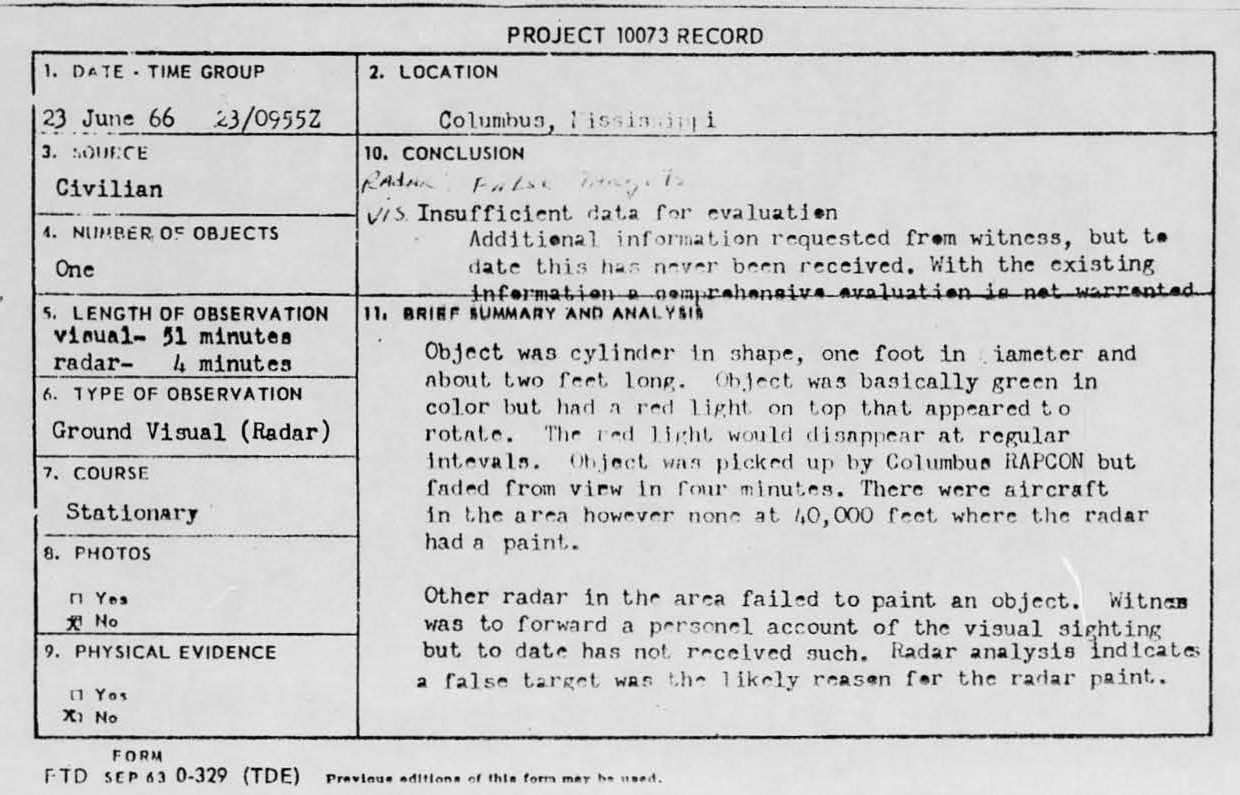
Pictured: the Project 10073 record card for this case, cropped from the first page of the Project Blue Book file: "23 June 66 23/0955Z," "Columbus, Mississippi," source "Civilian," length of observation "visual- 51 minutes / radar- 4 minutes," type "Ground Visual (Radar)," course "Stationary." The conclusion box carries a faint handwritten "Radar: False Targets" above "VIS. Insufficient data for evaluation." It is the Air Force's own index card, not a picture of the object. No photograph, drawing or radarscope image of the object exists; the witness's questionnaire sketch boxes are blank. U.S. government record, public domain.
Theoretical Alignment
The Extraterrestrial Hypothesis scores low. On paper this is the strongest kind of report Blue Book received, a visual sighting with a simultaneous radar return, and the radar placed its target at an altitude no airliner of the day was flying. In the file it is much weaker. Nobody can show that the man at the tire plant and the radar operators at the base were looking at the same thing. The visual object did nothing but hang in the sky and flash; the radar target did nothing but sit on the scope for four minutes and fade. Neither did anything that a light, a planet, an aircraft beacon or a radar echo from the ground cannot do, and there is no account from the witness himself.
The Interdimensional Hypothesis has nothing to work with. The Psycho-Social score is modest. The description that reached Ohio, "aircraft-like-size object with blue green flames," a cylinder "one foot in diameter and two feet long" with a rotating red light on top, had passed through at least three people before anyone wrote it down, and 1966 was the year of the Michigan "swamp gas" ridicule, when UFOs were front-page news and a light that would not move was more likely than usual to be reported as something more.
Background
Columbus AFB in 1966
Columbus Air Force Base lies in Lowndes County about ten miles (16 km) north of downtown Columbus. It is a pilot-training base today, and it was one in the Second World War and again during the Korean War, but in 1966 it was not. The base's own history records that "Columbus became part of the Strategic Air Command in April 1955," and that "after a rebuilding program, the base became home to a B-52 bomber squadron and a KC-135 tanker squadron in 1958." In February 1963, according to the 14th Flying Training Wing's historian, SAC replaced the base's 4228th Strategic Wing "with the 454th Bombardment Wing, Heavy to conduct air refueling operations and train in bombardment." From the summer of 1965 the wing's "headquarters staff, tactical aircraft and crews, and maintenance personnel became a part of SAC combat forces in the Pacific and Southeast Asia," and "while the 454th Bombardment Wing was involved in the Vietnam War, the 454th Combat Support Group operated Columbus AFB." The base did not return to Air Training Command and its T-37 and T-38 trainers until July 1, 1969.
That history explains three things about this file. The teletype that carried the report to Washington is headed "FM 454 BOMBWG COLUMBUS AFB MISS," and one of its addressees is the Second Air Force at Barksdale AFB, Louisiana, the SAC numbered air force above the wing. The report first went, according to the questionnaire, to a "SR. SAC CONTROLLER AT THE SAC CP," a Strategic Air Command command post, rather than to an air-defense unit. And the aircraft the radar operators checked included a KC-135 tanker, call sign "JEAN 42," the type the base had flown since 1959.
A RAPCON, short for radar approach control, was the Air Force's equivalent of a civilian approach-control facility: a radar room that sequenced and separated traffic arriving at and leaving a base and the airspace around it. The teletype names the set Columbus used: "GROUND ELECTRONIC CPN-18." The AN/CPN-18 was a Bendix surveillance radar, built for exactly this job; it is described in more detail under "What the Radar Saw" below.
1966: the year of "swamp gas"
June 1966 fell in the most politically uncomfortable year Project Blue Book ever had. In March, after a wave of sightings around Dexter and Hillsdale, Michigan, the Air Force's consultant J. Allen Hynek suggested that some of the lights might have been marsh gas, and headline writers reduced his hedged statement to two words that made the Air Force a national joke; the story is told in this site's Michigan "Swamp Gas" UFO Wave file. Michigan's congressman Gerald R. Ford, the House Minority Leader, called for hearings, and the House Armed Services Committee held one on April 5, 1966. On April 17, two months before the Columbus report, Ohio sheriff's deputies chased a light across two states at dawn, and Blue Book's chief, Maj. Hector Quintanilla, attributed what they saw to a satellite and the planet Venus; that case is this site's Portage County UFO Chase.
Meanwhile an Air Force Scientific Advisory Board committee chaired by Brian O'Brien had reviewed Blue Book and, in a March 1966 report, recommended that the Air Force contract with universities for an independent scientific study of UFO reports. That recommendation became the University of Colorado project under the physicist Edward U. Condon, whose contract was signed on October 6, 1966, and announced the next day; see this site's Condon Report file. The Columbus report thus arrived in June, while the Air Force was looking for a way out of the UFO business, and its last document, the radar evaluation, was written on October 25, less than three weeks after the Condon contract was signed. Nothing in the file mentions any of this. It is context, not evidence: it tells us how busy and how defensive Blue Book was, not what was over Lowndes County.
How a report traveled
The file shows the reporting system of the mid-1960s at work. In June 1966 Air Force UFO reports were governed by Air Force Regulation 200-2 of July 20, 1962; on September 19, 1966, it was superseded by AFR 80-17, the regulation reproduced as an appendix to the Condon Report. Under that system the base nearest a sighting sent an electrical message to the air-defense command, the regional air division, the Foreign Technology Division (FTD) at Wright-Patterson AFB, Ohio, where Project Blue Book was housed, and headquarters in Washington, in a fixed lettered format. As reprinted in AFR 80-17, it runs: "a. Description of the Object(s)," "b. Description of Course of Object(s)," "c. Manner of Observation," "d. Time and Date of Sighting," "e. Location of Observer(s)," "f. Identifying Information on Observer(s)," "g. Weather and Winds-Aloft Conditions," "h. Any other unusual activity or condition, meteorological, astronomical, or otherwise, that might account for the sighting," "i. Interception or identification action taken," "j. Location, approximate altitude, and general direction of flight of any air traffic or balloon releases in the area," and "k. Position title and comments of the preparing officer, including his preliminary analysis of the possible cause." The Columbus teletype follows the same pattern, with a final item L, though some of its section letters were lost in transmission; its winds-aloft levels (surface, 6,000, 10,000, 16,000, 20,000, 30,000, 50,000 and 80,000 feet) are exactly the ones the regulation lists. FTD then mailed the witness its own questionnaire, FTD Form 164, and Blue Book typed a record card when the case was closed.
The Columbus teletype went to "ADC ENT AFB COLO" (Air Defense Command at Ent AFB, Colorado Springs), "73AIRDIV TYNDALL AFB FLA" (the 73rd Air Division at Tyndall AFB, Florida, the regional air-defense headquarters), "FTD WPAFB OHIO," "HQ USAF AFNIN WASH DC" (the Air Force's intelligence directorate), "SAFOI WASH DC" (the Secretary of the Air Force's Office of Information, which answered the press), and "2AF BARKSDALE AFB LA." The routing line shows it was filed at "R 241930Z," 1:30 PM Central on June 24, a day and a half after the sighting, and the Pentagon's Staff Message Branch logged it as "AF IN: 29093 (25 Jun 66)."
Complete Timeline
| Date / Time | Event |
|---|---|
| April 1, 1955 | Columbus AFB transferred from Air Training Command to Strategic Air Command. |
| 1958–1959 | A B-52 squadron and a KC-135 tanker squadron arrive under the 4228th Strategic Wing. |
| July 20, 1962 | AFR 200-2, the UFO reporting regulation in force in June 1966, is issued. |
| February 1963 | The 454th Bombardment Wing, Heavy replaces the 4228th Strategic Wing. |
| Summer 1965 | The 454th's headquarters, aircraft and crews deploy to the Pacific and Southeast Asia; the 454th Combat Support Group runs the base. |
| March 1966 | The Michigan "swamp gas" controversy; the O'Brien Committee recommends a university study of UFOs. |
| April 5, 1966 | House Armed Services Committee hearing on UFOs. |
| April 17, 1966 | The Portage County, Ohio dawn police chase; Blue Book cites a satellite and Venus. |
| June 23, 1966, 0600–0800Z | Overcast at about 2,400 meters over Columbus AFB (hourly record); the sky clears by 0900Z. |
| June 23, about 0905Z and 0940Z | Astronomical and then nautical twilight begin at Columbus (computed). |
| June 23, 0955Z (3:55 AM CST) | A production manager at the General Tire and Rubber Company in Columbus begins watching a green, cylinder-like object with a rotating red light; it is "stationary." |
| June 23, about 1000Z | Hourly observation at Columbus AFB: wind calm, visibility ten miles, temperature 20.2°C, thin cloud covering most of the sky with no ceiling (NCEI hourly record). |
| June 23, about 1015Z | Civil twilight begins (computed). |
| June 23, about 1025Z | From this time an object at 40,000 feet over the area would have been in direct sunlight (computed). |
| June 23, about 1040Z (4:40 AM CST) | Columbus RAPCON paints a stationary target at 40,000 feet, bearing 140°, 25 nautical miles; a KC-135 ("JEAN 42") and two Delta Air Lines flights are in the area but not at that height. "Other radar in the area failed to paint an object." |
| June 23, 1044½Z (4:44 AM CST) | "TARGET FADED AT 1044½ Z." |
| June 23, about 1045Z | Sunrise at Columbus (computed). |
| June 23, about 1046Z | End of the 51-minute visual sighting, if it began at 0955Z (inferred). |
| June 23, 1966 (later) | A senior SAC controller at a SAC command post reports the sighting; an officer at the Air Force Command Post in Washington relays it to a captain at FTD and fills out an FTD Form 164 questionnaire with what he was told. |
| June 24, 1930Z | The 454th Bombardment Wing files its teletype report, message BC 23867; the base commander is "unable to determine probable cause." |
| June 25, 1966 | The message is logged in Washington as AF IN 29093. |
| September 19, 1966 | AFR 80-17 supersedes AFR 200-2. |
| October 6–7, 1966 | The University of Colorado contract for the Condon study is signed and announced. |
| October 25, 1966 | Col. Jerome J. Jones of FTD's Electronics Directorate sends Maj. Quintanilla a "UFO Evaluation": the radar data are insufficient for analysis, and of a balloon or a weather-caused false target, "the false target seems more feasible." |
| After October 25, 1966 | Blue Book's record card is completed: "Radar: False Targets"; "VIS. Insufficient data for evaluation." |
| December 17, 1969 | The end of Project Blue Book is announced. |
| November–December 2022 | Tim Printy's SUNlite review of May–August 1966 agrees with both conclusions and notes that "Venus was visible and could have been source of visual sighting." |
The File, Page by Page
The released file is item "1966-06-8280581-Columbus-Mississippi" in the Internet Archive's Project Blue Book collection (Fold3 file 8280581). It has 23 pages. Every page was read for this case file as an image at its native scan resolution, with contrast-enhanced enlargements of faint handwriting; no machine transcription was relied on, and the record card's conclusion was read from the image. All 23 pages concern this one case, but the folder is padded: the two-page teletype is filed three times, and six pages are photocopies of weather charts. In scan order:
- The record card (page 1), on form "FTD SEP 63 0-329 (TDE)" (see "The Record Card" below).
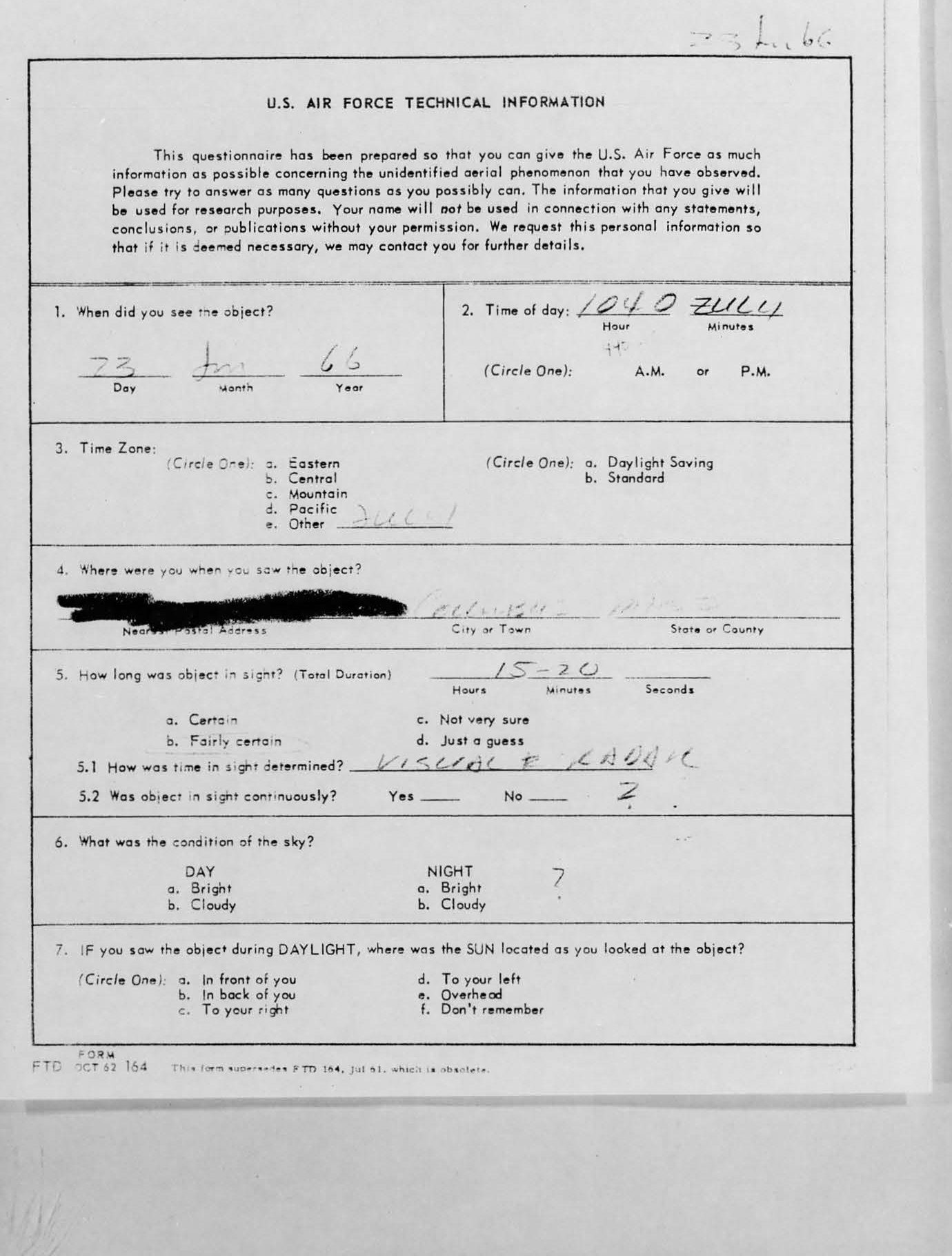
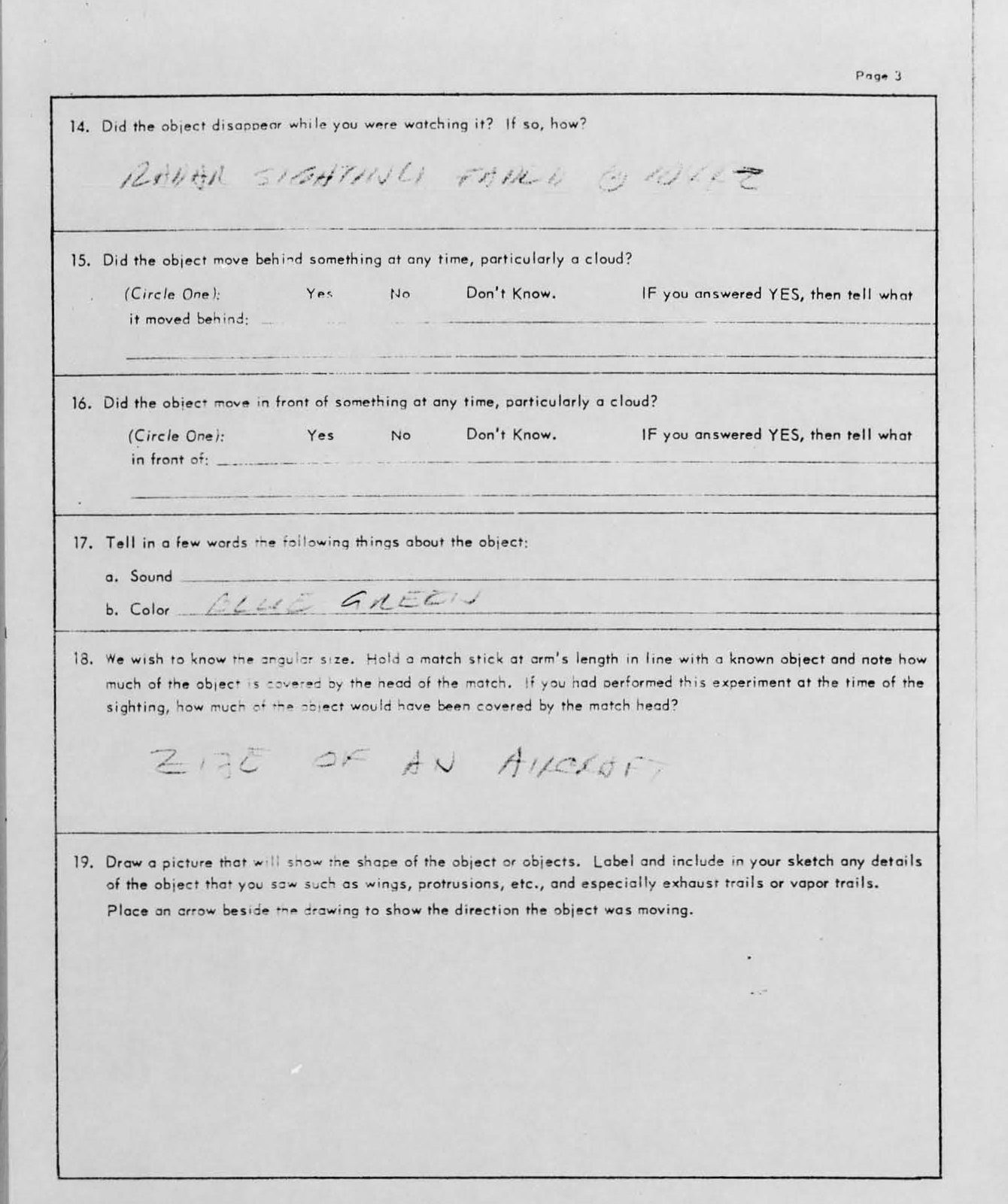
- An FTD Form 164 questionnaire, pages 4, 3, 6, 5 and 7 of the form (scan pages 2–6), out of order. Its pages 1 and 2 are at the end of the file (scan pages 22–23).
- Adiabatic chart photocopies (scan pages 7–11 and 13): U.S. Weather Bureau form WBAN-31B, "ADIABATIC CHART," for "Montgomery, Ala. (WBAS)," "1966 JUN 23," copied as negatives, white lines on black. Page 9 shows the upper atmosphere with an ellipse drawn in ink around one part of the temperature trace.
- The teletype, AF IN 29093, page 1 of 2 (scan page 12); its page 2 is scan page 17, and two more copies of both pages follow (scan pages 18–21).
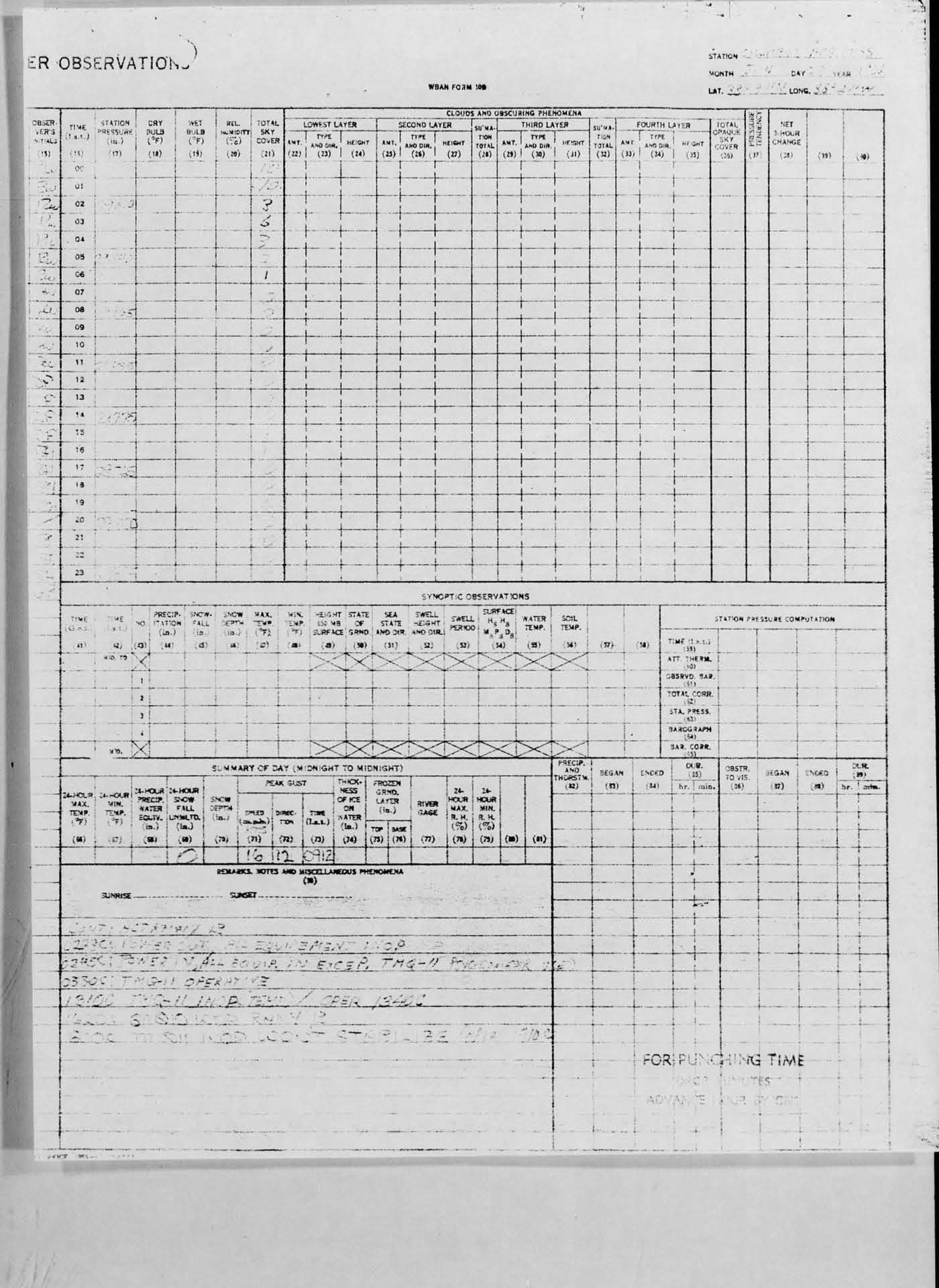
- Surface weather observations for Columbus AFB: WBAN Form 10B, hourly sky cover, gusts and remarks for June 23 (scan page 14), and WBAN Form 10A, the observer's log, headed with the station number "13825" (scan page 15). Both are faint, and most of the 10A entries cannot be read.
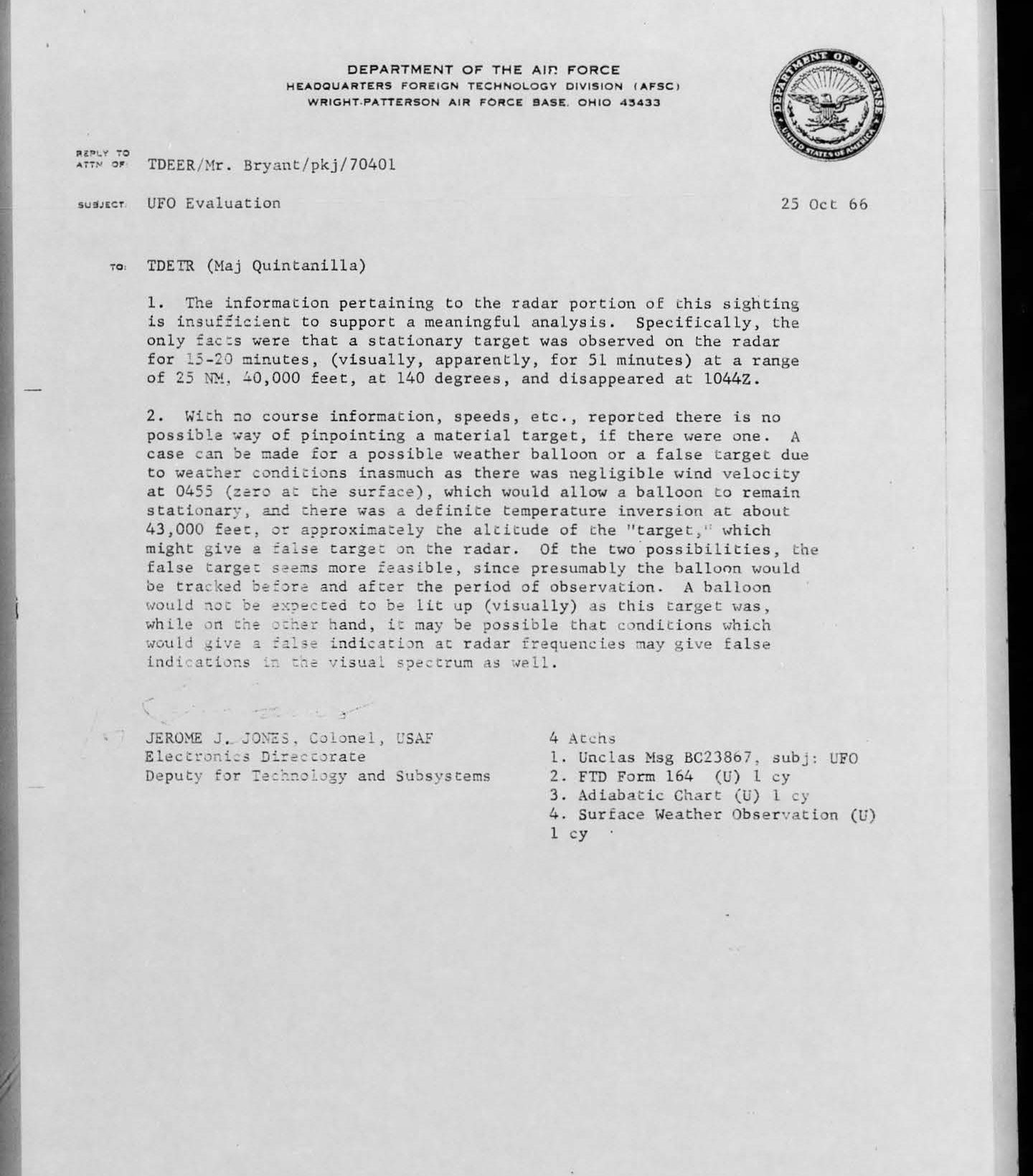
- The FTD radar evaluation of October 25, 1966 (scan page 16).
The memo's own attachment list matches what the file holds: "1. Unclas Msg BC23867, subj: UFO 2. FTD Form 164 (U) 1 cy 3. Adiabatic Chart (U) 1 cy 4. Surface Weather Observation (U) 1 cy." Nothing else is there. There is no statement from the witness, no letter to or from him, no radar log or scope photograph, no map, no FTD correspondence with the base, and no report from the "other radar in the area" that the card says "failed to paint an object." The station number on the 10A form, 13825, is the Weather Bureau-Air Force-Navy (WBAN) identifier for Columbus AFB in NOAA's station history, which confirms that the surface forms are the base's own.
The Record Card
Blue Book's record card for this case is the September 1963 version of the form, "FTD SEP 63 0-329 (TDE)," which has a blank box for the conclusion rather than the printed checkboxes of the 1950s cards. Its entries, as printed:
- Date-time group: "23 June 66 23/0955Z."
- Location: "Columbus, Mississippi."
- Source: "Civilian."
- Number of objects: "One."
- Length of observation: "visual- 51 minutes / radar- 4 minutes."
- Type of observation: "Ground Visual (Radar)."
- Course: "Stationary."
- Photos: No. Physical evidence: No.
The conclusion box holds two verdicts. The first is handwritten, faintly, across the top: "Radar: False Targets." Below it someone has written "VIS." in the margin in front of a typed line, "Insufficient data for evaluation," followed by a typed explanation: "Additional information requested from witness, but to date this has never been received. With the existing information a comprehensive evaluation is not warrented" [sic]. The handwritten reading was checked against an enlargement of the scan and agrees with the entry in Tim Printy's 2022 review of these cases, which gives the Blue Book explanation as "Radar: False Targets / Visual: Insufficient data."
The summary, typed in the box headed "Brief Summary and Analysis," reads in full, with its typing errors:
Object was cylinder in shape, one foot in diameter and about two feet long. Object was basically green in color but had a red light on top that appeared to rotate. The red light would disappear at regular intevals. Object was picked up by Columbus RAPCON but faded from view in four minutes. There were aircraft in the area however none at 40,000 feet where the radar had a paint.
Other radar in the area failed to paint an object. Witnes was to forward a personel account of the visual sighting but to date has not received such. Radar analysis indicates a false target was the likely reason for the radar paint.
Two sentences on the card add information found nowhere else in the file. "Other radar in the area failed to paint an object" implies that someone checked at least one other radar, but the file does not say which one, who asked, or when. And "Radar analysis indicates a false target" refers to the October memo from FTD's Electronics Directorate, which, as shown below, actually began by saying that the radar information was "insufficient to support a meaningful analysis." The card's two verdicts are therefore not equal. The visual verdict is a statement that the Air Force did not have enough to work with. The radar verdict is a positive identification, but one resting on an analysis that called itself inconclusive.
Project Blue Book's official conclusions, here as elsewhere, should be read as one input and not as a final answer. The project was small, worked under steady institutional pressure toward the least alarming explanation, and in the second half of 1966 was operating under political scrutiny and awaiting its own replacement by an outside study; its analysts often closed cases quickly with whatever explanation seemed adequate, and outside researchers cannot audit what checks were actually made beyond those that happen to survive in the file. Experienced researchers of every persuasion treat its labels with caution for those reasons. That does not mean the label here is wrong. It means the label has to be tested against the evidence like any other claim, which is what the rest of this file does.
What the Teletype Says
The 454th Bombardment Wing's message, "UNCLAS BC 23867. SUBJECT: UFO," is the only document in the file that originated at Columbus, and it is the nearest thing to a first-hand report that survives. Its text is reproduced here as received, with the transmission garbles ("))40,000," "LLSTATIONARY," "FIFTYLL-ONE") left in place.
Description. "1. CYLINDER. 2. ONE FOOT IN DIAMETER AND TWO FEET LONG. 3. GREEN 4. ONE. 5. N/A. 6. RED LIGHT ON TOP APPEARED TO ROTATE. 7. RED LIGHT WOULD DISAPPEAR AT REGULAR INTERVALS. 8. N/A 9. N/A." In the standard format these items are shape, "size compared to a known object," color, number, formation, "any discernible features or details," "tail, trail, or exhaust," sound, and "other pertinent or unusual features." No sound was reported, and the "size" is given in feet without any distance, which makes it impossible to tell whether it is a guess at the object's real size or a description of how big it looked.
Course. "1. FLASHING RED LIGHT. 2. APPROX ))40,000 FT-25 MILES SE OF COLUMBUS MISS. 3. SAME AS NR 2. 4. LLSTATIONARY. 5. FADED FROM RADAR PER COLUMBUS AFB RAPCON. 6. FIFTYLL-ONE MINUTES." This is the part of the format that asks what first drew the observer's attention, the "angle of elevation and azimuth" when the object was first seen and when it disappeared, its flight path ("Use elevations and azimuth, not altitude"), how it disappeared and how long it was visible. The answers mix the two observations, and they give exactly what the regulation asked them not to: an altitude instead of an elevation angle. What first caught the witness's eye was a flashing red light. But the position given for both the first and last sighting is the radar position, 40,000 feet and 25 miles southeast, not an elevation and bearing as the witness saw them, and the disappearance is described as the radar's, not his. The teletype never says in what direction the man at the tire plant was looking.
Manner of observation. "1. GROUND-VISUAL, GROUND ELECTRONIC CPN-18. 2. N/A. 3. KC-135- JEAN 42, DELTA AIRLINES FLIGHT 1839AND 892, ADDITION INFORMATION NOT AVAILABLE." No binoculars or other optical aid were used. The third item names the aircraft in the area: a KC-135 tanker using the call sign JEAN 42 and two Delta Air Lines flights, numbered 1839 and 892. "Addition information not available."
Time and date. "1. 23/0955Z. 2. NIGHT."
Location and identity of the observer. "E. GENERAL TIRE AND RUBBER CO COLUMBUSMISS. 1. CIVILIAN [name redacted], 33 YRS, [address redacted] COLUMBUS, MISS., PRODUCTION MANAGER, GOOD." "GOOD" is the base's estimate of his reliability. No military observer is listed: "2. N/A."
Weather. "1. PARTLY CLOUDLY. 2. SURFACE WINDS CALM, 6,000 FT 100/. 15K, 10,000 FT 100/15K, 16,000 FT 130/20, 20,000 FT 120/10K, 30,000 FT 090/20, 50,000 FT 090/20, 80,000 FT N/A. 3. HIGH THIN BROKEN. 4. TEN MILES. 5. 6/10TH. 6. N/A. 7. THREE DEGREE PER TEN THOUSAND FEET." In order: the observer's description of the sky, winds aloft (direction in degrees and speed in knots), ceiling, visibility, cloud cover, thunderstorms, and temperature gradient. Winds were light, from the east and east-southeast, at every level reported.
The rest. "H. N/A" (any unusual activity or condition, "meteorological, astronomical, or otherwise," that might account for the sighting), "I. N/A" (interception or identification action), "J. N/A" (air traffic "or balloon releases in the area"), and "K. BASE COMMANDER. UNABLE TO DETERMINE PROBABLE CAUSE DUE TO UNAVAILABILITY OF ADDITIONAL INFORMATION." The last item, "L. N/A," is answered without a heading. Item J says there was no air traffic or balloon release to report, though item C has just listed three aircraft; and item H, the one place the format asks about astronomical causes, was not considered at all.
The preparing officer, the base commander, offered no explanation. This matters, because the commander had the radar operators and weather observers under his command and could have asked them. Either he did not, or what they told him did not settle it.
The Questionnaire: A Report at Third Hand
FTD's standard questionnaire, FTD Form 164 of October 1962, opens: "This questionnaire has been prepared so that you can give the U.S. Air Force as much information as possible concerning the unidentified aerial phenomenon that you have observed." The copy in this file was not filled out by the person who observed it. Its page 6 gives the respondent's name (redacted) and, as his address, "AIR FORCE Command Post" and "WASH D.C." In answer to question 33, "When and to whom did you report that you had seen the object?" it says "23 Jun 66" and names a captain at "FTD" (the name is illegible). The officer who filled it in was relaying, by telephone or in person, what had been passed to him the same day.
The questionnaire's last page, question 35, holds a handwritten narrative in block capitals. It names two officers, and since the respondent's own name was redacted on page 6, this file does not repeat either of them; it gives only their ranks and roles. A major at the Air Force Command Post "REPORTED A UFO SIGHTING REPORTED BY" a colonel, the "SR. SAC CONTROLLER AT THE SAC CP (UNK LOCATION)." The narrative continues:
AIRCRAFT-LIKE-SIZE OBJECT WITH BLUE GREEN FLAMES WAS SIGHTED VISUALLY — A STATIONARY RADAR TARGET WAS PICKED UP AT 40000 FT, 140 DEG, 25 NMI BY COLUMBUS RAPCON IN MISS. RAPCON RPT'D A DELTA A/L A/C & A KC-135 IN THE AREA BUT NOT AT 40000 FT. TARGET FADED AT 1044½ Z
The bearing reads "140" (the second digit is slightly cramped, but the FTD memo also gives 140 degrees). Below the narrative are faint pencil notes, mostly illegible, that appear to include "On radar 4 minutes," the probable source of the card's radar duration.
The other answers on the form are sparse. Question 2, time of day: "1040 ZULU," with a faint pencil figure beneath it. Question 4, where were you: the street address is redacted and the town given as Columbus, Mississippi. Question 5, how long was the object in sight: "15–20" minutes, and, for how the time was determined, "VISUAL & RADAR." Question 10, did the object appear solid, transparent, vapor, as a light: "Solid" is circled. Question 14, did it disappear while you were watching: "RADAR SIGHTING FADED @ 1044Z." Question 17, color: "BLUE GREEN." Question 18, the matchstick test for angular size: "SIZE OF AN AIRCRAFT." The sketch boxes for the object's shape, its elevation and bearing, and its path are all blank.
The chain of transmission is therefore at least four links long: the witness; whoever at Columbus took his call, presumably the base, which then had RAPCON look; the senior SAC controller at a SAC command post whose location the writer did not know; the major at the Air Force Command Post in Washington; and the captain at FTD. The details changed along the way. In the teletype the object is green with a red light on top; in the questionnaire it is "blue green," with "blue green flames." In the teletype the visual sighting lasts fifty-one minutes; in the questionnaire the object is in sight "15–20" minutes, determined by "visual & radar." The questionnaire's time, "1040 ZULU," is not the start of the visual sighting, 0955Z, but apparently the time the radar target appeared. The officer filling in the form was mainly passing on what the radar people had said, and had very little from the man who saw the light.
FTD did write to the witness, or meant to. "Witnes was to forward a personel account of the visual sighting but to date has not received such," says the record card, and "Additional information requested from witness, but to date this has never been received." The file contains no copy of a letter to him, and he never answered.
Reconstructing the Times
The documents give five clock times, all in Zulu (Greenwich) time. Columbus AFB's own weather forms were kept in "90th meridian time," Central Standard Time, six hours behind Zulu, and this file converts to that. (Whether the witness's own clock was on standard or daylight time that summer does not matter, because nothing in the file is in his local time.)
- 0955Z, 3:55 AM CST: the "date-time group" on the card and in the teletype, "23/0955Z." In the reporting format this is the time of the sighting, so it marks when the witness first saw the object.
- 51 minutes: the visual duration in the teletype ("FIFTYLL-ONE MINUTES") and on the card. Counted from 0955Z, the visual sighting ended at about 1046Z, 4:46 AM.
- 1040Z, 4:40 AM: the "time of day" on the Washington questionnaire, which was written from the radar side of the story.
- 1044½Z, 4:44 AM: "TARGET FADED AT 1044½ Z," and "RADAR SIGHTING FADED @ 1044Z."
- 4 minutes on radar, according to the card (and, apparently, the pencil note "On radar 4 minutes"); 15–20 minutes according to the questionnaire and the FTD memo.
The four-minute version fits the times: 1040Z to 1044½Z. The fifteen-to-twenty-minute version would put the first radar paint at about 1025Z to 1030Z. The difference matters for the balloon question below, and the file does not settle it; the card's "4 minutes" was typed last, after the FTD memo, and agrees with the narrative's 1040Z and 1044½Z.
The most likely sequence, on the documents, is that the witness saw his light from about 0955Z, someone at Columbus AFB heard of it, and RAPCON looked and found a target at about 1040Z, about three-quarters of an hour into the visual sighting. The file does not actually say that the witness called the base, or when, so this is an inference. What is clear is that the radar did not find the object first; the questionnaire puts the visual sighting first ("WAS SIGHTED VISUALLY — A STATIONARY RADAR TARGET WAS PICKED UP"), and the visual sighting began forty-five minutes before the radar target appeared.
All of this happened in the last hour before sunrise. Computed with the NASA Jet Propulsion Laboratory's Horizons ephemeris for Columbus, the Sun stood about 9½ degrees below the horizon at 0955Z, in nautical twilight, with the northeastern sky beginning to brighten; it was 6 degrees down, the start of civil twilight, at about 1015Z, and it rose at about 1045Z, 4:45 AM CST. The radar target faded at 1044½Z and the visual sighting, by its stated length, ended at about 1046Z. Both observations ended at sunrise.
What the Radar Saw
The CPN-18
The teletype identifies the radar as "CPN-18." The Canadian Air Defence Museum's archive describes the AN/CPN-18 as a ground surveillance radar "manufactured by Bendix," "used in a Radar Approach Control (RAPCON) environment at many locations around the world," and including "an S-band surveillance search system, an automatic direction-finding system, moving-target indication, video mapping, a land line remoting system," with a 10-inch plan-position indicator and "a 60 nautical-mile range." A reference list of U.S. mobile radars gives its frequency as 2,700 to 2,900 MHz, its peak power as 500 kilowatts and its range as 53 nautical miles, or 70 in modified sets.
Neither description gives it any height-finding capability. A surveillance set of this kind shows a target's range and bearing on a round scope, from above, as it were; it does not measure altitude. That raises a question the file never answers: where did "40,000 feet" come from? A precision approach radar or a separate height-finder could measure altitude, but the file names only the CPN-18. It is possible the operators had another source, an estimate from the target's behavior, or a figure from the "other radar in the area." It is also possible that "40,000 feet" was not a measurement at all but an inference: the operators knew the altitudes of the KC-135 and the airliners from their flight plans and clearances, saw a target that did not correspond to any of them, and concluded that it was higher than all of them. The file does not say. Every later document, including FTD's analysis, treats "40,000 feet" as data.
Where the target was
A target 25 nautical miles from Columbus AFB at a bearing of 140° lies at about 33°20′ N, 88°07′ W (computed), some 46 kilometers southeast of the base, near the Mississippi–Alabama state line and about 34 kilometers (21 miles) from downtown Columbus at a bearing of about 124°. If it really was at 40,000 feet, an observer at the base would have seen it about 14½ degrees above the southeastern horizon, and an observer in Columbus at about the same height in the sky, a little south of southeast. The radar's "SE" agrees with the "25 MILES SE OF COLUMBUS MISS." in the teletype.
What "stationary" means on a scope
A real object at 40,000 feet that stayed in one place for four minutes would be remarkable; airliners and tankers cruise at hundreds of knots, and the winds at that height were blowing at about 20 knots. Three things limit what can be read into the word. First, four minutes is short: a balloon drifting with a 20-knot wind moves about 1.3 nautical miles in four minutes, a shift that is easy to miss on a scope covering sixty miles. Second, the CPN-18 had moving-target indication, a circuit whose purpose is to suppress echoes that do not move, such as hills, buildings and other "ground clutter," so that aircraft stand out. If MTI was in use, a truly stationary echo should have been suppressed; if it was switched off, ground clutter would show. The file does not say which. Third, and most important, a target that does not move is exactly what anomalous propagation produces.
Anomalous propagation
Radar waves normally bend slightly downward as they travel through the atmosphere, but not as much as the Earth curves, so the beam gradually rises above the ground with distance. When the air near the ground is cooler (and often moister) than the air above it, a temperature inversion, the beam can bend more sharply and strike the ground at long range. NOAA's National Weather Service explains that "Superrefraction is where the radar beam is bent greater than normal back toward the Earth," that "If the bending is severe, it can actually intersect with the Earth's surface," and that "Superrefraction is more likely when a strong low-level inversion is in place, especially when the low-level air is moist and the air above the inversion is very dry." The resulting echoes from distant terrain, buildings or water appear where no aircraft is. Ground clutter is easy to spot, the Weather Service adds, "since it does not move." Such a stable layer, an NWS case study notes, "often forms at night over land, where it is known as a nocturnal boundary layer."
The Columbus morning had the classic setting for a nocturnal inversion: a clear or thinly clouded sky after midnight, calm surface winds through the whole sighting, and surface temperatures falling steadily toward dawn. The Condon Committee's radar specialist, Gordon D. Thayer, studied such cases for the University of Colorado project a year later, and repeatedly found "radar false targets or slow-moving AP echoes" behind radar UFO reports. Anomalous-propagation echoes are typically low, near the ground, at the radar's lowest beam angles, and on a surveillance radar with no height-finder they would carry no altitude at all. If Columbus RAPCON's target was such an echo, the "40,000 feet" attached to it was an inference rather than a reading, which is possible but not shown. Anomalous propagation can also come and go as the inversion changes, and the low-level inversion begins to break up as the Sun heats the ground after sunrise; the target fading at 1044½Z, within a minute or so of sunrise, is consistent with that, though one minute of coincidence proves nothing either way.
"Other radar in the area failed to paint an object." The Weather Service's advice for suspicious echoes is to "always get a second opinion" from adjacent radars to see "if they are 'seeing' the same thing." Someone at the time did exactly that, and the second radar saw nothing. A real object at 40,000 feet should be visible to any radar with line of sight to it; a propagation echo is specific to one radar's location and beam. This one sentence on the card is the strongest single piece of evidence in the file that the Columbus target was a false return. The file's weakness is that it does not identify the other radar, its location or its coverage, so the check cannot be weighed precisely.
The Weather
The base's own report
The teletype gives the weather from the base weather station: partly cloudy, surface winds calm, winds of about 15 knots from 100° at 6,000 and 10,000 feet, 20 knots from 130° at 16,000 feet, 10 knots from 120° at 20,000 feet, and 20 knots from 090° at both 30,000 and 50,000 feet. The ceiling was "HIGH THIN BROKEN," the visibility ten miles, the cloud cover six-tenths, with no thunderstorms. The last item, "THREE DEGREE PER TEN THOUSAND FEET," is the vertical temperature gradient the format asked for. Taken literally, three degrees of cooling per ten thousand feet would describe an unusually stable atmosphere; the standard atmosphere cools by about 3.6°F per thousand feet (NASA's model: T = 59 − 0.00356 h, in °F and feet). "Ten thousand" may be a slip for "one thousand," in which case the gradient was ordinary. The figure is too ambiguous to rest anything on.
The surface forms
The two surface-observation forms in the file are the base weather station's own records for June 23. The 10A log, headed with the station number "13825" and the note that "Time entries on this form are 90th meridian time," is mostly illegible in the scan. The 10B form is clearer in places. Its total-sky-cover column records ten-tenths cover in the first hours after midnight, falling to a few tenths by about 2:00 to 4:00 AM local time (the figures are faint). Its "peak gust" for the day is 16 knots from 120° at 0912 local time, well after the sighting. Its remarks note, in faint pencil, that early that morning the station's power went out and "ALL EQUIPMENT" was inoperative, that power returned with all equipment working except a TMQ-11 (a wind-measuring set), and that the TMQ-11 was "OPERATIVE" at 0330 local. The power failure was over before the sighting began and there is nothing to connect it with the object.
An independent check comes from NOAA's National Centers for Environmental Information, whose Integrated Surface Database holds the digitized hourly observations from Columbus AFB (station 723306-13825) for 1966. They agree with the teletype and fill in the hours. From 0600Z to 0800Z the base was overcast at about 2,400 meters (7,900 feet). By 0900Z the low cloud had gone: two oktas (two to three tenths) of cloud with no ceiling, calm wind, visibility 16 kilometers (ten miles), temperature 21.3°C and dew point 15.7°C. At 1000Z, in the middle of the sighting, the wind was still calm, the temperature 20.2°C, and the sky cover was coded seven oktas, "9/10 or more but not 10/10, or BKN" (broken) in the database's own definition, still with no ceiling. At 1100Z, just after sunrise, it was calm, 18.5°C, and two oktas again. Thin, high cloud that comes and goes, under which stars and planets shine dimly and intermittently, fits the teletype's "HIGH THIN BROKEN" and "6/10TH."
The Montgomery sounding
The adiabatic charts in the file are from the Weather Bureau's upper-air station at Montgomery, Alabama, about 240 kilometers (150 miles) southeast of Columbus AFB (computed), the nearest radiosonde station whose chart FTD obtained. They are dated June 23, 1966; the release times are not legible in the photocopies. National Weather Service radiosondes are launched "up to an hour before 00:00 and/or 12:00 UTC" each day, so the June 23 morning flight would have left Montgomery at about 1100Z, after the Columbus sighting was over; the evening flight before it would have left about 2300Z on June 22. On the chart's upper section someone has drawn an ellipse around part of the temperature trace between about 125 and 160 millibars, which on the chart's height scale is roughly 13 to 14 kilometers. By NASA's standard-atmosphere formulas, 40,000 feet corresponds to a pressure of about 187 millibars, 43,000 feet to about 162, and 48,000 feet to about 125. The ellipse marks the "definite temperature inversion at about 43,000 feet" that FTD's analyst cited, which is in that range.
A temperature inversion at that height is, in all likelihood, the tropopause, the boundary above which the temperature stops falling with height and the stratosphere begins. In NASA's standard-atmosphere model, temperature falls with height up to 36,152 feet and is constant from there to 82,345 feet; the Montgomery chart puts the real boundary that morning higher, near 43,000 to 48,000 feet, and a break in the temperature curve there is an everyday feature of a sounding, not a special condition of that night. The memo was right that there was an inversion near the target's reported altitude. Whether it could produce a radar false target is a separate question, taken up below.
Winds and balloons
The base's winds aloft argue against a balloon hovering over one spot. At 30,000 and 50,000 feet the wind was 20 knots from the east. A balloon floating at 40,000 feet would have drifted west at about that speed: about 1.3 nautical miles in four minutes, 5 to 7 in fifteen to twenty minutes, and 17 in fifty-one minutes. Over the full visual sighting such a balloon would have crossed a good part of the sky as seen from Columbus. It could look stationary for four minutes on a radar scope; it could not stay in one place for fifty-one minutes in the witness's sky. The FTD memo's statement that "there was negligible wind velocity at 0455 (zero at the surface), which would allow a balloon to remain stationary" is true only at the surface. The memo's own attachment, the teletype, shows 20-knot winds at 30,000 and 50,000 feet.
No routine weather balloon is likely either. Upper-air soundings in 1966, as now, were made twice a day for 0000Z and 1200Z, with releases up to an hour before; the June 23 morning releases came after the sighting, and the previous evening's flights, which "can last in excess of two hours" and drift "more than 300 km," would have been long finished by 0955Z. A research balloon or a special launch cannot be ruled out from the file, which records no check of either; the teletype's item J, which asks for "balloon releases in the area," was answered "N/A."
The FTD Evaluation
The last document in the case is a one-page memorandum from the Foreign Technology Division at Wright-Patterson, dated October 25, 1966, four months after the sighting. It came from FTD's Electronics Directorate, office symbol TDEER, with "Mr. Bryant" as the action officer, and was addressed to "TDETR (Maj Quintanilla)," Project Blue Book. It was signed by Jerome J. Jones, Colonel, USAF, of the Electronics Directorate, Deputy for Technology and Subsystems. Its subject is "UFO Evaluation." Its first paragraph:
The information pertaining to the radar portion of this sighting is insufficient to support a meaningful analysis. Specifically, the only facts were that a stationary target was observed on the radar for 15-20 minutes, (visually, apparently, for 51 minutes) at a range of 25 NM, 40,000 feet, at 140 degrees, and disappeared at 1044Z.
Its second paragraph:
With no course information, speeds, etc., reported there is no possible way of pinpointing a material target, if there were one. A case can be made for a possible weather balloon or a false target due to weather conditions inasmuch as there was negligible wind velocity at 0455 (zero at the surface), which would allow a balloon to remain stationary, and there was a definite temperature inversion at about 43,000 feet, or approximately the altitude of the "target," which might give a false target on the radar. Of the two possibilities, the false target seems more feasible, since presumably the balloon would be tracked before and after the period of observation. A balloon would not be expected to be lit up (visually) as this target was, while on the other hand, it may be possible that conditions which would give a false indication at radar frequencies may give false indications in the visual spectrum as well.
The memo deserves credit for its candor. Its first sentence says plainly that the radar data cannot support a real analysis, and its preferred answer is offered as the more "feasible" of two possibilities, not as a finding. Its balloon reasoning is sound in one respect: a balloon drifting into and out of the area would normally be seen on the scope before and after, not appear and vanish in place, and a balloon at 40,000 feet in the dark would not be "lit up." (After about 1025Z, in fact, an object at that height would have been in sunlight; see "The Sky Over Columbus" below.)
Four points in it are weaker. It uses the questionnaire's "15–20 minutes" for the radar, where the card later says four. Its "negligible wind velocity" applies at the surface only, as shown above. Its mechanism for a false target, an inversion "at about 43,000 feet, or approximately the altitude of the 'target,'" mixes two different things. The inversion near 43,000 feet was almost certainly the tropopause, present on most days. The temperature inversions that produce ground echoes on surveillance radars are low-level ones near the ground, bending a nearly horizontal beam back to the surface; the beam toward a real object 40,000 feet up at 25 miles would have been climbing at about 14½ degrees, far above the angles at which such bending matters. The memo's conclusion, a false target, is well supported by the calm night, the falling temperatures, the stationary echo and the other radar's failure to see it; the reason it gives for it is not. Finally, its suggestion that the same conditions "may give false indications in the visual spectrum as well" is speculation. Low-level inversions do produce optical mirages near the horizon, but a mirage at 40,000 feet is not a recognized phenomenon, and nothing in the file says the visual object was low on the horizon.
Two practical facts frame the memo. It was written four months after the event, from four attachments, by an office that had no access to the radar operators, the scope, the other radar's records or the witness. And it was written on October 25, 1966, three weeks after the Air Force had signed its contract with the University of Colorado, at a time when Blue Book's caseload was being closed out with the minimum of further work. The memo's honesty about its own limits is worth more than its conclusion.
The Sky Over Columbus
The positions of the Sun, Moon and planets for the morning of June 23, 1966, were computed for this file from JPL Horizons, for an observer at 33.50° N, 88.43° W (central Columbus), from 0945Z to 1115Z. Bright-star positions were computed from catalog coordinates precessed to 1966. Azimuths are measured clockwise from true north.
- Venus, the brightest object in the sky at magnitude −3.9, was the morning star. It stood at azimuth 77.5° and 13° up at 0945Z, east-northeast, and climbed to azimuth 85° and 25½° up by 1045Z, just north of east.
- Saturn, magnitude +1.0, was in the southeast, about 44° up at azimuth 134° at 0945Z, moving to 51° up at azimuth 153° by 1045Z.
- Mars, magnitude +1.4, rose in the east-northeast at about 1000Z, too low and faint in the twilight to matter. Jupiter and Mercury were below the horizon. The Moon, a 26 percent crescent, was far below the horizon.
- Bright stars: Capella, magnitude 0.1, was low in the northeast, about 13° up at azimuth 43° at 0955Z. Aldebaran was rising in the east-northeast. In the southeast and south were only modest stars: Diphda (Beta Ceti, magnitude 2.0) about 26° up at azimuth 138°, and Fomalhaut (1.2) about 26° up a little east of south. Vega and Altair were high in the west.
- Twilight: nautical twilight began at about 0940Z, civil twilight at about 1015Z, and the Sun rose at about 1045Z at azimuth 61°.
The visual object and Venus. A brilliant point of light low in the east, seen for nearly an hour before dawn, that seems to hang motionless, flashes colors and is reported as "green" with a "red light" that comes and goes: this is a familiar description of Venus near the horizon, where turbulence in the long path through the air makes it scintillate in color. Venus was the brightest thing in the sky, it rose higher only slowly (about twelve degrees in an hour), and through thin, broken cirrus it would have dimmed and brightened. Tim Printy, reviewing the case in 2022, made the same point: "No direction of observation. Venus was visible and could have been source of visual sighting." Venus is the strongest conventional candidate for the visual sighting.
It has two problems. The first is direction. Venus was in the east-northeast to east, while the only position given anywhere in the file is the radar position, southeast. If the witness was looking where the radar target was, Venus was some sixty degrees to his left. But the file never gives his direction, and the teletype's "SE" is plainly the radar's, so this objection is not decisive. The second is the description: a "cylinder," "solid," "the size of an aircraft," with "blue green flames." Second-hand descriptions of planets often acquire shapes, but these details came through three or four people, and no one can now say which were the witness's.
Capella, the brightest star in the morning sky, was low in the northeast throughout, where any bright star twinkles in color. It is much fainter than Venus, and a star of its brightness fades from view in the brightening twilight well before sunrise, so it fits a fifty-one-minute sighting that lasted until sunrise less well. Saturn and Diphda were the brightest objects in the southeast, near the radar bearing, but both were modest lights, higher than the radar target would have appeared, and nothing about them suggests a green object with a rotating red light.
Sunlight at altitude. An object at 40,000 feet sees the Sun before the ground does. The geometric dip of the horizon from that height is about 3½ degrees, plus about half a degree of refraction, so a high object over Columbus would have been in direct sunlight once the Sun was within about 4 degrees of the horizon, at about 1025Z (computed). A balloon or aircraft at that height would have shone brightly in the dark sky from then until sunrise, as high-altitude balloons often do at dawn, and could look like a stationary light. It cannot explain the first half hour of the sighting, from 0955Z, when anything at 40,000 feet was still in the Earth's shadow and would have been invisible unless it carried lights of its own.
Satellites. The large balloon satellites Echo 1 and Echo 2, the brightest artificial objects in the sky in 1966, appear repeatedly in Printy's re-evaluations of other reports from that June. A satellite crosses the sky in a few minutes, however, and cannot account for a light that stayed put for fifty-one minutes, so no pass calculation was needed to set them aside here.
Key Witnesses
The production manager (name redacted)
Age 33; his name and address are blacked out in the teletype and on the questionnaire. The 454th Bombardment Wing gave his location as "GENERAL TIRE AND RUBBER CO" and rated his reliability "GOOD." He watched the object, by the base's count, for fifty-one minutes from 3:55 AM, apparently while at work. Everything known about what he saw comes through others: the base's teletype, and a questionnaire filled in by an officer in Washington. He was asked for a personal account and never sent one. Nothing in the file suggests he sought publicity, and no newspaper story about the sighting has been found.
The RAPCON operators (not named)
Painted a stationary target on the AN/CPN-18 surveillance radar at 25 nautical miles, bearing 140°, reported at 40,000 feet, from about 1040Z until it "FADED AT 1044½ Z." They identified a KC-135 ("JEAN 42") and two Delta Air Lines flights in the area, none at that height. No operator is named, and no log or scope record survives in the file.
The senior SAC controller (name withheld here)
Not a witness. According to the questionnaire's narrative he first "REPORTED A UFO SIGHTING" to the Air Force Command Post in Washington. The narrative prints his surname, but because the officer who filled in the questionnaire had his own name redacted on the same form, this file gives only the colonel's rank and role.
The Air Force Command Post officer (name redacted)
Not a witness. Received the report from the SAC controller, passed it to a captain at FTD on June 23, and filled out the seven-page FTD questionnaire with what he had been told, giving his own address as "AIR FORCE Command Post." His answers ("1040 ZULU," "15–20" minutes, "BLUE GREEN," "SIZE OF AN AIRCRAFT," "Solid") are the source of several details that differ from the base's teletype.
Jerome J. Jones
Not a witness. Signed the October 25, 1966 "UFO Evaluation" for Blue Book, which judged the radar information "insufficient to support a meaningful analysis" and preferred a weather-caused false target to a balloon. The action officer named in the memo's reference line is "Mr. Bryant," of office TDEER; no first name is given.
Hector Quintanilla
Not a witness. The FTD memo is addressed to "TDETR (Maj Quintanilla)," and his office closed the case with the two conclusions on the record card. Two months earlier he had issued Blue Book's evaluation of the Portage County chase.
The Five Observables Assessment
The Five Observables framework, associated with former AATIP director Luis Elizondo, classifies UAP reports by performance characteristics beyond known technology. The Columbus report touches one of them, and only if the visual object and the radar target were the same thing and were real.
Assessment:
- Anti-gravity lift (speculative). Both observations are of something "stationary": a light that hung in one place for fifty-one minutes, and a radar target that did not move for four. If an aircraft-sized object really hovered at 40,000 feet against a 20-knot wind, that would qualify. But a planet, a star, ground clutter and a propagation echo are all stationary too, and no measurement shows the visual object's distance or height.
- Instant acceleration (absent). Neither the light nor the target was seen to move at all. The radar target "faded"; it did not depart.
- Hypersonic speed (absent). No speed of any kind was reported.
- Low observability (absent). The object was a conspicuous light. The fact that "other radar in the area failed to paint an object" is evidence about the target, not a sign of stealth; a real object at 40,000 feet should have shown on any radar that could see that part of the sky.
- Trans-medium travel (not applicable).
Evidence Assessment
Supporting Anomalous Origin
- Two kinds of sensor reported something at nearly the same time: a civilian watching for fifty-one minutes, and a military approach-control radar that painted a stationary target before the visual sighting ended.
- The radar operators checked the air traffic and found a KC-135 and two airliners in the area, none at the target's reported 40,000 feet.
- The base commander, with his radar and weather people on hand, was "UNABLE TO DETERMINE PROBABLE CAUSE."
- FTD's own radar specialist wrote that the information was "insufficient to support a meaningful analysis"; the "false target" verdict is a preference, not a demonstration.
- The base rated the witness's reliability "GOOD," and he was a manager at a major local employer, not a thrill-seeker.
Supporting Conventional Explanation
- "Other radar in the area failed to paint an object." A real object at 40,000 feet should have been visible to it.
- The night was calm, clearing after midnight, with surface temperatures falling toward dawn: the setting for a low-level inversion and anomalous radar propagation, which produces stationary echoes.
- The CPN-18 surveillance radar had no height-finder; nothing in the file shows how "40,000 feet" was obtained.
- There is no first-hand account from the witness, and the descriptions that survive changed from link to link: "green" became "blue green flames," fifty-one minutes became "15–20."
- No direction was ever recorded for the visual sighting. Venus, magnitude −3.9, was low in the east throughout, and a brilliant planet that hangs motionless and flashes color for nearly an hour before dawn is a standard source of such reports.
- A balloon at 40,000 feet would have drifted about 17 nautical miles in fifty-one minutes in the reported 20-knot winds; nothing real at that height stays in one place in the sky for that long without power.
Why "Disputed"
The Columbus Radar-Visual Sighting is stamped DISPUTED with a score of 30/100. It is a genuine report, handled through the proper channels, and on its face it is a radar-visual case, the category that gave Blue Book some of its hardest problems. That is why it is not scored lower. But almost everything that would make a radar-visual case strong is missing. No one established that the man at the tire plant and the radar at the base were looking at the same thing; the only direction in the file is the radar's. The radar was a two-dimensional surveillance set, and the altitude that made the target interesting cannot be traced to a measurement. A second radar looked and saw nothing. The weather that night favored exactly the kind of false echo that Blue Book's verdict names. The visual account reached the Air Force third- or fourth-hand and changed on the way, the witness never gave his own version, and the brightest planet in the sky was low in the east for the whole hour he was watching.
The official "false target" conclusion is weighed here as one input, not as the answer. It came from an office that admitted it could not analyze the data, four months after the event, at a time when Blue Book was winding down and had every incentive to close cases; and its stated mechanism, an inversion near 40,000 feet, does not hold up. The conclusion it reached is nevertheless the one the evidence favors, for better reasons than the memo gave. The visual half remains formally unexplained only because no one could ask the witness which way he was looking.
Among this site's Mississippi Blue Book cases, it ranks just below the Biloxi Highway 90 Sighting (32), which had a sworn statement from a trained observer, and below the Keesler AFB Sighting and the Greenville AFB Tower Sighting (36 each), the Keesler AFB Weather Tower Sighting and the Biloxi VA Hospital Sighting (38 each), the Ocean Springs Family Sighting (40), the Meridian "Flying Cymbal" (44) and the Jackson Airborne Sighting (46). It is the only one of them with a radar component, and the radar is the reason it sits as high as it does; the absence of any first-hand account is the reason it sits lowest.
Sensor & Instrumentation Detection Profile
- Radar. Columbus RAPCON's AN/CPN-18, an S-band surveillance radar with moving-target indication and a 53- to 70-nautical-mile range, painted a stationary target at 25 nautical miles, bearing 140°, for about four minutes (or 15–20 minutes in the questionnaire and FTD memo), until 1044½Z. The set gives range and bearing, not height; the source of "40,000 feet" is not recorded. Whether MTI was in use is not recorded.
- Second radar. "Other radar in the area failed to paint an object" (record card). The radar is not identified.
- Visual. One civilian, naked eye ("N/A" for optical aids), fifty-one minutes.
- Air traffic. A KC-135 tanker, call sign "JEAN 42," and Delta Air Lines flights 1839 and 892 were in the area, "but not at 40000 ft." Their positions, altitudes and tracks are not recorded.
- Weather instruments. Base weather station surface observations (WBAN Forms 10A and 10B); winds aloft from 6,000 to 50,000 feet in the teletype; the Montgomery, Alabama radiosonde of June 23 on adiabatic charts.
- Cameras. None. "Photos: No."
Environmental & Geospatial Context
Columbus is the seat of Lowndes County in east-central Mississippi. Columbus AFB lies about ten miles to the north (computed from the base's coordinates in NOAA's station history, 33.65° N, 88.45° W). The radar target's position, about 33°20′ N, 88°07′ W, is open, rural country near the Alabama line, southeast of the city. The radiosonde station whose chart was used, Montgomery, lies about 150 miles beyond it in nearly the same direction (bearing about 128° from the base, computed). Other Mississippi military fields with UFO reports on this site include NAS Meridian, about 75 miles to the south, and Keesler AFB on the coast.
Weather
Summarizing the evidence above: an overcast near 7,900 feet cleared after about 2:00 AM; from 3:00 AM the sky held only thin, high, broken cloud, varying from two-tenths to nine-tenths; the surface wind was calm through the whole sighting; visibility was ten miles; and the temperature fell from 21.3°C at 0900Z to 18.5°C at 1100Z with the dew point a few degrees below. Winds aloft were light and easterly, about 15 knots at 6,000 to 10,000 feet and 20 knots at 30,000 to 50,000 feet. The tropopause lay near 43,000 to 48,000 feet in the Montgomery sounding.
Twilight and the Moon
The sighting ran from nautical twilight to sunrise. At 0955Z the Sun was about 9½ degrees below the horizon; civil twilight began about 1015Z; sunrise was about 1045Z. The Moon, a 26 percent crescent, was below the horizon, so the sky was dark apart from the growing twilight in the northeast, and Venus dominated the eastern sky.
Observer Credibility & Occupational Profile
Very little can be said about the visual witness, which is itself the main credibility problem. He was 33, a production manager at a tire factory, and the base judged him "GOOD." A manager on duty in the small hours at an industrial plant was presumably awake, sober and not inclined to waste his employer's time; and he watched the object for a long time. That he would not, or did not, fill in the Air Force's questionnaire is not evidence against him; many witnesses never returned FTD forms. But it means the only descriptions of what he saw were written by people who did not see it. The most striking details, a "cylinder" with "blue green flames," "solid," "the size of an aircraft," are exactly the details that grow in retelling. The simplest ones, a green light with a red light that "would disappear at regular intervals," "stationary," are the ones most likely to be his own words, and they describe a light rather than a craft.
The radar observers were professionals, and their check of the local traffic was sensible. But their report survives only as other people's summaries, it records no operator, no scope settings and no track, and the one technical fact that matters most, how the altitude was determined, is not in it. The file does not say whether anyone at Columbus considered ground clutter or anomalous propagation.
Physical & Material Assays
No physical evidence exists. The record card answers "Physical Evidence: No," the teletype's last item is "N/A," and nothing was searched for or recovered. No radarscope photograph or radar log was preserved in the file.
Historical Precedents & Archive Matches
- April 28, 1953, Columbus, Mississippi. An earlier Blue Book report from the city, carried as "Insufficient data"; Printy agreed (SUNlite 10-1).
- August 14 and 18, 1958, West Point and Columbus AFB. A report from West Point, about fifteen miles west-northwest of Columbus (computed), "Insufficient data" ("No positional data"), and one from Columbus AFB itself, explained as an aircraft; Printy agreed with both (SUNlite 12-1).
- December 19, 1966, Columbus AFB. Six months later, another report from the base, explained as a fireball; Printy agreed (SUNlite 15-1).
- June 22–23, 1966, elsewhere in the Southeast. The neighboring entries in Blue Book's files for those nights, as reviewed by Printy: east of Nashville, Tennessee (Blue Book: the star Regulus and a reflection of the Moon; Printy agrees on Regulus and suggests the Echo 2 satellite for the second object) and Tallahassee, Florida (Blue Book: "Satellite"; Printy: "Possible aircraft").
- April 17, 1966, the Portage County UFO Chase. A dawn light watched by police officers for over an hour, which Blue Book attributed to a satellite and Venus, the same morning planet that stood in the east over Columbus two months later.
- March 1966, the Michigan "Swamp Gas" UFO Wave. The controversy that defined how the Air Force's explanations were received that year.
- October 1965 – June 1966, the Andersen AFB radar wave, Guam. A contemporary series of unresolved radar contacts at another SAC bomber base, ending the same month.
- August 27, 1953, the Greenville AFB Tower Sighting. Another Mississippi Air Force base report of a stationary light flashing green and red, which this site finds consistent with bright stars low on the horizon.
- April 4, 1965, the Keesler AFB Weather Tower Sighting. The nearest Mississippi Blue Book case in time, a year earlier, carried as unidentified.
Material Analysis
There is no material to analyze. This section looks instead at what each element of the description implies.
"Cylinder ... one foot in diameter and two feet long"
A size in feet with no distance is uninterpretable. If the witness meant the object looked about as big as a two-foot cylinder held at some distance, it describes an apparent size, and could fit anything from a point of light to a large object; if he meant its real size, he could not have known it. In the Washington version the same object became "SIZE OF AN AIRCRAFT," in answer to a question that asked how much of it a match head at arm's length would cover. A cylinder two feet long is not the size of an aircraft. The two versions cannot both be his.
"Basically green" with a red light that "appeared to rotate"
This is the most specific detail, and the one with two ordinary readings. A rotating red beacon is the standard anti-collision light on aircraft, and a distant aircraft seen head-on or in a turn can show a steady colored navigation light with a red beacon flashing on top. An aircraft does not stay in one place for fifty-one minutes, though one flying an orbit at a distance can stay in roughly the same part of the sky for some time; the KC-135 in the area is the obvious candidate, but its track is not recorded. The other reading is scintillation: a bright planet or star near the horizon flickers rapidly through the colors as turbulent air refracts its light, and observers often describe it as one color with flashes of another. The phrase "would disappear at regular intervals" leans toward a beacon; "stationary" for fifty-one minutes leans toward a planet.
"Blue green flames"
This appears only in the Washington narrative. Nothing in the base's report mentions flames, and no exhaust or trail is reported ("N/A"). It is best treated as an elaboration in the retelling.
The radar target
A stationary echo, at a single range and bearing, with no reported change in strength until it "faded," seen on one radar and not on another, during a calm night with the surface cooling. These are the characteristics of a propagation echo or ground clutter. A real hovering object at 40,000 feet would have been seen by the second radar; a drifting balloon would have moved.
Supporting Non-Terrestrial or Anomalous Origin
- A radar target at a reported 40,000 feet with no known aircraft at that height, during a visual sighting of a stationary object.
- An official analysis that admitted it could not analyze the radar data.
Supporting Terrestrial Origin
- No physical, photographic or recorded radar evidence exists.
- A second radar saw nothing; the conditions favored false echoes; the altitude was not demonstrably measured.
- The brightest planet was low in the east throughout the visual sighting, and the witness's direction was never recorded.
- The only first-hand witness never described the object himself.
The Conventional Explanation Candidate
The two halves of the report need separate answers, as Blue Book recognized. For the radar, Blue Book chose a false target; for the visual sighting, it chose no answer at all. The candidates below are tested against what the file establishes, which is less than the bare case summary suggests.
Radar: anomalous propagation or ground clutter
This is Blue Book's answer, and the strongest one, though for reasons the FTD memo did not give. A stationary echo that does not move, seen on one radar but not another, on a calm night with the surface cooling toward dawn and fading about sunrise, is the textbook signature of a propagation echo. Its main weakness is the altitude: an anomalous-propagation echo comes from the ground or from low levels, and a surveillance radar cannot assign it an altitude of 40,000 feet. That weakness is also an argument for the explanation, since the file nowhere shows that the 40,000-foot figure was measured. If a height-finder had genuinely measured a target at 40,000 feet, the case would be harder to explain this way.
Radar: a balloon
FTD's other possibility. A balloon at 40,000 feet would drift about 1.3 nautical miles in four minutes in the reported 20-knot winds, which could pass as "stationary" on a sixty-mile scope. But as the memo said, "presumably the balloon would be tracked before and after the period of observation," and it was not; no routine radiosonde was aloft at that hour; the teletype recorded no balloon release; and the second radar did not see one. A large research balloon is not ruled out by anything in the file, but nothing points to one.
Radar: an aircraft
The KC-135 "JEAN 42" and the two Delta flights were in the area, and the radar operators saw them. They were checked and said to be "not at 40000 ft." The radar target, by every account, did not move, and no aircraft of the time could hover. An aircraft could explain the target only if the operators misidentified a return, which the file gives no reason to suppose.
Visual: Venus
The candidate Tim Printy suggested, and the best fit for the visual half. Venus, at magnitude −3.9, was by far the brightest object in the sky, low in the east-northeast at the start of the sighting and climbing slowly in the east. Low on the horizon it twinkles strongly and changes color; it appears motionless to a casual eye over an hour; and it was visible for the whole period. The case against it is that the description that reached the Air Force, a green cylinder with a rotating red light on top, "solid," "the size of an aircraft," sounds like something more than a planet, and that the only direction in the file, southeast, is about sixty degrees away from Venus. Neither objection is strong: the description is hearsay that changed with each retelling, and the southeast bearing is plainly the radar's. On the evidence available, Venus is a probable explanation for the visual sighting; it is not a proven one, because the one man who could have said which way he was looking never did.
Visual: a bright star
Capella, low in the northeast, was the brightest star up, and bright stars near the horizon flash red, green and blue. It is much fainter than Venus and would have faded from view in the growing twilight well before the end of a sighting that lasted until sunrise, so it fits less well. The southeastern stars and Saturn are fainter still.
Visual: an aircraft beacon
"A red light on top that appeared to rotate" and "would disappear at regular intervals" is a fair description of an aircraft's rotating anti-collision beacon, and a tanker flying an orbit at a distance could stay in one part of the sky for a long time. The KC-135 "JEAN 42" was in the area. But no aircraft keeps a fixed position for fifty-one minutes, and RAPCON, which could see the tanker, did not suggest it.
Visual: a sunlit balloon
A balloon high enough to catch the sunlight before dawn can hang in the sky as a brilliant, apparently stationary light, and from about 1025Z anything at 40,000 feet over Columbus was in sunlight. That would explain the last twenty minutes, not the first half hour, and a balloon at that height would have drifted with the wind; no balloon is recorded.
A genuine unidentified object
On this reading, a craft hovered at 40,000 feet southeast of Columbus for nearly an hour, visible to a man on the ground and, for four minutes, to the base's radar, then faded at sunrise. Nothing in the file excludes it, and the official analysis admitted it could not analyze the radar data. But nothing in the file requires it, either: it would need the two observations to be of the same object, which no one established, the altitude to have been measured, which no document shows, and the second radar's failure to see it to be explained away. It remains a possibility with very little to support it.
Anomalous Propagation / Ground Clutter (Radar)
PlausibleStationary echo, one radar only, calm cooling night, faded about sunrise. Blue Book's answer, though FTD's stated mechanism (an inversion near 43,000 ft) is weak. Fits only if "40,000 feet" was not a real measurement.
Balloon (Radar)
UnlikelyWould drift with 20-knot winds and be tracked before and after; no routine sounding aloft; no release recorded; a second radar saw nothing.
Aircraft (Radar)
UnlikelyThe known traffic was identified and was "not at 40000 ft"; the target did not move.
Venus (Visual)
ProbableMagnitude −3.9, low in the east the whole time, colored scintillation, apparently motionless, visible until sunrise. Direction never recorded; the second-hand "cylinder" description does not fit.
Bright Star (Visual)
PossibleCapella was low in the northeast and twinkles in color, but would fade in twilight long before sunrise.
Aircraft Beacon (Visual)
Possible but UntestedThe "rotating" red light fits an anti-collision beacon, and a KC-135 was in the area; but nothing holds position for 51 minutes, and the tanker's track was not recorded.
Sunlit Balloon (Visual)
Poor FitAnything at 40,000 ft was sunlit only from about 1025Z, half an hour after the sighting began, and would have drifted.
Genuine Unidentified Object
InconclusiveNot excluded, and the radar analysis was admittedly inconclusive; but it requires the two observations to match and the altitude to be real, and a second radar saw nothing.
Related Cases
Confirmed Documents & Official Records
From the Project Blue Book File
Nine of the 23 pages of the Project Blue Book file, as read for this case file: the record card, both pages of the 454th Bombardment Wing teletype, two pages of the second-hand FTD questionnaire, the FTD radar evaluation, the Columbus AFB hourly surface observations, and two of the Montgomery, Alabama adiabatic charts (one with the inked ellipse). U.S. Air Force records, public domain (Project Blue Book, Internet Archive item 1966-06-8280581-Columbus-Mississippi); the witness's and the questionnaire respondent's names were redacted before release. The two chart pages are photocopied negatives and are shown as filed. Click any page to open it full size.
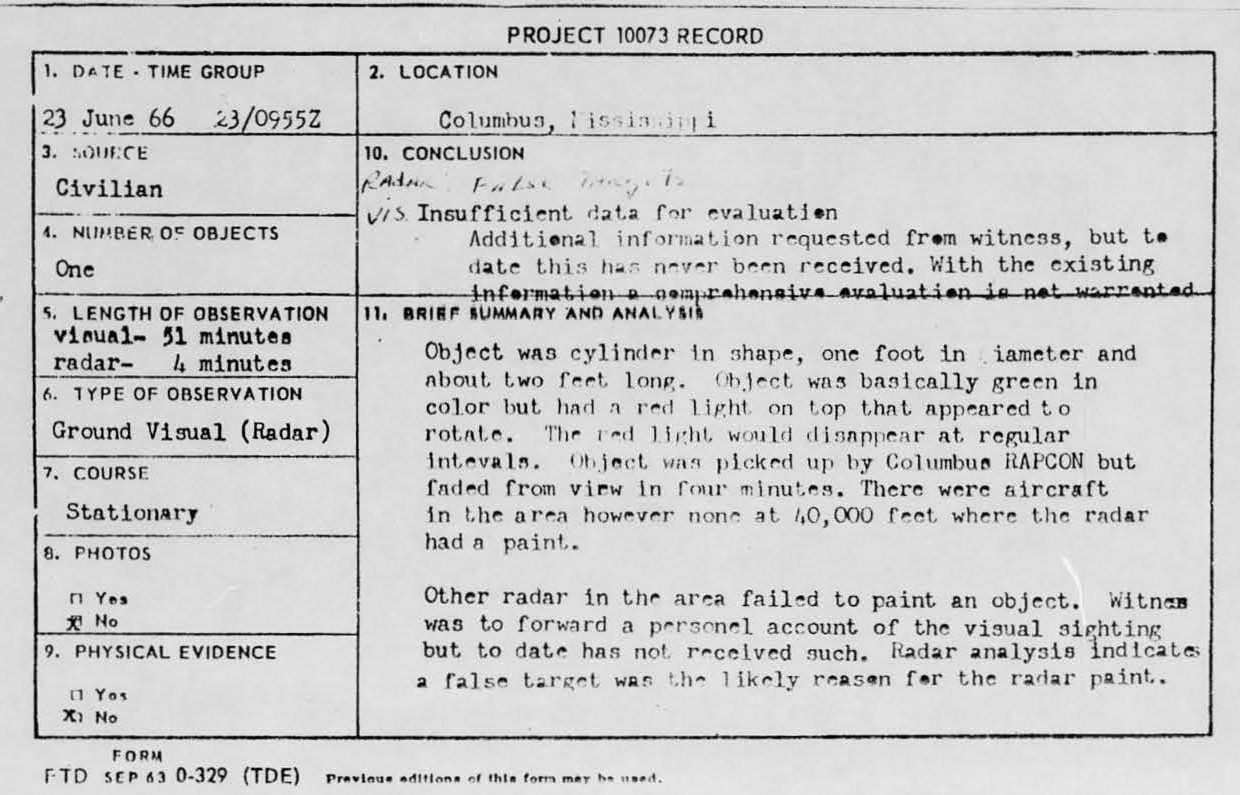
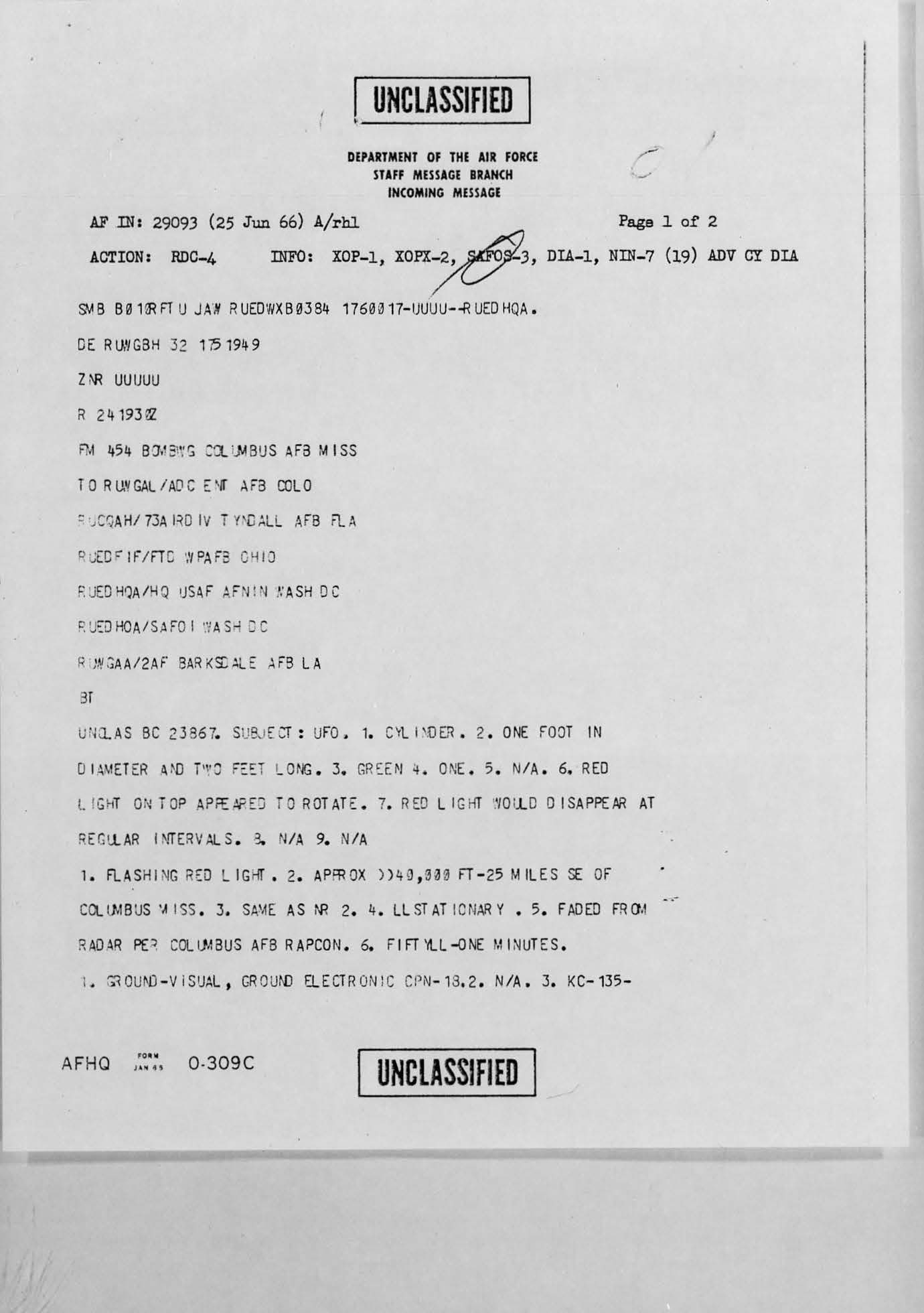
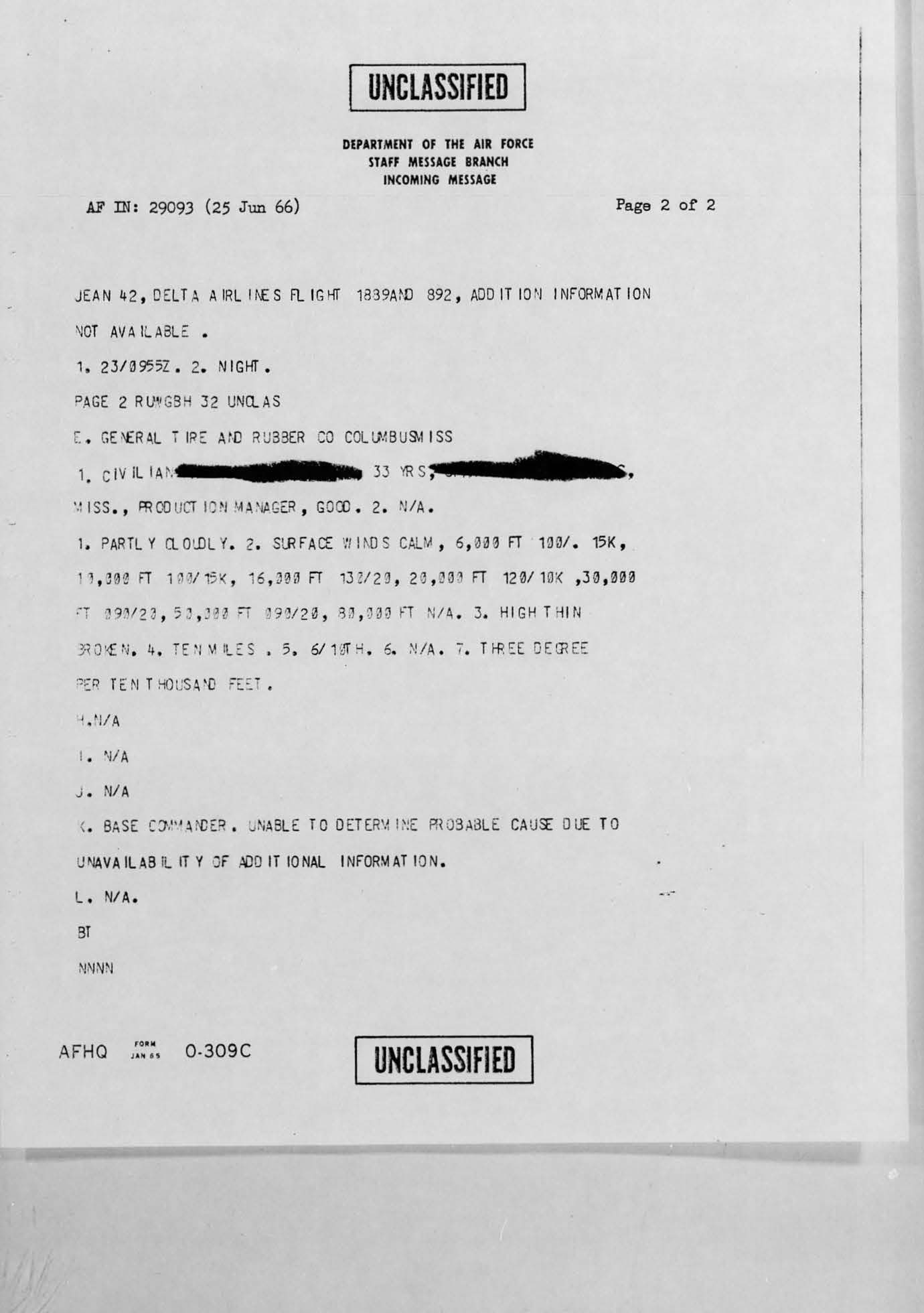
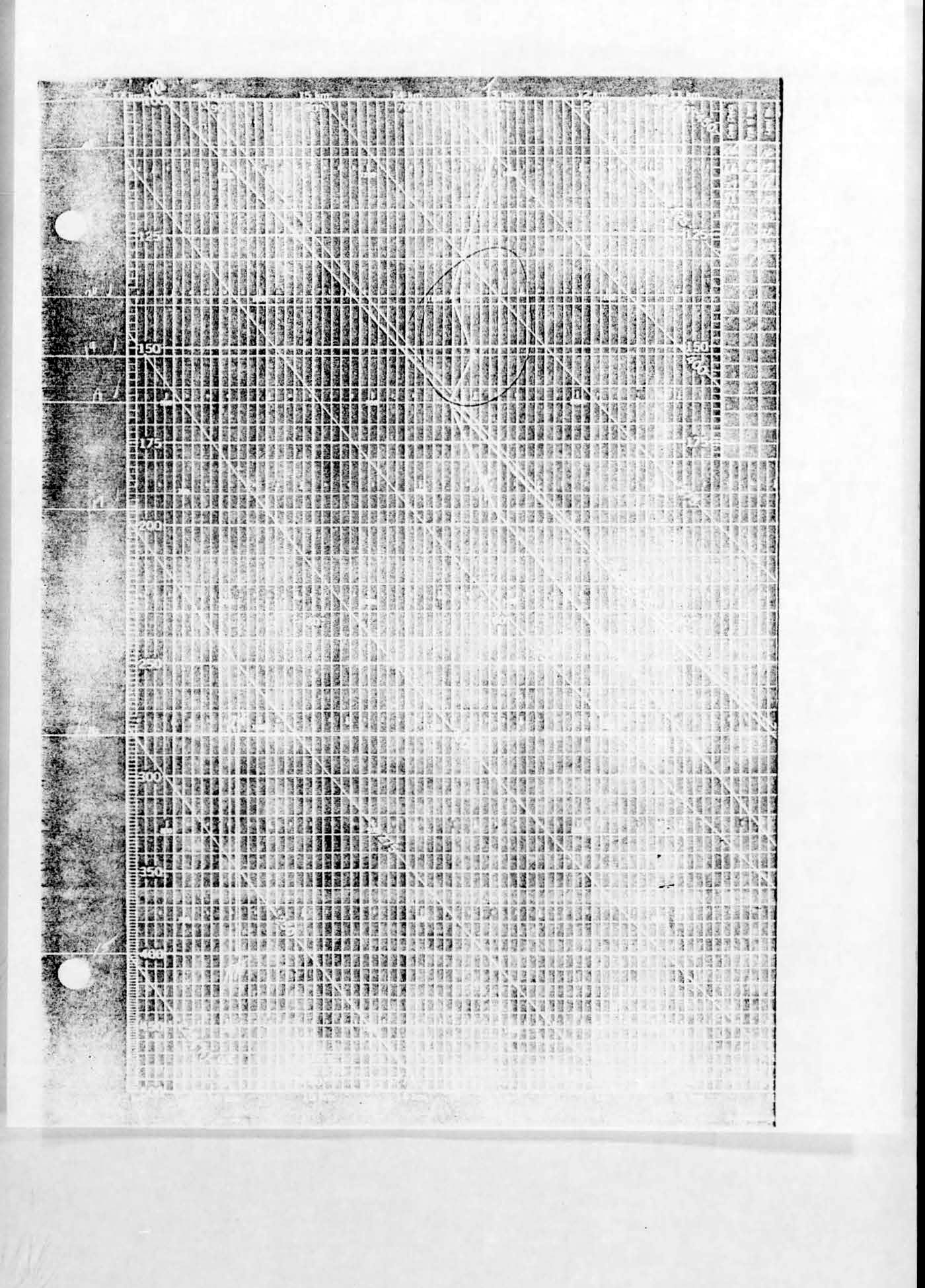
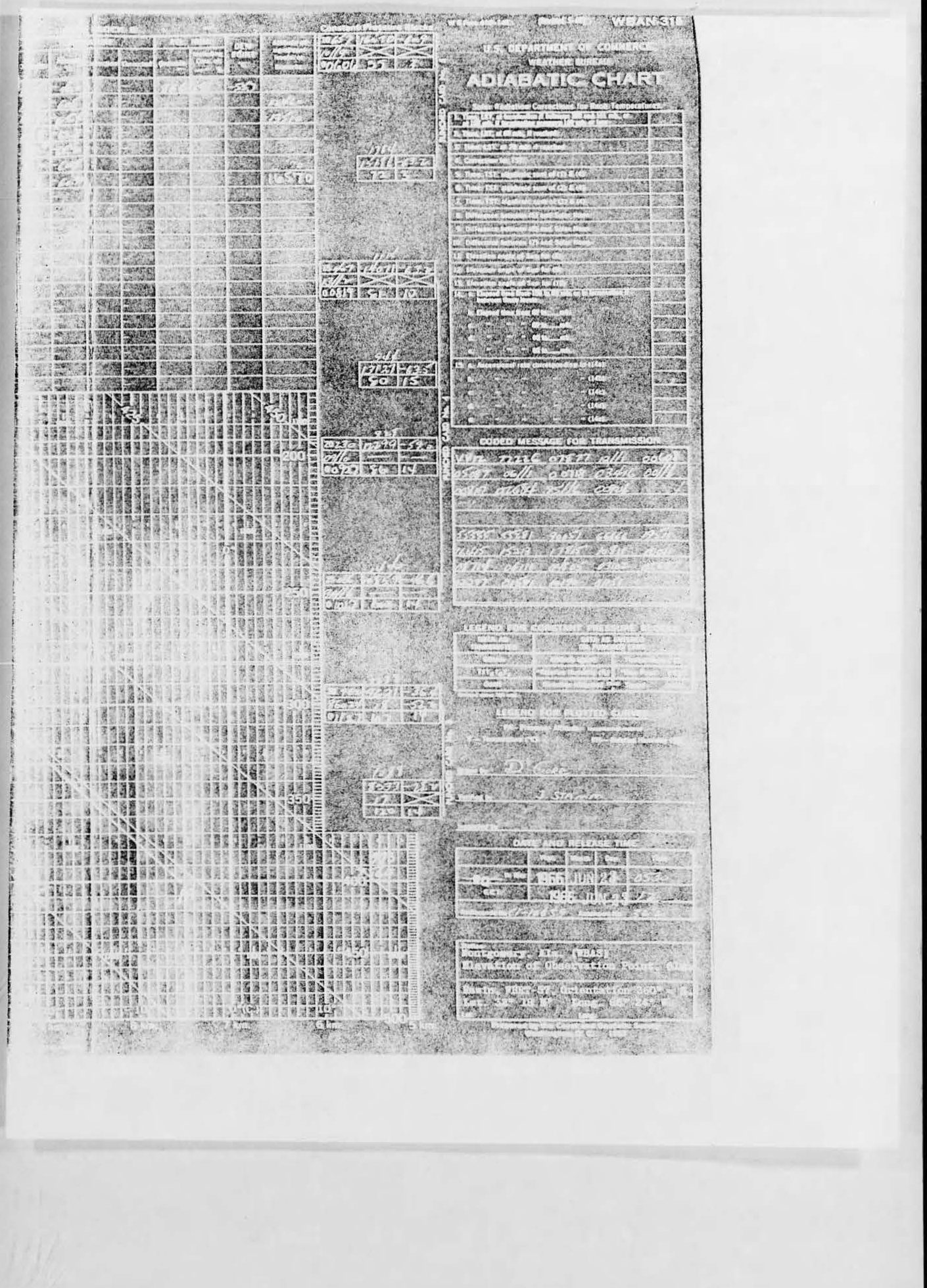
The 23-page released Project Blue Book file (Fold3 file 8280581), part of the Internet Archive's Project Blue Book collection: the record card, three copies of the teletype, the FTD Form 164, the FTD radar evaluation and the weather records. The primary source for this case file; the page images were read directly.
UNCLASSIFIEDThe regulation that superseded AFR 200-2 of July 20, 1962, three months after this sighting, with the lettered reporting format (description, course, manner of observation, time, location, observer, weather and winds aloft at the same eight levels, other activity, interception, air traffic and balloon releases, preparing officer's comments) that the Columbus teletype follows.
UNCLASSIFIEDThe catalog series for the released, name-redacted Blue Book case files (Record Group 341), filmed as microfilm publication T1206.
UNCLASSIFIEDNARA's fact sheet on Project Blue Book: 12,618 sightings reported from 1947 to 1969, 701 unidentified; termination announced December 17, 1969.
UNCLASSIFIEDSearch Government Archives Directly
Further Reading — Recommended Literature
The UFO Experience: A Scientific Inquiry
The Air Force's astronomical consultant on radar-visual reports and "nocturnal lights," and on how Blue Book handled both in the 1960s.
The Hynek UFO Report
Hynek's account of the Blue Book files, the "swamp gas" year, and the cases the Air Force closed with thin explanations.
UFOs and Government: A Historical Inquiry
A documented history of official UFO investigation, including Blue Book under Quintanilla and the road to the Condon study in 1966.
DISCLOSURE: Some links above are affiliate links. If you purchase through them, OverClassified receives a small commission at no additional cost to you. This helps support independent research.
Essential Viewing
No Videos Available
Sources
- U.S. Air Force, Project Blue Book. Project 10073 Record, form FTD SEP 63 0-329 (TDE), Columbus, Mississippi, 23 June 66, 23/0955Z (“Civilian”; “visual- 51 minutes / radar- 4 minutes”; “Ground Visual (Radar)”; “Stationary”; conclusion “Radar: False Targets” and “VIS. Insufficient data for evaluation”; “Other radar in the area failed to paint an object”). In Blue Book file “1966-06-8280581-Columbus-Mississippi”: archive.org
- 454th Bombardment Wing, Columbus AFB, Mississippi. Message UNCLAS BC 23867, “SUBJECT: UFO,” DTG 241930Z June 1966, to ADC Ent AFB, 73rd Air Division Tyndall AFB, FTD WPAFB, HQ USAF AFNIN, SAF-OI and 2nd Air Force Barksdale AFB; received as Department of the Air Force Staff Message Branch AF IN 29093 (25 Jun 66), two pages, filed in three copies (cylinder, green, red light; “40,000 FT-25 MILES SE”; CPN-18; KC-135 “JEAN 42” and Delta Air Lines flights 1839 and 892; General Tire and Rubber Co; winds aloft; “UNABLE TO DETERMINE PROBABLE CAUSE”). Same file: archive.org
- FTD Form 164 (Oct 62), “U.S. Air Force Technical Information” questionnaire, seven pages, completed 23 June 1966 by an officer at the Air Force Command Post, Washington, D.C. (name redacted) (“1040 ZULU”; “15–20” minutes, “VISUAL & RADAR”; “BLUE GREEN”; “SIZE OF AN AIRCRAFT”; narrative “A STATIONARY RADAR TARGET WAS PICKED UP AT 40000 FT, 140 DEG, 25 NMI BY COLUMBUS RAPCON ... TARGET FADED AT 1044½ Z”). Same file: archive.org
- Jones, Jerome J., Colonel, USAF, Electronics Directorate, Deputy for Technology and Subsystems, Headquarters Foreign Technology Division (AFSC), Wright-Patterson AFB. Memorandum “UFO Evaluation,” TDEER/Mr. Bryant to TDETR (Maj Quintanilla), 25 October 1966, with four attachments (“insufficient to support a meaningful analysis”; “the false target seems more feasible”). Same file: archive.org
- U.S. Weather Bureau. Adiabatic charts (form WBAN-31B), Montgomery, Ala. (WBAS), 23 June 1966, photocopies, with an inked ellipse at about 125–160 mb. Same file: archive.org
- Base Weather Station, Columbus AFB. Surface weather observations, WBAN Forms 10A (station 13825, 90th meridian time) and 10B, 23 June 1966 (hourly sky cover; peak gust 16 knots from 120° at 0912; power-failure and TMQ-11 remarks). Same file: archive.org
- Internet Archive. “1966 06 8280581 Columbus Mississippi” (U.S. Air Force, 23 images; Project Blue Book collection). archive.org
- Printy, Tim. “Project Blue Book case review: May-August 1966,” SUNlite 14, no. 6 (November–December 2022): 8ff.; June 1966 table, p. 12 (“23 | Columbus, MS | Radar: False Targets / Visual: Insufficient data | 1. Agreed. 2. Agreed. No direction of observation. Venus was visible and could have been source of visual sighting.”; also June 22 E. of Nashville, TN and June 23 Tallahassee, FL). (Download PDF): astronomyufo.com
- Printy, Tim. “Project Blue Book case review: January - June 1953,” SUNlite 10, no. 1 (January–February 2018): 15ff. (April 28, 1953, “Columbus, MS | Insufficient data | Agreed”). (Download PDF): astronomyufo.com
- Printy, Tim. “Project Blue Book case review: July-December 1958,” SUNlite 12, no. 1 (January–February 2020): 7ff. (August 14, 1958, “West Point, MS | Insufficient data | Agreed. No positional data”; August 18, 1958, “Columbus AFB, MS | Aircraft | Agreed”). (Download PDF): astronomyufo.com
- Printy, Tim. “Project Blue Book case review: September-December 1966,” SUNlite 15, no. 1 (January–February 2023): 11ff. (December 19, 1966, “Columbus AFB, MS | Fireball | Agreed”). (Download PDF): astronomyufo.com
- Sparks, Brad. “Comprehensive Catalog of 2,200 Project Blue Book UFO Unknowns,” version 1.35, February 3, 2026 (searched; no Columbus, Mississippi entry; the only June 23, 1966 entry is entry 1687, Hamburg, New York). NICAP (Download PDF): nicap.org
- Berliner, Don. “The Project Bluebook ‘Unknowns’,” compiled for the Fund for UFO Research (checked: June 1966 entries are Spooner, Wis., Kansas, Ohio, Burnsville, N.C., and east of Wake Island; no Columbus, Mississippi). NICAP: nicap.org
- Gross, Patrick. “Project Blue Book unexplained cases summaries with witness names: Year 1966,” UFOs at Close Sight (checked; no Columbus, Mississippi entry). ufology.patrickgross.org
- NICAP. “The 1966 UFO Chronology” (checked; June 22–24, 1966 entries include Guam, Placitas, N.M., Hamburg, N.Y., Richmond, Va., and Charlotte, N.C.; no Mississippi entry). nicap.org
- Department of the Air Force. AFR 80-17, “Unidentified Flying Objects (UFO),” 19 September 1966 (“This regulation supersedes AFR 200-2, 20 July 1962”; paragraph 11, reporting data and format), reprinted as Appendix B of the Condon Report. files.ncas.org
- Thayer, Gordon D. “Optical and Radar Analyses of Field Cases,” Section III, Chapter 5, in Edward U. Condon, ed., Scientific Study of Unidentified Flying Objects (1969) (“suggestive of radar false targets or slow-moving AP echoes”). files.ncas.org
- NOAA National Weather Service, JetStream. “Anomalous Propagation” (ground clutter “does not move”; superrefraction “more likely when a strong low-level inversion is in place”; “always get a second opinion”). noaa.gov
- Masek, Matthew. “The Role of a Stabilizing Boundary Layer during a Severe/Non-Severe Weather Event,” NWS Central Region Technical Attachment 12-01, January 2012 (the stable boundary layer “often forms at night over land, where it is known as a nocturnal boundary layer”; anomalous propagation returns expanding as the inversion strengthened). (Download PDF): weather.gov
- National Weather Service. “Radiosonde Observation” fact sheet (observations “up to an hour before 00:00 and/or 12:00 UTC”; a sounding “can last in excess of two hours”; drift “more than 300 km”). weather.gov
- NASA Glenn Research Center. “Earth Atmosphere Model — Imperial Units” (troposphere to 36,152 feet, T = 59 − .00356 h; lower stratosphere p = 473.1 exp(1.73 − .000048 h)) (used to convert 40,000, 43,000 and 48,000 feet to about 187, 162 and 125 mb; computed for this file). grc.nasa.gov
- NASA Jet Propulsion Laboratory. Horizons System ephemerides for the Sun, Moon, Mercury, Venus, Mars, Jupiter and Saturn as seen from 33.50° N, 88.43° W, 23 June 1966, 09:45–11:15 UT, refracted (computed for this file; bright-star positions computed from catalog coordinates precessed to 1966). ssd.jpl.nasa.gov
- NOAA National Centers for Environmental Information. Integrated Surface Database, station 723306-13825 (Columbus AFB), hourly observations for 1966 (23 June 0900Z, 1000Z and 1100Z: calm, visibility 16 km, 21.3, 20.2 and 18.5°C) (computed for this file). (Download data file): ncei.noaa.gov
- NOAA NCEI. “Federal Climate Complex Data Documentation for Integrated Surface Data” (sky-condition code 07, “Seven oktas — 9/10 or more but not 10/10, or BKN”; ceiling “Unlimited = 22000”). (Download PDF): ncei.noaa.gov
- NOAA NCEI. ISD station history list (“723306 13825 COLUMBUS AFB AIRPORT US MS KCBM +33.650 -088.450”). ncei.noaa.gov
- Canadian Air Defence Museum (CanDe), Pinetree Line archive. “CPN-18” (Bendix ground surveillance radar used in RAPCON; S-band search, moving-target indication, video mapping, 60-nautical-mile range). candemuseum.org
- Mobile Radar Units (mobileradar.org). “Radar Types” (AN/CPN-18: S-band surveillance radar portion of an air traffic control system, 2,700–2,900 MHz, 500 kW peak, 53 nautical miles, 70 in modified sets). mobileradar.org
- Columbus Air Force Base. “Columbus Air Force Base” fact sheet (SAC from April 1955; B-52 and KC-135 squadrons in 1958; 454th Bombardment Wing deployed from 1965; back to Air Training Command July 1, 1969). columbus.af.mil
- Goodsell, Leo, 14th Flying Training Wing Historian. “Columbus AFB: A Heritage of Training,” November 15, 2021 (4228th Strategic Wing; first KC-135 on January 7, 1959; 454th Bombardment Wing from February 1963; 454th Combat Support Group operated the base during the deployment; 3650th Pilot Training Wing from 1969). columbus.af.mil
- National Archives. “Project BLUE BOOK — Unidentified Flying Objects” (12,618 sightings, 701 unidentified; termination announced December 17, 1969). archives.gov
- National Archives Catalog. Series 597821, “Sanitized Version of Project Blue Book Case Files on Sightings of Unidentified Flying Objects.” catalog.archives.gov
- OverClassified. Michigan “Swamp Gas” UFO Wave case file (March 1966; Ford; April 5, 1966 hearing; O'Brien Committee), Condon Report case file (contract signed October 6, 1966), Portage County UFO Chase case file (April 17, 1966; satellite and Venus), Andersen AFB 1965–66 Radar Wave case file, and the Mississippi Blue Book case files linked above.
See something inaccurate? Have additional information or sources?
Suggest an Edit →Last Updated: October 2026