
The Andersen Air Force Base 1965–66 Radar Wave
Nine years after the last sighting in its own earlier 1952–1959 UFO cluster, Andersen Air Force Base in Yigo, Guam generated an altogether different, far better-instrumented kind of case file: a sustained, multi-sensor radar wave that Project Blue Book's own surviving paperwork places at 24 distinct unidentified-target contacts between October 1965 and June 1966, tracked on AN/FPS-20 surveillance radar, AN/FPS-6 height-finding radar, and a C-130 transport's airborne AN/APS-59 set. The wave climaxed just after midnight on June 28, 1966, when ground and airborne radar held continuous, mutually corroborating contact with an unidentified target for twenty minutes before it vanished from both scopes at the same instant — five days after Air Force Guam-based KC-135 and C-97 aircraft had already attempted their own intercepts against the same recurring phenomenon. No visual identification of the object was ever achieved on any of the wave's documented nights; the C-130 crew's own account describes what appeared to be a cloud sitting with the target at every turn. This case file lays out exactly what the surviving NICAP-hosted Blue Book documentation does and does not support — including an unresolved arithmetic discrepancy in the source material's own tally of incidents — rather than repeating the wave's most-quoted headline figure uncritically.
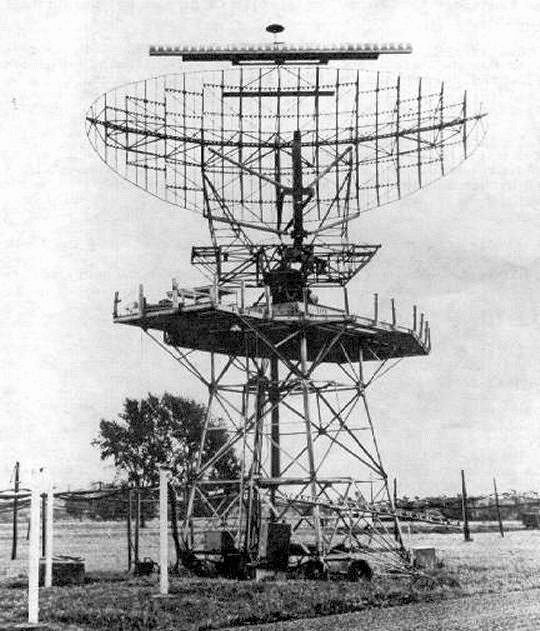
Pictured: a U.S. Air Force Bendix AN/FPS-20 early-warning/ground-controlled-interception radar of the same type identified in NICAP's Blue Book-sourced documentation as one of the two ground radar systems (alongside an AN/FPS-6 height-finder) that tracked the unidentified target during this case's June 28, 1966 culminating event. This is not a photograph of the specific FPS-20 unit stationed on Guam in 1965–66, nor of Andersen AFB itself; no rights-clear photograph of Guam's own period installation, or of any radar scope image from this specific wave, is known to survive. It is an official, public-domain U.S. Air Force photograph of the identical radar model, sourced from David F. Winkler's Cold War radar history Searching the Skies.
Theoretical Alignment
This case's evidentiary shape — instrumented, multi-sensor, sustained over nine months, but with zero visual or photographic confirmation on any single night — favors the Extraterrestrial Hypothesis more than the earlier, purely visual 1952–1959 Andersen cluster, but well short of certainty. The genuine cross-correlation between three independent radar sets (two ground, one airborne) and the simultaneous loss of contact on all channels at once are the strongest ETH-supporting details on this site's own evidentiary hierarchy, since they are difficult to explain as a single instrument's internal fault. The Psycho-Social Hypothesis scores low here specifically because PSH explanations depend heavily on subjective perception, expectation, and reporting behavior — all much weaker forces acting on a radar operator reading a scope than on an eyewitness describing a light in the sky, though PSH is not zero given that a base primed by 24 successive contacts may have developed elevated alertness that shaped how ambiguous returns were logged. The Interdimensional Hypothesis has no specific supporting evidence in the surviving record and is included only for this site's standard comparative framework.
Background
Andersen Air Force Base, on the northern tip of Guam within the village of Yigo, was already a documented site of unresolved UFO reporting by the time this wave began — a separate, earlier 1952–1959 cluster of three incidents (a Blue Book-flagged Unknown B-17 sighting, a fighter-interceptor pursuit by 1st Lt. Ted Brunson, and a mass sighting written into the 3rd Air Division's own classified annual history) is covered in full in this site's separate Andersen Air Force Base UFO Sightings case file. That earlier cluster rested entirely on unaided visual observation; nothing about it involved radar. This 1965–66 wave is a categorically different animal — smaller in incident-by-incident narrative detail (no named witnesses survive for it in available sourcing) but vastly better instrumented, generated by a base whose air-defense and air-traffic radar coverage had been substantially built out in the decade since the earlier cluster.
The most important piece of context for why this wave happened when it did is Guam's transformation into the primary forward-deployment hub for Operation Arc Light, the sustained B-52 Stratofortress bombing campaign supporting American forces in Vietnam. B-52s were first used in Southeast Asia on June 18, 1965, deploying to Andersen AFB and U-Tapao Royal Thai Navy Airfield in Thailand; the campaign would ultimately fly more than 126,000 sorties before ending in August 1973. This was not a minor uptick in base activity — it was one of the largest sustained air-traffic surges any single American installation experienced during the entire Cold War, arriving at Andersen just four months before this radar wave's first documented contact. A base handling that volume of B-52, KC-135, and C-130 traffic in and out of restricted Western Pacific airspace naturally had every incentive to keep its radar coverage active, alert, and well-staffed around the clock — which is very likely a significant part of why this wave is so much better documented, on an incident-count basis, than almost anything from the base's quieter 1950s.
Guam's Cold War-era ground radar network by 1965 included both AN/FPS-20 and AN/FPS-6 systems. The FPS-20, a Bendix-built L-band early-warning and ground-controlled-interception radar first developed in 1950, had been a backbone system of American continental and overseas air-defense networks through the early 1960s; by the mid-1960s many FPS-20 units nationally (and, per NICAP's own case documentation, the specific unit involved in this case) had been handed over to or shared with the Federal Aviation Administration for civil air-traffic surveillance, reflecting the broader post-SAGE drawdown of dedicated Air Defense Command radar coverage. The FPS-6, a General Electric-built S-band height-finder introduced in the late 1950s and produced in roughly 450 units for the U.S. Air Force and allied services including the Royal Air Force, was designed specifically to provide altitude data a search radar like the FPS-20 could not resolve on its own — pairing the two systems gave Guam's controllers both horizontal position and altitude on any tracked return, which is precisely the combination this case's June 1966 events describe being used.
This was also not the only UFO report on record at Andersen AFB between the 1952–1959 cluster and this wave. A separate, much smaller incident on September 25, 1961 — documented in a Project 10073 Record Card digitized by the researcher archive UFOScans.com and unrelated to either the earlier visual cluster or this radar wave — describes two brief nighttime sightings of a flame-trailing cylindrical object and a "grapefruit"-sized object, reported in part by Air Intelligence Officer Capt. Edward J. Pilecki, who was on record as "adamant" that the sighting was not a natural phenomenon despite the case's official "MAY BE METEOR" disposition. That 1961 case involved no radar and no aircraft, has no connection to the 1965–66 wave's sensor-corroborated pattern beyond sharing the same base, and is not otherwise treated in this article; it is noted here only so this case file does not imply Andersen AFB's Cold War UFO history consists of only two clusters when a third, smaller data point independently exists.
Complete Timeline
| Date | Event |
|---|---|
| Jun 18, 1965 | B-52 Stratofortresses are first used in Southeast Asia, with Andersen AFB, Guam established as a primary Operation Arc Light deployment base — a major surge in the base's air traffic beginning four months before this wave's first documented radar contact. |
| Oct 27, 1965 | First documented contact. Project Blue Book records place the wave's opening radar sighting on this date — the earliest of the "one" incident NICAP's own summary attributes to October 1965. |
| Nov 1965 | Two further unidentified radar contacts are logged, per Project Blue Book's own monthly tally, bringing the wave's running total to three. |
| Dec 1965 | One additional contact is recorded. |
| Mar 1966 | One additional contact is recorded, the wave's only documented event that month. |
| Apr 5 & Apr 27, 1966 | NICAP's National Sighting Index Database independently lists two of Project Blue Book's three April 1966 Anderson AFB contacts under these specific dates; the third April date is not separately identified in sourcing available for this article. |
| Jun 1966 | The wave sharply intensifies: Project Blue Book's own count attributes nineteen of the total 24 (or, per the source document's own internal arithmetic, 27) contacts to this single month — by far the wave's most active period, and the run-up to its best-documented night. |
| Jun 23, 1966 | Interception attempts are made against the recurring phenomenon by KC-135 Stratotanker and C-97 Stratofreighter aircraft — the wave's first documented attempted intercepts using fixed-wing Air Force aircraft rather than ground radar alone. |
| Jun 27, 1966 | A further intercept attempt is referenced in the Project Blue Book documentation, one night before the wave's best-corroborated event. |
| Jun 28, 1966, 12:45–1:15 a.m. | Culminating event. A C-130 aircraft of Andersen's Air Rescue Squadron, using its airborne AN/APS-59 radar, makes and holds continuous contact with an unidentified target for 20 minutes. Ground-based FAA AN/FPS-20 vectors correlate precisely with the airborne track; an AN/FPS-6 height-finder independently registers a return on the same target. The crew reports what appears to be a cloud consistently associated with the target, preventing visual confirmation despite repeated attempts. The target is lost from both FAA ground radar and the airborne set simultaneously at 1:15 a.m. Guam FAA controllers separately note unidentified radar beacon returns with no known or identifiable source. |
| 1966–2026 | NICAP researcher Daniel Wilson compiles and digitizes the surviving Project Blue Book documentation for the June 28, 1966 event, hosting it alongside a summary directory page; this remains the fullest publicly accessible account of the wave located for this article. |
The Nine-Month Buildup, October 1965 – May 1966
The surviving Project Blue Book paperwork for this wave, as digitized and summarized by NICAP, states plainly that "the Project Blue Book documents give exact dates and times of 24 radar sightings over a 9 month period of unidentified targets observed at Anderson AFB" — and separately breaks that total down by month: "Oct. 65 (one), Nov. 65 (two), Dec. 65 (one), Mar. 66 (one), Apr. 66 (three), and June 66 (nineteen)." Two things about that pattern are worth sitting with even before reaching the wave's best-known night. First, the distribution is heavily front-loaded toward inactivity and back-loaded toward a single explosive month: five contacts trickle in across the wave's first five active months (October through April, with no reported contact at all in January or February 1966), before June 1966 alone produces roughly three-quarters of the wave's entire documented activity. Second, NICAP's own National Sighting Index Database independently corroborates that Andersen AFB (listed there as "Anderson AFB") carries distinct, separately catalogued case entries for October 27, 1965, April 5, 1966, and April 27, 1966, in addition to the headline June 28, 1966 case — meaning this wave is not a single retrospectively-inflated NICAP summary claim resting on one document, but is cross-referenced by at least two independently structured NICAP data products (the narrative case directory and the separate database listing).
Neither the NICAP directory page nor the report page compiled by researcher Daniel Wilson identifies any individual by name for these early-wave incidents — no radar operator, no shift officer, no aircrew member. This stands in real contrast to the earlier 1952 and 1956 Andersen sightings, both of which preserved at least some named witnesses in their own Blue Book paperwork. Whether that reflects a genuine gap in what survived declassification, a deliberate anonymization of routine radar-log entries that were never treated as individually notable incidents until the June climax forced a fuller writeup, or simply that this article's sourcing has not located the underlying record cards for those earlier months, cannot be determined from the material available. This case file treats the early-wave contacts as real, Blue Book-documented events on the strength of NICAP's own cataloging, while being explicit that almost nothing beyond a bare date and a radar-only designation survives publicly for any of them individually.
A Note on the Conflicting Totals
Per this site's standing editorial policy of verifying every specific figure rather than repeating it uncritically, a genuine arithmetic problem in the source material itself must be flagged rather than silently resolved. NICAP's own case directory states the wave totals "24 radar sightings," but the same page's own monthly breakdown — one (Oct.), two (Nov.), one (Dec.), one (Mar.), three (Apr.), nineteen (Jun.) — sums to 27, not 24. This is not a rounding artifact or a transcription slip on this article's part; the two figures are three apart and both are quoted directly from the same source document. Three explanations seem plausible: the "24" figure may predate a later correction to the monthly count that was never reconciled in the summary sentence; the monthly breakdown may double-count some contacts that were logged more than once across adjacent categories in the original Blue Book paperwork; or the reverse could be true, with "24" representing a filtered, higher-confidence subset of the full 27 raw contacts. This article cannot resolve which explanation is correct from the sourcing available, and presents both figures — "24" as the source's own headline claim, "27" as its own internal arithmetic — rather than silently picking one. Readers should treat the true total as "in the mid-to-high twenties, per Project Blue Book's own count," not as a precisely confirmed 24.
The June 1966 Climax
Whatever the precise total, the wave's final week is its best-documented and most evidentially significant stretch by a wide margin. On June 23, 1966, Air Force KC-135 Stratotanker and C-97 Stratofreighter aircraft — not purpose-built interceptors, but large multi-engine transports pressed into service against a recurring, unidentified radar phenomenon — attempted intercepts against the target pattern that had been building since October. The specific outcome of those June 23 intercept attempts is not detailed in the summary documentation available for this article beyond the bare fact that they occurred; no source consulted states whether either aircraft achieved radar or visual contact. A further intercept attempt is referenced in the underlying Blue Book paperwork on June 27, one night before the wave's climactic event, though again without narrative detail surviving in the sources this article could access.
Then, at 12:45 a.m. local time on June 28, 1966, a C-130 aircraft from Andersen's Air Rescue Squadron — equipped with an AN/APS-59 airborne search radar, a set originally developed for the B-52's own airborne-alert and reconnaissance mission and adapted for a range of Air Force platforms through the 1960s — made radar contact with an unidentified target and held it continuously for twenty minutes. This was not an isolated, single-sensor blip: ground-based FAA controllers operating the AN/FPS-20 surveillance radar called vectors to the C-130 crew that, in NICAP's own words drawing on the Blue Book file, "checked perfectly" against what the airborne APS-59 was independently showing. A third radar, the AN/FPS-6 height-finder, was separately in operation and registered its own return on the same target — meaning three physically distinct radar systems, on two independent platforms (ground and airborne), were reading compatible data on the same unidentified contact at the same time. Throughout the twenty-minute hold, the C-130 crew reported what they described as a cloud that seemed to be consistently associated with the target — whenever they attempted to visually locate the return, it appeared to be obscured within this cloud, and no crew member achieved a confirmed visual sighting of any discrete object. At 1:15 a.m., the target vanished from both the FAA ground radar and the C-130's airborne radar at the same instant. Separately, Guam FAA controllers noted radar beacon returns from no known or identifiable source during this same general period — a distinct anomaly from the primary tracked target, adding a second category of unexplained radar activity to the same night's record.
NICAP's own internal case-rating system, explained on its public ratings page, assigns every radar case a numeric strangeness rating from 1 ("explainable or explained") to 5 ("highly strange: suggests intelligent guidance"), assessed by NICAP's own analyst review process; a rating remains "preliminary" until a full review finalizes it, and analyst disagreements are resolved by averaging. The June 28, 1966 Andersen case is recorded on NICAP's directory page as "Category 9, RADAR — Preliminary Rating: 5" — the maximum strangeness tier on NICAP's own scale, though explicitly marked preliminary rather than final. That is a meaningfully positive signal about how NICAP's own researchers assessed this specific night's evidence on first review, and this case file reports it plainly — but "preliminary" is not the same as "confirmed final," and no source consulted for this article documents that a full NICAP analyst review ever finalized the rating. Separately, and just as importantly: no source consulted for this article found any explicit Project Blue Book disposition of this case as an official "Unknown" (the "BBU" flag that marks the earlier 1952 Andersen sighting) — nor did any source document an official Air Force conventional explanation being offered for it either. The case appears to sit, in the surviving public record, undisposed by Blue Book's own formal classification system in either direction.
Key Witnesses
C-130 Aircrew, Andersen AFB Air Rescue Squadron (names not recorded)
The flight crew that held the AN/APS-59 airborne radar contact for twenty continuous minutes on June 28, 1966, and independently reported the cloud consistently obscuring the target from visual confirmation. No individual crew member's name survives in the summary Blue Book documentation available to this research; the underlying scanned case-file pages referenced by NICAP's own report page (via a now-defunct footnote.com/Fold3 archival link) may preserve names this article's sourcing could not access.
Guam FAA Radar Controllers (names not recorded)
Civilian Federal Aviation Administration controllers operating Guam's AN/FPS-20 surveillance radar, who called the ground-radar vectors that NICAP's Blue Book-sourced account describes as correlating precisely with the C-130's independent airborne track, and who separately logged the unidentified radar beacon returns noted during the same period. As trained civil air-traffic professionals with no institutional stake in UFO reporting, their corroboration of the airborne track is one of this case's stronger credibility signals despite their anonymity in available sourcing.
Ground GCI Radar Operators, AN/FPS-6 Height-Finder (names not recorded)
Military radar personnel operating Andersen's AN/FPS-6 height-finder, whose independent return on the same target during the June 28 event supplied the third of the case's three cross-correlating radar tracks. No individual is named in the sourcing located for this article.
The Five Observables Assessment
Low Observability is the one Observable this case documents with real confidence: a target that produced correlating returns on three separate radar systems yet was never once visually confirmed across the wave's entire nine months — despite an active C-130 crew specifically attempting to spot it inside its own reported "cloud" — is a textbook low-observable signature by this site's own standard. No source consulted describes any specific velocity, acceleration, or maneuver data for any contact in this wave (unlike, for instance, the ETH-favoring maneuver claims in the earlier 1956 Brunson pursuit at the same base), so Instant Acceleration and Hypersonic Velocity are both rated Absent rather than merely unconfirmed — there is no positive claim of either capability anywhere in the available sourcing to even rate as speculative. Anti-Gravity Lift is rated Speculative only because a maneuvering, radar-evasive-seeming target is sometimes associated with unconventional lift in the broader UAP literature, not because any source here makes that claim directly. Trans-Medium Travel is rated Speculative on the strength of the "cloud always associated with the target" detail, which admits of a genuinely trans-medium reading (a craft entering/exiting a self-generated obscuring phenomenon) but far more plausibly describes mundane atmospheric moisture coincidentally co-located with an anomalous propagation return — addressed directly in the Conventional Explanation Candidate section below.
Evidence Assessment
Supporting Genuine Anomaly
- Three physically independent radar systems (AN/FPS-20, AN/FPS-6, AN/APS-59) on two separate platforms (ground and airborne) reported mutually correlating data on the same target during the June 28, 1966 event, reducing the odds of a single instrument's internal fault or ground-clutter artifact explaining the whole event
- Simultaneous loss of contact on both ground and airborne radar at 1:15 a.m. is difficult to explain as one system's independent malfunction or scope-reading error
- NICAP's own analyst review provisionally rated the June 28 case at 5/5, the maximum strangeness tier on its rating scale, on first review of the Blue Book documentation
- The wave's sustained nine-month, 24-to-27-contact pattern argues against a single anomalous night being extrapolated into a "wave" narrative after the fact
Supporting Conventional Origin
- Zero visual confirmation was achieved on any of the wave's 24-plus documented contacts, including the well-instrumented June 28 event, despite an actively searching aircrew
- The C-130 crew's own description — a cloud consistently associated with the target — is also a textbook description of a genuine meteorological echo or anomalous radar propagation event, addressed directly below
- No named individual witness exists anywhere in this wave's surviving public documentation, limiting independent verification of exactly how each contact was logged and interpreted in real time
- The wave's own headline "24 incidents" figure does not arithmetically match its own source document's monthly breakdown (which sums to 27), indicating some degree of imprecision or unreconciled revision in how Blue Book's own paperwork was summarized
- No source consulted documents an official Project Blue Book "Unknown" disposition for this case, unlike the earlier 1952 Andersen sighting
Why "Credible"
This case file is classified CREDIBLE rather than Verified, Disputed, Open, or Debunked because its evidentiary profile clears a meaningfully higher bar than a single-witness or single-sensor account, while stopping short of the kind of multi-modal (radar-plus-visual-plus-physical) corroboration this site reserves its Verified label for. It is not Debunked: no source consulted proposes and substantiates a specific, dated conventional stimulus (a known aircraft flight, a specific meteor shower, a documented equipment fault) for the June 28, 1966 event or for the wave as a whole, and the underlying documentation was significant enough that Air Force aircraft were repeatedly scrambled against it. It is not merely Open/Unresolved in the same sense as the earlier 1952–1959 Andersen cluster: that cluster's central evidentiary problem was near-total absence of instrumented data, while this wave's central evidentiary problem is different in kind — abundant instrumented data (three correlating radar systems) but zero visual confirmation, which is a stronger overall evidentiary position even with its own real weaknesses. And it stops short of Verified because the wave's sourcing carries genuine, honestly-documented soft spots: no named witnesses, an unreconciled 24-versus-27 count discrepancy in the source material itself, a NICAP strangeness rating that was never confirmed past "preliminary," and — most significantly — a "cloud associated with the target" description that maps unusually well onto a specific, well-understood conventional radar phenomenon (see the Conventional Explanation Candidate section below) rather than pointing unambiguously toward an unconventional craft.
What is not in question: Project Blue Book's own surviving records document a sustained, multi-month pattern of unidentified radar contacts at a single, heavily-instrumented Cold War air base; three independent radar systems corroborated one another on the wave's best-documented night; and the U.S. Air Force considered the pattern serious enough to commit KC-135, C-97, and C-130 aircraft to active intercept and tracking attempts against it. Those are the load-bearing facts. What remains genuinely open is whether the target(s) behind them were craft, weather, or some combination across 24-to-27 separate nights that a single explanation may not even need to cover uniformly.
Sensor & Instrumentation Detection Profile
This is the strongest section of this case file's evidentiary record, and deserves treatment in real depth. Three physically distinct radar systems are named across the surviving documentation, and each brought a genuinely different detection capability to the wave's climactic June 28, 1966 event:
AN/FPS-20 — Ground Surveillance Radar
The Bendix-built AN/FPS-20 was an L-band early-warning and ground-controlled-interception radar first developed in 1950, with more than 200 units eventually deployed across American and allied air-defense networks; it formed part of the backbone of continental and overseas Air Defense Command coverage through the early 1960s before many units nationally were reassigned to or shared with the Federal Aviation Administration for civil air-traffic surveillance as dedicated Air Defense Command infrastructure was drawn down. In this case, it was the FPS-20 that Guam FAA controllers used to call ground vectors during the June 28 event — vectors that, per NICAP's Blue Book-sourced account, "checked perfectly" against the independently-operating airborne radar. The FPS-20 is a search radar: it excels at detecting a target's bearing, range, and general position, but on its own cannot resolve altitude with precision, which is exactly the gap the paired FPS-6 height-finder existed to close.
AN/FPS-6 — Height-Finding Radar
The General Electric-built AN/FPS-6 was an S-band height-finding radar introduced in the late 1950s, with roughly 450 units produced for the U.S. Air Force and allied forces including the Royal Air Force, serving as the principal height-finder for American air defense through the height of the Cold War. Paired with a search radar like the FPS-20, an FPS-6 gave Guam's controllers a genuine three-dimensional track — not just where a target was on a horizontal plane, but at what altitude — and its independent return on the same June 28 target is the case's third corroborating data point, distinct from both the FPS-20's ground track and the C-130's own airborne set.
AN/APS-59 — Airborne Search Radar
The AN/APS-59, mounted aboard the Air Rescue Squadron's C-130, was the sensor that made and held the twenty-minute contact directly, from a moving airborne platform rather than a fixed ground site — meaningfully harder to spoof or misattribute to fixed ground clutter than a stationary radar's return, since an airborne set's geometry relative to any fixed terrestrial source of false returns constantly changes as the aircraft maneuvers. That its track held steady and continuous for twenty full minutes, correlating throughout with the independently-operated ground systems, is a genuinely unusual degree of sustained multi-platform agreement for a UAP case on this site.
Radar Beacon Returns & the Absence of Any Visual Sensor Confirmation
Separate from the primary tracked target, Guam FAA controllers logged radar beacon returns from no known or identifiable source during the same general period — a second, distinct category of unexplained instrument activity on the same night, though one this case file treats as a related but separate data point rather than conflating it with the primary twenty-minute hold. Notably absent from every account located for this article: any optical, infrared, or photographic sensor confirmation of any kind. Every single one of this wave's 24-to-27 contacts is a radar-only event. That is simultaneously this case's greatest evidentiary strength (radar is far harder for a lone observer's expectation or misperception to corrupt than an eyewitness account) and its single greatest evidentiary gap (no photograph, gun-camera frame, or independent visual sighting exists anywhere in the wave to cross-check what the radar returns actually represented).
Environmental & Geospatial Context
Guam sits in the tropical Western Pacific typhoon belt, with a wet season running roughly July through November and a comparatively drier season from December through June. This wave's October-through-June span therefore begins at the tail end of one wet season, runs through the full dry season, and concludes right at the point the following wet season would typically be building — June 1966, the wave's most active month by a wide margin, sits at exactly the seasonal transition into Guam's heaviest tropical moisture and thunderstorm activity. That timing is directly relevant to this case's strongest conventional explanation candidate (see below): the atmospheric conditions capable of producing anomalous radar propagation and precipitation-related returns are, if anything, more common during this exact seasonal window than during Guam's driest months.
Geographically, Guam is a small, isolated volcanic and limestone island roughly 30 miles long, surrounded by open Pacific Ocean in every direction. Andersen AFB itself sits atop a limestone plateau on the island's northern tip, overlooking the Pacific with largely unobstructed radar and visual sightlines in most directions — a genuinely favorable radar environment in terms of ground-clutter reduction (no significant mountainous terrain nearby to generate the kind of persistent false returns common at continental radar sites), but also an environment where maritime humidity, temperature inversions over open water, and localized tropical convective cells are a routine, near-daily feature of the atmosphere. No specific meteorological report (storm activity, cloud cover, precipitation, or a documented temperature-inversion layer) for the exact night of June 28, 1966 was located in the sources consulted for this article; this section is deliberately limited to general seasonal and geographic climate context rather than fabricated site-specific weather detail for a night on which no such record was found in available sourcing.
Observer Credibility & Occupational Profile
Every witness category in this wave is an institutional, professionally trained observer rather than a civilian bystander — a genuine credibility-enhancing factor by this site's own standard, even though no individual within any of those categories is named in available sourcing. Federal Aviation Administration radar controllers are trained specifically to distinguish real aircraft tracks from clutter, weather returns, and equipment artifacts as a core, safety-critical function of their job; their independent corroboration of the C-130's airborne track is not the kind of casual observation this site treats skeptically. Military radar operators on the AN/FPS-6 height-finder and the aircrew operating the C-130's own APS-59 set occupy a similar professional tier. This site generally weighs trained instrument operators more heavily than untrained eyewitnesses precisely because their job explicitly trains them to second-guess an ambiguous scope return rather than assume the most dramatic interpretation — which, if anything, makes a sustained nine-month pattern that these specific professionals kept independently re-logging a more notable data point, not less.
The absence of any named individual, however, is a real limitation on how far this credibility assessment can be pushed. This site cannot verify any specific controller's or operator's years of experience, prior track record, or individual reliability the way it can for a named figure like Ted Brunson in the earlier Andersen cluster. The credibility case here rests on the occupational category as a whole (FAA controllers and military radar crews as a professionally screened, safety-trained population) rather than on any individually vetted person, which this site treats as a meaningfully weaker — though still legitimate — form of evidence than a fully identified, individually corroborated witness.
Physical & Material Assays
No physical debris, trace evidence, or material sample was recovered from any of the 24-to-27 incidents in this wave, and none is claimed by any source consulted for this article. Every documented contact in this wave is a radar-only event; nothing physical was ever retrieved or is claimed to have been retrieved. This section exists on this case file for structural consistency with this site's standard case-file template; there is no physical evidence to assay.
Historical Precedents & Archive Matches
This wave's most direct precedent sits at the same installation: this site's separate Andersen Air Force Base UFO Sightings case file documents a smaller, purely visual 1952–1959 cluster at the same base, thirteen years before this wave's opening contact. The contrast between the two is itself analytically interesting — the same installation producing two genuinely separate, well-documented UAP clusters a decade apart, the first entirely visual with no instrumented data, the second entirely instrumented with no visual confirmation, almost inverse evidentiary profiles from the same runway. A third, smaller and unrelated data point — the September 25, 1961 Pilecki sighting discussed in Background above — sits chronologically between the two larger clusters without meaningfully connecting to either.
Beyond Andersen AFB itself, this wave's evidentiary shape (multiple independent ground and airborne radar systems corroborating an unidentified target, intercepts attempted by military aircraft, no definitive visual resolution) most closely resembles this site's Lakenheath–Bentwaters Radar-Visual Incident (1956, Suffolk, England), in which four radar systems tracked violently maneuvering targets and an RAF night-fighter's own radar lock produced an anomalous result — though Lakenheath-Bentwaters also achieved a degree of visual and airborne-intercept-radar correlation this Andersen wave never did. It bears a looser resemblance to the RB-47 Bomber Chase (1957, Gulf Coast, USA), which combined visual, ground radar, and airborne ELINT tracking of a single pursuit rather than a sustained multi-month wave, and to the Kinross Incident (1953, Michigan/Lake Superior), another case built primarily on a radar target's behavior rather than eyewitness testimony. None of these comparisons should be read as claiming the cases share a common cause — only that they occupy a similar evidentiary category (military radar-corroborated, visually unconfirmed or only partially confirmed) that this site tracks across cases specifically because that category behaves differently, evidentially, than the far more common single-witness visual sighting.
Material Analysis
Because this wave produced no recovered physical material of any kind, this section addresses the closest available analogue: the physical and technical plausibility of the radar returns themselves, evaluated against what is actually known about mid-1960s radar technology and Western Pacific atmospheric conditions.
Cross-System Correlation as Physical Evidence
The single most physically significant fact in this wave's entire record is that three separate radar systems, built by two different manufacturers on two different frequency bands (the FPS-20's L-band and the FPS-6/APS-59's likely shared band family), operating from two physically separated platforms (fixed ground installations and a moving aircraft), reported data NICAP's own account describes as correlating "perfectly" on the same target during the June 28 event. A single instrument fault, a stuck antenna, a software/calibration error, or a persistent ground-clutter source specific to one radar's fixed geometry would not naturally explain agreement across three independently-maintained systems built by different manufacturers for different purposes. This does not prove an anomalous craft was present — a genuine shared atmospheric phenomenon (see the CEC section directly below) would also, by definition, produce correlated returns across multiple properly functioning radar sets, since all three systems would simply be detecting the same real physical thing in the air, whatever that thing was.
The "Cloud" Description as Physical Data
The C-130 crew's own description — a cloud consistently associated with the target, preventing visual confirmation — is the single most load-bearing sentence in this entire case file, and it cuts both ways. Read one way, it describes a craft that may have generated, entered, or exploited an obscuring atmospheric phenomenon as a form of low-observability behavior, which would independently support this case's "Present" rating on the Low Observability Five Observables criterion above. Read the other way — and this is the reading this site's own Conventional Explanation Candidate analysis below finds more persuasive on the available evidence — it describes precisely what a trained radar crew would report if their instruments were, in fact, detecting genuine atmospheric moisture (a cloud, a precipitation cell, or a layer supporting anomalous propagation) that radar can register as a discrete, trackable "target" under the right conditions, entirely independent of any craft being present at all.
Supporting Non-Terrestrial or Unconventional Origin
- Three independently-operated, differently-manufactured radar systems on two separate platforms corroborated the same target's position during the June 28 event
- The target vanished from both ground and airborne radar simultaneously, a pattern more consistent with a single object's sudden change in radar cross-section, altitude, or medium than with two unrelated instruments coincidentally failing at the same second
- The wave's sustained, 24-to-27-contact, nine-month duration argues against a single anomalous atmospheric night being retroactively inflated into a "wave" narrative
Supporting Terrestrial or Conventional Origin
- A "cloud consistently associated with the target" is also precisely how a real meteorological radar echo or an anomalous-propagation duct would present to a crew straining to get a visual on a purely radar-only return
- The wave's overwhelming concentration in June 1966 — the seasonal transition into Guam's wettest, most convectively active months — is a specific, testable point in favor of an atmospheric rather than a craft-based explanation
- Zero visual, photographic, or physical confirmation exists across the entire wave, meaning every single one of the 24-to-27 contacts rests on radar interpretation alone, with no independent sensory modality to cross-check what any given return actually represented
The Conventional Explanation Candidate
Because this case file covers a nine-month wave of 24-to-27 individually documented contacts rather than a single incident, no one candidate is claimed to explain every contact uniformly; several genuinely distinct mechanisms are evaluated below, any combination of which could account for different nights within the same wave.
Anomalous Propagation / Radar Ducting
Anomalous propagation (sometimes called "anaprop" or radar ducting) occurs when a temperature or humidity inversion layer in the atmosphere bends a radar beam in ways that cause it to detect and range genuine atmospheric structures, distant terrain, or even ocean-surface returns as if they were discrete, moving airborne targets. This phenomenon is extremely well-documented in tropical and maritime environments specifically, is most common during exactly the kind of dry-to-wet seasonal transition this wave's June 1966 climax coincides with, and is a leading, well-established candidate for exactly the kind of "target with an associated cloud, no visual confirmation, simultaneous multi-radar correlation" profile this case describes — because a genuine atmospheric duct or moisture layer would, by definition, be detected consistently by multiple properly functioning radar systems examining the same volume of sky, exactly as this case's three systems did. This candidate is also the leading category the Air Force itself historically favored when disposing of ambiguous radar-only cases through Project Blue Book and its predecessor programs across the Cold War.
A caveat on official Air Force/Blue Book explanatory patterns is warranted here. This case's own surviving record does not document Blue Book offering an official "anomalous propagation" (or any other) explanation for this specific wave, and this site does not claim one was given. But because this candidate belongs to the same general category of official-institution-favored explanation that the U.S. military and Blue Book leaned on repeatedly across the Cold War, readers should weigh it with real, calibrated skepticism rather than as automatically dispositive: official investigative bodies, including Blue Book, have a documented history of incomplete, delayed, or later-criticized "explained" rulings, an institutional and career incentive toward the least-alarming available conclusion, and — for a case sitting on an active, classification-adjacent Strategic Air Command bomber base at the height of the Vietnam buildup — no way for an outside researcher today to independently audit whether a fuller, more decisive explanation exists in records that were never declassified at all. This is not a claim that anyone specifically lied about this case; it is a statement that an atmospheric explanation, however well it fits the available facts, is one input to weigh rather than a closing argument, particularly given how many experienced UAP researchers treat official Cold War-era radar-case dispositions with exactly this kind of caution.
Weather Radar Clutter / Precipitation Returns
A closely related but mechanically distinct possibility is straightforward precipitation clutter: rain cells, especially the localized, fast-forming convective cells common in the tropical Western Pacific, can produce a strong, trackable radar return that a search radar's automated or manual target-extraction process treats as a discrete moving object rather than a diffuse weather cell, particularly at extended range where a storm cell's true size is harder to judge from raw scope data. This candidate is strengthened by the same seasonal-timing evidence as anomalous propagation (June's concentration of contacts at the wet-season transition) and by the explicit "cloud" language in the C-130 crew's own account, but is weakened somewhat by the twenty-minute duration and steady tracking behavior of the June 28 contact, which is a longer and more consistent hold than a typical fast-moving tropical convective cell would usually sustain against a moving aircraft's own radar without the apparent track visibly dissolving or reforming.
Conventional Aircraft Misidentification
Given Andersen AFB's dramatically increased 1965–66 air traffic as the primary Arc Light B-52 deployment hub, with B-52, KC-135, and C-130 sorties running at a volume the base had never previously sustained, some fraction of this wave's 24-to-27 contacts could plausibly represent misidentified or improperly correlated returns from the base's own genuine, non-anomalous air traffic — a radar operator momentarily losing track of which blip corresponded to which known, scheduled flight amid a much busier scope than the base's controllers were accustomed to managing in the pre-Arc Light years. This candidate is weakened for the June 28 event specifically by the explicit cross-correlation between independently-tasked airborne and ground radar, both of which would presumably have been aware of and able to exclude scheduled, transponder-equipped friendly traffic from an "unidentified" designation, but remains a live possibility for some of the wave's less-detailed earlier contacts.
Equipment Malfunction or Beacon Cross-Talk
The unidentified radar beacon returns separately logged by Guam FAA controllers — explicitly described as having no known or identifiable source — are a specific, testable candidate for equipment-level explanation: a malfunctioning or improperly coded IFF (identify-friend-or-foe) transponder aboard a genuine aircraft, cross-talk between multiple radar systems' own beacon-interrogation signals, or a faulty ground transponder could all generate exactly this kind of spurious, sourceless beacon return without requiring any craft, conventional or otherwise, to be physically present at all. This candidate applies specifically and only to the beacon-return anomaly, not to the primary twenty-minute tracked target, which behaved as a genuine radar-cross-section return rather than a beacon/transponder signal.
Genuine Anomaly
After weighing the above, a residual possibility remains that some portion of this wave's contacts — plausibly including the well-corroborated June 28 event — represent a genuinely unidentified craft or phenomenon not accounted for by atmospheric, aircraft, or equipment explanations. The strongest evidence for this candidate is precisely the cross-system correlation and simultaneous, synchronized loss of contact detailed above, which a purely atmospheric or clutter-based explanation would need to account for as coincidental rather than causal. This site does not resolve that question; it is presented here as a live candidate alongside the conventional alternatives, consistent with this case's overall Credible rather than Debunked or Verified classification.
The Assessment
Anomalous Propagation / Radar Ducting
PlausibleThe strongest single conventional candidate: fits the "cloud with the target," multi-radar-correlation, and June seasonal-timing evidence unusually well, though it remains unconfirmed by any Air Force disposition of this specific case.
Weather Radar Clutter / Precipitation
InconclusivePlausible in outline and seasonally well-timed, but the June 28 target's twenty-minute sustained, steady track is a longer and more stable hold than typical convective-cell clutter usually produces.
Conventional Aircraft Misidentification
InconclusiveA real possibility for some of the wave's less-detailed early contacts given Andersen's dramatic 1965–66 Arc Light traffic surge, but weakened for the well-corroborated June 28 event by independent cross-tasked radar correlation.
Equipment Malfunction / Beacon Cross-Talk
Plausible (for the beacon-return anomaly only)A strong, narrow explanation specifically for the sourceless radar beacon returns Guam FAA controllers separately logged; does not address the primary twenty-minute tracked target, which was not a beacon-type return.
Genuine Anomaly
InconclusiveCannot be ruled out given the cross-system correlation and synchronized loss of contact, but is not the best-fitting explanation once the atmospheric candidates above are weighed against the available evidence.
Related Cases
Confirmed Documents & Official Records
NICAP's own summary page for the wave's culminating event, sourced directly from Project Blue Book's declassified files — the origin of this case file's "24 radar sightings over a 9 month period" figure, the FPS-20/FPS-6/APS-59 radar detail, and the Category 9/Preliminary Rating 5 classification.
UNCLASSIFIED (declassified Blue Book file)Researcher Daniel Wilson's index of eleven individual scanned Blue Book document pages for this case (Project 10073 Record, FAA Radar Phenomenon reports, intercept-attempt logs, and the FPS-6/radar-beacon/cloud-target notes this case file draws on). The individual scan images were originally hosted on footnote.com, since restructured as Fold3.com; those specific deep links no longer resolve and are not used as citations in this article.
UNCLASSIFIED (declassified Blue Book file)A scanned-image Project Blue Book document package for this wave's earliest documented contact, hosted directly by NICAP. This research confirmed the file downloads successfully as a genuine 1.6MB scanned PDF; its content is image-based (no machine-readable text layer) and could not be transcribed for this article beyond what NICAP's own summary pages describe.
UNCLASSIFIED (declassified Blue Book file)NICAP's structured case-index database. This research independently extracted the database's raw text and confirmed separate, distinct "Anderson AFB" Guam entries dated 1965-10-27, 1966-04-05, and 1966-04-27, in addition to the headline 1966-06-28 case — corroborating this wave as a multi-entry pattern across NICAP's own indexing system, not a single summary claim.
UNCLASSIFIED (independent research archive)A separate, unrelated, and earlier declassified Blue Book case at the same base — two brief object sightings reported in part by Air Intelligence Officer Capt. Edward J. Pilecki. Verified by this research to be chronologically and evidentially distinct from this 1965–66 radar wave; included here only for completeness of Andersen AFB's own documented UFO-reporting history.
UNCLASSIFIED (declassified Blue Book file)National Archives holdings of Project Blue Book's full case files and administrative records (94 microfilm rolls), the ultimate primary-source archive underlying NICAP's own digitized case summaries for this wave.
UNCLASSIFIED (declassified)Search Government Archives Directly
Further Reading — Recommended Literature
The UFO Encyclopedia, 4th Ed.
The definitive general reference on UFO cases and history, including extensive coverage of Project Blue Book's radar-case investigative methods and rating conventions that this case file draws on directly.
UFOs and the National Security State
A chronological account of the American military and intelligence community's UFO reporting infrastructure, covering exactly the 1965–66 Vietnam-War-era period this case's Arc Light background is set within.
Clear Intent: The Government Coverup of the UFO Experience
A detailed examination of declassified military and government UFO files, with particular attention to radar-tracked and multi-sensor military cases of exactly this case file's evidentiary type.
The UFO Evidence
NICAP's own foundational compilation of its strongest documented cases, sent to every member of Congress in 1964 — the same research organization and analytical tradition that catalogued and rated this wave two years later.
Uninvited Guests
A documented history of UFO sightings drawing heavily on NICAP's own radar and multi-witness case files, including the kind of sustained military-base reporting patterns this Andersen wave represents.
DISCLOSURE: Some links above are affiliate links. If you purchase through them, OverClassified receives a small commission at no additional cost to you. This helps support independent research.
Essential Viewing
No Videos Available
Sources
- NICAP. UFO Report: Anderson AFB, Guam, June 28, 1966 — Air Intercept & Radar Tracks (case directory). nicap.org
- NICAP / Daniel Wilson. Full report and scanned Project Blue Book document index, June 28, 1966. nicap.org
- NICAP. Project 10073 Record Card scanned document package, Anderson AFB, October 27, 1965. nicap.org
- NICAP. National Sighting Index Database (NSID), "Listing by City" — entries for Anderson AFB, Guam, 1965–66. nicap.org
- NICAP. Explanation of NICAP's Category/Rating/Reliability case-classification system. nicap.org
- UFOScans.com. "Project 10073 Record Card and Incoming Staff Message: UFO Sightings at Andersen AFB, Guam" (September 25, 1961 — separate, earlier incident). ufoscans.com
- National Archives (NARA). Project Blue Book records and UFO investigation summary. archives.gov
- OverClassified. The Andersen Air Force Base UFO Sightings (1952–1959 cluster at the same base). overclassified.org
- "AN/FPS-20 Early Warning Radar." Wikipedia — consulted for radar system specifications, manufacturer, and service history. en.wikipedia.org
- "AN/FPS-6 Radar." Wikipedia — consulted for radar system specifications, manufacturer, and service history. en.wikipedia.org
- "Lockheed C-130 Hercules." Wikipedia — consulted for aircraft background and 1960s service role. en.wikipedia.org
- "Boeing KC-135 Stratotanker." Wikipedia — consulted for aircraft background and 1960s service role. en.wikipedia.org
- "Boeing C-97 Stratofreighter." Wikipedia — consulted for aircraft background and mid-1960s service role. en.wikipedia.org
- "Operation Arc Light." Wikipedia — consulted for the June 1965 B-52 deployment to Andersen AFB and its air-traffic implications for this case's background. en.wikipedia.org
- "Project Blue Book." Wikipedia — consulted for program history, case categorization, and 1969 closure. en.wikipedia.org
- "Andersen Air Force Base." Wikipedia — consulted for base history and geographic coordinates. en.wikipedia.org
- Wikimedia Commons. "AN-FPS-20 Radar.jpg," U.S. Air Force official photograph, public domain (via David F. Winkler, Searching the Skies, 1997). commons.wikimedia.org
- Winkler, David F. Searching the Skies: The Legacy of the United States Cold War Defense Radar Program (1997) — source of the hero image's original attribution.
- NICAP. UFO Casebook 1965 (consulted to confirm no separate public casebook entry exists for the October 1965 Andersen AFB contact beyond the NSID/PDF record). nicap.org
- NICAP. UFO Casebook 1966 (consulted to confirm no separate public casebook entries exist for the April 1966 Andersen AFB contacts beyond the NSID/PDF record). nicap.org
See something inaccurate? Have additional information or sources?
Suggest an Edit →Last Updated: August 2026