
The Andersen Air Force Base UFO Sightings
Across a seven-year span, Andersen Air Force Base in Yigo, Guam logged a cluster of officially recorded UFO incidents unlike almost anywhere else on the American Cold War map: a December 1952 B-17 bomber crew's sighting of a silver, flame-trailing cylinder — a case the Air Force's own Project Blue Book flagged "Unknown" — a December 1956 pursuit in which 1st Lt. Ted Brunson pushed his F-86D Sabre interceptor to its limits chasing a glowing object that simply out-turned him, and a November 1959 event significant enough that the base's parent command wrote it directly into its own classified annual history. No radar lock, wreckage, or photograph survives from any of the three. What survives instead is a paper trail running through the Air Force's own investigative bureaucracy — witness statements, a Blue Book record card, and a unit history entry — documenting a base that, by its own internal records, could not fully explain what its personnel kept seeing in the sky.
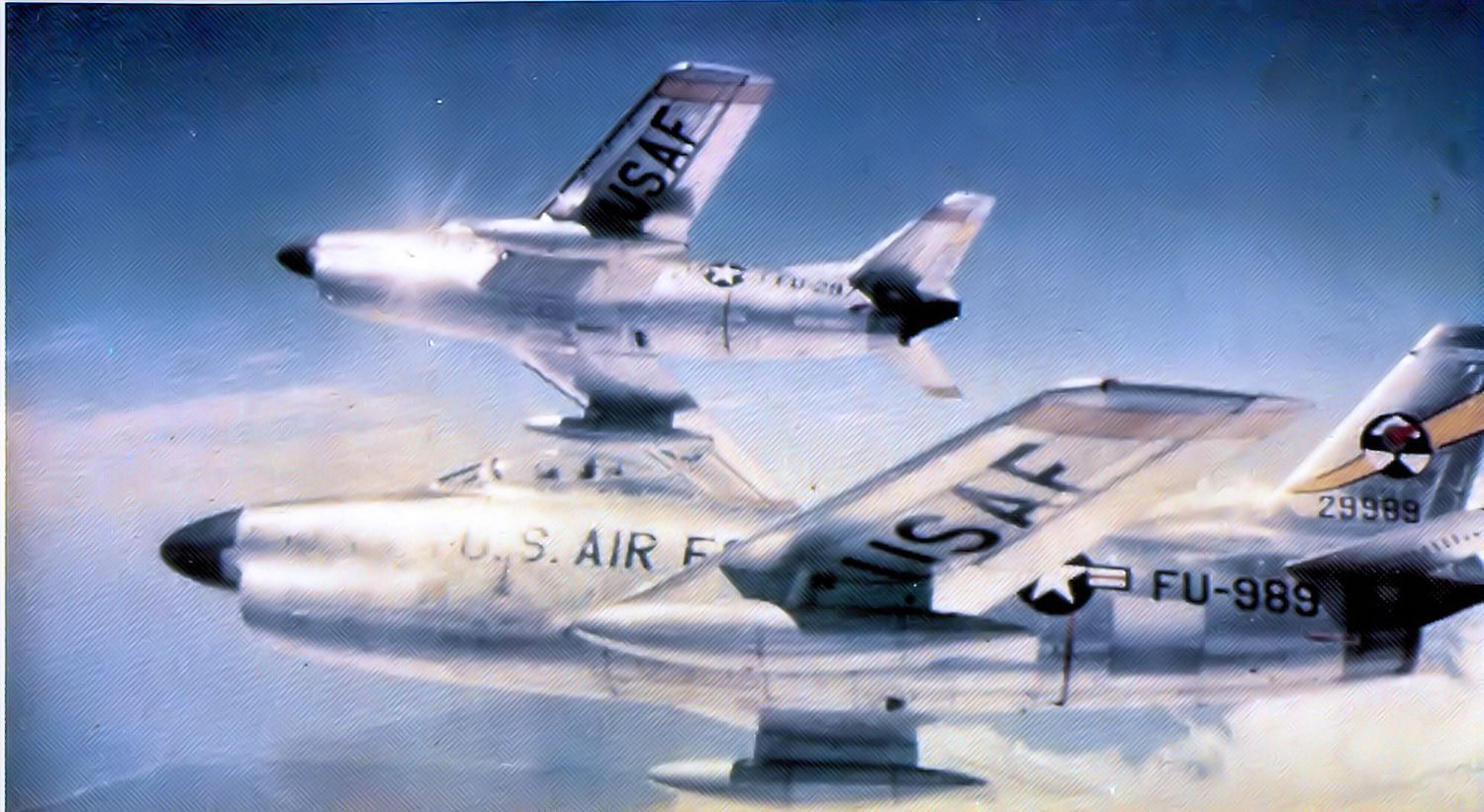
Pictured: a U.S. Air Force North American F-86D Sabre of the 41st Fighter-Interceptor Squadron, photographed in 1955 — the same squadron 1st Lt. Ted Brunson flew with when it relocated to Andersen AFB in August 1956. This is not a photograph of the actual December 1956 incident or its specific aircraft; no photograph of that pursuit, of Brunson's individual jet, or of any of this case's three incidents is known to exist. It is an official, public-domain U.S. Air Force photograph of the same unit and aircraft type, from the same year the squadron arrived on Guam.
Theoretical Alignment
None of the three incidents in this cluster offers the kind of physical or instrumented evidence that would strongly favor any single explanatory framework. The Extraterrestrial Hypothesis draws modest support from the 1952 case's officially unresolved Blue Book status and multi-witness, two-vantage-point corroboration, and from the performance implied by Brunson's inability to close on or out-turn the 1956 object in a radar-equipped interceptor. The Psycho-Social Hypothesis (PSH) — here understood broadly, as expectation and context shaping perception and reporting rather than as any claim of fabrication — is a serious candidate for the thinly documented 1959 mass sighting, which arrived in the same decade as the national "flying saucer" wave and a peak year for Blue Book reporting nationally. The Interdimensional Hypothesis has essentially no positive evidence in any of the three incidents and is included only for the site's standard comparative framework.
Background
Andersen Air Force Base occupies the northern tip of Guam, largely within the village of Yigo, and has been one of the United States' most strategically important Pacific installations since World War II. The base was renamed on October 7, 1949, in honor of Brigadier General James Roy Andersen, a 1926 West Point graduate who died on February 26, 1945, when his B-24 Liberator was lost between Kwajalein and Johnston Island. Through the late 1940s and early 1950s the base hosted rotating Strategic Air Command (SAC) bomber units — initially B-29 Superfortress groups descended from the wartime 314th Bombardment Wing, later B-36 and then B-47 rotations — and, from November 1952, the newly activated 79th Air Rescue Squadron flying SB-29 "Super Dumbo" search-and-rescue variants.
On June 18, 1954, the 3rd Air Division was activated at Andersen as the headquarters for all Strategic Air Command operations in the Pacific, replacing the Far East Air Forces Bomber Command (Provisional) that had performed the same function from Yokota Air Base, Japan. The division exercised operational control over SAC's deployed tactical bomber and tanker components across the theater and, in later years, would go on to manage the massive Arc Light and Young Tiger air campaigns of the Vietnam War. For most of the 1950s the base's own host-support function rotated between the 6319th Air Base Wing (1953–1955) and its successor, the 3960th Air Base Wing (from April 1955).
Guam's air defense picture changed on August 5, 1956, when the 41st Fighter-Interceptor Squadron relocated to Andersen from Japan, bringing all-weather F-86D "Sabre Dog" interceptors back to the island for the first time in several years. The squadron would remain Andersen's principal air-defense asset until its inactivation in March 1960, after which Guam's fighter-interceptor coverage was provided by periodic Fifth and Thirteenth Air Force deployments flying F-102 Delta Daggers. It was into this newly reconstituted interceptor squadron that 1st Lt. Ted Brunson arrived, less than five months before the sighting described below.
Guam's transformation into this kind of heavily fortified strategic hub did not happen in a vacuum. The island, a U.S. territory since 1898 and the site of a small naval coaling station in the early 20th century — the era of the nearby Guam-based USS Supply Aerial Phenomenon case, decades earlier — was captured by Japanese forces within days of the attack on Pearl Harbor and occupied for two and a half brutal years before U.S. forces retook it in the July–August 1944 Battle of Guam. That WWII experience, chronicled in historian Tony Palomo's An Island in Agony, left the island firmly committed to hosting a permanent, heavy American military presence in the postwar decades, and Andersen's own runways and support infrastructure trace directly back to the Army Air Forces' wartime construction effort. By the early 1950s, Guam had become one of the linchpins of American airpower projection in the Western Pacific — close enough to reach mainland China and the Korean peninsula, remote enough to be relatively secure from a first strike, and positioned squarely on the flight paths connecting Hawaii, the Philippines, and mainland Japan. It was this same strategic logic that placed the 3rd Air Division's entire Pacific SAC command structure at Andersen a few years later, and that made the base's local airspace one of the most closely watched, best-documented patches of sky in the entire American Pacific defense perimeter throughout the 1950s.
This strategic buildup happened against the backdrop of the first great American "flying saucer" era. Project Blue Book, the Air Force's official UFO investigation and reporting program, ran continuously from 1952 to 1969, ultimately cataloging 12,618 reported sightings nationwide, of which 701 were never resolved to the Air Force's own satisfaction and were left classified "Unidentified." Guam's remoteness meant it rarely surfaced in the mainland press coverage that drove national UFO reporting in this era — but Andersen's own internal record-keeping shows that its personnel were filing reports through the same official channels as bases across the continental United States, and that at least one of those reports cleared the same bar of unresolved strangeness that produced Blue Book's famous 701 Unknowns.
Complete Timeline
| Date | Event |
|---|---|
| Feb 26, 1945 | Brig. Gen. James Roy Andersen is killed when his B-24 Liberator is lost between Kwajalein and Johnston Island. |
| Oct 7, 1949 | The base is formally renamed Andersen Air Force Base in his honor. |
| Nov 14, 1952 | The 79th Air Rescue Squadron is activated at Andersen AFB, flying SB-29 search-and-rescue aircraft — five weeks before the first sighting in this case. |
| Dec 19, 1952 | Incident One. A B-17 bomber crew roughly 130 miles from Guam and three ground-crew witnesses at Andersen AFB, joined by a Naval officer, independently observe a silvery, cylindrical object trailing a bright flame from its aft section, on a heading of approximately 270°, for five to six seconds. No radar contact or electromagnetic interference is reported. Statements are later filed under the names of Major McKown, Captain MacDonald, Lorne A. Anderson, Marlin T. Johnson, and Donald C. McDonald. |
| 1952–53 | The case is processed through Project Blue Book as a formal Project 10073 Record Card entry, including aeronautical charts, Air Intelligence Information Reports, and a priority teletype to the USAF Director of Intelligence. |
| Jun 18, 1954 | The 3rd Air Division is activated at Andersen AFB as Strategic Air Command's Pacific headquarters. |
| Aug 5, 1956 | The 41st Fighter-Interceptor Squadron relocates to Andersen AFB from Japan, bringing F-86D Sabre all-weather interceptors to Guam's air defense mission. 1st Lt. Ted Brunson is among its pilots. |
| Dec 31, 1956, ~02:10 | Incident Two. Flying an F-86D interceptor, 1st Lt. Ted Brunson observes a round, glowing white object pass beneath his aircraft. He engages afterburners and pursues; the object executes turns tighter than his aircraft can match. He breaks off the chase roughly ten minutes later, low on fuel. |
| 1956–57 | Brunson's sighting is logged through Air Force reporting channels; it will later be cataloged by NICAP's National Sighting Index Database under "Airspace over Guam." |
| Nov 18, 1959 | Incident Three. Numerous UFO sightings are reported around Andersen AFB — enough that an entry is written directly into the 3rd Air Division's own classified annual history for the year. No named witnesses or object description from this event have surfaced in any publicly available secondary source located for this article. |
| Mar 1960 | The 41st Fighter-Interceptor Squadron is inactivated; periodic F-102 deployments from Fifth and Thirteenth Air Force take over Guam's air-defense alert mission. |
| Oct 1965 – Jun 1966 | Postscript, outside this case's scope. Andersen AFB experiences a much larger, separately documented radar-tracked UFO wave — at least 24 distinct incidents logged by FPS-20, FPS-6, and APS-59 radar systems, including a June 28, 1966 event in which a C-130's radar held an unidentified target in contact for 20 minutes while intercepts were attempted. See Historical Precedents & Archive Matches below. |
| 2021 | Journalist CJ Urquico's Pacific Island Times feature "Guam residents recall past encounters with the unknown" republishes the 1952 and 1956 accounts (via James Paton's The Book of Ghosts, UFOs and the Unexplained, itself citing an original St. Petersburg Times article) for a modern audience, alongside unrelated Guam UFO accounts from other decades. |
The December 1952 B-17 Sighting
At some point during the evening or early morning hours of December 19, 1952 — the surviving secondary sources disagree on which, a discrepancy addressed in full below — six people at two separate locations near Andersen Air Force Base independently reported the same or a very similar object. Two pilots aboard a B-17 bomber, then approximately 130 miles from Guam, saw a silvery, cylindrical object trailing a bright silverish flame from its aft section, moving on a heading of roughly 270 degrees. At essentially the same time, three ground-crew personnel at Andersen AFB itself, along with a Naval officer, reported observing the same or a comparable object. The total sighting duration was brief — five to six seconds — and no radar contact or electromagnetic interference was reported by either vantage point.
The case was processed as an official Project Blue Book file, catalogued under the Air Force's standard Project 10073 Record Card system. The surviving Blue Book paperwork, digitized and hosted by the civilian research organization NICAP, includes a description-of-incident narrative, several aeronautical charts, Air Intelligence Information Reports, individual witness statements, a priority teletype message to the USAF Director of Intelligence, and Naval observation records — a 28-page documentary package compiled by researcher Daniel Wilson. Five individual statements are named in that package: Major McKown, Captain MacDonald, Lorne A. Anderson, Marlin T. Johnson, and Donald C. McDonald. The specific role each of these five men held — airborne crew, ground observer, the Naval officer, or an investigating/reporting officer — is not distinguished in the summary documentation available for this article; the underlying scanned statement pages exist but sit behind sourcing this research could not access (see the Sourcing Note below).
What can be stated with confidence is the case's official disposition. NICAP's own National Sighting Index Database — a structured catalog of Project Blue Book cases cross-referenced against NICAP's independent files — lists the December 19, 1952 Andersen AFB sighting with the description "B-17 Crew Encounters Cylinder Reported By Ground Crew," a Category Code of 11 (the same code the database uses for other well-known, high-quality Blue Book Unknowns, including the 1948 Anacostia Naval Air Station sphere case and the 1953 "Lockheed UFO Case"), an "A" reliability rating (NICAP's top tier), a severity/strangeness score of 5, and — critically — the flag "BBU," meaning Blue Book Unknown. In plain terms: the U.S. Air Force's own investigators, working the case in real time in 1952 and 1953, were unable to identify the object to their own satisfaction, and it remained in Blue Book's small, closely tracked pool of genuinely unresolved cases.
A Sourcing Note: The Time Discrepancy
Two separate NICAP-hosted pages describing this same case give two different times for the sighting, and this article was unable to resolve which is correct from the sourcing available. NICAP's own case-directory summary page states the sighting occurred at approximately 6:55 a.m. local time (noting some sources say 6:50 a.m.). The companion report page, which draws directly from the Blue Book "Description of Incident" document, instead states the time as "2050 to 2055 hours" — 8:50 to 8:55 p.m. in 24-hour military notation. These are not close enough to be a rounding or transcription variant of each other; one places the sighting near dawn, the other well after dark. Per this site's standing editorial policy of verifying every specific claim rather than repeating it uncritically, both figures are presented in this case file's Quick Stats and Timeline rather than silently picking one, and the discrepancy is flagged explicitly in this article's own research notes rather than resolved by guesswork.
The December 1956 Brunson Interception
Four years later and a few miles away in the air over Guam, a very different kind of witness had his own encounter. 1st Lt. Ted Brunson was a fighter-interceptor pilot with the Andersen-based 41st Fighter-Interceptor Squadron, which had relocated from Japan to Guam on August 5, 1956 to fly all-weather air-defense alert with North American F-86D Sabre interceptors — the radar-equipped "Sabre Dog" variant, distinguished from the day-fighter F-86 by its nose-mounted AN/APG-36 radar and its ventral tray of 24 unguided 2.75-inch "Mighty Mouse" rockets in place of machine guns. Rated for a top speed in the neighborhood of 715 mph and a service ceiling near 50,000 feet, it was, in 1956, one of the most capable interceptors the United States had stationed anywhere in the Pacific.
At approximately 2:10 a.m. on December 31, 1956, while airborne over Guam, Brunson saw a round object glowing white pass directly beneath his aircraft. He pushed the F-86D after it, engaging the afterburner in an attempt to close the distance and identify it. According to the account he later gave, the object repeatedly out-turned him — making sharper maneuvers than his interceptor was capable of matching — and after roughly ten minutes of unsuccessful pursuit, with his fuel state dropping, Brunson broke off the chase and returned to base.
The sighting entered the Air Force's reporting system during the height of the Blue Book era and was later separately cataloged by NICAP's National Sighting Index Database, which lists it under "Airspace over Guam" with a Category Code of 11 — the same code applied to the 1952 sighting and to other multi-source, high-quality Blue Book cases — and a distinct case reference number. Unlike the 1952 sighting, however, this database entry does not carry NICAP's "BBU" (Blue Book Unknown) flag in the extract available to this research, and no radar corroboration for Brunson's specific sighting was located in any source consulted. This is a meaningful evidentiary distinction from the 1952 case, and this article does not claim an equivalent official "Unknown" disposition for the 1956 incident that the available sourcing cannot support.
Correcting a Claim: The Hynek/Umatac Conflation
An earlier pass of research for this article, based on an initial AI-generated web search summary, concluded that Brunson's case had drawn the personal attention of astronomer J. Allen Hynek — then Project Blue Book's chief scientific consultant — and that Brunson had later told a Guam journalist, "I knew I wasn't cuckoo," after meeting with Hynek. On closer reading of the actual 2021 Pacific Island Times source article in full, this attribution is incorrect. The Hynek meeting and that quote belong to a different, entirely unrelated interview subject in the same article: an anonymous man in his mid-60s from the southern Guam village of Umatac, who told the reporter that as a teenager he and his sister witnessed a landed silver craft near their home, with a door opening to reveal only the boots of an occupant. That man — not Brunson — is the one the article describes as having drawn Hynek's attention and later expressing relief at being "validated." The article's account of Brunson is limited strictly to the F-86D pursuit itself; it contains no claim of a Hynek meeting, Blue Book validation narrative, or direct quote from Brunson at all. This case file corrects that conflation and reports only what the primary source actually documents for each of the two men.
The November 1959 Mass Sighting
The third and least-documented incident in this cluster occurred on November 18, 1959, when, according to Andersen Air Force Base's own official heritage history, numerous UFO sightings were reported around the base — in numbers significant enough that an entry describing the event was written directly into the 3rd Air Division's annual command history for that year, a classified internal document rather than a public-facing report. This detail comes from Andersen AFB's own "Early AAFB Heritage Pamphlet," published by the base for the U.S. Air Force's 75th anniversary in 2022–23; this research was unable to directly retrieve the PDF itself (the file returned an access-denied response to automated requests), but the specific sentence describing the November 18, 1959 event was returned consistently, verbatim, across three independently phrased search queries indexing that document's own text — the verification standard this site's editorial rules specify for exactly this situation.
Beyond that single official acknowledgment, however, no named witness, object description, estimated number of observers, or Blue Book cross-reference for this specific date and event was located in any other source consulted for this article, including a direct check of NICAP's own year-by-year 1959 casebook, which contains no Guam or Andersen AFB entry at all. This is an unusual gap: an internal Air Force unit history considered the event noteworthy enough to record for the historical record, yet it appears not to have generated (or not to have survived as) the kind of civilian-facing paper trail that NICAP's independent research network typically picked up for other Blue Book-era cases, including both of this case's other two incidents. The most honest characterization available from current sourcing is that the 1959 event's existence and its significance to the base's own command are independently and officially attested, while its specific witness testimony and phenomenological detail are not currently recoverable from public documentation.
Key Witnesses
1st Lt. Ted Brunson
The only named witness across all three incidents in this cluster whose account survives in a fully attributed, first-person form. Newly arrived on Guam with his squadron's F-86D Sabres less than five months earlier, Brunson attempted a real-time intercept of the object he observed on December 31, 1956, using every performance advantage his radar-equipped interceptor offered — afterburner included — and still could not match its turning performance. As an active-duty fighter pilot flying a front-line all-weather interceptor on an operational air-defense mission, rather than a casual or off-duty civilian observer, Brunson represents one of this site's higher-credibility witness categories: a trained aviator whose professional judgment about relative aircraft performance is directly relevant to assessing the case, reporting an encounter that directly affected his own flight profile and fuel state rather than a passive sighting from the ground.
Maj. McKown, Capt. MacDonald, Lorne A. Anderson, Marlin T. Johnson & Donald C. McDonald
Five men named in the surviving Project Blue Book documentation for the 1952 sighting, each of whom is recorded as having provided an individual statement: "Statement of Major McKown," "Statement of Captain MacDonald," and individual statements from Lorne A. Anderson, Marlin T. Johnson, and Donald C. McDonald. NICAP's summary of the case separately describes six total observers split between an airborne B-17 crew (two pilots), three ground-crew witnesses at Andersen AFB, and one Naval officer — five names for what the summary describes as six people, a gap this research could not close without direct access to the underlying scanned statement pages. Their specific individual roles are not distinguished in any secondary source located for this article, and this case file does not assign them roles it cannot substantiate.
Unnamed Andersen AFB Personnel
No individual witnesses from the November 1959 event are named in any source located for this article. The event's existence is attested solely by Andersen Air Force Base's own official heritage-history documentation, which describes "numerous" sightings and reports around the base without further identifying detail.
The Five Observables Assessment
The Five Observables framework, developed by former AATIP director Luis Elizondo, is used to classify UAP encounters based on performance characteristics that exceed known technology:
Assessment: Neither the 1952 nor 1956 incident produced radar data, so no instrumented speed or acceleration figures exist to test against Hypersonic or Instant Acceleration criteria — both are marked N/A rather than Present or Absent, since the absence of radar means the question was never actually tested, not that the object demonstrably lacked the capability. The 1956 case offers the strongest, if still anecdotal, performance claim in the cluster: Brunson's account of an object that could out-turn a radar-equipped, afterburner-capable interceptor over a sustained roughly ten-minute pursuit implies maneuverability beyond the F-86D's own envelope, which is speculatively counted toward Low Observability (in the sense of evading a determined visual/radar-search intercept) and toward Anti-Gravity Lift only insofar as sustained high-G turning without any visible conventional control surface or exhaust plume, as briefly described, would be difficult to reconcile with 1950s aerodynamic propulsion. No trans-medium behavior (air-to-water or similar) is claimed in any of the three incidents.
Evidence Assessment
Supporting Anomalous Origin
- The 1952 case was processed as an official Project Blue Book Project 10073 Record Card and remained flagged "BBU" (Blue Book Unknown) in NICAP's independent cross-reference database — meaning the Air Force's own contemporaneous investigators could not identify it
- Six named or partially named witnesses across two independent vantage points (airborne and ground) reported the 1952 object within the same brief window, with no reported prior coordination
- NICAP's database assigns the 1952 case its top ("A") reliability rating and maximum (5) strangeness score, placing it in the same tier as other well-regarded Blue Book Unknowns
- 1st Lt. Brunson was a trained, on-duty interceptor pilot whose professional judgment about relative flight performance carries more weight than an untrained civilian's impression
- Brunson's pursuit lasted a sustained approximately ten minutes with afterburner engaged — not a brief, easily misjudged glimpse — and ended only due to his own fuel state, not loss of visual contact
- The 1959 event was considered significant enough by the 3rd Air Division's own command staff to be entered into a classified internal annual history, an unusual step for a routine or easily dismissed report
- The cluster spans three independent incidents, three different types of witnesses (bomber aircrew, fighter-interceptor pilot, unnamed base personnel), and seven years, at a single strategically sensitive installation
Supporting Conventional Explanation
- No radar contact, photograph, or physical trace evidence exists for any of the three incidents
- The 1952 sighting lasted only five to six seconds — well within the range of a bright meteor or fireball, which can also produce a bright trailing flame and a consistent apparent heading
- The two NICAP pages describing the 1952 case's own time of occurrence directly conflict with each other (dawn vs. night), undermining confidence in the precision of the surviving record
- The specific roles of four of the five named 1952 witnesses (aircrew vs. ground vs. investigating officer) cannot currently be verified, limiting how much independent-vantage-point weight can be assigned with confidence
- The 1956 NICAP database entry for Brunson's sighting does not carry the same "BBU" Blue Book Unknown flag found on the 1952 entry, meaning this research cannot confirm the Air Force ultimately classified it as unresolved rather than misidentification
- A single pilot's impression of an object's turning performance, at night, without a radar track to corroborate range and closure rate, is inherently difficult to verify independent of the observer's own account
- The 1959 incident has no surviving witness testimony, object description, or independent corroboration beyond a single sentence in an official but non-detailed base history document
- 1959 was a peak year nationally for UFO reporting generally, raising the possibility that a mundane stimulus (aircraft lights, flares, an astronomical event, or a genuine but conventional aerial anomaly) was amplified into "numerous" reports by the same climate of heightened attention documented at bases across the country that year
Why "Open"
This case file is classified OPEN rather than Disputed, Credible, or Debunked because the available evidence does not cleanly support any of those more decisive labels. It is not Debunked: no source consulted for this article proposes and substantiates a specific conventional identification for any of the three incidents, and the Air Force's own contemporaneous investigation of the 1952 sighting left it officially unresolved. It is not straightforwardly Credible in the sense this site applies to its strongest cases (e.g. multi-sensor radar-visual corroboration): none of the three incidents produced radar, photographic, or physical evidence, and one incident (1959) has essentially no recoverable witness detail at all. And while there is genuine ambiguity to weigh — a real time discrepancy in the 1952 sourcing, a role-attribution gap among the named 1952 witnesses, and an unresolved question about the 1956 case's official Blue Book disposition — this is a case of documentation gaps and open questions rather than two competing, well-evidenced interpretations actively disputing each other, which is what this site reserves the Disputed label for.
What is not in question: Project Blue Book's own record-keeping shows Andersen AFB personnel filed a UFO report in December 1952 that the Air Force could not resolve; a named, on-duty interceptor pilot flew a real, fuel-limited pursuit of an unidentified object in December 1956; and Andersen's parent command considered a November 1959 event significant enough to write into its own classified history. Each of those three facts is independently and officially documented. What remains genuinely open is what any of the three objects actually were.
Sensor & Instrumentation Detection Profile
No radar system at Andersen AFB, aboard the B-17 in 1952, or aboard Brunson's F-86D in 1956 registered a contact for any of the three incidents documented here, despite the F-86D's own AN/APG-36 airborne intercept radar being specifically designed to acquire exactly this kind of target — a notable absence given how central radar corroboration is to this site's strongest-rated cases elsewhere (compare the 1957 RB-47 Bomber Chase, which combined visual, ground radar, and airborne ELINT tracking). All three 1952–1959 sightings here rest on unaided visual observation alone. This stands in sharp contrast to the later, separately documented 1965–66 Andersen radar wave (see Historical Precedents below), in which FPS-20 height-finder, FPS-6 search, and C-130 APS-59 airborne radar systems repeatedly held contact with unidentified targets for extended periods — demonstrating that Andersen's own sensor suite was, in principle, fully capable of detecting and tracking an anomalous aerial target when conditions allowed, which sharpens the significance of its absence in this earlier cluster.
The F-86D's own AN/APG-36 radar, the specific sensor most relevant to the 1956 pursuit, was a nose-mounted search-and-lock system designed to slave the aircraft's fire-control computer to a detected target automatically, cueing the pilot's gunsight and rocket-tray release point without requiring a separate visual lock — a genuinely advanced capability for 1956, and one built specifically for exactly the kind of high-speed, high-angle intercept Brunson describes attempting. That no source consulted for this article mentions Brunson achieving or even attempting a radar lock during the pursuit is itself worth noting: it may indicate the object was too small, too distant, too low, or too radar-transparent to register, or simply that Brunson was focused entirely on visual pursuit and afterburner management during a fast-moving, fuel-critical intercept rather than working the radar scope. Neither possibility can be distinguished from the sourcing available. Ground-based early-warning radar coverage of Guam in the mid-1950s was comparatively thin relative to the more heavily instrumented continental Distant Early Warning and SAGE networks then being built in the continental United States and Alaska, which may also help explain why no ground radar track corroborates either the 1952 or 1956 sighting even if one had genuinely been present.
Environmental & Geospatial Context
Guam sits in the tropical Western Pacific typhoon belt, with a wet season running roughly July through November and a comparatively drier season from December through June; late December, when both the 1952 and 1956 incidents occurred, falls at the seasonal transition, typically bringing clearing skies and reduced storm activity relative to the preceding months. November 18, 1959 falls at the tail end of the wet/typhoon season, when tropical disturbance activity in the Marianas, while past its peak, remains possible. No specific meteorological report (storm activity, cloud cover, or visibility) for any of the three exact incident dates was located in the sources consulted for this article; this section is deliberately limited to general seasonal climate context rather than fabricated site-specific weather detail for nights on which no such record was found.
Geographically, Guam is a small, isolated volcanic and limestone island roughly 30 miles long, surrounded by open Pacific Ocean for well over a thousand miles in every direction, with minimal ambient light pollution outside its handful of population centers even during the Cold War buildup era. That isolation cuts both ways for this case's evidentiary weight: a genuinely dark, unobstructed tropical sky is an excellent environment for spotting a real anomalous light with high contrast against the background stars, but it is equally an excellent environment for a bright meteor, a planet near the horizon, or a distant aircraft's position lights to be misjudged in scale and distance without the reference points (city lights, terrain features, other aircraft) that an observer over a populated continental landscape would typically have available. Northern Guam's terrain, where Andersen sits atop a limestone plateau overlooking the Pacific, offers largely unobstructed sightlines to the horizon in most directions, consistent with both the B-17 crew's ability to track their object across a heading of roughly 270 degrees and Brunson's ability to maintain visual contact with his object throughout a sustained, maneuvering pursuit.
Observer Credibility & Occupational Profile
The witness pool across this cluster skews unusually heavily toward trained military aviation and support personnel rather than civilian bystanders, which this site generally treats as a credibility-enhancing factor. The 1952 case's named individuals include a Major and a Captain, both presumably commissioned officers with some investigative or command role in how the incident was documented, alongside three additional named men whose specific military roles are not distinguished in available sourcing. 1st Lt. Ted Brunson was an active-duty, on-alert fighter-interceptor pilot — among the most rigorously trained and psychologically screened observer categories this site encounters, flying a specific, performance-rated aircraft whose limits he would have known intimately, which strengthens the evidentiary weight of his account of being out-turned. The 1959 incident's witnesses are entirely unnamed and their occupational profile cannot be assessed at all from currently available sourcing.
This site generally weighs professional aviation and military-intelligence witnesses more heavily than untrained civilian observers, on the reasoning that their training specifically equips them to judge relative motion, altitude, and aircraft performance under operational conditions, and that their institutional position gives them comparatively little personal incentive to fabricate or exaggerate a report that, if anything, exposed them to peer skepticism and career risk rather than public attention or profit. Project Blue Book itself operated on a broadly similar principle: reports from rated pilots, air traffic controllers, and radar operators were generally investigated more thoroughly and taken more seriously in the program's internal correspondence than reports from the general public, precisely because Blue Book's investigators shared the same baseline assumption this site applies. That the 1952 case's witness pool included at least a Major and a Captain, and that the 1956 case's sole witness was an on-alert fighter-interceptor pilot, places this cluster's core testimony well within Blue Book's own historically higher-credibility witness tier — a meaningful factor in why the 1952 case was flagged Unknown rather than summarily dismissed.
Physical & Material Assays
No physical debris, trace evidence, or material sample was recovered from any of the three incidents in this cluster, and none is claimed by any source consulted for this article. This section exists on this case file for structural consistency with this site's standard case-file template; there is no physical evidence to assay.
Historical Precedents & Archive Matches
This 1952–1959 cluster was not the last time Andersen AFB generated a significant volume of UFO reporting. NICAP's National Sighting Index Database independently documents a much larger, better-instrumented wave of radar-tracked sightings at the same base between October 1965 and June 1966 — at least 24 separate incidents involving FPS-20 height-finder radar, FPS-6 search radar, and airborne APS-59 radar aboard transiting C-130 aircraft. One incident in that later wave, on June 28, 1966, involved a C-130 crew whose APS-59 radar held an unidentified target in contact for a full 20 minutes, with ground radar vectors aligning with the airborne track and the crew reporting what appeared to be a cloud associated with the target throughout; both ground and airborne radar lost contact with the target simultaneously. Interception attempts that June involved KC-135 and C-97 aircraft in addition to further radar tracking through the following weeks. That 1965–66 wave falls well outside this case file's 1952–1959 scope and is not otherwise detailed here, but its existence at the same installation, involving the same kind of multi-sensor military reporting infrastructure, is a striking pattern match worth flagging for future research; it is not currently the subject of its own case file on this site.
Within the narrower 1952–1959 window, NICAP's own database groups the 1952 Andersen sighting (Category Code 11, "BBU") alongside a small set of other well-regarded Blue Book Unknowns carrying the same category and rating combination, including the 1948 Anacostia Naval Air Station sphere sighting and the 1953 Lockheed UFO Case near Agoura, California — both cases treated in the broader UFO research literature as among Blue Book's stronger unresolved files, giving useful comparative context for how seriously to weigh the 1952 Andersen classification.
Material Analysis
Because none of the three incidents in this cluster produced recovered physical material, this section addresses the closest analogue available: the physical performance characteristics implied by each incident's own eyewitness account, evaluated against the known engineering limits of contemporary 1950s aircraft and natural atmospheric phenomena.
The 1952 Object: Flame Trail & Trajectory
The B-17 crew and ground witnesses described a silvery cylindrical object trailing "a bright silverish flame" from its aft section on a consistent heading of approximately 270 degrees, observed for five to six seconds. A trailing luminous flame and a short, single, roughly linear pass are both characteristics fully consistent with a bright meteor or fireball entering the atmosphere — a natural phenomenon this site's Conventional Explanation Candidate section below evaluates directly. They are also, notably, consistent with the witness descriptions found in several other Blue Book "cylinder with flame trail" Unknowns, a recurring morphological category in Blue Book's own files that investigators were never able to fully resolve to either explanation.
The 1956 Object: Implied Turning Performance
Brunson's account implies a sustained turning-performance advantage over a contemporary radar-equipped interceptor rather than raw straight-line speed — he described the object out-turning his aircraft, not simply outrunning it in a straight chase. An F-86D of this era was itself an aircraft of considerable performance (approximately 715 mph top speed, a climb rate over 12,000 feet per minute), so an object capable of consistently defeating its turn radius at night, across a sustained pursuit, represents a meaningful anecdotal performance claim, even without instrumented data to verify it.
Supporting Non-Terrestrial or Unconventional Origin
- The 1952 object's flame-trail-and-heading description matches a documented pattern found in other officially unresolved Blue Book cylinder cases, not just this one
- Brunson's implied turning-performance claim, if taken at face value, describes maneuverability exceeding a contemporary all-weather interceptor's own engineered limits
- No conventional aircraft, weather balloon, or known 1950s aerial vehicle operating in the Guam area on either date has been identified in any source consulted for this article
Supporting Terrestrial or Conventional Origin
- A five-to-six-second silvery object with a trailing flame on a fixed heading is also a textbook description of a bright fireball meteor, a far more statistically common event than an anomalous craft
- A single pilot's real-time impression of an unidentified light's turning performance, without a radar track to independently verify range, closure rate, or the light's actual angular size, is difficult to fully rule out as misjudged relative motion against a distant or high-altitude reference
- Neither incident produced instrumented data of any kind, so no performance claim in this section can be independently verified rather than taken on witness testimony alone
The Conventional Explanation Candidate
Because this case file covers three distinct incidents rather than one, no single Conventional Explanation Candidate can address the whole cluster. Instead, this section evaluates the strongest plausible conventional explanation for each incident individually, on its own evidentiary merits.
Bolide / Fireball Meteor (1952 B-17 Sighting)
A bright meteor or fireball entering the atmosphere is the single most statistically common source of a brief, unaided-eye sighting matching the 1952 description: a silvery object trailing a bright flame, moving on a consistent heading, for a duration of only five to six seconds. Fireballs are visible over enormous distances (routinely hundreds of miles), can appear cylindrical or elongated due to their luminous trail, and are frequently reported independently by geographically separated observers who never coordinate their accounts — which would also explain why the B-17 crew (130 miles away) and the Andersen ground witnesses saw what they took to be the same object. This candidate does not, however, explain why Project Blue Book's own contemporary investigators — who were well versed in identifying meteor reports, one of Blue Book's most common "solved" categories — nonetheless left this specific case flagged as an official Unknown rather than resolving it to a fireball, as they did with the great majority of similarly brief, bright, transient sightings reported to the program nationally. Across Blue Book's full 22-year run, "astronomical" (including meteor and fireball) misidentifications were consistently one of its single largest resolved-case categories, and the program's investigators had a well-established, formulaic process for closing out exactly this kind of report: comparing the described trajectory and duration against known meteor shower activity for the date, checking for corroborating reports from other Pacific stations, and noting the absence of any object trailing debris or breaking apart mid-flight. That the Andersen file survived that process with an Unknown flag rather than a routine astronomical closure is precisely the detail that keeps this candidate at "inconclusive" rather than "plausible" on this site's own rating scale, even though the raw physical description is, taken in isolation, a strong stylistic match for a bright bolide.
Aircraft, Balloon & Astronomical Misidentification (1956 Brunson Pursuit)
For the 1956 incident, the most commonly proposed category of conventional explanation across the broader UFO literature for night-time pilot pursuits of this kind involves misjudged relative motion against a bright celestial object (Venus is a recurring candidate in the Blue Book files generally), a distant transiting aircraft's lights, or a weather balloon or radar-reflector target caught in erratic winds. Each of these can, under the right conditions, appear to "outmaneuver" a pursuing aircraft simply because the pursuing pilot is misjudging its actual range and altitude rather than watching it perform genuine high-G turns. This candidate is weakened, though not disproven, by the length and directness of Brunson's pursuit — a sustained, roughly ten-minute afterburner chase is a considerably more demanding test of an initial misidentification than a brief glance, and a trained interceptor pilot on an active alert sortie is specifically the kind of observer this site treats as more resistant (though never immune) to this class of error.
Amplified/Unrecorded Conventional Stimulus (1959 Mass Sighting)
With no surviving witness testimony or object description for November 18, 1959, this article cannot meaningfully evaluate a specific conventional stimulus for that event — there is simply not enough surviving detail to test any hypothesis against. The most that can be said is that 1959 fell within a period of generally elevated national UFO reporting, and that a single genuine but ultimately mundane stimulus (an aircraft formation, a bright celestial conjunction, a classified test article, or a meteor) occurring at a base already primed by the 1952 and 1956 incidents' local reputation could plausibly generate "numerous" reports without requiring "numerous" separate anomalous objects.
The Assessment
Bolide / Fireball Meteor
InconclusivePlausible in outline — the description matches a fireball closely — but does not explain why Blue Book's own meteor-experienced investigators left the case an official Unknown rather than resolving it, which a straightforward fireball identification should have allowed them to do.
Aircraft/Balloon/Astronomical Misidentification
InconclusiveA common explanation for this class of night pursuit generally, but weakened here by the sustained, ten-minute, afterburner-powered nature of Brunson's chase and his professional aviator judgment, neither of which is typical of a brief misidentification.
Amplified/Unrecorded Conventional Stimulus
InconclusiveCannot be meaningfully tested one way or the other; no surviving detail about the 1959 event exists to evaluate against any specific conventional stimulus.
Related Cases
Confirmed Documents & Official Records
The Project 10073 Record Card, description-of-incident narrative, aeronautical charts, Air Intelligence Information Reports, individual witness statements, and teletype to the USAF Director of Intelligence, compiled and hosted by NICAP researcher Daniel Wilson.
UNCLASSIFIED (declassified Blue Book file)Andersen AFB's own official published heritage history, source for the November 18, 1959 3rd Air Division History entry. This research could not directly retrieve the PDF (it returns an access-denied response to automated requests); the specific sentence cited is corroborated by consistent, verbatim search-index matches across independent queries, per this site's verification policy for domains where direct fetching is unreliable.
UNCLASSIFIED (official public affairs document)National Archives holdings of Project Blue Book's full case files and administrative records (94 microfilm rolls), including the program's 12,618 total reported sightings and 701 official "Unidentified" cases.
UNCLASSIFIED (declassified)Search Government Archives Directly
Further Reading — Recommended Literature
The UFO Encyclopedia, 4th Ed.
The definitive general reference on UFO cases and history, including extensive coverage of the Project Blue Book era's investigative methods, rating systems, and best-documented Unknowns.
The Hynek UFO Report
Project Blue Book's own chief scientific consultant distills 12,000 sightings and 140,000 pages of Blue Book evidence, including the classification framework behind cases like Andersen's 1952 "Unknown."
UFOs and the National Security State
A detailed chronological account of the American military and intelligence community's UFO reporting infrastructure across more than fifty bases during exactly the period this case file covers.
Project Blue Book Exposed
A twenty-year study of declassified Project Blue Book files by a former military intelligence officer, examining how the program classified and disposed of individual cases like the 1952 Andersen sighting.
An Island in Agony
Guam's leading 20th-century historian's account of the island under wartime occupation, essential background for understanding Guam's subsequent transformation into the heavily fortified Cold War base this case file is set on.
DISCLOSURE: Some links above are affiliate links. If you purchase through them, OverClassified receives a small commission at no additional cost to you. This helps support independent research.
Essential Viewing
No Videos Available
Sources
- NICAP. UFO Report: Anderson AFB, Guam, December 19, 1952 (case directory). nicap.org
- NICAP / Daniel Wilson. Full report and Blue Book Project 10073 Record Card summary, December 19, 1952. nicap.org
- NICAP. 28-page consolidated scan of the December 19, 1952 Anderson AFB Blue Book case file. nicap.org
- NICAP. UFO Casebook 1956 (Dec. 31, 1956 Guam / Ted Brunson entry). nicap.org
- NICAP. UFO Casebook 1959 (consulted to confirm no separate public entry exists for the Nov. 18, 1959 Andersen AFB event). nicap.org
- NICAP. National Sighting Index Database (NSID), "Listing by City" — entries for Anderson AFB, Guam and "Airspace over Guam." nicap.org
- NICAP. UFO Report: Anderson AFB, Guam, June 28, 1966 radar case (context for the later, separately documented 1965–66 radar wave at the same base). nicap.org
- NICAP. Explanation of NICAP report reliability/rating scale. nicap.org
- Urquico, CJ. "Guam residents recall past encounters with the unknown." Pacific Island Times, Feb. 6, 2021. pacificislandtimes.com
- Paton, James. The Book of Ghosts, UFOs and the Unexplained (cited via the Pacific Island Times article above, itself citing an original St. Petersburg Times/Tampa Bay Times report)
- Andersen Air Force Base / U.S. Air Force. "Early AAFB Heritage Pamphlet" (USAF 75th Anniversary Special Edition, 2022–23), source of the Nov. 18, 1959 3rd Air Division History reference. andersen.af.mil
- National Archives (NARA). Project Blue Book records and UFO investigation summary. archives.gov
- "Andersen Air Force Base." Wikipedia — consulted for base renaming date, host-unit history, and geographic coordinates. en.wikipedia.org
- "3rd Air Division." Wikipedia — consulted for activation date and Pacific SAC command role. en.wikipedia.org
- "North American F-86D Sabre." Wikipedia — consulted for aircraft performance specifications. en.wikipedia.org
- Korean War Project. 41st Fighter Interceptor Squadron unit history and veteran accounts, including the squadron's 1956 move to Andersen AFB. koreanwar.org
- Wikimedia Commons. "41st Fighter-Interceptor Squadron – F-86D 52-9989.jpg" (1955), U.S. Air Force official photograph, public domain. commons.wikimedia.org
- UFO Insight. "The First Active Years: Unsolved Case Files Of Project Blue Book" (consulted for cross-reference on the Brunson case; contains limited independent detail beyond the Pacific Island Times account). ufoinsight.com
See something inaccurate? Have additional information or sources?
Suggest an Edit →Last Updated: August 2026