
The Meridian Thunderbolt Chase
At about ten minutes to five on the afternoon of Monday, November 13, 1950, Maj. B. D. Stephens of the Mississippi Air National Guard's 153rd Fighter Squadron was flying an F-47 Thunderbolt at 8,000 feet, eight miles east of Meridian, when he saw something to the west-southwest, "silhouetted against the sky by the sun." It was milky white, "resembling a daylight type neon bulb," and looked to him like "the edge of a bright tilted plate, bar or flattened out new moon." He climbed after it to 21,000 feet over Forest, Mississippi, and followed it for some 65 miles without getting any closer. Three mechanics watched it from the ramp at Key Field; a C-47 crew watched something "having the appearance of a parachute with no shrouds" for about an hour until they lost it near Vicksburg in the dark; the control tower at Jackson saw an object with a vapor trail; and for an hour around sunset, people from Meridian to Brookhaven, Vicksburg and Monroe, Louisiana, phoned in reports of a streak or a "flying saucer" in the western sky. The Air Force's Office of Special Investigations interviewed the pilot and his mechanics, collected four newspaper accounts, and closed its report with "ACTION: None contemplated." Project Blue Book's record card, typed more than a year later, carries one handwritten word: "Balloon." This file reads all 12 pages of the released Blue Book file, sets the reports against the sunset, the Moon and the winds aloft that evening, and asks how well the Air Force's one-word answer holds up.
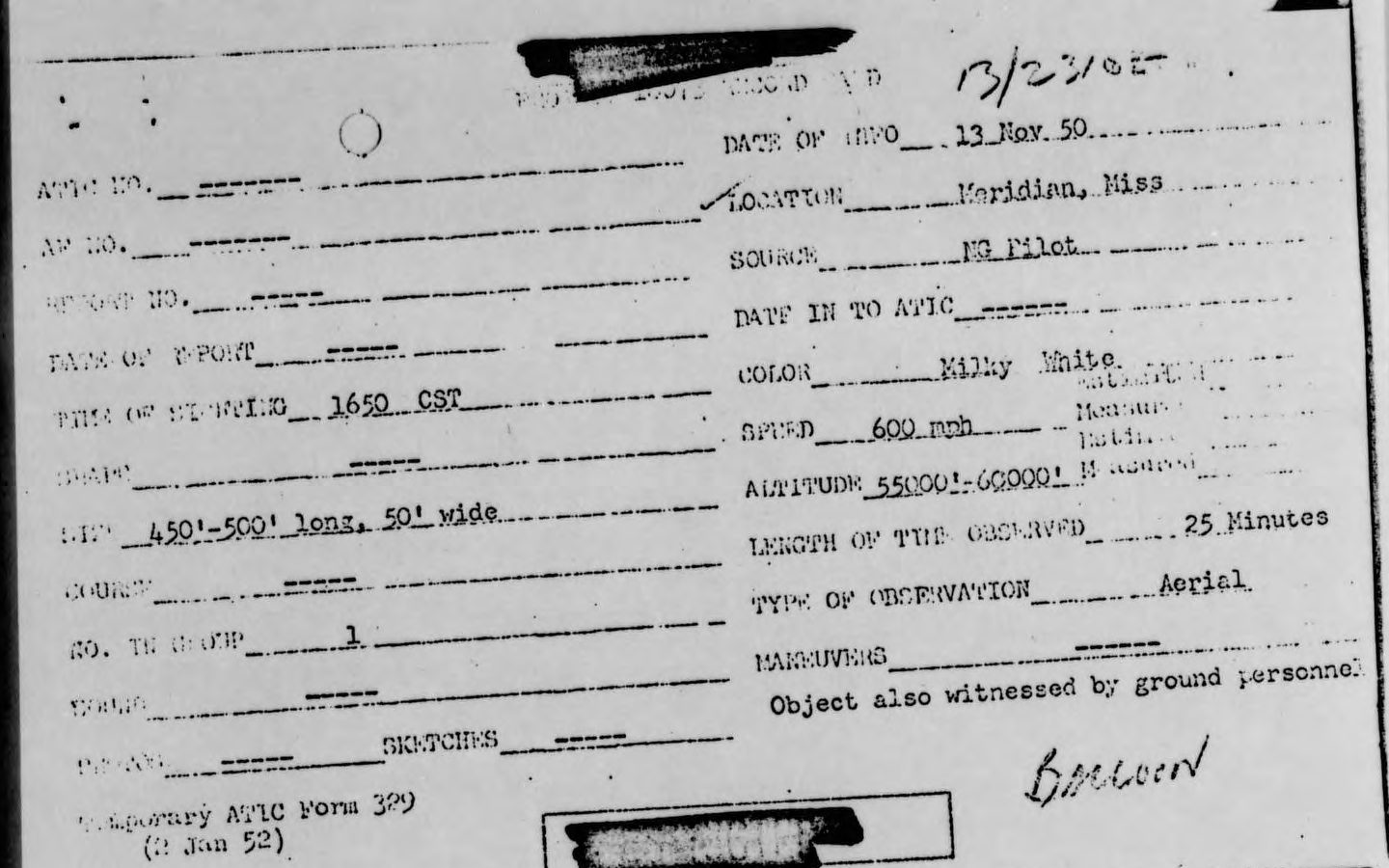
Pictured: the Project Blue Book record card for this case, cropped from the first page of the released file: "13 Nov. 50," "Meridian, Miss," source "NG Pilot," "1650 CST," "450'-500' long, 50' wide," "Milky White," "600 mph," "55000'-60000'," "25 Minutes," "Aerial," and the typed note "Object also witnessed by ground personnel." The conclusion is the single handwritten word "Balloon" at lower right. It is the Air Force's index card, not a picture of the object or of Maj. Stephens's aircraft. No photograph of the object was taken ("No photographs available"), and no photograph of the specific F-47 he flew that day is known. U.S. government record, public domain.
Theoretical Alignment
The Extraterrestrial Hypothesis scores very low. The case has the outward shape of a strong report: a military pilot pursued an object for twenty-five minutes, mechanics on the ground and an airborne C-47 crew confirmed that something was there, and an Army headquarters rated its own staff's observation "A-2," completely reliable and probably true. But nothing anyone reported is beyond an ordinary object high in a sunset sky. The pilot never closed on it, never saw it maneuver, and himself told reporters that it "could have been the vapor effect of a high-flying B-36." Its only extraordinary quality, a speed of "six hundred (600) MPH," was an estimate built on a guess at its distance, and the other witnesses saw it hang in the same part of the sky for most of an hour.
The Interdimensional Hypothesis has nothing to work with. The Psycho-Social score is modest but real: once the pilot's radio call went out to "all aircraft and radio stations within range," and the newspapers took it up, a whole region spent the sunset looking west, and what reached the press grew a "burning tail," a "cylinder of flame," and "a light pink fire in its path," details that none of the trained observers reported.
Background
The 153rd Fighter Squadron and Key Field
Key Field, the municipal airport about three and a half miles southwest of Meridian, is named for the brothers Al and Fred Key, who kept a small plane aloft over the city from June 4 to July 1, 1935, more than 27 days, to keep the airfield from being abandoned in the Depression. It became the home of Mississippi's Air National Guard. The flying unit there in 1950 was the 153rd Fighter Squadron, which had begun before the war as the 153rd Observation Squadron, was redesignated a fighter squadron and allotted to the National Guard on May 24, 1946, and was extended federal recognition at Key Field that September. Its aircraft were F-47D Thunderbolts, the heavy single-engine fighter that had been the P-47 in the Second World War and was renamed "F" for fighter when the new Air Force changed its designations in 1948. The squadron was called to active federal service on March 1, 1951, less than four months after this sighting, for the Korean War.
The record card calls the source simply "NG Pilot," and several secondary retellings of Mississippi sightings have assumed that the guard fighter was a P-51 or F-51 Mustang, the type Capt. Thomas Mantell was flying when he died chasing an object over Kentucky in 1948. The file is explicit that it was not. The OSI's synopsis says the pilot "sighted an unconventional aircraft while flying an F-47 aircraft," and its detailed account repeats that the flight was made "in an F-47 type aircraft." The aircraft type matters for the analysis below, since the pilot's own airspeeds and altitudes are the most precise numbers in the case.
The squadron had chased a light before. On the night of Wednesday, April 12, 1950, according to a Clarion-Ledger report of April 14 reproduced by the Project 1947 archive, members of the 153rd saw an object "of extreme speed," a white flickering light visible for about fifteen seconds near Key Field, and several of the squadron's F-47s were sent toward the southeast but found nothing. The squadron's officers would neither confirm nor deny that it was a "flying saucer." That report is not in the Blue Book files. It shows that seven months before this case, the Key Field pilots were already alert to the subject and willing to take off after a light in the sky.
Maj. B. D. Stephens
The pilot's name is blacked out throughout the OSI's detailed report, but it was never secret. The newspaper accounts that the OSI clipped and quoted name him as "Major B. D. Stephens, National Guard pilot," "of the 153rd Fighter Squadron of the Mississippi Air National Guard," and the OSI's own synopsis, on the first page of its report, leaves the surname uncensored: "The Vicksburg Evening Post carried an account of Major Stephens sighting an unidentified object over Mississippi." The same synopsis gives his civilian job: "Managing Editor of the Meridian Star, who is a major in the Mississippi National Guards." Stephens was therefore both an experienced military pilot and a newspaperman, which may explain why his account reached the wire services within a day. The file gives only his initials, and no fuller biography has been found for this case file.
The Air Force and "flying saucers" in late 1950
November 1950 fell in the low point of the Air Force's interest in the subject. Project Grudge, the successor to Project Sign, had published its negative final report at the end of 1949, and the investigating office at Wright-Patterson AFB was all but shut down. Edward J. Ruppelt, who took over the revived project in 1951, later wrote that "early in 1950 the project, for all practical purposes, was closed out; at least it rated only minimum effort," and that a "contemptuous attitude toward 'flying saucer nuts' prevailed from mid-1949 to mid-1950." Reports nevertheless kept coming in through other channels. The Fourteenth Air Force letter in this file opens: "In compliance with United States Air Force letter, dated 8 September, 1950, subject: 'Reporting of Information on Unconventional Aircraft,' the following information is submitted." Under that letter, sightings were collected by the intelligence offices of the commands and by the Office of Special Investigations, and sent to the Air Materiel Command's intelligence department (MCIS) at Wright-Patterson. That is exactly the path this file follows, and it explains why the case has no Blue Book investigation of its own: in November 1950 there was no Blue Book. The record card was typed on "Temporary ATIC Form 329 (2 Jan 52)," a form printed fourteen months after the sighting, when Ruppelt's project was cataloging the older files.
The same weeks were busy elsewhere. Loren Gross's chronology of late 1950 records a report of discs over Rome, Georgia, on the afternoon of November 14, radar and visual contacts near Key West on November 14 and 15, and a Thanksgiving Day report from Maxwell AFB, Alabama, on November 23; the Atomic Energy Commission's Oak Ridge radar and visual reports were still being argued over. Gross's volume does not mention the Mississippi sightings of November 13, and no catalog of Blue Book unknowns lists them. The case survived in the Blue Book microfilm, where Tim Printy's 2024 review of every 1950 Blue Book file found it and agreed with the Air Force's answer (see "Historical Precedents" below).
Complete Timeline
| Date / Time | Event |
|---|---|
| June 4 – July 1, 1935 | Al and Fred Key's endurance flight over Meridian; the airport is later named Key Field. |
| May 24, 1946 | The 153rd Fighter Squadron is allotted to the National Guard; federal recognition at Key Field follows that September. It flies F-47D Thunderbolts. |
| January 7, 1948 | Capt. Thomas Mantell dies chasing an object over Kentucky in an F-51D; later attributed to a Skyhook balloon. |
| April 12, 1950 | Key Field F-47s scramble after a fast white light near the field (Clarion-Ledger, April 14); not in Blue Book. |
| September 8, 1950 | USAF letter "Reporting of Information on Unconventional Aircraft," under which this case was reported. |
| November 13, 1950, about 4:15 PM CST (1715 E) | A C-47 crew at 4,000 feet, 25 miles south of Meridian, heading 250°, sees a long, slender, white object 20° right of the nose and 10° above the horizon. |
| About 4:20 PM | Maj. Stephens is airborne in an F-47 (he had been flying for 30 minutes at the time of his sighting). |
| 4:35 PM | Two control tower operators at Jackson Air Field see an object and a vapor trail through 6-power binoculars, at about 40° elevation, for 40 minutes. |
| About 4:45 PM | A woman living between Jackson and Clinton and her family see an object "traveling very fast directly west." |
| 4:50 PM (2250Z) | Stephens, at 8,000 feet 8 miles east of Meridian, sees the object west-southwest of the city "silhouetted against the sky by the sun" and begins to climb after it. Three mechanics see it from the Key Field ramp at about 15° elevation. Monroe Radio reports an object south of Monroe, Louisiana. The Sun is 0.7° above the horizon at Meridian, at azimuth 248° (computed). |
| About 4:55 PM | Sunset at Meridian (computed). |
| About 5:00–5:15 PM | Brookhaven residents watch an object like an "air sock" or "air sleeve" move across the town; one man reports it moving northwest with "a light pink fire in its path." |
| About 5:00–5:15 PM | At 21,000 feet over Forest, Stephens estimates the object at 55,000–60,000 feet and 40 to 70 miles west of him, and radios all aircraft and stations; Jackson Radio, McComb Radio, Maxwell AFB and Monroe Radio receive it. |
| 5:03 PM | Meridian weather spot check: clear, 15 miles, wind east-northeast 3. |
| 5:10 PM | The Key Field mechanics stop watching, "when they lost interest in it." |
| 5:10 PM (2310Z) | Two members of the Mississippi Military District headquarters see "a bright sliver of light, one half size of a flattened new moon," about 10° above the horizon "in direction of sun which was already below horizon." |
| About 5:15 PM | End of Stephens's 25-minute observation (inferred). Around this time the C-47 crew loses the object near Vicksburg "due to darkness" (inferred from "approximately one hour"). |
| 5:25 PM (2325Z) | The Military District observers' object "disappeared from view." |
| 5:30 PM | Hourly weather: clear at Meridian, Jackson, McComb and Monroe. |
| November 14, 1950 | The Jackson Daily News reports a "mysterious streak of light"; a wire story datelined "Meridian, Miss., Nov 14" quotes Stephens. |
| November 15, 1950 | The Atlanta Daily World prints the wire story on its front page. Third Army G-2 at Fort McPherson, Georgia, issues a "Summary of Information" relaying the Mississippi Military District's report and forwards it to the Fourteenth Air Force. |
| November 16, 1950 | An OSI special agent interviews Stephens. The Jackson Clarion-Ledger carries the Brookhaven reports. |
| November 24, 1950 | Hq Fourteenth Air Force, Robins AFB, Georgia, reports the C-47 sighting to the Air Materiel Command. |
| November 25, 1950 | The 9th OSI District sends its Spot Intelligence Report to the Director of Special Investigations: "ACTION: None contemplated by this Headquarters." |
| December 4–5, 1950 | OSI headquarters forwards two copies to the Directorate of Intelligence: "No further action is contemplated unless so requested." |
| March 1, 1951 | The 153rd Fighter Squadron is called to active federal service. |
| After January 2, 1952 | A record card is typed on Temporary ATIC Form 329 and marked by hand "Balloon." |
| December 17, 1969 | The end of Project Blue Book is announced. |
The File, Page by Page
The released file is item "1950-11-9618292-Meridian-Miss" in the Internet Archive's Project Blue Book collection. It has twelve pages. Every page was read for this case file as an image at its native scan resolution, with enlarged crops of anything faint; no machine transcription was relied on, and the record card's conclusion was read from the image. The folder is out of order: the seven-page OSI report has been split, its first four pages filed at the back and its last three near the front. In scan order:
- The record card (page 1), on "Temporary ATIC Form 329 (2 Jan 52)" (see "The Record Card" below).
- The OSI Spot Intelligence Report, pages 5 to 7 (scans 2–4): the last of the radio reports and four newspaper clippings, ending with "ACTION: None contemplated by this Headquarters" and the district commander's signature.
- A Third Army "Summary of Information" (scan 5), dated November 15, 1950, from G-2, Headquarters Third Army, Fort McPherson, Georgia, relaying a message from the Chief, Mississippi Military District. It bears a later stamp, "COPY JAN 9 1951."
- A two-page letter from Headquarters, Fourteenth Air Force, Robins AFB, Georgia (scans 6–7), stamped November 24, 1950, reporting the C-47 crew's sighting to the Commanding General, Air Materiel Command.
- A transmittal (scan 8) of December 4, 1950, from the Counter Intelligence Division of the Directorate of Special Investigations, Office of The Inspector General, forwarding "two copies of Spot Intelligence Report concerning captioned subject, dated 25 November 1950" to the Directorate of Intelligence.
- The OSI Spot Intelligence Report, pages 1 to 4 (scans 9–12): the synopsis, the pilot's interview, the mechanics' interview, the weather, and the Jackson tower operators.
Nothing else is in the folder. There is no statement written by Stephens himself, no sketch, no map, no flight log, no check of balloon launches or of military air traffic, no winds-aloft data, and no correspondence about how the "Balloon" conclusion was reached. The handwritten word on the card is the only evaluation in the file.
The Record Card
The card is the early-1950s temporary form with a typed box for each item and no printed list of conclusions. Its entries, as printed:
- Date of info: "13 Nov. 50." Location: "Meridian, Miss" (with a check mark). Source: "NG Pilot."
- Time of sighting: "1650 CST." Length of time observed: "25 Minutes." Type of observation: "Aerial." No. in group: "1."
- Size: "450'-500' long, 50' wide." Color: "Milky White." Speed: "600 mph." Altitude: "55000'-60000'."
- Shape, course, maneuvers, sketches: blank. Below the maneuvers line is typed: "Object also witnessed by ground personnel."
- Conclusion: handwritten, at lower right: "Balloon."
A handwritten date-time group at the top of the card is only partly legible; it appears to read "13/2310Z," the time given in the Third Army summary for the Military District observers' sighting, not the pilot's. Every other entry comes from the pilot's interview in the OSI report. The card ignores the C-47 crew, the Jackson tower, and the civilian reports, and records the pilot's estimates of size, speed and altitude as if they were measurements.
The Pilot's Account
An OSI special agent interviewed Stephens on November 16, three days after the flight. The report gives his account in numbered paragraphs, quoted here in full except for the redacted name:
"Time: 1650 hours CST, 13 November 1950. Object was under observation for approximately twenty-five (25) minutes." "Location: [Stephens] was flying at an altitude of 8,000 feet, about eight (8) miles east of Meridian, Miss., when he first saw the object as it was silhouetted against the sky by the sun, traveling due west at a location west southwest of Meridian. After sighting, [he] started to pursue the object, climbing to 21,000 feet at an indicated air speed of two hundred and ten (210) miles per hour (estimated three hundred (300) MPH ground speed). At 21,000 feet over Forest, Mississippi, [he] estimated the object's altitude to be 55-60,000 feet, with a conservative estimate of its speed being six hundred (600) MPH ground speed, without variation in course and with negligible change in altitude. During this observation the object was about forty (40) to seventy (70) miles west of [him]."
"Description: Color of milky white, resembling a daylight type neon bulb. About four hundred fifty (450) to five hundred (500) feet long, and fifty (50) feet in width, comparable to a horizontal bar held lengthwise, with one end slanting downward, traveling at an elevation of fifteen (15) degrees to the horizon. No exhaust, lights or vapor trail observed. Wingless without visible means of support or propulsion. Controls or airducts not evident. No reflection was cast because of sun. [He] flew north and south of the object and it did not change in perspective."
The agent added that "no celestial phenomena [were] reported as present," that the sky was clear, that Stephens "is physically fit for flying and is an active pilot," that he "had been in the air for thirty (30) minutes, denying any feeling of fatigue," and that "neighbors and Police Department gave [him] as being of excellent reputation and reliable." While over Forest at 21,000 feet, Stephens "radioed to all aircraft and radio stations within range to draw attention to the object. The broadcast was received by Jackson Radio, McComb Radio, Maxwell Air Force Base, and Monroe Radio."
What the numbers say
Three of the pilot's figures are firm and one is not. His own airspeed is reliable: an indicated 210 miles per hour at 21,000 feet corresponds to a true airspeed of about 290 miles per hour in a standard atmosphere (computed here from the standard density at that height), so his "estimated three hundred (300) MPH ground speed" is just what the instruments would give. His altitudes, 8,000 feet at first sight and 21,000 at the top of the climb, were read from his altimeter. His positions are simple geography: Forest is about 43 miles due west of Key Field (computed), so the chase covered roughly the distance the newspapers gave as "65 miles."
Everything he said about the object's size, height and speed, however, depends on one number he could not measure: its distance. An object seen against the sky has an angular size and an angular rate of motion, nothing more. To turn "about the length of a bar held at arm's length" into "450 to 500 feet long," or a slow drift into "600 MPH," an observer must assume how far away the thing is. Stephens assumed 40 to 70 miles, and from that and the angle at which he saw it, about 55,000 to 60,000 feet. If the object was twice as far away, it was twice as large and twice as fast; if it was half as far, half as large and half as fast. The two observations that do not depend on distance point the other way from "600 MPH": he flew north and south of it "and it did not change in perspective," and he could not gain on it in twenty-five minutes. A nearby fast object would have changed bearing as he maneuvered. A very distant one, slow or stationary, would not.
Taken at face value, his distance estimate also tells us where the object was. Forty to seventy miles west of Forest puts it between about 83 and 113 miles west of Key Field (computed), that is, roughly from Jackson to beyond Vicksburg. From Key Field, something at 55,000 to 60,000 feet that far away would stand only about 4 to 7 degrees above the horizon once the curvature of the Earth is allowed for (computed), rather than the 15 degrees the mechanics reported. Observers almost always overestimate elevation angles near the horizon, so the discrepancy is not surprising, but it is a real one, and it is a reminder that every number in the pilot's account except his own airspeed and altitude is an estimate.
What he told the press
Stephens spoke to reporters within a day, and his public account was more cautious than the OSI's paraphrase. The wire story, as printed on the front page of the Atlanta Daily World on November 15 under the headline "Air National Guard Chases Air Object," reads in part: "Maj. B. D. Stephens said the chase moved at 300 miles an hour, from 8,000 feet altitude to 21,000 feet, but he never got near the mysterious object. The 153rd Fighter Squadron pilot emphasized that he was not claiming the object was a 'flying saucer.'" He described it "as looking like a 'bright tilted plate,'" and said "possibly the object could have been the vapor effect of a B-36 or some other object at 31,000 feet altitude." The Vicksburg Evening Post version clipped by the OSI ends: "Stephens said the object resembled the edge of a bright tilted plate and could have been the vapor effect of a high-flying B-36." The pilot himself, in other words, offered a conventional explanation within a day, and gave reporters a much lower altitude than the 55,000 to 60,000 feet that ended up on the Air Force card.
The Ground Witnesses at Key Field
Three mechanics of the 153rd Fighter Squadron, a technical sergeant, a staff sergeant and a third man whose rank is also redacted, were interviewed together and "reported, simultaneously, the sighting of an unconventional flying object." Their account is brief: "Time: About 1650 hours CST, 13 November 1950. Object was under observation until 1710 hours, when they lost interest in it." They saw it "from ramp at Key Field," with the naked eye, in a "clear sky. No clouds." "All three men stated that the object was at an azimuth of approximately fifteen (15) degrees with the horizon" (the report means elevation, not azimuth). "Diminishing size was only indication that object was moving. Other information coincided with that of" the pilot. "No meteorological condition was indicated which might account for sighting. No physical evidence was obtained." All three had "recently received a USAF physical examination and found fit for duty status," and their major vouched for them.
The newspaper version, quoted in the OSI's clipping from the Vicksburg paper, adds something the OSI interview leaves out: "Two mechanics at Key Field, in Meridian watched the light with binoculars and said it could have been vapor trails from a B-36." That the men "lost interest in it" after twenty minutes, while it was still visible, is itself telling. Whatever it was, it did nothing to hold their attention.
The C-47 Crew
The most independent observation in the file came from an aircraft that was not chasing anything. The Fourteenth Air Force's report to the Air Materiel Command, signed for the commanding general by the Air Adjutant General at Robins AFB, describes it in full:
"Object sighted was long and slender having the appearance of a parachute with no shrouds. At times it appeared to have a tail. It flew in a wing-low attitude and gradually righted itself, finally disappearing due to darkness; color, white or silver-white with no shine. ... Object was sighted 13 November 1950 at 1715 E and remained visible until darkness. Length of time observed was approximately one hour. ... Sighted visually from a C-47 type aircraft which was flying at approximately 160 mph and at an altitude of 4,000 feet. ... Observers first sighted the object at approximately 25 mi. south of Meridian, Mississippi. The C-47 was on a heading of 250 degrees. Object appeared to be about 20 degrees to the right of the nose and 10 degrees above the horizon, and was finally lost at Vicksburg, Mississippi, due to darkness."
The witnesses were two captains and a master sergeant, all redacted. The weather "was CAVU and the wind 5 to 10 knots at 210 degrees; sky was a red haze with the sunset." "No photographs available. No interception attempted."
The time needs interpreting. "1715 E" is written in the zone-letter style of the day, and E here almost certainly means Eastern Standard Time, the time at the crew's home headquarters in Georgia. That is 2215Z, or 4:15 PM Central. Read that way, the crew watched for "approximately one hour" until about 5:15 PM Central, the same time the other observers lost the object as the sky darkened. Read as 5:15 PM Central, the hour-long sighting would have run until well after dark, which the report rules out. The crew's geometry is precise: heading 250° with the object 20° to the right puts it at a compass bearing of about 270°, due west, and 10° up. For the next hour the C-47 flew west at 160 miles per hour toward Vicksburg, about 130 miles away (computed), and the object stayed ahead of it the whole time. The heading to Vicksburg from the first position is about 282° rather than 250° (computed), so the aircraft probably turned during the hour; the report does not say. Either way, a slow transport flying toward the object for an hour never caught up with it or passed it. The object was either moving west as fast as the airplane or, far more likely, so distant that an hour's flight made no visible difference to its position.
"The appearance of a parachute with no shrouds" is the single most suggestive phrase in the file. It is the comparison Ruppelt drew for the object Mantell chased: the Godman Field tower operators described it as looking "like a parachute," he wrote, "which a balloon does."
Jackson: The Tower, the Weather Bureau and the Streak of Light
The Jackson observations do not describe the same thing as the pilot and the C-47 crew. Two control tower operators at Jackson Air Field, "sighted through six (6) power binocular," gave the OSI this account:
"Time: 1635 hours CST, 13 November 1950. Object was under observation for forty (40) minutes. ... From Control Tower, Jackson Air Field, south of Jackson at an estimated altitude of about forty (40) degrees to horizon. ... Object could have been an aircraft. First sighting revealed object and vapor trail. Object resembled wing of aircraft, with vapor trail obscuring fuselage, empennage and opposite wing. Vapor trail remained a constant length until it suddenly disappeared. Object a dull white, which did not cast reflections from the sun. No lights were visible."
The operators added that "their radio intercepted messages from Memphis ATC which revealed that no flights were scheduled which would be in that area at that time." (Whether "south of Jackson" describes the field or the object is ambiguous in the original.) The OSI's synopsis mislabels these men as "Control Tower employees of Key Field"; the detailed page makes clear they were at Jackson.
The Jackson Daily News of November 14, clipped by the OSI, describes what the city saw: "A 'mysterious streak of light' in the sky here late Monday startled local citizens and cause[d] newspapers, radio stations and the Weather Bureau to be swamped with calls. Officials at the control tower at the airport said it probably was a vapor trail from a jet plane, but Jacksonians who saw it thought otherwise, with many of them saying it had a 'burning tail.'" It "was reported seen in Florence and Vicksburg also." "It was described as changing in color from orange to lemon and then to white as it disappeared toward the horizon." "At the Weather Bureau, officials, said the light first was seen directly over the city and that it moved from east to west at a height of 'well above 30,000 feet.' They said they didn't know what it was." It "was described as having an oblong shape."
The same clipping reports a woman, 24, who lived between Jackson and Clinton, and who "said she and other members of her family saw the object about 4:45 p.m. They said it was flying at a very high altitude and traveling very fast directly west. She added that she could not see the front of the object but the rear end looked like a cylinder of flame about five or six feet long." She called "the observation tower at the Jackson Air Base who confirmed her report of seeing the strange object, but officials there would not attempt to identify it."
This is a description of a moving object with a trail: an "object and vapor trail" in binoculars, a "streak of light" with a "burning tail," moving "east to west," "traveling very fast directly west," changing color from orange to lemon to white. It is also a textbook description of a high-flying aircraft's contrail lit by the setting sun. Ruppelt, writing from Blue Book's experience, put it bluntly: "To a person in an area where there isn't much high altitude air traffic, a thin, blood red streak in the sky at sunset, or shortly after, is a UFO." The tower operators, the professionals who saw it best, thought so too. The Memphis air traffic control check covered scheduled civil flights, not military aircraft on training missions, which did not file with civil centers in the same way; the absence of a scheduled flight is not the absence of an aircraft.
Brookhaven, McComb and Monroe
The OSI recorded two radio reports without detail: "McComb Radio reported object north of McComb on a westerly course," and "Monroe Radio reported object south of Monroe at 1650 hours." These were evidently the aeronautical radio stations that heard Stephens's broadcast from over Forest; the file gives no more detail.
From the Jackson Clarion-Ledger of November 16, the OSI clipped a story from the Brookhaven Leader-Times, "Folks in Brookhaven See Flying Object": several persons had reported "seeing another 'flying saucer' moving across Brookhaven about 5 p.m. Monday afternoon. Some described it as resembling an 'air sock' or 'air sleeve' towed by pilots in target practice. Other persons speculated that it was merely a vapor trail made visible by the setting sun in the late afternoon skies or left by a trail of smoke from a passing plane." A local business owner (his name is redacted in the file) and a companion "drove out to U. S. Highway 51 and watched the object for about 15 minutes," and the owner "thought it was a blimp or an airplane." J. A. Smith "reported seeing what he described as a 'flying saucer' at about 5:15 p.m. Monday on North Jackson Street. He said several persons observed the strange object moving across the sky in a north westerly direction. He said it left a light pink fire in its path."
Brookhaven is about 50 miles south-southwest of Jackson and 112 miles west-southwest of Key Field (computed). The "air sleeve" comparison recalls this site's Jackson Airborne Sighting of January 1, 1949, when passengers in a light plane east of Jackson saw a wingless object "shaped like a sleeve target" with nothing towing it.
The Army's Report: "A Bright Sliver of Light"
The Third Army summary, prepared by G-2 at Fort McPherson, Georgia, on November 15, quotes a message "received by airmail today from the Chief, Mississippi Military District," the Army headquarters responsible for the state's reserve components. Its first paragraph is the clearest description in the file of how the object looked to experienced observers on the ground after the Sun had set:
"Object in sky characterized as bright sliver of light, one half size of a flattened new moon sighted at 132310Z November by Major [name redacted] and Master [remainder redacted], this headquarters. Object was approximately ten degrees above horizon in direction of sun which was already below horizon. There was slight movement from left to right but the steadily reducing size made the object appear to be traveling to the west away from the observers. Disappeared from view approximately 2325Z (Rating A-2)"
The second paragraph summarizes the pilot's chase: the major "pursured [sic] unidentified object by plane Monday evening. He went to 21,000 feet and did not get near object. Object resembled edge of a bright tilted plate or bar and had the appearance of new moon flattened out. Object also seen by Lieutenant [name redacted] (Rating C-2)." The ratings are the Army's standard two-part code printed on the form: the source of the first paragraph was "A," completely reliable, and its information "2," probably true; the pilot's report, at second hand, was rated "C-2," a fairly reliable source. The message was "forwarded to Hq, 14th Air Force, for information and any investigation deemed necessary." The summary does not say where the two officers were standing.
This report pins down two things. The time, 2310Z, is 5:10 PM Central, a quarter of an hour after sunset. And the object was "in direction of sun which was already below horizon," ten degrees up. Whatever these two men saw was high enough to still be catching sunlight after the Sun had set for them, and it lay toward the sunset, so that it was lit from behind and from one side. The comparison they reached for, a "flattened new moon," is exactly how a sunlit round object looks from that angle: a thin bright crescent, its sunlit edge facing away from the observer. The actual Moon that evening was a crescent too, 22 percent lit and about 27 degrees up in the south-southwest (computed), which may be why three separate accounts used it as the comparison.
Reconstructing the Sky
The Sun
The Sun's position decides most of this case. For Meridian (32.36° N, 88.70° W), NASA JPL's Horizons ephemeris gives the Sun at 2250Z, the moment of the pilot's first sighting, at an azimuth of 248°, west-southwest, and 0.7° above the horizon; it set about 2255Z, 4:55 PM Central. At 2310Z, when the Military District observers began watching, it was 3° below the horizon at Meridian, and at 2325Z, when they lost the object, 6° below. Farther west the Sun set a few minutes later: at Jackson it was 2.5° below at 2310Z and 5.5° below at 2325Z, and near the Mississippi River at 91.5° W, 4.4° below at 2325Z.
The pilot's own words fit this precisely. He first saw the object "silhouetted against the sky by the sun ... at a location west southwest of Meridian," which is where the Sun was, a fraction of a degree above the horizon. From 8,000 feet he would have seen the Sun about two degrees higher than an observer on the ground. "No reflection was cast because of sun" makes sense for an object that lay almost in line with the Sun from where he sat. A thin, bright, horizontal "bar ... with one end slanting downward" is how a sunlit object looks when it is seen nearly edge-on to the light.
When the light went out
After sunset, an object high in the sky stays lit until the Earth's shadow climbs past it. For an observer-independent check, the minimum height at which an object is still in direct sunlight depends on how far below the horizon the Sun is at the object's own location. Ignoring refraction (which lets sunlight reach a little lower), that height is about 28,700 feet when the Sun is 3° down, about 62,000 feet when it is 4.4° down, and about 115,000 feet when it is 6° down (computed from the Earth's radius). Put the other way round, something at 55,000 to 60,000 feet stays sunlit until the Sun is about 4.2° to 4.3° below the horizon beneath it, and something at 31,000 to 35,000 feet until about 3.1° to 3.3°.
That gives a test. The Military District observers lost their object at 2325Z. At that time, an object at 55,000 to 60,000 feet over the Mississippi River region west of Jackson, where the pilot's own distance estimate placed it, was just reaching the shadow line; an object at that height over Meridian or Jackson had already gone dark several minutes earlier. The C-47 crew likewise lost theirs "due to darkness" near Vicksburg at about the same time. An aircraft contrail at 31,000 to 35,000 feet over the same area would have gone dark a few minutes earlier still, around 2315 to 2320Z. The timing therefore fits a very high object to the west, but it cannot by itself choose between 35,000 and 60,000 feet: the margins are a few minutes, and none of the reported times is that precise. What it does rule out is anything low. A small object at a few thousand feet would have vanished at sunset, not half an hour later.
The Moon and the planets
The Moon was a waxing crescent, about 22 percent lit, low in the south and south-southwest between about 186° and 200° azimuth and 27° to 29° up during the hour (computed). It was in the sky for every observer and is not itself a candidate: no one described two crescents. Venus was in the evening sky but within a degree of the Sun and set with it. Jupiter, at magnitude −2.4, stood about 40° up in the south-southeast, and Mars about 25° up in the southwest, neither visible in daylight and neither in the west. The Jackson tower's "about forty (40) degrees" is close to Jupiter's altitude, but the tower watched from 4:35 PM, in full daylight, saw a vapor trail, and needed binoculars; Jupiter is not a plausible fit. "No celestial phenomena reported as present," the OSI wrote, and the ephemeris agrees that nothing astronomical was where the object was.
The Weather and the Winds
The two Key Field weather forecasters gave the OSI the hourly reports for 1730 CST: "Meridian: Clear; eight (8) miles; 247/53/39 calm; altimeter setting 025. Jackson: Clear; fifteen (15) miles; 247/56/26; north two (2); altimeter setting 025. McComb: Clear; fifteen (15) miles; 244/53/39; east south-east five (5); altimeter setting 024. Monroe: Clear; twelve (12) miles; 247/53/33; east six (6); altimeter setting 025." The groups after the visibility are, in the standard order of the day, sea-level pressure in tenths of a millibar (1024.7 mb), temperature and dew point in degrees Fahrenheit, then the wind. A "Meridian spot check at 1703 hours" was "clear; fifteen (15) miles; east north-east three (3)." It was a cool, dry, cloudless evening under high pressure, with almost no wind at the surface, across the whole region.
The file has no winds aloft. Jackson's radiosonde station has no surviving soundings for 1950 in NOAA's Integrated Global Radiosonde Archive, but three neighboring stations do. At Montgomery, Alabama, the evening sounding of November 14 (2100Z) measured winds from 270°, due west, at about 24 meters per second (roughly 54 miles per hour) at the 100-millibar level, about 53,600 feet, and from the west at 23 to 24 meters per second at 150 to 250 millibars. The November 14 0300Z soundings, the closest after the sighting, show westerly winds of 43 meters per second (about 96 miles per hour) at 200 millibars, about 39,600 feet, at Little Rock, Arkansas, and 47 meters per second from 248° at Boothville, Louisiana. The upper air over the Deep South that evening was moving strongly from west to east, fastest near 35,000 to 40,000 feet, and still westerly at the highest level measured.
This matters for both main explanations. A free balloon drifts with the wind. At 55,000 feet that evening it would have been carried eastward at perhaps 40 to 60 miles per hour, toward Meridian, not away from it. The impression that the object was "traveling to the west," which several observers shared, came by their own account from its "steadily reducing size" or "diminishing size," not from any change in position. An object that is fading as the Earth's shadow rises toward it also appears to shrink, and that, rather than real motion, may be what they saw. An aircraft flying west at 35,000 to 40,000 feet, on the other hand, would have been fighting a headwind of some 80 to 100 miles per hour but could easily have made steady progress westward and laid a long contrail in cold, dry air.
Where Was It?
The reports cover an area more than two hundred miles wide, and they are too coarse to triangulate. They can still be checked for consistency. From Key Field and from the pilot's first position, the object was west-southwest, low. From the C-47 south of Meridian it was due west, 10° up, and it stayed ahead of the airplane all the way to Vicksburg. From Forest, by the pilot's estimate, it was 40 to 70 miles west, which puts it over or beyond Jackson. From the Jackson tower it was high, about 40° up, and the Weather Bureau said it was "first seen directly over the city." From Monroe, Louisiana, 114 miles west of Jackson, it was to the south; from McComb, to the north; and at Brookhaven people saw it "moving across" the town.
Only a very high object, or a long contrail, can be seen at once from places so far apart. An object at 55,000 feet is above the horizon for an observer on the ground up to roughly 290 miles away (computed), and a sunlit balloon or a contrail at sunset is bright enough to be noticed at much of that distance; Ruppelt wrote that "it is not unusual to be able to see a large balloon for 50 to 60 miles," and that "a skyhook balloon can be seen at 60,000." But the reports do not agree on one position, and the Jackson and Brookhaven accounts describe motion, a trail and a "burning tail" that the pilot, the mechanics and the C-47 crew did not see. The most economical reading is that there were two things in the western sky at sunset: something high and nearly stationary, without a trail, seen from the east by the pilot, the Key Field mechanics, the C-47 crew and probably the Military District observers; and at least one high aircraft laying a sunlit contrail westward over Jackson, seen by the tower, the Weather Bureau and the public. Stephens's radio call and the next morning's newspapers merged them into a single "mystery object."
The Investigation
The file shows three separate chains of reporting, none of which investigated the cause.
The Army's ran from the Mississippi Military District to Third Army G-2 at Fort McPherson, which passed it to the Fourteenth Air Force "for information and any investigation deemed necessary." The Fourteenth Air Force, at Robins AFB, Georgia, sent the C-47 crew's report to the Air Materiel Command on November 24 under the September 1950 reporting letter, with copies to Third Army and the Continental Air Command; it attempted no investigation and noted "No interception attempted."
The OSI's ran from a special agent of the 9th OSI District, whose headquarters line on the report reads "Barksdale AF Base, La.," to the Director of Special Investigations in Washington. The agent interviewed the pilot, the three mechanics, the two Key Field forecasters and the two Jackson tower operators; checked the pilot's reputation with his neighbors and the police; noted the stations that had heard his broadcast; and clipped four newspaper stories. The report, dated November 25, 1950, and signed by the district commander, Lt. Col. John C. McLendon (the typed surname is faint here, but the signature reads "John C. McLendon," and the same name and title appear on the district's January 1950 report on the Biloxi VA Hospital Sighting), ends: "ACTION: None contemplated by this Headquarters." On December 4, Gilbert R. Levy, Acting Chief of the Counter Intelligence Division, Directorate of Special Investigations, Office of The Inspector General, forwarded two copies to the Air Force's Directorate of Intelligence with the note: "No further action is contemplated unless so requested by your Directorate." Nothing in the file shows that anyone requested it.
The OSI's interest was the one its title implies: whether "unconventional aircraft" over Mississippi represented a security threat. Its agent did not ask the question an analyst would ask first, which was whether a balloon or an aircraft had been in the area. No one checked balloon launches, plotted winds, or asked the bomber bases about B-36 or jet traffic. The "Balloon" on the card was written later, at ATIC, by someone who left no reasoning behind.
The Balloon Question
What a Skyhook looked like
In 1950 the only balloons capable of reaching 55,000 to 60,000 feet and staying there were the large polyethylene research balloons of the Navy's Skyhook program, built by General Mills, and the Air Force's similar programs launched from Holloman AFB, New Mexico. Ruppelt described one as "a huge, 100-foot-diameter skyhook balloon" and explained the Mantell case in terms that apply almost word for word here: the Godman Field observers saw something that "looked 'like a parachute,' which a balloon does"; "during the two hours that it was in sight, the observers reported that it seemed to hover"; "a skyhook balloon can be seen at 60,000"; and Mantell "didn't know that he was chasing a balloon because he had never heard of" one. Elsewhere he noted that "a balloon will glow like a 'ball of fire' just at sunset."
Skyhook balloons often floated far higher than the 55,000 to 60,000 feet the pilot estimated; flights to 90,000 feet and above were routine. That would not weaken the identification. A balloon at 90,000 feet would look smaller and slower, would stay sunlit even longer after sunset, and would be visible from even farther away; the pilot's altitude figure, like his speed, was an estimate built on a guessed distance.
Measured against that, the pilot's, the mechanics', the C-47 crew's and the Army observers' descriptions are close to a portrait of a large plastic balloon at very high altitude at sunset: milky white, "resembling a daylight type neon bulb," "white or silver-white with no shine"; "long and slender having the appearance of a parachute with no shrouds," "at times it appeared to have a tail" (a balloon's load line and payload hang below it); "wingless without visible means of support or propulsion," with "no exhaust, lights or vapor trail"; apparently motionless, so that an F-47 climbing toward it for twenty-five minutes "never got near it" and a C-47 flying toward it for an hour never overtook it; visible from a hundred miles and more; still bright after sunset, then gone "due to darkness"; and, seen toward the sunset, a thin crescent like "a flattened new moon."
What is missing
What is missing is the balloon. StratoCat, the most complete public database of research balloon launches, lists only fourteen stratospheric balloons worldwide for all of 1950, almost all from Holloman AFB. Between a flight on September 28 and one on November 29 it lists nothing at all. The November 29 Holloman flight landed 18 miles from its launch site. No launch in the database fits November 13 or the days before it.
That gap is less decisive than it looks. StratoCat's 1950 list is plainly incomplete: The Office of Naval Research alone supported more than 1,500 Skyhook flights in the decade after the first launch on September 25, 1947, an average of well over a hundred a year, and most of those flights are not individually logged in any public source. Ruppelt himself could never find the launch record for the balloon he believed Mantell had chased: "Somewhere in the archives of the Air Force or the Navy there are records that will show whether or not a balloon was launched ... I never could find these records." The absence of a matching launch in a partial list does not show that there was no balloon. But it does mean that the "Balloon" verdict, like Mantell's, rests on resemblance, not on a documented flight.
The winds are the other problem. A balloon that drifted into the western Mississippi sky at 55,000 feet on a westerly wind would have to have come from the west, from Louisiana, Texas or beyond, and would then have been moving toward Meridian, not away from it. That is not impossible: many of the observers' impressions of westward motion came only from the object's shrinking, and a balloon approaching from the far west while the shadow line rose toward it would also appear to fade and shrink. Nor is the stratospheric wind above 53,600 feet known for that evening; the soundings stop there. But it is a real tension in the balloon explanation, and the file gives no way to resolve it.
The Mantell parallel
Two years and ten months earlier, on January 7, 1948, Capt. Thomas F. Mantell Jr. of the Kentucky Air National Guard climbed his F-51D Mustang after a large object over Godman Field, Kentucky, is believed to have blacked out from lack of oxygen above 25,000 feet, and died in the crash; this site's Thomas Mantell file tells the story. The parallels with Meridian are close: an Air National Guard fighter pilot in a propeller fighter, climbing after a bright object high in the afternoon sky that seemed to hang motionless and that he could not reach; ground observers describing it as "like a parachute"; and an Air Force verdict, reached later and without a launch record, that it was a Skyhook balloon. The difference is that Stephens stopped at 21,000 feet and came home to describe what he saw, and that he himself suggested a conventional explanation. Mantell's death made his case famous; Stephens's caution kept this one out of the books.
The Aircraft Question
Stephens and the Key Field mechanics both suggested a B-36. In 1950 the Convair B-36 was the Air Force's largest bomber, and the pilot and mechanics evidently thought one could have been up there. A B-36, a B-29, a B-50 or one of the new jet aircraft of 1950 flying west over Jackson at 30,000 to 40,000 feet late in the afternoon would explain the Jackson observations well: a "streak of light" with a "burning tail," an object that "resembled wing of aircraft, with vapor trail obscuring fuselage, empennage and opposite wing," a trail that "remained a constant length until it suddenly disappeared" (as a contrail does when the aircraft passes out of the air cold and moist enough to sustain it), colors running from orange to lemon to white as the sunset light changed, and motion "from east to west" at "well above 30,000 feet." The Weather Bureau's estimated height is close to the "31,000 feet" that Stephens gave reporters.
It explains the pilot's own object less well. Stephens specifically reported "no exhaust, lights or vapor trail," "without variation in course," and no change in perspective as he flew north and south of it. A distant aircraft seen nearly head-on or tail-on without a trail can look like a short bright bar, and at sunset a bomber's fuselage and wings can catch the light; but an aircraft does not hang in the same part of the sky for an hour in front of a C-47 heading the same way, and the C-47 crew described a "parachute," not an airplane. No flight records were checked, then or since, so the aircraft explanation for the Jackson reports is as undocumented as the balloon explanation for the pilot's.
Key Witnesses
B. D. Stephens
An active pilot who had been airborne for thirty minutes when, at 1650 CST, he saw a milky white object west-southwest of Meridian "silhouetted against the sky by the sun." He climbed from 8,000 to 21,000 feet at an indicated 210 miles per hour, followed it about 65 miles to Forest, flew north and south of it without any change in its perspective, and broadcast a call to all aircraft and radio stations. His estimates of its size (450–500 by 50 feet), height (55,000–60,000 feet) and speed (600 miles per hour) became the record card. His name is redacted in the OSI's details but printed in its synopsis and in the press, where he said he "was not claiming the object was a 'flying saucer'" and that it "could have been the vapor effect of a high-flying B-36."
Three 153rd Fighter Squadron mechanics (names redacted)
Watched the object from the Key Field ramp from about 1650 until 1710, "when they lost interest in it," at an elevation of about 15°; "diminishing size was only indication that object was moving." The press reported that two of them watched it with binoculars and thought it "could have been vapor trails from a B-36." All had recent USAF physicals, and their major vouched for them.
The C-47 crew (names redacted)
Flying at 4,000 feet and 160 miles per hour, they first saw the object from 25 miles south of Meridian, 20° right of their 250° heading and 10° up, and watched it for about an hour until they lost it near Vicksburg "due to darkness." Their description, "long and slender having the appearance of a parachute with no shrouds," "white or silver-white with no shine," is the closest in the file to a balloon. Their report was rated "C-2."
Two members of the Mississippi Military District headquarters (names redacted)
Saw "a bright sliver of light, one half size of a flattened new moon," 10° up "in direction of sun which was already below horizon," from 2310Z until it "disappeared from view approximately 2325Z." Their headquarters rated the report "A-2." Their location is not stated in the file.
Two Jackson Air Field tower operators (names redacted)
Watched "object and vapor trail" for forty minutes from 1635 CST at about 40° elevation. The object "resembled wing of aircraft"; the trail "remained a constant length until it suddenly disappeared." They said it "could have been an aircraft," and told the newspaper it was probably a jet's vapor trail.
Two Key Field weather forecasters (names redacted)
Supplied the 1730 CST weather for Meridian, Jackson, McComb and Monroe, all clear with visibility 8 to 15 miles, and the 1703 Meridian spot check.
Gilbert R. Levy
Not a witness. Signed the December 4, 1950 transmittal sending the OSI report to the Directorate of Intelligence with the note "No further action is contemplated unless so requested by your Directorate." The action officer is given as "Maj Detwiler."
The Five Observables Assessment
The Five Observables framework, associated with former AATIP director Luis Elizondo, classifies UAP reports by performance characteristics beyond known technology. The Meridian reports touch one of them, and only if the pilot's estimates of distance are taken as measurements.
Assessment:
- Anti-gravity lift (absent). The object was "wingless without visible means of support or propulsion," and it appeared to hang in one part of the sky. But a balloon has no visible means of support either, and an object that hovers at 55,000 feet is exactly what a balloon at float altitude does. Nothing in the file requires a lifting mechanism beyond buoyancy.
- Instant acceleration (absent). No one reported any sudden change of speed or direction. The pilot noted "no variation in course and with negligible change in altitude."
- Hypersonic speed (speculative). The card's "600 mph" is subsonic in any case, and it was "a conservative estimate" derived from an assumed distance. The C-47 crew's hour-long observation, with the object staying ahead of a 160-mile-per-hour aircraft, and the pilot's report that it "did not change in perspective," point to a slow or stationary object far away.
- Low observability (absent). The object was conspicuous to many people across a wide area. No radar observation was reported or attempted.
- Trans-medium travel (not applicable).
Evidence Assessment
Supporting Anomalous Origin
- A military pilot pursued the object for about 25 minutes, climbing to 21,000 feet, and could not get near it.
- Independent observers at several locations saw something: mechanics at Key Field, a C-47 crew in the air, two Army observers, and the Jackson tower, all within the same hour.
- The pilot reported "no exhaust, lights or vapor trail" and "wingless without visible means of support or propulsion."
- An Army headquarters rated its own staff's observation "A-2," completely reliable and probably true.
- No balloon launch matching the date has been found in any public record, and no flight records were checked.
- The "Balloon" conclusion was written without any recorded reasoning, more than a year after the event.
Supporting Conventional Explanation
- The pilot himself told reporters he "was not claiming the object was a 'flying saucer'" and that it "could have been the vapor effect of a high-flying B-36"; the mechanics said the same.
- The object was first seen "silhouetted against the sky by the sun" in the west-southwest, where the Sun was setting; the Army observers saw it "in direction of sun which was already below horizon."
- "Long and slender having the appearance of a parachute with no shrouds," milky white, apparently motionless, visible for an hour, lost "due to darkness": a close match to the appearance of a large research balloon high in a sunset sky.
- Its "speed" and "size" depended entirely on an assumed distance; its constant bearing from a moving C-47 and an F-47 maneuvering north and south argues for a distant, slow object.
- It stayed visible for about half an hour after sunset, which requires a very high altitude, consistent with a stratospheric balloon or a high contrail.
- The Jackson tower operators, using binoculars, saw an "object and vapor trail" that "could have been an aircraft," and the public descriptions of a colored "streak of light" moving west are those of a sunlit contrail.
Why "Disputed"
The Meridian Thunderbolt Chase is stamped DISPUTED with a score of 24/100, the lowest of this site's Mississippi Blue Book cases. That reflects how strongly the evidence leans toward an ordinary explanation. The report is genuine and its witnesses were competent: a guard fighter pilot, his mechanics, an Air Force transport crew, two Army observers and two control tower operators all saw something in the western sky on a clear evening. But nothing any of them described is out of the ordinary for a very high object at sunset. The pilot's figures for speed and size were derived from a guess at distance; the two measurements that do not depend on distance, the constant perspective and the hour-long constant bearing, describe something slow and far away. The descriptions from the east, "a parachute with no shrouds," milky white, no trail, motionless, a "flattened new moon" toward the setting Sun, read like a portrait of a large research balloon. The descriptions from Jackson, a westbound "streak of light" with a "burning tail" and a vapor trail seen through binoculars, read like a sunlit contrail. The pilot himself suggested a B-36 within a day.
It is not stamped Debunked because the explanation has never been documented. No launch record places a balloon over Mississippi that evening, the public balloon catalogs are silent for that week, the upper winds were blowing the wrong way for a balloon to have drifted west, and no flight records were checked for the aircraft that the Jackson witnesses probably saw. Blue Book's "Balloon" is weighed here as one input, not as the answer. It was written by an office that did no investigation of its own, more than a year after the event, and left no reasoning; government investigators of this period had every incentive to close old files with the least alarming label available, and an outside reader has no way to audit how this one was chosen. In this case, though, the label is supported by the witnesses' own words more than by the Air Force's authority. Tim Printy, reviewing every 1950 Blue Book file, agreed with "Balloon" without comment. On the evidence as it stands, this is very probably a balloon, a contrail, or both, seen at sunset. The case would be closed if anyone ever found the launch log.
Among this site's Mississippi Blue Book cases, it ranks below the Columbus Radar-Visual Sighting (30), the Biloxi Highway 90 Sighting (32), the Keesler AFB Sighting and the Greenville AFB Tower Sighting (36 each), the Keesler AFB Weather Tower Sighting and the Biloxi VA Hospital Sighting (38 each), the Ocean Springs Family Sighting (40), the Meridian "Flying Cymbal" (44) and the Jackson Airborne Sighting (46). It has more witnesses than most of them, but it is the only one where the principal witness offered a conventional explanation himself, and the only one whose description matches a specific, well-known class of misidentification as closely. It also sits below the Mantell case (38), which shares the same unproven balloon explanation but whose object was never so closely tied to the setting Sun, and whose pilot's death left far more unanswered.
Sensor & Instrumentation Detection Profile
- Visual, airborne (F-47). One pilot, naked eye, about 25 minutes, from 8,000 to 21,000 feet; his own altimeter and airspeed indicator (210 mph indicated) are the only instrument readings in the case.
- Visual, airborne (C-47). Three crew members, naked eye, about one hour, at 4,000 feet and 160 mph, with a recorded heading (250°) and relative bearing (20° right, 10° up).
- Visual, ground with binoculars. Two Jackson tower operators with 6-power binoculars; two Key Field mechanics with binoculars (press report).
- Visual, ground, naked eye. Mechanics at Key Field; two Army observers; civilians in Jackson, Clinton, Brookhaven, Florence and Vicksburg.
- Radio. The pilot's broadcast was received by Jackson Radio, McComb Radio, Maxwell AFB and Monroe Radio; McComb and Monroe reported the object's direction. The Jackson tower monitored Memphis air traffic control messages.
- Radar. None recorded. No radar observation was made or requested.
- Weather instruments. Hourly surface observations at Meridian, Jackson, McComb and Monroe (1730 CST) and a Meridian spot check (1703); no winds aloft in the file.
- Cameras. None. "No photographs available."
Environmental & Geospatial Context
Meridian is the seat of Lauderdale County in east-central Mississippi, less than 20 miles from the Alabama line. Key Field, at 32.33° N, 88.75° W, lies about three and a half miles southwest of the city. The chase ran due west along the line of U.S. Highway 80 toward Forest, the seat of Scott County, about 43 miles west of Key Field; Jackson is about 84 miles west and Vicksburg about 125 miles west (computed). Brookhaven and McComb lie on U.S. Highway 51 south of Jackson, and Monroe, Louisiana, is about 114 miles west of Jackson. The country between is farmland and pine forest, with no major military installations other than the airfields at Meridian and Jackson. The later Navy jet base at NAS Meridian, north of the city, did not exist in 1950; it was commissioned in 1961.
Weather
Clear skies over the whole region, with visibility from 8 miles at Meridian to 15 miles at Jackson and McComb, light or calm surface winds, high pressure (1024.7 mb), temperatures in the low to mid 50s Fahrenheit and dew points between the mid 20s and the upper 30s. The C-47 crew reported "CAVU" (ceiling and visibility unlimited), the wind at their altitude "5 to 10 knots at 210 degrees," and "sky was a red haze with the sunset." Upper winds were strong westerlies, about 96 miles per hour near 39,600 feet at Little Rock and about 54 miles per hour near 53,600 feet at Montgomery.
Sun and Moon
Sunset at Meridian about 4:55 PM CST (2255Z) at azimuth 249°; the Sun 0.7° up at the pilot's first sighting and 6° down when the Army observers lost the object. The Moon, 22 percent lit, waxing, low in the south-southwest. Venus set with the Sun; Jupiter and Mars were in the south and southwest, not in the west.
Observer Credibility & Occupational Profile
The witnesses are about as good as a 1950 report could have. Stephens was a serving fighter pilot, an officer, and a newspaper managing editor; the OSI found him fit, rested and "of excellent reputation and reliable." His account is careful and his own figures for speed and altitude check out against his instruments. His mechanics were trained men with binoculars. The C-47 crew were Air Force aircrew who recorded their heading and the object's relative bearing. The Mississippi Military District's observers were rated "A-2" by their own headquarters, and the Jackson tower operators were professional observers of aircraft who used binoculars and checked the air traffic.
Their credibility is not in question, and it is not what decides the case. What these observers could reliably report was what they saw, its direction, its color, its apparent shape, how long it stayed; what none of them could report reliably was its distance, and therefore its size, height and speed. On the first set of questions they agree, and their answers point to a distant object near the setting Sun. On the second set, the record card adopted the pilot's estimates as if they were measurements. The most experienced observers of aircraft in the file, the Jackson tower operators, thought what they saw "could have been an aircraft," and the pilot and mechanics themselves suggested a B-36. The witnesses, in short, were credible, and they were also among the first to suggest the object was probably ordinary.
Physical & Material Assays
No physical evidence exists. The mechanics' interview records "No physical evidence was obtained," and nothing was searched for or recovered. No balloon or payload was reported found on the ground anywhere in the region in the days after the sighting, which is not surprising: a Skyhook balloon drifting east on a westerly wind could have come down hundreds of miles away.
Historical Precedents & Archive Matches
- January 7, 1948, the Mantell crash, Kentucky. The direct parallel: an Air National Guard pilot in a propeller fighter climbing after a bright, apparently motionless object "like a parachute" in the afternoon sky, later attributed to a Skyhook balloon without a launch record.
- October 1, 1948, the Gorman Dogfight, Fargo, North Dakota. A National Guard F-51 pilot's night "dogfight" with a light, which Ruppelt attributed to a lighted balloon.
- January 1, 1949, the Jackson Airborne Sighting. Passengers in a light aircraft east of Jackson see a wingless object "shaped like a sleeve target," the same comparison the Brookhaven witnesses made in 1950.
- April 12, 1950, Key Field. Pilots of the 153rd Fighter Squadron see a fast white light near the field, and F-47s scramble without finding it (Clarion-Ledger, April 14, 1950, via Project 1947); not in Blue Book.
- November 1950, elsewhere in the Southeast. Discs reported at Rome, Georgia, on November 14; radar and visual contacts near Key West on November 14 and 15; a Thanksgiving report from Maxwell AFB, Alabama, on November 23 (Gross, UFOs: A History, vol. 7, and supplement). The Maxwell report is in Sparks's catalog of Blue Book unknowns; the Mississippi reports of November 13 are not.
- July 17, 1957, the RB-47 Bomber Chase. A later, much stronger case in the same airspace: the wing intelligence officer's debriefing, as quoted in SUNlite 4-1, places one of the crew's unusual radar signals “at approximately Meridian, Mississippi,” before the encounter continued across Louisiana and Texas.
- July 10, 1967, the Meridian "Flying Cymbal". Meridian's other Blue Book case, a low-level sighting by a retired Marine officer near NAS Meridian, carried as Unidentified.
- November 5, 1950, Jonesville, Louisiana. Eight days earlier and about 100 miles southwest of Jackson, a Blue Book report closed as "Insufficient data," which Printy's review reclassifies as "Contrails" (SUNlite 16-3), the same explanation the Jackson tower gave for what it saw on November 13.
- Catalogs and reviews checked. Printy's "Project Blue Book case review: 1950" (SUNlite 16-3, May–June 2024) lists "13 | Meridian, MS | Balloon | Agreed" in its November 1950 table, without further comment; it is the only published review of the case found. The case does not appear in Sparks's Comprehensive Catalog of Project Blue Book Unknowns (v1.35), Don Berliner's Blue Book "Unknowns" list, Patrick Gross's 1950 unknowns, the NICAP 1950 chronology, or Loren Gross's 1950 history and its supplement. It has never been carried as an unknown.
Material Analysis
There is no material to analyze. This section looks instead at what each element of the description implies.
"Milky white, resembling a daylight type neon bulb"
A diffuse, even, white glow with "no shine" and no specular glint ("no reflection was cast because of sun") is what a translucent or matte surface looks like when it is lit from behind or from the side. The polyethylene film of a research balloon is translucent; a metal aircraft skin is not, and it flashes when the angle is right. The pilot's "neon bulb" and the C-47 crew's "white or silver-white with no shine" are the same observation from two aircraft.
"The edge of a bright tilted plate, bar or flattened out new moon"
Every witness who saw the object from the east, the side away from the Sun, described a thin bright shape: a bar, a plate's edge, a "sliver," a flattened crescent. A sphere or a teardrop lit from almost directly behind shows only a thin bright rim on the side toward the light, like the Moon a day or two after new. The geometry of the evening, with the object in "direction of sun," produces exactly that appearance. The same shape would look like a full disc to someone with the Sun at his back, which no witness in this file was.
"Long and slender having the appearance of a parachute with no shrouds"
A large plastic balloon at float altitude is not a perfect sphere. Under a heavy load it hangs as an inverted teardrop with its load line and instrument package below it, a shape that observers in this period repeatedly compared to a parachute. "At times it appeared to have a tail" fits the load line. "It flew in a wing-low attitude and gradually righted itself" describes a change in apparent orientation as the viewing angle changed while the C-47 flew west, which is what a fixed object seen from a moving platform does.
"450 to 500 feet long, and 50 feet in width"
A ten-to-one ratio of length to width at a distance of 40 to 70 miles. The absolute size depends wholly on the assumed distance. If the object was a balloon about 100 feet across with a long load line, at the distance the pilot guessed it would have looked smaller than he reported; if it was farther away than he thought, the figures could match. The ratio itself is more telling than the size: a long, thin, bright shape is what a sunlit crescent or a short section of contrail looks like.
"No exhaust, lights or vapor trail"
This is the one element that separates the pilot's object from the Jackson object. An aircraft at 31,000 feet in cold air that evening would probably have made a contrail, as the Jackson observers saw; a balloon makes none. The two groups of witnesses were very likely describing two different things.
Supporting Non-Terrestrial or Anomalous Origin
- A large, wingless, trailless object that a fighter could not approach, reported by trained military observers from the air and the ground.
- No balloon launch record and no flight record has ever been produced to explain it.
Supporting Terrestrial Origin
- No physical, photographic or radar evidence exists.
- Every description fits either a sunlit high-altitude balloon or a sunlit contrail at sunset, and the object was seen toward the setting Sun.
- Its size, height and speed were all derived from a guessed distance; its constant bearing points to a slow, distant object.
- The principal witness and the mechanics offered a conventional explanation themselves.
The Conventional Explanation Candidate
The Air Force chose a balloon. The file supports that answer for the pilot's object better than the Air Force ever showed, and it suggests a second, different answer for what Jackson saw. The candidates below are tested against what the file establishes.
A high-altitude research balloon (Blue Book's answer)
For the object seen from the east, by the pilot, the Key Field mechanics, the C-47 crew and the Army observers, this is the best explanation. It accounts for the milky white, shineless appearance; the "parachute with no shrouds" shape and the "tail"; the absence of exhaust or trail; the apparent hovering, the constant bearing, and the F-47's failure to close; visibility over a hundred miles; the continued brightness after sunset and the disappearance "due to darkness"; and the crescent shape toward the setting Sun. Its weaknesses are real. No balloon launch has been found for the date, though the public record of 1950 launches is far from complete. The upper winds were westerly, so a balloon in the western sky would have been drifting toward the observers, not away; but the observers inferred westward motion only from the object's shrinking, which a fading balloon would also show. Blue Book's own reasoning is not on record, and the only outside review, Printy's, simply agrees. As with Mantell's Skyhook, the explanation is strong and undocumented.
A sunlit contrail from a high-flying aircraft
For the Jackson observations, the tower's "object and vapor trail," the public's "streak of light" with a "burning tail" moving east to west and changing from orange to lemon to white, this is the best explanation, and the one the tower operators themselves gave. Strong westerly winds at 35,000 to 40,000 feet and a clear, cold upper atmosphere favored long contrails, and sunset light colors them exactly as described. It fits the pilot's own suggestion of a B-36, and the "31,000 feet" he gave the press. It fits the pilot's object less well, because he reported no trail and no movement, and the C-47 crew described a parachute, not an airplane. No military flight records were checked.
Both
The simplest account of all the reports together is that there were two stimuli in the western sky at sunset, a high balloon seen from the east and a contrail-laying aircraft over Jackson, and that the pilot's broadcast and the next day's news stories joined them into one object. The file cannot prove this, but nothing in it contradicts it, and it removes every apparent inconsistency among the witnesses: why some saw a trail and some did not, why some saw motion and some saw none, and why the tower at Jackson saw the object high overhead while observers 100 miles east saw it low in the west.
The Moon or a planet
The crescent Moon was in the sky and was probably the reason three accounts compared the object to "a flattened new moon," but it was in the south-southwest, not toward the sunset, and no one described two crescents. Venus set with the Sun. Jupiter was 40° up in the south-southeast, near the Jackson tower's elevation, but the tower watched in daylight, through binoculars, and saw a vapor trail. No astronomical object fits.
A genuine unidentified object
On this reading, a large, wingless craft hung at 55,000 to 60,000 feet over central Mississippi for an hour, outpaced a pursuing fighter, and vanished at dusk. Nothing in the file excludes it absolutely, and no launch or flight record has ever been produced to settle the matter. But nothing in the file requires it either. The craft's size and speed exist only as estimates built on an assumed distance; its appearance matches a familiar balloon in sunset light; its timing matches the Earth's shadow; and the pilot who chased it was the first to suggest it was probably a bomber's vapor trail. It remains a possibility with very little to support it.
High-Altitude Research Balloon (Pilot, C-47, Key Field, Army)
ProbableMilky white, shineless, "parachute with no shrouds," no trail, apparently stationary, toward the setting Sun, lit after sunset, lost at dark. Blue Book's answer. No launch record found, and upper winds were westerly.
Sunlit Aircraft Contrail (Jackson Reports)
Probable"Object and vapor trail" in binoculars; a westbound "streak of light" changing from orange to white; the tower operators' and the pilot's own suggestion. Military flights never checked; fits the pilot's trailless object poorly.
Two Stimuli Merged by the Press
PlausibleA balloon seen from the east and a contrail over Jackson, joined into one "mystery object" by the pilot's radio call and the next day's stories. Resolves the witnesses' disagreements about trail, motion and position.
Moon or Planet
ImplausibleThe crescent Moon was in the south-southwest and Venus set with the Sun; Jupiter was in the south-southeast in daylight. Nothing astronomical was in the west.
Genuine Unidentified Object
UnsupportedNot excluded, since no launch or flight record exists; but its extraordinary size and speed rest on a guessed distance, and every observed property fits an ordinary high object at sunset.
Related Cases
Confirmed Documents & Official Records
From the Project Blue Book File
Eleven of the 12 pages of the Project Blue Book file, as read for this case file: the record card, all seven pages of the OSI Spot Intelligence Report (synopsis, the pilot's interview, the mechanics, the weather and the Jackson tower, and the three pages of press clippings), the Third Army summary, the first page of the Fourteenth Air Force report on the C-47 sighting, and the OSI headquarters transmittal. U.S. Air Force and Army records, public domain (Project Blue Book, Internet Archive item 1950-11-9618292-Meridian-Miss). The witnesses' names were redacted before release; on the first clipping page one surname that the original redaction missed has been blacked out here. Click any page to open it full size.
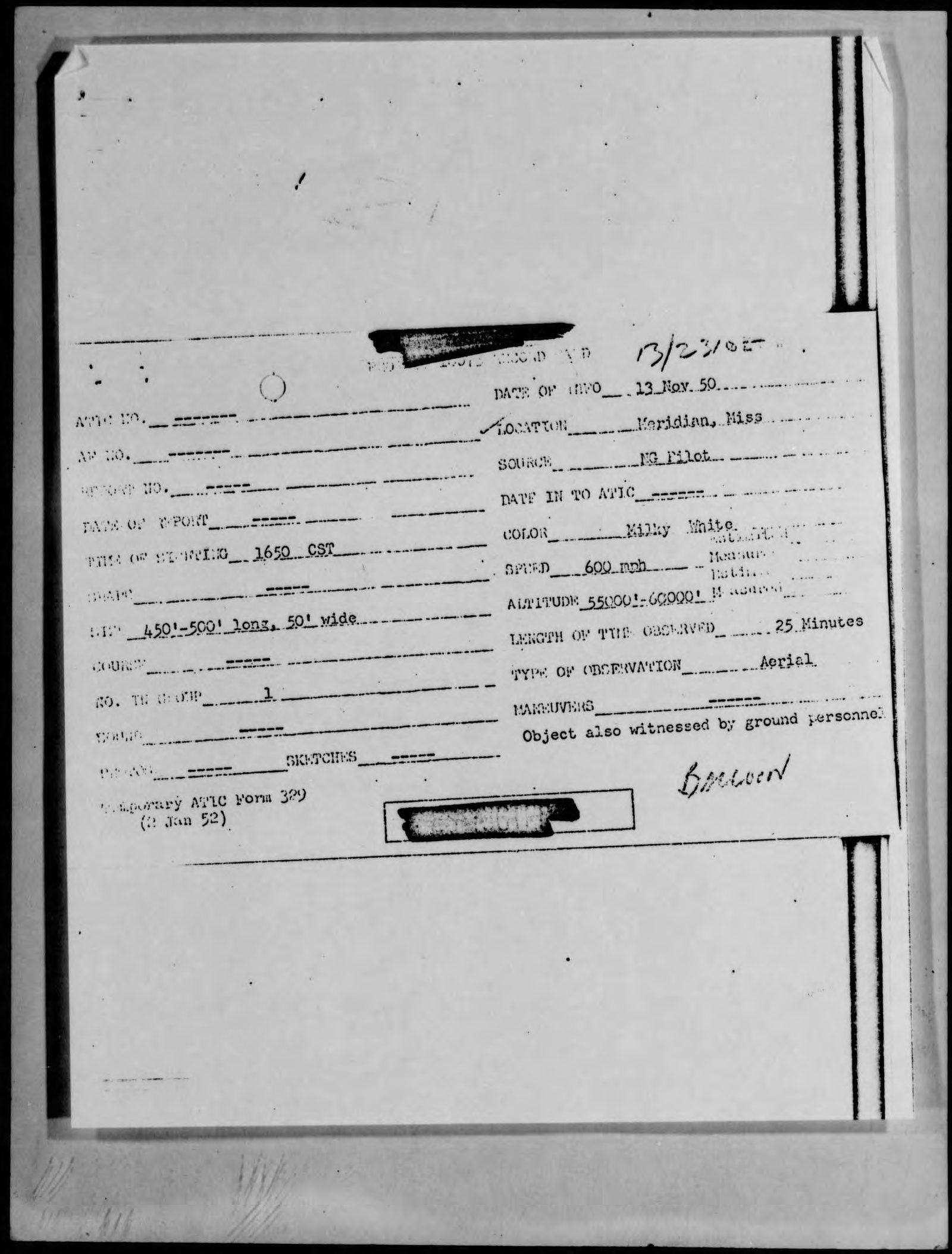
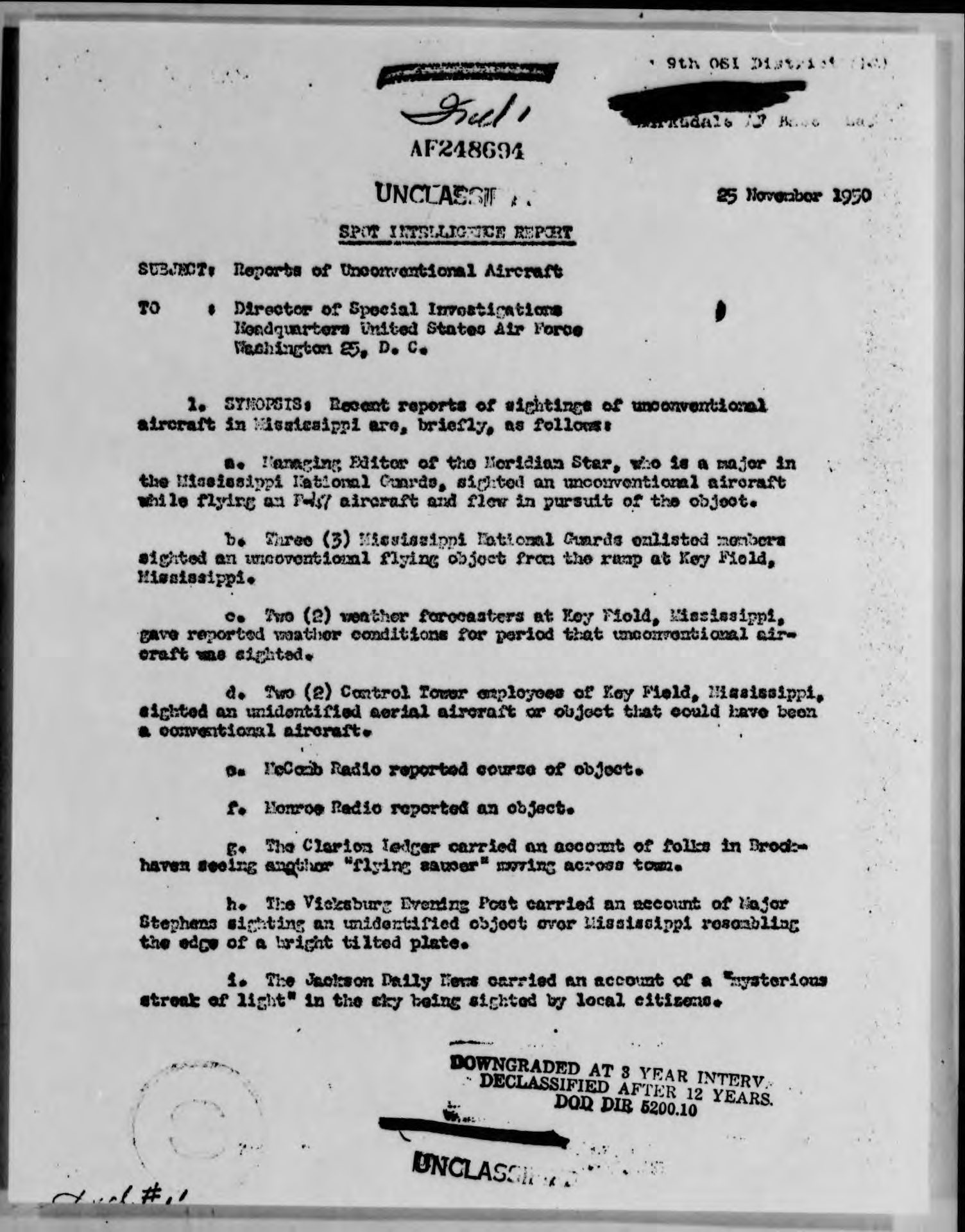
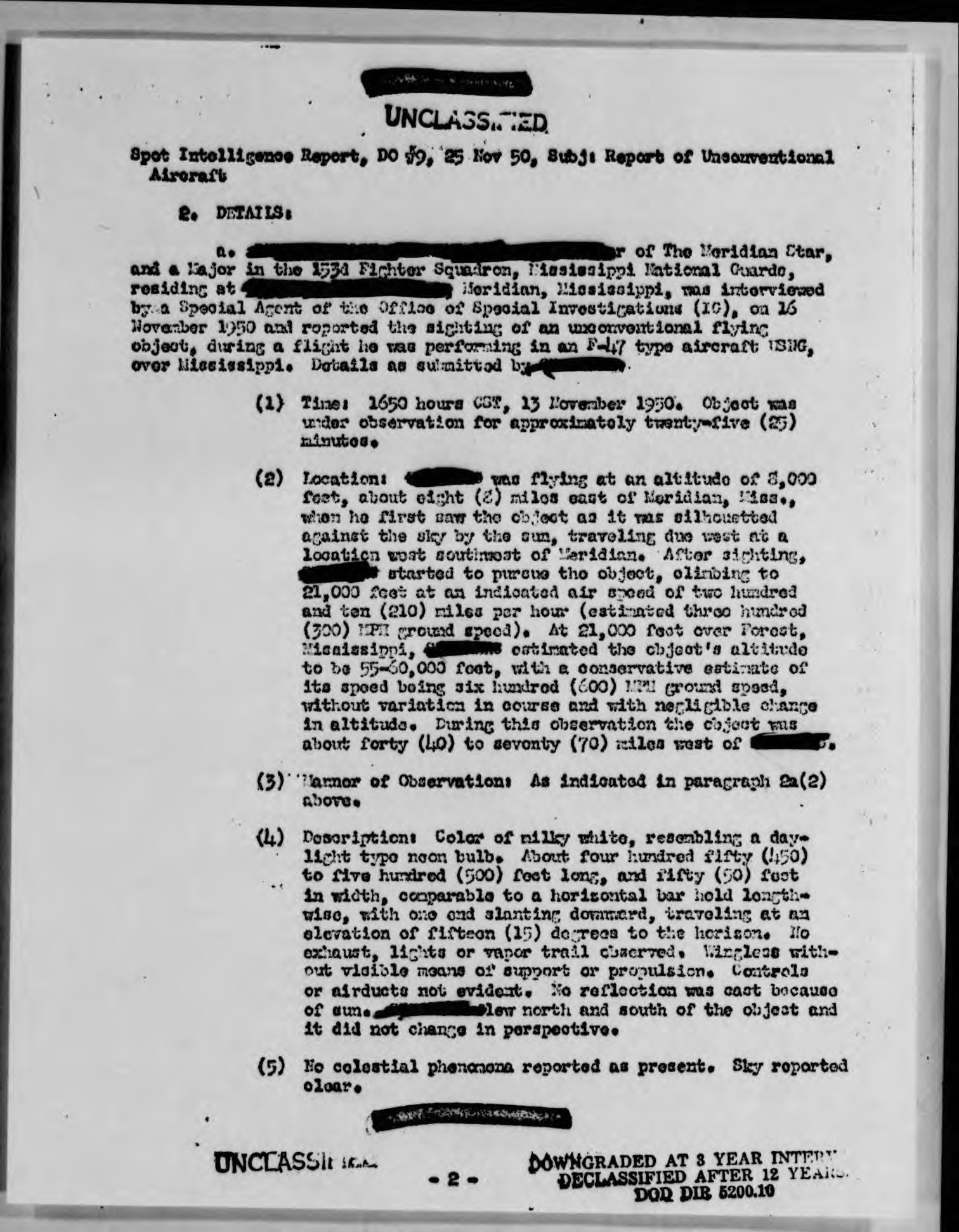
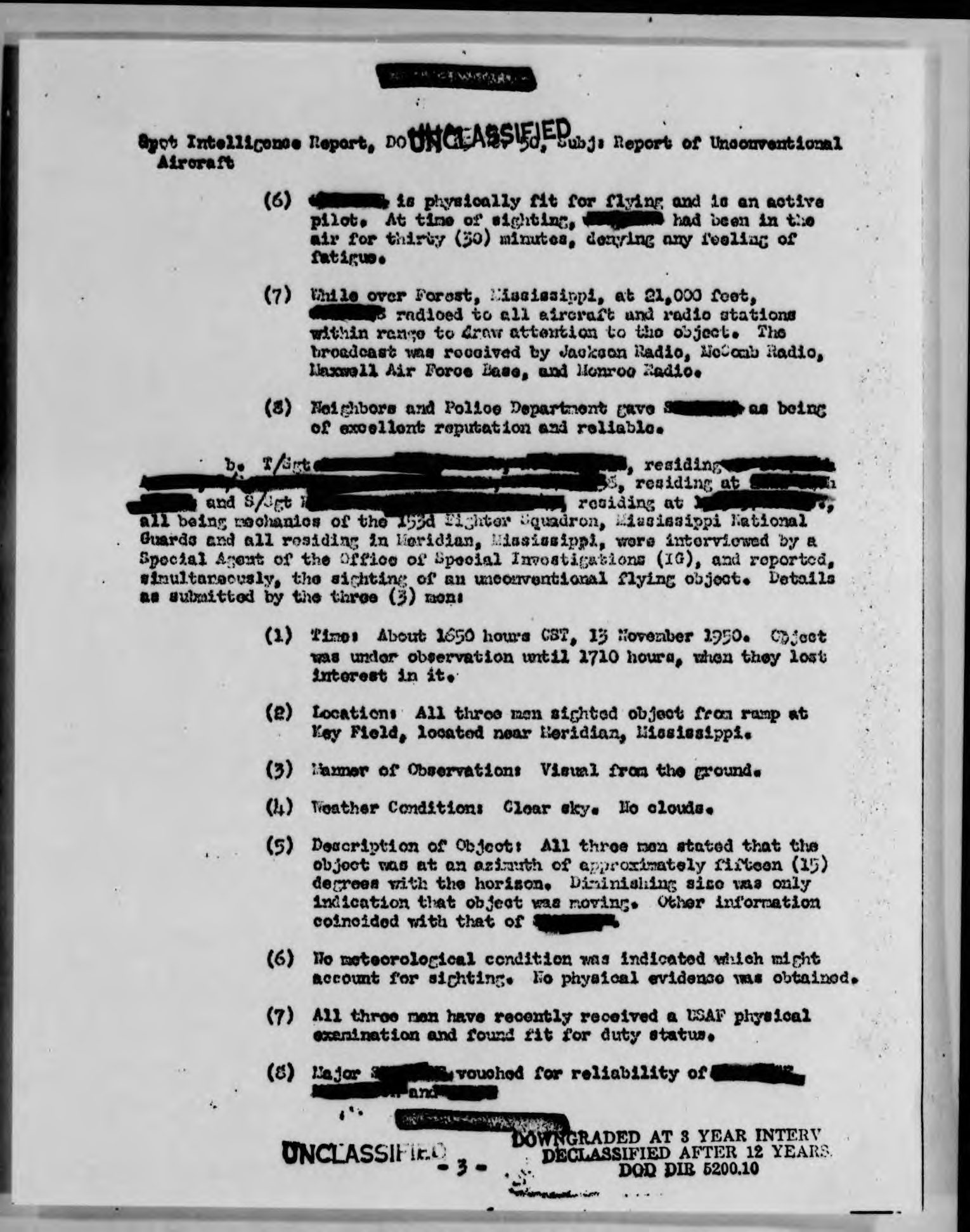
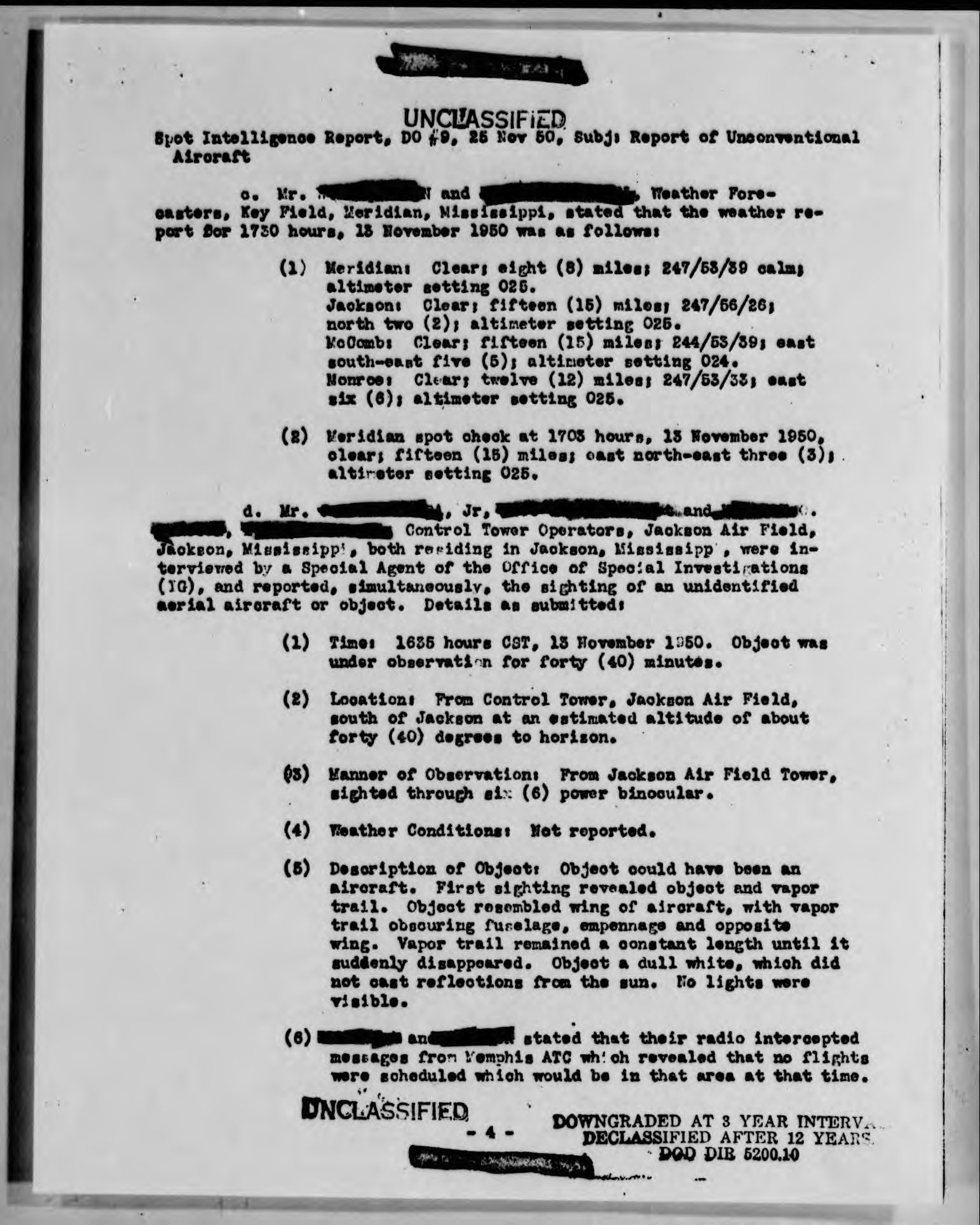
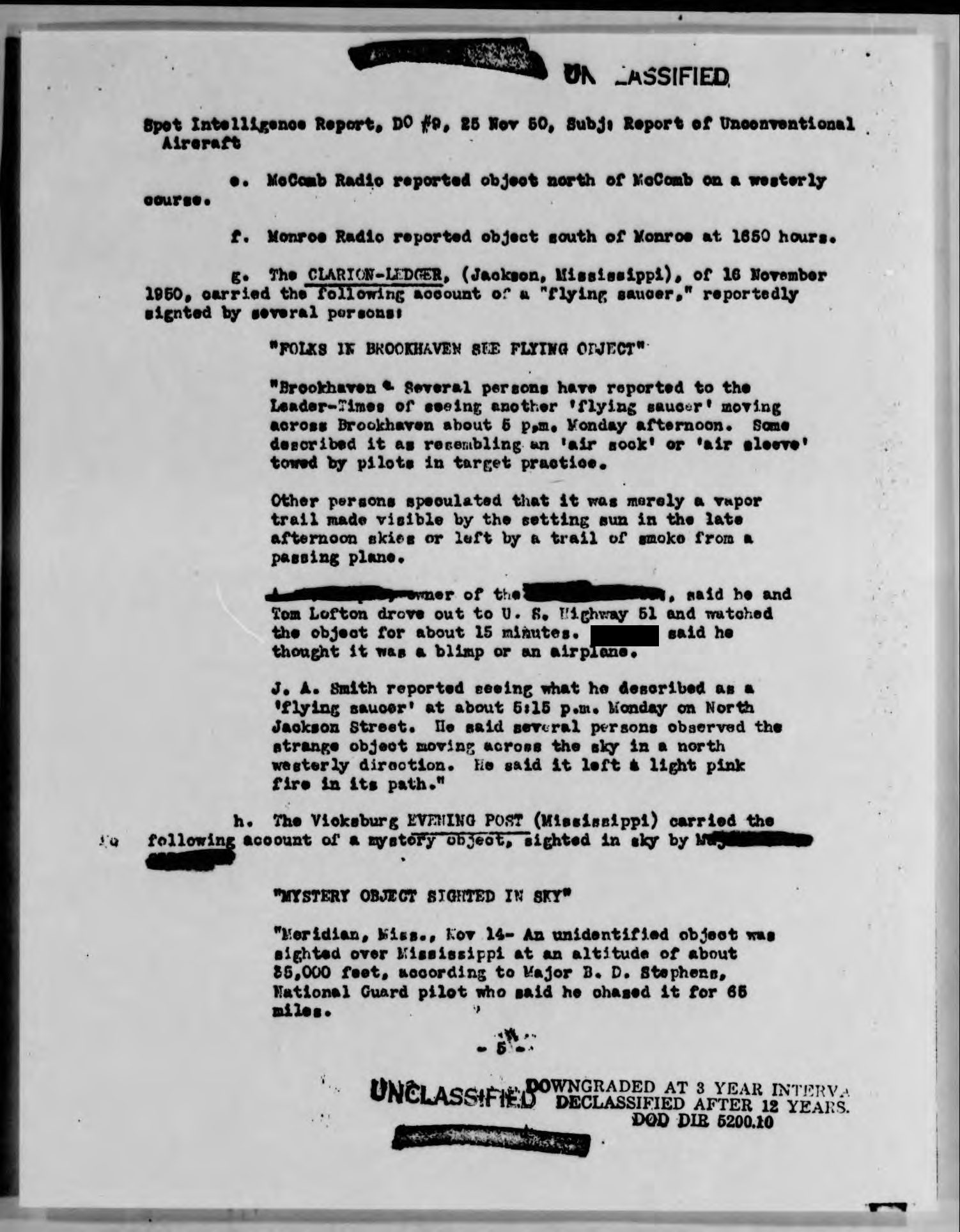
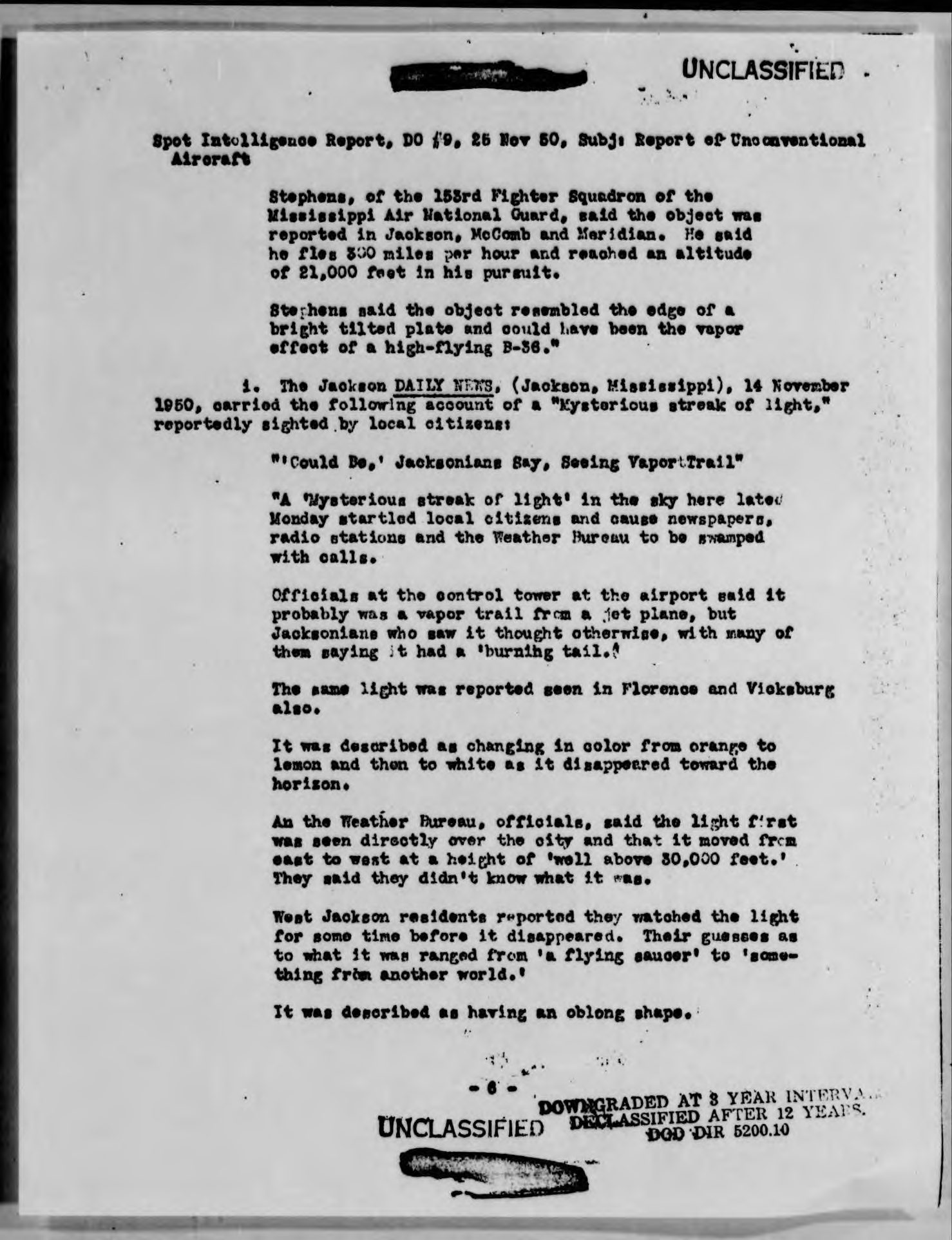
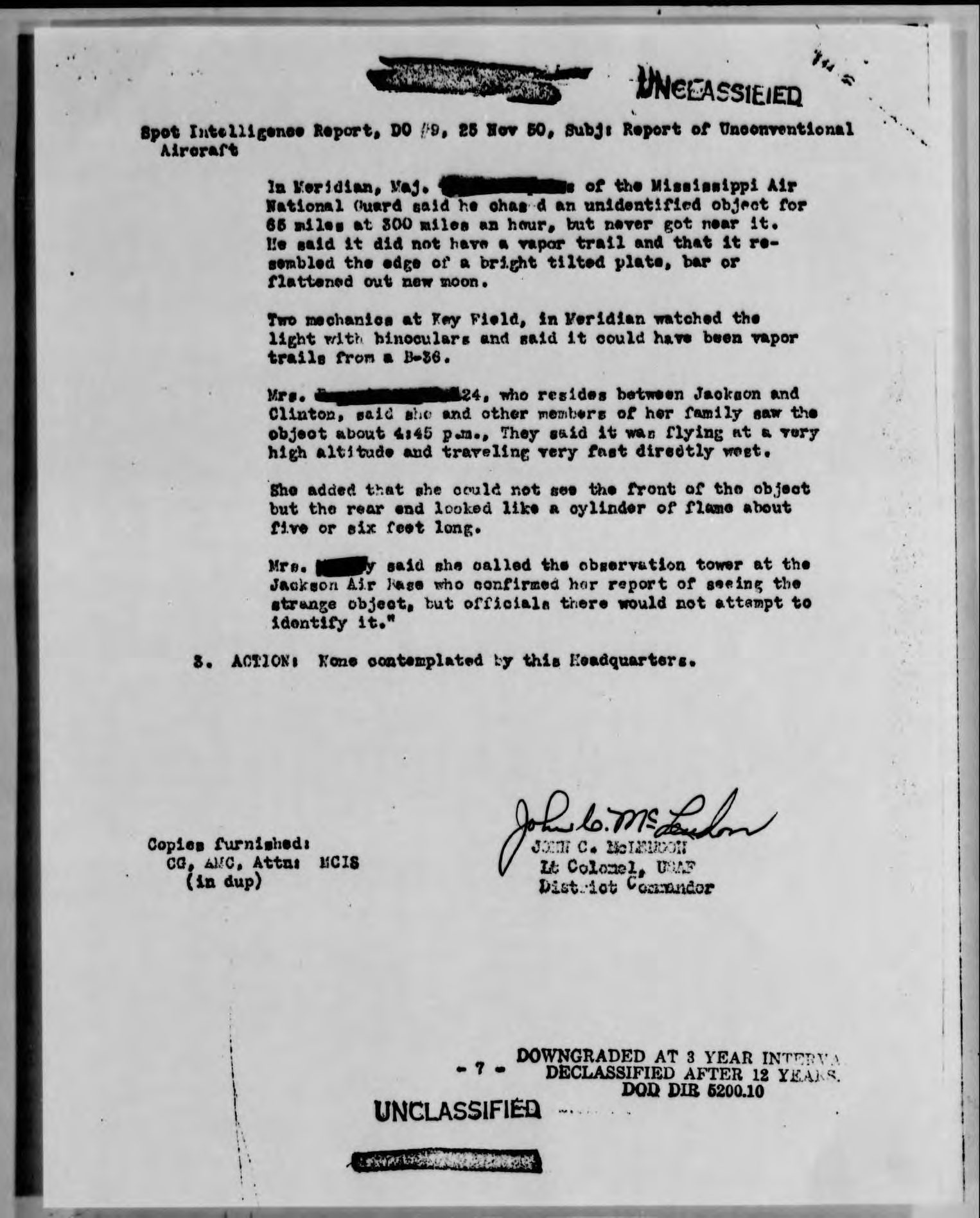
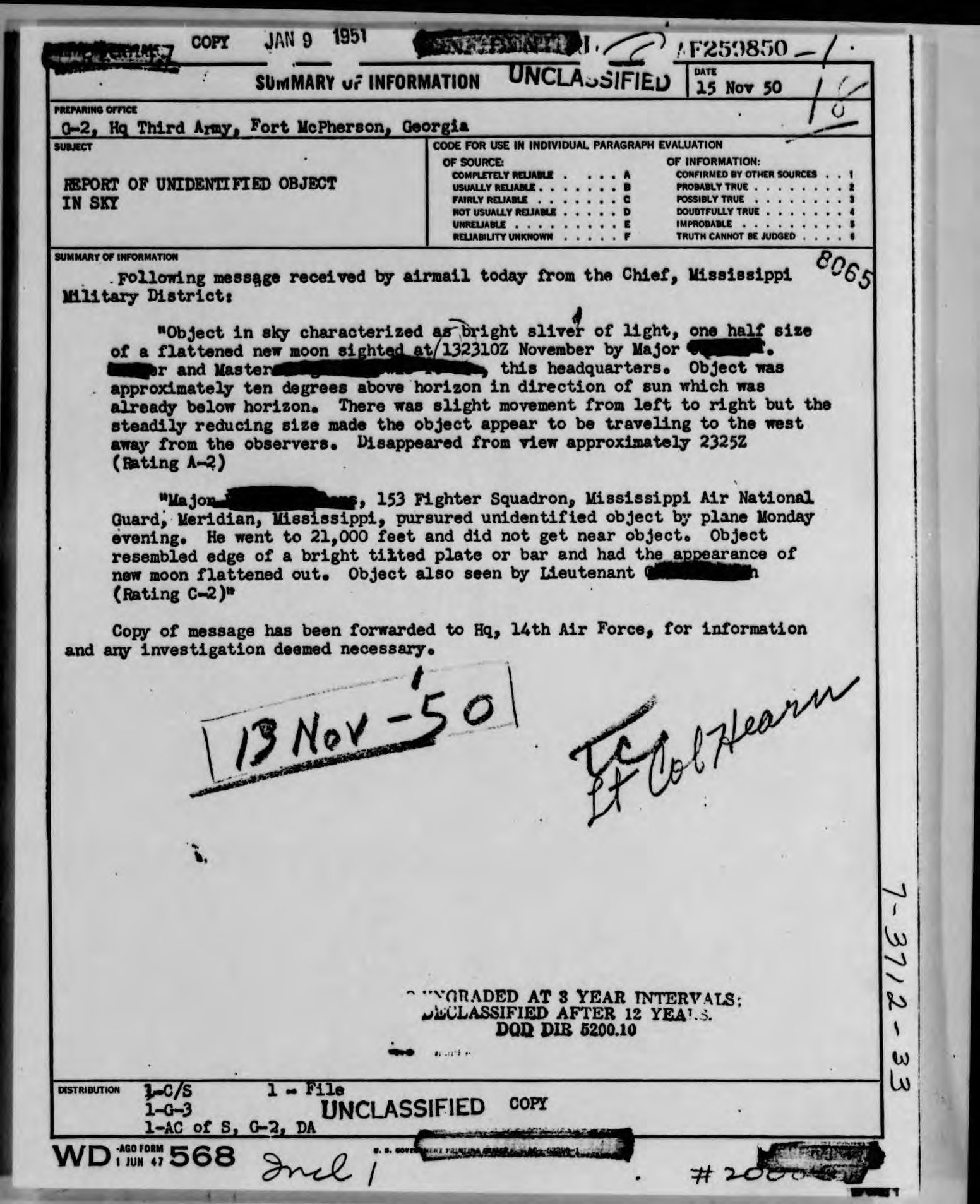
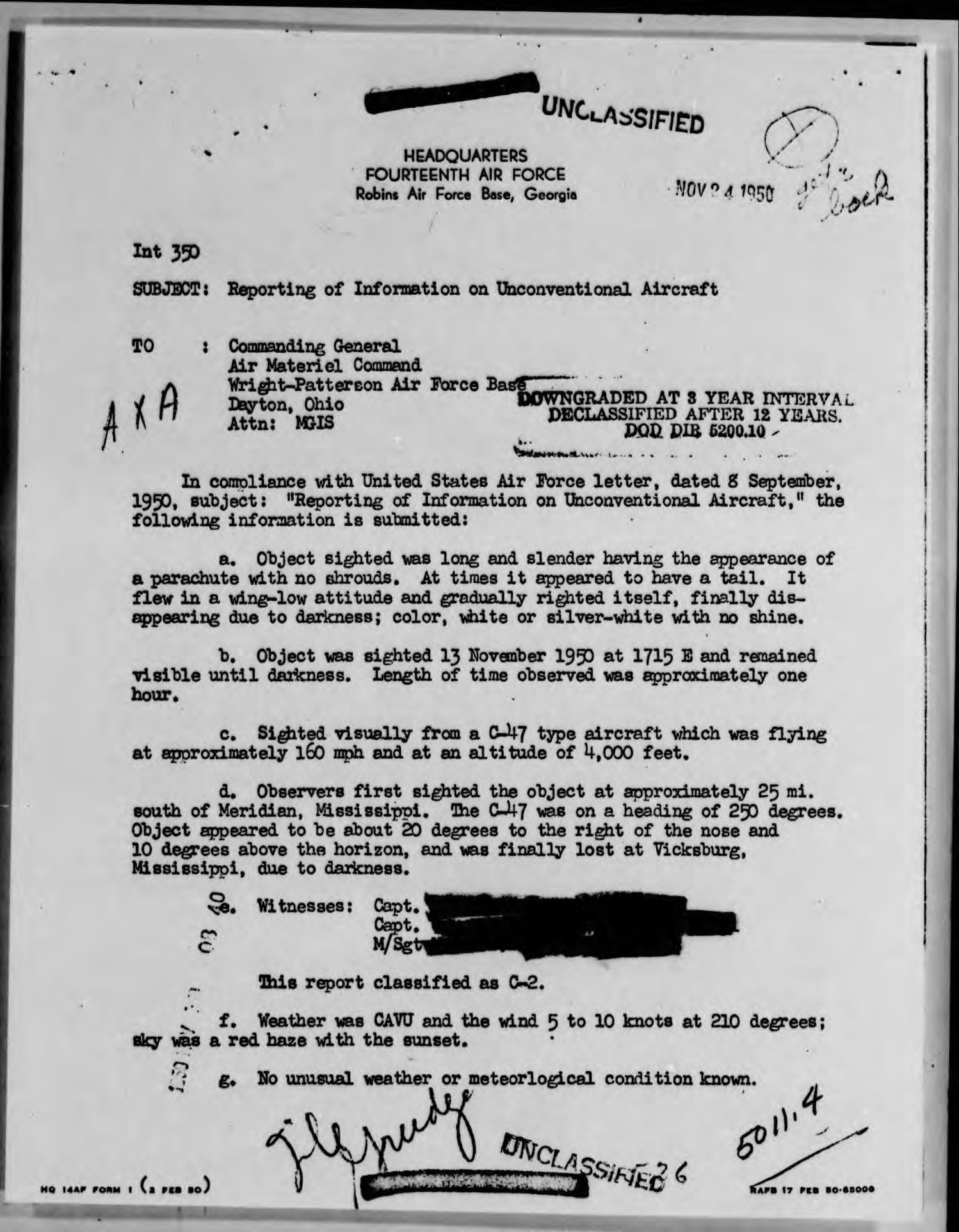
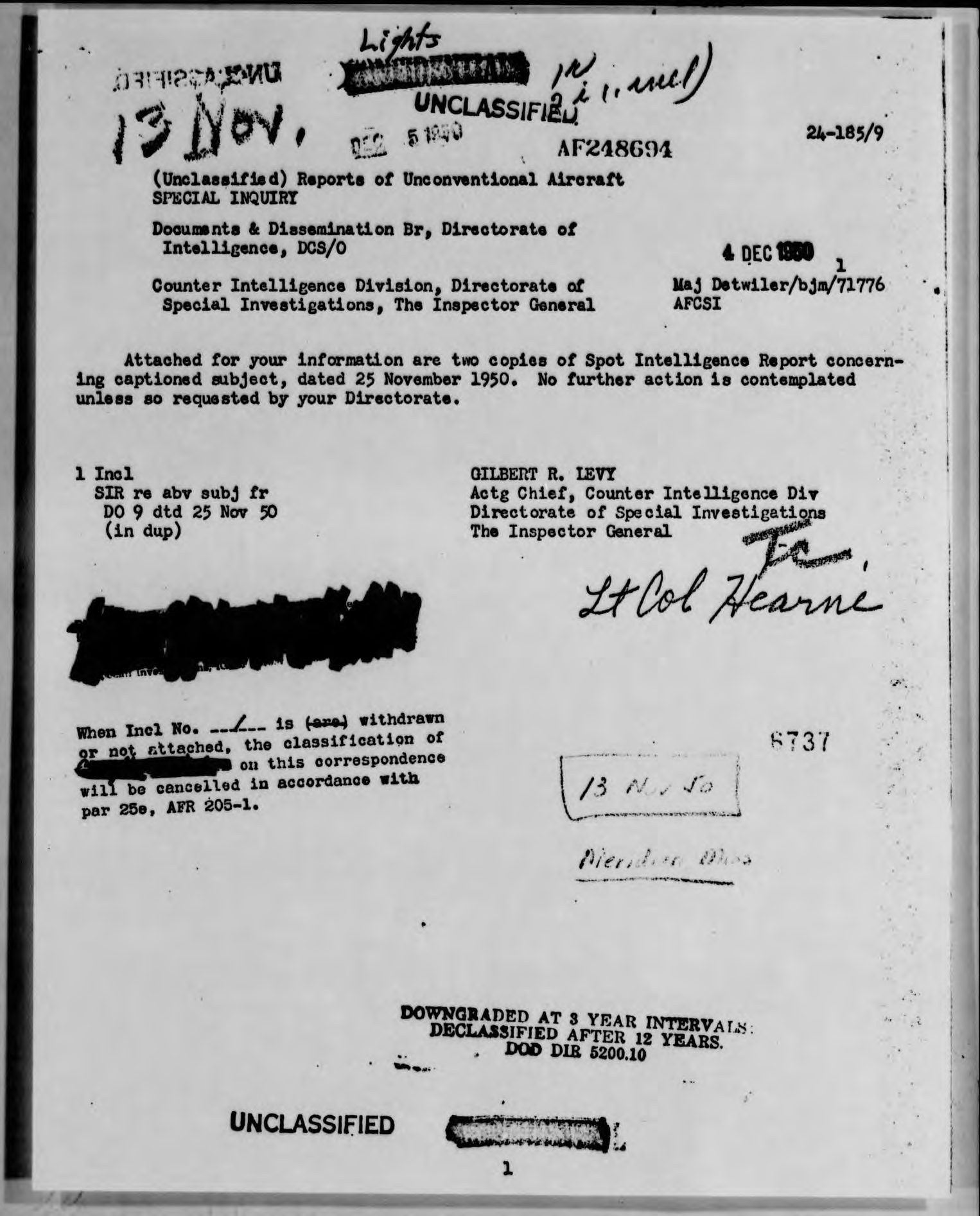
The 12-page released Project Blue Book file: the record card, the OSI Spot Intelligence Report of November 25, 1950, the Third Army summary of November 15, the Fourteenth Air Force report of November 24 and the OSI transmittal of December 4. The primary source for this case file; the page images were read directly.
UNCLASSIFIEDThe catalog series for the released, name-redacted Blue Book case files (Record Group 341), filmed as microfilm publication T1206.
UNCLASSIFIEDNARA's fact sheet on Project Blue Book: 12,618 sightings reported from 1947 to 1969, 701 unidentified; termination announced December 17, 1969.
UNCLASSIFIEDSearch Government Archives Directly
Further Reading — Recommended Literature
The Report on Unidentified Flying Objects
The Blue Book chief's account of the Mantell Skyhook explanation, of balloons and contrails at sunset, and of the project's near-closure in 1950.
Watch the Skies!: A Chronicle of the Flying Saucer Myth
A skeptical aerospace historian's chronicle of the early saucer years, including the Skyhook balloons behind many pilot reports.
UFOs and Government: A Historical Inquiry
A documented history of official UFO investigation, including the Grudge years and the OSI's role in collecting reports in 1950.
DISCLOSURE: Some links above are affiliate links. If you purchase through them, OverClassified receives a small commission at no additional cost to you. This helps support independent research.
Essential Viewing
No Videos Available
Sources
- U.S. Air Force, Project Blue Book. Record card, Temporary ATIC Form 329 (2 Jan 52), Meridian, Miss, 13 Nov. 50 (“NG Pilot”; “1650 CST”; “450'-500' long, 50' wide”; “Milky White”; “600 mph”; “55000'-60000'”; “25 Minutes”; “Aerial”; “Object also witnessed by ground personnel”; handwritten “Balloon”). In Blue Book file “1950-11-9618292-Meridian-Miss”: archive.org
- 9th OSI District (IG), Barksdale AFB, La. Spot Intelligence Report, “Reports of Unconventional Aircraft,” 25 November 1950, to the Director of Special Investigations, Hq USAF, seven pages, signed by Lt. Col. John C. McLendon, District Commander (synopsis; interview of the pilot on 16 November 1950; the three 153d Fighter Squadron mechanics; Key Field forecasters' 1730 weather; Jackson Air Field tower operators; McComb and Monroe Radio; clippings from the Clarion-Ledger, Vicksburg Evening Post and Jackson Daily News; “ACTION: None contemplated by this Headquarters”). Same file: archive.org
- G-2, Headquarters Third Army, Fort McPherson, Georgia. “Summary of Information: Report of Unidentified Object in Sky,” 15 November 1950, WD AGO Form 568, relaying a message from the Chief, Mississippi Military District (“bright sliver of light, one half size of a flattened new moon sighted at 132310Z”; “in direction of sun which was already below horizon”; “Disappeared from view approximately 2325Z (Rating A-2)”). Same file: archive.org
- Headquarters Fourteenth Air Force, Robins AFB, Georgia. Letter Int 350, “Reporting of Information on Unconventional Aircraft,” to the Commanding General, Air Materiel Command, Attn: MCIS, 24 November 1950, two pages (C-47 sighting: “appearance of a parachute with no shrouds”; “1715 E”; heading 250°; “finally lost at Vicksburg, Mississippi, due to darkness”; “CAVU”). Same file: archive.org
- Levy, Gilbert R., Acting Chief, Counter Intelligence Division, Directorate of Special Investigations, The Inspector General, USAF. Transmittal, “(Unclassified) Reports of Unconventional Aircraft, Special Inquiry,” to Documents & Dissemination Branch, Directorate of Intelligence, DCS/O, 4 December 1950 (“No further action is contemplated unless so requested by your Directorate”). Same file: archive.org
- Internet Archive. “1950-11-9618292-Meridian-Miss” (12 images; Project Blue Book collection). archive.org
- “Air National Guard Chases Air Object,” Atlanta Daily World, November 15, 1950, p. 1 (wire story datelined Meridian: “Maj. B. D. Stephens said the chase moved at 300 miles an hour, from 8,000 feet altitude to 21,000 feet”; “not claiming the object was a 'flying saucer'”; “the vapor effect of a B-36 or some other object at 31,000 feet altitude”). Library of Congress, Chronicling America: loc.gov
- “Mystery Object Sighted in Sky,” Vicksburg Evening Post (Mississippi), November 1950, dateline “Meridian, Miss., Nov 14” (names Major B. D. Stephens, 153rd Fighter Squadron), as quoted in the OSI report above. Same file: archive.org
- “'Could Be,' Jacksonians Say, Seeing Vapor Trail,” Jackson Daily News, November 14, 1950, and “Folks in Brookhaven See Flying Object,” Jackson Clarion-Ledger, November 16, 1950, both as quoted in the OSI report above. Same file: archive.org
- Project 1947. “Meridian, Mississippi, April 12, 1950” (reproducing the Jackson Clarion-Ledger, April 14, 1950: 153rd Fighter Squadron pilots see a light near Key Field; F-47s sent to intercept; not in Blue Book). project1947.com
- Ruppelt, Edward J. The Report on Unidentified Flying Objects (1956), Project Gutenberg eBook #17346 (“Early in 1950 the project, for all practical purposes, was closed out”; Mantell: “looked 'like a parachute,' which a balloon does”; “It is not unusual to be able to see a large balloon for 50 to 60 miles”; “A skyhook balloon can be seen at 60,000”; “A balloon will glow like a 'ball of fire' just at sunset”; “a thin, blood red streak in the sky at sunset”). gutenberg.org
- Gross, Loren E. UFOs: A History, Volume 7: August–December 1950 (Arcturus Book Service) (checked: November 1950 entries for Rome, Ga., Key West, Reading, Pa., Pasco/Hanford and Maxwell AFB; no Mississippi entry). Sign Oral History Project (Download PDF): sohp.us
- Gross, Loren E. UFOs: A History, Supplemental Notes, 1950 August–December (2000) (checked: November 10–15, 1950 entries; no Mississippi entry). sohp.us
- Sparks, Brad. “Comprehensive Catalog of 2,200 Project Blue Book UFO Unknowns,” version 1.35, February 3, 2026 (searched; November 1950 entries are November 5 (two), 7, 10 and 23; no Meridian entry). NICAP (Download PDF): nicap.org
- Berliner, Don. “The Project Bluebook ‘Unknowns’,” compiled for the Fund for UFO Research (checked; no Meridian, November 1950 entry). NICAP: nicap.org
- Gross, Patrick. “Project Blue Book unexplained cases summaries with witness names: Year 1950,” UFOs at Close Sight (checked; no Mississippi entry). ufology.patrickgross.org
- NICAP. “The 1950 UFO Chronology” (checked; November 14 and 15 Key West entries; no Meridian entry). nicap.org
- Printy, Tim. “Project Blue Book case review: 1950,” SUNlite 16, no. 3 (May–June 2024): 8ff.; November 1950 table, pp. 13–14 (“13 | Meridian, MS | Balloon | Agreed”; also November 5, “Jonesville, LA | Insufficient data | Contrails”; November 14, Rome, Ga. and Key West, Fla.; November 23, Maxwell AFB, “Birds | Agreed”). (Download PDF): astronomyufo.com
- Printy, Tim. “RB-47 Phase I: The up-scope incident,” SUNlite 4, no. 1 (January–February 2012): 13–18, at 14 (quoting the wing intelligence debriefing: “At approximately Meridian, Mississippi, a signal with the following characteristics”). (Download PDF): astronomyufo.com
- “Skyhook balloon,” Wikipedia (first launch September 25, 1947; “over 1,500 Skyhook flights were made for investigations supported by the ONR”; developed by Otto C. Winzen and General Mills; flights to over 90,000 feet). wikipedia.org
- Pacheco, Luis E. StratoCat, “Stratospheric balloons launched worldwide in 1950” (fourteen launches listed; none between September 28 and November 29, 1950). stratocat.com.ar
- NOAA National Centers for Environmental Information. Integrated Global Radiosonde Archive (IGRA) v2, station data for Montgomery, Ala. (USM00072226), Little Rock, Ark. (USM00072340) and Boothville, La. (USM00072232), November 13–14, 1950; Jackson, Miss. (USM00072235) has no 1950 data (computed for this file). (Download data file): ncei.noaa.gov
- NOAA NCEI. IGRA v2 station list. ncei.noaa.gov
- NASA Jet Propulsion Laboratory. Horizons System ephemerides for the Sun, Moon, Venus, Mars, Jupiter and Saturn as seen from Meridian (32.36° N, 88.70° W), Jackson (32.30° N, 90.18° W) and points west, 13 November 1950, 22:00–23:40 UT (computed for this file; sunlit-height and distance figures computed from these and the Earth's mean radius). ssd.jpl.nasa.gov
- NASA Glenn Research Center. “Earth Atmosphere Model — Imperial Units” (used to convert the pilot's 210 mph indicated airspeed at 21,000 ft to true airspeed; computed for this file). grc.nasa.gov
- “153d Air Refueling Squadron,” Wikipedia (lineage: allotted to the National Guard as the 153d Fighter Squadron on 24 May 1946; federal recognition at Key Field; F-47D Thunderbolts; called to active federal service 1 March 1951). wikipedia.org
- “Meridian Regional Airport,” Wikipedia (Key Field, 32°19′57″ N, 88°45′07″ W, about 3.5 miles southwest of Meridian; named for Al and Fred Key's June 4 – July 1, 1935 endurance flight). wikipedia.org
- National Archives. “Project BLUE BOOK — Unidentified Flying Objects” (12,618 sightings, 701 unidentified; termination announced December 17, 1969). archives.gov
- National Archives Catalog. Series 597821, “Sanitized Version of Project Blue Book Case Files on Sightings of Unidentified Flying Objects.” catalog.archives.gov
- OverClassified. Thomas Mantell case file (January 7, 1948; F-51D; Skyhook explanation without a launch record), Gorman Dogfight case file, Jackson Airborne Sighting case file, and the Mississippi Blue Book case files linked above.
See something inaccurate? Have additional information or sources?
Suggest an Edit →Last Updated: October 2026