
The Terror That Comes in the Night
An Experience-Centered Study of Supernatural Assault Traditions
Core Thesis
The Terror That Comes in the Night is a 1982 academic monograph by folklorist David J. Hufford about one strange experience: waking up unable to move, certain that something hostile is in the room. In Newfoundland, where Hufford first studied it, people called it being hagged, or the Old Hag. Sleep researchers call the nearest equivalent sleep paralysis with hypnagogic hallucinations. Hufford's argument is that the experience comes first and the folklore second. People who have never heard of the Old Hag report the same footsteps, the same presence and the same weight on the chest, so the tradition cannot be what produces the experience. He called this the experiential source hypothesis and set it against the usual academic assumption, which he named the cultural source hypothesis. This is not a UFO book. UFOs take up about three of its pages. It is on this list because the experience it describes sits at the centre of the argument over bedroom-visitation and abduction reports, including this site's file on Peter Khoury, and because skeptics and proponents both cite it, sometimes for claims Hufford did not make. A note on this breakdown: it was written from the publisher's description and contents list, the publisher-authorised Google Books preview (searched page by page for specific passages, not read cover to cover), two 1983 journal reviews read in full, Hufford's later abstract and interviews, and the sleep-research papers that cite him.
About the Author
David J. Hufford is an American folklorist who spent most of his career teaching in a medical school. In the book's acknowledgments he credits Don Yoder of the University of Pennsylvania with first showing him how complex belief is as a subject of study, and he thanks Kenneth Goldstein of the same university. This site could not confirm from a primary source where and when he took his degrees, so it does not state them. The book's first page says that from 1971 to 1974 he lived and worked in St. John's as a member of the Folklore Department at Memorial University of Newfoundland, where his job included duties in the university's Folklore and Language Archive.
In 1974 he joined the Penn State College of Medicine at Hershey, Pennsylvania. His own website says he retired in 2007 after 33 years there as University Professor and Chair of Medical Humanities, and that he is now University Professor Emeritus. The publisher's author note adds an adjunct post in Religious Studies at the University of Pennsylvania. He was Senior Fellow in Spirituality at the Samueli Institute in Alexandria, Virginia, from 2010 through 2016, and Wikipedia lists him as a Fellow of the American Folklore Society.
He also has a personal stake in the subject. Bruce Bower reported in Science News in 2005 that Hufford, as a college student ill with mononucleosis and studying for finals, fell asleep one December day in his locked off-campus room. He woke to footsteps, felt an evil presence and a weight on his chest, and could not move. When the paralysis broke he fled the room, and he told nobody. Bower dates this to 1964; Wikipedia, citing a 2013 interview, gives 1963. Bower adds that Hufford does not believe an invisible force attacked him, and quotes him saying, "I don't have a good explanation for these experiences." Neither 1983 review mentions the episode, and this site found no account of it in the book's searchable text.
For readers of this site the important point is what Hufford is not. He is not a ufologist and not a laboratory sleep scientist. His interest in anomalous reports predates the book: in 1977 he published a paper in the folklore journal Fabula titled "Humanoids and Anomalous Lights: Taxonomic and Epistemological Problems." Years later he wrote the foreword to Jacques Vallée and Chris Aubeck's Wonders in the Sky, as that article on this site records.
Historical Context & Origins
The book was written against a settled academic habit. William L. Rodman, reviewing it for the Canadian anthropology journal Culture, summed the habit up: since the Victorian anthropologist E. B. Tylor, scholars had treated supernatural traditions as products of faulty logic and of nature misperceived. Hufford's introduction says such accounts had too often been "explained away rather than explained."
Two bodies of research framed the specific problem. One was psychoanalytic. Ernest Jones, Freud's biographer, had published On the Nightmare in 1931, reading the classic nightmare as repressed sexual conflict, and Hufford begins his literature review there. Among the later works he examines is Nightmares and Human Conflict by the Harvard psychiatrist John E. Mack, the same Mack who two decades later wrote Abduction. Hufford faults him for an "excessively inclusive definition" of the nightmare. The other body of research was laboratory sleep science, which by the 1970s had described REM sleep, sleep paralysis and hypnagogic hallucinations. Hufford's complaint was that "nightmare" had drifted to mean any bad dream, so the waking, paralysed experience the word once named kept getting lost among ordinary dreams and night terrors.
The work took about a decade. A note in the introduction says, "I began the work in 1971." The Memorial University archive had circulated a "Nightmare/Hag/Old Hag" questionnaire to students in 1970, which the book reproduces as an appendix, and Hufford built on it. In 1973 he presented a paper, "A New Approach to 'The Old Hag': The Nightmare Tradition Reexamined," at a UCLA conference on American folk medicine organised by Wayland Hand. The book followed in 1982 as volume 7 in the new series of Publications of the American Folklore Society. Rodman's review gives the hardcover as 278 pages at $25. The jacket carried Henry Fuseli's 1781 painting The Nightmare, which the paperback cover still uses. The press dates the paperback to September 1989 and an ebook to May 2015.
The timing matters for the UFO question. In 1982 the abduction literature was thin. The Interrupted Journey had appeared in 1966 and Budd Hopkins's Missing Time only in 1981. Whitley Strieber's Communion (1987) and Mack's Abduction (1994) were still to come. The UFO writers Hufford had read and cited were John Keel and Vallée, both from 1969 and 1970. The bedroom abduction as a mass phenomenon came after his book.
Core Arguments & Key Concepts
Start with the experience, not the belief. Hufford's method, which the subtitle calls experience-centered, is to collect first-hand accounts in the witness's own words, describe exactly what is reported, and only then ask about explanation. He keeps accuracy of observation and adequacy of explanation as separate questions. Phyllis Harrison, reviewing the book in Folklore Forum, put the working assumption this way: the accounts are treated as neither falsehood nor fantasy but as accurate reports of something the tellers went through. Much of the book is therefore verbatim interview transcript.
The Old Hag is a specific, stable pattern. Hufford defines it by four primary features, all of which must be present: a subjective impression of being awake, immobility, a realistic perception of the actual surroundings, and fear. Around these he lists secondary features that recur without being required, among them a sensed presence, footsteps, pressure on the chest, a feeling of something numinous and fear of dying. He calls the pattern "stable" and "robust."
Experience is the source of the tradition. The cultural source hypothesis predicts that only people who know the tradition will report the attack. The experiential source hypothesis predicts that some people who have never heard of it will report the same thing. Hufford tested this on Memorial University students and then on mainland Americans, and concluded that the pattern and its distribution appear "independent of the presence of explicit cultural models." The experience, he wrote, has played "a significant, though not exclusive, role" in building traditions of supernatural assault. He estimated that it is found in "15 percent or more of the general population."
Sleep science describes the state, not the content. The chapter he calls the most difficult to write is titled "The Psychological Dis-Interpretation of the Old Hag." In it Hufford accepts that the Old Hag corresponds to sleep paralysis with hypnagogic hallucinations, a REM-related state intruding on wakefulness. Then he asks whether sleep research has explained the Old Hag, and answers plainly: "No, we cannot." Physiology accounts for the state in which the experience happens. "The specific contents of the experience, however, have not been explained." Why footsteps, why a presence, why the same things in people with no shared tradition, is left as an open problem.
Culture still does real work. Hufford does not argue that culture is irrelevant. His conclusions state that cultural factors heavily determine how the experience is described, whether it is disclosed at all, and how it is interpreted. A Newfoundlander had a name for it. An American student usually did not, and often kept quiet. Hufford also declines to make the Old Hag a master key. Rodman noted that he presents the study as work in progress and does not inflate it.
Key Cases & Evidence Discussed
The Old Hag in Newfoundland. The opening chapter draws on the Memorial University archive: accounts of people "hagged" by an enemy, of the hag sent through a curse, and of a parallel folk explanation in which the attack is a stagnation of the blood. Hufford then surveyed students. His figures rest on a sample of 93 native Newfoundlanders, of whom 21, or 23 percent, described at least one episode with the defining features.
The mainland cases. The third chapter moves to the United States. Hufford found subjects by describing the experience in lectures and classes and seeing who came forward, including a medical student in the Pittsburgh area whose attack happened after one of his talks. He reports that one group of ninety produced fifteen positive answers to a bare question, and that response rates rose toward 25 percent when he described the experience more fully. He compares this with a 1963 questionnaire study of medical students by Everett, in which eight of fifty-two, or 15.4 percent, reported sleep paralysis.
Haunted houses. Hufford shows the experience turning up inside other traditions. In one case a Pennsylvania family believed their house was troubled by a poltergeist, and a woman's account of somebody standing by the bed turns out to have the Old Hag's primary features. The fifth chapter, "The Old Hag and Culture," gives its longest case to a rented house in Kentucky first documented by Lynwood Montell of Western Kentucky University, where tenants and visitors reported presences, footsteps and paralysis. Hufford later interviewed one of the same informants and sets his material beside Montell's.
Other cultures and other centuries. The same chapter follows the pattern into witch-riding traditions recorded in South Carolina, vampire belief, a Philippine account involving the aswang, and Inuit material. Rodman added a parallel of his own from Robert Levy's ethnography of Tahiti. Hufford also touches on fiction, including Maupassant's story "The Horla," and on the out-of-body literature, noting that Robert Monroe's Journeys Out of the Body describes paralysis and fear as an early stage of the process.
The UFO passage. On pages 232 to 234 Hufford turns to what he calls a numinous figure usually thought to be of recent vintage: "the UFO creature." He writes that the UFO literature has always seemed to him "worth consideration by folklorists and other students of belief," that scholars had shown little sustained interest, and that UFO books built on field interviews are "often well worth reading," with a dry aside that the gap between journalistic and academic standards of accuracy is not always as flattering to academics as they might wish. His main example is a chapter called "The Bedroom Invaders" in Keel's 1970 book Strange Creatures from Time and Space, where Keel described the mail he received from readers who had woken paralysed with an apparition in the room. Keel linked that paralysis to the paralysis reported in UFO encounters. Hufford notes Keel's own admission that this was "not much to go on." A footnote cites Vallée's Passport to Magonia, and the bibliography lists Keel's Operation Trojan Horse.
What is not in the book. There is no abduction case in it. Hufford does not say that UFO encounters are sleep paralysis, and he does not say they are anything else. He observes that some of Keel's bedroom reports look like the pattern he has been describing and recommends the material to folklorists. Everything beyond that was added later by other writers. Readers who come from this site's files on Peter Khoury in Sydney, the Prospect, Kentucky abduction or Amaury Rivera, where sleep paralysis is offered as a conventional explanation, should know that the application is theirs to weigh. Hufford supplies the description of the experience, not a verdict on any UFO case.
Critical Reception & Controversies
The book was well received in its own field. The publisher still quotes Western Folklore, where Donald Ward reviewed it in October 1984, calling it "a brilliant and exciting look at a misunderstood phenomenon," and the magazine Fate calling it one of the most significant books on the paranormal. This site has read those two only as the publisher's excerpts. Harrison's Folklore Forum review, read in full, called Hufford's handling of his material "careful, sensitive, and insightful". She called his demonstration that the narratives contain accurate reports of real physiological events a significant turn-about in the study of supernatural belief.
Harrison also registered what the approach leaves out. Folklorists, she wrote, are usually interested less in where a tradition comes from than in how a culture defines and explains it, and the experience-centered method does not address that. Hufford's primary interest, in her words, is "the validation of an experience rather than the analysis of a tradition." She presents the omission as deliberate, but it is a real limit: the book says more about what happens to the sleeper than about what the hag means to a community.
Rodman's review is the sharpest contemporary criticism this site found. He called the monograph "innovative, provocative and just a bit unsettling," and then wrote that it was not without "methodological flaws and conceptual peculiarities." If the experience is independent of tradition, he asked, why name it after one tradition? More seriously, he pointed out that sixteen of the twenty-five detailed first-hand cases came from people already familiar with Hufford's research, leaving nine "naive subjects" to carry the claim of cultural independence. Those nine, he judged, "do not provide a strong enough foundation." In a society where films about succubi were popular entertainment, he doubted anyone was truly naive. He still concluded that Hufford was on to something and called the book "a model of academic discretion."
Sleep researchers accepted the description and disputed the open question. J. Allan Cheyne and colleagues at the University of Waterloo wrote in 1999 that accounts of these hallucinations are remarkably consistent across time and cultures, which is Hufford's finding, and then offered what Hufford said was missing: a model deriving the sensed intruder and the chest pressure from REM neurophysiology, with culture supplying the narrative. Bower's Science News article reports that Hufford considers the REM account inadequate, because sleep paralysis reports are so uniform while dreams vary so widely. Prevalence figures differ too. Harvard psychologists Richard McNally and Susan Clancy, citing Cheyne, put lifetime experience of sleep paralysis at about 30 percent, against Hufford's 15 percent or more for the full pattern. Hufford himself put such gaps down partly to differing criteria.
A last criticism concerns where the method leads. The 1982 book is agnostic about what the presence is. Hufford's 2005 paper in Transcultural Psychiatry is titled "Sleep Paralysis as Spiritual Experience" and offers an experiential theory of spiritual experiences found across cultures. A reader who wants a purely neurological account may see the method sliding from describing belief toward defending it; that is this site's observation, not a published critique it can cite. Readers on the other side of the UFO debate make the opposite complaint about how the book gets used. This site's article on Thomas Bullard's The Myth and Mystery of UFOs records the argument that sleep paralysis cannot stand in for the strongest abduction reports, and the Pascagoula file makes the obvious point that a private neurological event does not explain two men reporting the same thing at the same moment in Pascagoula.
Influence & Legacy
Within sleep-paralysis research the book became a standard citation. Susan Blackmore called it a classic in a 1998 Skeptical Inquirer article, and McNally and Clancy cite it twice in their 2005 paper, in part for the point that how a person reads an episode depends on the narratives available to them. Hufford's website says it has been translated into Japanese and Korean.
Its second life has been in the abduction debate, mostly in the hands of skeptics. Blackmore listed the Old Hag of Newfoundland among the world's sleep-paralysis traditions and proposed that abduction might be the modern one: "Perhaps alien abduction is our modern sleep paralysis myth." McNally and Clancy, working at Harvard, interviewed ten self-described abductees whose accounts began with apparent sleep paralysis, and argued that people explain such episodes with "personally plausible cultural narratives." Clancy's Abducted carried that case to general readers. Kevin Randle and his co-authors made a similar argument from their own sample in The Abduction Enigma, and Robert A. Baker and Michael Shermer read Strieber's bedroom encounter the same way, as covered in this site's articles on Hidden Memories and Why People Believe Weird Things. Blackmore also drew on a 1993 study led by Nicholas Spanos.
Hufford's own argument cuts across that use. The skeptical reading says culture turns sleep paralysis into aliens. Hufford's book says the core of the experience does not come from culture at all, and that nobody has explained its content. Folklorist Bill Ellis saw this. In Aliens, Ghosts, and Cults (2001) he applied Hufford to Strieber and suggested that Strieber may have turned to abduction investigators for the reason Hufford's subjects valued the Old Hag legend: it gave the experience a name and showed that others had had it. Hufford himself is reported to have given a paper titled "Awakening Paralyzed in the Presence of a Strange 'Visitor'" at the 1992 Abduction Study Conference at MIT, the meeting organised by David Pritchard and Mack. This site knows that paper only by its title, from a 2009 post by Michael Heiser, and has not seen the proceedings.
The book is still in print forty-odd years on, and Amazon showed 4.3 stars from 90 ratings when checked for this article. Hufford has gone on discussing it, in a long 2007 filmed interview and a 2020 radio interview that are both linked below. On this site it stands behind the conventional explanation offered in several case files. The Khoury file shows why it should be used with care: John O'Neill, the skeptic who proposed sleep paralysis there, conceded that his own episode was vague where Khoury's account was detailed.
The Book
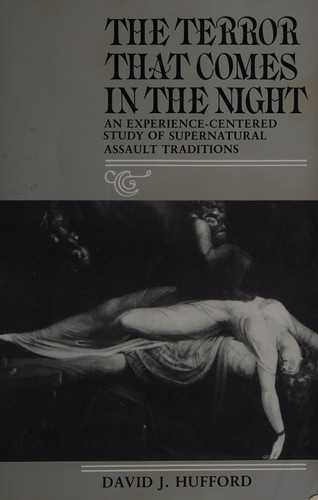
The Terror That Comes in the Night
An Experience-Centered Study of Supernatural Assault Traditions
Find on Amazon →As an Amazon Associate, OverClassified may earn from qualifying purchases made through this link, at no extra cost to you.
Why This Is Essential Reading
The Terror That Comes in the Night belongs on this list even though it is not about UFOs, because nobody can argue honestly about bedroom encounters without it. It gives the most careful description in print of what people report when they wake paralysed with a presence in the room, and it shows that the report does not depend on having heard the story first. That finding is awkward for everyone. It tells proponents that an experience can be vivid, consistent and sincerely reported without being an abduction. It tells skeptics that "sleep paralysis" names the state and leaves the content unexplained, as David J. Hufford said himself. Read it with William Rodman's doubts about the sample in mind, and next to Abducted and Abduction. This site worked from the preview, the reviews and the later papers, not a full reading, and will revise this assessment when it has read the whole text.
Related Cases & Theories
Essential Viewing

David Hufford: The Terror that Comes in the Night
NDE Radio with Lee Witting — A half-hour radio interview, posted in October 2020, in which Hufford discusses the book and the Old Hag experience with host Lee Witting. Verified via YouTube oEmbed before inclusion.
Sleep Paralysis Explained - 2007 Interview With David J. Hufford Ph D
Dark-Element-Films — A long-form 2007 interview with Hufford about sleep paralysis, posted by the production company in March 2021. Verified via YouTube oEmbed before inclusion.
Sources Cited
- Hufford, David J. The Terror That Comes in the Night: An Experience-Centered Study of Supernatural Assault Traditions. Publications of the American Folklore Society, New Series, vol. 7. University of Pennsylvania Press, 1982 (hardcover ISBN 0812278518; paperback ISBN 081221305X / 9780812213058). Consulted through the publisher-authorised preview, searched by page; not read in full. books.google.com
- "The Terror That Comes in the Night." University of Pennsylvania Press catalogue page (description, contents, author note, review excerpts from Western Folklore and Fate; paperback 304 pp., published September 1, 1989; ebook ISBN 9780812292596, May 5, 2015). pennpress.org
- "The terror that comes in the night: an experience-centered study of supernatural assault traditions." Open Library edition record for the 1982 hardcover, ISBN 0812278518 (xxiv, 278 p.; bibliography pp. 259–265; series statement). openlibrary.org
- "The Terror That Comes in the Night." Amazon listing for the paperback, ISBN 081221305X (304 pages; customer rating read from the listing, October 2026). amazon.com
- Harrison, Phyllis. Review of The Terror That Comes in the Night. Folklore Forum 16, no. 1 (1983): 88–91. Read in full. hdl.handle.net
- Rodman, William L. Review of The Terror That Comes in the Night. Culture (Canadian Ethnology Society) 3, no. 2 (1983): 91–93. Read in full. doi.org
- Ward, Donald. Review of The Terror That Comes in the Night. Western Folklore 43, no. 4 (October 1984): 274 ff. Known here only from the publisher's excerpt; the full review was not consulted. doi.org
- Hufford, David J. "Sleep Paralysis as Spiritual Experience." Transcultural Psychiatry 42, no. 1 (March 2005): 11–45. Abstract consulted. pubmed.ncbi.nlm.nih.gov
- McNally, Richard J., and Susan A. Clancy. "Sleep Paralysis, Sexual Abuse, and Space Alien Abduction." Transcultural Psychiatry 42, no. 1 (March 2005): 113–122. Read in full from an archived copy. doi.org
- Cheyne, J. Allan, S. D. Rueffer and I. R. Newby-Clark. "Hypnagogic and Hypnopompic Hallucinations during Sleep Paralysis: Neurological and Cultural Construction of the Night-Mare." Consciousness and Cognition 8, no. 3 (September 1999): 319–337. Abstract consulted. pubmed.ncbi.nlm.nih.gov
- Blackmore, Susan. "Abduction by Aliens or Sleep Paralysis?" Skeptical Inquirer 22 (1998): 23–28, as reproduced on the author's website. susanblackmore.uk
- Bower, Bruce. "Night of the Crusher: The waking nightmare of sleep paralysis propels people into a spirit world." Science News, July 9, 2005 (Hufford's own episode; interviews with Hufford, Cheyne, McNally and others). sciencenews.org
- "David Hufford." Biographical page on Hufford's own website (retirement in 2007 after 33 years at Penn State College of Medicine; Samueli Institute fellowship 2010–2016; Japanese and Korean translations). davidhufford.org
- "David Hufford." Wikipedia (1974 appointment at Penn State; American Folklore Society fellowship; the 1963 date for his own episode, cited to John W. Morehead's 2013 interview in Paranthropology, which this site could not open directly). en.wikipedia.org
- Ellis, Bill. Aliens, Ghosts, and Cults: Legends We Live. University Press of Mississippi, 2001 (Hufford's Old Hag research applied to Whitley Strieber and abduction belief, pp. 147–158). Consulted through the publisher-authorised preview. books.google.com
- Hufford, David J. "Humanoids and Anomalous Lights: Taxonomic and Epistemological Problems." Fabula 18 (1977): 234–241. Citation confirmed from the book's bibliography and the journal's DOI record; article not consulted. doi.org
- Heiser, Michael S. "Night Terrors and Sleep Paralysis." Blog post, March 25, 2009 (source for the title of Hufford's paper at the 1992 MIT Abduction Study Conference, published in Alien Discussions, North Cambridge Press, 1994; proceedings not consulted). drmsh.com
- Keel, John A. Strange Creatures from Time and Space. Fawcett, 1970 (chapter "The Bedroom Invaders"). Cited here as quoted and discussed by Hufford, pp. 233–234; original not consulted.
Have corrections, additional research, or peer-reviewed sources? Help improve this entry.
Suggest an Edit