
The Edge of Reality
A Progress Report on Unidentified Flying Objects
Core Thesis
The Edge of Reality is not a treatise but a transcript: most of its 301 pages reproduce a taped, three-way conversation between J. Allen Hynek, Jacques Vallée, and psychologist Arthur C. Hastings, who moderated without pretending to referee. Rather than resolve the UFO question into a single conclusion, the book stages the actual, unfinished argument its two authors were having with each other in 1975: Hynek, the former Air Force consultant newly running his own Center for UFO Studies, pressing the case that patterns in the case record are real and demand institutional science's attention; Vallée, his younger collaborator, pushing back that the "nuts and bolts" extraterrestrial-hypothesis framework cannot account for the phenomenon's reported psychic residue — telepathic impressions, altered consciousness, folkloric overtones — without breaking. Neither man wins the argument on the page, and the book's own preface says as much: it was written, in the authors' words, to "parade to public view" their own puzzlement rather than to hand readers a verdict.
About the Author
By 1975, J. Allen Hynek was six years removed from Project Blue Book's 1969 closure and two years into running the Center for UFO Studies (CUFOS), the independent research organization he had founded in 1973 out of a room in his own Northwestern University-adjacent home in Evanston, Illinois. His full biography, and the Blue Book case archive he would spend the rest of the decade auditing, is covered at length in this site's own breakdowns of The UFO Experience (1972) and The Hynek UFO Report (1977); this entry covers only what is specific to the book he wrote in the middle of that stretch, in conversation rather than alone.
Jacques Vallée, by contrast, was at the start of the most theoretically ambitious phase of a career this site has already traced across six other essential-reading entries — Anatomy of a Phenomenon (1965), Passport to Magonia (1969), Dimensions (1988), Confrontations (1990), Wonders in the Sky (2010), and The Invisible College, his own 1975 book discussed at length below. A computer scientist with a doctorate from Northwestern and an astrophysics degree from the University of Paris, Vallée had by 1975 also sat for several years on CUFOS's own scientific board — a formal tie that, by his own later account, he ended around 1976, not long after this book's publication.
The book's third named voice, largely absent from the site's own key-figures roster because his role here was structural rather than evidentiary, was Dr. Arthur C. Hastings, a psychologist and friend to both authors who moderated their recorded sessions and appears on the book's own title page as a contributing voice. It is Hastings's presence — asking the questions a general reader might ask, rather than the questions a fellow ufologist would — that gives the book its conversational rather than lecturing register.
Historical Context & Origins
The book arrives at a specific hinge point in both men's institutional lives. Project Blue Book had been closed for six years, and the Condon Report that killed it still defined mainstream science's default posture toward the subject: closed, settled, not worth further public funding. Hynek's own CUFOS, founded in 1973 with insurance executive Sherman Larsen and built around its first major investigation, the October 1973 Coyne Helicopter Incident, gave him for the first time an institutional base independent of the Air Force from which to keep making his case in public. It is that base, not Blue Book, that this book speaks from.
1975 was also, remarkably, the year Vallée produced two major, closely related statements of his thinking within months of each other: this collaborative volume with Hynek, and his solo The Invisible College, published separately by E.P. Dutton. The two books share more than a publication year. Robert Sheaffer, writing the most substantial contemporary critical notice either book received, reviewed them together as a pair in the Spring/Summer 1977 issue of The Zetetic (the journal that became Skeptical Inquirer), treating them as two expressions of the same working relationship — one an argument Vallée was having out loud with Hynek, the other the same argument written down alone. Where The Invisible College states the control-system hypothesis as a finished theoretical claim, The Edge of Reality captures that same idea, and Hynek's own more case-driven skepticism of overreaching theory, still being actively worked out between two people who did not fully agree.
The mid-1970s setting also explains material in the book that would look out of place in either author's later work: its interest in Uri Geller and in psychic phenomena more broadly reflects the genuine, concurrent boom in mainstream parapsychology research running through Stanford Research Institute in this exact period, the same laboratory-adjacent moment this site's Invisible College entry documents in more detail. Vallée's own Stanford ties — he was, at the time, associated with physicist Peter Sturrock's Institute for Plasma Research there — put him inside that network directly rather than reporting on it from outside.
Structurally, the book is unusual for its period specifically because of how it was made. Rather than write connected chapters, Hynek, Vallée, and Hastings taped a series of extended conversations and built the book by transcribing and lightly organizing them by topic, interspersing case summaries to anchor each discussion. Sheaffer's review calls this format itself "unconventional" for a book credited to two working scientists; the authors' own defense, printed in the same review exchange, is that the format was the point — a way of putting two informed, disagreeing researchers' actual reasoning on the record rather than smoothing it into false consensus.
Core Arguments & Key Concepts
The book's organizing argument, made most directly by Vallée across its conversations, is that the extraterrestrial hypothesis in its simple "nuts and bolts" form cannot carry the full weight of the case record without either ignoring or explaining away its reported psychic and anomalous residue: witnesses' altered states, impressions of telepathic communication, and encounters that behave less like a single physical event than like folklore replaying itself with new props. This is the same claim The Invisible College develops at full length that same year; here it surfaces mid-conversation, tested in real time against Hynek's more evidentiary caution rather than presented as settled conclusion.
Hynek's own throughline is less theoretical and more procedural: a case for taking the accumulated pattern of reports seriously as data, regardless of which final theory eventually explains it. He introduces, and leans on, a concept he calls the "jealous phenomenon" — the observation that UFOs, unlike an airliner or an eclipse, are never observed by the large, simultaneous, cross-verifying audience an ordinary physical object would attract, always slipping away before evidence becomes conclusive. In a detail that undercuts its own use in the book, Sheaffer's review notes he originated the specific term himself as Hynek's student at Northwestern years earlier — making its appearance here, credited to Hynek without attribution, a small, verifiable irony inside a book largely about how carefully the case record should be handled.
The book explicitly builds what its own subtitle calls a "progress report": chapters organized around specific evidentiary threads rather than a single narrative, including a chapter (Chapter 3, per contemporary review citation) tabulating reported "astronaut UFO sightings" and another (Chapter 5) revisiting the 1954 Walesville, New York incident, in which an Air Force F-94 crashed into a residential neighborhood while pursuing an unidentified radar target, killing its crew and two people on the ground — the book's own example of how an genuinely tragic, well-documented incident gets folded into looser "UFO incident" narratives once retold at a distance.
A recurring exchange in the transcript, quoted directly in Sheaffer's review, has Vallée asking whether skeptics deserve "a day in court" and Hynek answering that engaging every skeptic in detail wastes energy better spent on casework — a position consistent with CUFOS's own institutional posture at the time but one that drew direct fire from the book's critics as evidence the authors had insulated themselves from correction rather than earned the right to dismiss it.
Underlying both men's contributions is a shared, explicit refusal to declare victory for any single explanation. The book poses, without resolving, whether UFOs originate with extraterrestrial visitors, a purely physical but still-undiscovered phenomenon, or something closer to the "vaster, hidden realm" Vallée was simultaneously arguing for at greater length in The Invisible College — and its own preface frames that irresolution as the book's honest product rather than a shortcoming to apologize for.
Key Cases & Evidence Discussed
The Delphos Ring Sighting (Case File #067, 1971) — the Kansas landing case with witness Ronald Johnson and its hydrophobic soil ring — is treated by both authors here as a case worth taking seriously, the same case Vallée discusses independently in The Invisible College's opening chapter that same year; Sheaffer's contemporary review specifically challenges the authors' confidence in it, noting the same primary witness went on to report considerably stranger material in later years.
The McMinnville UFO Photographs (Case File #037, 1950) appear in the book presented as apparently authentic physical evidence, a judgment this site's critical-reception section below revisits directly, since it became one of the specific points on which the book's contemporary reviewer challenged the authors' evidentiary caution.
The Pascagoula Abduction (Case File #016, 1973), involving Charles Hickson and Calvin Parker, is discussed in the context of witness credibility and polygraph testing; Hynek's own defense of principal witness Hickson's refusal to take a public lie-detector test at a 1975 UFO conference became one of the most contested individual claims in the book's critical reception, engaged directly by both Hynek and his reviewer in print.
The book also discusses reported UFO-adjacent humanoid and abduction material more broadly, including material consistent with the Betty & Barney Hill Abduction (Case File #006, 1961) case type that later MUFON-era editions of the book highlight explicitly in their own marketing description, alongside the Michigan sightings that first put Hynek's own explanatory caution under national scrutiny: the Michigan “Swamp Gas” UFO Wave (Case File #168, 1966), which the book revisits from Hynek's own side of that controversy nine years on.
Critical Reception & Controversies
The book's single most substantial piece of contemporary criticism is also one of the more unusual documents in this site's own sources list: Robert Sheaffer's Spring/Summer 1977 review in The Zetetic, which covered this book and The Invisible College together, ran with published rebuttal comments from both Hynek and Vallée in the same issue, and drew a further reply from Sheaffer answering them — a genuine, four-way, on-the-record argument conducted in print rather than a conventional review.
Sheaffer's central charge was carelessness rather than dishonesty: he catalogued specific, checkable errors, including the book's claim that airline crashes are rare (contradicted, he wrote, by two dozen U.S. fatal accidents across the preceding five years), an internal chronological error in its Chapter 3 table of astronaut sightings that has Mercury 9 launching before Mercury 8, a claim that certain tape recordings were held by the Library of Congress when they were not, and a misstatement about the historical directorship of Northwestern's own Dearborn Observatory. He also directly disputed the authors' confidence in the McMinnville photographs and in performer Uri Geller's claimed abilities, and argued CUFOS's early publication record did not match its founders' claims of transparency.
Hynek's own printed response defended the Center's output by name — citing The Lumberton Report, Physical Traces Associated with UFO Sightings, a catalogue of 200 Type-1 events in Spain and Portugal, and the UFOCAT database, which he stated then held more than 80,000 entries — and pushed back specifically on Sheaffer's Socorro and Pascagoula points. Vallée's own reply was shorter and more pointed: he corrected the record on his CUFOS board membership, denied ever endorsing the contactee material Sheaffer attributed to him, and closed with a limerick composed on the death of skeptic Donald Menzel, a detail that captures the exchange's genuinely personal, unresolved tone better than any summary of its substance.
Reader reception, aggregated on Goodreads at roughly 3.9 out of 5 stars across more than 175 ratings and two dozen written reviews, splits along a line specific to the book's format rather than its conclusions: several reviewers called the three-way dialogue "very natural" and praised its highly scientific, analytical register as a welcome change from more sensational UFO writing of its era, while others found a transcribed conversation genuinely harder to follow on the page than connected prose, one reviewer noting it can be "hard to follow with only one reader since it was mostly set up like a conversation."
That structural criticism and the format's defenders are, on this site's own reading, arguing about the same real feature rather than talking past each other: the book's evidentiary looseness on specific claims and its unusual transcribed-dialogue structure are not separable flaws, since both are direct products of the same editorial choice — publishing two researchers' live, unedited disagreement rather than a single vetted argument.
Influence & Legacy
The book has had a longer publishing life than its initial critical reception might have predicted. MUFON reissued it in November 2023 under the retitled cover The Edge of Reality: Two Scientists Evaluate What We Know of the UFO Phenomenon (ISBN 9781590033098), with a new foreword by Hynek's son Paul Hynek — a close echo of the identical pattern this site's own Hynek UFO Report entry documents for that book's 2014 MUFON reissue, also introduced by Hynek family members. A companion 2023 audiobook edition, narrated by Jonathan Yen and carrying the same Paul Hynek foreword, brought the original transcript format back into the medium of recorded speech nearly fifty years after it began as one.
Within Vallée's own bibliography, this book functions as the informal, spoken-aloud counterpart to The Invisible College's formal theoretical statement, both published the same year and both eventually cited together by Sheaffer as products of the same working partnership. Where The Invisible College alone carried the control-system hypothesis forward into this site's own Interdimensional Hypothesis (IDH-001) and Egregore & Collective Thoughtform Hypothesis (ECT-001) theory files, this book is the primary surviving record of Hynek's own real-time reaction to that idea as Vallée was first developing it — agreeing with parts, resisting others, in his own words rather than Vallée's summary of them.
The book also sits at the midpoint of Hynek's own institutional arc from Air Force consultant to independent research-center director, a transition this site traces in full elsewhere: three years after CUFOS's 1973 founding, two years before The Hynek UFO Report's 1977 case-by-case audit of the declassified Blue Book archive, and roughly three years before Hynek and Vallée appeared together again on the public record, addressing the United Nations General Assembly on the UFO question in November 1978 alongside French researcher Claude Poher.
On this site specifically, this article completes a direct cross-link between the two figures' key-figures cards that six other Vallée essential-reading entries and two other Hynek entries had not yet closed: a single book both men are credited as co-authors of, published the same year each was independently producing some of the most consequential work of his career.
The Book
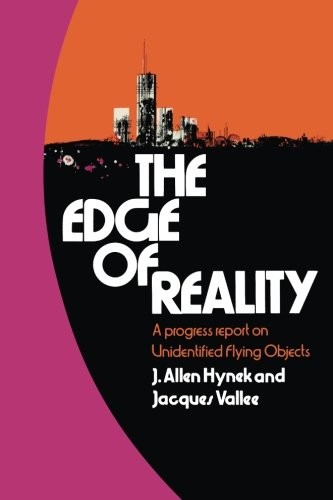
As an Amazon Associate, OverClassified may earn from qualifying purchases made through this link, at no extra cost to you.
Why This Is Essential Reading
The Edge of Reality earns its place on this list not as either man's best-argued book — by its own authors' admission, and by its critics' sharper complaint, it is looser with evidence and less resolved in its conclusions than The UFO Experience or The Invisible College — but as the one document on this site that captures Hynek and Vallée actually disagreeing with each other in real time, on tape, at the exact moment their still-forming ideas about a control system, a psychic residue, and the limits of the extraterrestrial hypothesis were becoming the field's next serious framework. Read against the Zetetic exchange it later provoked, in which both authors defended themselves in their own words against a detailed, largely accurate list of factual errors, the book reads less like a finished scientific report and more like exactly what its subtitle says it is: a progress report, filed in public, with its own authors' disagreements left legible rather than edited out.
Related Cases & Theories
Essential Viewing
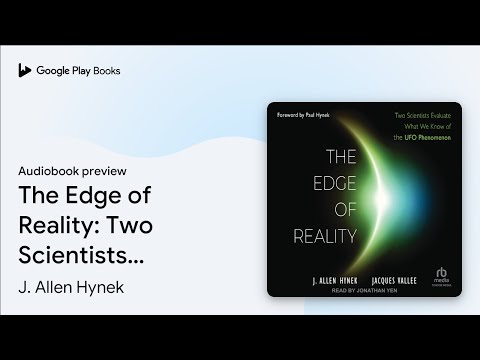
The Edge of Reality: Two Scientists Evaluate What We Know of the UFO Phenomenon — Audiobook Preview
Google Play Books — An official audiobook preview of the 2023 MUFON reissue of this exact book, verified via YouTube oEmbed before inclusion — a direct, publisher-sourced introduction to the text itself.
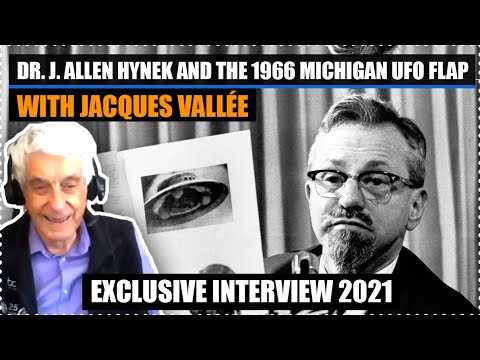
Dr. J. Allen Hynek and the 1966 Michigan UFO Flap with Jacques Vallée | Exclusive 2021 Interview
Rob Freeman UFO World Explorer — Jacques Vallée discussing his working relationship and history with Hynek directly, including the Michigan wave this book's own conversations return to nine years later. Verified via YouTube oEmbed before inclusion.
Sources Cited
- Hynek, J. Allen, and Jacques Vallée. The Edge of Reality: A Progress Report on Unidentified Flying Objects. Henry Regnery Co., Chicago, 1975 (hardcover ISBN 0809282097 / 9780809282098; paperback ISBN 0809281503 / 9780809281503, cited here). amazon.com
- "The Edge of reality: a progress report on Unidentified Flying Objects." Open Library edition record (publisher, page count xv+301, LCCN 75013226, OCLC 1529258, subject classification). openlibrary.org
- "The edge of reality: a progress report on Unidentified Flying Objects." Internet Archive (full scanned first edition). archive.org
- "The edge of reality." Internet Archive (edition crediting Hynek, Vallée, and moderator Arthur C. Hastings; description of the book's three-way transcribed-conversation format). archive.org
- Sheaffer, Robert. Review of The Edge of Reality and The Invisible College, with published replies from J. Allen Hynek and Jacques Vallée and a further reply from Sheaffer. The Zetetic, Spring/Summer 1977, pp. 72–80 (fact-check citations, direct quotations, and the full four-way exchange cited throughout this article). skepticalinquirer.org
- "The Edge of Reality: A Progress Report on Unidentified Flying Objects." Goodreads (aggregate rating, review count, and reader-review quotes on the book's transcribed-dialogue format). goodreads.com
- "The Edge of Reality: Two Scientists Evaluate What We Know of the UFO Phenomenon." MUFON / Wellington Square Books listing (2023 reissue publication details, retitling, and Paul Hynek foreword). wellingtonsquarebooks.com
- "The Edge of Reality Audiobook." Audible (2023 audiobook edition narrated by Jonathan Yen, foreword by Paul Hynek). audible.com
- "J. Allen Hynek." Wikipedia (biography, CUFOS founding, Blue Book career, 1978 United Nations address). en.wikipedia.org
- "Jacques Vallée." Wikipedia (biography, Institute for Plasma Research consulting role, career timeline through the mid-1970s). en.wikipedia.org
- "Center for UFO Studies." Wikipedia (1973 founding with Sherman J. Larsen, Coyne Helicopter Incident as CUFOS's first major case). en.wikipedia.org
- This site's own essential-reading entry: The Invisible College, for Vallée's solo 1975 companion volume and its own sourcing on the mid-1970s SRI parapsychology context and the control-system hypothesis.
- This site's own essential-reading entry: The Hynek UFO Report, for Hynek's 1977 case-by-case audit of the declassified Blue Book archive and its own CUFOS founding history.
- This site's own essential-reading entry: The UFO Experience, for the 1972 book that introduced the Close Encounter classification system referenced throughout this book.
- This site's own key-figures entries: J. Allen Hynek and Jacques Vallée, for both authors' fuller biographies and further case connections.
- This site's own resources library: Full Reading List.
Have corrections, additional research, or peer-reviewed sources? Help improve this entry.
Suggest an Edit