
The Invisible College
What a Group of Scientists Has Discovered About UFO Influence on the Human Race
Core Thesis
The Invisible College opens by naming its own subject matter: a real, informally networked "invisible college" of — in Vallée's own count — "about a hundred" credentialed scientists spread across "five or six countries," borrowing the name seventeenth-century natural philosophers used for their own underground correspondence before the Royal Society existed to make it respectable. From that documentary premise the book pivots almost immediately into Vallée's most openly speculative theoretical territory: the argument, developed at length in its ninth chapter, that the UFO phenomenon behaves less like a fleet of interplanetary visitors and more like a control system — comparable, in his own analogy, to a household thermostat regulating temperature within fixed limits — operating on human belief and behavior across recorded history rather than delivering a single, resolvable physical answer. The book's opening chapter, "The Psychic Component," makes a companion claim Vallée treats as inseparable from the first: that "no theory of UFOs can be deemed acceptable if it does not account for the reported psychic effects produced by these objects" — telepathic communication, psychokinesis, spontaneous healing, and altered states of consciousness reported by witnesses alongside the more familiar lights and craft. To hold those two claims together without collapsing into either believer's certainty or skeptic's dismissal, Vallée proposes what he calls "meta-logic": the idea that a message meant to convey something beyond ordinary language's reach — a UFO encounter's own "deep poetic and paradoxical quality," which he compares to Zen koans — may need to be built out of apparent contradictions rather than resolved into a single tidy statement.
About the Author
Jacques Vallée's fuller biography is covered across this site's other Vallée essential-reading entries; this one stays narrowly on 1975 itself. The Invisible College is the theoretical high-water mark of his career — written a year after Passport to Magonia's folklore argument had already unsettled ufology's extraterrestrial-hypothesis mainstream, and fifteen years before Confrontations would send him back into the field to test any of its claims against a single Brazilian burn case. It is Vallée at his least case-anchored and most explicitly speculative: proposing a mechanism for the phenomenon rather than cataloging or field-verifying one.
Historical Context & Origins
Vallée published The Invisible College in 1975 into a UFO research landscape that had, on paper, already been officially closed: the Air Force-commissioned Condon Report had recommended shuttering Project Blue Book in 1968, and the book's own "Triple Coverup" chapters revisit that closure directly, arguing the report's own data did not support its public conclusion. The informal scientific network the book takes its title from was not a rhetorical flourish; Vallée had been a working member of it for years, consulting since 1970 for Stanford physicist Peter Sturrock's Institute for Plasma Research, and remaining a close colleague of J. Allen Hynek, who had founded the Center for UFO Studies at Northwestern University two years earlier, in 1973, with insurance executive Sherman Larsen. Neither institution is identical to the roughly hundred-scientist "invisible college" Vallée describes in the book's opening pages, but both are the real, verifiable evidence that such a network existed and that Vallée sat inside it.
The book also landed in the middle of a genuine, concurrent boom in mainstream scientific parapsychology, which is what makes its "Psychic Component" opening chapter something other than free-floating speculation. In late 1972, former Apollo 14 astronaut and Institute of Noetic Sciences founder Edgar Mitchell personally arranged for Israeli performer Uri Geller to be tested at the Stanford Research Institute by laser physicists Harold Puthoff and Russell Targ, producing a controversial 1974 Nature paper on Geller's apparent perceptual abilities; the same Uri Geller, and the same laboratory-adjacent scientific interest in him, appears directly in Vallée's book three years later. Mitchell's own promotional blurb for The Invisible College — "not only are UFOs and psychic events inextricably linked, as Dr. Vallée so nicely points out, but neither can be understood without an appreciation of the role of myth, tradition, and belief system" — is not incidental praise from an unrelated public figure; it is one node of the same small, real, mid-1970s network connecting UFO research to consciousness research the book describes, blurbed by a man who had personally helped bring that connection into a physics laboratory.
That same mid-decade moment supplied the book's other notable jacket endorsement, from novelist and countercultural theorist Robert Anton Wilson, whose own conspiracy-and-consciousness novel Illuminatus! reached print the same year; Wilson called the book "unlike any other UFO book ever written," praising Vallée for questioning "what everybody else takes for granted" and drenching readers "with data that doesn't 'fit' any of the theories" — a description that doubles, fairly, as a description of the countercultural, boundary-crossing intellectual moment the book itself belongs to.
The term "invisible college" the book borrows predates Vallée by three centuries: it names the loose, often clandestine network of mid-seventeenth-century English natural philosophers — working, in an era when unorthodox scientific inquiry could draw real social suspicion, largely outside formal institutions — whose informal correspondence and meetings eventually formalized into the Royal Society when Charles II granted it a charter in 1662. Vallée's and Hynek's own half-joking adoption of the name for their UFO-research network was a deliberate historical claim: that serious, credentialed people investigating an institutionally unwelcome subject outside official channels were repeating a specific, respectable scientific precedent rather than behaving like cranks.
Core Arguments & Key Concepts
The book's central theoretical proposal, laid out most explicitly in its ninth chapter, is the control-system hypothesis: "I believe that when we speak of UFO sightings as instances of space visitations we are looking at the phenomenon on the wrong level. We are not dealing with successive waves of visitations from space. We are dealing with a control system." Vallée's own illustrative analogy is deliberately mundane — a household thermostat, which does not deliver one final answer about the temperature but continuously regulates it within limits — and he offers the model, elsewhere in his own account of the book, as one that can actually be tested against data, distinguishing it in his own mind from an untestable article of faith. The claim is not that UFOs are unreal; it is that treating each sighting as a discrete visitation event misses a longer-timescale regulatory pattern operating on "man's consciousness needs" as they evolve against "the evolving complexities of the world which he must understand."
The opening chapter, "The Psychic Component," makes the book's second load-bearing claim: that witness reports of telepathic "messages," psychokinetic effects resembling poltergeist activity, out-of-body experience, spontaneous physiological healing, and lasting personality change cluster around close encounters too consistently to be filtered out as noise before a "real" signal can be found underneath. Vallée's own case material for this argument — the pseudonymous French physician he calls "Dr. X," whose reported old war wound and subsequent skin markings and levitation episodes follow a 1968 sighting; a student he calls "the Engineer," who reported eighteen days of missing time, the loss of any need for sleep, and claimed new psychokinetic ability after a 1961 encounter — is presented with the same evidentiary caution the book applies throughout: offered as reported testimony worth taking seriously as data, not as confirmed physical fact.
"Meta-logic" is Vallée's proposed framework for holding the book's control-system and psychic claims together without forcing either into ordinary yes/no verification. In his own formulation: "If you strive to convey a truth that lies beyond the semantic level made possible by your audience's language, you must construct apparent contradictions in terms of ordinary meaning." Vallée compares the UFO phenomenon's persistent absurdity and internal contradiction — contactee messages that dissolve under scrutiny, symbols that mean nothing decodable, witnesses who report events that cannot both be literally true — to the deliberate paradox of a Zen koan: content whose apparent nonsense is not a flaw to be debunked but potentially a structural feature of how the phenomenon communicates at all.
The book's "Triple Coverup" chapters extend an argument this site's own Book of the Damned entry traces back to Charles Fort's 1919 vocabulary of institutionally "excluded" data: Vallée describes three overlapping layers of suppression — official discouragement of witness reporting, the outright physical destruction of anomalous data by embarrassed scientists and institutions, and a media ridicule cycle that makes the first two layers self-reinforcing — and argues the 1968 Condon Report's own underlying case data did not actually support the dismissive public conclusion drawn from it. Where Fort's version of this argument was about frogs and unexplained lights, Vallée's is about flying saucers and, more pointedly, about a scientific establishment he accuses of destroying its own tracking-tape evidence rather than risk institutional embarrassment — the same formative 1961 Paris Observatory episode this site's own Passport to Magonia entry documents as the origin of Vallée's distrust of institutional science.
Key Cases & Evidence Discussed
The Delphos Ring Sighting (Case File #067, 1971) is discussed directly in the book's opening chapter, within roughly four years of the Kansas event itself — Vallée's own casework on the Ronald Johnson sighting and its hydrophobic soil ring predates by decades the site's own case file's account of the Faruk and Budinger chemical analyses, but the underlying incident is the same one this site documents at length, and its early inclusion in The Invisible College is part of why Delphos became, and remains, one of ufology's most laboratory-scrutinized physical-trace cases.
"Dr. X," the pseudonymous French physician whose 1968 close encounter and subsequent reported skin markings, old-wound healing, and levitation episodes anchor the book's "Psychic Component" chapter, and "the Engineer," the pseudonymous 1961 abductee whose reported missing time and psychokinetic aftereffects appear in the same chapter, have no dedicated case file on this site; both are reported here honestly as book-internal testimony rather than independently verified incidents, consistent with how this entry treats all of the book's psychic-effects case material.
The book's discussion of Israeli performer Uri Geller, tested that same period at the Stanford Research Institute by physicists Harold Puthoff and Russell Targ in an experiment Edgar Mitchell personally arranged, is Vallée's most direct real-world link between his psychic-component argument and the actual, laboratory-adjacent parapsychology research of the period; Vallée's own stated position, discussed further below, was considerably more reserved than either Geller's admirers or the SRI team's published conclusions, explicitly declining to treat Geller as evidence of benign extraterrestrial contact.
The book's treatment of the Piedmont Missouri Wave (Case File #152, 1973) is the clearest example on this site of the book functioning as a critical, rather than credulous, document: Vallée dismisses physicist Harley Rutledge's field investigation outright as the work of "a confused local scientist," specifically over Rutledge's handling of the Eddie Webb eyeglasses incident — a judgment this site's own Piedmont case file quotes directly and treats as an example of one serious researcher dismissing another's specific call without engaging his broader multi-year field record.
Critical Reception & Controversies
Trade reception at publication leaned on endorsements from figures adjacent to, rather than embedded within, mainstream ufology. Novelist and countercultural theorist Robert Anton Wilson called it "unlike any other UFO book ever written"; former Apollo 14 astronaut Edgar Mitchell called it "an important book" specifically for linking UFO and psychic phenomena; and novelist Colin Wilson — whose blunter later assessment of Charles Fort's prose this site's own Book of the Damned entry documents — called it "certainly one of the most interesting, thought-provoking books so far written on UFOs."
The book's most substantive contemporary critical engagement came from Robert Sheaffer, reviewing it for The Zetetic (the journal that became Skeptical Inquirer) in 1977. Sheaffer read Vallée's "meta-logic" concept as, in practice, a synonym for "absurd" that let Vallée present claims as "not precisely true, but certainly not false either" — a framework Sheaffer argued abandoned falsifiability altogether, warning that adopting Vallée's methodology generally "would mean the end of experimental science," since nothing could be definitively proven or disproven under it. Sheaffer's review treated the book's embrace of psychic and paranormal material specifically as a retreat from the more empirical, source-checking posture of Vallée's own earlier work.
That specific criticism has drawn a direct rebuttal decades later: literary scholar Bryan Sentes, writing in 2022, argued Sheaffer's reading collapses a more careful argument than Sheaffer credits Vallée with making. Drawing on Roland Barthes's Mythologies, Sentes reads Vallée's meta-logic not as a claim that UFO reports are simply absurd, but as an argument that they function like myth or metaphor — carrying literal surface content (the "vehicle") and a separate, deeper significance (the "tenor") simultaneously — concluding that while Vallée's own prose expressing the idea is "clumsy," a textually fair reading finds a genuinely more sophisticated argument underneath than Sheaffer's dismissal allows.
A separate, more concrete critical thread runs through this site's own research into the book's case-by-case judgment calls specifically: this site's Piedmont Missouri Wave case file finds Vallée's own dismissal of Harley Rutledge as "a confused local scientist" leaned heavily on media coverage of a single disputed flare-reproduction test and did not fully engage Rutledge's considerably more extensive, multi-year field record — a specific instance, this entry notes honestly, of the book's own confident critical voice landing on a fellow field researcher without the full context that researcher's own defenders would supply.
Influence & Legacy
The clearest, most directly traceable line from this book to this site's own library runs through its title phrase itself: religious-studies scholar Diana Walsh Pasulka's American Cosmic (2019) documents a present-day network of credentialed scientists and engineers who, in Pasulka's own account, explicitly call themselves an "Invisible College" — the same term, used the same way, that Vallée and Hynek coined for their own network four decades earlier. Jacques Vallée appears in Pasulka's book as a real, named interview subject and, by her account, a continuing member of that network, making this site's American Cosmic entry not a thematic echo of this book but a direct, documented continuation of the specific institution it describes.
This site's Intimate Alien entry, David J. Halperin's 2020 argument that the UFO abduction experience is best understood as "a religious event, an experience of the numinous," arrives at a conclusion this book reached first and more speculatively forty-five years earlier: the claim, stated outright in this book's opening chapter, that UFO phenomena cannot be separated from "the role of myth, tradition, and belief system," in Edgar Mitchell's own phrase for it. Where Halperin brings two decades of training in Jewish mysticism and biblical visionary literature to that argument, Vallée arrived at the same territory from an astronomer and computer scientist's more improvisational theorizing — the same underlying instinct, tested by two very differently credentialed researchers four and a half decades apart.
Within Vallée's own bibliography, this book is the theoretical seed of everything this site's Confrontations entry documents being tested fifteen years later: the control-system hypothesis proposed here in the abstract is the same framework Confrontations carries into forty individually investigated close-encounter sites, including the Brazilian injury cases this site's own Colares case file discusses. This site's Interdimensional Hypothesis theory file (IDH-001) and Egregore & Collective Thoughtform Hypothesis theory file (ECT-001) both cite this book directly as the control-system model's origin point, with the Egregore file drawing the specific distinction this site's own Vallée key-figures entry insists on: Vallée's model requires a deliberate external intelligence using the phenomenon as a tool, which is a different claim from the Egregore file's own question of whether sufficiently intense collective belief could generate the phenomenon with no outside agent at all.
The "Invisible College" name has taken on a further, more informal life within this site's own case-file library specifically: this site's Chris Bledsoe and T. Townsend Brown case files both use the phrase as a working name for a present-day informal circle of aerospace and intelligence-adjacent researchers and insiders — a colloquial afterlife of Vallée's 1975 title that this entry notes as evidence of how far the specific phrase, if not always the specific theory behind it, has traveled through UFO-research culture over the following half-century.
The Book

The Invisible College
What a Group of Scientists Has Discovered About UFO Influence on the Human Race
Find on Amazon →As an Amazon Associate, OverClassified may earn from qualifying purchases made through this link, at no extra cost to you.
Why This Is Essential Reading
The Invisible College earns its place on this list as the one Vallée book on this site that is argument rather than archive: not Wonders in the Sky's five-hundred-case historiography, not Passport to Magonia's folklore catalog, not Confrontations's forty individually investigated field sites, but the single moment in Vallée's long bibliography where he set case-by-case verification aside and proposed, in his own words, that the phenomenon might be "a control system" — then, in the same book, insisted that no theory of it could be credible without accounting for the telepathy, healing, and altered consciousness witnesses kept reporting alongside the lights. That combination drew a real, substantive skeptical rebuttal from Robert Sheaffer at the time, and a real, substantive scholarly defense of the underlying "meta-logic" concept decades later — a genuine, still-unresolved argument rather than a settled verdict either way. What is settled, on this site's own evidence, is the book's afterlife: its title is the actual working name Diana Walsh Pasulka's American Cosmic subjects still use for themselves forty years later, and its central instinct — that the UFO experience is inseparable from myth, belief, and the numinous — is the same instinct David Halperin's Intimate Alien arrives at independently from an entirely different scholarly discipline. Read against those two later books, this 1975 text looks less like a speculative detour in Vallée's career and more like the moment he said, plainly and fifteen years before he tried to prove it in the field, what he actually thought the phenomenon was.
Related Cases & Theories
Essential Viewing
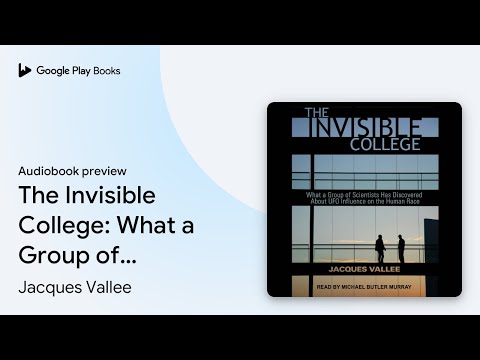
The Invisible College: What a Group of Scientists Has Discovered About UFO Influence on the Human Race
Google Play Books — An official audiobook preview of this exact book, verified via YouTube oEmbed before inclusion — a direct, publisher-sourced introduction to the text itself rather than secondary commentary on it.
Jacques Vallée on the Spiritual Side of UFO Phenomena
Ashrams of India — Vallée discussing the religious and spiritual dimension of UFO encounters directly, the same territory this book's "Psychic Component" chapter and meta-logic concept first staked out in 1975, verified via YouTube oEmbed before inclusion.
Sources Cited
- Vallée, Jacques. The Invisible College: What a Group of Scientists Has Discovered About UFO Influence on the Human Race. E.P. Dutton & Co., 1975; this edition Anomalist Books, 2014 (ISBN-13 9781938398278, paperback reissue). amazon.com
- "The Invisible College." Open Library edition record (original 1975 E.P. Dutton hardcover, ISBN 0525134700 / 9780525134701, 216 pp.). openlibrary.org
- "Jacques Vallée." Wikipedia (biography, career timeline 1969–1975, Institute for Plasma Research consulting role, bibliography). en.wikipedia.org
- The Invisible College, full OCR text (2014 Anomalist Books edition). Internet Archive (verification of table of contents, "invisible college" definition, control-system and meta-logic quotations, and named case material). archive.org
- Sheaffer, Robert. "Jacques Vallee's 'Invisible College' Teaches 'Metalogic.'" Bad UFOs (blog), reproducing Sheaffer's 1977 Zetetic review (bibliographic details, "metalogic"/"absurd" critique, "end of experimental science" quotation). badufos.blogspot.com
- Sentes, Bryan. "Point of order: meta-logic in Jacques Vallée's The Invisible College." Skunkworks (blog), March 2022 (rebuttal to Sheaffer via Roland Barthes's Mythologies; "vehicle"/"tenor" reading of meta-logic). skunkworksblog.com
- "THE INVISIBLE COLLEGE: What a Group of Scientists Has Discovered about UFO Influence on the Human Race." Book Soup listing (jacket endorsement quotations from Robert Anton Wilson, Edgar Mitchell, and Colin Wilson). booksoup.com
- "The Invisible College." Goodreads (edition data, reader rating distribution, reception summary). goodreads.com
- "Experiments with Uri Geller at Stanford Research Institute (SRI), 4–11 August 1973." Remoteviewed.com (Edgar Mitchell's role arranging Geller's 1972 SRI visit; Puthoff and Targ's testing and 1974 Nature paper). remoteviewed.com
- "Invisible College." Wikipedia (17th-century historical origin of the term; Royal Society precursor network; 1662 royal charter). en.wikipedia.org
- "Center for UFO Studies." Wikipedia (J. Allen Hynek's 1973 founding of CUFOS with Sherman Larsen at Northwestern University). en.wikipedia.org
- This site's own case file: The Delphos Ring Sighting (Case File #067), the 1971 Kansas case this book discusses directly in its opening chapter.
- This site's own case file: Piedmont Missouri Wave (Case File #152), which quotes this book's own dismissal of Harley Rutledge as "a confused local scientist."
- This site's own essential-reading entry: American Cosmic, documenting the present-day "Invisible College" network this book's title names.
- This site's own essential-reading entry: Intimate Alien, David Halperin's independently developed argument for the UFO experience as a religious/numinous phenomenon.
- This site's own essential-reading entry: Confrontations, Vallée's 1990 field test of the control-system hypothesis this book first proposes.
- This site's own theory file: The Interdimensional Hypothesis (IDH-001), which credits this book's 1975 publication as a milestone in the framework's development.
- This site's own theory file: The Egregore & Collective Thoughtform Hypothesis (ECT-001), for its explicit distinction from this book's external-intelligence control-system model.
- This site's own key-figures entry: Jacques Vallée, for his broader career background and the control-system model's place in his wider body of work.
- This site's own resources library: Full Reading List, where this title is cited on this site's Interdimensional Hypothesis theory page.
Have corrections, additional research, or peer-reviewed sources? Help improve this entry.
Suggest an Edit