
The Book of the Damned
A Catalog of the Data Science Excluded
Core Thesis
The Book of the Damned is not, and never claims to be, a book about flying saucers or spacecraft — the phrase "flying saucer" was still twenty-eight years from existing when Charles Fort finished it, and "UFO" itself was three decades away. It is a deliberately abrasive argument that organized science manufactures its own blind spots: that reports of frog and fish falls, mysterious lights, unexplained noises, and out-of-place objects get quietly excluded from the scientific record not because the underlying observations are worthless, but because they do not fit whatever theoretical furniture a given era of science has already decided to keep. Fort called this excluded material "the damned" — "data that Science has excluded," in his own opening line — and spent roughly a decade cross-referencing newspaper clippings, scientific-journal notices, and historical records at the New York Public Library to assemble a single, sprawling "procession" of it, offered not as proof of any one alternative theory but as evidence that the line between "explained" and "unexplained" is drawn by institutional convenience rather than by the data itself. Where the book matters to this site is not its content, which barely touches anything resembling a modern UFO case, but its method and its vocabulary: "the damned," the adjective "Fortean," and the basic practice of treating dismissed, unclassifiable reports as a legitimate archive rather than noise to be forgotten became the direct working premise of later researchers this site covers at length, from Jacques Vallée to John Keel.
About the Author
Charles Hoy Fort was born August 6, 1874, in Albany, New York, into a Dutch-American family; his father, a grocer, ran a strict, physically punishing household that Fort later wrote left him with a lasting distrust of authority and institutions of every kind — scientific ones included. A curious, largely self-educated boy who dreamed of becoming a naturalist and collected shells, minerals, and birds, Fort left school early, became a newspaper journalist at seventeen, and at eighteen set out on a world tour through the American West, Scotland, and England before illness in southern Africa cut the trip short. Back in New York, childhood acquaintance Anna Filing nursed him through the aftermath, and the two married on October 26, 1896, settling into a long stretch of poverty in the Bronx while Fort sold occasional feature stories and worked a series of unremarkable day jobs. He wrote roughly ten novels in this period; only one, the tenement story The Outcast Manufacturers (1909), found a publisher, and reviews were respectful but sales were not.
The turning point was financial rather than literary. An inheritance from his uncle Frank A. Fort in 1916, followed by a further sum from his brother Clarence's estate the next year, gave Fort enough independence to abandon day jobs entirely and pursue, full time, a private research habit he had actually begun a decade earlier, in 1906: collecting newspaper and scientific-journal reports of phenomena that had been noted, briefly disputed, and then dropped without explanation. For roughly three decades he worked this material almost daily, first at the New York Public Library's Fifth Avenue main branch and later, during stretches of the 1920s, in the British Museum's Reading Room in London, filling shoeboxes with notes on cramped scraps of paper — by his own joking account, tens of thousands of them, some blown away and lost, without much apparent grief on his part. Before The Book of the Damned found a publisher, Fort had already drafted and then burned two earlier manuscripts, titled simply "X" and "Y," after failing to place them; the surviving book that finally reached print in 1919 was, by his own account, a third attempt at organizing the same underlying archive.
Fort published three further books drawn from the same lifelong note-collecting practice — New Lands (1923), with a foreword by novelist Booth Tarkington; Lo! (1931); and Wild Talents, whose advance copies his publisher delivered to him on the same day, May 3, 1932, that Fort collapsed and died at a Bronx hospital, probably of leukemia, at fifty-seven. He had resisted doctors for some time, prioritizing the manuscript's completion over his own declining health and eyesight. Across all four books he coined or popularized terms — "teleportation" among them — and floated ideas, including an early hypothesis that some anomalous human appearances might reflect something like alien abduction, that predate the vocabulary later ufology would use for the same territory by decades. Fort insisted throughout that none of it was meant to be believed outright: "I believe nothing of my own that I have ever written," he wrote, treating his proposed explanations less as claims than as demonstrations that alternative readings of the same excluded data were just as defensible as the scientific dismissals that had buried it in the first place.
Historical Context & Origins
The Book of the Damned arrived into a publishing landscape shaped almost entirely by one relationship: Fort's friendship with novelist Theodore Dreiser, who had praised Fort's early short fiction as "the best humorous short stories that I have ever seen produced in America" and who, after reading the anomaly manuscript Fort had been quietly compiling for years, shopped it to publishers on his behalf. When it was repeatedly turned down, Dreiser reportedly forced the issue with his own publisher, Boni & Liveright, threatening to leave the house himself if it declined the book. The Book of the Damned was published December 1, 1919 — delayed from an original October date by printer strikes — priced at one dollar, and sold well enough to reach a second printing within two months.
The book landed in a cultural moment with no ready category for it. Modern ufology did not exist in any form: Kenneth Arnold's sighting near Mount Rainier, the event this site and most histories of the field treat as the effective birth of the flying-saucer era, was still twenty-eight years away, and the U.S. Air Force term "unidentified flying object" wouldn't be coined for another three decades after that. Fort was writing squarely within, and directly against, the confident scientific positivism of the late 1910s — a period in which Einstein's relativity was still working its way into public understanding and Darwinian evolution, Newtonian mechanics, and Euclidean geometry stood as settled, largely unquestioned pillars of respectable thought. Fort's targets in the book are exactly those pillars, attacked not with competing data but with a running demonstration that the era's own scientific journals had already published, and then quietly abandoned, hundreds of reports that didn't fit them.
Contemporary reviewers had no existing shelf to file the book on, and their reactions reflect that: bafflement, delight, and serious engagement in roughly equal measure, rather than the more predictable science-versus-pseudoscience split later decades would apply retroactively. That reception, discussed in full below, is itself a piece of the book's historical significance — it was read, on first publication, as a strange and possibly important work of general nonfiction rather than as a text belonging to any recognizable genre of paranormal or fringe writing, simply because no such genre, in the form later readers would know it, existed yet for it to belong to.
Core Arguments & Key Concepts
The book's organizing concept is stated in its opening lines: "A procession of the damned. By the damned, I mean the excluded. We shall have a procession of data that Science has excluded." Fort's argument is not that science is wrong about any specific settled question, but that the category boundary between "scientific fact" and "discarded anomaly" is maintained by institutional habit rather than by any principled test applied consistently to all the evidence. He calls the philosophy underlying this position "intermediatism": the claim that "nothing is real, but that nothing is unreal either," and that all phenomena, including the ones science confidently accepts, occupy a shifting middle ground between fully explained and fully mysterious. Read this way, the book's real subject is not any individual rain of fish or unexplained light but the sociology of how a discipline decides, case by case, what counts as worth explaining at all.
Structurally, the book alternates dense strings of specific, dated, sourced anomaly reports with lengthy digressive essays attacking the era's dominant scientific theories, written in a style contemporaries and later critics alike have called strange, funny, and often genuinely difficult to follow. Fort's best-known individual concept from the book is the "Super-Sargasso Sea," introduced in Chapter 8: a proposed stationary region high above Earth, functioning as a kind of atmospheric junkyard where "derelicts, rubbish, old cargoes from inter-planetary wrecks" collect and occasionally fall back to the surface during storms, offered as one possible account for the book's many reports of fish, frogs, and unidentified matter dropping from clear or storm-darkened skies. Fort does not argue for the Super-Sargasso Sea as literal fact; he offers it explicitly as no less plausible than the conventional explanations scientific journals themselves had failed to settle on for the same reports.
The book's most quoted single passage anticipates, without naming, ideas that would become central to modern ufology decades later: "I think we're property," Fort writes. "I should say we belong to something: That once upon a time, this earth was No-man's Land, that other worlds explored and colonized here, and fought among themselves for possession, but that now it's owned by something: That something owns this earth — all others warned off." Written in 1919, with no flying saucers, no extraterrestrial-hypothesis literature, and no Roswell to draw on, the passage is frequently cited by later historians as one of the earliest published statements of a control-and-ownership framework for anomalous phenomena — territory Jacques Vallée and John Keel would each independently return to, in very different forms, half a century later.
Fort's method throughout is source-first in a way that anticipates later Fortean historiography directly: each report is dated and attributed to a specific scientific journal, newspaper, or society transaction, with Fort frequently quoting the original document's own uncertainty or internal disagreement rather than asserting a conclusion of his own. That discipline — citing the actual document, flagging where authorities disagreed, and refusing to resolve the case for the reader — is the same discipline this site's own Wonders in the Sky entry credits Jacques Vallée and Chris Aubeck with applying to pre-modern aerial phenomena nine decades later; that book's own foreword explicitly situates its authors' approach within "Charles Fort's and Thomas Kuhn's broader arguments about how anomalous data gets treated by disciplines unprepared to classify it."
Key Cases & Evidence Discussed
Because The Book of the Damned predates the case-file structure modern ufology and this site both use by decades, its "cases" are not investigations in the site's usual sense — they are individually sourced newspaper and journal reports Fort assembled by the hundred, none of them UFO cases in the post-1947 sense, and none of them presently the subject of a case file on this site. The book's most frequently cited single example is the Kentucky flesh shower of March 3, 1876: at Olympian Springs in Bath County, Kentucky, "flakes of a substance that looked like beef fell from the sky — 'from a clear sky,'" as Fort quotes the original report, over a roughly 100-by-50-yard area. Fort's real interest was not the meat itself but the era's own scientific disagreement about it: he notes chemist Leopold Brandeis identified the substance as nostoc (a cyanobacteria sometimes mistaken for fallen matter after rain), while "Prof. Lawrence Smith, of Kentucky" argued instead for "'dried' spawn of some reptile, 'doubtless of the frog'" — two credentialed authorities publishing incompatible explanations for the same physical sample, exactly the kind of institutional inconsistency Fort's whole project was built to expose.
Beyond that single well-documented example, the book's hundreds of other entries range across mysterious aerial lights and unexplained sky phenomena, "thunderstones" reportedly found after lightning strikes, poltergeist activity, and reports of disappearances, cataloged with dates and source citations rather than woven into any single narrative case. None of these individual reports maps directly onto a case this site currently documents, since Fort's raw material predates the aviation-era framework (airships, then aircraft, then flying saucers) within which this site's own case files are organized.
What the book does connect to directly, and verifiably, is two of this site's own case files through their own further-reading citations rather than through anything Fort personally investigated: the Bonilla Solar Transit Photographs (Case File #219, 1883), observed from the Zacatecas Observatory in Mexico, and the Maracaibo UFO Sighting (Case File #055, 1886) both cite this exact edition of The Book of the Damned as essential background — not because Fort wrote about either specific case, but because both are precisely the genre of 19th-century scientific-journal anomaly report the book's method was built to collect and legitimize, and because Fort's own project is the direct ancestor of the case-preservation instinct this site's own library shares.
The book's more durable legacy in ufological case literature is indirect: it supplied the method rather than the cases. Passport to Magonia (1969) and Operation Trojan Horse (1970) — both already covered at length on this site — are the works that actually did the case-by-case work of applying Fort's excluded-data framework to modern sighting reports and older folklore respectively, discussed in the Influence & Legacy section below.
Critical Reception & Controversies
Reviews on first publication were mixed in tone but largely serious in engagement, and notably free of the dismissive "crank literature" framing later decades would apply. Maverick journalist Benjamin DeCasseres wrote that reading the book left him "more and more conscious of the fact that I was in the presence of a genius who, if he has hit a bull's eye in his overwhelming deductions, will easily jostle Euclid, Columbus and Darwin off their pedestals." Novelist and future Pulitzer winner Booth Tarkington, reading the book while laid up with influenza, called Fort a "magnificent nut, with Poe and Blake and Cagliostro and St. John trailing way behind," and reportedly demanded to know "who in the name of frenzy is Charles Fort?" Ben Hecht, reviewing for the Chicago Daily News, went furthest of all, describing Fort as "an inspired clown who, to the accompaniment of a gigantic snare drum, has bounded into the arena of science," and joking that "for every five people who read this book four will go insane." The Philadelphia Inquirer called it simply "one of the most amazing books ever issued," and Dreiser himself, whose advocacy had gotten the book published at all, wrote to a friend, "To me he is simply stupendous."
Later, more skeptically minded critics have been considerably less generous about the book's actual argumentative rigor. Science writer Martin Gardner, in his influential 1952 skeptical survey Fads and Fallacies in the Name of Science, grouped Fort's work among the era's pseudoscientific enthusiasms, treating his anomaly-collecting as long on provocative anecdote and short on any verifiable positive theory — a criticism consistent with Fort's own repeated insistence that he did not actually believe his own proposed explanations, which skeptics have read either as intellectual honesty or as a convenient way to make untestable claims immune to refutation. Novelist and philosopher Colin Wilson, writing decades later, was blunter still about the prose itself, calling it "atrocious" and "almost unreadable" while still conceding that "the facts are certainly astonishing enough" to justify the book's ongoing readership despite its difficulty.
The most substantive modern critical engagement with the book's actual source material is recent and specifically ufological: Martin Shough and Wim van Utrecht's Redemption of the Damned, Vol. 1: Aerial Phenomena (2019), published in the book's own centennial year, goes back to Fort's original 19th-century sources for his aerial-phenomena reports and re-examines each one at far greater length than Fort's own often single-paragraph treatment, using modern astronomical and meteorological knowledge unavailable to Fort himself. Reviewers in Fortean and ufological circles have praised the project's rigor as essential reading for anyone investigating historical aerial anomalies, treating it as a serious act of source verification applied retroactively to material Fort himself never had the tools or the inclination to resolve.
A separate, more diffuse strand of reception concerns Fort's own sincerity: biographers and critics remain genuinely divided over whether he believed any of his proposed alternative explanations, or treated the entire project as a deliberate performance meant to demonstrate that science's own confidence was itself unearned. Both of the standard full-length biographies — Damon Knight's Charles Fort: Prophet of the Unexplained (1970) and Jim Steinmeyer's Charles Fort: The Man Who Invented the Supernatural (2008) — treat this ambiguity as central to Fort's character rather than as a question either can fully resolve, which is itself a fair summary of how the book's critical reception has run for over a century: admired for its provocation, distrusted for its method, and never quite settled either way.
Influence & Legacy
The book's most concrete legacy is linguistic and institutional rather than argumentative: it produced the word "Fortean." Friends including Theodore Dreiser, Ben Hecht, Booth Tarkington, Alexander Woollcott, and H. L. Mencken founded the Fortean Society on January 26, 1931, at a meeting at New York's Savoy-Plaza Hotel, specifically to promote Fort's work; Dreiser served as its first president. Fort himself, lured to the inaugural meeting under somewhat misleading circumstances, refused the presidency offered to him, objecting on principle to becoming an authority figure for a movement built around distrusting authority figures, and worried openly that a formal society would attract believers and "zealots" rather than the critical, source-checking temperament his own books modeled. Novelist Tiffany Thayer, who took over running the Society and its newsletter Doubt after Fort's death and continued until his own in 1959, is generally credited with coining "Fortean" as the adjective describing Fort's whole approach to anomalous data — a term that outlived both Fort and the Society itself.
That vocabulary became a durable publishing category. Fortean Times, founded by Bob Rickard in November 1973 (originally titled The News, renamed in June 1976) and still published today, exists explicitly "to continue the work of Charles Fort," and remains the field's standing reference point for anomaly reporting done in Fort's own source-first spirit — the same magazine this site's own UFO Encyclopedia entry cites via co-founder Bob Rickard's own review blurb, and the same tradition The Mothman Prophecies entry situates John Keel's demonological framework inside, via David Clarke's essay collection Damned Facts: Fortean Essays on Religion, Folklore and the Paranormal.
The clearest, most direct line from this book to the UFO researchers this site covers most extensively runs through two specific titles already in this library. Jacques Vallée's Passport to Magonia (1969) explicitly extends Fort's practice of treating anomalous reports as a legitimate historical archive into the specific claim that modern UFO sightings share deep structural continuity with older folklore — fairies, angels, aerial ships — a project this site's own Wonders in the Sky entry, co-written by Vallée four decades later, still explicitly traces back to "Charles Fort's and Thomas Kuhn's broader arguments about how anomalous data gets treated." John Keel's Operation Trojan Horse (1970) sits even closer to Fort directly: this site's own data classification for that book files its genre as "Forteana / Ultraterrestrial Theory," and Keel's ultraterrestrial framework — non-human intelligences working through psychological and mythological masks rather than literal spacecraft — reads as a direct methodological descendant of Fort's own refusal to force anomalous data into any single tidy explanation.
The influence runs beyond ufology proper into weird fiction as well: this site's own The Cult of Alien Gods entry documents that H. P. Lovecraft is independently known to have read The Book of the Damned, and that Fort's catalog of unexplained anomalies sits alongside Theosophy and pulp scientific romance as one of the real, checkable sources behind Lovecraft's cosmic-horror mythology — a reminder that Fort's reach extended well past the anomaly-research community that eventually named itself after him.
More broadly, the book helped establish anomalistics as a subject at all: religious-studies scholars including Jeffrey J. Kripal and Joseph P. Laycock now treat Fort as a foundational figure in defining "the paranormal" as a coherent intellectual category rather than a grab-bag of superstition, and researchers who identify themselves as Forteans — cryptozoologist Loren Coleman and historian Mike Dash among them — continue working the same basic method Fort established in 1919: source the claim, note where authorities disagreed, and resist the urge to resolve it prematurely.
The Book
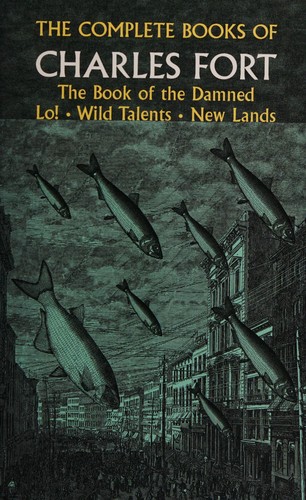
As an Amazon Associate, OverClassified may earn from qualifying purchases made through this link, at no extra cost to you.
Why This Is Essential Reading
The Book of the Damned earns its place on this list for a reason unlike any other title in the Consciousness & High Strangeness category: it is not a UFO book at all, and treating it as one would misrepresent both the book and the man who wrote it. What it actually offers is the founding vocabulary and the founding method for nearly everything on this site that isn't a straightforward government-document case file — the idea that dismissed, unclassifiable, institutionally inconvenient reports deserve to be preserved and cross-checked rather than forgotten, and the term "Fortean" that a century of subsequent researchers, Jacques Vallée and John Keel chief among them, adopted as their own working self-description. Read against this site's own Passport to Magonia and Operation Trojan Horse entries, the debt is not abstract or merely thematic; both books' authors did, explicitly and in their own words, the case-by-case work of applying Fort's excluded-data framework to the specific subject this site exists to document. Fort himself never claimed to have solved anything, and the book's own contemporary and modern critics are right that it resolves almost nothing on its own terms. Its value here is upstream of any single case: it is the argument, made in 1919, decades before there was a UFO phenomenon to have an argument about, that the excluded data was worth keeping in the first place.
Related Cases & Theories
Essential Viewing
Charles Fort: Defining the Anomalous, 1874 - 1932
Think Anomalous — A biographical overview of Charles Fort's life and research method, from his New York Public Library note-collecting to the publication of The Book of the Damned, from the same channel this site cites elsewhere for its own Condon Report coverage. Verified via YouTube oEmbed before inclusion.
Edinburgh Fortean Society: Weird World of Charles Fort
Gordon Rutter — A presentation for the Edinburgh Fortean Society covering Fort's biography and the founding of the Fortean research tradition his name eventually gave to the field. Verified via YouTube oEmbed before inclusion.
Sources Cited
- Fort, Charles. The Book of the Damned. Boni & Liveright, 1919; this edition Indoeuropean Publishing, 2019 (ISBN-13 9781644390986, paperback, matching this site's own resources library citation). amazon.com
- "Charles Fort." Wikipedia (biography: birth, family, career, inheritance, research method, four books, Fortean Society, death). en.wikipedia.org
- "The Book of the Damned." Wikipedia (publication history, structure, "Super-Sargasso Sea," content summary, reception). en.wikipedia.org
- "Strange Gods: Charles Fort's Book of the Damned (1919)." The Public Domain Review (essay: Dreiser's advocacy, Boni & Liveright publication history, contemporary reviews and reviewer quotes). publicdomainreview.org
- Fort, Charles. The Book of the Damned, full text. Project Gutenberg (verification of the book's opening lines and the Kentucky flesh-shower passage). gutenberg.org
- "Fortean Society." Wikipedia (founding January 26, 1931; Dreiser's presidency; Fort's refusal; Tiffany Thayer). en.wikipedia.org
- "Fortean Times." Wikipedia (founding by Bob Rickard, 1973; renamed 1976; ongoing publication). en.wikipedia.org
- "In Praise of the Paranormal Curiosity of Charles Fort, Patron Saint of Cranks." Literary Hub (Colin Wilson's "atrocious"/"almost unreadable" assessment and broader critical reception). lithub.com
- Shough, Martin, with Wim van Utrecht. Redemption of the Damned, Vol. 1: Aerial Phenomena, A Centennial Re-Evaluation of Charles Fort's 'Book of the Damned'. Anomalist Books, 2019 (modern source re-examination of Fort's aerial-phenomena cases). amazon.com
- This site's own resources library: Full Reading List, where this exact edition (ISBN 1644390981) is cited across the Bonilla and Maracaibo case-file pages.
- This site's own case file: Bonilla Solar Transit Photographs (Case File #219), which cites this book as context for 19th-century scientific-culture anomaly reporting.
- This site's own case file: Maracaibo UFO Sighting (Case File #055), which cites this book as the direct ancestor of the anomaly-report genre the case belongs to.
- This site's own Essential Reading entry: Passport to Magonia, for Jacques Vallée's direct extension of Fort's excluded-data method into UFO folklore-continuity.
- This site's own Essential Reading entry: Operation Trojan Horse, for John Keel's own explicitly Fortean ultraterrestrial framework.
- This site's own Essential Reading entry: Wonders in the Sky, whose own foreword situates its source-verification method within "Charles Fort's and Thomas Kuhn's broader arguments."
- This site's own Essential Reading entry: The Cult of Alien Gods, documenting H. P. Lovecraft's independently confirmed reading of this book.
- This site's own key-figures entry: Charles Fort, for his full biography and further case connections.
Have corrections, additional research, or peer-reviewed sources? Help improve this entry.
Suggest an Edit