
The Cult of Alien Gods
H.P. Lovecraft and Extraterrestrial Pop Culture
Core Thesis
The Cult of Alien Gods: H.P. Lovecraft and Extraterrestrial Pop Culture argues that the modern ancient-astronaut hypothesis — the claim that extraterrestrial beings visited Earth in antiquity and were worshipped by early humans as gods — did not originate in any genuine ancient tradition, esoteric scholarship, or suppressed archaeological record, but in the deliberate cosmic-horror fiction of American pulp writer H.P. Lovecraft, principally his 1926 short story "The Call of Cthulhu" and his 1931 novella At the Mountains of Madness, whose invented "Old Ones" — a prehuman, star-spawned race that created life on Earth and was later worshipped as gods by degenerate remnants of humanity — supplied the specific imaginative template later writers would present as literal prehistory. Jason Colavito traces a documented chain of influence, and in places direct textual borrowing, running from Lovecraft's fiction through French writers Jacques Bergier and Louis Pauwels, self-declared Lovecraft admirers whose bestselling 1960 book The Morning of the Magicians explicitly credited Lovecraft's "parallel universe" ideas, into Erich von Däniken's 1968 Chariots of the Gods? — which drew on the Pauwels-Bergier book so heavily that von Däniken was later pressed to acknowledge the debt in later editions — and onward into Zecharia Sitchin's Anunnaki mythology, Graham Hancock's lost-civilization writing, and the explicitly religious Raelian movement. The book's central and, by Colavito's own account, most durable claim is not merely that these later writers share thematic similarities with Lovecraft, but that a real, checkable paper trail runs from a man who invented an alien mythology self-consciously as fiction to a publishing genre whose entire commercial and rhetorical premise is that the same material is suppressed fact.
About the Author
Jason Colavito was born in 1981 and grew up in Auburn, New York, attending Auburn High School before earning a Bachelor of Arts in anthropology and journalism from Ithaca College in 2003, graduating summa cum laude and recognized as the college's Distinguished Graduate in the Social and Behavioral Sciences. His first professional publication, the article "Charioteer of the Gods," appeared in Skeptic magazine (vol. 10, no. 4) in 2004 and laid out, in condensed form, the same Lovecraft-to-von-Däniken argument this book would expand at length. By his own later account, he wrote the full manuscript between August 2003 and March 2004, finishing it at 22 or 23, then spent all of 2004 searching for a publisher before Prometheus Books — the same house behind Ronald Story's 1976 von Däniken rebuttal The Space-Gods Revealed and much of the broader CSICOP-adjacent skeptical literature this site's own Chariots of the Gods? and Watch the Skies! entries already document — agreed to publish it in December 2005. Colavito has since written that the published book was, in substance, his unrevised first draft; the developmental editing pass he expected never happened.
The book's reception inside the publishing industry itself was not uniformly warm. Colavito has recounted that some publishing professionals dismissed the manuscript's subject matter as déclassé, and that one editor told him directly she would not hire him because the book's subject matter called his professional judgment into question. Over the two decades since, however, the book's central textual-history argument has proven considerably more durable than that early reception suggested: by Colavito's own account, the thesis now appears, sometimes uncredited, across academic essay collections, reference works including the Handbook of UFO Religions, and popular treatments of the ancient-astronaut genre — to the point that, in his words, "some who discuss it no longer credit it to me, for it has passed into the realm of fact."
Colavito went on to build a sustained career on the same method. He launched his blog at jasoncolavito.com in 2010, which became a primary venue for real-time, episode-by-episode critiques of the History Channel's Ancient Aliens franchise, a project he has continued since the show's early seasons. His subsequent books include Knowing Fear: Science, Knowledge, and the Development of the Horror Genre (McFarland, 2007); A Critical Companion to Ancient Aliens (2012), which became an Amazon.com bestseller in the archaeology category; Faking History: Essays on Aliens, Atlantis, Monsters, and More (2013); the primary-source anthology Foundations of Atlantis, Ancient Astronauts, and Other Alternative Pasts (2019); The Mound Builder Myth: Fake History and the Hunt for a "Lost White Race" (University of Oklahoma Press, 2020); Legends of the Pyramids (Red Lightning Books, 2021); and, most recently, a departure from the pseudoarchaeology beat, Jimmy: The Secret Life of James Dean (Applause, 2024).
His research and commentary have been cited in the Washington Post, HuffPost, Slate, The New Republic, Esquire, CNN, and Skeptic magazine; his Lovecraft-and-extraterrestrials research was featured on the History Channel in 2009, and he has consulted for or appeared in National Geographic's Secret History of UFOs, the History Channel's MonsterQuest, NatGeo UK's Ancient X-Files, and William Shatner's Weird or What? In January 2018, the Southern Poverty Law Center's Hatewatch identified him as an expert on the convergence of fringe archaeology and far-right politics, quoting his warning that "the idea that aliens built the pyramids isn't so funny when it draws young people to websites that quickly switch out aliens for Jews and start talking about gas chambers" — a direct extension, seventeen years later, of the same source-tracing method this 2005 book applied to Lovecraft, Bergier, Pauwels, and von Däniken.
Historical Context & Origins
Colavito conceived and wrote The Cult of Alien Gods between August 2003 and March 2004, several years before the History Channel's own Ancient Aliens series would premiere in 2009–2010 and turn the genre into basic-cable programming, but into a publishing landscape already dominated by Graham Hancock's Fingerprints of the Gods (1995) and its sequels, the ongoing Zecharia Sitchin Earth Chronicles franchise, and nearly four decades of von Däniken paperbacks descended from Chariots of the Gods? (1968). No comprehensive literary-historical account of where the ancient-astronaut idea itself had actually come from yet existed; the existing skeptical literature, including Ronald Story's The Space-Gods Revealed (1976), had mostly rebutted specific archaeological claims — the Nazca Lines, the Piri Reis map, the Palenque sarcophagus — one at a time, rather than examine the genre's own intellectual genealogy as a connected whole.
Colavito's own entry point into the subject was Lovecraft fandom, not ufology or organized skepticism. He formalized the argument first as "Charioteer of the Gods" in Skeptic magazine (vol. 10, no. 4, 2004), his first professional publication, before expanding it into full book length. Prometheus Books took on the resulting manuscript after Colavito spent all of 2004 searching for a publisher willing to take the subject seriously; the book appeared in December 2005, running, by Colavito's own later account, essentially unrevised from the draft he had submitted.
The argument also depends on real, independently documented biographical facts about Lovecraft's own literary sources: the Theosophical cosmology of Helena Blavatsky's The Secret Doctrine, with its cyclical "root races" and hidden masters; Charles Fort's catalog of unexplained anomalies in The Book of the Damned (1919), a book Lovecraft is independently known to have read; and the interplanetary scientific romances of Jules Verne and H.G. Wells. Lovecraft synthesized these currents into a deliberately fictional mythology organized around cosmic indifference to humanity rather than any historical claim — a distinction the book treats as essential to its argument, and one its harshest critic, discussed below, argues it does not always honor consistently.
Core Arguments & Key Concepts
Colavito's textual case rests on two specific Lovecraft works. "The Call of Cthulhu," written in 1926 and published in Weird Tales in February 1928, introduces Cthulhu as an ancient cosmic entity, "not born in the way of true creation," worshipped by a scattered, degenerate cult as a god who came from the stars and now lies dreaming beneath the Pacific. At the Mountains of Madness, written in February and March 1931 and serialized in Astounding Stories in early 1936, sends a fictional Miskatonic University expedition into an Antarctic setting — a continent this site's own locations archive separately tracks for a real 1965 radar-and-visual UFO case at Deception Island — where the explorers uncover the ruins of a prehuman civilization built by the "Old Ones" — an alien race that arrived on Earth eons ago, engineered earthly life (including, incidentally, humanity), and was in turn worshipped as gods by their own bioengineered slave species. Colavito reads these two works, stripped of their fictional frame, as the specific imaginative template later ancient-astronaut writers would present as suppressed literal history.
Colavito is careful to trace where Lovecraft's own material came from: the Theosophical cosmology of Blavatsky's Secret Doctrine, Charles Fort's anomaly-collecting in The Book of the Damned (1919), and the interplanetary scientific romances of Verne and Wells, blended into a self-consciously invented mythology whose entire literary point was human insignificance in an indifferent cosmos — the opposite of a genuine claim to secret prehistory.
The book's documented chain of transmission runs through two French writers. Jacques Bergier, a chemist and wartime intelligence figure, discovered Lovecraft's fiction through Weird Tales in the early 1930s, corresponded admiringly with him, and after Lovecraft's 1937 death wrote that the author had been "crying out against the absurdity of a scientific civilization"; in 1955 Bergier edited and prefaced a French Lovecraft anthology under a title Colavito translates as "Lovecraft: The Great Genius from Elsewhere." Bergier and co-author Louis Pauwels's Le Matin des magiciens (The Morning of the Magicians, 1960) explicitly credited Lovecraft as the era's great "champion of the theory of parallel universes," folding elements of the Cthulhu Mythos together with Fort's anomalies into one of the founding texts of the modern ancient-astronaut and "fantastic realism" genre.
From there, Colavito documents, Erich von Däniken drew on The Morning of the Magicians for Chariots of the Gods? (1968) so extensively — occasionally close enough in phrasing to draw a direct plagiarism complaint from Robert Charroux's publisher, as this site's own Chariots of the Gods? entry separately documents — that later printings added Pauwels and Bergier to the bibliography as a result. The same material, several literary generations removed from Lovecraft's original invented mythology, recurs afterward in Zecharia Sitchin's Anunnaki-as-astronauts reading of Sumerian myth, in Graham Hancock's lost-civilization writing, and in the explicitly religious form of the Raelian movement, whose theology holds that humanity was genetically engineered by an extraterrestrial species called the Elohim.
Colavito's method throughout is closer to literary source-hunting than thematic argument: close reading and cross-referencing of specific passages across roughly eighty years of texts, aiming to demonstrate concrete transmission rather than merely assert a family resemblance — the feature of the book its more sympathetic reviewers single out as its genuine contribution, and the feature its harshest critic argues it does not execute carefully or completely enough.
Key Cases & Evidence Discussed
This book functions as this site's own most direct literary-historical complement to Chariots of the Gods?, the Essential Reading entry immediately preceding it: where that entry documents Erich von Däniken's fabrications, plagiarism, and 1970 fraud conviction claim by claim, this book supplies the specific, textually traceable earlier source — Lovecraft's fiction, filtered through Pauwels and Bergier — that von Däniken's own foundational claims were built on without full attribution.
Colavito already appears twice in this site's own Ancient Connections archive independent of this book. The Dropa Stones (Ancient Record File #007) cites his contemporaneous review of the History Channel's Ancient Aliens episode "The Alien Disks" and his identification of Peter Kolosimo's Not of This World as a principal vector carrying the Dropa claim into the anglophone market. Mahabharata's Brahmastra Weapons (Ancient Record File #005) cites his line-by-line reconstruction of the fabricated "nuclear weapon" quotation's route from Kisari Mohan Ganguli's translation through Pauwels and Bergier, von Däniken, and Charles Berlitz to David Hatcher Childress — the exact same Pauwels-Bergier transmission link this book's central argument runs through, applied to a second, independent case.
The site's Ancient Astronaut Hypothesis theory file (Theory File AAH-001) surveys the framework's claims and adherents broadly; this book supplies the intellectual-history account of specifically how that framework entered mass popular culture in the first place, tracing it to a named author, two named intermediaries, and a datable sequence of publications rather than treating its origin as diffuse or untraceable.
Critical Reception & Controversies
Publishers Weekly's 2005 review was measured rather than enthusiastic, crediting Colavito with "combining literary theory, cultural criticism and muckraking" in an attempt to "debunk alternative history," and noting he "does a fair job of presenting his case, using a great deal of textual analysis," while cautioning that "believers will dismiss it as yet another attempt to suppress the 'truth,' while those who haven't been immersed in the literature are likely to be bewildered or indifferent" — concluding, more favorably, that "the writing is engaging and the topic intriguing."
The book's most detailed and most critical review came from within Lovecraft scholarship itself. Dan Clore, a freelance Lovecraft scholar published in Lovecraft Studies and Studies in Weird Fiction and later author of Weird Words: A Lovecraftian Lexicon, wrote that the book contains "misspellings, slipshod scholarship, and factual inaccuracies" he could not overlook despite wanting to recommend it to fellow Lovecraft readers. Clore disputed the book's central framing on its own terms, arguing Colavito's claim that Lovecraft originated the ancient-astronaut theme in popular culture is "true on neither count": he points to Charles Fort's The Book of the Damned (1919) — a book Lovecraft himself had read — as already containing ancient-astronaut-adjacent speculation seven years before "The Call of Cthulhu," and to still earlier examples including Cyrano de Bergerac's seventeenth-century writing and Garrett P. Serviss's Edison's Conquest of Mars (1898). Clore also catalogued specific errors — the French writer Pauwels's name rendered "Pauwles," mistaken claims about Astounding Stories and editor John W. Campbell, and a mischaracterization of Blavatsky's The Secret Doctrine — and argued that Theosophy, not Lovecraft, was the more direct real-world source of the popular ancient-astronaut idea, a case the book underweights.
General reader reception has landed in similar mixed territory: the book holds a 3.73-out-of-5 average across 111 Goodreads ratings and 26 written reviews. Several reviewers call it, in effect, the best available connected history of the ancient-astronaut genre — one specifically writing that they were "not aware of another this good" — while others find the specific Lovecraft-to-von-Däniken causal argument "weak" or repetitively over-asserted rather than freshly demonstrated with each example, and at least one reviewer has argued the book's own insistence on a single tidy point of origin mirrors the reductive reasoning it critiques in the ancient-astronaut writers themselves.
Despite that uneven execution, the underlying source-tracing insight has proven unusually durable within the field it critiques. By Colavito's own account, the book's core thesis is now cited across academic essay collections and reference works, including the Handbook of UFO Religions, sometimes with no credit back to him at all — a claim independently plausible given how routinely later popular and academic treatments of the ancient-astronaut genre now repeat the Lovecraft-Bergier-Pauwels-von Däniken sequence this book was the first to lay out at length. Both things are true at once, and this site treats them as such: a genuinely useful, well-documented literary-history argument, delivered in a first draft that its own author has since acknowledged needed another editorial pass it never received.
Influence & Legacy
The book directly established Colavito's voice and method, and his subsequent career runs in an unbroken line from it: A Critical Companion to Ancient Aliens (2012) became an Amazon.com bestseller in the archaeology category, and his blog's episode-by-episode critiques of the History Channel's Ancient Aliens franchise, running continuously since the show's early seasons, explicitly extend this book's source-tracing method from print to television, tracking the same Lovecraft-descended claims as they recur on-screen decades later.
In January 2018, the Southern Poverty Law Center's Hatewatch cited Colavito as an expert on the convergence of fringe archaeology and far-right politics, quoting his warning about how ancient-astronaut media functions as a radicalization pathway: "the idea that aliens built the pyramids isn't so funny when it draws young people to websites that quickly switch out aliens for Jews and start talking about gas chambers." That argument is a direct, decades-later extension of this book's core method — tracing where an idea that presents itself as timeless actually originated, and who benefits from obscuring that trail.
Colavito went on to apply the identical method to other pseudoarchaeology beyond ancient astronauts, most substantially in The Mound Builder Myth: Fake History and the Hunt for a "Lost White Race" (University of Oklahoma Press, 2020), which traces the nineteenth-century racialized myth that Native American earthworks were built by a vanished non-Indigenous civilization, and in Legends of the Pyramids (2021).
On this site specifically, Colavito was already cited twice across the Ancient Connections archive and already held his own key-figures entry before this article existed; this breakdown formalizes that existing citation trail with its own dedicated book-length source and a direct cross-link back to the Chariots of the Gods? entry it most directly complements.
The Book
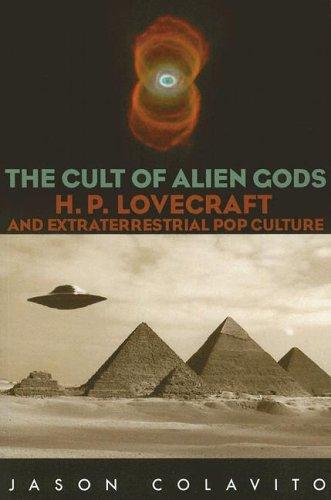
As an Amazon Associate, OverClassified may earn from qualifying purchases made through this link, at no extra cost to you.
Why This Is Essential Reading
The Cult of Alien Gods earns its place on this list as the rare book in this archive that investigates neither a sighting nor a cover-up, but the literary genealogy of the ancient-astronaut idea itself — and as the natural companion piece to this list's own Chariots of the Gods? entry, supplying the specific, checkable earlier source that book's own uncredited borrowings were built on. Its execution drew real, well-documented criticism: a Lovecraft scholar catalogued factual errors and disputed misspellings, and reasonably argued Theosophy and Charles Fort deserve more credit than Lovecraft alone for seeding the popular ancient-astronaut idea. But the book's central, structural insight — that a claim millions of readers treat as suppressed ancient history has a demonstrable paper trail running through a specific 1920s pulp writer, two named French intermediaries, and a datable sequence of twentieth-century publications — has outlived its own rough edges, becoming, by independently corroborated account, part of how the field itself now understands its own history. That combination, a flawed first draft whose core argument proved more durable than the book that first made it, is exactly the kind of essential background this site's own Ancient Connections archive depends on when it traces individual claims back to where they actually came from.
Related Cases & Theories
Essential Viewing

The Lovecraft Connection
Jason Colavito — Colavito's own video essay examining whether H.P. Lovecraft's 'The Call of Cthulhu' anticipated the ancient-astronaut claims later popularized by television programs like Ancient Aliens — the core argument of this book presented directly by its author. Verified via YouTube oEmbed before inclusion.

Jason Colavito and Ancient Aliens - Episode 14
Archaeology Podcast Network — A long-form interview with Colavito for the Archaeology Podcast Network's Pseudo-Archaeology series, discussing his research connecting pseudoscience, speculative fiction, and fringe historical claims, including the argument at the center of this book. Verified via YouTube oEmbed before inclusion.
Sources Cited
- "Jason Colavito." Wikipedia (biography, education, career, bibliography, media appearances). en.wikipedia.org
- Colavito, Jason. "Cult of Alien Gods." jasoncolavito.com (author's own book page: thesis, contents, contemporary review excerpts). jasoncolavito.com
- Colavito, Jason. "Celebrating the 20th Anniversary of 'The Cult of Alien Gods.'" jasoncolavito.com blog (writing timeline, publisher search, industry reception, later citation history, royalties). jasoncolavito.com
- Colavito, Jason. "Charioteer of the Gods." Skeptic, vol. 10, no. 4 (2004) — the article that became this book's basis. jasoncolavito.com
- Colavito, Jason. "Pauwels, Bergier, and Lovecraft." jasoncolavito.com (documents Bergier's Lovecraft correspondence, 1955 French edition, and Morning of the Magicians' direct credit to Lovecraft). jasoncolavito.com
- "The Cult of Alien Gods." H.P. Lovecraft Historical Society / hplovecraft.com (contemporary description of the book's thesis and scope). hplovecraft.com
- Clore, Dan. Review of The Cult of Alien Gods by Jason Colavito. (Detailed critical review: disputed originality claim, cited factual errors, Charles Fort/Theosophy counter-argument). oocities.org
- "The Cult of Alien Gods: H.P. Lovecraft and Extraterrestrial Pop Culture." Goodreads (aggregate rating, reader reviews). goodreads.com
- "The Cult of Alien Gods." AbeBooks (bibliographic record, ISBN 9781591023524, Prometheus Books, December 2005). abebooks.com
- "The Cult of Alien Gods." Amazon.com product listing for ISBN 1591023521 / 9781591023524 (edition already cited in this site's own resources library). amazon.com
- Zaitchik, Alexander. "Close Encounters of the Racist Kind." Southern Poverty Law Center Hatewatch, January 2018 (Colavito quoted as expert on fringe archaeology's overlap with far-right politics). splcenter.org
- "At the Mountains of Madness." Wikipedia (composition and publication history of Lovecraft's 1931 novella, Old Ones, Antarctic setting). en.wikipedia.org
- "The Call of Cthulhu." Wikipedia (composition and publication history of Lovecraft's 1926/1928 short story). en.wikipedia.org
- "The Morning of the Magicians." Wikipedia (Pauwels and Bergier's 1960 book, its sources, and its documented influence on Erich von Däniken). en.wikipedia.org
- This site's own essential reading entry: Chariots of the Gods?, for the von Däniken book this one supplies the literary prehistory of.
- This site's own case file: The Dropa Stones, which independently cites Colavito's research on the Pauwels-Bergier-von Däniken transmission chain.
- This site's own case file: Mahabharata's Brahmastra Weapons, which independently cites Colavito's line-by-line quotation-tracing method.
- This site's own key-figures entry: Jason Colavito, for his full biography and case connections.
Have corrections, additional research, or peer-reviewed sources? Help improve this entry.
Suggest an Edit