
Chariots of the Gods?
Unsolved Mysteries of the Past
Core Thesis
Chariots of the Gods? Unsolved Mysteries of the Past argues that a wide range of humanity's most celebrated ancient monuments, religious texts, and mythological accounts — the Egyptian pyramids, the Nazca Lines, the Piri Reis map, Ezekiel's vision, the Sanskrit vimana passages, Mayan sarcophagus carvings, and dozens more — are best explained not as the achievements and beliefs of the cultures that actually produced them, but as garbled folk-memories of real, physical visits by technologically advanced extraterrestrial beings, whom early humans lacked the vocabulary to describe except as gods, angels, or demons. Erich von Däniken, a Swiss hotel manager with no training in archaeology, history, linguistics, or any related discipline, assembled the argument largely from material that had already appeared in earlier fringe publications, presented it with the confident authority of original research, and turned it into one of the bestselling nonfiction books of the twentieth century. This entry treats the book as what it demonstrably is: the single most commercially and culturally influential text in the ancient-astronaut genre, and also one of the most extensively, specifically, and credibly debunked works in the history of popular pseudoarchaeology — two facts this site's own editorial standard requires holding together rather than letting either one erase the other.
About the Author
Erich von Däniken was born on April 14, 1935, in Zofingen, in the Swiss canton of Aargau, and raised in a strict Catholic household; he attended the Jesuit Collège Saint-Michel in Fribourg, where he rejected the school's religious instruction while developing an early fascination with astronomy and unexplained phenomena. At nineteen he received a suspended sentence for theft, with an examining psychiatrist at the time noting a "tendency to lie" — the first entry in a documented pattern that would recur, far more consequentially, in the years immediately before this book's publication. He apprenticed as a hotelier, worked for a period in Egypt (where a fraudulent jewelry deal produced a separate nine-month conviction), and eventually became manager of the Hotel Rosenhügel in Davos, Switzerland — the job he still held while writing Chariots of the Gods?.
The book itself traces back to a 1964 magazine article, "Were Our Ancestors Visited by Extraterrestrials?," that von Däniken wrote for a small German-Canadian periodical, drawing heavily on ideas already published by French writers Louis Pauwels and Jacques Bergier in The Morning of the Magicians (1960) and by Robert Charroux in his own 1963 book. That article became the basis for a book deal, but von Däniken's initial manuscript was rejected by multiple publishers before Econ-Verlag agreed to publish it — on condition that it first be extensively rewritten by a professional author, Wilhelm Utermann, working under the pen name Wilhelm Roggersdorf. The version that reached German readers in March 1968, and English-language readers the following year in Michael Heron's translation for G. P. Putnam's Sons, was therefore substantially reshaped editorial work built on top of borrowed source material, not the work of a lone innovative researcher its author-brand implied. Charroux's own publisher formally raised the plagiarism issue with von Däniken's publisher in March 1968; later printings of Chariots of the Gods? and its sequel added Pauwels, Bergier, and Charroux to the bibliography as a result.
The book's original German publication and its author's personal legal troubles collided directly and are a matter of public court record, not retrospective smear: to fund the travel behind his research, von Däniken had spent roughly twelve years falsifying hotel financial records and credit references to secure loans totaling about $130,000. He was arrested in November 1968, months after Chariots of the Gods? appeared in Germany, and on February 13, 1970, the Canton Court in Chur convicted him of repeated and sustained embezzlement, fraud, and forgery, sentencing him to three and a half years in prison and a fine of roughly 1,000 Swiss francs; a court-appointed psychiatrist diagnosed him as a pathological liar and "criminal psychopath," describing him in terms translators have rendered as a "master swindler," while the court itself characterized his lifestyle as that of a "playboy." He served about a year of the sentence before release. By then, the book's runaway international sales had already let him pay off the debts the fraud had been covering and leave the hotel business permanently; he wrote his second book, Gods from Outer Space, while still imprisoned.
Von Däniken went on to publish more than forty additional titles, sold by various estimates between roughly 65 and 75 million copies in over thirty languages by the time of his death, co-founded the Archaeology, Astronautics and SETI Research Association (AAS RA), designed and opened the alien-visitation theme park Mystery Park (later Jungfrau Park) in Interlaken in 2003, and became a recurring on-camera presenter on the History Channel's Ancient Aliens franchise. That later career includes further, independently documented instances of fabrication beyond this specific book — most notably his 1972 sequel The Gold of the Gods, in which the Ecuadorian contact who reportedly showed him the Cueva de los Tayos tunnels, Juan Moricz, told Der Spiegel that von Däniken's account was exaggerated and its photographs "fiddled," a fabrication von Däniken himself later partially admitted to Playboy. He also drew wide attention to Peru's Ica Stones, whose carver, Basilio Uschuya, told von Däniken directly in 1973 that he had forged them (a confession Uschuya later muddied with a partial recantation); von Däniken subsequently acknowledged the stones were "most likely fake." He did, on at least one occasion, walk back a specific Chariots of the Gods? claim once shown to be wrong: informed in 1974 that the corrosion-resistant Iron Pillar of Delhi had a well-understood metallurgical explanation, he told Playboy, "we can forget about this iron thing." Von Däniken died on January 10, 2026, at a hospital in Unterseen, near Interlaken, Switzerland, at age 90.
This documented biography — the borrowed source material, the ghostwritten rewrite, the fraud convictions immediately surrounding the book's writing and publication, the court psychiatrist's own assessment of his relationship to the truth, and the further fabrications in his subsequent books — is not incidental color. It is directly relevant to how much independent weight a reader should give any of Chariots of the Gods?'s own uncorroborated factual claims, and this site treats it as essential context rather than optional biographical trivia.
Historical Context & Origins
Chariots of the Gods? arrived at a specific cultural moment that did much of its persuasive work for it. Its German edition appeared in March 1968, the same year Apollo 8 became the first crewed mission to orbit the Moon; its English translation followed in 1969, the same year Apollo 11 landed there. A reading public primed by a decade of real, front-page space-age achievement was, for the first time in human history, culturally prepared to take the idea of interplanetary travel seriously as a literal, physically plausible thing — and von Däniken's argument that it might already have happened, in the deep past, landed inside exactly that receptive moment rather than against a skeptical baseline.
The book was not, however, an original theoretical departure. Its foundational claims had already been laid out by French writers Louis Pauwels and Jacques Bergier in The Morning of the Magicians (1960) and further developed by Robert Charroux in 1963; von Däniken's own 1964 magazine article drew directly on that material, and the finished 1968 book carried the same ideas to a vastly larger, English-and-German-reading mass market than either of its uncredited predecessors had reached, aided by the substantial rewrite its editor, Wilhelm Utermann, gave the rejected initial manuscript before Econ-Verlag agreed to publish it.
Once published, the book moved with unusual speed from fringe curiosity to global publishing event, translated into dozens of languages and adapted into a 1970 West German documentary film (directed by Harald Reinl) that was nominated for an Academy Award for Best Documentary Feature, followed by NBC's 1972 special In Search of Ancient Astronauts, narrated by Rod Serling, and a critical 1977 BBC Horizon special that treated the claims skeptically. That speed of adoption — a mass-market sensation years before the scholarly and skeptical rebuttal literature caught up to it — is itself part of the book's historical significance: Chariots of the Gods? effectively created the modern "ancient astronaut" or paleocontact genre as a commercial category, one this site's own key-figures archive already traces forward through Zecharia Sitchin, Peter Kolosimo, and other writers who followed directly in its wake.
Core Arguments & Key Concepts
Von Däniken's central claim is that numerous ancient civilizations achieved feats — monumental construction, astronomical alignment, metallurgy, described "flying" objects in myth and scripture — that he asserts exceeded plausible unaided human capability for their era, and that the best explanation for this gap is direct technological assistance, and in some cases genetic intervention, from visiting extraterrestrials who were worshipped by early humans as gods. He stated the genetic claim explicitly in his own words, writing that "not only have we been visited from outer space in ancient times but that those visitors had sexual intercourse with our ancestors."
The book supports this thesis with a wide, deliberately global survey of examples rather than a single case: the Egyptian pyramids and other megalithic construction (presented as beyond the engineering means of the societies that actually built them), the Nazca Lines in Peru (read as landing markers, illustrated with a photograph von Däniken described as showing airport-style "parking bays" that critics and later investigators identified as nothing more than the knee joint of one of the site's own giant bird geoglyphs), the 1513 Piri Reis map (claimed to show coastlines, including an ice-free Antarctica, that could only have been surveyed from orbit, despite the map's own marginal notes stating it was compiled from Ptolemaic, Portuguese, Arabic, and Columbus-derived sources), the so-called Baghdad Battery, cart ruts across multiple continents, Japanese Dogū figurines (read as spacesuited astronauts), and Egyptian temple carvings reinterpreted as depicting aircraft. He extends the same reading to religious and mythological texts, including the biblical Ark of the Covenant, the destruction of Sodom, and, discussed at greater length below, the prophet Ezekiel's vision and the Sanskrit vimana passages.
Archaeologist Kenneth Feder has described von Däniken's interpretive method as an "inkblot" approach: presenting deliberately ambiguous ancient imagery and artifacts and inviting readers to see modern technology in them, a technique that depends entirely on the reader's own imagination rather than on the artifact's actual, well-documented cultural and religious context. Feder and other critics have further noted that the pattern of which cultures get this treatment is not evenly distributed — von Däniken's alien-assistance explanations concentrate overwhelmingly on non-European civilizations (Egyptian, Andean, Mesoamerican, South and East Asian), a selectivity several scholars have read as reflecting an unstated assumption that non-European peoples were less capable of their own achievements, an assumption the book never extends to European monument-building.
Running underneath these individual claims is a consistent evidentiary pattern real critics have catalogued extensively rather than merely alleged: von Däniken repeatedly cites secondary or thirdhand sources as though they were primary evidence, presents contested or already-debunked claims (the Piri Reis map, the Baghdad Battery, the Iron Pillar of Delhi) without noting the existing scholarly literature that had already addressed them, and, as the Critical Reception section below documents in detail, in several cases turns out to have fabricated the underlying evidence outright.
Key Cases & Evidence Discussed
Chariots of the Gods? is directly cited, by name and by claim, in four of this site's own Ancient Connections case files — making it, alongside Wonders in the Sky, one of the handful of books this archive returns to repeatedly, though for the opposite reason: as the source of a claim being checked and found wanting, rather than as a trusted sourcebook.
Ezekiel's Wheel (Ancient Record File #001) traces how von Däniken's brief, impressionistic reading of the biblical prophet's vision as a garbled account of an alien aircraft became the direct inspiration for engineer Josef Blumrich's later, far more technical 1974 reinterpretation of the same passage — a clear, documented example of a single paragraph in Chariots of the Gods? spawning an entire secondary literature.
The Tulli Papyrus (Ancient Record File — Paleocontact Archive) shows the book operating as an accelerant rather than an originator: the disputed 1933–34 Egyptian document had already circulated in Fortean circles for over a decade before 1968, but Chariots of the Gods? becoming a global bestseller that same year is what cemented the ancient-astronaut framework within which the Tulli Papyrus would be recycled for the next half-century, right up through this site's own case file.
Vimana: The Vedic Aerial Chariots (Ancient Record File #001) documents perhaps the book's single most consequential individual misreading: von Däniken quotes a Ramayana translation describing Rama's chariot rising "up to a mountain of cloud with a tremendous din" as textual evidence for ancient aircraft, a reading that ignores the genuine literary and religious context of the vimana tradition and that this site's own file traces forward into the entirely separate, and separately fabricated, 20th-century "Vaimanika Shastra" hoax that later writers folded into the same claim.
Alexander the Great's "Flying Shields" (Ancient Record File #005) shows the book's method at its thinnest: von Däniken and later ancient-astronaut writers incorporated the uncited "flying shields" claim into their broader paleocontact narratives without ever producing an actual ancient citation for it, a pattern this site's own file identifies as characteristic of how unverified secondary claims move through this literature without anyone along the chain checking the primary sources.
Beyond these four direct citations, the book's core examples — the Egyptian pyramids (which von Däniken encountered directly during his time working in Cairo, Egypt), the Nazca Lines, and the Piri Reis map — remain the three claims most associated with Chariots of the Gods? in the broader literature, discussed at length in the Critical Reception section below even though this site does not currently maintain dedicated case files for them.
Critical Reception & Controversies
The scholarly and scientific response to Chariots of the Gods? was immediate, sustained, and remains essentially unanimous more than half a century later: professional archaeologists, historians, and scientists reject the book's central thesis as pseudoscience, and the near-total absence of supporting scholarship from any relevant discipline is itself part of the historical record, not a matter of unresolved academic dispute. Astronomer Carl Sagan reviewed the ancient-astronaut genre directly and repeatedly, describing its reasoning as "sloppy thinking" built on logical and factual errors and comparing its evidentiary standards unfavorably to those of quack medicine; he went on to contribute the foreword to the first full-length rebuttal of the book.
That rebuttal, Ronald Story's The Space-Gods Revealed: A Close Look at the Theories of Erich Von Däniken (1976), remains the standard point-by-point refutation: Story assembled contributions from astronomers and archaeologists including Frank Drake, William Hartmann, Thor Heyerdahl, and William Rathje to work through von Däniken's claims about the Piri Reis map, the Nazca Lines, Easter Island, the Egyptian pyramids, and the Palenque sarcophagus individually. Time magazine called it "a coherent and much-needed refutation of Von Däniken's theories," and Isaac Asimov wrote that it "neatly demonstrates the intellectual bankruptcy of this cultish nonsense." A second, differently framed rebuttal, archaeologist and Christian apologist Clifford Wilson's Crash Go the Chariots (1972), worked through many of the same specific claims, though its recurring turn toward biblical apologetics limits its usefulness as a purely evidentiary critique.
The most extensively documented and specific individual claims in the book have not held up under independent examination. Von Däniken's Nazca Lines photograph, presented as showing landing-strip "parking bays," has been identified as an image of the knee joint of one of the site's own giant bird geoglyphs — not an artificial marking at all. His reading of the Piri Reis map as evidence of a spacefaring survey of Earth ignores the map's own surviving marginal notes, in which Piri Reis states he compiled it from earlier Ptolemaic, Portuguese, and Arabic charts and a map attributed to Christopher Columbus; the map's actual coastline also does not match Antarctica in either shape or latitude. Even von Däniken himself eventually abandoned one of the book's specific claims: told in 1974 that the corrosion resistance of the Iron Pillar of Delhi had a well-understood, entirely terrestrial metallurgical explanation, he told Playboy, "we can forget about this iron thing."
Kenneth Feder, professor emeritus of anthropology at Central Connecticut State University, has been the book's most sustained academic critic across five decades, formalizing his "inkblot hypothesis" critique of von Däniken's method in his textbook Frauds, Myths, and Mysteries: Science and Pseudoscience in Archaeology. In a retrospective published in the May/June 2026 issue of Skeptical Inquirer, written after von Däniken's death, Feder went further, calling him "an avatar for the goofy uncle" whose body of work was, in Feder's own words, "entirely delusional" — while also arguing that von Däniken's specific pattern of crediting non-European civilizations' achievements to outside intervention, without ever extending the same doubt to European monument-building, reflects an underlying and unexamined racial bias running through the entire ancient-astronaut genre he founded. Biblical scholar Michael Heiser has separately documented instances of von Däniken acknowledging, on camera and in a Playboy interview, that he had "contrived" specific material presented in his books as genuine evidence.
Von Däniken's plagiarism problem is also a matter of public, legally documented record rather than allegation: Robert Charroux's publisher formally contacted von Däniken's publisher in March 1968 over the close, uncredited overlap between Chariots of the Gods? and material Charroux and, before him, Louis Pauwels and Jacques Bergier had already published; subsequent printings of the book and its sequel added all three writers to the bibliography as a direct result. And while the specific fabrications in his 1972 sequel The Gold of the Gods — the Cueva de los Tayos account that contact Juan Moricz told Der Spiegel was exaggerated and photographically "fiddled," and the Ica Stones episode, in which carver Basilio Uschuya directly told von Däniken in 1973 that he had forged the objects — postdate Chariots of the Gods? itself, they establish a documented authorial pattern of fabrication that any reader evaluating this specific book's own uncorroborated claims should weigh heavily.
None of this scholarly consensus meaningfully slowed the book's commercial trajectory, which is itself part of its critical story: Chariots of the Gods? remains, simultaneously, one of the most commercially successful and one of the most comprehensively discredited nonfiction books of the twentieth century, and both of those facts are necessary to understand its place in the literature.
Influence & Legacy
However contested its factual claims, Chariots of the Gods?'s commercial and cultural reach is not in dispute. Estimates of von Däniken's total career sales vary by source and year — roughly 65 million copies by 2017 per contemporary reporting, and as high as 75 million across more than forty books by the time of his 2026 death, according to figures from his own literary agent — but even the more conservative figures make this the best-selling and most widely translated ancient-astronaut book ever published, and the title that turned a fringe magazine-article theory into a durable, self-sustaining publishing genre.
That reach extended quickly beyond print. The 1970 West German documentary adaptation, directed by Harald Reinl, received an Academy Award nomination for Best Documentary Feature; NBC followed in 1972 with the Rod Serling-narrated special In Search of Ancient Astronauts; and the BBC's 1977 Horizon special gave the claims their first major skeptical television treatment. Decades later, the book's framework became the explicit foundation of the History Channel's long-running Ancient Aliens series (2010–present), on which von Däniken himself appeared repeatedly as an on-camera presenter — a direct, traceable line from a 1964 magazine article to one of cable television's longest-running franchises.
The book's influence on this site's own subject matter runs directly through the other ancient-astronaut writers its key-figures archive already documents: Zecharia Sitchin's Anunnaki mythology, Peter Kolosimo's Italian paleocontact writing, Alexander Kazantsev's role in transmitting the Dropa Stones story, and David Hatcher Childress's continued repackaging of von Däniken-era Sanskrit misreadings all follow, directly or indirectly, the commercial and thematic path Chariots of the Gods? opened in 1968. Von Däniken's own later career — the AAS RA research association he co-founded, and the Mystery Park (later Jungfrau Park) alien-visitation theme park he designed and opened in Interlaken in 2003 — is itself evidence of how completely a single mass-market book could reshape one person's life, and how much infrastructure a genre this size eventually builds around itself.
The book's legacy also includes its own opposition: Chris White's 2012 documentary Ancient Aliens Debunked, a roughly three-hour, point-by-point rebuttal of the History Channel franchise's claims, exists specifically because Chariots of the Gods?'s core arguments — Puma Punku, the pyramids, the Nazca Lines, the Palenque sarcophagus — migrated, largely unrevised, from a 1968 paperback into 21st-century basic-cable programming, and needed rebutting all over again for a new generation of viewers who had never read the original book at all.
The Book
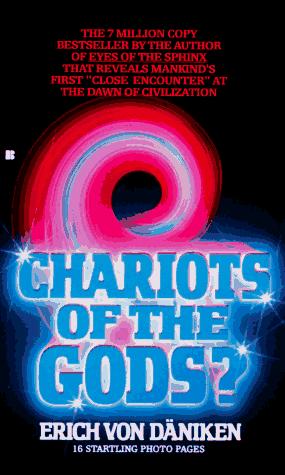
As an Amazon Associate, OverClassified may earn from qualifying purchases made through this link, at no extra cost to you.
Why This Is Essential Reading
Chariots of the Gods? earns its place on this list for its outsized, historically undeniable influence on how millions of people first encountered the idea of ancient extraterrestrial contact — not as an endorsement of anything the book actually claims. Its author had no relevant credentials, its manuscript was substantially rewritten by an editor after publishers rejected it, its core arguments were built on largely uncredited earlier writers, its author was convicted of fraud and embezzlement in the same window the book was written and released, and its most specific individual claims — the Nazca "parking bays," the Piri Reis map, the Iron Pillar of Delhi, and, in von Däniken's later books, entire fabricated expedition accounts — have been documented in detail as false or fabricated by named scholars working in the relevant fields. What makes the book essential reading is precisely the gap between that record and its cultural footprint: understanding why an evidentiary record this weak became one of the bestselling nonfiction books of its century, and directly seeded a television franchise still running today, is necessary background for this site's own Ancient Connections archive, much of which exists specifically to trace individual claims this book popularized back to their actual, checkable sources — the same discipline Chariots of the Gods? itself so consistently failed to apply.
Related Cases & Theories
Essential Viewing
Ancient Aliens Debunked
ProjectJohn832 (Chris White, 2012) — A roughly three-hour, point-by-point skeptical rebuttal of the ancient-astronaut claims the History Channel's Ancient Aliens franchise inherited directly from Chariots of the Gods? — including detailed treatment of the pyramids, Nazca Lines, Puma Punku, and the Palenque sarcophagus. Verified via YouTube oEmbed before inclusion.
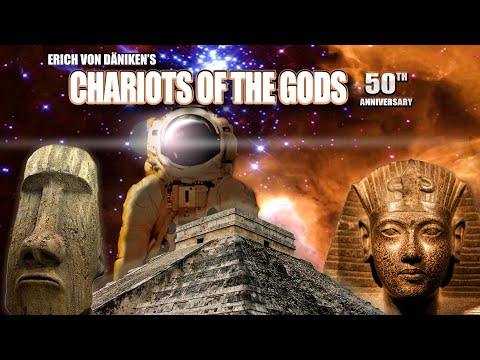
Chariots of the Gods? (1970) Have aliens invaded the earth? | Full Documentary Movie
The Sprocket Vault — The original 1970 West German documentary adaptation of von Däniken's book, directed by Harald Reinl and nominated for an Academy Award for Best Documentary Feature — included here as the book's own direct, era-appropriate film legacy rather than as an endorsement of its claims. Verified via YouTube oEmbed before inclusion.
Sources Cited
- "Chariots of the Gods?" Wikipedia (publication history, translation, editor Wilhelm Roggersdorf/Utermann, core claims, sales figures, television adaptations). en.wikipedia.org
- "Erich von Däniken." Wikipedia (biography, education, 1968 arrest and 1970 fraud conviction, court psychiatrist's assessment, later career, death). en.wikipedia.org
- Feder, Kenneth L. "Erich von Däniken: A Legacy of Pseudoscience." Skeptical Inquirer, Vol. 50, No. 3, May/June 2026 (post-obituary scholarly retrospective, "inkblot hypothesis," racial-bias critique, genetic-hybridization quote). skepticalinquirer.org
- Heiser, Michael S. "Chariots of the Frauds: The Real Erich von Daniken." drmsh.com (documented on-camera and Playboy admissions of fabrication). drmsh.com
- "Swiss author Erich von Däniken dead at 90." SWI swissinfo.ch, January 2026 (death, obituary details). swissinfo.ch
- "Erich von Däniken, Swiss writer who spawned alien archaeology, dies at 90." NBC News, January 2026 (obituary, sales figures, career summary). nbcnews.com
- "The Space-Gods Revealed." Wikipedia (Ronald Story's 1976 rebuttal, Carl Sagan foreword, contributor list, critical reception). en.wikipedia.org
- "Piri Reis map." Wikipedia (map's own sourcing notes, cartographic analysis rebutting von Däniken's claims). en.wikipedia.org
- "Ica stones." Wikipedia (Basilio Uschuya's forgery admission, BBC investigation). en.wikipedia.org
- "Cueva de los Tayos." Wikipedia (Juan Moricz's account to Der Spiegel, von Däniken's Gold of the Gods fabrications). en.wikipedia.org
- "The Morning of the Magicians." Wikipedia (Pauwels/Bergier/Charroux source material and the 1968 plagiarism dispute). en.wikipedia.org
- "Ancient Aliens Debunked." Chris White, 2012 documentary (point-by-point rebuttal of the Ancient Aliens franchise's core claims). ancientaliensdebunked.com
- "Chariots of the Gods." Amazon.com product listing for ISBN 0425074811 / 9780425074817 (Berkley pbk., 1984 — edition already cited three times in this site's own resources library). amazon.com
- This site's own case file: Ezekiel's Wheel, which traces this book's direct influence on Josef Blumrich's later technical reinterpretation.
- This site's own case file: The Tulli Papyrus, for this book's role in cementing the paleocontact framework around the case.
- This site's own case file: Vimana: The Vedic Aerial Chariots, for this book's misreading of the Ramayana and von Däniken's own documented fraud conviction.
- This site's own case file: Alexander the Great's "Flying Shields", for this book's uncited incorporation of the claim.
- This site's own key-figures entry: Erich von Däniken, for his full biography and case connections.
Have corrections, additional research, or peer-reviewed sources? Help improve this entry.
Suggest an Edit