
USS Jackson Tic Tac Encounter
On the evening of 15 February 2023, in the W-291 Warning Area off Southern California, an operations specialist aboard the littoral combat ship USS Jackson says he watched a self-luminous object rise out of the ocean, join three others of the same shape, and depart with all four accelerating simultaneously. The ship's Combat Information Center recorded part of it on an infrared turret. Two and a half years later he described it under oath to Congress — the first active-duty United States Navy sailor to testify publicly about a personal UAP encounter.
This case has an unusually clean evidentiary spine and an unusually short piece of evidence. The witness is named, credentialed, still serving, and gave his account in a document cleared for open publication by the Department of Defense's own prepublication office before he read it into the congressional record. The metadata attached to the imagery — date, time, latitude, longitude, platform — checks out against the ship's position and is precise enough for outside analysts to reconstruct the sightline. What is missing is almost everything the account's most striking claims would need: the released footage runs about thirty-three seconds, shows two unresolved thermal points, and captures neither the emergence from the water nor the four-object departure.
This file therefore separates three questions that popular coverage routinely merges. What did the sensor record, and what can be determined from it? What did the witness observe, and how much weight does his account carry on its own? And what would it take to move this case in either direction? The answer to the third is the most useful: the Navy is not known to have released the original unstabilised recording, any radar data, or any other crew member's statement, and until it does, a genuinely strong witness account is doing work that the physical evidence cannot yet support or refute.
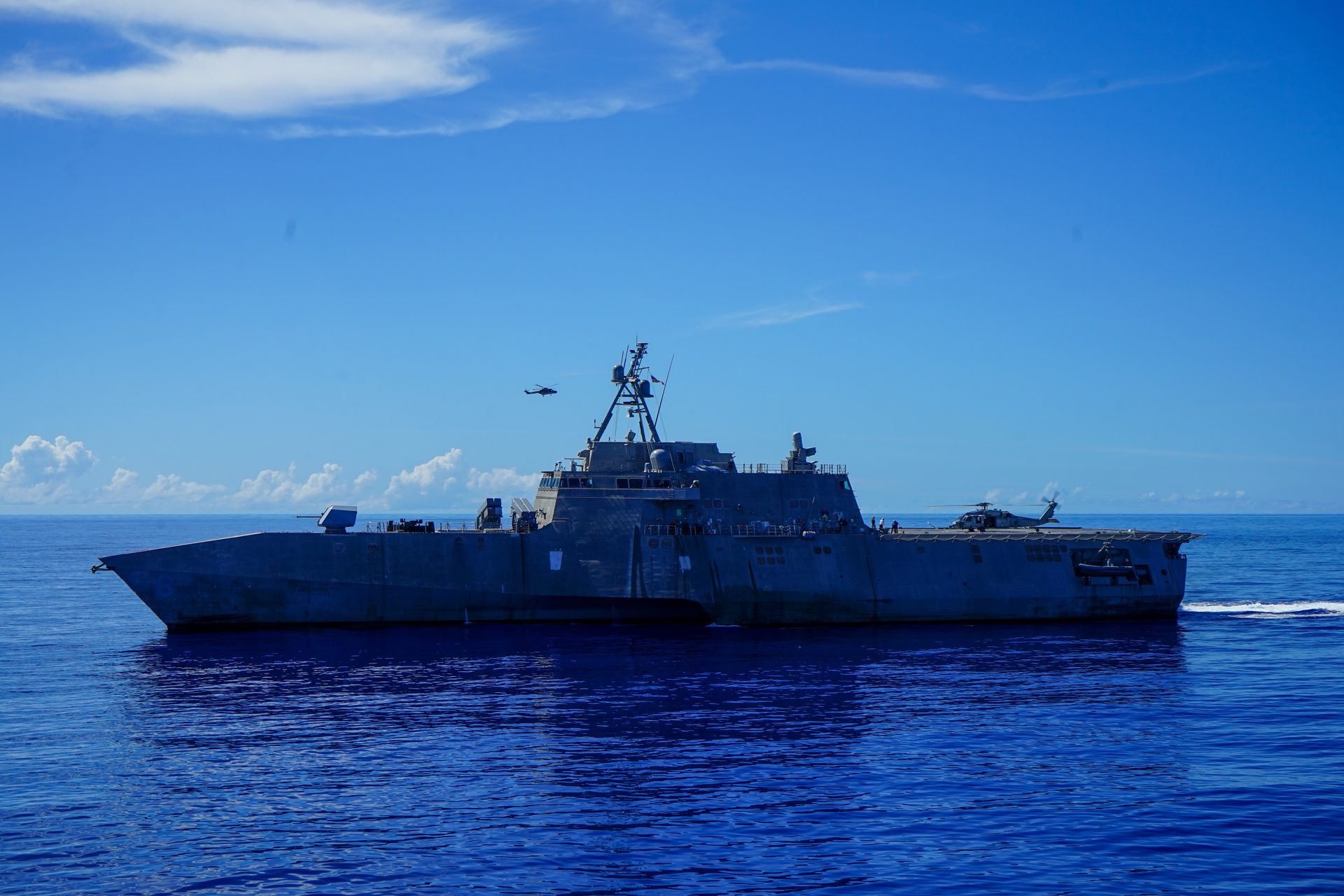
Pictured: USS Jackson (LCS-6), the Independence-class littoral combat ship at the centre of this case, photographed underway in the Philippine Sea on 18 October 2021 — the actual vessel, but not the night, the ocean or the event in question. No photograph of the 15 February 2023 encounter has been released; the only imagery is roughly thirty-three seconds of the ship's own infrared sensor feed, published as a second-generation copy by the journalists who received it. U.S. Navy photograph, public domain.
Theoretical Alignment
The described content of this encounter — a transmedium emergence, a formation, a synchronised near-instantaneous departure with no acoustic or propulsion signature — is squarely extraterrestrial-hypothesis shaped, and it sits inside the Unidentified Submerged Object corpus alongside this archive's USS Omaha and Nimitz files, in the same stretch of ocean. The alignment weighting nonetheless leans toward the Psycho-Social Hypothesis and the Sensor & Optical Artifact Hypothesis not because of anything about the witness, but because of the shape of what actually survives. The only element anyone outside the ship can examine is thirty-three seconds of unresolved infrared imagery from a moving platform, and the recorded portion is not the part of the account that is anomalous. Every claim doing real work here — the object rising from the water, the four-object formation, the simultaneous departure — rests on human observation and recall, which is precisely the evidentiary category the psycho-social frame addresses. The extraterrestrial weighting is meaningfully above zero because the observer was a trained radar and air-picture specialist reporting a recent event under his own name while still serving, which is close to the best a testimonial case can be.
Background
The waters off Southern California are the most intensively instrumented stretch of ocean on the planet and, by a considerable margin, the most productive single region in the modern UAP record. The Southern California Offshore Range and the associated warning areas exist so that carrier strike groups, submarines, aircraft and missile systems can be exercised together under continuous sensor coverage. That coverage is the reason so many contemporary UAP reports come from here: not necessarily because more unusual things happen off Point Loma than anywhere else, but because almost everything that happens here is watched by somebody's radar, sonar or infrared turret, and by crews trained to notice when a track behaves oddly.
Warning Area W-291 is a block of restricted offshore military airspace and sea-surface training range of roughly 113,000 square nautical miles, extending some 600 nautical miles south-west from the Southern California coast. It is the same operating area in which the Nimitz carrier strike group's 2004 Tic Tac encounter occurred, and the same area in which a cluster of Navy warships — the USS Omaha, USS Russell, USS Kidd, USS Rafael Peralta and USS Paul Hamilton among them — logged unidentified contacts across a series of nights in July 2019. The 2023 event described here occurred at the inshore end of that range: the coordinates displayed on the video overlay, 32°53.3′N 117°56.0′W, put the ship roughly nine nautical miles west of Point Loma, within sight of the San Diego coastline rather than far out to sea.
USS Jackson (LCS-6) is an Independence-class littoral combat ship — an aluminium trimaran, commissioned in December 2015, homeported at Naval Base San Diego, designed for shallow-water operations and built around a large flight deck and a modular mission-package bay. Independence-class ships carry a Combat Information Center of the type common to modern surface combatants, with radar consoles, a surface and air picture, and an electro-optical/infrared sensor whose feed can be displayed both in CIC and on the bridge. That last detail becomes important to the narrative: the bridge and CIC could see the same camera picture, separated by a curtain.
The sensor at the centre of the case is a Star SAFIRE, the Teledyne FLIR family of multi-spectral electro-optical/infrared gimbals used across United States military and law-enforcement platforms. It is not a camera in the ordinary sense but a stabilised turret combining thermal imaging with visible-light and other channels, with its own on-screen overlay reporting time, own-ship position, azimuth, elevation, field of view and system status. The overlay is why this case is analysable at all by anyone outside the Navy: a Star SAFIRE frame carries enough metadata to reconstruct, within limits, where the camera was pointing when it recorded.
The witness, Senior Chief Operations Specialist Alexandro Wiggins, is a career Navy Operations Specialist with approximately twenty-three years of service at the time of his testimony. An Operations Specialist is the rating responsible for radar and sensor track integration, air and surface picture management, and safety of navigation — effectively the Navy's air-traffic and tactical-picture specialist. Wiggins grew up in Las Vegas and attended Cheyenne High School; he has said his father worked security in the Nevada desert at Area 51. He had also served aboard the USS Omaha during its July 2019 deployment, making him one of a small number of people connected by service to two separate Southern California UAP episodes — a coincidence he has been candid about rather than one he has leaned on.
Complete Timeline
| Nov 2004 | The USS Nimitz carrier strike group encounters the original “Tic Tac” off Southern California, in the same general operating area — the reference point against which every later incident of this kind is measured. |
| Jul 2019 | Roughly ten U.S. Navy vessels, including the USS Omaha with Wiggins aboard, log unidentified aerial contacts within W-291 across several nights. The Omaha footage shows an object descending into the sea. |
| 15 Feb 2023, ~19:15 PST | USS Jackson is in transit within W-291. CIC operators are monitoring the EO/IR feed and the radar picture. Anomalous returns or cues draw focused attention to the infrared display. |
| 15 Feb 2023, evening | Wiggins moves to the bridge wing and, by his account, visually observes a light rising from the waterline — consistent, as he puts it, with a platform emerging from the ocean rather than a distant surface light or a celestial body rising. |
| 15 Feb 2023, evening | Returning to CIC, Wiggins examines the Star SAFIRE display. Two Tic-Tac-shaped objects are visible; on zooming out the crew count four in total. Neither shows visible control surfaces nor an exhaust plume. |
| 16 Feb 2023, 03:15:00–03:15:33 UTC | The thirty-three-second segment later released publicly is recorded. Overlay shows own-ship position moving from 32°53.333′N 117°56.012′W to 32°53.365′N 117°55.991′W — about 220 feet in 35 seconds, a ground speed of roughly 3.7 knots. |
| 15 Feb 2023, shortly after | All four objects depart simultaneously, in what Wiggins describes as “two steps behind instantaneous.” No sonic boom or other acoustic signature is perceived. The radar picture, he says, no longer displays them immediately afterwards. |
| 15 Feb 2023, after the event | Wiggins reportedly rebuts a junior officer of the deck's suggestion that the objects were an ordinary airliner by directing the camera operator to slew to a known air contact five or six nautical miles further out, which resolves visibly into wings and hot engine exhaust. CIC personnel make reports to the Tactical Action Officer. |
| 2023–2025 | No formal incident notice is filed by the ship, on the stated basis that the objects remained at a safe distance and displayed no hostile intent — conditions that, under the applicable Navy reporting practice, did not compel a report. The video circulates informally. |
| 8 Apr 2025 | Jeremy Corbell and George Knapp publish the footage and the encounter metadata through their Weaponized outlet, giving date, time, coordinates, vessel and imaging platform. NBC News and others pick it up. |
| 8–25 Apr 2025 | Independent analysts on Metabunk begin reconstructing the sightline from the overlay data, the ship's track and public flight-tracking records, and identify several candidate aircraft along the camera's line of sight without reaching a conclusion. |
| 15 Apr 2025 | Weaponized Episode 73, “Firsthand Military Witness Goes Public — Four ‘TIC TAC’ UAPs,” is published, with Wiggins speaking on the record for the first time. |
| 16 Apr 2025 | George Knapp's own investigative report for 8 News Now in Las Vegas airs, including Wiggins's statement that he considers himself a witness rather than a whistleblower and that he remains “skeptical myself as to what I saw that day.” |
| 4 Sep 2025 | Wiggins's written statement is cleared for open publication by the Department of Defense Office of Prepublication and Security Review. |
| 9 Sep 2025 | Wiggins testifies before the House Committee on Oversight and Government Reform's Task Force on the Declassification of Federal Secrets, in the hearing “Restoring Public Trust through UAP Transparency and Whistleblower Protection” — the first active-duty Navy official to testify publicly before Congress about a personal UAP encounter. |
The Account in the Witness's Own Words
The best source for this case is not a news report but Wiggins's own written statement for the record of the House Oversight Committee, submitted for the 9 September 2025 hearing and carrying a Department of Defense Office of Prepublication and Security Review clearance stamp dated 4 September 2025. It is a short, structured, deliberately unsensational document, and its restraint is one of the more persuasive things about it.
The executive summary gives date, time and place — 15 February 2023 at approximately 1915 PST in the W-291 Warning Area off the Southern California coast — and the vessel and the author's position aboard it: USS Jackson (LCS-6), with Wiggins moving in and out of the Combat Information Center and the bridge wing during the event. The phenomenon is stated in one sentence: a self-luminous, Tic-Tac-shaped object was observed emerging from the ocean, then linking up with three similar objects, all four departing simultaneously in a highly synchronised, near-instantaneous manner, with no sonic boom or conventional propulsion signatures observed.
The narrative section breaks the event into four stages. Initial awareness came from anomalous returns or cues that led to focused observation on the EO/IR display in CIC; the object under observation presented no visible control surfaces and no exhaust plume, features Wiggins describes as inconsistent with conventional aircraft or drones as typically seen on a Star SAFIRE in similar environmental conditions. Transmedium emergence is stated carefully: he visually observed a light rising from the waterline, consistent with a platform emerging from the ocean rather than distant surface lights or a celestial rise, and says this was corroborated by what was being viewed on the SAFIRE display. The formation of four follows — the emerging object linking up with three additional Tic-Tac-like objects, the four maintaining relative geometry consistent with a controlled formation. The synchronised departure closes it: all four departed at the same moment with an acceleration profile that, he is careful to write, subjectively appeared near-instantaneous; no acoustic signature associated with high-speed flight was perceived; and the radar picture no longer displayed the objects immediately after departure.
On sensor corroboration the statement is equally specific and equally hedged. CIC crew recorded hand-held EO/IR video of at least two of the objects. The released, stabilised footage includes timestamps, latitude and longitude and platform readouts consistent with USS Jackson's location in W-291 at the time. The objects were described as detected on multiple reconnaissance platforms including radar, and shortly after the departure the tracks dropped — with Wiggins writing that he personally observed the radar picture no longer displaying them. On kinematics he records that across EO/IR the crew did not observe standard propulsion signatures or control-surface articulation. And then a single sentence that has caused more analytical argument than anything else in the document: an approximate altitude reference of around 22,000 feet is reflected in conversation among CIC operators in the published transcript excerpts.
Post-incident, the statement records that CIC personnel recorded the encounter on Star SAFIRE with data overlays showing time and location, and made appropriate reports to the Tactical Action Officer. It records that the incident details and source video screenshots were later published by journalists, and that Wiggins subsequently described the encounter publicly with Jeremy Corbell and George Knapp — explicitly, in his own framing, in order to ensure an accurate firsthand record exists and to reduce stigma for other service members with similar observations. His closing line is a conclusion about process rather than about aliens: he submits the statement to assist the Committee in improving safety, reporting fidelity and analytic rigour regarding unidentified anomalous phenomena in United States operating areas.
The statement's own reference list names four items, all of them Corbell and Knapp's Weaponized material. That is worth noting plainly: the official congressional record of this encounter cites a podcast as its documentary basis, because there is no released Navy document to cite.
What the Crew Did on the Night
Wiggins's spoken accounts to Knapp and to Corbell fill in the texture the written statement leaves out, and one episode in particular deserves to be recorded in full because it is the closest thing this case has to a controlled comparison performed at the time.
By his telling, he first became aware of something unusual through the CIC picture, then went out to the bridge wing to get his own eyes on it. What he saw was a light on the horizon that looked as though it were surfacing out of the water and going up. He returned to CIC and looked closely at the SAFIRE feed — and, as he has been careful to stress in interviews, a Star SAFIRE is a thermal sensor rather than a camera, so what was on the screen was a heat picture. The sensor showed not one object but two, neither with any hint of exhaust or any known propulsion system. It was only on zooming out, he says, that the crew realised there were four.
A junior officer of the deck, watching the same feed repeated on a bridge monitor, offered the obvious objection: it was just an aircraft, a typical airliner, and it only looked like a Tic Tac because they were zoomed so far in on something far away. Wiggins's response was to test it. He asked the camera operator to slew the turret to a contact he already knew from his radar picture to be an aircraft — by his estimate five or six nautical miles further out than the objects — and to zoom in. The known aircraft resolved, in his description, into visible wings and visible hot propulsion, the way heat shimmer is visible on a hot summer day. He put the comparison back to the officer of the deck, who, by Wiggins's account, did not have an answer and simply chuckled.
Two things follow from that episode and they pull in opposite directions. In its favour: it is a real on-the-spot attempt at a control, performed by the person on the ship best placed to do it, using the same sensor at the same settings on a known target, and the result was a visibly different signature. It is precisely the test a skeptical analyst would ask for, conducted without prompting, two and a half years before anyone outside the ship was watching. Against it: the comparison was never recorded in the released footage, so nobody outside the CIC can evaluate it; the range estimate for the “known” aircraft is more precise than any range estimate Wiggins has given for the objects themselves; and combining his figures places the comparison aircraft at somewhere around eleven to sixteen nautical miles, which independent analysts have struggled to match against public flight-tracking records for that moment.
The departure is described consistently across his accounts: all four left at once, to the north-east, with an acceleration he characterises as “two steps behind instantaneous.” No sound. Nothing left on the radar picture.
The Video
The released footage is the case's most examined and least informative element, and being precise about what it is matters.
It is approximately thirty-three to thirty-five seconds long, timestamped 03:15:00 to 03:15:33 UTC on 16 February 2023, which is 19:15 PST on the 15th. It is not the original file. The crew recording was made hand-held — that is, somebody in CIC pointed a personal device at a display screen — and the version that reached the public was stabilised by Corbell's team from that hand-held recording. The material distributed publicly is therefore a processed second-generation copy of a photograph of a screen. The right-hand portion of the frame is cropped, so part of the overlay is not visible, and the latitude field is truncated for most of the clip.
What is visible: two small bright points against a dark sky, with the lower one zoomed on at one stage; a compass tape across the top of the frame reading 50–52°; azimuth and elevation readouts at the bottom; own-ship longitude changing through the clip; a “NIGHT” display mode indicator; an “INRPT” (inertial point) indicator showing the camera under manual joystick control; and a flashing FAULT annunciation reading “PEA WFOV,” a built-in-test warning which, on comparable systems, indicates limited mission impact rather than a failure of the imaging chain.
What is not visible is more important. The clip does not show an object emerging from the water. It does not show four objects. It does not show the synchronised departure. Every element of the account that is genuinely anomalous happens outside the thirty-three seconds the public has been given. The footage is, at best, corroboration that the crew were tracking something at a stated time and position; it is not evidence about what that something did.
The metadata does real work despite that. Independent analysis of the own-ship coordinates through the clip shows the ship moving about 220 feet in 35 seconds — a ground speed of roughly 3.7 knots, effectively loitering — along a track of about 28.8° true. The azimuth readout drifts at a very consistent 0.269 degrees per second, which, extrapolated across the clip, gives a start azimuth of about 22.8° and an end azimuth of about 31.4°. That constancy is itself informative: it is what a smoothly tracked distant object looks like, not what an erratically manoeuvring nearby one looks like.
The Independent Analysis, and Where It Got Stuck
Within hours of publication, analysts at Metabunk began the same kind of reconstruction that resolved the RAF Lakenheath police helicopter case in this archive. The attempt is worth documenting in detail, including the part where it failed, because the failure is as informative as the method.
The immediate comparison drawn was to the Chilean Navy video of 2014 — a case in which a naval helicopter's infrared turret recorded an unresolved hot object with an apparent plume, which after long analysis turned out to be a distant airliner viewed close to end-on, with the “plume” being contrail. The structural similarity is obvious: a thermal sensor, a night, a moving platform, an unresolved bright point, and an observer population predisposed to read structure into it.
The reconstruction requires knowing where the camera was pointing in true bearing, and this is where the analysis bogged down. Three reference frames appear on a Star SAFIRE overlay at once and they do not all mean the same thing. The compass tape along the top is a heading; the azimuth figure at the bottom is expressed relative to the platform; the elevation is relative to the deck plane and therefore swings with the ship's roll. Whether the top tape shows the camera's heading or the ship's heading, and whether it is true or magnetic, changes the resulting sightline by more than ten degrees — which, at ranges of tens of miles, moves the search area by a very large distance. Analysts pointed to a separate Star SAFIRE example in which a helicopter's overlay tape demonstrably matched the camera's absolute heading rather than the aircraft's, and to a “T” annotation suggesting true rather than magnetic. The researcher who had access to the fuller video disagreed and read the tape as the ship's heading. Magnetic declination in that part of the Pacific in 2023 was about 11.3° east, so the two readings differ by roughly that much again.
Compounding it, the ship's heading and its track are not the same thing. A 28.8° track derived from position change is the direction the hull moved over the ground; the 50–52° figure on the tape, if it is the ship's heading, would mean the vessel was crabbing more than twenty degrees. The suggestion that an ocean current accounted for the difference was tested against reanalysis data and does not survive: the current in that area at that time was on the order of 0.1 knots, which cannot deflect a 3.7-knot ship by twenty-two degrees. Producing that deflection would require a current above 1.5 knots, and the wind was blowing in the opposite direction.
Working under both readings, analysts identified several candidate aircraft along plausible lines of sight. A business jet, N325AS, an Embraer Phenom 300, sat almost exactly on one calculated bearing at a range of about 56.5 miles and an altitude of about 15,900 feet, climbing — and would have been viewed nearly tail-on, that is, looking straight into its hot exhausts. Another pairing that matched the two objects' relative placement was a Boeing 777 (G-STBN) at about 109 miles flying away, with a Sikorsky UH-60 (166532) at about 30 miles as the lower of the two dots. None of these was ever confirmed. The relative positions matched well at the start of the clip and less well at the end; the field-of-view scale had to be derived indirectly from the reticle geometry; and, as the analysts themselves repeatedly acknowledged, with roughly 150 aircraft above 2,000 feet in the general area that evening, a great deal of work would be needed before any of them could be excluded or confirmed.
One element of the account did find a clean external match, and it points the wrong way for the anomalous reading. Wiggins's statement records an approximate altitude reference of around 22,000 feet in the CIC operators' conversation. Southwest Airlines flight 1822 was at 22,000 feet roughly seventeen nautical miles from the ship at the relevant moment, and that flight is also a good candidate for the “known aircraft” the crew slewed to for comparison. On that reading, the 22,000-foot figure in the audio is the altitude of the comparison airliner rather than of the unidentified objects — a reading that also fits ordinary naval and aviation usage, where altitudes are spoken in thousands of feet and slant ranges are not. An alternative interpretation circulated by one commentator, that 22,000 feet was the slant range to the object, is harder to square with that usage and with Wiggins's own separate estimate of six to ten nautical miles.
Set against all of this is the analysis by Marik von Rennenkampff, a former State Department and Department of Defense analyst who examined air traffic records for the time and position and reported finding no aircraft or helicopter that could explain the objects. His conclusion and the Metabunk candidate list are drawn from the same public flight-tracking databases and cannot both be complete. This file does not adjudicate between them, because the dispute is not resolvable without the uncropped original video and a settled answer to the overlay-reference-frame question — neither of which has been released.
Corroboration: What Exists and What Does Not
This is a case where the difference between “multiple witnesses” and “multiple witness accounts” matters, and it is routinely blurred in coverage.
Other people were present. Wiggins's own statement refers to CIC crew recording the footage, to CIC operators whose conversation is audible in the published transcript excerpts, and to a junior officer of the deck on the bridge who advanced the airliner explanation. His interviews describe a camera operator responding to his instructions. There is no serious doubt that several sailors watched the same infrared display, and their voices are on the recording.
None of them has been named, and none has made a public statement. As of this file's research, no second crew member of USS Jackson has spoken on the record, under their own name or anonymously, about the 15 February 2023 encounter. That is a meaningful gap and this file scores it as one. It is not the same as the account being uncorroborated in principle — the audio of other operators discussing the contact in real time is a form of contemporaneous corroboration — but it does mean the entire public case rests on one person's interpretation of what a group of people saw.
The claim of radar detection is in a similar position. Wiggins states the objects were detected on multiple reconnaissance platforms including radar and that the tracks dropped immediately after departure, and he is the ship's radar specialist, which makes him the right person to say it. No radar data, screen capture, track record or log entry has been released to corroborate it. For a case whose single most important claim — a synchronised near-instantaneous departure of four objects — would be dispositive if it appeared on a radar track, that absence is the difference between a strong case and an unresolved one.
The Missing Report, and Why It Is Missing
One detail circulates in coverage of this case as though it were suspicious, and on examination it is not: the ship filed no formal incident report.
George Knapp's reporting states the reason plainly, from Wiggins: the ship did not file any formal notice about the incident because the Tic Tacs were not close enough to the ship and did not display hostile intent. Those are the actual thresholds. Naval reporting requirements for unidentified contacts are framed around proximity, safety-of-flight or safety-of-navigation risk, and indications of hostile intent; an unidentified contact observed at a distance, behaving in a way that threatens nothing, does not automatically trigger a formal report in the way a close-aboard contact or a near-miss does.
This is not a gap to insinuate about. It is a checkable procedural reason why the documentary record that would normally accompany a military UAP encounter does not exist, and it is consistent with what Wiggins's written statement does say — that CIC personnel recorded the encounter and made appropriate reports to the Tactical Action Officer. Something was reported, on the night, up the ship's own chain: the TAO is the officer responsible for tactical decisions on watch. What did not happen is the generation of a formal incident notice that would have entered a wider reporting system and produced a durable paper trail outside the ship.
The consequence, though, is real and it cuts against the case. Wiggins told Congress that no one in government had ever offered him an explanation, and that nobody from the All-domain Anomaly Resolution Office had ever debriefed him about the incident. Under questioning from Representative Jared Moskowitz about whether anyone in government had given him an answer, his response was a single word: “No one.” Asked by Representative Lauren Boebert whether the behaviour he observed could be explained by any known technology, he answered, “It cannot, no,” and confirmed that AARO had never debriefed him — “No one has, no, ma'am.” His policy recommendations to the Committee were about exactly this: standardised sensor protocols across the fleet, and confidential reporting channels, framed around his stated concern that sailors need to know reporting a UAP encounter will not harm their careers.
An event that generated no formal report also generated no formal analysis. The absence of an official explanation for this encounter is not evidence that no explanation exists; it is a consequence of nobody official having been required to look.
Going Public: Podcast, Then Congress
The sequence by which this account entered the public record is unusual and worth setting out, because it inverts the normal order.
The footage came first, without the witness. Video of the encounter had been circulating informally, and on 8 April 2025 Jeremy Corbell and George Knapp published it through their Weaponized outlet with the full metadata attached: date, time, coordinates, vessel, imaging platform. It was picked up quickly, including by NBC News, whose presentation drew criticism from analysts for treating a thirty-three-second clip of two unresolved dots as a significant reveal — though the segment did acknowledge that the video itself does not show much and that the value lay in a crew member's description.
Wiggins came second. He heard the video was circulating, was put in contact with Corbell, and appeared on Weaponized Episode 73 on 15 April 2025 under his own name, while still serving. Knapp's own investigative report for 8 News Now in Las Vegas followed on 16 April, and it is in that interview that the two most characterful statements in the case appear. He rejected the whistleblower framing outright — he is a witness, he said, and he loved his years in the Navy. And he volunteered a sentence that does more for his credibility than any amount of certainty would have: “I am skeptical myself as to what I saw that day. Maybe one day I'll know what that was, and I'll be like 80 or 90 years old, and it'll be normalized like… the stealth fighter or Area 51. At some point, it'll be public, but then I'll be old.”
Congress came third. Retired Rear Admiral Timothy Gallaudet had publicly encouraged military witnesses to come forward, and on 9 September 2025 Wiggins appeared before the House Oversight Committee's Task Force on the Declassification of Federal Secrets alongside USAF veterans Jeffrey Nuccetelli and Dylan Borland, journalist George Knapp and policy counsel Joe Spielberger, in the hearing “Restoring Public Trust through UAP Transparency and Whistleblower Protection.” This archive covers that hearing in full in its own 2025 House Oversight UAP Hearing file; the present file covers the underlying encounter.
The most quoted moment of his testimony was his account of the sensor comparison — describing how he convinced skeptical colleagues aboard ship by putting the radar return of a real passing aircraft, with its clear wing, tail and nose signature, next to the objects, which displayed none of those features. He summarised the moment as “like ‘Checkmate,’” after which, he said, the doubts in the room went quiet.
Two features of this sequence are worth weighing. The first is the cost structure. Wiggins testified under his own name while on active duty, having submitted his statement through the Department of Defense's own prepublication review. That is a real professional exposure and this archive weights it heavily; people rarely take that risk to embellish. The second is the provenance chain. The material reached the public through a UAP media outlet rather than through an official release, the thirty-three-second clip is a processed copy of a hand-held recording, and the congressional record's own citation list for this encounter consists of that outlet's episodes. Both things are true at once, and neither cancels the other.
On Official Silence and What It Is Worth
No official body has commented on this encounter. There is no AARO case resolution, no Navy statement, no released report. It is worth being careful about what that silence means, in both directions.
This archive's standing position is that official conclusions about UAP are one input among several rather than dispositive proof. Government and military bodies have a documented record of incomplete, delayed or later-revised explanations — Project Blue Book-era rulings criticised at the time even by Air Force-linked scientists, and the CIA's own 1997 acknowledgment that it knowingly allowed U-2 and OXCART reconnaissance flights to be misattributed as UFO reports. Institutions face a standing incentive toward the least alarming available explanation, and in cases with an active classification dimension no outside researcher can audit an investigation's methodology or completeness. Many experienced researchers in this field weigh official findings with real caution for those reasons.
But the situation here is the inverse of the usual one. There is no official finding to be skeptical of. Wiggins's own testimony is that nobody debriefed him, nobody offered him an explanation, and no formal notice was filed — and the stated reason for the last of those is a mundane and checkable procedural threshold rather than a cover-up. The correct reading of the silence is therefore not that an explanation is being withheld; it is that the machinery that would have produced one was never engaged, which is itself the substance of the policy complaint Wiggins brought to Congress. A reporting system that only captures encounters which are close enough to be dangerous will, by construction, never accumulate data on encounters that are not.
One asymmetry does deserve flagging. The Navy holds, or held, the original unstabilised Star SAFIRE recording, the full-duration file, the radar tapes and the CIC audio. A member of the public holds thirty-three seconds of a processed copy. Every question this file leaves open — the overlay's reference frame, the true bearing, whether anything appears on radar at the moment of departure, whether the emergence from the water is on the tape at all — is answerable from material one party has and the other does not. That is not proof of anything. It is a straightforward statement of why this case is stuck.
Key Witnesses
Alexandro Wiggins
The sole named witness and the case's entire public evidentiary spine. An Operations Specialist is the Navy rating responsible for radar and sensor track integration, air and surface picture management, and safety of navigation — making Wiggins, by training, the person aboard best qualified to judge whether a contact was behaving like an aircraft. He was moving between the Combat Information Center and the bridge wing during the event, states that he visually observed a light rising from the waterline before returning to the infrared display, and directed the on-the-spot comparison against a known air contact that he has described as settling the matter for skeptical colleagues on the bridge. He first spoke publicly in April 2025 with Jeremy Corbell and George Knapp, and testified under oath before the House Oversight Committee's Task Force on 9 September 2025 while still on active duty, with his written statement cleared by the Department of Defense Office of Prepublication and Security Review. He rejects the whistleblower label — “I am a witness” — and has said on the record that he remains “skeptical myself as to what I saw that day.” He had also served aboard the USS Omaha during its July 2019 deployment.
The USS Jackson Combat Information Center Watch
Several sailors were present and engaged with the same infrared feed. Wiggins's written statement records that CIC crew recorded hand-held EO/IR video of at least two of the objects, that conversation among CIC operators is audible in the published transcript excerpts — including the approximate 22,000-foot altitude reference — and that CIC personnel made appropriate reports to the Tactical Action Officer. His interviews describe instructing a camera operator to slew the turret to a known air contact for comparison. None of these personnel has been identified publicly, and as of this file's research none has made a statement of their own about the encounter, under their own name or anonymously. Their real-time voices on the recording constitute contemporaneous corroboration that a group of people were tracking a contact; they are not independent accounts of what it was.
The Junior Officer of the Deck
The only participant recorded as having voiced the conventional explanation at the time, and therefore, in a sense, the most valuable secondary witness in the case. Watching the SAFIRE feed repeated on a bridge monitor, he proposed that the objects were an ordinary airliner appearing Tic-Tac-shaped because the turret was zoomed far in on something distant — an argument analysts outside the Navy would advance independently two years later. Wiggins responded by slewing the camera to a known air contact he estimated at five or six nautical miles further out, which he says resolved visibly into wings and hot engine exhaust. The comparison is not in the released footage and the officer has never given his own account of it.
The Five Observables Assessment
Four of the five observables are claimed and none is demonstrated, which is an accurate summary of the whole case. The trans-medium claim — a light rising from the waterline consistent with a platform leaving the ocean — is the most consequential and rests entirely on Wiggins's visual observation from the bridge wing, supported by his statement that the SAFIRE display corroborated it; the released footage does not show it. Instant acceleration and anti-gravity lift rest on the described synchronised departure, which is likewise absent from the released clip and for which the claimed radar corroboration has not been released. Low observability is claimed in the specific and meaningful sense that the objects presented no control surfaces and no exhaust plume on a thermal sensor while a known comparison aircraft at greater range presented both — the single most testable assertion in the case, and one nobody outside the ship can currently test because the comparison was not released. Hypersonic velocity is marked absent rather than speculative because no speed was ever measured or estimated numerically by anyone; a subjective impression of near-instantaneous departure is not a velocity claim.
Evidence Assessment
Supporting Anomalous Origin
- The witness is a named, active-duty Senior Chief with roughly 23 years of service in the precise rating — Operations Specialist — responsible for reading a radar and air picture, testifying under his own name at real professional exposure.
- His written statement passed Department of Defense prepublication review and was entered into the congressional record; he testified under oath before a House committee.
- Contemporaneous instrument recording exists, with time, own-ship latitude and longitude, and platform readouts that are consistent with USS Jackson's stated position in W-291 at the stated time.
- An on-the-spot control was attempted at the time, slewing the same sensor at the same settings to a known air contact at greater range, which reportedly resolved into wings and hot propulsion while the objects showed neither.
- Multiple CIC personnel observed the contact simultaneously and their conversation is audible on the recording, including the altitude reference.
- Wiggins states the objects were held on radar and that the tracks dropped immediately on departure — a claim made by the person aboard best qualified to make it.
- A former Department of Defense and State Department analyst reports finding no aircraft or helicopter in air traffic records that could account for the objects.
- The event occurred in the same operating area as the 2004 Nimitz encounter and the July 2019 multi-ship contacts, an established cluster in the modern record.
Supporting Conventional Explanation
- The released footage runs about thirty-three seconds and captures none of the anomalous content — no emergence from the water, no four-object formation, no synchronised departure.
- What it does show is two small unresolved thermal points, structurally indistinguishable from the 2014 Chilean Navy case, which resolved after long analysis to a distant airliner seen nearly end-on.
- The public version is a stabilised second-generation copy of a hand-held recording of a display screen, with part of the overlay cropped away; the original file has never been released.
- The azimuth readout drifts at a very steady 0.269 degrees per second across the clip — the signature of a smoothly tracked distant object, not of an erratically manoeuvring nearby one.
- Independent analysts working from the overlay data and public flight-tracking records identified several candidate aircraft along plausible lines of sight, including a business jet at about 56 miles viewed nearly tail-on into its exhausts, and a large airliner-plus-helicopter pairing whose relative placement matched the two visible dots.
- The 22,000-foot altitude reference heard in the CIC audio matches the altitude of a Southwest Airlines flight roughly seventeen nautical miles from the ship at that moment — consistent with it being the comparison aircraft rather than the unidentified objects.
- No radar data, track record, log entry or screen capture has been released to corroborate the detection or the track drop.
- No second crew member has made any public statement about the encounter, named or anonymous.
- No formal incident report was filed, so no official investigation, analysis or documentary record of the event exists.
- The account reached the public through a UAP media outlet, and the congressional record's own source list for the encounter consists of that outlet's episodes.
Why “Disputed”
This case sits almost exactly on the boundary this archive's scoring is designed to detect: an unusually good witness attached to unusually thin physical evidence, where the two cannot be collapsed into a single number without saying which is doing the work.
What pushes it up. Wiggins is, by a clear margin, one of the strongest individual witnesses in this archive. He is named, he was on active duty when he spoke, he holds the exact rating whose job is to tell an aircraft track from something else, he submitted his account through his own service's prepublication review, and he testified under oath. The event was recent rather than recalled across decades. He attempted a real control at the time rather than after the fact. And the small epistemic gestures he makes — writing that the acceleration “subjectively” appeared near-instantaneous, telling a reporter that he is skeptical of his own observation, declining the whistleblower framing — are the markers of a careful witness rather than a committed one.
What holds it down, and why it cannot go higher. The thirty-three seconds of footage in public hands do not show a single one of the claims that make this case interesting. The imagery that does exist is two unresolved thermal points from a moving platform at night, which is the exact evidentiary shape that has resolved to distant aircraft in multiple previous cases including one the analysts immediately invoked here. The claimed radar corroboration, which would be decisive, has not been released in any form. No second crew member has spoken. The one numerical detail that has found an external match — the 22,000-foot figure — matches a commercial airliner rather than the objects. And the candidate-aircraft analysis, while inconclusive, is genuinely unresolved rather than refuted: analysts found plausible matches along the sightline and could not exclude them, which is not the same as finding nothing.
A score of 46 places this below the archive's multiply-corroborated instrumented cases and above its single-visual-witness accounts. It is not a judgement about Wiggins's honesty, which this file has no reason to question and considerable reason to credit. It is a judgement about what a single honest observer's interpretation can establish when the instrument record that would confirm or overturn it has not been released. If the Navy released the full unstabilised recording and the radar tapes, this case would move — and it could move a long way in either direction. That is what a genuinely disputed case looks like.
Sensor & Instrumentation Detection Profile
Star SAFIRE multi-spectral EO/IR turret. The primary and only released sensor record. The Star SAFIRE family, built by Teledyne FLIR, is a stabilised gimballed system combining long-wave thermal imaging with visible-light and other channels, widely fielded on United States military and law-enforcement platforms. On USS Jackson its feed was displayed both in the Combat Information Center and, via a selectable channel, on bridge monitors. The overlay on the released clip reports UTC time, own-ship latitude and longitude, azimuth and elevation, a heading tape, field-of-view mode and built-in-test status. The system's thermal channel is what makes the negative observations meaningful: on a thermal sensor a conventional jet's engines are the brightest thing about it, so an absence of exhaust signature at a range where a comparison aircraft showed one is a real datum — if the comparison can be verified, which it currently cannot.
Display status indicators. The released clip shows the turret in “INRPT” (inertial point) mode, meaning manual joystick control rather than automatic tracking, and in a night-optimised symbology brightness configuration. A flashing FAULT annunciation reads “PEA WFOV,” a built-in-test flag which on comparable systems denotes limited mission impact rather than an imaging failure. None of these indicates a malfunction capable of generating spurious targets, and no analyst has argued that it does.
Shipboard radar. Claimed but unreleased. Wiggins states the objects were detected on multiple reconnaissance platforms including radar and that the tracks dropped immediately after departure. An Independence-class ship carries an air-search radar and a combat system capable of holding and displaying air tracks, so the capability is not in question. What is in question is whether any recorded track exists in a releasable form and whether it shows what the witness describes. No data, screen capture or log entry has been produced.
Acoustic. Negative by observation: no sonic boom or high-speed flight signature was perceived. This is a meaningful negative for an object credited with near-instantaneous acceleration, but it is an unaided-ear observation from the deck of a ship under way, not an instrumented measurement.
What was not brought to bear. No aircraft was launched, no other vessel is known to have been cued, and — because no formal report was filed — no post-hoc analysis of the ship's own recorded sensor data appears to have been conducted by anyone with access to it. The detection profile of this case is, in the end, one turret and one radar console watched by one watch section, with only the turret's output ever leaving the ship.
Environmental & Geospatial Context
No official meteorological record for the encounter has been released, and this file will not manufacture one. What can be established comes from the imagery and the geography.
The event occurred after dark — approximately 19:15 Pacific Standard Time on 15 February, roughly ninety minutes after sunset at that latitude and date. Conditions were evidently clear enough for long-range thermal imaging across tens of miles, since the released footage holds distant point targets steadily against a uniform background with no visible cloud interference or atmospheric scintillation artefacts.
The position on the overlay places USS Jackson at roughly 32°53′N, 117°56′W — about nine nautical miles west of Point Loma, at the extreme inshore edge of the W-291 complex rather than far offshore. That matters for interpretation in two opposite ways. It puts the ship close to one of the busiest pieces of airspace on the Pacific coast, with San Diego International, North Island and Miramar traffic nearby and transcontinental and transpacific routings overhead, which is why any analysis has to contend with roughly 150 aircraft above 2,000 feet in the general area that evening. It also means the water beneath the ship was continental-shelf depth rather than deep ocean, a point of some relevance to a transmedium claim that this file notes without being able to develop, since no bathymetric or sonar information has been released.
The ship itself was effectively loitering. The position change across the released clip works out to about 220 feet in 35 seconds, a ground speed near 3.7 knots, on a track of roughly 28.8 degrees true. The sea state cannot be read directly from the footage, but the elevation readout varies from about 1.8 to 4.6 degrees across the first few seconds, and an initial roll excursion of around five degrees is visible — consistent with either ordinary swell or the beginning or end of a turn.
Magnetic declination in that part of the Pacific in early 2023 was approximately 11.3 degrees east, a figure that becomes load-bearing in any attempt to convert the overlay's heading tape into a true bearing, and therefore into a search cone for candidate aircraft.
Observer Credibility & Occupational Profile
Wiggins's occupational credential is stronger and more specifically relevant than most military UAP witnesses', and it deserves to be stated precisely rather than rhetorically.
What the rating genuinely establishes: a Navy Operations Specialist's professional function is the integration of sensor tracks and the management of the air and surface picture. Distinguishing a commercial airliner from a military aircraft from a surface contact from a sensor artefact on a radar scope is not an incidental skill for this rating; it is the job description. Twenty-three years in it represents a very large number of hours looking at exactly the class of display on which this event appeared, in exactly this operating area. When Wiggins says that a radar return lacked the wing, tail and nose signature of an aircraft, he is speaking from the relevant expertise rather than from general military authority, and this archive weights that distinction heavily because it is so often elided.
What it does not establish: the same rating confers no particular advantage in judging the range, size or altitude of an unfamiliar light seen with the naked eye from a bridge wing at night over water, which is the basis of the transmedium claim — the single most consequential element of the account. Nocturnal range estimation over a featureless sea, with no horizon reference and no scale cues, is a task at which all human observers perform poorly, including trained ones. This archive has documented the magnitude of that error elsewhere: in the RAF Lakenheath police helicopter case a professional aircrew's vertical separation estimate was wrong by a factor of roughly 8.5 under comparable conditions. A light appearing to rise from the waterline is also the expected appearance of a distant aircraft climbing from below the observer's horizon, or of a light source becoming visible as it clears the curvature of the sea.
The incentive structure is the second pillar and it is genuinely favourable. Wiggins came forward while serving, under his own name, through his own service's prepublication review process, and testified under oath. He has no book, no film and no evident commercial position in the outcome. He explicitly declined the whistleblower framing that would have maximised his news value, described his Navy career warmly, and volunteered that he remains skeptical of his own observation. Each of those is a small signal, and together they describe someone attempting to place an account accurately on the record rather than to win an argument with it.
Two caveats belong alongside that. The account was given publicly two years and two months after the event, and while Wiggins's core details have stayed stable across the podcast, the news interview and the written statement, the interval is long enough that ordinary reconstructive memory effects apply. And a witness's honesty and a witness's accuracy are separable properties — the distinction this archive draws throughout. Nothing here suggests Wiggins is misrepresenting what he believes he saw. The open question is whether what he saw was what he believes it was.
Physical & Material Assays
None exist. No object was recovered, no debris fell, no trace was left, and no physical sample of any kind is associated with this encounter. No electromagnetic interference with the ship's systems was reported, no navigation or combat-system anomaly was recorded, and no crew member has reported any physiological effect. USS Jackson continued its transit.
The absence is unsurprising for an encounter of this type — distant objects observed for a few minutes and then gone — but it does mean the entire case is confined to sensor and testimonial evidence, with no independent physical anchor of any kind. Where this archive can sometimes weigh a case's testimonial component against a trace, a burn, a metallurgical assay or a medical record, here there is nothing to weigh it against.
Historical Precedents & Archive Matches
The geographic clustering in this archive around the Southern California ranges is real and this case extends it, though the correlation should be read with care: it is at least partly a correlation between where the Navy operates its most heavily instrumented training areas and where military UAP reports get generated at all.
The Nimitz Tic Tac encounter of November 2004 is the acknowledged reference point, and Wiggins's own statement invokes it — noting that unidentified objects are reportedly encountered with some regularity in the operating areas off Southern California, the same general vicinity associated with the 2004 event. The morphological label “Tic Tac” comes directly from that case. The two events differ sharply in evidentiary weight, however: Nimitz involved multiple aircrew in separate aircraft, a fire-control radar lock, an independent submarine-hunting cruiser's radar track across days, and a witness who closed to visual range. This case has one named observer and thirty-three seconds of unresolved infrared.
The USS Omaha underwater object of July 2019 is the closest structural match and Wiggins is personally connected to it, having served aboard Omaha during that deployment. The Omaha footage shows a spherical object descending into the sea — the mirror image of the emergence claimed here — and belongs to the same multi-ship July 2019 cluster this archive covers in its 2019 Navy Destroyer Drone Swarm file. Wiggins has been notably measured about the Omaha connection rather than presenting it as a pattern, which is consistent with the rest of his conduct in this case.
The most analytically useful precedent is not a Southern California case at all. The Chilean Navy video of 2014 is the closest evidentiary analogue: a naval infrared turret, a night, a moving platform, an unresolved hot object apparently emitting a plume, a nine-minute recording, an official investigation that declined to identify it, and a resolution — reached years later by independent analysts working from flight records and geometry — that it was a distant airliner seen close to end-on, with the plume being contrail. Analysts drew the comparison to this case within hours of the footage being published, and it is the single best reason for caution here. It is also, in fairness, a case where the answer was ultimately found, which is more than can currently be said for this one.
Finally, the 2025 House Oversight UAP Hearing file in this archive covers the hearing at which Wiggins testified, alongside the other witnesses who appeared and the previously unseen Yemen missile-strike footage unveiled at the same session. That file treats the hearing as an institutional event; this one treats the encounter underneath it. Readers wanting the political and procedural context of the testimony should start there.
Material Analysis
With no physical material to assay, the material analysis here is an analysis of the thermal signature and the geometry — what the sensor recorded, and what can legitimately be inferred from a two-dimensional infrared image of an unresolved point.
The Thermal Signature
Two small bright points appear against a uniform cold background, one of which the operator zooms on. Neither resolves structure. The central claim built on this is a negative one: no control surfaces and no exhaust plume, in contrast to a comparison aircraft at greater range which reportedly showed both.
That negative is potentially the most important datum in the case, and it is also the one most vulnerable to the geometry. A conventional jet's infrared signature is dominated by its engines, which are at the rear; an aircraft viewed from directly behind presents its hottest surfaces and can appear as a single intense unstructured point with no wing or tail signature whatsoever. This is precisely the configuration that produced the long-standing confusion in the Chilean Navy case. One of the candidate aircraft identified along a calculated sightline here, the Embraer Phenom 300 at roughly 56 miles, would have been viewed almost exactly tail-on. A negative observation of structure is therefore aspect-dependent, and without knowing the true bearing and the target's heading it does not by itself distinguish an exotic object from an ordinary one flying away.
The Comparison That Was Not Released
What would settle the structure question is the comparison Wiggins actually performed on the night: same turret, same settings, same conditions, known aircraft, similar range. If that segment exists on the original recording, it is the single most valuable piece of unreleased evidence in the case — more valuable than the objects themselves, because it establishes the sensor's discrimination at that range under those conditions. Analysts examining the released material have said as much explicitly, noting how much the slew to the airliner would have told them about both the sensor's performance and the geometry of the sightline. It is not in the thirty-three seconds the public has.
The Motion Record
The one quantitative result extractable from the released clip is the azimuth drift: a very consistent 0.269 degrees per second across the segment, from about 22.8 degrees to about 31.4 degrees. This is a rate, not a velocity; converting it to a speed requires a range, which is unknown. But the consistency is itself meaningful. Objects performing the kind of erratic manoeuvring associated with anomalous flight do not produce smooth constant angular drift on a manually tracked turret. Whatever the objects were during these thirty-three seconds, they were moving steadily. Nothing in the recorded segment shows unusual kinematics at all — which is consistent with the account, since the account places the unusual kinematics outside the recorded segment.
Supporting Non-Terrestrial Origin
- No exhaust plume or control-surface articulation appears on a thermal sensor at a range where, per the witness, a known comparison aircraft at greater distance showed both clearly.
- The overlay metadata is internally consistent and matches the ship's stated position and time, establishing that a real recording of a real contact exists rather than a fabricated file.
- A trained radar specialist reports the objects were held on radar and that the tracks dropped simultaneously on departure — behaviour no conventional aircraft formation produces.
- No physical evidence exists that could exclude an exotic origin on material grounds.
Supporting Terrestrial Origin
- An unresolved thermal point with no visible structure is the expected appearance of a distant aircraft, and a jet viewed tail-on presents its hottest surfaces with no wing or tail signature at all — the configuration that produced the same confusion in the Chilean Navy case.
- Candidate aircraft were identified along plausible sightlines, including one viewed nearly directly into its exhausts at about 56 miles and an airliner-plus-helicopter pairing matching the relative placement of the two visible dots.
- The azimuth drift is smooth and constant at 0.269°/s — the signature of steady distant motion, with no anomalous kinematics recorded anywhere in the released footage.
- The 22,000-foot altitude reference in the CIC audio matches a commercial flight at roughly seventeen nautical miles, suggesting the figure belongs to the comparison aircraft rather than the objects.
- The decisive on-the-night comparison against a known aircraft was never released and cannot be independently evaluated.
- The sightline itself is not firmly established, because the overlay's heading reference frame is disputed and the resulting bearing uncertainty spans more than ten degrees — a very large search area at these ranges.
The Conventional Explanation Candidate: A Distant Conventional Aircraft
The leading conventional candidate is that the objects on the infrared display were distant conventional aircraft — most plausibly seen at or near a tail-on aspect, which on a thermal sensor presents the engines as a bright unstructured point with no wing or tail signature.
This candidate has real support and real problems, and both should be stated. In its favour: it explains the only thing actually recorded — two unresolved thermal points drifting smoothly at a constant angular rate — without requiring anything unusual; it has a direct precedent in the Chilean Navy case, which presented the same evidentiary signature and resolved to a distant airliner; candidate aircraft were in fact identified along plausible sightlines; and the 22,000-foot figure in the CIC audio matches a commercial flight nearby. Against it: no candidate was ever confirmed, the sightline is not firmly established because the overlay's reference frame is disputed, the relative geometry of the two best-matching aircraft fits well at the start of the clip and less well at the end, and a former defence analyst examining the same flight records reported finding nothing that fits at all.
Critically, this candidate does not address the account's anomalous content. Nothing about a distant airliner explains an object rising out of the water, a four-object formation, or a synchronised departure that drops off radar. Either those elements did not happen as described, or the conventional candidate accounts only for the thirty-three recorded seconds and not for the encounter. This file does not pretend to know which.
Candidate 2: Misperception of the Transmedium Emergence
The specific mechanism most likely to account for the “rising from the ocean” observation without any exotic element is ordinary horizon geometry. From a bridge wing a few dozen feet above the sea, the visible horizon is only some seven to nine nautical miles away. An aircraft climbing out beyond that horizon, or approaching at low altitude from far off, first becomes visible as a light apparently emerging from the waterline and then rising. This is a routine appearance at sea and is not, on its own, evidence of anything leaving the water. Wiggins's statement anticipates the objection and rejects it — he writes that what he saw was consistent with a platform emerging from the ocean rather than distant surface lights or a celestial rise, and says the SAFIRE display corroborated it. But a naked-eye impression of a light rising from the waterline cannot by itself discriminate between the two, and the corroborating display imagery has not been released.
Candidate 3: Unmanned Aerial Systems or Adversary Technology
Drone activity near U.S. naval vessels off Southern California is documented rather than speculative, and the July 2019 multi-ship encounters this archive covers were themselves partly attributed in later reporting to unmanned systems operating from a nearby vessel. That candidate is weakened here by the specific claims: existing small unmanned systems do not emerge from the sea, hold a four-object formation and accelerate out of a radar picture simultaneously. It is strengthened, though, by the fact that none of those claims is recorded — if the encounter was in reality a group of drones plus an interpretive overlay, the released footage is entirely consistent with it. The Foreign Adversary Technology Hypothesis covers this reading in more depth.
Candidate 4: Sensor or Display Artifact
The released clip carries a flashing FAULT annunciation (“PEA WFOV”), which invites the question. On comparable Star SAFIRE systems that built-in-test flag denotes limited mission impact rather than an imaging fault, and no analyst examining the footage has argued that it could generate spurious targets. More importantly, the objects were reportedly visible to the naked eye from the bridge wing as well as on the display, which an artifact confined to the imaging chain cannot explain. The Sensor & Optical Artifact Hypothesis is relevant to the shape-perception question — an unresolved point source rendered as a rounded blob by a thermal imager is a genuine artifact of the instrument, and is very likely why the objects looked like “Tic Tacs” at all — but not to the question of whether anything was there.
Distant Conventional Aircraft
Plausible for the Footage — Inconclusive for the AccountFully accounts for two unresolved thermal points drifting at a constant 0.269°/s, has a direct precedent in the resolved Chilean Navy case, and candidate aircraft were identified along plausible sightlines. No candidate was confirmed, the bearing is disputed, and it explains nothing about the emergence, the formation or the departure.
Horizon-Geometry Misperception of the “Emergence”
PlausibleFrom a bridge wing the horizon is only 7–9 nautical miles off; an aircraft climbing beyond it first appears as a light rising from the waterline. The witness explicitly rejects this reading, but a naked-eye impression cannot discriminate between the two and the corroborating display imagery has not been released.
Unmanned Systems / Adversary Technology
InconclusiveDrone activity near Navy vessels in this area is documented, and the released footage is entirely consistent with it. No known small unmanned system emerges from the sea, holds formation and departs a radar picture simultaneously — but none of those behaviours is on the recording either.
Sensor or Display Artifact
Implausible as a Whole-Case ExplanationThe FAULT flag denotes limited mission impact rather than an imaging failure, and no analyst has argued it can generate targets. Objects reportedly visible to the naked eye cannot be an imaging-chain artifact. Thermal blooming of an unresolved point source is, however, the most likely reason the objects looked “Tic Tac”-shaped at all.
Fabrication or Hoax
ImplausibleThe overlay metadata is internally consistent and matches the ship's position and time; the witness testified under oath while serving, through his own service's prepublication review, with no commercial position in the outcome. Nothing in the record supports invention, and this file finds no basis for it.
Related Cases
Confirmed Documents & Official Records
The single most important document in this case: the witness's own structured account of the 15 February 2023 encounter, giving date, time, position, vessel, sensor and a four-stage narrative, cleared for open publication by the Department of Defense Office of Prepublication and Security Review on 4 September 2025.
The official hearing page, carrying the witness list, all submitted written statements and the video record of the session at which Wiggins became the first active-duty Navy official to testify publicly before Congress about a personal UAP encounter.
The Department of Defense body established to receive and resolve UAP reports. Wiggins testified that AARO never debriefed him about this encounter and that no one in government had offered him an explanation — a gap consistent with the fact that no formal incident report was ever filed.
The Navy's own reference on ship types, including the littoral combat ship classes. Useful for establishing what sensors an Independence-class vessel such as USS Jackson (LCS-6) actually carries, against which the account's sensor claims can be checked.
Further Reading — Recommended Literature
UFOs: Generals, Pilots, and Government Officials Go on the Record
The foundational modern treatment of credentialed military witnesses testifying under their own names, and the standard against which a case resting on one serving officer's word should be weighed.
Imminent: Inside the Pentagon's Hunt for UFOs
An insider account of how UAP reports move — or fail to move — through Department of Defense reporting channels, directly relevant to why an encounter like this generated no formal record at all.
UFO: The Inside Story of the US Government's Search for Alien Life Here—and Out There
The most rigorously sourced institutional history of the subject, including the Southern California Navy encounters and the congressional machinery through which this witness eventually testified.
UFOs: A Scientist Explains What We Know (And Don't Know)
A working treatment of what infrared sensors, radar and thermal imaging can and cannot establish about a distant object — the precise instrumentation questions this case turns on.
Escaping the Rabbit Hole
The methodological counterweight: how perspective, unresolved point sources and platform motion produce apparent anomalies on sensor footage, written by the analyst who built the reconstruction tooling applied to this case.
DISCLOSURE: Some links above are affiliate links. If you purchase through them, OverClassified receives a small commission at no additional cost to you. This helps support independent research.
Essential Viewing

BREAKING NEWS: Active U.S. Navy Office Shares Publicly His UAP Sighting While Serving On USS Jackson
Posted by Forbes Breaking News: the unedited hearing-room footage of Alexandro Wiggins delivering his account of the 15 February 2023 encounter to the House Oversight Task Force on 9 September 2025 — the primary record of the sworn testimony this file relies on.

Firsthand Military Witness Goes Public - Four “TIC TAC” UAPs : WEAPONIZED : Episode #73
The 15 April 2025 episode in which Wiggins first spoke publicly, hosted by Jeremy Corbell and George Knapp. Cited by number and URL in Wiggins's own written statement to the House Oversight Committee, which makes it the documentary basis the congressional record itself points to.
Sources
- Alexandro C. Wiggins, Statement for the Record, Committee on Oversight and Government Reform, hearing on “Restoring Public Trust through UAP Transparency and Whistleblower Protection,” 9 September 2025; DoD prepublication clearance dated 4 September 2025. oversight.house.gov
- U.S. House Committee on Oversight and Government Reform, Task Force on the Declassification of Federal Secrets, hearing page: “Restoring Public Trust through UAP Transparency and Whistleblower Protection,” 9 September 2025. oversight.house.gov
- George Knapp, “Navy sailor recounts UFO sighting off California coast,” 8 News Now (KLAS), 16 April 2025 — the source for the no-formal-report explanation and Wiggins's “skeptical myself” statement. 8newsnow.com
- Weaponized, “The USS JACKSON TIC TAC UAP / Imaged off the coast of Southern California,” 8 April 2025 — the original release of the footage and its metadata. weaponizedpodcast.com
- Jeremy Corbell and George Knapp, “Firsthand Military Witness Goes Public — Four TIC TAC UAPs,” Weaponized Episode 73, 15 April 2025. weaponizedpodcast.com
- Jeremy Corbell and George Knapp, Weaponized Episode 73 (video). youtube.com
- Forbes Breaking News, “Active U.S. Navy Officer Shares Publicly His UAP Sighting While Serving On USS Jackson” — hearing-room footage of the testimony, September 2025. youtube.com
- NewsNation, “UAP sighting off California coast similar to Tic Tac incident recounted by Navy sailor,” April 2025. newsnationnow.com
- Brandi Vincent, “Military whistleblowers share new evidence of alleged UAP at transparency hearing,” DefenseScoop, 9 September 2025. defensescoop.com
- 8 News Now Investigators, “Never seen before video released at hearing on UFOs; 8 News Now's George Knapp testifies,” September 2025. 8newsnow.com
- Metabunk discussion thread, “The USS Jackson ‘Tic-tac’ UAP,” April–May 2025 — the full independent geometric and flight-tracking analysis, including the candidate aircraft, the reference-frame dispute and the 22,000ft comparison. metabunk.org
- Metabunk / Sitrec reconstruction environment used for the sightline modelling of this case. metabunk.org/sitrec
- ADS-B Exchange historical replay for 16 February 2023, 03:15 UTC, Southern California coastal sector — the public flight-tracking data underlying every candidate-aircraft analysis in this case. adsbexchange.com
- Teledyne FLIR, Star SAFIRE multi-spectral EO/IR imaging system product documentation (defense.flir.com) — manufacturer reference for the sensor family that produced the recording, including the on-screen symbology and built-in-test annunciations visible in the released footage. Cited without a direct link: the vendor’s defence product pages are behind bot-protection and could not be verified live.
- U.S. Navy, Fact File: Littoral Combat Ships — class characteristics for the Independence-class vessel USS Jackson (LCS-6). navy.mil
- All-domain Anomaly Resolution Office (AARO), official site — the DoD body Wiggins testified had never debriefed him. aaro.mil
- NOAA National Centers for Environmental Information, magnetic field calculator — source for the approximately 11.3° east declination at the encounter position in 2023, load-bearing for the bearing dispute. ngdc.noaa.gov
- The National Interest, “Mysteries at Sea: New Details About UAPs Spotted by U.S. Navy” — secondary coverage of the USS Jackson footage and its context. nationalinterest.org
- The New York Sun, “‘It's Not From Here’: Military Whistleblowers Drop UFO Bombshells in Latest House Hearing,” September 2025. nysun.com
- Apple Podcasts listing, “Firsthand Military Witness Goes Public - Four ‘TIC TAC’ UAPs” — one of the four references cited in Wiggins's own congressional statement. podcasts.apple.com
- UK Airprox Board, Airprox Report No 2024294 — cited here for the documented magnitude of nocturnal range-estimation error by professional aircrew, referenced in the Observer Credibility assessment. airproxboard.org.uk
- Marik von Rennenkampff, former U.S. State Department and Department of Defense analyst and The Hill columnist — his search of air traffic records for this encounter, reporting no aircraft or helicopter that could account for the objects, is recorded in George Knapp’s 8 News Now report of 16 April 2025 cited above.
- Chris Gomez / Interesting Engineering, “US Navy sailor claims seeing mysterious flying ships coming out of sea” — secondary coverage recording the no-formal-report claim. interestingengineering.com
- LADbible, “Navy chief who witnessed multiple UFO sightings in one evening reveals what actually happened that night,” 12 September 2025 — secondary coverage of the hearing testimony. ladbible.com
- Naval Sea Systems Command, USS Jackson (LCS 6) commissioning and class background. navsea.navy.mil
See something inaccurate? Have additional information or sources?
Suggest an Edit →Last Updated: September 2026