
RAF Lakenheath Police Helicopter Near-Miss
On the night of 22 November 2024, at the height of a week of reported drone incursions over three USAF-tenanted bases in East Anglia, a National Police Air Service EC135 was tasked to hunt drones near RAF Lakenheath. Its crew spent roughly twenty minutes tracking what they believed were unmanned aircraft shadowing them, climbed to 5,500 feet, and eventually made a descending turn away from an object they judged to be 200 feet above them. The UK Airprox Board later determined the object was a United States Air Force F-15 at 1,700 feet of vertical separation.
This case matters less for what it turned out to be than for how completely and how publicly it was resolved. It is one of the very few recent UAP-adjacent incidents where an official investigation, an independent reconstruction by outside analysts, and the original sensor footage itself — released under the Freedom of Information Act to a named researcher who had been adversarial to the official line from the start — all converged on the same answer. The archive's usual complaint about official resolutions, that no outsider can audit the methodology, does not apply here. The primary evidence is public.
It also matters because of what happened afterwards. A year to the day after the encounter, the incident was re-reported internationally as an unexplained UFO event on the strength of Suffolk Police incident logs obtained under FOI, an anonymous “UK military source” describing manoeuvres on a thirty-minute infrared video that no member of the public had seen, and a single still frame. Three weeks later a different FOI request produced the video. This file documents the encounter, the investigation, the counter-claims, and what the released footage actually shows — and separates the question of what the helicopter crew saw that night, which is answered, from the question of what caused the wider November 2024 incursions, which is not.
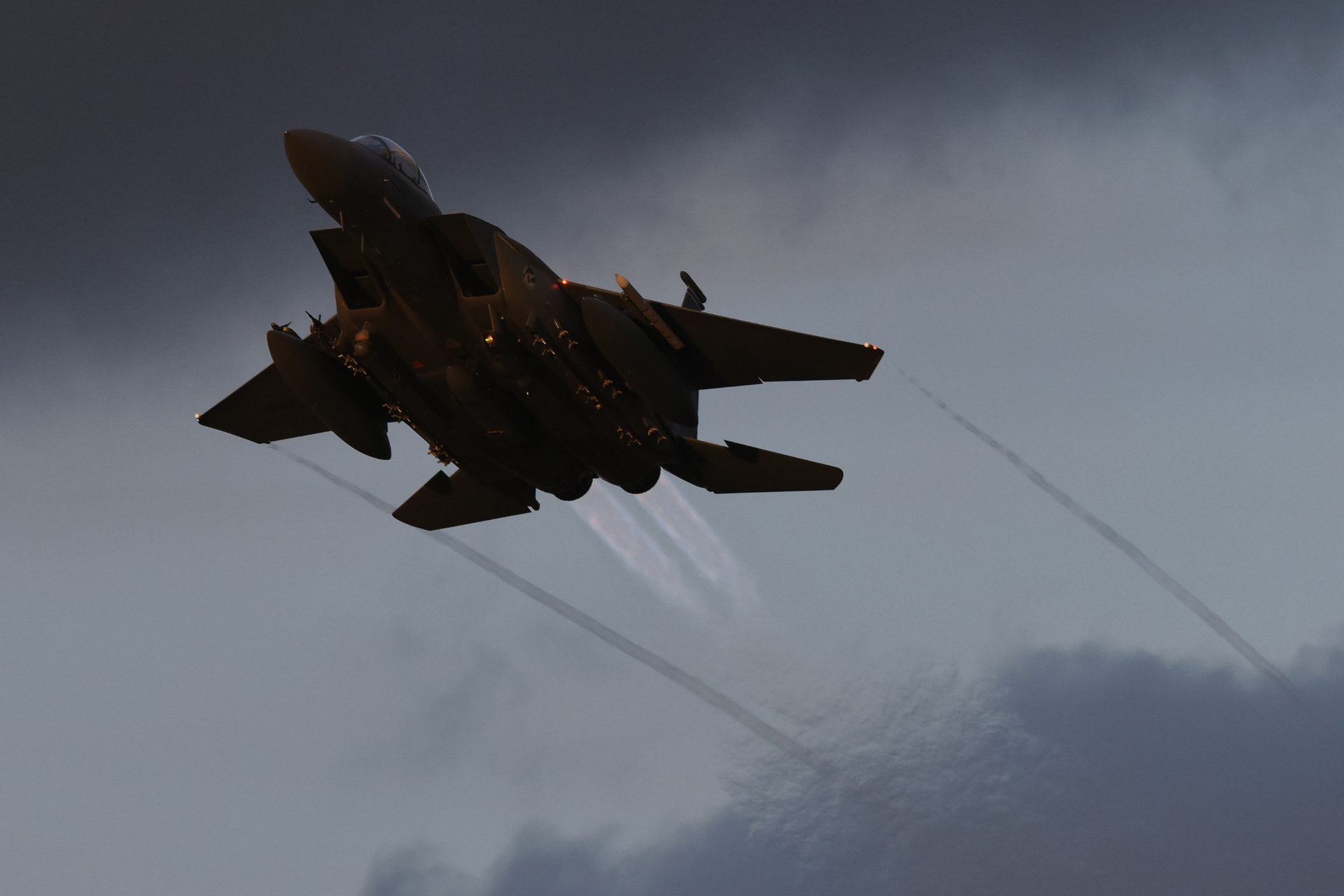
Pictured: an F-15E Strike Eagle of the 492nd Fighter Squadron over RAF Lakenheath, photographed on 14 November 2019 — the same wing, the same base, and the same aircraft type as the jet identified in Airprox 2024294, but not the aircraft or the night in question. No photograph of the 22 November 2024 encounter exists; the only imagery of the event is the police helicopter's own infrared sensor recording, which is Crown copyright and cannot be republished here. U.S. Air Force photograph by Airman 1st Class Mikayla Daly, public domain.
Theoretical Alignment
This is one of the most lopsided alignment profiles in the archive, and the reason is that the case's own primary evidence resolves it. The helicopter crew's perception is a textbook demonstration of the perceptual mechanisms the Psycho-Social Hypothesis describes and that this archive takes seriously in every other case: a trained, professional crew, primed by a specific tasking to expect drones, operating at night without night-vision equipment, with no horizon reference and no traffic information, misjudged the range of a distant fast-moving aircraft by nearly an order of magnitude — reporting 200 feet of vertical separation where radar recorded 1,700. Nothing about the event requires or even invites an extraterrestrial or interdimensional explanation. The small residual weight on those two columns is not a hedge about this encounter; it reflects only that the wider November 2024 incursion wave into which this flight was dispatched has never been publicly resolved, and that this file declines to pretend an answer to one twenty-minute flight answers that larger question too. The one hypothesis with real unfinished business here is the Foreign Adversary Technology Hypothesis, which concerns the incursion wave rather than this Airprox.
Background
Between 20 and 26 November 2024, personnel at three United States Air Force installations in East Anglia — RAF Lakenheath, RAF Mildenhall and RAF Feltwell, with RAF Fairford in Gloucestershire added later — reported repeated sightings of small unmanned aircraft over and around their perimeters. The bases are the most sensitive American-operated real estate in the United Kingdom. Lakenheath hosts the 48th Fighter Wing, flying F-15E Strike Eagles and, since 2021, F-35A Lightning IIs; Mildenhall hosts refuelling and special-operations aviation; Feltwell provides housing and support. The three sit within roughly fifteen miles of each other on the Suffolk–Norfolk border, in flat, sparsely populated fen country where an aircraft's lights are visible for a very long way.
The 48th Fighter Wing's commander, Colonel Jack R. Arthaud, addressed the base community directly, confirming “several sUAS or small drone sightings across the tri-base area since 20 Nov” and stating that they were “being actively monitored and have not impacted base residents or infrastructure.” United States Air Forces in Europe subsequently acknowledged the sightings publicly, noting that the number of systems fluctuated and that they ranged in size and configuration. The British Ministry of Defence described a response built on “multi-layered and credible force protection measures” and confirmed that it was working with United States Visiting Forces, police and other partners. British troops and counter-unmanned-aircraft equipment, including the ORCUS system, were deployed to the bases. No operator was ever identified, no drone was ever recovered, and the Ministry of Defence Police investigation that followed has never published a finding.
That is the context in which a civilian police helicopter came to be flying over the Suffolk fens after dark on the night of 22 November. The National Police Air Service is the single national provider of police aviation in England and Wales, operating a fleet of Airbus H135 (EC135) helicopters and fixed-wing aircraft from bases around the country on behalf of the individual territorial forces. NPAS does not self-task: a local force requests the asset, and the crew flies the job the requesting force describes. On this night Suffolk Constabulary asked for air support to search for suspected drone activity, and NPAS dispatched G-POLJ from North Weald Airfield in Essex. The aircraft lifted at approximately 21:13 UTC. On board, unusually, was the NPAS base commander for North Weald.
What the crew were told, and what was actually known, are not the same thing. Suffolk Police had received reports of drones from members of the public and from the bases. Drone analyst Ian Hudson, who has pursued the incident through Freedom of Information requests since it happened, has made the point bluntly: the crew were almost certainly told that drones were flying at Lakenheath as established fact, and were very unlikely to have been told that at least some of the underlying reports were ordinary members of the public calling in lights in the sky. The Ministry of Defence later confirmed in response to one of Hudson's FOI requests that a number of the reported sightings during that period had been identified as military or civilian aircraft, vessels, stars, satellites and other innocent aerial phenomena.
The airspace itself is the third piece of context, and it is the piece most often skipped in popular accounts. The encounter did not occur inside controlled airspace. It occurred in Class G — uncontrolled airspace, in the London Flight Information Region, where the legal responsibility for collision avoidance rests equally on both pilots and where an air traffic controller's obligations depend entirely on which class of service each aircraft has requested. That distinction turns out to be the hinge of the entire official investigation.
Complete Timeline
| 20 Nov 2024 | First reported small-drone sightings over the RAF Lakenheath, Mildenhall and Feltwell tri-base area. Sightings continue on successive nights. |
| 20–22 Nov 2024 | Suffolk Police log approximately twenty drone-related reports across the three bases, including one describing “10–15 drones … potentially into base airspace.” |
| 22 Nov, ~21:13 UTC | NPAS EC135 G-POLJ lifts from North Weald Airfield, Essex, tasked by Suffolk Constabulary to assist in a search for suspected drone activity in the Newmarket area. |
| 22 Nov, ~21:36 UTC | The helicopter reaches the Lakenheath area, having flown at 1,500ft. The crew contact Lakenheath Radar on 128.900 MHz and are cleared into the Aerodrome Traffic Zone at 1,500ft. No traffic information is passed. |
| 22 Nov, ~21:38 UTC | Lakenheath Tower takes the handover and gives the crew a “point-out” to “possible activity to the west of the Tower.” The crew report sighting the activity and request to route south. |
| 22 Nov, evening | The crew observe red flashing lights near the Lakenheath ATZ above 1,500ft, which they interpret as drones orbiting the airfield. They vacate the zone and climb to approximately 4,000ft to estimate the objects' height. |
| 22 Nov, 21:46–21:48 UTC | The onboard Star SAFIRE-class EO/IR turret records the aircraft heading as 285° with the camera looking approximately due north. A small unresolved target is visible on the infrared display. |
| 22 Nov, ~21:49 UTC | Now at 5,500ft (FL053) and tracking west at 120kt, the crew see one “drone” converge with them and pass above and in front. Two F-15s are operating in a surface-to-FL150 block within 20NM of Lakenheath under a Traffic Service from Lakenheath Approach. |
| 22 Nov, 21:50:46 UTC | Closest point of approach, 2NM north-east of Newmarket. NATS radar records 1,700ft vertical and 0.2NM horizontal separation. The EC135 crew report 200ft vertical and 400m horizontal. The F-15 is at FL070; the EC135 at FL053. |
| 22 Nov, ~21:51 UTC | The EC135 makes a descending left turn to increase perceived separation, at one point descending at 145kt. The F-15 pilot observes what they describe as an aggressive 90–120° turn to the south with a rapid descent, and maintains level flight above and behind. |
| 22 Nov, ~21:52–21:58 UTC | The F-15 pilot calls the police pilot three times on 128.900 MHz. The helicopter answers once, stating words to the effect of “we are going to RTB.” The EC135 announces on the Lakenheath Approach frequency at approximately 21:58 that it is returning to base; service is terminated. |
| 22 Nov, evening | Lakenheath Approach's assistant and supervisor begin facility-checklist notification calls to multiple agencies in response to the reported unusual occurrence. |
| Late Nov 2024 | Suffolk Constabulary incident logs record the crew's debrief, including that they were “forced to take emergency evasive action in relation to a drone which came within a dangerously close proximity to them.” |
| Feb 2025 | sUAS News reports that the object was roughly ten miles from Lakenheath, in the Newmarket area, and that NPAS held video. FOI responses begin to trickle out; the Civil Aviation Authority initially indicates no Airprox was filed, the matter having been logged as a Mandatory Occurrence Report. |
| 4 Apr 2025 | The BBC publishes Ian Hudson's ADS-B Exchange reconstruction of G-POLJ's flight: North Weald at 21:13, Lakenheath twenty-three minutes later, then south-west toward Newmarket, a steep climb and a series of turns — a track the BBC independently reproduced. |
| Jun 2025 | The UK Airprox Board publishes Airprox Report 2024294. Cause: perception and situational-awareness failures. Degree of Risk: Category E — no risk of collision. |
| 27 Jun 2025 | NPAS issues a statement from Chief Superintendent Vicki White acknowledging the findings and defending the crew's judgement. |
| 22 Nov 2025 | The Daily Mail, in a piece co-bylined by Liberation Times editor Christopher Sharp, publishes FOI-obtained Suffolk Police logs, a single FLIR still, and claims from an anonymous UK military source who says the full thirty-minute video shows a “corkscrew” manoeuvre impossible for an F-15. Fox News and others syndicate the story internationally. |
| 16 Dec 2025 | Ian Hudson obtains the complete NPAS EO/IR recording — more than twenty minutes — under the Freedom of Information Act and releases it publicly. Analysts including Mick West reconstruct it against the Airprox radar diagram and the ADS-B track. |
| 17 Dec 2025 | Hudson reports that with brightness increased, both F-15s are visible simultaneously on the infrared recording, and states that the video “doesn't for a moment suggest anything mysterious.” |
The Tasking and the Transit
G-POLJ lifted from North Weald at around 21:13 UTC and flew north-east at 1,500 feet. Twenty-three minutes later it was over the Lakenheath area. The crew called Lakenheath Radar on 128.900 MHz — the VHF frequency, because the EC135 is not UHF-equipped and could not have heard the discrete UHF frequency, callsign “Overlord,” on which Lakenheath Approach was working its fighters that night. That single equipment fact determines much of what followed. The crew were on a frequency where the fighters were not, and the fighters were on a frequency where the helicopter was not.
The crew requested and received a Basic Service and a clearance into the Lakenheath Aerodrome Traffic Zone at 1,500 feet. A Basic Service under the United Kingdom's Flight Information Services framework is the lightest form of air traffic service available: the controller provides general information and is under no obligation to monitor the flight or to pass traffic information about other aircraft. The Airprox Board would later observe, pointedly but fairly, that if the crew had wanted to know what else was in the sky, the service to ask for was a Traffic Service — the next tier up, under which the controller does pass that information. They did not ask for one, and on a Basic Service they were not given one.
Lakenheath Approach coordinated the transit with Mildenhall Tower and Lakenheath Tower. Lakenheath Tower then requested to handle the helicopter directly, because — in the Tower supervisor's own account — the controller was visual with “the activity” out of the window and could point it out to the crew. When the helicopter called, the Tower controller gave them a “point-out to possible activity to the west of the Tower.” The crew reported sighting it and asked to route south.
This is the most consequential communication of the night, and the Airprox Board treated it as such. The Board's members surmised that the crew may have assimilated the Tower's point-out as a reference to the object of their police tasking — that is, as confirmation that the lights they were now looking at were the drones they had been sent to find — rather than as information about other aircraft operating in the vicinity. Nothing in the exchange corrected that reading, and no traffic information on the F-15s was passed at any point, by Tower or by Approach.
The helicopter transited east of Lakenheath, through the Lakenheath ATZ, then south through the Mildenhall ATZ. About five minutes later Lakenheath Tower coordinated it back to Approach, by which time it was roughly five nautical miles south of Mildenhall. Approach accepted the traffic back. From this point the encounter unfolds over open Suffolk countryside between Mildenhall and Newmarket, not over the base at all — a geographical detail that most popular accounts of the incident, which place it “over RAF Lakenheath,” get wrong. NPAS itself, in its formal statement, described the crew as having been “tasked by the local police force to assist in the search for suspected drone activity in the Newmarket area.”
What the Crew Saw
The EC135 pilot's own written account, reproduced in the Airprox report, is worth following closely, because it is a precise record of a professional aviator's reasoning under a false premise.
The crew saw red flashing lights in the area of the Lakenheath ATZ, at a height they judged to be in excess of 1,500 feet, and believed at the time that they were drones. The pilot reported initially that the drones appeared to be carrying out large orbits of Lakenheath airfield. Having vacated the zone and advised air traffic control of their intentions, they climbed to approximately 4,000 feet specifically in order to estimate the height of the objects — a sensible, methodical piece of airmanship that only works if the target is close enough for parallax to mean anything.
They then headed east toward Bury St Edmunds, tracking a “drone” to the north of them at a slightly greater altitude. Several transmissions were made to air traffic control explaining what the helicopter was doing and what the “drones” were doing. Once the helicopter turned west, now at 5,500 feet, one of the objects appeared to converge with them and to fly above and in front of them. That moment, the Airprox Board's secretariat notes in the report, is the one that post-event analysis determined to be the closest point of approach.
The crew were aware that air traffic control was speaking to other callsigns, and they heard the F-15's callsign. But they did not know the fighters were in the zone, and crucially their Traffic Collision Avoidance System was showing nothing. A descending left turn was carried out to increase perceived separation. At one stage the helicopter had a significant rate of descent at 145 knots, and the pilot reported that the object overtook them while maintaining a constant height above them. Now tracking south, the crew continued the descent to below 2,000 feet, at which point it appeared that the object was no longer tracking them. During the last direction change there was two-way radio communication with the F-15 pilot, in which the police pilot stated that they thought they were being shepherded away from the area, and that they would return to base.
Two observations from the same account do more analytical work than anything else in the file. The first is the pilot's own risk assessment: Medium. Not high. A professional crew that genuinely believed it had come within 200 feet of an uncontrolled object would be entitled to call the risk high; they did not. The second is a remark the crew added themselves, and it is the single most useful sentence in the whole report: they did not observe standard aircraft lights visually, and none were picked up on the onboard camera systems — which, they noted, may have reinforced their perception that they had observed a drone. That is a crew doing, in writing, exactly the kind of self-critical reasoning about their own perception that this archive tries to do about other people's.
The F-15 Crew's Account
The F-15 pilot's report describes a routine night sortie with an entirely different texture. Around 22:00 local, the pilot was general-handling within an agreed block of airspace from the surface to FL150, within 20NM of RAF Lakenheath, working Lakenheath Radar Approach Control — RAPCON, callsign Overlord — on UHF. They remained outside controlled airspace. In line with standard operating procedure they were flying with anti-collision, navigation and formation lights all switched on, squawking Modes A and C. The pilot noted paying particular attention to level, because of the proximity of controlled airspace to the operating area.
Toward the end of the sortie, the pilot received word on an operations frequency that a police helicopter was operating in the area. Initially unable to identify it on the onboard radar, the pilot asked Lakenheath ATC for a “point-out.” The controller reported the helicopter at 12NM range at 5,000 feet. With that cue the pilot acquired the EC135 on radar, used other onboard systems to maintain contact, and flew toward it while holding FL60. The pilot then requested to change to the helicopter's frequency and was given 128.900 MHz.
Lakenheath ATC passed repeated traffic information to the F-15 until the crew reported visual. The pilot acquired the helicopter in their ten o'clock at one nautical mile, 1,000 feet below, and thereafter used onboard sensors to maintain situational awareness, staying at least 1,000 feet above and following behind. The pilot tried three times to raise the police pilot by radio; the helicopter answered once, with words to the effect that they were returning to base. The F-15 pilot then observed the helicopter make what they described as an aggressive 90–120 degree turn to the south and descend rapidly, maintained their own level overhead and behind, and on hearing the helicopter was going home, turned north for Lakenheath.
Set side by side, the two accounts describe the same physical geometry from opposite ends of a misunderstanding. The helicopter crew experienced an unidentified object closing, passing overhead, matching their descent and shepherding them out of the area. The fighter crew experienced a deliberate, sanctioned, ATC-coordinated attempt to visually identify and then keep clear of a police helicopter whose presence nobody had told them about in advance. Neither crew was doing anything wrong. Neither had the information that would have dissolved the other's interpretation.
The Airprox Board did not let the F-15 pilot off entirely. Members noted that it was not clear to them why the pilot, having been given traffic information on the helicopter, then requested a point-out to it and flew toward it. They further noted that the F-15 crossed in front of the EC135 — although significantly above it — on three occasions before the helicopter announced it was returning to base. Members balanced that against the fact that the F-15 pilot had at least attempted direct radio contact.
The Controllers' Accounts and the Basic Service Problem
Three separate air traffic control accounts appear in the report: the Lakenheath Approach controller, the Lakenheath Approach supervisor, and the Lakenheath Tower supervisor. Together they explain why nobody joined the dots in real time.
The Approach controller was working two F-15s on the discrete Overlord frequency in a surface-to-FL150 block. When the EC135 called from the south requesting a Basic Service transit toward Lakenheath, it was radar identified and given that service. Because of its position and its stated intention, the controller made coordination calls to Mildenhall Tower and Lakenheath Tower. Lakenheath Tower then took the traffic. Five minutes later it came back.
At the moment the helicopter returned to the Approach frequency, the controller was simultaneously aware of the assistant and the supervisor making coordination telephone calls in response to facility checklists — the notification chain triggered by a reported unusual occurrence, which in this case meant calls to several agencies across both bases. In other words, the reporting machinery generated by the drone alert was itself consuming the controller's attention at the exact moment the alert's real cause was in front of them on the scope.
The F-15 pilot then requested the point-out and it was given. The controller recalled that prior to that there had been no need to pass traffic information to either pilot, given the lateral and vertical separation. They observed the F-15 moving toward the EC135 and updated traffic information to both fighter pilots repeatedly until they reported visual. The controller continued to monitor and — this line matters — did not observe any unknown primary tracks in the vicinity of the helicopter. All aircraft under a service from Lakenheath at the time were observed and recorded squawking Modes A and C.
The Board's discussion of the controller's conduct is more interesting than a simple exoneration. Members agreed the controller had not been required to pass traffic information on the F-15s to a pilot receiving only a Basic Service. But they also agreed that it may have been particularly beneficial for the helicopter crew's situational awareness if reciprocal traffic information had been passed. Some members went further and wondered why the controller had not concluded that several calls from the police pilot about “drones” might be of importance to their own situational awareness — and suggested there had been an opportunity to respond with words to the effect of “nothing seen on radar,” or to pass traffic information on the F-15, or indeed to pass traffic information to the F-15 pilot about a possible drone sighting. Some members wondered whether the ATC staff's reaction to an unusual occurrence had itself degraded their picture of the traffic situation.
RAF Lakenheath RAPCON conducted its own unit investigation with USAFE-UK A3 ATC Liaison. Its conclusion was unambiguous: reviewing the radar recordings, it was evident that the police helicopter pilot was likely reporting, and reacting to, the activity of the F-15s operating in the area, and that the ATC staff and pilots involved had not recognised that as a possibility at the time. The recording showed no primary tracks in the vicinity of the police helicopter while under a Lakenheath service. The unit investigation also recorded, with some sympathy, that the workload during the occurrence was complex and that it would have been unusual and extremely difficult for staff, in the circumstances, to question the reports coming from the police helicopter pilot. USAFE's own comment added a final procedural finding: there had been no pre-coordination with USAF agencies about the use of police helicopters in planned policing operations in the area before the EC135 arrived.
The Radar Reconstruction and the Two Separation Figures
Two different separation figures circulate in coverage of this case, and both are real. They come from two different radar sources, and the difference between them is not a contradiction.
The UK Airprox Board's secretariat analysed the NATS radar replay. The EC135 was positively identified from Mode S data; the F-15 was identified by reference to its observed squawk and aircraft ID. From that data the Board constructed its own geometry diagram and determined the closest point of approach at 21:50:46 UTC: 1,700 feet vertical and 0.2 nautical miles horizontal. Separately, the Lakenheath RAPCON unit investigation reported the closest point of approach observed on the Lakenheath radar recording as 1,900 feet vertical when within one nautical mile horizontally. The first is the formal figure derived from the national radar replay at the actual CPA; the second is a locally-observed figure at a slightly different geometry. Both appear in the same report, and the Airprox summary table records the NATS-derived 1,700ft/0.2NM as the recorded separation.
Against that, the EC135 crew's own reported separation was 200 feet vertical and 400 metres horizontal. The Board recorded this without editorialising. It is the single most important number in the case: the crew's vertical estimate was wrong by a factor of roughly 8.5.
Independent analysts subsequently reconstructed the encounter from the radar diagram and the publicly available ADS-B track. One Metabunk contributor extracted eleven timestamped radar positions for the F-15 from the report's own diagram, interpolated a constant-speed track at FL070, and imported it into Mick West's Sitrec reconstruction tool; West separately built a four-minute recreation using the helicopter's ADS-B data, the three timestamped positions in the report's top-down image, and the EO/IR camera frame timestamped 21:47:25. The result of that exercise is instructive. From the helicopter's moving viewpoint, an F-15 flying a smooth constant-speed level turn 2,000 feet above appears to stop dead in mid-air, reverse direction, gradually accelerate, slow again, and finally fly up and over the helicopter and down the other side. Every one of those apparent behaviours is a product of relative motion and perspective. None of them is a manoeuvre the jet actually performed.
The TCAS Question
The one genuinely unresolved technical detail in the official record is why the helicopter's collision-avoidance system never showed the fighter.
The EC135 was equipped with TCAS I. The NATS radar replay confirmed the F-15 was squawking Modes A and C throughout. The Airprox Board's members noted both facts and recorded, in the report's own words, that they were at a loss to explain why the F-15 had not been detected by the TCAS. Members agreed that the pilot of the EC135 had no situational awareness of the presence of the F-15, and this became Contributory Factor 2.
No official explanation has been offered since. The most frequently suggested technical possibility — raised in independent discussion rather than in the report — is that TCAS I's traffic advisory logic is driven by closure rate and projected time to closest approach rather than by raw proximity, and that two aircraft whose flight paths were never genuinely converging, separated by 1,700 to 2,000 feet vertically, may simply never have generated a display target. That is a plausible reading of how the system is designed to behave, but it is an inference, not a finding. The honest statement is that the Board could not explain it and neither can this file.
It is worth being clear about what the TCAS silence does and does not license. It is a genuine gap in the official account. It is not evidence that the object was something other than the F-15, because the F-15's presence at that place and time is independently established by two radar recordings, by the fighter pilot's own report, by the controller's report, and by the unit investigation. A sensor that failed to show a known aircraft is a sensor problem, not a second aircraft.
The Board's Verdict
The UK Airprox Board is a joint civil–military body that assesses reported airborne conflicts in United Kingdom airspace. Its purpose is explicitly not to apportion blame but to improve flight safety; its reports are published openly, with pilot and controller accounts reproduced, radar analysis included, and the Board's own deliberations summarised. It assigns a Degree of Risk on a lettered scale, where Category A is a serious risk of collision and Category E means that normal procedures, safety standards and parameters pertained and there was no risk of collision.
Airprox 2024294 was assessed as Category E. The Board's concluding discussion acknowledged that, absent any indication to the contrary, the EC135 pilot had believed they were witnessing drone activity. Members appreciated that the incident occurred at night, without good spatial clues, and without the aid of a night vision device, and some expressed genuine sympathy with a pilot who believed they had seen a drone on a parallel or converging course and was concerned for the safety of their aircraft. But after analysis it was clear to members that the track of the F-15 correlated with the perceived position of the “drone,” and that the crew had actually sighted a fast-moving object at distance rather than a small object moving in close proximity. Members noted from the radar replay that vertical separation had been significant and were satisfied there had been no risk of collision.
Three contributory factors were recorded. CF1: although not strictly required to do so under the terms of a Basic Service, the Lakenheath controllers had not passed traffic information on the F-15s to the EC135 pilot. CF2: the EC135 pilot had no situational awareness of the presence or position of the F-15s. CF3: the EC135 pilot had been concerned by the proximity of the F-15s, perceiving them to be drones. In the Board's safety-barrier assessment, both the ground element's and the flight element's “situational awareness of the conflicting aircraft and action” barriers were rated ineffective.
The National Police Air Service response, issued by Chief Superintendent Vicki White, Accountable Manager at NPAS, accepted the findings while defending the crew without reservation. The statement confirmed the crew had been tasked by the local force to search for suspected drone activity in the Newmarket area, stated that “in the absence of any contradictory information, the crew acted on the belief that they were observing drone operations,” and concluded that “the crew demonstrated professionalism and sound judgement in identifying a potential hazard” and that “with no traffic information provided and no situational awareness regarding the presence of the F15 aircraft, the crew correctly returned to base as a precautionary measure.” That is a fair characterisation. The crew were wrong about what they were looking at, and they handled being wrong about it correctly.
On Taking Official Findings Seriously Without Taking Them on Faith
This archive's standing position is that an official finding about a UAP-adjacent event is one input to weigh, not a verdict to accept. Government and military bodies investigating anomalous aerial reports have a long and documented record of incomplete, delayed or later-revised explanations: Project Blue Book-era misidentification rulings that drew criticism even from Air Force-linked scientists at the time; the Central Intelligence Agency's own 1997 acknowledgment that a substantial share of Cold War-era “UFO” reports were misattributed U-2 and OXCART reconnaissance flights it deliberately declined to correct; and, more generally, an institutional and career incentive toward the least alarming available explanation. Many experienced researchers in this field — not merely casual skeptics — treat official conclusions with real caution for exactly those reasons, and they are right to.
Those cautions apply here with unusual force in one respect and unusually little in another, and it is worth separating them.
Where they apply: the United States Air Force conducted the primary unit investigation into an incident involving one of its own aircraft, in coordination with USAFE-UK, and no independent United Kingdom body audited that unit investigation. The Airprox Board has no drone or unmanned-systems specialist among its assessors and, as critics have noted, had no communication with the Ministry of Defence Police investigation running in parallel. The broader question of what caused the tri-base incursion wave remains entirely unanswered by any public authority nearly two years later, and the Ministry of Defence has declined FOI requests seeking even a yes-or-no statement about whether it holds credible evidence of drone activity. An institution that will not say whether it has evidence is not owed the benefit of the doubt about anything.
Where they do not apply: the Airprox Board's conclusion in this case is not a bare assertion that outsiders must take on trust. It is a conclusion resting on a published radar geometry, reproduced pilot and controller accounts, and a stated closest-approach time to the second — all of which outside analysts have independently checked against a separate, publicly available ADS-B track and against the helicopter's own infrared recording, which was subsequently released under FOI to a researcher who was not sympathetic to the official line. That is the opposite of an unauditable institutional pronouncement. When an official body publishes its working and the working survives independent reconstruction from independent data, the appropriate response is to accept the finding for the reasons given, not because of who gave them. This file's low credibility score reflects the strength of the underlying evidence, not deference to the Board.
The 2025 Re-Reporting and the Anonymous Source
On 22 November 2025, exactly one year after the flight, the Daily Mail published an investigation co-bylined by Josh Boswell and Christopher Sharp, the latter editor of the UAP outlet Liberation Times. It was widely syndicated, notably by Fox News on the same day. The story's core was genuinely new material: Suffolk Constabulary incident logs obtained under the Freedom of Information Act, which recorded the crew's own debrief in far stronger language than the Airprox report's clinical prose.
The logs stated that the crew “were forced to take emergency evasive action in relation to a drone which came within a dangerously close proximity to them,” that “they had to perform an emergency dive and described that they were pursued in the dive by two drones who matched their speed,” and that the pilots “felt that drones had targeted them and chased them off at approximately 140 knots.” A separate log recorded “NPAS is withdrawing due to a drone coming close to them.” Roughly twenty drone-related reports were logged across the three bases between 20 and 22 November, including one describing “10–15 drones … potentially into base airspace,” a witness with night-vision goggles reporting “five to six drones” near the A1065, and another describing “large stationary things — tic-tacs — they are not birds.”
Two things need saying about these logs. First, they are real documents and they do reflect what the crew genuinely believed and reported at the time. Second, they are a contemporaneous record of a belief, not an independent observation. A police incident log records what an officer was told. The crew's belief that they had been pursued by two drones is precisely the belief the Airprox investigation examined and found to be a misperception of two F-15s; the logs cannot corroborate that belief, because they are a transcript of it. An account and its own restatement are one piece of evidence, not two.
The story's second element was an anonymous “UK military source” who said they had viewed the complete thirty-minute infrared video and that it showed more than a brush with a fighter. The quotes as published: “In the 30-minute video with pilot audio, nobody mentions F-15s. They only talk about the drones. How they're basically mirroring the helicopter's movements. How fast the drones are going. That they're basically forcing them out of the area.” And: “A fixed-wing craft is caught on the video, where you can see a corkscrew move. An F-15 cannot make a small corkscrew turn like that.”
The first claim is self-defeating on inspection. That the crew never mention F-15s on the cockpit audio is not evidence that no F-15 was there; it is direct evidence for the Airprox Board's actual finding, which is that the crew did not know an F-15 was there. A crew that had identified the object as a fighter would not have filed an Airprox about a drone.
The second claim — the corkscrew — was, at the time it was published, unfalsifiable by the public. The source had seen a video nobody else had. The article published a single still frame and, separately, the co-author posted a nine-second clip described as a close-up handheld phone recording of a computer screen playing the original video, with none of the on-screen data legible. Analysts immediately noted the oddity that a source claiming the video contained a physically impossible manoeuvre had supplied a fragment that did not show it. Trained British meteorologist Stuart Onyeche, who works for a defence company and had independently pursued FOI requests on the incident, was also quoted, saying he was “inclined to trust the initial detail and assessment of the experienced helicopter pilots that we see noted in these logs, which was that they were forced to take evasive action due to the close proximity of some kind of unmanned drone.” Onyeche is a named, credentialed commentator making an explicit argument from witness credibility; he is not the anonymous military source, and his position should not be conflated with theirs.
The Video: What FOI Actually Released
Three and a half weeks later the argument stopped being about a video nobody had seen.
On 16 December 2025, Ian Hudson — the drone analyst behind UAV Hive, who had been filing Freedom of Information requests on this incident since it happened and who had told a public forum in November that he was prepared to take the matter to Tribunal to obtain the footage — announced that he had obtained more than twenty minutes of the NPAS infrared recording and had passed a copy to Mick West. It was published publicly. The overlay is legible: the date reads 22 November 2024, the clock runs in UTC, the aircraft callsign field reads NPAS51, the police crest is visible in the corner, and the camera's mount angles and the aircraft's true heading are all displayed.
The contents are undramatic. The relevant section published for analysis runs from 21:46:26 to 21:47:32 — a little over three minutes before the closest point of approach — and shows a small, unresolved thermal point against a featureless sky. West's initial assessment was that the imagery was fairly consistent with an aircraft flying toward the helicopter while turning east. He then overlaid the report's own radar-derived geometry on his reconstruction and confirmed that the two matched, while being candid about the recording's real limitation: the CPA moment itself is not usefully shown. At 21:50:46 the camera was pointing slightly east of north, and the F-15 would have been off-frame to the left. The video therefore corroborates the reconstruction for the minutes around the encounter without capturing the closest pass.
The following day Hudson reported a further finding: with the brightness increased, both F-15s are visible on the electro-optical/infrared recording at once. That matters, because the Airprox report repeatedly refers to two F-15s operating in the block and the Board itself observed that the Approach controller may not have deduced that the pilot's references to “drones” — plural — correlated to the positions of two fighters. The crew reported being pursued by two objects. Two fighters were there. Both are on the tape. Hudson also suggested, reasonably, that the Board's published diagram should arguably have plotted both tracks rather than one, and submitted an enquiry to the Civil Aviation Authority on that point.
Hudson's own summary of the release is the most significant statement any named investigator has made about this case, precisely because of who is making it. He had spent a year using FOI to press NPAS, the CAA and the Ministry of Defence, from the explicit position that the drone industry is repeatedly damaged by nocturnal misidentifications treated as fact — his stated reference point being the December 2018 Gatwick shutdown and the First-tier Tribunal proceedings that followed it. He is not a defender of official narratives. His verdict on the footage: “That video doesn't for a moment suggest anything mysterious, what it does do though is show there were no drones over Lakenheath.”
On the corkscrew specifically, Hudson offered a deflationary suggestion worth recording because it is testable in principle and because it comes from someone who had access to the material: he doubts there ever was a separate leaked video source at all, noting that the still the Daily Mail presented as exclusive was one he and the BBC had both already seen weeks earlier, held back at the time at a third party's request. Whether or not that particular reading is right, the substantive point stands. An anonymous claim about a video's contents survives only until the video is released. This one was released, and the claim did not survive it.
One further explanation for the corkscrew impression deserves to be stated on its own terms, because it is the same optical effect that resolves several other cases in this archive. A fixed-wing aircraft approaching a moving observer head-on while banking through a turn traces, on a two-dimensional infrared display with no depth cues, a looping helical path. It appears to spiral. It is flying a smooth arc. The Sitrec reconstructions of this encounter make that transformation explicit — the same geometry that makes a jet appear to stop, reverse and climb over the helicopter also makes a curved approach look like a corkscrew.
Freedom of Information and the Documentary Trail
More of this case is public than is public about almost any comparable incident, and essentially all of it arrived through the United Kingdom's Freedom of Information Act rather than through voluntary disclosure. That is worth documenting in its own right, because the pattern of what was released and what was withheld is itself evidence about how these events are handled.
Ian Hudson's requests to NPAS produced cooperative responses; his experience of the Civil Aviation Authority was less so. In February 2025 he noted that because the event had been logged as a Mandatory Occurrence Report rather than as an Airprox at that stage, the CAA's response to his FOI was, in his characterisation, evasive — stating there was no Airprox rather than that there was an MOR. The Airprox report did eventually appear, in June 2025. Hudson's follow-up requests sought the object's exact location and altitude, an identification of the aircraft type, the reason the helicopter had not pursued it to a landing site, and whether the USAF had requested that NPAS abandon its search. Stuart Onyeche separately obtained the Suffolk Constabulary logs.
The Ministry of Defence's disclosures are a study in partial candour. In response to FOI2025/15428 the department confirmed that some reported sightings of uncrewed aerial systems during the period had been identified as military or civilian aircraft, vessels, stars, satellites and other innocent aerial entities. Hudson's follow-on request — which asked, in terms designed to be answerable yes or no without prejudicing an investigation, whether the MOD held any clear EO/IR, CCTV or professional-camera imagery of a drone, any multi-sensor confirmation from radar and radio-frequency detection, or any clear daylight drone video — was refused. Liberation Times separately reported receiving contradictory FOI answers about whether a drone had been formally reported at all, with the Airprox Board initially indicating no drone-related Airprox existed and later clarifying that the report recorded the crew's belief that the other platform was a drone without formally designating it as one.
The Ministry of Defence Police investigation, which has primacy over the criminal aspect of the November 2024 incursions, has published nothing. The full cockpit audio has not been released; recording air traffic control transmissions is unlawful in the United Kingdom, and the USAF's own tapes would require an American FOIA request. Michael Morgan, a retired senior police detective who has pursued the affair publicly and who wrote a detailed critical account for Liberation Times in November 2025, has been blunt about the pattern: “There is a whole series of question marks about what went on in November 2024. I have run into repeated efforts by the authorities to avoid answering even the most basic questions. … What is so secret about this investigation?”
That complaint is legitimate and this file endorses it — about the incursion wave. It does not carry over to the Airprox. The one piece of primary evidence Morgan and others most wanted released was the video, and when it was released it did not support the anomalous reading.
Key Witnesses
The EC135 Pilot, G-POLJ
NPAS does not release the names of operational aircrew, and neither the Airprox report nor any subsequent disclosure identifies this pilot. The filed account is nonetheless one of the most useful witness statements in this archive, because it records both the observation and the pilot's own doubts about it. The pilot reported red flashing lights near the Lakenheath ATZ believed to be drones, climbed deliberately to 4,000 and then 5,500 feet to estimate their height, tracked one object east then west, and executed a descending left turn at 145 knots when it appeared to converge and pass overhead. The pilot assessed the risk of collision as Medium and reported separation of 200 feet vertically and 400 metres horizontally — against a radar-recorded 1,700 feet and 0.2 nautical miles. The pilot also volunteered that no standard aircraft lights were seen visually and none appeared on the onboard camera systems, and that this may have reinforced the crew's perception that they were watching a drone.
The EC135 Crew and the NPAS North Weald Base Commander
An EC135 on a police tasking normally carries a pilot and two tactical flight officers, one of whom operates the electro-optical/infrared turret and the searchlight. The Airprox report refers throughout to “the pilot and crew” and attributes the observation about the absent standard lighting to the crew collectively. The Suffolk Constabulary incident logs released under FOI in 2025 record a debrief in the plural, describing the crew as having performed an emergency dive and having felt that drones targeted them and chased them off at approximately 140 knots. One of the longer versions of those logs states that the NPAS base commander for North Weald was aboard the aircraft. No crew member has spoken publicly under their own name.
The F-15 Pilot
The pilot of the second aircraft in the Airprox filed a full account and is, for practical purposes, the only person in the encounter who knew what was happening while it was happening. Operating in a surface-to-FL150 block within 20NM of Lakenheath with anti-collision, navigation and formation lights on and Modes A and C selected, the pilot heard on an operations frequency that a police helicopter was in the area, could not find it on radar, obtained an ATC point-out placing it at 12NM and 5,000 feet, acquired it, and flew toward it while holding FL60. The pilot reported visual contact at one nautical mile in the ten o'clock position, 1,000 feet below, maintained at least 1,000 feet of separation, and attempted radio contact three times on 128.900 MHz, receiving one reply. The Board questioned why the pilot sought a point-out and then flew toward the helicopter, and noted that the F-15 crossed in front of it — significantly above — on three occasions.
The Lakenheath Approach Controller
Working two F-15s on a discrete UHF frequency and the EC135 on VHF under a Basic Service, this controller is the one person who could see both aircraft on one scope throughout. The controller radar-identified the helicopter, coordinated its transit with two towers, passed repeated traffic information to the fighters, and continued to monitor after the encounter — reporting that no unknown primary tracks were observed anywhere near the helicopter, and that every aircraft under a Lakenheath service was squawking Modes A and C. Simultaneously, the position's assistant and supervisor were working through facility notification checklists triggered by the reported drone activity. The Board found the controller had met every obligation a Basic Service imposes, while observing that passing reciprocal traffic information anyway would have been particularly beneficial.
The Five Observables Assessment
None of the five observables is present, and the apparent exception proves the point. The only performance characteristic ever attributed to the object — an anonymous source's claim that the infrared video captured a “corkscrew” turn impossible for an F-15 — would, if real, sit closest to the anti-gravity-lift and instant-acceleration columns. That claim is now testable against the released recording and is not supported by it; the apparent stop-reverse-climb behaviour the helicopter crew experienced is fully reproduced by a reconstruction in which the F-15 flies level at constant speed through a smooth turn 2,000 feet above a manoeuvring helicopter. Low observability is likewise not present in any meaningful sense: the F-15 was squawking Modes A and C, was visible on two radar systems, was flying with anti-collision, navigation and formation lights on, and was in two-way radio contact with the controller. It was unobserved by the helicopter crew's eyes and by their TCAS, which is a different thing entirely.
Evidence Assessment
Supporting Anomalous Origin
- A professional, trained police aircrew operating a sensor-equipped aircraft believed at the time, and reported in writing, that they were being pursued by unmanned aircraft that matched their speed and descent.
- The helicopter's TCAS I never displayed the F-15 despite the fighter squawking Modes A and C, and the Airprox Board explicitly recorded that it could not explain why.
- The crew reported seeing only red flashing lights and no standard navigation lighting, either visually or on the onboard camera systems, while the F-15 pilot reported flying with anti-collision, navigation and formation lights all switched on.
- Suffolk Constabulary incident logs obtained under FOI record the crew's contemporaneous debrief in markedly stronger terms than the official report — “emergency evasive action,” pursuit “in the dive” by two objects matching their speed at roughly 140 knots.
- The encounter occurred during an unresolved week-long wave of reported drone incursions over three USAF-tenanted bases, which no authority has publicly explained and about which the Ministry of Defence has declined to say whether it holds credible evidence.
- An anonymous UK military source claiming to have viewed the full infrared recording described objects mirroring the helicopter's movements and a corkscrew manoeuvre attributed to a fixed-wing craft.
Supporting Conventional Explanation
- Two independent radar recordings — the NATS national replay with Mode S identification, and the Lakenheath RAPCON recording — place a specific, identified F-15 at the perceived position of the “drone” at the closest point of approach, 21:50:46 UTC.
- The F-15 pilot filed an account describing the same geometry from the other side, including a deliberate ATC-coordinated approach to visually identify the helicopter, sustained visual contact, and three attempted radio calls.
- The Lakenheath Approach controller reported observing no unknown primary tracks anywhere near the helicopter, and confirmed every aircraft under a Lakenheath service was squawking Modes A and C.
- The crew's own reported vertical separation — 200 feet against a recorded 1,700 — is wrong by a factor of roughly 8.5, and nocturnal range estimation without a horizon or night-vision aid is a well-documented failure mode for all observers including trained aircrew.
- The complete NPAS infrared recording, obtained under FOI in December 2025 and released publicly, shows a small unresolved thermal point consistent with an aircraft approaching while turning, with both F-15s visible simultaneously when brightness is increased.
- Independent reconstructions in Sitrec, built from the Airprox radar geometry and a separate publicly available ADS-B track, reproduce every apparent anomalous behaviour — stopping, reversing, climbing over the helicopter — from an aircraft flying level at constant speed through a smooth turn.
- Ian Hudson, the named drone analyst who pursued the footage through FOI from an explicitly adversarial position and threatened Tribunal proceedings to get it, concluded on seeing it that the video “doesn't for a moment suggest anything mysterious.”
- The F-15's most distinctive night signature from below, to observers familiar with Lakenheath operations, is precisely a red tail strobe — the one light the crew did report seeing.
Why “Debunked”
This archive uses the Debunked stamp sparingly, and never on the strength of an official pronouncement alone. It is applied here because the conventional explanation in this case is not an assertion but a reconstruction, and because every independent line of evidence that could have broken it instead confirmed it.
The explanation names a specific aircraft, at a specific altitude, on a specific radar-recorded track, at a time given to the second. It is corroborated by two separate radar sources, by the other aircraft's own pilot, by the controller working both aircraft, and by a unit investigation. It was then tested against two independent datasets neither the Board nor the USAF controls: a publicly available ADS-B track of the helicopter, and the helicopter's own infrared recording, prised out of the police service under the Freedom of Information Act by a researcher who spent a year expecting to find that the official account did not hold. Both tested consistent. The strongest anomalous claim ever made about the case — the corkscrew — was made about a video's contents by an anonymous source while the video was unavailable, and did not survive the video's release.
The score of 22 is not zero, and the residue is real. The TCAS failure has never been explained by anyone with access to the equipment. The Board carried no unmanned-systems expertise and did not speak to the parallel Ministry of Defence Police investigation. The full cockpit audio has never been released. And the wider question — what people at three air bases were actually seeing for a week in November 2024 — is genuinely open, with the Ministry of Defence refusing to confirm even whether it holds credible evidence either way. This file's rating is a judgement about one twenty-minute police flight and the object its crew reported, not about that larger question, and readers should not let the resolution of the first be used to imply a resolution of the second.
Two further things deserve saying plainly. First, the crew did nothing wrong. They were sent to find drones, were told nothing about fighter activity, were flying on a service that did not oblige anyone to tell them, had no night-vision aid and no working traffic display, and when they became concerned they disengaged and went home. The identification error is a systems failure, not a competence failure. Second, this case is a rare and valuable demonstration of what a resolvable UAP report looks like: an incident with a timestamp, a radar track, a second aircraft's account, and a sensor recording that outsiders can obtain. Most of this archive's genuinely unresolved cases are unresolved precisely because they have none of those things.
Sensor & Instrumentation Detection Profile
Five distinct sensor systems bore on this encounter, and understanding which of them detected what is the whole of the case.
NATS primary and secondary surveillance radar. The national air traffic radar replay was the Airprox Board secretariat's primary analytical source. The EC135 was positively identified from its Mode S transponder data; the F-15 was identified by its observed squawk and aircraft ID. From this the Board constructed the geometry diagram published in the report and fixed the CPA at 21:50:46 UTC at 1,700 feet vertical and 0.2NM horizontal.
Lakenheath RAPCON radar. The unit investigation reviewed the base's own radar recordings and reported a closest observed approach of 1,900 feet vertically within one nautical mile. It also established the negative finding that matters most: no primary tracks in the vicinity of the police helicopter while under a Lakenheath service, and every serviced aircraft squawking Modes A and C. A drone small enough to be invisible to a military approach radar would also be far too small to be mistaken at 1,700 feet for anything at all.
TCAS I aboard the EC135. Non-functional for this encounter in the only sense that matters: it never displayed the F-15, which was transponding Modes A and C throughout. This is the one instrumentation failure in the case and it remains formally unexplained.
The onboard electro-optical/infrared turret. The overlay visible on the released recording is consistent with a Star SAFIRE-family gimbal. It records aircraft heading, mount azimuth and elevation, target heading, a north pointer, UTC time and mission identifiers — enough metadata for an outside analyst to reconstruct exactly where the camera was pointing at any moment, which is what subsequent analysis did. At 21:47:25 the aircraft heading reads 285° with a mount azimuth of 079°, giving a line of sight of 004° true — almost due north, toward the Lakenheath and Mildenhall area. The system detected the target as a small unresolved thermal point and never resolved structure, which is expected at the ranges involved and is consistent with a distant fixed-wing aircraft rather than a nearby small quadcopter.
ADS-B. G-POLJ's own broadcast track is public and was extracted from ADS-B Exchange by Ian Hudson, then independently reproduced by the BBC. It confirms the North Weald departure at 21:13, the arrival in the Lakenheath area, the turn south-west toward Newmarket, the steep climb and the subsequent turns. The F-15 does not appear on ADS-B Exchange, which is normal for military fast jets and is why the Board's radar diagram — rather than public tracking data — is the source for the fighter's positions.
The overall shape of the detection profile is the argument in miniature. Every sensor that could see the F-15 saw it. The one sensor aboard the helicopter that should have seen it did not, and the human eyes aboard the helicopter saw one light of the several the fighter was showing.
Environmental & Geospatial Context
The recorded weather comes from RAF Mildenhall, five nautical miles from the transit route, and is quoted verbatim in the Airprox report: METAR EGUN 222155Z 21006KT 9999 FEW030 01/M01 A2992. Decoded, at 21:55 UTC on the 22nd the wind was from 210 degrees at six knots, visibility was ten kilometres or greater, there were few clouds at 3,000 feet, the temperature was 1°C with a dew point of −1°C, and the altimeter setting was 29.92 inches of mercury. Both aircraft reported flying in visual meteorological conditions with greater than ten kilometres of visibility. Conditions were, in short, excellent — which is precisely why this is a perception case rather than a weather case. There was nothing obscuring the F-15; there was simply nothing to judge its distance against.
Late November at 52°N puts full darkness well before 21:00 UTC. The encounter occurred more than two hours after sunset over the flat, thinly-lit fen and heath country between Mildenhall and Newmarket, terrain that offers almost no vertical features and very few ground lights to establish scale. The crew were not equipped with a night vision device, a point the Airprox Board raised explicitly and sympathetically. In those conditions a light source of unknown size at unknown range is genuinely ambiguous, and the ambiguity resolves toward whatever the observer has been told to expect.
The geography is worth restating because popular accounts routinely mislocate the event. RAF Lakenheath sits at approximately 52.409°N, 0.561°E in the Suffolk Breckland. The Airprox position is recorded as 5216N 00026E — two nautical miles north-east of Newmarket, roughly seventeen kilometres south-west of Lakenheath and outside both the Lakenheath and Mildenhall Aerodrome Traffic Zones, in Class G airspace beneath the Newmarket area. The helicopter had already transited the Lakenheath ATZ, then the Mildenhall ATZ, and was five nautical miles south of Mildenhall when Tower handed it back to Approach. The sUAS News reporting in February 2025 made the same point from FOI material: the object was roughly ten miles from the base, in the Newmarket area rather than at the airfield.
One further environmental factor bears on interpretation. There was, as Hudson later noted while reviewing the recording, a substantial amount of ordinary civil traffic over Newmarket that evening — enough that at least one airliner may plausibly appear in the camera's pan-arounds. The area sits beneath busy routings into and out of the London terminal area. Any analysis of the infrared footage has to account for that traffic before attributing any particular thermal point to any particular aircraft.
Observer Credibility & Occupational Profile
The occupational profile in this case is strong and it points in the direction most readers will not expect, so it needs stating carefully.
NPAS pilots are typically highly experienced commercial or ex-military rotary aircrew operating under a police air operator's certificate, flying at night, at low level, in congested airspace, on short-notice tasking, as a matter of routine. The tactical flight officers alongside them are serving police officers trained on the aircraft's camera and mapping systems. This is not a casual observer group; it is close to the most credentialed category of night-time aerial observer available outside the military. NPAS itself defended the crew's judgement in its statement, and the Airprox Board's members expressed real sympathy rather than criticism. On the safety decisions — disengaging, descending, announcing intentions, returning to base, filing the report — the crew performed exactly as they should have.
What that credential does not confer is immunity from the specific perceptual failure that occurred. Estimating the range and size of an unfamiliar light source at night, against a featureless sky, without stereoscopic depth cues and without a night vision device, is a task at which every category of human observer performs badly — including pilots, including military pilots, and including this archive's own most credentialed witnesses in other files. The magnitude of the error here is documented rather than inferred: 200 feet reported against 1,700 feet recorded. That is the ordinary size of nocturnal range error, not an extraordinary one, and it is exactly why the aviation safety system relies on transponders, radar and traffic services rather than on eyesight.
The second credibility factor is priming, and this is where the occupational strength becomes an occupational vulnerability. The crew were dispatched on a tasking whose stated premise was that drones were operating near a United States air base, in a week when that premise was being reported as established fact across the national press. They then received a “point-out” from a Lakenheath Tower controller to “possible activity” — language the Airprox Board itself thought the crew may well have read as confirmation of their target rather than as information about other aircraft. Everything that followed was interpreted inside a frame that had been supplied to them before they took off and was never contradicted by anyone in a position to contradict it.
On the other side of the encounter, the F-15 pilot's account is that of a trained military aviator who had radar, ATC coordination, sustained visual contact from one nautical mile, and knowledge of the other aircraft's identity. Where the two accounts differ, the fighter pilot's is the better-instrumented, and it agrees with the radar.
Finally, the investigator profile deserves its own note, because it is unusually good. Ian Hudson is a named, publicly identifiable drone analyst with a substantial track record of Freedom of Information work in the United Kingdom unmanned-aviation sector, who has been openly critical of authorities treating nocturnal drone reports as established fact — his own reference point being the December 2018 Gatwick closure, where FOI disclosure and a First-tier Tribunal ruling eventually established that the only video evidence held depicted a police force's own drone, and where the tribunal recorded real reputational damage to the drone community as a result. That is the background of the person who obtained this video and then concluded it showed nothing anomalous. It is very difficult to characterise that conclusion as institutional deference.
Physical & Material Assays
There are none, and the absence is not a gap in the investigation — it is a consequence of the event's nature. No object landed, crashed, was recovered or left a trace. No electromagnetic interference with the helicopter's systems was reported; the one instrumentation anomaly, the TCAS non-display, is a detection failure rather than an interference effect and no serviceability defect was recorded against the aircraft afterwards. No crew member reported any physiological effect. The aircraft continued in service and returned to North Weald under its own power. The entire evidentiary content of this case is electronic and testimonial: radar returns, an infrared recording, a transponder track, radio transmissions, and four written accounts.
Historical Precedents & Archive Matches
This archive already holds a case file at this exact base, and the pairing is instructive rather than corroborative.
On the night of 13–14 August 1956, four independent radar and visual sensor systems — at RAF Bentwaters and RAF Lakenheath — tracked objects making instantaneous stops and accelerations to 400–600 mph, in the case the Condon Committee itself called the most puzzling and unusual in the radar-visual files. That case is filed here as the Lakenheath-Bentwaters Radar-Visual Case. The two events share a name on a map and nothing else evidentially. In 1956 the anomaly was on the radar and the question was what the radar was seeing; in 2024 the radar showed an ordinary identified fighter and the anomaly was entirely in what a crew believed they were looking at. If anything the 1956 case is a useful control: it demonstrates that when something genuinely inexplicable happens in this airspace, the instruments are the things that register it.
The closest real precedent is not a UFO case at all. Between 19 and 21 December 2018, reported drone sightings closed Gatwick Airport's runway for some thirty-three hours, grounding around a thousand flights and disrupting roughly 140,000 passengers in the pre-Christmas peak, in what became Sussex Police's Operation Trebor. The force took 222 witness statements, made door-to-door enquiries at 1,200 addresses, briefly arrested and released a man and a woman without charge, and spent about £790,000. No operator was ever identified and no drone was ever recovered. A First-tier Tribunal decision in the General Regulatory Chamber (EA/2023/0272, arising from ICO Decision Notice IC-193121-Z5F4) subsequently ordered further disclosure and recorded demonstrable damage to the drone community from the episode. Ian Hudson, in his own FOI correspondence to the Ministry of Defence about Lakenheath, cited Gatwick explicitly by name and asserted that the only video evidence held by that investigation, once uncovered through FOI, turned out to depict Sussex Police's own drone — a characterisation consistent with contemporaneous reporting in December 2018 that the sightings “may have been police's own drone,” though it is his framing rather than a tribunal finding. Gatwick is the template for how a nocturnal drone panic propagates through official channels and hardens into fact.
The wider pattern of drone incursions over Western military installations is the third context, and it is genuinely unresolved. This archive holds files on the Langley AFB UAP Incursions of December 2023, in which unidentified unmanned aircraft operated over a fighter base in Virginia for seventeen nights; on the New Jersey and Northeast Drone Wave of late 2024, contemporaneous with these British sightings; on the Palo Verde Nuclear Station Drone Swarm; and on the 2025 European NATO Drone Incursion Wave. Taken together these establish that the phenomenon of unattributed drone activity over sensitive sites is real, sustained and internationally distributed. They do not establish anything about what a police helicopter crew saw over Newmarket, and this file resists the common move of treating the reality of the general category as evidence about a specific instance.
Two further archive matches are worth recording for the geographic and sensor-analysis parallels. Rendlesham Forest, twenty-five years after Lakenheath-Bentwaters and forty miles east, remains the United Kingdom's most examined military UAP case and shares this one's core evidentiary problem: credentialed military witnesses, a strongly held interpretation, and a dispute about whether a nearby known light source accounts for it. And the Aguadilla CBP FLIR Encounter is the archive's clearest example of the specific analytical trap at work here — an infrared recording from a moving aircraft in which apparent target motion is dominated by the camera platform's own movement and by perspective, and in which the reconstruction rather than the raw footage is where the answer lies.
Material Analysis
With no physical evidence of any kind, the material analysis in this case is the analysis of the recorded signal — what the infrared sensor actually captured and what can legitimately be inferred from it.
The Infrared Signature
The released NPAS recording shows the target as a small, unresolved bright point against a uniform cold sky. It does not resolve wings, a fuselage, rotors or an exhaust plume. This is the single detail the anomalous reading leans on hardest — the crew's own note that no standard aircraft lights were seen visually or on the camera systems — and it is also the detail most often misread. At the ranges implied by the radar geometry, a fighter-sized aircraft subtends a very small angle, and a mid-wave or long-wave infrared sensor operating in a narrow field of view against a clear cold sky will render it as an unstructured hot point. Structure appears at much shorter ranges or in much wider apertures. An absence of resolved structure at distance is what the physics predicts and is not diagnostic of anything.
The Lighting Question
The apparent conflict between the F-15 pilot's report of anti-collision, navigation and formation lights all on, and the helicopter crew's report of seeing only red flashing lights, is real but not mysterious. Aircraft lighting is directional. Navigation lights are shielded to show red to port, green to starboard and white astern within defined arcs; formation lights are dim, low-intensity strips intended to be seen by other aircraft in close formation and are often barely visible at distance. The anti-collision strobe is the exception: it is the high-intensity, omnidirectional element designed to be seen from a long way off. Observers with long familiarity with F-15 night operations over East Anglia describe the red tail strobe as the single most recognisable identifier of the type at night from below. A distant aircraft at an unfavourable aspect angle showing one bright red flashing light and nothing else is not an anomaly; it is the expected appearance.
The Reconstruction
The decisive material analysis was done not on the imagery but on the geometry. Analysts extracted eleven timestamped radar positions for the F-15 from the Airprox report's own published diagram, assigned them the reported FL070 altitude, interpolated a constant-speed track, and combined that with the helicopter's public ADS-B positions and the camera overlay's own heading and azimuth values inside Mick West's Sitrec tool. The reconstruction reproduces, from an aircraft in unremarkable level flight, every behaviour the crew perceived as anomalous: apparent hovering, apparent reversal of direction, apparent matching of the helicopter's own turns, and an apparent climb over the top and down the far side. It also reproduces the appearance that would most naturally be described as a corkscrew — the two-dimensional projection of a banking approach seen head-on from a moving platform.
A note on this source's transparency: in May 2024, West publicly disclosed that Sitrec's ongoing development — the same tool used for this reconstruction — has been partially funded since December 2023 by an organization that has asked to remain anonymous, at what he describes as "a reasonable hourly rate." He states the funder has never directed what he writes or concludes and that he is not paid for a particular narrative; by the funder's own choice, that claim cannot be independently verified, and the funder's identity is unknown even to Metabunk's own members, who have publicly guessed at everything from AARO to the CIA without confirmation. This does not by itself undermine the specific reconstruction above, whose underlying inputs — the Airprox report's radar diagram, the helicopter's public ADS-B track, and the released camera overlay — are public data any analyst could independently check outside Sitrec. It is, however, a genuine and disclosed gap in this source's funding transparency, worth weighing whenever his broader analytical judgment is cited as evidence. See his key-figures profile for the full disclosure and its primary source.
Supporting Non-Terrestrial Origin
- No physical, trace, metallurgical or biological material of any kind exists to analyse, so nothing in the material record can exclude an exotic origin on physical grounds.
- The infrared target is unresolved, which formally leaves its true size and structure undetermined by the imagery alone.
- The failure of a serviceable TCAS I to display a transponding aircraft at close range is an unexplained instrumentation event on the record of the case.
Supporting Terrestrial Origin
- An unresolved thermal point at the ranges established by radar is exactly what an infrared sensor should render for a fighter-sized aircraft; no inference of small size or unusual construction follows from it.
- The camera overlay's own heading, azimuth and timestamp values place the line of sight toward the Lakenheath area at the times in question, consistent with the fighters' known operating block.
- Both F-15s appear simultaneously on the recording when brightness is increased, matching the crew's own report of two objects.
- The observed red flashing light is the expected dominant night signature of an F-15 seen at distance from below, with dimmer directional navigation and formation lights unlikely to be visible.
- Reconstruction from independent radar and ADS-B data reproduces every apparent anomalous manoeuvre from ordinary level flight, requiring no unusual performance from the object.
- Lakenheath's own approach radar recorded no unknown primary tracks near the helicopter at any point.
The Conventional Explanation Candidate: Misidentification of a USAF F-15
The leading conventional explanation is not merely a candidate; it is a named, tracked, identified aircraft. The F-15 was one of two operating in an agreed surface-to-FL150 block within 20 nautical miles of Lakenheath, under a Traffic Service from the same Approach controller who was providing the helicopter a Basic Service. Its pilot filed a report describing the encounter from the other side. Its track appears on the NATS radar replay and on the Lakenheath recording. Its closest approach to the helicopter is fixed to the second. Its lighting configuration, standard operating procedure and transponder state are all on record.
The explanation requires exactly one thing of the witnesses, and it is a thing the witnesses themselves half-diagnosed in their own report: that they misjudged the range of a bright light at night without a horizon reference or a night vision device, and therefore misjudged its size. Everything else follows automatically. A distant aircraft misperceived as a nearby small one will appear to hover when it is flying level, to reverse when the observer turns, to match a descent when it is holding altitude, and to shepherd when it is simply following an arc. The reconstructions make this explicit rather than asserting it.
Candidate 2: An Actual Drone Present Alongside the F-15
The steelman of the anomalous reading is not that the F-15 was absent, but that a real drone was also there and that the crew tracked it rather than, or as well as, the fighter. This deserves serious treatment because the wider tri-base incursion wave is genuinely unexplained and because the crew's contemporaneous account describes two objects. The evidence against it is specific rather than rhetorical: the Lakenheath Approach controller reported no unknown primary tracks in the vicinity of the helicopter at any point, the unit investigation's review of the radar recordings found none, the released infrared recording shows both F-15s and nothing else, and a small drone at 5,500 feet over open country at night, seventeen kilometres from the base it was supposedly attacking, would be an unusual operating profile for a commercially available system.
Candidate 3: A Genuinely Unidentified Object Distinct from Both
The third candidate is the one implied by the anonymous military source's corkscrew claim — that something else entirely was present, capable of manoeuvres no fighter can perform, and captured on the infrared recording. This candidate is now testable in a way it was not when the claim was published. The recording was released three and a half weeks later; the analyst who obtained it, and independent reviewers, found a small unresolved point consistent with an approaching turning aircraft, plus both F-15s when brightness was raised, and no corkscrew. Perspective analysis shows the appearance of a corkscrew is exactly what a banking head-on approach produces on a two-dimensional display from a moving platform. The candidate is not excluded by logic — a video that does not usefully capture the CPA cannot exclude everything — but no evidence now supports it, and the one claimed piece of evidence for it did not survive contact with the source material.
Candidate 4: The Wider November 2024 Incursion Wave
Separately from the Airprox, the question of what generated approximately twenty police reports and sustained base-level sightings across four installations over about a week remains open. The Ministry of Defence has confirmed that a number of the reports were resolved as aircraft, vessels, stars and satellites, which establishes that the wave contained substantial misidentification but not that it contained nothing else. It has refused to say whether it holds credible evidence of malicious drone activity. The New York Times reported that military analysts concluded the drones may have been on a surveillance mission for a state actor, which if accurate points to the Foreign Adversary Technology Hypothesis rather than anything exotic. This file records that question as unresolved and does not treat the resolution of the Airprox as bearing on it.
Misidentification of a USAF F-15
ConfirmedNamed aircraft, two independent radar recordings, the other pilot's own account, the controller's account, a unit investigation, an independently obtained ADS-B track, and the helicopter's own FOI-released infrared recording all agree. The only requirement is an ordinary nocturnal range-estimation error, which the record measures at a factor of about 8.5.
A Real Drone Present Alongside the F-15
ImplausibleNo unknown primary track was observed on either radar at any point; the unit investigation specifically checked and found none; the released EO/IR recording shows the two fighters and nothing else. A drone at 5,500ft seventeen kilometres from the base would also be an odd profile for any commercially available system.
A Distinct Unidentified Object Performing a “Corkscrew”
Implausible — Claim Not Supported by the Released FootageAsserted by an anonymous source while the video was unavailable; the video was released three and a half weeks later and does not show it. The visual impression of a corkscrew is reproduced by a banking head-on approach projected onto a 2D infrared display from a moving platform.
The Wider Tri-Base Incursion Wave
Unresolved — Separate QuestionPartly resolved as misidentification by the MOD's own admission, and partly not resolved at all. No operator identified, no drone recovered, no MDP finding published, and an explicit refusal to say whether credible evidence is held. Nothing in the Airprox resolution touches this.
Related Cases
Confirmed Documents & Official Records
The complete primary document: both pilots' written accounts, all four ATC accounts, the RAF Lakenheath RAPCON unit investigation, the USAFE comment, the NATS radar analysis with the CPA geometry diagram, the Board's discussion, the three contributory factors, and the Category E risk assessment. Cleared for unrestricted distribution.
The Board's full public archive of Airprox reports and statistical analysis, searchable by year. The mechanism by which every reported airborne conflict in UK airspace, including this one, becomes a public document.
The full statement of Chief Superintendent Vicki White, Accountable Manager at NPAS, confirming the Newmarket-area tasking, accepting the Board's findings, and defending the crew's conduct and decision to return to base.
Ian Hudson's follow-on FOI request to the MOD's Counter Terrorism & UK Operations Directorate, asking in yes/no terms whether the department holds clear EO/IR or CCTV imagery of a drone, multi-sensor confirmation, or daylight video. It also records the MOD's earlier admission that some sightings were identified as aircraft, vessels, stars and satellites. The request was refused.
Further Reading — Recommended Literature
How UFOs Conquered the World: The History of a Modern Myth
The standard academic treatment of how British UFO reports are generated, transmitted and hardened into fact by media and official channels. Directly applicable to how a police tasking premise became a national UFO story.
Escaping the Rabbit Hole
Written by the analyst whose Sitrec reconstruction tool was used to model this encounter. Its chapters on perspective, relative motion and the limits of eyewitness range estimation are the direct methodology behind this case's resolution.
The UFO Files: The Inside Story of Real-Life Sightings
Built from the UK National Archives' released Ministry of Defence UFO files, including the East Anglian air-base cases. Essential context for how British official bodies have historically handled and documented reports of this kind.
You Can't Tell the People: The Definitive Account of the Rendlesham Forest UFO Mystery
The most exhaustive treatment of the other great Suffolk air-base case, and a useful counterweight: a book that takes the witnesses' interpretation seriously, against a case where the witnesses' interpretation turned out to be wrong.
UFOs: A Scientist Explains What We Know (And Don't Know)
A working treatment of what radar, transponders and infrared sensors can and cannot establish about an aerial object — the exact instrumentation questions on which this case turns.
DISCLOSURE: Some links above are affiliate links. If you purchase through them, OverClassified receives a small commission at no additional cost to you. This helps support independent research.
Essential Viewing
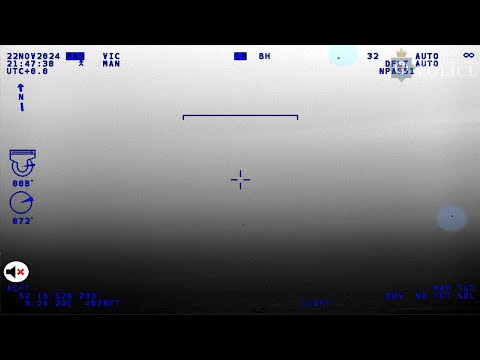
One further directly relevant video — the complete FOI-released NPAS helicopter footage as published by sUAS News under the channel name “Drone & Sundry” (youtube.com/watch?v=39x70PoQ9nU) — is cited in the Sources below but is deliberately not carded here. Its thumbnail is a photorealistic composite showing a police helicopter and an F-15 flying in close formation at night, a scene that did not occur; this archive does not host images that depict events as having happened in a way they did not. A rejected thumbnail costs a video card, not a citation.
Sources
- UK Airprox Board, Airprox Report No 2024294, 22 November 2024 event, published 2025 — the primary official document. airproxboard.org.uk
- UK Airprox Board, Reports and Analysis public archive. airproxboard.org.uk
- National Police Air Service, “UK Airprox Board publishes findings into Lakenheath incident” — statement of Ch. Supt. Vicki White, 2025. npas.police.uk
- David Cenciotti, “UK Police Helicopter Reports Near Miss with U.S. F-15 from RAF Lakenheath,” The Aviationist, 28 June 2025. theaviationist.com
- BBC News, “Police helicopter had ‘near miss with drone’ near Lakenheath,” 4 April 2025 — includes Ian Hudson's ADS-B Exchange analysis of G-POLJ, independently reproduced by the BBC. bbc.com
- Gary Mortimer, “Police Helicopter Footage Sheds Light on Lakenheath Drone Scare,” sUAS News, February 2025. suasnews.com
- Gary Mortimer, “RAF Lakenheath UFO/Drone Mystery: Police Helicopter Incident Fuels Speculation, FOIA Requests Reveal Details,” sUAS News, March 2025. suasnews.com
- Josh Boswell and Christopher Sharp, “Police chopper's near miss with mystery drones over US airbase,” Daily Mail, 22 November 2025 — FOI-obtained Suffolk Police logs and the anonymous military source claims. dailymail.co.uk
- Stepheny Price, “UFO-like ‘drones’ targeted police helicopter over air base before vanishing: report,” Fox News, 22 November 2025. foxnews.com
- Michael Morgan, “Drone Panic or Something Else? The Lakenheath Mystery, the NPAS Crew and the F-15,” Liberation Times, 26 November 2025. liberationtimes.com
- Metabunk discussion thread, “Lakenheath Nov 22, 2024, Drone filmed from Helicopter,” November–December 2025 — the FOI release of the full NPAS video, Ian Hudson's statements, and the Sitrec reconstructions. metabunk.org
- Metabunk / Sitrec reconstruction of the encounter from the Airprox radar geometry and G-POLJ's ADS-B track, December 2025. metabunk.org/sitrec
- Mick West, “Sitrec Development is Open Source and Partially Funded by an Anonymous Organization,” Metabunk, 29 May 2024 — primary source for the funding-transparency note above. metabunk.org
- Ian Hudson, Freedom of Information request to the Ministry of Defence: “Follow-On to FOI2025/15428: Investigation into Alleged Drone Sightings near RAF Lakenheath and Related Matters,” WhatDoTheyKnow, 2025. whatdotheyknow.com
- UAVHive, “Both F15 jets? Lakenheath NPAS EO/IR video,” YouTube, December 2025. youtube.com
- Drone & Sundry / sUAS News, “Lakenheath NPAS helicopter footage,” YouTube — the FOI-released recording. youtube.com
- Thomas Newdick and Howard Altman, “Mysterious Drones Have Descended Again On U.S. Air Bases In The United Kingdom,” The War Zone, November 2024 — Col. Jack R. Arthaud's statement and the MOD response. twz.com
- CBS News, “U.S. Air Force says drones spotted near 3 bases in England last week,” November 2024. cbsnews.com
- Air & Space Forces Magazine, “New Drone Sightings Spark Mystery at USAF's UK Bases,” November 2024. airandspaceforces.com
- UK Defence Journal, “Investigation continues into drone activity over RAF bases.” ukdefencejournal.org.uk
- Voice of America, “Drone sightings over US bases prompt British troop deployments,” November 2024. voanews.com
- The Aviationist, “Unauthorised Drones Continue to Plague U.S. Air Force Bases in the UK,” 27 November 2024. theaviationist.com
- East Anglian Daily Times, “Police helicopter and F-15 near miss over Lakenheath,” 2025. eadt.co.uk
- sUAS News, “Tribunal Rules: Sussex Police Must Release Gatwick Drone Information,” March 2024 — the First-tier Tribunal decision in EA/2023/0272 referenced in Hudson's FOI correspondence. suasnews.com
- Blakistons, “Airprox 2024294 — What Actually Happened at RAF Lakenheath?” 2025 — an aviation-industry reading of the report. blakistons.co.uk
- Civil Aviation Authority, CAP 774: UK Flight Information Services — the defining document for the Basic Service and Traffic Service distinction at the centre of this case. caa.co.uk
See something inaccurate? Have additional information or sources?
Suggest an Edit →Last Updated: September 2026