
How UFOs Conquered the World
David Clarke's Solo History of the UFO as a Modern Myth, from Kenneth Arnold's 1947 Sighting to the National Archives Files He Helped Release
Core Thesis
Published in hardback by Aurum Press on May 14, 2015 (paperback following in 2016), How UFOs Conquered the World: The History of a Modern Myth is the first book on this list credited to David Clarke alone, and it is a different kind of book from either of his two prior co-authored titles already covered on this site. Where The UFOs That Never Were (2000) prosecuted nine specific British cases and Out of the Shadows (2002) reconstructed the Ministry of Defence's own internal UFO-handling machinery, this book pulls back to the widest possible frame: a single-author, cover-to-cover social and folkloric history of the UFO as what its own text calls "the most enduring myth of modern times," tracing how a Cold War-era news story about "flying saucers" grew, decade by decade, into a genuinely global belief system. Clarke, writing as both a trained folklorist and the researcher who spent 2008 to 2013 curating The National Archives' full public release of the MoD's UFO files, structures the book as, in his own description, "a personal pilgrimage and mostly a social history" — part memoir of his own childhood UFO fascination and decades of investigative reporting, part argument that the phenomenon is best explained not by what is or isn't in the sky, but by what the recurring shape of the stories themselves reveals about the twentieth and twenty-first centuries that told them.
About the Author
This site's own breakdown of The UFOs That Never Were and breakdown of Out of the Shadows already cover David Clarke's full biography, so this entry does not repeat that ground. What matters specifically for this book is that it arrived as a solo, synthesizing project written after Clarke's 2008–2013 National Archives curatorship had already put him through the entire declassified MoD file record once — giving this later book the vantage point of someone who had already seen where the paper trail runs out, and was now asking a different, more historian's question about why the myth kept going regardless.
Historical Context & Origins
By 2015, Clarke had spent the better part of two decades working the same subject from increasingly wide angles: case-by-case investigation with Jenny Randles and Andy Roberts in The UFOs That Never Were (2000), then institutional history with Roberts alone in Out of the Shadows (2002), then five years, 2008 to 2013, as media consultant and curator for The National Archives' formal release of roughly 60,000 pages of Ministry of Defence UFO files — the single largest sustained look any researcher on this site's list has had at a government's own UFO paper trail from the inside. How UFOs Conquered the World is what Clarke wrote once that curatorship had ended: not another document-driven case study, but an attempt to explain, at book length and for a general readership, why a story with this little hard evidence behind it had nonetheless become one of the defining popular narratives of the modern age.
The book also arrived inside a specific, well-populated shelf of "UFO as modern myth" books it explicitly positions itself alongside: Curtis Peebles's Watch the Skies! A Chronicle of the Flying Saucer Myth (1994) had already made the equivalent argument for an American aerospace-historian audience, and Carl Sagan's The Demon-Haunted World (1995) had already used UFO abduction claims as its central case study for a broader defense of scientific skepticism. Clarke's book covers similar chronological ground — Kenneth Arnold's June 1947 sighting and the "flying saucer" coinage it produced, the Cold War decades, the contactee movement, the abduction era, and the government-secrecy narrative — but does so from a distinctly British, folklore-trained angle neither Peebles nor Sagan could supply: Clarke's own academic specialism, at Sheffield Hallam University's Centre for Contemporary Legend, is specifically the study of how modern legends form and spread, and this book applies that same disciplinary toolkit to UFO reports rather than the urban legends and rumor-panics it is more usually pointed at.
Structurally, the book also functions as a kind of closing statement on the specific pre-FOI-to-post-FOI archival arc Out of the Shadows had opened thirteen years earlier: that 2002 book worked from the discretionary, pre-2005 release mechanisms Clarke had available at the time, while this book was written after the statutory Freedom of Information Act 2000 was fully in force and after Clarke's own National Archives project had already put the fuller MoD record into the public domain. Where the earlier institutional history had to work within real documentary gaps, this book had the luxury of writing about the government-secrecy narrative from the other side of full disclosure — letting Clarke argue, with the complete file record already public, that the mundane bureaucratic reality he and Roberts had reconstructed in 2002 had held up, and that the persistence of cover-up belief afterward was itself the more interesting phenomenon left to explain.
Core Arguments & Key Concepts
The book's organizing concept, which Clarke names directly, is what he calls the "UFO Syndrome": not a claim about any specific sighting, but his term for the entire self-sustaining human phenomenon of seeing UFOs, believing in them, and communicating ideas about what they might be — a framing that treats belief itself, rather than any individual case's evidence, as the book's proper subject. Clarke is explicit that this is a folklorist's question, not a debunker's one: his stated interest lies in why people believe and experience the phenomenon, not simply in whether any given report is "true" or "false."
Clarke opens the modern history proper with Kenneth Arnold's June 1947 sighting near Mount Rainier and the newspaper coinage "flying saucer" it produced, arguing — consistent with the same method he had already applied to Britain's 1896–97 airship wave in the opening chapter of The UFOs That Never Were — that a single ambiguous press account, amplified by an already primed public imagination, was sufficient to establish a reporting template that shaped how witnesses across the following decades would describe what they saw, regardless of what was actually in the sky above them.
A recurring structural argument traces the myth's evolution in step with the surrounding culture rather than with any accumulating body of physical evidence: contactee narratives in the 1950s borrowed the era's Space Race optimism and Cold War anxiety in roughly equal measure; abduction accounts from the late 1970s onward absorbed the language and imagery of contemporary science fiction and recovered-memory therapy; and government-cover-up narratives grew in direct proportion to genuine Cold War secrecy culture, giving an otherwise unfalsifiable belief a plausible-sounding institutional villain. Clarke's own chapters on UFO religions and contactee movements make the overlap with conventional religious belief explicit, reading flying-saucer contact claims as a recognizably modern variant of much older visionary and prophetic traditions.
The book's treatment of government secrecy is the direct continuation of the argument Out of the Shadows had made in 2002, now updated with the benefit of Clarke's own completed National Archives release: the declassified British record, he argues, shows a bureaucracy that was mostly small, under-resourced and genuinely puzzled by a minority of reports, not the organized concealment operation cover-up narratives require — and the persistence of that narrative even after full disclosure is, for Clarke, itself further evidence for the UFO Syndrome's folkloric self-sufficiency rather than a reason to keep searching for a hidden second file.
Throughout, Clarke frames his own conclusions as a version of the psychosocial hypothesis — the view, shared with researchers like Jacques Vallee's earlier folkloric readings, that UFO reports are best explained by human psychology, culture and storytelling rather than literal extraterrestrial visitation — while consistently declining to frame that conclusion as an attack on witnesses themselves, a tonal choice several reviewers singled out as one of the book's more notable features given how skeptical its underlying argument actually is.
Key Cases & Evidence Discussed
The Calvine UFO Incident (Case File #028, August 4, 1990) postdates this book's 2015 publication as a public story — the diamond-shaped photograph did not resurface until Clarke's own 2022 reporting brought it back into circulation — but it stands as the clearest real-world sequel to this book's central argument: a genuinely well-corroborated two-witness Calvine, Scotland sighting that spent 32 years disappearing into rumor before Clarke, applying the same folklore-literate method this book lays out, helped track the original print back down.
The Broad Haven School Sighting (Case File #095, February 4, 1977) and the related Ripperston Farm & Broad Haven Triangle Wave (Case File #245, 1977–78) are both cited on this site's own case files as material this book situates within "the broader cultural and media history of British UFO belief in the 1970s" — exactly the kind of wave-forming, expectation-primed reporting pattern the book's Kenneth Arnold and 1896–97 airship-wave chapters use as their template.
The Bonilla Solar Transit Photographs (Case File #219, August 12–13, 1883) receive a specific mention on this site's own case file for how this book's folklore-and-archives method explains why a quietly published nineteenth-century astronomical curiosity could be "rediscovered and reframed generations later as 'the first UFO photograph'" — a case study in myth formation operating on a much longer timescale than the book's twentieth-century chapters usually cover.
The Solway Firth Spaceman Photograph (Case File #233, 1964) is cited on this site's own case file as an example of the book's account of Space Race-era "spaceman" imagery specifically, while the Cergy-Pontoise Abduction (Case File #241, 1979) is cited there for this book's "broader history of UFO contactee culture and religious movements" — the same overlap between contact narratives and religious belief this book's own contactee chapters argue is not coincidental.
The Project Condign Summary (Case File #125, completed December 2000, publicly released May 2006) is cited on this site's own case file as providing "useful skeptical framing for evaluating why an official government study's plasma explanation satisfied almost no one" — a case that sits directly downstream of the same S4(Air)/DI55 institutional history Out of the Shadows traced in 2002, now folded into this book's wider argument about why official explanations rarely settle a belief that was never really about the evidence in the first place.
Critical Reception & Controversies
The most substantive published pushback came from within ufology's own more evidence-forward wing: Bill Chalker — author of this site's own The Oz Files breakdown — reviewed the book critically in UFO Truth Magazine in July 2015, crediting Clarke's writing as "entertaining" and his psychosocial-hypothesis explanations as clearly argued, while objecting that the book treats a small set of debunked cases as license to dismiss stronger, less easily explained reports without individually examining them; Chalker singled out Clarke's line that "pilots are experts at identifying aircraft but their pilot skills are no better than anyone else's" regarding UFO identification as a claim he called simply "ridiculous," and characterized the book's overall approach as "the UFO theatre" rather than serious engagement with genuinely difficult cases like the 1968 Minot Air Force Base B-52 incident.
David J. Halperin — the religious-studies scholar behind this site's own Intimate Alien breakdown — reviewed the book more sympathetically but with a specific, pointed reservation: he praised it as an "engaging account" that introduces American readers to lesser-known British cases like the Warminster incidents, and credited Clarke's respectful treatment of believers, but faulted the book for declining to probe its own psychology at real depth, writing that Clarke "shies away from probing it at any depth," leaving, in Halperin's judgment, "a lot of unanswered questions, a lot of loose ends" precisely where a deeper reading of Jung's own conception of UFOs as psychological phenomena might have taken the argument further.
From the more conventionally skeptical side, psychologist Terence Hines reviewed the book favorably in Skeptic magazine (issue 22.4) under the title "Ultraterrestrials," calling it "insightful, informative and thought-provoking" and noting that although the book never explicitly bills itself as a debunking work, "it fulfills that function admirably"; Hines singled out Clarke's candid account of his own evolving UFO Syndrome — from boyhood science-fiction reader to NICAP-adjacent UFO-group member to eventual skeptic — as a rare piece of honest authorial self-examination in a genre that usually avoids it, and praised the consistently respectful, never "harsh or demeaning" tone Clarke keeps toward the believers he interviews throughout.
General-audience reception has been positive but modest: a four-star review at the science-book blog Pop Science Books praised the volume as scholarly and well-researched while noting plainly that it is "not for UFO believers" seeking validation, and Goodreads shows an aggregate 4.14 out of 5 stars from 81 ratings — a reasonably strong score for a specialist title, if a smaller sample than a mainstream science bestseller would draw.
Taken together, the book's reception splits along a familiar and, this article argues, revealing line: readers and reviewers already committed to the psychosocial or skeptical reading of ufology found it insightful and well-executed, while a working field investigator like Chalker — who has spent decades taking specific hard cases seriously on their own terms — found its case-selection too convenient for the thesis it was built to support. Neither side disputed the honesty or competence of Clarke's own research; the disagreement is squarely about whether a folklore-driven social history can fairly represent a body of evidence that, on Chalker's account, includes reports the book simply never engages with.
Influence & Legacy
This book's most concrete, independently verifiable influence is documented on this very site: across two separate print-edition ASINs — the 2016 paperback (1781313040), cited on eight separate case-file pages including Bonilla Solar Transit Photographs, Broad Haven School Sighting and Cergy-Pontoise Abduction, and the 2015 hardback (1781313032), cited on three more including Calvine, RAF Topcliffe and St Athan — this book is cited across at least eleven of this site's own case-file pages, making it one of the most frequently referenced single titles in this site's own British-case coverage.
Within David Clarke's own career, the book represents the point at which his research shifted from case-and-institution-specific investigation toward a broader, publicly accessible synthesis of everything his prior two decades of archival and field work had turned up — a shift that continued afterward in his 2020 co-founding of the UFOlore podcast and video project with journalist Richard Wilson and writer Jim Chisem, explicitly framed, in the same "educational, non-sensational" spirit as this book, around the folklore and belief systems surrounding UFO reports rather than case-by-case adjudication.
The book also extended Clarke's public-facing role as the researcher journalists and broadcasters turn to for the historical and psychological, rather than purely evidentiary, angle on UFO stories: his subsequent, high-profile 2022 re-investigation of the Calvine photograph — conducted using the same source-tracking, myth-literate method this book describes at length — drew directly on the reputation this book helped cement as much as on his earlier National Archives curatorship.
This entry also completes a documented three-book progression on this site's own Essential Reading list: The UFOs That Never Were (case-by-case investigation, with Randles and Roberts), Out of the Shadows (institutional history, with Roberts), and this book (solo cultural history) trace a single researcher's expanding scope across fifteen years — from adjudicating individual sightings, to reconstructing the government machinery that processed them, to finally asking why the underlying belief has proven so durable regardless of what either investigation turned up.
The Book
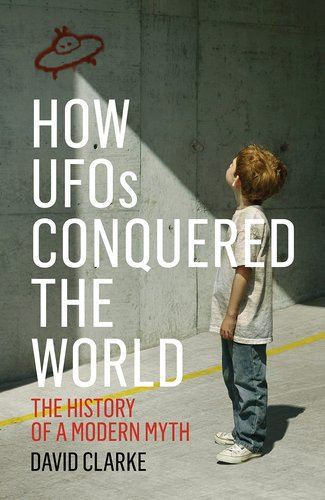
How UFOs Conquered the World
David Clarke's Solo History of the UFO as a Modern Myth, from Kenneth Arnold's 1947 Sighting to the National Archives Files He Helped Release
Find on Amazon →As an Amazon Associate, OverClassified may earn from qualifying purchases made through this link, at no extra cost to you.
Why This Is Essential Reading
How UFOs Conquered the World earns its place on this list for a reason distinct from either earlier David Clarke collaboration already covered on this site: it is not a verdict on specific cases or an institutional reconstruction, but the closest thing this list has to a single-author capstone — a folklorist's and former National Archives curator's attempt to explain, at the end of two decades of increasingly wide-angle research, why the UFO myth itself has outlasted every individual case built to sustain it. Its limits are real and named plainly in this article rather than smoothed over: Bill Chalker's own critical review makes a genuine case that the book's psychosocial thesis is easier to sustain because it declines to engage with ufology's harder evidence, and even sympathetic reviewers like David Halperin found its self-examination stopping short of where it could have gone. But as the clearest single statement of the historian's-eye view this site's own case-file library keeps citing back to — anchored by the same National Archives access that produced Out of the Shadows, and now the working companion piece to Clarke's own real, continuing Calvine-era research — it remains essential reading for understanding not whether the UFO phenomenon is real, but why believing in it became, on the evidence Clarke spent thirty years assembling, one of the modern world's most durable habits of mind.
Related Cases & Theories
Essential Viewing
The Calvine UFO Photo is REAL | Dr. David Clarke
UAP Files Podcast — Clarke discussing his 2022 re-investigation of the Calvine photograph, conducted using the same source-tracking, myth-literate method this book's own chapters describe. Verified via YouTube oEmbed before inclusion.
Dr David Clarke 'The Calvine UFO' Interview with Vinnie
Disclosure Team — An extended interview with Clarke on tracking down the Calvine photograph's origin, the same folklore-literate, archive-driven approach this book applies across the wider history of UFO belief. Verified via YouTube oEmbed before inclusion.
Sources Cited
- Clarke, David. How UFOs Conquered the World: The History of a Modern Myth. Aurum Press, hardback 2015 / paperback 2016 (ISBN 1781313040 / 9781781313046, paperback edition matching the majority of this site's own case-file citations). amazon.com
- "How UFOs Conquered the World: The History of a Modern Myth." AbeBooks, hardback listing (publisher Aurum Press, 2015, ISBN 9781781313039 / 1781313032). abebooks.com
- "How UFOs Conquered the World: The History of a Modern Myth." AbeBooks, paperback listing (publisher Aurum Press Ltd, 2016, ISBN 9781781313046 / 1781313040). abebooks.com
- "How UFOs Conquered the World." Dr David Clarke (drdavidclarke.co.uk), April 12, 2015 (author's own announcement: publication date, publisher, and "personal pilgrimage and mostly a social history" framing). drdavidclarke.co.uk
- Chalker, Bill. "'How UFOs Conquered The World' – A Critical Review." UFO Truth Magazine, July 2015, reposted at The UFO Chronicles. theufochronicles.com
- Halperin, David J. "David Clarke, 'How UFOs Conquered the World: The History of a Modern Myth.'" davidhalperin.net (review). davidhalperin.net
- Hines, Terence. "Ultraterrestrials" (review of How UFOs Conquered the World). Skeptic, vol. 22, no. 4. pocketmags.com
- "How UFOs Conquered the World: The History of a Modern Myth — David Clarke ****." Pop Science Books (blog review, May 2015). popsciencebooks.blogspot.com
- "How UFOs Conquered the World: The History of a Modern Myth." Goodreads (aggregate rating 4.14/5 from 81 ratings). goodreads.com
- "David Clarke (journalist)." Wikipedia (biography: education, PhD in Folklore, journalism career, Freedom of Information UFO-files research, National Archives project, bibliography including this book). en.wikipedia.org
- "David Clarke." Sheffield Hallam University staff profile (academic role, department, research specialism in contemporary legend). shu.ac.uk
- "Close Encounters (at a distance): the UFOlore Podcast." Dr David Clarke (drdavidclarke.co.uk), April 11, 2020 (on the UFOlore podcast/video project with Richard Wilson and Jim Chisem, the book's direct successor project). drdavidclarke.co.uk
- This site's own resources library: Full Reading List, where this book is cited across at least eleven separate case-file pages under two distinct print-edition ASINs.
- This site's own case file: The Calvine UFO Incident, for the case Clarke's own 2022 reporting brought back into public view using this book's own folklore-literate method.
- This site's own case file: Project Condign Summary, for the institutional-history material this book directly continues from Out of the Shadows.
- This site's own key-figures entry: David Clarke, for his full biography and further case connections.
- This site's own essential-reading entry: The UFOs That Never Were, for Clarke's first, case-by-case collaboration this book's method builds on.
- This site's own essential-reading entry: Out of the Shadows, for Clarke's second book, the institutional history this book's government-secrecy chapters directly continue.
- This site's own essential-reading entry: The Oz Files, for Bill Chalker's full biography and his critical review of this book.
- This site's own essential-reading entry: Intimate Alien, for David Halperin's full biography and his review of this book.
- This site's own essential-reading entry: Watch the Skies!, for Curtis Peebles's comparable American "flying saucer myth" history this book is usefully read alongside.
Have corrections, additional research, or peer-reviewed sources? Help improve this entry.
Suggest an Edit